Blog

  • Shrinking City, Flourishing Region: St. Louis Region

    Throughout the high income world, in this age of cities, many urban centers continue to shrink. This is particularly true in municipalities that have been unable either to expand their boundaries or to combine with another jurisdiction, subsequently running out of new developable land.

    For example, the city of Paris (as opposed to the metropolitan area or urban area, see Note) lost a quarter of its population between 1954 and 1999, while the loss in some core districts (arrondissements) was 75 percent. Copenhagen, which is often considered one of Europe’s most vibrant municipalities lost more than one-third of its population between 1950 and 2000. Other core municipalities have lost more than one-half million people, such as, London, Seoul, Glasgow, Berlin, Osaka, Chicago, Detroit, Philadelphia and St. Louis.

    City of St. Louis Population Loss: Yet no city which achieved the scale of a half million residents has lost a larger percentage of its population in peacetime than St. Louis. To some extent, this is a very old problem for a city that was once the largest in the Midwest but was passed in 1880 by Chicago.

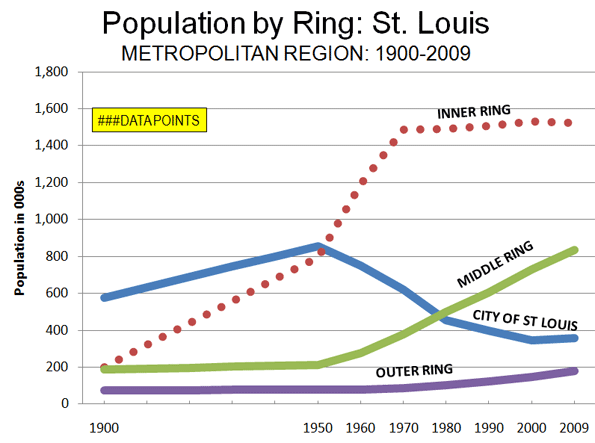
    In 1950 the city population peak at 857,000 people and ranked 8th among the nation’s municipalities. By 2009, the latest estimates, the population was 357,000 (ranked 48th in the nation), a decline of nearly 60 percent from the peak.

    Metropolitan Population Gain: But as is the case for many “shrinking cities,” the region outside the municipal boundaries has continued to grow. In1950, the population of the metropolitan region (as currently defined) was 1,940,000. By 2009, the metropolitan region had grown to 2,890,000, for a population increase of nearly 1,000,000 (more than a 50 percent increase). St. Louis is a bi-state metropolitan area, with three quarters of the population living in Missouri and the balance in Illinois, a ratio than has been largely unchanged since 1900.

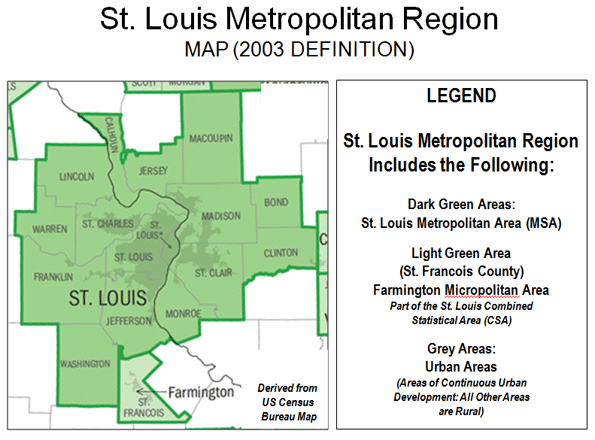
    The metropolitan region (or combined statistical area) includes the city of St. Louis, (a county equivalent jurisdiction), 8 counties in Missouri and 8 counties in Illinois. The St. Louis metropolitan region covers approximately 9,100 square miles (Figure 1), of which the principal urban area (area of continuous urbanization) covered 829 square miles (9 percent of the metropolitan region).

    As in the case of virtually all large high-income world metropolitan areas, population growth has principally occurred on the suburban fringe. For example, from 1965 to 2000, 110 percent of the growth in major metropolitan areas of Western Europe was in the suburbs, more than in the United States (90 percent since 1950).

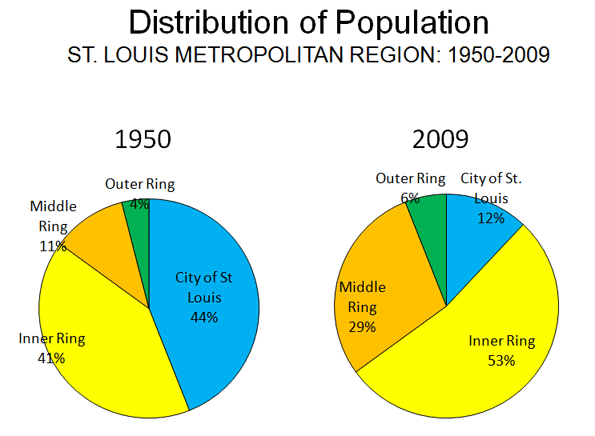
    Distribution of Population: Even by these standards, St. Louis may be an extreme case. In 1950, 44% of the region’s population was in the city of St. Louis. The inner ring the counties of St. Louis, St. Clair (Illinois) and Madison (Illinois), accounted for another 41% of the population. Thus 85% of the metropolitan region’s population lived in the city or the inner ring counties. The other 15% lived in middle ring and outer ring counties.

    By 2009 the population of the city and the inner ring counties had fallen to 65% of the region. The city and county of St. Louis (which were combined until 1876), reached a combined population peak in 1970 and has lost 225,000 people since that time, falling below the 1960 census total.

    The middle ring counties represented 29% of the population while the outer ring counties had 6% of the population (Figure 2) in 2009. During the 2000s, the middle ring counties added more than 130,000 residents, while the city added 10,000.

    Consistent with the trend since the late 1950s, nearly all of the metropolitan region growth occurred outside the city and the inner ring between 2000 and 2009. The city is estimated to have accounted for 7% of the region’s growth. The inner ring counties actually shrank while the middle ring counties accounted for 76% and the outer ring counties 22% of the growth (Table 1 and Figure 3) for the region.

    Table 1
    St. Louis Metropolitan Region: Population Trend
    1900-2009
    Sector
    1900
    1950
    2000
    2009
     METROPOLITAN REGION (CA) 
    1,039,543
    1,942,848
    2,757,377
    2,892,874
     HISTORIC CORE 
    575,238
    856,796
    346,904
    356,587
     City of St. Louis 
    575,238
    856,796
    346,904
    356,587
     INNER RING 
    201,419
    794,651
    1,531,692
    1,524,482
     St. Louis Co. 
    50,040
    406,349
    1,016,364
    992,408
     Madison Co. (IL) 
    64,694
    182,307
    259,120
    268,457
     St. Clair Co. (IL) 
    86,685
    205,995
    256,208
    263,617
     MIDDLE RING 
    187,384
    213,394
    730,563
    833,706
     Franklin Co. (MO) 
    30,581
    36,046
    94,059
    101,263
     Jefferson Co. (MO) 
    25,712
    38,007
    198,740
    219,046
     St. Charles Co. (MO) 
    24,474
    29,834
    286,171
    355,367
     Bond Co. (IL) 
    16,078
    14,157
    17,650
    18,103
     Clinton Co. (IL) 
    19,824
    22,594
    35,536
    36,368
     Jersey Co. (IL) 
    14,612
    15,264
    21,655
    22,549
     Macoupin Co. (IL) 
    42,256
    44,210
    48,989
    47,774
     Monroe Co. (IL) 
    13,847
    13,282
    27,763
    33,236
     OUTER RING 
    75,502
    78,007
    148,218
    178,099
     Lincoln Co. (MO) 
    18,352
    13,478
    39,254
    53,311
     St. Francois Co. (MO) 
    24,051
    35,276
    55,743
    63,884
     Warren Co. (MO) 
    9,919
    7,666
    24,721
    31,485
     Washington Co. (MO) 
    14,263
    14,689
    23,410
    24,400
     Calhoun Co. (IL) 
    8,917
    6,898
    5,090
    5,019
     Metropolitan Region: Combined Statistical Area (2009 Definition) 

    Despite often well-orchestrated impressions to the contrary, the continuing dominance of suburban population growth in the St. Louis metropolitan region mirrors the experience in other major metropolitan areas across the nation.. This growth has not been, as is often supposed, at the expense of the city. Over the past sixty years suburban growth was actually three times the total net loss suffered by the city. Increasingly when people move to St. Louis, they actually mean that they are coming to the suburban periphery.

    Domestic Migration: Overall in the past decade, the St. Louis metropolitan region experienced only a modest domestic migration loss – far less than many other regions . Approximately 1.3 percent of the 2000 population, or 35,000 people moved from St. Louis to other parts of the nation. By comparison, in similar sized and sunny San Diego, the domestic migration loss was 127,000, with a percentage loss more than three times that of St. Louis. Who could have imagined that in a decade, Los Angeles would lose 1.3 million more domestic migrants than St. Louis and New York 2 million more (granted, from much larger bases).

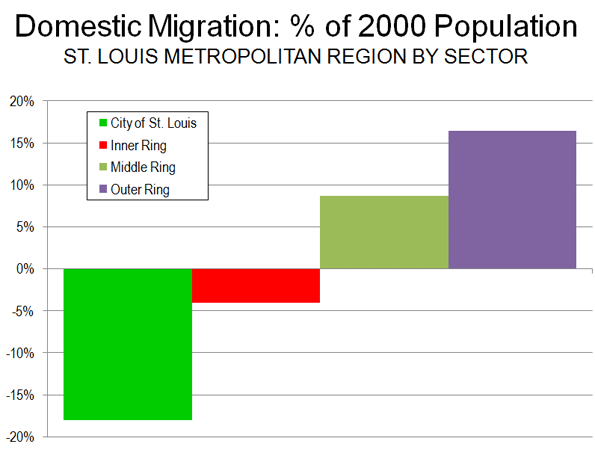
    During the 2000s, the domestic migration trends within the St. Louis metropolitan region reflected the national trend of migration from core areas to the suburbs. According to US Census Bureau estimates, the 2000 to 2009 in domestic migration loss in the St. Louis metropolitan region was distributed as follows (Figure 4):

    • The city of St. Louis has lost a net 63,000 domestic migrants (18.0 percent of its 2000 population)
    • The inner ring counties have lost a net 59,000 domestic migrants(4.0 percent of the 2000 population), 57,000 of which were lost in St. Louis County
    • The middle ring counties gained a net 64,000 domestic migrants with a gain of 45,000 in St. Charles County (8.7 percent of the 2000 population).
    • The outer ring counties gained a net 24,000 domestic migrants (16.4 percent of the 2000 population) with nearly one half of the gain (11,000) in Lincoln County.

    Net international in-migration was the one bright spot for the city and inner suburbs, which gained the bulk of the 30,000 immigrants who came to region over the past decade (Table 2). But this was not nearly enough to balance the losses from domestic migration.

    Ultimately the St. Louis story reflects the deeper reality seen across the high-income (and even in some low and lower income world metropolitan areas, as future installments will indicate), albeit somewhat more exaggerated. Many core cities continue to stagnate or even shrink, but their regions remain vibrant, expressing a form of urbanism that, while often unappreciated, remains vital and expansive.

    ——–

    Note: Metropolitan areas are composed (outside New England) of complete counties or county equivalent jurisdictions. They include substantial rural expanses, which are economically tied to the principal urban area (the largest urban area in the metropolitan area). An urban area is an expanse of continuous urbanization, and contains no rural territory.

    Photo: St. Louis skyline (by author)

    Wendell Cox is a Visiting Professor, Conservatoire National des Arts et Metiers, Paris and the author of “War on the Dream: How Anti-Sprawl Policy Threatens the Quality of Life

  • The Great Plains: An Old Frontier May Hold The Secret to Recovery

    Could the next zone of opportunity exist in the middle of the country? Census unemployment figures seem to signify this notion, especially in the Great Plains.

    State-wise, November 2010 unemployment rates were lowest in North Dakota at 3.6%; South Dakota at 4.6%; Nebraska at 4.9%; Kansas at 6.5%; and Iowa at 6.8%. Compare these numbers to the ever-growing Sunbelt states where unemployment is at its most dismal with Arizona at 9.6%, California at 12.4%, and Nevada at a depressing 14%.

    The top ten cities with the lowest unemployment rates are all found in the Midwest and the Great Plains, with the exception of Burlington, VT and Portsmouth, NH. The strength of the growing, younger manufacturing industry that escaped the huge manufacturing employment declines in the 80s and 90s may be fueling the prosperity in the plains.

    Upon closer inspection of the economies of these cities, a few common denominators are revealed. Health care is a prevailing industry recurrent across many of the cities. Unsurprisingly, agribusiness and manufacturing also dominate, along with insurance services, food processing, and, in some cases, higher education.

    Metromonitor prepared this interesting piece using data from the Bureau of Labor Statistics allowing one to see unemployement rates throughout the Midwest and the Rust Belt that appear to be on the rebound. The bottom map is of particular interest: One year’s growth has shown a decrease in unemployment throughout much of the Rust Belt, while cities in California and Florida consistently flounder. As far as overall performance, many cities in the Midwest – and much of the Great Plains – remain strong out of the recession and are comparable to the sturdy Texan cities that possess surging economies.

    Perhaps these urban centers across the Midwest, and especially the Great Plains, should be viewed as models for effective economic development. Large cities throughout the Great Plains offer integral services not found for miles and serve as regional havens for essential activities such as health care, education, business services, and food processing. Meanwhile, cities with declining industries, exploding real estate prices, and a surplus of workers suffer. Areas such as the Sun Belt, California, Florida, and some Northeastern cities bare the weight of this dilemma. Our focus should rest on the well-grounded economies of the often-ignored flyover states, instead of those on the crumbling coasts.

  • Labor’s End?

    Remember cigar-smoking union leaders, those portly white guys who sat around the pool at AFL-CIO conventions in Miami Beach?

    We called them the “old guard” and blamed them for allowing what looked at the time to be a very foreboding decline in union density, power and influence.

    When I started in the Labor Movement in the 1980s, the struggle to replace that generation with smart, progressive and militant leadership was well underway.

    Now many national unions and locals around the country are led and staffed by a new breed, schooled in strategic thinking and coalition-building, and committed to organizing members for action and recruiting workers into the ranks.

    The result:

    The plunge in the number and percentage of union members continues without a blip.

    The latest stats show 14.7 million union members in America; that’s 11.9 percent of the “wage and salary” workforce, a drop of almost a half a percent in one year and more than eight percent since 1983, when the rate was already tumbling.

    I’m not accusing my friends and colleagues of incompetence, lack of commitment or anything of the kind.  In fact, many have been – and are – involved in heroic struggles to reinvigorate and rebuild the movement.

    But the labor relations framework in the U.S. – effectively manipulated by a sophisticated union avoidance industry – makes union growth almost impossible.

    For true believers – you know who you are – a fleeting moment of euphoria ended two years ago when labor law reform was buried by a senate filibuster and a white house with other priorities (the president, by the way, made one oblique reference to unions in his speech to congress this week: the UAW’s support for his free trade pact with South Korea).

    Another daunting challenge facing the labor movement is the growing gap between the number of public sector union members (7.6 million) and those union members working in the business economy (7.1 million).

    How do we convince nonunion working class taxpayers to support government employees being scape-goated for their “budget-busting” pension payouts?

    Finally, a couple of interesting numbers on union distribution by states:

    Of the big ones, California has the most members (2.4 million), New York has the highest percentage (26 percent).  But two “outlier states” also share the spotlight:

    Heavily democratic Hawaii (23.5 percent) is no surprise.

    But, ironically, the republican state of Alaska finishes second in union density (24.8 percent).  It’s where big oil pays union wages, enabling our giant state’s ethic of  “up by your bootstraps” individualism.

    This first appeared at laborlou.com

  • Chicago: The Cost of Clout

    The Chicago Tribune has been running a series on the challenges facing the next mayor. One entry was about the Chicago economy. It described the sad reality of how Chicago’s economy is in the tank, and has been underperforming the nation for the last few years. I’ll highlight the part about challenges building an innovation and tech economy in Chicago:

    The region also has lagged in innovation, firm creation and growth in productivity and gross metropolitan product over the past decade, according to economic development consultant Robert Weissbourd, president of RW Ventures LLC. Daley’s two long-held dreams of Chicago emerging as a high-tech center and a global business center remain just out of reach… “We haven’t made the real global jump yet, and we have not made the tech jump either, but we are finally poised,” said Paul O’Connor, who for many years ran World Business Chicago, the city’s economic development affiliate. “We are still a major contender, but, yeah, we can blow it.” Or, as [Chicago Fed Economist William] Testa put it, “Given the poor performance of this decade, we need to rethink the challenges for Chicago.”

    “If I could wave a magic wand, I would get government to start thinking differently about … what are the levers that we need to push, away from the traditional (tax increment finance district) thinking and away from the traditional thinking of, ‘Let’s just get a big company to move here,’ and toward thinking about how to foster innovation and creativity,” Christie Hefner, former chairman and chief executive of Playboy Enterprises Inc., said at a recent economic forum.

    It has been extremely rare to see people with establishment positions ever say a discouraging word about the city. Most honest observers would have to rate Daley highly has a leader, but certainly not perfect. Yet any criticism at all of him (directly or implicitly by that of the city he runs) has been studiously avoided by most. They are terrified of being excommunicated or broken on the wheel if they deviate from the script. To have corporate executives asking tough questions is unusual, and hopefully an example of a forthcoming “Great Thaw” we need to have here in the wake of Daley’s retirement.

    Chicago’s inability to build an innovation/tech economy is pretty remarkable if you think about it. Here’s third largest city in the country, one with enormous human capital, tremendous wealth, incredible academic institutions, and above all an ability to execute that far outclasses virtually any city I know. How is it then that Chicago has been unable to execute on this?

    Believe it or not, a lot of it goes back to that bane of Chicago politics: Clout. People in Chicago tend to write off clout and political corruption in Chicago with a shrug, as a unique or even amusing local affectation, or just part of the character of purely political life of the city, but one that doesn’t fundamentally change its status as the “City That Works.” But nothing could be further from the truth. Chicago’s culture of clout is a key, perhaps the key, factor holding the city back economically.

    Chicago’s Ambition: Clout

    In Paul Graham’s essay Cities and Ambition, he writes about the subtle messages cities send about what you should try to achieve, and how that shapes their fortunes:

    “Great cities attract ambitious people. You can sense it when you walk around one. In a hundred subtle ways, the city sends you a message: you could do more; you should try harder. The surprising thing is how different these messages can be. New York tells you, above all: you should make more money. There are other messages too, of course. You should be hipper. You should be better looking. But the clearest message is that you should be richer.

    What I like about Boston (or rather Cambridge) is that the message there is: you should be smarter. You really should get around to reading all those books you’ve been meaning to. When you ask what message a city sends, you sometimes get surprising answers. As much as they respect brains in Silicon Valley, the message the Valley sends is: you should be more powerful.

    How much does it matter what message a city sends? Empirically, the answer seems to be: a lot. You might think that if you had enough strength of mind to do great things, you’d be able to transcend your environment. Where you live should make at most a couple percent difference. But if you look at the historical evidence, it seems to matter more than that.

    Chicago’s ambition, the message it sends is: “You should have more clout.” Does that matter? You bet it does.

    What Is Clout?

    Clout is a term of art in Chicago that normally refers to the ability to use connections to obtain jobs, contracts, subsidies or other favors from government. But more broadly, we can think of clout as the ability to influence organizational action within the context of a particular power structure.

    But if that’s the definition, isn’t saying you should have clout the same thing as saying you should have power like Graham said of Silicon Valley? No. Having power, like that held by Mark Zuckerberg or Larry Page and Sergey Brin, is about being autocephalous. It’s about have an independent base of authority or ability to act others are forced to respect. Clout, by contrast is all about petty privileges. Clout can be given, but it can also be taken away. That’s what makes it so corrupting. Tellingly, no one ever talks about Mayor Daley as having clout. That’s because he has real power instead. Having power is like being a king or a duke or a baron. Clout is all about being a courtier.

    To see this in action, just contrast Jesse Jackson with Al Sharpton. Both are prominent national civil rights leaders and black ministers. But Jackson rarely goes hard after anyone in Chicago, at least not anymore. Jackson has clout. One son is a congressman. Another somehow managed to acquire ownership of a lucrative beer distributorship. Jackson bought into the system in Chicago.

    By contrast, Sharpton wants to be a power player in New York, to be someone to whom even a would-be mayor has to come visit and, as they say, kiss the ring. He’s not interested in being bought off. Sure, he’ll make alliances. But he’ll never give up his independent base of power that makes him someone to be reckoned with. That’s the difference between power and clout.

    The Chicago Nexus

    John Kass likes to talk about clout in terms of the “the Combine,” or the bi-partisan system in Illinois in which the Democrats and Republicans have often proven less rivals than partners in crime, sometimes literally. But I prefer to think of “the Nexus” – a unitary social structure that pretty much everyone who’s anyone in Chicago is part of, one that goes far beyond the world of politics.

    Ramsin Canon had a good illustration of the Nexus in a piece he wrote over at Gapers Block:

    With big city economies cratering all around him, the Mayor was able to raise in the neighborhood of $70 million dollars to fund the Olympic Bid. At the same time he was able to get everybody that mattered–everybody–on board behind the push for the Olympics. Nobody, from the largest, most conservative institutions to the most active progressive advocacy group, was willing to step out against him on that issue.

    The list of big donors to the Chicago 2016 bid committee is a comprehensive list of powerful Chicago institutions. I mean, it’s exhaustive. Economy be damned, when the Mayor called, they listened. Why? What did those conversations sound like? And do we believe that the Mayor is so powerful–or that their relationship with him is so close–that they must obey him? Or–more likely–is it a mutual back-scratching club with an incentive to protect the status quo? Chicago’s political infrastructure isn’t about the Democratic Party or “the Machine” or special interest groups or labor unions. Those are elements of varying importance. It’s real power lives in the networks that tie that list together.


    Replace the man on the Fifth Floor–Bureaucracy Man, the superhero who keeps our alleys clear–and will these networks evaporate? Will they just disappear? How long would it take them to reorganize around the new personalities that moved in there?

    All cities have elite networks, but I have never seen a city that has a unitary power nexus to the extent Chicago does. I believe the Nexus resulted from the culture of clout combined with the fact that, with the exception of the interregnum between Daley pere and fils, power has been centralized on the 5th floor of city hall for decades. The Nexus may have come into being around the mayor, but now it has become a feature of civic life, one that practically longs for what Greg Hinz has labeled a “Big Daddy” style leader to sustain the system.

    Clout’s Effect on the Culture of Chicago

    The emergence of the Nexus is one of the key cultural impacts of clout in Chicago. If clout is only effective within a given power structure, then clearly the clouted want to see their power structure expand. The ultimate dream of the clout seeker is a centralized unitary state like Louis XIV’s France. In Chicago, we’ve come amazingly close to achieving it. It’s not that there’s no conflict, but it is all of the palace intrigue variety, not true conflicts between rival power centers. Without centralized political power and a tradition of clout, the Nexus would never have come into being.

    There are many other cultural impacts as well. As Douglas and Wildavsky note in Risk and Culture, “An individual who passes his life exclusively in one or another such social environment internalizes its values and bears its marks on his personality.”

    People are bought into and defend the system. They mapped these social environments along the axes of “grid” and “group” – the degree of hierarchy in the system and the degree of group cohesion. The Chicago Nexus is a high-grid, high-group structure, or collective hierarchy, with centralized decision making and a high cost of defection. Even groups that in other cities tend to be more oppositional to government will say something like, “Decisions get made in the mayor’s office here, so we have to play that game” and buy into the system. I’ve lost track of the number of times I’ve heard, “That’s just how it works here.” Of course, this means the basis of their own ability to make things happen then becomes influence – clout – within the Nexus. Thus they defend the system, because if it went away, so would their ability to make things happen because they’ve cultivated no alternative vectors for action. Also, the Council Wars period of the 1980’s still looms large in many leaders’ minds. Chicago remains heavily segregated and racially balkanized, as the recent quest for a single black mayoral candidate illustrates. There’s a lot of worry about what might happen if the current system breaks down.

    Conservatism and favoring of the establishment. Following on from that, the system fosters a sort of generalized conservatism, one dominated by a desire for institutional stability. It takes a heavy hitter to get the mayor’s attention or even access to the mayor, which reinforces establishment control, an inherently conservative model. This conservatism is even visible the realm of public design, as I’ve noted in discussion the retro-nostalgia design of the city’s streetlights and other streetscape elements. The evidence of clout-fed conservatism is literally graven in into the very streets of the city.

    Parochialism. Though fancying itself a cosmopolitan burg, I don’t see that Chicago is that much less parochial than most other Midwest cities. You see this in a thousand little ways. For example, in the way beloved long time personalities dominate the local airwaves. As the New York Times noted about turmoil at long time ratings leader WGN-AM, “Chicago tends to be unforgiving to newcomers. And with WGN pulling in the second- most radio revenue in the market behind WBBM, its moves are fraught with risk. ‘It was always difficult to bring someone in from out of town,’ said Bob Sirott, a longtime Chicago broadcaster.” (Longevity seems particularly prized here generally, as unless you are fortunately enough to be born to the right family or in the right parish, it takes time to accumulate clout). Or in the focus on local and hyper-local news in the local internet journalism community.

    Fear. As a high-group social structure, people are terrified of being kicked out of the club. Hence the unwillingness to cross the party line on almost any issue. As Tocqueville put it: “That which most vividly stirs the human heart is not the quiet possession of something precious, but rather the imperfectly satisfied desire to have it and the continual fear of losing it again.” People are even afraid of collateral damage if others near them cross the line. As Mike Doyle said, “In systems like Chicago’s, people don’t just refrain from rocking the boat, they do their best to keep anyone else from rocking it either.”

    Total Rejection of the Other. Anyone who exists outside the structure is a potential threat. Hence they are either co-opted or marginalized. The best illustration of this is the very title of that wonderful book on Chicago politics, We Don’t Want Nobody Nobody Sent. Or as Steve Rhodes said to me:

    One of the bartenders at the Beachwood says it took her awhile to figure this city out. In other cities you apply for a job with a resume, talk about your experience, etc. Here they just want to know who you know, who sent you – even at the bartender level….I’m not naive enough to believe this doesn’t happen elsewhere, but nowhere near as it does here, where it’s in the DNA. …Here, merit counts for next to nothing…In New York, everyone wants to know: “What do you do?” In Chicago, everyone wants to know: “Who do you know?”

    Why Clout Is Toxic to the Innovation Economy

    When you think about these cultural impacts of clout on Chicago, it becomes obvious why the city has failed to build an innovation economy. Innovation is fundamentally about new ideas, new ways of doing things, new players in the game, those from the outside, about merit, about dynamism. Clout is about what happened yesterday, the fruits of long years of efforts, and the same old – sometimes really old – players, about insiders, about connections, about stasis. As Jane Jacobs noted, “Economic development, no matter when or where it occurs, is profoundly subversive of the status quo.” Innovation driven economic development is fundamentally about disrupting the status quo. Clout is all about preserving it. Innovation welcomes the outsider, the clout-fueled Nexus abhors the Other. Innovation and clout are enemies.

    Think about the innovation hubs in America. They are all places that welcome the new. Not that it’s easy to make it in them. In fact, these place are often brutally competitive. And of course they have elite networks where the scions of the rich and powerful have a leg up and such. But the new is an important part of what makes them tick. In Silicon Valley, they are always looking for the tomorrow’s HP, Apple, Cisco, Google, Facebook, or Twitter, not just celebrating the past. They know that success today is ephemeral and, as Andy Grove put it, “only the paranoid survive.” DC loves its establishment, but the very nature of the place assures there will always be new players in the game. President Obama comes out of nowhere to gain the White House. But two years later it is the upstart Tea Party’s turn. Possibly because of their entertainment industry clusters, NYC and LA are always on the lookout for the fresh face and the next big thing.

    But Chicago? What do you think is going to happen when an ambitious 20-something with a great idea for a new business but no clout shows up in Chicago trying to make it happen and knocks on the door?

    I may not be 20 anymore, but at the risk of making this post sound like merely a bit of personal pique, I’ll share a true personal story to illustrate one example of how this plays out in real life in Chicago. In 2009 I received an award from the Chicagoland Chamber of Commerce for innovative thinking on public transit, winning first prize in a global competition they ran to solicit ideas for boosting public transit ridership in Chicago.

    I was thinking at the time that I might want to do something more entrepreneurial. I knew that the Chamber ran a sister organization called the Chicagoland Entrepreneurship Center chartered with boosting startups in Chicago. In the wake of my award I decided to check them out and see how they might be able to help me.

    There was just one problem: they wouldn’t return my phone calls. I made many attempts to get in touch with them by phone and email, and couldn’t even get them to give me a “No Thanks” or pawn me off on a peon. Now I’m a guy who a) had significant business experience, who b) built up one of America’s top urbanist sites from scratch, an inherently entrepreneurial act, and a successful one, if you think about it, and c) just got an award for innovation from the Chamber itself. Yet they wouldn’t even give me the time of day.

    What’s more, the Chamber mothership never showed any interest in engaging with me post-competition either. It was clearly just a PR exercise for them. Now don’t get me wrong, I’m delighted to report it was a very successful one. I got my picture on the front page of the Chicago Tribune above the fold. It exceeded my wildest expectations. I think the folks at the Chamber are nice people and I was extremely pleased with how it went. But clearly from their perspective, that’s where it ended. Actually uncovering innovators or something was not part of the agenda.

    From standpoint of the the Chicago system, this experience actually makes perfect sense, as I don’t have clout, nor can I bestow it on anyone. So why burn cycles on me?

    If you think about my profile and the treatment I got, can you imagine what a 23 year old armed with nothing but a crazy idea would get? A lot of ink has been dedicated to talking about how far Chicago and Illinois have come since they days when Mark Andreesen was actively harassed while trying to commercialize his web browser, then run out of town on a rail. But there is no doubt in my mind that if the next the next Andreesen showed up today, he’d get the exact same treatment. (I’m not familiar enough with Andrew Mason’s history to know how he was treated pre-Groupon, and pre-his association with the likes of big money Eric Lefkofsky. It would make an interesting case study to look at the history there – though he is a possible exception. I don’t know. In any case, his major local profile came after Groupon was already a huge success).

    This is what clout in Chicago hath wrought. The culture of the establishment Chicago is simply incompatible with an innovation economy. It’s not just about money or resources. It’s about respect. It’s about what this town respects, and more importantly what it doesn’t. It’s about what Chicago whispers to you about what you should aspire to achieve, what success means in this city, and the subtle – and not so subtle – messages about how you get ahead here.

    Until you’ve already made your millions or somehow wormed your way into connections or up through the hierarchy, establishment Chicago has no use for you in its economic plans, no matter what talent, ideas, or ambitions you might harbor. (Ironically, the biggest exception is Daley himself, who was famous for seeking out and rapidly promoting young talent like Ron Huberman and Richard Rodriguez. That’s another example of how he is head and shoulders above your average leader).

    By contrast, the local entrepreneurial tech community gets it, is energized, knows where the city is and where it needs to be, and is working hard to make progress with a sense of legitimate optimism backed up by recent good news. Grass roots and “by tech for tech” institutions ranging from Technori, to the Chicago Lean Startup Circle, to the folks at Groupon – which is a huge, inspirational success story, with people who get it and are committed to trying to build up Chicago’s tech scene – are hugely supportive of anyone trying to make a go at it no matter what stage they are in, and providing legitimately useful info and help along the way. Every single person in this group I’ve talked to has been more that willing to do anything to try to help me out, sometimes even more than I’d hoped or asked for – 100% of them. (Yes, this does mean I am starting an internet business myself – watch this space).

    I’ve long said Chicago isn’t going to be the next Silicon Valley and should seek only to get its “fair share” of tech. Having said that, as the third largest city in America, a fair share is still pretty big. If Chicago’s going to make it, this collaborative effort by the local tech community is what is going to get it there – not the Nexus.

    The Way Forward

    Pretty much every report out of officialdom – from Gov. Quinn’s Illinois Economic Recovery Commission Report to CMAP’s Go To 2040 Plan – suggests the public and quasi-public sectors need to do more to boost innovation. But what’s really needed is cultural change in the establishment. Until that happens, I’d suggest that what’s really needed is to take a page from the Getting Real playbook and for them to do less.

    Think about it. If Joe Investor shoots you down, you know the odds were probably long in the first place. While you might not come away feeling good about him, you probably don’t feel any worse about Chicago. But if you approach an official or quasi-official organization chartered with promoting “innovation”, “entrepreneurship”, “clusters”, “technology” or whatever in Chicago and they shoot you down, it’s not just them but your city you feel has rejected you. It’s one thing to generate a negative interaction with a private entity, but with an official entities that hurts the very thing they’re trying to promote. If an official or quasi-official organization can’t say Yes, or at least make sure that well over 50% of the people it says No to feel good about the experience, it should be shut down, because it’s doing more harm than good.

    What’s more, these organizations and leaders glom on to these hot phrases du jour and, as someone put it, “suck the oxygen out of the room.” They hog the microphone and the real stories and the real discussion that need to happen out there don’t get told in the press because big names are the default easy answer for reporters. Just look at the number of big titled civic folks and such quoted in the Tribune piece, for example. Startup blog Technori has already told me more in two months about things that matter in tech than the Tribune and the Sun-Times combined did all last year. As Mike Madison said of Pittsburgh:

    Tech-based economic development is not something that can be conjured in  meetings of mayors and CEOs.   That’s top-down, old-school, clear-the-skies, ACCD thinking.  In fact, I would guess that the more that the Downtown Duquesne Club crew gets in the middle of this process, the more the real entrepreneurs and innovators and risk-capital investors get turned off.

    Or as Paul O’Connor put it in that Tribune piece I led off with:

    “What we have now, to some extent, is a stodgy Midwest establishment, and underneath them are the kids who moved here, some of them in their 30s now,” he said. “They get it; they know how to do it. … We either give them permission and invite them to the table, which the next mayor should do and which Mayor Daley has begun to do a little bit lately, or we let them do it themselves.”

    Blowing Up the Culture of Clout

    Clout is so persistent in Chicago not just because of the people who personally benefit from it, but because there’s little perception of the ways the culture of clout affects Chicago outside the political realm. Indeed, to the extent people regard the Chicago Way at all, it’s often positively, because it enabled the city to “get things done.” It’s the same thing that causes Thomas Friedman to have his schoolgirl crush on China.

    But unfortunately for Chicago (and likely China too down the road) it doesn’t just matter if you can get things done, it matters what it is you do. And it also matters how you do it and who is involved. Until people understand the linkage between clout and other parts of the city like its economic under-performance, and care enough to change it, the non-political members of the Chicago Nexus are not going to feel the need to change the way things are done here. It’s not that these folks are corrupt by any means. Far from it. I believe they are completely sincere in their desire to better the city. But they don’t perceive the issue at the level that will collectively move them to action, or else feel the status quo is better for their institutional interests.

    Changing the culture is mission critical to Chicago realizing its ambitions as a global city and a center of the innovation economy, and a lot of other things too. The notion that you can have a centralized, top-down, clout driven Nexus infusing your civic culture but that somehow you’ll have an innovation driven economic culture – that’s just impossible. The attempt to fix and transform Chicago’s economy with a bunch of behind the scenes maneuvering and initiatives by a few heavy hitters has failed. We need to try a different way. That doesn’t mean Chicago has to become paralyzed with dysfunction of in-fighting or civic anarchy. But there need to be multiple power centers and a receptivity to everything innovation is all about. And it will be a bit messier. I think that’s a good thing. There’s no doubt Chicago is a great city with incredible assets and capabilities. There’s no reason it can’t join the ranks of the innovation elite – if it’s willing to start jettisoning the culture of clout the so hobbles its ambitions and embracing a more dynamic future for the city. What will it be, Chicago?

    Aaron M. Renn is an independent writer on urban affairs based in the Midwest. His writings appear at The Urbanophile, where this piece originally appeared.

    Photo by Bryce Edwards
  • Forged in Pittsburgh: The Football Industry & The Steelers

    When will the Labor Department come up with a statistic (GEP or Gross Entertainment Product) to measure to extent to which the economy is dependent on fun? The Pittsburgh Steelers are, at the very least, the emotional heart of Pittsburgh. In season on Sundays, the faithful wear their jerseys to church, and the city takes a reverential pause during the games, as it did during last Sunday’s AFC championship competition. Football wins in Pittsburgh are best understood as divine rapture, delivered by Steelers quarterback Ben Roethlisberger, despite his pre-season time in purgatory.

    The football industry has its factory lines across the river from downtown Pittsburgh. A joint venture between the Pittsburgh Steelers, the University of Pittsburgh, and local government accounted for the financial package that replaced Three Rivers Stadium with Heinz Field, a hulking monolith that, instead of producing steel by night, hosts football games on about twenty days a year.

    At the same time, the city replaced the baseball stadium and added on to the convention center, for a total expenditure of $809 million. Costs allocated to Heinz Field are estimated to be $281 million, although the accounting is more impenetrable than the Steel Curtain.

    Why would a city struggling to replace jobs lost to Asia put millions into two stadiums that are little more productive than Crusader fortresses in the Levant?

    Some answers might be found in the Obama appointment of the Steelers’ owner, Dan Rooney, as U.S. ambassador to Ireland. Presumably, Rooney and some local unions had delivered Pennsylvania to the Democrats over the course of many elections, and their reward was a sweetheart contract to build a football stadium and an ambassadorship.

    The arrangement casts professional football in the guise of a protected guild, although perhaps one as vulnerable as steel tubing is to competitive destruction.

    Were professional football not to enjoy an antitrust exemption, the Koreans and the Chinese might be supplying games for costs far less than those requiring a publicly funded stadium ($158 million directly) in which the Rooneys pocket the $125,000 per year from each of the high-end sky boxes.

    The first time I went to Pittsburgh, in 1972, I came up the Ohio Valley on a series of buses that stopped in places like Moundsville, Wheeling, Steubenville, and Weirton. Pittsburgh was an iron and steel city, although the London fog of soot no longer hung over the downtown. Still, it looked more like the past than the future, with the riverbanks lined with rusting barges and empty steel mills as forlorn as an Edward Hopper painting. The trip came after two weeks in Appalachia, studying coal mining for a High School project, together with my friend and classmate, Kevin Glynn.

    Approached from the south, Pittsburgh felt like the coal and iron ore capital of America, where train, road, and river traffic came together to form the crossroads of the carbon revolution. Opposition to cap-and-trade explains why Pennsylvania recently voted Republican.

    As we made our way up the Ohio Valley, Kevin and I went by car plants, rail yards, smelters, and gas flares, which, had I known more about economics, I might have recognized as the eternal flame of industrial America. Heavy industry was then moving to the Far East, which left downtown Pittsburgh with the air of a frontier settlement in which the saloon and the company store had closed.

    We stayed in a shabby hotel, went to a baseball game, and caught a night train home to New York, having liked Pittsburgh more than we expected. After the narrow valleys of West Virginia and claustrophobia of the fading coal mines, Pittsburgh had felt expansive, and the three rivers that converged off Fort Pitt suggested that the city had currents to wider worlds, as Abraham Lincoln found when he drifted from Kentucky to New Orleans.

    Thirty-eight years after my first visit, I recently came back to Pittsburgh, this time on the aft, open deck of a private railroad car, as if whistle-stopping in a political campaign.

    Although the private rail car offered excellent food, wine tasting, and good company, what interested me most was to see how Pittsburgh had changed since 1972. A friend who owns the car, New York Central 3, invited me to join him, and the excursion gave me the feeling that I was touring Rust Belt America in a steel gondola.

    I made much of the trip west on an outdoor folding chair that gave me a box seat as the train crossed the Alleghenies and moved toward Pittsburgh through the historically drenched valleys around Conemaugh and Johnstown, site of the flood, nature’s 9/11. At each stop I wondered the extent to which Smokestack American was underwater.

    In 1889 the dam of the South Fork Fishing and Hunting Club, above Johnstown, is said to have contained 20,000,000 tons of water before it broke, equivalent to the amount that goes over Niagara Falls in 36 minutes. A wind tunnel preceded the wall of water that killed 2,000. Another kind of tsunami has since swept over the modern American steel industry.

    Along the banks of the Monongahela and Allegheny rivers, the Pittsburgh steel mills that once belched fire are gone, replaced by highways, empty spaces, apartment blocks, and hotels. Much of the local steel production has been outsourced to Eastern Europe, reminding me that I had seen a train emblazoned “US Steel Serbia,” on a trip to the Balkans.

    The extent to which Pittsburgh has shifted into the service economy was clear, with universities, hospitals, government office buildings, and sports complexes accounting for the local growth industries.

    At the Western Pennsylvania Sports Museum, I collected some notes on the extent to which football is among the region’s thriving investments. A wall map shows the location of the many local quarterbacks exported to the professional ranks. I marveled at finding names like Dan Marino, George Blanda, Joe Montana, and Jim Kelly in places that once produced things like barbed wire.

    My Pittsburgh touring ended in nearby Beaver Falls, Pennsylvania, in homage to quarterback Joe Namath (of the New York Jets), who grew up on several of its gritty streets. A steel products company still operated in the town, but the mill appeared to be closed. Beaver Falls lives on the fumes of a community college and its sporting legends. In his memoirs, Namath writes that the area is “the home of more All-Americans per square mile, I’ll bet, than any other section of the country.”

    I found the houses where Joe Willie grew up, including rooms over a bar & grill then called the 1223 Club, which may explain Joe’s remark that he liked his girls blond and his Johnny Walker Red. Inside the bar both are still available.

    On the way back to the station, I drove past the location of Fort Pitt, the battles for which, as Fort Duquesne, had ignited the global Seven Years War (1756 – 1763) between the English and the French. A young officer, George Washington, conducted a blundering campaign against the then-French held fort, but his reputation survived.

    In the 1750s, Pittsburgh was the heart of the New World, as it was later the industrial capital of an industrial nation. Today, the only wars being fought around the Ohio Valley relate to foreign trade and the Super Bowl.

    Pittsburgh Steelers Photo by pitt6rng

    Matthew Stevenson is the author of Remembering the Twentieth Century Limited, a collection of historical essays. He is also editor of Rules of the Game: The Best Sports Writing from Harper’s Magazine.

  • Why Affordable Housing Matters

    Economists, planners and the media often focus on the extremes of real estate — the high-end properties or the foreclosed deserts, particularly in the suburban fringe. Yet to a large extent, they ignore what is arguably the most critical issue: affordability.

    This problem is the focus of an important new study by Demographia. The study, which focuses largely on English-speaking countries, looks at the price of housing relative to household income. It essentially benchmarks the number of years of a region’s household income required to purchase a median-priced house.

    Overall, the results are rather dismal in terms of affordability, particularly in what Wharton’s Joe Gyourko dubs “superstar cities.” These places — such as London, New York, Sydney, Toronto and Los Angeles — generally tend to be more expensive than second-tier regions commonly found in the American South and heartland.

    Even with their usually higher incomes, these regions, for the most part, still have a ratio of five years median income to median house price; this is far higher than the historical ratio of three. In some areas the ratios are even more stratospheric. Sydney and Melbourne, for example, have ratios over nine; London, New York, San Jose and Los Angeles approach six or more.

    Urbanists often assume that these high prices — unprecedented in a tepid economy — reflect the greater attractiveness of these regions. This is somewhat true, particularly for parts of London and New York, which can survive high ratios because their markets are less national and middle-income and more tied to the global upper classes.

    In places like Mayfair or New York’s Upper East Side, the buying “public” extends beyond the local market to high-income markets in places like the United Arab Emirates, Moscow, Shanghai, Singapore or Tokyo. Many owners are not full-time residents and consider a home in such places as just another expression of their wealth and privilege.

    Yet such markets are exceptional. In most regions, the vast preponderance of homebuyers are either natives or long-term migrants. Their less glamorous tastes — notably access to affordable single-family dwellings — drives migration  from one region to another. Over the past decade, and even since the crash, this has meant a general trend of migration from high-end, unaffordable markets to less expensive regions. In the U.S., for example, people have been flocking to the South, particularly the large metropolitan areas of Texas.

    One factor driving this migration, the Demographia study reveals, is differing levels of regulation of land use between regions. In many markets advocacy for “smart growth,” with tight restrictions on development on the urban fringe, has tended to drive up prices even in places like Australia, despite the relatively plentiful supply of land near its major cities.

    More recently, “smart growth” has been bolstered by claims, not always well founded, that high-density development is better for the environment, particularly in terms of limiting greenhouse gases. Fighting climate change (aka global warming) has given planning advocates, politicians and their developer allies a new rationale for “cramming” people into more dense housing, even though most surveys show an overwhelming preference for less dense, single-family houses in most major markets across the English-speaking world.

    Limits on the kind of residential living most people prefer inevitably raises prices. As the Demographia study shows, the highest rise in prices relative to incomes generally has taken place in wherever strong growth controls have been imposed by local authorities.

    Perhaps the poster child for “smart growth” has been the U.K. Long before the climate change debate, both of England’s major parties embraced the notion of strict constraints on suburban development — not only in London, but across the country. As a result, even places with weak economies are not as affordable as they should be. Liverpool, Newcastle and the Midlands have affordability rates higher than Toronto, Boston, Miami and Portland — and not much lower than those of New York or Los Angeles.

    But the most remarkable impact of “smart growth” policies has been in Australia, which once had among the most affordable housing prices in the English-speaking world. Houses in Sydney and Melbourne, for example, are now less affordable than in London or San Francisco.  Even secondary markets like Adelaide and Perth are more expensive than Toronto, New York, Los Angeles or Chicago. Most recently these policies have even caught the attention of the OECD, which linked overly regulated housing markets not only to the Great Recession, but to a continued slow economic recovery.

    Compared with the U.K. and Australia, the U.S. housing market is more hopeful, with a host of regions — notably Houston, Dallas, Austin, San Antonio, Phoenix and Kansas City — with affordability rates around three and under. Low prices by themselves, of course, are no guarantor of success; in economically challenged places like Detroit and Cleveland, out-migration and high unemployment have driven prices down.

    But in many, if not most, cases affordability has promoted economic and demographic growth.  Generally speaking, affordable markets tend to draw migrants from overpriced ones, for example to Houston or Austin from Los Angeles or New York.

    Nor is this necessarily a case of “smart” people heading to dense, expensive cities while the less cognitively gifted head to the low-cost regions — as news outlets like The Atlantic have claimed. In fact, the American Community Survey reveals that between 2007 and 2009 college graduates generally gravitated toward lower-cost, less dense markets — such as Austin, Houston and Nashville — than to the highly constrained, denser ones. Overall  growth in affordable markets — with a ratio of three or four — among college graduates was roughly 5%; in the more expensive places , it was barely 3%.

    How could this be, if everyone with an above-a-room-temperature IQ supposedly favors hip, cool, dense cities? Perhaps it’s because of factors often too small or mundane for urban pundits to acknowledge. Most people, particularly as they enter their 30s, aspire to a middle-class lifestyle — and being able to afford a house constitutes a large part of that.

    So what does this tell us about future growth? Clearly affordability matters. Areas that combine strong income and job growth, along with affordable housing, are poised to do best. This will be particularly true once the economy recovers and a new generation of millennial buyers, entering their 30s in huge numbers over the next decade, start their search for a place where they can settle down and start raising families.

    This piece originally appeared in Forbes.

    Joel Kotkin is executive editor of NewGeography.com and is a distinguished presidential fellow in urban futures at Chapman University, and an adjunct fellow of the Legatum Institute in London. He is author of The City: A Global History. His newest book is The Next Hundred Million: America in 2050, released in February, 2010.

    Photo by Je Kemp

  • Personal Income in the 2000s: Top and Bottom Ten Metropolitan Areas

    The first decade of the new millennium was particularly hard on the US economy. First, there was the recession that followed the attacks of 9/11. That was followed by the housing bust and the resulting Great Financial Crisis, which was the most severe economic decline since the Great Depression.

    Per capita personal incomes in America’s major metropolitan areas vary widely. Moreover, the changes in per capita incomes from 2000 to 2009 have also varied. The differences are particularly obvious when average incomes are adjusted for metropolitan area Consumer Price Indexes. The US Bureau of Labor statistics produces a Consumer Price Index for nearly 30 metropolitan areas. Among these, 28 metropolitan areas are covered by these local Consumer Price Indexes.

    While overall national inflation was approximately 25 percent between 2000 and 2009, the metropolitan area inflation indexes ranged from 16 percent in Phoenix to more than 32 percent in San Diego. Five additional metropolitan areas had 2000 to 2009 inflation of more than 30 percent, including Los Angeles, Riverside-San Bernardino, Miami, Tampa-St. Petersburg and San Diego. Four metropolitan areas experienced inflation of less than 20 percent, including Atlanta, Detroit and Cleveland and Phoenix.

    Overall, the 28 metropolitan areas covered by metropolitan inflation indexes averaged a per capita income decrease of 0.1 percent, after adjustment for inflation. Increases were achieved in 18 metropolitan areas, while decreases occurred in 10. The overall average declines occurred because the steepest loss (19 percent in San Jose), was far outside the plus 10 percent to minus 8 percent range of the other 27 metropolitan areas (Table).

    Metropolitan Area: Per Capita Income
    Metropolitan Areas Covered by Metropolitan Consumer Price Indexes
    Inflation Adjusted
    Rank Metropolitan Area
    2000 in 2009$
    2009
    Change
    1 Baltimore
    $    43,729
    $    47,962
    9.7%
    2 Pittsburgh
    $    39,024
    $    42,216
    8.2%
    3 Washington
    $    53,753
    $    56,442
    5.0%
    4 Philadelphia
    $    43,572
    $    45,565
    4.6%
    5 St. Louis
    $    38,636
    $    40,342
    4.4%
    6 Milwaukee
    $    40,028
    $    41,696
    4.2%
    7 Los Angeles
    $    41,382
    $    42,818
    3.5%
    8 Houston
    $    42,232
    $    43,568
    3.2%
    9 Cleveland
    $    38,396
    $    39,348
    2.5%
    10 Chicago
    $    42,761
    $    43,727
    2.3%
    11 Phoenix
    $    33,594
    $    34,282
    2.0%
    12 San Diego
    $    44,812
    $    45,630
    1.8%
    13 Kansas City
    $    39,020
    $    39,619
    1.5%
    14 New York
    $    51,638
    $    52,375
    1.4%
    15 Cincinnati
    $    37,852
    $    38,168
    0.8%
    16 Seattle
    $    48,651
    $    48,976
    0.7%
    17 Boston
    $    53,396
    $    53,713
    0.6%
    18 Minneapolis-St. Paul
    $    45,690
    $    45,750
    0.1%
    19 Denver
    $    46,205
    $    45,982
    -0.5%
    20 Miami-West Pallm Beach
    $    41,937
    $    41,352
    -1.4%
    21 Riverside-San Bernardino
    $    30,600
    $    29,930
    -2.2%
    22 Portland
    $    39,703
    $    38,728
    -2.5%
    23 Tampa-St. Petersburg
    $    38,048
    $    36,780
    -3.3%
    24 San Francico
    $    61,831
    $    59,696
    -3.5%
    25 Dallas-Fort Worth
    $    41,575
    $    39,514
    -5.0%
    26 Detroit
    $    40,412
    $    37,541
    -7.1%
    27 Atlanta
    $    39,775
    $    36,482
    -8.3%
    28 San Jose
    $    68,185
    $    55,404
    -18.7%
    Unweighted Average
    $    43,801
    $    43,700
    -0.2%

    The Top Ten: The strongest per capita personal income growth between 2000 and 2009 was in Baltimore, which had an inflation adjusted increase of 9.7 percent. This strong performance is not surprising due to Baltimore’s proximity to Washington and the federal government’s high paying jobs. It also receives spillover lucrative employment from federal contracts to health, defense and security companies. In fact, Baltimore did better than Washington. Washington, which extends from the District of Columbia and into Maryland, Virginia and West Virginia. Not that DC did badly; it boasted the third highest income growth, and 5.0 percent.

    However, perhaps the biggest surprise is the metropolitan area that slipped into the number two position between Baltimore and Washington. The Pittsburgh metropolitan area, which may have faced the most severe economic challenges of any major metropolitan area over the past 40 years, achieved per capita personal income growth of 8.2 percent. The Pittsburgh gain is all the more significant in view of the local financing difficulties which placed the city of Pittsburgh in the near equivalent of bankruptcy under Pennsylvania’s Act 47. However, as is the case in on number of metropolitan areas, the central city has become much less dominant and no longer seals the fate of the larger metropolitan area. Today, the city of Pittsburgh accounts for only 15 percent of the metropolitan area population.

    Philadelphia, the other long troubled region across the state, constitutes another surprise. Philadelphia placed fourth in per capita income growth at 4.6 percent only slightly behind Washington. The Philadelphia metropolitan area borders on that of Baltimore, stretching from Pennsylvania into New Jersey, Delaware and Maryland. Together with Washington and Baltimore, Philadelphia anchors the northern end of a corridor of comparative prosperity.

    Four of the next six positions are occupied by Midwest metropolitan areas. This may be unexpected because of the significant job losses sustained in this area since 2000. St. Louis, which stretches from Missouri into Illinois, ranked fifth in per capita income growth, at 4.4 percent. Milwaukee ranked sixth in its per capita income growth at 4.2 percent. Cleveland ranked ninth with per capita income growth of 2.5 percent, while Chicago placed 10th, with a gain of 2.3 percent in per capita personal income.

    Los Angeles was the only metropolitan area in the West to place in the top 10 in per capita income growth. Los Angeles ranked seventh growth of 3.5 percent. Houston replaced eighth with personal income growth of 3.2 percent.

    Overall, the East and Midwest captured six of the top ten income positions, while the South and West occupied four of the top ten positions.

    The Bottom 10: If the top 10 contained surprises, the bottom 10 could be even more surprising. Last place (28th) was occupied by San Jose, which experienced a stunning 18.7 percent decline in per capita inflation adjusted income between 2000 and 2009. This income loss is more than double that of the second-worst performing metropolitan area and more than triples that of all but two other metropolitan areas.

    The second worst position (27th) also contained a surprise, in Atlanta, which has enjoyed decades of unbridled growth. Yet, Atlanta experienced a per capita income loss of 8.3 percent. There was no surprise in the third to the last ranking (26th) of Detroit, with its automobile industry employment losses and the physical deterioration of its central city, which may be unprecedented in modern peace-time. Per capita incomes declined 7.1 percent in Detroit.

    Dallas-Fort Worth, which has also experienced strong growth in the past, posted a surprising fourth worst, with a per capita income decline of 5.0 percent. San Francisco, which has now replaced San Jose as the metropolitan area with the highest per capita income, ranked fifth worst and experienced a decline of 3.5 percent.

    All of the remaining bottom 10 positions were occupied by metropolitan areas that have developed a reputation for strong growth. Tampa St. Petersburg ranked 6th worst, with a per capita income loss of 3.3 percent. Portland (Oregon) ranked 7th worst with a personal income loss of 2.5 percent. Riverside San Bernardino, with the lowest per capita income ranking out of the 28 metropolitan areas, ranked 8th worst with a per capita income drop of 2.2 percent.

    The Miami (to West Palm Beach) metropolitan area ranked 9th in personal income growth with a loss of 1.4 percent from 2000 to 2009, while Denver topped out the bottom 10, ranking, with a per capita income loss of 0.5 percent

    Overall, the South and the West captured nine of the bottom ten positions, while only one Midwestern metropolitan area, Detroit, broke into the bottom ten.

    Of course, the 2000s certainly were an unusual time. But it does suggest that the dogma about the geography of regional prosperity needs to be challenged and perhaps thoroughly revised.

    Photo: Pittsburgh: Second Fastest Growing Income per Capita 2000-2009 (photo by author)

    Wendell Cox is a Visiting Professor, Conservatoire National des Arts et Metiers, Paris and the author of “War on the Dream: How Anti-Sprawl Policy Threatens the Quality of Life

  • Middle America: Problems and Prospects

    Undoubtedly, America is a middle class nation. But are there problems in the middle? It would certainly seem so: reduced employment, income and wealth (more worryingly, reduced employment, income- and wealth-building opportunities); reduced prospects for generational advancement (kids are supposed to do better than their parents, right?); general feelings of stagnation, “on the wrong track,” pessimism, frustration and anger.

    Are these cyclical or structural changes? What are the causes, and what are the cures?

    Many analyses say the cause is the breakdown of family structure and all that engenders; others say it’s that we can’t seem to get education right. But if it’s family and/or schools, trends are not favorable. On the other hand, maybe these problems are overblown. Let’s have a look.

    The Upward Mobility Gap
    According to the Brookings Institution, more than two-thirds of children born into low-income households grow up to earn a below-average income, and only 6% ever make it into the top one-fifth of income earners. Why is there an upward mobility gap in America, land of opportunity? The usually cited culprits are globalization, the decline of public schools, and the decline of intermarriage between people of different classes.

    As a group, adults with college degrees have an unemployment rate of 5%, steady or rising incomes, relatively stable families (their divorce rate declined over the last 10 years) and few children out of wedlock. Adults without a high school education, by contrast, face an unemployment rate over 15%, declining incomes, a higher divorce rate, and have lots of kids out of wedlock. (Among black women who didn’t finish high school, 96% of childbirths are outside marriage; among white women who didn’t finish high school, 43%).

    Can anything improve this troubling picture? It is now acknowledged across the political spectrum that people who do just three things – complete high school, work at any job, and not have children out of wedlock – will have a pretty good chance of making it into the middle class. Not easy, but simple. How do we help young people understand that?

    Bad Students, Not Bad Schools
    The conventional wisdom to address these issues has been to spend more on public education. That may be the proverbial barking up the wrong tree. According to Robert Weissberg, author of Bad Students, Not Bad Schools (2010), school reform is hopeless.

    His main points:

    • Academic achievement requires intelligence and motivation. School resources, pedagogy and instructional quality are important but secondary. Unfortunately, both liberal and conservative reformers have ignored brains and work ethic and concentrate on secondary factors.
    • “Bad schools” are not created “bad.” Indifferent, anti-intellectual, often violent students make schools bad, and pouring in more resources will fix nothing unless the students themselves change.
    • Academic achievement requires motivation, and today’s educators foolishly believe in making learning fun and “relevant.” This approach is doomed. Learning inescapably involves pain, and without a struggle, personal advancement is impossible. Substituting cheap self-esteem to avoid agony is particularly harmful to the intellectually less able.
    • American educators have long obsessed over closing racial gaps in learning and every attempt, regardless of the billions spent or tactics Yet trying to close these gaps undermines learning for both whites and blacks. The futile effort will only dumb-down education so as to provide the illusion of progress.
    • Recent efforts to uplift the least able students have harmed smart kids. Programs for the intellectually gifted have been decimated under No Child Left Behind. This is the opposite of what occurred in the late 1950s and early 60s when the US responded to Sputnik by concentrating on bright students. What rescues America from self-imposed education collapse is importing smart youngsters plus scientists born overseas. This may not last forever.
    • Reformers often insist that education should be treated as a business with clear standards and strict accountability to insure progress. Total nonsense. The parallel is inappropriate – you can’t “fire” non-performing students no matter how rotten or disruptive. The business-like infatuation on test scores and accountability almost inevitably subverts quality education, promotes cheating and steers less capable students away from more practical education.
    • School choice – vouchers and charter schools – infatuates “conservative” educators. This approach has seldom succeeded. More important, it falsely assumes that if students and parents were given ample choice, they would crave academic excellence. More likely, they prefer sports and country club-like facilities, not tough academics.
    • Education spending has sky-rocketed with little to show for these billions. Reformers misunderstand what today’s fixes are about. Schooling has become the reincarnation of the 1960s Great Society, a cornucopia of social welfare jobs and contracts. It is less about boosting learning than securing the social peace by preventing urban unrest.

    When Marriage Disappears
    Among the affluent, marriage is stable and may even be getting stronger. Among the poor, marriage continues to be fragile and weak. But the most consequential marriage trend of our time concerns the broad center of our society, where marriage, that iconic middle-class institution, is foundering. Marriage is in trouble in Middle America.

    So finds Brad Wilcox, director of the National Marriage Project at the University of Virginia, in his latest report. The numbers are clear; over the last 30 years:

    • Among “Middle Americans” (the 58% of moderately educated Americans who have a high school degree), the proportion of children born outside of marriage skyrocketed from 13% to 44% while the portion of adults in an intact first marriage dropped from 73% to 45%.
    • Among financially well-educated Americans (the 30% who have a college degree or higher), the proportion of children born outside of marriage climbed only slightly from 2% to 6%, the divorce rate dropped from 15% to 11%, and intact first marriages dropped from 73% to 56%.

    In sum, due to a shift in attitudes, values and behavior, the relationships of Middle Americans increasingly resemble those of the poor, while marriages among upscale Americans are getting better in many respects. For reasons both cultural and economic, there is a growing disengagement from societal institutions among large portions of the middle class.

    The retreat from marriage in Middle America cuts deeply into the nation’s hopes and dreams, writes Wilcox. He believes that if marriage is increasingly unachievable for our moderately educated citizens, then it is likely that we will witness the emergence of a diminished society. Economic mobility will be out of reach, their children’s life chances will diminish, and large numbers of young men will live apart from the civilizing power of married life.

    Wilcox says it is not too far-fetched to imagine that the United States could be heading toward a 21st century version of a traditional Latin American model of family life, where only a small oligarchy enjoys a stable married and family life – and the economic and social fruits that flow from strong marriages. In this model, the middle and lower-middle classes would find it difficult to achieve the same goals for their families and would be bedeviled by family discord and economic insecurity.

    Millennials and Hope
    Another view is offered by Joseph Lawler, managing editor of The American Spectator, who writes in the current issue that the idea that the middle class is in a “slow-burning crisis” is badly overstated. Middle-class college graduates must be doing fine, he surmises, if, as a recent New York Times article on the subject relates, they are turning down starting salaries of $40,000!

    The economic downturn has certainly caused widespread hardship, Lawler writes, but it would be a serious mistake to attribute the country’s economic woes to a prolonged erosion of middle-class opportunity. The fact that the American economy still provides opportunity on a vast scale should be evident from what Americans themselves are saying about their prospects. In early 2009, at the depths of the recession, the Economic Mobility Project, an initiative funded by Pew Charitable Trusts, commissioned a survey of Americans’ economic sentiments. The poll showed that 58% of people aged 18-29 thought that they would have an easier time moving up the economic ladder than their parents did. Seventy-two percent of those polled thought that their economic circumstances would be much or somewhat better in 10 years. Seventy-nine percent expressed confidence in the possibility that people could improve their economic standing even during the recession, and among youth the number rose to 88%.

    They could be all wrong, but optimism in the face of uncertainty should itself be considered a strength of American society!

    This clear expression of optimism among young workers conflicts with the grim trends echoed endlessly throughout political commentary, notes Lawler. The reason the polls don’t reflect such sentiments is that those malign developments are overblown, and are to a significant degree artifacts of the way statistics on income and inequality are kept.

    For instance, economic mobility – the ease with which young workers move up the economic ladder – is as healthy as the polls would suggest. Middle- and lower-class wages have not progressed as they did a couple of generations ago, but still about 65% of children go on to out-earn their parents, including 80% of those in the lowest income quintile, according to a study by Julia Isaacs of the Brookings Institution.

    It is hard to reconcile the fact that young generations are still advancing economically with the general phenomenon of stagnating wages until one factor is taken into account: immigration. Because immigrants earn less on average than others, including them in the sample makes it appear as though mobility is not as prevalent as it really is. And of course for many of them, even in lower income, they are doing far better than their own parents back home.

    Minnesota Federal Reserve economist Terry Fitzgerald, in a contrarian 2008 paper, separated some of the frequently repeated misleading facts from the reality that the middle class has made steady gains. A key finding was that while households in the middle of the distribution have fallen behind top-earning households since the 1970s, in fact almost all households have enjoyed substantial income gains since then.

    Middle America is troubled, economically and socially, and trends are not favorable. But the middle class is our strength, our hope. So what can we do to shore up the middle?

    We know that the answer is fostering human capital, and we have always thought the way to do this was through education. But we are finding that educational success is correlated with and dependent upon strong family structure. Which comes first, educational achievement or strong family structure? Now we know: strong family structure.

    What public policies to pursue to encourage and enhance stronger families? Answer: fewer of them.

    The usual policy prescriptions — intervention and redistribution — have not worked, will not work, cannot work. We actually need less public policy, less intervention, less redistribution. If stronger families are best, also the most natural, then we should leave resources to families.

    Dr. Roger Selbert is a trend analyst, researcher, writer and speaker. Growth Strategies is his newsletter on economic, social and demographic trends. Roger is economic analyst, North American representative and Principal for the US Consumer Demand Index, a monthly survey of American households’ buying intentions.

    Photo by: scarlatti2004

  • Kalamazoo Leads Michigan’s Education System

    The city of Kalamazoo in southwestern Michigan may be a shining pinnacle in an otherwise economically withering state. The secret may lie within the city’s well-educated population and its incentives to support an enlightened oasis. For 25-year-olds and older in Kalamazoo, 84.2% have finished high school or higher; 32.7% have accomplished a bachelor’s degree or higher; and 14.4% can boast a graduate or professional degree.

    Compare this to Detroit’s much more bleak statistics: 69.9% of 25-year-olds have graduated high school; 11% have attained a bachelor’s degree; and a petty 4.2% have acquired a graduate or professional degree. The percentage of unemployed in Detroit is 13.8%, while 12.5% are unemployed in Kalamazoo.

    These numbers reflect a well-educated workforce that hasn’t had such an apparent impact from the declining industries in the area. It seems that the answer may be in Kalamazoo’s education services. The most common industries for men and women are educational services, where 13% of men and 17% of women are employed. The area also employs 4% of men and 4% of women in professional, scientific, and technical services, which may lend the city with a more developed economy. Universities such as Western Michigan University and Davenport University help diversify Kalamazoo’s employment base opposed to the historically more manufacturing dependent Michigan .

    Unsurprisingly, Detroit’s leading industry for males is transportation equipment (includeing auto manufacturing) at 15% of the workforce. The share in educational services is much lower than Kalamazoo with only 4% of males and 10% of females employed in the area. Figures for professional, scientific, and technical services were not listed.

    Kalamazoo also has incentive programs for students in the local school systems. The “Kalamazoo Promise” is a program funded by anonymous donors who provide scholarships for students who attend and finish high school in Kalamazoo. Scholarships can total up to 100% of the student’s college tuition. The program started in 2006 and has likely contributed to the area’s 3% growth in student enrollment. In 2008, Detroit began a similar program in hopes of replicating the small economic boom that the Kalamazoo Promise instigated.

    If the city can leverage its higher education institutions and its surging base of high school students entering college, it could ultimately become a prime example of a community improving itself through education. Incentives and opportunities provide citizens with a solid and encouraging way out of a weakening economy inthe state while still providing a standard that the rest of Michigan can attempt to replicate.

    For more Kalamazoo facts and figures, visit http://www.city-data.com/city/Kalamazoo-Michigan.html.