Blog

  • The Urban Energy Efficiency Retrofit Challenge

    I was welcomed home to Chicago from visiting family on Christmas Day by a cold house and a gas furnace that wasn’t working. The next day a repair tech gave me the bad news about a blown circuit board that would cost over $500 to replace. But I heard that were was a $1500 tax credit for energy efficient upgrades that was expiring at year end. With $2000 in “free money” to spend, I thought maybe furnace replacement might be a better option. At eight years old, the furnace might have more years of life. But it was a “developer special” – that is, a basic workhorse model that was not particularly energy efficient – only 80% Annual Fuel Utilization Efficiency (AFUE) rated – or with other features I might like. My hot water heater dated to the same time and was probably closer to needing to be replaced, so why not do them both at the same time? Maybe I would even go super-enviro friendly with a tankless model water heater.

    This is exactly what the stimulus was supposed to be stimulating. Unfortunately, the reality didn’t work out like I thought it would, and in a way that shows the challenge of doing energy efficiency retrofits in urban areas.

    I had my heating company come out to give me an estimate on replacement for my furnace and hot water heater. Immediately, I learned that there were problems. Chief among them is that newer, energy efficient systems recycle heat that previously went up the chimney. This makes their exhaust much cooler, and requires special chimney pipes that are plastic, not metal. My old chimney wouldn’t work, nor could a new pipe be inserted through it, since my water heater and furnace shared a chimney and there wasn’t room to install all the piping needed. They’d have to punch new holes in my roof. I’m on the top floor of my 14 unit building, which means this is actually doable, but it would cost money and require getting permission from my association. It’s also not something I’d want to take on in the winter unless absolutely required. And, as it turns out, I might not have a big enough gas line required to feed regardless tankless water heater. Tankless units consume less energy overall, but they do burst at higher output, requiring heftier gas supplies.

    I decided to just fix the circuit board.

    According to the heating company, if I lived in a single family home, this would probably have all been a non-issue. First, no permission would be needed from anyone, and generally furnaces and such are located where you can just punch an exhaust line directly out the side of the house. This makes upgrading a snap. But since I’m in an urban multi-unit building, things aren’t so easy. What’s more, even though I and the other person who live on the top floor might be able to make an upgrade happen, the other 12 units below us will never be able to upgrade to energy efficient heating because it is impossible for them to run new chimney pipes to the roof. That is, unless a new generation of technology vents through older metal chimney pipes. In essence, then, my building is permanently precluded from installing high efficiency heating – although the structure is less than a decade old.

    Gas forced air is the standard heating solution for new construction in Chicago and much of the Midwest. This may not apply to the largest buildings, but certainly to single family homes and most of the new construction condos in Chicago. Being able to upgrade building systems is key to energy efficiency, because buildings are the number one source of carbon emissions. In the city of Chicago, about 70% of all carbon emissions come from buildings. And while multi-unit buildings may be inherently more efficient in some regards, they create huge challenges for upgrades because of all the shared infrastructure and lack of access to the roof, exterior walls, and utility feeds. This might not apply in some cases where there is, for example, a shared boiler where one upgrade takes care of all units. But for most new construction condos outside of high rises, I strongly suspect they were built without energy efficient furnaces and in a way that effectively precludes upgrading to current technology.

    This shows the need for infrastructure and buildings that are designed to physically evolve over time. With rapidly changing technology, a “build once for the ages” approach is no longer appropriate. Even if codes were changed to require energy efficient heating at the time of construction or the installation of provisions for gas supply and venting, it would only deal with the here and now. We’d be fools to believe we are never going to want to upgrade things again in the future.

    The things we buy become obsolete more rapidly than ever. Consumer electronics companies have solved this with a short product cycles and rapidly declining costs that assumes the things you buy will be disposable. We should think about this principle as applied to buildings, but we’re probably a long way off from that.

    This is a difficult challenge and one that requires significant thought and trial and error as technology doesn’t always evolve like we think it will. I was very proud of myself for being forward looking enough to run network cabling to every room when I renovated an 1898 house back in the 1990s. A few years later wireless rendered that investment in wires itself obsolete.

    But it’s worth the effort to try to find a solution. From our highways and transit systems, to water and sewer lines, to our buildings, we are facing a huge overhang of required replacements and upgrades, much of the cost driven by a need to bring designs up to new, modern design requirements and the state of the art. We could spend an enormous amount of money doing this only to find ourselves right back in the same boat a few decades down the road when things are old again, and society’s desires and technology have moved on to the next generation. In an era of ever greater technology change, finding a way to ride the upgrade curve effectively is an imperative.

    Aaron M. Renn is an independent writer on urban affairs based in the Midwest. His writings appear at The Urbanophile.

    Photo by Ron Zack

  • Skepticism About High-Speed Rail Is Growing

    “Spend first, answer questions later.” So concludes a critical editorial in the January 12 edition of the Washington Post, commenting on California’s proposed $43 billion High-Speed Rail program. The Post editorial, along with a January 11 article in the New York Times (both of which we reprint below), are emblematic of the increasingly skeptical press and public opinion concerning the fiscal and economic soudness of the Obama Administration’s high-speed rail initiative. “It’s unclear that the public benefits attributed to high-speed rail…would outweigh the inevitable operating subsidies,” observes the Washington Post, confirming the conclusions already reached by the states of Wisconsin, Ohio and Iowa.

    Other states and their freight railroad partners seemingly are having similar second thoughts, judging from the parties’ lack of progress in reaching cooperative track-sharing agreements. Conspicuous among them is the state of Florida which has been promised a $2.4 billion federal grant to build an 84-mile “high-speed” line from Tampa to Orlando. That line, by all evidence, is too short to produce any meaningful time savings over car trips along a parallel interstate freeway. Moreover, as the New York Times article points out, the proposed line has scored among the lowest in terms of projected ridership in a study of the nation’s high-speed rail corridors recently published by America 2050, a national urban planning initiative (www.America2050.org). Its authors cited the low population and employment density of the cities at either end of the line (and a lack of internal transit distribution systems, we might add) as the reason for low ridership estimates and the line’s low score. The article notes that “the report represents another blow to the Florida high-speed rail network after a report from the Reason Foundation found the project could cost Florida taxpayers $3 billion.”

    As the Washington Post editorial observed, “The president has a vision of a national high-speed rail network almost as grand as the interstate highway system. We have our doubts about the ultimate feasibility of this vision, in part because in much of the country passenger rail can’t compete with car travel by interstate highways.” The editorial could also have noted one other fundamental difference. Pres. Eisenhower’s ambitious plan for the interstate highway system was placed on a sound fiscal basis by being backed by a user fee (aka the gas tax). Mr. Obama’s high-speed rail vision, on the other hand is funded by a one-time $8 billion federal stimulus grant with no visible source of continued support. Indeed, the high-speed rail initiative faces little prospect of sustained congressional funding, it has yet to show evidence of attracting private capital, and it exposes the taxpayers to continued operating subsidies,as Amtrak experience suggests.

    No wonder Pres. Obama’s vision is increasingly being questioned, even by the mainstream media.

  • Krugman’s Muddled Argument Against Texas

    Last week NYT columnist and economist Paul Krugman wrote a very popular column pointing to Texas’ revenue shortfall and declaring it an example of the failure of conservative government.  I found the whole piece a muddled mess and dismissed it, but you can’t believe the notes I’ve gotten from people requesting a response.

    The thing is, I don’t really get his point. The bad national economy was going to cut state revenues no matter what. Is he saying we’d be better off if we had a fat government with easy cuts, instead of a lean government with tough cuts?  How much sense does that make?

    The nice thing about delaying my response is that others have already made great cases against the column (saving me the work).  Kevin Williams at the National Review is a bit sarcastic for my tastes, but makes several great points – the main ones being:

    • there’s no such thing as a shortfall in Texas, since we use zero-based budgeting (i.e. we start from nothing building every budget with no assumptions from prior years), and
    • our unemployment rate, which is better than the national average, is even more impressive when you consider our huge population gains and the jobs we’ve had to provide just to keep up with it.

    Bill Watkins here at New Geography also lays into Krugman’s fuzzy thinking:

    “People are not as stupid as many Nobel Prize winners might think; they move for opportunity, not just for cheap houses or low-paid work.”

    Then he comes up with a great new acronym:

    “A business moves to or expands in a region based on a whole host of reasons. These include available infrastructure, resource availability, market size and location, labor supply and costs, worker productivity, facilities costs, transportation costs, and other costs. Those other costs include what I call DURT (Delay, Uncertainty, Regulation, and Taxes).”

    Conveniently, the Wall Street Journal made the case for Texas’ growth and opportunity the next day:

    WSJ.com – Opinion: The Great Lone Star Migration

    Today one out of 12 Americans lives in Texas—the same proportion that lived in New York City in 1930.

    …Finally there is Texas. In 1930 there were (rounded off) six million people in the Lone Star State versus 13 million in New York. In 1970 there were 11 million in Texas and 18 million in New York: Each had grown by about five million. But in 2010 there were 25 million in Texas and 19 million in New York.

    Back in the 1930-70 period, liberal political scientists hoped and expected that America would become less like Texas and more like New York, with bigger government, higher taxes and more unions. In one important respect—the abolition of legally enforced racial segregation—that has happened. But otherwise Americans have been voting with their feet for the Texas model, with its low tax rates, light regulation and openness to new businesses and enterprises.

    Today one out of 12 Americans lives in Texas—the same proportion that lived in New York City in 1930. Metropolitan Dallas and metropolitan Houston, with about six million people each, threaten to overtake our fourth largest metro area, San Francisco Bay (population about seven million), in the next decade.

    That doesn’t seem to be much of an indictment of Texas’ approach to governance…

    That’s not to say the next budget is going to be easy.  A lot of hard tradeoffs will have to be made.  But it’s pretty clear Texas is a very far cry from being a failed state.

  • South Dakota’s Growth Is Noticeable in the Midwestern Arena

    According to the 2010 Census population data for the United States, the Midwest region was the slowest growing of the four Census regions, at a 3.9% increase overall. South Dakota led the Midwest for population with an increase of 7.9%, while the lowest was the battered state of Michigan at -0.6%. These numbers seem to suggest a shift from the Rust Belt to the Great Plains.

    This is more apparent when considering CNN Money’s list of the top 100 best cities to live in for 2010. Four cities represented the Dakotas on this list while only one city, Ann Arbor, stood for Michigan at number 46. The four cities from the Dakotas were Bismarck, ND at 74; Sioux Falls, SD at 77; Fargo, ND at 86; and finally Grand Forks, ND at 97.

    The odds seem to be against the growing state of South Dakota when compared to the once-great Michigan. Michigan has 32 Fortune 500 companies (the largest being GM, Ford, and Dow), a notable IT strength, three well-known universities (University of Michigan, Michigan State University, and Wayne State University), and is one of the biggest leaders of industrial research and development. However, Michigan’s weaknesses lie in its disintegrating manufacturing industries whereas South Dakota has attained a more promising outlook.

    South Dakota’s major city is Sioux Falls in Lincoln county, which has been named one of the “best counties to find a job” with a 67% increase in job growth in the last decade. Sioux Falls has been named one of the “best places to start a business” by CNN where operating a business costs an estimated 45% less there than it does in New York City. It also boasts a crime rate that is half the national average, is home to offices of many financial giants including Citibank and Wells Fargo that come to the state for its slackened usury laws and positive banking regulations, and has some of the region’s leading hospitals. A determined arts scene and a strong retail sector round out the package.

    Can Sioux Falls be compared to the crumbling Detroit? When considering Sioux Falls to be the major hub of its region (the most proximate major cities are Omaha and Minneapolis, both over 150 miles away) it’s no wonder that many people are flocking there to be a part of its thriving economy that can’t be found for miles. Detroit, on the other hand, is a homogenous product in a competitive market. Other Rust Belt cities find themselves in a corresponding situation, offering a similar lifestyle while depending on declining industries.

  • Here Comes Barack Cameron?

    President Bill Clinton and British Prime Minister Tony Blair were so “like-minded,” according to one Los Angeles Times writer, that they brought new meaning to the U.S. and England’s “special relationship.” Blair’s later embrace of George W. Bush, however, was less satisfying, leading to widespread ridicule that the PM was the Texan’s favorite “lap dog.”

    President Barack Obama shares little of his predecessors’ Anglophilia; he even unceremoniously returned Blair’s gift of a Winston Churchill bust loaned to Bush after 9-11. Yet however much Obama may detest the old Tory imperialist, he might find in Blair’s successor David Cameron a role model for his troubled administration.

    On the surface, the aristocratic, well-heeled Cameron, the son of a wealthy stockbroker and husband to an heiress (he is now estimated to be worth 30 million pounds), might seem a poor match for the self-made community organizer from Chicago. But Cameron’s philosophy — which melds liberal social and environmental concerns with fiscal conservatism — could prove useful to the U.S. president, particularly since Obama’s initial plan (massive expansion of the federal welfare state) has been made moot by the recent election. Cameron’s “One Nation” Toryism offers a model of governmental activism while accommodating anti-deficit sentiment that has grown in both countries.

    But Cameron’s politics share more with Obama’s than meets the eye.  Like the Obama, he is articulate, attractive and young — at 44 he is five years younger than the U.S. president. And he is determined to reshape his party’s image. Cameron represents a break from what we might consider rightist conservatism. Unlike Margaret Thatcher, Cameron reflects gentry, not middle-class, conservative values; much like Obama he appeals more to the well-educated segments of society. Enterprise, the breaking down of class structures and expanding opportunity and ownership do not rank among Cameron’s priorities. The Telegraph’s Simon Heffer suggests that Cameron shares some similarities with Harold MacMillan, who sought to put a more human face of Britain’s notoriously rigid class system rather than upending it entirely.

    Cameron’s Conservatives, locked in a governing alliance with the Liberal Democrats, also eschew the unattractive views, common on the continental right, about immigrants or minorities. These enlightened social attitudes reflect the class consensus of the upper echelons of post-industrial Britain — much as Obama’s social views resonate with the U.S.’ academic, media and financial sectors.

    The big banks represent the most important gentry constituency on both sides of the Atlantic. In Washington the new Chief of Staff, crony capitalist extraordinaire Bill Daley, will strongly reflect their interests. In both countries, the financial services industry has benefited more from government largesse and monetary policy than any other sector. Less than three years from helping sink the world economy, firms in the City in London and Wall Street in New York are minting money and handing out lush bonuses. In London, developers are considering building new office complexes. The restaurants and fancy shops, from the City and Mayfair to the West End, like their counterparts in swank parts of Manhattan, are thriving.

    This prosperity, of course, contrasts dramatically with conditions outside the financial sector. Like the American industrial heartland, areas outside the largely prosperous southeastern U.K. are struggling. Some of these areas, notes Conservative MP Mark Field, resemble “Stalinist Russia” in their near total dependence on government spending. Any significant cutbacks in government expenditures will hit these areas hardest.

    These areas would benefit most from expansive, pro-growth policies that encourage building new plants, research facilities and business services outside London’s swanky precincts. But Cameron, like Obama, seems more interested in promoting “hip” urbanism focused on high-end services, media and cultural exports than in rebuilding Britain’s declining middle-class job base.

    Cameron’s political “green act,” as Heffer calls it, reflects aristocratic attitudes and a keen reading of “focus groups.” Unlike the current crop of conservatives in Washington, Cameron’s Conservatives embrace the global warming agenda about as fully as their Labour predecessors. They embrace all the policies — high-speed rail, pro-density planning policies, massive subsidization of renewable fuel — that remain critical Obama policies.

    Cameron’s Conservatives have even sought to limit the construction of new runways at Heathrow, the country’s main airport, in order to stop what the government has called “binge flying.” Of course, this usually refers to middle-class people taking cheap vacations on low-cost airlines. After all, much higher airfares won’t much affect the financial sector, which can easily absorb them.

    Green land-use policy is also useful to the City, notes the pro-development group Audacity, since it serves to constrict supply and bolster the value of  mortgages by keeping prices artificially high. The U.K. suffers a perennial shortage of homes that already has reached 1 million, a number likely to double in the following decade. No surprise then that British property prices, compared to incomes, are among the highest in the world, particularly in and around London.

    The City, like Wall Street and Silicon Valley, hopes to make a killing on “cap and trade” as well as a host of renewable energy schemes. For Obama, who is anxious to repair relations with big business, green politics represents a potential windfall, bringing him accolades from both the financial hegemons and parts of his enviro-focused “progressive” base.

    Yet a combined policy of fiscal austerity and green regulations could also suppress growth across the broader economy outside the high-end financial and service sector. Opposition to new fossil fuel plants, opting instead for expensive and highly subsidized wind-energy could double U.K. energy by 2030. Faced with competition from developing countries willing to burn coal, oil and perhaps anything flammable, and lacking the hydro-resources of Scandinavia or the nuclear industry of France, British the U.K. will face ever great obstacles in the global marketplace

    Overall Cameron’s policies, notes author James Heartfield, will likely intensify class barriers in Britain. Over this cold, snowy winter as many as 25,000 people have died from exposure, in large part because they cannot afford higher energy bills. Millions of homes, schools and hospitals face winter fuel-rationing.

    Similarly, the Tory resistance to building new suburban housing will not only deprive people of the option of a decent, low-density lifestyle, but it will also strip jobs from the historically well-paying blue-collar construction trades. Under current policies, notes one recent study, prospective homeowners will face “mortgage misery” for the rest of the decade.

    Of course, these policies present political risks.  Conservative poll ratings are up slightly, but Cameron’s coalition partners, the Liberal Democrats, who appeal more to centrist voters, are fading rapidly. A year after its resounding defeat, Labour has surged to a slight lead in the polls.

    Yet given the current reality, a Cameron-like embrace of austerity coupled with green policies represents a positive strategy for the Obama Administration. Just as Cameron has sought to redefine conservativism with a humane face, Obama could concoct a modern progressivism that is both green and fiscally responsible.  By 2012, the radical community organizer could well morph into an entirely new persona: Barack Cameron.

    This piece originally appeared in Forbes.

    Joel Kotkin is executive editor of NewGeography.com and is a distinguished presidential fellow in urban futures at Chapman University, and an adjunct fellow of the Legatum Institute in London. He is author of The City: A Global History. His newest book is The Next Hundred Million: America in 2050, released in February, 2010.

    Photo Wikipedia Commons

  • One of Us

    Could these awful events in Tucson really forge a national “cooling off period?”

    Many would make the case that American tragedies are exploited by media and government elites to manipulate public sentiment.

    But even if that’s true, I believe there is an American community that grieves, celebrates and grows together.

    Despite my dedicated opposition to George Bush, for example, I was moved four years ago by his memorial speech after the Virginia Tech massacre.

    Americans look to the president for comfort.

    In November ’09 I watched President Obama’s reaction to the Fort Hood shootings and was appalled by his dispassionate affect.  I criticized him in my blog for sounding like a white house staffer reading a prepared statement.

    I want and expect Obama to console Americans over the next several days and not just to gain political advantage. 

    But to make us feel less confused.  (I was unsettled by the way cable and the internet went into overdrive seconds after the rampage: weekend tv anchors stumbling through worthless conversations with elected officials and over-the-top instant online analysis).

    This is a time for the country to rise above political differences.

    And this is an opportunity for Barack Obama to show all Americans that he is – after all – one of us.

    This first appeared at laborlou.com

  • The Dispersing of Urbanism

    For more than a century, people have been moving by the millions to larger urban areas from smaller urban areas and rural areas. Within the last five years, the share of the world population living in rural areas has dropped below one-half for the first time. The migration to the larger urban areas has spread to lower income nations as the countryside seemingly empties into places like Chongqing, Jakarta and Delhi. In the United States, the rural population has declined from slightly more than 60% in 1900 to approximately 18% in 2010. In Australia, the rural population is expected to decline to below 10% later in this decade.

    Of course, the driving factor in this urban migration is the quest for opportunity. People have flocked to urban areas because opportunities are greater.

    Yet if the opportunities are in metropolitan areas, indications are that this is taking place over a wider area than in the past. A review of income growth between 2001 and 2006 in four nations shows that incomes rose more in some surrounding regions than within the metropolitan areas, at least during the first half of the decade. It will be interesting to see if these patterns have changed in the second half of the decade, something we will be able to discern once the 2010/2011 round of census data is available.

    Australia

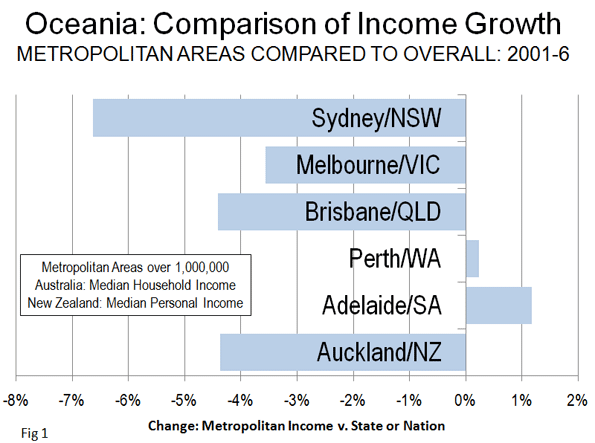
    This dispersion of opportunity is particularly evident in Australia, where data from the last two national censuses indicates that incomes overall have risen more quickly outside some major metropolitan areas. In three of five cases (the three largest) incomes rose higher outside rather than inside the major metropolitan areas (Figure 1).

    • In Sydney, the largest metropolitan area in Australia, median household incomes declined 6.6% relative to those of the state of New South Wales.
    • Melbourne median household incomes declined 3.5% relative to those of the state of Victoria.
    • Brisbane median household incomes declined 4.4% relative to those of the state of Queensland.
    • Median household incomes in Perth rose marginally more than those in the state of Western Australia (0.2%), while Adelaide incomes rose the strongest against state (South Australia) incomes at 4.4%.

    New Zealand

    Mimicking the largest metropolitan areas in Australia, Auckland, New Zealand’s largest metropolitan area, experienced a median personal income loss of 4.4% relative to that of the nation between 2001 and 2006 (Figure 1).

    Canada

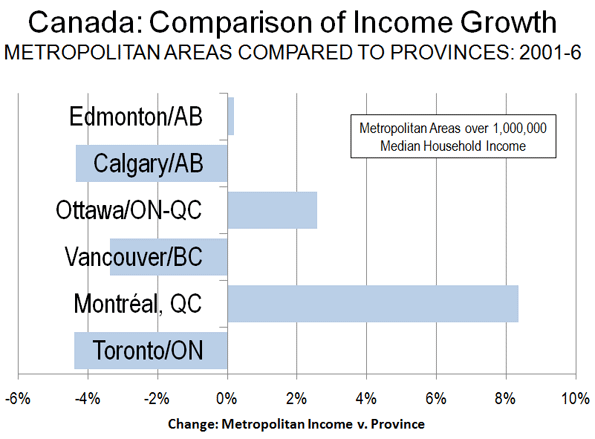
    A similar story has unfolded in Canada. Major metropolitan area median household incomes declined relative to provincial incomes in one half of the cases (Figure 2). The largest relative losses occurred in arguably two most dynamic metropolitan areas :

    • Toronto, which accounts for nearly one fifth of Canada’s population experienced a median household income decrease of 4.4% relative to that of the province of Ontario. Steve LeFluer’s recent article shows that within the Greater Toronto area, the core city, with its amalgamated inner suburbs, has the lowest median household income.
    • Calgary, Canada’s energy capital, also experienced a median household income decrease of 4.4% relative to its province, Alberta.

    Vancouver’s median household income also fell, 3.3% relative to that of British Columbia’s.

    Three metropolitan areas experienced faster economic growth:

    • By far the strongest growth income growth occurred in Montréal, where median household incomes increased 8.4% relative to incomes in Québec.
    • The nation’s capital, Ottawa (a metropolitan area that straddles the borders of Ontario and Québec) experienced a median household income increase of 2.6% relative to the weighted median of the two provinces.
    • Edmonton, Alberta’s capital, experienced income growth marginally above that of the province (0.2%).

    United States

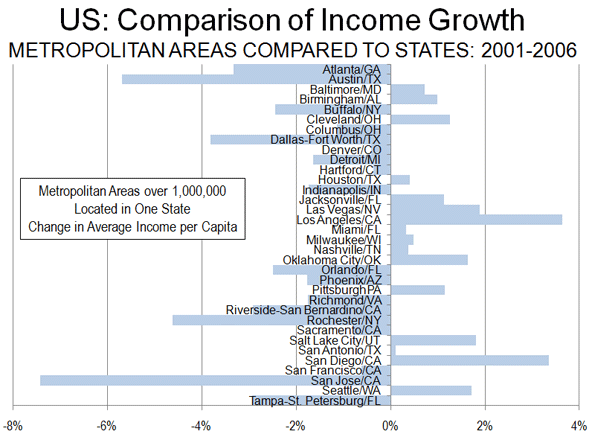
    A review of data in the United States indicates similar results. The same time span (2001 to 2006) was analyzed for the 34 metropolitan areas with more than 1 million population that are in a single state. State personal incomes per capita rose at a greater rate than the metropolitan area rates in 18 of the 34 cases (Figure 3).

    Two California metropolitan areas performed the best. In Los Angeles personal income per capita rose 3.6% relative to that of California in San Diego, per capita income rose at 6% relative to that of the state.

    Other metropolitan areas, including Las Vegas, Salt Lake City, Seattle, Oklahoma City, Cleveland, Pittsburgh and Jacksonville experienced income per capita increases of between 1% and 2% relative to those of their respective states.

    The largest loss occurred in information technology intensive San Jose, where incomes dropped 7.4% relative to those of California. Austin, capital of the nation’s second-largest state, experienced the second largest drop at 5.7% relative to incomes in the state of Texas, which as one of the leading information technology centers in the nation, generally mirrors the San Jose performance.

    Other losses between 2% and 5% relative to their states occurred in Rochester, Dallas-Fort Worth, Atlanta, Tampa-St. Petersburg, Riverside-San Bernardino, Orlando and Buffalo.

    Among the 15 multi-state metropolitan areas, eight experienced income increases relative to the states in the largest share of the population lives (this state with the historical core municipality) and seven declined. Perhaps the most surprising finding is that two metropolitan areas (New York and Washington), which have been among the most consistent in providing economic opportunities experienced only modestly greater income growth than their states.

    • New York, one of the two or three principal financial centers of the world, experienced income growth only 0.6% relative the weighted average of the states of New York and New Jersey, where nearly all of the area is located (Pike County, Pennsylvania is also in the metropolitan area).
    • Washington, where federal government and related in one can be counted upon to produce income growth, experienced only a modest rise of 0.3% relative to the weighted average of the two states (Virginia and Maryland) that comprise nearly all of the metropolitan area (Jefferson County, West Virginia is also in the metropolitan area).

    Metropolitanizing the World?

    These trends suggest a shift in metropolitan fortunes, at least in advanced countries. Historically incomes have grown much more strongly in metropolitan areas than in other areas. Now incomes are rising more quickly or at least nearly as quickly outside some major metropolitan areas as they are inside. It can no longer be blithely assumed that large metropolitan areas experience greater economic growth than their less urban hinterlands. The differences may be fading away, shaped not so much by proximity to the core but by other regional factors.

    We currently can only speculate as to the reasons for this development. The expansion of personal mobility and the ability of people to commute from outside major metropolitan areas may be one reason. Perhaps the most important factor is the rise of the information economy, which has freed some people from more intense urban living by permitting working at home part or all of the time. The proliferation of shopping opportunities, through franchised chains, the outward movement of immigrants, and online ordering may have made formerly remote areas more able to fulfill the needs and desires of people who previously would have inclined to live in more urban surroundings.

    These developments are consistent with the net migration of more than 2 million people away from metropolitan areas of more than 1 million population between 2000 and 2009 in the United States. Further, the phenomenon may be spreading beyond the high income world. As recently noted, in China, economic opportunities may be expanding in rural areas.

    ——

    Note

    This analysis compares metropolitan incomes to incomes in larger political jurisdictions (such as the metropolitan area of San Diego and California). An analysis that compared the area within the larger jurisdiction, but outside the metropolitan area, would yield a somewhat a difference (whether higher or lower), because the larger jurisdiction data available includes the metropolitan areas.

    Photo: “Outback” New South Wales: Faster Income Growth than Sydney (by author)

    Wendell Cox is a Visiting Professor, Conservatoire National des Arts et Metiers, Paris and the author of “War on the Dream: How Anti-Sprawl Policy Threatens the Quality of Life