Blog

  • Is China About to Decentralize?

    More than a car, plane or train tick, the “Hukou” (the residential permit system) is the key to mobility in China.

    I can still remember what my junior high English teacher said to my classmates and I, “I really worry about you guys; if you don’t study hard, not only will you not be able to get a job, you will probably have nowhere to stay, while the kids from the countryside; at least they will have some land to grow plants on and a house to live in!” (In my junior high school, all of my classmates had an urban hukou.) Looking back, I can’t help but admire my teacher’s far-reaching vision.

    I remember about two decades ago, my relatives from the countryside spent a fortune to get their kids an urban hukou. At that time, the “value” of one’s hukou was measured by the rank and scale of that city/town. As one can imagine, hukou for major cities such as Beijing, Shanghai, or Guangzhou are more “expensive” than my hometown Yangzhou.

    However, in the past couple years the trend has reversed, especially in the suburban areas of some cities. With the massive real estate development here in China, many lucky “farmers” with rural hukou have received enormous relocation compensation packages, which translate into millions of yuan and several brand new apartments.

    Yet despite these changes, the hukou system creates enormous boundaries for us.

    For someone like me, having a Yangzhou hukou and living in Nanjing, I have to go back to my hometown when I apply for a visa or any documentation related to my hukou. My future offspring will have to pay special fees and higher tuition to be admitted by the local schools. Even when I go to pay my internet bill, I have to pay a year in advance instead of monthly payments just because I do not have a local hukou. Still, I am fairly lucky because Yangzhou and Nanjing are in the same province. People holding a hukou belonging to another province have to overcome even greater difficulties and inconveniences, to say at the least.

    However, do not take it for granted that citizens who have a hukou for the big cities have it made. In Shanghai for example, the local government requires private car owners to pay 40,000 yuan for their license in order to limit the number of automobiles on the roads. Recently, one of my friends who has a Shanghai hukou bought a car in Nanjing, and he could not get a license for his car because the Nanjing authorities worried that he would secure a Nanjing license and actually drive his car in Shanghai in order to avoid paying the 40,000 yuan that the Shanghai municipality requires. He did eventually get his license by proving he is currently working and living in Nanjing and, of course, by pulling some important strings. This is rather ironic when looking back at how people valued a hukou several decades ago.

    The shifts in the value of a hokou parallels another interesting shift: many migrant workers are returning to their hometowns much earlier. In the previous years, migrant workers would usually return home right before Lunar Chinese New Year, which typically falls in February, but a large number of them have started to return home in December this year.

    The driving factor behind this change is that the cost of living in the cities has risen so dramatically over the past few years, and the money migrant workers earn barely covers their living costs. So rather than struggle through the holiday season, more and more are deciding to go home early and enjoy the time with their families. If these workers can secure work in the countryside, then the big cities could suddenly be facing a significant shortage of cheap labor as the Chinese New Year approaches.

    Although China’s urbanization will likely continue, the patterns might increasingly be to smaller cities and towns. In this sense, China’s development may, sooner than any expected, begin to take on the dispersion pattern that has occurred in the Western countries for more than a half century.

    Lisa Gu is a 26-year old Chinese national. She grew up in Yangzhou (Jiangsu) and lives and works in Nanjing (Jiangsu).

    Photo: South Gate, Nanjing

  • Fuzzy Thinking by Famous Economists

    Edward L. Glaeser, in an end-of-year piece for the New York Times, claims that generous housing supply is the reason that Texas’s economy is performing so well. As he says in his final paragraph:

    “Housing regulations, more than those that bind standard businesses, explain the Sun Belt’s population growth. If New York and Massachusetts want to stop losing Congressional seats, then they must revisit the rules that make it so difficult to build. High prices show that the demand would be there if the supply is unleashed.”

    This can’t be true.

    If it were true, Fresno, Modesto, and other cities in California’s Central Valley would be booming. They are not. Instead, six of the ten worst U.S. Metro Areas for joblessness are in California’s Central Valley.

    It is not just California. There are lots of places where housing is abundant and inexpensive and economic activity is dismal, Michigan for example. Maybe bringing up Michigan is a little unfair, Glaeser does mention demand for housing in the essay, and there is clearly little demand for Michigan housing. Still, it brings up the question of where demand for housing comes from. It’s a question Glaeser does not address.

    We’ll get back to the question of demand for housing.

    Glaeser claims that building homes causes prosperity, but Michigan’s housing abundance is not because of recent construction. He mentioned Georgia and Arizona, but those economies have been performing worse than the national average in terms of jobs and unemployment since the crash of the housing bubble. Now Nevada leads the nation in the AP’s Economic Stress Index, the sum of unemployment, foreclosure, and bankruptcy rates.

    As it turns out, Texas is the only state among the ones that Glaeser discusses that has outperformed the national average since the recession. Something else is going on, and that something is opportunity, but Glaeser makes a fundamental mistake early in the paper:

    “If economic productivity – created by low regulations or anything else – was causing the growth of Texas, Arizona and Georgia, then these places should have high per capita productivity and wages. Yet per capita state product in Arizona in 2009 was $35,300, 16 percent less than the national average. Per capita state products was $36,700 in Georgia and $42,500 in Texas.”

    It is a mindboggling mistake for an economist to claim that business decisions are made based on productivity, without consideration of costs. If productivity was all that mattered, little manufacturing would take place in China, as United States factory workers are about five times more productive than their Chinese counterparts.

    Paul Krugman, in another New York Times piece, takes up where Glaeser leaves off and makes another amazing mistake:

    “Part of the answer is that reports of a recession-proof state were greatly exaggerated. It’s true that Texas job losses haven’t been as severe as those in the nation as a whole since the recession began in 2007. But Texas has a rapidly growing population — largely, suggests Harvard’s Edward Glaeser, because its liberal land-use and zoning policies have kept housing cheap. There’s nothing wrong with that; but given that rising population, Texas needs to create jobs more rapidly than the rest of the country just to keep up with a growing work force.”

    Krugman goes on to say that people move to cheap housing, and economic growth follows.

    People make locational decisions based on far more factors than housing costs, factors like job prospects and opportunity, climate, cultural amenities, taxes and the like. In economic terms, we say that job growth and population growth are jointly determined. There is nothing sequential going on at all. Instead, population growth (and housing demand) reflects job growth prospects, housing costs, and other factors. Job growth reflects population growth prospects (and housing supply), productivity, wage rates, and other costs and resources.

    Krugman also asserts that Texas’s economy is not exceptional among the large states, citing unemployment rates equal to New York or Massachusetts. But he ignores the fundamentals here – like higher job growth and more in-migration. During its boom period, California often suffered higher unemployment because so many people were coming there. In contrast, the workforces in both Massachusetts and New York are among the slowest growing in the country. New York, in particular, competes with California and Michigan for the highest rates of domestic outmigration. People would stay if there was opportunity.

    In his rush to denounce Texas, Krugman exaggerates or dismisses facts. Yes, Texas has a twenty billion deficit now, but that the Lone Star State budget is for two years, something he neglects to mention. These estimates may soon be downgraded, as the price of oil rises. In addition, he fails to acknowledge Texas’s stellar performance in creating both high-tech and middle skill jobs at many times the rate of such favored blue states as Massachusetts, New York and California. People are not as stupid as many Nobel Prize winners might think; they move for opportunity, not just for cheap houses or low-paid work.

    You do not have to be a free market fundamentalist to recognize that, in relative terms, we can see a band of prosperity from North Dakota to Texas. In general, economic performance declines as you move from this Heartland band to the coasts, particularly the West Coast. People who want to believe that policy doesn’t matter give oil and agriculture as the two major reasons for the Heartland’s relative prosperity. Krugman suggests that high oil prices are a key reason for Texas’s economic performance.

    No doubt, oil is important to Texas, but prices have been generally low throughout the recession, while the oil companies’ domestic capital budgets have been small. Similarly, agriculture is booming nationwide, not just in the Heartland, a result of high prices caused by growing global demand. California certainly has lots of oil and agriculture, and no one would claim that California is booming. There is more to the Heartland’s growth than agriculture and oil, and that includes states which are governed by Democrats, such as Montana.

    A region’s job growth is a result of business locational decisions. A business moves to or expands in a region based on a whole host of reasons. These include available infrastructure, resource availability, market size and location, labor supply and costs, worker productivity, facilities costs, transportation costs, and other costs. Those other costs include what I call DURT (Delay, Uncertainty, Regulation, and Taxes).

    There is no reason for every location to have the same DURT. On the contrary, a location blessed with an abundance of the other factors of business locational decisions could afford to have more expensive DURT, while locations less blessed need to have cheaper DURT to attract businesses.

    This is what we see. The coasts tend to be more intrinsically attractive than the Heartland, but they also tend to have more expensive DURT. But now many of these states – driven by such factors as public sector costs or environmental regulations – have raised the price of their DURT so high that they have driven business to expand more to less attractive locations with cheaper DURT, demonstrating once again that policy matters.

    Bill Watkins is a professor at California Lutheran University and runs the Center for Economic Research and Forecasting, which can be found at clucerf.org.

    Photo by Dean Terry

  • The Heartland Rises

    The change in congressional power this week is more than an ideological shift. It ushers in a revival in the political influence of the nation’s heartland, as well as the South.

    This contrasts dramatically with the last Congress. Virtually its entire leadership — from former House Speaker Nancy Pelosi (D-Calif.) on down — represented either the urban core or affluent, close-in suburbs of large metropolitan areas. Powerful old lions like Reps. Charles Rangel (D-N.Y.) of Harlem, Henry Waxman (D-Calif.) of Los Angeles and Barney Frank (D-Mass.) of Newton, an affluent, close-in Boston suburb, roamed. The Senate was led by Sen. Harry Reid (D-Nev.), who loyally services Las Vegas casino interests while his lieutenant, Sen. Chuck Schumer (D-N.Y.), is now the top Democratic satrap of Wall Street.

    The old Senate tandem remains in place — but with greatly reduced influence. Many remaining Democrats, particularly those from the heartland, now live in justifiable fear for their political lives. But the most radical shifts in political geography are in the House.

    The new House leaders are, for the most part, from small towns, suburbs and interior cities. Most GOP pickups came from precisely these regions — particularly in the South and Midwest.

    The new speaker, Rep. John Boehner (R-Ohio), for example, represents a southern Ohio district that includes some Cincinnati suburbs. Rep. Eric Cantor (R-Va.), the majority leader, comes from suburbs west of Richmond. Rep. Paul Ryan (R-Wis.), chairman of the Budget Committee, hails from Janesville (population: 63,000).

    Power is moving within state delegations. Before the elections, California’s most influential House members hailed from coastal districts. In contrast, Rep. Kevin McCarthy, the new majority whip, represents Bakersfield, an oil-rich, largely agricultural area known as “Little Texas” — a far cry from the urbanity of Pelosi’s San Francisco.

    This change in geography also suggests a shift in the economic balance of power. The old Congress owed its allegiance largely to the “social-industrial” complex around Washington, Wall Street, public-sector unions, large universities and the emergent, highly subsidized alternative-energy industry. In contrast, the new House leaders largely represent districts tied to more traditional energy development, manufacturing and agriculture.

    The urban-centered environmental movement’s much-hyped talk of “green jobs,” so popular in Obama-dominated Washington, is now likely to be supplanted by a concern with the more than 700,000 jobs directly related to fossil fuel production. Greater emphasis may be placed on ensuring that electric power rates are low enough to keep U.S. industry competitive.

    The Obama administration’s land-use policies will also be forced to shift. Sums lavished on “smart growth” grants to regions, high-speed rail and new light-rail transit are likely to face tough obstacles in this Congress.

    Ken Orski, a former senior Transportation Department official and longtime observer of Washington land-use and transportation policy, said that no member of the GOP majority on the House Transportation and Infrastructure Committee comes from a big-city, transit-oriented district. The new committee, dominated by members from rural, suburban and interior smaller cities, represents areas that rely little on mass transit. These members are expected to steer money back to the roads and bridges their constituents rely on.

    Even more important are pending changes in energy policy. Many conservatives disdain what they consider “green pork” — subsidies for renewable fuels like solar and wind as well as the electric car and battery industry. Many firms involved in renewable fuels, already struggling to compete with cheap natural gas, could be driven out of business without continued federal nurturing.

    Another top priority for GOP leaders — and perhaps some energy-state Democrats — may be to choke off funding for the Environmental Protection Agency’s announced new regulations for greenhouse gases. Three out of four jobs in the oil and gas extraction industry are in GOP-dominated Texas, Oklahoma and Louisiana. California’s still-large oil industry includes many who work in the state’s increasingly Republican-leaning interior.

    Similarly, more than two-thirds of the nation’s coal mines, a prime EPA target, are in just three, increasingly red-leaning states — Kentucky, Pennsylvania and West Virginia, according to the Energy Information Administration.

    Yet urban areas can expect some benefits from this Congress. The recent extension of the Bush tax cuts largely benefits wealthy professionals, who cluster in a handful of expensive, liberal-oriented cities and their leafy, affluent suburbs. San Francisco, Boston and Manhattan liberals may groan about “breaks” for the rich, but many may be cursing the GOP all the way to the bank.

    Over time, the new emphasis on fiscal austerity could also play to Wall Street’s advantage — probably the last intention of most tea party activists. Reductions in public borrowing should drive more money into the private economy. This approach, adopted by Conservative British Prime Minister David Cameron, has helped create a smart recovery for London — even as the rest of Britain suffers from government cutbacks.

    The drive for austerity could also threaten traditional heartland staples like agricultural price supports and military spending. Major defense budget reductions, a necessity for any credible cut, could prove painful for military-oriented, red states like Virginia, Arizona, Alabama and Texas.

    This new regional balance of power poses a profound existential question for Democrats in states like California, New York and Illinois. The unlikely possibility of any future bailout for states or cities should help concentrate their minds on things like cutting spending and restoring their ability to create new jobs.

    Overall, it may be better for all regions to have a divided government. With President Barack Obama still in charge of the executive branch, we are not likely to see a repeat of the Bush-era excesses that favored traditional energy companies, suburban housing speculation and agribusiness.

    Optimistically, we may now see a canceling out of both parties’ regional tilts, spurring greater competition among localities for both investment and human talent. This could ultimately benefit the entire economy — taxpayers and communities — shedding an enlightened pragmatism on the current dreary landscape that is U.S. politics.

    This article first appeared at Politico.

    Joel Kotkin is executive editor of NewGeography.com and is a distinguished presidential fellow in urban futures at Chapman University, and an adjunct fellow of the Legatum Institute in London. He is author of The City: A Global History. His newest book is The Next Hundred Million: America in 2050, released in February, 2010.

    Photo by Smaku

  • Coalition of the Unwilling

    This week the UK government announced an ”end to anti-car policies” reversing the guidance to local authorities to dissuade citizens from using their cars in favour of public transport. Charges for parking will be reined in, they promise.

    It should be good news. The comically-named ”traffic calming” schemes put in place by the outgoing government were deeply unpopular. Still, we are getting used to taking our announcements from the new coalition government with a pinch of salt.

    Before the election Housing Minister Grant Shapps backed demands from the Housebuilders’ Federation for a ‘right to build’. That might seem unnecessary, but in Britain the planning laws are so prohibitive that owning land extends no right to build upon it. Instead planning authorities extend permission to build where it meets the terms of the local plan.

    The impact of Britain’s planning laws has always been a problem, but for the last thirteen years the ‘local plan’ has been hi-jacked by anti-growth campaigners from the Campaign to Protect Rural England, the Urban Taskforce and the massed ‘NIMBY’ campaigners of the Tory Shires.

    The new local government minister Eric Pickles explained that the net effect of the planning system’s strangle hold on house building was that ”we’re at rock bottom”: ”1924 was the last time we built this little number of houses”. His Labour predecessor Nick Raynsford had ”done more damage than the Luftwaffe”, said Pickles, exaggerating a little, but making his point (Sunday Times, 12 September 2010).

    So what about the changes? Grant Shapps’s published policy does include the words ”right to build” – but they are heavily hedged about:

    ”provided that [the new homes and buildings] conform to national environmental, architectural, economic and social standards, conform with the local plan, and pay a tariff that compensates the community for loss of amenity and costs of additional infrastructure’ (Open Source Planning, Page 3).

    All of which sounds pretty much as bad as it was before. What right to build, you might ask? Indeed the words ‘right to build’ feature just once in the document, as quoted above, in the executive summary. There is a question mark, too, over who it is that has the right to build. ”Communities”, according to Shapps, and the government have the right, but just how these ”communities” are defined is not clear. More likely they will be the same planning authorities as before. In that case the only developers that get a look in will be the powerful and well-connected like Tesco or Barratt Homes – those who are in a position to meet the municipal fathers’ demands for baksheesh… or ”planning gain” as it is known in the UK.

    Coalitions are new to Britain (apart from one shaky Liberal-Labour government in the seventies). But with neither David Cameron’s Conservative Party, nor the deeply demoralised Labour Party of Gordon Brown winning enough votes to command a majority in the House of Commons, Cameron had to turn to Nick Clegg’s minority Liberal Democrats.

    This arrangement seems to suit Cameron. Cameron became leader on a pledge to lose the ”nasty party” image the Conservatives had after years of office in the 1980s. His method is a mirror image of Tony Blair’s repositioning of the Labour Party as a centre party by distancing it from its socialist roots. First we had a Labour government that was against socialism. Now we have a Conservative-led government that is shy about capitalism.

    Sidelining the old-school Thatcherite, free market Tories in favour of his friends in the public relations, media and volunteer sector, Cameron seems obsessed with changing the party brand.Although this did not work in the election, the advantage of an alliance with the Liberal Democrats means that he can ditch whatever fundamentalist free market doctrines whenever convenient on the grounds that ”coalition government is compromise”.

    The net effect is a government that keeps sounding as if it is going to do something decisive, but then doesn’t.

    The greatest challenge has been the state of the public finances. Britain’s government debts are astonishing: one trillion pounds sterling, or 68.2 per cent of GDP. Since most of the debt was contracted under Labour’s watch, the coalition government has the moral high ground. The Labour coalition says that the cuts announced in the public sector put the recovery in danger because they are too far, too fast. They stand by ”counter-cyclical” spending, but Labour has little mainstream credibility in terms of the country’s finances.

    For the left, though, balancing the capitalists’ books is hardly the issue. They are looking forward to a re-run of the campaign against the Thatcher public spending cuts of the 1980s. The protests and banners all seem to reinforce the idea that the government is indeed planning to rein in public spending, but it is not. As former Tory Minister John Redwood has pointed out, the planned cuts are not even cuts at all, but a limit on spending growth.

    Cameron’s government had to sound tough on public spending, because the bond traders were in fear of Britain’s debt rating being marked down, and the wider impact of a loss of confidence. With both Greece and Ireland’s finances in trouble, the British government needed to promise stability.

    But the same city traders are just as determined that the spending party should carry on, even if the volume is turned down to avoid scaring the neighbours. For years Britain’s ”private sector” has been dependent on extraordinary boosts of government cash. Under the outgoing government’s Private Finance Initiative, public institutions like hospitals and schools were allowed to raise funds by issuing their own bonds, debt that was not reckoned in the official accounts. Then Gordon Brown’s banking bailout found government buying up failing banks like Royal Bank of Scotland.

    Despite their fawning support for austerity Britain’s City traders still expect to be looked after. The Bank of England’s emergency policy to meet the shortage of credit in the economy is called ”quantitative easing”. In practice it means that the government trades government bonds for the banks’ own toxic debts, while bond traders make money on the commission.

    Even the one controversial cut in public spending turns out to be something more like a gift to the banks. The government says that they will let universities charge fees approaching the market rate, and that students will no longer be subsidised. Since those who made the decision all got to go to university for free, the backlash was understandable – the kind of rioting Saturnalia that Britons indulge in from time to time (“off with their heads!“ shouted student rioters when they chanced upon the Prince of Wales’s limousine and mobbed it, while running from the police).

    To moderate the impact of the fees, though, the government has promised to expand the student loans scheme, where the State lends the money, and then recovers it later, through the tax system. For the banks, what could be more perfect? Here is a tranche of debt created overnight, guaranteed by a government that undertakes to recover it on their behalf: More of a subsidy to the City of London than a cut in government spending.

    Though the Conservatives are thought of as ”Thatcher’s Children”, they behave much more like their ”New Labour” predecessors. The tough talk is for show.

    Nowhere is this proto-New Labour approach clearer than on energy policy. Although Energy Minister Chris Huhne has acknowledged that Britain faces severe electricity shortages – he fails to ascribe the problem to its proximate cause, the failure to build enough coal-powered power stations.

    Huhne’s solution, though, will make things worse. Not more coal-powered stations, but a government imposed increase on tariffs for fossil-fuel generated power, and a special allowance for renewable energy. Of course, renewable energy on any normal pricing system would be uneconomic. Britain’s latest windmills even had to be heated up to stop them freezing solid this winter. The net effect of Huhne’s proposal: no fix for the energy shortage, and more expensive electricity.

    These policies have had disastrous, even lethal, results. According to the latest figures, excess winter deaths in the UK are in the region of 25 000, most of them the elderly, often hastened along by fuel poverty. With Huhne’s proposals, those numbers are set to increase, as electricity becomes something of a luxury to the poor.

    At least in this area, the Tories are “conservative”. The tradition of the poor freezing to death in wintertime is being restored, and so too may be the old class system that allows the City to enrich itself as the expense of everyone else, including the taxpayers.

    James Heartfield is the author of Let’s Build: Why we need five million new homes, a director of Audacity.org, and a member of the 250 New Towns Club.

    Photo by Chris Devers

  • Yes, We Do Need to Build More Roads

    Road are clearly out of fashion in urban planning circles. Conventional wisdom now decries roads in favor of public transit, walking or biking in developments designed to mimic traditional 19th century urbanism. Common refrains are “we can’t build our way out of congestion” or “widening roads to cure congestion is like loosening your belt to cure obesity.” Also frequently noted is the vehicle miles traveled has – at least until recently – outpaced population growth.

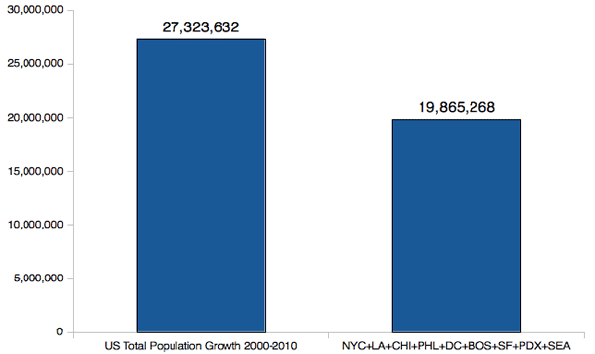
    But this piece of conventional wisdom is also deeply flawed. It obscures the bigger point that in a growing country we need to expand infrastructure to keep pace. The recent 2010 Census results put this in stark relief. The rate of growth from 2000 to 2010 slowed considerably from the previous decade, but still at a robust 9.7%, or 27.3 million new Americans. It would have been physically impossible to house all those people in traditional urban communities well-served by transit. The 27.3 million number is more than the combined 2009 population of the cities of New York, Los Angeles, Chicago, Philadelphia, Washington, Boston, San Francisco, Portland, and Seattle.

    In fact, this national growth is greater than the combined population of the 12 largest municipalities in the country.

    That’s just one decade’s worth of growth. America’s traditional urban areas couldn’t contain this, even if they were emptied of all their current residents. And the United States is projected to add an additional 90 million people by 2050. Where are all those people going to go? And how would they get to work even if they could live in these cities, given that much of America’s job growth has been suburban?

    Keep in mind also that much of this urban and transit infrastructure must be seen as more legacy than a reflection of modern choices. It was largely compete 50 or more years ago. Only Portland and Washington, DC have really managed to build new transit friendly urban core cities in the modern era. And despite their growing populations, these two places can only absorb a relatively small amount of new population every year. In Washington, it’s less population growth than gentrification – the replacement of largely poor African Americans with more affluent whites – that is the most outstanding demographic trend.

    That’s not to say America can’t invest more in transit or build more transit friendly cities. It can and it should. In particular, large, already dense urban areas like New York, Chicago, and Washington with large core area employment require major investment to upgrade their systems.

    Even smaller cities need better transit options and more urban neighborhoods. They are simply not well positioned to compete head on with newer suburban areas built from the ground up to support an auto-oriented lifestyle. But this will be difficult since they will have to build transit largely from scratch, and given anticipated cutbacks in new federal transit funding. this suggests they would be well-advised to avoid costly boondoggle mega-projects in favor of unglamorous but basic activities like running a quality urban bus system.

    But even if we achieve our potential in transit, America still needs to build more roads. We’ve got an interstate system originally designed for a 1960 population of 180 million and we are now well over 300 million and going up. By 2050 we’ll have more than double the 1960 population. This will require a major expansion of infrastructure, and that includes highway infrastructure.

    Just as one example, consider a moderate growth area like the Indianapolis-Carmel MSA. Its interstate system was mostly designed and completed circa 1970. The region had a population of a bit over 1.1 million then. Today it is over 1.7 million, an increase of 52%, or 596,000 people. A county the size of that increase would be the second largest county in the state of Indiana, well exceeding that of today’s #2, Lake County, a heavily urbanized county in Northwest Indiana.

    Yet until recently there had been almost no expansion of the Indianapolis freeway system. Fortunately, it was over-designed when built, but that is no longer the case. Thanks to a fortuitous lease of the Indiana Toll Road however, over 50 miles of freeway in the region are now being widened. Without this, the region would have faced decades of commuting misery.

    Unfortunately, that’s the bind where most cities now find themselves: managing growth with funding for roadway expansion and even maintenance running dry nationally.

    Keep in mind that tomorrow’s roads need not resemble yesterday’s monstrosities. The days of simplistically adding lanes while neglecting basics like enclosed drainage, sidewalks and paths, bus shelters, and aesthetics are likely over in many parts of the country. We need to provide room for the traffic we need to accommodate without excessive over-designs for a 15 minute peak of the peak, or dehumanizing roadway design approaches. Reform of our civil engineering educational system is eminently doable as plenty of great examples of suburban roadway design already exist. Federal standards need a revamp as well. We need to build not just more, but also better roads.

    With a botched stimulus, huge deficits at the federal and state level, and a public that has decisively turned against those deficits, a major construction program seems unlikely at this time. But in a couple years the economy should be back and a plan for fiscal recovery put in place and under execution. If not, we’ll have much bigger problems than roads.

    But assuming we get past this moment, we need to be laying the groundwork for a major continuation of the long history of American investment in infrastructure, from the Erie Canal to the interstate highway system. This includes not only a significant boost in urban transit spending where appropriate, but also a major program of both roadway repair and quality expansion, particularly in our growing metro regions. And as the Indiana example of a Toll Road lease shows, this doesn’t all have to come from tax dollars. Without this investment, our critical transport networks will ultimately seize up and America cannot hope to be competitive globally over the long haul.

    Aaron M. Renn is an independent writer on urban affairs based in the Midwest. His writings appear at The Urbanophile.

    Photo of a suburban road in Carmel, IN by author.

  • Trying to Keep Hope Alive: High-Speed Rail in Illinois

    Despite the rejection of high-speed rail in many states, Illinois is trying to revive it. The Illinois Department of Transportation recently made a cooperative agreement with Union Pacific and Amtrak to fund passenger rail improvements for its line from Chicago to St. Louis with a $1.1 billion federal high-speed rail grant. The project, to be completed in 2014, would make transit more efficient between the two cities, but as many other states have realized, the numbers indicate that this efficiency is not worth the cost or the trouble.

    The high-speed trains set to carry passengers 284 miles from Chicago to St. Louis would do very little to drastically change the commute experience. When the Illinois Department of Transportation first applied for this grant one year ago, they claimed that the trains would cut travel time between the cities from 5 hours 20 minutes down to 4 hours 10 minutes. However, current estimates now put the trip time at around 4 hours 32 minutes. As with every high-speed rail proposal, it seems, planners set the bar too high and end up either spending more than the public bargained for or overestimating the benefits of these billion dollar projects. How efficient will high-speed rail be if it costs more than people can afford and does relatively little to enhance the commute?

    Union Pacific’s terms in the agreement are not settling for riders either. According to CEO Jim Young, the company’s priority is “to protect Union Pacific’s ability to provide the exceptional freight service our customers need and expect,” and not necessarily passenger rail operations. Not only that, but there are no consequences stipulated in the agreement for if the railroad fails to meet on-time performance standards for passenger service, stipulations withdrawn from the initial agreement by the Federal Railroad Authority. High-speed rail was advertised to the public who would be paying for it with tax dollars and the divergence of their tax dollars from the state’s other pressing needs, but those developing the system do not seem as concerned with this large pool of customers.

    Local governments all over the country are recognizing the flaws with high-speed rail projects and are starting to act. The incoming governors in Wisconsin and Ohio have cancelled plans for a high-speed rail line while Florida governor Rick Scott doubts the cost effectiveness of what Michael Grunwald of TIME magazine calls a “glorified Disney shuttle.” Many inside and outside of California have also vehemently voiced their opposition to the “railroad to nowhere,” a line that would connect Corcoran and Bakersfield and would be the first costly step in its overall plan to connect San Francisco and Anaheim. Since projects are stalling in many other states as well, it might be worth it to take a second look at the necessity of high-speed rail at the present time.

    The influx of Republicans into Congress along with this local opposition may pressure the Obama administration to cut back funding for high-speed rail and work on fixing the deficit. However, this high-speed rail grant for Illinois shows that the federal government is not about to abandon the pipe dream yet.