Blog

  • Washington Opens The Virtual Office Door

    On December 9, President Obama signed into law the Telework Enhancement Act, a bill designed to increase telework among federal employees. Sponsored by Representatives John Sarbanes (D-MD), Frank Wolf (R-VA) and Gerry Connolly (D-VA), the legislation gives federal agencies six months to establish a telework policy, determine which employees are eligible to telework, and notify employees of their eligibility. Agency managers and employees are required to enter written telework agreements detailing their work arrangements and to receive telework training. Under the Act, teleworkers and non-teleworkers must be treated equally when it comes to performance appraisals, work requirements, promotions and other management issues. Each agency must designate a Telework Managing Officer, and must incorporate telework into its continuity of operations plan.

    Supporters of the measure, including the National Treasury Employees Union and the Telecommunications Industry Association, rightly tout its potential to improve the productivity of federal employees, reduce the government’s overhead expenses, decrease energy consumption and cut carbon emissions. Indeed, the Telework Research Network estimates that if the eligible federal workers who wanted to telecommute did so once a week, agencies would increase productivity “by over $4.6 billion each year” and save “$850 million in annual real estate, electricity, and related costs.” The country would save nearly six million barrels of foreign oil and reduce greenhouse gas emissions by one million tons per year. The bill would enable agencies to continue functioning during emergencies (federal telecommuters saved the government an estimated $30 million per day when D.C.-area snow storms shut down offices last winter), and it would decrease traffic congestion.

    Increasing the number of federal telecommuters is a good first step towards empowering the nation to tap telework’s many benefits. However, a diverse group of advocates would like to see telework become widely available for all workers. The Obama Administration endorses this goal. Proponents of broad access to telework include champions for small businesses and for energy independence, transportation alternatives, work/life balance, homeowners, environmental protection, disabled Americans, and rural economic development. To maximize telework’s promise — including its potential to open employment opportunities for 17.5 million people — Congress must enact comprehensive legislation offering employers, workers and other stakeholders in both the public and private sectors a wide array of cogent reasons to expand the practice.

    Comprehensive legislation would need to offer either carrots or sticks to constituencies that may resist telework’s growth: organizations with telework-shy managers; commercial landlords worried about telework-induced vacancies; and cities and states afraid that reducing the number of commuters will decrease their revenue. A few key elements:

    Remove Regulatory Barriers
    Perhaps the single greatest regulatory barrier to telework is the threat interstate, part-time telecommuters face of being taxed twice at the state level on the wages they earn at home: once by their home state and then again by their employer’s state. New York has been especially aggressive in taxing nonresidents on the wages they earn at home even though their home states can tax those wages, too. The double tax risk makes telework unaffordable for many Americans.

    Proposed federal legislation called the Telecommuter Tax Fairness Act would eliminate this roadblock to telework, prohibiting states from taxing the income nonresidents earn in their home states. This bill, introduced in the 111th Congress by Representatives Jim Himes (D-CT) and Frank Wolf, enjoys bi-partisan support from lawmakers representing states across the country. It must be included in any package intended to accelerate telework’s adoption.

    Simplify the Home Office Deduction
    The complexity of the current home office deduction discourages home-based workers from taking advantage of it. Potent telework legislation would give both home-based business owners and telecommuting employees the option to take a standard home office deduction.

    Offer Incentives To Employers
    Employers should be allowed to treat as nontaxable income the dollar savings they realize as a result of telework. Alternatively, they should receive a tax credit based either on the cost they incur for equipping employees to telecommute or on the percentage of workers who telecommute. They should receive a payroll tax break when they hire new teleworkers

    Because managerial resistance is a significant obstacle to telework’s growth, and because managers who telecommute themselves may have a more positive view of telework than their office-based colleagues, businesses should receive added incentives to allow managers to telecommute.

    Offer Incentives To Workers
    Workers should be allowed a tax credit based on the amount of time they spend telecommuting or on the cost they incur to purchase equipment and services necessary for telecommuting. They should have the option to treat the value of all equipment and services the employer provides to facilitate telework as a fringe benefit excludable from their taxable income, even when personal use of the tools is also permitted.

    Officer Incentives To Insurers
    Insurers covering losses that telework can minimize should be recruited to promote telework with tax advantages. Because experienced teleworkers enable their companies to continue operating even when emergencies render the main office unusable, business continuity insurers can limit their exposure by increasing the number of their policyholders that maintain strong, well-designed telework programs. They should receive incentives to do so.

    Automobile insurers should also be enlisted. The less frequently people drive, the fewer accidents occur and the less liability car insurers face. To motivate these insurers, Congress should offer them tax advantages based on 1) the proportion of their corporate policyholders that have both significant telework programs and aggressive policies to replace work-related driving with Web-based or telephone conferencing; and 2) the proportion of their individual policyholders who telecommute regularly.

    Offer Incentives To Commercial Property Owners
    Because businesses with dispersed workers need less office space, commercial landlords may wince at decentralization. However, the landlords able to fill their buildings with a greater number of tenants requiring less space – rather than fewer tenants requiring more – can thrive. In addition to operating greener and more cost-efficient sites, these landlords can reduce their risk of loss: Because each tenant represents a smaller proportion of a landlord’s total revenues, a single tenant’s default or decision to relocate is less likely to deal the landlord an insurmountable blow.

    To entice commercial property owners to encourage their tenants to adopt telework, Congress should offer the owners tax incentives based on the proportion of their tenants that have either vigorous telework programs or well-enforced policies requiring employees to replace business travel with remote conferencing.

    Make State and Local Efforts To Promote Telework A Condition Of Federal Transportation Funding
    By reducing the demand for roads and mass transit, telecommuting minimizes the cost of repair, maintenance and expansion of such infrastructure. Before the federal government subsidizes state and local transportation investments, the funding recipients should be compelled to mitigate costs by promoting telework.

    One step that states receiving federal aid should be required to take is to eliminate tax barriers to interstate telework. For example, they should be prohibited from subjecting a nonresident company to business activity taxes when the company’s sole connection to the state is its employment of a few in-state telecommuters. States could also allow car insurers to offer pay-as-you-drive policies.

    States and municipalities could require their agencies to develop telework programs for their own workers and to engage only those contractors that make the maximum possible use of telework. They could require agencies seeking funds to increase their car fleets or facilities to submit an assessment of whether telework could eliminate or reduce the need. They could compel their employees who seek approval for business travel to demonstrate that remote conferencing would not be an adequate substitute. They could authorize agencies to retain the funds the agencies save as a result of telework.

    States could create offices that promote telework and provide technical/legal support for both public and private employers developing telework programs; designate high traffic and pollution days as telework days and publicize them; and conduct public awareness campaigns to encourage telework, including campaigns specifically targeting businesses. Municipalities could eliminate telework-hostile zoning rules.

    All of these proposals would go a long way towards minimizing needless travel. Some would cost the federal government nothing or save it money. Others require a federal investment, but the investment would be made via business and individual tax breaks — welcome incentives for many members of the incoming Congress. Together, these suggestions would create jobs and strengthen the nation’s energy security. They would reduce traffic, carbon emissions and transportation costs; enable workers to meet conflicting job and family responsibilities; help businesses lower expenses, and drive profits. These are fundamentally important goals with bi-partisan support. Congress should act quickly and forcefully to unleash telework’s potential to meet them.

    Photo by By Rae Allen, “My portable home office on the back deck”

    Nicole Belson Goluboff is a lawyer in New York who writes extensively on the legal consequences of telework. She is the author of The Law of Telecommuting (ALI-ABA 2001 with 2004 Supplement), Telecommuting for Lawyers (ABA 1998) and numerous articles on telework. She is also an Advisory Board member of the Telework Coalition.

  • General Motors’ IPO: Deal Or No Deal?

    Those who are looking for a feel-good stimulus story, notably members of the Obama administration, cite the recent initial public offering (IPO) in which the federal government sold off 28 percent of its General Motors shares for about $15 billion.

    When the government-owned shares went public, President Obama said: “American taxpayers are now positioned to recover more than my administration invested in GM.” From the headlines and sound bites, you might think that the government was in the money on the $49 billion that the Troubled Asset Relief Program invested in GM during the dark days of the Great Recession.

    To believe that the U.S. government made money on its GM investment is to imagine that former republics of Yugoslavia will get back together so that they can restart the production lines of the Yugo.

    In the GM story, there have been many winners and losers on the road from bankruptcy to IPO. For the most part, the losers include investors, bondholders, taxpayers, and the 65,000 workers laid off so that, in the showroom of American politics, the bailout money could look like a rebate.

    The winner was the United Auto Workers union, which delivered Ohio and Michigan to the Obama campaign in the 2008 election. Without the union’s support in 2012, the president’s handling and maneuvering ability in the electoral college might resemble the torque on a Chevy Vega.

    The GM that went bankrupt in 2008 was not just a car company; it was also an unfunded pension plan, a bad bank (partial ownership of General Motors Acceptance Corporation or GMAC), and a health maintenance organization notable for padded bills.

    As it hit the crash wall, GM had negative equity, $88 billion in losses since 2004, 92,000 workers, 500,000 retirees, and 22% of a domestic car market that had shrunk to 13 million cars a year.

    What sleight of an accountant’s hand turned the originator of the Chevy Nova into an emerging juggernaut (maybe one with “soft Corinthian leather?”) that the market now values at $51 billion?

    Instead of letting GM go through Chapter 11 liquidation, and winding up the company according to bankruptcy laws, the U.S. government stepped in and allocated the spoils according to political rather than legal precedents. In theory, the move was designed to “protect American jobs.” What did these jobs cost?

    The immediate losers were GM shareholders (largely wiped out), and the holders of $95 billion in corporate bonds, now worth about $0.30 on the dollar.

    If you check the price of GM shares today, you will see them trading at around $34 a share. “Not bad,” I can hear you saying, recalling GM at $22 or even $8. But these are the new Government Motors shares; the old ones, which your grandfather owned, are trading for less than $1 on penny stock exchanges. Maybe the certificates are selling at flea markets?

    In the restructuring, the new owners of GM became the U.S. (61%) and Canadian (12%) governments, and the United Auto Workers (17.5 %), whose generous health and retirement packages would have been watered down or lost in a commercial liquidation.

    In the bankruptcy, the UAW retirees were moved ahead of the bondholders to the front of the disassembly line, no doubt because their rust-belt votes count more in presidential elections than those of bi-coastal hedge funders.

    Stakes in the new GM were granted to the union in lieu of cash due on health care and other benefits, which survived the reorganization. In the recent IPO, the unions netted $3.4 billion for a third of their stake.

    Other options thrown into the car deal included the $17 billion given to GMAC, whose losses became a ward of the state, and whose profits go to the hedge fund, Cerberus. It’s been renamed Ally Bank, just so you won’t associate its bad debts with the GM bailout. (“Test drive the new Ally… from zero to $17 billion in six point four seconds.”)

    GM was also allowed to carry forward $45 billion in Net Operating Losses through bankruptcy, a deduction rarely, if ever, granted to other scrapped companies. Clunkers for cash? The company also got a $6.7 billion loan, at below market rates.

    And finally, to promote Chevy Volts, buyers of the new hybrid electric car are given $7500 in federal tax credits. Maybe Ford dealers can match the subsidy on their hybrids by throwing in a set of snow tires?

    The new GM is allowed to operate with an unfunded pension liability, which remains on the books to the tune of about $30 billion. Mark that claim to market (those accounting rules that did so much to collapse the likes of Merrill Lynch), and GM’s IPO stake is hardly worth $15 billion.

    The contrived GM liquidation also kept the auto maker from dumping about $14 billion in promises onto the Pension Benefit Guaranty Corporation, a nominally private company — the board, however, consists of the secretaries of Labor, Commerce, and Treasury — that, with government benedictions, backs up politically correct pension payments.

    There is almost no way to know the total losses that can be attributed to the government’s GM restructuring. But, clearly, the government played Three-card Monte with the company’s bad assets, and kept the good ones for themselves. On Wall Street — the object of so much government venom — this is called “asset stripping.”

    Little wonder that everyone, including its government shareholders, are now upbeat about GM’s prospects. Morningstar writes: “GM can break even at near-depression-like sales volume, and it is selling more units in the U.S. with four brands than old GM did with eight brands in 2009.”

    At the time of GM’s IPO, President Obama sounded like Mr. Goodwrench: “Just two years ago, this seemed impossible. In fact, there were plenty of doubters and naysayers who said it couldn’t be done, who were prepared to throw in the towel and read the American auto industry last rites.”

    What he might have said is this: “We hosed the shareholders and suckered the bondholders down to $0.30 on the dollar. We propped up GMAC with $17.5 billion and then buried the losses in bad bank accounting. We leaned on the accountants to keep $45 billion in Net Operating Losses. We learned something from Bernie Madoff and are letting GM continue to carry $30 billion in unfunded pension liabilities. We dumped GM’s health care obligations, for shares, into a union trust. The rest we moved off the lot. Home run.”

    The government originally threw $49 billion at GM’s cash guzzling problems and then forced another $100 billion on the market in losses. In exchange thus far, it has recouped $15 billion, for about half of it stake in the new GM.

    In Washington, that might pass for a good deal. It might also seem fair in a remake of The Godfather (“The Corleone Family wants to buy me out? No, I buy you out, you don’t buy me out.”) Elsewhere, it sounds like a lemon.

    Photo of Classic Cadillac 2 by Shiny Things: “For-sale Cadillac parked in Morro Bay. How tempting is that?”

    Matthew Stevenson is the author of Remembering the Twentieth Century Limited, a collection of historical essays. He is also editor of Rules of the Game: The Best Sports Writing from Harper’s Magazine. He lives in Switzerland.

  • Demography vs. Geography: Understanding the Political Future

    Demography favors Democrats, as the influence of Latinos and millennials grows. Geography favors the GOP, as the fastest-growing states are solid red. A look at America’s political horizon.

    In the crushing wave that flattened much of the Democratic Party last month, two left-leaning states survived not only intact but in some ways bluer than before. New York and California, long-time rivals for supremacy, may both have seen better days; but for Democrats, at least, the prospects there seem better than ever.

    That these two states became such outliers from the rest of the United States reflects both changing economics and demographics. Over the past decade, New York and California underperformed in terms of job creation across a broad array of industries. Although still great repositories of wealth, their dominant metropolitan areas increasingly bifurcated between the affluent and poor. The middle class continues to ebb away for more opportune climes.

    Each state has also developed a large and politically effective public sector. In both states, no candidate opposed to its demands won statewide office in 2010. At the same time, the traditional, broad-based business interest has become increasingly ineffective; instead, some powerful groups such as big developers, Wall Street, Silicon Valley, and Hollywood, became part of the “progressive” coalition, willing and able to cut their own deals with the ruling Democratic elite.

    In New York, Republicans did capture a handful of seats in rural areas that have historically been friendly to the GOP, but in California the Republicans made no headway at all, even in rural areas. The difference here can be explained by demographics. In New York, the rural population is overwhelmingly Anglo; in California, much of it is Hispanic, a group that is both growing and, for the most part, tilting increasingly to the left.

    Can the New York and California models be replicated in other states and yield political gold for Democrats? The answer depends on how these two economies perform over the coming decades.

    Another state model competes for supremacy. It can be found in Texas, the Southeast, and parts of the intermountain West. The hallmarks are fiscal restraint and an emphasis on private-sector growth. If these free market-oriented states can produce better results than the coastal megastates, with their emphasis on government they could own the political future.

    Demographics: The Democrats’ Best Hope

    Right now, demography is the best friend Democrats have. Over the next four decades, the two groups that will increasingly dominate the political landscape are Hispanics and millennials (the generation born between 1983 and the millennium). Both groups tilted leftwards in recent elections. This trend should concern even the most jaded conservatives.

    The Latinization of America, even if immigration slows, is now inevitable. Only 12 percent of the U.S. population in 2000, Hispanics will become almost 25 percent by 2050. As more Latinos integrate into society and become citizens, they are gradually forming a political force. Since 1990, the number of registered Latino voters swelled from 4.4 million to nearly 10 million today.

    Anglos—60 percent of whom supported Republican congressional candidates in 2010—are beginning to experience an inexorable decline. In 1960, whites accounted for more than 90 percent of the electorate; today, that number is down to 75 percent. It will drop even more rapidly in the coming decades, with white non-Hispanics expected to account for barely half the nation’s population by 2050.

    California and New York are laboratories of the new ethnic politics. In New York, Latinos represent roughly 12 percent of the voters, while the overall “minority” vote has risen to well over 30 percent. California has, by far, the nation’s largest Hispanic population and Latinos are now roughly 24 percent of eligible voters. Overall, non-whites constitute well over a third of the electorate.

    The growth of the Latino vote works to Democrats’ advantage. Until the GOP-sponsored passage in 1994 of the anti-illegal alien Proposition 187, Latinos in California routinely voted upwards of 40 percent Republican (and even did so for Governor Arnold Schwarzenegger in 2006). This year, barely one-third of California Latinos supported Republican candidates Meg Whitman and Carly Fiorina.

    The Republican embrace of what is perceived by Hispanics as nativism has clearly alienated Latinos. This applies not only to California but also in Arizona, where Latino voters are now 18 percent of the total; in Nevada, they represent 14 percent and played a critical role in re-electing Majority Leader Harry Reid.

    This shift is all the more remarkable given the fact that many Democratic policies, on both social issues and regulations squashing economic opportunity, are at odds with Latino social conservatism and aspirational instincts.

    Of course, Latino voters are not the same in every corner of the country, and Republicans can do well with Hispanic voters if conditions are right. For example, Latinos in Florida and New Mexico support Republican candidates far more than in California or New York. Texas Republicans picked up two predominately Latino house districts along the Mexican border this year. And several recently elected high-profile Latinos—Florida Senator Marco Rubio and Governors Brian Sandoval in Nevada and Susan Martinez in New Mexico—earned strong Hispanic support (Rubio won more than 45 percent of Latino voters in a three-way race). Latino Republican candidates also won in Washington State and, of all places, Wyoming.

    The elevation of such emerging leaders could eventually turn the Latinos into a successfully contested group. But there is also a distinct possibility that emboldened nativist-oriented Republicans (backed largely by their older, Anglo base) could embrace policies, such as abolishing birthright citizenship, that seem almost calculated to alienate Latino and other immigrant voters.

    Millennials: Growing Up, Staying Left?

    Latinos and minorities are not even the GOP’s biggest demographic challenge. Millennials, the so called “echo boomers,” constitute a growing percentage of the electorate. They also tilted heavily Democrat. In 2008, millennials accounted for 17 percent of the nation’s voting-age population; by 2012, that share will grow to 24 percent. By 2020, they will account for more than one-third of the total population eligible to vote. Their power will wax while the seniors’, who broke decisively for the GOP this year, will inevitably fade.

    Millennials and generation X, their older brothers and sisters, constitute the majority of self-professed Democrats, note Mike Hais and Morley Winograd, authors of the forthcoming Millennial Momentum: America in the 21st Century. Last November, they supported Democratic candidates 55 percent to 42 percent, although their turnout flagged compared to what it was in 2008. They can be expected to turn out in bigger numbers in the 2012 presidential election.

    A connection exists between the Latinization trend and millennial voters. Boomers were 80 percent white; among millennials, at least the younger cohorts, the majority are from minority households.

    More critically, on a host of issues—from the environment to gay rights and economic re-distribution—this generation appears well to the left of older ones. One hopeful note for libertarian-minded Republicans: almost half believe that government is too involved in Americans’ lives (in this sense, their views are similar to those of older generations).

    Can millennials and generation X-ers be turned toward the center? History suggests this is at least possible. Boomers started off relatively left of the mainstream, notes political scientist Larry Sabato (although as Hais and Winograd suggest, Boomers were never as “left” as their louder, and often better-educated, generation “spokespeople”). In 1972, their first appearance at the ballot box, they split between Richard Nixon and George McGovern while older voters went overwhelmingly with President Nixon. In 1976, they helped put Jimmy Carter in office.

    But, over time, Boomers clearly shifted to the center-right, and eventually tracked close to the national averages. They supported Ronald Reagan in 1984, Democratic Leadership Council standard-bearer Bill Clinton, and George W. Bush. Politically, Sabato notes, “the boomers have become their parents.”

    Will today’s younger voters follow a similar arc? The key lies with how Republicans deal with critical issues, such as gay rights and the environment. It should be sobering for Republicans that a popular conservative like Senator Jim DeMint—the putative godfather of the Tea Party—lost overwhelmingly among South Carolina millennials by 54 to 46 percent against a marginal Democratic candidate.

    “This doesn’t say that the millennials will necessarily be Democrats forever and could never vote for Republicans,” notes Hais, who surveyed generational dynamics for Frank N. Magid Associates, an Iowa- and Los Angeles-based market research firm. “Obviously, the Democrats will have to produce, especially in the economy. But, I think that for millennials to begin to vote for Republicans, it is the Republicans and not millennials who will have to do most of the changing. The Republicans will have to come up with a way to appeal to an ethnically diverse, tolerant, civic generation—something they haven’t done very well to date.”

    Geography: The Great Republican Advantage

    Demographics may seem a long-term boon for Democrats, but geographic trends tilt in the opposite direction. Actually, Republicans did exceptionally well in the country’s fastest-growing places, both within metropolitan areas and by state. Democrats won the urban core, winning it by almost two-to-one in an otherwise disastrous year for them. But this is not where population growth is concentrated. Out of the 48 metropolitan areas, notes demographer Wendell Cox, suburban counties gained more migrants than core counties in 42 cases over the past decade. Overall suburbs and exurbs accounted for roughly 80 percent or more of all metropolitan growth.

    Suburbs and exurbs, where a clear majority of the country lives, are where American elections are determined. Dominated by the automobile single family houses, these areas shifted heavily to the Republicans this year, voting 54 to 43 percent for the GOP. Unless there is a startling economic development or the unlikely imposition of density-promoting national planning policy, the periphery is likely to remain the ultimate “decider” in American politics for the foreseeable future. The next generation of homebuyers, the millennials, note Hais and Winograd, also identify suburbs as their “ideal” place to live—even more than their boomer parents.

    Immigrants also are demonstrating a strong preference for the suburbs. Since 1980, the percentage of immigrants who live in the suburbs has grown from roughly 40 percent to above 52 percent. They also remained the preferred home for most boomers as they age.

    Republicans also dominate the fastest-growing states: Virginia, Utah, Florida, North Carolina, and, most importantly, Texas. Over the past decade, more than 800,000 more people moved to Texas than left the Lone Star State. In contrast, New York suffered a net migration loss of over 1.6 million, while California, once the nation’s leading destination, lost almost as many. Texas, Florida, and Virginia will gain congressional seats while New York will lose seats and California, for the first time in its history, will add none.

    More important still are the reasons driving this migration: job growth, cost structure, taxes, and regulation. While the highest earners in Hollywood, Silicon Valley, or Wall Street may still flourish in the two big blue states, jobs are evaporating for many middle- and working-class residents.

    For the vast majority of middle- and working-class people, the growth states are increasingly attractive places for relocation. Over the past decade, states like Texas, Virginia, North Carolina, and Utah, according to a Praxis Strategy Group analysis, enjoyed faster growth in middle-income jobs than in the deep blue strongholds. Texas, for instance, has increased middle-income jobs at seven times the rate of California over the past decade.

    This job growth extends beyond low-wage jobs at places like Walmart. Over the past decade, Texas has increased its number of so-called STEM jobs (science, technology, engineering, and mathematics related jobs) by 14 percent, well over twice the national average. Virginia and Utah performed even better. In contrast, New York and Massachusetts grew high-tech jobs by a paltry 2.4 percent, while California lagged with a tiny 1.7 percent increase.

    Jockeying for the Future

    In its first two years, the Obama administration tried to reverse these geographic trends by steering funds into universities, mainly those located in big cities and along the Northeast and California coasts. This tilt was natural for an administration which one Democratic mayor from central California described as “Moveon.org run by the Chicago machine.”

    The Obama administration’s “green” policies are also designed to favor major dense urban areas, with large increases in transit funding, high-speed rail projects, and grants for pro-density “smart growth” policies. But with the resounding defeat in November, the drive to force the population into dense and normally democratically inclined cities seems certain to ebb. The demise of the fiscal stimulus will put increased pressure on states like New York and California to cut down their public-sector growth, further threatening their weak recoveries.

    In the coming years, budget-constrained states will have to focus on private-sector jobs and growth. Given the likely tight job market over the next decade, particularly for minorities and millennials, Republicans could do well to demonstrate the superiority of their pro-enterprise model.

    Currently, red-leaning states top the list of states with the “best” business climates. Texas, North Carolina, Tennessee, and Virginia topped a recent survey by Chief Executive Officer magazine. In contrast, the bottom rungs are dominated by New York and California, as well as by longstanding Democratic bastions Michigan, New Jersey, and Massachusetts.

    To succeed, Democrats will need to prove capable of something other than a reverse Midas touch. They will need to develop a pro-growth, job-oriented program, something that they have not done well since the Clinton era. The decline in the numbers of pragmatic, business-oriented Democrats at the state and federal levels could make that job tougher than ever.

    It is still possible that, as millennials and Latinos flock to the suburbs, blue state demographics could overwhelm red state geography. In a decade, for example, Texas will likely be more far Latino than Asian; by 2040, according to demographer Steven Murdoch, the overall minority population, could be three times that of Anglos. At the same time, surging high-end employment will bring more educated, socially liberal people to the state. If these groups continue to favor the Democrats, Texas and other deeply red states could turn purple if not blue.

    In the long run, each party has strong cards to play. Demographic shifts favor Democrats, while geography tilts to the Republicans. Ultimately, the winner will be the party that offers a successful strategy for economic growth—but without culturally alienating the demographic groups destined to hold the balance in the political future.

    This article originally appeared at The American.

    Joel Kotkin is executive editor of NewGeography.com and is a distinguished presidential fellow in urban futures at Chapman University. He is author of The City: A Global History. His newest book is The Next Hundred Million: America in 2050, released in February, 2010.

    Photo by Eric Langhorst

  • Holiday Greetings from New Geography

    Here’s to the end of our 31st month publishing NewGeography.com. It’s been another good year of steady growth. Thanks for reading, for the good natured arguments, and your submissions. We hope your holiday season is relaxing and safe (for me it’s a 350 mile drive across the frozen tundra.)

    Here’s a look at of some of our most popular pieces over the past year.

    January
    The War Against Suburbia
    Reducing Travel Congestion and Improving Travel Options in Los Angeles
    Housing Affordability as Public Policy: The New Demographia International Housing Affordability Survey
    Beyond Neo-Victorianism: A Call for Design Diversity

    February
    America on the Rise
    A Race of Races

    March
    What American Demographics Will Look Like in 2050
    Midwest Success Stories
    New Traffic Scorecard Reinforces Density-Traffic Congestion Nexus
    Let’s Not Fool Ourselves On Urban Growth

    April
    Best Cities Rankings
    Finding Good in this Bad Time

    May
    Is it Game Over for Atlanta?
    Bungled Parliament: The Price of Pursuing Safe Society Over Growth and Opportunity
    Shanghai: The Rise of the Global City

    June
    The Future of America’s Working Class
    Time to Dismantle the American Dream?
    The Suburban Exodous, Are We There Yet?

    July
    How Texas Avoided the Great Recession
    ”James Drain” Hits Cleveland
    Civic Choices: The Quality Vs. Quantity Dilemma

    August
    The Golden State’s War on Itself
    The Beginning of the Great Deconstruction
    Urban Legends, Why Suburbs Not Dense Cities are the Future
    City Thinking is Stuck in the 90s
    Can the Suburban Fringe be Downtown-Adjacent?

    September
    The New World Order
    City Size Does Not Matter Much Anymore

    October
    The Smackdown of the Creative Class
    Greetings from Recoveryland, Ten Places to Watch Coming out of the Great Recession
    The World’s Fastest Growing Cities
    The Privitization-Industrial Complex

    November
    I Opt Out of California
    The Rise of the Efficient City
    The Other Chambers of Commerce

    December
    Hasta La Vista, Failure
    If California is so Great, Why are So Many Leaving?
    Cities that Prosper, Cool or Not

    Photo by Fusionpanda

  • The California Cheerleaders Are at it Again

    State Treasurer Bill Lockyer and economist Stephen Levy published a piece in the Los Angeles Times that argues that California doesn’t really have any fundamental problems. In their piece, Lockyer and Levy don their rose-colored glasses and give us the same tired old excuses, twisted logic, and factual inaccuracies.

    I’ll begin with the factual inaccuracies:

    Lockyer and Levy claim that California is the state with the youngest population. That is just incorrect. The U.S. Census website has a map. California is not even the same color as that used to identify the lowest-aged states.

    The authors’ claim that California’s high unemployment rate is due to the loss of 600,000 construction jobs is also wrong. Since November 2007, the month before the recession started, California’s construction industry has lost 334.7 thousand jobs. This represents less than 25 percent of California’s 1.36 million job losses since the recession’s inception. The story is still wrong if we choose the starting date for calculating job losses as the date that most supports L&L’s argument. California’s construction jobs peaked at 948.3 thousand in February 2006. It appears to have bottomed out at 529.2 thousand in September 2010. This is a huge number of job losses, over 400,000, but it is only two-thirds of the 600,000 claimed, and it certainly does not explain all of California’s high unemployment or California’s million plus non-construction recession job losses.

    Lockyer and Levy claim that California’s budget crisis stems strictly due to revenue shortfalls, saying,

    “Our critics say we are addicted to spending. But the numbers show that isn’t true….California’s current budget woes have been caused by the devastation visited on our revenue base by the recession, not a failure to curb spending. In the three fiscal years preceding this one, general fund expenditures fell by $16 billion.”

    This is just disingenuous. Lockyer knows as well as anyone that the general fund comprises less than half of California’s spending, and while the general fund expenditures have indeed reflected a decline in taxes, total State spending has increased from $194.3 billion in fiscal year 2007/08 to $216 billion in the 2010/11 year. Furthermore, when the composition of State spending is evaluated, we see that virtually all of the cuts in the general fund have been in local assistance. State operations have been almost completely spared.

    Besides, California’s budget problems didn’t begin with the recession. Do Lockyer and Levy think that our memories are so short that we forgot that Gray Davis was thrown from office because of budget problems, and that Arnold came in office pledging to fix California’s persistent budget deficits?

    We are also again treated to Lockyer’s mantra that California has a constitutional requirement that it not default on bonds, adding,

    “During the current fiscal year, general fund revenues are expected to total $89.4 billion. Education spending under Proposition 98 will total $36 billion. That leaves $53.4 billion available to pay debt service on bonds — more than eight times the $6.6 billion the state will need.”

    That’s wonderful, but constitutional requirements and revenues don’t pay debt. Cash pays debt, and California does run out of cash. When California runs out of cash it issues vouchers. Already some banks have refused to accept California vouchers. What will the State do if all banks refuse to honor vouchers?

    I’m sure the Treasury sets aside funds for debt repayment before they issue vouchers. Whatever they set aside will probably not be enough if California finds itself in a situation where vouchers are not accepted. Do we think the unions will let their people work if they are not being paid? Would the workers want to work if they are not being paid? Would contractors work? Will there be anybody around to write a check, even if the reserves are there?

    The fact is that if vouchers are not accepted, California will be plunged into a very serious crisis, a crisis in which case California’s constitutional requirement to pay would have no more meaning than its constitutional requirement that it have a balanced budget by June.

    Lockyer and Levy ludicrously claim that California’s business environment is good. But disinterested groups that issue reports that consistently rank California as among the least attractive states are wrong, groups like the Tax Foundation and Chief Executive Magazine. Lockyer and Levy cite Public Policy Institute of California (PPIC) research that business relocations cause smaller percentage job losses in California, but the PPIC can’t measure jobs that aren’t created when businesses that could reasonably be expected to expand in or move to California don’t.

    Lockyer and Levy also repeat Brett Arends’s claim that California’s share of the World’s venture capital has increased to 50 percent, but they neglect to note that the amount is declining, a lot, as Tim Cavanaugh showed here. California is getting a larger share of a rapidly declining pie. The net result is a huge decrease in California’s venture capital.

    Finally, I’ll conclude with my favorite Lockyer and Levy quote:

    “California no doubt faces serious challenges. But our obstacles are not insurmountable.”

    That’s exactly right, but the problems are not insurmountable until you confront California’s real, fundamental, problems.

    Bill Watkins is a professor at California Lutheran University and runs the Center for Economic Research and Forecasting, which can be found at clucerf.org.

    Photo by Kevin Cole

  • Special from Sydney: Misunderstanding Paris

    Reporters, columnists and even consultants often misunderstand urban areas and urban terms. The result can be absurd statements that compare the area in which the writer lives to somewhere else where the grass is inevitably greener, bringing to mind an expensive competitiveness report that suggested St. Louis should look to Cleveland as a model. Sometimes this is the result of just not understanding and other times it results from listening to itinerant missionaries from idealized areas who have no sense of the reality.

    A most recent example is from the Sydney Morning Herald, one of Australia’s largest and most respected newspapers.

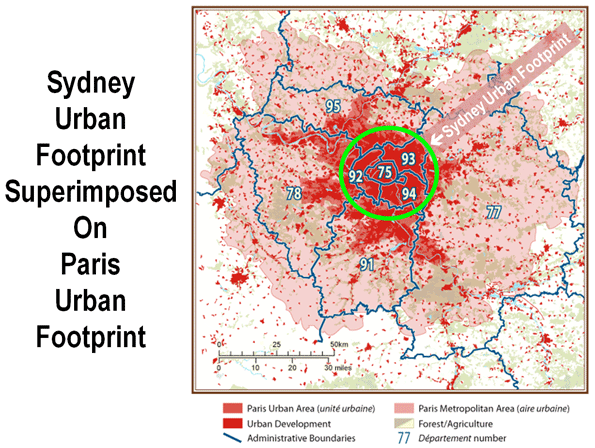
    Columnist Elizabeth Farrelly told her readers that Paris covers one-quarter the land area (urban footprint) of Sydney and has a population of 5.5 million. In fact, the urban footprint of Paris is at least five times larger and the population nearly double.

    According to the Institut national de la statistique et des études économiques (INSEE), the statistics bureau of France, the urban footprint of Paris was 2,723 square kilometers in 1999 and the population in that area was 10,143,000 in 2006 (both figures are the latest data available).

    In contrast, according to the Australian Bureau of Statistics (ABS), the statistics bureau of Australia, the urban footprint of Sydney was 1,788 square kilometers in 2006. However, even the 50 percent larger urban footprint of Paris may actually understate the difference, because ABS uses a lower population density threshold than INSEE for urban versus rural classification. The difference between the two urban footprints is shown in the figure below.

    Ms. Farrelly also decried the continuing sprawl that she perceives in Sydney, despite the fact that no urban area in the new world, except perhaps Vancouver, has shut down home construction on its fringe to a greater degree (nor even has Paris). The effect of Sydney’s development Berlin Wall is housing affordability so bad that it is second only behind Vancouver out of nearly 275 metropolitan areas in the 6 nations we cover in the Demographia International Housing Affordability Survey.

  • A New Era For The City-state? The New World Order

    The city-state, a relic dating back to Classical or Renaissance times, is making a comeback. Driven by massive growth in global trade, shifts in economic power and the rise of emerging ethnic groups, today’s new independent cities have witnessed rapid, often startling, economic growth over the past decade.

    The contemporary city-state has flourished primarily in two regions: the Persian Gulf and Southeast Asia. The development of Hong Kong and Singapore provided a critical stage for Southeast Asia, which has been home to the world’s the greatest economic expansion. Hong Kong, now a quasi-independent part of China, competes with London’s West End as the world’s most expensive office market. By one account, it is experiencing the fastest growth in rents of major office markets in the past year. Once known for their poverty and destitution, these Asian city-states now boast incomes comparable to many European and North American cities.

    The Persian (or, as some like to call it, Arabian) Gulf constitutes the other hot bed for 21st Century city-states. Over the past decade, a string of once obscure cities from Dubai and Abu Dhabi to Qatar and Bahrain have risen to positions of global significance. Qatar, a tiny emirate with roughly 1.7 million people, will host the 2022 World Cup–an announcement that surprised nearly everyone. Abu Dhabi, a desert metropolis of some 2 million people, is undergoing the largest cultural development project on the planet, financed by the emirate’s huge oil wealth. This includes three massive museums: an outpost of the Louvre, a branch of the Guggenheim 12 times the size of the New York original, and a museum on maritime history.

    These city-states may share religious and political affiliations, but like their Phoenician, Greek and Renaissance forebears, they compete ferociously with one another. Today Dubai, which like Abu Dhabi is part of the United Arab Emirates, easily represents the most evolved expression of the modern Gulf city-state. Not much more than a tiny fishing and pirate haven until modern times, the city had less than 400,000 residents in 1985; it now has close to 2 million. In the past decade Dubai has become a city of superlatives: the world’s largest office tower; the Middle East’s largest port, airport and financial center.

    In many ways Dubai’s strengths are those of traditional city-states. Unlike other Gulf Arabs, the Dubai Emiratis have depended more on trade than oil for their wealth. Highly anxious to seize one of the most critical corridors of world trade, they have built the Middle East’s largest port at Jeber Ali and the massive Dubai International Airport, one of the largest and best-run on the planet.

    And to an extent largely unmatched in the Arab world, Dubai and its ruler, Mohammed bin Rashid Al Maktoum, have fostered an environment well-suited for global trade. Muslim cultural tendencies (like Friday holidays and largely halal food) are gently followed, but there’s room for a great deal of flexibility for expatriates.

    Inside the financial towers, it’s not unusual to see people dressed as they would in London or Wall Street–men in smart suits and women in knee-length skirts. Alcohol is readily available in the hotel restaurants, and the cab drivers are as likely to be Hindus from India as Muslims from an Arab country. Restaurants tend to be Lebanese, Persian or Western; there are karaoke clubs, bars and pubs across the city. Business in Dubai is conducted in many languages among a plethora of ethnic groups ranging from Americans and Brits to Indians, Russians, Pakistanis, Koreans and Lebanese, among others.

    “Funny” business, as in most trading cities, also fuels the Dubai’s dynamism. The city-state has been a convenient laudromat for money out of sanctioned Iran. Indeed, the Dubai Creek area near the souk is crowded with dhows being packed with crates ready to ship across the Gulf to the Islamic Republic. These can include some relatively harmless consumer goods like televisions, but some allege that some of the cargo includes materials for Iran’s nuclear program.

    Then there are the corrupt south Asian politicians, Russian Mafiosi or Southeast Asian drug dealers, who reside part time in the city and also deposit their cash there. Included in this cash in-flow, according to Wikileaks, are many millions of U.S. and other NATO aid dollars skimmed off by our wonderful Afghan allies. (Your tax dollars at work!)

    Both the predominate legitimate business and, probably, the thieves see much benefit in Dubai’s largely efficient authoritarian order. There are incidents of violence on occasion, but nothing on the scale of Karachi or Juarez, Mexico, gang wars. A safe place attracts all kinds of business, as was true back in the days when the Doges ran Venice.  Backed both by social order and monumental  infrastructure investments and high social order, Dubai now boasts the fourth most office space per capita of any large city on the planet–behind only New York, Paris and London.

    Since the 2008 financial crisis the office market has become severely overbuilt, transforming Dubai from one of the world’s hottest commercial markets to one of the sickest. Estimates of actual office vacancy rates start at 15% but could rise to 25% or even 50%, according to a recent Jones Lang estimate. However, a walk through the massive new “Business Bay” development–planned as 64 million square feet of office, commercial and residential space–resembles a walk through the real estate landscape left from a neutron bomb. You don’t see much in the way of people except   security guards and occasional day laborer. Even optimists, counting on a renewal of global economic growth, do not expect a major improvement in the overall property market until 2013 or 2014.

    A more serious and long-term problem may prove political. Unlike Singapore and Hong Kong, where most work is done by citizens, Dubai and the other gulf city-states rely almost completely on imported labor. Expatriates seem to do almost everything from city planning and administration work to running the hotels and basic infrastructure maintenance. This is not surprising as less than 1 in 5 residents is an Emirati.

    Some foreign residents live luxuriously, in communities like the Palm that look more like Newport Beach, Calif., than parts of the developing world. Many others inhabit dismal labor camps that are collections of cinderblocks in the desert. These camps, notes Kevin Phillips, a local evangelical missionary who works in Dubai, are plagued with problems typical of any settlement made up of young, temporary males workers: crime, drugs, fist-fights and prostitution.

    But arguably the biggest danger to Dubai–and to other Gulf city states–lies in the numbers of Arabic speaking workers and professionals who, despite sharing a language and religion with the Emiratis,  often feel only a tenuous stake in the city’s success. Unlike their counterparts in Singapore, they have virtually no chance to become citizens. Commitment to the long-term health of the city is not always evident among people who consider themselves mere sojourners.

    Yet for all these problems, one should not rule out Dubai or other Gulf urban areas like Abu Dhabi and Qatar as potential future great city-states. In a world where cross-cultural trade remains an ascendant phenomenon, we are likely to see the emergence of an expanding number of city-states over the coming years. Athens, Carthage or Venice may have constituted the great city-states of the past, but the 21st century is likely to  create its own batch  of luxuriant successors.

    This article originally appeared at Forbes.com

    Joel Kotkin is executive editor of NewGeography.com and is a distinguished presidential fellow in urban futures at Chapman University, and an adjunct fellow of the Legatum Institute in London. He is author of The City: A Global History. His newest book is The Next Hundred Million: America in 2050, released in February, 2010.

    Photo by *Crazy Diamond*

  • The Tax Cut that Killed California?

    I studied with the Austrian economists at New York University. The Austrian school of economics (as contrasted to Keynesians or Chicago school economists) work with a theory about business cycles that essentially starts from the understanding that what appear to be almost mechanical, regular ups and downs in the economy are actually caused by the periodic disappointment of the expectations of entrepreneurs. The alternative is to suggest that business owners periodically and collective wake up stupid one morning and start making a lot of bad decisions. A connection to the routine horizons of fiscal policy – for example, the 5-year funding cycle for federal highways – is a more likely cause of what appear to be “cycles”.

    A current example of how government spending policy can make a disaster of the economy by confounding decision making is the changes/not-changes in US tax policy. What if you are a business owner who has a fiscal year that runs from July 1 to June 30? All of your plans for the first half of 2011 would have been based on the tax cuts expiring (which is the reasonable thing to do – don’t change your plans until the law is changed). If the tax cuts are extended, then the last half of your budget is completely changed. In this case, there will be more net income. Being unable to plan for this, according to economic principal-agent theory, will put a lot of cash in the hands of managers who may not spend it in the best interests of the shareholders. The failure of managers to invest wisely when government stimulates business through unexpected and excessive free cash flow is well-documented.

    Now imagine you are a state whose tax policy mirrors the federal policy. Tax cuts to businesses and individuals translate into revenue cuts for states, counties and cities. Any state that opts out of mirroring whatever Washington D.C. passes risks being cut-out of certain federal funding programs in the future. Nebraska, for example, passes a biannual budget. The last one covered the fiscal-years 2009-2011, which was based on the tax cuts expiring at the end of 2010. The difference if the tax cuts are extended will be a $200 million shortfall. Nebraska is a relatively small state, so consider what this will do to the budgets of all the states, plus counties and cities in the U.S. This could be the event that brings the global financial crisis in public debt home, especially to states like California which are already in trouble.

    Note: A good source for more on Austrian economic theory is the Mises Institute at Auburn University. Click this for a brief on “The Austrian Theory of the Business Cycle” from Roger Garrison – who is an expert on the subject.