Blog

  • Dallas: Building America’s Largest Urban Park on the Trinity Riverside

    A flood protection site in Dallas is being transformed into America’s largest urban park. The economic and ecological benefits of conserving this slice of North Texas are destined to reverberate well beyond the city limits. Blackland Prairie is the most endangered large ecosystem in North America. The development that is underway —thankfully — to preserve this remnant of our past will also shore up our natural assets for the future.

    The Trinity River Corridor Project aims to restore or develop a total of 10,000 acres, including 6,000 acres of forest, 2,000 acres along the river’s Elm Fork, and a 2,000-acre floodway extension, which alone will be three times the size of Central Park. Over eighty percent of it will comprise natural landscape, much of it Blackland Prairie ecology. In 1998, a $246 million bond was passed to establish the ambitious public works project, which will also preserve the Great Trinity Forest, the largest urban bottomland hardwood forest in North America.

    What It Means For Dallas
    After plans to turn the 715-mile Trinity River into a shipping channel were scrapped, the value of the Trinity River and its surrounding environs was re-evaluated. At the 21st Century City conference, Ignacio Bunster-Ossa, a principal with Philadelphia-based Wallace, Roberts & Todd, calculated benefits that included 19,000 new trees to absorb approximately 380 tons of CO2 – the equivalent of 750,000 miles traveled by automobile; 300 acres of wetlands to sequester 3,000-4,000 tons of CO2; and $8.8 billon in development value to boost the local economy.

    Estimated at around $2.2 billion, the Trinity River Corridor Project also allocates a portion of the land use for recreational amenities including an equestrian center, sports fields, trails, and a “nature interpretative center.” International regattas, fireworks, concerts…these are promises for the future, although at present, the nature interpretive center is the only part of the plan that has been completed.

    Trinity River Audubon Center: A Glimpse
    Trinity River Audubon Center is a 21,000 square foot LEED-certified nature education facility . The view from the window of TRAC Executive Director Chris Culak’s office is vintage Old West: fertile soil, coneflowers, Lemon Beebalm, Black-bellied Whistling Ducks, and a vast many other flora and fauna that have sprung up in this nexus of Cross Timbers, grasslands, and wetlands.

    “The property started out as a quarry in the 1940s,” explains Chris. “Since the mid-60s it has been a dump. The guy who ran it was fined repeatedly. The dump caught fire twice— in 1988 at 1997— and the second time it burned for two months, primarily due to the construction debris. Bulldozers had to roll in to make room for the fire trucks.” Ultimately, stakeholders organized and sued the City.

    The City of Dallas estimated it would cost $107-110 million to clean it up, and would take at least 10 years. In 2000, it resolved the matter by doing a $25 million landfill instead, which was completed in record time. Its partnership with the National Audubon Society to develop a nature center within this property demonstrates how a municipal liability can be transformed into a major asset.

    Today, the Trinity River Audubon Center is the gateway to remarkable biodiversity that blossoms across 120 acres, including four miles of meandering trails. Since opening in October 2008, more than 85,000 people have come through the Center, 30,000 of whom are students. Reflecting the National Audubon Society’s mission to connect people to the outdoors, TRAC is fostering a conservation ethos in children who may not get it elsewhere.

    Getting Down to Brass Tax
    The Trinity River Audubon Center presents a great example of the economic development potential in public-private partnerships. The $15 million TRAC building was jointly paid for by the City of Dallas, which contributed $13.5 million and the National Audubon Society, which covered the rest. Additional funds are appropriations from the federal government for flood control, and from state, county, city, and private funds.

    The City’s return on its initial investment is a restoration project that totals $37 million in capital improvements. As with other public-private partnerships for cultural centers such as the Dallas Museum of Art and the Nasher Sculpture Garden, the City maintains ownership, but only pays a small stipend. Beyond that, these entities must raise their own money.

    “People sometimes say that if it’s worth so much, then private interests will develop it,” says TRAC’s Culak, “but without the vision for implementation and municipal support, you can’t get that kind of development in here.” He added, “The economic benefit will be tenfold, but we’re going to have to put something into it to get as much out of it.”

    Fortunately, Dallas has tremendous resources within its philanthropic community. A core group of visionaries have been keepers of the dream, including Gail Thomas, Ph.D., the president of The Trinity Trust. “The average citizen in Dallas doesn’t have a clue about the marvelous, dramatic changes that will take place in their lives,” says Gail.

    Renewal Takes Awhile
    “In the 20th century we created our cities to move as quickly as we could from one place to another,” explains Gail. “We built these cities in the fast lane, for connectivity. In the midst of building airports, railroads, and highways we forgot the importance of walking, of having our human senses activated by our environment. Consequently, our 20th century cities have been rather cruel to human sensibilities. We seek a more humane city, one that allows for the complexities of diverse lifestyles while offering serene and quiet places that feed the soul.”

    To get to this vision will require a significant amount of development, over the next decade and beyond. Says Culak, “This is on the same order as building DFW Airport was over 50 years ago. Any resistance we have to it is just like it was then.” He continues, “People want things instantly. They are still asking, ‘What’s in it for me?’ Unless you go on vacation to Indianapolis, Pittsburgh or Vancouver, you don’t necessarily know what other cities are doing. For Dallas, this is it. It’s a city built on a prairie next to a river. The Trinity River is the only natural resource we have. You’ve got to use what you have.”

    Dallasites are in for a surprise when they discover that what we do have is a river made for kayaking. The standing wave, a practice whitewater feature, will open this spring, the horse park will open its first barns this coming year, and the first of two Calatrava bridges will open in October 2011.

    Such events represent a great thrust forward for a project that is still a mystery to many in this community. “There have been a lot of naysayers,” says Gail, “but we think we’ll have the last laugh.”

    Photo of Trinity River near Dallas by gurdonark — Robert Nunnally

    Anna Clark is the author of Green, American Style and the president of EarthPeople. She lives in one of Dallas’ first residences to earn a Platinum-LEED certification from the U.S. Green Building Council.

  • Chicago Magazine Asks Why Illinois is So Corrupt

    Chicago Magazine has an interesting article on the sore subject of Illinois corruption. The article was written by Shane Tritsch who interviews several experts on Illinois political history. There’s no “good old days” of clean government in the Land of Lincoln. Tritsch explains a major reason for Illinois’ historical graft:

    Owing to historical factors, Illinois developed a labyrinthine governmental structure that offered fertile ground in which corruption could sprout. The Illinois constitution of 1870, in effect until 1970, limited the amount of debt counties and municipalities could carry and taxes they could levy. When cities needed to fund improvements, they got around those constraints by creating new units of government with the capacity to borrow—a library district, for example, would be created to build and administer a new library. “The 1870 constitution almost forced you into multiple units of government if you were going to deliver services beyond your municipality or modernize your municipality,” says Redfield. Today the state contains almost 7,000 separate governmental fiefs—far more than any other state—ranging from counties, towns, and school and fire districts to water reclamation and mosquito abatement districts. Most have budgets to protect and authority to wield. “It’s very hard to stay on top of it all, and it creates many more opportunities for patronage,” says Cindi Canary. “It creates ways for small islands of graft and corruption to stay hidden.”

    It appears that Illinois’ luck is running out. According to Forbes, Illinois is number two on the list of states Americans are fleeing behind New York:

    at No. 2. Illinois is expected to lose 27,000 people this year, consistent with its average annual loss over the last five years. The losses are likely linked to the state’s economy and tax structure. Job losses in manufacturing and industrial machinery are likely pushing people out of the state

    The bond market has taken notice of Illinois’ debt problem. While Illinois can’t go legally bankrupt, creditors can refuse to extend credit. Illinois faces massive public pension crisis in the coming years. Unfunded liabilities will make Illinois a less desirable place to invest.

    The Illinois economic situation was born in Illinois’ history of corruption. Shane Tritsch’s article is a decent history on Barack Obama’s home state. The Chicago segment of Illinois corruption is certainly unique. Below is an excellent segment from a National Geographic TV special on how Chicago was taken over by the Mob.

  • Commissioner Leonard Steps Up Portland’s War on Fun

    Portland is known primarily as a cool city, where people spend their 20s happily working in the service sector, drinking craft beer, eating organic food, and exploring a variety of unconventional lifestyle options. In short, Portland is weird. That’s not just an observation: it’s the city’s marketing strategy. Keep Portland Weird is a pretty common bumper sticker in the city (believe it or not, there are cars in Portland). Yet despite the non-conformist attitude of Portlanders, the municipal government seems bent on destroying everything fun about the city.

    The first attack, which I documented in Reason Magazine, is on craft beer, the city’s primary cultural export. The city attempted to increase the tax on beer producers several fold, though the motion was soundly defeated. It was the only time I’ve ever seen hippies handing out anti-tax fliers in bars on Friday nights. This was followed up by an EPA mandated tampering of the water supply, which may or may not reduce the quality of the world beer capital’s unparalleled beer.

    The second attack is on street vendors. Portland has some of the most liberal rules regarding street vendors. You can find anything from Mexican to Thai food in the nearly 600 Portland street carts. This is one of the things that make the city charming. Street vendors add to the street life of the city. Yet this summer, a story about a little girl having her unlicensed lemonade stand shut down drew international attention. Now City Commissioner Randy Leonard is openly discussing a city wide crackdown on food vendors. The complaint? Many of them are guilty of attaching unlicensed appendages such as awnings and decks.

    Where are the complaints originating from? You guessed it: local restaurants. They claim that street vendors are providing unfair competition, since they don’t have to provide restrooms, be wheelchair accessible, and so forth. This has so alarmed the Commissioner that he’s instructed building inspectors to assign top priority to inspecting street vendors. Ironically, this debate completely ignores the most legitimate question: are street vendors actually hurting anyone? Is their safety record worse than local restaurants? Are they blocking off public sidewalks? The answer to the first question isn’t clear, since the inspection reports aren’t reported in the same way they are for restaurants. Having said that, the health inspectors would shut them down if there were egregious violations. The second question is easier. They aren’t unduly encroaching on sidewalks. If anything, they’re providing sidewalk dwellers shelter from the rain with their unlicensed awnings.

    Quirky things like world class craft beer and street vendors are what make Portland interesting. If the city is going to market itself as a destination for the creative class, it is going to have to stop cracking down on the very things that attract these people in the first place. After all, they sure aren’t moving to Portland because of the local economy.

  • Hasta La Vista, Failure

    In his headier and hunkier days, Arnold Schwarzenegger spoke boldly about how “failure is not an option.” This kind of bravado worked well in the gym–and in a remarkable career that saw an inarticulate Austrian body-builder rise to the apex of Hollywood and California politics.

    But Schwarzenegger’s soon-to-be-ended seven-year reign as California’s governor can be best described in just that one simple world: failure.  It has been so bad that one even looks forward to having a pro, the eccentric Machiavellian master, Jerry Brown, replace him.

    Schwarzenegger never grew beyond the role of a clueless political narcissist. As the state sank into an ever deeper fiscal crisis, he continued to expend his energy on the grandiose and beyond the point: establishing a Californian policy for combating climate change, boosting an unaffordable High-Speed Rail system, and even eliminating plastic bags. These may be great issues of import, but they are far less pressing than a state’s descent into insolvency.

    The Terminator came into office ostensibly to reform California politics, reduce taxation and “blow up the boxes” of the state’s bureaucracy. He failed on all three counts. The California political system–particularly after the GOP’s November Golden State wipeout–is, if anything, more dominated by public employee unions and special interests (including “green” venture capitalists) than when Gray Davis ruled. Taxes, despite efforts by members of Schwarzenegger’s own Republican Party, have steadily increased, mostly in the form of sales and other regressive taxes. The bureaucracy, with its huge pension costs,  continued to swell until this year even as state unemployment climbed well over double digits.

    Schwarzenegger’s fiscal street cred was undermined by his support for unessential new bond issues for such things as stem cell research and high-speed rail. He threw financial prudence out the window in order to appease his business cronies and faithful media claque, particularly those working for mainstream eastern media.

    Looking back, it seems difficult to remember that Schwarzenegger’s election initially thrilled the business community, who saw him as a counterweight to the dominant axis of unions and green zealots. “An army of entrepreneurs,” as I wrote around the 2003 recall, rallied around a self-made man who seemed to understand the challenges of running a business.

    In the end Schwarzennegger failed these California optimists miserably. He ignored the impending crash of the state’s real-estate-driven “boom” and instead waxed lyrical on California as “the new Athens and Sparta,” destined to lead not only the nation but the world “into the future.” Sadly, a more apt classical analogy might be Carthage–except the burning and salting of the California has been committed by its own leaders.

    Today few governors, much less foreign leaders, would regard California’s government as anything other than a cautionary tale in colossal mismanagement. Many others, particularly newly elected Republican governors, regard the state’s persistent mismanagement as a mega opportunity for poaching jobs and companies  for the benefit of their constituents.

    At the heart of the Terminator’s failure lies the politics of delusion, perhaps not surprising for someone whose greatest success was based on fantasy.  Traditionally California Republican governors focus on the hoary economic fundamentals. But Schwarzenegger’s main economic advisor, San Francisco investment banker David Crane, has clung to the notion that California’s creative skills would allow the state to flourish amid “creative destruction.”

    This delusion has failed to materialize. Silicon Valley’s venture capitalists, the much celebrated architects for a creative revival, increasingly seem a spent force, investing fewer funds with less success than a decade ago.  2009 saw fewer new venture fund financing than in any year since 2003, while actual dollars raised have been dropping since the late 1990s.

    And for all their self-importance, the venture capitalists are hardly the game-changing visionaries of the past; instead, they seek federal subsidies or back social networking start-ups that provide far less  in the way of employment prospects than legendary successes like Intel or Apple. The Google-Facebook economy has wowed the business media, but their direct  impact on jobs is largely concentrated  in a few affluent areas around Palo Alto and parts of San Francisco. Despite the celebrations of these companies, much of the more decidedly middle-class parts of the Valley remain in a deep recession, with over 15 empire state buildings worth of empty space.

    Of course, apologists point out, quite correctly, that many signature corporations are keeping their headquarters in the Golden State–after all not many CEOs are anxious  to leave the climatically blessed environs of Atherton, Palo Alto, San Diego or West Los Angeles for a new life in  Salt Lake, Shanghai or even Austin.  But these same CEOs are shifting manufacturing, tech support and. increasingly. research at a rapid clip to places with lower taxes, more accommodating business climates and a better chance for the non-filty-rich to live a good life.

    This slow but steady leakage is draining the state economy. California’s share of the nation’s jobs and national income continues to drop.  In the last seven years, California has underperformed the nation in generating both middle-income and tech-oriented jobs. Unemployment has remained two points or more higher than the national average.

    The draconian greenhouse gas reductions now proudly touted by Schwarzenegger could make this worse. If the nation was following similar regulations, something conceivable prior to the November elections, the pain may have been more equally shared and an aggressive stategy aimed at “green” industries could more likely have proved  a decent bet. Now companies in California and a handful of other similarly minded states simply will have to cope with regulatory overkill and much higher energy costs against   competitors domestically and around the world.

    The production sector, the most vulnerable target of the green machine, is already reeling. Manufacturing losses, over 32% since 2001, have remained well above the national average–with a toll of over 600,000 jobs .  Over the last three years the state ranked dead last among the nation’s 25 largest states in terms of adding new manufacturing capacity.

    This, of course, has had little impact on those who inhabit the upper echelons of Hollywood or Silicon Valley. Arnold’s failure has been toughest on California’s working and middle classes, the very people who once saw in him a savior.

    Now, in an act of what seems like desperation, Californians have brought back that quirky dinosaur, Jerry Brown, who at least one can never call either stupid or naive. Brown’s campaign scored well by linking his amateurish opponent, Meg Whitman, to Arnold’s patent lack of political savvy. Brown recognized that  Schwarzenegger had done a great job in discrediting both himself and the state GOP. The  Terminator, who once enjoyed a 65%  approval rating,  suffers the  lowest popularity rating of any California governor in the past 50 years –a dismal 22%, according to the latest Field Poll.

    Six in ten Californians now think Schwarzennger is leaving the state in worse shape than he found it, and they are right.  So what do you call a star who has lost the admiration and support of his fans? There’s just one word in this script: failure.

    This article originally appeared at Forbes.com

    Joel Kotkin is executive editor of NewGeography.com and is a distinguished presidential fellow in urban futures at Chapman University. He is author of The City: A Global History. His newest book is The Next Hundred Million: America in 2050, released in February, 2010.

    Photo by Nate Mandos

  • Can We Replicate in the 21st Century What we Accomplished in the 20th? Not if We Handcuff Ourselves

    Can the American republic replicate in the 21st century what its people accomplished in the 20th: widespread economic prosperity at home, the conquering of tyrannies and fascist ideologies abroad, the application of science to eradicate disease and improve life? These accomplishments took great efforts and costs, but the benefits were extraordinary. I have been optimistic my whole trend-forecasting career, but now it has become harder to be optimistic.

    We come to the close of the first decade of the 21st century confronted by profound economic, social, political and international challenges. Of course we differ on what policies to pursue; that has always been the case. But now we differ on fundamental goals, purposes and world-view. We don’t even agree on the positive benefits of pursuing prosperity through free-market, private-sector economic growth and development, or about conquering tyranny and fascist ideologies. And science, which used to be the objective pursuit of truth, has become politicized.

    This is a very different world than that experienced by my parents. They experienced a “typically extraordinary” rags-to-riches 20th-century American story. Born around the time of the First World War to first-generation parents, they lived in meager circumstances and worked continuously and constantly from a very young age while going to school, and of course handing their earnings over to their moms to help cover expenses. (I remember my dad telling me one of his earliest memories is a paint brush in his hand and a rope tied around his waist, being lowered into a tight spot his father, a housepainter, could not reach.)

    Dad worked his way through college and optometry school, attending nights and weekends to shorten the route; he wanted to be a surgeon, but this was the fastest path to being called “doctor.” They married young, started a family and moved to the suburbs. Dad started his professional practice and would work all day, come home for family dinner every night, then shoot downstairs and see patients until the rest of us were all in bed asleep. Mom was a wonderful homemaker to us four kids, and was also quite active in community and volunteer activities. When the last of her four kids was in middle school, she went back to work. At 50 years old she started commuting to New York daily, taking the bus into the Port Authority and then walking cross town to her job.

    Yes, they lived the American dream.

    Their legacy: putting all four of us through college (two through graduate school!), and watching all of us, all in long-time first marriages ourselves, do the same for our kids, their grandchildren. And giving us all wicked work ethics as well! Not bad, mom and dad, not bad. We could never thank you enough.

    Could they do it again today? I wonder. They benefited from public education, public transportation, a military that kept us safe, and a free market economy that provided opportunity and rewarded work, thrift, and responsibility. That was a lot, but compared to today, that’s limited government.

    Housing
    Mom and dad bought their house in 1946 for $30,000 and lived in it for nearly 50 years. They had to scratch together every dime they had to come up with the 25% down payment, and were lucky to get the loan at all (I remember my father telling me the loan officer got cold feet at the last moment). But it was a good bet for both the bank and my parents. Federal government policy promoted a stable family home market, stable house financing, a growing economy, private sector employment, etc. Local government was responsive and responsible; property taxes were reasonable. They paid off the loan early, and in what used to an American milestone, owned it outright (with no debt).

    Today the housing market has been exploded, and then imploded. Government policies have promoted instability, speculation, leverage, unimaginable debt, and irresponsibility. Would I advise my daughter, at a comparable stage of life, to buy a home? Not in these circumstances.

    Education
    Dad graduated from City College in New York when expectations and results were of a far higher standard than what exists today. He went to the Southern School of Optometry because it was the cheapest he could find, with the shortest route to graduation. He worked his way through school when it was still possible to do such a thing; he did not go thousands of dollars into debt, let alone tens of thousands, to get an education.

    Today the education industry has wildly inflated prices, and produces poorer results. Would I advise my daughter to go into thousands of dollars of debt to get a degree? Not in these circumstances.

    Starting and running a business
    Dad benefited from low barriers to entry and operation of private businesses. He was not inundated with laws, regulations, permits, fees, taxes and a minefield of liabilities covering every single action he could possibly take.

    Today all businesses are. According to Philip Howard, chair of CommonGood.org and author of Life Without Lawyers: Restoring Responsibility in America, a flood of statutes, rules and regulations is killing the American spirit. Legal mandates have accumulated like sediment in a harbor, robbing small business entrepreneurs of the opportunity to serve us all by hiring, producing goods and services, and thriving.

    Would I advise my daughter to start a business? Not in these circumstances. As Howard writes:

    “Small business owners face legal challenges at every step. Municipalities requires multiple and often nonsensical forms to do business. Labor laws expose them to legal threats by any disgruntled employee. Mandates to provide costly employment benefits impose high hurdles to hiring new employees. Well-meaning but impossibly complex laws impose requirements to prevent consumer fraud, provide disability access, prevent hiring illegal immigrants, display warnings and notices and prevent scores of other potential evils. The tax code is incomprehensible.”

    The very idea of progress today is slowly being strangled. In each of the examples listed above, all of which are keys to our future prosperity and well-being – housing, education, and small business – government intervention has made matters worse. Often designed, ironically, to help those who need it, government policies and programs have had a perverse effect, resulting often in the opposite of what was intended. These policies have stifled, not encouraged, self-reliance and self-sufficiency; have punished, not rewarded, thrift, responsibility and frugality; and have accentuated, not alleviated, poverty and inequality. And they have done so at a staggering cost to future generations.

    And yet, on the other hand, this is still America
    Despite these problems there are reasons to be optimistic about the American future. They include:

    1. SIZE: a large, growing and dynamic (not static) nation
    2. DEMOGRAPHICS: a large, growing and melding (not melting but melding) population
    3. MANUFACTURING, INDUSTRY, TECHNOLOGY & EXPORTS (still the world leader in all these categories)
    4. ENERGY & NATURAL RESOURCES (plentiful, if we have the political will)
    5. CAPITAL (traditional and non-traditional sources)
    6. LAND & AGRICULTURE (plentiful and fertile)
    7. MILITARY POWER & PROWESS (not to impose our will but to protect our interests)
    8. ENTREPRENEURSHIP, INNOVATION, CREATIVITY (they are in our DNA)
    9. EDUCATION, R&D (we realize their value and prioritize them)
    10. CONSUMERS GOTTA SPEND (we are as acquisitive as conditions allow)
    11. THE CULTURE (Americans will not settle for an unsatisfactory status quo)

    Would I advise my daughter to be optimistic, not give up, to go forward and work to better herself and her wonderful country by fighting to change harmful policies?

    You bet I would.

    I bid you a happy new year.

    Dr. Roger Selbert is a trend analyst, researcher, writer and speaker. Growth Strategies is his newsletter on economic, social and demographic trends. Roger is economic analyst, North American representative and Principal for the US Consumer Demand Index, a monthly survey of American households’ buying intentions.

    Photo: Paula Selbert was laid to rest at Riverside Cemetery in Rochelle Park, NJ on December 12, 2010, next to Harold, her beloved husband of 60 years, who passed away in 2003.

  • If California Is Doing So Great, Why Are So Many Leaving?

    Superficially at least, California’s problems are well known. Are they well understood? Apparently not.

    About a year ago Time ran an article, “Why California is Still America’s future,” touting California’s future, a future that includes gold-rush-like prosperity in an environmentally pure little piece of heaven, brought to us by “public-sector foresight.”

    More recently, Brett Arends’ piece at Market Watch, “The Truth About California,” is more of the same. California’s governor elect, Jerry Brown, liked this piece so much that he tweeted a link to it.

    The optimist’s argument about California’s future ultimately hinges on the creativity of the state’s vaunted tech sector, in large part driven by regulation promulgated by an enlightened political class and funded by a powerful venture capital sector.

    No fundamentalist evangelical speaks with more conviction or faith than a California cheerleader expounding on the economic benefits of environmental purity brought about by command and control regulation.

    The more honest cheerleaders acknowledge that California has challenges, including persistent budget problems. Arends denies even the existence of a budget problem, demanding “Er, no, actually. It’s your assertion. You do the math.” Let me help you, Brett. The non-partisan California Legislative Analyst’s Office has done the math. You can find it here. They expect budget shortfalls in excess of $20 billion a year throughout their forecast horizon. This is on annual revenues of less than $100 billion.

    Last week the numbers got even worse, as the Governor-elect, Jerry Brown, acknowledged. The deficit may now be as much as $28 billion this year, and over $20 billion for the foreseeable future. This is more than a nuisance. There’s a reason, after all, why California has among the worst credit ratings of any state.

    Most people outside of California haven’t drank from this vat of the economic equivalent of LSD-laced Kool-Aid. People know that a state is in trouble when it has persistent intractable budget deficits, chronic domestic net out-migration, and 30 percent higher unemployment than the national average. Indeed, California’s joblessness, chronic budget deficits, governors, and credit rating have made the state the butt of jokes worldwide.

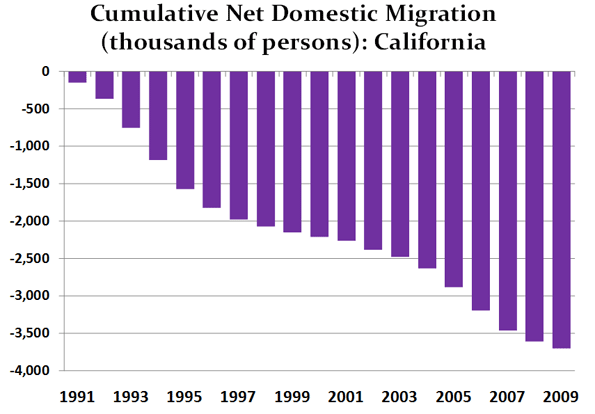
    How bad are things in California? California’s domestic migration has been negative every year since at least 1990. In fact, since 1990, according to the U.S. Census, 3,642,490 people, net, have left California. If they were in one city, it would be the third largest city in America, with a population 800,000 more than Chicago and within 200,000 of Los Angeles’ population.

    We’re seeing a reversal of the depression-era migration from the Dust Bowl to California. While California has seen 3.6 million people leave, Texas has received over 1.4 million domestic migrants. Even Oklahoma and Arkansas have had net-positive domestic migration trends from California.

    Those ultimate canaries in the coal mine, illegal immigrants, recognize California’s problems. Twenty years ago, about half of all United States illegal immigrants went to California. Today, that’s down to about one in four.

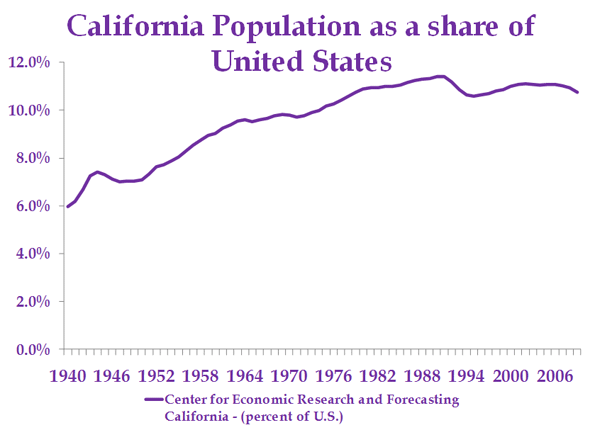
    The result of these migration trends is that California’s share of the United States population has been declining.

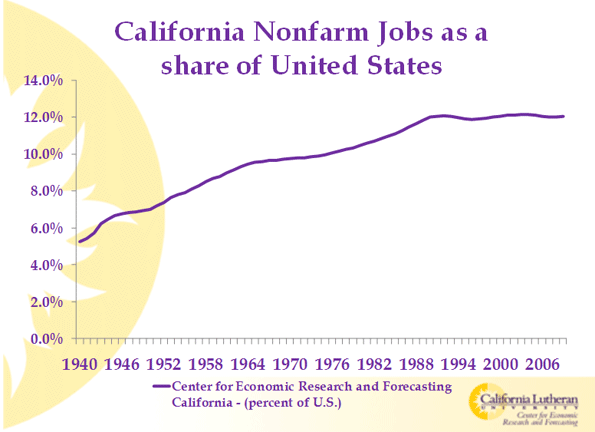
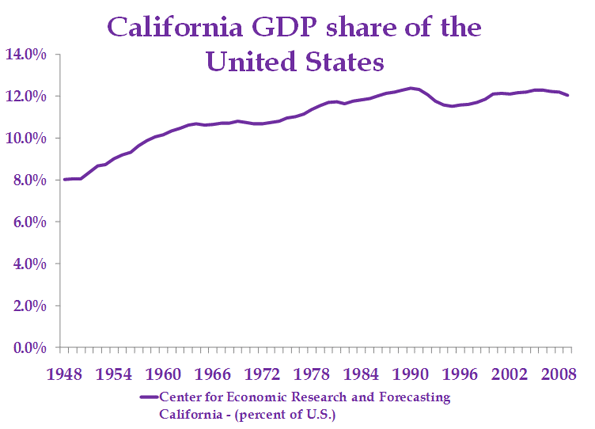
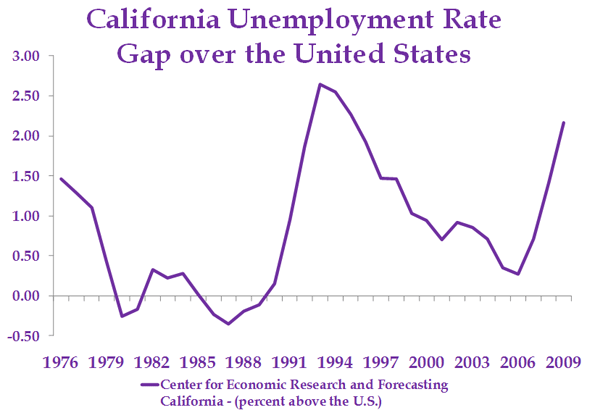
    What do these migrants see that so many of California’s political class do not see? They see a lack of opportunity. California’s share of United States jobs and output has declined since 1990, and its unemployment rate has remained persistently above the United States Average, only approaching the average during the housing boom.

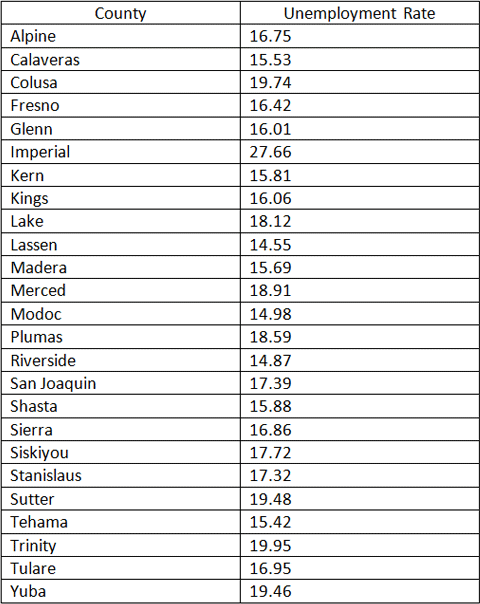
    California’s unemployment is particularly troubling. As of October 2010, only two states, Nevada at 14.2 percent and Michigan at 12.8 percent, had higher unemployment rates than California’s 12.4 percent. California’s unemployment problem is particularly severe in its more rural counties. Twenty-five of California’s 58 counties have unemployment rates higher than Nevada’s:


    These unemployment rates approach depression levels. Some will excuse many of them because they are in agricultural areas, but many assert that low Midwest unemployment rates are due to a booming agricultural sector. Which one is it?

    California’s unemployment problems are not limited to rural and agricultural areas. Most of Riverside County’s population is very urban, yet the County’s unemployment rate is 14.87 percent. On December 7th, the Wall Street Journal listed the unemployment rates for 49 of America’s largest urban regions. California had six of the 19 metro areas with double-digit unemployment. These include such major cities San Diego, San Jose, and Los Angeles.

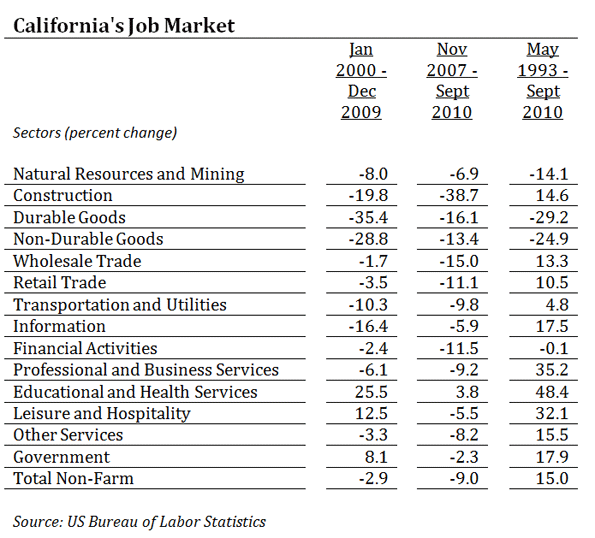
    Just as rural areas are not California’s only depressed areas, agriculture is not California’s only ailing sector. From 2000 to 2009, the only California sectors to gain jobs were government, education and health services, and leisure and hospitality.

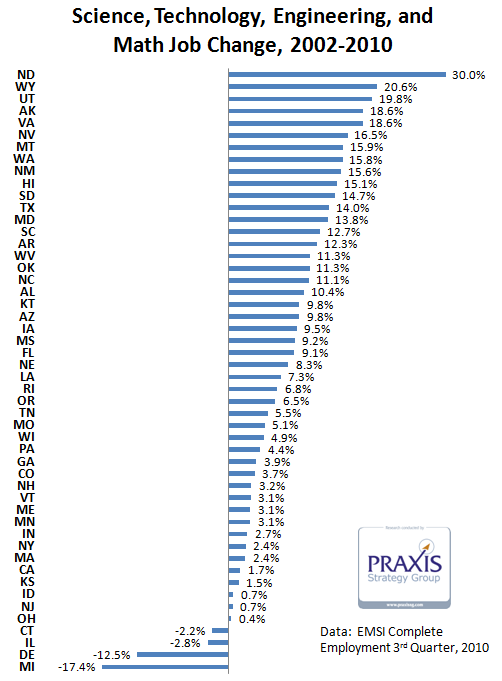
    California’s cheerleaders claim that the state’s future is assured by a vibrant tech sector, but the data do not support that assertion. North Dakota’s Praxis Strategy Group has performed analysis by job skills. They compare Scientific, Technical, Engineering, and Math (STEM) jobs across states. Their analysis shows that California is the Nation’s ninth worst state in creating STEM jobs in post dot-com-bust years. It has produced far fewer new tech jobs than Texas, and far less on average, than the country over the past decade:


    In this respect, California’s precipitous decline is really quite shocking. In just a couple of decades, California has gone from being America’s economic star, a destination for ambitious people from around the world and abundant with opportunity, to home of some of America’s most distressed communities. It has been a man-made, slow motion tragedy perpetuated by a political class that is largely deluded.

    The cheerleader’s faith in command and control regulation and environmental purity is so strong they cannot see anything that contradicts that faith.

    But that faith is misplaced. Joel Kotkin, Zina Klapper, and I performed an extensive review of the economic impacts of one of California’s most important greenhouse gas regulation, AB 32, and found that command and control regulation in general and AB 32 in particular is inefficient, cost jobs, and depress economic activity. California’s Legislative Analyst’s Office agrees, as evidenced by this report.

    More depressing still are the growing ranks of what could be called “the resigned”. They simply have given up. These include a business leadership that is more interested in survival and accommodation than pushing an agenda for growth. Easier to get along here, and expand jobs and opportunities elsewhere, whether in other states or overseas.

    Yet ultimately California’s future is what Californians make of it. No place on Earth has more natural amenities or a more benevolent climate. No place has a location more amenable to prosperity, located between thriving Pacific Rim economies and the entire North American market. No place has more economic potential.

    But unless policy is changed, California’s future is dismal, with the specter of stubbornly high unemployment, limited opportunity, and the continued exodus of the middle class. California’s political class needs first to confront reality before we can hope to avoid a dismal future.

    Bill Watkins is a professor at California Lutheran University and runs the Center for Economic Research and Forecasting, which can be found at clucerf.org.

    Photo by Stuck in Customs

  • Are Developers Greedy, Or Just Misunderstood?

    Construction starts in Australia, like much of the English-speaking world, are falling across a spectrum from commercial to retail, industrial and housing. Construction industry jobs – one of the few sources for well compensated blue collar employment – are going with them. Yet developers, the very group who would create these jobs, continue to suffer a poor public image. Why, and can it ever be improved?

    The Reserve Bank of Australia’s recent move to increase interest rates was not well received by the development and construction industry. Housing and non-residential approvals are in a general slide and a widely reported lack of new supply in housing is compounded by private sector commercial development at a virtual standstill, with development finance the most widely cited culprit. According to the UDIA, construction industry jobs are down by around 25,000 in just one Australian state, the formerly booming Queensland. That’s a lot of incomes not being spent in the economy.

    Yet despite these problems, developers aren’t exactly being courted by policy makers or regulators. Quite the opposite – politicians still regularly throw the mud at the very industry which holds a key to improving housing supply and construction industry jobs. “I won’t stand by and let greedy developers get away with … blah blah blah.” You’ve all heard it before. Denial, pass the buck and shoot the messenger continue to be preferred defensive tactics of politicians responding to industry complaints of excessive regulation. Labeling all developers “greedy has about as much validity as suggesting all politicians are corrupt simply because a handful break the law, but the latter (politicians) continue to target the former (developers) – and get away with it.

    It’s not just the politicians of course. Many regulators and planners, if you believe the horror stories, have taken an adversarial stance to development assessment whereby the developer is regarded with suspicion from the outset. The regulators don’t see themselves as facilitators of new activity but as ‘growth managers’ exercising every precautionary principle known in a bid to slow, curtail, check and re-check the consequences (real or imagined) of a proposal.

    Then there’s community opinion, which puts developers and real estate agents and used car dealers into the same category. Development proposals that align with local or state planning schemes, and which may have already jumped through several hoops before a public airing, are often widely rejected via the pages of the local press. This isn’t just NIMBYism, because the target of hostile public complaint isn’t the planning scheme or the local or state politician who endorsed it, but the developer applicant who is simply complying with the scheme’s intent. Irrespective of how green, how sustainable, how rational or how much needed the proposal may be in community or economic terms, it’s the developer who gets the bad press.

    Why is it that developers just can’t win?

    I’ll venture a theory that many readers won’t like. Developers are too meek, too obsequious, too prepared to be thrashed with a wet lettuce and succumb. With rare exceptions (Stockland’s Matthew Quinn is one) developers rarely comment publicly about the problems imposed on the industry by excessive and growing regulatory burdens. The allegations of land banking, of profiteering, greed, opportunism, social irresponsibility and environmental vandalism are too infrequently challenged in the public domain.

    Some blame no doubt lies in the politicization of development assessment: development is no longer an exercise in market and land economics, but a political game. Political intervention in planning schemes and the ability to kybosh proposals means that developers need to be acutely sensitive to political trends. Throwing back the facts and arguing the case publicly may not win political friends, and developers certainly don’t need any more political enemies. But what that means is that as more mud is thrown, more mud sticks.

    It’s true that industry groups have their role to play in advocating development industry positions and promoting the benefits the industry brings, and by and large do a good job with the resources available. But is it also true that developers themselves tend to hide behind their industry groups in a sort of ‘good guy, bad guy’ act where industry group executives are left to do the sledging while developers do the schmoozing?

    I recall a meeting with a Government Minister some years ago, dealing with a mounting problem in the Minister’s Department which threatened to cost the industry dearly. The meeting was civil but the issues weren’t danced around – “a full and frank discussion” might be its best description. The Minister was getting the message, loud and clear. But then, at the close of the meeting, the developer representative left the Minister with the comment that “Minister, thanks for your time and we want you to know you’re doing a great job.” Bang, pop – the pressure was instantly deflated. That Minister no doubt reported to their colleagues that the industry was pretty put off but didn’t present a political problem.

    Perhaps asking individual developers to publicly challenge the opprobrium being thrown at them and defend themselves more aggressively is akin to asking them to paint a target on their forehead saying ‘shoot me’ But perhaps they can take a hint from Australian farmers. Farmers, thanks to aggressive environmental politics, were copping all the bad press from tree clearing and land erosion to fertilizer and herbicide runoff. Somehow the community was allowed to forget that without farmers we don’t eat, they responded. The ‘Every Family Needs a Farmer’ campaign was a defensive community education campaign, designed to build more empathy amongst urban consumers of the issues faced by farming communities. The campaign has run through several incarnations over several years, and was no knee-jerk, one-off exercise.

    Now if Australian entrepreneur Dick Smith can fund a TV documentary and anti-growth campaign single handed, you’d think the entire development industry could manage something in its own interests, especially when those interests are closely aligned to the interests of the community. You wouldn’t call it ‘Every Family Needs a Developer’ but you could start with a few things that the community as a whole seems to have forgotten:

    • Almost every street and the houses in it, in every neighborhood, is the result of a developer at some stage taking a risk.
    • Every shop in every high street, and every shopping mall your family visits, is the result of some developer at some stage, taking a risk.
    • Almost every workplace, whether it’s a medical centre, a factory, or an office building, is the result at some stage of a developer taking a risk.
    • Increasingly, many of the schools, roads and community facilities that we enjoy are funded through the activity of developers.

    The homes we will need so that people aren’t sleeping on the streets won’t be provided by governments, or politicians, but by developers. The economy that we need to feed our families and support our aged and infirm, relies heavily on developers and the construction jobs that flow from them.

    Many developers go broke trying, and in doing so they lose their own money, not public money. It’s a high risk venture where certainty is essential. It’s not an industry where the public sector has ever shown much of a track record – witness the billions squandered on public housing programs which produce very few roofs.

    Developers have legitimate concerns about the cost of doing business. It means their costs to the consumer,in the form of houses young people can’t afford, or rents that businesses struggle to pay, are higher than they need to be. It’s not developers making this happen; it’s regulation.

    At the end of the day, developers can sit back and wait for more mud to be thrown, or begin to defend their reputation, and to defend the need for growth.

    Is there anything to be lost by trying?

    Ross Elliott has more than 20 years experience in property and public policy. His past roles have included stints in urban economics, national and state roles with the Property Council, and in destination marketing. He has written extensively on a range of public policy issues centering around urban issues, and continues to maintain his recreational interest in public policy through ongoing contributions such as this or via his monthly blog The Pulse.

    Photo by Scorpions and Centaurs