Blog

  • Retro Rail Alert

    The New Zealand Government recently decided to follow the example of Montreal and Toronto by amalgamating the six City councils and the single Regional Council of the Auckland Region to create a united “Super City” of 1.4 million people.

    Like similar amalgamated bodies, the new Auckland Council, which came into being on the 1st November, 2010, has fallen for the notion of regionally determined smart growth built around a huge investment in heavy rail.

    Backed by a Regional Council totally committed to Smart Growth, every decision was driven by the need to “get people out of their cars” rather than to improve mobility. Since the 1990s they have fought for densification as a means of enabling more public transport. The bus lanes linking the north shore to the CBD are for buses only. HOVs are not allowed on and nor are shuttle buses. The planners openly argue that the near empty lane is to encourage people to get out of their cars on the congested motor way lanes and take the bus. Also they are inserting bus only lanes into our already narrow urban streets. Cars are just being crowded off the streets.

    Consequently, congestion has grown progressively worse, but this was seen as only further evidence of the need to invest in rail.

    Many of us thought that the election which replaced the Labour Government with a coalition of National and Act, two conservative-leaning m parties of the Right, would put an end to this “trip backwards to the future”.

    But, as has happened elsewhere, the Right adopted the policy while the Chambers of Commerce and similar groups championed the mega-amalgamation on the grounds of efficiency. They saw huge savings to be made in having only one Mayor and one council, and one plan, and one rate, and indeed, ideally only “one of everything”.

    Yet instead of searching for a new, modern way to develop this region, Len Brown, the left of center first Mayor of the Auckland Council has backed a “Vision for Auckland” built around an extensive rail network – including a rail link to the Airport, a CBD rail loop, light rail on the surface streets, and a rail tunnel under the Waitemata harbour.

    Residents of surrounding areas may not share this Vision – especially if they have to share the costs. This is the kind of division that led to Montreal’s recent de-amalgamation.

    The Mayor supports his Vision with claims that professional analysis and expert advice will show that these projects are viable and necessary and that Government must fund them.

    One has to wonder where he gets his advice from.

    No investment in rail in New World cities since the 1980s has resulted in a reduction in congestion. In most cases congestion has increased and public transport market share has diminished because the investment into rail has diminished funds for roads, buses and High Occupancy Toll lanes, measures that actually work to increase mobility

    The Government should also be aware that the international engineering firms at come in behind these proposals for rail investment (and similar major project works) have a proven expertise in getting a foot in the door with low bids then cranking up the costs afterwards. These projects routinely come in over budget.

    Furthermore, some research reveals that Heavy Rail (as is proposed for the Auckland network) has a worse record for cost overuns than Light Rail projects. Early projects have a worse record than more recent projects, possibly because the tendering firms have gained experience over time in how to fool the public, and the population with low ball estimates of cost and exaggerated estimates of ridership.

    Megaprojects and Risks: and anatomy of ambition.” (Click on the link to read the Public Purpose review.)

    This has become a clearer pattern, as seen in projects as diverse as the English Channel Tunnel, the Great Belt rail-road bridge between Zealand and the Jutland Peninsula, and the Oresund road-rail bridge between Copenhagen and Malmo, Sweden.

    So this is not just an American problem.

    The “Chunnel” trains, for example, were projected to carry 15.9 million passengers in the first year of operation (1995) but by the sixth year (2001) ridership was 57% lower at 6.9 million. The cost overrun was 79%.

    The Flyvbjerg data set of international studies, including rail and road schemes, contained 258 projects.

    • 90% had significant overrun of costs.
    • Rail projects had the highest cost escalation (45% over)
    • Road projects had the lowest escalation (20% over)
    • The average ridership was 61% of forecast and the average cost overrun was 28%.

    The figures for rail alone were worse.

    An even more pessimistic summary of performance is contained in a power-point presentation by Lewis Workman of the Asia Development Bank, Predicted vs. Actual costs and Ridership – Urban Transport Projects, May 2010.

    This presentation notes that the problem is actually worse in developing countries. The Bangkok metro “actual ridership” fell short of the projections by 55%. The authors ask the question “Lies or Incompetence?” and their answer is “Probably Both.”

    New Zealand’s Minister of Transport, Stephen Joyce is well prepared to shout louder than the “one voice” of the new Auckland Council. In September 2009 he warned that the Government is committed to spending NZ$500m on the city’s rail electrification projects – but funding cost over-runs is not an option.

    His officials have identified up to $200m of potential cost over-runs in the NZ$1.6bn project, which is still on the drawing board.

    One of the first rail upgrade contracts demonstrates his concerns are justified.

    The Manukau Rail Link was initially estimated to cost NZ$40 million [2006] which subsequently rose to NZ$72 million [2008] and the latest figure is NZ$98 million. This is for a 1.8k link and station southwest of Manukau CBD.

    The Minister should hold fast to this position. But maybe he should also hold fast to the position that Auckland Council will not be compensated for any revenue shortfalls on account of lower than projected ridership.

    Maybe the Auckland Council would then take on board the remedies for these “foot in the door” feasibility studies, or get those who make the studies to stand behind them with some form of guarantees backed up by insurance.

    The recent experience with BART suggests that US politicians should learn to play equal hard-ball.

    Similarly the 5 km BART connection to the Oakland Airport (on the East Bay) was originally projected to cost $130 million and cater to more than 13,000 passengers daily. However, after a decade of delays, those forecasts have been changed to $484 million – a cost increase of say 250%, and 4,350 passengers a day – a ridership shortfall of say 60%.

    The crystal balls are not getting any clearer.

    Consequently, according to a study by transport planners Kittelson and Associates, each new passenger who uses the system during its estimated 35-year lifespan will be supported by a subsidy of $102 – on top of the fares they pay. This is more than 10 times the original projected subsidy of $9 per new passenger. This combination of cost overrun and ridership shortfall has had a catastrophic effect on the viability of such projects.

    But the boosters are not deterred. They say it should be built because “the community wants it”, which sounds familiar.

    The table below shows this the Oakland Airport rail link is clearly a project that should never be started. Even the “rapid transit” speed will not be delivered.

    Politicians’ Visions reward the citizens with nightmares.

    These large multi-national engineering consulting firms have become accustomed to treating Governments – both Central and Local – as giant ATM machines.

    It’s time to take away their plastic.

    Owen McShane is Director of the Centre for Resource Management Studies, New Zealand.

    Photo by bcran

  • Florida Goes Underground

    By Richard Reep

    Last year’s report that Florida had lost people marked a new low in our state’s boom-and-bust history. But this autumn’s news seems to surpass even that sorry milestone with a combination of sluggish tourism, empty state coffers, and a reputation as one of the top real estate foreclosure states. Florida just can’t seem to get out of its own way, and with the fourth highest population in the country, it could have competed with Texas to replace California as one of the best business climates in the nation. Instead, Florida, which boasts one of the lowest tax rates in the nation, continues to see businesses and citizens depart, with newly elected governor Rick Scott recommending even lower taxes as the best solution. Instead, it is high time that Florida fix its real problems of economic monoculturalism and anti-education policies that drive it further and further away from America’s future potential.

    It is no secret by now that a diverse income source is the only way to survive the Millenial Depression. States that have more than one income source, like Texas, were able to adapt policies to favor resilient businesses and industries. In Florida, despite loud and clear input to the state legislature, no change in state policies have been effected this year, once again making tourism and construction growth the focus of job creation.

    The tourism industry knows well its position as “first in, last out” when a recession hits, diversifying its products and geography, enabling at least something to run while everything else stands idle. Thus Marriott International, in the late nineteen eighties, invested in senior living facilities, which bore well through the 1990-93 recession. Regulatory burdens on this market segment eventually caused Marriott to focus on other, less regulated markets, and today its global diversity has caused the company to remain economically sustainable. Florida, with so much sunk cost in tourism, seems unaware that its former tourism dominance has been quietly replaced by such glittering destinations as Brazil, Dubai, and China.

    Agriculture is, of course, Florida’s economic mainstay: even in a recession, people must eat. This industry, however, employs a whopping 44,000 farmers, about a month’s worth of laid-off Florida workers. Clearly, the state should be looking elsewhere to create jobs.

    Governor-elect Scott’s vague promise to increase state venture capital spending while cutting taxes is amusing, in light of similar promises from past politicians. While the state’s Capital Formation Act has attracted investment in biomedical clusters, it takes a great deal of spending to sustain this fund. Similar promises created tax incentives for the film industry, which built studios in the nineteen nineties. Then, when the going got rough, these subsidies evaporated, and the studios promptly moved to New Mexico.

    The money for such schemes comes from the same place that Florida politicians seem to always find money: the education system. Florida, after struggling to get up to 27th in spending per pupil, seems about to find out what it is like to be 50th. And this is a last place finish the state should avoid.

    An educated population can adapt more easily to the changing times, can more competently choose its leaders, and can create wealth for itself. None of these qualities have been demonstrated by Floridians in recent years (think of the 2000 election) and, if the newly elected leadership has its way, none are likely to spring forth in the near future either.

    Florida’s two best hopes are to invest more in its public education system, not less, and to diversify its economy. Recent immigrants from states like Wisconsin and New Jersey, where schools are well funded and taken seriously, express shock and dismay at the public schools in Florida. While states like New York debate the worth of comprehensive assessment tests, Florida has been busy distilling its education system down to a teaching-the-test model, producing little else but test results. Regaining an educated, aware citizenry is critical if the state is to see a future as a contributor to the nation’s recovery.

    The potential to diversify its economy remains strong in Florida. Instead of lowering taxes, however, the new state leadership would do well to consider a more guided regulatory approach that favors a diverse economy. Come and gone are many industries which could return with the right incentives: aviation training, movies and television, solar energy research, and the space program. Research, manufacturing, and commercial jobs in all of these industries could contribute to a rebirth of Florida and spark investment that would produce lasting results.

    Florida’s tax climate favors business, but is oddly mismatched by its regulatory climate. The dodged a bullet with the failure of Amendment 4 – a proposal that all new development would have to face a public vote – and the state’s development industry congratulated itself heartily on this success. This proposal made the ballot because of the cumbersome development process regulated by the state’s Department of Community Affairs, which has widely been perceived to fail at its task, protecting neither nature nor the quality of life for its citizens. Whether or not the new governor gets his wish to eliminate this bloated state bureaucracy remains to be seen, but regulatory reform in the state’s development codes needs to be in the works.

    And tourism, which has been a great economic engine, has a chance to come back. Florida will always be a destination, and while other world places have leapfrogged ahead, tourism is highly competitive, as destinations age rapidly. The enduring romance with Florida will continue, but its famous beaches and theme parks will need to reinvent themselves bigger and better than ever. With a new Legoland in the design phase, and redevelopment at some of the world’s most hallowed ground in the Magic Kingdom, tourism’s long-term future bodes well.

    The smoke has cleared from the election battles. Now, more than ever, Florida’s leadership should be nurturing a more educated citizenry and reforming its regulatory system, rather than keep its tax system at ultra-low levels, to pull itself out of this nosedive. Florida’s natural advantages in climate and accessibility make it ideal for such a wide variety of businesses that very little should stand in its way to diversify the economy and create a productive, vibrant, educated workforce.

    Richard Reep is an Architect and artist living in Winter Park, Florida. His practice has centered around hospitality-driven mixed use, and has contributed in various capacities to urban mixed-use projects, both nationally and internationally, for the last 25 years.

    Photo by Captain Kimo

  • Could the Dallas Way be the Right Way?

    Dallas was George W. Bush’s first choice for a retirement destination but it gets low approval ratings elsewhere. A recent poll of readers of American Style magazine rated Dallas only 24th out of 25 large American cities as an arts destination. It came in immediately behind those well-known cultural magnets Milwaukee and Las Vegas, and ahead of only Jacksonville FL, even though it dwarfs all three places in terms of population, arts institutions and urban amenities. An apparently typical assessment residing in the blogosphere states flatly “God I hate Dallas. Everything about it. Especially the airport. Which is the only part of Dallas I’ve ever been in.”

    There has always been urban rivalry, going back at least to the days of the Greek city-states. When Phoenix overtook Philadelphia in the census rankings some years ago, the local newspapers delighted in printing unflattering pieces about the other and extolling their own virtues.

    Increasingly, this rivalry goes beyond traditional boosterism. Cities used to be places where one lived, but they have become metaphors about lifestyle and identity, and the personal has become increasingly highly political.

    In the last presidential election, the former mayor of Wasilla, Alaska seemed to argue that small towns were the keepers of the true American flame, which upset quite a few urbanites. But not all cities are created equal. The creative class thesis suggests that, like high school, there is cool and there is un-cool. This gets complicated when the nerds decide the cool places are. Cities that are designated as cool, like Portland, also tend to be among the least ethnically diverse.

    In short, we are now quarrelling about which cities are the coolest, based upon the extent to which they serve as extensions of our personalities and manifestations of our identities. This has always existed in terms of local rivalries—New York and New Jersey, Minneapolis and St. Paul—but now it is taking on the characteristics of cultural civil war.

    In this scheme of things, Dallas ranks among the totally uncool, which is probably one of the reasons George Bush chose it. But reputation is not necessarily its reality, as visitors to the city can find out for themselves. On a recent Friday afternoon downtown, I saw a line of school buses jostling to drop off and pick up their passengers ranging from young children to strapping adolescents. Every ethnicity seemed to be represented. They were not going to a sports event represented but regular traffic to the Dallas Arts District, a contiguous area amid the high rises that covers 68 acres and contains a broad array of theatres, museums and the city’s Arts Magnet school.

    Texas is hardly short of arts destinations: San Antonio ranked high in the American Style poll, as did Austin, which is known for its South by Southwest and Austin City Limits music festivals. Although Dallas does not automatically come to mind when thinking about highbrow culture, its Arts District is not just a vanity project, but is part of a restructuring of the city’s image taking shape for over three decades. The Arts District was anchored by the opening of the Dallas Museum of Art in 1984; this was followed by the Myerson Symphony Center [designed by I.M. Pei], the Crow Collection of Asian Art, the Nasher Sculpture Center, and the renovation of the Booker T. Washington High School for the Performing and Visual Arts [Norah Jones is an alumna]. Most recent to open is the AT&T Performing Arts Center, the fourth of the cultural buildings to be designed by a prize-winning architect.

    Most metro areas would delight in this kind of enhancement. Yet Harvey Graff, in his book “The Dallas Myth” suggests the city has grown by “brash boosterism”. He argues the ‘Dallas Way’ of getting things done involves an existential denial of the past [especially negative events, notably the Kennedy Assassination] and an equally strong denial of any limits to the future.
    Graff believes that the Dallas Way fails its residents. He argues little, if anything, has been done for poorer neighborhoods. There is substance to this of course: all American cities reflect the inequalities of our society

    Yet what Dallas is doing is still remarkable. In addition to the Arts District, it is pursuing costly projects such as the DART light rail network, which is connecting formerly neglected neighborhoods [now reviving to create a new Uptown] and reaching out to middle suburbia, where whole plazas are sprouting Asian stores and restaurants. No-one is going to be confusing it with New York any time soon, but it does seem that the Dallas Way also has things to recommend it. House prices have not cratered; the Metroplex is not in the fifth circuit of foreclosure hell like Phoenix or Las Vegas.

    Of course, this comes at a literal price, and a figurative one. Reviving some neighborhoods means gentrification. Spending on light rail tends to support young adults rather than children needing kindergartens. Stable house prices in some Dallas neighborhoods can mean modest homes costing more than a half million dollars, the antithesis of affordability.

    Yet the growth machine worked in the past and helped Dallas become a leading producer of higher end jobs and a high degree of home ownership. In many ways Dallas works better for its diverse residents than many urban aesthetes might suggest.

    This leaves unanswered the question of the aspirations of a city like Dallas to be taken seriously by the urban tastemakers. In the current climate, that seems unlikely. Cool is going to beat out the rest—except in the contexts of jobs and incomes, which is the world in which most people operate. Economic growth in Dallas and Houston gets little attention in the chat rooms where the defenders of Portland and its counterparts congregate. But as for me, I’m thinking that for the very first time, George Bush might actually be right.

    Andrew Kirby has been associated with the journal *Cities* for nearly thirty years. He is based in Arizona.

    Photo by purpletwinkie

  • Home Sweet McMansion

    Is the new American house, with three-car garages and laundry chutes like Olympic ski runs, an improvement over the old ones that were limited to a cozy dining room, a den, and a kitchen that held a small round table on which was kept a toaster?

    The size of the American house tracks the evolution of the budget deficit and national debt. Think of McMansions as you would the Federal Reserve Bank—an imposing edifice with the contents of the garage pledged to Household Finance, if not the Chinese.

    Many neighborhoods have become the United States of Gatsby.

    Because I live in Europe but travel across America to visit family and friends, I will start my appraisal in the guest room.

    In my wanderings, I have slept on bunk beds, fold-out sofas (one called “the rack of pain”), camping mats oozing air, and luxury, king-sized mattresses, suitable for a sultan. This summer, I woke up in the middle of the night to find two dogs nestled against my feet. My only objection was when they chose to growl at each other at 3:00 a.m.

    What makes a great guest room? My tastes are idiosyncratic, but I like a room that has bookshelves, a good reading light, a clock that works, a large desk, Wi-Fi, windows that open onto cool air, the distant sounds of trains in the night, hooks instead of closet hangers, and a cat that buys into guests.

    Instead of television, I prefer a radio beamed up to the BBC World Service and a side table of magazines (ones devoted to gardens, yachts, and celebrity divorces are the best) that I would never buy or read, unless I were a guest. I like coming down in the morning with up-to-date information on Jody Foster’s career. (She’s loyal to Mel Gibson, despite his crazy rants.)

    Having been recently in Pennsylvania, North Carolina, and New Jersey, I can report that the American guest room is alive and well. As for the rest of the new American home, the jury is out, or least meeting with the architect to design several thousand more square feet of pool rooms, wet bars, conversation pits, walk-in closets, and fireplaces that ignite with jet propulsion.

    When I last lived in the United States in the 1990s, our kitchen was the size of a pantry. If I held my arms outstretched, I could almost touch both walls, and the length was less than that of a stretch limo (literally and figuratively, imagine the oven in the trunk).

    Nevertheless, that kitchen was a perfect place to feed a family of four, prepare a dinner party, and hold a conversation. The cost to renovate the kitchen was about $900, but that’s because we went with a “custom” linoleum countertop that fit around the stove top. The overhead light came from a closed New York City school. A neighbor, whose services we won at a charity auction, repainted the cupboards.

    Now the American kitchen is the size of Polynesia and comes with archipelagos of “islands,” a nearby “family room,” television screens that could track a lunar launch, machines that dispense coffee and boiling water on demand, hidden drawers that contain freezers, enough marble to impress the Emperor Aurelian, and appliances that give the room the air of an operating theater.

    The “new” kitchen is designed to celebrate the diversity of American families—imagine Thanksgiving with the Brady Bunch, maybe over at Bill Cosby’s house—although best as I can judge from my travels, these tribal nations rarely eat together, in the kitchen or anywhere else.

    Like nomads, children and adults wander through the new American kitchen as if it were the Serengeti, collecting food and drink until the grazing land is stripped, and then they head off to a cave, to surf the web, text, or watch movies.

    I would say that the herd goes to the living room, but I haven’t seen anyone in an American living room since “Gunsmoke” was aired during the Eisenhower administration.

    Part of the reason that living rooms are now as forlorn as a safe house is because the television is elsewhere and because there are few formal occasions to sit in the American living room, which often looks as though it could be hired out to a funeral parlor.

    As a guest, I am sometimes granted a living-room audience. As a rule of thumb, however, Americans prefer to talk to their guests when standing up in the kitchen or sitting outside on the porch.

    Porches are one of the few areas of the house that modern architecture has improved. Screened porches used to be small and cramped, with patches on the screen where the bugs had drilled holes in the night.

    In places like Florida, there are now screened porches that are the size of the backyard; in fact, they are the backyard, and the netting and enclosed jungle trees give the terrace the air of a film location on “Survivor.” But I admire anything that allows me to sit outside, beyond the reach of mosquitoes. I also like the practical evolution of the outdoor kitchen, even though the idea seems better suited to the Roman senate.

    Part of the reason that many new American houses lack a central focus (think of the courtyard in a Spanish hacienda or an English fireplace) is because television is the high alter of fleeting attention, and screens pop up in all sorts of diverse places, as though part of a billboard campaign.

    I have seen televisions in the basement, in small dens, in exercise rooms, on kitchen and living room walls, and on small robotic arms that shift the blue haze around the bathroom as if it were yet another jet spray coming out of the shower or Jacuzzi.

    Nevertheless, television watching is a solitary endeavor and programs could be beamed into headsets, for all they foster family or community. Its effect on house layout is put up electronic walls that the architects have spent thousands of dollars to remove, in the spirit of open design.

    In my experience, happy houses are those that work in spite of their obvious flaws, like all those New York City apartments that used to have a bath tub in the kitchen or farmhouses with large wood stoves just inside the kitchen door.

    In the 1970s, I loved visiting a house in Maryland that instead of a front hall had an indoor rock garden. The meals were cooked outdoors on an open flame, but no one left the dinner table before midnight, unless it was to go for beer (kept outdoors).

    The house in which I grew up had claw-footed tubs and one shower. Between 1961 and 1994, when my parents lived there, home improvements consisted of cosmetics and painting (sometimes carried out by one Larry W. Jones, who was a family legend for his ability to paint windows shut).

    For years, my parents resisted “improving” the kitchen, because the walls had hand-painted fruit trees and it reminded them of a European café. Nor did they touch the wallpaper in the hall, which had similar scenes of the French revolution.

    When they sold the house, the new owners, no doubt in counterrevolutionary horror, tore it down and put up a McMansion, although I have a hard time imagining that they were able completely get rid of all the “fraternité” that would have been lodged in the walls.

  • China’s Urbanization: It Has Only Just Begun

    In May, disgruntled workers of Honda factories in Zhongshan, southern China, went on strike at the Honda Lock auto parts factory and started posting accounts of the walkout online, spreading word among themselves and to workers elsewhere in China.

    In June, Bloomberg reported that China, “once an abundant provider of low-cost workers, is heading for the so-called Lewis turning point, when surplus labor evaporates, pushing up wages, consumption and inflation.” China had depleted its surplus labor; the period of cheap labor was over.

    In the subsequent debate, some observers concurred with the observation that a turning point had arrived in China. Others noted that the conclusion is too simplistic because it does not fit into the big picture of China’s demography.

    With the gloomy economic prospects in the advanced economies and relatively strong recovery in the large emerging economies, the debate is about to resurface.

    Eclipse of “Unlimited Supplies of Labor”

    In 1954 Arthur Lewis published one of the most influential development economics articles, “Economic Development with Unlimited Supplies of Labor,” which contributed to his Nobel Prize a quarter of a century later. In this paper, Lewis sought to provide a broad portrayal of the development process, based on the current state of the developing countries, the historical experience of developed countries, and some central ideas of the classical economists.

    In the Lewis story a “capitalist” sector develops by taking labor from a non-capitalist backward “subsistence” sector. At an early stage of development, there would be “unlimited” supplies of labor from the subsistence economy, which means that the capitalist sector can expand without the need to raise wages. The implication is that industrial wages in developing countries begin to rise quickly at the point when the supply of surplus labor from the countryside tapers off.

    Lewis likely would have recognized the validity of his tipping point in the more prosperous first-tier cities of China where there clearly are increasing labor shortages and which thus reflect the world of classical economics. However, had he taken a tour in China’s smaller cities, or ventured into the countryside, he would have recognized there still remains “unlimited supplies of labor” – the world portrayed by the classical political economists, including David Ricardo, Adam Smith, and Karl Marx.

    So has China reached the Lewisian tipping point? The answer is yes and no: in some regions yes, but in all of China, emphatically n no.

    Urbanization and Growth through Tiered Cities

    Starting in the 1980s, China’s reform and opening up were initiated by the creation of the coastal special economic zones (SEZs), initially in the southern province of Guangdong, close to Hong Kong and Macao. Soon the reform extended from urban agglomerations such as Shenzhen and Guangzhou to other primary cities, from Beijing to Shanghai – thanks to the colossal investment projects in Pudong which turned the swampland into an emerging global financial hub.

    During the past decade, the economic success of these megacities has been spilling over into other tiers of Chinese cities. Even before the onset of the global financial crisis, second-tier cities – such as Suzhou, Tianjin, Shenyang, Chengdu, Dalian and Chongqing – had already attracted significant attention with investments from global corporate giants.

    At the same time, third-tier cities, from Ningbo and Fuzhou to Wuxi and Harbin, have been following in the footprints of first- and second-tier cities. Behind these three tiers of rapidly-growing urban agglomerations, there are still others such as Kunming and Hefei, seeking to take advantage of the urban growth trajectories.

    Some 60 years ago, Lewis saw something similar in several developing countries, with their polar opposites, vibrant and modern cities, and sleepy and traditional rural villages. “There are one or two modern towns, with the finest architecture, water supplies, communications and the like, into which people drift from other towns and villages which might almost belong to another planet.”

    Migration and the Turning Point

    Paced by strong economic growth, China’s leading megapolises are also evolving very fast. The urbanization that took almost a century in the West is occurring in a decade or two in China. In 1979, Shenzhen was still a poor fishing village with some 20,000 inhabitants. In 2009, it had a population of 9 million, and income per capita exceeded $13,600, only $3,000 less than in Taiwan or South Korea. Now Shenzhen plans to achieve an average GDP per capita of $20,000 by 2015, the level of European countries, such as Portugal and Slovenia. In the latter, the real GDP growth will be more subdued in the coming years, at best. In Shenzhen and China’s other megacities, it will be around 10%.

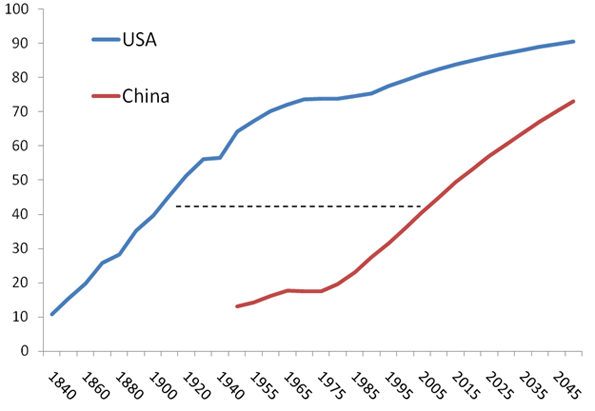
    Yet, despite these colossal shifts, China’s urbanization still has a long way to go. In 1980, the U.S. urban population was 74% of the total; China’s comparable figure was only 19%. Today, America’s urban share of the population is more than 80%, whereas China’s remains less than 50%. Taken into consideration China’s colossal size and development level, this gap suggests extraordinary potential. In 2025, America will have two cities (New York and Los Angeles) with more than 10 million people, three with 5-10 million and 37 with more than a million. By then, China will have five cities with more than 10 million people, 9 with 5-10 million, and almost 130 with more than a million. Viewed this way, China’s urbanization has barely begun (Figure 1).

    Figure 1: Percentage of Urban Population: United States and China

    Winning China’s West
    If Lewis had spent even some time in the rural China or the emerging new tiers of cities, he would have associated them with the world of “unlimited supply of labor”.

    During the past three decades, migrant laborers have played a key role in China’s economic growth in the first-tier cities. Now as living costs rise fast in Beijing, Guangdong, and the Yangtze River Delta region, employment prospects are improving in the inland cities and the West.

    Since the early 2000s, the new “Go West” policy covered the huge municipality of Chongqing, six provinces, from Gansu to Sichuan and Yunnan, and five autonomous regions. At the time, this region accounted for almost 30 percent of China’s population, but less than 17 percent of its GDP. Initially, the policy focused on the development of infrastructure (transport, hydropower plants, and energy and telecom establishments). But it is the new stage of development in eastern China that is now dramatically accelerating growth in the West.

    Even before the global financial crisis, the Ministry of Commerce designated more than 30 “priority relocation destinations” in China’s inland to increase the share in the processing industry in central and western areas, especially in labor-intensive manufacturing.

    In the future, China’s West hopes to catch up with its East through domestic consumption, cost advantage, investment policies and infrastructure, which has been boosted by the nation’s stimulus policies. China’s West is about to experience a revolution in durable consumer goods, from color TV sets to refrigerators. True, the volume of retail sales remains higher in China’s East, but sales growth is stronger in the non-coastal areas.

    As costs have risen, China has lost some jobs to Bangladesh, Vietnam and Cambodia, primarily for cheaper, labor-intensive goods like textiles, simple electronics, and toys. Yet, China’s West still offers many of the comparable benefits and an emerging infrastructure.

    The Decades to Come

    In the next two decades, China’s urbanization is expected to boost domestic demand by $4.5 trillion, which should assure a stable economic development even if exports decline. In effect, the urban migrants’ demand for housing is likely to become the largest driving force for China’s economic growth in the future.

    During the past three decades, the share of China’s city dwellers has more than doubled to 45 percent. And by 2040, the urbanization rate is expected to be close to 67 percent. In the next three decades, the number of China’s urban residents is expected to grow by 360 million people to 970 million. In terms of current urban populations, this is the same as creating city space for entire urban America (260 million), Japan (85 million) and another 15 million people – within one generation.

    This great transformation, however, is predicated on sustained economic growth and a stable international environment. China’s first-tier cities are now coping with the coming of the Lewisian turning point/ The big story in the coming decades, will be the takeoff in the west and among many once peripheral cities. Due to China’s sui generis magnitude, this process will take another decade or two.

    Dan Steinbock is Research Director of International Business at India China and America Institute (USA), and Visiting Fellow at Shanghai Institutes for International Studies (China).

    China’s Provinces and Cities

    References

    1 Hamlin, K. et al. (2010), “China Reaches Turning Point as Inflation Overtakes Labor,” Bloomberg News, June 11.

    2 On the argument that China is coping with the Lewisian turning point, see Cai, Fang, Wang, Meiyan, 2008. A counterfactual analysis on unlimited surplus labor in rural China. China & World Economy 6 (1), 51–65.; Fang Cai, Meiyan Wang (2010), “Growth and structural changes in employment in transition China,” Journal of Comparative Economics 38 (2010) 71–81. On the argument that Lewisian turning point is years away, see Yang Yao (2010), “No, the Lewisian turning point has not yet arrived,” Economist, July 16, 2010; Roach, S. (2010), “ Chinese wage convergence has a long way to go,” Economist, July 18.

    3 Lewis, W. Arthur (1954). “Economic Development with Unlimited Supplies of Labor,” Manchester School of Economic and Social Studies, Vol. 22, pp. 139-91

    4 Steinbock, D. (2010),” Legacy of Globalization: Shanghai and Hong Kong as China’s Emerging Financial Hubs,” Policy Brief, Shanghai Institutes for International Studies, January 2010.

    5 These tiers of cities are evolving dynamically and through a national plan. With its more than 31 million people, Chongqing, for instance, is already one of China’s five national central cities. National central cities have a great impact around the surrounding cities on integrating services in infrastructure, finance, public education, social welfare, sanitation, business licensing and urban planning.

    6 In fact, Lewis’s classic article offers also another clue to assess China’s stages of growth. As far as he is concerned, small migrations explain little. In the 1950s, he noted, 100,000 Puerto Ricans emigrate to the United States every year. Still, it is Puerto Rican wages which are pulled up to the U.S. level. Mass immigration is quite a different kettle of fish. “If there were free immigration from India and China to the U.S.A., the wage level of the U.S.A. would certainly be pulled down towards the Indian and Chinese levels,” Lewis argued. In China’s economic development, the tens of millions of migrant workers have played the comparable role of pulling down the national wage level.

    7 In the beginning of the “Go West” program, the largest proportion of the West’s total fixed asset investment was in infrastructure. And almost half of China’s huge stimulus of $586 billion was earmarked for transportation, infrastructure and power grids. These, in turn, facilitate the exploitation of minerals, natural gas and oil in China’s West. In addition to the stimulation of domestic demand, the government’s strategy is to “cultivate areas of high consumer demand and expand consumption in new areas”.

    8 “China’s urbanization to fuel domestic demand,” China Daily, November 15, 2010.

    9 Steinbock, D. (2010), “Growth fueled by urban investment,” China Daily, February 25, 2010.

    10 On the international relations dimensions of China’s stages of growth, see Steinbock, D. (2010), “China’s Next Stage of Growth: Reassessing U.S. Policy toward China,” American Foreign Policy Interests, No 6, December 2010.

  • Looking Down Under for a California Turnaround

    At a time when government in California faces an existential crisis, it’s telling to observe a starkly different picture in Australia. Forty years ago, local officials in fast-growing suburban communities in Queensland, Australia looked to their colleagues in fast-growing suburban communities in California as kindred spirits. They began a tradition of trading annual exchange visits to compare notes. Last month I had the opportunity to participate in that exchange. This year’s gathering took place on the “Sunshine Coast” north of Brisbane. While California government seems paralyzed by the strains of the economic crisis, local government Down Under is leading constructive change.

    Fiscal crisis is so pervasive in California that some have questioned whether the nation’s largest state and the world’s eighth largest economy remains “governable.” Every year our state budget is held hostage to interminable partisan bickering. This year, a patently bogus deal was cut that left an estimated $25 billion gap over the next 19 months.

    Until recently, non-partisan local government maintained greater credibility. But with the City of Vallejo declaring bankruptcy, Maywood firing its entire workforce and Bell embroiled in a grotesque corruption scandal, most Californians fear the eclipse of the “California Dream.” Widespread unemployment, home foreclosures, budget meltdowns and severe cuts in government services are the most obvious symptoms. But there’s a growing disconnect between angry voters and their government.

    Yet in Australia, the unofficial national motto is “no worries, mate.” It’s not an excuse for complacency. Australians seem to recognize that innovation is key to continued success. Where California politics has become gridlocked, local government in Queensland plows forward with reorganization and strategic visioning.

    At the annual conference of the Local Government Managers Association in Queensland, the most glaring distinction I viewed was the Australian embrace of “amalgamation.” Beginning a decade ago, state governments in Australia have pushed consolidation of smaller towns into larger and more efficient regional groupings. In Queensland, that process has reduced the number of local governments from 157 to 72. While local officials may have questioned the mandate, they approached the challenge with brisk efficiency. Three years on, Queensland local government officials look forward confidently instead of backward nostalgically.

    After the conference I spent five days with the Central Highlands Regional Council, gaining direct experience with current Australian local government. I was particularly impressed by the Central Highlands motto of “one region, one council”, to underscore their commitment to regional unity and equity.

    In contrast, local officials in California have an almost pathological hostility to State government (not without justification.) California’s 488 cities are part of a confusing jumble of 5,000 overlapping government entities in our state. Californians elect separate boards for schools, colleges, and innumerable water, library, sanitation, transportation and other “special district” agencies. It’s been forty years since the state has done anything to rationalize this fragmented and multilayered governance, despite the glaring meltdown of dysfunctional cities like Bell, Vernon and Maywood.

    Queensland’s appetite for challenges is by no means confined to amalgamation. The conference was dominated by talk of innovation in everything from library services to “reinventing government.”

    Before the housing meltdown, many California cities built new library buildings without rethinking the role of public libraries in the digital age. In contrast, I was captivated by vision I heard from Ross Duncan, Director of Learning Communities on the Sunshine Coast. Infusing their 10 branch library system with a focus on “changing the world,” he’s created a family university offering more than 4500 activities, workshops and events that bring together their 120,000 members in a shared journey toward a “learning community.”

    The vision of the City Council and community in the Sunshine Coast is to create “Australia’s most sustainable region, one that is vibrant, green and diverse.” The library’s role is to promote that through learning. That means that every library is a wireless hotspot which offers a kaleidoscope of classes and seminars on everything from worm farming to support groups for parents of autistic children. The libraries offer a “book a brain” service that allows you to reserve time with a retired business executive or professor to offer advice for your business or community group. Duncan is constantly pushing to “think outside the square,” seeking partners to underwrite new efforts to make learning accessible and attractive, and to make libraries “the key community hub to bring the community together, breaking down barriers of age, income and geography.”

    That pioneering spirit is evident on the larger challenge of “reinventing government.” Professor Ken Wiltshire, head of public administration at the University of Queensland Business School, posed two key questions as challenges for each manager:
    • “If your organization were to be abolished, would it be missed?”
    • “If your organization was privatized, would anyone invest in it?”
    Despite California’s dire crisis, few public organizations are facing those challenges. We are mainly engaged in trimming or chopping existing functions and services, instead of re-organizing for success in the “new normal.”

    At a time of deep distrust and discontent with public institutions, I return to the Golden State buoyed by the professional pride I saw in Queensland local government. Professor Wiltshire illustrated the value of local leaders in shaping and leading change. “Today . . . our work focuses on the ‘transformational’ aspect of leadership, the role of empowering, challenging, inspiring, celebrating and encouraging others to make powerful and enduring changes.”

    That audacious spirit is sorely needed – and missing – in the Golden State. At a time when our crisis calls out for making powerful and enduring changes, we lack the transformational leadership to shape and lead those changes. We might look Down Under for both the hope and example we need to turn California around.

    Photo by mi..chael: Wheel along the Brisbane river in South Bank, Brisbane, Queensland, Australia.

    Rick Cole is city manager of Ventura, California, and 2009 recipient of the Municipal Management Association of Southern California’s Excellence in Government Award. He can be reached at RCole@ci.ventura.ca.us

  • Rave Review for Our Contributors!

    Others are noting Morley Winograd and Michael D. Hais’ piece stating that the GOP field for 2012 will need to overcome an increasingly divided America. Republicans have some work to do in finding the nominee who has the best chance of defeating President Obama, and it certainly is a work in progress. Should Republicans stay true to ideology or act pragmatically? The solution must entail a little bit of both.

    Review

    Will Ideology or Pragmatism Rule American Politics?

  • Is All Politics Still Local?

    Not according to Michael Lind’s piece for salon.com. He explores how today’s leaders in Washington are not unlike Dickens’ “Mr. Jellyby,” a philanthropic character too concerned with long-term problems of remote peoples than with the disaster in his own backyard. Does this fit the description of today’s Representatives and Senators? You decide.

    Mr. Jellyby goes to Washington

  • Urbanization Not Always a Plus

    As the world becomes more and more city-centered, Joel Kotkin argues for the Wall Street Journal that smaller cities can master efficiency, a trait of which the “megalopolis” is not necessarily capable. The “nimble” city can offer a better quality of life for its citizens. Click the link below to read more!

    The Rise of the Efficient City

  • Forbes.com has Joel Kotkin’s latest pieces!

    In case you missed reading them on our homepage , catch Executive Editor Joel Kotkin’s latest works on forbes.com! Don’t forget to join the conversation and share your comments with the virtual community!

    The Toto Strategy: How Kansas Can Save Barack Obama’s Presidency

    Korea Conflict Shows That Borderlands Are Zones of Danger