Blog

  • How Post-Familialism Will Shape the New Asia

    Surprisingly, the modern focal point for postfamilial urbanism comes from eastern Asia, where family traditionally exercised a powerful, even dominant influence over society. The shift toward post-familialism arose first in Japan, the region’s most economically and technologically advanced country. As early as the 1990s sociologist Muriel Jolivet unearthed a trend of growing hostility toward motherhood in her book Japan: The Childless Society? –a trend that stemmed in part from male reluctance to take responsibility for raising children.

    The trend has only accelerated since then. By 2010 a third of Japanese women entering their 30s were single, as were roughly one in five of those entering their 40s – that is roughly eight times the percentage seen in 1960 and twice that seen in 2000. By 2030, according to sociologist Mika Toyota, almost one in three Japanese males may be unmarried by age 50.

    In Japan, the direct tie between low birth rates and dense urbanization is most expressed in Tokyo, which now has a fertility rate of around one child per family, below the already depressed national average. Some of the lowest rates on earth can be seen elsewhere in eastern Asia, including those in Seoul, Singapore and Hong Kong, which are now roughly the same as the rate in Tokyo.

    As more of Asia becomes highly urbanized like Japan, this kind of ultra-low fertility will spread to other parts of the continent. Most critically, this dynamic has already spread to mainland China, or at least to its larger cities, where fertility rates have dropped well below 1.0. In 2013, Shanghai’s fertility rate of 0.7 was among the lowest ever reported – well below the “one child” mandate removed in 2015 and only one-third the rate required to simply replace the current population. Beijing and Tianjin suffer similarly dismal fertility rates.

    This pattern of low fertility, notes demographer Gavin Jones, suggests that rapid urbanization has already made the notion of the one-child policy antiquated. Now, even with fertility policies being loosened, many Chinese families are opting not to take advantage, largely due to the same reasons cited in other parts of the world: the high cost of living and high housing costs.

    Perhaps no city better reflects Asia’s emerging urban paradigm than Seoul, the densest of the high-income world’s megacities outside of Hong Kong. The Korean capital is more than 2.5 times as crowded as Tokyo, twice as dense as London and 5 times as crowded as New York. No surprise then that self-styled urban pundits love the place, as epitomized by a glowing report in Smithsonian magazine that painted Seoul as “the city of the future.” Architects, naturally, joined the chorus. In 2010 the International Council of Societies of Industrial Design named Seoul the “world design capital.”

    Ultimately, Seoul epitomizes the retro-urbanist fantasy: a city that is dense and dominating, rapidly turning the rest of the country into depopulating backwaters. Seoul has monopolized population growth in Korea, accounting for nearly 90% of total growth since 1970. Seoul also currently holds nearly 50% of the country’s population, up from 20% in 1960.

    Seoul’s development has come at the expense of not just its own hinterlands but also its own humanity. Its formerly human-scaled form of housing, known as a hanok , which was one story tall and featured an interior courtyard, has been largely replaced with tall, often repetitive towers that stretch even into the suburbs. While architects and planners celebrate this shift, they rarely consider whether this form of urbanization creates a good place for people, particularly families.

    When you consider the trends in similar cities, it’s unsurprising that Korean sociologists have noted the shift to high-density housing as being unsuitable for families with children.

    Over time the impact of these housing policies will be profound. By 2040 Korea’s population will join those of Japan and Germany as one of the world’s oldest. This will occur despite determined government efforts to encourage childbearing, efforts that may well be doomed by the government’s similar commitment to a dense, centralized urban form.

    What will happen to societies that are likely to retain extremely low rates of fertility? Japan, notes Canadian demographer Vaclav Smil, represents “an involuntary global pioneer of a new society.” Japan certainly exemplifies one way societies may evolve under diminishing birth rates.

    Projecting population and fertility rates is difficult, but the trajectory for Japan is unprecedented. The UN projects Japan’s 2100 population to be 91 million, down from 2015′s 127 million, but Japan’s own National Institute of Population & Social Security Research projects a population of 48 million, nearly 50% lower than the UN’s projection.

    Japan’s urban centralization both feeds and accelerates this trend. Rather than disperse, Japan’s population is “recentralizing.” A country with a great tradition of regional rivalries, home to an impressive archipelago of venerable cities, is becoming, in effect, a city-nation, with an increased concentration on just one massive urban agglomeration: Tokyo. This has, for the time being, allowed Tokyo to escape the worst of Japan’s demographic decline, drawing heavily on the countryside and smaller cities, both of which are losing population. From 2000 to 2013 the Tokyo metropolitan area added 2.4 million residents, while the rest of the nation declined by 2 million.

    Tokyo is now home to almost one in three Japanese. But its growth is likely to be constrained, as the last reservoir of rural and small-city residents seems certain to dry up dramatically. A projection for the core prefecture of Tokyo indicates a 50% population cut by 2100 to a number smaller than it was at the beginning of World War II; 46% of that reduced population will be over 65.

    This suggests it is time, in high-income countries at least, to shift our focus from concerns about overpopulation to a set of new and quite unique challenges presented by rapid aging and a steadily diminishing workforce. Even birth rates in developing countries are tumbling toward those of wealthy countries. As British environmental journalist Fred Pearce puts it, “the population bomb’ is being defused over the medium and long term.”

    Some, like Pearce, see the Japanese model as an exemplar of a world dominated by seniors – with very slow and even negative population growth – that will be “older, wiser, greener.” Following the adolescent ferment of the 20th century, Pearce looks forward to “the age of the old” that he claims “could be the salvation of the planet.”

    Yet, if the environmental benefits of a smaller, older and less consumptive population may be positive, there may be other negative ramifications of a rapidly aging society. For one thing, there will be increasingly fewer children to take care of elderly parents. This has led to a rising incidence of what the Japanese call kodokushi , or “lonely death,” among the aged, unmarried and childless. In Korea, Kyung-sook Shin’s highly praised bestseller, Please Look After Mom, which sold 2 million copies, focused on “filial guilt” in children who fail to look after their aging parents and hit a particular nerve in the highly competitive eastern Asian society that seems to be drifting from its familial roots.

    Additionally, an aging population will certainly diminish demand for both goods and services and likely would not promote a vibrant entrepreneurial economy.

    China will face its own version of “demographic winter,” although sometime later than Japan or the Asian Tiger states. The U.S. Census Bureau estimates that China’s population will peak in 2026 and then will age faster than any country in the world besides Japan. Its rapid urbanization, expansion of education and rising housing costs all will contribute to this trend. China’s population of children and young workers between 15 and 19 will decline 20% from 2015 to 2050, while that of the world will increase nearly 10%.

    In China the consequences of the rising number of elderly will be profound. Demographer Nicholas Eberstadt, for example, sees the prospect of a fiscal crisis caused by an aging and ultimately diminishing population. China, he notes, faces “this coming tsunami of senior citizens” with a smaller workforce, greater pension obligations and generally slower economic growth.

    It seems likely, as has occurred in Japan already, that rising costs associated with an aging population, and a dearth of new workers and consumers, will hamper wealth creation and income growth. Societies dominated by the old likely will become inherently backward-looking, seeking to preserve the existing wealth of seniors as opposed to creating new opportunities for the increasingly politically marginalized younger population.

    The shift to an aging population also creates, particularly in Asia where urbanization is most rapid, the segregation of generations, with the elderly in rural areas and the younger people in cities. Around the world, the results of this shift are likely to resemble those seen in Japan, with cities becoming home to an ever expanding part of the population, while people in the countryside are destined to grow older and ever more isolated. It is not clear how the expanding senior population, which was traditionally cared for by younger generations, will fare with fewer children to support them and in the absence of a well-developed welfare state.

    Later this century these same challenges will even be felt in many parts of the developing world. In rapidly urbanizing, relatively poor countries such as Vietnam, the fertility rate is already below replacement levels, and it is rapidly declining in other poorer countries such as Myanmar, Indonesia and even Bangladesh. In parts of Latin America, especially Brazil, fertility rates are plunging to below those seen in the United States. Brazil’s birth rate (4.3 in the late 1970s and now 1.9) has dropped not only among the professional classes but also in the countryside and among those living in the favelas. As one account reports, women in Brazil now say, “Afábrica está fechada”–the factory is closed.

    Excerpted from The Human City: Urbanism for the Rest of Us, by Joel Kotkin (B2 Books, 2016)

    This piece first appeared in Forbes.

    Joel Kotkin is executive editor of NewGeography.com. He is the Roger Hobbs Distinguished Fellow in Urban Studies at Chapman University and executive director of the Houston-based Center for Opportunity Urbanism. His newest book, The Human City: Urbanism for the rest of us, was published in April by Agate. He is also author of The New Class ConflictThe City: A Global History, and The Next Hundred Million: America in 2050. He lives in Orange County, CA.

    Photo: John Gillespie, CC License
  • Suburban Nations: Canada, Australia and the United States

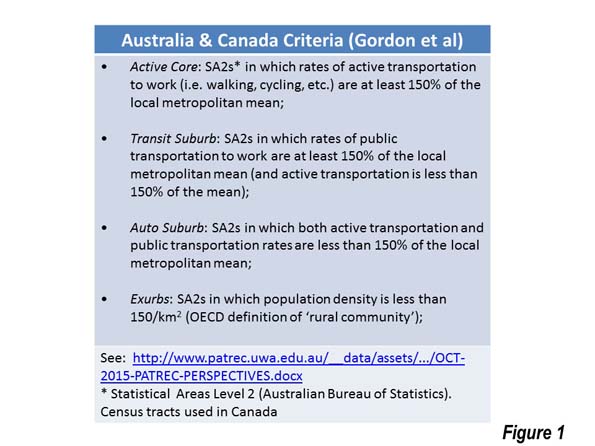
    Professors David L. A. Gordon of Queens University (Canada) and Paul Maginn and Sharon Biermann of the University of Western Australia have now shown Australia to be a largely suburban nation. This follows on Professor Gordon’s work with colleagues in 2013 that came to the same conclusion on Canada based upon 2006 census data. By using census tract data, rather than municipality data, Gordon, et al were able to avoid the misleading but readily accessible jurisdictional analysis (central city versus suburbs) that equated large low-density central municipalities like Calgary and Edmonton, with more compact and dense municipalities like Vancouver and Montreal (or New York with Phoenix). The Gordon, et al criteria is illustrated in Figure 1.
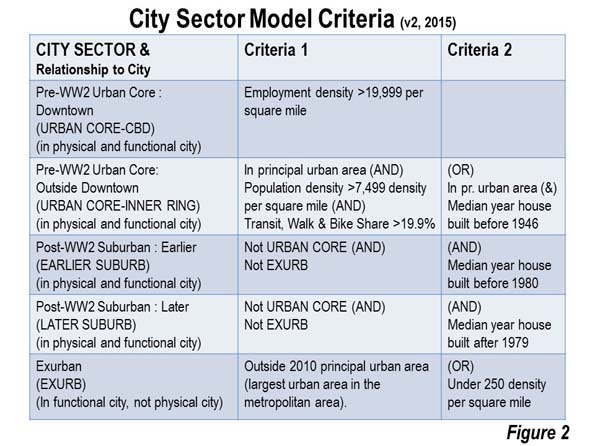
    Broadly following the Gordon et al research, in the Spring of 2014, I published a similar “City Sector Model” using postal code tabulation areas (zip codes) for the major metropolitan areas of the United States. That criteria is illustrated in Figure 2.

    This article compares the Gordon findings in Canada and Australia and contrasts them with my findings in the United States.

    The Gordon Research: Canada and Australia

    In Australia, as in Canada, Professors Gordon, Maginn and Biermann divided metropolitan areas into four classifications at a small area level. The research called the urban core classification "active core," to note the greater dependence of residents on walking and cycling for commuting to work. They divided suburban areas into transit and auto suburban areas, and designated the more rural areas of metropolitan areas as exurban. In both countries, they used the functional or economic definition of cities, which is metropolitan areas or labor market areas (Note 1).

    Gordon, Maginn and Biermann’s analysis shows that Australia’s 27 metropolitan areas are 13 percent “active core”, nine percent transit suburbs, 69 percent auto suburbs and 10 percent exurban. This is nearly the same as the previous research on the 2011 Census of Canada which revealed 12 percent active core, 11 percent transit suburbs, 69 percent auto suburbs and eight percent exurban for all 33 metropolitan areas.

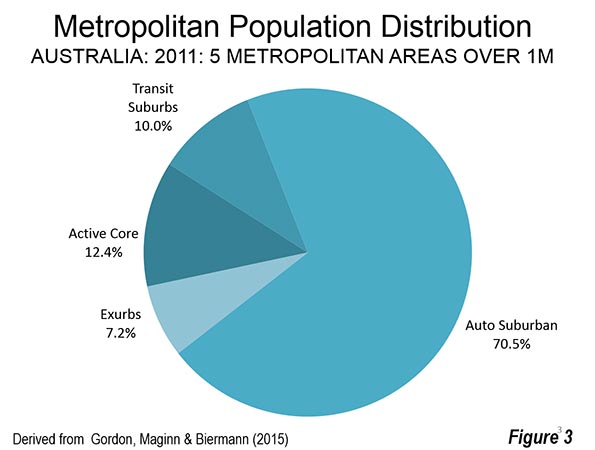
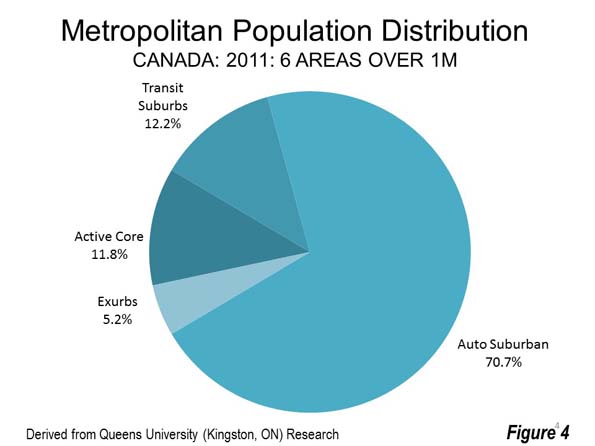
    The Major Metropolitan Areas (Over 1,000,000 Population) In the smaller number of Australian metropolitan areas with more than 1,000,000 population, the “active cores” are only slightly larger than those in Canada (12.4 percent of the metropolitan population versus 11.8 percent). But Canada’s major metropolitan areas has larger “transit suburbs” by a 12.2 percent to 10.0 percent margin. The “auto suburban” figures are virtually the same, with Australia at 70.5 percent and Canada at 70.7 percent. Finally, Australia has a slightly larger “exurbs,” at 7.2 percent compared to Canada’s 5.2 percent (Figures 3 and 4).

    Comparing to the United States

    In the United States, the City Sector Model uses somewhat different criteria. Gordon’s central classifications (“active core” and “transit suburb”) parallel the City Sector Model’s “urban core: CBD” and “urban core: inner ring.” Gordon’s “auto suburban” and “exurban” also roughly parallel the two “suburban” and the exurban City Sector Model classifications.

    Perhaps the largest difference between the two models is in the treatment of commuting. Professor Gordon’s approach is to classify the two central areas based on 50 percent higher than each metropolitan’s area average shares of walking, cycling and transit journey to work travel. The City Sector Model uses an across-the-board minimum 20 percent market share (transit, cycling and walking combined), to replicate a division between more dense pre-World War II development and the automobile oriented suburbs that followed.
    Comparing to the United States

    Of course, it is to be expected that the United States, with the lowest density built-up urban areas (called population centers in Canada and urban centres in Australia) would be even more suburban than Australia and Canada . This is indicated by the data (see Demographia World Urban Areas).

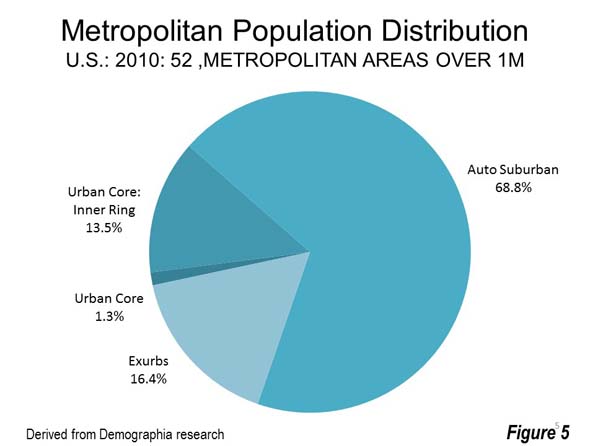
    There are large differences in the two more central classifications. In Australia, the two central areas have 22.4 percent of the metropolitan area population, somewhat less than Canada’s 24.0 percent. In the United States the two central areas have a smaller 14.8 percent of the metropolitan area population (Figure 5).

    Various factors account for this difference. There were, for example, huge urban core population losses   in the United States, but not in Canada and Australia. Another cause is the much earlier motorization of the United States, which by 1929, according to economist Robert Gordon, had achieved 0.9 vehicles per household and had 90 percent of the world’s registered vehicles (Note 2). With this unparalleled market penetration, the U.S. had a several decade long head start in automobile oriented suburbanization. Canada equaled the 1929 U.S. automobile market penetration in the middle 1950s and Australia in the middle 1960s.However, in the suburban classification, the metropolitan areas of the three nations were very similar. The US automobile suburb share of the population, at 68.8 percent was within two percentage points of both Canada and Australia. However, like the urban core, the suburbs showed considerably different results, with the United States having a 16.4 percentage exurban share, compared to approximately 10 percentage point lower shares in both Canada and Australia.
    Part of difference in the exurbs is the larger geographic size of U.S. metropolitan areas, which are far less representative in capturing the genuine labor market. The building geographical blocks used by the U.S. Office of Management and Budget are simply too large for sufficient preciseness. This is illustrated by the Riverside-San Bernardino metropolitan area, which covers an area about the same size as the Canadian province of New Brunswick or the Australian state of Tasmania. By contrast, in Canada, Statistics Canada uses municipalities to construct metropolitan areas, while Australia uses “Statistical Areas Level 4,” which are generally smaller than US counties (Note 3). When the boundaries of a metropolitan area are far larger than the actual commuting shed (as often happens in the United States), more people will be in the metropolitan area.

    At the same time, these results must be interpreted carefully, since there are differences in the criteria and geographical building blocks of metropolitan areas in all three nations.

    Comparison of Population Growth

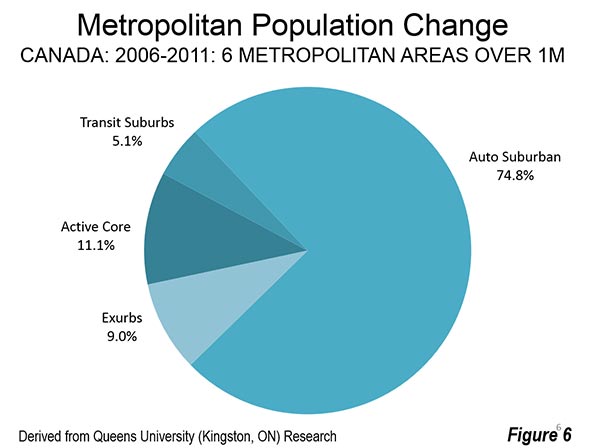
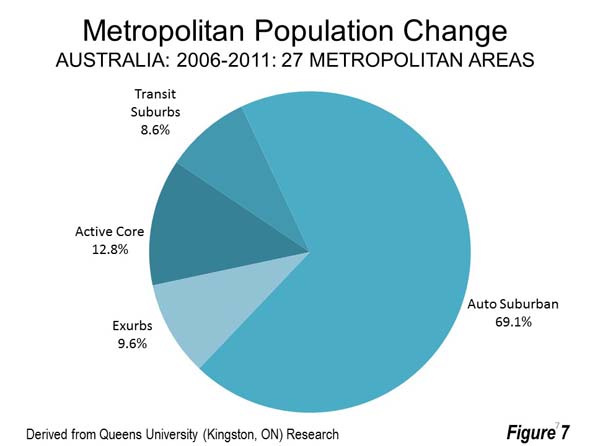
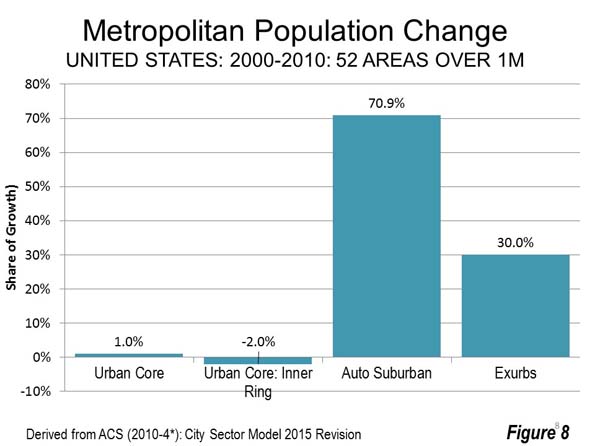
    Professor Gordon’s research in both nations shows suburban growth   far out stripping growth in the central areas. In Canada, nearly 84 percent of major metropolitan area population growth between 2006 and 2011 was in the “auto suburbs” and “exurbs” (Figure 6). In Australia (27 metropolitan areas), the “auto suburbs” and “exurbs accounted” for nearly 78 percent of population growth (Figure 7). In the United States, the suburbs and exurbs accounted for over 85 percent   (Figure 8).

    Suburban World

    Contrary to planning preference for dense urbanization, suburbanization has occurred virtually wherever people can afford cars. This is even true in Europe, Japan and China. For example, the municipality of Paris continues to languish with a population a quarter below its level of 135 years ago (1881). The 8 million resident urban area growth since that time has been in the suburbs , which now cover more than 25 times the area of the ville de Paris (the central municipality). Other examples, such as the core municipalities of Copenhagen (from 1950), Barcelona and Milan (from 1970) have suffered significant population losses while all metropolitan area growth has been in the suburbs. There are many similar examples around the world.

    Even with the differing definitions, the data in Canada, Australia and the United States is remarkably similar. Of course, not all suburbs are the same, but it should not be surprising that the organic growth of cities continues on their edges.

    Note 1: For further information see: Paul Cheshire, Max Nathan and Henry G. Overman of the London School of Economics in their recent book, Urban Economics and Urban Policy: Challenging Conventional Policy Wisdom.

    Note 2: See Robert J. Gordon, The Rise and Fall of American Growth: The U.S. Standard of Living Since the Civil War, page 374, reviewed at http://www.newgeography.com/content/005364-robert-gordons-notable-history-economics-and-living-standards.  

    Note 3: The larger size of US exurbs is illustrated by the 11,400 square kilometer average areas outside the principal urban areas (exurbs) of US metropolitan areas. In Australia, the average outside the principal urban centres is 6,500 square kilometers, while in Canada the average area outside the principal population centres is 4,600 square kilometers (data based on metropolitan areas with more than 1,000,000 population).

    Wendell Cox is principal of Demographia, an international public policy and demographics firm. He is a Senior Fellow of the Center for Opportunity Urbanism (US), Senior Fellow for Housing Affordability and Municipal Policy for the Frontier Centre for Public Policy (Canada), and a member of the Board of Advisors of the Center for Demographics and Policy at Chapman University (California). He is co-author of the “Demographia International Housing Affordability Survey” and author of “Demographia World Urban Areas” and “War on the Dream: How Anti-Sprawl Policy Threatens the Quality of Life.” He was appointed to three terms on the Los Angeles County Transportation Commission, where he served with the leading city and county leadership as the only non-elected member. He served as a visiting professor at the Conservatoire National des Arts et Metiers, a national university in Paris.

    Photo: Brisbane, Australia Inner Suburbs (by author)

  • Looking Forward, With Better Cheer

    Among many urbanites, a certain bunker mentality has already surfaced at key locations within the geography of the city.  Here in Orlando, places like the Stardust Video and Coffee where once there was warmth, one feels coolness in the air, a little less eye contact, briefer conversations, a sharper tone. For many who practice tolerance and inclusiveness, and bend our lives towards mutual sustainability, this was a temporary setback.  But this is no time for recriminations or succumbing to the temptation to snip at one another.  It is a time to look forward, with better cheer.

    We must expand our tolerance even further, and recognize that true inclusiveness really means everybody.  At the same time, there is a subtle upswing in other places too.  Just around the corner from Stardust lies three convenience stores, ostensibly gas pump backdrops.  It’s time to get to know the coffee choices around here, and expand my horizons a bit.

    Lotto, beer, and cigarettes figure big in these places; our small weaknesses are also their small profit. The mood in these colorful, brightly lit stores is upbeat, and it shows how the two different streams of society intermingle within very small distances.  

    In the 7-Eleven, Rhonda and Lexi posed for the camera, shoulder to shoulder with big grins on their faces. When asked who made the coffee, Rhonda announced "I did!"  Convenience store coffee is surprisingly good here.  Around the corner, Elizabeth briefed me on her complicated coffee system at the National Food Mart. When I asked her for a picture, she shrugged.  "Yeah, sure," and broke into a sweet, disarming smile.  

    For the workers in these stores, there’s a coming-out, a sense of "yeah, well, we’re cool too," a new posture being tried.  Is it the surprise, the swift triumph of the unhip, that has suddenly put a bounce in their step?  The cashiers of our vices are happier, a little more hopeful, these days, a little less grim and underclass.

    It is now the formerly hip Stardust which now feels dour and tragic. Avoidance of eye contact was once a game practiced at the convenience store; now it is practiced at this cluttered countertop.  At one time, the scene at Stardust was open, with shouts of greeting and smiles.  A boisterous and diverse crowd kept a gentle, Haight-Asbury vibe going.  It was improvisational, a do-it-yourself kind of culture. John, a retired engineer, mixed with hippie chicks, artists, writers and techies in for a cup and a jam.  DJs and photographers met to plan out a photo shoot.  

    Salesmen sat with their laptops, looking at their sales leads for the day.  In the evening, kids did their geometry homework while older couples sat and drank wine.  An ancient, timeless public house feel was rich and was ripe. This openness is what I love about Stardust, it has a sense of shared ownership and a mutual agreeableness that we are all in it together.  It suits me, as I move in a very wide range between laborers, the very wealthy, plumbers and professors.  

    In these days of looking backward, a veil of grimness seems to separate the hip and the cool for now.  Stardust is lately tinged just a bit with the atmosphere of all convenience stores.  It is tinted with the grimness of outcasts.

    This grimness of outcasts was once the province of convenience store workers, hanging their heads, ringing up gas sales, condoms, smokes.  They knew their place, and it was pretty far down the class system.  Condemned to shapeless, garish uniforms, convenience store workers were the bottom, especially in the chic neighborhood of Audubon Park.  Everyone on Corrine Drive outranked the convenience store worker.  The only caste lower than convenience store clerk was possibly convenience store night clerk.

    Life at the bottom of the social pyramid was bad enough, but especially the Audubon Park social pyramid, what with its ultra-cool scene of independent record stores, custom beer taps, movie production guys, East End Market, for Christ’s sake–a hipster convenience store in drag–and, naturally, it was all anchored by Stardust Video and Coffee.  For the convenience store clerk in this neighborhood, a special hell was your lot.  High school diploma, if you’re lucky, making nine oh five an hour selling stupid stuff to liberal arts school students, techies wearing glasses that cost six months of your wages, bourgeois bohemians. It rankled. You sucked.

    Back at Stardust, the post-election mortification has given way to the next phase of outsider-mentality:  recrimination.  Now, for the first time ever, I hear green-shaming: "Where’s your cup today?" after a patron asked for a coffee and committed the green sin of not bringing in his own reusable mug. This never used to happen at Stardust, where they are usually happy to sell you a disposable cup.  The barista, however, got a little dig in that morning, fingering me as the Other.

    I do not have to prove that I am not the Other.  That charge just won’t stick.  It’s a symptom of feeling like an outcast, possibly, to accuse someone, label them as Other, and sulk.  During my day, I think about those all around me in a modern, white-collar office, and how good we all have it.  Still, for many, the sense that things just weren’t good enough probably caused people to send a signal in the voting booth.   

    Perhaps here’s a lesson to this election, which has unnerved liberals and hipsters to their core. You cannot turn many, if not most, Americans into “the Other.” This is not the road to inclusiveness; perhaps the "in-crowd" at Stardust never was very inclusive to begin with.  If you want to see real people of color, go into the unhip convenience stores all around.  African-American, Asian-American, and Latina-American.  Inclusiveness means a society where all of our people, even the convenience store clerks, are included.

    At Stardust, one could easily convince oneself of being in comfortable surroundings of openness and diversity.  This bubble of comfort sadly diverged from reality.  Outside the bubble, the Lexis and Rhondas and Elizabeths have gotten a break.  They were decidedly NOT in this bubble.  It has finally burst.

    So what? I’m taking a break from the hip and the cool, and creating my own hip and cool with people in 7-Eleven, National Food Mart, and Shell.  I frequent these places often, for they have things that I need:  gas, air, vacuum, batteries, and aspirin. Stardust offers nothing practical like that anyway.  I’ve already introduced myself to a few of the other clerks, and found them to be very nice.  I haven’t been subjected to green-shaming, and probably won’t be.  They’re professional, they make it snappy, and they smile.

    It is weak and incorrect to circle the wagons and point fingers at The Other and continue this divisiveness that has caused such a big warfare in our hardened, weary society.  This is the sure road to further isolation and loss.  The secret is that there really are no losers and winners, and to act like there are just makes more. Instead, acting like we are all people with our own aspirations and difficulties is a harder, but far more interesting road to travel.  This is not about populist politics or presidents; rather, it is about the need to re-invent the concept of a society where everyone wins.

    Richard Reep is an architect with VOA Associates, Inc. who has designed award-winning urban mixed-use and hospitality projects. His work has been featured domestically and internationally for the last thirty years. An Adjunct Professor for the Environmental and Growth Studies Department at Rollins College, he teaches urban design and sustainable development; he is also president of the Orlando Foundation for Architecture. Reep resides in Winter Park, Florida with his family.

    Photo by DoxvoomOwn work, CC BY 2.5, Link

  • Generation X’s Moment Of Power Is Almost Here

    It certainly seems as if boomers are in charge in America now, with Donald Trump about to move into the White House and members of the generation in the majority in Congress. Meanwhile, huge attention has been paid over the past few years to the emergence of the boomers’ children, the millennials, on the national scene. But relatively little thought has been accorded to the group sandwiched between the two mega-generations: Generation X.

    Referred to by some pundits as a “lost generation,” the Xers, born between the mid-1960s and 1980, may be less numerous than either the boomers or millennials, the latter of whom now slightly outnumber them in the workforce, but Gen X seems likely to dominate the near future. Not only do they now make up the majority of of managers at U.S. companies, they are far more entrepreneurial than millennials, both at early ages and now. Their rate of startup formation is roughly twice that of millennials, and on the way up, while the younger generation’s rate has been on the decline. 

    Financially, they are clearly the ascendant generation. According to analysis by the Deloitte Center for Financial Services, they now have 14 percent of the nation’s wealth compared to just 4 percent for millennials and 50 percent for the boomers. But by 2030, as the boomers finally start to fade from the picture, Xers will dominate the nation’s wealth, accounting for 31 percent, twice the projected share of millennials.

    Politically they also seem destined to take power next. They are gradually replacing the aging boomers in Congress. Their politics are neither as conservative as the boomers nor as liberal as millennials: younger Xers tilted slightly to Clinton in the last election, older ones favored Trump. Right now there are 117 Xers in Congress compared to five millennials, with the most prominent being House Speaker Paul Ryan; it will likely take a generation or more for the millennials to challenge the Xers.

    To be sure, millennials will dominate the future eventually, but the question is when. Boomers are living, and working, longer than ever. Over time, though, millennials’ overlords will come from the smaller but more aggressive X generation. Unlike the millennials, who received participation trophies and “good job” plaudits, notes generational analyst Morley Winograd, the Xers were the original “latch-key” kids who were forced to make their way in a county dominated by Boomers.

    Critically, however much millennials may talk about changing the world, as a group they are entrepreneurial laggards, in large part responsible for America’s current depressed startup rates, the lowest in a quarter century. It’s the Xers — less coddled, with less college debt and just enough experience — who are starting and running more of the economy. In a word, they are tough, used to adversity and their time is coming. 

    X-Strong Metropolitan Areas

    With all these considerations in mind, we decided to take a close look at which metropolitan areas have been gaining the largest shares of 35 to 49 year olds, currently the Xers. This is critical not only because of their economic influence, but also because they are the ones who have the most children. If a metro area’s share of this age group is growing, it is likely to have more young people as well. 

    Using Census data from 2000 to 2015, we found that the share of 35 to 49 year olds grew most dramatically in the affordable Sun Belt. This makes sense as this is the age when home ownership is most critical and people are looking for the maximum income relative to costs. Being in your late 30s to 50 does not mean you have lost the ability to dream, but it does make addressing reality far more imperative than when in your 20s.

    Many of the metropolitan areas where the 35-49 population has grown the most are precisely those that have topped most of our best city lists. At the apogee is Austin, whose 35 to 49 year old population has expanded a remarkable 44.9% since 2000, compared to a 6.6% national decline in this age range over that period. This suggests that although the bar scene and liberal politics appeal to many, other characteristics — such as relatively low housing prices, attractive suburbs and good-paying jobs — seal the deal for 35 to 49 year olds. 

    Housing and rent differentials have been particularly determinative for today’s 35 to 49 year olds. They suffered the most from the housing bust of 2007 and are only now entering the market with full force. They may not be able to afford the high prices of houses owned by coastal boomers, but they seem to be entering aggressively less expensive markets. Another reason they may be heading to these areas is to buy bigger houses than the small units now in vogue among millennial-craving builders. 

    Virtually all the other places that have experienced the biggest shift in this age group follow this pattern. No. 2 Raleigh-Durham’s population of 35-49s grew 40.1 percent, or 50.1 percent compared to the national rate, for many of the same reasons as Austin. Other places that attract these ages are generally low-priced dynamos, including No. 3 Las Vegas, No. 4 Charlotte, No. 5 Phoenix, and No. 8 Salt Lake City. Texas dominates the list here with four of the top ten, including No. 7 Houston, No. 9 Dallas-Ft. Worth and No. 10 San Antonio. 

    If we tighten of measurement to the years 2010 to 2015, the pattern is largely the same except for the emergence in the top 10 of such tech havens as metropolitan Denver and Portland, which have done very well during the tech boom. Yet surprisingly the 35 to 49 year old population share has remained stagnant in the epicenter of the “new economy,” the San Francisco and San Jose areas, although these areas continue to attract people of millennials age. Housing prices may be playing a big role with roughly a third of Bay Area residents considering leaving, largely for this reason. Silicon Valley and San Francisco may remain great places to start, but are far from the easiest places to settle down for the long term.

    Gallery: Top 1o Gen X Cities

     Yet Silicon Valley is a veritable 35 to 49 magnet compared to most of the country’s big cities. Los Angeles, New York, Boston, Chicago and Philadelphia areas have all seen declines in their 35 to 49 shares both since 2000 and, more revealingly, since 2010 as well. In terms of 35-49s, these greatly hyped metropolitan areas actually do, however, much better than Rust Belt cities such as Detroit, Cleveland, Hartford, Pittsburgh and Rochester, which experienced a survey worst 9.5 percent decline relative to the national rate in Xers since 2010 and a 19.2 percent decline since the beginning of the new millennium.

    Xers: The New Suburban Generation 

    In the popular press, youth (stretched liberally as high as 50) are widely associated with the much heralded “return to the city.” Yet in reality, all generations continue to head primarily for the suburbs, with this trend most evident among those aged 35-49. 

    Using the “city sector model” to analyze metropolitan areas by such factors as density, age of housing, transit use and housing forms, we have looked at where 35-49s have been moving over the past 11 to 15 years. Peope aged 35-49 have shown little inclination to stay in the urban core, moving out in considerable numbers to suburbs and exurbs. 

    Indeed since 2000 the percentage of Xers living in the urban core has dropped by one percentage point, while the percentage living in new suburbs and exurbs has grown by six percentage points. By 2015 over 80 percent of Xers in the 52 largest metropolitan areas lived in suburban areas, although they have in more recent years favored older suburbs (built before 1980) over exurbs.

    This reflects one of the basic demographic realities: as people age, and start families, they tend to move further out. Generally speaking, notes economist Jed Kolko, the peak years for urban living take place between ages 18 and 30. After that there’s generally a steep decline as people start families and head to the suburbs. Kolko calculates that while almost a quarter of people under 30 live in urban neighborhoods, by age 40 the urban share drops well below 20 percent, and stays there well into their 70s.

    The reasons for this move are not surprising. Suburban real estate tends to be cheaper than in good urban areas, and offers the kind of housing — single family — preferred by the vast majority of consumers. They also tend to be much safer (the rate of violent crime  in core municipalities remains almost four times higher), and have much better schools and less poverty than urban areas, things that tend to matter to people starting families and raising children.

    What It Means For Other Generations 

    The increasing importance of Xers will, of course, impact other generations. Boomers, who have had a very long run in control of just about everything, are likely to see their influence reduced as Xers hit their prime earning years. This will be accelerated by the digital revolution; the average age of venture capital-backed founders, notes the Harvard Business Review, is in their late 30s and early 40s, which puts them deep in X territory. Just as boomers had to adjust to the work culture of the previous generations, the millennials will now have to fit their careers into patterns developed by their Xer overlords. 

    For the millennials, the experience of the Xers may also presage their future lifestyle choices. Like the Xers, millennials are beginning to move into the suburbs, contradicting all claims to the contrary. Like the Xers, they too are looking for more space, something not likely to lead them to the city. Similarly they are also increasingly moving to the same lower cost cities, largely in the Southeast and Intermountain West. Since 2010, the biggest gains in millennial share have been Orlando, Austin and San Antonio. 

    Ultimately, rather than focus on boomers, the millennials will need to figure out how Xers think — their independence and entrepreneurialism — since Xers will be both their bosses and their role models. Generation X may be relatively small, and largely unsung, but what it does, and where it moves, may do more to shape the country in the next decade than the more celebrated groups born before and after them.

    Gallery: Top 1o Gen X Cities

    This piece first appeared at Forbes.

    Joel Kotkin is executive editor of NewGeography.com. He is the Roger Hobbs Distinguished Fellow in Urban Studies at Chapman University and executive director of the Houston-based Center for Opportunity Urbanism. His newest book, The Human City: Urbanism for the rest of us, was published in April by Agate. He is also author of The New Class ConflictThe City: A Global History, and The Next Hundred Million: America in 2050. He lives in Orange County, CA.

    Wendell Cox is principal of Demographia, an international public policy and demographics firm. He is a Senior Fellow of the Center for Opportunity Urbanism (US), Senior Fellow for Housing Affordability and Municipal Policy for the Frontier Centre for Public Policy (Canada), and a member of the Board of Advisors of the Center for Demographics and Policy at Chapman University (California). He is co-author of the “Demographia International Housing Affordability Survey” and author of “Demographia World Urban Areas” and “War on the Dream: How Anti-Sprawl Policy Threatens the Quality of Life.” He was appointed to three terms on the Los Angeles County Transportation Commission, where he served with the leading city and county leadership as the only non-elected member. He served as a visiting professor at the Conservatoire National des Arts et Metiers, a national university in Paris.

    Photo by Caleb Smith; Office of the Speaker of the House [Public domain], via Wikimedia Commons

  • Carrier and the Commonwealth

    I was asked by Fortune to contribute a piece about Trump’s Carrier deal. They had gotten a lot of people criticizing it and were looking for someone who would give a different perspective. I think many of the criticisms are valid in a sense, but miss the larger context. So I wrote the piece which is now online. Here’s an excerpt:

    Alexis de Tocqueville pointed out that one of the keys to America’s unique success was its sense of enlightened self-interest. Americans worked and competed hard for themselves, their families, and their businesses, but they understood that a purely selfish mindset was self-destructive in the long term. Tocqueville observed inDemocracy in America, “Each American knows when to sacrifice some of his private interests to save the rest; we [the French] want to save everything, and often we lose it all.

    Businessmen once understood this link between national, local, and personal success. The men of the Commercial Club of Chicago who commissioned Daniel Burnham to create his famed 1909 plan for that city had personal fortunes deeply tied to Chicago. They needed the city as a whole to succeed for them to succeed. Likewise, General Motors CEO Charles Erwin Wilson once famously said, “For years I thought what was good for our country was good for General Motors, and vice versa.” He understood that his company’s fortune and America’s were intertwined: GM couldn’t make any money if no one could afford to buy its cars.

    As these restrictions were lifted, these businesses left enlightened self-interest behind in favor of quarterly profits. They forgot their community in favor of global capital. Their business models evolved to delink profits and executive compensation from broad-based American prosperity. They could take a portfolio view of local communities and even countries. It was all very economically efficient. These firms and their managers could thrive even while much of America fell into ruin. Or so they thought.

    Click through to read the whole thing.

    Some people were a bit critical, saying, “Why not say this when Obama bailed out the auto industry?” or “Why is it only good when Trump does it?” In fact, I’ve actually written on this theme before.

    Back in November 2008, shortly after Obama’s election, I posted a piece in which I criticized the auto companies’ management and came out in favor of a federally backed restructuring of the auto industry. While I am critical of some aspects of how Obama handled this, the idea of bailing out the car companies was something I was on record as supporting before it happened. Here are some excerpts from that:

    Even if you assume a lot of this [auto company management behavior] is exaggerated for effect or outright BS, I’ve heard so many similar type things from people who’ve been associated with the auto industry that there must be a kernel of truth in it somewhere. I lead with this because it is so common to blame the UAW and its $73/hour or some such wage packages for the problems facing the Big Three. And indeed in the modern era that is not sustainable. But there has been particularly little focus on the management excesses of the auto industry, and the corporate cultures of those companies, and by analogy that of Detroit.

    I’ve seen estimates that 2-3 million jobs could be lost and that chaos would ensue if the auto makers went bankrupt. That’s probably true if GM, Ford, and Chrysler just waltz down to the court house and file. But it is not the case if they have a government sponsored, pre-packaged bankruptcy.

    Even so, we can’t lose track of the fact that there are real human beings, labor and management, with real trauma in their lives. Even if they are at least partially to blame for the mess they are in, that doesn’t mean they deserve what they are getting. It’s like a Greek tragedy: the suffering is disproportionate to the crime. And there but for the grace of God go you and I. I also work in a restructuring industry, and may yet join the auto workers in their pain.

    The stories you hear in the Detroit papers are heartbreaking. One that really stuck with me was about people losing their life’s possessions when they couldn’t pay the rental fees on storage lockers. People who had already lost their homes to foreclosure put their possessions in storage, only to lose them too as the storage companies auctioned them to pay the bills. I’m not an emotional guy, but this makes me sick to my stomach. I don’t know about you, but I don’t think this should be happening in a country like America. People who made decisions in good faith, who showed up to work every day, who did the right things to care for their families, shouldn’t be left to lose everything because of the action of economic forces they can’t understand or control. Not in America. That’s why we absolutely need a federal safety net program here. Michigan alone can’t fund this.

    I probably anticipated more of a bite the bullet approach than actually happened (which is one reason restructuring is still ongoing), and my views have probably changed somewhat in eight years, but clearly the same general themes are present.

    Where I would take issue with Trump, is in the idea of “bringing the jobs back” as the theme. This sort of nostalgia for a bygone idyllic era that never really was is powerful in the Midwest. It’s very backwards looking and based on a language of resentment. I can understand why the appeal to this works rhetorically, but as an actual policy goal it’s not realistic. The ship has already sailed too far to return to the harbor. That doesn’t mean we should double down on the status quo, but we’ll have to chart a different path forward to the future, not roll back the clock. (Fortunately, Trump’s working class supporters seem realistic on this point and don’t expect him to literally do every single thing he said).

    This perhaps explains why I’m more positive on intervention to save existing jobs than to try to lure new ones. That and the difference in the price tags. It’s one thing to try to preserve actually existing businesses already woven into the fabric of the community, but it’s another to try to speculatively create something new. I’m not under any illusion that we’ll get rid of economic incentives, but it does seem excessive to me to spend, say, $750 million (corruptly, as it appears to have turned out) to lure a solar panel factory to Buffalo. I’m ok with the idea of spending a billion dollars of state money in Buffalo, but there have to be better ways to do it. (Mayor Stephanie Miner of Syracuse said if she had a billion, she’d spend three fourths of it to fix her city’s water pipes – a prescient pledge made prior to the Flint debacle).

    It’s also the case that we need to be willing to face the unpleasant reality that many communities are poorly positioned for the future economy. That doesn’t mean abandoning them, but we do have to level with them. And those communities, not just the federal government, also need to be willing to make some changes.

    But all that doesn’t mean that simply pushing forward with more of what we’ve already been doing is a viable option. Trump understood that, and beyond the politics of it, the Carrier deal was a symbol that he intends to pursue a new direction.

    Update: In line with these themes, a commenter pointed me at this recent blog post by South Bend mayor Pete Buttigieg.

    Aaron M. Renn is a senior fellow at the Manhattan Institute, a contributing editor of City Journal, and an economic development columnist for Governing magazine. He focuses on ways to help America’s cities thrive in an ever more complex, competitive, globalized, and diverse twenty-first century. During Renn’s 15-year career in management and technology consulting, he was a partner at Accenture and held several technology strategy roles and directed multimillion-dollar global technology implementations. He has contributed to The Guardian, Forbes.com, and numerous other publications. Renn holds a B.S. from Indiana University, where he coauthored an early social-networking platform in 1991.

    Photo: By Carrier Corporation (http://www.teamworkmarinesxm.com/) [Public domain], via Wikimedia Commons

  • Progressives Have Let Inner Cities Fail for Decades. President Trump Could Change That.

    When Donald Trump described the “devastating” conditions in America’s inner cities, emphasizing poor schools and lack of jobs, he was widely denounced for portraying our urban centers in a demeaning and inaccurate way, much as he had been denounced previously for his supposed appeal to “racial exclusion” when he asked black voters “what the hell do you have to lose” by backing him.

    To be sure, Trump was tromped in big cities nationwide, losing by stupendous margins, but he actually did a little better than Mitt Romney among black and Hispanic voters, according to exit polls. Still, some urbanistas embraced the idea that even if Trump had won in the electoral college, “the city is ours,” as New York Magazine put it. And our America, those voices maintained, was doing great and would continue to do great even without a friend in the White House.

    But as we saw in November, something isn’t so just because the coastal cocooners say it’s so. In reality, if we go beyond the big-city boosterism that dominates media coverage, poverty, crime, and economic stagnation still characterize many urban core neighborhoods even as many downtown districts have recovered. For all the talk about gentrification, concentrated urban poverty has been a persistent and growing problem, with 75 percent of high-poverty neighborhoods in 1970 still classified that way four decades later.

    Racial and class inequality is very much alive even in the most “progressive” cities. In New York, the poster child for urban revitalization, poverty and homelessness have worsened, in large part due to soaring housing costs. Since 2007, median rents in the city have gone up 8.5 percent while median renters’ incomes have gone down by 6.8 percent. Particularly shocking have been rent rises at the edge of gentrification, in places like Brooklyn’s Williamsburg—where rents have risen 80 percent since the 1990s.

    In most urban areas, particularly outside New York and a few other cities, the much ballyhooed “back to the city” movement — mindlessly overblown by the national media — impacts basically the downtown cores, which account for roughly 1.3 percent of the national population, a percentage they have held since 2000. Some inner-ring communities — often right next to the urban core — have lost population in those 16 years. Overall, the outer suburbs and exurbs, home to more than 40 percent of the metropolitan population, have added population at more than five times the rate of urban cores.

    The same pattern applies to jobs. Though some cores have gained some employment, that’s been offset by big losses in the surrounding urban neighborhoods for an overall decline in the number of jobs in and around most city centers.

    Bottom line: The suburbs and exurbs disdained by most urbanists and Democratic politicians continue to add residents and jobs as inner cities continue to languish.

    In fact, roughly 80 percent of all job growth since 2010 has been in suburbs and exurbs. And tech, supposedly newly focused on the urban core, still concentrates largely in dispersed, suburban environments from Silicon Valley to Austin to Raleigh.

    Rather than clustering downtown, most rapid growth is now in what may be seen as post-suburban cities, places like Irvine, California, Overland Park, Kansas, or Frisco, outside Dallas, where single family neighborhoods and cars co-exist with dense office parks and often expanding town centers. And with millennials now entering their thirties in greater numbers, these communities, generally safe and with good schools, seem to be growing in popularity much faster than the inner cities. These are unfortunate facts for Democrats, who have long celebrated, sometimes garishly, cities’ glaring problems—thus helping make Trump’s campaign comments sound that much more reasonable.

    Trump’s pick of Ben Carson to run the Department of Housing and Urban Development has horrified some retro-urbanists who point to his lack of experience with housing issues, let alone running a $50-billion-a-year agency. Yet given the obvious failures of existing policies, an outsider may prove something of a blessing—if he comprehends the nature of the challenge.

    During the past decade, urban boosters have hailed “the rise of creative class,” reflected by the migration of educated millennials to “hip and cool” cities including New York, San Francisco, Seattle, and Portland. Yet as Richard Florida, who coined the term “creative class” has since observed, gentrification has not made life better for most urbanities, as the rise in housing costs has outpaced that in wages, making those cities even less affordable. The creative class certainly improved selected parts of urban America, but for the most part urban poverty, including homelessness and hunger, has barely been dented by gentrification and in some cases may have been made worse.

    This poor result reflects the failure of urban policies that have been promoted by the very interests—particularly real-estate speculators and big-city politicians who count on them—that most strenuously oppose Trump and his pick of Carson in particular. Those policies include redevelopment that often serves to push inner-city residents from their homes—with HUD in the worst cases trying to lure poorer populations out of their cities altogether.

    Those moves happened even as more upwardly mobile minorities headed in huge numbers to the periphery. Since 2000, notes demographer Wendell Cox, more than 95 percent of the minority population growth in the 52 largest metropolitan areas has been in suburban and exurban areas.

    In Portland, minority neighborhoods close to downtown have been resettled, with encouragement from the progressive government, by upscale hipsters. Indeed, the largest reductions of African-American populations, and occasionally of Latinos as well, have taken place in precisely the bluest cities such as SeattleBoston, and San Francisco in what becomes a genteel exercise in whitewashing.

    Even in more diverse cities such as Chicago, notes urban analyst Pete Saunders, city policies have been designed that force poorer, largely minority areas out of areas that, in essence, are considered too valuable for such populations. The results of dislocation, Saunders notes, has created a kind of progressive apartheid, where blacks and other minorities are driven away from neighborhoods that have been their home for generations. He describes Chicago poignantly as “one third San Francisco and two-thirds Detroit.”

    Increasingly, at least in the centers of the greatest hipster infestation, minorities and working class families are being driven into less desirable areas, often further from work locations. This helps create new social tensions and, in many places, notably Chicago, more social unrest, and now the most murders in more than two decades. Overall, the rate of violent crime in urban cores remains almost four times higher than the national average, according to FBI data. The worst violence, and the sharpest upticks over the decade have been in cities with large black populations, including Detroit, Oakland, St. Louis, Memphis, Cleveland, and Atlanta.

    Left out of the urban revival, minority and poor communities face diminishing opportunities while others prosper. This is true not only in places like Chicago, notes researcher Daniel Hertz, but also in New York where class and race inequality are much higher than in the rest of the country. Generally speaking, it’s the bluest and largest cities that suffer the worst levels of inequality.

    Indeed despite the media spin, in the core cities of the 51 metropolitan areas, 81 percent of the population increase over the past decade was under the poverty line, compared to 32 percent of the suburban population increase. Despite talk about “suburban ghettos,” the poverty rate in the suburbs remains roughly half that of urban centers (20.9 percent in core compared to 11.4 percent in the suburbs as of 2010). Crime rates in core cities, meanwhile, remain over three times higher than in the suburbs.

    No surprise that discrete and genteel “ethnic cleansing”—in the form of HUD “affirmative action” or taxpayer funded redevelopment—appeals to many urban boosters. In contrast, the much sought after hipster and wealthy childless adults thrill developers and mayors; they love a population that will pay a premium to live there and that doesn’t need good schools or working-class jobs.

    If lack of commitment to pre-existing failure offers some hope to Trump and Carson, the non-existence of a programmatic agenda represents the significant downside. Trump, after all, hardly built his career in fighting poverty; his business of building luxury high-rises hardly made him a natural ally to the diminishing ranks of working- and middle-class urbanites.

    Certainly, the new HUD should abandon its agenda of redirecting populations, or forcing high density on reluctant communities, whether in the poorer urban neighborhoods or the more comfortable suburbs. But there needs to more. One hopeful sign—particularly for cities in the heartland—would be attempts to keep industrial jobs in what’s left of the manufacturing economy, the loss of which has devastated cities such as Milwaukee. Similarly Trump’s stand against H-1B visas could help keep some white-collar positions in the hands of citizens residing in our cities, including on the coasts.

    Other steps could be taken to reawaken the grassroots economy, particularly in hard-hit poorer neighborhoods. This might include such things deregulating some businesses, like in cosmetology, and making it easier for new restaurants and shops. Yet these things cannot be mandated from Washington; it will take some rise in the level of business savvy of our elected leaders in cities. Perhaps most critical will be addressing the escalating crime rate in many cities, where by far the vast majority of victims are minorities, as Trump himself pointed out.

    Other parts of the potential Trumpian urban agenda, such as charter schools and vouchers, long supported by his Education Department nominee Betsy DeVos, could help address poor urban education, arguably the biggest reason why families don’t stay in cities like Chicago with their dysfunctional schools. Federal support for educational reform is vastly preferable to the kind of anti-charter agenda that, for example, Hillary Clinton, with her incestuous ties to the teacher unions, would have promoted.

    Similarly, a shift away from “one size fits all” transportation policies might allow communities to build public transit options, ranging from bus rapid transit to innovative dial-a-ride services. Under the old regime, money tended to go into light rail and trolley projects designed to appeal to upscale riders and developers; a better focus on inner city needs might be actually helping working class people actually get to work as quickly and easily as possible, at reasonable cost rather than building dedicated lines that tend to push land prices up, and existing residents out.

    Even if Carson can concoct such an agenda, this is unlikely to make Donald Trump popular among the retro-urbanist chattering class who have thrived under the current urban regime. But it is to be hoped that such a new approach, at very least, could finally make progressives, who control America’s big cities as virtual fiefs, reconsider policies that have led to tragic levels of impoverishment, violence, and inequality across our great urban centers.

    This article first appeared on The Daily Beast.

    Joel Kotkin is executive editor of NewGeography.com. He is the Roger Hobbs Distinguished Fellow in Urban Studies at Chapman University and executive director of the Houston-based Center for Opportunity Urbanism. His newest book, The Human City: Urbanism for the rest of us, was published in April by Agate. He is also author of The New Class ConflictThe City: A Global History, and The Next Hundred Million: America in 2050. He lives in Orange County, CA.

    Photo by Gage Skidmore [CC BY-SA 3.0], via Wikimedia Commons

  • Edward Hopper’s Rockford

    I had dinner in Rockford, Illinois recently with Jennifer and Michael Smith of the City Smiths. You will never find a more charming, kind, and industrious couple. Any town would be lucky to have such passionate and engaged citizens.

    Rockford has good bones: a diversified economy, a well educated population, a bountiful rural hinterland, and ready access to Chicagoland. I’ll blog about that some other time with selected photos I took yesterday afternoon. But it’s breakfast time here in Chicago and I thought I’d do something a little different for the moment. I’m posting photos of the drive away from the restaurant in downtown Rockford as I made my way toward the Interstate after dinner.

    img_3145-1024x683

    img_3319-1024x683

    img_3324-1024x683

    My conversations with people all across the country tend to focus on the quality of the downtown core, the prosperous suburban landscape, the public schools, the dynamics of municipal finance, the palace intrigue of local politics, blah, blah, blah. And then, inevitably, I hop in the car and head out through the reality of what every American town actually is.

    img_3369-1024x683

    img_3323-1024x683

    img_3241-1024x683

    img_3325-1024x683

    img_3401-1024x683

    This drive-thru Edward Hopper dreamscape goes on for miles in every direction. Pound for pound this is what constitutes the bulk of the built environment – or at least what passes for the public realm. This is where we all get our transmissions repaired, take our meals, have our hair done, and buy our groceries. This is where a significant proportion of the population works each day. This is our tax base. This is our infrastructure burden. At the very least this is what we all pass through on our way to other places.

    img_3384-1024x683

    img_3381-1024x683

    img_3391-1024x683

    Forget downtown. It’s a tiny speck on the map compared to the endless buffet of strip malls and parking lots that have engulfed it. Let go of the ideaof comfortable homes set in pristine leafy cul-de-sacs. These muffler shops and fast food outlets are the lion’s share of what we’ve created for ourselves. There’s so much of this stuff everywhere that these establishments will continue to define our communities for the next couple of generations. We’ll need to maintain them, reinvent them, or deal with the consequences of letting them decline. I don’t hear people talk much about that process, most likely because no one’s thinking about it. These places aren’t worthy of consideration.

    img_3353-1024x683

    img_3354-1024x683

    img_3335-1024x683

    img_3332-1024x683

    It’s easy to get excited about restoring a magnificent Beaux-Arts theater and contemplate the economic benefits of a reinvigorated historic downtown. It’s equally tempting to shine up a mid-century residential gem to its original Mad Men condition. But what exactly becomes of a defunct gas station that’s already devolved to a scratch and dent used car lot? How do you polish that turd? Keep in mind, the town just spent a few million bucks improving the road that serves this fine specimen of local commerce. Now multiply this place by thousands of similar properties.

    img_3201-1024x683

    img_3221-1024x683

    A newly resurfaced parking lot, some fresh paint, a green lawn and some flowers… Is that the solution? How much lipstick can you put on a pig?

    img_3368-1024x683

    img_3422-1024x683

    img_3230-1024x683

    img_3359-1024x683

    img_3340-1024x683

    This isn’t the kind of conversation that gets much traction at city council meetings. It’s hard to rally civic spirit around the Family Dollar parking lot. But whether we realize it or not our towns will sink or swim based on how well we manage this banal landscape of disposable schlock.

    John Sanphillippo lives in San Francisco and blogs about urbanism, adaptation, and resilience at granolashotgun.com. He’s a member of the Congress for New Urbanism, films videos for faircompanies.com, and is a regular contributor to Strongtowns.org. He earns his living by buying, renovating, and renting undervalued properties in places that have good long term prospects. He is a graduate of Rutgers University.

    All photos by Johnny Sanphillippo

  • Uber! Regulations Mean San Francisco Loses While Phoenix and Pittsburgh Win

    Any business person who has dealt with California’s frustrating laws, regulations and bureaucrats was nonetheless surprised to see the story headlined, "Uber Ships Self-Driving Cars to Arizona After California Ban."

    Really? A state ban on Uber? The poster child of the billion-dollar-plus startup, tech-guru, market-disruptor club? Why would Sacramento give Uber, of all people, a bad time?

    Reuters said Uber Technologies Inc. pulled its fleet of self-driving cars from the streets of San Francisco and sent them to Arizona’s friendlier territory:

    The California Department of Motor Vehicles banned Uber’s self-driving cars from San Francisco just days after they first deployed. In response, Uber picked up and moved out. "Our cars departed for Arizona this morning by truck, Uber said… . We’ll be expanding our self-driving pilot there in the next few weeks, and we’re excited to have the support of Governor Ducey."

    Gov. Doug Ducey wooed Uber on social media the evening when the ride-hailing company pulled its self-driving test from San Francisco. “California may not want you; but AZ does!” he wrote on Twitter. The next morning, Uber’s fleet was headed his way.

    California moved to revoke registrations for Uber’s automobiles, but Uber said its vehicles require oversight by a human driver and shouldn’t qualify under California’s autonomous-driving rules. Nonetheless, the state Attorney General and soon-to-be Senator, Kamala Harris (loyal to unions and hostile to business interests), threatened legal action if the company continued operating automobiles without a permit.

    Uber in Arizona

    Anthony Levandowski, the head of Uber’s Advanced Technologies Group, argued that because the company’s self-driving system is an early prototype and requires test drivers to keep their hands on the steering wheel at all times. It’s no different from driver-assist systems already on the market — and those are exempt from the requirement for a California permit.

    Levandowski said that it isn’t clear why the DMV is requiring a permit now when they’ve known that Ubers have been on the streets of San Francisco over a month and have been operating safely for months in Pittsburgh, "where policymakers and regulators are supportive of our efforts."

    Last year, Uber opened its Center for Excellence in Phoenix, where it serves U.S. customers and Uber users worldwide. Now, it seems that more development work will occur in Phoenix. That’s what happens when a state is friendly to business interests.

    Uber in Pittsburgh

    Uber has been successfully testing autonomous-driving vehicles in Pittsburgh for some time. An extensive Wall Street Journal story in September — Uber’s Self-Driving Cars Debut in Pittsburgh — described how Uber is turning the city into an "experimental lab" where it will have as many as 100 specially equipped Volvo XC90s operating. Also, reported the WSJ, the city has its quirks – like the "Pittsburgh left turn" – which makes it a great location for testing autonomous vehicles:

    It is customary for the first driver at a stoplight who is signaling a left turn to have priority over oncoming traffic when the light turns green. People in the oncoming lanes generally allow that leftward dash and are puzzled or even angry if it doesn’t occur. Uber has programmed its cars to allow other cars to make the ‘Pittsburgh left’ but not to make it themselves. The city is also notoriously difficult to drive through with steep hills and three rivers that make streets twist and turn unpredictably… . “If you can drive successfully in Pittsburgh, you’re pretty much done,” said Ragunathan Rajkumar, a professor at [Carnegie Mellon University] who specializes in autonomous vehicles.

    Last year Uber opened an Advanced Technologies Center in Pittsburgh and this year is developing its second research facility there, which will be part of a massive brownfield redevelopment site. Uber says it likes Pittsburgh’s “world-class research universities and engineers and a thriving technology community.”

    Uber entered into a strategic partnership with Carnegie Mellon University to help create its new technology center and also to rely on the university’s National Robotics Engineering Center to do R&D in mapping, vehicle safety and autonomy technology. Safety is one of Uber’s major concerns.

    Uber also selected Pittsburgh because of the clustering of robotics companies such as Carnegie Robotics and RedZone Robotics.

    Although California prides itself on the pool of technical talent found in San Francisco and Silicon Valley, Uber has found justification to praise Phoenix and Pittsburgh for the talent available from local universities and the community support of technology and innovation.

    Uber’s experience in San Francisco shows that venture capitalists, Ph.Ds in robotics and software engineers are no match for an all-knowing California bureaucracy.

    Joseph Vranich is the Principal of Spectrum Location Solutions, an Irvine-based Site Selection firm that helps companies identify optimum locations to accommodate growth or to improve competitiveness. On such projects he conducts an in-depth analysis of business taxes, the regulatory climate, labor rates, logistics options and lifestyle factors.

  • Back to the Future: Moving Interstate Again, to the South and West

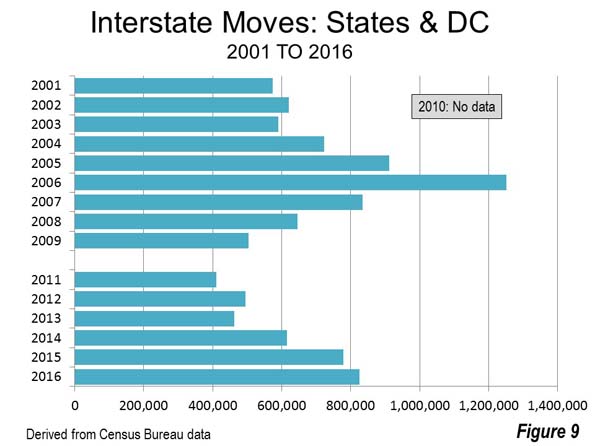
    New data from the Census indicates that population growth and domestic migration patterns have continued to move away from the East and the Midwest to the South and West, at accelerated rates. Equally important, pre-Great Recession interstate mobility rates have been restored.

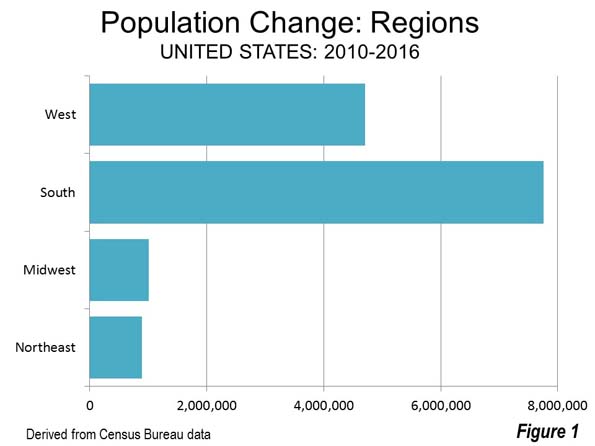
    The just released Census Bureau population estimates for the nation, states and the District of Columbia indicate a population increase for the South of 7.7 million between 2010 and 2016. The West gained 4.7 million. By contrast, the Midwest grew 1.1 million, while the East was even lower, at 900,000 (Figure 1). 

    Combined, the South and West accounted for 87 percent of the national growth. In 2011, the South and West captured 82 percent of the national growth. By 2016, the South and West had risen to 94 percent of the national population increase. The South, alone had 57 percent of the growth, up from 52 percent in 2011. The West also had a strong gain, from 31 percent in 2011 to 36 percent in 2016.

    Domestic Migration

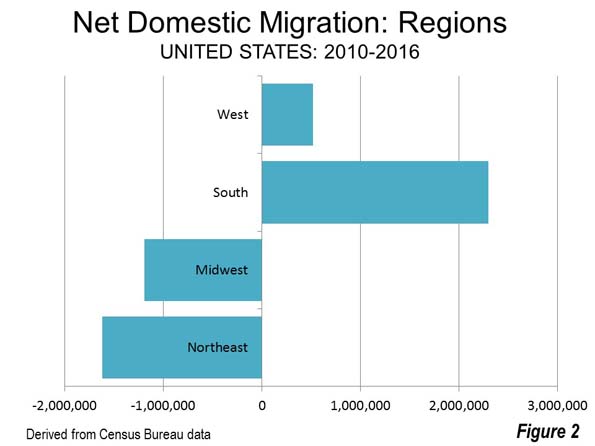
    Not surprisingly, the South and West also dominated net domestic migration — the movement of residents from one state to another (Figure 2). The South attracted 2.3 million people from other regions, more people than live in the cities (municipalities) of Philadelphia and Boston combined. The South dominated domestic migration even more than population growth, attracting more than four times the new residents as the West, which had a net inflow of more than 500,000.  The Northeast lost 1.6 million domestic migrants, nearly as many people as live in Rhode Island and Vermont. The loss in the Midwest was 1.2 million, more people than live in the cities (municipalities) of Minneapolis, Cleveland and St. Louis combined.

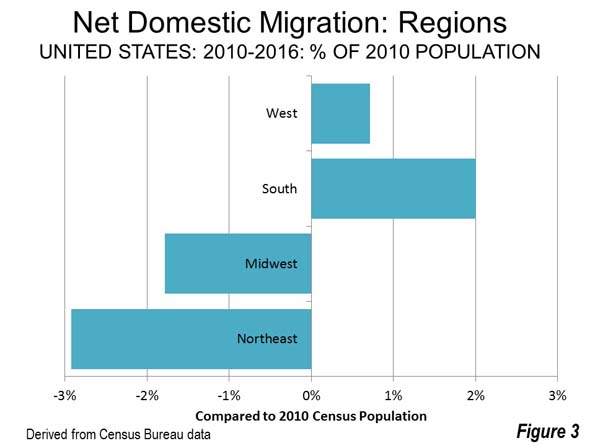
    The South also led in the percentage of net domestic migrants in relation to the 2010 population, at 2.0 percent, nearly three times that of the West (0.7 percent).  The net loss in the Midwest was 1.8 percent, while the East sustained a loss of 2.9 percent (Figure 3)

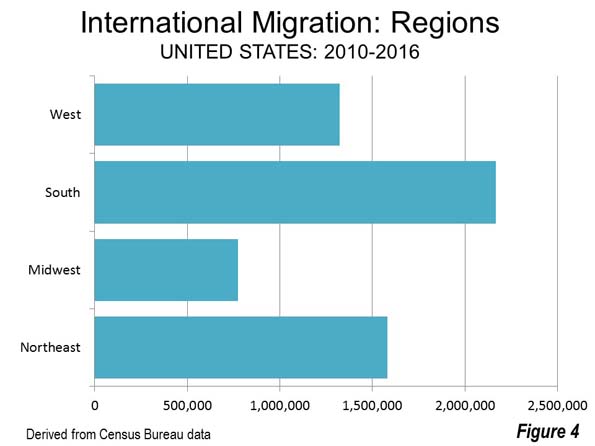
    Perhaps most surprisingly, the South also led in population gains from immigration. Between 2010 and 2016, the South added 2.2 million foreign migrants. The East added 1.6 million, the West 1.3 million and the Midwest 800,000 (Figure 4).

    State Population Trends

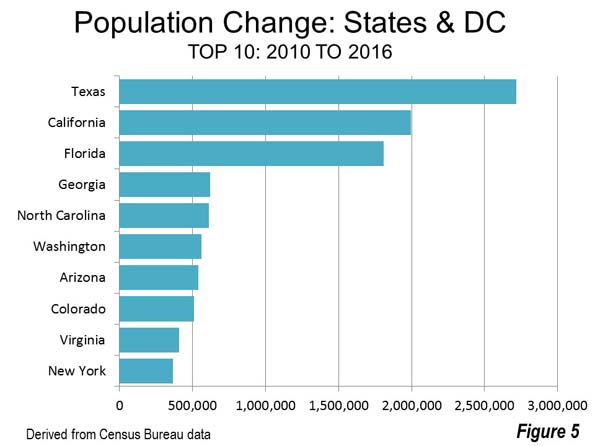
    Texas has led the nation in total population growth. Total population growth includes the natural change (births minus deaths), international migration and net domestic migration.  Texas added 2.7 million residents, a 10.8 percent increased compared to its 2010 population. This is more than double the national rate of 4.7 percent. California was well behind, with a gain of 2.0 million, despite having started the decade with a 50 percent higher population. California’s growth rate was 5.3 percent.

    Florida added the third largest number of new residents, at 1.8 million, for a 9.6 percent growth rate from 2010. After that the gains were much less. Georgia and North Carolina gained somewhat more than 600,000. Washington, Arizona and Colorado added between 500,000 and 600,000 residents. Virginia and New York rounded out the top ten (Figure 5). New York generated large numeric, but small proportional increases early in the decade (1.9 percent), the result of its fourth largest population, after California, Texas, and Florida.

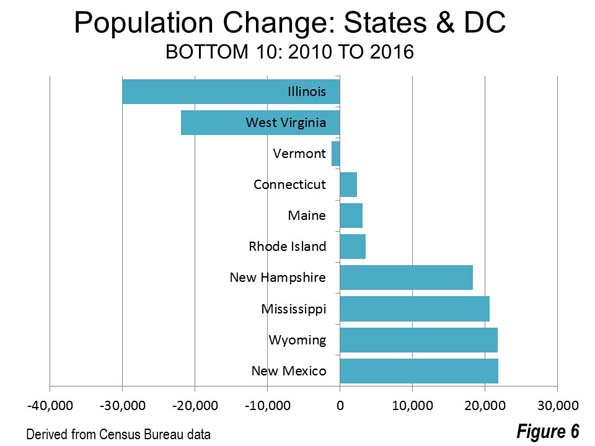
    Three states suffered population losses over the period. Illinois lost 30,000 residents and West Virginia lost 20,000. Vermont lost 1,000 and was joined by New England neighbors Maine, New Hampshire, Connecticut and Rhode Island in the bottom 10. However, Maine has begun to gain again (below). The bottom 10 included one southern state, Mississippi and two western states, Wyoming and New Mexico (Figure 6)

    State Domestic Migration Trends

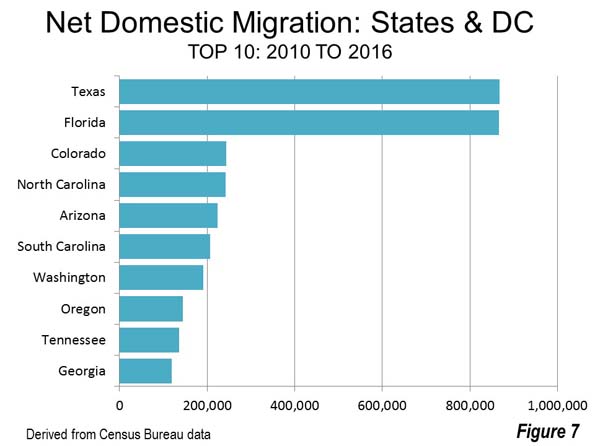
    Throughout the decade, Texas has led in net domestic migration. But the race is much closer, with the Longhorn state leading second ranked Florida by only 500. Both states have gained between 866,000 and 867,000 net new residents from domestic migration since 2010 (Figure 7). Perhaps due to the energy downturn, domestic migration to Texas dropped by more than one-quarter, while Florida continued led the nation for the second straight year. In 2016, Florida added 207,000 net domestic migrants, compared to the Texas gain of 126,000. With the improving prospects for energy under the Trump administration, the competition could be stiff between the two states in the years to come.

    Other net domestic migration leaders added between 200,000 and 250,000, including Colorado, North Carolina, Arizona and South Carolina. Washington, Oregon, Tennessee and Georgia added between 100,000 and 200,000 net domestic migrants, as did Nevada, which ranked 11th, a remarkable turnaround. Nevada as well as Arizona, Georgia suffered serious setbacks during the Great Recession, but now show signs of significant recovery.

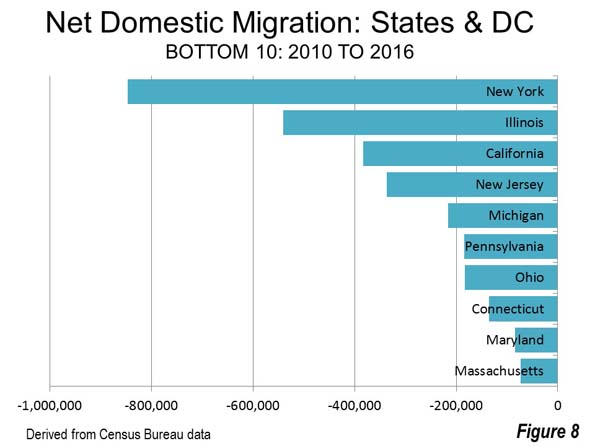
    The East and Midwest had a near monopoly on the bottom 10 in net domestic migration. New York lost 867,000 net domestic migrants, while Illinois lost 540,000. California’s loss was 383,000. New Jersey lost 336,000 and Michigan 216,000. Pennsylvania, Ohio and Connecticut lost between 100,000 and 200,000, while Maryland and Massachusetts lost between 70,000 and 100,000 (Figure 8).

    New York had the largest net domestic migration loss in 2016, at 191,000. Illinois lost 114,000, closely followed by California, at 109,000.

    Highlights

    The data also indicates significant shifts in growth rates during the decade.

    The largest drop was in the East, where the total population gain dropped 90 percent, from 245,000 in 2011 to 24,000 in 2016. In the Midwest, growth dropped from 174,000 to 103,000. Meanwhile, population rose 1,281,000 in the South, up from 1,199,000 in 2011. The West had the largest gain, from 697,000 to 822,000.

    New York’s population gain has declined every year, from 117,000 in 2011 to 27,000 in 2015 and a loss of 2,000 in 2016. Pennsylvania lost 8,000 residents in 2016, down from a 32,000 gain in 2011.

    Not all states in the West had positive trends. California gained only 256,000 in 2016, down from 344,000 in 2011. California’s gain dropped nearly 20 percent in just the last year. In 2016, California’s percentage growth trailed that of the United States for the first time in the decade (6.6 percent compared to the national rate 7.0 percent).  Between 2011 and 2015, California’s average, at 8.6 percent, was well above that of the nation (7.3 percent).

    The states to which Californians migrate in the greatest numbers gained as a result. Nevada’s population gain nearly quadrupled between 2011 and 2016, Idaho, Oregon and Arizona approximately doubled, while strong improvements were registered in Washington, Colorado and Utah.

    Florida added 367,000 new residents, a strong gain from the 2011 level of 247,000, while South Carolina’s gain nearly doubled. North Carolina, Georgia, Tennessee and Texas posted healthy increases. However, Maryland’s growth fell by more than one-half (55,000 to 21,000), while Virginia saw its gain drop from 84,000 in 2011 to 44,000 in 2016.

    Pervasiveness of Declining Growth

    At the national level, the annual growth rate continues to trend downward. In 2011, the United States added 0.75 percent to its population. By 2016, the rate had dropped to 0.70 percent. In 30 states, plus the District of Columbia, the growth rate dropped between 2011 and 2016.

    On the other hand, 20 states had stronger growth rates in 2016 than in 2011. Given the utter domination of the trends by the South and West, it is surprising that seven of these states are outside the West.

    In the East, the New England states of Maine, New Hampshire and Rhode Island had higher growth rates in 2016. At the same time, Vermont, where similar trends might be anticipated, slipped from modest growth in 2011 to a decline in 2016.

    Four Midwestern states also grew faster in 2016 than in 2011. These include Michigan, Missouri, Nebraska and Ohio. Michigan, the only state to reach more than 10 million and then fall below, has gained four years in a row, though remains below 10 million.

    Among these seven states, only Nebraska exceeded the national growth rate in 2016.

    Natural Increase Down, Mobility Up

    The natural population growth rate (births minus deaths) dropped from 4.7 percent in 2011 to 3.8 percent in 2016. At nearly 20 percent (18.8 percent), this is a huge reduction in just five years. At the same time the Great Recession-interrupted interstate mobility seems to have recovered. In 2016, there were 825,000 interstate moves, more than double the post-2000 low of 411,000 in 2011. The 2016 interstate move figure was greater than all but the three largest Housing Bubble years, 2005, 2006 and 2007. The 2016 moves also exceeded the 2001 to 2009 average by more than 10 percent (Figure 9).

    Back to the Future
    As we get farther from the Housing Bust and the Great Recession, population growth and domestic migration seem to be increasingly restored to prior trends around the nation.

    Wendell Cox is principal of Demographia, an international public policy and demographics firm. He is a Senior Fellow of the Center for Opportunity Urbanism (US), Senior Fellow for Housing Affordability and Municipal Policy for the Frontier Centre for Public Policy (Canada), and a member of the Board of Advisors of the Center for Demographics and Policy at Chapman University (California). He is co-author of the “Demographia International Housing Affordability Survey” and author of “Demographia World Urban Areas” and “War on the Dream: How Anti-Sprawl Policy Threatens the Quality of Life.” He was appointed to three terms on the Los Angeles County Transportation Commission, where he served with the leading city and county leadership as the only non-elected member. He served as a visiting professor at the Conservatoire National des Arts et Metiers, a national university in Paris.

    Photo of Zion National Park in Utah, the nation’s fastest growing state by Tobias Alt – Own workGFDLLink

  • An Open Letter To The Democratic National Committee From A Rural Democrat

    Dear Democratic National Committee,

    I’m writing you as a recently defeated Democratic State Senator in the “Red State” of North Dakota to talk about rural America. I’ve heard you may be interested in learning about us after the results of the 2016 election. Some of you have taken to the national airwaves to talk about reconnecting with our life styles here in the heartland. I’m glad it seems we finally have your attention.

    Here in the heartland of America, Democrats have been forced to fight against the odds you’ve unwittingly built against us to win elections. Unfortunately after the past couple of election cycles, there are only a handful of rural Democrats left who have been successful at overcoming those odds. One of them I’m proud to call my United States Senator.

    You should know that since the election, many of the North Dakota Democrats I visit with have done a lot of serious soul searching. “Where do we go from here?” “Has the national party shifted in such a way that I no longer identify with it?” “How do we reclaim what it means to be a Democrat in rural America?” All of those questions are complex and will take time to resolve. The answers may come differently for each of those individuals, especially for those who have felt abandoned out here. One thing I know for sure, none of them plan to quit and walk away from their drive to improve the community around them. It is the path to successfully have an impact that is the question.

    We’ve witnessed good, solid, moderate candidates get abandoned here in the Midwest; financial help stripped from promising campaigns and a separation in policy priorities between North Dakota and the coastal states. This only furthers the difficulty of finding great candidates who are willing to put their name on the ballot under your brand. Believe me; there are elected officials from the other side of the ticket whose priorities do not align with the average North Dakotan. Some of them have their eyes set on higher office. And as you know, Senator Heidi Heitkamp is up for reelection in 2018. We are willing to do all we can locally to get her reelected, but we need the assurance we aren’t going it alone.

    It is not just North Dakota Democrats either. A poll done by the Pew Research Center finds Democrats are less optimistic about their party’s future. This is a swift change from the pre-election talk of Trump being the death of the Republican Party as many of your pundits boasted. We also see how party leaders are trying to rationalize this year’s drumming. It was the FBI, it was fake news on Facebook, it was Jill Stein, and the list goes on. Bullshit. All of those likely had an impact, but I fear there is a more fundamental failing in the national Democratic Party.

    You’ve forgotten about who we are in rural America, and how many of us live our lives.

    I’m afraid you may have learned nothing from the November 8th election. While you talked about us in rural America, Congressional Democrats decided to stick with Rep. Nancy Pelosi as their leader over the other option, Rep. Tim Ryan from rural America. Staying the course with the same leadership that has overseen the decimation of the Democratic Party in the Midwest doesn’t bode well for us in the heartland.

    North Dakota Democrats have been in a precarious position for at least a decade. We are an energy-producing state with family and friends in the industry. Some of our towns are built for, and sustained by, energy workers. We understand how vital these resources are to our country while we build new technologies to diversify. We’re also proud farmers who take pride in caring for our land and feeding the world. We hunt, we fish, we own guns, and we have closets full of camouflage, blaze orange, and Carhartts. We’re the crowd at a small town street dance where live music is played on the back of a flatbed trailer. We are community driven individuals who know we all do better when we all do better.

    When you push an agenda where at the top you aim to hamper fossil fuels or add foolish rules on farmland, it boxes local Democrats in, here in North Dakota. It has become easy for the local political opposition to simply say, “Those Democrats are out-of-touch. They’re the party of Pelosi!” and they do it effectively. Here, we know how our homes are heated in the cold winter months, what fuels our trucks to drive down our gravel roads, and where our food comes from. That seems like a stark contrast from the rhetoric we hear from many national Democratic leaders who seemingly want to alter our way of life.

    So after laying that out, this is often where my more liberal friends ask if there is even a difference between a Republican and us rural, moderate Democrats. You’re damn right there is. To understand this, I welcome you to look at the North Dakota Legislature. Democrats pushed for sales tax exemptions on clothing for families. We reasoned for renters’ relief. We fought for family leave. We defended services for senior citizens, veterans, and people with disabilities. Meanwhile, what was passed by the Republican majority was an oil tax cut, a weakening of insurance for injured workers, corporate income tax cuts that go out-of-state, and threatening a reduction in services for senior citizens and children with disabilities. If people think there isn’t a difference between Democratic and Republican priorities in North Dakota, they haven’t been paying attention. It is on the Democratic Party to do a better job of telling that story and remind the average, hard working American that our values and priorities align with theirs.

    While you’ve been focused on the White House and maintaining Congressional seats, you’ve surrendered the fight for us in the heartland. We are now left clinging on to the hope that we can recapture the trust of our local electorate. We hear from the national Democratic Party about how important connecting with rural America is to them now. Here is the problem:

    You keep talking about us, but nobody is talking with us.

    The first step to understanding us is listening to us. The first step to winning is showing up. There is still time. If you’re interested, I know a lot of small town diners, bar counter tops, gas stations, and locally owned businesses that would welcome you if anyone were interested in engaging and talking with us here in the heartland.

    Tyler Axness
    Former North Dakota Democratic State Senator

    This piece first appeared at NDxPlains.com, a site discussiong ND and national politics.