Blog

  • Beyond Grassroots and Into Congress: California High-Speed Rail

    While most of the substantial opposition to high-speed rail in California previously came from local government leaders and citizens, primarily in the Bay Area, Congressmen are now taking the issue to the entire country for debate. House Representative Jerry Lewis, R-Redlands, introduced H.R. 6403, also entitled the “American Recovery and Reinvestment Rescission Act,” which would allot the remaining $12 billion in uncommitted stimulus money to the US Treasury to help relieve the national deficit of $1.3 trillion. At least half of that $12 billion is set to go to various high-speed rail projects across the country.

    Although the divergence of money to the US Treasury would not have a significant impact on the national deficit, it would greatly affect California’s high-speed rail plans. The project, now estimated to cost $43 billion, relies heavily on federal money because it will only receive voter-approved state bonds on a matching basis. No federal money, no bond money. So far, it has gotten $2.25 billion from Washington, $200 million of which has already been spent on planning. The American Recovery and Reinvestment Rescission Act would halt the development of the largest high-speed rail project in the country.

    Lewis and 27 other Republicans in the House are pushing for this bill, not necessarily because they think the Democratic Senate or President Obama will let it pass, but because they want to start a movement to stop wasteful government spending. Whether or not anything comes of Lewis’ efforts, he is forcing his fellow members in Congress to consider how high-speed rail fits into national economic priorities.

    President Obama will not abandon high-speed rail anytime soon- he has invested too much into it at this point. Therefore, if the federal government is going to put any kind of controls on funding poorly planned projects like California’s high-speed rail, it will have to come from Congress.

  • Harry Potter and Airport Scanners? Ask Dennis E. Powell…

    A comedic take on the latest in Homeland Security, be sure to read just how our rights may be slipping away due to fear, not unlike Hogwarts’ “Ministry of Magic.” The cynicism might just make your day!

    The View from Mudsock Heights

  • Korea Conflict Shows That Borderlands Are Zones of Danger

    The current conflict between the Koreas illustrates a broader global trend toward chaos along borders separating rich and poor countries. Ultimately, this reflects the resentments of a poor neighbor against a richer one. Feeling it has little to lose, the poorer neighbor engages recklessly in the hope of gaining some sort of tribute or recognition   from the better-heeled neighbor, or at least boosting its own self-respect.

    The Korean situation epitomizes the fundamental danger when rich and poor countries live adjacent to one another. According to 2006 statistics, South Korea has a per capita income of roughly $18,000; the North’s stands at $1,300. Clearly, the threat of leveling Seoul, a wealthy and successful city, has limited South Korea’s ability to respond as it might otherwise to its nasty, militaristic neighbor, whose people live on the brink of starvation.

    Conflicts between poorer peoples and richer neighbors have been part of human history since antiquity. In ancient Mesopotamia the rough Semites attacked and eventually overcame the wealthier, more sophisticated Sumerians. This pattern was repeated throughout the ancient world, for example, pitting Chinese against the peoples of the Steppes, hurling German and Hunnish barbarian races against the Romans, and in countless upheavals throughout Meso-America.

    Although the wealthier neighbor can beat back the threat through better organization and technology, often it’s the poor neighbor who ultimately triumphs.   The Great Arab historian Ibn Khaldun, a student of Mid-east  and Mediterranean politics in the 14th  century, even developed a theory positing that the poorer, hungrier neighbor often held the long term advantage Of the more affluent countries, he writes,  “Time feasts on them, as their energy is exhausted by well-being and their vigor drained by the nature of luxury.”

    As the settled, wealthier nation becomes soft and “senile,” Khaldun observed–and ultimately either unwilling or incapable of overcoming the threat from their more savage neighbor. You can people off only so long before you drain your own treasury and self-respect. If Khaldun is right, the world is going to become a more unsafe place in the coming decade as the great unwashed seek to crash the gilded gates.

    Other changes have made borderlands more dangerous in recent decades. During the Cold War era, such conflicts were often mediated by the two great super-powers. There were clear zones of influence. But in an increasingly chaotic multi-polar world, where power is diffused and technology sometimes favors the rogue, it become increasingly difficult to manage these conflicts. In Korea we can see this in the gamesmanship of China, which further limits any strong American and South Korean response.

    But Korea is hardly the only place where borderlands have become hot zones. There are many places around the world where rich nations abut poorer ones, creating serious potential for major conflict. Among the most worrisome:

    The Saudi/Yemen border. Oil-rich Saudi Arabia boasts a per capita income over 13 times greater than that of its southern neighbor. Criminal elements, illegal immigrants and a growing al Qaeda presence, cross the porous border. These could ultimately undermine the country with the largest proven energy reserves. Over 130 Saudi soldiers have been killed this past year along this 1,100 mile long desolate border region–so desolate it was only demarcated in 2000.

    Israel and Gaza/Palestine. Ancient hatreds make this a particularly worrisome set of borders.  There are huge gaps not only in ideology and religion but income. Israel’s 2006 per capita income was just shy of $18,000, while Palestine’s was under $800 and Gaza’s under $500. Such huge gaps, as can be seen in the Koreas, tend to exacerbate already great tensions.

    Spain/Maghrebian countries. The flow of immigrants from Muslim North Africa into southern Europe has become a major international flashpoint, particularly as Spain, Italy and countries continue to experience major economic dislocation. There are well over 1 million Muslim immigrants in the country. The income difference between these two adjacent worlds can be immense; Spain’s per capita GDP is more than ten times that of Morocco, its closest Arab neighbor. The flow of immigrants and far higher fertility rates among them can be unsettling to some.   ”Tomorrow Europe might no longer be European,” Libya’s Leader Muammar Ghadafi suggested recently.

    U.S./Mexico. Although relations between the two countries have been cordial under both Presidents George W. Bush and Barack Obama, the ground level violence in Mexico–claiming 26,000 deaths since December 2006–is both driving Mexicans north and driving Americans away from the border region. With U.S. per capita incomes over six times that of Mexico, the temptation for criminals, as well as illegal immigrants, to cross the border can be overwhelming, and unsettling. Border violence is way up, leading to calls for tighter controls over immigration.

    Two recently discovered tunnels for drug smuggling near San Diego, complete with rail cars, indicate how inventive some cross-border entrepreneurs can be. But it is a mistake to see borderland as only bastions of criminality and unrest. Until recently the U.S./Mexico border constituted one of North America’s fastest-growing economic regions, marrying U.S. technology and investment with hard-working Mexican labor.

    Perhaps the most positive model of harmonious border relations can be seen along the border of Singapore and Malaysia. Although Singapore’s per capita income is more than five times that of Malaysia, there are ambitious plans to build a vast new business complex in the Iskandar section of Malaysia’s Johore State   The Malaysians envision “a strong and sustainable metropolis of international standing.” Right now the most obvious signs of mega-development in the area are somewhat oversized government buildings.

    If the cross-straits development materializes, this region would both expand the economic footprint of the predominately Chinese city-state and its largely Muslim neighbor. Instead of worrying about drugs, terrorists or illegal migrants, some well-placed Singaporeans see Johore as a base to expand its manufacturers and those of foreign firms.

    There is also a swank upscale “Leisure Farm” that offers green-tinged amenities for Singapore’s often crammed and stressed residents. Some  Singaporeans privately doubt the ability of Malaysians to compete with them in higher-value-added fields, but others wonder if their growing investment across the straits may be creating a tough competitor.

    Ultimately,   the planet’s future depends on successfully integrating the economies of rich countries and poorer ones. Aspiring countries have much to offer their rich neighbors–in terms of markets, labor and entrepreneurial energy. One hopes the world will see more of the commerce-driven model of Malaysia, and less of the kind of potentially dreadful military conflict now brewing along the Korean frontier.

    This article originally appeared at Forbes.com.

    Joel Kotkin is executive editor of NewGeography.com and is a distinguished presidential fellow in urban futures at Chapman University. He is author of The City: A Global History. His newest book is The Next Hundred Million: America in 2050, released in February, 2010.

    Photo by anja_johnson

  • Stuck in the Station: The High-Speed Rail “Low Ball Express”

    You know that something is up when a Washington Post editorial advises that the Obama Administration do a “reality check” on its plans for high speed rail. From the beginning, there was more slow-speed than high speed rail, however both components of the plan could be in trouble. The Onion joined the issue with a satirical video announcing a federal “high-speed bus” program that would replace the high-speed rail plans.

    The Post criticized Secretary of Transportation Ray LaHood for not allowing Wisconsin and Ohio to use the federal money to make needed highway improvements instead:

    “This blunt refusal to heed the fresh mandate of Ohio and Wisconsin’s voters seems hard to justify – especially since using the money for other infrastructure would have created jobs, just as building trains would have.”

    Wisconsin and Ohio: This is vividly illustrated by recent election results, when successful gubernatorial candidates in two states vowed to kill two of the slower lines that had already received substantial federal funding. Wisconsin’s Scott Walker took aim at the Milwaukee to Madison line, which would average less than 60 miles per hour, despite reaching speeds of 110. Ohio’s John Kasich says that Ohio’s Cincinnati to Cleveland train is “dead” It could have been named the “Ohio Fast Mail,” because it would have averaged 50 miles per hour, about the same as the Fast Mail over the longer New York and Niagara Falls route — in 1877! These trains would have operated at average speeds from one-third to one-fourth those achieved by the Wuhan to Guangzhou trains in China.

    Illinois: There are also problems in Illinois. That state received $1.1 billion from the federal government to ramp up Chicago to St. Louis speeds to 110 miles per hour and to make the trip in four hours. Yet, the state received only about one-third of the requested $3 billion from the federal government for this project. It is a fair question where the rest of the money is coming from. Illinois had proposed to contribute only one percent of the cost ($4 million), leaving the project still nearly $2 billion short, before the seemingly inevitable cost overruns (which are already an inflation adjusted 8 times earlier projections). Illinois, which by some accounts is in as bad shape fiscally as California, simply does not have the money to complete the job.

    Incremental High Speed Rail? One of the most cynical myths about slower speed rail is that it is a “stepping stone” to genuine high speed rail, which is now being built in some countries to operate from 200 to 220 miles per hour. Such claims are patently misleading. The slower speed 110 mile per hour trains will run on tracks shared with freight trains and there will be some grade crossings (intersections with roads where trains, trucks and cars could conceivably collide). Genuine high speed rail requires starting all over.

    Illinois provides an example. The unfunded $3 billion slower speed line is not enough. The state has also sought federal funding to plan a genuine high speed rail line that would cost an additional $12 billion, according to a Midwest High Speed Association report. However, this amount would rise substantially, since it does not include rail-cars, maintenance facilities, stations and, of course, cost overruns. There is nothing incremental about building one line and then abandoning it to build another.

    California and Genuine High Speed Rail? Maybe Not: Meanwhile, the news is not encouraging to proponents of the nation’s two genuine high speed rail lines, in California and Florida.

    For two years, the California High Speed Rail Authority has been concentrating its attention on planning for the two most expensive sections of its proposed $43 billion (before cost-overruns) line from Los Angeles (Anaheim) to San Francisco. Plans that some claim would create a Berlin Wall across the largely affluent cites of the Peninsula led to a “boondoggle rally” attended by 500 people in Palo Alto. Community concerns have also been raised about the line through Orange County and southeastern Los Angeles County.

    Now, however, the federal government has virtually steered all of promised money to the San Joaquin Valley, requiring that it be spent between Merced and Bakersfield. The provisions of the high speed bond issue will require that state funding to be spent where the federal money is spent.

    The federal department of transportation has not indicated its rationale for this decision, but the new strategy could indicate that a modicum of sanity may be at work. Clearly the state of California does not have the money to build the system. Joe Vranich and I raised this issue in our Due Diligence report on the system, published by the Reason Foundation. We noted that the proposed 2:40 travel time from San Francisco to Los Angeles Union Station would more likely erode to 3:40, because the trains will not be able to travel as fast as planned in the urban areas, and they are not likely to attain their aggressive planned speeds on other portions of the route. We also suggested the likelihood that only part of the system would be built, with trains operating at conventional speeds over conventional tracks for the final 60 or more miles into San Francisco and Los Angeles. With insufficient money, there could be pressure to cut the genuine high speed rail portion of the system back even more than that, given the federal requirement for confining construction to the San Joaquin Valley, which now barely supports minimal air service and has largely traffic-free freeways.

    Proponents have been mouthing fairy tales about French, Chinese or Japanese investment in the system. Can they be so naive to believe that French or Japanese taxpayers will pay for high speed rail system in California? In fact, any such “investment” would be loans and would have to be paid back. Around the world, virtually all private investment for high speed rail has been either lost or bailed out by taxpayers.

    Perhaps the best that proponents can hope for is that some 220 mile per hour track will be built on the flat-as-Kansas agricultural land in the San Joaquin Valley. Trains could continue from the northern terminus (Merced) to San Francisco and from the southern terminus (Bakersfield) to Los Angeles and Anaheim on upgraded conventional rail tracks. This would bring the now discarded slower speed rail vision of Ohio and Wisconsin to California. Trains might well average 70 miles per hour or somewhat more.

    It could be even worse. Californians Advocating Responsible Rail Design (CARRD) reveals that the California High Speed Rail Authority has revealed “Plan B.” Its October 2009 application to the US Department of Transportation indicated that “In the event of significant delays or abandonment of the HST program, the Merced/Fresno Program would have created rail crossing benefits, as well as provided the potential for significant improvement to the existing San Joaquin intercity passenger service operated by Amtrak and underwritten in part by the state.”

    Florida: People were also having second thoughts about the genuine high-speed line between Orlando and Tampa. The two cities are so close together than even if the train reached the speed of light, given waiting in a rental car line and driving to and from the stations, car travel could be faster.

    Congressman John Mica, who seems likely to be Chair of the House Infrastructure and Public Works Committee in the next congress, has suggested that the line be truncated to a local operation between Orlando International Airport and Disneyworld. Governor Elect Rick Scott is now reviewing the project.

    International: The international news is barely any better. The Chinese government is now reviewing the wisdom of its huge expenditures on high speed rail, as a result of a critical report from the Chinese Academy of Sciences. And, as in California, communities are resisting along a proposed high speed rail line in England. Moreover, cost overruns have been routine, as have been revenue and ridership shortfalls relative to the always rosy projections.

    At least in the United States, the high-speed rail “low-ball express” remains stuck in the station. The actual costs, however, will certainly rise well above the low-ball estimates.

    Photo: The Fast Mail (1877 Average Speed Equal to Cancelled Ohio High Speed Rail Train): Harper’s Weekly, 1877.

    Wendell Cox is a Visiting Professor, Conservatoire National des Arts et Metiers, Paris and the author of “War on the Dream: How Anti-Sprawl Policy Threatens the Quality of Life

  • Love and the City

    It has been said that the modern city is soulless, that it is heartless, and that it is brutal. The modern city represents in its scale and complexity one of the most extraordinary of human inventions, but there is also no doubt that everywhere in the world it is also one of our biggest failures.

    The dysfunction of a city in the past was an inconvenience. The dysfunction of a city in the future will be a profound disaster for that city and, ironically, a profound opportunity for another city, of a smarter city. It will be an opportunity for a city that has found out how to position itself better in the world of cities, but more importantly in the eyes and hearts of its citizens.

    All over the world, there is a growing recognition that this brutality must stop; we have to imagine a different kind of city which addresses human needs and that puts the soul back into the city. This is essential to the survival of the city. Put another way, there is a growing understanding that it is actually “love” that will be the prime force in the future economy of successful 21st century cities.

    Who would have thought in the last generation that “love” might become a meaningful topic in a discussion about urban economies, much less a prime force of those economies?

    One important reason for creating a love-based city grows from the struggle today among cities for hegemony. We read all the time about “alpha-cities” and “delta-cities”: the “alphas” enjoy the fruits of labour and the “deltas” just do the labour – they just exist. And why is this?

    Well, it’s because the dynamics of urban growth and competition have fundamentally changed in the last quarter century. The world has become footloose, with people and capital moving at will: business can be done anywhere. Other aspects of life are more important than one’s livelihood and where people choose to settle is not tied down the way it used to be. We can do and be almost anything anywhere.

    The result is a new kind of economic base for our cities, augmenting the traditional economic activities holding our cities together. This is the ideas and service economy and it opens up the imperative to create a city of beauty and quality liveability and style. This is an economy driven by people, their direct needs, their preferences and their day-to-day experiences.

    This ideas and service economy quickly becomes an economy involving almost everyone. If you live in a core city, have you ever tried to get a gardener or a plumber? But, even beyond that, you have to think about all of the professions and vocations that can now demand an enjoyable as well as functioning city.

    We’re not just talking about the service sector or the ‘creatives’, we’re talking about almost everybody. We have to focus the discussion on a city that is liveable for a broad array of its population.

    I worry that in all our creative thinking about sustainable technologies and sustainable urban forms, there may be some strong denial going on about people and their inclinations, denial that will block the way towards sustainability.

    Take the fashion that insists on the primacy of density and mixed use and diversity and sustainable transportation. Sadly, most consumers in the English speaking world, except in a very few of our older gracious places, have shown very little interest in being a part of that kind of city. In my country, two-thirds of Canadians live in auto-dominated suburbs that boast none of these qualities – and that proportion is even higher in America.

    Let’s be blunt: most people hate density because most of it has been so bad; they think of mixed use as probably hitting them negatively and transit is not even in most people’s vocabulary. The ideal of most people is some sort of rural “garden of Eden” that they want to escape to from the city – even if that ends up being an illusory goal.

    I sympathize. The cities we have been building since the War have very seldom offered anything very appealing at almost any density. Who can really fall in love with brutal concrete canyons or anonymous strip malls or wind-swept roads?

    If cities want to offer an alternative, they must change and bring back the human touch – we have to bring placemaking to the very heart of the civic agenda. We have to stop trading away the urban qualities we care about for the urgencies of the moment of modern life.

    We must start to build places that truly appeal to people – yes, places that are sustainable, but also places that are so good that people will choose them. These cities have to have all the human services and they have to have beauty and they have to be gentle. Only then will they become attractive to a wide range of people.

    I call this “Experiential Planning” – learning about and then carefully making the city deliver the experiences people tell us they want in their lives for their families and children.

    Experiential planning looks beyond land-use and transportation patterns to things like character and comfort and health and convenience and the visceral response of the senses and caprice: things that simply make people happy. Happiness is the applied side of love.

    People want all of the efficiencies and choices but they also want more. They want to feel the unique, special spirit of a place as a real thing, not a marketing gimmick. They want their habitat to have a “buzz” that makes them feel good. They want their day-to-day living environment to foster social engagement and neighbourliness not isolation. That is what the contemporary city has often been missing.

    For as long as anyone can remember, modern cities, with very few exceptions, have been shaped by economic activity and politics and the shifting of social groups: the city exploited as a commodity. But that doesn’t have to be the case. We can actually design our cities as an explicit act of creation – grand civic design with the whole city as a canvas. And every city has to find its own way: they should not accept cookie-cutter replications of what’s being done everywhere else.

    To start, every city needs to perform a ritual burning of these outdated and single-purpose rules. Now I am not talking about de-regulation. The city of the future will have to have strong regulations because the possibilities out there for development are just too diverse and the private interests in development too strong. There must be a clear expression of the public interest and public needs to match that of the private sector.

    Also, I want to be clear that this is not a “top-down” agenda. Experiential planning requires an aggressive and diverse engagement of the public at every step along the way to articulate the public perspective and to insure public buy-in and ownership. The general public needs to discuss and debate an overall civic vision and all aspects of urban design.

    In this experiential-based city there will be an alignment of profitability and community building. We will also see people coming back to live in the core city and to suburbs transformed through natural choice and preference. There will be an alignment of consumer selection and sustainable practice. This will include all kinds of people but especially families with children.

    But none of this will happen by accident. We have to make it happen and bring along individual values through a careful process of reconciliation.

    Tomorrow’s city must meet the environmental test and the economic test but it must also meet the experiential test; and that is the test of love; that is the test of soul. It must be beautiful and joyful and sociable and humane and offer a complete rich community life – with all the subtleties of human occupation. That is the real power of an urban love affair.

    Larry Beasley is the retired Director of Planning for the City of Vancouver in Canada. He is now the “Distinguished Practice Professor of Planning” at the University of British Columbia and the founding principal of Beasley and Associates, an international planning consultancy. He chairs the ‘National Advisory Committee on Planning, Design and Realty’ of Ottawa’s National Capital Commission; he is the Chief Advisor on Urban Design for the City of Dallas, Texas; he is on the International Economic Development Advisory Board of Rotterdam in The Netherlands; and he is the Special Advisor on City Planning to the Government of Abu Dhabi in the United Arab Emirates.

    Photo by ecstaticist

  • The Rise of the Efficient City

    Smaller, more nimble urban regions promise a better life than the congested megalopolis.

    Most of the world’s population now lives in cities. To many academics, planners and developers, that means that the future will be dominated by what urban theorist Saskia Sassen calls “new geographies of centrality.” According to this view, dense, urban centers with populations in excess of 20 million—such as metropolitan Tokyo, New Delhi, Sao Paolo and New York—are best suited to control the commanding heights of global economics and culture in the coming epoch.

    In fact, the era of bigger-is-better is passing as smaller, more nimble urban regions are emerging. These efficient cities, as I call them, provide the amenities of megacities—airports, mass communication, reservoirs of talent—without their grinding congestion, severe social conflicts and other diseconomies of scale.

    Megacities such as New Delhi, Mumbai, Sao Paolo and Mexico City have become almost unspeakably congested leviathans. They may be seen as “colorful” by those engaging what writer Kennedy Odede calls “Slumdog tourism.” They may also be exciting for those working within the confines of “glamour zones” with high-rise office towers, elegant malls, art galleries and fancy restaurants. But most denizens eke out a meager existence, attractive only compared to even more dismal prospects in the countryside.

    Consider Mumbai, with a population just under 20 million. Over the past 40 years, the proportion of its citizens living in slums has grown from one in six to more than half. Mumbai’s brutal traffic stems from a population density of more than 64,000 per square mile, fourth-highest of any city in the world, according to the website Demographia.

    Many businesses and skilled workers already are moving to smaller, less congested, often better run cities such as Bangalore, where density is less than half that of Mumbai. Much of this new growth takes place in campus-like settings on the edge of town that take advantage of newer roads, better sanitation systems and sometimes easier access to airports. Companies like Alcatel-Lucent and Infosys offer their employees facilities more similar to those of Silicon Valley or suburban Austin than to Mumbai or Kolkata (formerly Calcutta).

    Consider also Singapore and Tel Aviv, which are among the best models for the efficient cities of the future. At its founding in 1965 after independence from Malaysia, Singapore’s per capita GDP was about that of Guatemala and well below that of Venezuela and Iraq. Today it equals, on a purchasing power basis, that of most Western cities including London, Sydney and Miami.

    The city-state bears no resemblance to the typical unsanitary and disorderly tropical metropolis. Singapore’s roughly five million citizens live under efficient (if heavy handed) government. With its modern port, airport and excellent transport network, Singapore consistently ranks as the No. 1 locale for ease of doing business by the World Bank. Over 6,000 multinational corporations including Seagate, IBM and Microsoft have a large presence in Singapore.

    Tel Aviv represents a decidedly different approach to building the efficient city. With roughly two million people in its metropolitan area, this little dynamo produces the vast majority of Israel’s soaring high-tech exports, is home to a preponderance of the country’s financial institutions and has established itself as the global center of the diamond industry. Incomes in the region are as much as 50% above Israel’s national average.

    Tel Aviv’s pleasure-loving denizens may differ markedly from more controlled Singaporeans—or the usually more religious citizens of Jerusalem—but they employ many of the key efficient city advantages: a sharp focus on business, a well-developed sense of place and a first-class communications infrastructure. The city’s tech industry includes firms such as Microsoft, Cisco, Google and IBM. It is home to Israel’s only stock exchange and most of the country’s resident billionaires.

    The U.S. is also embracing the efficient city. Between 2000 and 2008, notes demographer Wendell Cox, metropolitan areas of more than 10 million suffered a 10% rate of net outmigration. The big gainers were generally cities with 100,000 to 2.5 million residents. The winners included business-friendly Texas cities and other Southern locales like Raleigh-Durham, now the nation’s fastest-growing metro area with over one million people. You can add rising heartland cities like Columbus, Indianapolis, Des Moines, Omaha, Sioux Falls, Oklahoma City and Fargo.

    Some of these—such as Austin, Columbus, Raleigh-Durham and Fargo—thrive in part by being college towns. Others like Houston, Charlotte and Dallas have evolved into major corporate centers with burgeoning immigrant populations. But they thrive because they are better places for most to live and do business.

    Take the critical issue of getting to work. According to the American Community Survey, the average New Yorker’s daily trip to work takes 35 minutes; the average resident of the Kansas City or Indianapolis region gets to the office in less than 13 minutes. That adds up in time and energy saved, and frustration avoided.

    The largest American cities—notably New York, Los Angeles and Chicago—also show the most rapid decline in middle-class jobs and neighborhoods, with a growing bifurcation between the affluent and poor. In these megacities, high property prices tend to drive out employers and middle-income residents. By contrast, efficient cities are where most middle- and working-class Americans, and their counterparts around the world, will find the best places to achieve their aspirations.

    This article originally appeared at the Wall Street Journal.

    Joel Kotkin is executive editor of NewGeography.com and is a distinguished presidential fellow in urban futures at Chapman University. He is author of The City: A Global History. His newest book is The Next Hundred Million: America in 2050, released in February, 2010.

    Photo by wili_hybrid

  • Toronto Election Highlights Failure of Amalgamation

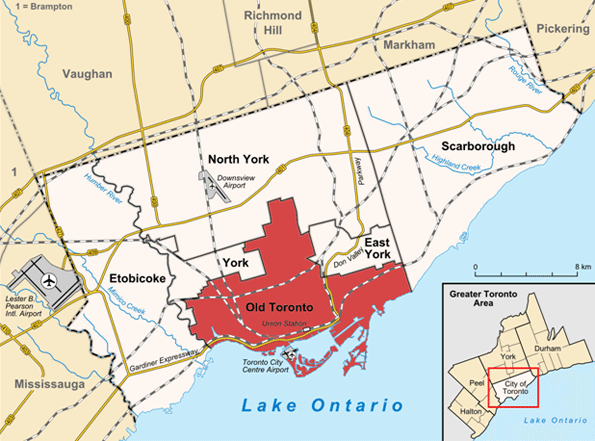
    In my pre-election piece on the Toronto election, I discussed the city’s lingering malaise. It developed slowly but its roots can be traced to the 1998 amalgamation that swallowed up five suburban municipalities. This led to a six folds expansion of city boundaries and a tripling the population base. This amalgamation was initiated by the province of Ontario as a cost saving measure and faced major local opposition. Citizens and politicians were concerned that the benefits of the alleged efficiency saving would be outweighed by the negative impact of losing local decision making powers. The recent Toronto municipal election bore out this concern.

    In the October 25th election, Torontonians were presented with two dramatically different visions. The first vision was presented by former Liberal Ontario cabinet minister George Smitherman. A self-described progressive, Smitherman appealed mainly to voters in the downtown core of Old Toronto. He stood for issues such as improved bicycle lanes, renewal of the downtown waterfront, and improving social housing conditions. The second version was presented by maverick councilor Rob Ford, who represented a ward in the former City of Etobicoke. Ford’s message was simple: it’s time to stop the “gravy train” at City Hall. While he had elaborate platforms on many issues, cutting waste at City Hall was his ubiquitous message.

    Despite Toronto’s social democratic image, Rob Ford won a crushing victory. Ford earned 47% of the vote, while Smitherman ended up with 35%. Far left candidate Joe Pantalone (known primarily for attempting to stop businesses from opening in his own ward) managed to capture 12% of the vote.

    Aside from the shock that a partisan conservative won in Toronto, there are two other significant developments. Both front runners were significantly more fiscally conservative than the current administration. Ford and Smitherman represented constituencies desperately seeking change. Smitherman’s base was frustrated with the inability of the city to provide the services that they want efficiently. Ford’s base was angry that the city is providing many of these services in the first place.

    Not surprisingly the results broke down along specific geographic lines. Ford won an outright majority of votes in every single ward outside of Old Toronto. Within the old boundaries, Smitherman won 13 of the 16 wards. The three Old Toronto wards Ford won are all on the fringes of the Old City.

    In 1997, the newly amalgamated city went to the polls for the first time. Conservative former North York Mayor Mel Lastman narrowly defeated social democratic former Old Toronto Mayor Barbara Hall. Since then, downtown oriented social democrats have controlled the city ever since.

    Clearly this result shows that the concerns expressed by the opponents of amalgamation were largely valid. Amalgamation failed to create cost savings, and has created a dysfunctional megacity. Rather than having six municipalities where voters are focusing on solving local problems, we have one gigantic city with the core and the suburbs fighting for their share of the public purse. This leads to the schizophrenic policy decisions we see today.

    Before amalgamation, there were six different versions of Toronto life that one could choose from. If you didn’t like living in high tax Toronto, you could live in Etobicoke. If Etobicoke’s bylaws and business taxes were hurting your business, you could move to North York. Now all people in the Toronto area can do is vote the bums out on election day, or get out of the area altogether. This isn’t a viable long-term solution.

    The problems are systemic, and cannot be solved so long as the megacity exists. This extends beyond the fact of the impossibility of satisfying the core and the suburbs at the same time. The megacity allows public sector unions to literally hold 2.5 million people hostage whenever they feel like it. A notorious strike last summer lead to a month without garbage collection in the entire city. The 24,000 strikers also shut down parks and recreation services, daycare, provision of municipal licenses, health inspections, animal services, and forced a 25% reduction in ambulance services. In 2008, the transit union called a last minute strike at midnight on a Friday night, grinding the city to a halt. These are just two examples of how powerful Toronto public sector unions have become. The only reason strikes aren’t more frequent is that the city typically gives them whatever they want in order to avoid chaotic strikes. De-amalgamation would not only allow more local control over policy, but would help fray the noose that the unions have tied around the city’s neck.

    Downtown progressives gripe over how Rob Ford is going to destroy their city, but they should take a minute to think about what some of their policies have been doing to suburbanites for years. They have imposed high taxes, and burdensome regulations on the amalgamated cities, as well as a myriad of new bylaws. Some of these policies make sense in Old Toronto. For instance, dissuading automobile usage in the congested core makes sense. Doing so in the suburbs does not. It might make sense to regulate trees on private property in a crowded downtown neighborhood. Not so much in a new subdivision. One-size-fits-all policies don’t work across a city as large and diverse as Metropolitan Toronto.

    Now that the suburbs have wrought their revenge on the old city, progressives need to recognize that de-amalgamation is not just a fantasy of libertarians and angry suburbanites. It is a prerequisite to restoring sound public policy reflecting the preferences of individual communities. Railing against Rob Ford won’t fix the problem. Rob Ford is what the suburbs want. As long as the megacity lives, Toronto will elect a Rob Ford type every now and then.

    The only way to stop this pattern of alternating, divergent visions is by de-amalgamation. Critics will use metaphors such as ‘unscrambling an egg’ to illustrate the difficulties of de-amalgamation. No one should believe that de-amalgamation would be easy. But there will never be a better time than now to take the necessary step of de-amalgamation. A few years of chaotic governance would be worth the long run benefit of restoring local control.

    Downtown Toronto photo by Astro Guy

    Steve Lafleur is a public policy analyst and political consultant based out of Calgary, Alberta. For more detail, see his blog.

  • Amtrak Fails To Weather The Storms

    Why do I persist in riding Amtrak, the short name for the National Railroad Passenger Corporation, a company originally owned by the freight railways, but now subsidized by Congress and run like a Russian bureaucracy, complete with late trains, sullen employees, myriad petty regulations, budget deficits, cold coffee, feather bedding, broken seats, clogged toilets, rail cars that feel like buses, and a schedule that serves the interests of congressmen, lobbyists, unions, budget stimulators, and small-town mayors, but rarely passengers?

    Isn’t it time to let Amtrak go the way of such failed railroads as the Nickel Plate, Erie Lackawanna, Chicago & Alton, Rock Island, Maine Central, Wabash, Missouri Pacific, or the New York Central, lines that outlived their corporate incarnations and were either wound up or merged into larger entities?

    Amtrak was set up in 1971 to replace the passenger rail network that was killed off by government regulations, the Interstate Commerce Commission, subsidized air and road travel, and urban blight. The new entity went to work hauling passengers on a route system better adapted to 1921 than 1971. The earlier trains were faster.

    It’s hard to imagine Leland Stanford or E.H. Harriman buying into the Amtrak business model. Forty years after Amtrak’s creation, little of its plan has changed. It offers corridor services on the East and West coasts and, in between, a meandering schedule of trains that account for less than one percent of all intercity travel.

    Buyers could easily be found for the Northeast Corridor service between Boston and Washington. Better yet, allow competition on the line, and auction off the franchise rights, using the proceeds to pay down national debt.

    England had the dreadful network that operated as BritRail. After it was privatized, Britain’s rail service became competitive, passenger friendly, faster, and more comfortable.

    Compare the new British private train system with the Amtrak experience (“Enjoy the journey”). Think about New York’s Pennsylvania Station, a subterranean strip mall with dank corners, uncomfortable chairs in cheerless waiting rooms, confusing destination boards and dreary platforms that have seen few improvements since I first used them in the early 1960s.

    Passengers buying Amtrak tickets in Penn Station stand in a line that feels like Ceauşescu’s Romania. Only one or two agents are on duty, the tickets are expensive, you need you an identity card to buy one, and getting on the train has the feel of descending into a Chilean mine.

    At the cost of billions, there’s a plan for a new “Moynihan Station” across the street, although much of what’s wrong with Penn Station could be fixed if Amtrak outsourced the operation to Hyatt.

    Its shoddy service explains the rise of discount bus lines that are now digging into core Amtrak passenger revenue between Boston, New York, and Washington. Companies such as Bolt Bus charge $15 or $20 to get from New York to Boston, while Amtrak costs $67 to $95, depending on the day and time.

    Bolt leaves from West 34th Street, and departures are punctually on the hour. The seats are cramped, but the buses are clean and have Wi-Fi. The trip takes less time than many trains, when you add in inevitable Amtrak delays. Nor is there a surly Amtrak conductor reading the riot act at each station.

    To get a flavor of Amtrak’s attitude toward its passengers, read the cheerful words of its CEO in the on-board magazine: “Our identification policy, random screenings in stations, random on-board ticket verification process and more interactive police efforts—including our K-9 teams—are some of the visible activities we have been working on.” Trains used to advertise comfortable berths with sleeping kittens.

    Killing off Amtrak would mean the end of long-haul passenger service, the sleepers that are the heirs to trains like the Twentieth Century Limited. I would deeply regret the absence of long-distance train travel in the United States. But, were Amtrak spun off, its overpriced and indifferent service might be replaced by a network of private operators that would compete to take Americans around a glorious country that longs to be seen by rail.

    Even today, Amtrak trains run near full capacity, and the potential to tap into a travel-happy country of 300 million ought to interest a few hedge funds and stock jobbers, not to mention flourishing overseas rail companies.

    Already there are nascent private companies and sleeping car owners that offer rail trips to national parks, art museums, jazz festivals, baseball games, and the homes of famous writers. Deregulate the passenger industry, and companies like these will flourish. Railroads are in America’s entrepreneurial DNA.

    Recently, for $325, less than the cost of a cramped night in an Amtrak “Slumberette” (emphasis on the “ette”), I rode round-trip in a private rail car, New York Central 3, owned by Lovett Smith III, from New York to Pittsburgh.

    Along the way, I sat on the open, rear platform from which presidential candidates whistle-stopped across America, and took in the sweep of the Philadelphia skyline, the majesty of Amish country (I loved the teams of horses pulling plows), the arched bridge across the Susquehanna, the engineering marvel that is the Horseshoe Curve, the path of the Johnstown Flood, and the remnants of the steel industry around Greensburg. Inside the car, I chatted with my fellow passengers, ate elegant meals, and sampled Italian wines (a group on board had organized a tasting). Were Amtrak a service company, not a protection racket set up to bleed government money into padded contracts, it would have the imagination to operate similar excursions.

    Instead, Amtrak wants to position itself as the paymaster for a national rail plan. The Department of Transportation recently issued a strategic plan called Moving Forward: A Progress Report. (If Amtrak were to issue a report to its passengers, it could be entitled, “Sorry for the Inconvenience: Due to a Track Incident, We’re Being Held in Baltimore.”)

    Amtrak imagines itself as the federal agency that should be hired to spend $117 billion, over thirty years, to build a segregated high-speed rail system between Boston and Washington, and for additional billions, to operate Core Express Corridors between cities less than 500 miles apart.

    Such visions of grandeur come from a company that needs nine hours and fifteen minutes to run a train the 444 miles from New York to Pittsburgh; that’s an average speed of 48 m.p.h.

    To be fair, not all of Amtrak’s failings are its fault. Most of the tracks on which it operates are owned by freight companies that find passengers a nuisance, and think nothing of shunting aside “the varnish” to send through more coal and containers.

    Amtrak, however, is responsible for a corporate culture that makes a mockery of “customer service.” In many ways, it is the perfect metaphor for everything that is wrong with letting Washington have a heavy hand in the economy, or for imagining that an economic revival can be built around companies with federal guarantees.

    Amtrak lacks direction, lives off subsidies and stimulating money, and now wants $117 billion to operate high-speed rail that, for the cost differential, would be only marginally better than the private bus companies now competing up and down the East Coast, with fares of one third or less than what Amtrak charges.

    Americans would happily pay for low-speed rail, if the food was good, the seats spacious, the broadband fast, and if, on the rails, they could surf, shop, eat tacos, and watch movies.

    At the moment, I am riding an Amtrak train that is four hours behind schedule on its way into North Carolina. So far, to use a phrase from railroading legend, the services have not been worth a “plated nickel.”

    Photo By Kyle Gradinger, Amtrak Keystone Snowstorm I. Amtrak AEM-7 locomotive 904 leads a Keystone Corridor train through the snow in Rebel Hill, King of Prussia, PA.

    Matthew Stevenson is the author of Remembering the Twentieth Century Limited, winner of Foreword’s bronze award for best travel essays at this year’s BEA. Growing up, he was a “Central” man, but loved the majesty of the old Pennsylvania Station. Together with his father, now 91, he recently has waded through a 1969 edition of the ‘Official Guide to the Railways’. He lives in Switzerland.