Blog

  • Car Wars: Should Autos Rule The Road? Part I

    We’ve decided to become a one car family. Denver has proven to be the ideal locale for this experiment, of sorts. The “Mile High City,” and particularly our new neighborhood, provide a range of mobility options beyond the four-wheel variety for trekking from place to place.

    The metropolitan area is naturally blessed with a mobility-favorable landscape. It is approximately 10 miles by 10 miles. More importantly, our neighborhood possesses what I affectionately refer to as “accessible proximity” to local amenities such as grocery stores, coffee houses, parks, and specialty shopping centers. The immediate area is not only safe, it’s engaging in its physical and social makeup, with stately homes and troves of dog-walkers along suburban style streets.

    Recently, our daughter, who is eight, remarked “Ya know, at our old home it seemed like we always needed a car to go places, while here in Denver, we can actually walk places and enjoy the clean air.”

    The website Walkscore, an online index, which ranks communities nationwide based on access by foot to restaurants, coffee houses, schools, businesses and other frequent destinations. Denver’s score provides tangible evidence of my daughter’s contention: According to the site’s analytics, our Denver address registers a whopping 88 out of 100, defined as ‘very walkable,’ meaning that “one is able to accomplish most errands by foot. Our residence in Folsom, California — from which we recently relocated — stumbled in at a paltry 48 out of 100, defined by Walkscore as ‘car dependent’.

    Why is this such a big deal to us, as well as to growing numbers of Americans? I would contend that it is affordability. As Americans continue to struggle financially amid the worst economic times since the great depression, the argument could be made that location efficient neighborhoods offer a cost effective alternative to those that are exclusively auto-centric. In an era where expenses associated with automobile ownership, maintenance and fuel represent a significant slice of our household budgets, policy makers would be wise to expand options that encourage alternative forms of mobility.

    Automobiles are still the transportation mode of choice for most working commuters, and for good reason, as most Americans still live a reasonable distance from where they work. But alternative forms of transportation are gaining momentum, as many struggle with insurance and other automotive related expenses.

    According to the U.S. Census Bureau’s recently released American Community Survey (ACS), bicycling is becoming a viable option for Americans willing to pump the pedal on their way to work. Portland leads the U.S. in terms of the most bike commuters, with almost six percent of its residents using a bicycle as their primary mode of transportation to work in 2009. Minneapolis (3.86%), Seattle (2.99%), San Francisco (2.98%), and Oakland (2.53%) round out the top five.

    Denver is one of a handful of cities that is actively promoting the use of bicycles as a viable short-run commute option. This year, the city introduced the first large-scale bike-sharing program in the U.S. A partnership between Humana, Trek Bicycle and the advertising agency Crispin Porter + Bogusky, this initiative flows from the shared belief that bicycles should serve as vehicles for positive health and environmental change, as well as important parts of a community’s transportation ecosystem. It’s this latter point that has gained the attention of Denver hotels and the convention center, which are seeking to provide visitors with mobility tools that compliment the downtown’s free bus system and walkable grid.

    The dilemma continues to be how to efficiently travel short distances that are too far to walk. Like Pavlovian dogs, many of us are conditioned to reach for the car keys, even for the shortest of trips. This behavior is deeply embedded in our consciousness;, an auto-centric mindset that has been nurtured in us for years.

    Chris Wiggins of the Folsom, California based Glide Electric Cruiser believes that a huge demand exists for short-range transportation options. His invention is ideal for short commutes and has virtually no impact on the environment. What is it? A series of motorized electric scooters with top speeds of up to 38 miles per hour. Currently in a first production run stage, these “cruisers” have attracted a wide swath of interest, from law enforcement agencies to senior groups. “I personally believe they have the potential to revolutionize short-range commuting in the U.S. and beyond,” says Wiggins. “My greatest hope in developing them is that they will have a meaningful impact on the quality of life, as well as improve the environment.”

    Recognizing that car-based travel will continue to be a reality for most Americans, innovative companies like Zip Car and Car2Go have adroitly positioned themselves for where I believe the auto market is headed: Short-term, just-in-time rentals that eliminate the expense of owning a car. And since my family has only one car, I personally am exploring these and other options to assist with those commutes beyond my immediate, local area.

    There are many factors affect the viability of a mobility option. Density currently receives the greatest amount of air-time. I’m often reminded of a business trip several years ago to the wonderful island community of Bermuda. I was intrigued to discover that because of its dense configuration and its size, cars weren’t allowed on the island until 1946. Today, only residents are permitted to drive cars on the island, and only one car is allowed per household. As Bermuda is a heavily trafficked tourist destination, I wondered what forms of transportation were available. An amused hotel bellman directed me to a lot full of mopeds and scooters.I discovered that these low-power transporters were the predominant form of transportation for residents as well as visitors to the island.

    While it could be argued that population density is the raison d’etre for alternative mobility options, there are other factors that should be taken into consideration. Much talk of late has centered around a concept called “intersection density,” which refers to the number of intersections in an area. The greater the intersection density, the shorter the blocks, and it is these short blocks that are the main contributing factor to neighborhood walkability. In Travel and the Built Environment: A Meta Analysis, which appeared in the summer 2010 issue of the Journal of the American Planning Association, Reid Ewing and Robert Cervero, urban planning academics at University of Utah and U.C. Berkeley respectively, found that of all the built environment measurements, intersection density has the largest effect on walking — more than population density, or distance to a store or to a transit stop, or jobs within one mile. According to the authors, it’s this ease of accessibility that spurs walkable foot-traffic to high destination nodes such as shopping and recreation.

    Density, unfortunately, is often associated exclusively with large urban environments that possess tightly packed, downtown center-cities. This undermines the enormous advantages of many suburban style cities such as Naperville, Illinois; Traverse City, Michigan; and Glenwood Springs, Colorado, all of which offer a plethora of local amenities within walking distance of their adjacent neighborhoods.

    Our deeply ingrained auto-centric habit makes it hard to say if any of these lessons in metropolitan mobility will gain traction, and if so, where they are likely to lead us. But one thing is for certain: A new narrative for how to approach short-distance trips is fostering a debate that is, at the very least, a carbon footprint in the right direction.

    This is the first of a two-part series in which different writers examine the centrality of the automobile in urban and suburban life. Tomorrow, read a very different viewpoint in Part Two.

    Photo by Michael Scott of the author’s Denver neighborhood.

    Michael P. Scott is an associate with Centro, Inc, a Denver-based consulting firm focused on the future of our city centers. He can be reached at michael@becentro.com
  • The Myth of the Sustainable Public Budget

    Nobel Laureate economist Paul Krugman caused a stir on ABC’s This Week, expressing the following view to Christina Amanpour on the recommendations by the leadership of the US Debt Reduction Commission:

    “Some years down the pike, we’re going to get the real solution, which is going to be a combination of death panels and sales taxes. It’s going to be that we’re actually going to take Medicare under control, and we’re going to have to get some additional revenue, probably from a VAT.”

    He later clarified his statement to be less provocative, noting that health care costs had to be better controlled and that there is a need for “several percent” more revenue, which might “most plausibly” come from a value added tax.

    He went on to say that “And if we do those two things, we’re most of the way toward a sustainable budget.” That is a very tall order. Any serious examination of government costs makes it clear that there is no such thing as a sustainable budget. The unit costs of government services routinely rise, frankly because in government competitive influences are largely absent. When government encounters financial difficulty, it looks for ways to cut services and raise taxes — that is, ways to reduce customer service or to charge more for what it does. Regrettably, in government, the answer to every question seems to be “more money.”

    On the other hand, when companies in competitive markets run into fiscal difficulties, their survival requires that they find ways to attract customers and look for ways to lower their prices without cutting service.

    Sustainability and government budgets are more often than not an oxymoron, except perhaps for the special interests who live off them (whether of the Right or the Left).

  • California Suggests Suicide; Texas Asks: Can I Lend You a Knife?

    In the future, historians may likely mark the 2010 midterm elections as the end of the California era and the beginning of the Texas one. In one stunning stroke, amid a national conservative tide, California voters essentially ratified a political and regulatory regime that has left much of the state unemployed and many others looking for the exits.

    California has drifted far away from the place that John Gunther described in 1946 as “the most spectacular and most diversified American state … so ripe, golden.”  Instead of a role model, California  has become a cautionary tale of mismanagement of what by all rights should be the country’s most prosperous big state. Its poverty rate is at least two points above the national average; its unemployment rate nearly three points above the national average.  On Friday Gov. Arnold Schwarzenegger was forced yet again to call an emergency session in order to deal with the state’s enormous budget problems.

    This state of crisis is likely to become the norm for the Golden State. In contrast to other hard-hit states like Pennsylvania, Ohio and Nevada, which all opted for pro-business, fiscally responsible candidates, California voters decisively handed virtually total power to a motley coalition of Democratic-machine politicians, public employee unions, green activists and rent-seeking special interests.

    In the new year, the once and again Gov. Jerry Brown, who has some conservative fiscal instincts, will be hard-pressed to convince Democratic legislators who get much of their funding from public-sector unions to trim spending. Perhaps more troubling, Brown’s own extremism on climate change policy–backed by rent-seeking Silicon Valley investors with big bets on renewable fuels–virtually assures a further tightening of a regulatory regime that will slow an economic recovery in every industry from manufacturing and agriculture to home-building.

    Texas’ trajectory, however, looks quite the opposite. California was recently ranked by Chief Executive magazine as having the worst business climate in the nation, while Texas’ was considered the best. Both Democrats and Republicans in the Lone State State generally embrace the gospel of economic growth and limited public sector expenditure. The defeated Democratic candidate for governor, the brainy former Houston Mayor Bill White, enjoyed robust business support and was widely considered more competent than the easily re-elected incumbent Rick Perry, who sometimes sounds more like a neo-Confederate crank than a serious leader.

    To be sure, Texas has its problems: a growing budget deficit, the need to expand infrastructure to service its rapid population growth and the presence of a large contingent of undereducated and uninsured poor people. But even conceding these problems, the growing chasm between the two megastates is evident in the economic and demographic numbers. Over the past decade nearly 1.5 million more people left California than stayed; only New York State lost more. In contrast, Texas gained over 800,000 new migrants. In California, foreign immigration–the one bright spot in its demography–has slowed, while that to Texas has increased markedly over the decade.

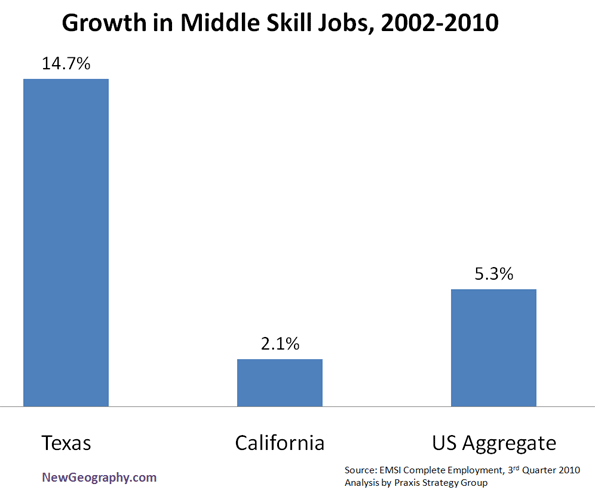
    A vast difference in economic performance is driving the demographic shifts. Since 1998, California’s economy has not produced a single new net job, notes economist John Husing. Public employment has swelled, but private jobs have declined.  Critically, as Texas grew its middle-income jobs by 16%, one of the highest rates in the nation, California, at 2.1% growth, ranked near the bottom. In the year ending September, Texas accounted for roughly half of all the new jobs created in the country.

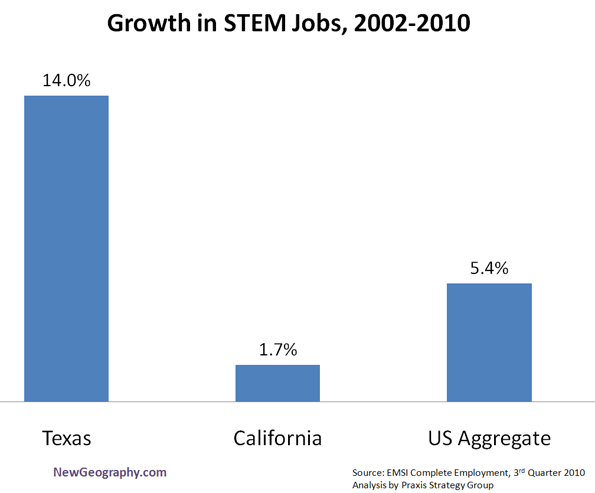
    Even more revealing is California’s diminishing preeminence in high-tech and science-based (or STEM–Science, Technology, Engineering and Mathematics) jobs. Over the past decade California’s supposed bulwark grew a mere 2%–less than half the national rate. In contrast, Texas’ tech-related employment surged 14%. Since 2002 the Lone Star state added 80,000 STEM jobs; California, a mere 17,000.

    Of course, California still possesses the nation’s largest concentrations of tech (Silicon Valley), entertainment (Hollywood) and trade (Port of Los Angeles-Long Beach). But these are all now declining. Silicon Valley’s Google era has produced lots of opportunities for investors and software mavens concentrated in affluent areas around Palo Alto, but virtually no new net jobs overall. Empty buildings and abandoned factories dot the Valley’s onetime industrial heartland around San Jose. Many of the Valley’s tech companies are expanding outside the state, largely to more business-friendly and affordable places like Salt Lake City, the Research Triangle region of North Carolina and Austin.

    Hollywood too is shifting frames, with more and more film production going to Michigan, New Mexico, New York and other states. In 2002, 82% of all film production took place in California–now it’s down to roughly 30%. And plans by Los Angeles County, the epicenter of the film industry, to double permit fees for film, television and commercial productions certainly won’t help.

    International trade, the third linchpin of the California economy, is also under assault. Tough environmental regulations and the anticipated widening in 2014 of the Panama Canal are emboldening competitors, particularly across the entire southern tier of the country, most notably in Houston. Mobile, Ala., Charleston, S.C., and Savannah, Ga., also have big plans to lure high-paid blue collar jobs away from California’s ports.

    Most worrisome of all, these telltale signs  palpable economic decline seem to escape most of the state’s top leaders. The newly minted Lieutenant Governor, San Francisco Mayor Gavin Newsom, insists “there’s nothing wrong with California” and claims other states “would love to have the problems of California.”

    But it’s not only the flaky Newsom who is out of sync with reality. Jerry Brown, a far savvier politician, maintains “green jobs,” up to 500,000 of them, will turn the state around. Theoretically, these jobs might make up for losses created by ever stronger controls on traditional productive businesses like agriculture, warehousing and manufacturing. But its highly unlikely.

    Construction will be particularly hard hit, since Brown also aims to force Californians, four-fifths of whom prefer single-family houses, into dense urban apartment districts. Over time, this approach will send home prices soaring and drive even more middle-class Californians to the exits.

    Ultimately the “green jobs” strategy, effective as a campaign plank, represents a cruel delusion. Given the likely direction of the new GOP-dominated House of Representatives in Washington, massive federal subsidies for the solar and wind industries, as well as such boondoggles as high-speed rail, are likely to be scaled back significantly.  Without subsidies, federal loans or draconian national regulations, many green-related ventures will cut as oppose to add jobs, as is already beginning to occur. The survivors, increasingly forced to compete on a market basis, will likely move to China, Arizona or even Texas, already the nation’s leader in wind energy production.

    Tom Hayden, a ’60s radical turned environmental zealot, admits that given the current national climate the only way California can maintain Brown’s “green vision” will be to impose “some combination of rate heights and tax revenues.”  Such an approach may help bail out green investors, but seems likely to drive even more businesses out of the state.

    California’s decline is particularly tragic, as it is unnecessary and largely unforced. The state still possesses the basic assets–energy, fertile land, remarkable entrepreneurial talent–to restore its luster. But given its current political trajectory, you can count on Texans, and others, to keep picking up both the state’s jobs and skilled workers. If California wishes to commit economic suicide, Texas and other competitors will gladly lend them a knife.


    This article originally appeared at Forbes.com.

    Joel Kotkin is executive editor of NewGeography.com and is a distinguished presidential fellow in urban futures at Chapman University. He is author of The City: A Global History. His newest book is The Next Hundred Million: America in 2050, released in February, 2010.

    Employment data from EMSI.

    Photo by {Guerrilla Futures | Jason Tester}

  • Miami Condo Price Implosion Continues

    The National Association of Realtors has just published its quarterly median house prices and the trend continues downward in Miami. At the end of the third quarter, the median condominium price had dropped to $82,900 in Miami, about the same as the list price for a BMW-7 sedan. This places condominium prices at 77 percent below the 2007 second quarter median of $367,000.

    While Miami has experienced perhaps the most substantial condominium bust in the nation, other metropolitan areas, such as Atlanta, Seattle, Los Angeles, San Diego, Chicago and Portland (Oregon) have seen huge decreases and a spate of spate of distress auctions and conversion of units to rentals.

    A recent article in The Wall Street Journal noted that condominiums have experienced an even greater market decline than detached housing. The over-building of condominiums may have been spurred by rose predictions from urban planners about the demand for central city housing being far greater than the supply. For example, the developer of City Center Las Vegas indicated that they built too many condominium units, at least in part in response to information received an urban planning symposium.

    Photograph: Condominium Conversion to Rentals in Portland (by author).

  • The State Government Deconstructors

    The results of the mid-term election of 2010 will be written over the next two years. Can the Republicans really make good on their promise of fiscal discipline? A glimpse of our future federal budget may be seen in the fiscal actions (and inaction) of America’s governors. Most states are struggling to balance budgets in troubled economic times with projected shortfalls nationwide of more than $100 billion for Fiscal Year 2012. Federal bail-outs are no longer an option. The hard choices are tax increases, reduction of services or innovative fiscal solutions like deconstruction. These bold and innovative governors, or “Deconstructors,” are what Alexander Hamilton had in mind when he wrote in The Federalist that “energy in the executive is a leading character in the definition of good government.”

    New Jersey Governor Chris Christie was the first Deconstructor to emerge. He wasted no time when he was sworn into office in January of 2010, declaring a fiscal state of emergency and freezing billions of spending. This week he announced 1,200 more public workers will get the axe come January. Governor “Wrecking Ball” is attracting plenty of national attention.

    Governor Mitch Daniels of Indiana has an approval rating today over 70%. This Deconstructor, a former U.S. Office of Management and Budget Director, inherited a $600 million deficit and within a year turned it into a $300 million surplus. Four years later, the state had a $1.3 billion surplus. In 2008, “The Blade” as he is called, ushered through the legislature a bill that cut property taxes on the average house by more than 30%, making Indiana one of the nation’s lowest property tax states.

    Along the way, Daniels decertified the public service unions. Within a year, 92% of government employees quit paying their union dues. He reduced the number of state employees by 14% to a level last seen in 1982. He leased the Indiana Toll Road to foreign investors for $3.85 billion, which he sequestered in an escrow account, where it can only be used for road construction. Today, Indiana is one of nine states with a triple-A bond rating and, it is creating jobs. Despite only 2% of the national population, Indiana generated 7% of all new jobs created in the U.S. last year.

    Mr. Daniels predicted that Americans would come to realize how much of what government now does “we can get by without.” He questions, “will the public sector be the servant, the enabler of the free economy…or will they be the master?” “Some of the anger out there now”, he said, “is directed not just at Wall Street but government employees and their unions.” In August 2010, The Economist wrote of, “his reverence for restraint and efficacy,” adding, “He is, in short, just the kind of man to relish fixing a broken state — or country.”

    Another Deconstructor is Governor Bob McDonnell of Virginia. Since taking office in 2010, Governor McDonnell converted a $1.8 billion deficit into a $200 million surplus. He overhauled Virginia’s pension system, saving $3 billion over 10 years. He imposed an immediate, statewide hiring freeze that covers all noncritical areas of state government. He saved $20 million per year by cutting and consolidating boards and agencies. State employees, who experienced a wage freeze for four years, identified $28 million is savings and will be rewarded with an $83 million bonus this year.

    Governor Haley Barbour of Mississippi inherited a budget deficit of $720 million deficit when he took office and created a surplus without raising taxes. Today Mississippi runs on less money than required two years ago, a lesson Barbour says the federal government needs to learn. Barbour championed serious tort reform. “We’ve gone from being labeled as a judicial hellhole and the center of jackpot justice to a state that now has model legislation,” says Charlie Ross, a Republican who chairs the state Senate Judiciary Committee. He increased funding for education and job training. The reward for his success is talk that Barbour may be a candidate for President in 2012.

    West Virginia Governor Joe Manchin, a Democrat, was elected to take Senator Byrd’s place in the Senate. As governor, he was routinely described as a penny-pincher and a tightwad. Manchin has been so focused on controlling state spending when an employee quit, he refused to allow new hires without his direct permission. West Virginia had a budget surplus last year while other states fired cops, fireman and teachers. The Charleston Gazette called the governor, “Penny wise and pound foolish,” but others praised his budget discipline. Conservative CATO Institute gave Manchin an A for his money management.

    What do these Deconstructors have in common? Despite the Great Recession, they each created a budget surplus. They did so by deconstructing the state government (and state deficits) they inherited. They used bold ideas (selling the toll road) and innovation (decertifying the unions) to do what others said cannot be done.

    The success of these deconstructors should offer some hope for badly managed states like California, Illinois, New York, and Michigan. The question is whether politicians in Sacramento, Springfield, Albany, or Lansing are ready to learn from these early deconstructors or will continue to bankrupt their states. Crunch time is approaching now since, thanks to the election, there is likely little appetite in Washington to bail these states out of their morass.

    **************************

    The Great Recession of 2007 – 2012 will be followed by a period during which budget deficits, unfunded obligations and credit restraints force tremendous change to the core structure of governments worldwide. This period will come to be known as THE GREAT DECONSTRUCTION.

    Robert J Cristiano PhD is the Real Estate Professional in Residence at Chapman University in Orange, CA and Head of Real Estate for the international investment firm, L88 Investments LLC. He has been a successful real estate developer in Newport Beach California for twenty-nine years.

    ¬¬¬
    Other works in The Great Deconstruction series for New Geography
    Deconstruction: The Fate of America? – March 2010
    The Great Deconstruction – First in a New Series – April 11, 2010
    An Awakening: The Beginning of the Great Deconstruction – June 12, 2010
    The Great Deconstruction :An American History Post 2010 – June 1, 2010
    A Tsunami Approaches – Beginning of the Great Deconstruction – August 2010
    The Tea Party and the Great Deconstruction – September 2010
    The Great Deconstruction – Competing Visions of the Future – October 2010The Post Election Deconstructors – Mid-term Election Accelerates Federal Deconstruction – November 2010

  • Contributor Aaron M. Renn on the Atlanta success story–and where it’s headed.

    Atlanta truly is the success story of the American South. It grew from a mid-sized biscuit and gravy haven to a sprawling center of urban life over the past half-century. But as the recession hits home down home, will Atlanta hold on to its triumph? Aaron M. Renn has some doubts; a “sputtering” job market and neglected infrastructure are just two of the worries for this city.

    The capital of the New South looks vulnerable