Are you wondering if the liberal ideology is only suffering in the US? Michael Lind shows us that this could, indeed, be something of a global epidemic. He demonstrates that the collapse of center-left parties is not just something isolated to our side of the pond. Curious as to why this is so? Read all about it!
Blog
-
Catch up on Joel Kotkin’s latest Forbes articles!
Though you may have seen them here at New Geography first, we’re happy to announce that Joel’s works are quite popular at Forbes! If you didn’t read them here, join the conversation at the following addresses:
-
“The Broken Ladder” by Joel Kotkin–a Must Read!
In The Broken Ladder, Joel Kotkin examines the city as a crucible of modern society and a determining factor in economic prosperity. An important distinction in this study is that cities, which have always been the nuclei of societal development, now house most of the world’s residents. Furthermore, this study takes a closer look at London, Mumbai, and Mexico City–the latter two as hubs of progress demonstrating that no longer are western cities the only ones at the forefront of advances. In the modern era,
“Indeed, of the world’s most twenty most populous regions, the preponderance are located in third world or developing countries. The urban drama will play out on a truly global stage, with the most decisive developments taking place in the growing mega-cities of the developing world.”
The cycle of cities’ growth is examined and analyzed. Established cities create the resources that emerging urban centers use to grow. While it is known fact that modernization leads to urbanization, what is not known is whether or not the growth of cities is actually desirable in the long term. Emerging, poignant concerns are the issue. Do cities and their growth actually stifle the growth and sustainability of the middle class? Even more importantly, does their growth actually detain upward mobility through society?
Economic growth has slowed drastically over the past few decades due to a host of reasons. An important aspect of this debate is the school of thought that rejects the desirability of economic growth because of ecological factors. A critical debate is at the podium: as polling data from different countries demonstrates, people are not primarily concerned with “green” issues. However, as emerging economies adopt technology, the pressure to enact these costly policies mounts. This report suggests that this focus may not be the wisest course of action.
In a comparative case study, London, Mumbai, and Mexico City are all analyzed as entities with different functions and histories in the global economy. Though these cities are completely unique, their survival shares essential lynchpins.
“First, their future vitality depends largely on the future of their middle classes. Second, the critical issue for all these places remains how to sustain economic growth to meet the needs and aspirations of their citizens.”
As economies continue to advance, there is an increased risk of class displacement, thus adding to the volatility of the aforementioned issues. This report suggests that, due to these factors, cities must regain a primary focus on their economies as opposed to the elite focus on “green” policies.
These topics and more are tackled in this comprehensive, must-read report by Joel Kotkin for the Legatum Institute.
-
Building Sustainable Economies in West Africa – One Farmer at a Time
Among farmers in western Africa, the passion for agriculture runs deep. Kwabena (Koby) Yeboah farms near the village of Gomoa Adumase about 45 minutes outside of Accra, Ghana in West Africa, driven by his focus and intent to succeed.
Koby started farming five years ago at the age of 22. “I love the outdoors, working with my hands and making things grow,” he says.” I also enjoy hunting too, anything to be outside.” It’s a familiar refrain you’ll hear from almost any farmer you visit in North America. It’s all about the outdoors and a certain respect for the land. (Photo)
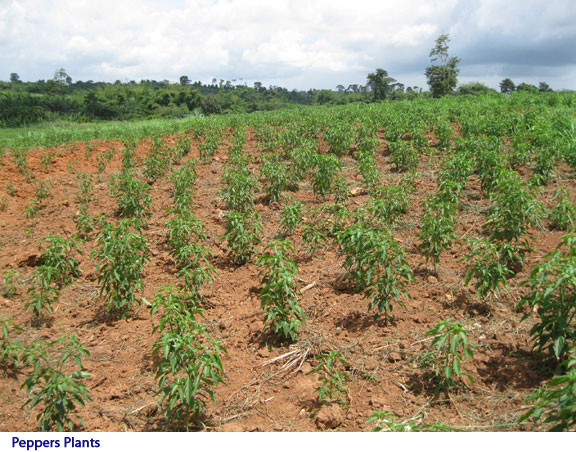 Today he is working on bringing about 200 acres into production on his farm. Over the past five years Koby has built roads, cleared land, accessed water and prepared for production. With a number of full-time villagers who are on the farm every day caring for crops and land, he visits the farm about three days a week, but his mind is on the farm every day. He is anxious for the day when he can bring all of his 850 acres into production and be able to spend seven days a week on the farm. Until then he continues his role as an education consultant recruiting students to schools in Ghana in order to support his family, while spending as much time as he can feeding his passion for farming.
 Koby grows pineapple, maize, peppers, tomatoes and okra. In the near future he plans to add mushrooms, snail production, and has begun work developing a fish pond for Tilapia production. The diversification is impressive. He is also growing several different varieties of specialty potatoes in a custom greenhouse. His plans are to increase potato seed production for planting on his farm and to educate other farmers on growing these potatoes in hopes of expanding acreage around the region. He will seek and secure markets for the potatoes and work to build a reliable and effective means for the region to become a trusted supplier. It is upon the backs of individual farmers and small business operators that economic success will be built.
  Koby’s vision is to turn his farm into a key center of commerce for the village. When he puts out the call for harvest help 40 to 100 people arrive at his farm looking for work, forcing Koby to turn people away. But he has plans to grow and to create a solid source of continued employment for the villagers. His agriculture plan calls for planting dates staggered every six weeks, year round.
 The climate in the region is very steady and stable with consistent temperatures and consistent rainfall year round making it a perfect climate for staggered production. By creating a pattern where harvest and planting activities are happening every month of the year, he could employ farm help every month of the year. The impact of consistent, uninterrupted employment for the village would be an economic boon to the region, and Koby is well aware of this fact. He often speaks of one day being able to provide steady employment to the villagers.
 The villages in rural Ghana are agrarian in nature, mainly for subsistence but also for commercial gain. There is available land, potentially productive but largely untouched in this region. There are also many able hands available in the nearby villages looking for productive work, but too often idled by lack of need for their assistance. Koby Yeboah sees an opportunity to make a difference for the region by setting a strong example for others and helping fellow farmers succeed. It is a sense of honor and commitment not readily found among your average 27 year old, but certainly not lost on this man.
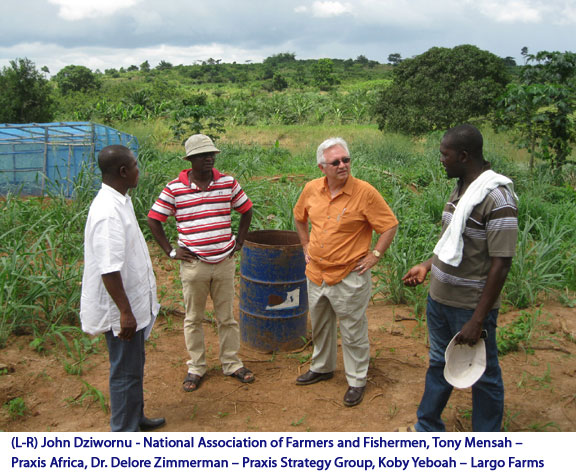 An example of his commitment to the region, Koby has created a “model farm” just outside the village of Gomoa Adumase. Here on one acre of land he has tilled and prepared the soil and is demonstrating advanced farming practices for raising pineapple. He is teaching other farmers and villagers in the region about the new farming practices so they can learn and produce on their own, and doing it in an entirely hands-on environment. (Photo)
 The sense of community in the area is strong and Koby has grown to become an important part of it. Knowing that the villagers live on tight budgets he says, “I contribute all he can,” often purchasing school uniforms for a number of the children. But, the support doesn’t end there. Just outside the village lies the Gomoa Buduatta Orphanage, home to 16 beautiful young boys and girls who find a safe and secure place to live and go to school. Koby has taken on the incredibly honorable challenge of supporting the orphanage to the best of his ability. Again he says, “I contribute all I can” and you know that it is well appreciated.
 Upon visiting the orphanage the house mother greeted us and invited us in to the quaint accommodations. We visited for a few moments before she invited the children in to say hello. All 16 children came to the door, graciously removed their shoes and stepped inside. Tallest to the back, shortest to the front, nary a word said. As we engaged the children in conversation they were pleasant, extremely polite and often responded as a group in verbal unison. They were just wonderful children.
We toured the facility to see the sleeping quarters for the 8 boys and the quarters for the 8 girls before stepping into the two small classrooms. It is a humble building, but you can see that to these children it is home and it is safe. Upon our departure all sixteen children in a melodic tone said, “Thank you Mr. Koby.” The whole experience was beyond impressive. (Photo)

Returning from the tour of the farm, discussion turns to the fragile economy of Ghana and the poor condition of the infrastructure and road system. When asked about it Koby responds, “I live in my own economy. I don’t live in the economy of Ghana,” a stark statement that quiets discussion momentarily. He goes on to explain, “I have a plan and a program. I know what I need to do to succeed and that’s all I am focused on. I cannot worry about what I cannot control.”
Koby Yeboah has a goal, a plan and is driven to succeed. He says, “I want to be the best farmer in Africa within 10 years.” And you know what? I believe he is just the man to do it.
Dr. Colin N. Clarke is a senior strategist for AdFarm, a North American agriculture communications firm. AdFarm is a strategic partner of Praxis Strategy Group an economic development consultancy. Follow Dr. Clarke on Twitter @colinnclarke.
-
Livability and All That
Livability is one of those once innocuous words, like sustainability, that now receive almost unquestioned acceptance in the bureaucracy, academia and the media. After all, words like sustainability and livability have no acceptable negative form. Who could be in favor of anything unlivable, insensitive, unhealthy or unsustainable?
Back in the late seventies, when I served as Special Assistant for Information Policy in the Office of the Secretary, our shibboleth was “balanced”. Can anyone be in favor of unbalanced transportation? It didn’t matter that the word had no meaning and we couldn’t explain it to others, it still became standard in the rhetoric of secretarial officers. In an unkind moment a reporter asked the present DOT Secretary Ray LaHood what he meant by livable, given that the department had just added it to its criteria for giving away money. He replied vaguely it was something about being able to walk to work and the park and a restaurant, to a doctor and a few more things.
Well it turns out I was living the livable life style when I was growing up in Queens, New York in the fifties and didn’t know it. Here all along I just thought we were poor.
Aside from seeking to have the same modal shares of America in 1910, or Tajikistan today, this idea fails on both theoretical and practical grounds. Theoretically, whatever merit the idea might have, livability means very different things in a tenement in Brooklyn, or a place in Billings, Des Moines, or Peoria. I can recall being sent to the store for milk or lettuce by my Mom after school. If I didn’t get there in time the four heads of iceberg lettuce (I was 16 before I found out that there were other kinds) were gone. The milk was “milk”. Today in a supermarket the milk section is bigger than the grocery store I went to as a kid. There’s skim, 1%, 2%, whole, lactaid, acidophilus in quarts, half-gallons, and gallons and 86 kinds of lettuce. The typical market today has above 50,000 items. That means that the market shed for such stores is far broader than it was back in the day.
We were three generations of the family in the same household and we all had the same doctor who lived two blocks away. Today I don’t have a doctor – I have half a dozen – none of them selected on the basis of distance. When one selects doctors, best, not closest, matters. Hospitals are growing in size but declining in the number of facilities per thousand population. All of this is simply representative of the immense trend towards specialization in our society – an increasing division of labor in all activities and an accompanying division of tastes and preferences in an increasingly affluent society. If you want a loaf of wonder bread there’s a 7-11 down the street; if its ciabatta with sun-dried tomatoes there’s this really great place I know a few miles off of exit 29 on the freeway.
In today’s job market don’t we expect that people will be willing to go farther to find the job they want or can get? If the average travel time is about 25 minutes and a half-hour commute is acceptable, how long is one unemployed before the acceptable becomes 45 minutes or an hour? In this period of housing constraint in which people are even more locked into their homes by underwater mortgages, the commute will grow as people get desperate.
In my town of College Point, Queens when the factory whistle blew a few thousand walked in the gate and out again when the whistle blew in the evening. People don’t live outside the factory gate anymore and haven’t for awhile. Again, specialization and division of labor are the main factor. Job groupings are far smaller today, and the rate of job turnover means more people won’t/can’t move every time they change jobs. Moreover, about 70% of workers live in a household with other workers – whose job will they live next to?
More importantly, the great competitive strength of America lies in access to skilled workers. Employers will be reaching out farther and farther to find the specializations and skills they require. We should expect work trip lengths to grow not become walking trips. It won’t be inner city oriented either. The metropolis of today is of immense size because many employers need a market of hundreds of thousands of potential workers to reach the ones they need. The Atlanta region with 26 counties is not a great economic engine because it is 26 charming adjacent hamlets, but rather because the market reach of employers, suppliers, customers and job seekers spreads over several million residents.
In this environment it takes massive transportation capability to assure that market shed. The questions are how many potential employees can I reach in half an hour; how many suppliers, how many customers? In the future more of us will be free to live where we want and work where we want. Most will not be willing to trade living floor space for a close-by sidewalk café. Americans will drive to where they want to walk.
There remains, of course, lots of room now within the existing land use distribution to make it easier for those who wish to live closer to shops, jobs or entertainment. People also are free to go to the nearest store or nearest doctor. The fact that so few do so reflects the oft-forgotten fact that people have their own notions of what is most important. Trying to coerce them to live the way government – particularly the upper bureaucracy – thinks they should live holds many perils. The American people have no obligation to live in ways that make it convenient for government to serve them. Government isn’t smart enough to know how people should live or to order their lives in more “convenient” arrangements.
On the practical side:
It’s on the practical side that the concepts of livability really fail. The central failure inheres in what the Europeans call subsidiarity, proposes that any necessary activity of an authority should be conducted by that level of governance closest to the problem that can effectively address it. Having livability rise to become central principle of federal transportation investment planning is an egregious failure in our historical system of decentralized government. If sidewalks and bike paths are federal then everything is federal.
The mayors of our cities love it. Why not? It is the closest they have come to being able to lay claim to direct federal funding, getting those pesky states and suburban communities where the majority of Americans live out of the way. They see it as finally being their turn at the money from Washington. In these times, when every government level is broke, livability and sustainability can prove a potential lifeline, and a bonanza as well to developers – often themselves subsidized – who focus on the inner city.
The livability criterion is ultimately centralist: fed-centric. It is not up to local people if they want to densify or not, but real power will rest with a really “smart” guy behind a desk in Washington. Proposals for federal “performance measurement” degenerate into a charade that produces pre-ordained results. Now I can fund my friends, who are as right-thinking as I am!
The problem here is a total disconnect between what people in a diverse democracy want, and what the central bureaucracy, and their academic allies, wish to impose. The livability agenda may be popular in the press and among pundits, but for most communities and people it’s neither popular nor remotely democratic.
Alan E. Pisarski is the author of the long running Commuting in America series. A consultant in travel behavior issues and public policy, he frequently testifies before the Houses of the Congress and advises States on their investment and policy requirements.
Photo by Mastery of Maps
-
HSR Just Doesn’t Fit
According to many economists, including the well-respected Robert J. Samuelson, the federal government’s effort to fund high-speed rail lines is like trying to fit a round peg into a square hole. If one really breaks down the numbers, the Obama administration’s goals of reducing green house gas emissions, traffic congestion, and oil consumption with these rail lines are idealistic to say the least, and this idealism may cost states more than their budgets can handle right now.
The administration wants to build rail lines in 13 urban corridors throughout the nation, 12 of which span distances of less than 500 miles. High-speed rail in these areas would compete with car and air travel, but statistics indicate that this would not save a significant amount on energy costs. Assuming daily air passengers, about 52,934 people in the 12 corridors in 2007, switched to high-speed rail, the result would amount to only a 2.5% drop in air passenger totals. Driving is even less likely to decrease seeing as 85% of the 140 million Americans drive to work each day. If you take the example of the Northeast corridor with 45 million commuters, only 28,500 of which take Amtrak, high-speed rail will not divert enough drivers to cut the amount of energy costs that the administration claims it will.
However, they use high-speed rail models from Europe and Asia to justify spending upwards of $10.5 billion on this infrastructure of the future. The problem with this is that the successful high-speed rail lines, the most successful of which are the Paris-Lyon and the Tokyo-Osaka lines, are located in densely populated urban areas. The United States became heavily suburban in the past half century and the percentage of the metropolitan population living in central cities dropped to 32% in 2000. As a result, jobs spread out to the suburbs and more Americans are even working from home. Rail service to big core cities will be even less useful as this trend continues.
Washington will end up footing most of the bill for these high-speed rail projects, especially in states like California that have massive budget woes and few interested private investors. In fact, California is asking for $19 billion for its now $42.6 billion project. That’s almost twice as much as the administration has paid for all the high-speed rail projects in the nation combined (currently $10.5 billion). If this starts happening in every state waiting to get high-speed rail, even if it is on a smaller scale, the federal government will have little money to address the country’s more pressing needs, such as education.
Some state governments are starting to wise up. Not wanting to waste money on unfruitful high-speed rail lines, they are simply rejecting federal money for these projects because they would not be able to spend the funds on things they really want, like better roads. Obviously, the federal government won’t be able to force high speed rail on Americans for long.
There is no doubt the Obama administration has good intentions for high-speed rail, but good intentions don’t always translate to success. Rather than try to wedge its idealistic vision of a new transportation infrastructure into the realities of recession-ridden America, it should evaluate what the country truly needs.
-
The Two Worlds of Buenos Aires
Central Buenos Aires is undoubtedly one of the world’s great tourist destinations. Days could be spent walking among its narrow streets admiring the plentiful art noveau, art-deco, beaux-arts and other architectural styles. The triumphal Avenida 9 de Julio is one of the world’s widest boulevards with two interior roadways of up to seven lanes and two service roads of two lanes, with a Washington Monument type obelisk at Avenida Corrientes (Top photo). Avenida 9 de Julio is bordered by buildings that are both ordinary and impressive, such as the Colon Opera House.
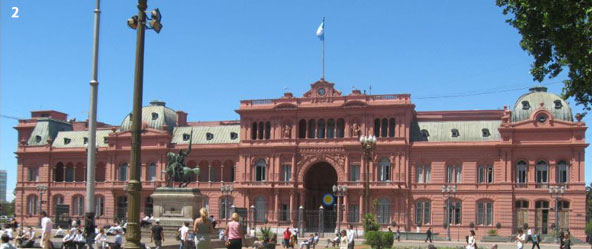
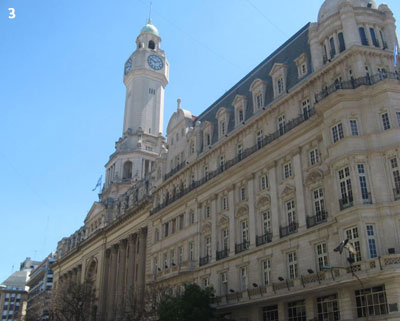
There is also an attractive area of redevelopment adjacent to the core in the former dock area, Puerto Madero. The old port buildings have been converted to commercial uses, especially restaurants. A number of high-rise condominium buildings have been constructed beyond the old port basins. Government buildings more than match the commercial architecture, with the National Congress and the Casa Rosada, or “Pink House,” with its balconies from which President Peron and his wife Eva used to address the public (Photo 2). Not more than two weeks ago, former President Nestor Kirchner lay in state to be visited by in an emotional outpouring by hundreds of thousands of Argentineans. The city of Buenos Aires also has a distinctive legislative building (Photo 3).
These older romantic styles make Buenos Aires a wonderful walking environment. Most were erected in the first three decades of the 20th century. This was Buenos Aires at its zenith. Then, Buenos Aires was capital of one of the world’s acknowledged economic powers. Argentina generally ranked around10th in gross domestic product (GDP) per capita during that period (Note 1). Thus, today, the tourist can enjoy the product of that prosperous time.
Economic Stagnation: More recent years have not been good to the Buenos Aires area and Argentina. The nation has seen decades of ups and downs – but mostly downs. The nation has been buffeted between constitutional governments and military dictatorships. Too often, even the constitutional governments have placed too little emphasis on creating wealth and too much on redistributing it. A failed currency policy in the 1990s destroyed the savings of millions. All of this has led to Argentina’s migration from the top 10 economies to near the bottom of the top 100, now ranked at 82nd in the world in GDP per capita. No top ten nation from early in the 20th century has fallen so far. New Zealand managed to drop from 1st in the world in 1920 to 51st now, but still has a GDP per capita double that of Argentina.
Argentina suffered the largest sovereign debt default in world history, at $100 billion in 2002. The nation’s former colonial master, Spain, trailed Argentina in GDP per capita throughout the 20th century to the 1980s, yet is now more than twice as prosperous (Figure 1)

This economic decline is not so evident in the autonomous city of Buenos Aires, which is also called Capital Federal, analogous to the District of Columbia (DC) in the United States. This is the Buenos Aires of tourists, an area only slightly larger than Washington, DC, but with five times the population. The municipality of Buenos Aires is by far the most affluent urbanization in the nation. Even so, there are informal settlements within the city, such as Villa 31. Overall, approximately three percent of the city’s population is in these kinds of informal settlements.
BA3-bencich
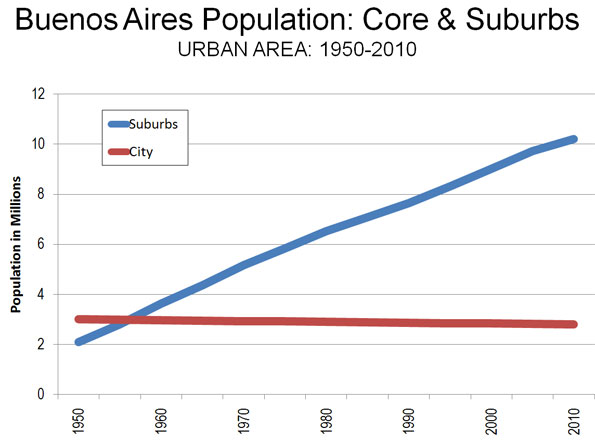
 Population and Distribution: According to the last census (2001), the city of Buenos Aires had fewer people than in 1947, having fallen from 3.0 million residents to 2.8 million. The city is also very dense, at 35,600 persons per square mile (13,700 per square kilometer), which is about one-half the density of Manhattan or the ville de Paris and double the density of the city of San Francisco.
 Most of the population lives in peripheral areas. This dominant suburban growth pattern is typical of world urbanization, as can be seen in such high-income nation capitals as London, Washington, Brussels, Copenhagen has been in the suburbs. Indeed, all growth in Paris has been in the suburbs since 1881. Like the ville de Paris, the city of Buenos Aires now accounts for less than 25 percent of its metropolitan area population (Figure 2).
Overall, the urban area (area of continuous development) has nearly 13 million people and covers more than 1,000 square miles (2,600 square kilometers) for a population density of 12,100 per square mile (4,700 per square kilometer). This is 70 percent more dense than Los Angeles and one-third more than Paris but less than one-eighth that of Dhaka (Bangladesh).
Suburban Buenos Aires: The suburbs of Buenos Aires differ from those in high-income national capitals. Generally, the suburbs are far poorer than the city and reflect the more recently less affluent Argentina that has emerged in recent decades just as the central area testified to the nation’s former relative wealth. All of suburban Buenos Aires is in the adjacent Buenos Aires province, which has the largest population in the nation.
Some of the suburbs are affluent, especially to the northwest, where suburban municipalities like Pilar and Tigre contain housing that could easily fit in upper middle income suburbs of the United States or Europe. However, even in these areas, there are close-by developments of low-quality and even informal housing, mostly housing domestic employees to the higher income population.
 The suburban poverty is far more pervasive to the southwest and the southeast. Many neighborhoods look similar to modest suburbs in Mexico City, though without the pervasive informal settlements. More people live in informal settlements in the suburbs than in the city, with estimates putting the number at above 500,000.
 More than the Core: Any thought, however, of Buenos Aires being a “compact city” is dispelled by the vast sea of lights visible on an evening flight out of Ezeiza International Airport. The urbanization stretches 30 to 40 miles in all possible directions, to the northwest, southwest and southeast (with the Rio de la Plata being to the northeast).
However, probably no urban area illustrates the general rule that urban cores tend to be substantially different from their suburbs. Not only is suburban Buenos Aires far less dense, but it is far less affluent. Any who visits the city alone will have missed more than three-quarters of the reality.
————
Note: GDP per Capita data based upon Angus Maddison’s work for the Organization for Economic Cooperation and Development.
Photos (by the author):
Top: Avenida 9 de Julio
2: Casa Rosada
3: City of Buenos Aires Legislative & Office Buildings
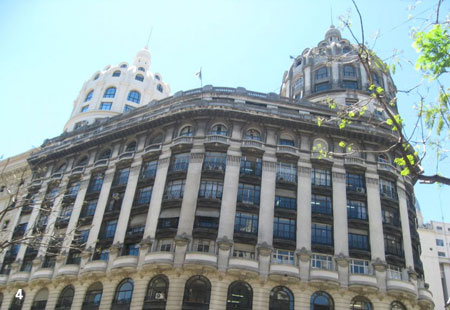
4: Bencich Building
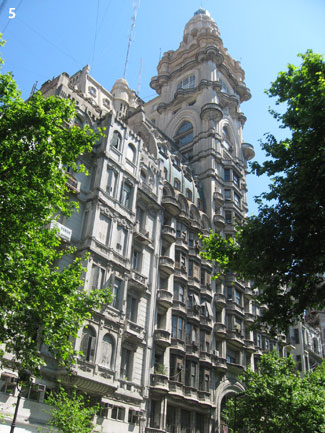
5: Casa Borolo————
Wendell Cox is a Visiting Professor, Conservatoire National des Arts et Metiers, Paris and the author of “War on the Dream: How Anti-Sprawl Policy Threatens the Quality of Life
”
-
Asia’s Go-to Cities: Moving Between Mumbai and Singapore
As someone who has lived in both Singapore and Mumbai, I can appreciate both in their uniqueness. Each city has its own unique place in the world, neither lesser than the other.
In 2006, I left behind a slightly laid back, well run Singapore, a city trying to come to terms with its boring and over-regulated image. The Singapore of 2010 that I returned to, as a newspaper put it recently, has “grown up‟. It is a speeding, futuristic looking city. You can see signs of progress everywhere and among the people an almost obsessive desire to get ahead. The famed fines and traffic rules are still there, but you can see that the police force has its hands busy with issues that come with a fast pace of growth.
Surprisingly Mumbai has much in common with Singapore. The India I had left behind was resigned to accept its second rate status in the developing world. Today’s Mumbai has become a city proud of its bustling economy, rearing to get ahead and much like the country, confident of its emergence on the world stage.
The Immigration issue
Although very different in their level of development both Mumbai and Singapore are very much ”go-to” cities, places where people believe ”things will get better.”.
In Mumbai, there is an alluring aura that notwithstanding your education or background, if you were hardworking, you could get lucky. It was an “equal opportunity” city. This attracts opportunity seekers who migrate to the city from other parts of India. They are often seen as undercutting existing employment. This has led to widespread discontent and unrest among the existing unskilled population who have so far been enjoying the fruits of no competition.
This has long been an issue in Mumbai, but the numbers of immigrants are so large politicians can no longer ignore the issue. Attacks on immigrants are now part and parcel of daily life in Mumbai, directed against fellow countrymen from poorer parts of North India.
Singapore also faces an immense immigration issue. Many “locals” worry about the growing number of immigrants who have been accepted by the government as either Singaporeans or as permanent residents. The target of discontent could be anyone: the handymen or construction workers brought in from neighboring countries to cater to the booming construction industry or the highly paid executives brought in for their expertise. Of course, unlike Mumbai things never get too out of control. Most of it discontent is spoken quietly among individuals or discussed muted in few newspaper columns.
Immigrants are a necessity for Singapore, perhaps even more essential than for Mumbai. Inviting foreigners was their way of coping with one of the world’s lowest birthrates and most rapidly aging populations.
Bread and Butter
Singapore has never been known for ”cheap food.” The small nation imports almost all of its fresh food produce from neighboring countries driving up prices significantly.
As a result, food costs are a significant part of my household expenses here in Singapore, much more so than in Mumbai. The tropical temperatures do not allow long storage of fresh produce, enabling frequent trips to the supermarket or wet markets. Food is a very important part of life and a large part of the appropriately named ”cost of living.” Our family of four spends a lot to keep a regular, non-fancy table.
The fact that I had just moved from Mumbai didn’t help. The diverse income segments and the need to woo them all in a democracy has led to a long tradition of government controlled, subsidized food pricing. Unprecedented inflation has toppled governments. Most importantly, unlike Singapore, the double digit wage inflation is quite ahead of the growth in cost of living, enabling more disposable income. In other words, even with lower tax rates of Singapore, I am outside my home country and poorer for it!
On the topic of disposable income, families thirty years ago saved bit by bit to get their children married off. A lavish wedding, where you invited all to pay off your social debts was the one dream celebration of an Indian household. A wedding was the social antenna, the marriage bellwether, the occasion to be one up on your entire fraternity. They were occasions to savor and discuss for years to come. Everyone desired to hold/create a wedding for their children/close family that would henceforth be the new standard for weddings to come.
Increasing affluence has given people the opportunity to make the ”lifetime celebration“ a more frequent affair and what could be a better occasion to show off that income than a birthday party for your little ones? Recently, my six year old was invited to a classmate’s birthday party. Everything about the party, starting from the invite and box of custom made chocolates tells you that no expense had been spared. The bash was at a swanky five star hotel in the suburbs, with two hundred invitees. There were chocolate fountains, different kinds of cuisine and professional entertainment: all elements that are by now mandatory parts of any self respecting birthday party. However, it was the custom labeled return gift, an I-Pod shuffle, which lifted the commonplace ”return gift” to a level significantly above the Joneses.
Social pressures are similar in Singapore but they manifest themselves differently. The bar is always what you don’t have:,the latest BMW coupe, a condominium at the swankiest address in town, or the latest Louis Vuitton bag. Birthday parties are not the highlights but these acquisitions are.
Condo-mania
Every weekend, all Singaporeans indulge in property-porn, poring over newspaper advertisements on new construction openings, walking through the show flats, and marveling at the impressive fittings.
Four years back, I lived within striking distance of the famous Orchard Road, near enough to walk to it, far enough to breathe. It had several condominiums but was punctuated nicely with green stretches of land. Come 2010, much of the greenery has vanished and been replaced by tall and narrow sky scrapers, most of them glass monstrosities. Many more are similarly taking up every inch of green space.
Mumbai, like Singapore, is a growing island city where space is at premium. Growth is all vertical. Property prices are high and rising, albeit for completely different reasons.
Mumbai’s population density of 22,000 people per sq km exceeds that of small Singapore by a factor of three. But the mentality is similar. Owning a place of your own in Mumbai is as much a dream as it is in Singapore. Your “own space“ could be just a small hovel or shanty or a flat in any suburb of Mumbai. The desire to own a place in any part of the city in a market tightly controlled by builders and ineffectively regulated by politicians, ensuring that prices will stay high. A 600 sq ft size of condo, in a distant suburb is priced at between USD$100-120,000.
Of course, this is out of reach for most of the city’s residents. So most of them plod on, spending a significant part of their incomes squeezed into tiny rented spaces dreaming of a day when they can afford a roof of their own. More than the rentals, most landlords demand a fat lump sum equivalent to a year’s rent, ubiquitously termed ”deposit.” In the absence of any regulation, this safeguards the owner from renters who might refuse to vacate units or destroy and mutilate them. It also benefits the renter, as it sits in the bank for a year and earns interest which – given India’s comparatively high interest rates – is not insignificant.
On the other hand, 82% of Singaporeans stay in state-provided Housing Development Board flats. What keeps the real estate market fanned and growing is the desire to upgrade; from a rented property to an owned one, from a HDB flat to an executive condominium and from there to a private condominium with its own swimming pool and gymnasium.
Wherever you turn you can see signs of show flat enticing you to invest more than USD 1 million for a mere 600 sq ft of private condominium space. Since space is at a premium, the buildings get narrower, the units get smaller and prices only go north. Builders try to outdo each other on the concept; enticing buyers with high end kitchen fittings like wine chillers and coffee machines from aspirational European brand names like “Kupperbusch” and “Gaggenau”.
Most of the investors – Singaporeans and outsiders – have bought property for its appreciation, not to create a source of rental income. Therefore rent is high, averaging USD 3-4 for every sq ft. And you if plan to be here for the long haul, that is a significant part of your income.
In Conclusion
Moving between countries is always an enlightening experience. Among other things, it also teaches you to appreciate things about the country you have left behind. When I left Singapore for Mumbai, I took with me an appreciation of systems that work, roads clean enough to eat off and a daily routine that largely remained unchanged for four years.
On my return to Singapore, I have brought with me memories of a dynamic city, confident that it will only offer a better life to its citizens. I have come from one a growing, global city to another, still unsure of what the implications of that term will be in how people can live.
Vatsala Pant is a management graduate with several years of business leadership experience and a connoisseur of people, places and cultures. She currently lives in Singapore.
Photo by a-n-d-y-l-e-o-s-s
-
Geography of the Election: The Philadelphia Collar Counties – A Splash of Red
The Obama coalition of 2008 has begun to fracture with independents, women and college educated voters bolting to Republicans and the youth vote seemingly uninterested in this election. But perhaps the most critical change took place in suburbia. This was particularly evident last week in southeastern Pennsylvania, especially in the suburban Philadelphia counties.
Historically in Pennsylvania statewide Democratic candidates won big in Philadelphia only to see their margin decimated in the traditionally heavily Republican suburban counties of Bucks, Chester, Delaware and Montgomery, known as the Philadelphia “Collar Counties.” This trend began to shift in the 1990s due in large measure to the GOP stance on abortion and other social issues.
During the 1990s, Democratic candidates were able to claim the mantel of moderation by positioning themselves as fiscally conservative and socially moderate. Affluent, college educated, women, and younger voters from traditionally staunch Republican families joined with established Democratic constituencies including the Jewish community, working class voters from old suburban mill towns, and minority voters to form winning coalitions throughout the collar counties.
During the 2000s, Democrats would be elected to fill Congressional seats in three of the four collar counties. Not surprisingly, no Republican at the top of the ticket would win Pennsylvania over the next 10 years. The main reason was the collar counties were voting more Democratic with each election. The table below shows the percentage of the vote won by the Republican candidate at the top of the ticket from 2000 – 2008:
Top of Ticket
Chester
Bucks
Delaware
Montgomery
Phila.
Bush/Gore 2000
53.4%
46.3%
42.7%
43.8%
18.0%
Fisher/Rendell 2002
41.1%
43.6%
33.1%
31.4%
14.7%
Bush/Kerry 2004
52.0%
48.3%
42.3%
44.0%
19.3%
Santorum/Casey 2006
45.0%
41.5%
38.3%
38.1%
15.9%
McCain/Obama 2008
45.0%
45.1%
38.8%
39.2%
16.3%
In 2010, the trend began to favor Republicans again. The GOP picked up a net five Congressional seats including two in the southeast region. It also propelled State House Republicans to a huge victory moving from 99 seats to a projected 111 – 92 majority. Republican Tom Corbett won the governorship by 10 percentage points with 55 percent of the vote. Conservative Pat Toomey outpaced Joe Sestak for the U. S. Senate by two percentage points.
A look at the trends shows that both statewide Republican candidates ran stronger in the collar counties than did Senator John McCain in 2008 in his bid for President:
2010 Numbers
Chester
Bucks
Delaware
Montco
Phila
Toomey/Sestak
53.4%
53.2%
43.6%
45.9%
16%
Corbett/Ontorato
55.9%
55.4%
47.0%
48.3%
17.1%
McCain 2008
45.0%
45.1%
38.8%
39.2%
16.30%
Tom Corbett ran nearly 10 percentage points ahead of McCain in the collar counties. In fact, Corbett carried these counties by 22,370 votes as he reversed the top of the ticket trend of the past decade. Although this was not enough to offset the 274,373 he lost by in Philadelphia at least he won enough elsewhere, including in the collar countries, to win a fairly impressive victory statewide.
Pat Toomey, a clear conservative, ran well ahead of the vote former Senator, and social conservative, Rick Santorum was able to win four years earlier, but he did not perform as well as Corbett did against McCain. This can be explained in part by the fact that his opponent, Joe Sestak, was an elected Congressman from Delaware County.
2010 Numbers
Chester
Bucks
Delaware
Montco
Phila
Toomey/Sestak
53.4%
53.2%
43.6%
45.9%
16%
Santorum/Casey 2006
45.0%
41.5%
38.3%
38.1%
15.9%
Toomey would lose the collar counties by 27,195 votes. This gave him a much steeper hill to climb in the other 61 counties of Pennsylvania, but at least he was not out of the game as had been McCain, Santorum, and Fisher over the past 10 years.
Will this change in voting pattern continue? It could if Republicans can hold Independent voters by delivering solid results at both the Federal and State levels. Republicans will now control redistricting in Pennsylvania. This should allow them to consolidate the gains made this year in Congress, but does not change the fact that the Philadelphia collar counties will continue to determine the fate of statewide candidates in Pennsylvania into the foreseeable future.
The fight in Washington over the next two years will likely be the traditional “heart vs. head” fight of the past where Democrats push for more social programs and Republicans position on the costs of these programs.
The 2010 election in southeastern Pennsylvania seemed to prove that a bad economy and fears of continuing increases in taxes and debt will add a splash of red to the collar counties “light blue” voters.
Dennis M. Powell is president and CEO of Massey Powell, an issues management consulting company located in Plymouth Meeting, PA.