Blog

  • The Future of a Hub: Can Singapore Stay On Top of the Game?

    Viewed from a broad, historical perspective, Singapore’s position as a hub is far from inevitable or unassailable. History shows that hubs come and go. Malacca used to be the centre of the spice trade in Southeast Asia. Venice was the centre of East-West trade throughout the Middle Ages. Rangoon, now Yangon, was the aviation hub of Southeast Asia before 1962.

    Is Singapore in danger of also ceding its hub status as a result of forces beyond our control? The case of Malacca is instructive. By the 16th Century, the city on the Malay peninsula had become the most important port in Southeast Asia. It served as the bridge between the spice-producing islands of Southeast Asia and the markets in Europe and Asia. Malacca became so integral to East-West trade that a Portuguese traveller and writer, Tome Pires, proclaimed that “who is Lord of Malacca has his hand on the throat of Venice”.

    Malacca was a forerunner of the free port that Singapore was to become. It welcomed foreign merchants as well as their trade. But after the Portuguese conquest of the city in 1511, it declined as the spice hub of the region, as the Portuguese – and later the Dutch – sought to achieve monopolistic control of the spice trade. Fierce competition from neighbouring ports such as Johor meant that traders had other options. The city soon declined and today is best known as a tourist attraction.

    Half a world away from Malacca, Venice emerged as the European hub of the global trading network. For nine hundred years, Venice was a flourishing centre of trade between Europe and Asia, especially in silk, grain and spices. Geography played an important role in Venice’s rise. Its relative isolation from the mainland insulated it from the confusing and often deadly politics of the Italian states.

    Venice concentrated its resources and energies on advancing its commercial interests in distant regions. By the 13th century, Venice was the second largest city in Europe after Paris, and its most prosperous. It linked the main trade routes between Europe and Asia.

    But eventually Venice also declined. The fall of Constantinople to the Ottomans in 1453 disrupted the traditional overland trade route from Europe to Asia, forcing Europe to find alternative trade routes to the East. At the turn of the 16th century, Portugal’s discovery of a sea route to the East Indies undermined Venice’s monopoly. New ports emerged to become Europe’s main intermediaries in the trade with the East, striking at the very foundation of Venice’s wealth. With its centrality as a commercial hub broken, Venice declined and eventually fell to the Austrians in 1797.

    The Theory of Hubs

    Malacca and Venice are both examples of hubs in that first flourished and then declined as trade routes and technologies changed. Simply defined, hubs are the exceptionally well-linked nodes in a network. Malacca and Venice exploited their commanding positions in the main trade networks of their times. They consolidated their hub positions by astute diplomacy, openness to talent from elsewhere, and broadening the range of their activities beyond just trade.

    Throughout history, hubs have been the main engines of economic growth and development. Network theory provides us with insights to explain why hubs acquire wealth more easily than other nodes in a network. Today, as in the past, the world’s economic geography remains dominated by hubs which are the focal points of opportunity, growth and innovation. Firms locate where skills, capabilities and markets cluster.

    A recent study identified the existence of 40 mega-regions worldwide. They are defined as places that claim large populations, large markets, significant economic capacity, substantial innovative activity, and highly skilled talent. Many of these 40 mega-regions are formed by hub cities growing outward and into one another. Singapore is one of these hubs.

    Today, of course, air transport plays a critical role in establishing hubs. Air hubs make previously unlinked cities accessible to one another in just one or two links. Singapore is classified as a “connector” hub – it is a hub within the East Asian/Southeast Asian region, with a high number of links to cities in other regions. So in 2007, while Changi Airport was ranked 19th by the Airports Council International in terms of passenger numbers, it was ranked 6th if only international passengers are considered.

    If Singapore is a central node connecting different regions, what might undermine this position? Challenges could come from two directions. The first is competitors in the region, such as Kuala Lumpur, Bangkok and Hong Kong, as well as those from other regions, such as Dubai. Dubai is the largest aviation hub in the Middle East and is a fierce competitor for the Australia-Europe traffic. Another challenge is from long-haul flights. The same technology that allows Singapore Airlines to bypass Tokyo on flights to Los Angeles could one day allow Emirates to fly non-stop from Dubai to Sydney, and Qantas or British Airways to fly non-stop along the “kangaroo route” from London to Sydney.

    The more cities move away from the hub-and-spoke model of air transportation to point-to-point transportation, the more difficult it will be for Singapore to retain its status as an aviation hub. This is conceptually no different from Venice losing its hub status because alternative and more direct trade routes were found between markets in Europe and spice producers in the East.

    This threat underlines the importance of constantly re-inventing Singapore as a hub. It would be fatal to assume that the density of connections that we have today and the centrality that we enjoy in today’s networks – whether in air transportation, maritime, or other networks – are permanent. New technologies might create new networks with their own hubs and connectors. Whether we will continue to be a hub in the networks that emerge will depend on our capabilities, on our ability to seize early mover advantages, and on how quickly the new networks emerge.

    I think it is possible to distil five factors that determine the success and sustainability of hubs like Singapore.

    1. Establish your role early. Singapore built the first container port in the region. This gave us first-mover advantage. We exploited it, and Singapore was propelled to the front rank of global container ports.
    2. Ensure open access and maximum connectivity. Singapore under the British thrived because of its status as a free port. In contrast places like Jakarta languished under the Dutch policy of controlling and taxing trade. Being well-connected and plugged into dense networks confer far more advantage than efforts to monopolise production or to control access to resources.
    3. Capitalise on and exploit small initial advantages. The research on networks suggests that the economic development process is highly path-dependent: the choices we face today are largely shaped by the choices we made in the past and the capabilities that we have already built up. Singapore was able to become a leading petrochemicals hub because we were able to build on our early success in attracting oil refinery activities.
    4. Constantly re-invent and diversify the hub’s value proposition. In Singapore’s context, our status as a maritime hub gives us the opportunity to develop strengths in new areas that go beyond our traditional role as a port. These include ship financing, ship insurance and various ancillary activities that the shipping industry depends on. This diversification will also give us greater resilience in the face of uncertainties and rapid changes in the maritime industry.
    5. We need a strong sense of belonging. If people only see Singapore as “Hotel Singapore”, then when there is an economic downturn or other problems, they will move to where the opportunities are greater. The challenge is to maintain a core that will sustain the hub through economic cycles.

    Singapore’s continued success as a hub depends both on its connections to the world, as well as connections to its citizens wherever they may now live. Our strategic response to the limitations of our physical size must be to strengthen our hub position by boosting not only its physical connections to networks, but also in other domains – an R&D hub, an intellectual hub, and even a cultural and entertainment hub.

    To avoid the fate of Malacca or Venice, we must re-invent and re-position ourselves and stay ahead of the competition. This is the imperative that will determine our future as a city-state, as both a place and a nation.

    Peter Ho is Senior Advisor to Singapore’s Centre for Strategic Futures. Before retirement, he was the Head of Civil Service in the Singapore Government.

    Photo by Storm Crypt

  • Satellite Cities for Beijing? Yes, But….

    China Daily ran an article on the continuing urbanization of Beijing. In Build upward or outward: City’s growth dilemma, Daniel Garst notes that Beijing is not as centralized as other urban areas, with its multiple business districts and comparatively low density in its inner areas. He indicates a preference for the urbanization of Shanghai, with its stronger center (both Pudong and Puxi), but suggests that it would be a mistake to replace the historic low density development with the high rises that would be necessary to change Beijing’s urban form.

    Actually, Beijing’s form is not that unusual for Asian urban areas. Tokyo has multiple office centers rather than a single dominant center and has comparatively low residential densities, even within the Yamanote Loop. Bangkok, Manila and Jakarta are similarly multi-centric. Chinese urban areas like Shenyang, Xi’an, Wuhan, Suzhou and Changsha are closer (but smaller) replicas of Beijing than Shanghai. Garst also misunderstands the dynamics of traffic congestion in his belief that roads and metros (subways) would be less congested with a more centralized form. In fact, higher densities routinely produce more intense congestion, not only on the roads but also on the rails and buses, a point recently made by Michael Matusik on this site.

    However, Garst may be onto something with respect to a suggestion that Beijing’s growth should be directed to new satellite towns, in which residents work rather than commuting to Beijing. This is good theory, but there is an important caveat, which we outlined in a comment at China Daily on the article.

    Satellite cities are not a reasonable answer unless they are so far from the Beijing urban area that commuting to Beijing is not possible. The idea of self-contained satellite cities, where people live and work in them has not worked anywhere. There are good examples of failure in London, Cairo, Stockholm, etc. So long as the large urban area can be reached, people will commute there.

    Cairo provides a useful example. Egyptian planners have long decried the continuing commute pattern into the urban area from the new towns of 6th of October and 10th of Ramadan, which are within commuting distance. On the other hand, the new town of Anwar Sadat, more remote from the urban area, has been more successful in keeping its residents in its labor market.

    Locating new satellite towns far enough to make commuting infeasible will be a real problem for Beijing. There just is not enough territory in the provincial level municipality. That means the new towns would have to be in the province Hebei, which along with the province level municipality of Tianjin surrounds Beijing.
    Short of remote new towns and forcing population and economic growth away from Beijing, the key to minimizing traffic congestion will be to minimize work trip distances by achieving a dispersion of comparatively lower density employment to match the lower density suburban dispersion. Economists Peter Gordon and Harry W. Richardson have found that “suburbanization has been the dominant and successful mechanism for reducing congestion.” in the United States. This applies no less to Beijing.

    Photograph: Forbidden City, Beijing (by author)

  • London Special Report: Britain Drifts South – and Why Not?

    The British Broadcasting Corporation wants 1500 of its staff to move to its new ”MediaCity” headquarters in Salford, near Manchester in northwest England. The Corporation, they say with some justification, is too southern, too much part of the metropolitan elite. The move ”addresses concerns that the organisation is not fully representative of the peoples of the UK.”

    On the surface it looks like a good deal. On top of a £5000 payment, they have been offered £350 for each house-hunting journey as well as removal costs, a guaranteed house purchase scheme and and even £3,000 for new carpets and curtains. Other benefits include help securing jobs for spouses or partners jobs in the area and specialist help with children’s schooling. For all that, take up for the scheme has been slow, and the Corporation’s grunts were unhappy to hear that the head of BBC North, Peter Salmon ”is the latest exec to announce that he would rather hack off his own face than move his family anywhere remotely near the north,” as ex-BBC producer Rod Liddle puts it.

    The BBC’s difficulties in persuading its staff of the benefits of the North of England reflects a broader British predicament. Since the 1930s British governments have tried to use grants boost Britain’s depressed regions in the North of England, Wales and Scotland. None of this has stopped the long-term trend of population movement. Demographers Daniel Dorling and Bethan Thomas of Sheffield University point out that outside of London, all major cities are declining in population, and that ”the population of the UK is slowly moving to the South.”

    Dorling and Thomas’s analysis of the 2001 Census drew criticism from regional dignitaries. Bob Kerslake, chief executive of Sheffield City council, and a champion of the lobbying group Core Cities insisted that ”there is already evidence of a turnaround in the last five years and every prospect of things getting better.” Denton and Reddish MP Andrew Bennet, Labour chairman of the Commons local government, housing and planning committee also claimed that ”in the regeneration of cities, the government’s proposals are working well,” while admitting that there were ”horrendous” problems.

    Looking at what Dorling and Thomas say, it is not hard to see why the census should be so problematic for champions of a Northern resurgence.

    At the start of the 21st Century, the human geography of the UK can most simply be summarised as a tale of one metropolis and its provincial hinterland… On each side of the divide there is a great city structure with a central dense urban core, suburbs, parks and a rural fringe. However, to the south these areas are converging as a great metropolis, while to the north is a provincial archipelago of city islands.

    In recent years the decline of the North has at least been mollified by a relatively buoyant economy in contrast to the disaster of de-industrialisation that it was in the 1980s. Yet even still, the divergence is difficult to wish away. Most disturbing, much of the growth taking place in the North owes more to government spending that it does to private initiative. The public spending share in output is 52.6 per cent in the North West, 61.5 per cent in the North East, and 54.9 per cent in Scotland.

    For housing, the importance is clear. With the provinces suffering greater or lesser degrees of depopulation, houses have to be cleared. In 2002 government plans to demolish up to 880,000 homes in northern England and the Midlands were announced. Gateshead, Newcastle, Blackburn, Manchester, Hull, Sheffield, Liverpool, Stoke-on-Trent and Birmingham are all earmarked for substantial demolitions. In Liverpool alone, the council has to cope with 28,000 derelict homes. Long-standing development critic Simon Jenkins bemoaned the plans to knock down 100,000 Victorian terrace houses in the Welsh Streets area of Liverpool as they constitute precisely the “sort of buildings” over which yuppies “would purr” if they were in London.’.

    The contrast between empty homes in the North of the country and the prospect of new building in the South offends people like Green Party’s London leader Darren Johnson who says that it is ”particularly ludicrous to have every single scrap of land in London and the South East being eyed up by developers, when the populations of other regions, such as the North West and the North East, are actually declining.”

    Ros Coward, columnist for the liberal Guardian newspaper, protests that ”In the North-West, vast tracts of urban land lie derelict, while in the South-East … our countryside is under ever-increasing threat.” Uber-architect Richard Rogers takes a similar view, arguing that ”regional balance is critical to achieving a sustainable economy”. This is in the context of bemoaning the ”divided country” of the North and the Midlands with the ”bulk of redundant industrial land” and the South-East’ where the ”greatest pressure for new housing development” is felt.

    Though he is cautious to spell it out, Rogers’s ”regional balance” could only achieved by relocating people up North. No doubt the chaotic workings of the economy do create unplanned waste and blight, but does anyone suggest people should be forced to move up North? Infamously Westminster Council housed its homeless out of borough, paying more outlying regions to take on the social problem. More recently the government imposed resettlement schemes on asylum seekers, forcing them into unwelcoming estates in Glasgow and elsewhere. Surely, everybody understands that in a free society you cannot direct people where to live, like Stalin did the Chechens in 1944 – or do they, particularly if the case can be made on ideological grounds, this time green instead of red.

    It’s undoubtedly true that there is indeed a London-centric bias among British policy makers and media professionals. Deeply rooted in the gentrified boroughs of inner London, opinion-formers often treat the rest of the country with disdain. But it would be a mistake to see the population’s southern drift as the ascendance of the metropolitan chattering classes.

    As important as London is to Britain’s economy, the more interesting area of growth is the south east region around London. The South East has the second highest GDP, and the second highest GDP per head of any region. London has the highest GDP, but it also has more of the very poorest people than the South East.

    This is the heartland of Britain’s middle classes, first in the percentage of the population economically active and the fastest growing demographically. Coastal Brighton, 60 miles from London’s centre, is Britain’s fastest growing town. If the BBC offered its relocation package to move staff to Southampton or Brighton, there would be many more takers.

    We cannot keep holding like Canute and wish away the shifting economic geography of Britain. It is something that has to be worked with. For cities and towns outside of the southeast that can mean some profound challenges. It is not easy to manage a downsizing without it appearing to be a rout.

    But the demolition of old houses ought not to be seen as a disaster, so much as an opportunity. Britain’s ageing housing stock needs renewing. Simon Jenkins presumed to speak up for the “local community” of the Welsh Streets area of Liverpool, but Irene Milson and Mary Huxham of the local tenants and residents association saw things differently:

    Far from it being “wrought” on them, residents in this neighbourhood have been campaigning to be included within the Housing Market Renewal Pathfinders plan for over four years. The decision was supported in a survey of all Welsh Street residents, with a 72 per cent majority in favour of a clearance. … The campaigners, conservationists and critics don’t have to deal with 125-year old properties that are damp, decaying and expensive to heat – let alone with collapsed Victorian sewage systems now over-ridden with rats.

    In principle, there is nothing wrong with the population concentrating itself more densely in one part of the country than another. It is not as if it will tip up and sink. No doubt a perfectly planned society would achieve things less chaotically, but in a democratic society it is better to manage change,rather have planners reshape our society from above.

    James Heartfield is the author of Let’s Build: Why we need five million new homes, a director of Audacity.org, and a member of the 250 New Towns Club.

    Photo by Feuillu

  • London Special Report: The Making of the Hundred Mile City

    (Part I of II.) The writer Ford Madox Ford summarised the inventiveness of the early twentieth century in an essay The Future of London (1909) by lambasting what he called the “tyranny of the past.” “The future,” he argued on the other hand, wages a ceaseless war against the monuments of the past’.

    This debate is alive today in the battle between the emerging metropolitan reality and the nostalgia of the urban past. Ford’s dream was of a Great London ‘… not of seven, but of seventy-million imperially minded people’.

    Unlike urbanist romantics, Ford’s “Great London” presciently considered the capital in relation to its suburbs. He also refused to call them “suburbs”, which he thought derogatory, from the Latin sub urbe, meaning less than the town, and preferring instead the more ambitious fore town: “The fore town of my Great London would be on the one hand, say, Oxford, and on the other, say, Dover.”

    Ford, much like his contemporary H.G. Wells, imagined a London that extended from Winchester, the delightful country around Petersfield, Chichester, all of the coast down to Brighton, Hastings, Dover, all of Essex and round again by way of Cambridge and Oxford. “All south-eastern England,” he wrote, “is just London.”


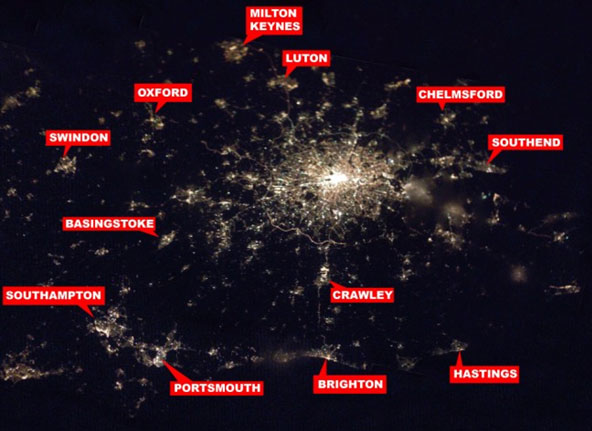
    London and the South East, seen from the night sky, shows the expansion into the South East

    Neither Utopian, nor Dystopian, Ford’s vision proved accurate. Sir Richard Rogers says as much himself, in his Cities for a Small Planet, describing London, some thirty miles wide in 1945, as a commuter belt 200 miles wide stretching from Cambridge to Southampton, and is the largest and most complex urban region in Europe. What delights Ford, appals Rogers.

    Ford was also correct that in failing to embrace change and embrace status of the fore town,. it reduced to the status of suburbs, and many opportunities were lost to create a healthier decentralized metropolis. The elements of Ford’s plan that never got off the drawing board were his proposals to “thin out” central London. Perhaps this had something to do with an eagerness to hang onto the Duke of Westminster’s slum tenements.

    It is tragic that Ford’s vision was ignored, and the real day-dream, that of a London contained, has continued to dominate policy. As a result, there is no London, as such. The city has lost all definition, as its outer edges have blurred into the dormitory towns around it. Having burst its bounds, there really is no recognisable unit called London that can be parcelled together under one name any more. The green belt cannot contain the sprawling suburbs. London has dissolved as its boundaries expand and become more porous.

    For more than a century, the London of the Londonostalgics has been a fraction of the administrative London. Victorian London outnumbers medieval London by more than six to one. Since 1965 Greater London has incorporated Essex boroughs like Walthamstow and other “railway suburbs”.

    The Londonostalgics jeer at the suburbs. ‘Barret Hutches … ‘Kennels’, ‘Lego Homes’, ‘They come in kits,’ according to Iain Sinclair. But for all that bitter condescension, London’s suburbs are where most of its population now lives. Put another way, they do not live in London at all, but Stevenage, Shepperton, or even Oxford and Brighton, commuting sometimes to work or play in the central heritage zone.

    How did London expand?

    From 1901 to 1950 the County of London’s population fell. In the 1930s the annual rate of decline was quite steady at around eight percent, but between 1938 and 1947 that climbed to 40%, reducing the County to a population of 3,245,000. By 1961 that number had reduced to 3,200,000.

    But these numbers obscure the demographic vitality of London, if viewed broadly. If one includes the many who live in the suburbs, the green belt or the outer country, the population of London has climbed to 10.6 million.

    London’s population changes continued to present a confusing picture. In 1965, Greater London incorporated parts of Essex and Middlesex to take account of the popular movement. But between 1961 and 1981 the population of this new, Greater London fell 15%, a loss of 1,186,000 people. Then in 1984, against everyone’s expectations, the direction of population movement changed again with the outer suburbs growing, and inner London once again growing, albeit modestly, between 1981 and today.

    Year

    Inner London Population

    Greater London Population

    1939

    4,364,457

    8,615,000

    1951

    3,679,390

    8,197,000

    1961

    3,492,879

    7,992,000

    1971

    3,031,935

    7,452,000

    1981

    2,550,100

    6,806,000

    1991

    2,559,300

    6,890,000

    2001

    2,859,400

    7,322,400

    2009

    3,061,000

    7,750,000

    Not only did London’s population change unexpectedly, in the opposite direction planned for in Patrick Abercrombie’s 1944 plan for the region: the outer boroughs expanded at the expense of the inner. The greater growth took place in the belt just beyond Greater London,adding another 2-3 million.

    Long before Lord Rogers sought to promote the city against sprawl, planners were trying to reverse the flow of people from London. Then why is London’s expansion so confusing?

    London’s growth combines two distinct trends. There is an underlying trend towards expansion and dispersion due to shifts in the locus of economic growth and better transport. But in the 1980s there was counter-trend of inward migration (much of it from Bangladesh) and later some gentrification in the inner city.

    The secular expansion and dispersal of London’s population can be seen in the fact that the thinning out of inner London’s population is roughly proportional to the expansion of outer London. From 1940, the same trend is expressed in the decline of Greater London’s population relative to the expansion of the outer suburbs of Surrey, Essex, Middlesex and Hertfordshire. “In each decade, the centres of growth moved a little farther out,” says Stephen Inwood, and this continues to be the pattern.


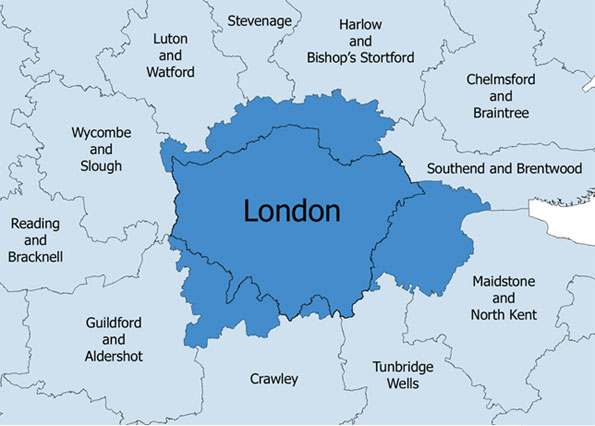
    London and its commuter belt (the ‘Travel to Work Area’, where three quarters of those working work in London) has a population of 9,294,800

    Transportation is the most important factor in dispersal. A.N. Wilson notes that even in the mid-nineteenth century the breakthrough of elliptic springs led to the “age of the carriage folk”, and that this was in turn spurring a movement out of the centre: even “the Marxes abandoned their cramped flat in Soho and moved to a variety of new-built family houses in Kentish Town on the edges of Hampstead Heath.” * So too did William Morris, in his Pre-Raphaelite phase, move from lodgings in the then run-down Red Lion Square, to Bexleyheath in Kent, where he built his celebrated Red House with Philip Webb in 1859. “He continued to curse the iniquities of railways,” writes his biographer Fiona MacCarthy, “but he was to make good use of Abbey Wood, his local station, only three miles away on the newly opened North Kent line.” * Edward Burne-Jones and Gabriel Dante Rossetti were just some of the medieval revivalists collected from the station in Morris’s specially built carriage.

    Later on, lower rail prices – “workmen tickets” – helped clerks establish themselves in Hackney, Wood Green, Hornsey, Hendon, Willesden, Balham and Camberwell. However, these same railway terminals were also adding to the overcrowding of inner London, as land was found for stations by knocking down working-class slums, or “rookeries” – with the surplus population generally moving to the adjacent neighbourhood. *

    In the early century it was electric trams and underground extensions. Historian Asa Briggs says that the slogan of the North Metropolitan Railway (extended from Baker Street to Harrow in 1880) Live in Metroland!, “showed that it was not so much satisfying existing needs as creating new residential districts.” *

    By the post-war period the South-East went through another expansion, one that was driven by the car, rather than the train, which was losing out to its more versatile rival. In 1951 the M1 to Birmingham opened just as car ownership spread among the middle classes. In 1970 the Westway took the M40 right into central London, and in 1986 the London orbital outer ring-road, the M25 was opened by the Prime Minister Margaret Thatcher.

    Greater car ownership was helping to accelerate the process of suburbanisation, coupled with the policies pursued in the 1980s of promoting home ownership (at the expense of public housing). Tories took pride in winning over “Essex Man” – the psychological construct of the aspirant working class voter. Though between 1981 and 1991 it was Cornwall, Cambridgeshire, Buckinghamshire whose population grew fastest, while those of London, Liverpool and Belfast were all stagnant or falling.

    Planners have tried again and again to restrict the growth of London, from the Abercrombie Plan of 1946 to the Urban Task Force of 1998. But just as they planned for a denser inner core and to limit outward sprawl, Londoners stubbornly have preferred the opposite. Even when they changed the boundary to include more of the suburbs and called it Greater London, the main thrust of growth had already moved further outwards into the commuter belt, and the rest of the South East. In reality, today, Oxford and Brighton, Southend and even Southampton are all part of a vast Southern conurbation. Political leaders have failed to catch up with these changes and even tried to stop them – but the change, as Ford explained, is happening with or without them.

    James Heartfield, of the development think-tank audacity.org spoke, at the Mayor’s ‘Story of London’ event on ‘Is London Growing Too Fast?’ on 5 October 2010.

    Photo: By J. A. Alcaide

  • Property Values 11 Times Higher Across Portland’s Urban Growth Boundary

    One of the starkest impacts of smart growth policies is the huge differentials in property prices that occur on virtually adjacent properties on either side of an urban growth boundary.

    The extent to which regulatory restrictions can drive up prices is illustrated by the differences between the values of undeveloped lands just a few steps from each other, but across the urban growth boundary. Research from more than a decade ago in Portland indicated that land on which development is permitted inside the urban growth boundary tended to be 10 times as valuable per acre as land immediately outside the urban growth boundary, on which development was not permitted. In Auckland, New Zealand, recent research found virtually adjoining undeveloped land value differences at 10 times or more as well. Research in the London area by Dr. Timothy Leunig of the London School of Economics indicates that this difference can be as much as 500 times.

    Recently (February), I examined tax assessment records for all parcels in Portland’s Washington County that abut the urban growth boundary to see if value differences exist. The properties had to be 5 or more acres and be undeveloped. Research was conducted based upon Internet information in February 2010. Property along 25 miles of the urban growth boundary from Cedar Hills to Hillsboro to southwest Beaverton was included in the analysis.

    • The land adjacent to, but outside the urban growth boundary (on which development is prohibited) was assessed at approximately $16,000 per acre.
    • The land adjacent to, but inside the urban growth boundary (on which development is permitted) was assessed at approximately $180,000 per acre, approximately 11 times the price of land that is virtually across the street (across the urban growth boundary)

    A sample was also taken of more remote developable parcels of more than 5 acres, on which development would not be permitted. These parcels, which were from one to five miles outside the urban growth boundary, had a value of approximately $8,500. Thus, the developable land inside the urban growth boundary was 21 times as expensive as the more remote land.

    These data indicate the impact of urban growth boundaries on the price of raw land, which is inevitably passed on to buyers of new housing. Without an urban growth boundary, it would be expected that land on both sides of an urban growth boundary would have similar values. Further, land would be expected to drop in value beyond the urban fringe, but not by the drastic amounts indicated in Portland, Auckland and London.

    —-

    Photograph: (By Author)

  • Modifying Loans and the Decision-Makers

    A recent editorial in The New York Times lamented the latest housing market woes, this time resulting from various banks’ disregard for, or inattentiveness to, a legal foreclosure process. As the article correctly states, “It is hard to be shocked.”

    Further fueling uncertainty is of immediate concern, adding another layer of doubt to what may end up proving to be a formerly nascent recovery. While President Obama is calling for more thorough analysis to determine if foreclosure or modification is more prudent, and a provision in the Dodd-Frank bill authorizes government aid for troubled homeowners to assist with legal services, neither gets to the heart of the problem.

    Homeownership is not an inalienable right, and should be reserved for those who are in the financial position to shoulder the burdens that come with the supposed pride. The banks reviewing loan applications should be the final bastion of culpability in assessing prospective buyers’ financial wherewithal.

    This creates a moral conflict in many cases, as banks make money by lending money. In the interest of financial stamina, however, the banks have overlooked the simple fact that they only make money by lending money if the borrowers can pay them back. While there will always be some percentage of borrowers that fail to pay back their loans, it is all too well documented now that those levels are excessively high in today’s economic environment.

    Most troubling is the realization that many bank REO departments (for “real estate owned,” the class of property that goes back to lenders upon unsuccessful foreclosure auctions) are not staffed by real estate minds. While it is not fair to make a wholesale categorization of REO departments nationwide as real estate deficient, there are multiple cases where simple real estate fundamentals are unknown.

    Examples here include law firms, architecture firms and real estate advisory firms being engaged to teach real estate 101 to national banks’ REO departments. There have been cases where those making the decisions between lending or not lending, or foreclosure or modification, are unable to effectively comprehend sale and purchase agreements, site plans and floor plans, inspection reports or market analysis documents. This is not to suggest that these are bad people. But, as clerks, statisticians and analysts who are not educated or trained in the intricacies, or even general principles of real estate, they simply do not get it. How can such fragile issues with widespread economic and social ramifications be addressed by anything less than experts?

    In other words, these last bastions of culpability are unable to perform the simple tasks that even a reasonably responsible borrower should comprehend. Banks are in the business of making money, and that, in and of itself, is not a crime in a capitalist economy. But they should at the very least properly train those who are making decisions on lending millions upon millions of dollars to aspiring, whether ready or not, homeowners.

  • North America’s Fastest-Growing Cities

    The U.S. and Canada’s emerging cities are not experiencing the kind of super-charged growth one sees in urban areas of the developing world, notably China and India. But unlike Europe, this huge land mass’ population is slated to expand by well over 100 million people by 2050, driven in large part by continued immigration.

    In the course of the next 40 years, the biggest gainers won’t be behemoths like New York, Chicago, Toronto and Los Angeles, but less populous, easier-to-manage cities that are both affordable and economically vibrant.

    Americans may not be headed to small towns or back to the farms, but they are migrating to smaller cities. Over the past decade, the biggest migration of Americans has been to cities with between 100,000 and 1 million residents. In contrast, notes demographer Wendell Cox, regions with more than 10 million residents suffered a 10% rate of net outmigration, and those between 5 million and 10 million lost a net 2.4%.

    In North America it’s all about expanding options. A half-century ago, the bright and ambitious had relatively few choices: Toronto and Montreal for Canadians or New York, Chicago or Los Angeles for Americans. In the 1990s a series of other, fast-growing cities–San Jose, Calif.; Miami; San Diego; Houston; Dallas-Fort Worth, Texas; and Phoenix–emerged with the capacity to accommodate national and even global businesses.

    Now several relatively small-scale urban regions are reaching the big leagues. These include at least two cities in Texas: Austin and San Antonio. Economic vibrancy and growing populations drive these cities, which ranked first and second, respectively, among large cities on Our “Best Places For Jobs” list.

    Austin and San Antonio are increasingly attractive to both companies and skilled workers seeking opportunity in a lower-cost, high-growth environment. Much the same can be said about the Raleigh-Durham area of North Carolina, and Salt Lake City, two other U.S. cities that have been growing rapidly and enjoy excellent prospects.

    One key advantage for these areas is housing prices. Even after the real estate bust, according to the National Association of Homebuilders, barely one-third of median-income households in Los Angeles can afford to own a median-priced home; in New York only one-fourth can. In the four American cities on our list, between two-thirds and four-fifths of the median-income households can afford the American Dream.

    Advocates of dense megacities often point out that many poorer places, including old Rust Belt cities, enjoy high levels of affordability, while more prosperous regions, such as New York, do not. But lack of affordability itself is a problem; areas with the lowest affordability, including New York, also have suffered from high rates of domestic outmigration. The true success formula for a dynamic region mixes affordability with a growing economy.

    Our future cities also are often easier for workers and entrepreneurs alike. Despite the presence of the nation’s best-developed mass transit systems, the longest commutes can be found in the New York area; the worst are for people living in the boroughs of Queens and Staten Island. As a general rule, commuting times tend to be longer than average in some other biggest cities, including Chicago and Washington.

    In contrast, the average commutes in places like Raleigh or San Antonio are as little as 22 minutes on average–roughly one-third of the biggest-city commutes. Figure over a year, and moving to these smaller cities can add 120 hours or more a year for the average commuter to do productive work or spend time with the family.

    Similar dynamics–convenience, less congestion, rapid job growth and affordability–also are at work in Canada, where two cities, Ottawa (which stretches from Ontario into Quebec) and Calgary, stand out with the best prospects. Many Canadians, particularly from Vancouver, would dispute this assertion. But Vancouver, the beloved poster child of urban planners, also suffers extraordinarily high housing prices–by some measurements the highest in the English-speaking world. This can be traced in part to the presence of buyers from other parts of Canada and abroad, particularly from East Asia, but also to land-use controls that keep suburban properties off the market.

    Calgary, located on the Canadian plains, not much more than an hour from the Rockies, retains plenty of room to grow, and its housing price-to-income ratio is roughly half that of Vancouver’s. Calgary is also the center of the country’s powerful energy industry, which seems likely to expand during the next few decades, and its future is largely assured by soaring demand from China and other developing countries.

    The other Canadian candidate, the capital city of Ottawa and its surrounding region, has developed a strong high-tech sector to go along with steady government employment. Remy Tremblay, a professor at the University of Quebec at Montreal, notes that Ottawa “is changing very rapidly” from a mere administrative center to a high-tech hotshot. Yet for all its growth, it remains remarkably affordable in comparison with rival Toronto, not to mention Vancouver.

    In developing this list we have focused on many criteria–affordability, ease of transport and doing business–that are often ignored on present and future “best places” lists. Yet ultimately it is these often mundane things, not grandiose projects or hyped revivals of small downtown districts, that drive talented people and companies to emerging places.

    Raleigh Durham, N.C.

    Even in hard times this low-density, wide-ranging urban area has repeatedly performed well on Forbes’ list of the best cities for jobs. The area is a magnet for technology firms fleeing the more expensive, congested and highly regulated northeast corridor. One big problem obstructing the region’s ascendancy has been air connections. But Delta recently announced a large-scale expansion of flights there from around the country. Population growth will likely be lead by educated millennials seeking affordable housing and employment opportunities. Today the region has 1.7 million residents; the State of North Carolina projects it will grow to 2.4 million by 2025.

    Austin, Texas

    Austonites tend to be smug, but they have good reason. The central Texas city ranked as the No. 1 large urban area for jobs in our last Forbes survey. Along with Raleigh-Durham, Austin is an emerging challenger for high-tech supremacy with Silicon Valley. The current area’s population is 1.7 million and is expected to grow rapidly in the coming decades. Austin owes much both to its public sector institutions (the state government and the main Campus of the University of Texas) and its expanding ranks of private companies–including foreign ones–swarming into the city’s surrounding suburban belt.

    Salt Lake City, Utah

    Once seen as a Mormon enclave, the greater Salt Lake urban area–with roughly 1 million people–has every sign of emerging as a major world player with a wider appeal. The church still plays a critical role, in part by financing a massive redevelopment of the city’s now rather dowdy city core. The area’s population has doubled since the early 1970s and will grow another 100,000 by 2025 to well over 1.1 million. New companies are flocking to this business-friendly region, particularly from self-imploding California. Increasing national and global connections through Delta’s hub will tie this once isolated city closer with the wider world economy.

    Calgary, Alberta, Canada

    You don’t have to buy the notion of a climate-change-driven northern ascendancy to see a bright future for Alberta’s premier city. Calgary is positioned well on the fringe of Canada’s largest energy belt and enjoys lower taxes and less stringent regulations than its Canadian rivals. Calgary has been hit by a slowdown in energy business, but over time demand from China, India and a slowly recovering world economy should boost this critical sector. The region is expected to be back to its familiar place on top among Canadian urban economies by next year.

    San Antonio, Texas

    Last year this historic Texas metropolis–home to the Alamo–ranked second on our list “best cities for jobs” among larger cities. The region has been growing rapidly to well over 2.1 million. As the economy, particularly in Texas, recovers, an already strong health care sector will be joined by an expanding industrial base. One key factor in San Antonio’s favor: stable house prices–even by Texas standards. PMI Mortgage Insurance Co.’s most recent risk index, which is a two-year measure, lists San Antonio as having the lowest risk from falling prices among large Texas cities.

    Ottawa, Ontario-Quebec

    Canada’s capital region, which extends across the border to Gatineau, in Quebec, has grown to over 1.2 million. This growth has come in large part from government–which may slow after the end of Canada’s stimulus–but also a vibrant private sector. Ottawa boasts a pleasant quality of life and is one of Canada’s most affordable big cities. The population, notes the University of Quebec’s Remy Tremblay, is the “most educated, with the highest disposable income, of all Canadian cities.” Ottawa airport, Tremblay adds, is experiencing the fastest traffic growth of virtually any in Canada.

    Oklahoma City, Okla.

    Oklahoma City–with its business-friendly environment and abundant oil and natural gas reserves–ranked No. 11 in Forbes’ list of the best big cities for jobs. A KPMG study named it the least costly metro area to do business among U.S. cities with populations between 1 million and 2 million, and according to the Census Bureau Community Survey, it has the third-shortest commute time among the 52 largest cities. Such factors–plus its exciting new basketball star, Kevin Durant–have definitely attracted plenty of new residents. An article in the Sacramento Bee reported that many Californians were migrating to the former Dust Bowl town in search of jobs and more stable housing prices, and its population, at 1.2 million, is expected to grow 9.8% in the next 10 years, according to the Greater Oklahoma City Partnership.

    Omaha, Neb.

    The Omaha metro area has a population of 838,875, making it the 60th largest metropolitan area in the country. And it’s growing, thanks to high in-migration and a recent baby boom that added about 4,600 children between 2008 and 2009. The population has grown 9.4% to from 2000 to 2009, and it is expected to grow another 2.3% by 2014. Why are so many people flocking to Omaha? One reason is the low cost of living, including stable housing prices (like many of the Great Plains cities). Another reason: jobs. Omaha ranked ninth in our most recent best big cities for job list, with its healthy agriculture and civil engineering industries. Its friendly attitude toward business and innovation–as well as the strong universities in the area–has made it a leader in biotechnology. More than 20 bioscience companies are headquartered there–including Streck Laboratories and ConAgra Foods.

    Northern Virginia

    Formerly considered a suburb of Washington, D.C., Northern Virginia–which comprises Arlington, Fairfax, Loudon and Prince William counties, as well as other independent cities–has become a metro area of its own. The expanding federal government no doubt plays a large part in the area’s growth; the CIA and the Department of Defense are headquartered there, and it is home to many other government agencies. The area also has one of the largest technology industries outside Silicon Valley. Northern Virginia has one of the most affluent, as well as the most educated, populations in the country; an astonishing 35% of Arlington County’s population, for example, holds a graduate or professional degree.

    Nashville, Tenn.

    A high quality of life, a vibrant cultural and music scene and a diverse population make Nashville a desirable place to live. The Nashville Area Metropolitan Planning Organization expects the 10-county greater Nashville area, home to 1.3 million people, to add close to another million by the year 2035. Low housing costs contribute to a cost of living that is lower than other affordable cities, like Raleigh, Austin, Dallas or Indianapolis. Nashville is also home to a growing health care industry: More than 250 health care companies have operations in Nashville, and 56 are headquartered there.

    Columbus, Ohio

    While the recession has taken a huge toll on the rest of Ohio, Columbus has been thriving, thanks to strong population growth, a booming startup culture and the largest college campus in the country–Ohio State University, a major employer and information center. Forbes named the Columbus metropolitan area–home to 1.8 million residents– one of America’s best housing markets, as well as one of the best places for businesses and careers. The city enjoys below-average unemployment and a strong tech presence that includes Battelle Memorial Institute, which oversees laboratories for several federal agencies.

    Indianapolis, Ind.

    Thanks to a business-friendly attitude, inexpensive housing and a strong cultural community, Indianopolis’ population–now at 1.7 million–has increased at a rate that is 50% higher than the national average. That’s faster than hot spots Washington, D.C., and Seattle, and nearly as fast as urban-planner darlings Portland or Denver. But while Portland and Denver may attract more young singles, Indianapolis boasts a growing population of educated, young married couples–many coming from cities like Chicago for the shorter commutes and lower cost of living–an arguably more attractive demographic since they will most likely stay, raise families and invest in the communities, boosting the area’s growth even more.

    This article originally appeared at Forbes.com.

    Joel Kotkin is executive editor of NewGeography.com and is a distinguished presidential fellow in urban futures at Chapman University. He is author of The City: A Global History. His newest book is The Next Hundred Million: America in 2050, released in February, 2010.

    Photo by branewphoto

  • Soccer Moms Against Rail Transit in Tampa

    On election day, the voters of Hillsborough County, Florida (Tampa) will vote on a one-cent sales tax that would fund transit (75%) and roads (25%). Part of the funding would be used to build a new light rail line, which is the focus of campaigns on both sides.

    The proponents are the usual well financed coalition of business, rail construction companies and consulting engineers, who could well profit from the program going forward.

    The opposition, however, is unusual. It is a direct outgrowth of the growing citizen involvement from the TEA Party and 912 Project. These groups have broken new ground in raising general issues of government waste and public expenditure policy. This could be an important step toward balancing the spending proclivities of special interest groups with taxpayer interests in spending no more than is necessary to provide essential public services.

    In Tampa, the rail opposition goes by multiple names, including “No Tax for Tracks” and Smartmoms. The more interesting of the terms is Smartmoms, or “Suburban Moms Against the Rail Tax.” They might have just as accurately called themselves “Soccer Moms Against the Rail Tax,” reflecting the demographic that has been so important in recent elections.

    I recall being told by a disappointed former federal official that one of his greatest disappointments was to learn that there was no constituency for economic efficiency. This may be changing, if the developments in Tampa are any indicator.

    I had the privilege of speaking at one of their rallies recently and wonder whether Tampa might represent a new birth of citizen questioning of large spending projects. Their revulsion at the “if we don’t take the federal money, Baltimore will” line of thinking was refreshing. One key to restoring a more prosperous America will be to minimize this mutual plunder, by which Washington seduces local areas to buy things they never would with their own money. A new day could be dawning.

    —-

    Photo: Downtown Tampa (by the author)

  • The Hudson Tunnel: Issues for New Jersey

    New Jersey Governor Chris Christie sent shockwaves through the transportation industry on last Thursday when he cancelled the under-construction ARC (Access to the Regional Core) rail tunnel under the Hudson River from New Jersey to New York (Manhattan).

    The Governor accepted the Access the Regional Core (ARC) Executive Committee’s recommendation to “pull the plug” on the expensive project because of cost overruns. The project was to have cost $8.7 billion, but could escalate up to $14 billion according to the Governor’s office. All of any such cost overrun would have to be absorbed by the state of New Jersey, which like many other states is in dire financial straits.

    Christie said:

    “I have made a pledge to the people of New Jersey that on my watch I will not allow taxpayers to fund projects that run over budget with no clear way of how these costs will be paid for. Considering the unprecedented fiscal and economic climate our State is facing, it is completely unthinkable to borrow more money and leave taxpayers responsible for billions in cost overruns. The ARC project costs far more than New Jersey taxpayers can afford and the only prudent move is to end this project.”

    Governor Christie indicated that the project could become New Jersey’s “Big Dig,” referring to the Boston highway project that he said escalated in cost by 10 times (that is not a typo).
    Yet supporters of the tunnel were unanimous in their condemnation of Christie’s move, from Paul Krugman of The New York Times to the Regional Plan Association.

    New Jersey Senator Frank Lautenberg announced that Christie had backed down, noting his “reversal of yesterday’s decision to kill” the tunnel project. Referring to a meeting between US Secretary of Transportation Ray LaHood and Governor Christie, Lautenberg said “The Secretary was clear with Governor Christie: if this tunnel doesn’t get built, the three billion dollars will go to other states. We can’t allow that to happen.” Lautenberg listed a litany of benefits such as a reduction of greenhouse gas emissions by 70,000 tons annually. He also noted that New Jersey would have to reimburse the federal government the $300 million it had received for the tunnel. Senator Robert Menendez added that “New Jersey taxpayers don’t want to own a $600 million hole to nowhere.”

    However, under examination, it is unclear whether Christie had “reversed” his position. Christie agreed to consider “options to potentially salvage” a tunnel project based upon options (not made public) offered by LaHood. New Jersey and Federal officials will be meeting on the matter over the next two weeks. Christie, however, reaffirmed his concern about project finances, stating that” the ARC project is not financially viable “ and its expectation “to dramatically exceed its current budget remains unchanged. ” The Newark Star-Ledger cited state officials as saying that the decision does not represent a reversal of Christie’s original decision.

    Thus, everything may be up in the air. Given that, here are a few issues the state of New Jersey may like to consider as it finalizes its decision:

    1. Exaggerating the Need for the Project The new rail tunnel is to serve a purported increase in commuter rail ridership to Manhattan jobs in the future. The project’s Final Environmental Impact Statement says that Midtown Manhattan’s employment will grow from its present 2.6 million by another 500,000 by 2030. This is unlikely. Manhattan’s entire employment (not just Midtown) peaked at 2.4 million in 2008. One might expect the planners could have gotten something so simple correct. Manhattan employment remains below 2001 levels and never rose more than 35,000 even at the peak of the last boom (annual figure, from 2001). The consultants also are projecting a 1.6 million population increase west of the Hudson River (New Jersey suburbs along with the New York counties of Rockland and Orange) by 2030. However, the New Jersey and New York metropolitan counties to the west of the Hudson are more likely to grow only 1.1 million, based upon official state projections (Note). The questionable population and employment projections reveal that the “need” for the new tunnel may have been grossly overstated.

    2. Exporting New Jersey Jobs to New York Why should New Jersey pay to build more capacity so that its people can work across the state line? Why should they not work in New Jersey? New Jersey is often thought of an economic afterthought in Manhattan centric media and business interests (such as by The New York Times). In fact only a small share of New Jersey commuters travel to Manhattan for work. Even in the New Jersey counties that border New York, only 12% of commuters work in Manhattan. In the other New York metropolitan area counties in the metropolitan area, the figure drops to 5%.

    The trends here are also important. Since 1956, every new job in the New York metropolitan area has been created outside Manhattan (Manhattan’s employment is 400,000 lower now than back then). New Jersey depends on New Jersey far more than it does New York. New Jersey has developed successful new office complexes in Jersey City, New Brunswick, along the I-287 Belt Route and elsewhere. Perhaps New Jersey should seek to minimize work trip lengths and encourage the next 500,000 jobs to be created in the state rather than in New York. Downtown Newark, for example, has excellent transit access and could use substantial new employment investment. This might prove more beneficial for New Jersey and its taxpayers.

    3. Costs Could Rise Even Higher The tunnel could easily climb in cost beyond the now feared $14 billion. Big Dig cost escalation continued almost to the project’s opening. There is no reason to expect it will be different with the Hudson tunnel. It has been reported that one of LaHood’s options is simply to lower cost projections. New Jersey should buy that option only if the federal government underwrites all of the cost overruns. However, such a deviation from federal policy would bring stiff opposition from other parts of the country.

    4. The Cost of Reducing Greenhouse Gas Emissions Like so many transit projects, the reduction of greenhouse gas (GHG) emissions is raised as a benefit of the tunnel. But at what cost? Each of the 70,000 annual tons of greenhouse gas emissions removed would require a capital expenditure of $16,000. The present market price for greenhouse gases is $20 per ton. New Jersey could accomplish the same objective for just $1.4 million annually.

    The Decision Much rides on Governor Christie’s decision. It may be better for the state to have a $600 million tunnel to nowhere than a $14, $20 or $25 billion tunnel that may not really be needed. Moreover, frustration is building with Washington’s “plunder” philosophy that encourages wasting money at home, so that another state doesn’t get the chance. Digging the nation out of its present (and future) malaise seems likely to require fresher thinking than this.

    If Governor Christie musters the courage to stop this project now, it could be a shot across the bow of an international vendor and consulting engineering community that has routinely low-balled costs only to later jack them up, confident that no project would be canceled once started.

    ——–

    Note: This figure is derived using New York 2030 projections and New Jersey 2025 projections, increased by the 2020-2025 growth rate to project 2030 population.

    Wendell Cox is a Visiting Professor, Conservatoire National des Arts et Metiers, Paris and the author of “War on the Dream: How Anti-Sprawl Policy Threatens the Quality of Life

    Photo: Hudson River looking south between Lower Manhattan and Jersey City (photo by author)

  • Cruising Into Student Debt

    I once calculated that, for the cost of four years of education at a private American university, a student could take 105 cruises around the world. For the comparison, I chose only cruises that cost about $1,900, as who wants to go through college stuck with an inside cabin? As I imagine it, Cruise College (school motto: “Go Overboard on Learning”) even has some similarities to the landlocked undergraduate experience.
    For all I know it may exist, given that higher education is one of the few growth sectors in the U.S. economy.

    Despite the decline of American business, private colleges, state universities, night schools, and for-profit continuing education have boomed.

    Harvard College will get about 30,000 applications for the 1,700 places in next year’s freshman class. At the same time, there’s a strong demand for education at community colleges in economically depressed places, as laid–off workers retool for new jobs.

    Beyond colleges with bricks and mortar boards, there is also the flourishing world of online universities, which flash their pop–up banners each time you log onto the Internet. (“Welcome to Faber College: Knowledge is Good.”)

    “For profit universities” offer master’s in business administration or degrees in philosophy in exchange for computer clicks and (prepaid) tuition. But you don’t need an online degree from Ace’s Accounting and Appraisal Academy to understand that there are hidden costs.

    For years one of the hottest stocks on Wall Street has been Apollo Group, Inc., an education corporation that markets its degree under the flagship of the University of Phoenix.

    Its campuses (not to mention leafy computer servers, for online students) are spread across the country and operate in forty states. Among other theorems, Phoenix postulated that continuing educators like their “campus” to be near Interstate exits, and that students usually only will drive twenty minutes to attend class. (It was Mark Twain who said, “Never let college get in the way of the evening commute.”)

    Apollo’s stock went public in the 1990s, and reached a pre-crash high of $91 a share, before Wall Street reduced its grade to about $50. Still, it’s a billion dollar company with strong growth, and the University of Phoenix is larger than nearly all state universities, not to mention the Ivy League, with some 470,000 enrolled students.

    Faithful to its name, Phoenix believes in the redemption of the American spirit, and it attracts its students with the promise that more degrees will lead them out of their doldrums. Courses are practical, borrowing from the school of knocks.

    To “take this job and shove it,” Americans need new skills — as nurses, IT programmers, whatever — and Phoenix (“the drive-thru university”) markets classes at convenient times and places.

    The reality of online education, however, is more subtle, as students are not the instruments of a new enlightenment so much as the pipeline of subprime student debt. They are recruited not for their mastery in art or football, but for their ability to fill out bank forms that let Phoenix, like any for-profit school, tap into the vast subsidized gold mine of federal student loan programs.

    Imagine, one day, stickers on the back of their Volvos that read “Subprime State.”

    For-profit university cheerleaders and even the federal government often brag about the low default rates on student loans. The reason the loans stay current, long after students have flunked out of astrology, is because it’s impossible to walk away from the tuition bills.

    Neither a bankruptcy nor an incomplete allows a student an escape from lenders intent on debt collections. (John Blutarksy: “Christ. Seven years of college down the drain.”) Better yet, the ultimate guarantor of the loans is the U.S. government. Knowledge may be Good, but government-backed debt is better.

    According to the New York Times, the default rate on student loans was about 7 percent in 2008, the most recent year for which data are available; “In the 2008-9 award year, students at for-profit schools represented 26 percent of borrowers — but 43 percent of defaulters. The median federal loan debt for students earning associate degrees at for-profit institutions was $14,000.”

    There is an online Student Loan Debt Clock, which reports outstandings of $855 billion, more than the credit card debt in the United States. It goes up about $3,000 a second, which is 5,684 luxury cruises an hour.

    It could be argued that traditional universities have similar Faustian (he coached at Notre Dame) bargains with their students. In exchange for about $200,000, which funds all sorts of professorial sabbaticals and vague courses (“Proust, Prufrock, and Pederasty”), students get undergraduate degrees that can be redeemed for yet more study at the graduate level… should they want to find interesting jobs.

    Statistically, an undergraduate degree provides, on average, $50,000 more per year in salary than does a high school diploma, although it is about a wash, were you to invest the tuition money into an S&P stock fund. Engineers are paid more than poets; state universities offer better “returns” than private colleges. It’s hard to date a cheerleader at an online university.

    Is Cruise College a better deal than the great American undergraduate experience? I can only speak from personal experience, which is limited. I have only gone on one cruise, while I spent six years in the waters of American and European universities. My quick take: The cruise had better floor shows, but I preferred the college library. The food was about the same. Overall, it would be hard to distinguish those who were drunk at fraternity parties from those merely seasick on board.

    And at least the students at Cruise College, for their job networking practicum, can mix with retired American executives.

    Because I am a child of mid-century suburbia, I believe in the good of a college education. On the walls of my childhood room were the pennants of various schools, and we covered our grammar school books with the names of great universities. In high school, we laughed at the Woody Allen line: “I was thrown out of there during my freshman year, for cheating on my metaphysics final. You know, I looked within the soul of the boy sitting next to me.”

    I loved a lot about my university experiences — the seminars, my friends, and something the cafeteria staff called “Chicken Eugène.” Still, I have no doubt that learning has many paths and that, for some, cruising would work as well as Princeton or Cal State. And for universities to be the instruments of financial sleights-of-hand, as opposed to teaching the great books, seems as distorted as the sermons of Elmer Gantry.

    Herman Melville wrote: “A whale ship was my Yale College and my Harvard.” I never read Moby-Dick in college, but I heard that it was a quite a cruise.

    Photo by Jonathan Blundell

    Matthew Stevenson is the author of Remembering the Twentieth Century Limited, winner of Foreword’s bronze award for best travel essays at this year’s BEA. He is also editor of Rules of the Game: The Best Sports Writing from Harper’s Magazine. He lives in Switzerland and has two children at universities.