Blog

  • Aussie Urban Myths

    Urban planning in Australia is lost in a dense fog of presumption and theory. What’s needed is to toss out the hype and to illuminate some of the common planning myths for what they really are: impediments to progress.

    An example of planning hype occurred not long ago when ten urban academics loudly criticised the Victorian government’s decision to develop about 40,000 hectares of new land on Melbourne’s fringe, calling the decision short-sighted and unsustainable.

    The best way to development Melbourne, they said, is to intensify redevelopment along tram and train lines and around existing activity centres, with such developments being more dense than the surrounding suburbs, but not necessarily high-rise. Their modelling suggests that the 600,000 new dwellings required by 2030 could be accommodated under four stories within the existing built-up area.

    They did confess that not everyone wants or needs to live in an activity centre or on a rail/tramline, but were adamant that a sustainable city is “one where you can get there without a car”. The future, according to them, will be “fitter rather than fatter”; where we will “live with more amenity” and have more “choice of housing type”.

    They concluded that this is a national issue because when we finally commit to a low-carbon economy, we will have these extra 40,000 undeveloped hectares which, one assumes, will act as some form of carbon sink.

    Under normal circumstances, one might be tempted to dismiss the more extreme machinations of latte-left academia, but unfortunately, some serious decision makers are starting to listen to this type of questionable commentary.

    Without doubt, a key challenge facing Australia’s major capitals is how to redevelop the middle-ring suburbs, but placing all of one’s development eggs in this basket is lunacy and is based on misguided presumptions and poor theory. In this light, it is pertinent to consider several urban myths.

    But before our myth busting, it is worth stating that infill development is more expensive than many realise, in terms of site acquisition, approval processes, infrastructure provision, and combating NIMBYism. This is reflected in the high end prices of infill stock which, in short, costs more than twice as much as broadhectare product.

    For example, the cost of a new infill dwelling (which is two bedroom/two bathroom and one car space) within five kilometres of the Brisbane CBD is $650,000. But a new detached house (around 20 kilometres from the GPO, comprises three bedrooms, study, two bathrooms, double garage and on a 500 sqm allotment) can cost $325,000. On a rate per square metre basis the infill product (including any land) is $8,000, the detached house (again including land) is around $2,000, sometimes less depending on who the builder is.

    Low affordability makes the sale of infill product often slow, even in stronger economic times. In addition, there is often a large mismatch between the product type (and size) offered in infill locations and household demographics and, importantly, the market’s aspirations.

    Our urban academics were somewhat correct on one point – not everyone wants to live in an infill development. Our experience is that demand for such product – and assuming the dwellings can be delivered at an economic price point – varies between 25% and 40% of overall demand, depending on the urban location in question. Under current conditions, the real demand, however, is around 15% at best. So from the get-go, delivering such an ambitious infill development target is extremely unlikely. In fact, it is impossible.

    Myth – higher densities will mean less traffic
    The theory is that higher densities around existing public transport networks will see a lift in public transport use and fewer cars on the road. Public transport accounts for about 10% of total trips in our major cities. Most urban metropolitan strategies aim to increase this to 20%. So, four-fifths of the trips will, at best, still be via private vehicle. Why? Because the car is much more convenient.

    Without serious infrastructure commitments to repair and upgrade the public transport networks in our cities, cars will continue to dominate. In fact, under current conditions, and somewhat ironically, infill development would lead to more traffic congestion.

    Most infill product built within Australian cities will not sell without a car space. The quality of our public infrastructure, especially outside of Melbourne, is not good enough for infill owners (or their tenants) to forgo the security of their cars. So, new infill development is increasing the number of cars on the road and often in areas which are already congested and are hard to improve from a traffic management perspective.

    One could argue that it would be better to further decentralise employment and settlement around the edges of the metropolitan area, and most obviously upgrade the existing road network.

    Academia, obviously, have never tried to sell a dwelling without a dedicated car parking space.

    Myth – urban consolidation is better for the environment
    This implicit assumption is now widespread among the media, the planning community, government agencies and in political circles. Yet the available evidence suggests the opposite.

    • Comparison between suburban houses and infill product often overlooks the number of persons per household, which is much higher in the traditional suburban detached house.
    • In traditional suburban detached homes, larger household numbers share various facilities – the refrigerator; television; washing machine; dishwasher etc., and even the lighting needed to light a room. The per capita energy, and even water consumption, is more efficient in suburbia than in more central urban locations. The “average” household size within an infill development across Australia is around 1.6 people, in detached housing it is 3.2. In most cases infill product have as many appliances as are in a detached house, yet the number of occupants living in infill product is about half that living in detached suburban homes.
    • The nature of infill housing is, in itself, prejudicial to positive environmental outcomes due to things like clothes driers (lack of outdoor drying areas), air conditioners, lifts and the need to service (lights and air-conditioning) common areas. Also, suburban development allows for wider footpaths and private yards, which in turn provide space for trees to grow. There is less opportunity for greenery – a key producer of carbon offsets – in higher density urban development.

    Not withstanding anything about the actual built form, the greatest correlation between energy and water use (and hence, environmental impact) is based on per capita income. Wealthy people consume more energy/water and thus have a bigger environmental impact. The better off are the only ones who can afford to live in infill housing.

    Research in 2007 by the Australian Conservation Foundation found that in almost all Australian cities, higher-density, infill housing produced higher per capita greenhouse emissions and had larger eco footprints than outer suburbs, notwithstanding the greater access to public transport.

    Myth – most jobs are downtown
    There is also a widespread presumption that central business districts and their immediate fringes contain the majority of jobs in a city’s economy, and are therefore the major generators of traffic. Developing housing further from the downtown area, the argument goes will only mean more congestion as commuters try to get into and out off the downtown area.

    It is easy to understand how this myth developed: the CBD/fringe holds the tallest buildings; the seat of government is often located there; so, too, are many cultural facilities; they are the hub of train/tram networks and the focus of much of our angst about traffic congestion.

    But downtown is home to around 20% of all jobs in a city’s metropolitan area (just 10%, when looking at the CBD alone. According to the latest Australian census (2006) the proportion of employment in our major CBDs (Sydney, Melbourne, Brisbane, Perth and Adelaide) ranges from 9% to 11% – thus 10% is pretty consistent). So 80% of our jobs are actually outside of the downtown area. The implications of this are profound. Our ten friends from academia are proposing a policy based on a myth: that urban dispersal of housing will mean longer commutes to work.

    The facts are that most commutes (over 90%) within a city are across suburbs and not downtown. Unfortunately, this type of travel (and the nature of the work involved) makes it impossible to service efficiently via public transport.

    So in truth, more housing on the urban fringe will not in itself lead to more inner-city congestion, but will produce more suburb-to-suburb work trips. Perhaps as a priority (and in concert with more decentralisation and suburban development), we should build better ring-road systems (and more river crossings in a city like Brisbane, for example), rather than advocating mostly infill redevelopment and heavy urban infrastructure spending.

    Michael Matusik is a qualified town planner and director of independent residential development advisory firm, Matusik Property Insights, based in the Brisbane region in Australia.

    Photo by Onlygoneanddoneit – Suziflooze & Stuart

  • Vancouver Olympic Villiage Development Becoming a Burden to Taxpayers

    The former Olympic athlete’s village in Vancouver is in the news again, but this time no one is celebrating. The billion dollar plus development, originally built to house athletes then converted to a residential housing development, was primarily financed by a loan from the city of Vancouver. Millennium Development Corp., developer of the project, currently owes the city $731 million. Millennium was scheduled to pay back the first $200 million by August 31st, but came up $8 million short. They managed to find another $5 million by September 20th, but they are still $3 million short. On top of this, they have another $75 million due in January. The city is considering legal action against the developer.

    This isn’t the first we’ve heard about financial troubles with the project. The city actually took over the loan from Millennium’s initial lender due to cost overruns. The repayment schedule was considered feasible, given the strength of the Vancouver real estate market. Unfortunately for them, sales have been slow. While 223 units sold during the presale, only 36 units have moved since. This leaves more than half of the units. 454, lingering on the market. The city has actually been forced to take over the 252 units of social housing that were required to be built due to the city’s inclusionary zoning laws.

    Amidst this turmoil, the city is doing everything it can to ensure that the remaining units are neither sold off cheaply nor rented out, since this would reduce the long run selling price. Their solution is to wait for the market to rebound. Councilor Raymond Louie stated that “the benefit of being the city is that we are lasting and we can stay forever…it’s a paper loss for now, but we can wait for the market to recover.” Of course, if this were a wise decision, why are private brokers and developers not doing the same? The answer is simple: the assets are depreciating anyways, so they may as well cut their losses. The problem here seems to be that the sitting government is afraid that it will look bad for them if the sale of the units doesn’t cover the full loan amount. By telling the developer to sit on the assets, they can claim that the debt will be repaid when the market recovers (and they are happily retired from council).

    The British Columbia government reported that the cost of the Olympics to BC taxpayers was $925 million. The original estimate was $600 million. On top of this, the federal government kicked in $1 billion for security costs. That also doesn’t count the $700 million they spent on highway upgrades, $2 billion for a light rail extension, or $885 million for a convention center. Millennium’s financial troubles threaten to add to the losses incurred by taxpayers. Reports claim that the development is worth between $150-200 million less than what they owe the city. On top of that, at least 15 of the pre-sale buyers are trying to back out of their purchases. The bad news for taxpayers just keeps coming.

    While the city was forced to back the loan in order to live up to its Olympic commitments, there is a clear lesson here: cities should not be in the housing business. Even though they’ve managed to keep housing prices artificially high, they can’t break even on a housing development that was advertised to the whole world. Either the housing market will overheat again, and the project will become solvent, or the taxpayers will lose a couple hundred million dollars. Potential home owners in Vancouver can’t seem to win. The best thing the city can do at this point is admit failure, and allow Millennium to have a fire sale. It won’t do much about the cost of living in the city, but at least a few people will pick up bargains. Of course, politicians aren’t likely to cut their losses. Better to pass the buck to the next council.

  • The World’s Fastest-Growing Cities

    The evolution of cities is a protean process–and never more so than now. With over 50% of people living in metropolitan areas there have never been so many rapidly rising urban areas–or so many declining ones.

    Our list of the cities of the future does not focus on established global centers like New York, London, Paris, Hong Kong or Tokyo , which have dominated urban rankings for a generation. We have also passed over cities that have achieved prominence in the past 20 years such as Seoul, Shanghai, Singapore, Beijing, Delhi, Sydney, Toronto, Houston and Dallas-Fort Worth.

    Nor does our list include the massive, largely dysfunctional megacities–Mumbai, Mexico City, Dhaka, Bangladesh–that are among planet’s most populous today. Bigger often does not mean better.

    Instead, our list focuses on emerging powerhouses like Chongqing, China, (population: 9 million), which Christina Larson in Foreign Policy recently described as “the biggest city you never heard of.”

    Chongqing sits in the world’s most important new region for important cities: interior China. These interior Chinese cities, notes architect Adam Mayer, offer a healthy alternative to coastal megacities such as Shanghai, Hong Kong, Shenzen and Guangzhou, which suffer from congestion, high prices and increasingly wide class disparities. China’s bold urban diversification strategy hinges both on forging new transportation links and nurturing businesses in these interior cities. For example, in Chengdu, capital of the Sichuan province, new plane, road and rail connections are tying the city to both coastal China and the rest of the world. And the city is abuzz with new construction, including an increasing concentration of high-tech firms such as Dell and Cisco.

    India, although not by plan, also is experiencing a boom in once relatively obscure cities. Its rising urban centers include Bangalore (home of Infosys and Wipro), Ahmedabad (whose per-capita incomes are twice that of the rest of India) and Chennai (which has created 100,000 jobs this year). Many of India’s key industries–auto manufacturing, software and entertainment–are establishing themselves in these cities.

    The growth of India and China also creates opportunity for other emerging players, particularly in Southeast Asia by creating markets for goods and services as well as investment capital. Potential hot spots include places like Hanoi, Vietnam, which is attracting greater interest from Japanese, American and European multi-national firms upset with China’s often bullying trade practices and rising costs. Malaysia’s capital Kuala Lumpur–with its rising financial sector–also displays considerable promise.

    Africa also boasts many huge, rapidly growing cities, but it’s hard to identify many of these places–like Lagos, Nigeria, Luanda, Angola or Kinshasa, the Democratic Republic of the Congo–as bright prospects. One exception may well be Cape Town, the beautiful South African coastal city that shone so well during the recent World Cup.

    Latin America, too, has a plethora of huge and growing cities, but it’s hard to nominate the likes of Mexico City or Sao Paulo as likely hot spots for future sustainable growth.

    The best economic prospects in this region lie in more modestly sized cities like Santiago, the capital of resource-rich Chile, and even Campinas, Brazil, a growing smaller city–with 3 million residents–that lies outside the congested Sao Paolo region. This shift to smaller-scaled cities, as Michigan State’s Zachary Neal points out, has been conditioned by massive improvements in telecommunications and transportation infrastructure throughout the urban world. Today, he asserts, it is the ability to network long-distance–not girth–that makes the critical difference.

    This is clear in the Middle East, where the emerging stars tend to be smaller cities. Tel Aviv, whose total metropolitan area is no larger than 3 million, has emerged as a major center for technology as well as one of the world’s premier diamond centers. The other leading candidates in the region hail from the United Arab Emirates, notably oil-rich Abu Dhabi and perhaps its now weakened neighbor, Dubai.

    In North America the best urban prospects–Raleigh-Durham, N.C.; Austin, Texas; Salt Lake City; and Calgary, Canada–are far smaller than homegrown giants New York, Chicago and Los Angeles. Generally business-friendly and relatively affordable, these cities will attract many talented millennials as they start forming families in large numbers later in this decade.

    Europe’s urban problem lies with stagnant or slow-growing population levels, and in the south at least, very weak economies. The only rapidly growing big city lies on the region’s periphery: Istanbul, which straddles the border between Europe and Asia and faces many of the problems common to developing-country mega-cities.

    Overall, the populations of Europe’s cities are growing at barely 1%, the lowest rate of any continent. With low birthrates and growing opposition to immigration, it seems unlikely that any European city will emerge as a bigger global player in 20 years than today.

    Other leading cities all over the world may also be in the early stages of fading from predominance. In the United States, according to analysis by the California Lutheran University forecast, Los Angeles and Chicago, America’s second and third cities, respectively, have fallen behind not only fast-comers like Houston and Dallas-Fort Worth, but even historically dominant New York in such key indicators as job generation and population growth.

    Similarly Berlin, once seemingly poised to thrive in the post-Cold War future, has chronic high unemployment and a weak private sector, compared with Germany’s generally smaller, less unruly successful cities. The Osaka-Kobe-Kyoto area in Japan may also be set to fade a bit, due largely to the overwhelming predominance of Tokyo and the general demographic and economic decline of Dai Nippon.

    Of course, none of this is set in stone. But this list provides an educated peek into which cities are best positioned to prosper and grow in our emerging era of cities.

    Chengdu, China

    The development of interior China, long on the back burner of national priorities, has reached the country’s western-most large city. Chengdu is abuzz with new construction, including an increasing concentration of high-tech companies, including Dell and Cisco. New plane, road and rail connections are tying the city to both coastal China and the rest of the world. With a metropolitan population of 6 million, economic factors–including lower costs–may prove critical to the capital of the Sichuan province. The business-friendly city still has a way to grow to catch up to the GDP per capita of Shanghai.

    Chongqing, China

    Chongqing enjoys rapidly improving transportation links with its neighbors to the west and the coastal megacities. Foreign companies like Ford, Microsoft, Hewlett Packard and Singapore-based Neptune Orient Lines are flocking to the city. The Business Times of Singapore reports that since 1998, Chongqing’s GDP has quadrupled from $21 billion to $86 billion. Last year alone, Chongqing’s GDP expanded at almost twice the rate of China as a whole. The population, according to United Nations projections, should grow from 9 million to 11 million by 2025.

    Chongqing, China

    Chongqing enjoys rapidly improving transportation links with its neighbors to the west and the coastal megacities. Foreign companies like Ford, Microsoft, Hewlett Packard and Singapore-based Neptune Orient Lines are flocking to the city. The Business Times of Singapore reports that since 1998, Chongqing’s GDP has quadrupled from $21 billion to $86 billion. Last year alone, Chongqing’s GDP expanded at almost twice the rate of China as a whole. The population, according to United Nations projections, should grow from 9 million to 11 million by 2025.

    Ahmedabad, India

    This is the largest metropolitan region in Gujarat, perhaps the most market-oriented and business-friendly of Indian states. Gujarat’s policies helped lure away the new Tata Nano plant from West Bengal (Kolkata) to Sanand, one of Gurajat’s exurbs. One Indian academic, Sedha Menon, compares the state–which has developed infrastructure more quickly than its domestic rivals–with Singapore and parts of Malaysia. Per-capita incomes in Gujarat are more than twice the national average. India’s seventh-largest city has a population of roughly 5.7 million and is expected, according to the U.N., to grow to over 7.6 million by 2025.

    Santiago, Chile

    Santiago boasts a diversified economic base: mining, textile production, leather technologies and food processing. Its favorable investment climate has enticed many multinational companies; there are few restrictions on foreign investment, and transparency is extensive. Recent surveys have ranked Chile and Santiago as leading locations in Latin America in terms of competitiveness. The 2010-2011 Global Competitiveness Report ranked Chile the highest in terms of competitiveness (based on institutions, infrastructure, macroeconomic environment, education, market efficiency, financial market development, et. al).

    Raleigh Durham, North Carolina

    Even in hard times this low-density, wide-ranging urban area has repeatedly performed well on Forbes’ list of the best cities for jobs. The area is a magnet for technology firms fleeing the more expensive, congested and highly regulated northeast corridor. One big problem obstructing the region’s ascendancy has been air connections. But Delta recently announced a large-scale expansion of flights there from around the country. Population growth will likely be lead by educated millennials seeking affordable housing and employment opportunities. Today the region has 1.7 million residents; the State of North Carolina projects it will grow to 2.4 million by 2025.

    Tel Aviv, Israel

    This urban region of roughly 3 million may boast the most vibrant economy of any along the Mediterranean. Tel Aviv and its surrounding environs control the vast majority of Israel’s high-tech exports, making it what may well be the closest thing to a Silicon Valley outside East Asia or California. It also boasts a household income that is nearly 50% above the national average for Israel. But perhaps its greatest asset is its free-wheeling lifestyle: Tel Aviv combines an Israeli entrepreneurial culture with the attributes of a thriving seacoast town.

    Kuala Lumpur, Malaysia

    Kuala Lumpur’s prospects lie in a development strategy focused on improving its air service, road and trade infrastructure, much as occurred in previous decades in Singapore. The urban area’s population has grown to over 5.8 million, and demographer Wendell Cox projects a population of roughly 8.2 million by 2025. KL has emerged as a global Islamic financing hub and maintains close ties with the Arabian Gulf’s finance sector. Educational and health care institutions also bolster the city’s growth. Forbes lists Kuala Lumpur as one of Asia’s future financial centers.

    Suzhou, China

    As in the U.S., some of the fastest-growing cities in China are located close to the bigger cities. Suzhou, only 75 miles from Shanghai, seems well positioned to benefit from spillover growth from the megacity. Known as the Venice of China, with many attractive canals and vast international tourism potential, its beauty and history could help secure its aspiration to become “the world’s office.” Some reports suggests Suzhou may already be the most affluent city in China; demographer Wendell Cox estimates that per-capita income is more than three times that of interior cities like Chengdu.

    Hanoi, Vietnam

    Chinese, Japanese, American, Singaporean, European and Indian companies identify this fast-growing city as ripe for industrial and infrastructure growth. The population of the region has doubled since the end of the Vietnam War to almost 3 million, and the U.N. projects a population of 4.5 million by 2025. Along with Ho Chi Minh City (formerly Saigon), Hanoi is expected be one of the fastest-growing GDPs in the world. Hanoi’s GDP growth rate for the first nine months of 2010 was estimated at 10.6%, almost twice that for the same period of last year.

    Chennai, India

    Formerly known as Madras, this metropolitan area of 7.5 million, up from 4.7 million 20 years ago, is projected by the U.N. to approach 10 million by 2025. Located on India’s east Asian coast, the city has so far this year created over 100,000 jobs–more than any other Indian city outside of the much larger Delhi and Mumbai. Chennai’s metropolitan area is taking full advantage of India’s soaring industrial sector, particularly the booming automobile sector. Electronics, led by Dell, Nokia, Motorola, Samsung, Siemens, Sony and Foxconn, are also booming. Chennai is home to India’s second-largest entertainment industry, behind Mumbai.

    Austin, Texas

    Austonites tend to be smug–but they have good reason. The central Texas city ranked as the No. 1 large urban area for jobs in our last Forbes survey. Along with Raleigh-Durham, Austin is an emerging challenger for high-tech supremacy with Silicon Valley. The current area’s population is 1.7 million and is expected to grow rapidly in the coming decades. Austin owes much both to its public sector institutions (the state government and the main Campus of the University of Texas) and its expanding ranks of private companies–including foreign ones–swarming into the city’s surrounding suburban belt.

    Abu Dhabi, United Arab Emirates

    Oil rich Abu Dhabi is among the world’s wealthiest countries in terms of per-capita GDP, which exceeds $68,000. However, the non-oil sector is likely to grow to about 45% of the GDP in coming years. To do so, the government has started to invest its oil revenues in construction, tourism and the electricity and water industry. Abu Dhabi is also helping to keep its neighbor Dubai afloat. If Dubai, with its world class infrastructure, can make a comeback, a global city separated by 80 miles of desert Arabian Gulf coastline could arise.

    Campinas, Brazil

    Campinas, located around 50 miles north of São Paulo, the country’s dominant industrial center, has attracted many technology companies, including IBM, Dell, Compaq, Samsung and Texas. The city also boasts a major research and university center. Firms engaged in high-tech activities–following a global pattern–tend to cluster in relatively pleasant, affordable and efficient places. Campinas could prove a big Brazilian beneficiary of this trend.

    Melbourne, Australia

    Australia has resources galore and relatively few people. But which of its cities is poised to benefit most from the nation’s expanding trade with China and India? Sydney’s costs have been shooting up–particularly for housing, but Melbourne’s political class seems about to open up new land for suburban development to restore some of the area’s affordability for younger Australians. Demographer Bernard Salt has predicted that Melbourne’s population will exceed Sydney‘s in less than 20 years. Melbourne also boasts Australia’s most walkable and pleasant urban cores , a pleasant San Francisco-like climate and a European ambiance.

    Bangalore, India

    Many big players in tech and services–Goldman Sachs, Cisco, HP as well as India-based giants like Tata–have located operations in Bangalore. But the city also boasts home-grown tech giants Infosys and Wipro, which each have over 60,000 employees worldwide. Since 1985 Bangalore’s population has more than doubled to over 7 million and is projected by the U.N. to reach 9.5 million by 2025. In the future, maintaining Bangalore’s advantage over smaller, less congested cities could prove a challenge.

    Salt Lake City, Utah

    Once seen as a Mormon enclave, the greater Salt Lake urban area–with roughly 1 million people –has every sign of emerging as a major world player with a wider appeal. The church still plays a critical role, in part by financing a massive redevelopment of the city’s now rather dowdy city core. The area’s population has doubled since the early 1970s and will grow another 100,000 by 2025 to well over 1.1 million. New companies are flocking to this business-friendly region, particularly from self-imploding California. Increasing national and global connections through Delta’s hub will tie this once isolated city closer with the wider world economy.

    Nanjing, China

    The one-time Imperial and Republican (Nationalist) capital sits only 150 miles from Shanghai. The relative affordability of Nanjing has drawn huge construction projects to the city, which is also the capital of Jiangsi Province. The city is developing a transport hub, and huge commercial construction projects abound in the downtown area. A majority of employment is in the fast-growing service sector. The metropolitan economy grew 50% just between 2006 and 2008, and future rapid growth is likely.

    Cape Town, South Africa

    The second-largest city in South Africa behind Johannesburg, Cape Town made the most of the recent World Cup. The region of some 3 million boasts fast-growing communications, finance and insurance sectors. Cape Town is looking to intellectual capital, transportation assets, business costs, technology, innovation and ease of doing business as its primary assets. In 2009 Empowerdex rated Cape Town as the top-performing municipality in South Africa for service delivery. About 97% of the operational budget went to infrastructure development, ensuring that households can enjoy adequate sanitation and water access.

    Calgary, Canada

    You don’t have to buy the notion of a climate-change-driven northern ascendancy to see a bright future for Alberta’s premier city. Calgary is positioned well on the fringe of Canada’s largest energy belt and enjoys lower taxes and less stringent regulations than its Canadian rivals. Calgary has been hit by a slowdown in energy business, but over time demand from China, India and a slowly recovering world economy should boost this critical sector. The region is expected to be back to its familiar place on top among Canadian urban economies by next year.

    The World’s Diminishing Cities: Chicago, Ill.

    Great cities don’t only rise, some decline. Even with Barack Obama in the White House, Chicago is struggling with persistent job losses that, since 2000, are exceeded only by Detroit among the nation’s top 10 largest U.S. regions. The Windy City’s deficit as a percentage of spending–a remarkable 16.3 %–is now higher than Los Angeles and twice that of New York. Moreover, crime remains stubbornly high, and the widely hyped condo boom has left a legacy of uncompleted buildings, foreclosures and vacancies.

    The World’s Diminishing Cities: Berlin, Germany

    By all rights, Berlin should be a European boomtown: The capital of united Germany, a natural crossroads to the east and Europe’s bohemian hot spot. But it remains, as its mayor, Klaus Wowereit, famously remarked, “poor but sexy.” Berlin suffers unemployment far higher than the national average, and its gross added-value per inhabitant amounted to just over half that created by residents in the northern city of Hamburg, which has about half as many people. One-quarter of the workforce earns less than 900 euros a month, and one out of every three children lives in poverty.

    The World’s Diminishing Cities: Osaka-Kobe-Kyoto, Japan

    Few places possess a more glorious urban pedigree than Japan’s Kansai region. But the shift of manufacturing to China and other countries has undermined the economy of Osaka, traditionally the industrial heart of Japan. As Japan shrinks both economically and demographically, Tokyo, the world’s largest city, looms ever larger while Osaka’s role is, as one demographer put it, “fading away.” Tokyo’s population, now over 30 million, has grown to be double that of the Osaka region, and continues to outpace it. Most critical: It is to Tokyo, not Osaka, that Japan’s diminishing reserves of educated young people–and industries dependent on their talent–are headed.

    This article originally appeared at Forbes.com.

    Joel Kotkin is executive editor of NewGeography.com and is a distinguished presidential fellow in urban futures at Chapman University. He is author of The City: A Global History. His newest book is The Next Hundred Million: America in 2050, released in February, 2010.

    Photo by Sarmu

  • Religious Freedom or A Tax-Free Ride?

    The furor over a mosque in Manhattan has swirled around issues of personal freedom and collective tolerance. But very little of the discussion has focused on the pros and cons of construction of places of worship in our cities and suburbs, or on their tax status. In a country that displays high rates of worship and has a growing population, it’s to be expected that religious spaces would be on the increase. Yet, like all things that are added to the built environment, churches, synagogues, temples and even meeting halls can have a negative impact on those who live in the area. Economists term this a ‘negative externality’.

    Parks are a simple analogy, in that it is nice to have somewhere to walk your dog if you live nearby, but it is not so pleasant if dogs are shipped in by their owners from other neighborhoods to use the space, especially if they have little incentive to clean up after themselves [that would be the owners, not the pets]. Places of worship are the same, insofar as it might be convenient to have a temple next door, but only if it is for a compatible religion. If not, it is just another source of traffic and noise for the neighborhood, and if it is a religion that is presently controversial, then there is even more likelihood of unhappiness.

    One of the reasons that so many congregations can afford to build new spaces for themselves is that religious enterprises are not taxed. A glance at the chat rooms across the Internet suggests that this is a warm-button topic — not of major importance, but ready to become so at a moment’s notice. Those who patrol these issues have developed a rather neat logic for this tax exemption, namely, that payment of income or property taxes by religious institutions would violate the separation of church and state. Indeed, the Supreme Court seems to have fostered this logic, arguing in 1970 in Walz vs. Tax Commission of the City of New York, that a tax exemption for churches “restricts the fiscal relationship between church and state, and tends to complement and reinforce the desired separation insulating each from the other”.

    Logically then, payment of taxes by religious groups should indeed be considered unconstitutional. But what if we were to separate the payment of taxes on income from the payment of property taxes? It’s reasonable enough to argue that the former should be exempt, especially if you are comfortable with the reality that plenty of corporations and many affluent individuals pay little or nothing in income tax.

    However, the non-payment of property taxes is quite different, as it has a large impact on the way in which cities operate. Religious enterprises can afford to outbid their competitors when purchasing land as they buy at a discount, namely, the dollars saved on non-payment of property taxes. Put another way, they can afford to purchase marginally larger properties, as they are able to fold the putative taxes into their bids for land.

    Congregations can often afford to buy prime locations at urban intersections; in the suburbs, they can afford to buy larger lots and build mega-churches with vast parking lots. The scale of these developments can be remarkable. A new LDS temple that is planned for Gilbert, Arizona will cater to tens of thousands of worshipers on a 21 acre site.

    Now, I would rather that the urban fabric be maintained than be left idle, especially at present, while the construction industry is in poor shape. It makes little sense, though, to encourage market distortions. Churches can break up the land-use in a city, inserting a structure that is used intermittently among, say, office spaces for which there can be high demand. Building any kind of religious structure in Manhattan, where land can fetch $100 million per acre, serves to drive up the costs of real estate yet further. In the suburbs and exurbs, where land is of course infinitely cheaper, the distortion is less, but the impacts are potentially higher. Vast mega-churches have all the impact of a Wal-Mart but none of the tax benefits, and of course none of the jobs.

    How much are we talking here in hard cash? My simplistic calculations and equally non-rigorous research suggest that there are approximately 350,000 religious spaces in the US. If we assume that each occupies 10,000 square feet [and many are five to ten times larger], then that would be approximately 80,000 acres of land on which taxes are not being paid. Clearly, few of those acres are as expensive as those in Manhattan, but even in suburban Phoenix, raw land reached $300,000 per acre before the 2008 correction. My arithmetic suggests that $20 billion of land is being used without tax payment, which would amount to tens of millions annually.

    Places of worship are in general highly inefficient uses of space if you simply take into account the number of hours per week they are used. This notwithstanding, they place a burden on the public purse in terms of water and sewerage links, road maintenance, and fire and police protection—the fact that they are unoccupied may actually increase the cost of surveillance. These services, plus the opportunity costs of lost taxes, come at a moment when nearly all municipalities and most States are looking for ways to replace contracting revenues. Law professor Evelyn Brody has done a fabulous job in documenting the ways in which non-payment is hurting the public sector, and the innovative ways in which some jurisdictions are using PILOTS (payments in lieu of taxes) to make up the losses.

    As we know, religion is a touchy subject. Asking congregations to pay their property taxes will be taken by many as an assault on religious freedom. But if we also look at the larger class of charitable and non-profit organizations, we find many small charities that could not and thus should not pay property taxes. Small churches, mosques and temples would be in this category. But there are also non-profit organizations that are wealthy; Harvard University should pay millions of dollars on its holdings in Boston, and the same is true of large, wealthy religious organizations with land holdings throughout the country’s urban areas.

    Why single out what many regard as ‘the good guys’? The answer is that welfare subsidies distort the market, wherever and whenever they occur. That’s true of mega-churches, and it’s equally true of new shopping malls that receive tax incentives to locate in one jurisdiction rather than another. Taxes are of course anathema to many in our society, but then so is welfare. So let’s be consistent and get rid of property tax subsidies for developers and large charities, regardless. If that includes large churches, then so be it. The new revenues will be a boon for municipalities, so that they can provide services for those who need them most. Some organizations will claim they cannot pay, but even there the news is not bad: There is evidence that when land-uses change, redevelopment can have a multiplier effect. This was true of plenty of military sites, and it has been documented for churches being re-purposed in inner city redevelopment areas.

    In its 1970 decision, the Supreme Court observed that “the power to tax involves the power to destroy.” Yet it is also the case that the power to provide exemptions is a powerful distortion of the ways that cities organize themselves as efficient providers of goods and services. To the extent that we can have a sensible discussion of religion or taxation, let’s explore just which interests are served by subsiding worship.

    Photo by rauchdickson of Solid Rock megachurch, Monroe, Ohio

    Andrew Kirby is an urbanist based in Phoenix. For several years he lived next door to the 12th century church in Cholsey in the UK, where Agatha Christie is buried.
    .

  • California Expenses Putting a Strain on Business

    Is it any wonder why California’s economy has been so sluggish during the recession? According to the 2010 Kosmont-Rose Institute Cost of Doing Business Survey, one-third of the nation’s forty most expensive cities are located in California, deterring businesses from setting up shop in the state. The increases in sales, income, and vehicle taxes in 2009 further depressed the business climate and exacerbated the problem of unemployment. Though local governments are trying to cut costs and boost local businesses, they have not been able to reverse the effects of outrageous taxes and fees.

    As one would predict, the ten most expensive cities in California in 2010 are located almost exclusively in the Bay Area or Los Angeles Area. Berkeley, Oakland, and San Francisco round out the Bay Area localities with San Francisco actually making the top ten national rankings as well. Beverly Hills, Culver City, Inglewood, Los Angeles, San Bernardino, and Santa Monica all represent Los Angeles County while Rancho Santa Margarita fills the final spot. However, none of these cities joined San Francisco on the national list.

    There is one thing missing from Kosmont’s national list of most expensive cities: the Great Plains states and Midwest. With the exception of Chicago, there are no cities on the list from the area between Arizona and Ohio. Even in the West, there are only three cities, San Francisco, Portland, and Phoenix, that made the top ten.

    Where do we find the least expensive cities? They are in the middle of the country, of course. Five of 2010’s least expensive cities are in Texas, one is in Nevada, and one is in Wyoming. Texas has fared surprisingly well during the recession, as have states like North Dakota. Low business costs and a bustling energy industry have made these states havens for new businesses and job seekers alike.

    Companies in California are now packing up and moving north and west to save money. Friendlier and more stimulating business climates in states such as Arizona, Washington, Oregon, and Colorado are luring companies like Google, Hilton, and Genentech. As Larry Kosmont, President and CEO of Kosmont Companies, commented, “Just being located in California, cities are at a ‘cost’ disadvantage right out of the gate.” If California wants to keep the companies that bolstered its success during the beginning of the decade, it must reconsider its recent tax hikes and have faith that improving the business climate will stimulate the economic growth that the state sorely needs.

  • Decade of the Telecommute

    The rise in telecommuting is the unmistakable message of the just released 2009 American Community Survey data. The technical term is working at home, however the strong growth in this market is likely driven by telecommuting, as people use information technology and communications technology to perform jobs that used to require being in the office.

    In 2009, 1.7 million more employees worked at home than in 2000. This represents a 31% increases in market share, from 3.3 percent to 4.3 percent of all employment. Transit also rose, from 4.6% to 5.0%, an increase of 9% (Note). Even so, single occupant automobile commuting also rose, from 75.7% to 76.1%, despite the huge increase in gasoline prices. The one means of transport that continued to decline was car pooling, which saw its share decline from 12.1% in 2000 to 10.0% in 2009.

    The increase in working at home was pervasive in scope. The share of employees working at home rose in every major metropolitan area (over 1,000,000 population), with an average increase of 38%. The largest increase was in Charlotte – ironically a metropolitan area with large scale office development in its urban core – with an 88% increase in the work at home market share. In five metropolitan areas, the increase was between 70% and 80% (Richmond, Tampa-St. Petersburg, Raleigh, Jacksonville and Orlando). Only five metropolitan areas experienced market share increases less than 20% (New Orleans, Salt Lake City, Rochester, Buffalo and Oklahoma City). Nonetheless, the rate of increase in the work at home market share exceeded that of transit in 49 of the 52 major metropolitan areas. Transit’s increase was greater only in Washington, Seattle and Nashville (where the transit market share is miniscule).

    The working at home market share increase was also strong outside the major metropolitan areas, rising 23%.

    Working at home is fast closing the gap with transit. In part driven by the surge in energy prices since earlier in the decade, transit experienced its first increase since data was first collected by the Bureau of the Census in 1960. Yet working at home is growing more rapidly, and closing the gap, from 1.7 million fewer workers than transit in 2000 to only 1.0 million fewer in 2009. At the current rate, more people could be working at home than riding transit by 2017. This is already the case in much of the country outside the New York metropolitan area, which represents a remarkable 39 percent of the nation’s transit commuters. Taking New York out of the picture, 31% more people (1.35 million) worked at home than traveled by transit, more than 4 times the 7% difference in 2000 (Table 1, click for additional information).

    Table 1
    Transit & Work at Home Share of Commuting
    Major Metropolitan Areas: 2000 & 2009
      Transit Work at Home
    Metropolitan Area 2000 2009 2000-2009 2000 2009 2000-2009
    New York 27.4% 30.5% 11.4% 2.9% 3.9% 32.6%
    Los Angeles 5.6% 6.2% 11.6% 3.5% 4.8% 35.3%
    Chicago 11.3% 11.5% 2.0% 2.9% 4.0% 37.1%
    Dallas-Fort Worth 1.8% 1.5% -13.3% 3.0% 4.1% 37.0%
    Philadelphia 8.9% 9.3% 3.7% 2.9% 3.9% 35.0%
    Houston 3.2% 2.2% -29.2% 2.5% 3.4% 37.4%
    Miami-West Palm Beach 3.2% 3.5% 9.7% 3.1% 4.5% 48.0%
    Atlanta 3.4% 3.7% 8.7% 3.5% 5.6% 59.9%
    Washington 11.2% 14.1% 26.6% 3.7% 4.5% 22.7%
    Boston 11.2% 12.2% 9.8% 3.3% 4.3% 31.9%
    Detroit 1.7% 1.6% -4.7% 2.2% 3.1% 40.1%
    Phoenix 1.9% 2.3% 17.5% 3.7% 5.3% 44.3%
    San Francisco-Oakland 13.8% 14.6% 6.0% 4.3% 6.0% 40.5%
    Riverside 1.6% 1.8% 9.0% 3.5% 4.6% 32.6%
    Seattle 7.0% 8.7% 25.0% 4.2% 5.1% 23.6%
    Minneapolis-St. Paul 4.4% 4.7% 6.4% 3.8% 4.6% 20.6%
    San Diego 3.3% 3.1% -7.0% 4.4% 6.6% 50.2%
    St. Louis 2.2% 2.5% 14.2% 2.9% 3.5% 22.5%
    Tampa-St. Petersburg 1.3% 1.4% 11.0% 3.1% 5.5% 75.7%
    Baltimore 5.9% 6.2% 5.8% 3.2% 3.9% 23.2%
    Denver 4.4% 4.6% 4.3% 4.6% 6.2% 36.4%
    Pittsburgh 5.9% 5.8% -2.9% 2.5% 3.2% 28.5%
    Portland 6.3% 6.1% -3.0% 4.6% 6.1% 32.9%
    Cincinnati 2.8% 2.4% -13.4% 2.7% 3.8% 40.3%
    Sacramento 2.7% 2.7% 0.8% 4.0% 5.4% 33.1%
    Cleveland 4.1% 3.8% -8.1% 2.7% 3.4% 25.0%
    Orlando 1.6% 1.8% 15.4% 2.9% 4.9% 71.4%
    San Antonio 2.7% 2.3% -12.5% 2.6% 3.4% 29.0%
    Kansas City 1.2% 1.2% 4.6% 3.5% 4.3% 24.7%
    Las Vegas 4.4% 3.2% -26.8% 2.3% 3.3% 45.1%
    San Jose 3.4% 3.1% -9.6% 3.1% 4.5% 44.4%
    Columbus 2.1% 1.4% -35.0% 3.0% 4.1% 36.7%
    Charlotte 1.4% 1.9% 32.2% 2.9% 5.4% 88.1%
    Indianapolis 1.3% 1.0% -22.2% 3.0% 3.7% 24.7%
    Austin 2.5% 2.8% 11.7% 3.6% 5.9% 64.6%
    Norfolk 1.7% 1.4% -17.7% 2.7% 3.4% 27.9%
    Providence 2.4% 2.7% 12.8% 2.2% 3.6% 64.5%
    Nashville 0.8% 1.2% 38.5% 3.2% 4.3% 34.6%
    Milwaukee 4.2% 3.7% -12.5% 2.6% 3.2% 25.3%
    Jacksonville 1.3% 1.2% -9.1% 2.3% 4.0% 73.8%
    Memphis 1.6% 1.5% -8.1% 2.2% 3.1% 41.3%
    Louisville 2.0% 2.4% 20.2% 2.5% 3.1% 22.9%
    Richmond 1.9% 2.0% 6.5% 2.7% 4.7% 76.8%
    Oklahoma City 0.5% 0.4% -13.0% 2.9% 3.1% 4.7%
    Hartford 2.8% 2.8% -1.3% 2.6% 4.0% 53.6%
    New Orleans 5.4% 2.7% -50.3% 2.4% 2.9% 19.2%
    Birmingham 0.7% 0.7% -2.3% 2.1% 2.7% 29.5%
    Salt Lake City 3.3% 3.0% -10.1% 4.0% 4.7% 17.8%
    Raleigh 0.9% 1.0% 10.7% 3.5% 6.0% 74.4%
    Buffalo 3.3% 3.6% 7.9% 2.1% 2.3% 8.3%
    Rochester 2.0% 1.9% -4.3% 2.9% 3.3% 13.7%
    Tucson 2.5% 2.5% 1.8% 3.6% 5.0% 36.3%
    Total 7.5% 8.0% 6.4% 3.2% 4.4% 37.7%
    Other 1.0% 1.2% 12.3% 3.4% 4.2% 23.0%
    National Total 4.6% 5.0% 9.2% 3.3% 4.3% 30.9%
    Major metropolitan areas: Over 1,000,000 population in 2009
    Metropolitan Area definitions as of 2009
    Data from 2000 Census and 2009 American Community Survey

    The rise of working at home is illustrated by the number of major metropolitan areas in which it now leads transit in market share. In 2000, working at home had a larger market share than transit in 28 of the present 52 major metropolitan areas. By 2009, working at home led transit in 38 major metropolitan areas, up 10 from 2000. Between 2000 and 2009, the working at home market share increased nearly 6 times as much as the transit share in the major metropolitan areas (38.4% compared to 6.4%).

    Working at Home Leaps Above Transit In Portland and Elsewhere: Perhaps most surprising is the fact that Portland now has more people working at home than riding transit to work. This is a significant development. Portland is a model “smart growth” having spent at least $5 billion additional on light rail and bus expansions over the last 25 years. Portland was joined by other metropolitan areas Houston, Miami-West Palm Beach, New Orleans and San Jose, all of which have spent heavily on urban rail systems. Working at home also passed transit in Cincinnati, Hartford, Las Vegas, Raleigh and San Antonio (Table 2).

    Table 2
    Work at Home Share Greater than Transit
    Major Metropolitan Areas
    Atlanta Houston Norfolk Sacramento
    Austin Indianapolis Oklahoma City Salt Lake City
    Birmingham Jacksonville Orlando San Antonio
    Charlotte Kansas City Phoenix San Digo
    Cincinnati Las Vegas Portland San Jose
    Columbus Louisville Providence St. Louis
    Dallas-Fort Worth Memphis Raleigh Tampa-St. Petersburg
    Denver Miami-West Palm Beach Richmond Tucson
    Detroit Nashville Riverside
    Hartford New Orleans Rochester
    Indicates working at home passed transit between 2000 and 2009

    Further, the shares are close enough at this point that working at home could surpass n transit in Milwaukee, Cleveland and Minneapolis-St. Paul in the next few years.

    Transit: About New York and Downtown

    As noted above, transit also has gained during this decade. However, the gains have not been pervasive. Out of the 52 major metropolitan areas, transit gained market share in 29 and lost in 23. As usual, transit was a New York story, as the New York metropolitan area saw its transit work trip market share rise from 27.4% to 30.5%. New York accounted for 47% of the increase in transit use, despite representing only 37% in 2000. New York added nearly 500,000 new transit commuters. This is nearly five times the increase in working at home (106,000). Washington also did well, adding 125,000 transit commuters, followed by Los Angeles at 73,000 and Seattle at 41,000.

    Transit’s downtown orientation was evident again. This is illustrated by the fact that more than 90% of the increased use in the major metropolitan areas occurred in those metropolitan areas with the 10 largest downtown areas (New York, Los Angeles, Chicago, Philadelphia, Houston, Atlanta, Washington, Boston, San Francisco and Seattle). Among these, only Houston experienced a decline in transit commuting.

    Implications

    Working at home has been the fastest growing component of commuting for nearly three decades. In 1980, working at home accounted for just 2.3% of commuting, a figure that has nearly doubled to 4.3% in 2009. This has been accomplished with virtually no public investment. Moreover, this seems to have happened without any loss of productivity. Companies like IBM, Jet Blue and many others have switched large numbers of their employees to working at home. These firms, which necessarily seek to provide the best return on their investment for stockholders and owners would not have made these changes if it had interfered with their productivity.

    Over the same period, and despite the recent increases, transit’s market share has fallen from 6.4% of commuting in 1980 to 5.0% in 2009. At the same time, gross spending over the period rose more than $325 billion (inflation and ridership adjusted) from 1980 levels. Inflation adjusted expenditures per passenger mile have more than doubled since that time.

    Given the remarkable rise of telecommuting, its low cost and effectiveness as a means to reduce energy use, perhaps it’s time to apply at least some of our public policy attention to working in cyberspace. It presents a great opportunity, perhaps far greater and far more cost-effective than the current emphasis on new rail transit systems.

    ———-

    Note: Work trip market share reflects transit in its strongest market, trips to and from work. Transit’s overall impact, measured by total roadway and transit travel (passenger miles) is approximately 1%, compared to the national work trip market share of 5%.

    Wendell Cox is a Visiting Professor, Conservatoire National des Arts et Metiers, Paris and the author of “War on the Dream: How Anti-Sprawl Policy Threatens the Quality of Life

    Photograph: DDFic

  • The Great Deconstruction: Competing Visions of the Future

    During the Great Recession, America’s wealth has diminished while indebtedness has increased. This is simply a matter of fact. How the United States will marshal its resources and deploy its wealth in the future is a matter of great public debate. Previous installments of the Great Deconstruction series have explored the debate over the growing size of government and the impact the Tea Party movement may have on a possible smaller role for future government.

    The current administration has its own vision of how to address the coming period of deconstruction. John P. Holdren, Director of the White House Office of Science and Technology, shied away from using the term “de-development” that he endorsed in past writing. When asked by CNSNews how he would “de-develop” the United States, Holdren said he would use the “free market economy” to implement “stopping the kinds of activities that are destroying the environment and replacing them with activities that would produce both prosperity and environmental equality”.

    But this stated new appreciation for market forces likely does not mean he has shifted from his belief that resources “must be diverted” from advanced countries to the underdeveloped countries. An example of how Holdren’s vision of the future may be implemented as policy in the United States can be found in this administration’s actions towards energy and in particular, oil drilling. The BP oil well, Deep Horizon, has been officially capped yet the federal ban on all drilling in the Gulf remains in place. The administration estimates the ban cost just 8,000 – 12,000 jobs but Baton Rouge-based Louisiana Mid-Continent Oil and Gas Association believes that the moratorium may put as many as 46,000 rig workers out of work. If all workers on deep water rigs were laid off during the suspension, the moratorium would lead to the loss of 23,247 jobs.

    In contrast, the same Administration approved $2 billion in loan guarantees from the US Import Export Bank to Brazil’s state owned oil giant, Petrobas, to open the giant Tupi oilfields in the Santos Basin fields near Rio de Janeiro. The oil recovered from the Tupi fields will not go to the US and US taxpayers, but it will make Brazil richer and energy independent

    Critically much of what the Administration has proposed follows the contours of “de-development”. This can be seen in a host of initiatives that would hit Americans economically from the “cap and trade” scheme, support for solar and wind energy, as well the attempt to regulate greenhouse emissions through the EPA.

    Oddly the Administration has not put much priority on nuclear power, which is arguably the most effective way to reduce greenhouse gases. Despite announcing an $8 billion loan program for nuclear power plant construction, there is only one nuclear power plant under construction in the US, compared to 50 worldwide. Jeff Immelt, CEO of General Electric, joked that the nuclear industry’s most important output these days is press releases. Nuclear power remains banned in many states. Just 6 states are able to generate more than 40% of their electricity from nuclear power.

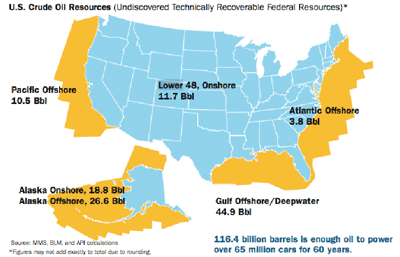
    The drive to de-develop America begins with control of energy. This includes actions to restrict access to our natural resources. The United States has 31 billion barrels of oil reserves on-shore in the lower 48 and Alaska. Off-shore oil reserves include 60 billion barrels along the coastal US and 26 billion barrels in off shore Alaska. Yet almost all of these reserves remain untouchable. Drilling in ANWAR is still banned and due to the BP oil leak in the Gulf, a drilling ban remains in place on the only coastal resource previously open for drilling.

    The US oil reserves are a pittance compared to our reserves of oil shale deposits. Estimates put oil shale reserves at 1.5 – 2.0 trillion barrels or five times that of Saudi Arabia. “The technical groundwork may be in place for a fundamental shift in oil shale economics,” the Rand Corporation recently declared. “Advances in thermally conductive in-situ conversion may enable shale-derived oil to be competitive with crude oil at prices below $40 per barrel. If this becomes the case, oil shale development may soon occupy a very prominent position in the national energy agenda.” Shell utilized a process called “in situ” mining, which heats the shale while it’s still in the ground, to the point where the oil leaches from the rock. The process eliminates the need to mine the shale to get to the oil. The Administration has shown little sign of encouraging the development of these resources, particularly in the areas controlled by the federal government.

    US policy towards the coal industry is no more favorable. U.S. coal production decreased in 2009, dropping by 8.5 percent to a level of 1,072.8 million short tons. The decline in coal production in 2009 was the largest percent decline since 1958 and the largest tonnage decline since 1949.

    In sharp contrast, the administration openly promotes green technologies like wind and solar. Unfortunately, these sources provide just 1% of our energy requirements.

    De-development, the Obama Administration’s version of deconstruction, is very different from a growing political movement aimed at reducing the nation’s debt and current spending. The Great Deconstruction will not come from a government policy of reducing energy consumption to bring America into a more correct distribution and use of the world’s resources. Rather, it will come from the people demanding a smaller bureaucracy, more efficient government and government employees actually willing to do the job they are paid to do.

    The election in November offers the most profound choice for the future of America that we have seen in decades. One choice espouses government control of our natural resources, motivated by the strategy of “de-development” and expensive, rationed energy. The other choice seeks deconstruction of unsustainable and dysfunctional bureaucracies and intends to choke off the money supply from Congress and defund these programs.

    **************************

    Robert J Cristiano PhD is the Real Estate Professional in Residence at Chapman University in Orange, CA and Head of Real Estate for the international investment firm, L88 Investments LLC. He has been a successful real estate developer in Newport Beach California for twenty-nine years.

    Other works in The Great Deconstruction series for New Geography
    Deconstruction: The Fate of America? – March 2010
    The Great Deconstruction – First in a New Series – April 11, 2010
    An Awakening: The Beginning of the Great Deconstruction – June 12, 2010
    The Great Deconstruction :An American History Post 2010 – June 1, 2010
    A Tsunami Approaches – Beginning of the Great Deconstruction – August 2010
    The Tea Party and the Great Deconstruction – September 2010

  • Environmentalism as Religion

    Traditional religion is having a tough time in parts of the world. Majorities in most European countries have told Gallup pollsters in the last few years that religion does not “occupy an important place” in their lives. Across Europe, Judeo-Christian church attendance is down, as is adherence to religious prohibitions such as those against out-of-wedlock births. And while Americans remain, on average, much more devout than Europeans, there are demographic and regional pockets in this country that resemble Europe in their religious beliefs and practices.

    The rejection of traditional religion in these quarters has created a vacuum unlikely to go unfilled; human nature seems to demand a search for order and meaning, and nowadays there is no shortage of options on the menu of belief. Some searchers syncretize Judeo-Christian theology with Eastern or New Age spiritualism. Others seek through science the ultimate answers of our origins, or dream of high-tech transcendence by merging with machines — either approach depending not on rationalism alone but on a faith in the goodness of what rationalism can offer.

    For some individuals and societies, the role of religion seems increasingly to be filled by environmentalism. It has become “the religion of choice for urban atheists,” according to Michael Crichton, the late science fiction writer (and climate change skeptic). In a widely quoted 2003 speech, Crichton outlined the ways that environmentalism “remaps” Judeo-Christian beliefs:

    There’s an initial Eden, a paradise, a state of grace and unity with nature, there’s a fall from grace into a state of pollution as a result of eating from the tree of knowledge, and as a result of our actions there is a judgment day coming for us all. We are all energy sinners, doomed to die, unless we seek salvation, which is now called sustainability. Sustainability is salvation in the church of the environment. Just as organic food is its communion, that pesticide-free wafer that the right people with the right beliefs, imbibe.

    In parts of northern Europe, this new faith is now the mainstream. “Denmark and Sweden float along like small, content, durable dinghies of secular life, where most people are nonreligious and don’t worship Jesus or Vishnu, don’t revere sacred texts, don’t pray, and don’t give much credence to the essential dogmas of the world’s great faiths,” observes Phil Zuckerman in his 2008 book Society without God. Instead, he writes, these places have become “clean and green.” This new faith has very concrete policy implications; the countries where it has the most purchase tend also to have instituted policies that climate activists endorse. To better understand the future of climate policy, we must understand where “ecotheology” has come from and where it is likely to lead.

    From Theology to Ecotheology

    The German zoologist Ernst Haeckel coined the word “ecology” in the nineteenth century to describe the study of “all those complex mutual relationships” in nature that “Darwin has shown are the conditions of the struggle for existence.” Of course, mankind has been closely studying nature since the dawn of time. Stone Age religion aided mankind’s first ecological investigation of natural reality, serving as an essential guide for understanding and ordering the environment; it was through story and myth that prehistoric man interpreted the natural world and made sense of it. Survival required knowing how to relate to food species like bison and fish, dangerous predators like bears, and powerful geological forces like volcanoes — and the rise of agriculture required expertise in the seasonal cycles upon which the sustenance of civilization depends.

    Our uniquely Western approach to the natural world was shaped fundamentally by Athens and Jerusalem. The ancient Greeks began a systematic philosophical observation of flora and fauna; from their work grew the long study of natural history. Meanwhile, the Judeo-Christian teachings about the natural world begin with the beginning: there is but one God, which means that there is a knowable order to nature; He created man in His image, which gives man an elevated place in that order; and He gave man mastery over the natural world:

    And God blessed them, and God said unto them, Be fruitful, and multiply, and replenish the earth, and subdue it: and have dominion over the fish of the sea, and over the fowl of the air, and over every living thing that moveth upon the earth. And God said, Behold, I have given you every herb bearing seed, which is upon the face of all the earth, and every tree, in the which is the fruit of a tree yielding seed; to you it shall be for meat. [Genesis 1:28-29]

    In his seminal essay “The Historical Roots of Our Ecologic Crisis,” published in Science magazine in 1967, historian Lynn Townsend White, Jr. argues that those Biblical precepts made Christianity, “especially in its Western form,” the “most anthropocentric religion the world has seen.” In stark contrast to pagan animism, Christianity posited “a dualism of man and nature” and “insisted that it is God’s will that man exploit nature for his proper ends.” Whereas older pagan creeds gave a cyclical account of time, Christianity presumed a teleological direction to history, and with it the possibility of progress. This belief in progress was inherent in modern science, which, wedded to technology, made possible the Industrial Revolution. Thus was the power to control nature achieved by a civilization that had inherited the license to exploit it.

    To White, this was not a positive historical development. Writing just a few years after the publication of Rachel Carson’s eco-blockbuster Silent Spring, White shared in the concern over techno-industrial culture’s destruction of nature. Whatever benefit scientific and technological innovation had brought mankind was eclipsed by the “out of control” extraction and processing powers of industrial life and the mechanical degradation of the earth. Christianity, writes White, “bears a huge burden of guilt” for the destruction of the environment.

    White believed that science and technology could not solve the ecological problems they had created; our anthropocentric Christian heritage is too deeply ingrained. “Despite Copernicus, all the cosmos rotates around our little globe. Despite Darwin, we are not, in our hearts, part of the natural process. We are superior to nature, contemptuous of it, willing to use it for our slightest whim.” But White was not entirely without hope. Even though “no new set of basic values” will “displace those of Christianity,” perhaps Christianity itself can be reconceived. “Since the roots of our trouble are so largely religious, the remedy must also be essentially religious.” And so White suggests as a model Saint Francis, “the greatest spiritual revolutionary in Western history.” Francis should have been burned as a heretic, White writes, for trying “to substitute the idea of the equality of all creatures, including man, for the idea of man’s limitless rule of creation.” Even though Francis failed to turn Christianity toward his vision of radical humility, White argued that something similar to that vision is necessary to save the world in our time.

    White’s essay caused a splash, to say the least, becoming the basis for countless conferences, symposia, and debates. One of the most serious critiques of White’s thesis appears in theologian Richard John Neuhaus’s 1971 book In Defense of People, a broad indictment of the rise of the mellifluous “theology of ecology.” Neuhaus argues that our framework of human rights is built upon the Christian understanding of man’s relationship to nature. Overturning the latter, as White hoped would happen, will bring the former crashing down. And Neuhaus makes the case that White misunderstands his own nominee for an ecological patron saint:

    What is underemphasized by White and others, and what was so impressive in Francis, is the unremitting focus on the glory of the Creator. Francis’ line of accountability drove straight to the Father and not to Mother Nature. Francis was accountable for nature but to God. Francis is almost everyone’s favorite saint and the gentle compassion of his encompassing vision is, viewed selectively, susceptible to almost any argument or mood…. It was not the claims of creation but the claims of the Creator that seized Francis.

    Other Christian writers joined Neuhaus in condemning the eco-movement’s attempt to subvert or supplant their religion. “We too want to clean up pollution in nature,” Christianity Today demurred, “but not by polluting men’s souls with a revived paganism.” The Jesuit magazine America called environmentalism “an American heresy.” The theologian Thomas Sieger Derr lamented “an expressed preference for the preservation of nonhuman nature against human needs wherever it is necessary to choose.” (Stephen R. Fox recounts these responses in his 1981 book John Muir and His Legacy: The American Conservation Movement.)

    The Greening of Christianity

    From today’s vantage, it seems that White’s counsel has been heeded far and wide. Ecotheologies loosely based on concepts lifted from Hinduism or Buddhism have become popular in some Baby Boomer circles. Neo-pagans cheerfully accept the “tree-hugger” designation and say they were born “green.” And, most strikingly, Christianity has begun to accept environmentalism. Theologians now speak routinely of “stewardship” — a doctrine of human responsibility for the natural world that unites interpretations of Biblical passages with contemporary teachings about social justice.

    In November 1979, a dozen years after White’s essay, Pope John Paul II formally designated Francis of Assisi the patron saint of ecologists. Over the following two decades, John Paul repeatedly addressed in passionate terms the moral obligation “to care for all of Creation” and argued that “respect for life and for the dignity of the human person extends also to the rest of Creation, which is called to join man in praising God.” His successor, Benedict XVI, has also spoken about the environment, albeit less stirringly. “That very ordinariness,” argues a correspondent for the National Catholic Reporter, “seems remarkable. Benedict simply took for granted that his audience would recognize the environment as an object of legitimate Christian interest. What the matter-of-fact tone reveals, in other words, is the extent to which Catholicism has ‛gone green.’”

    American Protestantism, too, has gone green. Numerous congregations are constructing “green churches” — choosing to glorify God not by erecting soaring sanctuaries but by building more energy-efficient houses of worship. In some denominations, programs for recycling or carpooling seem as common as food drives. Church-sponsored Earth Day celebrations are widespread.

    Even some evangelicals are turning toward environmentalism. Luis E. Lugo, the director of the Pew Forum on Religion and Public Life, speaks of their “broader environmental sensitivity”:

    Once it’s translated into Biblical terms, [evangelicals] pick up the environmental banner using phrases that resonate with the ­community — “Creation care.” That immediately puts it in an evangelical context rather than the empirical arguments about the environment. “This is the world God created. God gave you a mandate to care for this world.” It’s a very direct religious appeal.

    That said, the widely reported “greening of evangelicals” shouldn’t be exaggerated. Conservative evangelical leaders remain wary of environmentalism’s agenda and of any attacks on industrial prowess that could be seen as undermining American national greatness. Many evangelicals are rankled by environmentalists’ critique of the Genesis depiction of man’s place in the natural order. And evangelicals are alert to any hint of pagan worship. Moreover, the available poll data — admittedly rather sparse — paints a mixed picture. In a 2008 survey conducted by the Barna Group, a California-based public opinion firm that concentrates on church issues, 90 percent of the evangelical respondents said they “would like Christians to take a more active role in caring for creation” (with two thirds saying they strongly agreed with that sentiment). But the term “Creation care” had not sunk in (89 percent of the respondents who ­identified ­themselves as Christian said they had never heard of it). And both the Barna survey and another 2008 survey conducted by Pew found that evangelicals tend to be much more skeptical about the reality of ­global warming than other American Christians or the population at large.

    To the extent that evangelicals and environmentalists are in fact reaching out to one another, there can be benefits for each side. For churches with aging congregations, green issues reportedly help attract new, younger members to the pews. And what do environmental activists hope to gain by recruiting churches to their cause? “Foot soldiers, is the short answer,” says Lugo.

    Carbon Calvinism

    Beyond influencing — one might even say colonizing — Christianity, the ecological movement can increasingly be seen as something of a religion in and of itself. It is “quasi-religious in character,” says Lugo. “It generates its own set of moral values.”

    Freeman Dyson, the brilliant and contrarian octogenarian physicist, agrees. In a 2008 essay in the New York Review of Books, he described environmentalism as “a worldwide secular religion” that has “replaced socialism as the leading secular religion.” This religion holds “that we are stewards of the earth, that despoiling the planet with waste products of our luxurious living is a sin, and that the path of righteousness is to live as frugally as possible.” The ethics of this new religion, he continued,

    are being taught to children in kindergartens, schools, and colleges all over the world…. And the ethics of environmentalism are fundamentally sound. Scientists and economists can agree with Buddhist monks and Christian activists that ruthless destruction of natural habitats is evil and careful preservation of birds and butterflies is good. The worldwide community of environmentalists — most of whom are not scientists — holds the moral high ground, and is guiding human societies toward a hopeful future. Environmentalism, as a religion of hope and respect for nature, is here to stay. This is a religion that we can all share, whether or not we believe that global warming is harmful.

    Describing environmentalism as a religion is not equivalent to saying that global warming is not real. Indeed, the evidence for it is overwhelming, and there are powerful reasons to believe that humans are causing it. But no matter its empirical basis, environmentalism is progressively taking the social form of a religion and fulfilling some of the individual needs associated with religion, with major political and policy implications.

    William James, the pioneering psychologist and philosopher, defined religion as a belief that the world has an unseen order, coupled with the desire to live in harmony with that order. In his 1902 book The Varieties of Religious Experience, James pointed to the value of a community of shared beliefs and practices. He also appreciated the individual quest for spirituality — a search for meaning through encounters with the world. More recently, the late analytic philosopher William P. Alston outlined in The Encyclopedia of Philosophy what he considered the essential characteristics of religions. They include a distinction between sacred and profane objects; ritual acts focused upon sacred objects; a moral code; feelings of awe, mystery, and guilt; adoration in the presence of sacred objects and during rituals; a worldview that includes a notion of where the individual fits; and a cohesive social group of the likeminded.

    Environmentalism lines up pretty readily with both of those accounts of religion. As climate change literally transforms the heavens above us, faith-based environmentalism increasingly sports saints, sins, prophets, predictions, heretics, demons, sacraments, and rituals. Chief among its holy men is Al Gore — who, according to his supporters, was crucified in the 2000 election, then rose from the political dead and ascended to heaven twice — not only as a Nobel deity, but an Academy Awards angel. He speaks of “Creation care” and cites the Bible in hopes of appealing to evangelicals.

    Selling indulgences is out of fashion these days. But you can now assuage your guilt by buying carbon offsets. Fire and brimstone, too, are much in vogue — accompanied by an unmistakable whiff of authoritarianism: “A professor writing in the Medical Journal of Australia calls on the Australian government to impose a carbon charge of $5,000 on every birth, annual carbon fees of $800 per child and provide a carbon credit for sterilization,” writes Braden R. Allenby, an Arizona State University professor of environmental engineering, ethics, and law. An “article in the New Scientist suggests that the problem with obesity is the additional carbon load it imposes on the environment; others that a major social cost of divorce is the additional carbon burden resulting from splitting up families.” Allenby, writing in a 2008 article on GreenBiz.com, continues:

    A recent study from the Swedish Ministry of Sustainable Development argues that males have a disproportionately larger impact on global warming (“women cause considerably fewer carbon dioxide emissions than men and thus considerably less climate change”). The chairman of the Intergovernmental Panel on Climate Change states that those who suggest that climate change is not a catastrophic challenge are no different than Hitler…. E.O. Wilson calls such people parasites. Boston Globe columnist Ellen Goodman writes that “global warming deniers are now on a par with Holocaust deniers.”

    The sheer volume of vicious language employed to recast social and cultural trends in terms of their carbon footprint suggests the rise of what Allenby calls a dangerous new “carbon fundamentalism.”

    Some observers detect parallels between the ecological movement and the medieval Church. “One could see Greenpeacers as crusaders, with the industrialist cast as the infidel,” writes Richard North in New Scientist. That may be a stretch, but it does seem that this new religion has its share of excommunicated heretics. For example, since daring to challenge environmentalist orthodoxy, Freeman Dyson has discovered himself variously described as “a pompous twit,” “a blowhard,” “a cesspool of misinformation,” and “an old coot riding into the sunset.” For his part, Dyson remains cheerily unrepentant. “We are lucky that we can be heretics today without any danger of being burned at the stake,” he has said. “But unfortunately I am an old heretic…. What the world needs is young heretics.”

    Many of those making the case that environmentalism has become a religion throw around the word “religion” as a pejorative. This disdain is rooted in an uncontroversial proposition: You cannot reason your way to faith. That’s the idea behind the “leap of faith” — or the leap to faith, in Kierkegaard’s original formulation: the act of believing in something without, or in spite of, empirical evidence. Kierkegaard argued that if we choose faith, we must suspend our reason in order to believe in something higher than reason.

    So those on the right side of the political spectrum who portray environmentalism as a religion do so because, if faith is inherently not ­achievable through rationality, and if environmentalism is a religion, then environmentalism is utterly irrational and must be discredited and ignored. That is the essence of Michael Crichton’s 2003 speech. “Increasingly,” he said, “it seems facts aren’t necessary, because the tenets of environmentalism are all about belief.” Environmentalism, he argued, has become totally divorced from science. “It’s about whether you are going to be a sinner, or saved. Whether you are going to be one of the people on the side of salvation, or on the side of doom. Whether you are going to be one of us, or one of them.”

    A similar attack from the right comes from Ray Evans, an Australian businessman, politician, and global-warming skeptic:

    Almost all of the attacks on the mining industry being generated by the environmentalist movement [in the 1990s] were coming out of Northern Europe and Scandinavia, and it didn’t take me long to work out that we were dealing with religious belief, that the elites of Northern Europe and Scandinavia — the political elites, the intellectual elites, even the business elites — were, in fact, believers in one brand of environmentalism or another and regardless of the facts. Some of the most bizarre policies were coming out of these countries with respect to metals. I found myself having to find out — “Why is this so?” — ­because on the face of it they were insane, but they were very strongly held and you’d have to say that when people hold onto beliefs regarding the natural world, and hold onto them regardless of any evidence to the contrary, then you’re dealing with religion, you’re not dealing with science….

    Secondly, it fulfills a religious need. They need to believe in sin, so that means sin is equal to pollution. They need to believe in salvation. Well, sustainable development is salvation. They need to believe in a mankind that needs redemption, so you get redemption by stopping using carbon fuels like coal and oil and so on. So, it fulfills a religious need and a political need, which is why they hold onto it so tenaciously, despite all the evidence that the whole thing is nonsense.

    Leftists also sometimes disparage environmentalism as religion. In their case, the main objection is usually pragmatic: rationalism effects change and religion doesn’t. So, for instance, the Sixties radical Murray Bookchin saw the way environmentalism was hooking up with New Age spirituality as pathetic. “The real cancer that afflicts the planet is capitalism and hierarchy,” he wrote. “I don’t think we can count on prayers, rituals, and good vibes to remove this cancer. I think we have to fight it actively and with all the power we have.” Bookchin, a self-described revolutionary, dismissed green spirituality as “flaky.” He said that his own brand of “social ecology,” by contrast, “does not fall back on incantations, sutras, flow diagrams, or spiritual vagaries. It is avowedly rational. It does not try to regale metaphorical forms of spiritual mechanism and crude biologisms with Taoist, Buddhist, Christian, or shamanistic ‛Eco-la-la.’”

    The Prophet and the Heretic

    In the 1960s, a British chemist working with the American space program had a flash of insight. Planet Earth, James Lovelock realized, behaves like one complex, living system of which we humans are, in effect, some of its parts. The physical components of the earth, from its atmosphere to its oceans, closely integrate with all of its living organisms to maintain climatic chemistry in a self-regulating balance ideal for the maintenance and propagation of life.

    His idea turned out to have scientific value. However, Lovelock would probably just be a footnote in scientific history instead of the much-decorated intellectual celebrity he is, except for one thing: He named this vast planetary organism after the Greek goddess who personified the earth — Gaia — and described “Her” as “alive.”

    Not only was his Gaia Hypothesis predictably controversial in the world of science — as befits a radical rethinking of earth’s complex biosphere — but it was both revered and reviled by those who saw it as fitting in perfectly with tie-dyed New Age spirituality. This was true even though he describes his time at the Jet Propulsion Laboratory in Pasadena as one in which “not all of us were hippies with our rock chicks.” For both good and ill, Lovelock not only gave the planet a persona, he created one for himself, becoming “the closest thing we have to an Old Testament prophet, though his deity is not Jehovah but Gaia,” as the Sunday Times recently noted.

    Even though Lovelock continues to go to great lengths to be an empiricist, his 2009 book The Vanishing Face of Gaia: A Final Warning — published in the year he celebrated his ninetieth birthday — has been reviewed as a prophet’s wrathful jeremiad of planetary doom, studded with parables of possible salvation for the few.

    Being embraced by the spiritual left has brought Lovelock fame and attention. Yet it’s a marvel the challenges Lovelock has created for himself in changing the minds of zealots. In Vanishing Face, for example, Lovelock, ever the scientist, open-mindedly considers the possibilities for last-ditch humans fighting global warming by intentionally reengineering the planet. One idea he discusses is retrofitting every commercial airliner on earth to allow them, as they fly, each to spray a ton or two of sulfuric acid into the stratosphere every day for the foreseeable future. The notion is that this will create molecules that will cause solar energy to be reflected back into space, replacing the reflectivity of the melting polar ice caps.

    So, you say to Lovelock: You’ve succeeded in getting out this idea that the planet is a living organism. An awful lot of people are totally convinced by your hypothesis, and even view you as a prophet. How would you begin to sell this idea of injecting sulfuric acid into a living being that some view in religious terms?

    “Yes, especially when you think about the role of the element sulfur in old theology,” Lovelock replies. “The devil — the scent of sulfur reveals his presence. I hear what you’re saying very clearly. I’ve never had to sell it to religious greens so far. I don’t look forward to the job.”

    Of environmentalism increasingly being faith-based, Lovelock says, “I would agree with you wholeheartedly. I look at humans as probably having an evolutionary desire to have ideology, to justify their actions. Green thinking is like Christian or Muslim religions — it’s another ideology.”

    In terms of saving Gaia, do you view carbon Calvinism as a net plus or a net minus?

    “A net minus. You often hear environmentalists saying that one should do this or the other thing — like not fly — because not doing it can save the planet. It’s sheer hubris to imagine we can save Gaia. It’s quite beyond our capacity. What we have to do is save ourselves. That’s really important. Gaia would like it.”

    Gaia would like it?

    “Yes. I’ve got to be very careful here, because I get misinterpreted badly. I’m not making out Gaia to be a sentient entity and that sort of thing. It’s really metaphoric. So having said that — ”

    Gaia would think it important for us to save ourselves?

    “Exactly. Our evolution of intelligence is something of immense value to the planet. It could make, eventually, part of it, an intelligent planet. More able to deal with problems like incoming asteroids, volcanic outbursts and so on. So I look on us as highly beneficial and therefore ­certainly worth saving.”

    The good news about religious greens, Lovelock says, is that they can be led. Saints like him can change minds. “I have a personal experience here. Something like five years ago in Britain they did a big poll. There was hardly anybody” in favor of nuclear power. Now — thanks in no small part to Lovelock’s lobbying, at least in his own account — the great majority of Britons favor nuclear energy.

    Lovelock’s faith in democracy is shared by Bjørn Lomborg. He believes that people want to do good, and if you approach them on that basis, you can get them to listen to reason. Lomborg is the Danish author of The Skeptical Environmentalist (published in English in 2001), and the director of the Copenhagen Consensus Center. He has been pilloried for opposing the Kyoto Protocol and other measures to cut carbon emissions in the short term because of the evidence he sees that they don’t achieve their goals. Instead, he argues that we should adapt to inevitable short-term temperature rises and spend money on research and development for longer-term environmental solutions, as well as other pressing world crises such as malaria, AIDS, and hunger. He argues, for example, that ­getting Vitamin A and zinc to 80 percent of the 140 million children in the developing world who lack them is a higher priority than cutting carbon emissions. The cost, he argues, would be $60 million per year, yielding health and cognitive development benefits of over $1 billion.

    Despite his heresy, Lomborg thinks empiricism can prevail over faith. He believes that, in a democracy, if you keep calmly and rationally and sympathetically making your case, the great majority can come to think you are making more sense than the true believers. “My sense is that most people do want to do good,” he says.

    They don’t just want to pay homage to whatever god or whatever religion is the flavor of the year. They actually want to see concrete results that will leave this planet a better place for the future. So I try to engage them in a rational manner rather than in the religious manner. Of course, if people’s minds are entirely made up there is nothing you can do to change it. But my sense is that most people are not in that direction. My sense is that in virtually any area, you have probably 10 percent true believers that you just cannot reach. And probably also 10 percent who just disparage it and don’t give a hoot about it. But the 80 percent are people who are busy living their lives, loving their kids, and making other plans. And I think those are the 80 percent you want to reach.

    So why do so many people want to burn you at the stake?

    Oh sure. Certainly a lot of the high priests have been after me. But I take that as a compliment. It simply means that my argument is a lot more dangerous. If I was just a crazy guy ranting outside the religious gathering, then it might not matter. But I’m the guy who says, maybe you could do smarter. Maybe you could be more rational. Maybe you could spend your money in a better way.

    A lot of people have been after me with totally disproportionate behavior if this were really a discussion on facts. But I continuously try to make this an argument about rationality. Because when you do that, and your opponents perhaps exaggerate, and go beyond the rational argument, it shows up in the conversation. Most people would start saying, “Wow, that’s weird, that they’d go this far.”

    This is not to deny that global warming is also a serious problem. But then again I ask: why is it that we tackle it only in the way that current dogma talks about — cut carbon emissions right now and feel good about yourself? Instead of focusing on making new innovations that would [allow everyone] to cut carbon emissions in the long run much cheaper, more effectively, and with much greater chance of success.

    When you make those double arguments, I think the 80 percent we’ve talked about start saying, “That guy makes a lot of sense. Why are the other people continuously almost frothing around the mouth?” And always saying, “No, no, no, it has to be cut carbon emissions and that has to be the biggest problem in the world.”

    I think that’s the way to counter much of this discussion. It’s not about getting your foot into the religious camp as well. It’s simply to stand firmly on the rational side and keep saying, “but I know you want to do good in the world.”

    Lovelock and Lomberg, prophet and heretic, honored and reviled, one hoping for action today and the other expecting solutions tomorrow — yet each professes confidence in an eventual democratic endorsement of his plan. Talk about a leap of faith.

    The New Religion and Policy

    The two faces of religious environmentalism — the greening of mainstream religion and the rise of carbon Calvinism — may each transform the political and policy debate over climate change. In the former case, the growing Christian interest in stewardship could destabilize the political divide that has long characterized the culture wars. Although the pull of social issues has made the right seem like a natural home for evangelicals, a commitment to environmentalism might lead them to align themselves more with the left. Even if no major realignment takes place, the bond between evangelicals and the right might be loosened somewhat. (And beyond politics, other longstanding positions may be shaken up. Activists and scientists who long pooh-poohed evangelicals because of their views on evolution or the life questions will have to get accustomed to working with the new environmental “foot soldiers,” and vice versa.)

    A deeper concern is the expansion of irrationalism in the making of public policy. Of course, no policy debate can ever be reduced to matters of pure reason; there will always be fundamentally clashing values and visions that cannot be settled by rationality alone. But the rhetoric of many environmentalists is more than just a working out of those fundamental differences. The language of the carbon fundamentalists “indicates a shift from [seeking to help] the public and policymakers understand a complex issue, to demonizing disagreement,” as Braden Allenby has written. “The data-driven and exploratory processes of science are choked off by inculcation of belief systems that rely on archetypal and emotive strength…. The authority of science is relied on not for factual ­enlightenment but as ideological foundation for authoritarian policy.”

    There is nothing unusual about human beings taking more than one path in their search for truth — science at the same time as religion, for example. Nor is there anything unusual about making public policy without sufficient data. We do it all the time; the world sometimes demands it.

    The good news about making public policy in alliance with faith is that it can provoke a certain beneficial zeal. People tend to be more deeply moved by faith than by reason alone, and so faith can be very effective in bringing about necessary change — as evidenced by the civil rights movement, among others.

    The bad news is that the empirical approach arose in no small part to mitigate the dangers of zeal — to keep blood from flowing in the streets. A strict focus on fact and reason whenever possible can avert error and excess in policy. But can someone who has made a faith of ­environmentalism — whose worldview and lifestyle have been utterly shaped by it — adapt to changing facts? For the one fact we reliably know about the future of the planet’s climate is that the facts will change. It is simply too complex to be comprehensively and accurately modeled. As climatologist Gavin Schmidt jokes, there is a simple way to produce a perfect model of our climate that will predict the weather with 100 percent accuracy: first, start with a universe that is exactly like ours; then wait 14 billion years.

    So what happens if, say, we discover that it is not possible to return the environment to the conditions we desire, as James Lovelock expects? What happens if evidence accumulates that we should address climate change with methods that the carbon Calvinists don’t approve of? To what extent, if any, would devotees of the ­“natural” accept reengineering the planet? How long will it take, if ever, for nuclear power to be accepted as green?

    In the years ahead, we will see whether the supposedly scientific debates over the environment can really be conducted by fact and reason alone, or whether necessary change, whatever that may turn out be, will require some new Reformation. For if environmental matters really have become matters of faith — if environmentalism has become a new front in the longstanding culture wars — then what place is left for the crucial function of pragmatic, democratic decision-making?


    This article first appeared in The New Atlantis.

    Joel Garreau is the author of Radical Evolution: The Promise and Peril of Enhancing Our Minds, Our Bodies — and What it Means to be Human (Doubleday, 2005); the Lincoln Professor of Law, Culture, and Values at Arizona State University; and a Senior Future Tense Fellow at the New America Foundation. This article was developed during a Templeton-Cambridge Journalism Fellowship in Science and Religion at the University of Cambridge.

    © 2010 by Joel Garreau

    Photo by Andy Revkin.