Blog

  • Redefining ‘Niners’: Football on The Great Plains

    At 0.5 people per square mile, Harding County, South Dakota is one of the least populated places in the nation. The county’s only high school, located in Buffalo, is small by even small-town standards, with 85 students in grades 9-12. However, few schools can match its gridiron success. Nicknamed after the primary industry in the region, “The Ranchers” football team has experienced only one losing season in its 44-year history.

    Harding County’s teenage boys suit up every Friday night and dominate 9-man football.

    Nine-man football is a small-town sport. Unique to three upper Great Plains states (South Dakota, North Dakota, and Minnesota), it was designed for rural high schools, where mounting a standard 11-man team simply isn’t feasible.

    The first three games of the 2010 season are already in the books, all three ending early due to the 50-point mercy rule (any time after halftime, a 50-point lead wins the game). The Ranchers have so far outscored their opponents 172 to 14.

    The key to 9-man football, according to Ranchers head coach, Jay Wammen, is speed. “With two less defensive linemen, we have more space to work with. Like most 9-man teams, our kids play both offense and defense, so there is a demand for physicality and the ability to be on the field giving it their all from the first whistle to the last.”

    The Ranchers play on what many regard as the worst football field in South Dakota. “We tried raising grass on the field last year,” laments assistant coach and school principal Josh Page. “We laid some sod, but it died out.” The field is too muddy to use when it rains, and when it’s dry, clouds of thick dust blow across from the adjacent rodeo grounds. It’s not unusual for Friday night Ranchers games, originally scheduled for their home field, to be forced to move to their opponent’s school, due to unsuitable playing conditions. Visiting teams consider this good news — over the years players have come to dread the invasive cockleburs populating the Harding County High School football field.

    Football is a collision sport, and wrestling cattle on the ranch prepares these young men for confronting 250-pound opponents. Getting up at sunrise to feed livestock trains them to be alert, disciplined, and ready to execute. Says Wally Stephens, sports editor of The Nation’s Center News (circulation 1200) about the Ranchers’ style of play, “Our boys play hardnosed, power football. They grind the ball out and they hit hard.”

    Located in the farthest northwest corner of South Dakota, Harding County is known to paleontologists as the T-rex capital of the world — more T-rex fossils have been found here than in any other place on earth. It has a population of 1,353 people, spread out over 2,678 square miles. The region boasts the nation’s coldest winters, punctuated by fierce blizzards that are capable, even today, of immobilizing residents for weeks at a time. When its High School team members are not playing football or going to school, most are working on the family ranch: branding calves, wrestling steers, herding sheep, or moving hay. Many are the third or fourth generation on the land. When they start practice in August, the players are in shape and ready to work hard. Sure, they have a little swagger, notes Coach Wammen, but it’s been earned by their success.

    Whether they win or lose, away games constitute a long ride home over vast stretches of two-lane roads. The conference has nine teams and encompasses an impressive 38,000 square miles, with the farthest regular season game 213 miles away. Yet even with an average round trip of over 250 miles, Harding County fans often outnumber those of the opposing team. “The whole county comes,” according to Nora Boyer, the erudite 78-year-old volunteer curator at the Buffalo Historical Museum. “It gets pretty nippy around November and some people watch the game from their vehicles, but I say, if you sit in your pickup truck, you can’t holler.” Many of the players have fathers and grandfathers in the crowd who, when they were teenagers, played for Harding County High School.

    High school senior Jace Jenson is a standout wide receiver and line backer whose ranch is 40 miles from the high school. Jenson attended hometown games as a grade school student, playing rough-and-tumble football in the field behind the goalposts. “I remember being a little kid and goofing around with the same guys that I play with today.” One of those guys is current teammate and fellow senior Austin Brown who has been the Ranchers’ quarterback and safety since he was a freshman. Brown lives on a ranch that belonged to his grandfather, 25 miles north of the high school in Buffalo. He describes Harding County football as “tradition,” saying, “I have had a football in my hands ever since I can remember.”

    The 6’5” quarterback was one of only three South Dakota football players who were recognized in the renowned Tom Lemming’s Prep Football Report Summer 2010. The report calls Brown “…One of the biggest sleepers in the country . . . he plays way out in western South Dakota so most college coaches are unaware of the potential blue chipper.”

    Both Brown’s and Jenson’s fathers played for the Ranchers in the early 1980s. Jenson says, “My dad played Harding County football when he was in high school. But,” he adds with a sly grin, “I don’t know if he was any good. You could ask him . . . but he’s out moving hay.” The fathers of both the Ranchers’ head coach and assistant coach played football together on the same field that their sons coach on today. Coaches Page and Wammen are too young to have boys of their own on the field, but, most townsfolk believe it’s only a matter of time. People in ranch country are patient.

    Places as isolated as Harding County are sometimes referred to as ‘the middle of nowhere’. But for these exceptional football players, it’s not ‘nowhere’ — it’s ‘now’ and ‘here’– it’s their past, it’s their future, and it’s one of the best places to grow up in America.

    Photo: Friday night in Harding County

    Debora Dragseth, Ph.D. is an associate professor of business at Dickinson State University in Dickinson, North Dakota. She trains and develops leadership curriculum for CHS, Inc. a diversified energy, grains and foods company. The Fortune 100 company is the largest cooperative in the United States. Dragseth’s research interests include Generation Y (Millennials), outmigration and entrepreneurship.
  • Shifting Religious Climate

    While the new Memphis Islamic Center in Cordova, TN awaits completion, members meet at a nearby church building that houses Cordova’s Heart Song Church. The Christian congregation has opened its doors to the Muslim community as a gesture of good will.

    This kind act is in contrast with other recent activities, like an August arson fire to an Islamic Center’s construction equipment in suburban Murfreesboro just south of Nashville. And to complicate things even more, there’s that tiny little church that had planned to burn the Qur’an on September 11th. While all of this is going on, there is of course the ongoing debate surrounding plans to build a mosque near ground zero.

    These stories serve to illustrate the ongoing struggle many Americans have with how to navigate the country’s shifting religious climate.

    The United States is the most religiously diverse country in the world. We already noticed that much of America’s religious geography has trended suburban, as indicated in a previous article titled “The Suburbanization of Religious Diversity.” This has put new religions face-to-face with America’s mainstream faiths. The big question remains: how do “mainstream” (Evangelical, Catholic, and Mainline Protestant) Americans view neighbors both culturally distant yet geographically close?

    Many Americans say that religious beliefs affect their views on social issues such as abortion, same-sex marriage, and the death penalty. On the other hand, fewer Americans, according to a Pew Research Center report, are inclined to lean on their religious beliefs when it comes to issues like immigration or the environment. Only 7% of Americans say that religion is “the most important influence on their opinions about” immigration but more than one third report that religion influences their opinions on same-sex marriage.

    It ends up being a matter of interpretation. Some Christians cite Biblical texts to inform their approach towards new and diverse residents in their communities. “And you shall not wrong a stranger or oppress him, for you were strangers in the land of Egypt.” (Exodus 22:21) Or, “(God) executes justice for the orphan and the widow, and shows His love for the alien by giving him food and clothing.” (Deuteronomy 10:18).

    Recalling a role that Christianity played concerning “immigration” in ancient Greco-Roman society, sociologist Rodney Stark wrote, “To cities filled with newcomers and strangers, Christianity offered an immediate basis for attachments.”

    So is the same true for the country’s new immigrant populations?

    Gwinnett County near Atlanta, for example, has seen an influx of new foreign-born neighbors over the past two decades. Duluth, one of Gwinnett County’s largest communities, epitomizes the cultural diversity of the county.

    In 2008, as part of a multi-church research project, several of Duluth’s pastors gathered as a “learning community” on a monthly basis to discuss ways in which Duluth’s churches could better serve their community. The pastors agreed that their churches were not culturally integrated with the many ethnic congregations scattered around the community. The pastors were asked how people would know whether or not churches were making a difference in their community. One of the pastors stated that it would be significant if each person could identify one friend of a different economic sector or different culture and be able to say that they met at church.

    It’s no secret that the religious beliefs of America’s new immigrants don’t always mesh with the country’s more traditional, or mainstream, religious groups.

    Some believe that America is, traditionally speaking, a “Christian” nation. This is also the perception of others outside the United States. Just ask a student studying in the U.S. from a Middle Eastern country how he or she perceives America’s religious identity . Yet, not all Americans take the position that America is a “Christian” country. Others suggest that North America has always been home to diverse religious ideas.

    Some mainstream religious groups and religious adherents, however, feel threatened by the increased religious diversity in this country. They view pluralism as a dangerous thing, something that might impede or compete with the values of those who share a more traditional (traditional-Christian) perspective on faith and life in the United States.

    At the same time, sociologists and cultural anthropologists who study religions have stated for years that the even center of “Christian” demography no longer resides in the West . Today, Christianity’s geography looks less European and more Asian, African, and Latin American – cultures that will constitute upwards of half America’s population in the next 30 – 40 years when minorities become the majority.

    This is a key issue facing places like Knoxville, which with nearly 700 churches, has more churches per capita than any other city in Tennessee. Religion has shaped Knoxville’s social climate more than any other factor in the city’s history. But even in Knoxville, religious geography is changing.

    According to the findings from the Religious Congregations and Membership Study conducted ten years ago by the Association of Statisticians of American Religious Bodies (ASARB), more than 10,000 Knoxvillians claimed adherence to some “other” religious tradition – meaning non-Evangelical, non-Mainline Protestant, non-Orthodox, and non-Catholic.

    Today, there is at least one Buddhist center in Knoxville. And according to Brian Long, a writer with the Knoxville News Sentinel, as of 2007 there were 300-500 Hindu families in the area. Knoxville has also had a growing Muslim population since the 1970s and today has roughly 4000 Muslim adherents and three places of worship in the Knoxville region.

    Some of America’s more traditional religious groups view new(er) religions in the U.S. such as those in Knoxville to be “compassionate” or “peaceful” religions, while others believe that a religion like Islam is “wicked” or “evil”, even “dangerous,” according to a study produced by the Tennessee-based Lifeway Research group earlier this year.

    Then again, it depends on where you live, work, and play.

    A few years ago, Deborah Laverty of the Northwest Indiana Times reported that “efforts to establish mosques resulted in controversy and lawsuits” in some of Chicago’s suburbs.
    However, in the same article titled “Muslim Mecca in Merrillville,” Laverty wrote about a favorable reception given to Muslims in the region by others. Regarding a willingness of some to invest in the area’s newest Muslim center, Laverty wrote, “One reason the group has chosen to invest in Merrillville is because the community has welcomed those of the Muslim faith with open arms.” Quoting an investment banker, Laverty pointed out, “The Muslim community (in Merrillville) is growing because of a good relationship with members of the law enforcement, government officials and even those of other religions and faiths. We haven’t had any negative incidents and the word is getting around, even in Chicago…”

    As the country’s demography continues to change, “mainstream” religious groups in the U.S. will undoubtedly re-calibrate their approaches to the country’s new religious landscape. Already there are some community-based movements that consist of people from diverse religious traditions attempting to figure out how they can serve the common good of their cities without blending together incompatible theological beliefs. Such groups from both “old” (mainstream) and “new” (not-so-mainstream) streams of thought are trying to help communities flourish and dispel fear.

    Critical thinking and meaningful dialogue will have to be applied at every level as America grows more – not less – religiously diverse in years to come.

    Since 2006, Travis Vaughn has conducted community studies in a number of U.S. cities. He is a visiting instructor at Covenant Theological Seminary and is the catalyst behind cityandcitizen.com.

    Photo: Church in Santa Fe by author.

  • Portland Metro’s Competitiveness Problem

    Portland Metro’s president, David Bragdon, recently resigned to take a position with New York’s Bloomberg administration. Bragdon was nearing the end of his second elected term and ineligible for another term. Metro is the three county (Clackamas, Multnomah and Washington counties) planning agency that oversees Portland’s land use planning and transportation policies, among the most stringent and pro-transit in the nation.

    Metro’s jurisdiction includes most of the bi-state (Washington and Oregon) Portland area metropolitan area, which also includes the core municipality of Portland and the core Multnomah County.

    Local television station KGW (Channel 8) featured Bragdon in its Straight Talk program before he left Portland. Some of his comments may have been surprising, such as his strong criticism of the two state (Washington and Oregon) planning effort to replace the aging Interstate Bridge (I-5) and even more so, his comments on job creation in Portland. He noted “alarming trends below the surface,” including the failure to create jobs in the core of Portland “for a long time.”

    Bragdon was on to something. Metro’s three county area suffers growing competitive difficulties, even in contrast to the larger metropolitan area (which includes Clark and Skamania counties in Washington, along with Yamhill and Columbia counties in Oregon). This is despite the fact that one of the most important objectives of Metro’s land use and transportation policies is to strengthen the urban core and to discourage suburbanization (a phenomenon urban planning theologians call “sprawl”).

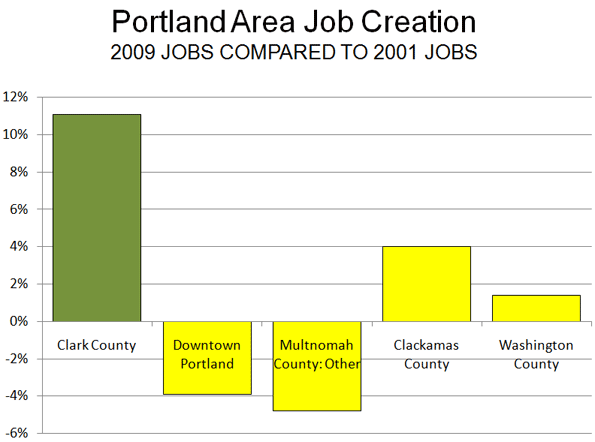
    Anemic Job Creation: Jobs have simply not been created in Portland’s core. Since 2001, downtown employment has declined by 3,000 jobs, according to the Portland Business Alliance. In Multnomah County, Portland’s urban core and close-by surrounding communities, 20,000 jobs were lost between 2001 and 2009. Even during the prosperous years of 2000 to 2006, Multnomah County lost jobs. Suburban Washington and Clackamas counties gained jobs, but their contribution fell 12,000 jobs short of making up for Multnomah County’s loss. The real story has been Clark County (the county seat is Vancouver), across the I-5 Interstate Bridge in neighboring Washington and outside Metro’s jurisdiction. Clark County generated 13,000 net new jobs between 2001 and 2009 (Figure 1).

    Domestic Migration: Not only are companies not creating jobs in the three county area, but people are choosing to locate in other parts of the metropolitan area.

    Between 2000 and 2009, the three counties – roughly 75% of the region’s total population in 2000 – attracted just one-half of net domestic migration into the metropolitan area. Washington’s suburban Clark County, across the Interstate Bridge, added a net 48,000 by domestic migration and has accounted for 40% of the metropolitan area’s figure all by itself.

    Core Multnomah County, which had nearly double Clark County’s 2000 population, added only 4,000 net domestic migrants, at a rate less than 1/20th that of Clark County. Suburban Clackamas and Washington counties did better, but between them achieved barely one-half of the Clark County rate.

    Exurban Columbia and Yamhill counties, outside the jurisdiction of Metro but inside the metropolitan area, added nearly 13,000 domestic migrants, more than three times that of Multnomah County, despite their combined population less than one-fifth that of Multnomah’s in 2000.

    Effects of Pro-Transit Policies: Portland’s unintended decentralization has even damaged the much promoted, and subsidized, public transit agencies. Despite Portland’s pro-transit policies, the three county transit work trip market share fell from 9.7% in 1980, before the first light rail line was opened, to 7.4% in 2000, after two light rail lines had opened. Two more light rail lines and 9 years later, (2009) the three county transit work trip market share had fallen to 7.4%, despite the boost of higher gasoline prices. The three county transit work trip market share loss from 9.7% in 1980 to 7.4% in 2009 calculates to a near one-quarter market share loss. By contrast, Seattle’s three county metropolitan area, without light rail until 2009, experienced a 5% increase in transit work trip market share from 1980 to 2009 (8.3% to 8.7%).

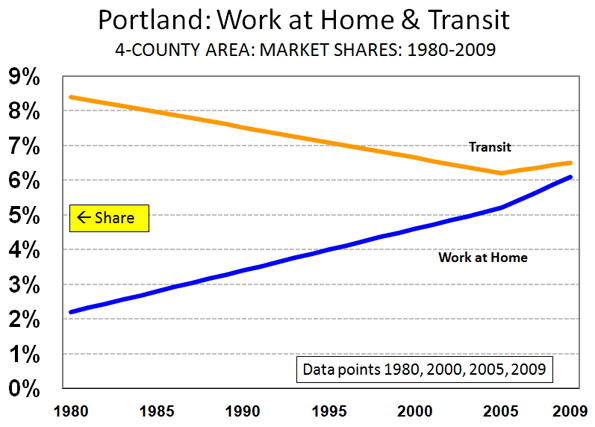
    While taxpayer funded transit was attracting less than its share of new commuters out of cars, one mode –unsupported by public funds – was doing very well. Between 1980 and 2009, working at home rose from 2.2% of employment to 6.2%. in the four county area (including Clark County). Thus, nearly as many people worked at home as rode transit to work in 2009 (Note). Already, working at home accounts for a larger share of employment than transit in the larger 7 county metropolitan area. All of this is despite Portland’s having spent an extra $5 billion on transit in the last 25 years on light rail expansions and more bus service. (Figure 2).

    Why is the Three County Area Doing Less Well? Why have Portland’s policies that are designed to help the core failed to draw jobs and people? People who move to the Portland area from other parts of the nation are probably drawn by the lower house prices in Clark County, where less stringent land use regulation has kept houses more affordable. New housing in Clark County is also built on average sized lots, rather than the much smaller lots that have been required by Metro’s land use policies. House prices are also lower in the exurban counties outside Metro’s jurisdiction.

    As Metro has forced urban densities up in the three county area and failed to provide sufficient new roadway capacity, traffic congestion has become much worse. A long segment of Interstate 5 in north Portland seems in a perpetual peak hour gridlock unusual for a medium sized metropolitan area, which is obvious from Google traffic maps that show average conditions by time and day of week. Even more unusual is the gridlock on a long stretch of the US-26 Sunset Highway that serves the suburban Silicon Forest of Washington County. A long overdue expansion will soon provide some relief on US-26. However transportation officials seem in no hurry to provide the additional capacity necessary to reduce both greenhouse gas emissions and excessive travel delays on Interstate 5 in north Portland. People who move to Clark or the exurban counties can avoid these bottlenecks by working closer to home or even in the periphery of the three county area.

    Portland has important competitive advantages, such as a temperate climate and marvelous scenery. It also helps to be close to hyper- uncompetitive California, which keeps exporting households to neighboring states. But a higher cost of living driven by policies that have kept prices 40% higher than before the housing bubble (adjusted for household incomes), and increasing traffic congestion make Portland’s three county area less competitive and nearby alternatives more attractive.

    This is not surprising. More intense regulation deters business attraction and expansion. An economic study by Raven Saks of the Federal Reserve Board concluded that … metropolitan areas with stringent development regulations generate less employment growth. At least part of the reason the Metro region’s diminished competitiveness lies with a failed strategy that appears to be having the exact opposite effect to what has been advertised – and widely celebrated – among planners from coast to coast.

    Note: 1980 three county data not available on-line.

    Wendell Cox is a Visiting Professor, Conservatoire National des Arts et Metiers, Paris and the author of “War on the Dream: How Anti-Sprawl Policy Threatens the Quality of Life

    Photograph: South Waterfront Condominiums, Portland. Photo by author

  • California’s New Grassroots Movement: High-Speed Rail on the Peninsula

    In 2008, California voters approved Proposition 1A to allocate $9.95 billion of the state’s money to a high-speed rail system. Just two years later, many of these same voters are yelling and screaming at the High-Speed Rail Authority to revise their plans. Why have Californians turned against this project so quickly?

    Initially High Speed Rail seemed like a wise investment. The California High-Speed Rail Authority posts a video on its website of President Obama outlining the benefits of high-speed rail systems. However, by now this video seems a bit dated. In this April 2009 speech, Obama claims that not only would high-speed reduce travel time and emissions, but it would also decrease gridlock and save or create 150,000 jobs. It would be faster, cheaper, and easier. As if that were not enough to convince you, he goes on to say that the project is “on schedule and under budget.”

    Yet today, the California’s high-speed rail system has stalled. Citizens and state officials alike have lost faith in the rail authority to competently plan, fund, and build a rail line from San Francisco to Los Angeles. The project’s developers continue to scramble to secure funding.

    Not surprisingly, the cost of HSR in California has soared well above initial projections. Estimated costs for the first phase alone have risen from $30.7 billion in 2008 to $42.6 billion, adding over $10 billion to the original total of $45 billion. This is a problem. Though it received $9.95 billion in bonds through Proposition 1A, the California Rail Authority still must depend heavily on private business to foot a significant, and likely growing, portion of the bill. California treasurer Bill Lockyer has doubts that the rail authority will be able to sell the deal – due in part to a lack of consistent estimates in ridership or cost – to either potential bond-buyers or California consumers.

    Perhaps an even more serious problem has been caused by the hastiness with which California’s HSR is being developed. There often has been little consideration for local public opinion.

    A case in point lies on the Peninsula just south of San Francisco. The rail authority is hurrying to build on the Peninsula so that it can qualify for federal funding. But they have run into a flurry of complaints from city governments and citizens. Though it initially proposed building a trench system, essentially a shallow box for the train that would be covered at street crossings, it backed off on the idea in an August 6 application for federal monetary support. Instead, the Authority plans to run the line mainly on aerial structures to save money for later construction. “If the trench solution is selected,” it claims, “then less infrastructure could be implemented.” Since then it has switched to erecting aerial structures in Burlingame as well.

    Many cities along the Peninsula have rebelled over these abrupt adjustments. One of the primary arguments for high-speed rail has been to help the environment, but qualms about aerial structures are also rooted in environmental concerns. Menlo Park, Atherton, and later Palo Alto filed a lawsuit against the rail authority in 2008 in a partnership with four environmental groups, complaining that the authority did not conduct a thorough environmental review of the trench system before scrapping the idea. Judges in Sacramento are currently reviewing the authority’s plan to use the southern Pacheco Pass entrance from Merced, which the plaintiffs claim is less ecologically friendly. Decisions like these do not fit with California state environmental laws that require agencies to study several alternatives before approving a project.

    This lawsuit only made minor gains in addressing the cities’ complaints. While a Sacramento judge required the rail authority to make some concessions in the 2009 ruling, it sided with them on most of the issues, mainly because the state’s responsibility in this project remains unclear. However, recent developments over aerial structures have stimulated a tsunami of lawsuit threats. In one editorial, Martin Engel, a transportation commissioner for Menlo Park and opponent of California’s high-speed rail, rallies the Bay Area using a mob mentality: “Those towns that have refused to join the PCC out of fear of Atherton, Menlo Park and Palo Alto’s penchant for lawsuits, now have to re-assess their reluctance. Lawsuits are the only genuine legal negotiating tools at our disposal.”

    But, in reality, lawsuits are not the only weapons in the Peninsula’s arsenal. Democratic Assemblyman Jerry Hill of San Mateo has threatened to put high-speed rail back on the ballot if costs start to surpass initial estimates. This puts enormous pressure on the California Rail Authority since every day delayed means a rise in costs. If it does not secure the support of Peninsula cities soon, these extra expenses will push costs over the estimate and push the project back to the voters.

    San Mateo and Burlingame, though not involved in Atherton and Menlo Park’s original lawsuit, have just as much cause to complain. Almost one-third of the track crossings on the Peninsula would be in both cities. Building will certainly disrupt the businesses in the cities’ respective downtowns, many of which have flourished with locally owned boutiques and restaurants. Burlingame, “The City of Trees,” prides itself on the natural beauty of its neighborhoods. Cement walls carrying clamorous trains will undoubtedly disrupt this bucolic reality. If high-speed rail is put back on the ballot, it is likely that these cities will vote it down.

    Communities, not just city governments, are coming together to stop high-speed rail. The Community Coalition on High Speed Rail in Palo Alto, for example, is holding a presentation about the rail authority’s use of eminent domain in this project. The proposed elevated rail structure would displace residents, some permanently, and would lower the value of surrounding homes because of the elevated noise and traffic. The Coalition has been very active throughout the summer and will continue to fight for Peninsula residents.

    The already dire situation with Caltrain, the Peninsula’s current rail system, should provide a warning for city officials about the viability of high-speed rail. It has cut costs recently because of decreased ridership, which now averages 2,000 fewer riders per weekday compared to 2009, a 5% drop. Train stops have already been eliminated from Tamien in San Jose down to Gilroy. Caltrain’s experience has hardly shown the viability of expanded rail service.

    To some, high-speed rail epitomizes a new era of California infrastructure innovation. Yet a less sanguine reality is seeping in. Project costs continue to rise even as ridership estimates decline. The resulting increase in ticket prices creates even less of an incentive to choose rail over air travel. Even worse, the California Rail Authority is beginning to alienate potential riders from the Peninsula down to Los Angeles, many of whom could conceive of more useful ways to employ the state’s slender resources.

    Kirsten Moore is an undergraduate student at Chapman University and native of the Bay Area. She is a double major in history and screenwriting, focusing primarily on US social history.

    Photo of high speed rail station groundbreaking by mayorgavinnewsom

  • The New World Order

    Tribal ties—race, ethnicity, and religion—are becoming more important than borders.

    For centuries we have used maps to delineate borders that have been defined by politics. But it may be time to chuck many of our notions about how humanity organizes itself. Across the world a resurgence of tribal ties is creating more complex global alliances. Where once diplomacy defined borders, now history, race, ethnicity, religion, and culture are dividing humanity into dynamic new groupings.

    Broad concepts—green, socialist, or market-capitalist ideology—may animate cosmopolitan elites, but they generally do not motivate most people. Instead, the “tribe” is valued far more than any universal ideology. As the great Arab historian Ibn Khaldun observed: “Only Tribes held together by a group feeling can survive in a desert.”

    Although tribal connections are as old as history, political upheaval and globalization are magnifying their impact. The world’s new contours began to emerge with the end of the Cold War. Maps designating separate blocs aligned to the United States or the Soviet Union were suddenly irrelevant. More recently, the notion of a united Third World has been supplanted by the rise of China and India. And newer concepts like the BRIC nations (Brazil, Russia, India, and China) are undermined by the fact that these countries have vastly different histories and cultures.

    The borders of this new world will remain protean, subject to change over time. Some places do not fit easily into wide categories—take that peculiar place called France—so we’ve defined them as Stand-Alones. And there are the successors to the great city-states of the Renaissance—places like London and Singapore. What unites them all are ties defined by affinity, not geography.

    1. New Hansa

    Denmark, Finland, Germany, Netherlands, Norway, Sweden

    In the 13th century, an alliance of Northern European towns called the Hanseatic League created what historian Fernand Braudel called a “common civilization created by trading.” Today’s expanded list of Hansa states share Germanic cultural roots, and they have found their niche by selling high-value goods to developed nations, as well as to burgeoning markets in Russia, China, and India. Widely admired for their generous welfare systems, most of these countries have liberalized their economies in recent years. They account for six of the top eight countries on the Legatum Prosperity Index and boast some of the world’s highest savings rates (25 percent or more), as well as impressive levels of employment, education, and technological innovation.

    2. The Border Areas

    Belgium, Czech Republic, Estonia, Hungary, Iceland, Ireland, Latvia, Lithuania, Poland, Romania, Slovakia, U.K.

    These countries are seeking to find their place in the new tribal world. Many of them, including Romania and Belgium, are a cultural mishmash. They can be volatile; Ireland has gone from being a “Celtic tiger” to a financial basket case. In the past, these states were often overrun by the armies of powerful neighbors; in the future, they may be fighting for their autonomy against competing zones of influence.

    3. Olive Republics

    Bulgaria, Croatia, Greece, Italy, Kosovo, Macedonia, Montenegro, Portugal, Slovenia, Spain

    With roots in Greek and Roman antiquity, these lands of olives and wine lag behind their Nordic counterparts in virtually every category: poverty rates are almost twice as high, labor participation is 10 to 20 percent lower. Almost all the Olive Republics—led by Greece, Spain, and Portugal—have huge government debt compared with most Hansa countries. They also have among the lowest birthrates: Italy is vying with Japan to be the country with the world’s oldest population.

    4. City-States

    London

    It’s a center for finance and media, but London may be best understood as a world-class city in a second-rate country.

    Paris

    Accounts for nearly 25 percent of France’s GDP and is home to many of its global companies. It’s not as important as London, but there will always be a market for this most beautiful of cities.

    Singapore

    In a world increasingly shaped by Asia, its location between the Pacific and Indian oceans may be the best on the planet. With one of the world’s great ports, and high levels of income and education, it is a great urban success story.

    Tel Aviv

    While much of nationalist-religious Israel is a heavily guarded borderland, Tel Aviv is a secular city with a burgeoning economy. It accounts for the majority of Israel’s high-tech exports; its per capita income is estimated to be 50 percent above the national average, and four of Israel’s nine billionaires live in the city or its suburbs.

    5. North American Alliance

    Canada, United States

    These two countries are joined at the hip in terms of their economies, demographics, and culture, with each easily being the other’s largest trade partner. Many pundits see this vast region in the grip of inexorable decline. They’re wrong, at least for now. North America boasts many world-class cities, led by New York; the world’s largest high-tech economy; the most agricultural production; and four times as much fresh water per capita as either Europe or Asia.

    6. Liberalistas

    Chile, Colombia, Costa Rica, Mexico, Peru

    These countries are the standard–bearers of democracy and capitalism in Latin America. Still suffering low household income and high poverty rates, they are trying to join the ranks of the fast-growing economies, such as China’s. But the notion of breaking with the U.S.—the traditionally dominant economic force in the region—would seem improbable for some of them, notably Mexico, with its close geographic and ethnic ties. Yet the future of these economies is uncertain; will they become more state–oriented or pursue economic liberalism?

    7. Bolivarian Republics

    Argentina, Bolivia, Cuba, Ecuador, Nicaragua, Venezuela

    Led by Venezuela’s Hugo Chávez, large parts of Latin America are swinging back toward dictatorship and following the pattern of Peronism, with its historical antipathy toward America and capitalism. The Chávez-influenced states are largely poor; the percentage of people living in poverty is more than 60 percent in Bolivia. With their anti-gringo mindset, mineral wealth, and energy reserves, they are tempting targets for rising powers like China and Russia.

    8. Stand-Alones

    Brazil

    South America’s largest economy, Brazil straddles the ground between the Bolivarians and the liberal republics of the region. Its resources, including offshore oil, and industrial prowess make it a second-tier superpower (after North America, Greater India, and the Middle Kingdom). But huge social problems, notably crime and poverty, fester. Brazil recently has edged away from its embrace of North America and sought out new allies, notably China and Iran.

    France

    France remains an advanced, cultured place that tries to resist Anglo-American culture and the shrinking relevance of the EU. No longer a great power, it is more consequential than an Olive Republic but not as strong as the Hansa.

    Greater India

    India has one of the world’s fastest-growing economies, but its household income remains roughly a third less than that of China. At least a quarter of its 1.3 billion people live in poverty, and its growing megacities, notably Mumbai and Kolkata, are home to some of the world’s largest slums. But it’s also forging ahead in everything from auto manufacturing to software production.

    Japan

    With its financial resources and engineering savvy, Japan remains a world power. But it has been replaced by China as the world’s No. 2 economy. In part because of its resistance to immigration, by 2050 upwards of 35 percent of the population could be over 60. At the same time, its technological edge is being eroded by South Korea, China, India, and the U.S.

    South Korea

    South Korea has become a true technological power. Forty years ago its per capita income was roughly comparable to that of Ghana; today it is 15 times larger, and Korean median household income is roughly the same as Japan’s. It has bounced back brilliantly from the global recession but must be careful to avoid being sucked into the engines of an expanding China.

    Switzerland

    It’s essentially a city-state connected to the world not by sea lanes but by wire transfers and airplanes. It enjoys prosperity, ample water supplies, and an excellent business climate.

    9. Russian Empire

    Armenia, Belarus, Moldova, Russian Federation, Ukraine

    Russia has enormous natural resources, considerable scientific-technological capacity, and a powerful military. As China waxes, Russia is trying to assert itself in Ukraine, Georgia, and Central Asia. Like the old tsarist version, the new Russian empire relies on the strong ties of the Russian Slavic identity, an ethnic group that accounts for roughly four fifths of its 140 million people. It is a middling country in terms of household income—roughly half of Italy’s—and also faces a rapidly aging population.

    10. The Wild East

    Afghanistan, Azerbaijan, Kazakhstan, Kyrgyzstan, Pakistan, Tajikistan

    This part of the world will remain a center of contention between competing regions, including China, India, Turkey, Russia, and North America.

    11. Iranistan

    Bahrain, Gaza Strip, Iran, Iraq, Lebanon, Syria

    With oil reserves, relatively high levels of education, and an economy roughly the size of Turkey’s, Iran should be a rising superpower. But its full influence has been curbed by its extremist ideology, which conflicts not only with Western countries but also with Greater Arabia. A poorly managed economy has turned the region into a net importer of consumer goods, high-tech equipment, food, and even refined petroleum.

    12. Greater Arabia

    Egypt, Jordan, Kuwait, Palestinian Territories, Saudi Arabia, United Arab Emirates, Yemen

    This region’s oil resources make it a key political and financial player. But there’s a huge gap between the Persian Gulf states like Saudi Arabia and the United Arab Emirates and the more impoverished states. Abu Dhabi has a per capita income of roughly $40,000, while Yemen suffers along with as little as 5 percent of that number. A powerful cultural bond—religion and race—ties this area together but makes relations with the rest of the world problematic.

    13. The New Ottomans

    Turkey, Turkmenistan, Uzbekistan

    Turkey epitomizes the current reversion to tribe, focusing less on Europe than on its eastern front. Although ties to the EU remain its economic linchpin, the country has shifted economic and foreign policy toward its old Ottoman holdings in the Mideast and ethnic brethren in Central Asia. Trade with both Russia and China is also on the rise.

    14. South African Empire

    Botswana, Lesotho, Namibia, South Africa, Swaziland, Zimbabwe

    South Africa’s economy is by far the largest and most diversified in Africa. It has good infrastructure, mineral resources, fertile land, and a strong industrial base. Per capita income of $10,000 makes it relatively wealthy by African standards. It has strong cultural ties with its neighbors, Lesotho, Botswana, and Namibia, which are also primarily Christian.

    15. Sub-Saharan Africa

    Angola, Cameroon, Central African Republic, Congo-Kinshasa, Ethiopia, Ghana, Kenya, Liberia, Malawi, Mali, Mozambique, Nigeria, Senegal, Sierra Leone, Sudan, Tanzania, Togo, Uganda, Zambia

    Mostly former British or French colonies, these countries are divided between Muslim and Christian, French and English speakers, and lack cultural cohesion. A combination of natural resources and poverty rates of 70 or 80 percent all but assure that cash-rich players like China, India, and North America will seek to exploit the region.

    16. Maghrebian Belt

    Algeria, Libya, Mauritania, Morocco, Tunisia

    In this region, spanning the African coast of the Mediterranean, there are glimmers of progress in relatively affluent countries like Libya and Tunisia. But they sit amid great concentrations of poverty.

    17. Middle Kingdom

    China, Hong Kong, Taiwan

    China may not, as the IMF recently predicted, pass the U.S. in GDP within a decade or so, but it’s undoubtedly the world’s emerging superpower. Its ethnic solidarity and sense of historical superiority remain remarkable. Han Chinese account for more than 90 percent of the population and constitute the world’s single largest racial-cultural group. This national cultural cohesion, many foreign companies are learning, makes penetrating this huge market even more difficult. China’s growing need for resources can be seen in its economic expansion in Africa, the Bolivarian Republics, and the Wild East. Its problems, however, are legion: a deeply authoritarian regime, a growing gulf between rich and poor, and environmental degradation. Its population is rapidly aging, which looms as a major problem over the next 30 years.

    18. The Rubber Belt

    Cambodia, Indonesia, Laos, Malaysia, Philippines, Thailand, Vietnam

    These countries are rich in minerals, fresh water, rubber, and a variety of foodstuffs but suffer varying degrees of political instability. All are trying to industrialize and diversify their economies. Apart from Malaysia, household incomes remain relatively low, but these states could emerge as the next high-growth region.

    19. Lucky Countries

    Australia, New Zealand

    Household incomes are similar to those in North America, although these economies are far less diversified. Immigration and a common Anglo-Saxon heritage tie them culturally to North America and the United Kingdom. But location and commodity-based economies mean China and perhaps India are likely to be dominant trading partners in the future.

    This article originally appeared in Newsweek.

    Legatum Institute provided research for this article.

    Joel Kotkin is executive editor of NewGeography.com and is a distinguished presidential fellow in urban futures at Chapman University and an adjunct fellow with the Legatum Institute in London. He is author of The City: A Global History. His newest book is The Next Hundred Million: America in 2050, released in February, 2010.

    Illustration by Bryan Christie, Newsweek

  • China Development: Go West, Young Comrade

    Deng Xiaoping, the pragmatic leader who orchestrated China’s ‘reform and opening-up’ 30 years ago, once said that “some areas must get rich before others.” Deng was alluding to his notion that, due to the country’s massive scale, economic development could not happen all at once across China. Planning and implementation of such an economy would take years, even decades, and some areas would inevitably be developed before others.

    The logical place to start was the coastal regions of China, with the natural advantage of access to Asian and overseas markets via the South China Sea and Pacific Ocean. Not surprising then that the two areas that benefited most after initial economic reforms were the Yangtze River Delta region in the east and Pearl River Delta region in the south. Both places became international manufacturing centers with numerous factories and busy seaports.

    Today, the prosperity of the Yangtze River Delta can be experienced in Shanghai, ‘the Pearl of the Orient’- undoubtedly China’s most modern and cosmopolitan city. Down south in the Pearl River Delta, the city of Shenzhen, chosen by the Central Government as a ‘Special Economic Zone’ in 1980, transformed from a small fishing village to a bustling metropolis of nearly 10 million people in a mere 30 years. Both places best represent China’s economic achievements of the recent past.

    Although China’s coastal regions continue to develop, the initial boom has already slowed. Furthermore, foreign investors are beginning to grow weary by the increasing costs of doing business in cities like Shanghai and Shenzhen. Now both international and domestic businesses have their eyes looking towards the interior of the country, where overhead costs are lower and the cities are building the necessary infrastructure to support growth.

    China’s vast western region will be perhaps the most exciting economic development story of the next decade. The country’s west includes 6 provinces, 5 autonomous regions and 1 municipality. Overall the entire region comprises a whopping 70% of China’s landmass and 28% of its population. It also currently accounts for 17% of the country’s GDP, but that is set to change for the better.

    In 2001, the Chinese government implemented its Western Development Strategy also known as the ‘Go West’ campaign. The lagging economic progress of the region prompted the Central Government to offer incentives for business development, including a 10% corporate income tax reduction. The plan also calls for massive infrastructure development both in urban and rural areas.

    Nearly 10 years after the beginning Western Development Strategy, the positive effects are evident in the region’s largest cities. The key cities that have benefitted most so far are Xi’an (capital of Shaanxi Province), Chengdu (capital of Sichuan Province), Kunming (capital of Yunnan Province) and Chongqing (a direct-controlled municipality). These cities form a tight bond, and despite each being within a less than 2 hour flight from one another, each is unique in character and culture.

    At the center of this prosperity is the Chengdu-Chongqing Megaregion. About 200 miles apart from each other, the two cities form a combined urban population of about 10 million people. Chengdu and Chongqing are the principal economic, government, and cultural centers that serve a regional population of nearly 110 million (the combined population of Sichuan Province and Chongqing Municipality). Given these demographics, the potential for growth in these two cities is enormous.

    In the past, like the ambitious living in our own heartland, those from China’s interior were forced to leave home for the far-off coastal regions to benefit from the country’s economic growth. Migrant workers from Sichuan had it especially difficult, facing employment discrimination due to their strong local accent (seen as low-class by the eastern cosmopolitans) and the misperception that they are lazy workers. Today, the rise of Chengdu-Chongqing Megaregion means that workers from Sichuan need not go far from home in order to find opportunity. This is a considerable departure from China’s migrant worker narrative of the past 30 years.

    Increasingly what you see today is a reversal of past emigration trends, as not only young people from the Chengdu-Chongqing Megaregion opt to stay close to home but people from other regions relocate to the interior to take advantage of the growth.

    There is a bit of a rivalry between the cities of Chengdu and Chongqing, with much talk about which of the two will become western China’s most important city. In reality they are more like ‘sisters’ as both cities stand to benefit. As my American friend who lived in the area for over 10 years described the relationship, “Chengdu is the fat provincial nobleman to Chongqing’s beer and hot pot steel worker.”

    In the case of Chongqing, he is referring to the importance of the city as an industrial center, both in metal manufacturing and natural resource mining (the surrounding area is rich in coal and natural gas). In contrast, Chengdu is quickly becoming a major player in China’s information technology sector.

    Much of this has to do with Chengdu’s advantageous geography. Whereas the surrounding terrain in Sichuan and Chongqing is mountainous and hilly, Chengdu lies in a flat, fertile basin, allowing the city to sprawl out. Dubbed the ‘Land of Abundance’ for its long history of agricultural prosperity, Chengdu is today abounding in domestic and foreign investment in high-tech.

    The local government has set up the ‘Chengdu Hi-Tech Industrial Development Zone (CDHT)’ with 2 locations: the South Park and the West Park. Both areas lie outside the historical city center and are being built on previously undeveloped land. The character of the CDHT is not the dense urban forest of supertall skyscrapers that characterizes other Chinese cities. Rather, a series of modern low-rise office parks can be seen popping up in the CDHT, not dissimilar from what can be found close to where I grew up in Silicon Valley.

    Already, international IT behemoths like Intel have established operations in the CDHT, having opened semiconductor assembly and testing facilities. Other American companies look to expand in the CDHT. Just a few days ago Dell Computer announced it would open an operations center in Chengdu, creating 3,000 new jobs. Cisco Systems has also been involved in Chengdu, collaborating with local institutions like the University of Electronic Science and Technology of China in research and development.

    Chengdu attracts foreign investment not only because of its lower cost-value compared to other cities in China but because of its efficient infrastructure and logistics. Chengdu’s Shuangliu Airport is national airline Air China’s third major traffic hub after Beijing and Shanghai. The city is also undergoing the construction of a comprehensive subway system with the first line scheduled to open in on October 1st. This line, Line 1, will connect the historic center of the city with the South Park area of the CDHT- making commuting for IT workers who live in the city more reasonable.

    Most interestingly, Chengdu is also promoting quality of life when courting business investment. The local government has established what is called a ‘Modern Garden City’ to keep in line with the city’s history as an agricultural base. The sense of the past is strong with locals, and Chengdu is doing everything to preserve this despite the development.

    If Deng Xiaoping were still alive today, he would probably be proud to see Sichuan flourishing- after all it is the patient pragmatist’s native region.

    Adam Nathaniel Mayer is an American architectural design professional currently living in China. In addition to his job designing buildings he writes the China Urban Development Blog.

    Photo by Toby Simkin

  • California’s Failed Statesmen

    The good news? Like most rock or movie stars, there’s nothing fundamentally wrong with California. It’s still talented, and retains great physical gifts. Our climate, fertility and location remain without parallel. The state remains pre-eminent in a host of critical fields from agriculture to technology, entertainment to Pacific Rim trade.

    California can come back only if it takes a 12-step program to jettison its delusions. This requires, perhaps more than anything, a return to adult supervision. Most legislators, in both parties, appear to be hacks, ideologues and time-servers. This time, when the danger is even greater, we see no such sense of urgency. Instead we have a government that reminds one more of the brutally childish anarchy of William Golding’s 1954 novel “Lord of the Flies.”

    Arnold Schwarzenegger has not turned out to be that supervision. Rather than the “post-partisan” leader hailed by the East Coast press, he has proven to be the political equivalent of the multi-personality Sybil. One day he’s a tough pro-business fiscal conservative; next he’s the Jolly Green Giant who seems determined to push the green agenda to a point of making California ever more uncompetitive.

    Contrast this pathetic performance with what happened after our last giant recession in the early 1990s. At that time, a bipartisan coalition of leaders – Speaker Willie Brown, State Senator John Vasconcellos and Governor Pete Wilson – worked together to address what was perceived as a deep economic crisis. They addressed some key problems and brought the state back from the brink. California recovered smartly between the mid-90s and the new millennium.

    Overall though, things are worse now. California has been flirting for the past year with its highest unemployment rate since the Great Depression. The last time we could blame the end of the Cold War for much of our economic distress; now the problem is a more broadly based, largely self-inflicted secular decline.

    A bloated government is part of the problem: Between 2003 and 2007, California state and local government spending grew 31 percent, even as the state’s population grew just 5 percent. The overall tax burden as a percentage of state income, once middling among the 50 states, has risen to the sixth-highest in the nation, says the Tax Foundation. Even worse, the state is getting ever less benefit from these revenues; since the Pat Brown era the percentage of budget spent on basic infrastructure has dropped from 20 to barely 5 percent.

    Although these taxes are often portrayed as “progressive,” California has continued to become more socially bifurcated. Our ranks of middle-wage earners are dropping faster than the national average even as the numbers of the affluent and poor swell. Overall California’s per capita income, roughly 20 percent above the national average in 1980, now barely stays with the national average. When housing and other costs are factored in, Los Angeles, San Francisco and Fresno rank among the top five major urban areas in America in terms of percentage of people in poverty, according researcher Deborah Reed of the Public Policy Institute of California. Only New York and Washington, D.C. do worse.

    At the root of these problems is an increasing lack of economic competitiveness. An analysis of the economy made for the Manhattan Institute shows California losing its edge in everything from migration, income, jobs and in entertainment industry employment. Tech companies may cluster in Silicon Valley but many are sending their new jobs abroad or to other sites. Recently, several leading Bay Area firms – Twitter, Adobe, eBay, Oracle and Adobe – have established major new operations in the Salt Lake area alone.

    So how do we turn it around? First, let’s find some adults, like former Speaker Robert Hertzberg or GOP financer Gerald Parsky, who know what it is to run a business and comprehend that the economy actually matters, and get them to head up a commission on the economy. Second, our leaders and policy elites must engage the emerging new business leadership of the state, which is increasingly immigrant, Asian and Latino.

    Right now neither party seems focused on the state’s future besides enriching their core constituencies. Lower taxes – the favored strategy of the right – on the already wealthy reflects an understandable desire to preserve one’s asset but is insufficient as a strategy.

    Democrats meanwhile seem determined to defend public sector pensions, Draconian labor, the high-speed rail boondoggle and environmental regulations, no matter what the cost to the economy.

    However contradictory their sound bites, the established parties are each following a script that would assure the next generation of Californians – largely Latino – remain an underclass that will have to move elsewhere to reach their aspirations. The left would do it by killing jobs in such fields as agriculture, manufacturing, construction and warehousing. As Robert Eyler, chairman of the economics department Sonoma State puts it, “the progressives have become the regressives.”

    For their part the GOP would kill the new California by starving it. They have no plan to bolster the basic services – like community colleges, roads, water and power systems – that will allow future working-class Californians to thrive.

    Their interests ignored by the parties, the immigrants and their offspring still represent the very key source of demographic energy and entrepreneurship that can revitalize the state. If you still want to see hopeful stirrings in California, go to places like Plaza Mexico in Lynwood or the new Irvine center recently built by the Diamond Development Group. Appealing to young families and distinct tastes, these retail facilities have thrived as the rest of the state’s overall retail economy has declined.

    More important still are the companies started by immigrant entrepreneurs like John Tu, CEO of Kingston Technology or scores of smaller Asian-owned firms in places like the San Gabriel Valley. Since the 1990s, newcomers have launched roughly one in four Silicon Valley startups.

    Add to this the muscle of the emerging Latino economy, led by food processing companies like the Cardenas Brothers, who now provide Costco with its frozen Mexican food.

    Due to their strong family and cultural ties in California, such ethnic firms appear less likely to move than more Anglo-dominated companies. But if the state keeps eroding public services and adding new regulations, these firms – like their counterparts in Silicon Valley and elsewhere – will place most of their new jobs as well in Utah, Texas or overseas.

    What we have here, in the end, is a massive disconnect between economics and politics. Does anyone in Sacramento talk to or even know about the largely Middle Eastern-led L.A. fashion industry? Is anyone talking to the hip sportswear mavens of Orange County’s own “Velcro valley”? Or what about agriculture, our traditional ace in the hole, which is largely disdained by the state’s intellectual and media class who see in large farms the work of the corporate devil?

    Somehow these productive voices – essential to our comeback – must be placed at the center of the debate. Sacramento’s leaders need to talk not just to lobbyists but to the key job-creators.

    These are the people who, even in hard times, are showing how we can grow an economy based on our natural advantages of climate, ethnic diversity, entrepreneurship and location.

    Ultimately we must make the creation of new jobs a priority that goes beyond formulaic mantras about lower taxes or illusory, state-supported “green jobs.” With a return to growth, California can still address its basic problems and challenges. But first we must corral the ideological hobbyhorses now running wild through Sacramento and make the needs of job-creators the central issue for our policy-makers.

    This article originally appeared in the Orange County Register.

    Joel Kotkin is executive editor of NewGeography.com and is a distinguished presidential fellow in urban futures at Chapman University. He is author of The City: A Global History. His newest book is The Next Hundred Million: America in 2050, released in February, 2010.

    Photo by Nate Mandos

  • Latino Dems Should Rethink Loyalty

    Given the awful state of the economy, it’s no surprise that Democrats are losing some support among Latinos. But they can still consider the ethnic group to be in their pocket. Though Latinos have not displayed the lock-step party loyalty of African-Americans, they still favor President Barack Obama by 57 percent, according to one Gallup Poll — down just 10 percentage points from his high number early in the administration.

    This support is particularly unusual, given that probably no large ethnic group in America has suffered more than Latinos from the Great Recession. This is true, in large part, because Latino employment is heavily concentrated in manufacturing, and even more so in construction.

    A half-million Latino workers in the construction sector — in which their share of the work force is double what it is in the broader economy — have lost their jobs since the start of the recession.

    Unfortunately, the Obama stimulus plan was light on physical infrastructure. It favored Wall Street, public-sector unions and large research universities. Big winners included education and health services — in which Latinos are under-represented.

    Not surprisingly, Latino communities across the country are in trouble. Today, of the 10 most economically “stressed” counties, seven are majority or heavily Latino, according to The Associated Press.

    Theoretically, Republicans should be able to take advantage of this situation. But not with the party’s increasing embrace of its noisy nativist right — evident not only in support of the controversial Arizona immigration law but also in the strong move against “birthright citizenship.” This makes the prospect of earning back President George W. Bush’s 40-plus-percentage-point support difficult at best.

    Thus, Latinos remain allied with Democrats whose policies inhibit the growth of construction and manufacturing jobs. This dichotomy puzzles many in the business community.

    “You have all these job losses in Latino districts represented by Latino legislators who don’t realize what they are doing to their own people,” said Larry Kosmont, a California business consultant. “They have forgotten there’s an economy to think about.”

    Despite that economic logic, Latino Democrats mindlessly follow liberal Democrats such as House Speaker Nancy Pelosi and Rep. Henry Waxman of California and Sen. John Kerry of Massachusetts, who represent largely white, affluent white-collar constituencies on issues such as cap and trade and federal regulation of greenhouse gases. Whatever the intent, these policies are likely to further decimate blue-collar employment in Latino districts.

    If they had independent thoughts, Latino Democratic politicians would be advocating positions that create new opportunities for their districts — particularly among young people. They could push, for example, a Works Progress Administration-like public works program that could provide new opportunities and skills training.

    One possible reason for not doing so is the opposition of public employee unions, which dominate Democratic politics, particularly in urban districts, and would see such a program as competing against their special interests.

    In contrast, Obama administration policies favor Ivy League schools, high-speed rail and light-rail service — issues with predominantly well-to-do, Anglo constituencies.

    This disjunction between interests and politics is particularly evident in California, the state with the largest Latino population. Latino Democrats have generally embraced the state’s draconian environmental and planning policies.

    The state’s fertile Central Valley offers one example. A green-inspired diversion of water from farms to save an obscure species of fish has forced more than 450,000 acres to lie fallow. Thousands of agricultural jobs — held mostly by Latinos — have been lost, perhaps permanently. Unemployment, which stands at 17 percent across the valley, reaches upward of 40 percent in towns like Mendota.

    These policy positions speak to the limits of the current Latino leadership. Latino political power has waxed in Sacramento since 1999 — the state Assembly has had three Latino speakers. But on the ground, things have waned for the state’s Latino working class. During the past decade, according to research from California Lutheran University, the state has experienced one of the nation’s most dramatic drops in household earnings — between $35,000 and $75,000 in lost income.

    The pain at the bottom of the economic ladder is even greater. Indeed, according to Deborah Reed of the left-leaning Public Policy Institute of California, when housing and other costs are factored in, three heavily Latino counties — Los Angeles, Fresno and Monterey — rank among the 10 poorest metropolitan areas in the United States. Increasing numbers of working- and middle-class Latinos have been migrating to more job-friendly areas such as Texas and the Plains states.

    Latino Democratic politics are equally dysfunctional at the local level. In the largely Hispanic industrial belt south of downtown Los Angeles, for example, a sprawling Latino machine, marked by near Chicago-scale corruption, now controls most elective posts. Many of its leaders — most outrageously in the city of Bell — have proved far more adept at feathering their own nests than at reviving local economies.

    A similar disconnect can be seen in the City of Los Angeles, where corruption and inefficiency have led some local entrepreneurs to invest in other regions. “It’s extremely difficult to do business in Los Angeles,” said retail developer Jose de Jesus Legaspi. “The regulations are difficult to manage. … Everyone has to kiss the rings of the [City Hall politicians].”

    L.A. Mayor Antonio Villaraigosa epitomizes this self-defeating ethnic politics. Last year, for example, Cecilia Estolano, executive director of the Los Angeles Community Redevelopment Agency, supported shifting resources from building high-end housing and amenities downtown to rejuvenating the large industrial district, a major employer of blue-collar Latinos.

    Her efforts quickly ran afoul of Villaraigosa, whose staff favors pouring more money into downtown amenities — even if doing so drives out industrial jobs. Estolano, who now works for a local nonprofit, says the lack of interest in manufacturing and the blue-collar economy is easy to explain: campaign contributions.

    “The problem is manufacturers in L.A. are mostly small and don’t contribute to campaigns,” Estolano said. “L.A.’s politics are controlled by real estate interests, their lawyers and consultants.”

    As Latinos become a critical part of our emerging economy, they need to develop a policy agenda that focuses less on old-style, machine ethnic politics and more on the critical issue of upward mobility.

    Latino voters might also consider avoiding the African-American one-party model by embracing both growth-oriented Democrats and enlightened Republicans. This is most likely to increase their political leverage, while creating a politics that supports their most fundamental interests.

    This article originally appeared at Politico.

    Joel Kotkin is executive editor of NewGeography.com and is a distinguished presidential fellow in urban futures at Chapman University. He is author of The City: A Global History. His newest book is The Next Hundred Million: America in 2050, released in February, 2010.

    Photo by chadlewis76

  • Why We Have to Learn to Love the Subdivision – Again

    When did anyone last hear officials and professionals talking enthusiastically about the social and economic benefits resulting from the subdivision of land to create secure, clean and tradable title?

    Indeed, any planning document is likely to include a long list of potential problems caused by the subdivision, but will mention few, if any, of the benefits. Maybe it’s time to rethink this conventional planning wisdom. In Peru, during the eighties, Hernando De Soto and the Institute for Liberty and Democracy promoted land reforms that led to more than 1.2 million rural families being given titles to the land they worked. One major grant of titles to a whole village was celebrated on television. When the reporter asked a woman “Why is having title important for your family?” she replied “Having secure title means I can now go out to work.” She went on to explain that the family’s past “customary settlement” required continual occupancy and eternal vigilance. Some member of the family had to be on the property at all times, or else someone else could move in.

    During a recent BBC television news bulletin on the floods in Pakistan, reporter Orla Guerin said “Many here are bound to their land and their livestock, and will live or die with them. We spotted one young boy, clinging to the top of an electricity pylon. He climbed down to collect a bag food aid, but refused to be removed from the waters.”

    I suspect he was also concerned with the need to help maintain his family’s right to occupy.

    City officials and urban planners in particular are always claiming that their cities are “running out of land”. Of course they are not running out of land. They are surrounded with it, as any air traveler knows, just from looking out the window.

    However, they are short of land with a certificate of title that allows the landowner to develop the property for housing or anything else. One reason for this shortage lies with the costs and often onerous conditions of compliance are simply too high. The French Revolutionaries learned that when they fixed the price of bread at less than it cost to bake a loaf, the bakers simply stopped baking bread. When it costs more to gain a title than the lot can be sold for, we should not be surprised if people stop creating lots.

    Suburban residential development creates many jobs and the residents who move continue to create new employment opportunities for decades. Every home owner becomes a property developer as they add rooms, sleepouts, new decks and swimming pools and upgrade their kitchens, and so on. I should have emphasized that it’s the land around the dwelling that enables so many of these projects to take place over the decades and to create so many jobs.

    If Smart Growth policies force people to live in apartments, their opportunities to improve their dwellings become seriously limited.

    City governments appear to overlook the economic and employment impact of rejecting large-scale developments, but the cumulative effect of a multitude of prohibitions of smaller proposals is equally serious – especially in a small economy like New Zealand or a relatively unpopulated place like Montana.

    During the nineteenth century the key function of governments in the New World was to churn out titles as quickly as possible.

    Surveyors served as the true frontiersmen, enabling the migrants to arrive, put down their roots, and build. The post-war suburban boom repeated this experience, supported by an equal enthusiasm for creating a property owning democracy.

    Then during the 1990s, “The Age of Environmentalism” arrived and activists persuaded decision-makers in the developed world that the creation of titles enabled polluting humans to possess the Earth Mother and must be stopped, or be made as difficult as possible. These constraints on land supply created the short-term property boom, and the inevitable bust that led to the greatest financial crisis in recent history.

    The developing nations and their economists continue to recognize the value of title. The works of Hernando de Soto, the Peruvian economist, emphasize that the major problem facing people in poor countries has been their lack of secure title to land, which constrains their ability to borrow significant sums of money and put down secure roots. As he says, the family with title builds a dwelling; the family that squats invests in furniture. This has led to his founding leadership of The Institute for Liberty and Democracy in Peru.

    At the recent conference of international surveyors in Sydney it was quite exhilarating to hear surveyors and officials from Peru talking of targets of 150,000 new titles per year. They knew full well that titles generate wealth. Maybe it’s time for New World cities to set similar targets and share de Soto’s enthusiasm for the contribution of subdivision to ongoing liberty and the pursuit of happiness.

    Bankers have long recognized that many families’ main means of saving is paying off their mortgage. Equally, many aging citizens fund their retirement by subdividing their large lots to create a nest egg for the future. Most university-indoctrinated central planners regard this as an “inappropriate” activity.

    Unexpected Super Large-Lot zoning in rural areas can suddenly deprive thousands of people of a secure and active retirement. Of course the planners claim the landowners are still able to subdivide, but just have to go through an approval process. Then the same planners make sure the costs and uncertainties render the exercise prohibitive. Their environmental cost benefit analysis ignores this destruction of individual wealth – and dreams.

    I wonder if any advanced developed country planning school has Hernando de Soto on its reading list?

    Instead of encouraging the creation of titles, as history suggests we should, the Smart Growth central planners have persuaded our governments to penalise the creation of new lots by imposing highly expensive and highly regressive fines called “development contributions” – which are actually anti-development levies.

    We tax cigarette smokers to discourage smoking, and we fine speedsters to discourage speeding. Should we be fining the creators of legal title if our aim is to encourage development, promote employment growth, increase savings and promote personal well-being?

    Some politicians, like Maurice Williamson, New Zealand’s Minister for Building and Construction ARE determined to reduce the costs of building consents and inspections. But these are trivial compared to the costs of subdivision and land use consents.

    And there is something of an international movement away from rule based management of development and a return towards broader concerns of society and the people who inhabit it.

    But before any legislative reforms can be effective we need to learn to once again celebrate secure, tradable, private title. This remains one of Western Civilisation’s greatest contributions to our wealth, health and general well-being.

    Owen McShane is Director of the Centre for Resource Management Studies, New Zealand.

    Photo by Brenda Anderson