Blog

  • Transit Work Access in 2016: Working at Home Gains

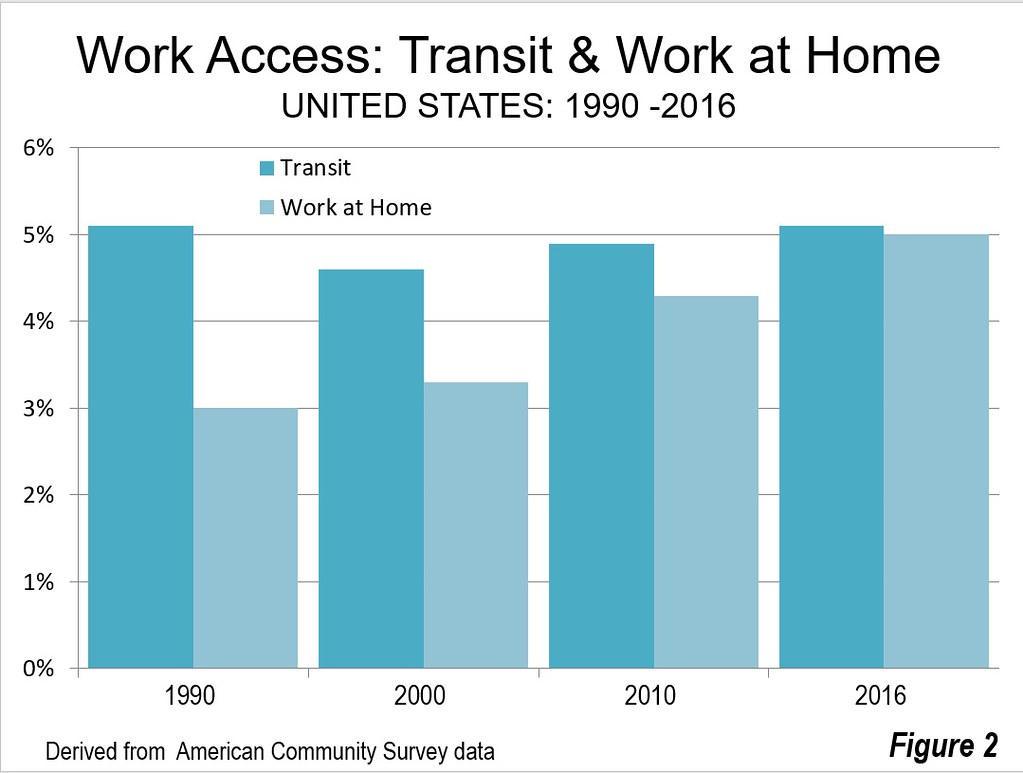
    Working at home continues to grow as a preferred access mode to work, according to the recently released American Community Survey data for 2016. The latest data shows that 5.0 percent of the nation’s work force worked from home, nearly equaling that of transit’s 5.1 percent. In 2000, working at home comprised only 3.3 percent of the workforce, meaning over the past 16 years there has been an impressive 53 percent increase (note). Transit has also done well over that period, having increased approximately 10 percent from 4.6 percent.

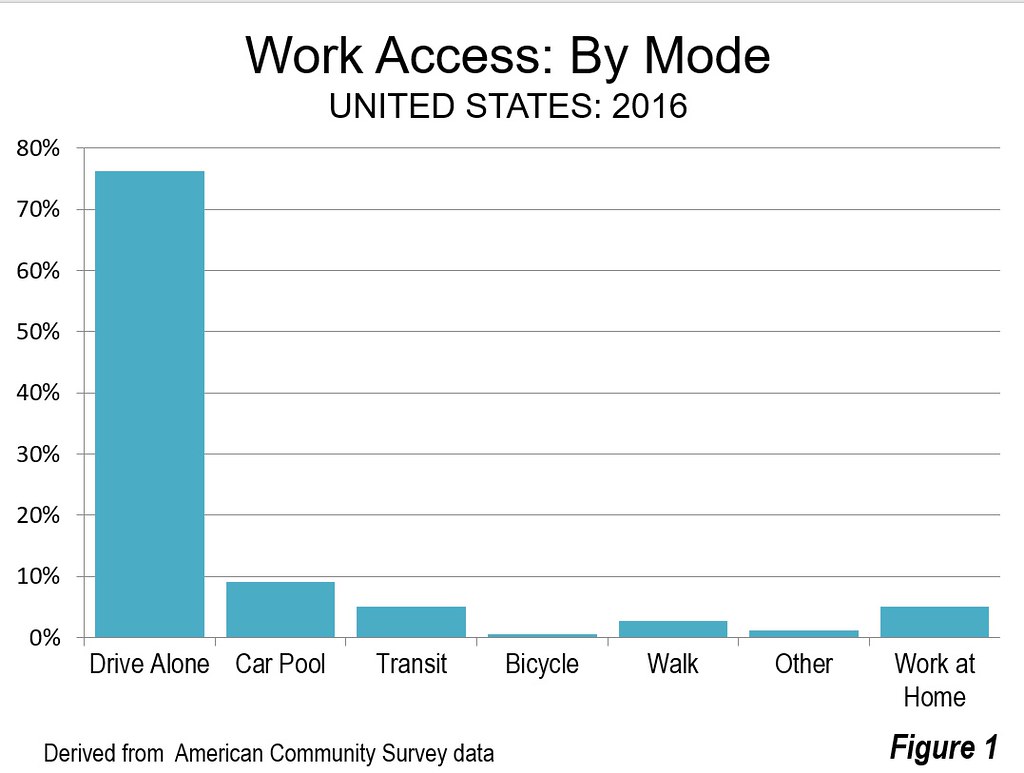
    Automobiles continue to be the “work horse” of employment access, with 76.3 percent of the market driving alone and 9.0 percent car pooling or van pooling. By comparison, driving alone was the mode of access for 75.7 percent of workers in 2000 and car pooling or van pooling accounted for 12.2 percent Walking has a 2.7 percent market share, down from 3.3 percent in 2000. On a percentage basis, bicycles, although still a comparatively tiny share, have done about as well as working at home, increasing percent, from 0.4 percent to 0.6 percent between 2000 and 2016, a 43 percent increase (Figure 1).

    The market share in the “other” category has stayed constant, at 1.2 percent in both 2000 and 2016. This category includes other modes, including motorcycles, taxicabs and the more recently popular ride hailing services. Despite some thought that Uber and Lyft have begun to attract riders from transit, the work trip data contains no evidence of it. The “other” category market share in 2016 was the same as in 2010 (Figure 1 and Figure 2).
    Transit and Work at Home Market Share

    Transit has experienced by far its best work trip trend since World War II over the past 16 tears. The 4.6 percent share in 2000 was the nadir, in a fall from 12.1 percent in 1960, the earliest work trip data available. Transit’s share has continued to grow modestly since 2010, from 4.9 to 5.1 percent, though widespread overall transit ridership declines have been reported in the last year (here and here).

    The work at home share has, in contrast, risen strongly and nearly closed the gap with transit. In 2000, transit had an approximately 1.7 million advantage on working at home. By 2016, the difference had fallen below 60,000. Now, 43 of the 53 major metropolitan areas (over 1,000,000 population) — including the second largest metropolitan area Los Angeles — have more people working at home than riding transit to work.

    Comparing Working at Home with Transit in New Rail Metropolitan Areas

    Even huge expenditures of taxes have failed to keep transit more popular with workers than working at home in many metropolitan areas. This includes metropolitan areas that have built new rail systems:

         •  Austin, Charlotte, Dallas-Fort Worth, Nashville and Phoenix where nearly four or more times      as many work at home as commute by transit.

         •  Orlando and Sacramento where about three times as many people work at home as use      transit.

         •  Atlanta, Denver, Houston and Riverside-San Bernardino, St. Louis, San Diego and Virginia      Beach-Norfolk, where about twice as many people work at home as ride transit to work.

         •  The work at home advantage over transit is smaller in Miami, Minneapolis-St. Paul, Portland,      Salt Lake City and San Jose.

         •  The same is true of Los Angeles. Despite spending more than $15 billion (2016$) building and      opening an extensive urban rail and busway system, not only has working at home recently      passed transit, but ridership on the largest transit system has fallen from before opening the      first line.

    On the other hand, rail ridership is more than double the work at home share in other metropolitan areas that have opened new rail systems since the 1970s. In San Francisco and Washington, the transit share is more than double the work at home share. In Seattle it is more than 50 percent higher, and it is also higher in Baltimore.

    Where Working at Home is the Most

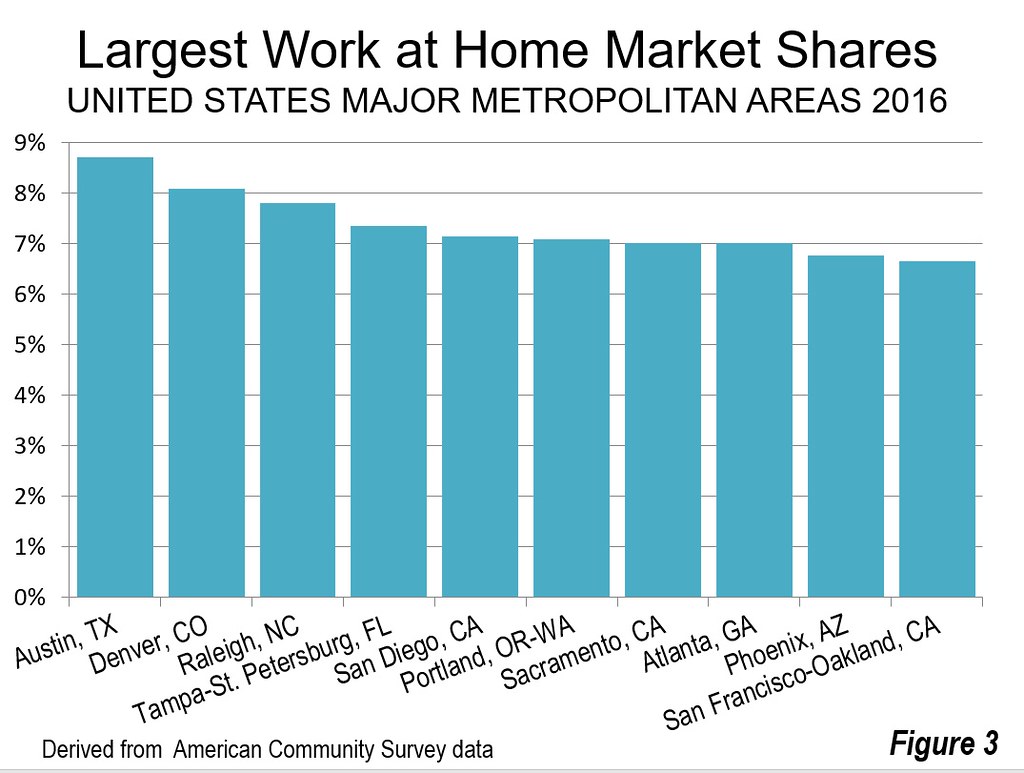
    As might be expected, high-tech hubs lead in working at home. Austin has the largest work at home share, at 8.7 percent. Austin is followed by other tech-heavy metropolitan areas Denver (8.1 percent) and Raleigh (7.8 percent). Tampa-St. Petersburg, San Diego, Portland, Sacramento and Atlanta have shares of 7.0 percent or more. Charlotte and San Francisco-Oakland round out the top 10 (Figure 2).
    The distribution of transit and work at home shares is much different. Among the 53 major metropolitan areas, the largest transit market share is in New York, at 31.2 percent, while the smallest is in Oklahoma City, at 0.4 percent, a spread of more than 80 times (8,000 percent). The median metropolitan area has a transit work trip market share of 2.6 percent.

    Leader Austin’s work at home market share is less than the transit shares in the six metropolitan areas with transit legacy cities (the core municipalities [not the metropolitan areas] of New York, Chicago, Philadelphia, San Francisco, Boston, Washington) as well as Seattle, in all of which more than nine percent of workers use transit. Nearly 60 percent of the transit work trips are to destinations in the core municipalities of these metropolitan areas, most of that in the downtown areas (central business districts). Thus, 60 percent of commuting is to areas having less than 7 percent of the nation’s employment and less than one percent of nation’s urban land area.

    Working at home is much more evenly spread around the nation. The market share range is from 8.7 percent in Austin to 2.9 percent in Buffalo. The middle value is 5.2 percent, double that of transit. Thirty of the 53 major metropolitan areas have smaller transit work trip market shares than last ranking Buffalo’s work at home market share (Table).

    Work Access Mode: Major Metropolitan Areas: 2016
      Drive Alone Car Pool Transit Bicycle Walk Other Work at Home
    Atlanta, GA 77.6% 9.2% 3.1% 0.3% 1.3% 1.5% 7.0%
    Austin, TX 76.0% 9.4% 2.2% 0.8% 1.7% 1.1% 8.7%
    Baltimore, MD 76.6% 8.3% 6.1% 0.3% 2.6% 1.1% 4.9%
    Birmingham, AL 85.6% 8.9% 0.5% 0.1% 1.1% 0.9% 2.9%
    Boston, MA-NH 66.6% 7.5% 13.1% 1.0% 5.2% 1.4% 5.2%
    Buffalo, NY 82.8% 7.4% 3.5% 0.4% 2.4% 0.6% 2.9%
    Charlotte, NC-SC 80.9% 9.2% 1.4% 0.0% 1.3% 1.0% 6.3%
    Chicago, IL-IN-WI 70.3% 7.6% 12.0% 0.7% 3.1% 1.2% 5.1%
    Cincinnati, OH-KY-IN 81.7% 7.8% 1.9% 0.2% 2.1% 0.7% 5.5%
    Cleveland, OH 81.3% 7.6% 3.1% 0.3% 2.3% 0.9% 4.5%
    Columbus, OH 82.5% 7.5% 1.6% 0.3% 2.2% 1.2% 4.7%
    Dallas-Fort Worth, TX 80.8% 9.7% 1.4% 0.1% 1.2% 1.1% 5.7%
    Denver, CO 75.2% 8.5% 4.0% 0.7% 2.3% 1.2% 8.1%
    Detroit,  MI 84.3% 8.2% 1.5% 0.3% 1.3% 0.8% 3.6%
    Grand Rapids, MI 81.5% 8.5% 1.8% 0.7% 2.4% 0.6% 4.4%
    Hartford, CT 80.4% 8.1% 3.1% 0.2% 2.5% 1.0% 4.8%
    Houston, TX 80.8% 10.2% 1.9% 0.2% 1.4% 1.3% 4.1%
    Indianapolis. IN 84.5% 7.4% 0.7% 0.3% 1.6% 0.8% 4.6%
    Jacksonville, FL 81.0% 7.7% 1.7% 0.6% 2.0% 1.4% 5.7%
    Kansas City, MO-KS 83.8% 7.9% 0.9% 0.2% 1.3% 0.8% 5.2%
    Las Vegas, NV 79.4% 9.9% 3.7% 0.3% 1.2% 1.5% 4.0%
    Los Angeles, CA 75.0% 9.6% 5.1% 0.8% 2.5% 1.4% 5.5%
    Louisville, KY-IN 82.5% 8.4% 1.8% 0.2% 1.5% 1.2% 4.4%
    Memphis, TN-MS-AR 83.2% 9.8% 1.1% 0.1% 1.1% 1.0% 3.6%
    Miami, FL 77.7% 9.3% 3.8% 0.5% 1.7% 1.4% 5.5%
    Milwaukee,WI 80.4% 8.2% 3.6% 0.5% 2.7% 0.7% 3.9%
    Minneapolis-St. Paul, MN-WI 77.7% 8.1% 4.7% 0.8% 2.1% 0.8% 5.7%
    Nashville, TN 81.8% 8.7% 0.9% 0.1% 1.3% 1.1% 6.1%
    New Orleans. LA 77.2% 11.0% 2.6% 1.1% 2.2% 1.4% 4.4%
    New York, NY-NJ-PA 49.5% 6.6% 31.4% 0.7% 5.8% 1.4% 4.5%
    Oklahoma City, OK 83.2% 9.2% 0.4% 0.4% 1.5% 1.1% 4.1%
    Orlando, FL 80.5% 9.1% 1.9% 0.4% 1.1% 1.3% 5.8%
    Philadelphia, PA-NJ-DE-MD 72.6% 7.9% 9.3% 0.6% 3.6% 1.0% 5.1%
    Phoenix, AZ 76.2% 11.2% 1.8% 0.7% 1.5% 1.7% 6.8%
    Pittsburgh, PA 76.7% 8.2% 6.0% 0.4% 3.2% 0.8% 4.8%
    Portland, OR-WA 70.9% 9.1% 6.4% 2.3% 3.2% 1.0% 7.1%
    Providence, RI-MA 80.9% 8.3% 2.5% 0.2% 3.4% 0.7% 3.9%
    Raleigh, NC 80.6% 8.1% 1.2% 0.3% 1.0% 0.9% 7.8%
    Richmond, VA 82.4% 8.1% 1.4% 0.5% 1.9% 1.0% 4.7%
    Riverside-San Bernardino, CA 78.4% 11.8% 1.3% 0.3% 1.5% 1.2% 5.5%
    Rochester, NY 80.8% 7.8% 2.6% 0.4% 3.5% 0.7% 4.2%
    Sacramento, CA 76.9% 9.5% 2.1% 1.6% 1.8% 1.1% 7.0%
    St. Louis,, MO-IL 82.6% 7.1% 2.6% 0.3% 1.6% 0.8% 5.0%
    Salt Lake City, UT 74.8% 10.7% 4.6% 0.7% 2.5% 1.0% 5.8%
    San Antonio, TX 79.0% 10.6% 2.3% 0.2% 1.9% 1.3% 4.8%
    San Diego, CA 75.7% 8.9% 2.9% 0.7% 3.2% 1.5% 7.1%
    San Francisco-Oakland, CA 58.1% 9.6% 17.2% 2.1% 4.5% 2.0% 6.7%
    San Jose, CA 74.5% 10.6% 4.3% 1.6% 2.3% 1.3% 5.3%
    Seattle, WA 68.3% 9.7% 9.5% 1.1% 4.1% 1.1% 6.1%
    Tampa-St. Petersburg, FL 78.9% 8.5% 1.4% 0.8% 1.5% 1.6% 7.4%
    Tucson, AZ 76.4% 10.5% 2.6% 1.6% 1.9% 1.5% 5.4%
    Virginia Beach-Norfolk, VA-NC 79.7% 9.3% 1.8% 0.4% 3.8% 1.6% 3.5%
    Washington, DC-VA-MD-WV 65.9% 9.3% 13.4% 0.9% 3.4% 1.4% 5.7%
    Major MSAs 73.4% 8.7% 7.9% 0.6% 2.7% 1.2% 5.4%
    United States 76.3% 9.0% 5.1% 0.6% 2.7% 1.2% 5.0%
    Outside Major MSAs 80.4% 9.4% 1.2% 0.5% 2.7% 1.2% 4.6%
    Source: American Community Survey, 2016


    The Future

    There is considerable potential for expanding the work at home share of work access, as is indicated by Global Workplace Analytics and Flexjobs in their report (The State of Telecommuting in the U.S. Employee Workforce). The advantages are great. Working at home is by far the most environmentally friendly mode of work access and requires virtually no public subsidies.

    Note: Calculated using two-digit data.

    Wendell Cox is principal of Demographia, an international public policy and demographics firm. He is a Senior Fellow of the Center for Opportunity Urbanism (US), Senior Fellow for Housing Affordability and Municipal Policy for the Frontier Centre for Public Policy (Canada), and a member of the Board of Advisors of the Center for Demographics and Policy at Chapman University (California). He is co-author of the “Demographia International Housing Affordability Survey” and author of “Demographia World Urban Areas” and “War on the Dream: How Anti-Sprawl Policy Threatens the Quality of Life.” He was appointed to three terms on the Los Angeles County Transportation Commission, where he served with the leading city and county leadership as the only non-elected member. He served as a visiting professor at the Conservatoire National des Arts et Metiers, a national university in Paris.

    Photograph: Texas State Capital, Austin (largest work at come work access mode).
    https://commons.wikimedia.org/wiki/File:Texas_State_Capitol_Night.jpg

  • Garden Grove: The Other Kind of Incremental Urbanism

    This is the historic Main Street in Garden Grove, California. Back in 1874 land was platted in small twenty five foot wide lots and sold off with minimal infrastructure. Individuals built modest pragmatic structures with funds pulled largely from the household budget, extended family, and short term debt. This was long before the thirty year mortgage, government loan guaranties, mortgage interest tax deductions, zoning regulations, subsidies, economic development grants, or the codes we have today.

    Many of these simple one story shops were specifically designed to be subdivided in to two smaller shops that were each about twelve feet wide and not terribly deep. These were ideal economic incubators with a low bar to entry for tenants, yet they generated a high yield per square foot for the landlord. Businesses could expand and contract as needs changed. Some things failed. Others succeeded. Time sorted it all out.

    Families often lived above their own shops. In many cases rooms or apartments were rented to tenants. Sometimes the upper floors served as professional offices or hotel rooms. This was an additional layer of flexibility that allowed properties to adapt over time while providing affordable yet profitable accommodations. Everything expanded gradually as money and market demand permitted. This was the process that produced our Main Street towns all across the country.


    Here’s an aerial view of Main Street courtesy of Google. At one time it was the economic and cultural center of a thriving farm community. Notice the amount of private value relative to public infrastructure. Let’s pull out a bit and see what the surroundings look like today.


    Google

    Whatever may have existed around Main Street is now a vast ocean of surface parking lots. Next door and across the street are big box stores along high speed arterial roads. Times change. When transportation switched from shoe leather and horses to cars and trucks the scale of absolutely everything in society ramped up exponentially. The the old Main Street became a relic.

    Garden Grove’s civic leaders obviously thought its historic center was worth preserving, so planners did the best they could to keep it viable. Removing defunct buildings in favor of parking lots made the shops available to suburban motorists.

    Decorative paving, ye olde lamp posts, hanging flower baskets, park benches, lots and lots of American flags, potted shrubbery, and piped in music created a respectable unified atmosphere for retail. The place is clean, safe, and orderly.

    Events are programmed to keep Main Street active and attract customers. An Elvis festival, a vintage car show, the annual celebration of the strawberry… Shops that might otherwise go empty are filled with civic organizations like the Chamber of Commerce and the offices of elected representatives. Garden Grove’s remaining historic center – all one block of it – is well maintained. But it stopped functioning as a town a long time ago. It’s now an embellished strip mall. The current regulatory environment and larger economic context have halted the iterative wealth building process that might have otherwise continued. Now it’s dependent on city planning efforts to keep up appearances with grants for fresh lipstick and rouge. It’s an exercise in sentimentality and kitsch. Nothing else is legal anymore.

    Advocates for a return to the kind of development pattern that existed a century ago are up against hard limits of every kind. Reforming the current system of regulations and cultural attitudes is a waste of time. What they don’t recognize is that the small scale, fine grained, mom and pop process is alive and well in places like Garden Grove. It just doesn’t look like a Norman Rockwell village. That era is gone and isn’t coming back anytime soon. But a new version is already here. The mobile shop is the new version. I see more and more of these all across the county, because this is the new low resistance entry point for small businesses to form.

    This is only the visible stuff. Inside many suburban homes are businesses that you can’t see. These aren’t traditional retail stores. Operating a physical shop makes no sense in most cases. Who can compete with Costco or Amazon? Who wants to try to extract permission from the zoning authorities? But household ventures generate income in ways that aren’t readily apparent from the curb. I can’t publish photos of the best examples because I’d get a lot of good people in to trouble. But trust me. They’re out there in large numbers under the radar.

    When it comes to housing it’s incredibly difficult to build anything simple and cost effective anymore. A combination of endless regulations and outraged neighbors means only production home builders are left in the game. They build whole subdivisions of single family homes, or they build two hundred unit apartment complexes. The middle range of modest accommodations is no longer a reasonable option. Under the circumstance the existing stock of suburban homes are pressed in to service as de facto multi family buildings. On my way out of Orange County I asked a waitress at the airport about her living arrangements. She said she rented shared space in a five bedroom house in Costa Mesa. The overall rent was $4,200 a month. Her share was $1,100. She had three room mates. She also had three kids. That’s why so many front lawns are parking lots.

    There’s a general acceptance of the super sized suburban home. A plain vanilla ranch home can become a much larger house without breaking any rules. The neighbors don’t always love being in the shadow of such upscaled structures, but there’s the countervailing knowledge that surrounding property values go up with this kind of redevelopment. Borderline insolvent municipal authorities understand this sort of activity allows a rare opportunity for property taxes to be adjusted upwards without building more public infrastructure. And it’s difficult to create codes that forbid such additions so long as set back regulations, health and fire safety, and other concerns are addressed. It’s all still a regular house so the suburban imperatives remain inviolate.

    I have a peculiar ability to wander around and get myself invited in to people’s lives. This place in Garden Grove was once a little 1950s tract home. It was added on to in a way that perfectly conformed to all the existing rules and procedures and is still a fully detached single family home. But individual rooms are rented out and the tenants share a common kitchen and baths. It’s a small apartment building by other means. This is what we get when we forbid the Norman Rockwell Main Street model. Some people hate it. I see it as a perfectly natural response to the artificial constraints that have been placed on the old Main Street model. We can’t go back. But we can adapt and move forward under the circumstances.

    This piece first appeared on Granola Shotgun.

    John Sanphillippo lives in San Francisco and blogs about urbanism, adaptation, and resilience at granolashotgun.com. He’s a member of the Congress for New Urbanism, films videos for faircompanies.com, and is a regular contributor to Strongtowns.org. He earns his living by buying, renovating, and renting undervalued properties in places that have good long term prospects. He is a graduate of Rutgers University.

  • Too Many Rust Belt Leaders Have Stockholm Syndrome

    One of the criticisms leveled at Richard Florida is that many of the Rust Belt cities that tried to cater to the creative class ended up wasting their money on worthless programs.

    What this illustrates instead is that leaders in the Rust Belt have taken the contours of the current economy as a given, and attempted to find a way to adapt their community to that.

    This is actually a smart way to approach it. The fact is, local leaders are market takers not market makers in most places. They don’t have much leverage. With a global economy and dominance by knowledge industries, trying to create a more favorable environment to tap into those is a rational decision. If that hasn’t turned around those places yet, then nothing else has either.

    However, what I’ve noticed is that civic leaders in these places have gone beyond trying to adapt to the global economy, and have become cheerleaders for the status quo – the same status quo that has wrecked in their community.

    To be sure, much of deindustrialization resulted from simple productivity and technology improvements. But globalization played a role, both in tearing these cities down and in building up the coastal capitals.

    In the second edition of her book The Global City, Saskia Sassen wrote:

    What comes out of this book is that the globalization of manufacturing activity and of key service industries has been a crucial factor in the growth of the new industrial complex dominated by finance and producer services. Yes, manufacturing matters, but from the perspective of finance and producer services, it does not have to be national. This is precisely, as this book sought to show, one of the discontinuities (between major cities and nations) in the operation of the economy today compared with two decades ago, the period when mass production of consumer goods was the leading growth engine. One of the key points in this book is that much of the new growth rests on the decline of what were once significant sectors of the national economy, notably key branches of manufacturing, that were the leading force in the national economy and promoted the formation and expansion of strong middle class [emphasis added]

    In other words, deindustrialization and the rebirth of cities like New York are linked via globalization.

    Given this, you might think urban leaders in post-industrial cities would be advocates for some type of macroeconomic policy changes. That doesn’t really seem to be the case though. Certainly they do not want to see any form of rollback or material alteration in the current globalization schema, apart from perhaps arguing for more of the same.

    I noticed this after the election last year when I observed leaders from some of America’s most economically bleak locales bemoaning Trump’s win. That in and of itself wouldn’t be a problem. But it was also clear that they loved the status quo and wanted to preserve and extend it. It is there any reason whatsoever to think that Hillary Clinton would have done anything for Youngstown? I don’t think so. Yet they were enthusiastic about her entire agenda, a more or less stay the course approach that would continue to pile more and more success into existing superstar cities.

    I wouldn’t expect them to embrace Trumpism. But one would think that flyover America’s leadership class would be promoting a reform agenda of its own, one which would benefit their cities and regions. But they don’t seem to have one. All of their ideas are more or less adaptions of things people in coastal cities came up with. And they don’t have a national policy change agenda to speak of other than “give cities more money.”

    For the younger, educated Millennial types, this is somewhat understandable. Many of them hope aspire to actually be in a coastal city. But much of the leadership class of these places is older and deeply rooted in their community.

    As along as these folks remain enthusiasts and staunchly committed to the global status quo that helped ruinate their city, economic policy will continue to be made in ways that disproportionately benefits the coastal, global city elite at their expense.

    This piece originally appeared on Urbanophile.

    Aaron M. Renn is a senior fellow at the Manhattan Institute, a contributing editor of City Journal, and an economic development columnist for Governing magazine. He focuses on ways to help America’s cities thrive in an ever more complex, competitive, globalized, and diverse twenty-first century. During Renn’s 15-year career in management and technology consulting, he was a partner at Accenture and held several technology strategy roles and directed multimillion-dollar global technology implementations. He has contributed to The Guardian, Forbes.com, and numerous other publications. Renn holds a B.S. from Indiana University, where he coauthored an early social-networking platform in 1991.

    Photo: Jack Pearce from Boardman, OH, USA [CC BY-SA 2.0 or CC BY-SA 2.0], via Wikimedia Commons

  • Where America’s Highest Earners Live

    The mainstream media commonly assumes that affluent Americans like to cluster in the dense cores of cities. This impression has been heightened by some eye-catching recent announcements by big companies of plans to move their headquarters from the ‘burbs to big cities, like General Electric to Boston and McDonald’s to Chicago.

    Yet a thorough examination of Census data shows something quite different. In our 53 largest metro areas, barely 3% of full-time employed high earners (over $75,000 a year) live downtown, according to Wendell Cox’s City Sector Model, while another 11.4% live in inner ring neighborhoods around the core. In contrast, about as many (14.1%) live in exurbs while suburbs, both older and new ones, are home to 71.5% of such high earners.

    New county-level research by Chapman University researcher Erika Nicole Orejola also sheds light on the geography of wealth. Orejola ranked the nation’s 136 largest counties by the proportion of full-time workers in the population who earned over $75,000 in 2015, which represented the 77th percentile of incomes then, and by the share of households earning over $200,000.

    She found that 16 of the 20 counties with the largest share of full-time employed residents earning over $75,000 were functionally suburban, with most people driving to work and living in low to moderate density environments. The other four, interestingly enough, are among the most urbanized parts of the country, including Manhattan and San Francisco.

    Where The High-Wage Earners Are

    The very top of this pyramid consists largely of two archetypes, elite “superstar” cities, but more so well-located suburbs, often near the most dynamic cores. Many are areas that have benefited the most from the post-Great Recession boom in technology as well as in the much larger business and professional services sector.

    Ranking first is New York County, otherwise known as Manhattan, where a remarkable 49.2% of all full-time workers earn over $75,000. That’s up from 40.2% in 2006. Other big counties with high concentrations of high earners include No. 3 San Francisco (49.1%), No. 7 Washington, D.C. (44.9%, up sharply from 29.5% in ’06), and No. 14 King County, Wash. (41.3%), which includes Seattle and its closer in suburbs.

    Virtually all the rest are counties that are primarily suburban, usually close to high-wage core cities. These include, not surprisingly, the California counties of Santa Clara (fourth place) and San Mateo (ninth), which make up Silicon Valley. (In Santa Clara, a whopping 21% of households have annual incomes over $200,000, tops in the country.) Several New York suburbs make the top 20, including Monmouth, N.J. (eighth), Westchester, N.Y. (10th), Fairfield, Conn. (11th), and Nassau County, N.Y. (Long Island) (13th).

    There are also strong pockets of high-wage workers in suburban counties surrounding Boston, including Norfolk (fifth) and Middlesex (12th). Washington, D.C., is flanked by wealthy suburban Fairfax County, which ties with Manhattan for the highest percentage of resident full-time workers making over $75,000 (49.2%) – we gave Manhattan the top ranking for its greater population (1.63 million vs. 1.13 million for Fairfax). Another D.C. suburb, Montgomery County, Md., ranks sixth. And outside Philadelphia, Chester County ranks 17th.

    The pattern holds away from the East and West coasts. The Houston suburb of Fort Bend County ranks 18th and the Dallas suburb of Colin County ranks 19th. Near Chicago, DuPage County ranks 24th and Lake County 27th. Oakland County outside of Detroit ranks 25th, and 29th-ranked Johnson County, Kan., is the most dynamic part of the Kansas City regional economy.

    Counties housing some of the nation’s largest cities don’t fare well in this ranking, but that isn’t necessarily because the wealthy aren’t there. The nation’s largest county, Los Angeles, ranks a mere 74th, with 24% of the full-time employed population earning over $75,000; in nearby suburban Orange County the proportion is 33.8%. But that’s because L.A. is much larger– L.A. County has more than double the number of high earners as Orange Country, 808,000 vs. 360,000. Similarly Cook County in Illinois, which includes Chicago and its closer in suburbs, places 55th with a 27.7% share of high earners, but it’s still home to 499,350 people making over $75,000, 2.3 times as many as live in higher-ranked DuPage and Lake County combined, and the high earner population in Cook County has been growing faster. Kings County, N.Y., aka Brooklyn, comes in 66th with 25.4% of the full-time working population making over $75k, but that’s still 221,000 high earners, and it’s had the second fastest growth rate in its high earner population of any large county since 2006.

    The Bronx, long a poster child for urban poverty, clocks in 132nd, fourth from the bottom, but it ranks 11th for the growth rate in the proportion of its population that earns high incomes, up from 7.2% in 2006 to 12.3% in 2015.

    Households Over $200,000 Income: The Suburban Connection

    Much the same pattern applies to households with incomes over $200,000 annually. The same four urban core counties rank highly: San Francisco is third with 20.4% of households making over $200,000 a year, more than double the proportion in 2006, New York County is fifth, Washington, D.C., ranks 16th and the mixed suburban-urban core of the Seattle area, King County, Wash., places 20th. All the rest of the top 20 are firmly suburban, led by Santa Clara, where 21% of households earn $200,000 a year, followed closely by the D.C. suburb of Fairfax County, Va.

    So what gives here? The Center for Demographics and Policy at Chapman University just completed a national survey, fielded and tabulated by The Cicero Group, of 1,191 professionals aged 25-64 with household incomes greater than $80,000, and who work in education, healthcare, information technology, finance or other professional services jobs. What we found may help us understand what high income professionals are looking for in terms of location.

    The survey found priorities for actual high-end workers do not largely follow the “hip and cool” agenda so promoted by some urban pundits and inner city developers. In fact, the biggest factors influencing location, the respondents told us, are such prosaic factors as housing costs — generally the number one issue — jobs for a spouse, commute times, proximity to family, and K-12 quality.

    Features commonly cited as reasons for an urban revival, like cultural amenities and nightlife, are not so critical with this demographic. In our survey, nearly 40% cited housing costs and 30% commute times as reasons why they would choose not to move to a place. In contrast, barely 5% prioritized “access to culture” or “nightlife.”

    The needs of families seem paramount. There are certain factors that are “must haves , such as affordable housing, jobs for spouses and reasonable commute times,” notes the survey’s designer, Chapman University analytics expert Marshall Toplansky.

    The message for cities and counties seeking to lure professionals may be, think parks and playgrounds rather than edgy music venues — focus on the basics that shape quality of life for families.

    The Future

    Where are these folks likely to go in the coming years?

    There may be some good news here for central cities. Some of the biggest increases in the proportion of high earners in the population took place in places like Kings (Brooklyn) and Queens counties, which have been prime areas for gentrification over the past decade as Manhattan has become extraordinarily pricey. Since 2006, Kings has seen its number of high income earners soar by almost 94% while Queens saw a jump of 78%.

    Other urban core counties have seen some impressive gains, although from a low base, including Baltimore and Philadelphia counties. But here too some suburban areas have shown strong increases, notably Snohomish County, Wash., just outside Seattle, which saw its $75k cohort grow by over 90%. Other suburban areas with strong growth trajectories including Utah County, south of Salt Lake City, Ft. Bend and Montgomery counties outside Houston, as well as several suburban counties outside Boston.

    What appears to be occurring are two things at the same time. There’s a strong concentration of affluent households both in select suburbs of major cities and another one, far more urban, that is beginning to spread, but in many older cities although still at a much lower concentration. Other hotspots appear to be in the newer suburbs of the Sun Belt. The geography of affluence is changing, but in ways that are as diverse as the country as a whole.

    This piece originally appeared on Forbes.com.

    Joel Kotkin is executive editor of NewGeography.com. He is the Roger Hobbs Distinguished Fellow in Urban Studies at Chapman University and executive director of the Houston-based Center for Opportunity Urbanism. His newest book is The Human City: Urbanism for the rest of us. He is also author of The New Class ConflictThe City: A Global History, and The Next Hundred Million: America in 2050. He lives in Orange County, CA.

    Photo: About Fairfax County website.

  • A Layman’s Guide To Houston After Harvey: Don’t Throw The Opportunity Baby Out With The Stormwater

    In the aftermath of Hurricane Harvey, and the disastrous flooding, Houston has come under extreme scrutiny. Some in the global, national as well as local media assaulted the area’s flood control system and its development model, criticisms that were echoed by some in the local area.

    Much of the current debate starts from a firm misunderstanding of the region’s realities. This could lead to policies that ultimately undermine the keys that have propelled the region’s success. Below is a primer to inform future discussions of Houston’s future trajectory.

    Click here to read more or download the full paper.

    Photo: Michael Coppens, via Flickr, using CC License.

  • Our Quiz Challenges You to Spot Some of Your Favourite Cities

    At ParcelHero, we’ve gotten to know cities all over the world. In order to share some of our favourites, we’ve put together a fiendish quiz called CurioCities, which features a hundred cities from around the world. You’d be forgiven for thinking that doesn’t sound all that exciting, which is why we put our own twist on it.

    Each city in our quiz is shown off as a picture – but not a photo of the place. Instead you’ll have to think laterally and say what you see in order to work out what we’re getting at. How do you know which cities to guess? Well, with one exception we’ve picked from cities that have more than 100,000 occupants, so you can narrow things down for yourselves by looking for the biggest cities first.

    To give you an idea of what we mean, let’s take Glasgow for example. It doesn’t feature on our quiz, but if it did, it might be represented by a glass on top of a traffic light, with a green light showing. One down, ninety-nine more to go!

    If you’re one of the lucky few who can work out all 100 of our fiendish clues, you’ll earn your place on our illustrious 100 Club. With so difficult a quiz to work through, you’ll be in exclusive company. We here in the office haven’t even managed it without taking a peek at the answers.

    Interested? Why not take a trip over to Curiocities.parcelhero.com and check it out. You can save your progress and ask for help from your social media pals, so your lunch breaks are sorted for the next few days at the very least.

    Do you think you can make it to the 100 Club?

  • Big Tech Finds Itself Lacking Political Allies

    Our nation’s ruling tech oligarchs may be geniuses in making money through software, but they are showing themselves to be not so adept in the less quantifiable world of politics. Once the toast of the political world, the ever more economically dominant tech elite now face growing political opposition, both domestically and around the world.

    For its part, the right has been alienated by the tech establishment’s one-sided embrace of progressive dogma in everything from gender politics and the environment to open borders and post-nationalism. The left is also now decisively turning against tech leaders on a host of issues, from antitrust enforcement to wealth redistribution and concerns about the industry’s misogynist culture, so evident in firms such as Uber.

    This mounting bipartisan opposition is placing the oligarchs into an increasingly uncomfortable political vise. As left-leaning Buzzfeed’s Ben Smith put it recently, there’s “a kind of ‘Murder on the Orient Express’ alliance against big tech: Everyone wants to kill them.”

    Politics after Obama

    It’s hard to recall that Occupy Wall Street demonstrators in 2011 actually celebrated the life of Apple founder Steve Jobs — a brilliant, but ruthless, capitalist, but also one who founded a religion-like technology cult. President Barack Obama also clearly embraced the techie economic model, and used Google and other tech talent in his data-driven campaigns.

    Obama was their kind of progressive — socially liberal but comfortable with hierarchy, particularly of the college-educated kind. Just a few years ago, author Greg Ferenstein suggested that Silicon Valley would forge an entirely new liberal political ideology built around its technocratic agenda. Big tech’s ascendency was further bolstered by a “progressive” Justice Department that allowed the large tech firms to buy out and squeeze competitors with utter impunity.

    Advocating antitrust at a nonprofit organization dominated by tech oligarchs, as one of my former colleagues at the liberal-leaning New America Foundation recently found out, can be dangerous for your employment status. Gradually, the image of spunky, enlightened entrepreneurs has morphed into one of monopolists reigning over what is rapidly becoming the most consolidated of our major industries.

    No one really expects competition to rise against venture capital-created firms like Google, which owns upwards of 80 percent of the global search ad market, or Facebook, which uses its power to undermine upstarts like Snap, and calls for greater government oversight are now found on both sides of the aisle.

    Kowtowing to the left has not turned out to be as clever a move as the tech oligarchs believed.

    The Democrats, as it now appears, have been taken over by Sen. Bernie Sanders, whose redistributionist, pro-regulation agenda does not sit well with the likes of Amazon CEO Jeff Bezos, the world’s third-richest man, who last year used the Washington Post to try to undermine Sanders during his presidential campaign.

    Read the entire piece at The Orange County Register.

    Joel Kotkin is executive editor of NewGeography.com. He is the Roger Hobbs Distinguished Fellow in Urban Studies at Chapman University and executive director of the Houston-based Center for Opportunity Urbanism. His newest book is The Human City: Urbanism for the rest of us. He is also author of The New Class ConflictThe City: A Global History, and The Next Hundred Million: America in 2050. He lives in Orange County, CA.

    Photo: TechCrunch [CC BY 2.0], via Wikimedia Commons

  • How Much Value Do Economists Assign to Having Married Parents Who Aren’t on Drugs?

    Yesterday I posted my new column from the September issue of Governing magazine in which I write:

    “There are a number of people in the national media who make the argument that things aren’t so bad, that if you look at the numbers this idea that things are horrible in much of America just isn’t true. It’s easy for me to believe this is actually the case in a quantitative sense. But man does not live by bread alone. When you have an iPhone but your community is disintegrating socially, it’s not hard to see why people think things have taken a turn for the worse.”

    Conveniently the Wall Street Journal published an op-ed last week by Harvard economist Martin Feldstein called “We’re Richer Than We Realize” that makes the kind of argument I was talking about, right down to talking about iPhones:

    “Government statistics paint an excessively grim picture of what is happening to real wages and the growth of real national income. Although most households’ take-home cash has been rising very slowly for decades, their standard of living is increasing more rapidly because those wages can now buy new and better products at little or no extra cost. The government’s measure of real incomes gives too little weight to this increase in what take-home pay can buy….First, government statisticians grossly understate the value of improvements in the quality of existing goods and services. More important, the government doesn’t even try to measure the full contribution of new goods and services.

    The other source of underestimation of growth is the failure to capture the benefit of new goods and services. Here’s how the current procedure works: When a new product is developed and sold to the public, its market value enters into nominal gross domestic product. But there is no attempt to take into account the full value to consumers created by the new product per se.

    Or consider consumer electronics. New York University economist William Easterly recently tweeted an image of a 1991 RadioShack newspaper ad and noted that all the functions of the devices on sale—clock radio, calculator, cellphone, tape-recorder, compact-disk player, camcorder, desktop computer—are “now available on a $200 smartphone.” The benefits to consumers from these advances don’t show up in GDP.”

    I don’t dispute anything Feldstein says in the article, which to me sounds completely correct. If you’re a Journal subscriber, you should read it. But it’s very incomplete.

    Feldstein says we should consider the full value of the product innovations we’ve created. He cites improvements in health, for example.

    But where is the expansive treatment of the economic value – the negative economic value – of declines in social conditions? Is the fully expansive impact of violence in some of Chicago’s neighborhoods fully counted? Is the quality of life impact of having a mother strung out on opioids, or having a father who is just plain gone? What’s the impact of going from being able to leave your keys in your car and your house unlocked to realizing that burglary is a very real possibility? And speaking of health, what is the all in effect on a community of the declining life expectancy we’ve experienced? What’s the community impact of an HIV crisis?

    The truth is that along with real economic progress there has been a parallel big degradation in the lived experience of life in much of America, a part of America largely invisible to and certainly not relatable to on a visceral level by most of those in booming sections of global cities. I’m all in favor of understanding the very real way that technology and other innovations have made our lives better, and fully capturing that in statistics. But we need to be equally as diligent in capturing and measuring the downsides of those trends, an effort I’ve read much less about in the papers.

    This piece originally appeared on Urbanophile.

    Aaron M. Renn is a senior fellow at the Manhattan Institute, a contributing editor of City Journal, and an economic development columnist for Governing magazine. He focuses on ways to help America’s cities thrive in an ever more complex, competitive, globalized, and diverse twenty-first century. During Renn’s 15-year career in management and technology consulting, he was a partner at Accenture and held several technology strategy roles and directed multimillion-dollar global technology implementations. He has contributed to The Guardian, Forbes.com, and numerous other publications. Renn holds a B.S. from Indiana University, where he coauthored an early social-networking platform in 1991.

    Photo: The house Aaron grew up in.

  • Africa: 800 Million Jobs Needed

    African economies are in a race to get ahead of the demographic boom.

    While some people in the United States are sweating the presence, against the backdrop of a demographically stagnant white population, of the 11 million undocumented immigrants or of the 30+ million other foreign-born residents, there are far bigger numbers brewing in other parts of the world, indeed numbers that are so large that they could affect decades from now the life of an American citizen far more than the rare determined Mexican or Guatemalan who manages henceforth to scale President Trump’s purportedly impenetrable border wall.


    In the next decades as was so often the case in history, the future shape of the world could once again be decided in Europe and by Europe’s and the West’s handling of Africa’s incipient demographic boom.

    In fact, if you are a generous-minded European who shares the Pope’s noble sentiment and who views the ongoing wave of migrants coming into your country as a benign and positive development; or, if you believe that borders are outdated constructs and that all refugees and other immigrants should be welcomed into the rich world; indeed, if it is your view that anyone who stands in the way of this openness is misguided by racist and nefarious motives, then it behooves you to test the strength of your belief by examining the larger demographic data coming out of Africa and Asia.

    Because it is likely that your kindness and generosity will be, in the next decades, tested to their limits (unless they are limitless like the Pope’s). Because the two million people who have entered Europe on foot or via inflatable rafts in the past few years are, in scale, only thin vapor rising out of the demographic cauldron that is boiling up in Africa and south Asia. There are potentially many many more to come.

    The Numbers

    If Africa does not get its act together to start creating jobs at a rapid rate, there may be tens of millions more such people attempting to migrate in the future. The world population in 2015 stood at 7.3 billion and, on the UN’s medium variant, was expected to rise to 9.7 billion in 2050. Half of this 2.4 billion increase would take place in sub-Saharan Africa where the population will more than double in nearly every country.

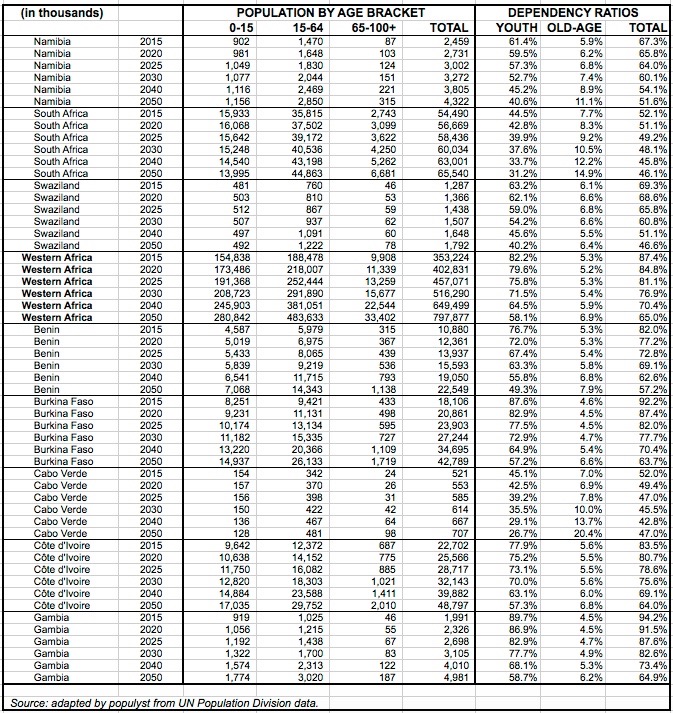
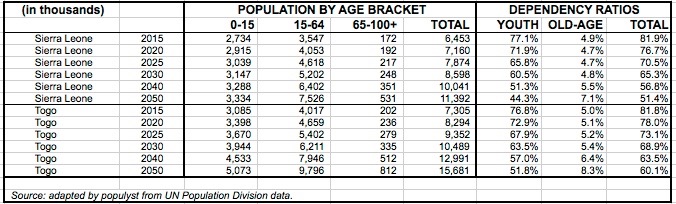
    (See at the bottom of the article region and country tables derived from the UN’s medium variant).

    Today sub-Saharan Africa has a billion people. In 2050, it will have 2.1 billion. Of more vivid concern is the fact that the working-age population, aged 15 to 64, will grow by 800 million people from 500 million to 1.3 billion. This 800 million increase is roughly equal to five times the current size of the US labor force.

    It is possible that these numbers are too high. But it should be noted that, in arriving at these forecasts, the UN Population Division has plugged into its assumptions a significant decline in fertility rates across the sub-continent, from 4.8 children per woman today to 3.1 in 2050. On a constant-fertility scenario assuming no decline in the fertility rate, the population boom would be even larger. The working age population would rise to 1.6 billion (instead of 1.3 billion under the median variant) and the increase from today would then be equal to 1.1 billion (instead of 800 million). These are unimaginable numbers that are unlikely to materialize.

    (See this article for the Total Fertility Ratio of every African country from the highest, Niger at 7.7, to the lowest, Mauritius at 1.5.)

    In some ways, the precise magnitude of the boom is unimportant, so long as we accept that it will be somewhere between large and very large. Even a sanguine scenario that would halve the increase of the working age population from 800 million to 400 million would still present a challenge that African economies are today ill-equipped to handle. Economic conditions are insufficient even today to adequately feed, dress, educate and shelter the population.

    One reason to feel some optimism is the fact that the BRIC countries (Brazil, Russia, India and China) also experienced a big rise in their working-age populations in the past thirty-five years and they managed to handle their demographic boom effectively. But this positive outcome was greatly assisted by a steep decline in China’s dependency ratio (DR) from 0.77 to 0.38. The DR is the ratio of dependents, children and the elderly, to working adults.

    By comparison, the DR of sub-Saharan Africa is projected to fall from 0.86 today to a still elevated 0.63 in 2050. The decline in the youth DR (see tables below) is somewhat offset by a rise in the old-age DR that is itself due to an expected increase in life expectancy.

    Certainly, if African fertility falls faster than median variant estimates, the total DR would decline more rapidly and there could be a faster acceleration in job creation and in GDP per capita.

    (See at the bottom of the article the change in the dependency ratio for every country).

    The Drive for Change

    Africa is a wealthy continent but its wealth is highly concentrated in the hands of a few and it is often domiciled outside of Africa, in offshore financial centers, and in real estate and other assets all over the developed world. For decades, this configuration has worked wonders for Africa’s rulers and their entourages.

    If the above numbers are correct, that configuration is not sustainable in the long run. Not only will there be many more Africans in the future than in the past, but the advances in global connectivity through the internet and mobile phones mean that these future Africans will be much more aware of the prevailing living standards in the rich world. Even now, each has in the palm of his hand a direct visual connection to Europe, the United States and other prosperous places. They have seen what a rich society looks like and they want their own place within it.

    So what are the steps that can be taken to improve conditions in Africa? They can be summed up as the following:

    • Fight corruption and cronyism. They divert capital to a small percentage of the population, capital that should be re-invested within Africa.

    • Stop or reduce capital flight from poor to rich countries. A lot of Africa’s money is parked in offshore bank vaults, real estate projects or trophy property in the West.

    • Raise confidence among foreign investors. With less corruption and clearer exit strategies, foreign money would flood into Africa.

    • Institute a more inclusive form of governance that helps spread power and wealth away from the elite and to a greater segment of the population.

    • Create or reinforce an independent judiciary, strengthen the rule of law, including respect for contract law and property rights.

    • Invest in infrastructure. Africa needs trillions of dollars for projects ranging from power generation and water treatment plants to new roads and transportation systems.

    • Boost literacy to rich-country levels, and close the gender gap in literacy. There is a strong correlation between female literacy and fertility. The greater the literacy, the lower the number of children per woman.

    • Lower fertility. There is also a strong correlation between fertility and GDP per capita. Several countries like China that experienced a sharp decline in fertility enjoyed a significant demographic dividend.

    Because there is now on the one hand an entrenched elite that may not easily let go of its privileges and on the other hand enormous demographic pressure on the economy, it is becoming clear that the current configuration is no longer sustainable. Either Africa gets on the fast road to modernization and industrialization, or the continent could suffer dislocation and instability at a near unimaginable scale.

    There is certainly a strong desire by many foreign parties to invest in Africa, but there is a lack of confidence in one’s ability to recover the investment with or without a profit. This major hurdle can be overcome by modernizing Africa’s institutions and its financial system, and as importantly by attacking corruption and cronyism.

    Tables

    The data below were compiled by populyst from the UN Population Division’s medium variant. Note that in sub-Saharan African in 2015-2050:

    • the youth population (under 15 years old) is not quite doubling.

    • the working-age population (15 to 64) is more than doubling.

    • the elderly population (over 64) is more than tripling, albeit from a low base.

    In the world overall, the under 15 number will be stagnant, the 15-64 will grow by 25% and the over 64 will more than double.

    This piece originally appeared on Populyst.net

    Sami Karam is the founder and editor of populyst.net and the creator of the populyst index™. populyst is about innovation, demography and society. Before populyst, he was the founder and manager of the Seven Global funds and a fund manager at leading asset managers in Boston and New York. In addition to a finance MBA from the Wharton School, he holds a Master’s in Civil Engineering from Cornell and a Bachelor of Architecture from UT Austin.

    Photo: Lars Rohwer (Lars Rohwer – per OTRS) [CC BY-SA 3.0], via Wikimedia Commons

  • Does the Tax Code Favor Homeowners?

    For many years, a common complaint has been that the provisions of the Federal Internal Revenue Code, and most state income tax codes, favor homeownership in the form of major tax deductions for mortgage interest and property taxes. With the exception of those who reside in government housing of some type (subsidized apartments, public college dormitories, military housing, jails and penitentiaries), the homeless, almost all U.S. residents either live in a home they, or their family, owns or is paying off the mortgage, or they rent. Therefore, when looking at tax subsidies for home ownership, the valid analysis is not just to total these subsidies, but to compare home ownership subsidies to the tax benefits to owners of residential rental property – and, more to the point, the renters who live in them.

    Although the widespread conventional wisdom is that homeowners get huge tax benefits, the reality is that renters actually do far better. Typical is this statement by Kenneth Harvey in the LA Times:

    “In all, homeowners will split about $102 billion in direct federal largess (in fiscal 2002). Renters, meanwhile, will receive zero in direct federal transit subsidies.”

    (See also these from the Brookings Institution and Matthew Desmond in the New York Times.)

    The key in the above is the word “direct.”

    Almost every homeowner, and many non-homeowners, is very aware of deductions for home mortgage interest and property taxes from Federal income tax returns. Further, they know that residential renters do not have mortgages, nor do they receive property tax bills, so they have nothing to deduct on their tax returns.

    But it simply never occurs to many people (particularly renters) that their landlords do have these tax deductions, and many more – and that the resulting tax savings to the landlord are largely passed through to the renters through lower rents. There are even CPA’s that get caught up in this error.

    Yes, homeowners can deduct mortgage interest and property taxes – and virtually nothing else in most cases (Note 1). In contrast, landlords can deduct these, plus depreciation on the capital cost of the property and, depending on the details of the rental agreements, insurance, maintenance and repairs, most other taxes and assessments, utilities, and many other valid business expenses.

    I’m going to focus on the third of a recent series by Devon Marisa Zuegel (Note 2), “Exempting Suburbia – How Suburban Sprawl Gets Special Treatment in our Tax Code.” I’m using Ms. Zuegel’s work because she puts so many of the usual flawed arguments in one place.

    This paper has three major headings; the first is: “Homeowners get major tax breaks” – which is, of course, true, but the comparable, even more favorable, tax treatment of residential rental property and rents is absent from her paper.

    The second, “Profits on home sales is not taxed;” is, as Ms. Zuegel acknowledges, not totally correct. Under current law, capital gains on sales of homes where the taxpayers meet the requirements are not taxed on the first $250,000 gain for singles and $500,000 for couples. She also points out that, pre-1997, taxes on sales of homes could be delayed – or, in many cases, even eliminated entirely – by reinvesting in a home of equal or higher value.

    However, for landlords, the art and science of minimizing taxes on disposal of residential rental property is very well developed. For example, a “Section 1031 like-kind exchange” works almost exactly as the pre-1997, buy-a-more-expensive-home-and-don’t-pay-any-taxes provision – except that, it applies to residential rental property. The residential real estate portion of this provision is still very in place and is well utilized.

    Also, if the “active” owner of a residential rental property sells at a loss, that is tax-deductible; if a personal home is sold at a loss; no such benefit is available.

    The third heading is “New construction is a tax shelter.” Again, true, but, the points above clearly make residential rental property a far bigger tax shelter than home ownership.

    Interesting, Ms. Zuegel leads here with a quote from Brookings fellow Steven M. Rosenthal in the New York Times, “There’s probably no special interest that’s more favored by the existing tax doe than real estate.” Somehow, she misses that this article is entirely about the real estate “industry” – such as the likes of the National Multifamily Housing Council – the trade association of apartment owners, managers, developers, and lenders – with only one brief mention of home ownership in the article.

    One very important point to keep in mind is that the value of tax deduction to a taxpayer is directly proportional to the taxpayer’s marginal tax rate and that while there are certainly home owners in the highest tax brackets, there are also many in lower ones. This explains why many owners of residential rental property covet it since they generally are in high tax brackets where the deductions for these rental properties have major value.

    What is even more important is that many renters pay little, if anything, in Federal and state income taxes and, even for those that do, many do not itemize, and/or are in low tax brackets, and would receive little, if any, benefit from tax deductions on their own returns. In contrast, if their high-tax rate landlord gets major benefits from such deductions, the renters get a major share of these benefits passed on to them through lowered rents.

    An interesting comparative perspective can be found in a recent paper by Margaret Morales for the Sightline Institute, “Why Seattle Builds Apartments, But Vancouver, BC, Builds Condos:”

    “When it comes to condominium development, Cascadia’s two largest cities couldn’t be more different. Last year nearly 60 percent of new housing starts in the city of Vancouver, BC, were condominiums; meanwhile, Seattle saw no new condominium buildings open. And that’s not changing anytime soon: less than 10 percent of all building slated for downtown Seattle in the next three years will be condos. What’s the difference—why the blossoming of condominium construction in one city and the almost complete dearth in the other? The short answer is economics. In Vancouver, apartments are saddled with an unfavorable tax code, making condos the more lucrative multi-family housing investment even despite high rental demand. In Seattle’s skyrocketing rental market, one that’s climbed even faster than the condo market in recent years, apartment buildings are much more financially attractive, while condos come with bigger risks and, typically, lower returns.”

    While Ms. Morales discusses other factors that impact the huge difference between home ownership and residential construction offerings in Seattle and Vancouver, it is very clear that she sees the difference between U.S. and Canadian tax treatments of these as the most important factor.

    The conventional wisdom is that the U.S. (and most state) tax codes provide great advantages to U.S. homeowners, advantages that can be seen as subsidies of home ownership. While this is certainly true, it is, unfortunately, very rare that the authors and advocates who make such statements take their analysis any further to the real – the whole – truth: that the U.S. tax code greatly favors almost all owners of real estate – and that, in many cases, there are far greater advantages for owners of residential real estate in the form of many more deductions, of greater value, than the mortgage interest and real estate taxes that a homeowner can utilized.

    Also, because of these greater tax advantages, residential real estate has been a major tax-advantaged investment for high-income taxpayers for decades, often combining positive cash flow, little or no current income tax payments, potential for long-term gains, and, frequently, opportunities to delay, minimize, or even escape taxes on ultimate disposal. Because an effective real estate market demands that the major share of these tax advantages be passed on to tenants in the form of lower rents, much of these residential real estate tax breaks ultimately wind up favoring tenants – who are often in such low income tax brackets, if they pay income taxes at all, that they would receive no significant advantages if they directly paid real estate loan interest, property tax, depreciation, insurance, utilities, or any of the other expenses that are deducted – in a major way, for the tenants’ benefit – by their landlords.

    Yes, homeowners get significant tax breaks – but renters are generally the beneficiaries of far more.

    Note 1: Yes, a fire, earthquake, flood, etc. could produce a major casualty loss for tax purposes, this is hardly a common situation anticipated by homeowners when they entered into home ownership.

    Note 2: Ms. Zuegel indentifies herself as a software engineer at Affirm, a section leader for introductory programming classes at Standard, and Editor Emeritus of The Stanford Review, who blogs on a number of topics:
    http://devonzuegel.com/. This is the third of a three-part series by Ms. Zuegel. The first two, “Subsidizing Suburbia – A Forgotten History of How the Government Created Suburbia” and “Financing Suburbia – How Government Mortgage Policy Determined Where You Live,” are both accessible through the above link. While the primary focus of these is an exposé of U.S. governmental actions which Ms. Zuegel believes have led to the undesirable result of American suburbia, my instant purpose is on the impacts of tax policy on home ownership vs. renting; therefore, the relative pro’s and con’s of suburbia is a topic left for another day.

    Tom Rubin has over 35 years in government surface transportation, including founding the transit industry practice of what is now Deloitte & Touche, LLP, and growing it to the largest of its type. He has served well over 100 transit agencies, MPO’s, State DOT’s, the U.S. DOT, and transit industry suppliers and associations. He was the CFO of the Southern California Rapid Transit District, the third largest transit agency in the U.S. and the predecessor of Los Angeles County Metropolitan Transportation Authority.

    Photo: Andrew Smith, via Flickr, using CC License.