Blog

  • Health Care: Booster Shot for Jobs?

    As a former health care human resources executive, I’m often drawn to the local hospital in whatever city I’m visiting. A city’s health care environment reflects its social, cultural and economic state. Because the local medical center complex is often the largest employer in town, it would seem that strong fiscal returns would be rewarded to those cities that strategically aligned their economic development efforts to capitalize on growing this sector. Unfortunately, the health industry has historically been viewed as a local disaster, replete with quality of care issues, bureaucratic inefficiencies and high costs.

    While the spiraling costs, the inefficiencies, and the future of reform are often talked about, little attention is given to health care jobs as springboards to enliven local and regional economies. The steady parade of doctors, nurses, technicians and support staff at our medical establishments provide cities with a huge multiplier effect on nearby housing, restaurants and retail businesses. The trickle-down effect spreads outward to hospital manufacturers, suppliers, pharmaceutical companies, and other ancillary firms that serve as the lifeblood of a functioning health care system. The economic activity of the medical business extends well beyond hospital walls; it’s a high-octane job engine, with the buying power of health professionals helping to sustain struggling communities.

    With current U.S. unemployment rates stagnating at high levels, the robust quantity of workforce activity resonating through hospital corridors is good news for our nation’s cities and regions. According to the U.S. Department of Labor, 1.7 million new jobs have been added to the health care sector since 2001. This figure includes employment gains in health insurance, construction, pharmaceuticals, biotech, the life sciences and other complementary fields. More impressively, the DOL estimates that by 2018 there will be a 21% employment increase in health practitioners (1.6 million jobs) and a 29% increase in health care support roles (1.1 million jobs). Health care also currently boasts the lowest unemployment rate of any industry, and salaries average a respectable $43,700.

    Cleveland, Ohio, is a prime example of a city that has undermined its economic potential by permitting dubious redevelopment efforts – centered on sports complexes and museums – to overshadow assets such as the Cleveland Clinic and the University Hospitals Health System, which together encompass 51,000 employees.

    Like most Rust Belt cities, Cleveland sorely needs an infusion of jobs outside of the long diminished blue collar sector. It could build collaboratively on its health care niche, creating complementary clusters of medically related firms in the life sciences and health information systems that would bring new opportunities and life to the area. The city’s world-class medical establishments could supply the ideal springboard for branding Cleveland as a global medical hub, rather than as the home of the Cleveland Cavaliers and the Rock and Roll Hall of Fame museum.

    One Cleveland-area organization, BioEnterprise, is taking the lead in fueling the growth and commercialization of health care companies in the bioscience sector. A collaborative effort between top medical and higher education institutions in the region, BioEnterprise is a promising attempt to alleviate Cleveland’s persistent difficulties in generating jobs and economic growth.

    The potential economic impact of new health related establishments is also gaining attention in Shawnee, Kansas, where the Economic Development Council is pursuing plans for a Biosciences Development District to attract high-paying job opportunities. And in Solano County, California, local leaders have made savvy use of existing infrastructure, new capital investments and local tax policies to fuel growth in the emerging medical sciences corridor between Sacramento and San Francisco.

    To build a successful future around health care jobs, cities must make creative use of their local and regional assets. For example, a four-year medical school in Spokane, Washington, according to a recent report entitled “America’s Next Great Academic Health Center,” would support more than 9,000 new jobs by 2030 and generate nearly 1.6 billion in new economic activity for the area.

    Here’s a concept of a model for job creation and economic growth: the Medical District Oriented Development (MDOD). These multidisciplinary districts would consist of a cluster of complementary stakeholders: health care entities (hospitals and medical centers, imaging facilities, community health centers, and private and specialty clinics); durable equipment manufacturers and providers, and pharmaceutical and life science research institutions. Livable communities, these districts would include housing, retail, and transportation options operating on the fringe of the medical campus setting.

    Unlike the much discussed Transportation Oriented Development paradigm, MDODs would not be faced with the “cart before the horse” issue; there wouldn’t be a question of whether to create demand before building the infrastructure or vice-versa. The magic behind MDODs would be a health care sector that already possesses a mature yet growing cadre of physicians, nurses, technicians and researchers who would serve as a captive audience for new development initiatives.

    In Sacramento, the U.C. Davis Medical Center campus possesses many of the building blocks of a successful medical district. As the flagship safety-net hospital for Northern California, the Medical Center has successfully collaborated with local task forces and associations to support the redevelopment of nearby neighborhoods, bringing new jobs to the immediate area. It has also spawned new workforce housing, restaurants and other amenities in an area that has faced hard times.

    In addition to collaboration between municipalities and medical institutions, and leveraging a region’s local assets, what else can cities do to manifest economic prosperity through health care centers? Chip and Dan Heath, the bestselling authors of Switch: How to Change Things When Change Is Hard, note that successful transformations begin when this question is asked: What’s working now and how can we do more of it? For city leaders, the question becomes: How can we capitalize on the booming health care sector through new investments in multidisciplinary medical districts, including housing and transportation options?

    When cities and regions choose to create synergies between their communities and their medical campuses, the prognosis is promising for an economic cure.

    Photo: Christiana Care health workers submit Magnet Recognition Program documents to the American Nursing Credentialing Center.

    Michael P. Scott is an associate with Centro, Inc, a Denver-based consulting firm focused on the future of our city centers. He can be reached at michael@becentro.com
  • The Tea Party and The Great Deconstruction

    Some say a Second American Revolution has begun. In the first American Revolution, American militiamen at the Old North Bridge in Concord, Massachusetts, fired the Shot Heard Round the World at British Redcoats on April 19, 1775.

    The Shot Heard Round the World in the Second American Revolution was the surprise election of Scott Brown, again in Massachusetts, on January 19, 2010. The bullets fired were ballots as a Tea Party-backed candidate captured the “Kennedy seat” in the US Senate. The militiamen of 2010, riding pickup trucks rather than horses, call themselves the Tea Party, named after an act of insurrection against the out of touch establishment of King George.

    Since January of 2010 the Tea Party has swept Republican establishment politicians from office in Massachusetts, New Jersey, Pennsylvania, Alaska, Delaware, Utah and Florida. Like King George, the establishment does not plan to go quietly. Governor Crist continues to run as an independent in Florida. Senator Murkowski announced she would run as a write-in candidate in Alaska.

    Americans who joined the Tea Party movement believe our government has grown too big. In this they have broad support that extends beyond the 50% coalition that elected George Bush. Part of the key to their successes to date has been steering clear of divisive social issues and concentrating on fiscal ones.

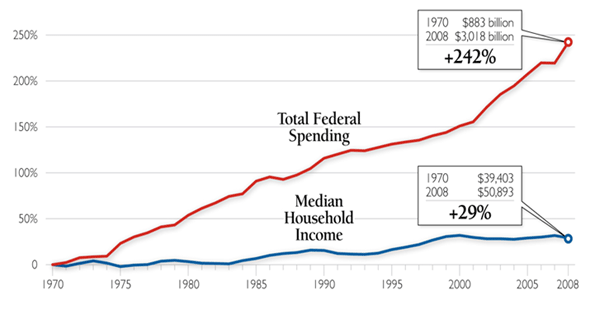
    Like a majority of Americans, Tea Parties are alarmed that government spends too much (Chart from Heritage Foundation) and does so with borrowed money. They understand that our children and grandchildren will be forced to pay for today’s reckless spending. As a result they have gone to the polls in record numbers to make their voice heard. They want the spending to stop and if the politicians do not listen, they will throw them out as their forefathers displaced King George. It does not appear that the politicians are listening. Despite the boisterous town hall meetings of 2009 and a string of primary upsets in 2010, politicians discount the public sentiment. Democratic Congressman Tom Perriello of Virginia recently said, “If you don’t tie our hands, we’ll keep stealing.”


    Source: Heritage Foundation

    What kind of America does the Tea Party want?

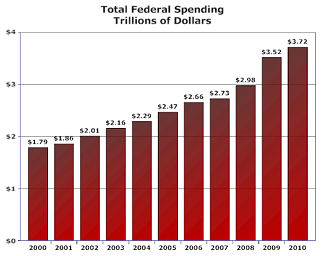
    The Tea Partiers have watched the federal budget double under Bush and Obama at a time hen they have had to cut back on their own family expenditures. (Chart from the Cato Institute) They want a smaller, less intrusive government and most importantly, a government that lives within its means. The Tea Party wants an end to trillion dollar deficits. Where the two political parties accept trillion dollar deficits, The Tea Party demands draconian change in our system of governance. They recognize the need for the coming Great Deconstruction.

    The Cato Institute has offered a website dedicated to downsizing the federal government. Cato outlines clear and concise methods to reduce spending and deconstruct the various departments of government as the Tea Party is demanding. Cato’s author, Chris Edwards, envisions the elimination of entire branches of the federal government by “devolving” various programs to the states.

    The annual savings proposed by the Cato Institute study total more than $400 billion per year. Some call the recommendations draconian and outrageous. Yet the savings represent just 11% of current spending – a critical way to adjust to the new realities of the deconstruction.

    The Second American Revolution may have begun. If it is so, and America earns its independence from trillion dollar budget deficits and professional politicians, the future of America may look very much like Cato study has proposed. No matter what the outcome of the elections in November of 2010, the future will look very different than today as the Great Deconstruction comes to pass.

    ***************************

    Robert J Cristiano PhD is the Real Estate Professional in Residence at Chapman University in Orange, CA and Head of Real Estate for the international investment firm, L88 Investments LLC. He has been a successful real estate developer in Newport Beach California for twenty-nine years.

    Other works in The Great Deconstruction series for New Geography

    Other works in The Great Deconstruction series for New Geography
    Deconstruction: The Fate of America? – March 2010
    The Great Deconstruction – First in a New Series – April 11, 2010
    An Awakening: The Beginning of the Great Deconstruction – June 12, 2010
    The Great Deconstruction :An American History Post 2010 – June 1, 2010
    A Tsunami Approaches – Beginning of the Great Deconstruction – August 2010

  • Light Rail & Left Turns

    Imagine that you own a service station that supplies fuel to the surrounding community, and you specialize in automotive repair. You’re proud that your reputation for service attracts vintage Corvette owners. You worked hard all of your life, and your shop is your equity for retirement. Your business is entirely dependent on customers who enter via a left turn from Boone Avenue, a low traffic street, because drivers cannot get direct access to you from Highway 55, just south of your business.

    One fateful day, a traffic engineer decides that the street serving as access to your station is to be cut off with a concrete median. This leaves no convenient access to your business; no left turn for your customers. Perhaps it was not intentional, but a lower level draftsman at a highway department, or an engineering consultant who never met you and only saw your business from a MapQuest image, decided that this concrete barrier was needed for some unknown-to-you reason. In what seemed like a blink of an eye, the business that you worked so hard all of your life to build was cut off.

    Your income, as well as the value of your business, plummets. Traffic engineers who have never met you have essentially destroyed your life’s earnings, as they drew a squiggle on a plan. Meanwhile the BP Station across the street is maintaining convenient access and flourishing.
    This is a true story. The barrier was installed, and what has remained for years since the business failed and was bull-dozed. It’s a vacant field in what would have otherwise been considered prime real estate.

    This video is an extremely well done representation of the new light rail that connects downtown Minneapolis with downtown St. Paul, right in the center of University Avenue, which is currently lined with hundreds of small businesses, including many small restaurants that are easily accessible from University Avenue by a left turn from half of the passing vehicles. While watching the video, did you notice that the light-rail in the street center eliminates left turns into businesses that are not at the few major intersections between Minneapolis and St. Paul?

    I admit that I’m no traffic engineer, and perhaps I’m not seeing the big picture, so please bear with my opinions, which I hope are based on common sense; you be the judge.

    Opinion #1: Build the light-rail and people will walk instead of driving their cars? Yes, in theory, people may use this new light-rail (based on old technology), and those people will surely choose walking over driving. But theory often conflicts with common sense. This “walkable” theory might work well in San Diego where every day has heaven sent weather. But in this region, there could be a month where 10 degrees below zero is the normal high temperature. Anyone ready for a leisurely stroll in that weather? Yes, there are many Minnesotans who do weather the weather, but many cannot. Going from a warm cozy home to the garage and leaving in the comfort of a car that heats up to toasty within minutes, and then parking close to a destination (in the cold winter or the sweltering summer) is hard to compete with.

    Opinion #2: Building a barrier down the center of a street cannot be good for business. When driving, the only way to access the vast majority of the businesses on the opposite side of the street is to drive a distance to the next major intersection, then make a (probably illegal) u-turn and drive all the way back. Given this choice, most potential customers will bypass the business, and some may choose to stop at the competition on the convenient side of the street.

    Opinion #3: The light rail will result in a considerable increase in fuel usage. Let’s not touch on the logic, argued by some, that the light rail saves energy because people are not in their cars, but instead concentrate just on how residents will get to and from their homes when they are driving. Assuming that the route by car will use University Avenue, which is based in a tight old urbanist (just like new urbanist) grid pattern, it is quite easy and convenient to get home, which is possibly a reason that so many like to live in these areas. Alas, no more of that convenience after the light rail bisects University Avenue. The likely scenario is that you make the left turn and then continue on the high density grid streets to your home. If you live closer to the next intersection, you are likely to continue at a higher speed along University Avenue and then make two left turns to get home. Ultimately, in both cases you will encounter more intersections, which means more accelerate-slow-stop cycles that consume energy and time, and increased distances, which also mean more time and energy. Whatever savings result from the light-rail in the middle of the street are not close to the extra energy consumed by the newly inconvenient vehicle routes.

    Opinion #4: Pedestrians are more endangered by the newly-complex train and traffic scenario. Do all drivers on busy streets stop for the pedestrian in the cross-walk? This one comes close to home. We have a cross-walk between our home in St. Louis Park the coffee shop on Minnetonka Boulevard, a street with much less traffic than University Avenue. My wife insists that we should simply walk across when cars are zooming past, telling me that it’s the law, they must stop. Well, they don’t always. Sometimes a driver in a left lane stops, but the right lane drivers do not see the pedestrian until it’s too late. The video (linked above), shows cars slowing down and stopping at the cross-walks for pedestrians to enter the train station. I’m not so sure that will work out as well on a busy street that’s been made slightly more complex by the light-rail smack in the middle.

    Opinion #5: Pedestrians are about to have a much longer walk. Let’s say you live south of the Light Rail line, between two major intersections, and want to walk across University Avenue to a restaurant on the north side for that delicious Pad Thai you have enjoyed so much for the past 15 years, just a block away. It is a typical January evening, dark, and 25 degrees BELOW zero. Huh, that Light Rail line does not allow you to cross the street, so you go that one block to University, and just 150 feet away is the restaurant – you can taste the Pad Thai! You venture ¼ mile to the next cross walk, cross University, and tread another ¼ mile back to the restaurant. You stop shivering about the time dinner is served. After the meal the wind picks up and the wind chill is 40 below zero. By the time you get home, you cross your favorite restaurant off your list of regular visits. You no longer even think about that side of the street if it is icy; one slip and brittle bones shatter. While this can happen anywhere, creating longer walking distances instead of shorter ones will surely increase the risk.

    A related problem: If you Google Map University Avenue today you will notice parallel parking along both sides of University Avenue in much of its business district. In the video, those spaces are eliminated. This means that all drivers will become pedestrians, trekking longer distances to the businesses. The driving customers must park somewhere… how does that work?

    Opinion #6: Eliminate the light-rail and replace it with a PRT (Personal Rapid Transit) or elevated rail. An elevated PRT or rail system would not require the current vehicular system to change much, it might be able to be built with little interruption to businesses, and certainly the business along both sides of University Avenue will continue apace. Snow? No problem with an elevated system . Of course an elevated system does not interfere with vehicular traffic, and as such would still promote driving. Was the “driving” force behind the ground-based design for the light-rail intended to disrupt cars? Logic suggests that this might be the case.
    Why do we still, in 2010, continue to build transportation systems that have their basis in century old technology? If Dr. Spock from StarTrek was in charge at the DOT, he would certainly find this illogical. And Captain Kirk would surely want elevated systems to zip us off to our destinations at warp speed – don’t you think?

    I’m not convinced that our traffic engineers are as dedicated to a roundabout (see http://www.rhsdplanning.com/roundabout/roundabouts.swf) and light- rail path as our politicians are. I have talked to many engineers over the years that do not seem to be “all on board”.

    If the vision in the video is an accurate representation of how our future will look, Ford Motor Company will be the major winner in this deal. Check it out: It sure looks like the vast majority of cars driving along University Avenue in the future will be new Silver Mustangs – better buy yours today!

    Photo: ‘Go West Young Man’ by TheeErin

    Rick Harrison is President of Rick Harrison Site Design Studio and Neighborhood Innovations, LLC. He is author of Prefurbia: Reinventing The Suburbs From Disdainable To Sustainable and creator of Performance Planning System. His websites are rhsdplanning.com and performanceplanningsystem.com.

  • Political Decisions Matter in State Economic Performance

    California has pending legislation, AB 2529, to require an economic impact analysis of proposed new regulation. Its opponents correctly point out that AB 2529 will delay and increase the cost of new regulation. There will be lawsuits and arguments over the proper methodology and over assumptions. It is not easy to complete a thorough and unbiased economic impact analysis.

    Should California incur the costs and delays of economic impact studies?

    California should, because political decisions matter and too many California politicians don’t believe it. I’ve had a State Legislator, sitting in her office in the Capital, tell me in essence that decisions made in this building won’t impact California’s economy.

    She’s not alone. It is common to hear politicians or their advisors claim that “California will come back” or something similar. They believe that California’s climate and abundant amenities are enough to guarantee prosperity. They are wrong.

    Consider North Dakota, and its booming economy. As of July 2010, North Dakota’s unemployment rate was 3.6 percent, and in 2008, the most recent year for which we have data, its economy grew at a 7.3 percent rate. California’s unemployment rate was 12.3 percent in July 2010, and its 2008 economic growth rate was an anemic 0.4 percent.

    That’s a very big difference. If California had North Dakota’s unemployment rate, it would have over 1.3 million jobs than it has today. That is almost the entire population of Sacramento County and 30 percent more than the entire population of Northern California’s Contra Costa County.

    Why the big difference? Why is North Dakota booming, as the United States suffers its most devastating economic decline in over 70 years? Why is California’s economy, with almost 30 percent higher unemployment than the United States, performing so poorly?

    Does North Dakota have some naturally endowed advantage over California? If so, nobody has noticed it before. It is not climate. California has a friendly Mediterranean climate, while North Dakota has a Northern Continental climate. North Dakota’s mean minimum temperature is below freezing six months of the year, and it gets as low as -60F! Many Californians, living on the coast, can go decades without witnessing a freezing temperature. I remember when we had a multi-day freeze in my hometown of Ventura, sometime in the 1980s. I was freezing; a North Dakotan would be walking around in a t-shirt.

    California has oil and gas. North Dakota has oil and gas. California has over 2,000 miles of beaches. North Dakota doesn’t have beaches. California has magnificent mountains. North Dakota doesn’t have any mountains and only a few hilly areas. Over 20 species of trees reach their largest size in California. Most of North Dakota doesn’t naturally grow many trees.

    Let’s face it. Most Californian’s consider North Dakota to be a cold, windy, God-forsaken piece of dirt best left to the bison. North Dakota’s natural endowment doesn’t explain why it has been growing with vigor while California has been stagnating.

    Maybe North Dakota has been lucky while California has been unlucky? Luck can play a part in economic performance, and North Dakota has almost surely been luckier than California over the past few years, but that can’t be the only explanation.

    It’s hard to point to a single source of North Dakota’s prosperity. Its taxes aren’t particularly low. It has a reasonable safety net for the unfortunate. It does have a booming oil and gas business. Its agriculture sector is doing well. It has a small, but dynamic, tech sector. Its universities remain well funded since the state is actually running surpluses. It has a hardworking, well educated, Midwestern population. Governments and politicians in both parties tend to be business friendly, willing to support business and enter into occasional partnerships. North Dakotans have done lots of things right, and they’ve probably also been a bit lucky.

    It’s just as hard to point to a single source of California’s dismal performance. California hasn’t maximized the economic potential of its oil and gas resources, but its economy is large, and oil and gas alone can’t explain the differences between California and North Dakota. California hasn’t updated its ports to accommodate the most recent and planned ships, but those ports see lots of activity. Many California communities are not business friendly, but some are, particularly some smaller ones inland. California has lost some military bases, but many remain. California is a relatively expensive place to do business, because of taxes and regulation, but California’s workers are more productive, even after adjustment for industrial composition and capital, and California’s consumers still constitute a huge market.

    California’s economy is dying the death of a thousand cuts: a tax here, a regulation there, an unfriendly city council in Coastal California, a lack of infrastructure investment everywhere. These things add up to a significant net negative for California, its businesses, and its workers.

    Californians have done lots of things wrong, and they’ve been a bit unlucky.

    That’s why AB 2529 is a good idea for California, why it’s worth the costs and delays. The analysis will require regulators to consider the economic costs of regulation, something many green activists and Sacramento politicians simply ignore. Perhaps if this regulation had been in place over the past few years, some of California’s 2.2 million unemployed workers would have jobs and once Golden State would not be on the verge of becoming, as historian Kevin Starr has noted, “a failed state”.

    Bill Watkins is a professor at California Lutheran University and runs the Center for Economic Research and Forecasting, which can be found at clucerf.org.

    Photo by Willem van Bergen

  • Suburbia Evolved: Glendale Then and Now

    The classic picture of suburbia is that of white picket fences, the family Chevy in the driveway, and Mom in an apron beckoning her children to abandon the baseball and glove for a home-cooked dinner. Of course, there is nothing wrong with this picture, per se. Nothing wrong except for the fact that it is now becoming more of the exception than the rule among American suburban communities, memorialized best in cultural artifacts like reruns of “Leave It to Beaver.”

    Over the past sixty years, the idealization of this traditional, Rockwell-esque habitat has slowly eroded, leaving only structural-skeletal remains of that old community – the single-family houses, the neighborhood streets, the shopping malls.

    In southern California these remains exist where one might least expect them: eight miles from downtown Los Angeles. The town is Glendale, California, and it’s not what you would imagine, both currently and throughout its history. It is here where you see the fusion of the new suburbia; a new blended reality, part suburb, part city.

    Glendale started out as a farming community, much like the rest of Los Angeles, writes Juliet M. Arroyo in her book Early Glendale. However, it experienced an economic boom in the ’20s with neighboring LA, becoming a bedroom community in the utmost sense of the term. Yet as the town grew, more people lived but also worked in Glendale, creating a relatively independent suburb.
    This independence differentiated it from its neighbors in both lifestyle and demographics. By the time the Civil Rights Movement was beginning its upswing in the late ’50s and early ’60s, some strong and distasteful local reaction resulted. “I heard legends of Nazi factions camped out on the streets leading into [Glendale], oh yes. They made their presence known on Colorado Boulevard, where they had a sort of pseudo-headquarters across from the landmark Bob’s Big Boy restaurant, ” recalls a forty-seven year resident. This intimidation created a de facto boundary between the urban and suburban.

    Over time such extreme behaviors diminished here as they did in much of the rest of the country. Yet even until the early 1990s, Glendale remained a predominantly WASP middle class community, a Republican stronghold in the House of Representatives, maintaining a picture of that comfortable American lifestyle, complete with 75 year-old camphor trees lining side streets.

    Demographic changes in the ’90s played a substantial role in transforming this traditional town that had remained static for so long. A major increase in Hispanics and Asians, but chiefly peoples of the former Soviet Union – Armenians in particular – have risen to take central stage in Glendale’s recent history.

    After the dissolution of the USSR, many Armenians sought refuge in the United States, and a prominent section of their population made their way to Glendale. With three foreign cultures now robustly represented (Armenians, Russian-Armenians, and Iranian-Armenians), the city was transformed. The city’s Armenian population surged, noted the Daily News, by 65 percent between 1990 and 2000, with more than one in four of Glendale’s residents now claiming Armenian descent.

    A new set of challenges emerged with this change. The immigrant groups impacted the community economically, as lower incomes and more people per housing unit (apartments, houses) lowered tax revenues, while increasing demands on public services like the school district. During this time, many of the older residents began to move to Orange County and the Santa Clarita Valley, northwest of the city, following children and grandchildren to areas offering a lower price per square foot. In many cases, they were replaced a third type of resident: the urban commuter.

    Los Angeles had always been nearby, of course, but remained a somewhat distant, urbanized neighbor. Glendale saw low turnover rates in its housing market as original owners held onto their properties. “They liked the community, and didn’t want to leave,” claims longtime Glendale real estate agent Phyllis Cotton. She recalls that the mid-1990s saw a boom in home sales and prices. An attractive feature unique to this market is the existence of “character homes” as opposed to the “cookie-cutters” found in housing tracts in the suburbs further removed from LA. The intrinsic value of these unique homes built in the ’30s is due to the fact that they were usually well-maintained (often sold by the original owner), and situated just minutes from the job markets of Los Angeles and Burbank.

    The local market’s boom attracted a more affluent resident. The neighborhoods where these character homes existed now had three primary types of residents: the remaining original owners or their offspring, immigrant families making their way up the economic ladder, and young(er) professionals looking for a slower paced, more suburban quality of life.

    Yet as the town comes into its own in the 21st century, it offers a lifestyle that is almost anything but quiet and relaxed. Today, Glendale is becoming increasingly reminiscent of an urban center itself than the tranquil suburb it once was. Brand Boulevard, one of its main streets, is lined with local hotspots such as the historic Alex Theater, Porto’s Bakery with its patio chock-full of patrons from all over Los Angeles, as well as the newly minted Americana at Brand. This development is a multi-use property of trendy stores, upscale restaurants, and luxury apartment and condominium residences. With dancing fountains similar to those at the Bellagio in Las Vegas (though admittedly on a much smaller scale), the Americana relates more to the more diverse, younger, affluent population than the profile of Glendale’s original residents.

    Today there is room for just about every type of person in the new Glendale – those seeking both a more urban experience and the more traditional suburban one. “Buyers and sellers are still confident in this market,” asserts Phyllis Cotton, previously introduced above. Homes are retaining their values better than those in other suburbs of Los Angeles. Also, the city’s website reports higher test scores, higher per capita incomes, and lower crime rates than all of its closest neighbors – Burbank, Pasadena, and Los Angeles proper.

    Still, recent growth and its proximity to Los Angeles leads to one important question: when will the line between urban and suburban become so blurred that the two become indistinguishable? If Glendale is the case study, it may be impossible to tell. What we are seeing is something new: an urbanized suburb that offers the diversity and tempo of the big city alongside good schools, safe streets, and single-family homes on relatively large lots. But this transformation may not yet be complete. The challenge for the future may be maintaining Glendale’s character despite the growing urban influence.

    Laura Jean Berger is a senior at Chapman University studying Political Science and Communication Studies. A lifelong resident of Glendale, she is an avid classical pianist and a self-diagnosed political junkie.

    Photo by Renee Silverman

  • Toronto’s Civic Malaise

    Despite Toronto’s international reputation for livability, all is not well in the city. Many politicians and pundits blame the outgoing city council, and Mayor David Miller. While they’ve done their share of damage, the city faces deeper, systemic problems. The source of the problem is more fundamental than stifling bureaucracy, or the stranglehold of the public sector unions. These are symptoms of the institutional sclerosis caused by the amalgamation of Toronto and surrounding areas into the new Toronto Megacity.

    The first taste of this malaise came in the form of a nasty garbage strike last summer. Torontonians waited weeks to have their garbage picked up as it rotted in their front yards. Those who dared to pick up trash for a fee were threatened with legal sanctions. This incident helped propel provincial cabinet minister George Smitherman into the political limelight. The prominent Liberal helped spearhead a volunteer effort to clean up the city. Smitherman was seen by many as the right man to fix what was wrong at city hall. The strike was eventually resolved, but the contract was widely seen as a union payoff. The blowback convinced Mayor Miller not to run for a third term. Smitherman was considered an early frontrunner to replace Miller. He has a reputation for being a maverick who could whip the city into shape. This optimism quickly faded, and it looks increasingly as though the Smitherman could lose.

    There are times when a simple photo shared on Twitter can outrage an entire population. This happened this summer, when a picture of a sleeping toll collector on the Toronto subway ignited months of anger at the city’s public transit system. In the wake of the garbage strike, Torontonians were incensed to see employees sleeping on the job. Frustrated downtown residents were looking for a change, which they assumed would be embodied by Mr. Smitherman. But few commentators seemed to realize what Jaideep Mukerji recently pointed out: while downtown residents are frustrated, suburbanites are downright angry. This has lead to a surge of support for Etobicoke’s hot-headed, penny pinching councilor Rob Ford. Unlike downtown residents, who primarily want to ensure that services such as transit are efficiently delivered, Ford’s supporters want to cut spending, and end the “war on drivers.”

    It turns out that service delivery was only the tip of the iceberg. The true source of the city’s malaise is the realization that amalgamation may have turned Toronto into an ungovernable city, serving neither the suburbs nor the downtown core. Because of this, the election is evolving into a culture war between downtown and the suburbs.

    The Toronto megacity dates back to 1995, when Progressive Conservative Premier Mike Harris attempted to unshackle an economy crippled by unsustainable tax and spend policies and burdensome regulations. In his quest to find efficiencies, Harris commissioned a KPMG study to determine how to make the provinces most populous city run more efficiently. The answer was amalgamation. The study claimed that if the six cities in Metro Toronto were to merge, they could save between $300-$645 million dollars in operating costs per year. These savings could be purchased for a mere $220 million in transition costs—or so the report went. The actual cost ended up being $275 million. More importantly, the operating cost savings were far lower, at $135 million per year. If this were the whole story, the merger would likely be considered a success.

    The theory of amalgamation revolves around saving money by reducing redundant bureaucracy. According to a study by York University economist Harvey Schwartz, the opposite happened. All of the efficiency savings created by amalgamation were dwarfed by a massive increase in city government employment. Between 1997-2008, the city added 4,741 employees. Over the same time period, the operating budget ballooned from $5 billion to $8.1 billion. The promised savings simply never materialized.

    Not only has amalgamation failed to save money, it has also lead to policies that have left neither downtown residents nor suburbanites happy. To a great extent, representatives from the newly annexed cities have felt consistently marginalized. Take, for example, a recent council motion to force all retail stores to have public washrooms. The motion was overwhelmingly popular with councilors from North York, Scarborough, and old Toronto, gaining 77% of their votes. Not so in Etobicoke, and East York, where only 22% of councilors from their old boundaries favored the motion.

    Though public urination or lack of toilets may be an issue in some parts of the megacity, it isn’t necessarily a problem everywhere. Forcing coffee shops in Toronto to have toilets may seem reasonable, though requiring a print shop in Etobicoke to pay for the installation and maintenance of a public washroom is an unjustifiable cost imposition. East York and Etobicoke councilors also overwhelmingly opposed the introduction of a garbage tax, this time with the help of their North York counterparts. Only 25% of their representatives voted for it, while 91% of Toronto and Scarborough councilors voted for it. The motion carried due to the greater population of the core.

    Arguably the most symbolic recent vote in terms of the city’s post amalgamation malaise could be seen in a recent vote on whether non-unionized employees should receive pay increases equivalent to their unionized counterparts. Two thirds of East York and Etobicoke councilors supported the motion, while two thirds of the rest of the megacity opposed it. This vote underscores a core problem with amalgamation: elimination of policy experimentation.

    Amalgamation into megacities is analogous to the decline of federalism in North America. Both the Canadian and American constitutions lay out a division of powers, which allows for varying degrees of policy experimentation. The virtue of this, as later articulated by public choice scholars, is that it lets people vote with their feet. If taxes are too high in Massachusetts, you can move to Maine. If you’re fed up with business regulations in California, you can set up shop in Nevada. On a more local level, you don’t like the regulatory regime in Los Angeles, you can move to Burbank or Calabasas.

    This competition between states and regions impels the more competitively minded jurisdictions to craft policies that will attract people and business. This was one reason for the massive suburban exodus during the 60s and 70s in both Canada and the US. People didn’t like how things were going in major cities, so they packed up and left.

    Amalgamation eliminates this competition. To escape the Toronto tax regime, you need to either move well outside of reasonable commuting distance, or leave the Toronto region all together. Rather than having small cities competing, we have one big city that won’t let you leave. This is the ultimate source of Toronto’s malaise.

    Amalgamation is slowly making its way into a campaign issue. Mr. Smitherman, to his credit, has proposed empowering community councils to decentralize decision making. He even went so far as to say he wants to adopt a “concept of de-amalgamation.” This would be a start, although it still wouldn’t allow for tax competition, or sufficient local control over land use planning, and other major policies.

    Hopefully the fact that amalgamation is becoming an issue in one of North America’s biggest megacities will lead to a rethinking of the concept. Many cities are continuing to move in this direction, largely due to annexation emerging from the core. While many big city politicians feel the need to continually expand, it is to the detriment of their cities. Urban cores have different needs from their suburbs. Amalgamation has left neither old Toronto nor the suburbs happy. Perhaps one day Toronto’s political elites will finally realize that de-amalgamation is necessarily. Unfortunately, the only thing more difficult than a bad marriage is a messy divorce.

    Downtown Toronto photo by Small

    Steve Lafleur is a public policy analyst and political consultant based out of Calgary, Alberta. For more detail, see his blog.

  • California’s Cities Should Look to Oxfordshire

    California, now in the midst of a heated debate on high-speed rail, could learn a thing or two from a few small villages in England about consolidating their opposition. Residents from five villages in Oxfordshire created the Villages of Oxfordshire Opposing HS2 (High-Speed Rail 2) action group to voice their concerns about the proposed project.

    HS2 would link London and Birmingham by 2025, going through Finmere, Mixbury, Fingford, Fulwell, and Newton Purcell in north Oxfordshire. Not only would the rail line greatly alter the countryside landscape, but it would also create an immense amount of noise pollution. Trains would run through these villages at 250 mph about every three minutes. On top of that, rail authorities are giving out little information to citizens who are growing frustrated.

    The Chairman of Villages of Oxfordshire Opposing HS2, Bernie Douglas, wants the group to influence rail authorities to route the line away from the area and raise awareness about the detriments of a high-speed rail line in the countryside. He has certainly succeeded in the latter goal. The group’s meeting in April drew more than 80 people from an area with only 100 homes. However, their efforts for the former cause have been largely in vain. Transport Minister Phillip Hammond and HS2 Ltd, the company behind the project, have not responded to the group’s letters.

    There is hope for Oxfordshire, though. A spokesman for the Department of Transport claims that “No final decision will be made on whether to proceed with a high-speed rail line or on its route until any scheme has undergone a full public consultation.” If this is true, it is almost certain that the rail line will not run through Oxfordshire.

    Cities on the Peninsula have similarly started to band together to oppose the California Rail Authority, who has decided against using the much preferred trench system to cut costs, but opposition remains scattered throughout many different groups. Lawsuits from a few cities and organizations have driven the authority to reconsider the trench system, but the project seems like it will continue to progress, much to the dismay of many unhappy California residents.

    Palo Alto, Menlo Park, and Atherton, who are at the forefront of the opposition, need to gather support from other cities on the Peninsula to truly affect the future of high-speed rail in the state. It is easy for the California Rail Authority, backed by Governor Schwarzenegger, to defend its position from a few cities, but a united Peninsula coalition would be a tough obstacle to overcome. Maybe Burlingame, San Mateo, and their neighbors should take a page out of the book of Oxfordshire and use collective action to more effectively voice their concerns.

  • Iowa’s Agro-Metro Future

    When Brent Richardson, a field rep for Cadillac, was told he’d been transferred to Des Moines, he assumed he’d be spending the next year in a small town environment. Des Moines turned out to have much more bustle than he expected. The city had a robust insurance sector among its diverse industries. And the lifestyle was very similar to what he was able to live in big city suburbs like Naperville, Illinois or Bellingham, Massachusetts. Steeped in a decade of Farm Aid concerts, he also expected the surrounding rural areas to be populated with hardscrabble homesteaders struggling to hang on. Instead, he discovered that farming was big business – and, these days in particular, reasonably profitable. And some of those Iowa farmers turned out to be Cadillac buyers.

    Richardson’s outsider view of Iowa is typical. Few people give it much thought, and those who do conjure up visions of cornfields and American Gothic. There’s some truth to that, but the real Iowa today is much more than that. A resurgent but industrialized agriculture sector and thriving cities give the state a 1-2 “agro-metro” punch, although large areas of the state still struggle.

    Straddling the Midwest and the Great Plains, Iowa is in a region known for trouble. But the state has managed to pile up impressive statistics. Iowa lost fewer jobs than the nation in the last decade, and has consistently maintained a lower unemployment rate. In 2009, Iowa’s unemployment was only 6.0% compared to a national average of 9.3%, a huge differential. Its agricultural sector is booming. So far this year US farm cash incomes were up 23%. That’s increasingly driven by large farm operations, as 75% of farm output comes from just 12% of farms. Iowa is right in the middle of this.

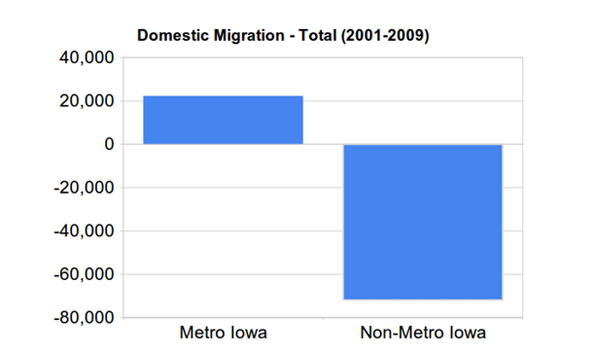
    But if the state as a whole looks reasonably healthy, this obscures its unevenness. Des Moines and big farms are doing well, but many rural and manufacturing communities are not. This is best illustrated by a map of domestic migration over the last decade.

    Net Domestic Migration, 2000-2009, in-migration in gray, out-migration in red. Darker shading denotes intensity.

    This shows net in-migration in grays and net-outmigration in pinks. The darker gray areas are clustered in metro Iowa, which is showing incredible growth, particularly around Des Moines. Des Moines population is actually up 16.5% in the last decade, about double the national average growth rate. In a decade where the US as a whole didn’t add any jobs, Des Moines powered ahead on employment by 9.3%. It’s GDP per capita is actually 12% higher than Chicago’s.

    Many other Iowa metros are likewise doing well. Dubuque recently landed a 1,000 job operation from IBM and grew its employment by over 3% last decade. Dubuque, along with other Iowa metros like Ames and Sioux Falls, grew economic output per capita faster than the average for the rest of America’s cities.

    But for non-metro Iowa, it can be a different story. Some big farmers are doing well, but many places are living up to their Great Plains reputation; they are simply drying up and emptying out. They are too remote, too sparsely populated, too lacking in talent concentrations, and ill prepared for the demands of the global economy.

    As farming transforms, cities thrive, and other areas shrivel, Iowa in changing, splitting into two states as its regions diverge, and becoming increasingly metropolitan in character.

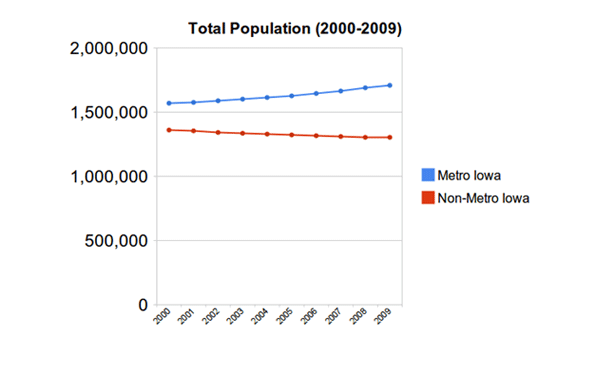
    This divergence is most easily illustrated by a chart of population:

    There are already more people living in metro areas than non-metro areas in Iowa, and the gap is only getting wider. Non-metro Iowa is actually shrinking as people leave and the population re-orders itself in the state:

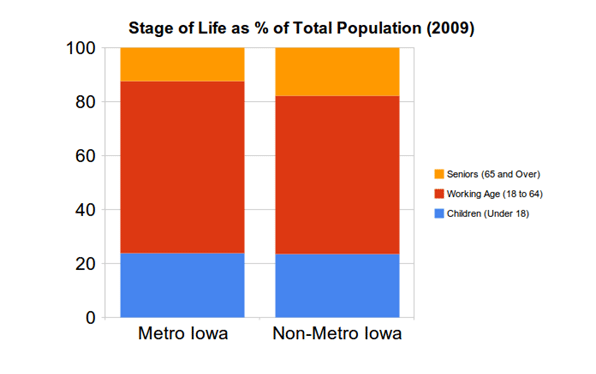
    Non-metro Iowa also has a larger senior population and lower population of working age. Generational turnover will drive even further population declines over time:

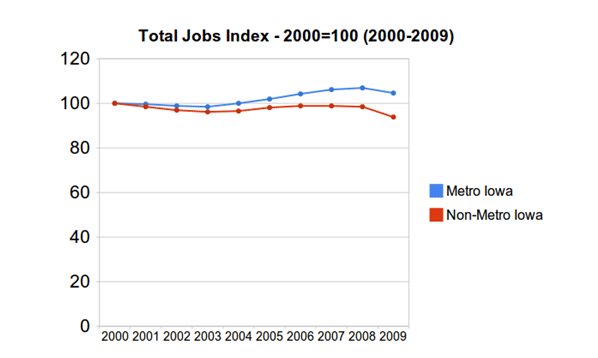
    And of course, these demographic trends are reflected in employment numbers as well, with metro Iowa adding jobs even in the last decade while non-metro Iowa is losing them.

    People’s opinions of Iowa are largely shaped by which of these two states they are looking at. More people tend to think about the struggling parts because that fits the traditional coastal media narrative and those places look big on a map. Iowa’s thriving metro regions are often overlooked because they are smaller and don’t fit the mold espoused by big city urbanists. Des Moines might not look like a Boston or Chicago, but that doesn’t mean it isn’t prosperous – and growing at almost Sunbelt rates.

    Like all of America, Iowa is a state in transition. And while it faces challenges to be sure, it’s managing that change better than most. Iowa’s future is likely to be very different from its small town past. It will be a more urban state, with several thriving metro regions. Farming will remain important, but will increasingly as a big business operation. Iowa’s future will be neither small town nor “hip cool” big city; it will represent the kind of agro-metro future that is emerging across wide swaths of America’s heartland.

    Aaron M. Renn is an independent writer on urban affairs based in the Midwest. His writings appear at The Urbanophile.

    Photo by Pete Zarria