Blog

  • A Pill For Los Angeles? Medicating the Megacities

    Los Angeles — and other modern megacities — conjure increasingly unique genetic profiles that point the way to a new medical industry: Call it urbo-pharmaceuticals. Investors are needed.

    Is there a pill that might inoculate us from smog?
    Is there a gene we can target that would make us resistant to resurgent infectious diseases?
    And is there a way to use genetic data to insulate new immigrants from some of the metabolic challenges of living in a new land of plenty?

    Welcome to the slowly emerging world of environmental medicine and its inevitable outgrowth, environmental pharmaceuticals: compounds specifically suited for mitigating the physiological challenges of mega-city life in the 21st century.

    The inchoate drive for such pills — disparate, proceeding in entrepreneurial fits and starts — is fueled by twin facts.

    First: Inflammation, the chronic-over-firing of the body’s immune system, now sits at the core of almost all scientific discussion of chronic diseases, diseases that persist despite thirty years of lifestyle advice, medication and surgical intervention.

    Second: Urban environments today are physiologically inflammatory beyond belief, their brew of fumes, crowding, germs and bad food wreaking all kinds of internal damage and prompting no end of lifelong medical problems. As Dr Marc Reidl, a specialist in respiratory disease at UCLA puts it, “Mega city life is an unprecedented insult to the immune system.”

    The consequent diseases — asthma and COPD, heart disease, diabetes, alcohol and drug addiction — are costly and life-sapping. They are accentuated by the huge inflows of young populations, many from poor rural environments, from Mexico to the Middle East. These new migrants bring their own unique pathogens, and their own unique vulnerabilities. Poverty fuels excess consumption of cheap fruits and sugars, pushes people into smog-proximate neighborhoods and pest-filled homes, and drives them to unhealthful behaviors. And certain genes — most notably the well-studied “hungry gene” — exacerbate the reaction. Consider:

    Asthma and COPD, considered among the world’s top medical concerns, seem to be activated by special sets of genes, some of which accentuate the impact of smog (along with tobacco smoke, the principle culprit in the industrialized world). Other genetic profiles seem to mitigate it. Researchers at the University of Southern California have identified both versions.

    In the Latino population, mutations in liver genes, particularly one well-known one named CYP450, seem not only to fuel alcohol abuse, but also to accentuate some of its gravest consequences: fatty liver disease and cirrhosis.

    Heart disease, as well as problem pregnancies, uncontrolled diabetes, and even sleep apnea, are increasingly driven not just by the traditional devils of unhealthy lifestyle and poverty, but by genes activated by uniquely urban pathogens and concentrated diesel and auto exhaust.

    Genes governing stress responses may be at the root of why traditional antibiotics do not work within the germy reality of big cities. For years, speaking the words “genes,” “immigrants,” and “public health” was the proverbial ticket to a social and political nether-land. It was almost as bad as talking about obesity. It is still a messy brew.

    Yet outside of “nannyism” (not necessarily such a bad thing), or trying to scare away any new migrants (which is), what can be done? One tack might be to take a cue from modern pharmacology’s attempt to develop a pill for Metabolic Syndrome, the debilitating mix of diabetes, high blood pressure and high cholesterol now prevalent in most developed nations. Can we design an urban poly-pill, one built specifically for the inflammatory storms of the mega-city? And can we point it at what might be called the big three: the impairment of respiration, metabolism and cardio vascular processes?

    UCLA’s Riedl, a specialist in respiratory disease, has zeroed in on oxidative stress — the damage caused by unstable, burned-up nutrient particles in the blood stream. He knew that anti-oxidant supplement regimes have been an overwhelming bust, most of them weak and not very good at targeting the body’s native anti-oxidant systems. Then came a number of insights made possible by genetics. Perhaps the most important was a molecule dubbed GSTM1. It is deeply implicated in fighting oxidative stress from smog and other pollutants. Riedl traced the pathway upstream and found that it was driven by another gene product called Nrf-2.

    Then he decided to pharmaceuticalize one molecule derived from broccoli sprouts, sulphoraphane, crafting a concoction using concentrates of the vegetable mixed with daikon root essence. The result was a compound he could try out in various concentrations in humans, then measure whether its effect on Nrf-2 were, in the lexicon of pharmaceutical development, “dose dependent.” It was. The next step will be to test how well it works in people exposed to constant high levels of smog.

    Though the path to any therapy remains long and arduous, Riedl holds a picture in his mind of one possible future. “The Holy Grail for us is if we could identify the population sub group that is most likely to have the mutation that impairs Nrf-2, and who are environmentally vulnerable —say, people who live close to freeways — and essentially do targeted chemotherapy for environmental insults.”

    Among urban woes, metabolic disorders are particularly troublesome. The NIH has singled out type 2 diabetes and fatty liver disease as the two biggest factors driving hospitalization, amputations and prescription drug use. Their effect on health care expenditure is huge and growing. Treatment — let alone prevention — has proved vexing.

    Two promising compounds are under serious study. The first is the grape skin compound known as Resveratrol. Though mainly known for its claim to extend mammalian lifespan, its true value is quietly emerging in diabetes treatment, where early clinical trials showed promising results but, unfortunately, several safety issues.

    And Metformin, a diabetes drug originally synthesized from the French lilac plant, may have huge protective benefits for urbanites. Researchers at UCLA Riverside have used microchip arrays to discover that it activates liver genes that dampen high insulin levels and vascular inflammation.

    At USC, one of the world’s leading centers for studying diabetes and liver diseases, scholars have pinpointed a gene that, when activated, causes fatty liver disease, another potential urbo-drug target. As Michael Goran, the head of USC’s diabetes research, notes: “In Mexican Americans there is mutation in a gene called PNPLA1 which is related to an elevation in liver fat which could be related to increased diabetes risk and definitely [is] related to longer term increase in liver disease; this mutation is highly prevalent in Hispanics/Mexican Americans; moreover, in our own research we have just discovered that: a) the effect of this gene is manifested very early in life and b) the effect of this gene on increasing liver fat is promoted by high sugar intake.”

    What about the heart? UCLA heart researcher Alan Fogelman, the dean of modern HDL research, has two compounds in small clinical trials that would help the body restore its ability to make good cholesterol, a process increasingly undermined by the smog, virii and bad food of mega-cities. Both are peptides — short, protein-like molecules — that target specific gene products activated by chronic inflammation, which can include everything from the flu to sleep apnea to unchecked diabetes. The compounds are being developed by Bruin Pharma, a commercial venture in which Fogelman is a principal and an officer.

    What are his HDL peptide’s chances? “It is so early to try to tell something like that,” he says. “We have no idea where that effort will take us, or whether it will hit the target we hope. We have to wait for the trials.”

    Yet waiting, especially when it requires patience and foresightedness, is something we as a society seem incapable of, especially when dealing with complicated public health issues. But what if there were a faster, cheaper way? Urbo-pharmaceuticals might be one ticket. After all, we are patient and forgiving when it comes to pills and the time, cost and uncertainty that comes with their development.

    Chalk that up to the ease-seeking nature of humans, something for which there is no pill, but which, in itself, might drive us to invest in a poly pill for modern life.

    Greg Critser’s new book is Eternity Soup: Inside the Quest to End Aging (Random/Harmony 2010).

    Photo by ilmungo / Luigi Anzivino, Los Angeles from the top of Temescal Canyon Trail, “…taken not at sunset, but at 11AM… that pretty peach-colored layer in the sky is the famous LA smog.”

  • Progressives Against Progress

    For the first two-thirds of the twentieth century, American liberals distinguished themselves from conservatives by what Lionel Trilling called “a spiritual orthodoxy of belief in progress.” Liberalism placed its hopes in human perfectibility. Regarding human nature as essentially both beneficent and malleable, liberals, like their socialist cousins, argued that with the aid of science and given the proper social and economic conditions, humanity could free itself from its cramped carapace of greed and distrust and enter a realm of true freedom and happiness. Conservatives, by contrast, clung to a tragic sense of man’s inherent limitations. While acknowledging the benefits of science, they argued that it could never fundamentally reform, let alone transcend, the human condition. Most problems don’t have a solution, the conservatives maintained; rather than attempting Promethean feats, man would do best to find a balanced place in the world.

    In the late 1960s, liberals appeared to have the better of the argument. Something approaching the realm of freedom seemed to have arrived. American workers, white and black, achieved hitherto unimagined levels of prosperity. In the nineteenth century, only utopian socialists had imagined that ordinary workers could achieve a degree of leisure; in the 1930s, radicals had insisted that prosperity was unattainable under American capitalism; yet these seemingly unreachable goals were achieved in the two decades after World War II.

    Why, then, did American liberalism, starting in the early 1970s, undergo a historic metanoia, dismissing the idea of progress just as progress was being won? Multiple political and economic forces paved liberalism’s path away from its mid-century optimism and toward an aristocratic outlook reminiscent of the Tory Radicalism of nineteenth-century Britain; but one of the most powerful was the rise of the modern environmental movement and its recurrent hysterias.

    If one were to pick a point at which liberalism’s extraordinary reversal began, it might be the celebration of the first Earth Day, in April 1970. Some 20 million Americans at 2,000 college campuses and 10,000 elementary and secondary schools took part in what was the largest nationwide demonstration ever held in the United States. The event brought together disparate conservationist, antinuclear, and back-to-the-land groups into what became the church of environmentalism, complete with warnings of hellfire and damnation. Senator Gaylord Nelson of Wisconsin, the founder of Earth Day, invoked “responsible scientists” to warn that “accelerating rates of air pollution could become so serious by the 1980s that many people may be forced on the worst days to wear breathing helmets to survive outdoors. It has also been predicted that in 20 years man will live in domed cities.”

    Thanks in part to Earth Day’s minions, progress, as liberals had once understood the term, started to be reviled as reactionary. In its place, Nature was totemized as the basis of the authenticity that technology and affluence had bleached out of existence. It was only by rolling in the mud of primitive practices that modern man could remove the stain of sinful science and materialism. In the words of Joni Mitchell’s celebrated song “Woodstock”: “We are stardust / We are golden / And we got to get ourselves back to the garden.”

    In his 1973 book The Death of Progress, Bernard James laid out an argument already popularized in such bestsellers as Charles Reich’s The Greening of America and William Irwin Thompson’s At the Edge of History. “Progress seems to have become a lethal idée fixe, irreversibly destroying the very planet it depends upon to survive,” wrote James. Like Reich, James criticized both the “George Babbitt” and “John Dewey” versions of “progress culture”—that is, visions of progress based on rising material attainment or on educational opportunities and upward mobility. “Progress ideology,” he insisted, “whether preached by New Deal Liberals, conservative Western industrialists or Soviet Zealots,” always led in the same direction: environmental apocalypse. Liberalism, which had once viewed men and women as capable of shaping their own destinies, now saw humanity in the grip of vast ecological forces that could be tamed only by extreme measures to reverse the damages that industrial capitalism had inflicted on Mother Earth. It had become progressive to reject progress.

    Rejected as well was the science that led to progress. In 1970, the Franco-American environmentalist René Dubos described what was quickly becoming a liberal consensus: “Most would agree that science and technology are responsible for some of our worst nightmares and have made our societies so complex as to be almost unmanageable.” The same distrust of science was one reason that British author Francis Wheen can describe the 1970s as “the golden age of paranoia.” Where American consumers had once felt confidence in food and drug laws that protected them from dirt and germs, a series of food scares involving additives made many view science, not nature, as the real threat to public health. Similarly, the sensational impact of the feminist book Our Bodies, Ourselves—which depicted doctors as a danger to women’s well-being, while arguing, without qualifications, for natural childbirth—obscured the extraordinary safety gains that had made death during childbirth a rarity in developed nations.

    Crankery, in short, became respectable. In 1972, Sir John Maddox, editor of the British journal Nature, noted that though it had once been usual to see maniacs wearing sandwich boards that proclaimed the imminent end of the Earth, they had been replaced by a growing number of frenzied activists and politicized scientists making precisely the same claim. In the years since then, liberalism has seen recurring waves of such end-of-days hysteria. These waves have shared not only a common pattern but often the same cast of characters. Strangely, the promised despoliations are most likely to be presented as imminent when Republicans are in the White House. In each case, liberals have argued that the threat of catastrophe can be averted only through drastic actions in which the ordinary political mechanisms of democracy are suspended and power is turned over to a body of experts and supermen.

    Back in the early 1970s, it was overpopulation that was about to destroy the Earth. In his 1968 book The Population Bomb, Paul Ehrlich, who has been involved in all three waves, warned that “the battle to feed all of humanity is over” on our crowded planet. He predicted mass starvation and called for compulsory sterilization to curb population growth, even comparing unplanned births with cancer: “A cancer is an uncontrolled multiplication of cells; the population explosion is an uncontrolled multiplication of people.” An advocate of abortion on demand, Ehrlich wanted to ban photos of large, happy families from newspapers and magazines, and he called for new, heavy taxes on baby carriages and the like. He proposed a federal Department of Population and Environment that would regulate both procreation and the economy. But the population bomb, fear of which peaked during Richard Nixon’s presidency, never detonated. Population in much of the world actually declined in the 1970s, and the green revolution, based on biologically modified foods, produced a sharp increase in crop productivity.

    In the 1980s, the prophets of doom found another theme: the imminent danger of nuclear winter, the potential end of life on Earth resulting from a Soviet-American nuclear war. Even a limited nuclear exchange, argued politicized scientists like Ehrlich and Carl Sagan, would release enough soot and dust into the atmosphere to block the sun’s warming rays, producing drastic drops in temperature. Skeptics, such as Russell Seitz, acknowledged that even with the new, smaller warheads, a nuclear exchange would have fearsome consequences, but argued effectively that the dangers were dramatically exaggerated. The nuke scare nevertheless received major backing from the liberal press. Nuclear-winter doomsayers placed their hopes, variously, in an unverifiable nuclear-weapons “freeze,” American unilateral disarmament, or assigning control of nuclear weapons to international bodies. Back in the real world, nuclear fears eventually faded with Ronald Reagan’s Cold War successes.

    The third wave, which has been building for decades, is the campaign against global warming. The global-warming argument relied on the claim, effectively promoted by former vice president Al Gore, that the rapid growth of carbon dioxide in the atmosphere was producing an unprecedented rise in temperatures. This rise was summarized in the now-notorious “hockey stick” graph, which supposedly showed that temperatures had been steady from roughly ad 1000 to 1900 but had sharply increased from 1900 on, thanks to industrialization. Brandishing the graph, the UN’s Intergovernmental Panel on Climate Change predicted that the first decade of the twenty-first century would be even warmer. As it turned out, temperatures were essentially flat, and the entire global-warming argument came under increasing scrutiny. Skeptics pointed out that temperatures had repeatedly risen and fallen since ad 1000, describing, for instance, a “little ice age” between 1500 and 1850. The global-warming panic cooled further after a series of e-mails from East Anglia University’s Climatic Research Unit, showing apparent collusion among scientists to exaggerate warming data and repress contradictory information, was leaked.

    As with the previous waves, politicized science played on liberal fears of progress: for Gore and his allies at the UN, only a global command-and-control economy that kept growth in check could stave off imminent catastrophe. The anti-progress mind-set was by then familiar ground for liberals. Back in the 1970s, environmentalist E. J. Mishan had proposed dramatic solutions to the growth dilemma. He suggested banning all international air travel so that only those with the time and money could get to the choice spots—thus reintroducing, in effect, the class system. Should this prove too radical, Mishan proposed banning air travel “to a wide variety of mountain, lake and coastal resorts, and to a selection of some islands from the many scattered about the globe; and within such areas also to abolish all motorised traffic.” Echoing John Stuart Mill’s mid-nineteenth-century call for a “stationary state” without economic growth, Mishan argued that “regions may be set aside for the true nature lover who is willing to make his pilgrimage by boat and willing leisurely to explore islands, valleys, bays, woodlands, on foot or on horseback.”

    As such proposals indicate, American liberalism has remarkably come to resemble nineteenth-century British Tory Radicalism, an aristocratic sensibility that combined strong support for centralized monarchical power with a paternalistic concern for the poor. Its enemies were the middle classes and the aesthetic ugliness it associated with an industrial economy powered by bourgeois energies. For instance, John Ruskin, a leading nineteenth-century Tory Radical and a proponent of handicrafts, declaimed against “ilth,” a negative version of wealth produced by manufacturing.

    Like the Tory Radicals, today’s liberal gentry see the untamed middle classes as the true enemy. “Environmentalism offered the extraordinary opportunity to combine the qualities of virtue and selfishness,” wrote William Tucker in a groundbreaking 1977 Harper’s article on the opposition to construction of the Storm King power plant along New York’s Hudson River. Tucker described the extraordinary sight of a fleet of yachts—including one piloted by the old Stalinist singer Pete Seeger—sailing up and down the Hudson in protest. What Tucker tellingly described as the environmentalists’ “aristocratic” vision called for a stratified, terraced society in which the knowing ones would order society for the rest of us. Touring American campuses in the mid-1970s, Norman Macrae of The Economist was shocked “to hear so many supposedly left-wing young Americans who still thought they were expressing an entirely new and progressive philosophy as they mouthed the same prejudices as Trollope’s 19th century Tory squires: attacking any further expansion of industry and commerce as impossibly vulgar, because ecologically unfair to their pheasants and wild ducks.”

    Neither the failure of the environmental apocalypse to arrive nor the steady improvement in environmental conditions over the last 40 years has dampened the ardor of those eager to make hair shirts for others to wear. The call for political coercion as a path back to Ruskin’s and Mishan’s small-is-beautiful world is still with us. Radical environmentalists’ Tory disdain for democracy and for the habits of their inferiors remains undiminished. True to its late-1960s origins, political environmentalism in America gravitates toward both bureaucrats and hippies: toward a global, big-brother government that will keep the middle classes in line and toward a back-to-the-earth, peasantlike localism, imposed on others but presenting no threat to the elites’ comfortable lives. How ironic that these gentry liberals—progressives against progress—turn out to resemble nothing so much as nineteenth-century conservatives.

    This essay originally appeared in City Journal.

    Fred Siegel is a contributing editor of City Journal, a senior fellow at the Manhattan Institute, and a scholar in residence at St. Francis College in Brooklyn.

    Photo: CarbonNYC

  • City of Austin Approves Big Greenfield Development

    Despite its smart growth policies, the city of Austin has approved a new development on the urban fringe that will include new detached housing starting at $115,000.

    Austin is the third fastest growing metropolitan area with more than 1,000,000 residents in the United States, following Raleigh, North Carolina and Las Vegas. The city of Austin accounted for 53% (672,000) of the metropolitan area’s 1.27 million population in 2000, but has seen more than 70% of the growth since that time go to the suburbs. Now the metropolitan area has 1.65 million people, and the city has 785,000.

    The Austin metropolitan area managed to experience only modest house price increases during the housing bubble, though other metropolitan areas in Texas (Dallas-Fort Worth, Houston and San Antonio) did even better (see the Demographia International Housing Affordability Survey). Austin’s Median Multiple (median house price divided by median household income) peaked at 3.3, slightly above the historic maximum norm of 3.0. Like other Texas markets, there has been little price decline during the housing bust, illustrating the lower level of price volatility and speculation identified by Glaeser and Gyourko with less restrictive land use regulation. This stability has helped Texas weather the Great Recession better than its principal competition, the more intensely regulated states of California and Florida.

    The city of Austin, however, is rare in Texas for generally favoring the more restrictive (smart growth) land use policy devices that have been associated with the extreme house price escalation in California, Florida, Portland, and many other metropolitan areas. The city’s freedom, however, to implement the most draconian policies and drive house prices up is severely limited by far less restrictive land use policies in the balance of its home county (Travis), neighboring Williamson County (usually among the fastest growing in the nation), Hayes County and the other counties in the metropolitan area.

    Austin is competing. This is illustrated by the recent Austin city council action to approve a new “mega” development on the urban area’s eastern fringe that could eventually add 5,000 new houses, town houses and apartments. The first phase will be 350 detached houses that the developer indicates will be priced from $115,000 to $120,000 (including land), an amount less than a building lot San Diego, Los Angeles, Vancouver and Australia.

    By comparison with other developments in the Austin area, however, these houses may be expensive. One home builder is currently advertising new detached houses, only 7 miles from downtown Austin for $90,000. These are not the least expensive in Texas. Detached houses in Houston are being advertised for $79,000.

    A case study in the 3rd Annual Demographia International Housing Affordability Survey showed that the median income Austin household could purchase the median priced house for 11 years less income than in Perth, Australia (this includes mortgage interest). While both Austin and Perth have been growing rapidly, Austin’s faster growth is evidence of stronger demand, which, all things being equal, would have been expected to drive house prices up more than in Perth. But, with more restrictive land use regulation, all things are never equal.

  • America’s 21st-Century Business Model

    Current attitudes aren’t too kind to the old American way of doing business. In our globalized economy, the most enthusiastically touted approaches are those adopted by centralized, state-dominated economies such as China, Brazil and Russia as well as–somewhat less oppressively–those of the major E.U. states.

    Yet the U.S. may well be constructing the best sustainable business model for the 21st Century. It is an approach built on the country’s greatest enduring strength–an innovative business culture driven increasingly by a diverse pool of immigrants.

    This model, of course, lacks the kind of centralized control beloved by many pundits. Yet its virtues are also missing from statist-oriented European or East Asian capitalism. These other regions’ systems may be more disciplined in their thinking, but they do not draw as well on the diversity of human experience and connections that drive America’s post-racial economy.

    This is not to suggest that state-based, national capitalism is inferior, but that it may not apply so well to this vast, highly diversified economy–just look at the stimulus. If the U.S. wants to retain pre-eminence, it needs to go with what makes it a great country: its protean national and increasingly post-racial business culture.

    This evolution is increasingly evident at the very top of our economy. Between 1990 and 2005 immigrants started one quarter of all venture-backed public companies. Large American firms are also increasingly led by people with roots in foreign countries, including 14 of the CEOs of the 2007 Fortune 100. Even the top tier of corporate America–once the almost-exclusive reserve of native-born Anglo-Saxon–increasingly reflects the diversification of the larger society.

    Already, for example, eight Indian American CEOs run U.S. corporations with over $2 billion in sales, including companies like Citicorp, Adobe Systems and Pepsico. Pepsi’s historic rival, Coca Cola, is now run by Muhtar Kent, a native of Turkey. Foreign CEOs also include Kellogg’s Australian-born David Mackay and Ethan Allen’s M. Farooq Kathwari, yet another native of India.

    This process will intensify in the coming decades. Take for instance the case of Li Lu, a former Tiananmen Square activist now widely expected to take the helm of Warren Buffett’s Berkshire-Hathaway when the old billionaire retires. Imagine if a former American radical was placed in charge of one of China’s huge state-supported enterprises. Not likely.

    One critical harbinger can be seen in the current crop of students at top U.S. business schools. Between one-third and one-half all students at Stanford, MIT, University of Pennsylvania, University of Chicago and UC Berkeley come from abroad. These schools are training camps for immigrants transitioning into careers as American entrepreneurs.

    Equally important, immigrant commerce also thrives at the grassroots level. It manifests most visibly in the proliferation of small stores, restaurants, food-processing businesses, garment factories and trucking lines. Overall, immigrants are 60% more likely to start a new business than native-born Americans. The number of self-employed immigrants has grown even in New York City, where the number of self-employed among the native-born has dropped.

    Immigrant businesses have thrived by providing basic services, such as banks, insurance agents, funeral homes and grocery stores. Some of these businesses arose because the mainstream community had failed to identify opportunities in these markets or had consciously decided to exclude them.

    This follows a historical pattern. In the past many immigrants succeeded by focusing on an economic specialty–Jews in the garment industry, Chinese in laundries, Greeks in diners, and Italians in green groceries, barbershops and fish stores. Ultimately, some moved beyond these niches and began to develop whole new business models. One clear example is A. P. Giannini’s Bank of Italy in San Francisco, which eventually became Bank of America, a pioneer in mass market branch banking. Other ethnic businesses, often drawing on ways of doing business brought from abroad, have propelled the growth of whole industries, such as the garment industry in New York and later Los Angeles.

    There is clearly something in the immigrant experience that encourages innovation–one can call it the advantage of non-acceptance. Take the founding generation of the film industry–Samuel Goldwyn, Louis B. Mayer, Harry Cohn, Jesse Lasky, Adolph Zukor. They had their roots in the Jewish enclave economy in the eastern cities. The great historian Irving Howe notes that the immigrant need to find an unoccupied or underserved niche shaped these often “vulgar, crude and overbearing” men. That they became founders of the nation’s premier cultural industry, Howe noted, “was something of a miracle and something of a joke.”

    We are now witnessing a continuation of this process, and on a scale simply not seen in other countries. In 2005 the U.S. swore in more new citizens than the next nine countries put together. The national immigration debate may focus largely on low-skilled newcomers, but more than half of all skilled immigrants in the world also come to the U.S. Even with the continent’s slow-growing population, Europe continues to be a major source of American immigrants, particularly skilled workers, with some 400,000 E.U. science and technology graduates residing in the U.S.

    These newcomers are a prime source of entrepreneurial vitality. In the 21st century Asians, like the Jews and Italians before them, have concentrated in specific niches and expanded outside the boundaries of historic ghettos. Indians from the subcontinent, who arrived in large numbers starting in the 1970s, specialized in hotels and motels across the country. Koreans opened up green groceries in New York and Los Angeles. Vietnamese became well-known for nail parlors, and Cambodians for owning doughnut stores. Overall Asian enterprises expanded roughly twice the national average through the first several years of the new century.

    This pattern can be seen particularly in food-related businesses. In Houston, once dominated by Southern cooking, nearly one in three restaurants serves Mexican or Asian cuisine. Together they account for more establishments than hamburger, BBQ and Italian restaurants put together. Nationwide, as pizza, hamburger and “traditional” fast-food restaurants have stagnated, new chains that sell quick, inexpensive Mexican or Asian food have flourished. Immigrant-founded firms such as El Pollo Loco, Wolfgang Puck and Panda Express, are emerging as the McDonalds of 21st-century America.

    The emerging post-racial economy provides two distinct opportunities for American business. First the newcomers offer a new domestic “emerging” market. Taken together, purchases by African-Americans, Asians and Native Americans, according to the Selig Center for Economic Growth at the University of Georgia, have exploded, growing far more rapidly than the national average. Combined with Latinos, these minorities could account for over $2.5 trillion by 2010, close to $1 in every $4 in total U.S. consumer spending.

    But perhaps even more important may be the uniquely international cast of American business. Heads of corporations and senior executives of many leading American firms will not have to go to graduate school in international training; they will have received theirs at home, talking to parents or grandparents who migrated from Mexico, Cuba, Russia, Iran, China, India, Israel or a host of other countries.

    This diversity will allow Americans to tap the global market, and culture, in ways other countries and their state-based enterprises just can’t match. It is in this model, not in imitating foreign ones, that American business can find the path to greater success in the globalized, dispersed economy of the 21st century.

    This article originally appeared at Forbes.com.

    Joel Kotkin is executive editor of NewGeography.com and is a distinguished presidential fellow in urban futures at Chapman University. He is author of The City: A Global History. His newest book is The Next Hundred Million: America in 2050, released in February, 2010.

    Photo by SEIU International

  • What’s Behind China’s Big Traffic Jam

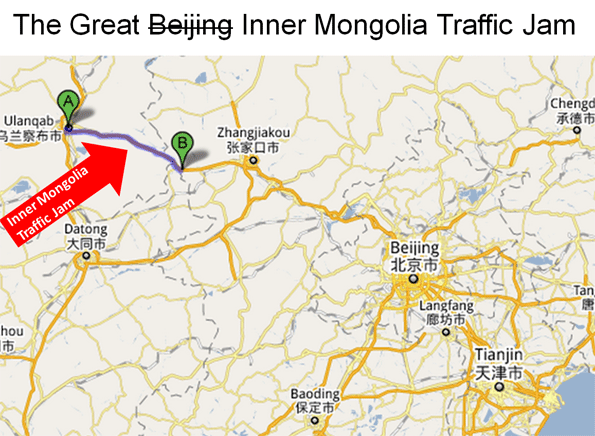
    The world press has been fixated on the “Beijing” traffic jam that lasted for nearly two weeks. There is a potential lesson here for the United States, which is that if traffic is allowed to far exceed roadway capacity, unprecedented traffic jams can occur.

    The Inner Mongolia Traffic Jam: First we need to understand that this was not a “Beijing” traffic jam at all,or even on the outskirts of Beijing. The traffic jam came no closer to Beijing than 150 miles (250 kilometers) away, beyond the border of the city/province of Beijing, through the province of Hebei and nearly to the border of Inner Mongolia. The traffic jam then extended for more than 60 miles (100 kilometers) from near the Inner Mongolia border to Jingxi, in the region/city of Ulanqab. In reality this would be like calling a New York City traffic jam something that originated from Springfield, Massachusetts to Boston’s I-495 beltway (Figure 1).

    However, even the New York City example understates the complexity of the Chinese traffic jam. Beijing, China’s national capital, is one of the world’s largest urban areas (with a population of nearly 14 million). The city is situated at the northwestern limit of the densely populated part of China (which is called “China Proper”) that runs from Manchuria in the north to Yunnan in the south.

    Beijing’s urbanization ends at the mountains less than 30 miles from the Forbidden City, Beijing’s core. The area beyond the mountains, through which the Great Wall runs, possesses only intermittent and generally minor urbanization. The area is dominated by grassland, and some rice farming. In this environment, it is not surprising that there were few alternatives for traffic to the G-110 Expressway (freeway), just as there would be few alternatives for traveling between Casper and Cheyenne, Wyoming on Interstate 25.

    Continuing the I-25 comparison, the Inner Mongolian traffic jam more closely resembled traffic destined for Denver, with the congestion stretching from north of Cheyenne for another 60 miles, not far from the south end of the Powder River Basin, America’s largest coal producing region. This is a particularly appropriate comparison, because the type of traffic that caused the Inner Mongolian jam, coal trucks, would similarly jam I-25, were it not for the high-capacity freight rail system that moves most of the coal from the Powder River Basin to the nation’s electricity generation plants in the Midwest, East and South.

    Like Interstate 25, the G-110 Expressway is a high quality divided and grade separated four lane road. As with Wyoming’s I-25, Inner Mongolia has an old 2-lane road (National Route 110) that parallels the G-110 for much of the way. This is not a viable alternative for the truck traffic volumes that are needed to supply the megacity of Beijing with its electric power.

    Beijing’s First World Traffic: The Beijing city commission has announced that traffic flows continue to slow in Beijing. In the first half of 2010, the average speed dropped to 14 miles per hour (24 kilometers per hour). This is despite the fact that the urban area has a world class expressway system, with a fifth ring expressway (beltway) mostly completed (Note 1) and radial expressways feeding the inner areas. The surface arterial system in the inner area consists of a dense network of wide streets, providing capacity that certainly exceeds that of the city of Chicago or the four highly urbanized boroughs of New York, Manhattan, Brooklyn, the Bronx, and Queens (Note 2).

    Beijing’s inner area traffic congestion is like that of New York City. The population density is 30,000 people per square mile (the approximate density also of the four New York boroughs), too high to move the volume of traffic over a freeway and expressway system. Higher population densities are associated with greater traffic congestion, slower speeds, stop and go traffic and more intense pollution. Beijing and New York share all of these conditions.

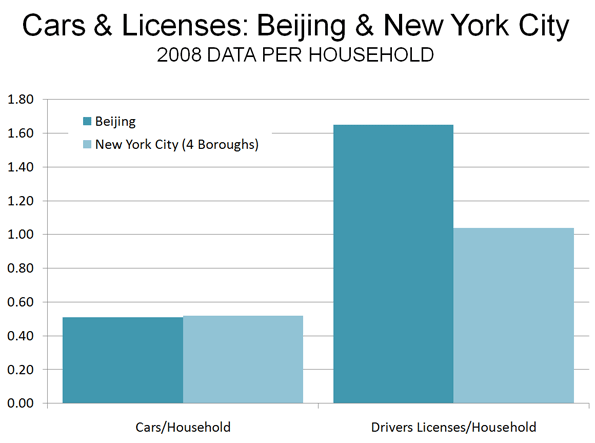
    There is a perception that the traffic situation could become substantially worse in Beijing, and that could well be the case. However, it is surprising that the Bejing (the city/province) is already well along in private vehicle ownership and use. Beijing has achieved a car ownership rate almost equal to that of New York City’s dense boroughs. In 2008, the dense boroughs of New York City had 0.52 cars per household, while Beijing had achieved a 0.51 rate. One report now places Beijing’s car ownership one third higher than in 2008, which would place Beijing’s car ownership rate 20% above that of New York City.

    By 2008, Beijing already had 1.5 times as many drivers per household as New York City’s dense boroughs (Figure 2). The difference appears to be in commercial drivers licenses, which account for nearly one-half of Beijing’s 9.4 million driver’s licenses. With the coal truck traffic and heavy truck traffic to the port of Tianjin, little more than 100 miles (160 kilometers) away, it is possible that trucks comprise a higher share of the traffic volume in Beijing than in New York City (Note 3).

    Local authorities are seeking to reduce the traffic congestion problem by building one of the world’s largest Metro (subway) systems. By the middle of the decade, nearly 350 miles (561 kilometers) should be open. Some lines will extend to outside of the fifth ring road, where much of the population growth is occurring. The Beijing Metro, like that of Mexico City, has been designed to better serve the contemporary urban area. Both are characterized by a concentration of grid routes and less by radial routes. Beijing also has ring routes. This design is especially appropriate for Beijing, which as is typical for many large Asian urban areas and unlike New York, Chicago or Hong Kong, has a decentralized core. Large office buildings in the center are more sparsely spread around a larger area, larger than these concentrated central business districts. Yet, even with this appropriate route design, the decentralization of retail and office activity necessitates time-consuming transfers that can make cars faster, even in Beijing’s traffic.

    China is also encouraging the use of electric cars, subsidizing buyers willing to switch from cars powered by fossil fuels. This will not ease traffic congestion, but it will reduce air pollution.

    At the same time, a period review of traffic conditions on the Internet will show Beijing’s worst traffic congestion to be concentrated in the high density core while in the much less dense expanding suburbs, traffic conditions are considerably better. Additionally, there is discussion of a seventh ring road and Beijing officials continue to improve their roadway network. As in US urban areas, Beijing’s continued decentralization could allow traffic to eventually be managed. Economists Peter Gordon and Harry W. Richardson have found that “suburbanization has been the dominant and successful mechanism for reducing congestion.”

    Clearing the Traffic: Meanwhile, there are reports that authorities have eased the traffic jam in Inner Mongolia. A longer term solution might be to add a couple of additional lanes in each direction. This should not be too difficult in a nation that by the end of the year will have nearly as many miles of freeway (43,000 or 70,000 kilometers) as the original US interstate system and will probably lead the world early in the next decade. This is a key to improving the competitiveness of Chinese urban areas. Sufficient roadway investment to handle growing travel demand will be just as important to maintain the competitiveness of US urban areas.

    —-

    Note 1: Beijing has six ring roads, however the first is the arterial road surrounding the Forbidden City, which is not an expressway.

    Note 2: Staten Island is excluded because its urban form is principally that of a post-war suburb, with a much lower population density.

    Note 3: This assumes comparability of data, which may not be fully reliable due to incomplete information.

    —-

    Wendell Cox is a Visiting Professor, Conservatoire National des Arts et Metiers, Paris and the author of “War on the Dream: How Anti-Sprawl Policy Threatens the Quality of Life

    Photo of Beijing Fourth Ring Road by archlife

  • Commuter Rail Brings Slower Transit in Austin

    Commuter rail is often sold to the public as a faster means of travel than buses. This can be true if the drive to the park and ride lot is short and your destination is within walking distance of a station. However, it is apparently not true in Austin.

    The Austin American-Statesman reports that bus riders showed up at a Capital Metro hearing this week to oppose cancellation of two express bus routes that parallel the new commuter rail line. Their complaint? Taking the train takes longer.

    As has become typical for new urban rail projects, Austin’s commuter rail line is carrying considerably fewer riders than projected. During its first month of service, daily ridership averaged 900 (450 each way), less than one-half the projected 2,000. This is less than 1/100th of Capital Metro’s daily bus ridership.

  • Australia 2010: Unstable Politics in a Prosperous Country

    2010 has been something of an annus mirabilis in Australian politics. On 24 June a prime minister was dumped before facing the voters a second time. This was the first time ever for such an early exit. Then the election on 22 August produced a “hung parliament”, an outcome not seen since the 1940s. Having fallen short of enough seats to form government, the major parties are scrambling for the support of four independents and one Green in the House of Representatives.

    If this looks like the politics of a nation mired in economic upheaval, the reality is far different. Australia was one of a handful of advanced countries to avoid recession during the financial crisis. The unemployment rate never rose much above 5 per cent. For some economists, Australia is “the wonder from down under”.

    So why did the Labor government, elected in 2007, fall apart? There was certainly a lack of governing experience after eleven years in opposition. But in a broader sense, the political class is struggling to cope with Australia’s increasingly regionalised economy, and the divergent sources of its new-found prosperity.

    Like many industrialised countries, Australia passed through a seemingly intractable malaise in the 1970s. The country’s predicament appeared worse than that of more diverse and innovative economies like the United States. Relying on agricultural and mineral exports, legacies of a colonial past, Australia’s manufacturing base was inward-looking, outmoded and sclerotic. Disparaging assessments like that of former Singapore Prime Minister Lee Kwan Yew – Australians were destined to be “the poor white trash of Asia” – were common. Some fretted about “the Argentine route”, a country failing to diversify its economy and sliding down world rankings of GDP per capita. As transformed manufactures and high-tech products gobbled up an increasing share of world trade, Australia seemed stuck in the slow lane of commodity exports.

    And then came the 1980s. Protective barriers were slashed, the currency was floated, the financial system was opened up to foreign banks and state-owned agencies were sold off or treated to radical micro-economic reform. By the mid-2000s, the contours of the economy had changed. Activities such as business and property services rose from 10 to almost 15 per cent of GDP over the decade to 2006. Meanwhile manufacturing declined from 15 to 12 per cent. The new economy was dominated by services, now accounting for 68 per cent of GDP. Rather than drag down the economy, however, mining enjoyed parallel growth, from 4.5 to 8 per cent in the same period. China’s explosive arrival on the world scene shifted commodity exports into a very fast lane. These developments set Australia on a growth path that few could have foreseen in the 1970s. A small economy in relative terms to countries like China and the United States, it has evolved into a series of distinct geographic regions.

    The booming commodities export sector, dominated by mining, is concentrated in the northern and western states of Queensland and Western Australia, which account for 74 per cent of onshore mining production. Business and property services are concentrated in the south-eastern states of New South Wales and Victoria, specifically the inner precincts of Sydney and Melbourne, the nation’s emerging global cities. Together, these cities host around 50 per cent of Australia’s finance industry jobs. Public sector services, mostly in health and education, figure prominently in the populous south-east, again skewed towards long-established inner-city localities, where the most prestigious institutions are found. Construction, consumer services, including retail, and light manufacturing, fuelled by demand for household goods and building supplies, thrive in the larger metropolitan regions with high rates of immigration and population growth, like outer Sydney and Melbourne, and increasingly south-east Queensland.

    At the end the true driver of the economy lies with commodities. Today mineral resources make up just under 80 per cent of Australia’s commodity trade and around half of all exports (including services). Australia is the world’s leading exporter of coal and iron ore and ranks high other minerals like zinc and aluminium.

    Reaping the China bounty, former Prime Minister John Howard kept the federal budget in surplus and reduced government debt to zero, while handing out tax cuts and family income supplements. This winning combination delivered Howard eleven years in power. Towards the end of his rule, however, strains in the boom economy began to manifest themselves. Skilled labour shortages and the heated property market began to put pressure on inflation and interest rates, contributing to a sense of policy exhaustion in Howard’s later years.

    By 2007, there was a widespread view that the benefits of the resources boom were not being distributed fairly. The service sector professionals of the south-east, especially in the public sector who dominate the national media, began to shift to Labor as did outer suburban workers, who saw the dream of home ownership slipping beyond their reach. Forced to compete for investment in the open economy, south-eastern state governments, controlled by Labor, were constrained to keep taxes low. An ever larger proportion of their budgets was channelled into health and education services, partly due to close links with powerful public sector unions. There was little left to pay for urban infrastructure on the booming fringes.

    In response, infrastructure costs were shifted onto developers and local government, along with a new set of regulations, and urban consolidation (“smart growth”) was enforced as planning policy, ostensibly to reduce the need for extra resources. These choices reflected the green ideology taking hold in the planning profession, as well as among the professional classes.

    The impact of these measures on housing affordability were disastrous. When the low interest rates of the Howard years began to creep up, the problem turned into a crisis, as the Demographia survey has shown. The property market slowed down, depriving the south-eastern states of even more funds, since property taxes are a significant share of their revenues. This contrasted with conditions in the mining states, prompting the Federal Treasury Secretary to declare Australia a “two speed economy”.

    At the 2007 election, Labor leader Kevin Rudd claimed to have the solutions. Paying lip service to Howard’s fiscal conservatism, he signalled plans to divert mining boom proceeds towards infrastructure and services, including a new deal on health funding and an “education revolution“. Much of this was wrapped up in the rhetoric of climate change, talked up by Rudd as “the greatest moral challenge of our time”. His environmental centrepiece was an Emissions Trading Scheme (cap and trade), a massive revenue raising device for the federal government. In essence it was a mechanism for transferring wealth from the mining states, and their fossil-fuelled economies, to the populous south-east.

    Rudd’s electoral success, and apparent public support for climate action, drove the agenda forward until the crash at Copenhagen. This precipitated a revolt in the opposition Coalition, which replaced ETS supporter Malcolm Turnbull with climate-sceptic Tony Abbott. When Abbott labelled the ETS “a great big new tax on everything“, and blocked its passage in the Senate, public interest in the scheme melted away, particularly in the mining regions. Rudd lost his nerve and shelved it until 2012. For many Australians, he was exposed as a weak leader without the courage of his convictions.

    Rudd refused to give up his dream of redistribution though, turning to Plan B. Having commissioned a review of Australia’s taxation system, he announced a Resource Super Profits Tax, a complex device confiscating up to 40 per cent of mining profits above a threshold. Adopted without consulting the resources industry, it attracted furious opposition from the global mining companies, which launched a powerful advertising campaign against it. Opposition leader Abbott labelled the measure ”a great big new tax on mining”. Opinion polls showed strong opposition to the tax in mining states, and mild support in the south-east. Rudd’s poll ratings fell through the floor. He was soon deposed by his Labor Party colleagues.

    Julia Gillard, the new prime minister, substantially modified the proposal after negotiations with the large miners, but smaller operators remained opposed, along with most of Queensland and Western Australia. Gillard quickly called an election to capitalise on her status as the country’s first female leader. But the legacy of Rudd’s undelivered promises shaped the outcome. Australia’s regional divisions were clearly evident in the voting patterns. Western Australia and Queensland swung to the Coalition, and Queensland proved to be a killing ground, depriving Labor of nine seats. New South Wales also swung to the Coalition, reflecting dissatisfaction with the long-serving state Labor government’s failure to address the infrastructure and housing needs of suburban western Sydney. In contrast, the southern states of Victoria, Tasmania and South Australia swung towards Labor.

    Well over half of Labor’s lost votes moved left to the Greens, who more than doubled their share of the vote, rather than right to the Coalition. Increasing numbers of south-eastern professionals consider the Greens their preferred agent of redistribution. Handing the Greens the balance of power in the Senate, and possibly the House of Representatives (only one seat this time), may prove a better strategy than sticking with a fractured Labor Party. Inevitably though, regional and outer-suburban voters, with their divergent priorities, will react to a green-dominated agenda, which tends to dismiss suburban interests. Over time, and perhaps after the next election, this may mean a shift back to the right and a clear Coalition victory.

    John Muscat is a Sydney lawyer and co-editor of The New City (www.thenewcityjournal.net), a web journal of urban and political affairs.

    Photo by webmink

  • Summer in the Hamptons: UnReal Estate

    If you are looking for a place where you can, in your day dreams, ride out the recession, might I suggest one of the Hamptons? These are the celebrity-drenched villages that stretch for thirty miles across the sand dunes and potato fields of Long Island’s South Fork, which ends at Montauk Point and its lighthouse.

    Why the Hamptons for a depression-era exile? For starters, if you’re a seller, the Hamptons remain Paradise. Fishermen’s cottages start at $1 million, oceanfront property goes for about $7 million an acre, and the street value of guacamole rivals that of cocaine.

    When I was growing up on Long Island (although closer to New York City than the East End), the Hamptons were popular, but not in the league of Newport, Malibu, or Key Biscayne. Southampton was notable for the childhood home of Carl Yastrzemski, the Boston Red Sox star. Montauk had a few old inns associated with railroad developments, and party fishing boats with names like the “The Codfather.”

    Then as now, the beaches and the surf were invigorating. To spend time in the Hamptons, however, it wasn’t necessary to have the wealth of Stephen Spielberg, Jerry Seinfeld, or Martha Stewart (whose Hampton Style mansions I have passed when out biking).

    Now, however, the Hamptons have become as mythical as Camelot, a place where for $26.7 million you can buy an oceanfront “cottage” that looks like a departure lounge at Raleigh-Durham Airport.

    Part of the reason for this North Atlantic bubble is that the Hamptons allow tourists and residents to imagine themselves as extras in a romantic comedy.

    If you have never been, it’s best to imagine the towns, once fishing and potato farming villages, as Hollywood backlots, although to play a leading role it helps to cultivate eccentricity. For example:

    When Jerry Seinfeld bought his estate off Further Lane in East Hampton, he put in a baseball diamond, prompting his neighbors to insist that he screen the backstop, less someone think it was a public park.

    In one of her piques of anger or carelessness, Martha Stewart apparently ran over her neighbor’s gardener.

    The writer George Plimpton was arrested for shooting off fireworks.

    As told in the documentary film Grey Gardens, in the 1970s East Hampton authorities and the ASPCA raided the house belonging to Jacqueline Kennedy Onassis’s aunt, who lived in a 28-room beachfront mansion with stray cats, broken windows, and unpaid electricity bills.

    The house now belongs to the former Washington Post editor, Ben Bradlee, and his wife, Sally Quinn. I have puzzled over the connection between an East Hampton estate and Richard Nixon’s Watergate scandal, which Bradlee broke. Was one a reward for the other?

    Even in World War II, the Hamptons had a make-believe aura. The local newspaper ran ads for “War Damage Insurance…resulting from enemy attack,” just in case your infinity pool got taken in some crossfire.

    According to the popular legend (well packaged by J. Edgar Hoover’s FBI), on a foggy night in June 1942, a German U-boat landed four spies on Amagansett beach, plus enough money, weapons and explosives to make a dent in Pennsylvania’s Horseshoe Curve and New York’s Hell Gate Bridge.

    A Coast Guardsman patrolling the beach came across the bumbling Germans, who claimed (in slightly accented English) to be local “Fischermenn” but then offered a $300 bribe to the officer to forget about the encounter.

    The spies-like-us buried their stash in the sand, including a hat with a Nazi insignia (now that’s covering your tracks), and walked to the train station, where they bantered with the ticket agent, presumably about the weather in Berlin. Some days later in New York, Hoover’s G-men busted the ring. It’s impossible not to wonder whether the FBI scripted such turgid summer theater from the beginning.

    Technically, Montauk is not part of the Hamptons. Traditionally a fishing village, it is responsible for many East End legends, including the rumor that Howard Hughes was secluded here in one of his darkened rooms.

    In 1792 President George Washington authorized the construction of the Montauk Lighthouse. Now it’s part of a state park, which charges $8 for parking and $9 per person for admission, and where bicycles and picnickers are treated as public nuisances.

    In the Spanish-American war, Teddy Roosevelt and the Rough Riders were stationed at Montauk, although with so few rations that they had to live off food baskets from local housewives. Later, Montauk harbor became the preserve of bootleggers, who would land hooch and drive it to the Hamptons .

    Through much of the early twentieth century, speculators traded land around Montauk, on the theory that it would become the “Miami of the North” or a commercial port for transatlantic shipping. Neither ever happened, although the Pennsylvania and Long Island railroads ran sleeping car service to the end of the island. Clearest proof of the Great Depression was the news in 1932 that the Pennsylvania had suspended its parlor cars from Pittsburgh to Montauk.

    What do people “do” in the Hamptons? The beach and the surf are the main attractions, and near them are tennis courts and golf courses, not to mention all sorts of boutiques, including those selling skimpy $3,000 cocktail dresses.

    What many visitors like to do is drive up and down Route 27, the only east-west corridor through the Hamptons. At all hours it is clogged with black SUVs, with tinted windows, that give the Hamptons the air of a parking lot at a Russian night club.

    Full-time residents have an additional burden: their vacations are spent at various “benefits” to support libraries, whales, wetlands, and rain forests, all of which can be saved for about $1,000 a table.

    The East Hampton Star, the local newspaper, and a great one at that, chronicles the summer charitable works with celebrity pictures and half-page invitations, all of which, as best as I can determine, promise to deliver the presence of Alec Baldwin.

    Leaving aside the $100 guacamole and the multi-million dollar cottages, there is still a lot to love about the real-world in the Hamptons. The beach is glorious, and the sea breezes deal with most New York City heat waves. The view of the ocean and the dunes at sunset is timeless. I still like biking to the Montauk lighthouse, despite the Route 27 traffic and gruff staff.

    One reason I return to the Hamptons is that it reminds me of childhood summers, which involved trips to the same beaches, sometimes by train. On still nights, lying in bed, I can hear the engine whistles of the Long Island Railroad, echoing at grade crossings in distant cornfields. They remind me of F. Scott Fitzgerald’s boats, those that “beat on, against the current, borne back ceaselessly into the past.”

    Photo By Jeff Pearce, Montauk Lighthouse

    Matthew Stevenson is the author of Remembering the Twentieth Century Limited, winner of Foreword’s bronze award for best travel essays at this year’s BEA. He is also editor of Rules of the Game: The Best Sports Writing from Harper’s Magazine. He lives in Switzerland.

  • Has America Caught the British Disease?

    As the economy stalls, analysts are worrying that the United States might repeat the experience of Japan’s “lost decade” (actually, two lost decades). Is America turning Japanese? We should be more worried about the prospect that America is turning British.

    The United Kingdom went from creating the first industrial economy and establishing a global empire to lagging Italy by the 1970s. The neoliberal reforms of Thatcher and Blair, intended to modernize the economy, merely replaced a rotting manufacturing economy with an unstable rentier economy centered in the City of London. With a zombie economy characterized by industrial wastelands, off-limits aristocratic landholdings, tourist kitsch and a financial sector that choked on its own excesses, Tony Blair’s “Cool Britannia” looks more like “Ghoul Britannia.”

    The decline of Britain was generations in the making, as Corelli Barnett has argued in his “The Pride and the Fall Books,” a series of polemics that include “The Audit of War” and “The Collapse of British Power.” The industrial strength that made the island nation the pioneer of the modern era was the result of unfashionable people – middle-class manufacturers – in the unfashionable industrial towns of the British midlands.

    Unfortunately, Britain’s industrial revolution was not accompanied by a revolution in values that emphasized making things over inheriting things. The old elite of aristocratic parasites, Church of England drones, and their snobbish retainers like elite lawyers and professors despised upwardly mobile arrivistes, although their children and grand-children might become socially acceptable if they abandoned “trade” for the lifestyle of genteel rentiers and were laundered through public schools like Eton and Oxbridge. The equivalent of Germany’s technical high schools and polytechnics and America’s agricultural and mechanical colleges were (and are) sneered at in Britain as vulgar “redbrick” universities.

    The failure to change Britain’s elite attitudes was accompanied by a failure to change Britain’s temporarily-successful free trade policies when they became anachronistic. From the Tudor era until the nineteenth century, the British state used mercantilist policies of the kind nowadays associated with the “East Asian model” – selective protectionism, subsidies to exporters, procurement, taxes on resource material exports to keep prices low. The American colonies, forbidden to manufacture anything and forced to supply the metropole with food and raw materials in return for high-value-added British manufactures, were part of the mercantilist system, like Scotland, Ireland and India.

    By the 1840s, Britain’s technological supremacy allowed it to take off the protectionist training wheels and practice and preach free trade, confident that its manufactured exports would kill off infant industries in other countries. Beginning in the 1870s, however, the newly-united Germany and post-Civil War America adopted their own high-tariff policies of industry-supporting mercantilism. Despite the warnings of trade reformers like Joseph Chamberlain in the 1880s and 1890s, the British continued to practice one-way free trade, allowing German and American corporations based in their own giant, protected domestic markets to increase their shares of the market in Britain, its dominions and its colonies.

    As British industry shrank under American and German competition, the City of London became even more important. Finance was a clean business, untainted by the grime and odor of the factory, and could be practiced by gentlemen. The British discovered too late that finance follows industry, as the epicenter of global banking migrated from London to New York during World War I.

    Today the U.S. is repeating Britain’s mistakes. First the Japanese and now the Chinese have used a variety of methods, from nontariff barriers (Japan) to currency manipulation (both) to keep U.S. products out of their markets while enjoying unimpeded access to America’s consumer market, the biggest in the world. As in Britain, the center of gravity in the business world has shifted from manufacturing to finance. The catastrophic deregulation of the U.S. financial industry was based on the argument that unless the U.S. scrapped the New Deal era regulations that provided decades of financial stability and steady growth, Wall Street might lose out to the City of London or Hong Kong or Shanghai. For America’s bipartisan oligarchy, Wall Street is more important than Detroit.

    Not content to re-enact the British cycle of deindustrialization and decline, the U.S. imports British pundits to lecture Americans on nineteenth-century free market ideology. Asking dogmatic British free marketers how to organize a successful economy in the twenty-first century is the equivalent of asking unreconstructed Japanese militarists how to run a successful foreign policy or asking Iranian mullahs how to create a world-class R&D sector.

    Innovation without production is not the answer, as Britain’s sad history shows. Britain continued to have a world-class science and technology sector, inventing the jet engine and radar, among other things. But the British were unable to commercialize the products of British R&D because they lacked adequate mass production industries. Similarly, innovation will enrich few Americans other than technologists and venture capitalists if the new products that result are then licensed to be produced in industrial Asia or industrial Europe.

    The irony is that, while the American colonists were right to rebel against their role of hewers of wood and drawers of water in the British Empire, the British mercantile system of the fifteenth through the nineteenth centuries was a great success story, producing not only temporary British supremacy but also modern technological civilization. The Germans, Japanese and Chinese have always practiced subtle and not-so-subtle versions of the technonationalism that Britain pursued before its misplaced confidence led it to adopt the free market ideology that accelerated its downfall. Modern America has more to learn from the pre-liberal, industrializing Britain of the seventeenth and eighteenth centuries that Adam Smith denounced than from the post-1840s Britain that sat nobly on its laurels as it sank beneath the waves it briefly ruled.

    Michael Lind is Policy Director of the Economic Growth Program at the New America Foundation and author of The Next American Nation.

    Photo by **Maurice**

  • The Housing Bubble: The Economists Should Have Known

    Paul Krugman got it right. But it should not have taken a Nobel Laureate to note that the emperor’s nakedness with respect to the connection between the housing bubble and more restrictive land use regulation.

    A just published piece by the Federal Reserve Bank of Boston, however, shows that much of the economics fraternity still does not “get it.” In Reasonable People Did Disagree: Optimism and Pessimism About the U.S. Housing Market Before the Crash, Kristopher S. Gerardi, Christopher L. Foote and Paul S. Willen conclude that it was reasonable for economists to have missed the bubble.

    Misconstruing Las Vegas and Phoenix: They fault Krugman for making the bubble/land regulation connection by noting that the “places in the United States where the housing market most resembled a bubble were Phoenix and Las Vegas,” noting that both urban areas have “an abundance of surrounding land on which to accommodate new construction” (Note 1).

    An abundance of land is of little use when it cannot be built upon. This is illustrated by Portland, Oregon, which is surrounded by such an “abundance of land.” Yet over a decade planning authorities have been content to preside over a 60 percent increase in house prices relative to incomes, while severely limiting the land that could have been used to maintain housing affordability. The impact is clearly illustrated by the 90 percent drop in unimproved land value that occurs virtually across the street at Portland’s urban growth boundary.

    Building is largely impossible on the “abundance of land” surrounding Las Vegas and Phoenix. Las Vegas and Phoenix have virtual urban growth boundaries, formed by encircling federal and state lands. These are fairly tight boundaries, especially in view of the huge growth these areas have experienced. There are programs to auction off some of this land to developers and the price escalation during the bubble in the two metropolitan areas shows how a scarcity of land from government ownership produces the same higher prices as an urban growth boundary

    Like Paul Krugman, banker Doug French got it right. In a late 2002 article for the Nevada Policy Research Institute, French noted the huge increases auction prices, characterized the federal government as hording its land and suggested that median house prices could reach $280,000 by the end of the decade. Actually, they reached $320,000 well before that (and then collapsed).

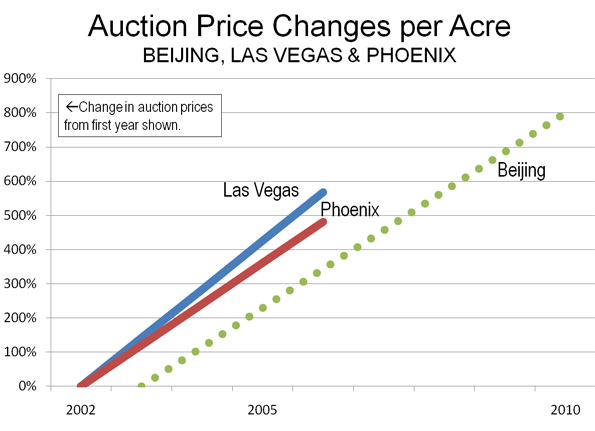
    In Las Vegas, house prices escalated approximately 85% relative to incomes between 2002 and 2006. Coincidentally, over the same period, federal government land auctions prices for urban fringe land rose from a modest $50,000 per acre in 2001-2, to $229,000 in 2003-4 and $284,000 at the peak of the housing bubble (2005-6). Similarly, Phoenix house prices rose nearly as much as Las Vegas, while the rate of increase per acre in Phoenix land auctions rose nearly as much as in Las Vegas.

    In both cases, prices per acre rose at approximately the same annual rate as in Beijing, which some consider to have the world’s largest housing bubble. According to Joseph Gyourko of Wharton, along with Jing Wu and Yongheng Deng Beijing prices rose 800 percent from 2003 to 2008 (Figure). This is true even thought we are not experiencing the epochal shift to big urban areas now going on in China.

    The Issue is Land Supply: The escalation of new house prices during the bubble occurred virtually all in non-construction costs such as the costs of land and any additional regulatory costs. It is not sufficient to look at a large supply of new housing (as the Boston Fed researchers do) and conclude that regulation has not taken its toll. The principal damage done by more restrictive land regulation comes from limiting the supply of land, which drives its price up and thereby the price of houses. In some places where there was substantial building, restrictive land use regulations also skewed the market strongly in favor of sellers. This dampening of supply in the face of demand drove land prices up hugely, even before the speculators descended to drive the prices even higher. Florida and interior California metropolitan areas (such as Sacramento and Riverside-San Bernardino) are examples of this.

    Missing Obvious Signs: There are at least two reasons why much of the economics profession missed the bubble.

    (1) Unlike Paul Krugman, many economists failed to look below the national data. As Krugman showed, there were huge variations in house price trends between the nation’s metropolitan areas. National averages mean little unless there is little variation. Yet most of the economists couldn’t be bothered to look below the national averages.

    (2) Most economists failed to note the huge structural imbalances that had occurred in the distorted housing markets relative to historic norms. Since World War II, the Median Multiple, the median house price divided by the median household income, has been 3.0 or less in most US metropolitan markets. Between 1950 and 2000, the Median Multiple reached as high as 6.1 in a single metropolitan area among today’s 50 largest, in a single year (San Jose in 1990, see Note 2). In 2001, however, two metropolitan areas reached that level, a figure that rose to 9 in 2006 and 2007. The Median Multiple reached unprecedented and stratospheric levels in of 10 or more in Los Angeles, San Francisco, San Diego and San Jose- all of which have very restrictive land use and have had relatively little building. This historical anomaly should have been a very large red flag.

    In contrast, the Median Multiple remained at or below 3.0 in a number of high growth markets, such as Atlanta, Dallas-Fort Worth and Houston and other markets throughout the bubble.. Even with strong housing growth, prices remained affordable where there was less restrictive land use regulation.

    Seeing the Signs: Krugman, for his part, takes a well deserved victory lap in a New York Times blog entitled “Wrong to be Right,” deferring to Yves Smith at nakedcapitalism.com who had this to say about the Federal Reserve Bank of Boston research:

    It is truly astonishing to watch how determined the economics orthodoxy is to defend its inexcusable, economy-wrecking performance in the run up to the financial crisis. Most people who preside over disasters, say from a boating accident or the failure of a venture, spend considerable amounts of time in review of what happened and self-recrimination. Yet policy-making economists have not only seemed constitutionally unable to recognize that their programs resulted in widespread damage, but to add insult to injury, they insist that they really didn’t do anything wrong.

    Maybe we should have known better: beware economists bearing the moment’s conventional wisdom.

    ——

    Note 1: The authors cite work by Albert Saiz of Wharton to suggest an association between geographical constraints and house price increases in metropolitan areas. The Saiz constraint, however, looks at a potential development area 50 kilometers from the metropolitan center (7,850 square kilometers). This seems to be a far too large area to have a material price impact in most metropolitan areas. For example, in Portland, the strongly enforced urban growth boundary (which would have a similar theoretical impact on prices) was associated with virtually no increase in house prices until the developable land inside the boundary fell to less than 100 square kilometers (early 1990s). A far more remote geographical barrier, such as the foothills of Mount Hood, can have no meaningful impact in this environment.

    Note 2: William Fischel of Dartmouth has shown how the implementation of land use controls in California metropolitan areas coincided with the rise of house prices beyond historic national levels. As late as 1970, house prices in California were little different than in the rest of the nation.

    Wendell Cox is a Visiting Professor, Conservatoire National des Arts et Metiers, Paris and the author of “War on the Dream: How Anti-Sprawl Policy Threatens the Quality of Life

    Photograph: $575,000 house in Los Angeles (2006), Photograph by author