Blog

  • The China Syndrome

    China’s ascension to the world’s second-largest economy, surpassing Japan, has led to predictions that it will inevitably snatch the No. 1 spot from the United States. Nomura Securities envisions China surpassing the U.S.’ total GDP in little more than a decade. And economist Robert Fogel predicts that by 2050 China’s economy will account for 40% of the world’s GDP, with the U.S.’ share shrinking to a measly 14%.

    Americans indeed should worry about the prospect of slipping status, but the idée fixe about China’s inevitable hegemony–like Japan’s two decades ago–could prove greatly exaggerated. Countries generally do not experience hyper-growth–the starting point for many predictions–for long. Eventually costs rise, internal pressures grow and natural limitations brake and can even throw the economy into reverse.

    Instead the U.S. has a decent chance of remaining the world’s pre-eminent economy not only over the next decade or two and even by mid-century. There are five key reasons for this contrarian conclusion.

    1. If Water is the “new oil,” China faces a thirsty future. China’s freshwater reserves are about one-fifth per capita those of the United States, notes Steve Solomon, author of Water: The Epic Struggle for Wealth, Power and Civilization. Much of that supply has become dangerously polluted; ours , for the most part, has become cleaner.

    More important, the U.S. has become more efficient in its water usage, says Solomon. China, with a far less developed economy, will face increasing demands from industrial and agricultural users as well as hundreds of millions of households that now don’t enjoy easy access to clean drinking water.

    2. China’s energy demands are soaring, but it lacks adequate domestic resources. China impresses journalists and policy-makers with grand “green” projects and heavy investment in renewables, but two-thirds of the country’s energy comes from that dirtiest of sources. China burns more coal than the U.S., Europe and Japan combined, often using very primitive technology. It has now overtaken the U.S. for the dubious honor of the most total energy use and highest greenhouse gas emissions. Since 1995 China’s dependence on foreign oil has grown from near to approaching 60%, and the country, long a coal exporter, is becoming a major importer of that unfashionable fuel.

    The U.S. meanwhile sits on largely untapped fossil fuel resources, including coal, natural gas and oil. Add Canada to the equation and North America ranks second, behind the Middle East, in energy resources. In contrast to China, America’s energy use and greenhouse emissions appear to be dropping while still enjoying enormous, still largely untapped renewable resources, particularly from wind power in the Plains and biomass.

    3. Food remains pressing problem for China. Scarce water, mass pollution and high energy costs all will limit China’s future food production. By some estimates acid rain falls on a third of all agricultural land; some climate experts predict long-term reductions in the country’s vital rice crop.

    Plagued by floods, China now will have to look to U.S. and Canada to meet demand for crucial foodstuffs, particularly corn. And the food deficit may get worse over time: As China becomes wealthier, demand for high-protein foods like beef and pork will increase. The U.S. remains the world’s most reliable supplier of many of those agricultural products.

    4. China’s rapidly aging population and shrinking workforce will slow growth, perhaps dramatically, by the next decade. Like that of the “Asian tigers” in the ’70s and ’80s, China’s rapid growth has been propelled in part by an expanding young workforce. Due to a very low birthrate, however, this trend will reverse within a decade or two. By 2050 31% of China’s population will be older than 60, compared with barely one-quarter in the U.S. There will be over 400 million elderly, with virtually no social security and few children to support them. Also worrisome: The preference for male children has skewed sex demographics dramatically, with roughly 30 million more marriageable boys than girls.

    The logical solution to this dilemma would be immigration, but China’s culture appears far too insular for such an event. Rather than a benevolent “socialist” super power China, whose population is made up over 90% Han Chinese, will bestride the world as a racially homogeneous, and communalistic “Middle Kingdom.” In contrast, the U.S., despite occasional fits of nativism, remains remarkably successful at integrating cultures from around the globe.

    5. Dictatorship thrives sometimes in a “take off” period, but often fails to compete well with more open societies during later stages of growth. Many American intellectuals and journalists celebrate China’s achievements, much as some of their predecessors admired past “successful” economic regimes in fascist Italy, Nazi Germany and the late Soviet Union. The longest lasting of the authoritarian superpowers, the Soviet state massively misallocated its resources in its unsuccessful competition with the more flexible systems of the U.S. and its allies.

    Big Brother economies experience more subtle problems. Chinese entrepreneurs , according to a survey by the Legatum Institute in London, depend far more than their more nimble and self-reliant Indian counterparts. Overweening Chinese state power also might be chasing many foreign businesses–and some developing countries– toward more congenial investment and trade partners.

    For all these problems, the Chinese emergence remains the dominant business event of our epoch. But world-wide dominion seems highly unlikely. One often overlooked factor: political problems stemming from growing inequality in this officially Marxist state. Over the past 20 years China’s income distribution pattern has shifted from the relative egalitarianism of Sweden, Japan or Germany to that of countries like Argentina and Mexico.

    The class divisions will deepen further as growth inevitably slows. Roughly one-third of 2008’s 5.6 million university graduates have been unable to find work. Things are even worse for those less skilled, rural residents and small manufacturers.

    Ironically, the Communist Party appears to further concentrate wealth and power; most of the richest people in China are linked to the party. Policies push growth, but with diminishing rewards to the masses. Over the last decade the share of GDP going to consumption dropped from 46% to less than 36%.

    Of course, a comparatively small number of skilled, with often well-connected professionals and investors flourishing, but opportunities for economic advancement may now be scarcer for most workers compared to the earlier period of China’s remarkable “liftoff” after 1980. Conditions for the working class in China remain more akin to Dickensian England than a Marxian “worker’s paradise.” China’s dismal health care system for example, ranks according to the World Health Organization, among the world’s most inequitable, 188th out of 191 nations.

    Not surprisingly, class anger has reached alarming proportions, with almost 96% of respondents, according to one recent survey, agreeing that they “resent the rich.”

    America also faces its own share of social problems but not to such an extreme degree. Many Americans resent the affluent, but also dream of becoming them. How else to explain the popularity of paeans to bourgeois vulgarity like Housewives of New Jersey?

    In the coming decades China, not the currently depressed U.S., may face greater headwinds. America’s biggest enemy will prove to be not China, but itself. The U.S. needs to move toward a pro-growth course driven by investments in our productive economy, basic infrastructure and skills-based education as well as sustainable immigration and population growth levels. If the country does these things then Americans will someday look back at their current Sinophobia as a delusion dressed up as irresistible conventional wisdom.

    This article originally appeared at Forbes.com.

    Joel Kotkin is executive editor of NewGeography.com and is a distinguished presidential fellow in urban futures at Chapman University. He is author of The City: A Global History. His newest book is The Next Hundred Million: America in 2050, released in February, 2010.

    Photo: Steve Webel

  • Strategic Diminshment at the Heart of New Housing Policy

    Robert Samuelson in the Washington Post takes on the role of homeownership in our society. I’m generally a fan of Samuelson’s writing, a normally sober, cold-eyed analysis of issues without favor to one ideology over another, so imagine my disappointment when reading him say, “The relentless promotion of homeownership as the embodiment of the American dream has outlived its usefulness.”

    Of course, there’s more to his column. He goes on to say:

    Unfortunately, we let a sensible goal become a foolish fetish. Not everyone can become a homeowner. Some are too young and footloose; some are too old and dependent; some are too poor or irresponsible. Some don’t want a home.

    This is different that saying homeownership is not a worthy goal for our nation and is quite distinct from the ideas of Richard Florida, who has previously written that homeownership is overrated and who’s recent “Roadmap” to recovery focuses on de-emphasizing homeownership. Where Florida is right is in acknowledging that this would “blow up” the fundamentals of our economy.

    He’s also engaging in what I call strategic diminishment – that is, consciously pursuing a future that is less than our current state. Many elite progressives think we have it too good and that our lifestyle choices are harmful to ourselves and our planet. It’s not enough that they want to be scolds; they want to use the power of government to change America into a place where our quality of life is diminished.

    And progressives also glorify this reduction with a “less is more” attitude. The Washington Post recently presented the case against air conditioning, and USA Today reported on the banning of drive-throughs in the city that pioneered them sixty years ago. I’ve addressed strategic diminishment as it relates to the mobility and the Obama administration’s “Livable Communities Act,” but this is also true for homeowners and covers not just the percentage of homeowners but even the size of homes. Ron Utt of the Heritage Foundation warns how even the President has adopted a worrisome narrative on homeownership.

    Before we go off the deep end, let’s clear up two points. First, the crisis we’ve gotten ourselves into is not because people own homes. It’s because of the flawed policies promoting homeownership. We know about the role of the Community Reinvestment Act and Fannie Mae and Freddie Mac, but also contributing were various land-use planning schemes collectively known as Smart Growth.

    Second, homeownership has many benefits. Homeownership is more than a lifestyle choice; it’s a source of wealth and stability. And when homeowners take out a second mortgage on their homes, it’s often as a source for financing their own small businesses – another ideal we associate with the American Dream.

    There are countries with equal or greater rates of homeownership that do not have government intervention policies that skew the market. But as we consider housing policy at the local, state, and federal levels, what should be the principles on which it is based?

    • Owning a home is a laudable goal held by millions of Americans.
    • Homeownership is positive good that should never be discouraged by government policy.
    • Everyone should have the right to pursue homeownership, but not everyone is ready to be a homeowner.
    • Government’s role is not to determine who should be a homeowner or when and where they should buy a home.
    • Markets are better than mandates at creating the environment in which people pursue renting or owning homes according to their ability.

    Before we adopt A Nation of Renters as our new creed, let’s fix the broken policies that got us here.

    Ed Braddy is executive director of the American Dream Coalition, a non-profit grassroots and public policy organization that promotes freedom, mobility, and affordable homeownership. The ADC’s annual conference takes place September 23-25 in Orlando, Florida. For more information, visit americandreamcoalition.org or email Ed at ed@americandreamcoalition.org.

  • The Disappearance of the Next Middle Class

    Every week we read that yet another major housing project has been turned down by the Courts here in New Zealand because of the need to protect “rural character” or “natural landscapes”. This may well have profound short and long-term consequences for the future of our middle class, as it does for the same class in countries around the advanced world.

    Every week a multitude of smaller developers abandon their projects because Councils’ compliance costs and development contributions make the projects unviable – even if the land were free. And it’s not.

    The New Zealand Institute of Economic Research says the ten-year norm for New Zealand is 26,000 new dwellings built per year. Statistics New Zealand reported only 16,000 dwelling consents issued in 2009. The NZ Property Investors Federation says we are building only 7,000 dwellings a year.

    Some say the Property Investors Federation figures are too low given that Statistics New Zealand’s figures for the year to date suggest we shall issue between 13,000 and 11,000 consents this year, and that the “slippage” between consents and finished dwellings cannot be that great.

    However, this is rather like wondering whether you are driving towards a concrete wall at 100 mph or only 80 mph.

    Any current year estimates confirm we are on a slippery slope to catastrophe.

    Unemployment, especially among young unskilled males is on the rise. Given these dreadful build-rates, should we be surprised, since these workers depend on construction for economic opportunity?

    And why don’t we recognize the cause and do something about it?

    First let’s look at the statistics. A Google search under “construction multipliers” turns up statements such as “building 1,000 houses generates 2,300 permanent full time jobs”. Another will say “Every dollar spent in the sector has a multiplier effect between 2.1 and 2.8.” These “low multiplier” statistics seldom spell out what is meant by “the construction sector”, and most are annual figures, and focus on “permanent full time jobs”. But the construction sector generates a multitude of short-term contracts that presumably slip through the net.

    These low “construction” multipliers are reinforced by a post-modernist ideology that tries to persuade us that housing is an unproductive activity that takes productive rural land out of production and hence undermines the economy. This is the old “primary” industry myth, further reinforced by the quaint animist notion that subdivision causes “death by a thousand cuts”. The surveyors are out there wielding their long knives and watching the Earth Mother bleed to death.

    Smart Growth planners claim the “urban sprawl” that grew around our cities during the post-war decades was the terrible price paid for housing the baby boomers and must be replaced with Smart Growth (or perhaps more accurately, Dense Thinking).

    We have lost sight of the fact that those prosperous decades were actually in large part the result of those large-scale suburban developments.

    US economists generally explain the post-war boom as being driven by the work force switching from weapons to washing machines.

    In New Zealand we used to attribute those golden years to micro-management of the economy, and to import licensing in particular. In reality, our real genius was probably introducing the capitalized family benefit which led to our own “Levittown builders” such as Fletcher Construction and Neil Housing.

    Back in the late sixties, while reading for my thesis in urban development economics, I read a report on the drivers of the post-war boom in America, during the twenty years from 1945 – 1965. Wildavsky’s Oakland Project focused on behavioural analysis rather than econometrics.

    The authors concluded that the suburban development boom laid the foundations for the long-term development of the post-war American middle class.

    An equivalent thought experiment would now read something like this:

    • We begin with a clean greenfields site, presumably being farmed, or just open space of some kind.
    • A developer decides the land is well located for a new 1,000 lot residential development and hires consultants or staff to prepare an application. The process alone takes five to six years and provides unproductive employment for a host of highly paid professionals.
    • The project is then killed off by either the Council or the Courts.

    In a sensible world, as prevailed in the post war years, the project would move on to the next stage:

    • The land development teams move onto the site and start the final surveys, road-building, drainage and stormwater schemes, landscaping, and street-crossings, all required before the builders drive their first profile-pegs into the ground.
    • Then teams of contractors start building the houses, which will have been designed by architects, draughtsmen or architectural designers, and then processed through a simple consenting procedure.
    • The teams of carpenters, glaziers, plumbers, painters, roofers, stoppers, electricians and plumbers all move in to finish the houses ready for occupancy. A gang of maybe ten drain-layers could lay the drains for the 1,000 houses over a five year sales-and-build period – say 20 contracts a year.
    • These teams use products and materials cut from forests, mined from quarries, processed in mills, or produced in factories, or recycled products, all requiring employed labour.

    So after a few years the 1,000 homes may be built and occupied. The analysts in the sixties suggested the 1,000 houses would generate say 5,000 direct contract-jobs over those early years.

    However, they recognized that the real economic activity would continue for another fifteen years or more. The same happens today.

    • As the families move into the houses they buy kitchen equipment, drapes and light fittings, bookshelves, plasma TVs, computers, artworks and wine cellars and so on.
    • The owners lay paving, build decks, plant gardens, and landscape the property.
    • The gardens require lawn mowers, chain saws, hedge trimmers, nursery plants, and barbecues.
    • Then up go the Gazebos, the dog kennels, the play houses, the extra rooms, and so on.
    • And then come the swimming pools, spa pools, home offices, sleep-outs, and solar heaters.

    Many of these improvements are produced by the “sweat-equity” of the DIY owners and are a major means of increasing household wealth and well-being. They arealso a potent form of saving, provided the owners are investing in tangible improvements and not over-priced land.

    These suburban on-site improvements go on forever. Consequently, even today there are about 80,000 certified “alterations” a year in New Zealand – and many more that don’t get near a permit.

    All these activities create jobs for the people who make the spa pools, the plasma TVs, the gardening tools, the cars, and the Gazebos.

    After several years from start up the properties are likely to require a gardener once a week, and maybe a housekeeper one or two days a week, and baby sitters, and whatever else the modern family needs to manage its work-life balance. These are the on-site ‘jobs’, but the families also need teachers, doctors, day-care providers, retail staff and so on and so on.

    The sixties report concluded that every 1000 houses would generate a total of 40,000 contracts and jobs. Which seems outrageous until you divide the 40,000 by the fifteen to twenty years, which comes back to the multipliers of 2.0 to 2.6.

    The sixties thought-experiment reminds us that by driving our residential build-rate from 24,000 a year to a no more than 13,000 a year, and probably much fewer, we are turning off the boiler that regenerates our middle class.

    It also explains why an economy with a low “build-rate” is unlikely to enjoy full employment.
    Those suburbs were not “a sad price to pay for our post war housing” but were the economic driver of “the long summer of content” so well described by Bill Bryson in “The Thunderbird Kid.”

    So why are we allowing our institutions to destroy the ability to regenerate our own suburban middle class?

    Whatever happened to genuine sustainable development? Sustainable for middle class people and families too.

    Owen McShane is Director of the Centre for Resource Management Studies, New Zealand.

    Photo by pie4dan

  • McClatchy-Medill: Real $timulating News

    I saw this story in the Omaha World Herald last week: Benefits of stimulus bill spread unevenly over U.S. As I read through it, I became increasingly impressed. The journalists start off by laying out who said what about the benefits of stimulus spending. They provide quotes and facts from the White House, the Congressional Budget Office, and Joe Biden’s spokesperson. They include viewpoints and analysis from professors at Berkeley, Harvard, George Mason and the editor of the Journal of Economic Perspectives. They even talked it over with the National Association of State Auditors, Comptrollers and Treasurers – the people in charge of receiving and accounting for the billions of dollars represented by the American Recovery and Reinvestment Act. What impressed me most, though, was that they did their own research – not just reporting what the Administration or Congress told them was happening or was supposed to be happening.

    Spending the Stimulus” is a website put together by McClatchy Newspapers and the Medill News Service to track what was promised and what was done, how much was actually spent and where and on what the stimulus billions were spent. I was intrigued by their finding that “much of the stimulus money has yet to go out the door” eighteen months after the emergency, gotta-fix-it-now legislation was passed. After Congress approved $750 billion for the Wall Street Bailout in October 2008, I’m pretty sure all that money was out the door before December!

    Even more intriguing is the finding that the money was spread around rather unevenly. Beyond the infantile “Why Did North Dakota got More Than Me?” rhetoric going around among the states (by the way, the McClatchy-Medill per-capita graphic shows that most of New England got more than North Dakota), is the more interesting discussion of where would the spending be most stimulating. Transportation money was directed to the states under the “usual formula” despite the fact that the Great Recession didn’t follow a formula as it spread throughout the economy. The result: “researchers were unable to find any relationship between unemployment in a given area and the amount of stimulus dollars spent there.” If unemployment is lower in some areas than in others, it wasn’t because of the stimulus spending.

    Maybe this is a good thing. Instead of focusing on the political necessity of justifying billions of dollars to pull the country out of the Great Recession (unlike the complete lack of justification for bailing out Wall Street), the McClatchy-Medill report raises more interesting points. Is it “rewarding failure” to send more money to the states that most failed to develop diversified economies that are resilient to downturns? Would we be throwing good money after bad to provide more spending for states that didn’t manage the cash inflow from the rapid rise in property taxes that came with rapidly rising home prices? Finally, did we really want a central government to make every decision – county by county – about where and on what the money would be spent?

    If you missed this story last week, I highly recommend perusing the “Spending the Stimulus” website for more stimulating idea.

  • China’s Sliver of a Housing Bubble

    Few finance issues have received such a wide range of opinions among financial experts than the “housing bubble” in China. This is an issue of international importance because what happens in what is now the world’s 2nd largest economy affects the rest of the world.

    Differing Views: There are frequent reports of excessively high purchase prices on new housing, which when compared with measures of average household income make it appear that China has the highest house price to income ratios in history. Andy Xie, a Shanghai economist formerly with Morgan Stanley sees a huge housing bubble, which he expects to burst. Stephen Roach, chairman of Morgan Stanley Asia denies there is a bubble, claiming that there is sufficient demand from the continuing migration to the cities for the housing market to be healthy.

    I have been reluctant to weigh in on the debate, simply because there has been insufficient data available to calculate inferior housing affordability measures (such as average price to average income), much less the data that would permit Median Multiples to be calculated. (The Median Multiple is the “middle” house price divided by the “middle” household income and is optimal for measuring middle income housing affordability).

    The problems in assessing China’s housing affordability have been manifold:

    • There has been virtually no median household income data.
    • There appears to be no data available on the median house price

    This means that it is impossible to calculate the Median Multiple.

    Housing Occupancy in Urban China

    Having visited all but two of China’s 20 largest urban areas and traversed them, east to west and north to south from the countryside to the countryside (as I do in obtaining photos and impressions for my “Rental Car Tours“), however, two things are obvious.

    • New high-rise housing is being built at a furious pace in the largest urban areas.
    • Nonetheless, the volume of this new housing pales by comparison to the lower rise, older housing that was built before the present boom (which appears to have started in the 1990s). It is clear that the vast majority of people do not live in the new high rise buildings.

    Nonetheless the press has been filled with absurd reports to the effect that there are 65 million empty housing units in China. The absurdity of this now discredited number is illustrated by the following.

    (1) All of China’s urban areas with more than 500,000 population, where much of the new high rise housing has been built, have less than 300 million people. At the average household size, this means there are no more than 100 million households. In such an environment, 65 million empty units would stick out like a sore thumb. They do not.

    (3) 65 million vacant units is more houses than have been constructed since 1990.

    The New National Economic Research Institute Data: Finally, however, some clarity may be being brought to the issue. Credit Suisse sponsored groundbreaking research by National Economic Research Institute (NERI) of the China Reform Foundation in Beijing, which was led by Deputy Director Dr. Wang Xiaolu. Dr. Wang’s principal contribution is to show that household incomes are considerably higher in China than official statistics indicate. This “grey income” or “hidden income” includes bonuses paid by local governments, payments to public officials, revenues from land development and other sources of income that are not reported in official data and amounts to 90% more than reported figures (report (Analyzing Chinese Grey Income, published by Credit Suisse). In the top decile (top 90-100% of household incomes), grey income added 200% to reported incomes, while in the second decile (80%-90%), grey income more than doubled reported incomes. Buried in the NERI report is median household income data and average multiple housing affordability indicators that are the best information yet made available.

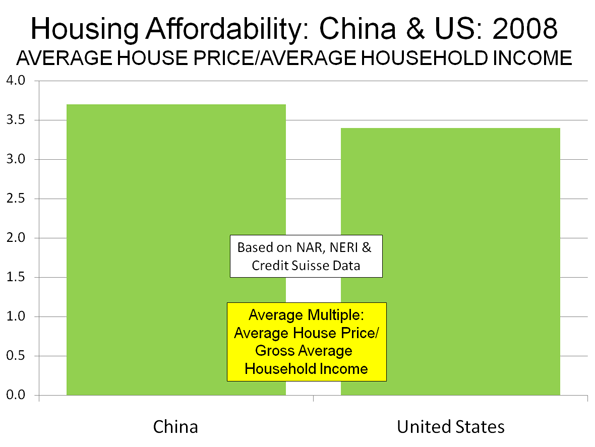
    China’s Average Multiple: Credit Suisse analyst Jinsong Du takes the NERI further to calculate housing affordability indicators that are far below the claims about the Chinese housing bubble. The average (mean) house price was 4.0 times the average disposable household income in 2008, after accounting for “grey income.” Based upon the national ratio of gross income to disposable income (from the China Yearbook), this would indicate an “average multiple” (average house price divided by gross average household income) of 3.7. This is similar to the US average multiple figure of 3.4 (Figure 1) in the same year (2008).

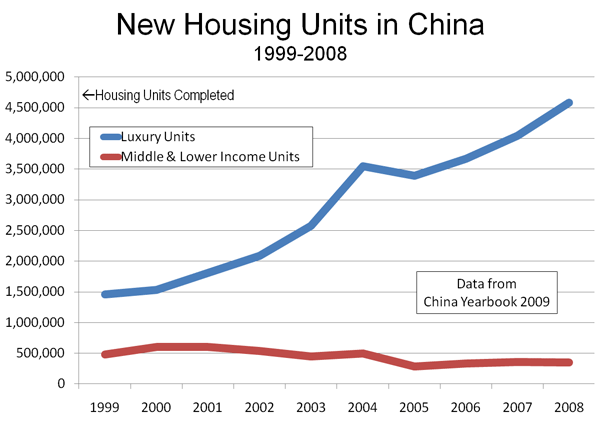
    China’s Median Multiple? This leaves the question of the Median Multiple. There is still no available median house price data. However, it is clear that the new housing is largely irrelevant to median house prices. According to data in the China Yearbook (Table 5-42), only 13% of the 31 million new houses were affordable to lower and middle income people (Figure 2). The new luxury units, with their widely touted prices, remain a minority of the houses, and, as a result, none of these can be the “middle” or median price

    In fact, the median priced house could be of a design similar to a Danwei (live-work unit) type design built before 1990. This is the type of housing that any walk or drive through a Chinese urban area will demonstrate to be dominant (and which is illustrated in the photograph above). There are huge disparities in both house prices and incomes in China. It would not be surprising for China’s Median Multiple to be similar to its average multiple, as is the case in the United States.

    Further, there is a huge difference between the US bubble and the Chinese bubble. In the United States the bubble drove up prices across all income spectrums in the impacted metropolitan areas. It burst largely because middle income households had taken on debt they could not afford. In China, the bubble may be limited to the top of the income scale, the very households that NERI finds are making two to three times as much as the official reports indicate.

    China’s Sliver of a Bubble: None of this is to suggest that house prices at the top of the market are not high. One of America’s leading housing economists, Joseph Gyourko of Wharton, along with Jing Wu and Yongheng Deng found that residential real estate auction prices rose 800% from 2003 to 2008 in Beijing (Note). Recently the government has taken action to cool the high end of the market and to encourage development of more housing for middle and lower income households. At the same time, the Gyourko research team found that new house prices had fallen relative to household incomes in Chengdu, Wuhan, Tianjin and Xi’an, all urban areas with more than 4,000,000 population.

    To accurately assess housing affordability it is necessary to have complete data. Housing affordability cannot be assessed in London using data from Belgravia, nor will Upper East Side data tell an accurate story about New York. The same is true in China. Stephen Roach said that China has a “sliver of a bubble.” That’s what the data seems to show.

    ——————

    Note: This annual rate of increase is approximately the same as was experienced in per acre government land sales in Las Vegas and Phoenix before the peak of the bubble (both urban areas are tightly ringed by “virtual” urban growth boundaries composed of government owned land).

    Wendell Cox is a Visiting Professor, Conservatoire National des Arts et Metiers, Paris and the author of “War on the Dream: How Anti-Sprawl Policy Threatens the Quality of Life

    Photograph: Median priced (?) flats in Fushun, Liaoning (photograph by the author)

  • Can We Socialize Ourselves to Good Health?

    How can we reduce health problems in society? Should we tackle poverty and social problems such as crime and drug abuse, or is the problem inequality in itself? If we reduce the income in a middle class neighborhood, will this in itself improve the health of poor people living in the same city?

    The latter form of reasoning is perhaps not so popular in the US, but quite so amongst European social democrats. A new book highlights how the European left is as concerned with fighting wealth as it is with fighting poverty.

    One year after its publication, the “The Spirit Level: Why More Equal Societies Almost Always Do Better” – by social epidemiologists Richard Wilkinson and Kate Pickett – has been embraced by many European intellectuals and politicians. The Social Democratic Party leader Mona Sahlin relies on the book as one of her main arguments during the current Swedish election campaign.
    Even conservative British Prime Minister David Cameron has praised the book, which claims that income inequality in itself causes more or less every problem in society. The argument goes: if your neighbor’s income increases, so does you chances of catching cancer.

    The authors of the book, Wilkinson and Pickett, seemingly make as strong argument for the notion that social ills are caused not by poverty but rather by inequality itself. Inequality, they say, acts like a “pollutant spread throughout society,” with rich and poor equally susceptible to its toxic effects.

    The book will likely soon appear also on the bookshelves of many US intellectuals, not least amongst the left. It is interesting then to note that its notions are dismissed by current research.

    Last year for example, the “Oxford Handbook of Economic Inequality” was published. There we could clearly read that income inequality in itself is not the cause of health problems or lifespan: “The preponderance of evidence suggests that the relationship between income inequality and health is either non-existent to too fragile to show up in a robustly estimated panel specification.”

    The same conclusion has been drawn in research conducted by Professor Angus Deaton, one of the world’s leading health economists. After a comprehensive survey of the scientific literature he concludes:
    “[I]t is not true that income inequality itself is a major determinant of public health. There is no robust relationship between life expectancy and income inequality among the rich countries, and the correlation across the states and cities of the United States is almost certainly the result of something that is correlated with income inequality, but is not income inequality itself.” (Published in Journal of Economic Literature, 2003).

    One could say that one of the main theses of the European social democracy – that inequality in itself is the problem – has been proven wrong by recent scientific studies. Social problems in themselves do cause inequality.

    If there are problems with drug abuse, racial tensions, unemployment, etc., in one neighborhood for example, this will decrease the income of the citizens. Thus income inequality arises compared to the middle class. Reducing social problems will also reduce inequality. But inequality in itself does not cause social problems.

    The socialist approach – to shrink the income of the middle class instead and hope this will aid the poor – is simply based on a skewed analysis of the correlation between social problems, poverty and inequality.

    A comparison between Sweden and the US is often used to argue that the European social democratic approach will reduce social problems and expand life span. As noted in a previous New Geography article, this reasoning is misleading.

    Sweden was characterized by an even income distribution, low poverty and long life spans already before the introduction of high-tax welfare policies. The difference in lifespan between Swedes and Americans was the same (2.6 years) in 1950 as it is today (2.7 years). And lastly, the 4.4 million Americans with Swedish origin are not only 50% more rich than Swedes living in Sweden, but also have the exact same level of poverty.

    It is simply wrong to assume that high tax welfare state policies automatically improve health. In 1960 Sweden was a low-tax country, with the third highest lifespan in the world. Switzerland was ranked on the sixth position. 45 years later, it was Switzerland that had the second highest lifespan, whilst Sweden was ranked on sixth position. Evidently, retaining a low-tax system did not hinder Switzerland from catching up to and surpassing Sweden.

    Low taxes might however explain why the poorest fifth of Swiss citizens have a considerably higher purchasing power compared to the same group in Sweden (the US figure is slightly, but not much, lower than in Sweden).

    And it is simply not true that socialist policies always lead to low income distribution, whilst free-markets increases inequality. Reforming away from communism to a very free-market oriented approach has for example allowed the Czech Republic, Slovakia and Slovenia from gaining a high living standard. But these nations do not have a low, but rather relatively high level of income equality. Moving away from socialism has benefited not only a small handful of capitalists, but rather the population as a whole.

    History teaches us that one society simply cannot change to another by simply changing its policies. Much can be achieved by focusing on the root of social problems – such as unemployment, crime and drug abuse – but society has little to gain and much to lose from thinking that we should hinder those who strive towards success in the name of social equality.

    Nima Sanandaji is president of the Swedish think tank Captus. He is the author of the book ”Entrepreneurs who go against the stream – what the 90s successful entrepreneurs can teach us” (Swedish title: ¨”Entreprenörer som går mot strömmen – vad 90-talets succéföretagare kan lära om dagens utmaningar”) for Fores.

    Photo by: JavierPsilocybin

  • Affordable Housing Leads to Economic Growth

    Logic suggests that a lack of affordable housing in a region will dissuade people from living there, and employment levels will suffer as a result. However, until recently, no one had readily tested this theory and simply relied on this logic to substantiate this assumption. Ritashree Chakrabati and Junfu Zhang of the New England Public Policy Center published a report looking empirically at this theory in the United States. In doing so, they have found a substantial correlation between a lack of affordable housing and suppressed job growth.

    While Chakrabati and Zhang analyzed data from many US metropolitan areas and counties, they first used California as a state case study to cut down on the number of unaccounted-for heterogeneities created by state policies. California epitomizes the problem of a dearth of affordable housing suppressing an economy. The increased cost of doing business has driven companies out of expensive California, exacerbating the unemployment problem, while the recipients of this flight (mainly in the Midwest and Pacific Northwest) are finding some growth in this recession. These days, people aren’t prioritizing culture and lifestyle; they simply don’t have the budget for it. In order to grow, states must assure residents and businesses that they can sustain themselves during this difficult time.

    The findings of this study should also alert countries such as Australia, now in the midst of a major land and housing crisis, about creating more affordable conditions around their urban core cities to maintain economic growth, much less stimulate it. Just as businesses are reluctant to stay in California, business will be reluctant to find a home in these expensive core cities. Almost every country depends on global ties to support itself, and it will be those that can strike a balance between affordable housing and standard of living that thrive.

  • Vancouver: Planner’s Dream, Middle Class Nightmare

    Vancouver is consistently rated among the most desirable places to live in the Economist’s annual ranking of cities. In fact, this year it topped the list. Of course, it also topped another list. Vancouver was ranked as the city with the most unaffordable housing in the English speaking world by Demographia’s annual survey. According to the survey criteria, housing prices in an affordable market should have an “median multiple” of no higher than 3.0 (meaning that median housing price should cost no more than 3 times the median annual gross household income). Vancouver came in at a staggering 9.3. The second most expensive major Canadian city, Toronto, has an index of only 5.2. Even legendarily unaffordable London and New York were significantly lower, coming in at 7.1 and 7.0 respectively. While there are many factors that make Vancouver a naturally expensive market, there are a number of land use regulations that contribute to the high housing costs.

    Vancouver is a unique real estate market: it’s the only major Canadian city that doesn’t experience frigid winters. This makes it a major draw for high skilled, high salary employees. It is also a major destination for wealthy Canadian retirees, who choose to actually spend their winters in Canada. There is little doubt that it is a naturally expensive real estate market. As with coastal California cities, people pay a premium for (in this case relatively) hospitable weather. The proximity to world class skiing, fishing, and hiking are no doubt another factor in the city’s high real estate costs. There is certainly a premium to be paid for living less than two hours away from the world’s best ski resort.

    Moreover, Vancouver has become an appealing real estate market for overseas investors, particularly Chinese nationals. There has been a good deal of news recently about how many of the nouveau riche in China are now looking to Vancouver, rather than Los Angeles or New York as an immigration destination. In absolute dollar terms, Vancouver is still cheaper than either city. This, combined with the more hospitable Canadian immigration system, has made Vancouver so attractive to overseas investors that real estate agents are now organizing house hunting tours for potential Chinese buyers.

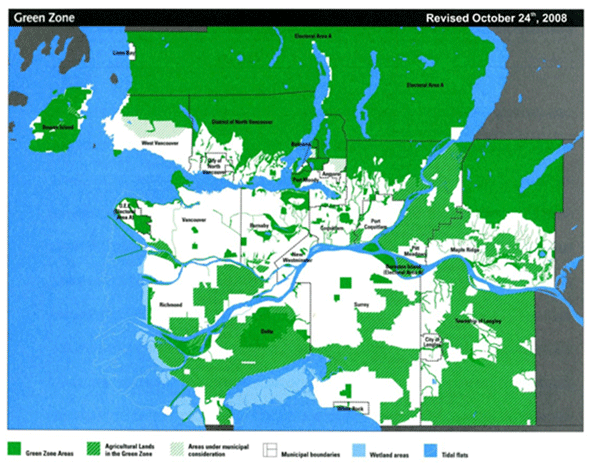
    To be sure, geography deserves much of the blame for Vancouver’s high housing costs. But a large chunk of the blame lies with restrictive municipal and provincial land use policies. Since the introduction of the city’s first comprehensive plan in 1929, Vancouver has used various land use regulations to create dense mixed use development in order to protect green space surrounding the city. In 1972, the provincial government passed legislation aimed at protecting BC farmland. This left less than half of the already scarce land in Greater Vancouver off limits to developers. As a result, the city is circled by undeveloped land, referred to as the Green Zone. The Green Zone acts as a de facto urban growth boundary, largely designed to prevent sprawl.

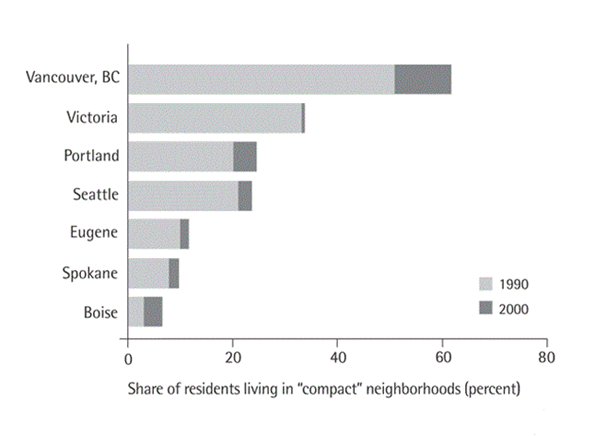
    As a result, Vancouver is one of the few North American cities that have been growing almost exclusively upwards, rather than outwards for the last century. Its narrow streets and lack of a major highway running through the city make it one of the least automobile friendly cities on the continent. Unsurprisingly, Vancouver was ranked the most smart growth oriented city in the Pacific Northwest by the Sightline Institute. Roughly three times more Vancouver residents live in compact neighborhoods as a percentage of the population compared than Portland or Seattle. This arguably makes Vancouver the most smart growth oriented city in North America.

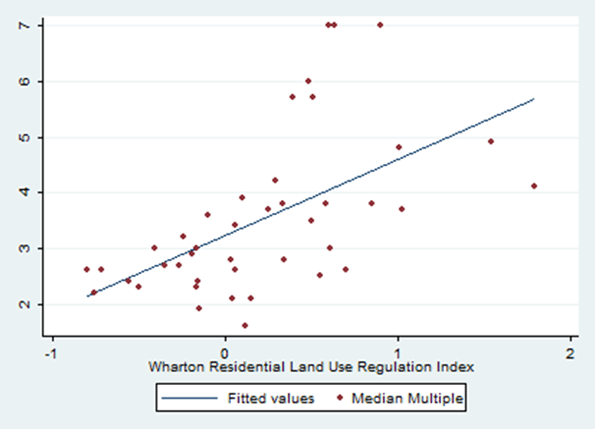
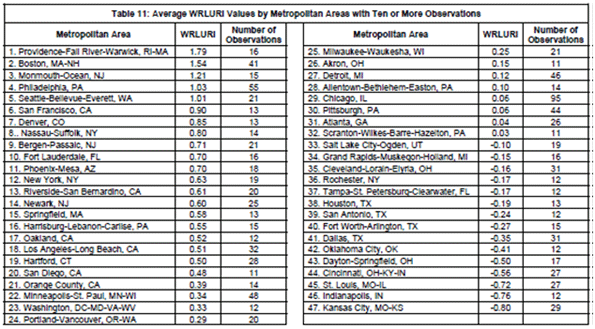
    Smart growth has become a truism for urban planners. Walkable communities with a mix of commercial and residential units combined with strict zoning regulations to encourage transit usage is a formula increasingly prescribed for North American cities. Though many smart growth principles are attractive, there is an strong correlation between heavy land use regulations and housing costs. Using data from the Wharton Residential Land Use Regulation Index (WRLURI), and Demographia’s International Housing Affordability Survey, a simple scatter plot diagram has been included to illustrate this correlation.

    The WRLURI measures the stringency of land use controls imposed on various US jurisdictions by state and local governments. There is a clear correlation between high regulations, and low housing affordability. Though the index does not include Canadian cities, it does include neighboring Seattle. Seattle ranks fifth of 47 cities on the Wharton Index. According to a recent study in Boston College International & Comparative Law Review by David Fox, Vancouver is decades ahead of Seattle in terms of smart growth policies. This means that Vancouver would rank at least fifth in North America on the index, though it is more realistic to assume it would most certainly top the index.

    In addition to smart growth policies, Vancouver also has very stringent inclusionary zoning laws. Inclusionary zoning requires developers to provide a certain number of affordable housing units in any given development. This policy might seem to make the city more affordable, but it functions exactly like rent control. Those fortunate enough to find spaces in the affordable housing units pay less, but the subsidized rent is made up for by higher rent in adjacent units. In a study of inclusionary zoning in California cities, Benjamin Powell and Edward Stringham from the Department of Economics at San Jose State University found that inclusionary zoning imposes an additional $33,000-$66,000 cost on adjacent market rate units.

    There have been some recent policy initiatives that may reduce the cost of housing marginally. In 2004, the city amended its zoning code to permit secondary suites throughout the city. Secondary suites are subdivided units of owner occupied homes that are used as rental units. This zoning change brought tens of thousands of relatively low cost units into the market. There are currently 120,000 secondary suites in the province. The city recently went one step further to allow homeowners to convert laneway garages into rental units. These units have a maximum of 500 square feet. There are 70,000 homes in Vancouver that are eligible for conversion, though it is unclear how many will take up the offer. This will add to the stock of relatively affordable rental housing in the city, but may not significantly reduce housing costs. In fact, by increasing the revenue generating potential of houses, it may actually increase the cost of purchasing a single dwelling home. After all, if the potential rental income of a single dwelling unit increases, the market price of the unit is likely to do the same. This isn’t necessarily an argument against the policy, though it does underscore the fact that housing costs in Vancouver will never decrease without liberalizing municipal and provincial land use policies.

    In short, the City of Vancouver and Province of British Columbia have chosen to favor compact growth over affordable housing costs. This likely makes the city more attractive to affluents from both the rest of Canada and abroad, but increasingly makes it unaffordable for middle class families. There is certainly some substance to the Economist’s claim that Vancouver is the most livable city on earth. It is a very attractive place for those who can afford it. Nevertheless, creating a city fit only for the wealthiest segments of society and non-families is hardly something to be proud of.

    Downtown Vancouver photo by runningclouds

    Steve Lafleur is a public policy analyst and political consultant based out of Calgary, Alberta. For more detail, see his blog.

  • High Cost of Living Drives New York’s Fiscal Deficit with Washington

    Between now and the end of the year, a hot political topic here in New York will be whether to let the Bush tax cuts expire for people in the highest income bracket, as the Obama administration proposes, or whether to extend those cuts for everyone. Advocates taking the latter position will correctly argue that higher rates will be especially harmful to New York, because of the large number of wealthy people, who live here.

    What is not likely to be discussed, however, is that because of the exorbitant cost of living in New York and the surrounding suburbs, federal taxes take a supersized bite out of the incomes of all New Yorkers, who in the vast majority are not wealthy at all. The result is that here in New York City, which is arguably the poorest city in America when it comes to what people can actually afford, we end up subsidizing other states and localities, where people pay less to Uncle Sam, even as they enjoy a higher standard of living than we do.

    How could this be? The answer is that because New York and the surrounding suburbs are so expensive, businesses have to pay higher salaries to recruit people to work for them. According to the ERI Economic Research Institute, a leading data survey company that helps corporate clients set compensation packages and calculate the cost of doing business throughout the United States and elsewhere, these higher salary costs are substantial.

    They calculate, for example, that a typical registered nurse in metropolitan New York earns $82,712 versus a national average of $65,464. In the case of an accountant, they calculate a figure of $74,388 versus a national average of $58,712. In the case of an administrative assistant, as they define those job responsibilities, they calculate a figure of $59,243 versus $47,961 nationally. And finally, they also provide data for someone working as a janitor. Here the figure they calculate is $38,142 versus $31,220.

    Sounds great. Who doesn’t want a higher salary? But unfortunately, it’s not that simple. The problem is that the IRS doesn’t care how much you can actually buy with your hard earned dollars. They just want to see the number printed on your W-2. And as we all know, the more you make, the more you pay.

    For the average registered nurse in New York, filing as an individual, and assuming no special deductions or one-time credits, the tax bite amounts to $14,381 versus $10,219 for the average registered nurse in the rest of the country. An accountant here pays $12,444 versus $8,531 nationally. For an administrative assistant, the figure is $8,656 versus $5,844. And in the case of a janitor, the figure is $3,899 versus $2,864.

    But wait, it gets worse than that. Based on data from the federal Bureau of Economic Analysis, it turns out that the cost of living in the New York metropolitan area is significantly higher than the difference in salaries alone would indicate. According to their data, the cost of living here is 45 percent higher than in the rest of the country or approximately twice the difference in salaries.

    Yes, employers have to pay more to recruit people to work here in New York, but they don’t have to make up the whole difference. Economists refer to this as money illusion, which is their way of saying that people find it difficult to distinguish between the nominal value of money and the true purchasing power of that money in the marketplace.

    If we recalculate salaries to take into account the cost of living, it turns out that the federal tax premium that New Yorkers have to pay is even greater. Thus, if the tax bite were to reflect the actual standard of living for a registered nurse in New York, the real tax would be $8,106 instead of the actual tax of $14,381 or a difference of $6,275. For an accountant, the difference would be $5,775. For an administrative assistant, it would be $4,352, and for a janitor, $1,778.

    The lessons here are clear. In the short term, New York’s Congressional delegation needs to restrain efforts to raise taxes in Washington, D.C., because the impact here will be greater than elsewhere. And in the longer term, we need to determine why the cost of living in New York is so high and then implement the reforms necessary to fix the problem and give New Yorkers a standard of living that is competitive with rest of America.