Blog

  • Australian Opposition to Loosen Land for Housing

    The opposition Liberal-National Coalition, locked in a close battle with the ruling Labor Party in Australia’s Saturday elections, has adopted a housing policy to improve the nation’s housing affordability. The policy would require states to monitor housing affordability and to release more land for development. There would also be a review of the efficacy of development charges.

    Australia suffers from some of the most unaffordable housing in the world, with a Median Multiple (median house price divided by median household income) of 6.8, which is more than double the historic norm of 3.0. With recent interest rate increases, the median household would have to pay more than 50% of its gross income to service a mortgage on the median priced house. Little more than 15 years ago, house prices were affordable in Australia, which had seen home ownership rise from approximately 40% before World War II to approximately 70%. The principal cause of the loss of housing affordability has been the virtual universal adoption of “smart growth” (“urban consolidation”) land use restrictions, which have (among other things) made it virtually impossible to develop inexpensive housing on the urban fringes, with the price of rationed land driven up many times.

    The Coalition’s housing policy includes the following provisions that are directly related to removing the urban consolidation barriers to affordable housing:

    In order to continue to receive federal funds, States and Territories will need to increase land supply and reform their planning and approval systems under the National Affordable Housing Agreement (NAHA).
    States and Territories will need to set affordability targets to guide land releases and dwelling approvals. In order to receive federal funds States and Territories would need to demonstrate that they had a plan for delivering these targets and those approvals and land releases occurred consistent with the targets established.
    The Coalition will review of State, Territory and local developer charges, which have been contributing an increasing component to the cost of development. State and local governments that build higher charges into the cost of housing will be less able to meet their home affordability obligations under the Compact.

    Housing affordability has been an issue of substantial concern in Australia for years and has emerged as the top concern among voters in this election. State governments have talked about housing affordability, but have done little. Over the past five years, house prices have continued to rise relative to incomes. Just in the last nine months, a mortgage payment on the median priced house has risen from $500 in Adelaide to more than $800 in Sydney.

    The Coalition policy, however, represents the second significant development in recent weeks (Note). The first was an expansion of the Melbourne urban growth boundary by 440 square kilometers. All of this may signal an overdue attention to housing affordability in Australia.

    —–

    Note: Performance Urban Planning statement on the Coalition housing policy.

    —–

    Photograph: Adelaide: Urban fringe land (no houses allowed). Photograph by author

  • City Thinking is Stuck in the 90s

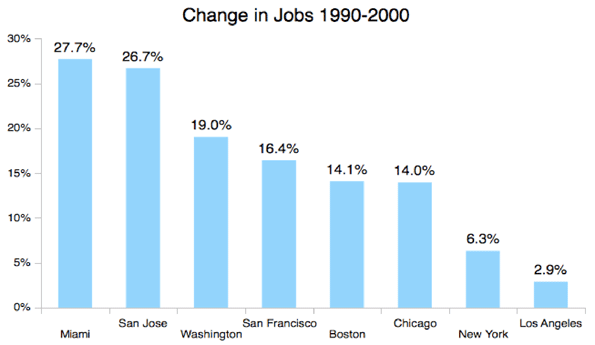
    The 1990s proved to be quite a nice decade indeed for most of America’s largest cities. It was an era of general prosperity in all of America to be sure, but in contrast to previous decades, the turnaround also extended from the suburbs to many of the nation’s biggest cities, notably New York, Chicago, Miami, San Francisco and San Jose. The notion – popular in the 70s and 80s – associating cities with a sour and fatalistic sense of decline and dysfunction, or even anarchy, in the 90s finally began to evaporate. There emerged a bracing new sense of optimism that these large cities had found a new role for themselves in the world.

    This is evident from the large decreases in crime in these cities where lawlessness once reigned and also from the job numbers from that decade, when all of America’s tier one metros added jobs.

    Some of these places lagged overall US growth, but considering their lower rate of population growth most of these cities enjoyed robust economies. The aerospace and defense center of Los Angeles, hit hard by the post-Cold War “peace dividend”, and the devastating 1992 riots, was a partial exception.

    The 90s saw the convergence of two trends that profoundly benefited these cities: the digitization and globalization of business. The 90s were the heart of the digital revolution. At its beginning, corporate “data processing” was still dominated by mainframes and personal computers were not yet fully deployed even on corporate desktops. By the end of it, the internet was widespread and had caused a business revolution. In the middle were several waves of technology change and disruption: first client/server, then internet based computing, PC and mobile phone ubiquity in business, the Y2K retrofit, and the beginnings of integrated Enterprise Resource Planning systems.

    The 90s also saw a lesser known revolution in American business: deregulation and structural changes. In the past many businesses that had previously operated on a local or regional basis – banking, utilities, retail, etc – got rolled up into much larger super-regional, national, and increasingly global players.

    These shifts provided big benefits to these tier one cities. Obviously high tech havens like the Bay Area, DC, and Boston did particularly well in this decade. Also performing strongly were professional services hubs like Chicago. These rapid waves of technology and business change created a lot of new openings for professionals to master, not just by creating and implementing technology, but also in adapting business processes to the new realities as well as managing the organizational change journey. These newly rolled up businesses also needed the types of services firepower typically located in larger locales, stimulating further demand. Notably, virtually all of this demand was satisfied with employment growth on shore, much of it in these tier one cities.

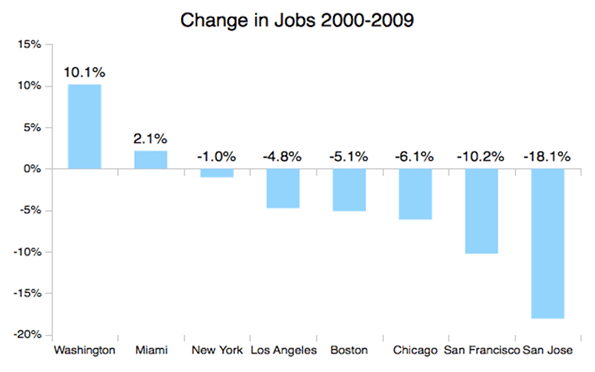
    The 2000s, however, were a very different story. This decade began with the dot com bust and its associated recession, a funk from which the Bay Area economy has yet to fully recover despite Silicon Valley’s continued reign as high tech capital. Similarly, while specialized professional services still flourish, the more mainline areas, such as IT implementations or business process outsourcing, found themselves under significant pressure as digital business matured.

    This caused one commentator to famously declare that “IT Doesn’t Matter.” Then the offshore wave, which had been a born in the 1990s, began to suck away services work just as had occurred previously in manufacturing. This included not just low skill business process outsourcing like invoice processing, but also high value IT engineering and other services not dependent on face to face interaction. This, we found out, could be performed by high skill, low cost labor in places like India.

    This helped to create a so-called “lost decade” of job creation in the US during the 2000s. The tier one metros, save for recession-proof Washington, fared even worse, losing jobs during the decade.

    These are facts and trends that barely impacted the world of urbanists, who continued to act as if nothing had changed. The media, located almost totally in primary cities, bought the message but rarely looked at the basic facts.

    As a result, when it comes to thinking about America’s big cities, too many people remain stuck in the 90s.

    Partially this is understandable. The 2000s saw strong increases in GDP per capita in many of these cities. Also, they experienced huge real estate booms and an associated increase in high end amenities of all kinds: swanky hotels, starchitect buildings, upscale new restaurants and shops, etc. But a lot of this has proved somewhat self-delusional. Like Citigroup CEO Chuck Prince’s now infamous statement that “As long as the music is playing, you’ve got to get up and dance,” these cities continued to party like it was 1999 even as their job base continued to erode and the real estate bubble headed for a crash.

    Today, as the Great Recession has civic finances in a vice grip, and places like Chicago and Los Angeles face stunning budget shortfalls, people are less sanguine. Advocates for the big city model still refuse to face up to the core problems that face our large cities. The real issue should not be how to restart the condo boom, but how to restore what drove the resurgence of the 90s: job creation. This is a national problem to be sure, but not one that seems to interest most big city advocates. It’s almost as if there’s an assumption the jobs will come without working for them. The stimulus and bailout, which helped key urban sectors like green building, university research and public employees, is now running out of steam and political support. In the long run they may have served largely to exacerbate complacency.

    So rather than a focus on private sector job growth, many urban boosters have remained free to focus on other things like sustainability and lifestyle enhancers in the assumption they would generate jobs But what if it doesn’t work out that way? What if the current economy, unlike those boom years of the 90s, does not generate enough money and employment to support these huge regions?

    These cities would be well-advised to go beyond counting skyscrapers, new condo construction, green roofs, and bike share programs. Those things are all good, but basic measures of civic health and dynamism like job growth ultimately underpin those things for the long haul. More than anything, these cities need to be fundamentally focused on their commercial success. Their great challenge is figuring out how to recapture that previous era of job growth, and once again become engines of employment.

    Aaron M. Renn is an independent writer on urban affairs based in the Midwest. His writings appear at The Urbanophile.

    Photo by Werner Kunz (werkunz1)

  • Sarah Palin: The GOP’s Poison Pearl

    Sarah Palin has emerged as the right’s sweetheart, a cross between a pin-up girl and Joan of Arc. For some activists, like the American Thinker‘s Lloyd Marcus, she’s “my awesome conservative sister” who the mainstream media wants to “destroy at any cost.”

    On a more serious note, leading right-wing pundit Roger Simon argues Palin’s is now the biggest name in Republicandom, which he admits is not too great an accomplishment. Armed with “something more than intellect,” he praises her unique ability to “connect with the base.” He also believes, citing some polls for 2012, that she could run a close race against President Obama.

    These Republicans may grow to regret their embrace of Sarah Palin: She will likely prove less a gem than a poison pearl for conservatives. Sure, she can stir the base, but her crossover appeal remains limited. Recent Pew surveys show that she’s still toxic for the Independents and moderate Democrats who generally determine national elections.

    Palin keeps building her brand, but she may also be diminishing the GOP’s. She has helped propel several potentially weak, marginal “Tea Party” candidates such as Rand Paul in Kentucky and Sharron Angle in Nevada into the general elections. These could end up losing seats that more earth-bound Republicans could have won.

    But if conservatives really want evidence of Palin’s limitations, they only need to talk to people in her home state of Alaska. “She represents a constituency that is rural, but that’s it,” says Jim Egan, executive director of Commonwealth North, a local think tank. “What she says and does makes little sense in the urban environment that most Americans live in.” If it does not sell across the board in Anchorage, home to almost half of Alaskans, you wonder how well her message will play in Omaha or suburban Houston, much less New York or Los Angeles.

    Conservatives in Washington might also cool their drool, Egan suggests, if they examine Palin’s Alaska record. True, she did initially take on some in-bred corruption, but she left the state as dependent on oil revenues and federal largesse as before. She left no strong legacy, particularly in comparison with the late former Sen. Ted Stevens–known widely as “Uncle Ted”–who brought heaps of federal blubber to the Last Frontier.

    In contrast, Palin is seen by many Alaskans–including business-oriented conservatives–as a hopeless lightweight. “She’s a narcissistic individual,” suggests Republican State Sen. Craig Johnson. “What bothers me is people think we are like Sarah Palin. We’re not.”

    To Johnson and many Alaska political veterans Palin is more self-promoter than serious politician. Even as some are touting her as a serious candidate for president of the United States, it’s important to realize she proved ill-prepared to be governor of Alaska–more interested in powdering her nose than putting it to the grindstone.

    And remember that Alaska, a vast, underpopulated state of 700,000 hard-working individuals, does not require the horsepower needed to rule a disaster zone like Michigan, much less a mega insane asylum like California. For one thing, Alaska, due to its huge mineral wealth, is a comparatively rich state, with the eighth highest per capita income in the nation. Over 80% of the state budget comes through energy-related taxes. Everyone even gets a nifty $1,300 check as well, also paid for by the energy companies.

    Egan and others argue that Palin, who boosted the return to taxpayers from oil revenues, failed to capitalize on these assets. The state’s bulging revenues during the energy price spike of 2007-08 could have been applied to badly needed infrastructure and education, not to buy new snowmobiles and shotguns. “She epitomizes the whole idea of we get a piece and no sense of planning for the future, about thinking about what we need to do,” Egan says.

    In this sense Palin appeals to the grifter spirit of America–opportunistic and self-centered. This was amply evidenced by her decision to quit office mid-way through her first term for the more lucrative job of cashing in on her personality cult. “Sarah Palin was a breath of fresh air,” says one-time supporter Iris Gardner, who with her husband operates a mercantile store in Alaska’s scenic Seward (population 3,000). “But she blew all that when she quit. People have soured on her.”

    This view is widely shared in Alaska. Today, according to Alaskadispatch.com, about half of Alaskans want to be “done with her.” Only 56% of Republicans count themselves as Palin fans. She is widely unpopular among both Democrats and Independents, the state’s largest electoral base, the Dispatch noted.

    So we have to ask why Palin continues to be attractive for so many conservatives? It has more to do with subliminals than the subtleties of public policy. Palin’s power is not that of serious policymaker but rather as someone with a keen understanding of message and branding. Still, Palin’s appeal cannot be easily dismissed. Certainly charisma does not necessarily translate into a lack of gravitas. Prominent conservatives like Norman Podhoretz have pointed out that Ronald Reagan too was considered a lightweight by many in the mainstream media.

    Yet those who knew and covered Reagan–like my old boss Lou Cannon–always argued Reagan was a serious figure, surrounded by a coterie of very smart advisers. He had spent decades in and around politics before ascending to the White House. Palin, in contrast, seems to be making up her politics along the way.

    Reagan also served two terms as governor of California, despite running for the nomination in 1976. Even today he enjoys some considerable respect from longtime opponents, as well as something close to adoration among friends. As those who interviewed him can attest, he also was very sharp: Reagan would have never allowed a Katie Couric to get the better of him. To paraphrase the famous Lloyd Bentsen’s quip about Dan Quayle, Sarah Palin is no Ronald Reagan.

    Still Palin’s populist appeal seems well-suited against a Democratic Party–and a president–burdened with what seems like a congenital inability to connect with most middle- and working-class concerns. Barack Obama has turned intellectualism into a liability.

    There’s also the novelty factor working in Palin’s favor. “It’s a sense of mystery we can’t keep away from,” Jim Egan suggests. In this sense, oddly, she’s a bit like Barack Obama–someone people enthuse over not because they are ready for the job but because they appeal to some emotional need for novelty. But, as Palin herself would say, how’s that working out for ya?

    This article originally appeared at Forbes.com.

    Joel Kotkin is executive editor of NewGeography.com and is a distinguished presidential fellow in urban futures at Chapman University. He is author of The City: A Global History. His newest book is The Next Hundred Million: America in 2050, released in February, 2010.

    Photo: geerlingguy

  • Year 1959

    Get a glass of wine. Then click on this link, which plays a video called Community Growth, created in 1959.

    Once you’ve seen the video, read on…

    You’re probably sitting with a puzzled look – 1959? Aren’t these the exact same issues that are plaguing us today? Don’t those 1959 developments look like many of today’s latest developments? Even the way they bulldozed through the land and stick-built the homes looks just like the methods used today!

    When I was 7 year old, my mother bought a new white 1959 Chevrolet Impala convertible with a red vinyl interior. This was one of the best designs with those wonderful curved wing-like fins and oblong tail lights. I remember sitting in the front when my mother slammed on the brakes as a child ran in front of the car. Since they did not have seat belts back then, my head flew into the steel dashboard (your probably thinking; ah ha! so that’s why he writes for New Geography). That beautiful Chevy was a coffin in a crash, as witnessed by the following video showing 50 years of safety advances between the 1959 Chevy vs. 2009 Chevy.

    Back then, a 1959 Chevy with 50,000 miles on it was on its last legs, just about broken down, whereas today, a 2009 Chevy with 50,000 miles would be considered just about broken in.

    If a 1959 land development subdivision layout were to crash into (OK, be overlayed upon) a 2009 land development subdivision layout there would be little difference.

    We have written about this in the past, but it bears repeating: Designers look to the ordinances for guidance, and these regulations have been stagnant for about 5 decades (1959. Developers hire designers assuming they will get the best possible layout. Designers look to the six decade old ordinances and assume the minimum dimensions are the optimum ones to maximize density (their clients profits). The layout by minimums will result in cookie cutter monotonous designs. The council and planning commissions admonish the developer for submitting plans that lack character and imagination, yet the developer just followed the regulations that promote such development. And the cycle repeats, and repeats, and repeats for generations upon generations.

    You are reading this article on a computer that is more powerful than any that existed in 1959, or 1969, or possibly even in 1979. If you are older than 60 years old, chances are if this was 1959, you would be dead by now. Advances in health as well as an awareness of what we eat and how we live allow us to live longer happier and more productive lives.

    Technological advancements have touched virtually every product and aspect of our lives – except the neighborhoods we live, work and play within.

    There is something very wrong with this situation, and solving these problems through over densification and forcing a nation into public transportation is taking giant leaps backwards, not towards 1959, but more towards 1859. We posses innovation and technology for the design and building of sustainable future cities without sacrificing the desire for space and personal transportation freedom. This however takes more effort. But isn’t about time we leave 1959 behind?

  • Urban Legends: Why Suburbs, Not Dense Cities, are the Future

    The human world is fast becoming an urban world — and according to many, the faster that happens and the bigger the cities get, the better off we all will be. The old suburban model, with families enjoying their own space in detached houses, is increasingly behind us; we’re heading toward heavier reliance on public transit, greater density, and far less personal space. Global cities, even colossal ones like Mumbai and Mexico City, represent our cosmopolitan future, we’re now told; they will be nerve centers of international commerce and technological innovation just like the great metropolises of the past — only with the Internet and smart phones.

    According to Columbia University’s Saskia Sassen, megacities will inevitably occupy what Vladimir Lenin called the “commanding heights” of the global economy, though instead of making things they’ll apparently be specializing in high-end “producer services” — advertising, law, accounting, and so forth — for worldwide clients. Other scholars, such as Harvard University’s Edward Glaeser, envision universities helping to power the new “skilled city,” where high wages and social amenities attract enough talent to enable even higher-cost urban meccas to compete.

    The theory goes beyond established Western cities. A recent World Bank report on global megacities insists that when it comes to spurring economic growth, denser is better: “To try to spread out economic activity,” the report argues, is to snuff it. Historian Peter Hall seems to be speaking for a whole generation of urbanists when he argues that we are on the cusp of a “coming golden age” of great cities.

    The only problem is, these predictions may not be accurate. Yes, the percentage of people living in cities is clearly growing. In 1975, Tokyo was the largest city in the world, with over 26 million residents, and there were only two other cities worldwide with more than 10 million residents. By 2025, the U.N. projects that there may be 27 cities of that size. The proportion of the world’s population living in cities, which has already shot up from 14 percent in 1900 to about 50 percent in 2008, could be 70 percent by 2050. But here’s what the boosters don’t tell you: It’s far less clear whether the extreme centralization and concentration advocated by these new urban utopians is inevitable — and it’s not at all clear that it’s desirable.

    Not all Global Cities are created equal. We can hope the developing-world metropolises of the future will look a lot like the developed-world cities of today, just much, much larger — but that’s not likely to be the case. Today’s Third World megacities face basic challenges in feeding their people, getting them to and from work, and maintaining a minimum level of health. In some, like Mumbai, life expectancy is now at least seven years less than the country as a whole. And many of the world’s largest advanced cities are nestled in relatively declining economies — London, Los Angeles, New York, Tokyo. All suffer growing income inequality and outward migration of middle-class families. Even in the best of circumstances, the new age of the megacity might well be an era of unparalleled human congestion and gross inequality.

    Perhaps we need to consider another approach. As unfashionable as it might sound, what if we thought less about the benefits of urban density and more about the many possibilities for proliferating more human-scaled urban centers; what if healthy growth turns out to be best achieved through dispersion, not concentration? Instead of overcrowded cities rimmed by hellish new slums, imagine a world filled with vibrant smaller cities, suburbs, and towns: Which do you think is likelier to produce a higher quality of life, a cleaner environment, and a lifestyle conducive to creative thinking?

    So how do we get there? First, we need to dismantle some common urban legends.

    Perhaps the most damaging misconception of all is the idea that concentration by its very nature creates wealth. Many writers, led by popular theorist Richard Florida, argue that centralized urban areas provide broader cultural opportunities and better access to technology, attracting more innovative, plugged-in people (Florida’s “creative class“) who will in the long term produce greater economic vibrancy. The hipper the city, the mantra goes, the richer and more successful it will be — and a number of declining American industrial hubs have tried to rebrand themselves as “creative class” hot spots accordingly.

    But this argument, or at least many applications of it, gets things backward. Arts and culture generally do not fuel economic growth by themselves; rather, economic growth tends to create the preconditions for their development. Ancient Athens and Rome didn’t start out as undiscovered artist neighborhoods. They were metropolises built on imperial wealth — largely collected by force from their colonies — that funded a new class of patrons and consumers of the arts. Renaissance Florence and Amsterdam established themselves as trade centers first and only then began to nurture great artists from their own middle classes and the surrounding regions.

    Even modern Los Angeles owes its initial ascendancy as much to agriculture and oil as to Hollywood. Today, its port and related industries employ far more people than the entertainment business does. (In any case, the men who built Hollywood were hardly cultured aesthetes by middle-class American standards; they were furriers, butchers, and petty traders, mostly from hardscrabble backgrounds in the czarist shtetls and back streets of America’s tough ethnic ghettos.) New York, now arguably the world’s cultural capital, was once dismissed as a boorish, money-obsessed town, much like the contemporary urban critique of Dallas, Houston, or Phoenix.

    Sadly, cities desperate to reverse their slides have been quick to buy into the simplistic idea that by merely branding themselves “creative” they can renew their dying economies; think of Cleveland’s Rock and Roll Hall of Fame, Michigan’s bid to market Detroit as a “cool city,” and similar efforts in the washed-up industrial towns of the British north. Being told you live in a “European Capital of Culture,” as Liverpool was in 2008, means little when your city has no jobs and people are leaving by the busload.

    Even legitimate cultural meccas aren’t insulated from economic turmoil. Berlin — beloved by writers, artists, tourists, and romantic expatriates — has cultural institutions that would put any wannabe European Capital of Culture to shame, as well as a thriving underground art and music scene. Yet for all its bohemian spirit, Berlin is also deeply in debt and suffers from unemployment far higher than Germany’s national average, with rates reaching 14 percent. A full quarter of its workers, many of them living in wretched immigrant ghettos, earn less than 900 euros a month; compare that with Frankfurt, a smaller city more known for its skyscrapers and airport terminals than for any major cultural output, but which boasts one of Germany’s lowest unemployment rates and by some estimates the highest per capita income of any European city. No wonder Berlin Mayor Klaus Wowereit once described his city as “poor but sexy.”

    Culture, media, and other “creative” industries, important as they are for a city’s continued prosperity, simply do not spark an economy on their own. It turns out to be the comparatively boring, old-fashioned industries, such as trade in goods, manufacturing, energy, and agriculture, that drive the world’s fastest-rising cities. In the 1960s and 1970s, the industrial capitals of Seoul and Tokyo developed their economies far faster than Cairo and Jakarta, which never created advanced industrial bases. China’s great coastal urban centers, notably Guangzhou, Shanghai, and Shenzhen, are replicating this pattern with big business in steel, textiles, garments, and electronics, and the country’s vast interior is now poised to repeat it once again. Fossil fuels — not art galleries — have powered the growth of several of the world’s fastest-rising urban areas, including Abu Dhabi, Houston, Moscow, and Perth.

    It’s only after urban centers achieve economic success that they tend to look toward the higher-end amenities the creative-classers love. When Abu Dhabi decided to import its fancy Guggenheim and Louvre satellite museums, it was already, according to Fortune magazine, the world’s richest city. Beijing, Houston, Shanghai, and Singapore are opening or expanding schools for the arts, museums, and gallery districts. But they paid for them the old-fashioned way.

    Nor is the much-vaunted “urban core” the only game in town. Innovators of all kinds seek to avoid the high property prices, overcrowding, and often harsh anti-business climates of the city center. Britain’s recent strides in technology and design-led manufacturing have been concentrated not in London, but along the outer reaches of the Thames Valley and the areas around Cambridge. It’s the same story in continental Europe, from the exurban Grand-Couronne outside of Paris to the “edge cities” that have sprung up around Amsterdam and Rotterdam. In India, the bulk of new tech companies cluster in campus-like developments around — but not necessarily in — Bangalore, Hyderabad, and New Delhi. And let’s not forget that Silicon Valley, the granddaddy of global tech centers and still home to the world’s largest concentration of high-tech workers, remains essentially a vast suburb. Apple, Google, and Intel don’t seem to mind. Those relative few who choose to live in San Francisco can always take the company-provided bus.

    In fact, the suburbs are not as terrible as urban boosters frequently insist.

    Consider the environment. We tend to associate suburbia with carbon dioxide-producing sprawl and urban areas with sustainability and green living. But though it’s true that urban residents use less gas to get to work than their suburban or rural counterparts, when it comes to overall energy use the picture gets more complicated. Studies in Australia and Spain have found that when you factor in apartment common areas, second residences, consumption, and air travel, urban residents can easily use more energy than their less densely packed neighbors. Moreover, studies around the world — from Beijing and Rome to London and Vancouver — have found that packed concentrations of concrete, asphalt, steel, and glass produce what are known as “heat islands,” generating 6 to 10 degrees Celsius more heat than surrounding areas and extending as far as twice a city’s political boundaries.

    When it comes to inequality, cities might even be the problem. In the West, the largest cities today also tend to suffer the most extreme polarization of incomes. In 1980, Manhattan ranked 17th among U.S. counties for income disparity; by 2007 it was first, with the top fifth of wage earners earning 52 times what the bottom fifth earned. In Toronto between 1970 and 2001, according to one recent study, middle-income neighborhoods shrank by half, dropping from two-thirds of the city to one-third, while poor districts more than doubled to 40 percent. By 2020, middle-class neighborhoods could fall to about 10 percent.

    Cities often offer a raw deal for the working class, which ends up squeezed by a lethal combination of chronically high housing costs and chronically low opportunity in economies dominated by finance and other elite industries. Once the cost of living is factored in, more than half the children in inner London live in poverty, the highest level in Britain, according to a Greater London Authority study. More than 1 million Londoners were on public support in 2002, in a city of roughly 8 million.

    The disparities are even starker in Asia. Shenzhen and Hong Kong, for instance, have among the most skewed income distributions in the region. A relatively small number of skilled professionals and investors are doing very well, yet millions are migrating to urban slums in places like Mumbai not because they’ve all suddenly become “knowledge workers,” but because of the changing economics of farming. And by the way, Mumbai’s slums are still expanding as a proportion of the city’s overall population — even as India’s nationwide poverty rate has fallen from one in three Indians to one in five over the last two decades. Forty years ago, slum dwellers accounted for one in six Mumbaikars. Now they are a majority.

    To their credit, talented new urbanists have had moderate success in turning smaller cities like Chattanooga and Hamburg into marginally more pleasant places to live. But grandiose theorists, with their focus on footloose elites and telecommuting technogeniuses, have no practical answers for the real problems that plague places like Mumbai, let alone Cairo, Jakarta, Manila, Nairobi, or any other 21st-century megacity: rampant crime, crushing poverty, choking pollution. It’s time for a completely different approach, one that abandons the long-held assumption that scale and growth go hand in hand.

    Throughout the long history of urban development, the size of a city roughly correlated with its wealth, standard of living, and political strength. The greatest and most powerful cities were almost always the largest in population: Babylon, Rome, Alexandria, Baghdad, Delhi, London, or New York.

    But bigger might no longer mean better. The most advantaged city of the future could well turn out to be a much smaller one. Cities today are expanding at an unparalleled rate when it comes to size, but wealth, power, and general well-being lag behind. With the exception of Los Angeles, New York, and Tokyo, most cities of 10 million or more are relatively poor, with a low standard of living and little strategic influence. The cities that do have influence, modern infrastructure, and relatively high per capita income, by contrast, are often wealthy small cities like Abu Dhabi or hard-charging up-and-comers such as Singapore. Their efficient, agile economies can outpace lumbering megacities financially, while also maintaining a high quality of life. With almost 5 million residents, for example, Singapore isn’t at the top of the list in terms of population. But its GDP is much higher than that of larger cities like Cairo, Lagos, and Manila. Singapore boasts a per capita income of almost $50,000, one of the highest in the world, roughly the same as America’s or Norway’s. With one of the world’s three largest ports, a zippy and safe subway system, and an impressive skyline, Singapore is easily the cleanest, most efficient big city in all of Asia. Other smaller-scaled cities like Austin, Monterrey, and Tel Aviv have enjoyed similar success.

    It turns out that the rise of the megacity is by no means inevitable — and it might not even be happening. Shlomo Angel, an adjunct professor at New York University’s Wagner School, has demonstrated that as the world’s urban population exploded from 1960 to 2000, the percentage living in the 100 largest megacities actually declined from nearly 30 percent to closer to 25 percent. Even the widely cited 2009 World Bank report on megacities, a staunchly pro-urban document, acknowledges that as societies become wealthier, they inevitably begin to deconcentrate, with the middle classes moving to the periphery. Urban population densities have been on the decline since the 19th century, Angel notes, as people have sought out cheaper and more appealing homes beyond city limits. In fact, despite all the “back to the city” hype of the past decade, more than 80 percent of new metropolitan growth in the United States since 2000 has been in suburbs.

    And that’s not such a bad thing. Ultimately, dispersion — both city to suburb and megacity to small city — holds out some intriguing solutions to current urban problems. The idea took hold during the initial golden age of industrial growth — the English 19th century — when suburban “garden cities” were established around London’s borders. The great early 20th-century visionary Ebenezer Howard saw this as a means to create a “new civilization” superior to the crowded, dirty, and congested cities of his day. It was an ideal that attracted a wide range of thinkers, including Friedrich Engels and H.G. Wells.

    More recently, a network of smaller cities in the Netherlands has helped create a smartly distributed national economy. Amsterdam, for example, has low-density areas between its core and its corporate centers. It has kept the great Dutch city both livable and competitive. American urbanists are trying to bring the same thinking to the United States. Delore Zimmerman, of the North Dakota-based Praxis Strategy Group, has helped foster high-tech-oriented development in small towns and cities from the Red River Valley in North Dakota and Minnesota to the Wenatchee region in Washington State. The outcome has been promising: Both areas are reviving from periods of economic and demographic decline.

    But the dispersion model holds out even more hope for the developing world, where an alternative to megacities is an even more urgent necessity. Ashok R. Datar, chairman of the Mumbai Environmental Social Network and a longtime advisor to the Ambani corporate group, suggests that slowing migration to urban slums represents the most practical strategy for relieving Mumbai’s relentless poverty. His plan is similar to Zimmerman’s: By bolstering local industries, you can stanch the flow of job seekers to major city centers, maintaining a greater balance between rural areas and cities and avoiding the severe overcrowding that plagues Mumbai right now.

    Between the 19th century, when Charles Dickens described London as a “sooty spectre” that haunted and deformed its inhabitants, and the present, something has been lost from our discussion of cities: the human element. The goal of urban planners should not be to fulfill their own grandiose visions of megacities on a hill, but to meet the needs of the people living in them, particularly those people suffering from overcrowding, environmental misery, and social inequality. When it comes to exporting our notions to the rest of the globe, we must be aware of our own susceptibility to fashionable theories in urban design — because while the West may be able to live with its mistakes, the developing world doesn’t enjoy that luxury.

    This article originally appeared at Foreign Policy

    Joel Kotkin is executive editor of NewGeography.com and is a distinguished presidential fellow in urban futures at Chapman University. He is author of The City: A Global History. His newest book is The Next Hundred Million: America in 2050, released in February, 2010.

    Photo: Mugley

  • New York Commuting Profile: From Monocentrism to Edgeless City

    The US Bureau of the Census has just released detailed county to county and place (municipality) to place work trip flow tables. This new data is the most comprehensive since the 2000 census and covers 2006 to 2008.

    The county to county data is particularly useful for analysis in the nation’s largest metropolitan area (Note 1), New York. The New York metropolitan area has more than 19 million people and stretches across 6,700 square miles of land area, one half of it in the urban area, which is the urban footprint that includes all areas, including suburbs, in the continuous urbanization (3,350 square miles) and the other half rural (Note 2). This area is composed of 23 counties, which makes far finer grain analysis possible than in Los Angeles, with just two counties or San Diego, where its single county precludes any county based metropolitan area analysis.

    The New York metropolitan area’s counties extend east to west from Suffolk on Long Island to Pike in Pennsylvania and north to south from Putnam in the Hudson Valley to Ocean on the New Jersey shore. Surprisingly, it does not include Fairfield and New Haven counties in Connecticut, which have strong economic ties to the urban area (and which are a part of the larger, Census designated “combined statistical area”). Indeed, major parts of these two counties can be considered part of the New York urban area (Note #3).

    Median house age is a useful indicator of the urban form in segments of a metropolitan area. This examination breaks the New York metropolitan area into rings. The core is New York County (Manhattan, where the median construction date of owned dwellings is 1942). The first ring is the other four boroughs of New York City. The inner ring includes counties outside the city in which the median aged house was built in the 1950s, while the outer ring includes counties in which the median aged house was built in the 1960s or later. The one anomaly is Staten Island (Richmond County) which although politically part of the city of New York, demonstrates a mean housing age closer to that of the outer ring (median construction date 1971). Visually it resembles late suburban New Jersey much more than it does the rest of the city. However, Staten Island’s strong ties to the city justify its classification with the other boroughs.

    Comparatively Centralized: New York is one of the most centralized large urban areas in the high income world,with only Tokyo ranking higher among areas over 5 million population. The Manhattan business district, located to the south of 59th Street is the world’s second largest (following Tokyo’s Yamanote Loop). But in terms of employment density Manhattan has more than double the employment density. What was, at least until recently, indisputably the world’s most spectacular skyline leads many to conclude that nearly everyone works in Manhattan.

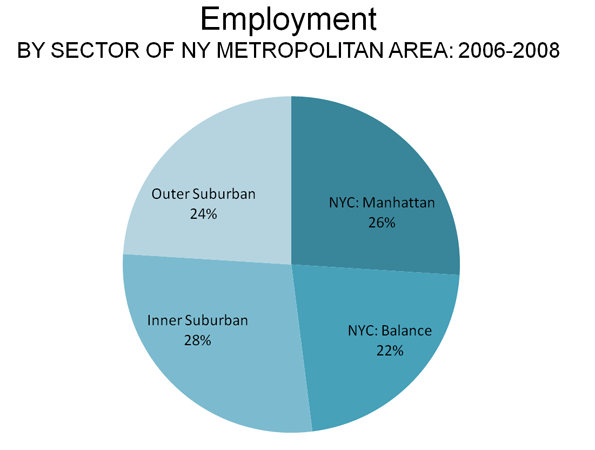
    A Highly Decentralized Metropolitan Area: Yet in reality, New York is a highly decentralized metropolitan area. Approximately 74% of employment is outside Manhattan and the jobs are comparatively evenly dispersed among the sectors. There is more employment in the inner ring suburbs than in Manhattan (28%). Even the outer ring is competitive has nearly as many jobs, at 24%. Finally, the balance of the city, the four boroughs, has 22% of the employment (Figure 1).

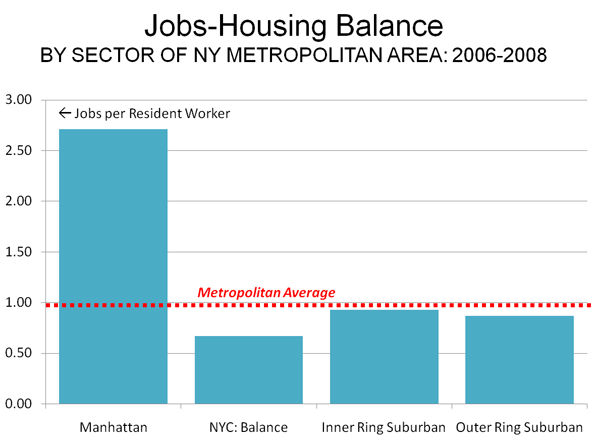
    Wide Variations in the Jobs-Housing Balance: It is hard to understate the intensity of Manhattan’s central business district employment. Manhattan has 2.71 jobs for every resident worker. An important tenet of modern urban planning theory is to achieve a balance of jobs and housing. Manhattan’s jobs/housing imbalance is certainly the most acute of any county in the United States, yet it is to Manhattan that purveyors of smart growth densification policies are routinely drawn.

    Manhattan’s huge excess of jobs contrasts with employment the rest of the the city, where the jobs-housing balance at the county level is 0.67, the lowest in the metropolitan area. The inner ring suburbs have the highest jobs-housing balance at 0.93, while the outer suburbs have a jobs-housing balance of 0.87 (Figure 2), nearly one-third higher than the non-Manhattan boroughs (three of which are more dense than any major municipal jurisdiction in the nation). The city’s strongest jobs-housing balance is in Brooklyn (Kings County), at 0.72, which is lower than all of the suburban counties except for the most remote (Pike, Putnam and Sussex).

    Manhattan’s Impact: Diminishing Rapidly with Distance: There is no doubt that Manhattan remains the core of the New York economy, but that is less true the further you go out. While nearly 70% of the core’s workers commute from outside Manhattan, the employment influence of Manhattan drops off like the temperature falls the further you get away from a fireplace.

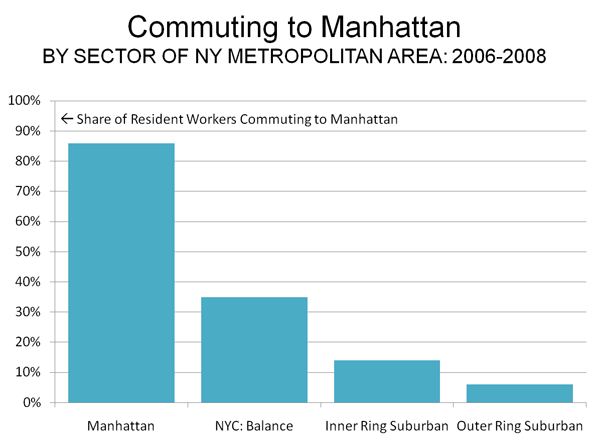
    86% of Manhattan’s resident workers have jobs in Manhattan, but only 35% of workers living in the city’s other boroughs work in Manhattan. This falls off to 14% in the inner suburban counties and 6% in the outer suburban counties (Figure 3). In Sussex County and Ocean County, New Jersey, only 2% of resident workers commute to Manhattan.

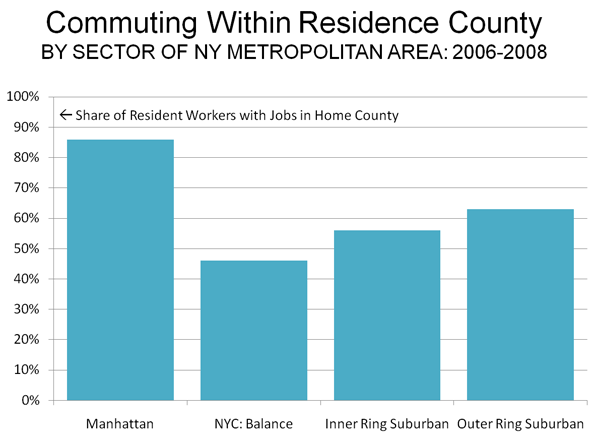
    Working Close to Home: At the same time a larger number of resident workers outside Manhattan work in their home counties than work in Manhattan. In the balance of the city, 46% of workers have jobs in the same counties. The inner suburban counties employ 56% of their resident workers, while the outer suburban counties employ 63%. Overall, 58% of New Yorkers work in their county of residence, more than double the share that work in Manhattan (Figure 4). In Richmond County (Staten Island), Suffolk County and Rockland counties in New York and Pike County, Pennsylvania, more than 80% of jobs are filled by local residents.

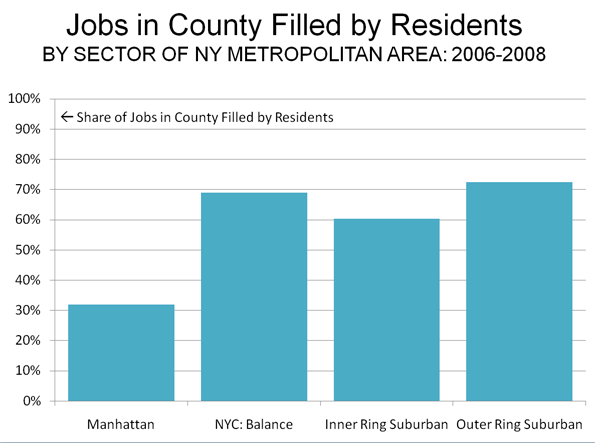
    Local Workers Generally Come from the Same Counties: A review of the residential location of workers by job location reinforces the dominantly local nature of commuting in New York. Overall, 56% of jobs are filled by residents of the same county. The figure is the highest in the outer ring suburban counties, at 73%. The inner ring suburban areas draw 60% of their workers from the same county, while the balance of the city draws 69%. In Manhattan, with its seriously out of balance jobs and housing, just 32% of the jobs are filled by it residents (Figure 5).

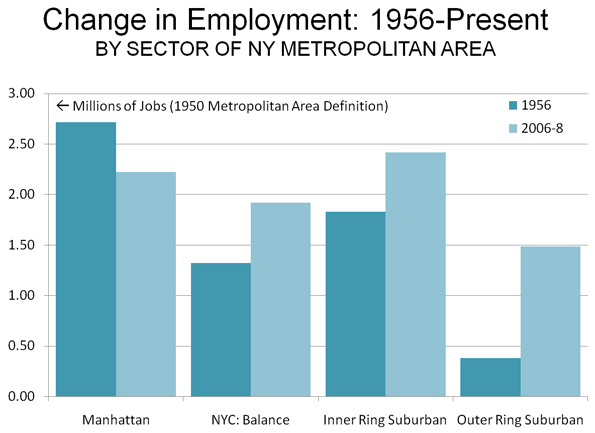
    Dispersion: Past and Present. All of this is a huge change from a half-century ago. In 1956 (according to data in the classic Anatomy of A Metropolitan Area, by Edgar M. Hoover and Raymond Vernon), Manhattan accounted for 43% of the metropolitan area’s employment (1950 metropolitan definition). Since that time, employment has fallen substantially in Manhattan and risen elsewhere. There have been gains in the outer boroughs, related principally to the strong population growth Queens and Staten Island. There were also gains in the inner suburban counties. The strongest gains were in the outer suburban counties (Figure 6).

    The dispersion is continuing. As Ed McMahon and I showed in Empire State Exodus, there is considerable migration from New York to Pennsylvania, as people are moving to metropolitan areas such as Allentown and Wilkes-Barre. Obviously, as the modest level of commuting from the outer counties of metropolitan New York indicates, relatively few of these people are commuting to Manhattan. This impression may be more a product of the fact the Manhattan-based media only recognizes workers when they actually make it into town; those who stay in the periphery, it seems, might as well live on another planet.

    New York, with as by far the strongest central business district in the nation, still has moved from virtual monocentrism, to the Edge Cities polycentrism of Joel Garreau and increasingly even to the amorphous Edgeless Cities employment dispersion of Robert Lang. The strong core continues to regenerate, but no longer exerts anything like its former dominant influence.

    ——-

    Note 1: For complete data.

    Note 2: For a description of urban terms (metropolitan area, urban area, etc).

    Note 3: Demographia World Urban Areas includes the continuous urbanization of southwestern Connecticut as a part of the New York urban area.

    ——-

    Table 1
    COMMUTING IN THE NEW YORK METROPOLITAN AREA (2006-2008): SUMMARY BY GEOGRAPHIC RING
    RINGS Ring Jobs/Housing Balance (Jobs per Resident Worker) Workers Employed in Residence County Share of Jobs Filled by County Residents Workers Employed in New York County (Manhattan) Average One-Way Work Trip Time (Minutes): Residence Average One-Way Work Trip Time (Minutes): Workplace Median Year Owned Housing Built
    NYC: Manhattan 1 2.719 86.3% 31.7% 86.3%                30.3                49.1 1942
    NYC: Balance 2 0.674 46.4% 68.8% 35.6%                42.0                37.3 1939-1971
    Inner Ring 3 0.927 56.0% 60.4% 14.4%                30.5                29.1 1950-1956
    Outer Ring 4 0.870 63.1% 72.5% 6.2%                31.3                26.0 1967-1983
    New York MSA 1.000 57.6% 57.6% 26.1%                34.5                35.5 1955
    Derived from American Community Survey data (2006-2008)
    Note: MSA work trip times (residence and work location) differ because commuters from outside the MSA are included


    Table 2
    COMMUTING IN THE NEW YORK METROPOLITAN AREA (2006-2008): SUMMARY BY COUNTY
    COUNTIES Ring Jobs/Housing Balance (Jobs per Resident Worker) Workers Employed in Residence County Share of Jobs Filled by County Residents Workers Employed in New York County (Manhattan) Average One-Way Work Trip Time (Minutes): Residence Average One-Way Work Trip Time (Minutes): Workplace Median Year Owned Housing Built
    New York Co., NY 1 2.719 86.3% 31.7% 86.3%                30.3                49.1 1942
    Bronx Co., NY 2 0.676 44.3% 65.6% 36.8%                41.1                35.7 1950
    Kings Co., NY 2 0.721 51.2% 71.0% 36.7%                42.3                39.0 1939
    Queens Co., NY 2 0.645 42.4% 65.7% 36.0%                42.0                37.5 1949
    Richmond Co., NY 2 0.585 47.3% 80.8% 26.3%                42.7                29.8 1971
    Bergen Co., NJ 3 0.960 56.7% 59.1% 15.0%                29.3                27.2 1956
    Essex Co., NJ 3 1.052 53.6% 50.9% 9.7%                30.8                31.8 1953
    Hudson Co., NJ 3 0.892 47.1% 52.8% 23.6%                32.4                35.1 1950
    Passaic Co., NJ 3 0.797 45.3% 56.8% 4.3%                27.0                28.0 1954
    Union Co., NJ 3 0.969 50.7% 52.3% 7.1%                33.0                27.6 1954
    Nassau Co., NY 3 0.884 59.1% 66.8% 14.8%                31.6                30.0 1954
    Westchester Co., NY 3 0.928 67.3% 72.6% 19.9%                33.6                27.7 1955
    Hunterdon Co., NJ 4 0.736 49.5% 67.2% 3.7%                31.4                28.2 1978
    Middlesex Co., NJ 4 0.943 58.5% 62.0% 7.7%                26.9                25.8 1968
    Monmouth Co., NJ 4 0.880 63.4% 72.0% 8.2%                33.2                23.8 1970
    Morris Co., NJ 4 1.097 58.7% 53.5% 5.4%                29.4                31.2 1967
    Ocean Co., NJ 4 0.723 63.4% 87.7% 2.0%                31.1                21.3 1977
    Somerset Co., NJ 4 0.988 46.7% 47.3% 5.6%                31.0                31.1 1978
    Sussex Co., NJ 4 0.565 44.5% 78.8% 2.3%                38.2                23.7 1972
    Putnam Co., NY 4 0.441 30.9% 70.1% 8.0%                37.0                24.4 1967
    Rockland Co., NY 4 0.763 61.2% 80.1% 12.0%                29.8                25.1 1969
    Suffolk Co., NY 4 0.872 76.2% 87.4% 5.7%                29.8                23.5 1967
    Pike Co., PA 4 0.574 45.9% 80.0% 4.6%                44.1                25.2 1983
    New York MSA 1.000 57.6% 57.6% 26.1%                34.5                35.5 1955

    ——-

    Wendell Cox is a Visiting Professor, Conservatoire National des Arts et Metiers, Paris and the author of “War on the Dream: How Anti-Sprawl Policy Threatens the Quality of Life

    Photo: Levittown (Nassau County): Inner Suburban (photo by author)

  • In California Cool is the Rule, but Sometimes, Bad is Bad

    Californians value cool. I’m not sure how this came to be. It might be the weather. It might be the entertainment industry. Whatever the reason, Californians don’t get excited. Better to go with flow than to get excited. Things will be ok. Concerned about the economy? Stay cool Dude. It’ll come back. Always has. Always will. Relax.

    It’s not cool to get excited, or heaven forbid, panic. Californians are not quick to react to problems, so confident that eventually the problem will just go away. This was forcefully brought home to me when a member of California’s legislature told me that “It doesn’t matter what we do in this building. California will always rebound.”

    California’s governance is seemingly designed to enforce cool in the government. Term limits, two-thirds requirements, and bipartisan gerrymandering combine to insure that change is not legislated. So you see absurdities, such as the legislature’s worrying about the asbestos content of the State Rock while the budget-less State goes down the path of bankruptcy and economy collapse.

    Institutionalized stasis is why I don’t think it matters who wins the upcoming gubernatorial election. Neither Mercurial Meg Whitman nor Moonbeam Jerry Brown will cause Sacramento to actually do anything to change California’s trajectory.

    Veteran capital-watcher Dan Walters likes to say that when legislators do agree and actually do something important, it’s usually bad. He cites California’s failed “electricity deregulation” back in 2000 as a case in point. The state does have a release valve, the initiative, which is much hated by the political class. But it is their fault. Legislative inaction is probably one reason for the increase we’ve seen in ballot initiatives. Of course, initiatives are seldom the optimal way to create change.

    Proposition 13 is an excellent example. Sacramento was aware of the property-tax problem, but was unable to deal with it. That created a vacuum, and the radical tax reformers stepped in. The result was a far more draconian and less flexible law than necessary or desirable. That’s the way initiatives work. The legislature fails to legislate. Inaction creates a vacuum. The vacuum is filled by more extreme interests. The resulting law is almost always flawed.

    California cool may be legendary, but as the Huey Lewis song says, sometimes bad is bad, and California’s economy is bad, very bad, and it’s not going to get better soon without real change. Plenty of lawmakers, especially the governor, are counting on renewable energy and green industry to provide California with an economic rebirth. It won’t happen. Read why here and here.

    I’m thinking that now would be a good time for Californians to lose their cool.

    Recently, Boeing announced that it is moving two programs from Long Beach California to Oklahoma. The move will cost California about 800 mostly well-paid engineering jobs. This is a relatively small event in an economy the size of California’s, but it is part of a steady drumbeat of businesses leaving California. Northrop Grumman has already decamped. General Dynamics’ San Diego shipbuilding subsidiary, Nassco, is shrinking its workforce by 300 workers, most of them highly skilled. Even the entertainment industry is slowly reducing its footprint in California. The list goes on and on.

    The main reason: California is an expensive place to do business, and the expense is made more onerous by uncertainty about future taxes and regulation. Consequently, those businesses that can increasingly are departing for more reliable, friendlier climes.

    Policy makers may find excuses for each of these events, but the persistence and size of the differences between California’s economic performance and those of better-managed states indicate something few in Sacramento understand: many of California’s economic problems are self inflicted. How big is the difference between California’s economy and other states? The unemployment rate provides one answer: California’s unemployment rate is about 30 percent higher than that of the rest of the country. That’s big, far larger than can be explained by demographic factors.

    High and persistent unemployment is not the only result of California’s job-killing environment. Income inequality is increasing, a legacy of declining opportunity for skilled blue collar workers and a failed educational system. Home prices and sales will not recover for years. Commercial real estate is in freefall, and we may not see anything approaching full occupancy for a decade. Real-per-capita retail sales may never recover, a result of joblessness, high taxes, and increased internet competition. Perhaps the most telling trend is that domestic migration has been negative for most of the past 15 years, as people vote with their feet and seek opportunity in other states.

    About the only source of hope, in a perverse way, is that government revenues are down. By now, it should be clear, even to those who thought their income was independent of economic activity, that a prosperous private sector is a necessary precondition for general prosperity. Professors, non-profit-sector workers, and government employees are learning the hard way their dependence on the private sector. We can hope that personal interest will drive them to more enlightened policy.

    That hope is tempered, though, by the political class’s willingness to embrace the mirage of a free lunch. The AB 32 climate change and SB 375 anti-sprawl bills were the result of a well-meaning search for the Holy Grail of costless environmental and economic virtue.

    Environmental and economic interests are not inherently incompatible, but environmental quality is not costless. In fact, it is a luxury good. Wealthier societies invest far more in environmental protection and rehabilitation than do subsistence societies whose primary concern is finding the next meal. In short, environmental protection requires investment, and wealthier societies are better able to pay the price.

    California’s leadership’s embrace of AB32/SB375 is unlikely to achieve any of its goals. It will be a drag on economic activity. Its impact on global greenhouse gasses will be negligible. Worse, it is very inefficient. Economic research is not ambiguous. Subsidies and command-and-control regulation are far from the cheapest way of improving the environment. The best way to reduce greenhouse gas emissions is through a rebated tax. This would be a carbon tax, where the tax revenue would be rebated to offset a more distortionary tax, say a labor or capital tax. This simultaneously discourages the bad, pollution, while encouraging the good, work or investment.

    AB32/SB375 is certainly not the source of all of California’s problems. The state has lots of them, and it’s time we took a serious approach of addressing them. Maybe, we should lose our cool and demand real leadership from Sacramento.

    Bill Watkins is a professor at California Lutheran University and runs the Center for Economic Research and Forecasting, which can be found at clucerf.org.

    Photo by Duncan H

  • Syria: Luxury Rentals With A Turkish Backstory

    In looking for winners in the war in Iraq, a good place to start is the Damascus real estate market, which went from being a subprime, Axis-Of-Evil neighborhood to one where Iraqis with flight capital could stash their money.

    I had not connected the cost of a Syrian two-bedroom with those Iraqis who are losing hearts, minds, and subsidiaries, until I traveled with my teenaged son on the Ottoman and Crusader roads from Istanbul to Damascus… and heard of apartments selling for $2 million.

    In headlines about the Middle East, Syria is a front-line state, a radical Arab nation that is sworn to Israel’s destruction, and, more recently, an ally of Iran that will envelope the infidels running Iraq and agitate terror along the Lebanese-Israeli border.

    On the ground, however, Syria has softer edges than most rogue states. It has a nascent tourist industry, built around Roman ruins and Crusader fortresses. The populace is friendly, and largely indifferent to the protectionist rackets of the ruling al-Assad family. There is perhaps enough secularism to bridge east and west, if not Israel and the Arab world.

    Getting to Syria isn’t easy. The trip from Istanbul’s glorious Haydarpasha Station was a forty-hour excursion, including a train ride across Anatolian Turkey and the Taurus Mountains. Highlight: the kabuki theatre at the Turkish-Syrian border crossing, an Arabian Checkpoint Charlie. (Our taxi driver distributed duty-free cigarettes to each of the passengers and, between the borders, filled up the tank of his car with gas from a Pepsi bottle.)

    The places between Istanbul and Aleppo — Syria’s second largest city — included Tsarus, the hometown of St. Paul; Ceyhan, terminus of the geopolitical Azerbaijan-Georgia-Turkey oil pipeline; and ancient Antioch, now Hatay, where the word “Christian” first circulated in caves beyond the city.

    We spent the night in the port of Iskenderum in the province of Hatay, which remains a sore point in the often troubled foreign relations between Turkey and Syria. To keep Turkey away from an alliance with Nazi Germany in 1939, the French government, which had a League of Nations mandate over Greater Syria, gave the Arabic province to the Turks.

    Syria claims the region, which may explain why, in happier days, Turkey was friendly with Israel. When that relationship cooled, irredentism in Hatay was forgotten, and now trade is booming between Syria and Turkey.

    The Iskenderum waterfront feels like a Black Sea resort. Most importantly, it has backgammon and strong coffee. The town was contemplated as the terminus of a Persian Gulf railway, to speed British troops to India. In 1917, after his ignominious defeat at Gallipoli, Winston Churchill wanted to stage yet another amphibious assault behind the Ottoman lines, this time from Alexandretta (now Iskenderum). Britain’s war cabinet ignored him.

    Aleppo is a traveler’s dream, and far from the raw emotions of Middle East politics. We stayed at the Hotel Baron in the Agatha Christie room (I checked the armoire for a body), and wandered around the souk, the Crusader citadel, and the mosque, which has more little boys with soccer balls than it does angry Muslims.

    In the Armenian genocides of 1915, the few survivors walked to Aleppo. I met an older woman at the hotel whose father, at age ten, was the only member of a large family to survive the forced march. As she told the story of their fate, she wept.

    T. E. Lawrence (of Arabia) also stayed at the Baron. We inspected his hotel bill, saved in a musty cabinet. In 1909, to research his Oxford thesis on Crusader fortresses, Lawrence walked across Syria, at that time just an Ottoman province.

    We did his trip in reverse—not on foot but in a rental car—and ended up at Krak des Chevaliers, which he called the “finest castle in the world.” Imagine the roundtable of King Arthur on a Syrian mountain.

    The Crusaders lost their foothold in the Near East, in part because they failed to form a lasting alliance with their logical protector in Constantinople, the Byzantine Empire. Even now, the Christian enclaves in Lebanon and Syria, not to mention those in Israel, feel adrift from history. Diplomatically, Syria is largely alienated from its neighbors.

    For its patchy tourist industry — a few more road signs would be nice — Syria can build upon the soaring columns of its Roman ruins, which can be found near the Mediterranean coast and in the remote eastern desert.

    We walked the imperial miles at Apamea and in Palmyra, where many columns are intact. Hadrian and other emperors turned these distant watering holes into cities that resemble the Parthenon in Athens. Palmyra feels like a Greek mirage.

    I didn’t linger over the tourist kitsch of Old Damascus or the city’s charming alleys. Instead, I found a cafe overlooking the Umayyad mosque and read David Fromkin’s A Peace to End All Peace, a book that tries to lay the blame for current Middle East instabilities on the British decision in World War I to break up the Ottoman Empire.

    The 1919 Peace of Paris (for Turkey, it was the Treaty of Sèvres) left the Middle East with national borders drawn haphazardly around tribal clans. Of the partitioning, Fromkin writes: “It was the Liberal dream of triumphant Hellenism and Christianity, promoted by Gladstone’s political heir, David Lloyd George.”

    Lawrence dreamed of independence for the Arabs, only to see them subjugated to the British and French empires. He observed: “Our government is worse than the old Turkish system.” He might well have said the same about the United States, which has taken up the Ottoman’s burden in the Middle East.

    The modern nations of Syria, Lebanon, Israel, and Jordan were originally figments in the imaginations of Paris mapmakers. Arabs complain about Israel’s artificial borders, but the same can be said of all its neighbors.

    Few people I met in Syria ever mentioned Israel, the Golan Heights, or the Arab-Israeli conflict. The border wars seemed more symbolic than real, a looming menace that allows the al-Assad family to prove its bona fides with Arab nationalists (few of whom have a voice in the Syrian government). Syrian diplomacy is generally cynical: Syria talks tough against Israel, funds Hezbollah, and rails against the Americans… so that the Syrian government can then lord over the local economy as if it were a family business.

    As a train man, I spent much of the trip searching for the Hejaz Railway, which Lawrence devoted his time in the desert to blowing up. The railway brought pilgrims, not to mention janissaries, from Damascus to Medina, now in Saudi Arabia, and it had a branch line to Haifa. Since the lines were cut, the Middle East has been fractured.

    To further the cause of peace in the Middle East, I am for its revival. The narrow gauge engines are still in working condition, and much of the track bed remains. Call it the Peace Train or the Freedom Express, but have rail service from Beirut to Damascus, and a connection to Haifa. Rail buffs and tourists would love it, but so would Syrian merchants and Israeli trading companies.

    The line might not connect Berlin to Baghdad, or even Alexandretta to the Persian Gulf. But it would be a better use of Middle East reconstruction money than what’s now disappearing into Damascus apartments.

    Photo by Steven Damron; Damascus apartments.

    Matthew Stevenson is the author of Remembering the Twentieth Century Limited, winner of Foreword’s bronze award for best travel essays at this year’s BEA. He is also editor of Rules of the Game: The Best Sports Writing from Harper’s Magazine. He lives in Switzerland.