Blog

  • Are We Going fascist?

    The rise, and then the improbable election, of Donald Trump have reawakened progressive fears of a mounting authoritarian tide. With his hyperbole and jutting chin, he strikes some progressives as a new Benito Mussolini who will threaten free speech and other basic human rights.

    Some aspects of Trumpism do exhibit some classic fascist modalities — emphasis on personal charisma, attacks on vulnerable minorities, rage against comfortable and self-satisfied elites. Yet, at the same time, some of the most histrionic attacks on Trump come from people who, rather than rejecting authoritarianism, really fear only his politically incorrect version of it.

    During the election, Trump supporters did not generally disrupt Clinton rallies, but disturbances by progressives were somewhat common. After the election, the most hysterical forebodings about free speech came from the very college campuses — along with the left-leaning social media — that have not exactly been friendly to free speech.

    At the same time, the powerful green lobby has made a point of trying to marginalize even distinguished scientists who differ in any degree from its climate change orthodoxy. In some cases, these scientists are not only demonized by fellow academics, but have been targeted for prosecution by “right-thinking” politicians. Sounds pretty fascist to me.

    Read the entire piece at The Orange County Register.

    Joel Kotkin is executive editor of NewGeography.com. He is the Roger Hobbs Distinguished Fellow in Urban Studies at Chapman University and executive director of the Houston-based Center for Opportunity Urbanism. His newest book, The Human City: Urbanism for the rest of us, was published in April by Agate. He is also author of The New Class ConflictThe City: A Global History, and The Next Hundred Million: America in 2050. He lives in Orange County, CA.

    Photo by Gage Skidmore from Peoria, AZ, United States of America (Donald Trump) [CC BY-SA 2.0], via Wikimedia Commons

  • The End of Eyes on the Street

    Jane Jacobs talked about the “sidewalk ballet” of her neighborhood and the importance of eyes on the street. But her conception of that, one where shopkeepers policed the sidewalks in front of their stores and kept an eye out for neighborhood kids, is far away from what we have today.

    My latest post looking at this is over at City Journal and is called “The End of Eyes on the Street“:

    “The bedrock attribute of a successful city district is that a person must feel personally safe and secure on the street among all these strangers,” wrote Jane Jacobs in The Death and Life of Great American Cities. Jacobs is revered as an urban prophet, but key facets of her prescription for how to keep streets safe and maintain thriving urban neighborhoods are increasingly being ignored in New York today.

    Key to safe and thriving sidewalks is what Jacobs called “eyes on the street”: people taking an active interest in what’s happening around them. Citizen vigilance, she believed, was even more important than the police. Public peace, she wrote, was “kept primarily by an intricate, almost unconscious network of voluntary controls and standards among the people themselves, and enforced by the people themselves.” Some eyes on the street were more important than others–especially those belonging to local business owners. “Storekeepers and other small businessmen are typically strong proponents of peace and order themselves,” Jacobs observed. “They hate broken windows and holdups; they hate having customers made nervous about safety.”

    Click through to read the whole thing.

    What’s amazing to me is that at the same time we’re told we can’t do anything about things like a panhandler following my wife a block down the street cursing at her because she refused to give him money (which happened recently), or when we can’t stop mentally ill people from pushing people in front of subway trains and killing them (as happened yesterday at Times Square), we have immense effort being put into farcical items like stopping “microaggressions.” It certainly belies a lot of the rhetoric around what we can and can’t do in society.

    Aaron M. Renn is a senior fellow at the Manhattan Institute, a contributing editor of City Journal, and an economic development columnist for Governing magazine. He focuses on ways to help America’s cities thrive in an ever more complex, competitive, globalized, and diverse twenty-first century. During Renn’s 15-year career in management and technology consulting, he was a partner at Accenture and held several technology strategy roles and directed multimillion-dollar global technology implementations. He has contributed to The Guardian, Forbes.com, and numerous other publications. Renn holds a B.S. from Indiana University, where he coauthored an early social-networking platform in 1991.

    Photo: Andy C (Own work) [CC BY-SA 3.0 or GFDL], via Wikimedia Commons

  • The Future of Racial Politics

    From its inception, the American experiment has been dogged by racial issues. Sadly, this was even truer this year. Eight years after electing the first African-American president, not only are race relations getting worse, according to surveys, but the electorate remains as ethnically divided as in any time of recent history.   

    Donald Trump has emerged in most media accounts as the candidate of Anglo voters, with a margin of 21 percentage points over Hillary Clinton among that segment of the electorate. Clinton’s embrace of “identity” politics may have played a role in turning off many of these white non-Hispanic voters, who might otherwise had voted Democratic.

    Many Democrats maintain still, with some justification, that as demographics evolve over the next decade, the increasingly diverse electorate will reward their identification with racial minorities. The country, and the electorate, seem destined to become ever less white in the coming decades.  Between 2000 and 2015, the nation’s population makeup became increasingly minority, from 31 percent to 38 percent. This trend will continue, with the country conceivably becoming 45 percent non-white by 2030 and 53 percent by 2050.

    White Men Can’t Jump, But They Can Still Vote

    It may well be that Democrats this year jumped the demographic gun. Even as the white population diminishes, it retains a dominant influence in elections. One reason: Whites tend to vote more. Most critical, the African-American share of the electorate, which reached record highs with Barack Obama atop the ticket,  actually dropped by a percentage point in 2016. Latino turnout, widely seen as a surge that would elect Clinton, represented  about the same percentage –11 percent — in 2016 as in 2012.  

     Thesedynamics keyed the Trump victory, particularly in heavily white working-class precincts in the Midwest, Pennsylvania and Florida, where he secured his electoral victory. Many of the pivotal states electorates remain very white indeed. In Wisconsin, for example, more than 80 percent of voters are white, and most of them are not residents of liberal college towns like Madison. This is also the case for Pennsylvania, where more than 75 percent of voters are Caucasian. Even Florida – itself a very diverse state — still has a heavily white electorate, accounting for more than 55 percent of voters.  

     These patterns will remain critical past what might be seen as their sell-by date for two critical reasons. One has to do with the concentration of minority voters. Nearly 60 percent of African-Americans live in Southern states where Trump won by dominating a very conservative white electorate. Other minority voters are clustered in big cities in the Northeast, which are not remotely contestable for Republicans.

     Latino voters, and also Asians, are likewise heavily concentrated, particularly in California,   now essentially a non-GOP zone, as well as the similarly politically homogeneous Northeastern cities and Chicago. To be sure, Latinos are also critical in Texas, and Asians too (increasingly so), but for now the Texas white population still outvotes them by a considerable margin.

     Another problem for the much-ballyhooed “emerging Democratic majority” lies in one stubborn fact: The elderly, most of whom are white, are not dying out quickly enough for Democrats to win. Although the extension of life spans may have slowed, or even slightly reversed in some demographic segments, seniors are clearly living longer than before.  

    The Limits of Identity Politics    

    Ignoring the reality of economic decline in the states that swung to Trump, some observers maintain that the increased conservatism among white working-class voters reflects deep-seated racial antagonisms. But this does not explain the considerable movement  of these voters, particularly in the Rust Belt, from support for Obama to support for Trump, as seen in such places as Youngstown, Ohio, Wheeling, W.Va., Macomb County, Mich., and Erie, Pa.

    The Democratic Party made things easier for Trump by adopting identity politics as its mantra. This is particularly maddening when charges of racism are leveled by affluent professionals, academics and bureaucrats, many from elite universities, who are themselves privileged.

    To their credit, some  progressives suggest shifting away — at least in the short run — from identity politics. But racial determinism may now be too central to their ideological core. Bernie Sanders’ campaign spokesperson Symone Sanders, for example, said that when it comes to picking a new leader for the  Democratic National Committee, whites need not apply.    

     Matthew Yglesias, always an excellent window on progressive dogma, insists that “there’s no other kind of politics” but identity politics; Democrats, he asserts, simply need “to do it better.” Progressives seem about as ready to ditch racialist politics  as Southern segregationists were willing to abandon Jim Crow in 1948.

    The Coming GOP Crisis

    For Republicans, identity politics is the gift that keeps giving, but the question is for how long. If you want a nightmare racial scenario for the GOP, just look at California. Since 1994, when the state passed Proposition 187, a measure widely perceived as anti-Hispanic, the Anglo population has dropped by more than 2 million as the state has added 9 million people, including more than 7 million Hispanics. Minorities now account for 62 percent of the population, compared to 43 percent in 1990. The shift in the electorate has been slower but still significant. In 1994, 49 percent of the electorate was Democratic and 37 percent Republican. Due in large part to ethnic change, by 2016 the Democratic margin was 45 percent-26 percent.

    In California this surge in minority voters has accompanied a gradual erosion of the white population, a large portion of which has left for other states. The Golden State  also has gone out of its way to encourage immigration of undocumented aliens by offering them driver’s licenses, subsidized health care and  financial aid for college; 74 percent of all California children under 15 are  now minorities, compared to 66 percent in 2000, and  25 percent of them live below the poverty line. This is 2.5 times the white non-Hispanic rate in California.  

    Despite largely positive results outside the blue coastal states, potentially the biggest long-term problem facing Republicans is in a dominant aspect of geography:  suburbia. Trump lost   some largely affluent suburban areas like Orange County, where 55 percent the population is Latino or Asian, up from 45 percent in 2000.  Perhaps most emblematic of potential GOP problems was Trump’s — and the GOP’s —  loss of Irvine, a prosperous Orange County municipality that is roughly 40 percent Asian.

    Republicans should be even more worried about trends in Texas, where Latinos are already close to a plurality and the Asian population is surging. There are still enough conservative whites to win elections in Texas — Trump won by 10 percentage points — but the margins will continue to shrink. This trend can already be seen in Houston’s sprawling, increasingly multiracial suburbs. Trump, for example, lost solidly middle-class Fort Bend County, by some estimates among the most diverse in the country, which voted Republican in every presidential elections since 1968.

    If this pattern continues, the die may indeed be cast for the GOP. As most minorities now live in the suburbs — a trend that continues to increase — a loss of suburban voters, given the total Democratic lock on inner city electors, would be too much for rural and small-town whites to overcome.  Simply put, by 2030, losses in the multicultural suburbs could make dreams of progressive long-term dominance all but inevitable.

    How Republicans Can Withstand the Racial Shift

    Republicans must reverse these trends if they don’t want to go the way of the dinosaur. They can take some limited satisfaction in knowing that Trump did somewhat  better than Mitt Romney or John McCain among Hispanics and blacks  as well as improving slightly among Asians.

    To expand on these modest gains, Republicans need to focus not on race but economics.  Our recent study for the Center for Opportunity Urbanism demonstrates clearly that minorities generally do far better in red states than in blue ones, based on such factors as income, homeownership, entrepreneurship and migration. Minorities all continue to move in ever larger numbers to red states because their economic climate and regulatory regime work better for them.

    Conservatives can make a case that Barack Obama’s progressive agenda actually favored the highly affluent, who tend to be disproportionately white.  According to a 2016 Urban League study,  African-American levels of economic equality are lower now than in 2009, surely a disappointment for a black middle class so understandably proud of Obama’s elevation.

    The best role model for the GOP could be in Texas. Latinos in the Lone Star State generally do better than their counterparts in California — as measured by homeownership, marriage rates, incomes — and also tend to vote more conservatively. In 2014, for example, Republican Gov. Greg Abbott won 44 percent of Texas Latinos. In contrast, that same year Democratic Gov. Jerry Brown won 73 percent of the Latino vote in California.  

    Other factors, notably upward mobility among  Latinos, African-Americans and Asians, could play a transformative role. As they continue to move to the suburbs, buy houses and start businesses, they may become less likely to support a high-regulation, high-tax and redistributionist agenda. Since 2000, more than 95 percent of the minority growth (black, Asian and Hispanic) in the 52 largest metropolitan areas has been in suburban and exurban areas. Trump did much better among college-educated black males, for example,  than those with no college education — 16 percent vs. 11 percent.

    If more minorities enter the middle class, particularly under Trump, this  could provide an opening for Republicans, just as occurred after the World War II when Italian, Irish, Polish and other eastern European voters moved to the suburbs and assimilated, even intermarried, after years of living apart. A message that targets the middle class aspirations of minorities could be more effective in the long run than appealing merely to xenophobic sentiments shared by an inexorably diminishing population.

    Critically, in the coming  decades, the vast majority of Latinos and Asians will be native-born. They will have spread out increasingly not only within regions but to more conservative parts of the country, notably Texas and the Southeast. At the same time, the population of undocumented workers, the least assimilated and generally the poorest demographic, is already declining, down by 300,000 since 2008. If it continues to decline, which may be likely under Trump, immigration may soon fade away as a primary issue for Latinos.

    Perhaps even more critical, however, may be the growing trend toward intermarriage among minorities. Among second-generation Latinos and Asians, interracial marriage is creating what could become an increasingly fluid racial identity. Intermarriage involving African-Americans is also on the upswing. The new generation of ethnic hybrids, most with one Anglo parent, will no longer be easily pigeon-holed ethnically. Overall, 15 percent of marriages were between partners of different ethnic groups in 2012.

    These are all opportunities to succeed, but the GOP can only prolong itself if it finds a way to reach minority voters based on an appeal of economic mobility. Whether they take this tack, or simply play for time until white voters lose their primacy, may determine whether it is the stupid party that some suggest, and one that, even at its great moment of opportunity, is destined to remain permanently so.

    Ultimately, Republicans could build on Trump’s economic message by demonstrating its efficacy for minority voters. This may be the party’s only hope in the future, given the demographic trends. The competition could also encourage Democrats to focus more on “bread and butter” issues. If future presidential campaigns are waged over key economic issues, rather than pitting ethnicities against one another, the nation will be both unified and stronger.

    This article first appeared on Real Clear Politics.

    Joel Kotkin is executive editor of NewGeography.com. He is the Roger Hobbs Distinguished Fellow in Urban Studies at Chapman University and executive director of the Houston-based Center for Opportunity Urbanism. His newest book, The Human City: Urbanism for the rest of us, was published in April by Agate. He is also author of The New Class ConflictThe City: A Global History, and The Next Hundred Million: America in 2050. He lives in Orange County, CA.

    Wendell Cox is principal of Demographia, an international public policy and demographics firm. He is a Senior Fellow of the Center for Opportunity Urbanism (US), Senior Fellow for Housing Affordability and Municipal Policy for the Frontier Centre for Public Policy (Canada), and a member of the Board of Advisors of the Center for Demographics and Policy at Chapman University (California). He is co-author of the “Demographia International Housing Affordability Survey” and author of “Demographia World Urban Areas” and “War on the Dream: How Anti-Sprawl Policy Threatens the Quality of Life.” He was appointed to three terms on the Los Angeles County Transportation Commission, where he served with the leading city and county leadership as the only non-elected member. He served as a visiting professor at the Conservatoire National des Arts et Metiers, a national university in Paris.

    Photo: Steve White, Creative Commons

  • Agglomeration in Los Angeles

    The Economy of Cities

    Cities have been called “engines of growth”.  What does that mean?

    Fly over a major city and what do you see? Not well defined centers and sub-centers. More likely, an amazing complexity. We argue that what is actually down there, but hard to actually see, is a large number of superimposed and spatially realized supply chains.

    In big cities like Los Angeles, we are well served by large numbers of people (mostly strangers) arranged in complex and usually unfathomable supply chains Their incredible (and hidden) complexity is not a problem.  Shopping is simple; we look at prices and the reputations of sellers and products.  Markets illustrate the stark contrast between how much we get vs how little we have to know.

    Market competition also means a scramble for new ideas. The best performing firms form new ideas first. There are supply chains for things and supply chains for ideas. The latter are harder to identify but clearly essential. New ideas come before new things. Mokyr (2002) notes that we are all on the lookout for useful knowledge.

    Managers are charged with the challenge of deciding what to make vs what to buy.  But the choices require a decision of what to buy where? What is available where?

    Cities are engines of growth because the settlement patterns that evolve (survive) are ones that provide good access – to things we may want to buy and to ideas we may want to hear about and learn about.

    What Kind of City?

    The question here is what kind of city is most congenial to the kind of network formation required for all this to work?

    Urban economists and geographers once described the evolution and spread of cities as an evolution from “pedestrian city” to “streetcar city” to “automobile city” (Mueller, 2004).  But this has been elaborated and updated. Baldwin (2016) describes how economic geography changed as various advances lowered trading costs and communications costs. He separates face-to-face costs from communications costs; the former are the constraint to a “flat world”. The partition recognizes the special nature of tacit information exchange. We do many things electronically but we still travel to meetings, near and far.

    This has led some to assume that dense, traditional cities possess intrinsic advantages. Although some of these are relevant, evidence is that different urban forms can also function successfully.  

    Cities can achieve efficiencies in different ways. Delivering goods or ideas can occur via many modes or media. Possibilities, costs and choices change as technologies evolve, e.g. transactions costs, location choice and urban form evolve. All this suggests that evolving and adapting cities — of differing forms— constitute an essential part of durable economic growth. Just as price discovery is a market process, so is supply chain formation — and chains’ spatial arrangements.

    What matters more than form is the ability to allow the market to function. Economic efficiencies cannot be achieved top-down; top-down involvement must maintain a light touch. Rules should be simple and clear. Approvals that are complex and politicized must be clarified and simplified. There might also be a balance whereby landowner’s rights are not swamped by neighbors’ rights to stop (politicize) development.

    We all have many chains in our lives; we participate in many supply chains as buyers and as sellers. This includes going to work, where we sell our labor. All of us choose (compete for) locations in light of these many interests. This suggests that we are eager to find and secure locations that facilitate our performance in the many supply chains we are involved in. This defines how   we get the cities we have.

    Boundaries and Geography

    Drawing boundaries is never simple. Where does the city or region begin and end? The same is true for important features within cities. What constitutes or defines the center, the downtown, the major sub-centers? Where do “suburbia and “exurbia” begin and end? And what happens beyond these centers, sub-centers, clusters and agglomerations?

    Economists who study cities often describe them via just one number, the (average) density. How can that be adequate?  Cities are complex and distinguished by their peculiar locational arrangements. Most studies of city success rely on simple metropolitan area average densities for the simple reason that these are easily found. Yet it is a leap to describe large and complex places via one single number. Consider that Los Angeles — which does not achieve almost anywhere the densities common to Manhattan or San Francisco —  has been the densest urbanized area in the U.S. since approximately the mid- 1980s. The factoid illustrates the problem of relying on just one number. 

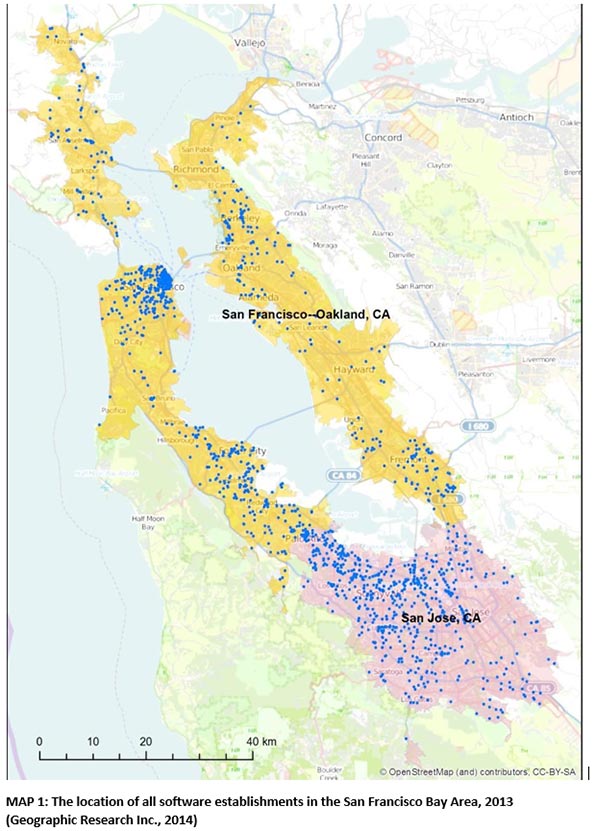
    Map 1 of the location San Francisco Bay Area software firms illustrates the complexities. Does the Bay Area’s overall population density – considerably less than that of Los Angeles, much less than Manhattan – signify anything? Where does the  Silicon Valley a “cluster” or an “agglomeration” begin and where does it end?  Were the map a three-dimensional density surface, there would be peaks as well as low-rise hills. Which ones are sub-centers or clusters?

    The standard labels fall short. Settlement patterns are complex — and emergent. Being near or far from “the action” can be many things. It also involves many possible trade-offs. Less expensive homes for workers? Better schools? Less commuting? Any industry includes many players who will avail themselves of many choices along the ranges of many possible trade-offs.

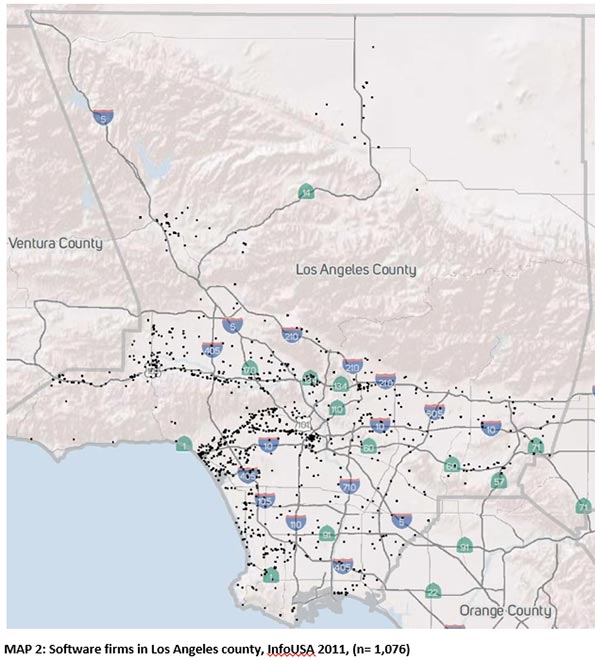
    Map 2 plots locations of software firms in Los Angeles County. The same variety of arrangements and the same questions apply. But both of our maps show that the spread of software firms is always lumpy, but is also dispersed widely.

    Here is one example, from a large literature, of the challenges. Bumsoo Lee (2007) applied several centers identification strategies to the study of employment in major U.S. metropolitan areas. According to one such method, MSAs of more than 3 million inhabitants had roughly 7 percent of jobs in the central business district, 15 percent in the various sub-centers and the remaining 78 percent “dispersed”, outside of any identified center.  

    What L.A. Data Tell Us

    Data on production functions are widely available. Geographically detailed data on the locations of firms are becoming available. In a recent study of Los Angeles, we used two data sources. The first was InfoUSA 2011 with data on businesses in 6,395 census block groups in Los Angeles County. The InfoUSA data indicate business locations with number of employees by NAICS (2007) industrial sector. These were aggregated to create the sectors we wanted to study such as Software and Biotech.  

    We tabulated Los Angeles area co-locations of firms. Employment and firms were spatially aggregated by Census Block Group. The aggregated jobs and firms are divided by the size (acres) of the Census Block Group to calculate employment and firm densities. The median-size Census Block Group in L.A. County is 79 acres. These data were useful for, among other things, calculating pair-wise co-location coefficients. These became dependent variables in multiple regression tests.

    The second data source is US IMPLAN input-output 2013, originally with 536 sectors which were also aggregated to the industrial sectors we were interested in. The technological coefficients, proportions of sector-to-sector purchases, were the independent variables used to test their effects on the observed co-locations of firms. 

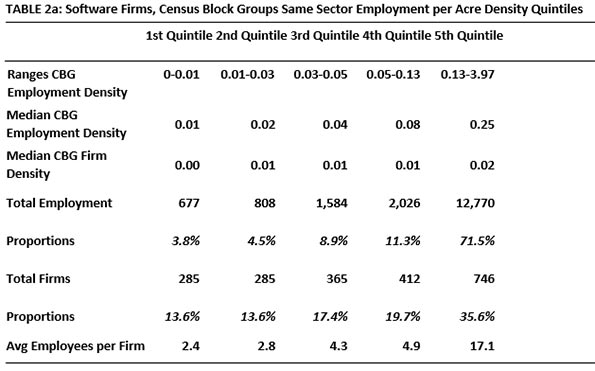
    What kind of spatial arrangements do we see? To avoid the problem of identifying centers and subcenters – and leaving out all the other places, people and jobs — we computed density quintiles. Looking at the number of firms and their sizes in each density quintile, we found that they might or might not be arranged in compact geographic clusters. That’s what our two maps suggest.

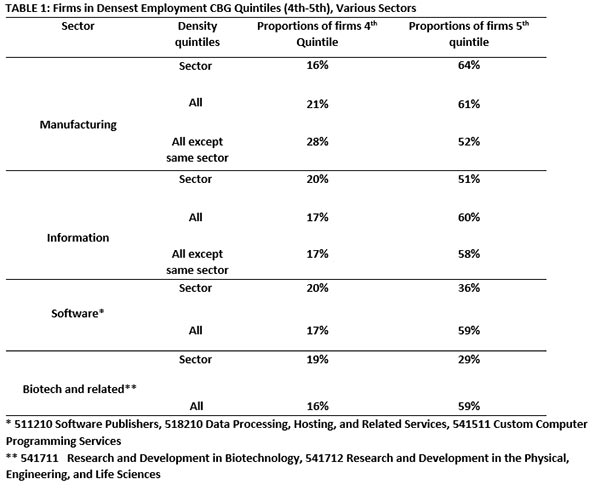
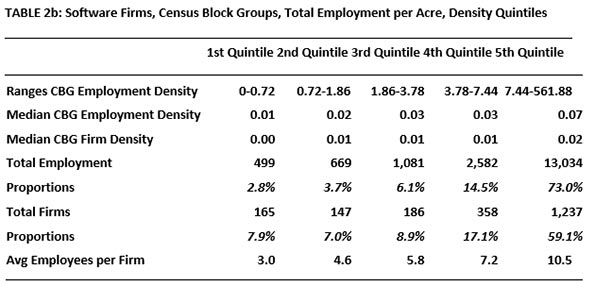
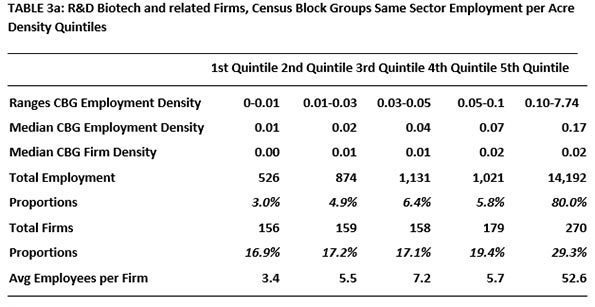
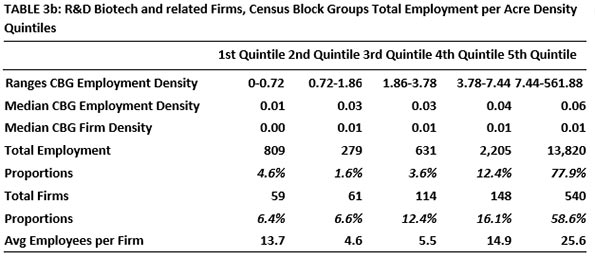
    Table 1 summarizes our findings on firm location in the two densest quintiles. For the large sectors, three kinds of densities were tabulated: for all firms of the sector, for all firms in all sectors and for all firms in all sectors except the sector being studied.

    The two subsectors studied here, Software and Biotech, are prominent in the modern world and unique enough to merit their own categories. They employ about the same number of people in LA County. But these two sectors differ in important ways. Software firms have service as well as research functions. Biotech is more weighted toward the research side. In addition, biotech is the more regulated of the two, most significantly subject to Federal Drug Administration vetting and ruling. “The estimated average pre-tax industry cost per new prescription drug approval (inclusive of failures and capital costs) is: $2,558 million.” (DiMasi, et al 2014). All this suggests greater risk and generally larger firm sizes.

    When it comes to total industry clusters, medium-sized Biotech firms are in the least dense areas; this cannot be said of Software firms. As in the story of the more aggregated sectors, clustering (with same sector firms as well as with others) is apparent. But there are prominent exceptions. Scooping up ideas can be initiated remotely.   Some firms are able to do less up-close interacting and complementing it with the virtual alternative. The blends vary.

    Large proportions of Software and Biotech firms choose the dense quintiles in similar proportions. These agglomerate even though economizing on shipping is not their big concern. As expected, more of the larger Biotech firms are less likely to seek clusters.  

    Firm size differences are also interesting. The largest Software firms (by number of workers) prefer the highest density quintile, whether densities refer to all firms or just same-sector firms. It is not the same for Biotech firms, where many of the medium-sized firms prefer the lowest density quintile, as defined for sectors of all firms. In this sector, that size may be good for internal R and D and information gathering and creation.

    Does density matter? By all means but it is complex. Even for firms in sectors that deal more in information than physical product, nearby densities (of same-sector and well as other-sector) do affect location choice. An interest in establishing networks by which ideas can be shared can explain this. Idea sharing is complex and still requires some degree of nearness. Over 50 years ago, Mel Webber wrote about “Community without Propinquity” (1963). This was years before there was an internet but Webber deserves credit for calling our attention to the fact that we seek and form a variety of very complex links that help explain our locational preferences.

    Peter Gordon is Emeritus Professor, USC Price School of Public Policy. His current research addresses how the nature of cities impacts economic growth prospects. John Cho is Associate Regional Planner at the Southern California Association of Governments. His interests involve transportation networks and their effects on regional development.

    REFERENCES

    Baldwin, Richard (2016) The Great Convergence. Cambridge, MA: Belknap.

    DiMasi, Joseph A. and Henry G. Grabowski and Ronald W. Hansen (2014) Innovation in the Pharmaceutical Industry: New Estimates of R&D Costs. Boston: Tufts Center for the Study of Drug Development, Tufts University.

    Lee, B. (2007). "Edge" or "edgeless" cities? Urban spatial structure in U.S. metropolitan areas, 1980 to 2000. Journal of Regional Science, 47(3), 479-515.

    Mokyr, Joel (2007) “The Market for Ideas and the Origins of Economic Growth in Eighteenth Century Europe” Tijdschrift Voor Sociale en Economische Geshiedenis, 4.

    Muller, Peter O. (2004) “Transportation and Urban Form: Stages in the Spatial Evolution of the American Metropolis” in S. Hanson (ed.) The Geography of Urban Transportation (3rd ed.) Guilford Press.

    Webber, M.M. (1963) “Order in Webber Diversity: Community without Propinquity” in Cities and Space, Lowdon Wingo (ed.) Baltimore: Johns Hopkins University Press.

  • World’s Most Affluent Areas: Dominated by Low Population Densities

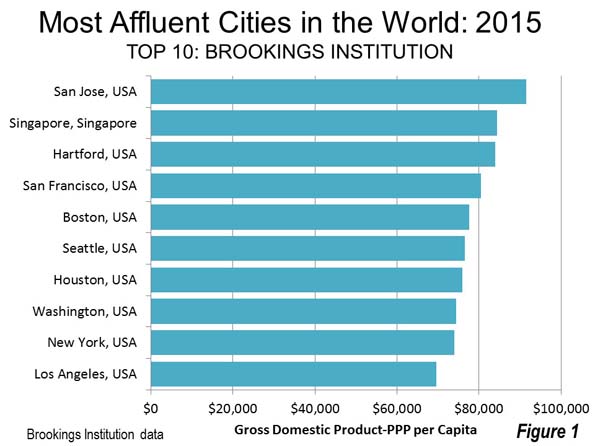
    The Brookings Institution is again out with data on the world’s most affluent metropolitan areas. The GDP data is in Redefining Global Citieswhich contains a treasure trove of data. Again, United States metropolitan areas dominate the highest rankings, capturing nine of the top 10 positions. San Jose is rated with the highest gross domestic product (GDP) per capita, at $91,400 (purchasing power parity or PPP). This is an improvement from third in 2014 and second in 2012 (Figure 1). The top 10 is dominated by cities with relatively low urban densities, like those that characterize San Jose (core of the world’s leading information technology center , Silicon Valley).

    In 2015, San Jose finally passed even less dense Hartford, which had ranked second and first in the two previous reports. In 2014, Macau, the smaller of China’s two Special Administrative Regions (SAR) had ranked number one (the larger SAR is Hong Kong, ranked 32nd). There was a methodology change in 2015 that established a population threshold higher than that of Macau, however the government’s anti-corruption campaign was credited with reducing Macao’s gaming revenue substantially and dropping the GDP per capita by about 15 percent. If it had been rated, Macau’s GDP per capita would have remained in the top 10, but would have fallen from the top.

    Singapore broke into the top 10, positioning itself between San Jose and Hartford, rising from 14th place, with a GDP per capita of $84,300. The Hartford, metropolitan area, which lead the list in 2012 and ranks second in 2014 fell to third place, with a GDP per capita of $84,000. San Francisco rose from nine in 2014 to 4th, with a GDP per capita of $80,600. Boston ranked fifth, with the GDP per capita of $77,700, dropping from fourth place. The top 10 was rounded out by Seattle, Houston, Washington, New York and Los Angeles (Note 1).

    The US dominance was far less in the second 10, with positions 11, 12 and 13 being captured by Zurich, Perth (Australia) and Munich. Paris, often rated highly as a world city, ranked 17th, while Stockholm ranked 19th. The five US entries were Portland (14th), San Diego (16th), Minneapolis St. Paul (17th), Dallas-Fort Worth (18th), and Denver (20th).

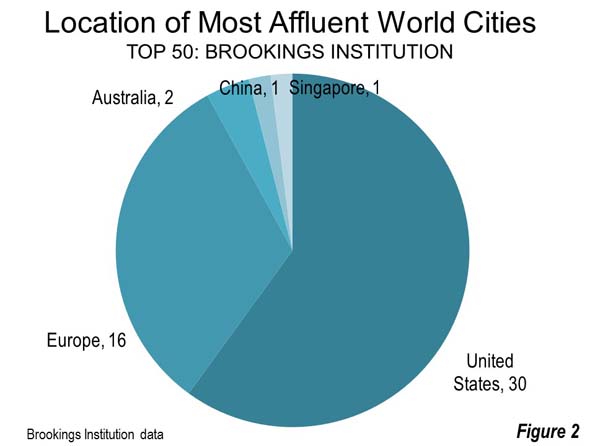
    Thirty of the 50 most affluent cities were in the United States, and 16 were in Europe. Australia had two entries, while East Asia had two, Singapore and Hong Kong (Figure 2).

    As usual, the rankings produced results that would surprise people who do not regularly follow this data.  London, which is routinely in a neck and neck competition with New York as the strongest “world” city ranked 35th, just behind Columbus Ohio. Tokyo, home of the world’s largest urban area, ranked 60th, behind Shenzhen, China (59th). Toronto, Canada’s principal city, ranked 53rd, just behind San Antonio. Sydney, Australia’s largest city ranked 47th, just behind St. Louis and just ahead of Detroit.

    Expanded Contents: Redefining Global Cities

    The new Brookings Institution report contains far more data than is indicated above. There is labor productivity data, indicated by GDP per worker. San Jose also leads in this category, and again, nine US metropolitan areas are included in the top 10. The only non-US entrant is the industrial powerhouse of Dongguan, China, one of the world’s least known metropolitan areas, located between Hong Kong, Shenzhen, Guangzhou and Foshan (the latter three municipalities in Guangdong Province).

    The report also contains data on economic growth, tradable clusters, innovation, talent and connectivity (with multiple indictors in each category). With the three reports since 2012, the Brookings Institution has positioned itself as a premier source for regularly published world urban data.

    The Highest Productivity in the Lowest Urban Densities

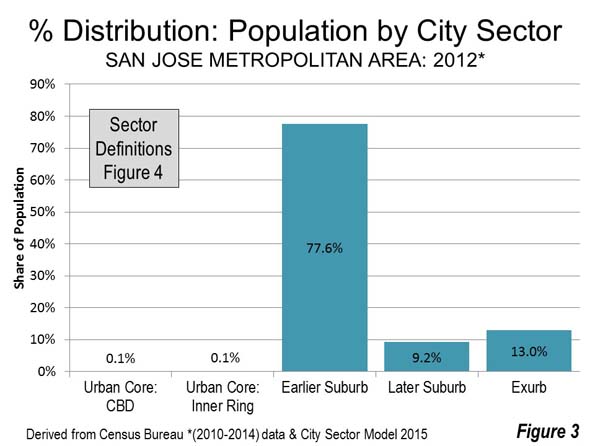
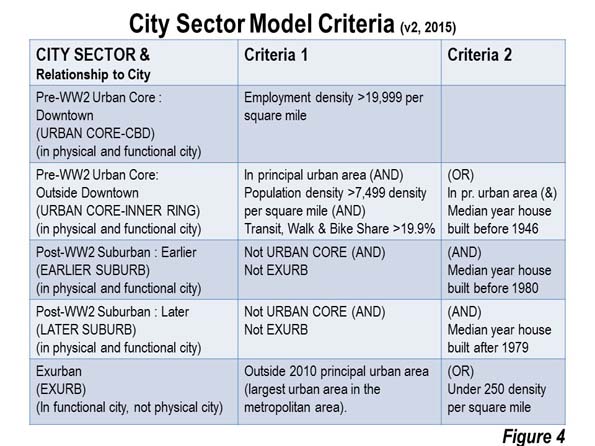
    There have often been suggestions that productivity and innovation are associated with high urban densities. This year’s data provides ample refutation of any such claim. San Jose, the top city in both GDP per capita and labor productivity, is virtually all suburban, as is indicated by the City Sector Model (Figures 3 and 4). San Jose, without a pre-World War II core and world-class dispersion is illustrated in the photograph at the top.

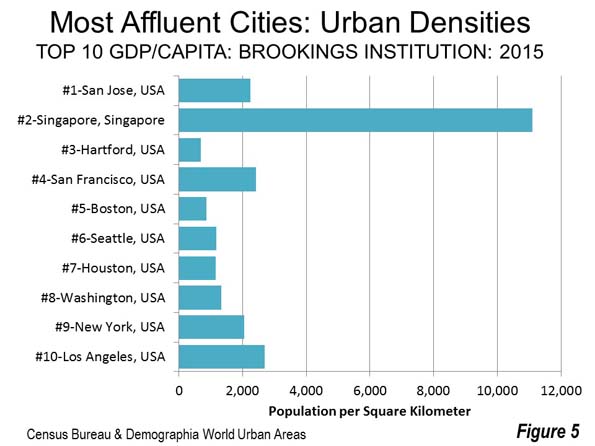
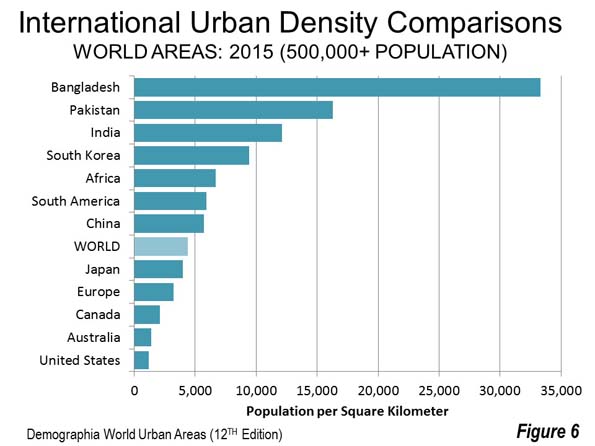
    The highest built-up urban area density among the top 10 metropolitan areas in GDP per capita is in Singapore, which is also the only one exceeding the world average urban density in the top 30. All of the US metropolitan areas in the top 10 have urban population densities well below that of Singapore (Figure 5) and below that of the average Chinese and Western European urban areas. Indeed, US metropolitan areas, which dominate world affluence, have the lowest urban population densities in the world as is indicated in Figure 6 (Note 2). 

    Note 1: US city data not adjusted for PPP (regional price parities) within the United States. Application of regional price parities to personal or household incomes would yield considerably different rankings.

    Note 2: Built -up urban area data are the only reliable measure for comparing urban densities at the organic city level, which in the economic or functional sense is metropolitan areas, and in the physical sense is contiguous built-up urban areas . This excludes the administrative unit or “municipality,” which is simply a political construct. For further information see: Paul CheshireMax Nathan and Henry G. Overman of the London School of Economics in their recent bookUrban Economics and Urban Policy: Challenging Conventional Policy Wisdom. Virtually all metropolitan areas contain a principal built-up urban area and extensive rural areas (commuting sheds), which may also contain smaller urban areas. Thus, any comparison of metropolitan densities is not an urban comparison, but a mix of urban and rural densities. In most of the few countries that designate metropolitan areas, the rural land areas are substantially greater than the urban land areas. The matter is further complicated by the lack of international “building block” standards for metropolitan areas. These standards produce hugely different mixes of urban and rural in metropolitan areas. For example, the New York urban area represents only 42 percent of the land area. In Riverside-San Bernardino, the principal urban area has 2 percent of the metropolitan land area. In Paris, the land outside the principal urban area represents 83 percent of the metropolitan area. A recent post in the respected Marginal Revolution blog (“China Fact of the Day”) indicated that China’s metropolitan area densities were lower than those of the United States. As noted above, metropolitan density comparisons are not reflective of urban densities. China’s urban densities are nearly five times that of US urban areas (Figure 5).

    Wendell Cox is principal of Demographia, an international public policy and demographics firm. He is a Senior Fellow of the Center for Opportunity Urbanism (US), Senior Fellow for Housing Affordability and Municipal Policy for the Frontier Centre for Public Policy (Canada), and a member of the Board of Advisors of the Center for Demographics and Policy at Chapman University (California). He is co-author of the “Demographia International Housing Affordability Survey” and author of “Demographia World Urban Areas” and “War on the Dream: How Anti-Sprawl Policy Threatens the Quality of Life.” He was appointed to three terms on the Los Angeles County Transportation Commission, where he served with the leading city and county leadership as the only non-elected member. He served as a visiting professor at the Conservatoire National des Arts et Metiers, a national university in Paris.

    Photo by Michael from San Jose, California, USA (Santa Clara Valley – California) [CC BY 2.0], via Wikimedia Commons

  • Babes In Trumpland: The Coming Rise Of The Heartland Cities

    Contrary to the media notion that Donald Trump’s surprising electoral victory represented merely the actions of unwashed “deplorables,” his winning margin was the outcome of rational thinking in those parts of the country whose economies revolve around the production of tangible goods.

    And their economies stand to gather more steam in the years ahead.

    Trump’s victory was largely minted in the suburbs and smaller cities of the new American Heartland, from Pittsburgh to Omaha to Dallas-Ft. Worth. The heartland regions depend on agriculture, home construction, manufacturing and energy, all of which could benefit from the policies of the new presidential administration and Republican Congress. In contrast, Hillary Clinton favored extending the Obama administration’s policies on fossil fuels and housing that may win support in the dense progressive bastions of the East and West coasts, but were viewed with alarm by many tied to heartland industries, some of which have been under pressure from a global decline in commodity prices.

    Trump’s pro-fossil fuel stance may be anathema in the coastal cities, but will have a very positive effect on the many cities in the “oil patch” that extends from Texas’ Permian Basin to North Dakota, Ohio and western Pennsylvania. This is not just a matter of roughnecks out on the Gulf or West Texas; many of the 100,000 or so jobs lost in the energy industry over the past few years were located in major cities, such as Houston, where many of the employees are both well-educated and dwell close to the urban core.

    Most important of all, manufacturing matters in the heartland in ways that no longer resonate in coastal areas, particularly New York and San Francisco. Since 2000, two of America’s historic centers for manufacturing, Los Angeles and New York together have lost over 600,000 manufacturing positions. Trump’s call for more U.S. industrial jobs could turn out a swan song, but every job that stays in America due to his cajoling is more likely to benefit people in suburban St. Louis or Detroit than Manhattan or Malibu.

    Building on Momentum

    Critically, Trump’s election comes at a time when heartland cities already had economic momentum, including in the Rust Belt.

    The stock, real estate and tech booms on the coasts, as well as increased regulation and taxation there, have made interior cities increasingly attractive to relocating companies and migrants. This is most evident in Texas’ leading metropolitan areas — Dallas-Ft. Worth, Austin, San Antonio and, until recently, Houston — which have consistently led the nation in job and population growth.

    When California companies like Apple look to add middle-class jobs, they don’t often do it in the Golden State, but in more affordable places like Austin. Every big Texas city in recent years can show you a big scalp from my adopted home state: Occidental to Houston, for example, or Toyota America and Jacobs Engineering to Dallas.

    Similar patterns can be seen in the rapid expansion of such smaller cities as Nashville, Charlotte, Columbus, Salt Lake City — all in states that Trump won handily. These cities have developed impressive central cores, but have seen larger scale growth on their periphery. Resilient Great Plains cities like Fargo, Omaha and Sioux Falls have spiffed up and attracted investments in everything from tech and financial services to health care.

    Other industries, such as financial services and business and professional services, are also moving increasingly to heartland cities, and some are building impressive presences in health care.

    Voting With Their Feet

    Perhaps the most underreported, but significant shift towards heartland cities has been a human one. Before, educated people generally clustered in favored blue cities such as San Francisco, New York, Boston, Washington, D.C., and Chicago. This thesis was well documented by urban analyst Richard Florida in his “Rise of the Creative Class.”

    Yet when Richard and I were together in Kansas City last month we were treated to a tour of the region’s ascendant neighborhoods, both in the city and in adjacent parts of Kansas.Cities like Kansas City have seen their downtown residential populations surge, but the vast majority of growth there, as well as in the rest of heartland, tends to be on the periphery.

    As growth in New York and other “hip” cities has slowed, populations are shifting to less expensive ones. Research by demographer Wendell Cox has found that since 2010 over 1.45 million people net have moved from Clinton states to those that favored Trump.

    This increasingly includes young people, according to research conducted at Cleveland State University. There has been a sea change in the migration patterns of educated millennials since 2010, with faster growth in heartland cities than the Bay Area, Washington or New York.

    The biggest drivers for migration to Trumpland tends to be housing prices and rents. Housing prices across the New heartland overall Is 3.4 times the median household income (this is a price-to-income ratio called the “median multiple”). This compares to 7.5 times in California and 4.3 times in the Northeast Corridor (Washington to Boston).Given the choice between more expensive locales on the coasts and less expensive ones in the interior, many people have begun to flock to places like Des Moines, Omaha, Indianapolis and Columbus.

    These trends may become more pronounced when the bulk of millennials enter their 30s and begin to start families and buy homes. Derek Thompson of the Atlantic observes: “The great irony of national migration is that media headquarters overwhelmingly reside in the same dense urban areas that other Americans are desperately trying to escape (or cannot afford).”

    A similar trend may soon take place among immigrants. The Trump campaign may have sought to demonize some of the foreign born, notably the undocumented and Muslims, but many of the cities now growing their immigrant populations most rapidly are in the heartland.

    Houston has been gaining more foreign-born residents than Los Angeles; Dallas now has a higher share of foreign-born residents than Chicago.

    Now the immigrants are expanding to other mid-American outposts such as Nashville, Indianapolis and Columbus. Trumpian politicians may seek to exploit xenophobic sentiments, but metropolitan boosters across the heartland are quick to promote their appeal with foreign-born residents, seeking their entrepreneurial energy and enriching cultural influences. When in Nashville, boosters take you not just to the old country music haunts, but to thriving Kurdish, Somali,  and Mexican enclaves.

    Can Trumpland take success?

    Yet for Trump and his allies in the Republican Party, the resurgence of heartland cities will also bring with it risks. Some of those who now find their future in Kansas City or Houston also bring with them attitudes shaped in blue states, something some progressives are counting on. They may have escaped the worst aspects of ultra-high taxes and abusive regulations, but sometimes this does not stop them from wanting to repeat the old patterns in their new homes.

    the core cities in most of the larger heartland metropolitan areas are either deep blue, as is the case in the Great Lakes, or are turning blue, including Dallas and Houston. The suburbs, particularly the new, further out ones, have remained deeply conservative, but this also could change over time as more young people and immigrants migrate there. Heartland success could undermine some of the very reasons for their resurgence.

    Success also has strange impacts on people’s thinking, and ultimately a resurgent heartland, populated by newcomers and immigrants, could take a very different turn in the decades ahead.

    But this can only happen if Democrats somehow learn to craft their appeal to places outside their current deep-blue bastions. Trump may have won in large part due to the misfortunes heaped on these in the past, but, unless challenged, he ultimately may further consolidate his base by riding on the ascendancy.

    This piece first appeared in Forbes.

    Joel Kotkin is executive editor of NewGeography.com. He is the Roger Hobbs Distinguished Fellow in Urban Studies at Chapman University and executive director of the Houston-based Center for Opportunity Urbanism. His newest book, The Human City: Urbanism for the rest of us, will be published in April by Agate. He is also author of The New Class ConflictThe City: A Global History, and The Next Hundred Million: America in 2050. He lives in Orange County, CA.

    Photo by Max Goldberg from USA (Trump Cedar Rapids) [CC BY 2.0 (http://creativecommons.org/licenses/by/2.0)], via Wikimedia Commons

  • Caltrain and Blended High Speed Rail Promise Peninsula Traffic Paralysis

    The following notice was issued by the Community Coalition on High Speed Rail in the San Francisco Bay Area.

    A TRANSPORTATION EXPERT CONFIRMS OUR WARNINGS:
    THE SO-CALLED "BLENDED" PROJECT WILL
    PARALYZE TRAFFIC ON THE PENINSULA

    Paul Jones, a mechanical and industrial engineer who was an Associate Professor of Industrial and Systems Engineering at the Georgia Institute of Technology, and who was the principal engineer in charge of the high-speed rail design study for the high-speed train from Madrid to Barcelona, Spain, has analyzed the traffic impacts that can be expected if the High-Speed Rail Authority (partnering with Caltrain) actually constructs its proposed "Blended System" project on the Peninsula.

    What is Mr. Jones’ bottom line conclusion? The following quotation is from the "Abstract" of his November 7, 2016 report, "Potential Traffic Paralysis Throughout the Peninsula: Blended Caltrain/High Speed Rail Impact on Street Traffic."

    (End of notice)

    The report is available at: http://www.cc-hsr.org/news-pdf/Paul-Jones-traffic-delays.pdf.

    Note: The California High Speed Rail project, of which this work is a part, has been evaluated in reports by Joseph Vranich and Wendell Cox, who predicted substantial cost escalation (http://www.reason.org/files/1b544eba6f1d5f9e8012a8c36676ea7e.pdf). This prediction turned out to be low. This was shown in a subsequent report, with an analysis indicating that the system is likely to require substantial subsidies to operate (http://reason.org/studies/show/california-high-speed-rail-report). A later report by Wendell Cox and Adrian Moore found that the high speed rail line that the reductions in greenhouse gas emissions (CO2) from passengers transferring from planes and cars would cost up to nearly $19,000 per metric tonne (http://demographia.com/CalHSRGHGAnalysis.pdf). This is more than 1,000 times the market price.

  • How the Left and Right Can Learn to Love Localism: The Constitutional Cure for polarization

    The ever worsening polarization of American politics—demonstrated and accentuated by the Trump victory—is now an undeniable fact of our daily life. Yet rather than allowing the guilty national parties to continue indulging political brinkmanship, we should embrace a  strong, constitutional solution to accommodating our growing divide: a return to local control.

    Such an approach would allow, within some limits, local constituencies to follow their own course, much as the Founding Fathers suggested, without shaking the fundamentals of the federal union. Localism, as I label this approach, would address the sentiments on both right and left by reversing the consolidation of central power in Washington.

    What Americans across the political spectrum need to recognize is that centralizing power does not promote national unity, but ever harsher division. Enforced central control, from left or right, polarizes politics in dangerous ways. The rather hysterical reaction to Trump’s election on the left is a case in point, with some in alt-blue California calling for secession from the union. Had Clinton and the Democrats won, we would have heard other secessionist sentiment, notably in Texas.

    This is no way to maintain a “United” States. Under Obama, conservative states resisted ever expanding federal executive power; now it’s the progressives’ turn to worry about an overweening central state. Some blue states are already planning to go on their own in such areas as health care and somewhat less plausibly, immigration. Progressives may also face potential federal assaults on such things as legal marijuana by a now GOP-controlled central government.

    Do people want Washington to rule everything? The real issue is not the intrinsic evil of government itself, but how we can best address society’s myriad problems. For decades, many progressives have embraced an expansive central government as the most effective method of changing society for the better. Yet it is far from clear that most Americans prefer that alternative. A rough majority in November cast their votes for either Trump, who attacked President Obama’s executive orders, or libertarian Gary Johnson, a candidate with an even stronger localist tendency. Since 2007, the percentage of people who favored expanding government has dropped from 51 to 45 percent.   

    In contrast, localism is widely embraced by a broad majority of the American public. By 64 percent to 26 percent, according to a 2015 poll—Americans say that they feel “more progress” on critical issues take place on the local rather than the federal level. Majorities of all political affiliations and all demographic groups hold this same opinion.  

    The preference for localism also extends to attitudes toward state governments, many of which have grown more intrusive in recent years. Some 72 percent of Americans, according to Gallup, trust their local governments more than they do their state institutions; even in California, where executive power has run riot, far more people prefer local control to that of Sacramento.  

    Critically, millennials, notes generational analyst Morley Winograd, generally  favor community-based, local solutions to key problems. Indeed, a recent National Journal poll found that less than a third of millennials favor federal solutions over locally-based ones. They are also far less trusting of major institutions than their Generation X predecessors. 

    Any party, right or left,  that wishes to expand federal power will face broad political headwinds. Roughly half of all Americans, according to a 2015 Gallup poll, now consider the federal government “an immediate threat to the rights and freedoms of ordinary citizens”; in 2003, only 30 percent felt that way. The federal bureaucracy is held in such low regard that 55 percent of the public says “ordinary Americans” would do a better job of solving national problems.

    The election of Trump and his “deplorables” is leading more progressives, after years of cheering on President Obama’s ever increasing policy of rule by decree, to seek ways of preserving their own progressive bubble. Cheerleaders for Barack Obama’s imperial presidency, such as The New Yorkerare now embracing states’ rights with an almost Confederate enthusiasm. There are increasing plans to promote new progressive measures, for example on energy as a means to counter the nefarious, anti-planetary intentions of the new monarch.

    Yet in reality, progressivism and localism are hardly incompatible. The progressive Justice Louis Brandeis invoked the notion that the states, not the federal government, should serve as “laboratories of democracy,” empowering them to “try novel social and economic experiments without risk to the rest of the country.”  

    This more decentralized progressive approach was also expounded by David Osborne in his 1990 book, Laboratories of Democracy. Notably, Osborne’s book featured a foreword by the then-governor of Arkansas, Bill Clinton. The future president praised “pragmatic responses” to key social and economic issues by both liberal and conservative governors. Such state-level responses, he correctly noted, were critical in “a country as complex and diverse as ours.”

    Localism also has fans among grassroots leftists. Some embrace the ideal of localism as a reaction against globalization and domination by large corporations. For example, grassroots progressives often support local merchants and locally produced agricultural products. Some have adopted localist ideas as an economic development tool, an environmental win, and a form of resistance to ever-greater centralized big business control.   

    Yale Law professor Heather Gerken makes the case that progressive social causes like racial integration, gay marriage, marijuana legalization, and others have historically tended to be adopted first at a local level before spreading to other areas. Gerken argues that it’s necessary for cities and states to have these powers so that local “cities upon a hill” of social reform can be allowed to flourish and lead by example.

    With Trump and the GOP ensconced in Washington for a likely four more years, more progressives can be expected to adopt Gerken’s strategy. Longtime Washington insiders such as Brookings’ Bruce Katz already have made a strong pitch for a supplanting federal control with a regional approach. Although this usually leads to the dominance of regions by well-connected urban elites, Katz’s approach at least leaves smaller cities and towns free to govern themselves.  

    President-elect Trump needs to recognize there is no great clamor to replace one “imperial president” for another. The authoritarian tendencies of some of his key allies, notably Senator Jeff Sessions, to perhaps overturn state marijuana, abortion and gay rights measures would simply extend, in different fields, the pernicious federalization of daily life. This is not exactly a consistent message for a party that often promotes itself as the voice of “liberty” and local choice.

    We have already seen some harbingers of right-wing centralism on the state level, notes analyst Aaron Renn, where conservative state legislators contravene the progressive agenda of their core cities. Already in some states such as North Carolina and Texas, conservative legislatures have overturned actions adopted by certain cities on issues as diverse as transgender bathrooms and fracking. A better solution would be to allow blue places to reflect their values on as many issues as possible, while granting to conservative places the same right.

    When it comes to preserving the character of our communities, there is often no red or blue. We choose places for their character and, if they need to change, this is preferably shaped along the lines favored by local residents. What may be fine with residents of Portland or Brooklyn does not necessarily work for people in suburban reaches of Dallas, Houston, or, for that matter, New York. As far as I am concerned: vive le difference!

    Localism, of course, is not a panacea for all issues, some of which are indeed better addressed on a larger scale. And some basic rights need to be protected from local overreach. But overall, nothing is more basic to the American identity than, whenever feasible, leaving control of daily life to local communities, and, as much as practical, to individuals and families. Effective policy can only be shaped where there exists a “common civic culture” of shared values, something far more evident today on the local than the national level.

    In his drive to make America “great” again, the new president needs to revitalize our flagging democracy not by doubling down on federal power but by empowering local communities to determine what’s best for them. Anything else gives us a choice between ideological despotisms that can only enrage and alienate half of our population by forcing down their throats policies they can’t abide, and, in most cases, should not be forced to accept.

    This piece first appeared in The Daily Beast.

    Joel Kotkin is executive editor of NewGeography.com. He is the Roger Hobbs Distinguished Fellow in Urban Studies at Chapman University and executive director of the Houston-based Center for Opportunity Urbanism. His newest book, The Human City: Urbanism for the rest of us, will be published in April by Agate. He is also author of The New Class ConflictThe City: A Global History, and The Next Hundred Million: America in 2050. He lives in Orange County, CA.

  • A Summary of the Analysis and Motivators of Growth in the Austin – San Antonio Corridor

    This essay is part of a new report from the Center for Opportunity Urbanism titled “The Texas Way of Urbanism“. Download the entire report here.

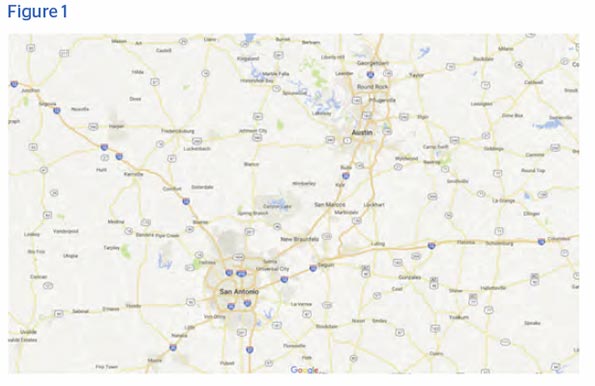
    A new economic corridor is emerging in the center of Texas. Hays and Comal Counties are part of the Austin and San Antonio metropolitan areas respectively. But they are not merely suburbs capturing overflow from larger cities. They are becoming part and parcel of an emerging 80-mile long economic corridor between San Antonio and Austin, along the I-35. In the process, this region centered around San Marcos and Hays County, is emerging as a hub in its own right.

    This new corridor is beginning to resemble another Texas style “metroplex” between Dallas and Ft. Worth. It is a development that can also be compared, in some aspects, to other growth corridors, such as the San Jose to San Francisco strip, the Raleigh-Durham area and the Wasatch Front stretching from Ogden through Salt Lake City to Provo.

    Texas State Demographer Lloyd Potter foresees an additional 1.5 million people in the corridor by 2030, a nearly 34 percent jump. In Hays and Comal counties, the state projects between 69 and 44 percent in population growth during that period. “Over the next 50 years, Austin and San Antonio will become a single mega-metro area,” Austin Mayor Steve Adler says. “The corridor in between will be the first reflection of this coming future, providing greater connectivity to serve the increasing interdependence and joint economic potential as the two cities grow together.”

    As occurs in many emerging regions, the Austin-San Antonio can be considered multi-directional, extending to and from both larger cities, but also from the emerging hub around San Marcos.

    The San Marcos segment of the Corridor is already more than a bedroom and retail community. Amazon decided to build an 855,000 square foot fulfillment center in San Marcos (Hays County) that will eventually employ 1,000 people. Sysco Corporation opened a distribution facility in New Braunfels (Comal County) that employs 650 people. More importantly, Texas State University in San Marcos, with nearly 40,000 students and a growing research profile, is anchoring an emerging high tech base for the corridor.

    Something big is starting to happen in this once rural region of Texas. This report is divided into three sections that explore – the what, the why, and the future. The best predictor of the future is usually what has happened in the past, let us begin there.

    Dimensions of Regional Growth

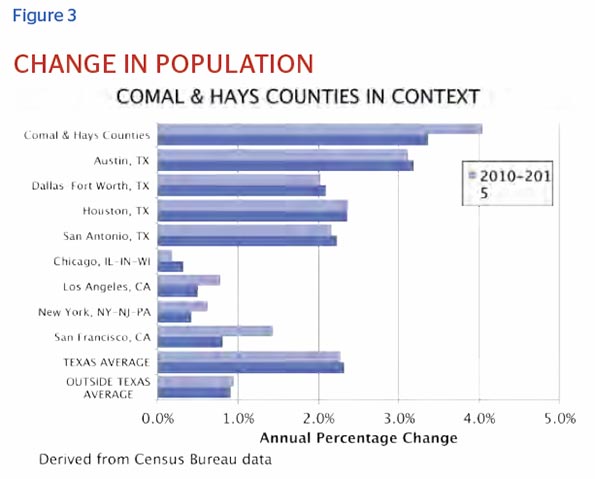
    The rate of growth in Hays and Comal Counties is exceptional, even by the standards of Texas. They are far outpacing the nation in both population and jobs, and growing at twice the rate of Texas as a whole. The two counties exceed even the rest of metro Austin, which has historically been among the leaders in job growth nationally. Three of the 25 fastest growing counties in the country are located in the Austin-San Antonio Corridor.

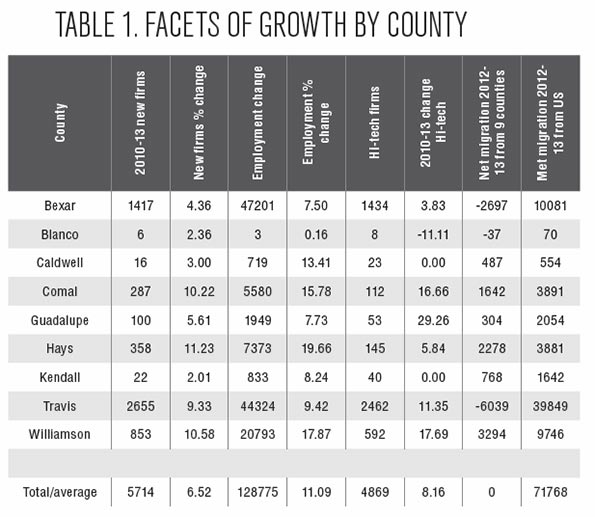
    The table below highlights the dimensions of this very rapid growth.

    Employment Growth. There has been a pattern of positive employment growth in all counties, with Hays the leader followed by Williamson then Comal. The entire corridor is among the national leaders in job creation, out-distancing not only the nation but Texas as well.

    New Firms. We see more new firms in all counties, with the highest percentage growth in new firms occurring in Hays, then Williamson and Comal counties. The definition of new firms used here includes opening of new branches or plants by existing firms that operate multiple establishments.

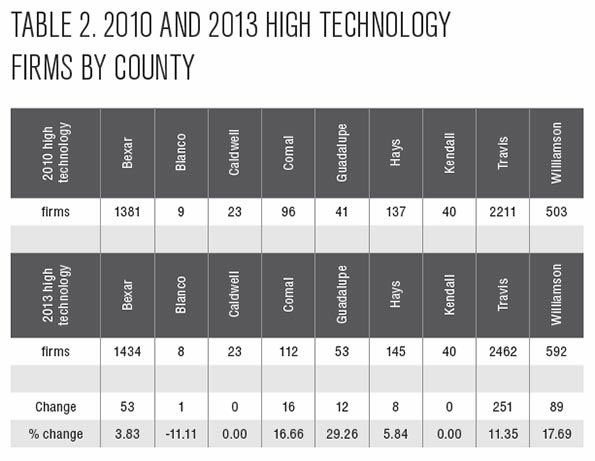
    High-Tech Firms. Growth of high-technology firms occurred in 6 of the 9 counties, with Guadalupe the leader in percentage terms followed by Williamson then Comal and Travis counties.

    Population. The entire San Antonio-Austin corridor has some of the most rapid growth in the country, as we can see in the first slide. The region also contains many of the fastest growing counties not only in Texas but the country.

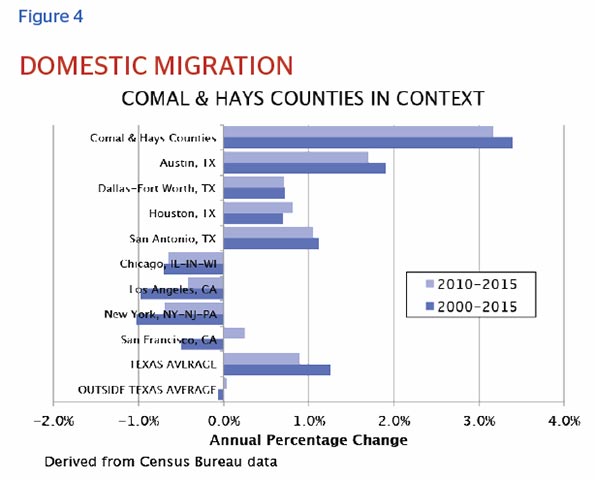
    Migration. Williamson County gained the most population from those living in the nine county region, followed by Hayes and Comal. Overall the entire Corridor has experienced large domestic in-migration, well above Texas averages, and even more so in comparison with large metropolitan areas like New York, Los Angeles and Chicago.

    The following sections provide more detail on this out-sized performance.

    Industries Driving Regional Employment Growth

    Employment growth has been broad across several industries, with the fastest growing industry being Electronic Shopping and Mail-Order Houses. Another cluster of fast growing industries are private (not public) firms involved in education and training (Elementary and Secondary Schools, Other Schools and Instruction, Technical and Trade Schools, Business Schools and Computer and Management Training). This does not include the significant role played by Texas State University in education related to business and computer management and engineering.

    This job growth, of course, has been driven by population growth. In terms of location quotient, the area remains much stronger in lower-end service industries. For example, Hays and Comal counties have 26 and 16 percent of employment in retail industries compared to only 13 percent nationally.

    But this appears to be changing, as evidenced by the growth of key “export” industries — that is goods and services largely consumed elsewhere. This includes key manufacturing fields, such as Industrial Machinery, Motor Vehicle Parts, and Metalworking Machinery. Overall the area is enjoying a manufacturing boom that far exceeds the national average.

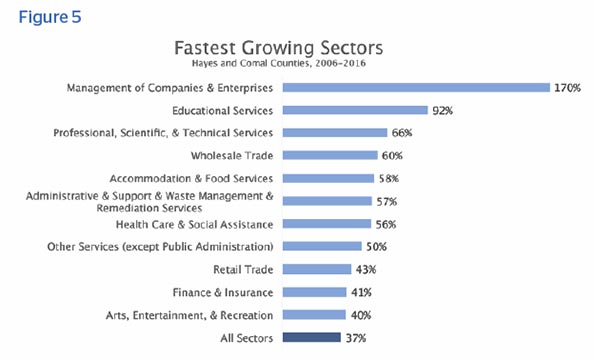
    This growth is also evident in several key service industries such as Management Services, Educational Services, and Professional, Scientific and Technical services. Particularly critical has been the logistics and wholesale industry, which serves not just the local economy but the entire regional and nation, with the massive new Amazon facility representative of this type of growth. Although much of the region’s growth has been in traditionally lower-wage service industries, the fastest growing sectors tend to be higher wage, information fields like management of companies and enterprises, educational, professional, scientific and technical services.

    Is a High Technology Corridor between Austin and San Antonio Emerging?

    Located between the high-tech hub of Austin and the emerging one centered in San Antonio, the region between the two is also showing growth in high-tech firms, as show in table 2 below.

    The most rapid growth has been in Basic Chemical Manufacturing, Software Publishers, Computer Systems Design and Related Services, Commercial and Service Industry Machinery Manufacturing, Scientific Research and Development Services, and Pharmaceutical and Medicine Manufacturing.

    The high-technology industry with the largest number of establishments was Computer Systems Design and Related Services, consistent with the reputation of Austin as an emerging leader in this area of economic activity. Architectural, Engineering, and Related Services had the second largest number of establishments, followed by Scientific Research and Development Services, Oil and Gas Extraction, and Software Publishers.

    The total number of firms in Hays and Comal remains much lower than in the far larger Travis and Bexar Counties, but their growth shows that the San Marcos Corridor segment is already participating in the regional high tech cluster, with potential future upside from its growth.

    If the region is to develop into a larger high tech center, Texas State University will play a vital role in powering that transformation as it continues to expand its research reputation and the funding that goes with it. Texas State has already helped launch an important tech industry venture with the establishment of the Science, Technology and Advanced Research (STAR) Park which sits on 58 total acres dedicated by Texas State for future expansion. Executive Director Stephen Frayser describes the park as an accelerator, now helping eitht for-profit companies to market, including three student startups. STAR One, the first building, broke ground with 14,000 square feet, but filled up quickly. Frayser says, “We have had to expand twice since opening in November, 2012 and will have 36,000 square feet operational by September 1, 2016.”

    How the future growth of Texas State, its research funding quest, and initiatives such as STAR Park play out will do much to determine the degree to which San Marcos’ high tech ambitions take off.

    Population Growth and Migration

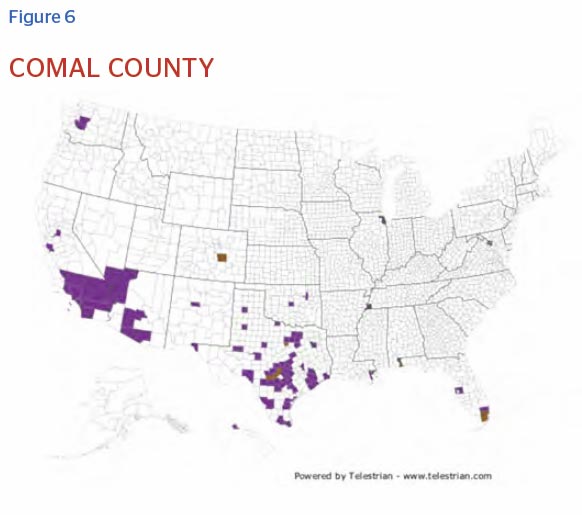
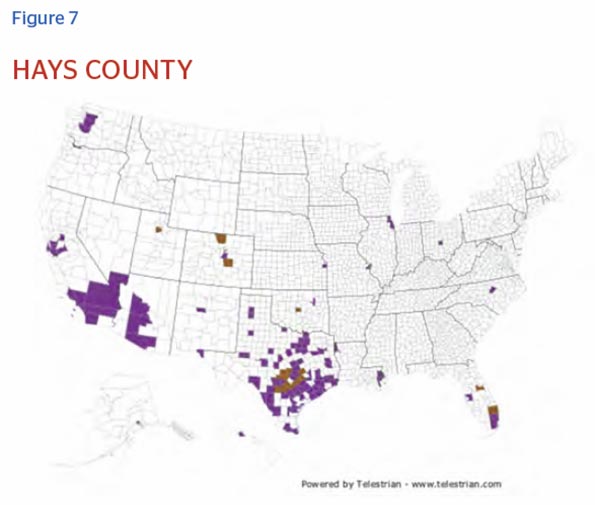
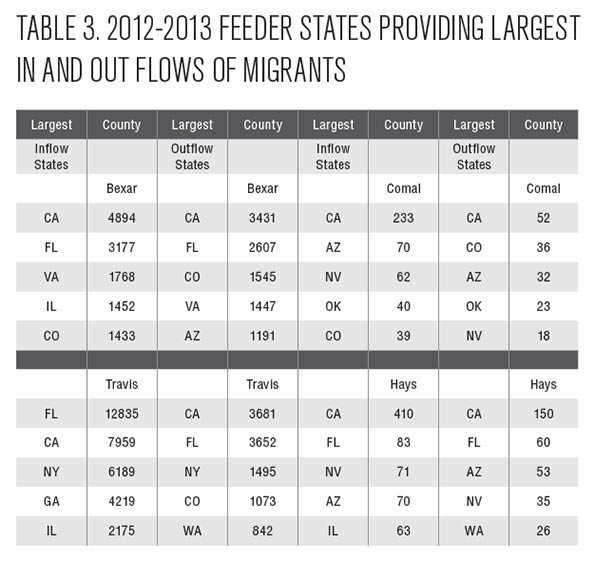
    People are an increasingly critical raw material for economic growth in San Marcos (Hays County) and New Braunfels (Comal County). Overall Hays and Comal have enjoyed among the fastest growth rates of any counties over 100,000 in the nation, easily outpacing even the torrid growth experienced by Austin and other Texas cities. The following map tells us the regions and feeder states from which Hays and Comal Counties have been drawing net migration.

    Outside Texas, California was the largest source of in-migration and also the largest destination for out-migration. (In the case of Travis County, California is the second largest source of in-migration with Florida being first.) Focusing on California and Florida, we see total net gains from California equal to 6,182. In the case of Florida, we see total net gains equal to (9,776 during the 2012-2013 period.

    Explaining Regional Growth: A Geographically Advantaged Region

    What accounts for the growth of the San Marcos Corridor? Three factors loom large: the region’s unique geographic advantages and exceptional quality of life that set it apart from other suburban regions, and the high quality public policy environment of Texas.

    Just as Dallas-Ft. Worth benefitted from being a highly multi-polar “metroplex” that evolved from two formerly distinct urban areas, a similar (if smaller scale and more nascent) effect is taking place between Austin and San Antonio.

    Dallas and Ft. Worth are 33 miles apart. Austin and San Antonio are 80 miles apart. Despite the greater distance, much of the I-35 corridor is already developed between the two. It makes logistical and financial sense to locate some facilities, such as Amazon’s fulfillment center, in the San Marcos Corridor segment to easily serve both markets.

    The same effect applies to people too. Those who live in the corridor have the ability to commute to either major city to work, giving them access to more potential employment opportunities. San Marcos is about 30-45 miles from downtown Austin or San Antonio – a long but doable commute – which is shorter than in many suburban areas. However, in both Austin and San Antonio, there are many jobs located in suburban areas that are closer to San Marcos.

    A look at job growth by occupational category reveals the Hays and Comal advantage. Nationally, the largest 21 broad occupational categories account for one third of all employment. In Austin and San Antonio, 21 broad occupational categories (not necessarily the same) also account for around one-third of all employment.

    Of these 21 categories of jobs, 16 were in common to Austin and San Antonio, and the percentage change in these types of jobs were compared for Austin and San Antonio. Somewhat remarkably, 8 of the 16 job categories show a pattern where either Austin or San Antonio has higher than national employment growth while the other city has lower than national growth.

    This may explain the attraction of Hays and Comal counties where residents can commute to work in either metro area. In the face of jobs requiring specific skills disappearing in one city, workers find new jobs appearing in the other city. They simply need to commute to a new job in the other city, rather than being forced to move.

    This effect is magnified for households with more than one worker. One spouse can work in Austin, the other in San Antonio. Outside of pricey Austin neighborhoods, inexpensive suburban housing can be found throughout the Corridor.

    The Quality of Life Advantage

    Perhaps nothing drives growth in the region more than the quality of life offered by the Corridor. When we asked several business leaders what brought people here it wasn’t too long in the conversation before the discussion turned from the tangible reasons to the intangible, the big intangible being quality of life.

    Dan Stauffer, Vice President of Marketing/Real Estate of McCoy’s Building Supply (which moved its headquarters from Houston to San Marcos decades ago) was quick to bring up the quality of life draw that Austin and San Antonio has for people who move to the area. Again the geographic advantage of the region is key. Austin and San Antonio are culturally very different cities; residents of the San Marcos Corridor visit both and enjoy all they have to offer – then come home and live in the relative peace and tranquility of Central Texas.

    The overpowering quality of life factor in the Corridor is the Texas Hill Country. Bordered west of the Austin/ San Antonio Corridor the Hill Country is immense and very unique. It covers 11,111 square miles, offering plenty of recreational options including tubing opportunities in the Guadalupe River (Comal County), The Blanco (Hays County) and a lot more. Overall the elevation goes from about 510 feet above sea level, just east of San Marcos, to 853 feet in Wimberley to its highest elevation of 2,460 feet further in.

    The Hill Country’s attraction ranges from residents and CEOs who want to move their company to be close to their ranch full time, to city dwellers who have second homes they visit to get away from it all. The Wall Street Journal’s recent article describing a “land rush for the rich” in the Hill Country testifies to its red-hot appeal.

    Near New Braunfels is the Town of Gruene – which features one of America’s oldest Dance halls – Gruene Dance Hall (established 1878). It attracts over 1.2 million guests per year according to Rusty Brockman, Economic Development Director of the Greater New Braunfels Chamber of Commerce. Many artists – legends such as Chubby Checker, Lyle Lovett, and Willie Nelson and relative newcomers like Kevin Costner have performed there according to the Gruene Dance Hall website.

    The Texas Policy Advantage

    Although the region has generally outpaced other Texas cities in terms of the growth, the area’s emergence has much in common with the same things that have driven the growth of other Texas cities.

    There are a unique set of conditions that exist in both Texas and the emerging Central Texas Corridor which do not exist in very many other places. We’re not saying that they individually don’t exist throughout the other 49 states, but together this complete set of free market oriented set of rules and tax rates would be hard to find in too many places. These include being a no income tax state, a right to work state, and having biannual legislative sessions that limit the opportunity for regulatory mischief.

    These reasons provide a base of attraction for businesses and people to consider Texas – and the Austin – San Antonio Corridor – to relocate, expand and grow.

    Source: Tax Policy Advantage, 2015

    Texas also does not impose a traditional corporate income tax, though it does impose a modified gross receipts tax, commonly known as the Margin Tax. However, in 2014, this rate was only 0.975%.

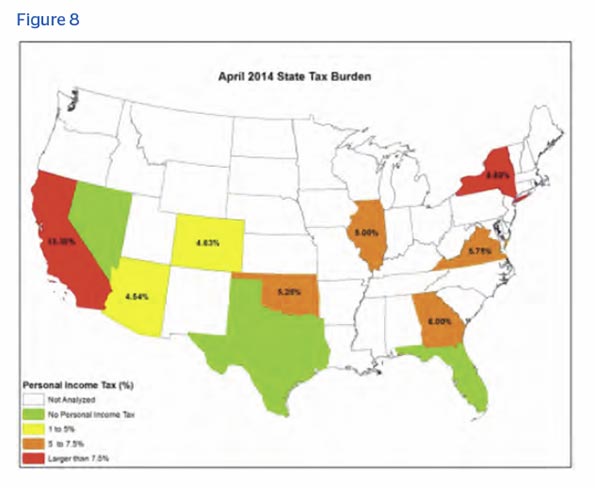
    When doing the math, you can see that individuals and businesses coming from the area’s large feeder states can look forward to keeping more of their own money – a worker or investor from California gets a raise of 13.3% for starters, not to mention much lower property prices. The pretax incomes in some feeder states may be higher, but will in most cases be lower once tax burdens are accounted for.

    Overall, Texas’ tax climate is ranked 10th by the Tax Foundation.188 California, the state sending the most people to the area, ranks 48th. Other key feeder states to the region also score lower than Texas, include Colorado (18th), Illinois (23rd), Arizona (24th), Virginia (30th), Oklahoma (33rd), Georgia (39th) and New York (49th).

    Beyond low taxes, Texas also has a regulatory system that’s friendly to business and housing development. In part this comes from a state legislature that meets only once every two years. Only four states still do this (the others are Montana, Nevada, and North Dakota). The legislatures of every other state meet annually.

    A biannual legislative session does not necessarily guarantee less burdensome regulations, though legislators do have fewer opportunities to regulate. But Texas’ biannual legislature is indicative of its business friendly mindset, which we see clearly in the output. This includes a right to work law, which prohibits employees from being forced to join a labor union.

    Even within Texas, the counties at the center of the Corridor maintain distinct advantages. One key advantage can be seen in such things as property taxes, which comprise the bulk of the tax burden in Texas. Hays and Comal counties, and their cities, offer favorable numbers that attract not only feeder states migrants, but feeder Texas cities and county migrants.

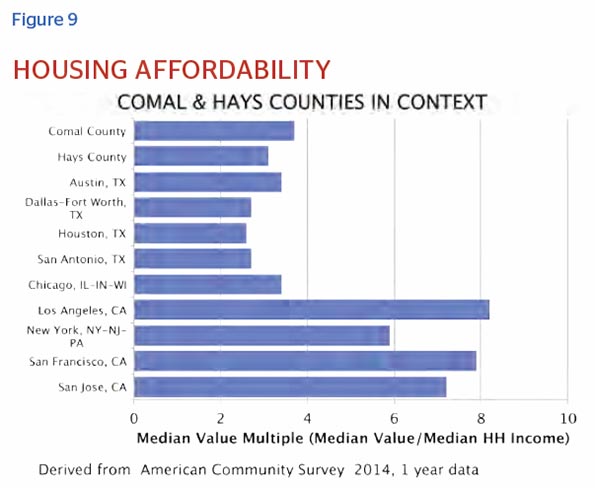
    Home prices constitute an advantage for most Texas cities, but even here, the Hays-Comal hub provides even a higher level of affordability. Low taxes and low housing prices make a very convincing case for companies, and individuals, coupled with strong job growth.

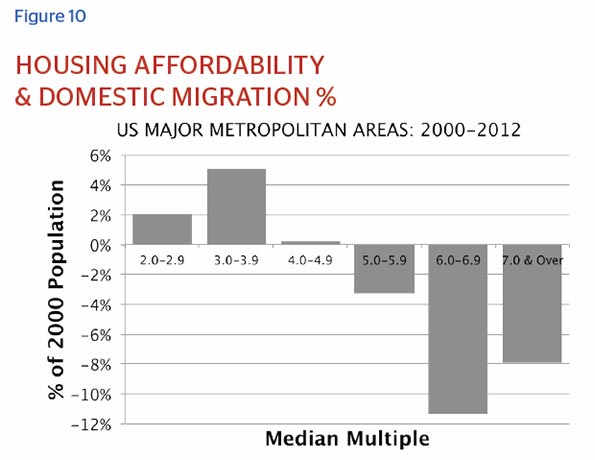
    Housing affordability has become one of the key determinants that attracts new migrants to a region. Those areas with high prices relative to incomes tend to lose migrants while those with lower costs — a median multiple of four or less — tend to attract newcomers.

    The Future of the San Marcos Corridor: A New Start for Texas?

    Lee Graham, President of Mensor LP, a market leader in pressure calibration that moved from Houston in 1978, suggests, “There’s a lot of similarities between what happened with Dallas and Fort Worth 30 years ago with all the communities that filled in between there…. It all developed and filled in.” He went on to say that there is more industry coming on line in the Corridor – even talks about the viability of a future regional airport in Hays or Caldwell County.

    Austin’s Culture Map prognosticated recently with the headline “Could Austin and San Antonio be the Next Dallas-Fort Worth?” They interviewed Austin entrepreneur, author, and speaker Gary Hoover who thinks that by 2050 the US Census Bureau will label Austin and San Antonio as precisely this kind of meg-metro area. He notes: “Just the natural growth of the two cities will cause them to collide”.

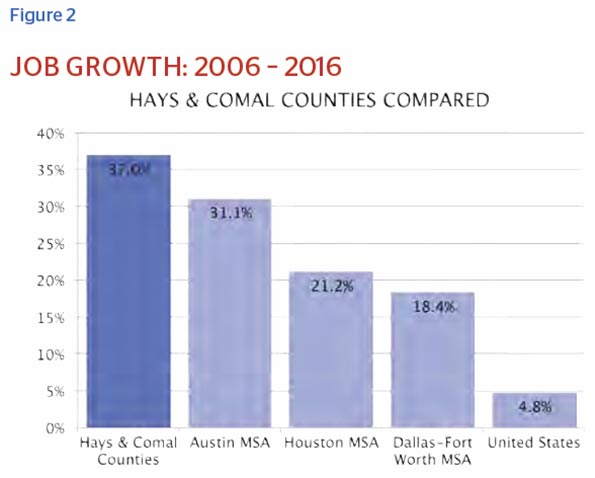
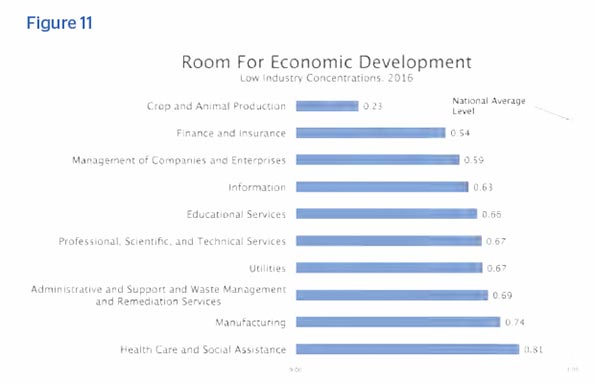
    However, for this vision to become reality, there needs to be greater focus on higher paying jobs in business and professional services, manufacturing and technology. Today Hays and Comal County employment is concentrated in construction (including residential and multifamily), retail trade, accommodation and food services and arts, entertainment and recreation -which has fueled the 37% job growth from 2006-2016. Yet, as we have seen above, the fastest growing sectors are in higher-wage, skilled and technical fields. Despite growth in these fields, the area still lags the national average in many key fields like information, management of enterprises, finance and professional, business and technical services.

    It is critical to note that the Corridor — particularly the Hays-Comal area — has only recently emerged from an essentially rural past. The key is to make sure that this pastto-the-future transition is tilted towards higher wage, high skilled sectors.

    Yet the past does not define the future. Silicon Valley was largely agricultural as late as the 1960s and Raleigh-Durham even later. In contrast Boston’s 128 beltway grew amidst the oldest industrial area in North America, and yet ultimately lost preeminence to the Valley.

    The formula that needs to be applied here is forward looking. An agrarian past is no barrier, and may even, to some extent, be an advantage to a region that wants to capture expanding growth from already strong metropolitan economies. The room to expand, lower cost of living associated with less developed economies, and a commitment to preservation of some open space could prove advantageous over the long term.

    Key Future Challenges

    However, just being at the right place at the right time may not be enough. Hays and Comal Counties face many challenges that must be overcome to achieve long-term success. Education has been a big part of all high-tech corridor successes, and Texas State University is certainly a piece of it. But there is also the challenge of training the existing workforce; although improving, the education level of the counties remains below national standards but competitive to the city and county comparisons nearby (see charts 1 and 2). Efforts to upskill the existing workforce will be critical in the future. Just as important is keeping up with infrastructure needs, particularly transportation.

    Perhaps the greatest vulnerability of the corridor lies with educational attainment. Although the Austin area is very strong, and well above the national average, the San Antonio region is lagging, as is New Braunfels. In contrast, in large part due to Texas State, San Marcos is above the national average in educational attainment. Expanding the area with high concentrations of college educated people seems a critical step to fulfilling the vision of a thriving Corridor between Austin and San Antonio, and the emergence of Hays and Comal as key players in the new regional configuration.

    Fortunately, there are positive efforts and activity in all three areas.

    The Greater San Marcos Partnership, according to President Adriana Cruz, has developed a five-year regional economic development strategy (Vision 2020) aimed at growing the region’s economy to attract the high skilled and wage jobs critical to the region’s future.

    Since 2006, ten new schools have opened in the four Hays County School districts: Hays, San Marcos, Wimberley and Dripping Springs. Three new schools are to open soon in both the Hays and Dripping Springs school districts.

    In Hays County the three workforce development players are Gary Job Corps Center (US Department of Labor), Workforce Solutions Rural Capital Area (multi county community partnership) and Austin Community College (ACC – Hays County falls into their 7,000 square mile service area). Texas State University was recently added to this roster having been named part of the Tech Hire community by the White House. TechHire is designed to train and develop a homegrown information technology workforce that includes ACC, Capital and Rural Capital Workforce Solutions, the City of Austin and the Greater San Marcos Partnership.

    In Comal County, the Central Texas Technology Center in New Braunfels is undergoing a 25,000 square foot expansion (opening for classes in 2016) that will double the size. This is part of the Alamo Community College District. Schools in both Comal school districts have been building new schools at a rapid rate. Comal County has had seven new schools come on line since 2006 with four more due to open within the next few years.

    Then there is the challenge of infrastructure and transportation. Two major highways serve the region. One is I-35, connecting San Antonio to New Braunfels to San Marcos to Kyle to Buda to Austin. The other is State Highway 130, a 90-mile toll way connecting Seguin to Lockhart to North Austin – and boasting an 85 miles per hour speed limit. Capacity is presently adequate, but future growth may put strain on these facilities. Failure to expand infrastructure has already produced traffic problems in Austin.

    There is an ongoing discussion of a commuter rail line connecting Austin to San Antonio that would serve San Marcos. The proposal suffered a serious setback when Union Pacific elected not to support it, and the history of new rail projects is not necessarily encouraging.

    If the area can continuously improve these critical must-haves – work force, education and transportation – the trajectory for the area seems to be very positive indeed. The corridor has many things that are likely to accelerate its growth in the years ahead: the continued growth of Austin and San Antonio, the attraction of the Hill County, Texas State University’s emergence and, the overall business climate of Texas. Of course many things could change but the future looks bright for now.

    When the future becomes the past, we’ll know if we’re right.

    John C. Beddow served as publisher of the Houston Business Journal from 1998 to last year. He successful turned the HBJ fromjust a weekly print product to a 24/7 digital first multi-platform business news channel. He serves on the advisory board of the Houston Technology Center and a recently started his own consulting company – Real Time Consulting, specializing in sales, marketing, media relations and project management. He lives part time in the Hill Country.

    Jim LeSage received his PhD in economics from Boston College and a Master’s degree from University of Toledo, where he was a faculty member from 1988 to 2005. Since 2006 he has been the Jerry and Linda Gregg Fields Endowed Chair in Urban & Regional Economics at Texas State University. He is a Fellow of the Regional Science Association International, Spatial Econometrics Association and Southern Regional Science Association, and a past president of the North American Regional Science Council. He has published over 100 scholarly journal articles, and is co-author with R. Kelley Pace of a 2009 book entitled Introduction to Spatial Econometrics. His research has received past support from the National Science Foundation, and he has given workshops on spatial econometrics in Austria, China, France, Germany, Portugal, Spain and several American universities.

    Top photo: Larry D. Moore [CC BY-SA 3.0 or GFDL], via Wikimedia Commons

  • San Antonio: Growth and Success in the Mexican-American Capital

    This essay is part of a new report from the Center for Opportunity Urbanism titled “The Texas Way of Urbanism“. Download the entire report here.

    For decades, as many U.S. cities declined, and others became overly exclusive, cities in Texas evolved into places of opportunity. Due in large part to liberalized economic policies, the state’s “Big Four” metro areas — Houston, Dallas, Austin and San Antonio — consistently rank among the nation’s leaders in population growth and job growth, experiencing the rapid urbanization once common among America’s legacy cities. In a state once defined by cowboy towns, these metros have become intense human and business agglomerations, growing more global and ethnically diverse in the process.

    In many ways, the newcomer to these ranks of opportunity cities is Texas’ oldest urban area, San Antonio. In recent decades, San Antonio has been considered the underdog of the foursome, able to outshine other Texas cities in professional basketball, but not in economic or cultural reputation. Houston, a mega wealthy oil town, has reached remarkable heights in health care, luxury shopping and housing development. Dallas has emerged as a mid-American banking center. Austin has become Texas’ yuppie capital, full of educated techies who are turning the city into “Silicon Hills.” But San Antonio, as America’s northernmost gateway with Mexico, has been viewed as a magnet for poor immigrants and thus a place of low incomes and education levels.

    “There has been a long perception of San Antonio as a poor city with a nice river area,” says Rogelio Sáenz, dean of the public policy school at the University of Texas-San Antonio. “Even today, despite being the seventh-largest city in the country, many people outside Texas have little information about our city.”

    But as I discovered while living in San Antonio for six weeks this spring, these negative stereotypes are outdated. Thanks to a commitment toward growth by the city’s political and business establishment, San Antonio in 2016 offers a much more diverse urban profile, catching up to some degree with Texas’ other major cities and surpassing many in other states.

    The leading cause has been a good economy. San Antonio first grew thanks to a few key sectors, most notably its voluminous military presence, which earned it the nickname “Military City USA.” But its economy has diversified recently, seeing growth in sectors that benefit both from proximity to the military and from the broader Texas growth machine. The city’s financial industry has been propelled by providing banking for service members. The tech industry, which had overlooked San Antonio for trendier cities like Austin and San Francisco, now has a presence here; since 2010, San Antonio’s information sector has expanded by over 15 percent, placing the city 17th among the 70 largest U.S. metros in a 2016 Forbes magazine survey. The city has even seen manufacturing growth, as corporations take advantage of Texas’ corporate welfare and proximity to Mexico’s supply chains. Along with San Antonio’s more traditional economic drivers, such as health care and tourism, this expanding private sector has turned the city into a jobs engine.

    And this is impelling people to move here, creating a more interesting demographic mix. The city’s historic ties to Mexico have long cemented it as the Mexican-American capital, viewed as much a part of “northern Mexico” as of the United States. It remains a majority-Hispanic city, but this, rather than being a liability, has infused San Antonio with a young, energetic population, making it a case study for how an increasingly diverse America can function. This includes “Tejanos” — native Texans of Mexican descent — and the more recent increase in Mexican nationals, professional-class immigrants escaping the violence in their homeland. Meanwhile, people throughout the U.S. seeking well-paying jobs and low living costs — including young white professionals, African Americans, Asian Americans and immigrants of every variety — are flooding into San Antonio.

    This explosive job and population growth has bred all the familiar elements underpinning an urban renaissance. Indeed, just like in other rapidly growing Texas cities, there is a certain buzz about San Antonio, as it has become denser, more global and more cosmopolitan than when I previously visited in 2007. The new developments emerging in and around downtown fuel restaurants and bars that are slammed during weekends with everybody from international jet-setters to Tejano ranchers in cowboy hats. This imprint has extended to outlying areas, where new country clubs and luxury shops spring up on formerly virgin land.

    Yet amid this new shine sits a more traditional culture. Just as parts of modern-day San Antonio were built during the first stirrings of civilization within Texas, the city is dominated by families who have lived here for generations, instilling a small-town, community feel. This combination of old and new — which extends across a landscape largely built by, and for, people of Mexican descent — is what makes San Antonio the most compelling of Texas’ urban success stories.

    Evolution into the Mexican-American Capital

    San Antonio’s Hispanic ties date to the late 1600s, when Spanish explorers mixed with the native Yanaguana population.115 The Spanish founded the city in 1718, built several missions, including the Alamo, and by 1773 made San Antonio de Bexar the capital of Spanish Texas.

    By the 19th century, these religious structures were transformed into forts, as San Antonio became a prime battleground for Spain’s imperial ambitions. The city suffered from numerous battles in the early 1800s, with Spain defending its territory against ragtag armies of Anglos and natives. In 1821, Spain granted independence to Mexico,relinquishing much of modern Mexico and the U.S. Southwest, and San Antonio became the new nation’s foremost northern entryway.116 Several years later, Mexico adopted a constitution, but leaders soon violated it by forming a centralized government even more oppressive than Spain’s.

    In response, many Texas towns, which were peripheral Mexican territory anyway, revolted, and San Antonio became ground zero in the Texas war for independence. This climaxed in February and March 1836, when 200 defenders encamped inside the Alamo held out nearly two weeks against a several-thousand-man Mexican militia that ultimately overwhelmed and killed them. Texas seceded soon after and became a republic, before the U.S. annexed it in 1845.

    In following decades, rail connections made San Antonio an industrial crossroads. Culturally, it enjoyed influences from European and American frontiersmen and indigenous people from Mexico. By 1900, San Antonio had 53,000 residents, making it Texas’ largest city.
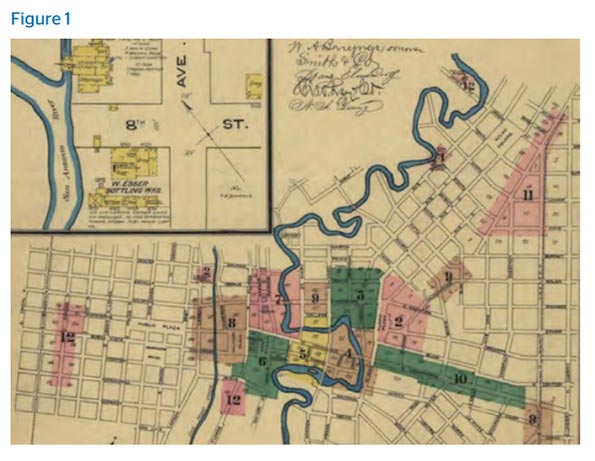
    San Antonio’s major step forward, however, came during the Mexican revolution of 1910, an event supported by city residents. In 1876, Porfirio Diaz became Mexico’s president, overseeing a multi-decade dictatorship. In 1910, a popular dissident candidate named Francisco Madero ran for president and was imprisoned. After his family posted bail, Madero fled to San Antonio, joining other expats fomenting revolution. They organized an armed struggle that lasted for decades within Mexico, causing a refugee surge. From 1900-30, the Mexican population in the U.S. grew from 100,000 to 1.5 million, and San Antonio’s total population more than quadrupled, with refugees viewing it as a safe and culturally familiar city.

    “At that time, San Antonio was the center, not Los Angeles,” T.R. Fehrenbach , a Texas-based historian, told the San Antonio Express-News in 2010. “San Antonio was the capital of the Latin American world outside of Latin America.”

    Newcomers consisted largely of Mexico’s business elite. For example, the grandparents of former San Antonio mayor Henry Cisneros, and the parents of famed former local congressman Henry Gonzalez, came to San Antonio during this period. The influx of Mexican business savvy helped make San Antonio a modern city.

    After slowing during the Great Depression, San Antonio resumed growth during World War II. From its inception, San Antonio was a military city, the linchpin in the defenses of Texas. This continued following statehood, as San Antonio became a prime location for military installations. Fort Sam Houston, which still sits on the city’s east side, was founded in 1845. Kelly Air Force Base opened during World War I. Other military functions would follow, and by World War II they were running on all cylinders.

    The large civilian workforce that flooded into San Antonio during this time created severe labor shortages in rural areas. The federal government responded with the Bracero Program. From 1942-64, 4.6 million Mexican agricultural guest workers entered the U.S.121 Like with past Mexican migrations, many gravitated to San Antonio, and by 1970 the dusty old Spanish colonial outpost had become a 654,000 person city.

    Postwar Economic Growth and Political Equality

    Since then, the region has added an average of approximately 300,000 new residents per decade. Much of the influx has resulted from the organic movement between America’s colder and warmer climes. But much also stemmed from local sources and initiatives.

    Economic growth and job creation are enhanced by transportation systems that allow people to reach employment and other destinations throughout the metropolitan area. Metro San Antonio has a highly ranked roadway system, with comparatively light traffic congestion. San Antonio ranks 10th in per-capita freeway capacity among the 53 U.S. metropolitan areas with 1-million-plus populations. This contributed to San Antonio’s ranking of 22nd best in overall traffic congestion delay among 172 urban areas in 30 nations, according to the 2015 Tom Tom Traffic Index. The metropolitan area has two freeway beltways (ring roads), like a number of other cities.

    Like Texas’ other cities, San Antonio has also benefited from pro-growth state policies. Texas has no income tax and has the fifth-lowest overall state tax burden. Texas routinely ranks near the top in surveys tracking ease of doing business. Such liberalization has produced statewide in-migration of people and businesses, mostly to the major metros.

    But the city’s establishment has also embraced the growth agenda. This is because San Antonio, says Cisneros, who in 1981 became the first Hispanic mayor of a large U.S. city, perceives itself as an opportunity zone for Hispanics.

    “For a good part of its history, San Antonio was a poor city,” he suggests. The establishment has responded by making economic development “the central current of San Antonio’s political discourse and electoral politics … [giving] us the basis on which we decide other questions.”

    This has meant, on one hand, subsidizing a number of flashy projects. San Antonio’s famed River Walk, first restored in 1941, has been serially expanded to connect key downtown tourist spots. San Antonio hosted the World’s Fair in 1968, rebranding itself as the northernmost Latin American gateway into the United States. And public money was used to retain the San Antonio Spurs, who proceeded to win five NBA titles, putting the city on the map perhaps more than anything else.

    But growth has mainly occurred because local and regional officials embraced the unsexy projects needed to enhance San Antonio’s infrastructural footprint. For example, the city pumps water from the vast Edwards Aquifer that spans central Texas. Thus San Antonio has more reliable water access — and cheaper water rates — than other cities, who rely on surface-level infrastructure and are more subject to droughts.

    In the 1970s, San Antonio joined its municipal energy company — CPS Energy — with a south Texas regional nuclear power network. Unlike other cities that joined, CPS entered the partnership to generate its own power, rather than renting it from a third party, making it the nation’s largest city-owned utility for gas and electricity. This has helped the company eradicate the middle man, selling energy to San Antonio residents and businesses at 10 percent to 20 percent less than in Dallas and Houston.

    Another area has been key to San Antonio’s political development and the rise of Hispanics. From 1955-75, San Antonio’s City Council was controlled by the Good Government League, a mostly white group that endorsed pro-business candidates. The group fought patronage politics, but was exclusionary in nature. In the early 1970s, San Antonio became ground zero for La Raza Unida, a national movement dedicated to increasing Hispanic representation within government. Working against the GGL, the movement organized voter drives throughout the early 1970s, and by 1977 had helped inspire council elections by district, rather than at-large. This meant that following the 1977 election, the majority-minority city had filled five of 10 council seats with Hispanics and another seat with an African American. This diversity at City Hall has continued.

    But, according to Michael Cary, a writer for the San Antonio Current, the political establishment has still championed the pro-growth leanings of the GGL, thus merging two constituencies that otherwise remain divided. This merger was embodied by Cisneros, who was elected to council in 1975 and later served four terms as mayor.

    “Cisneros broke with the liberal Chicano ranks and ran on the West Side Good Government League ticket,” wrote Cary, serving “as a bridge between Anglos and Hispanics.”

    The former mayor agreed that this unity remains intact, thanks to the citywide “political consensus” favoring growth.

    “We’re not going to do it with welfare, we’re not going to do it with income maintenance, we’re not going to do it remaining contentious and divided,” Cisneros said, summarizing the Latino and Anglo establishments’ attitudes. “We’re going to do it if we come around a single theme — jobs.”

    Diversifying Economy

    This approach has powered San Antonio near the top on various growth and prosperity metrics. Since 2000, San Antonio has been No. 8 among the 50 major U.S. metro areas in population growth rate.
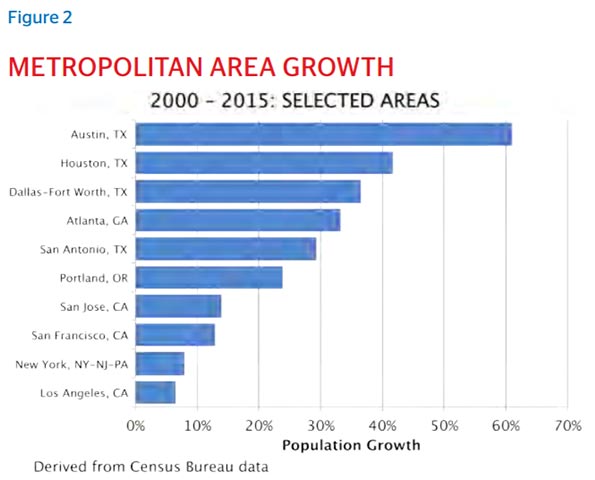
    Critically, this growth has been due largely to Latinos. Since 2000, the area has been among the leaders in net Hispanic population growth, adding over 400,000 residents. Economic prosperity explains much about why people are coming. Over this time, San Antonio has been No. 6 in job growth rate among these metros, and the highest income growth among major metropolitan areas since 2005, according to Forbes magazine. When comparing Hispanic populations in the 53 largest metros, San Antonio has been one of only four to see median household income gains since 2000 and has the 15th-highest median household income for Hispanics when adjusted for living costs. According to the Kauffman Foundation, San Antonio is No.10 in startup activity, and the area unemployment rate is nearly two percentage points below the national average. The Milken Institute ranked San Antonio No. 12 among its best-performing major metros, although it has ranked higher in previous years.
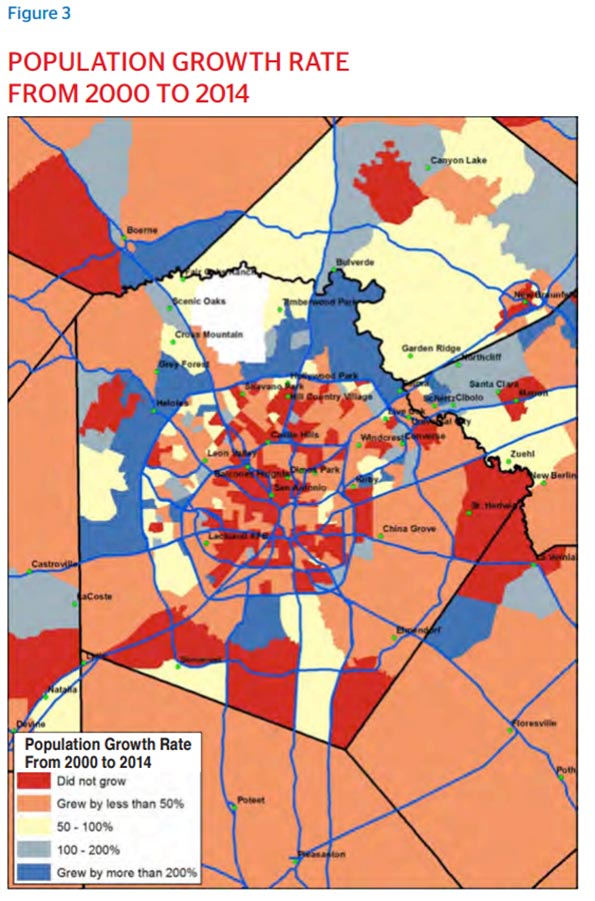
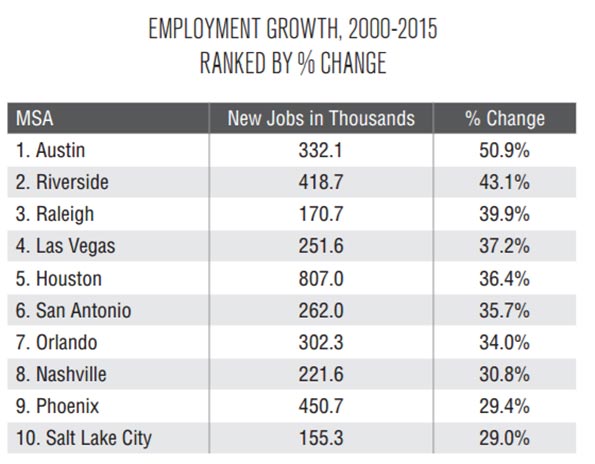
    The backbone of this growth is an economy that has strengthened and diversified. In 2011, Mario Hernandez, former CEO of the San Antonio Economic Development Foundation, wrote about how San Antonio was evolving beyond its “big three” industry sectors — tourism, military and health care. His points have only strengthened since.

    Among the original big three, military remains the strongest. According to a study by the city government, San Antonio “is home to more Department of Defense students and active runways than any other military installation.” The metro area also includes 55,000 military retirees. The military has a $27.7 billion economic impact and employs 189,148 people. Lackland Air Force Base and Fort Sam Houston are by far the area’s largest employers, at 37,000 and 32,000 workers, respectively, while other significant installations include Randolph Air Force Base and Camp Bullis (the names of all four begin with the moniker “Joint Base San Antonio”). There is also a special relationship between the military and the city’s Hispanics, who have historically viewed military service as an opportunity for well-paying jobs, free educations and integration into mainstream American society.

    Bioscience and health care is another vast sector, having grown from $12 billion to $30.6 billion in annual economic impact since 2003.136 The industry employs 164,000, or one of six San Antonians.137 In many ways, the sector is an outgrowth of the military, as medical workers receive training for — and often operate on — personnel preparing for, or returning from, battle. Following the federal Base Realignment and Closure Commission’s report in 2005, many of the Pentagon’s medical functions were concentrated in San Antonio, infusing billions of dollars into the city. This was highlighted by the new Medical Education and Training Campus built at Fort Sam Houston, the world’s largest facility for military medical education, research and training. The center’s students often apply their knowledge at nearby Camp Bullis, a site that specializes in combat training. Just down the block within Fort Sam Houston, meanwhile, is Brooke Army Medical Center, an inpatient hospital that is the military’s largest health care organization.

    Yet the military’s medical functions only scratch the surface of San Antonio’s health care sector, with much of the private and nonprofit institutions located on the northwest side. The city benefits from the South Texas Medical Center, the Baptist, Methodist and University Health Systems, the University of Texas Health Science Center, the Children’s Hospital of San Antonio, and numerous other hospitals, research labs and medical startups.

    Tourism has been the city’s third economic staple, employing one in eight San Antonians. This is centered on traditional attractions like the Alamo and the River Walk, and outlying lures like Six Flags and SeaWorld. The impact will surely expand, because last year San Antonio’s five former Spanish missions were given UNESCO World Heritage status.

    Aside from the big three economic drivers, San Antonio is expanding into manufacturing, aviation, finance, technology and education, all tied somewhat to the military. While not traditionally a manufacturing city, San Antonio is now Texas’ fourth-largest manufacturing market, with the industry accounting for 57,000 jobs. One notable coup came when San Antonio, thriving on the corporate relocation momentum throughout Texas, compelled Toyota to build its largest manufacturing plant on the city’s south side in 2003. There was a combination of factors involved — the state offered $133 million in corporate welfare; the city government made infrastructure upgrades; local entrepreneurs stepped up to create a supply chain; and the city is proximate to the strong truck-buying markets in Texas and Mexico. As The Rivard Report, a local news website, noted 10 years later, “the company’s total direct investment in the plant has reached $2.1 billion, with $1.5 billion or more invested by the supplier community.”

    The aviation industry, an offshoot of both the military and manufacturing, has also grown exponentially in recent decades. Key to this has been Port San Antonio. In 1995, following the Cold War’s end, Kelly Air Force Base was closed. A government entity was created to repair and lease out the vast space to private companies, and the port has become a profitable facility, avoiding the graft and waste endemic in other American ports. Port San Antonio, which is located not near water but near heavily trafficked I-35, is dedicated to heavy industrial and aerospace uses and includes tenants like Boeing, Lockheed Martin and StandardAero, although it also houses cybersecurity and IT companies.

    The military has also brought growth to San Antonio’s financial industry, specifically through the rise of niche companies that loan to military members, who are traditionally seen as higher risk. The granddaddy of them all is USAA, a Fortune 500 firm headquartered in northwest San Antonio that employs 17,000. Significant mainstream banking institutions include JP Morgan Chase, which employs 5,000 locals, and Frost Bank, based in San Antonio. By year’s end, the latter company will break ground on a new 23-story downtown headquarters.

    The military has driven tech growth, as well. Some of this $10 billion impact is generated by federal agencies that contract with local IT and cybersecurity firms, making San Antonio No. 2 in the country in concentration of data centers. Much of the rest comes from a more subdued private startup scene, which has benefited from the city establishment’s focus on tech, and the energy of one man, city native Graham Weston. In 1998, Weston co-founded Rackspace, a cloud computing company in northeastern San Antonio that employs 3,300 and is valued at $3.29 billion. Weston has since made it his mission to grow a tech scene downtown, renting out incubator space and filling it with small organizations that collaborate on ideas, including Weston Urban, the 80/20 Foundation, Geekdom, Techstars and Tech Bloc.

    Lastly, the military — and San Antonio’s wider network of STEM enterprises — is inspiring educational growth. While San Antonio has historically enjoyed several small, renowned liberal arts schools, it more recently strengthened its public higher education. A University of Texas branch opened in 1969, and a Texas A&M branch followed in 2009. UT San Antonio, has an enrollment of 28,000. Its cyber security program is ranked first in the nation by tech industry professionals, meaning that graduates can plug into the region’s tech and military scene. The local community college system, Alamo Colleges, has partnered with Port San Antonio to establish workforce development programs, and the general focus for its roughly 60,000 students is on aerospace, manufacturing and IT.

    One industry in San Antonio that has not been particularly strong — likely to the benefit of the others — is local government. In many major U.S. cities, the largest employers are some combination of city governments, county governments and various civil service authorities. In San Antonio, the city government is the ninth-largest employer at 9,145.

    But perhaps the biggest economic driver has been population growth itself, with the city proper adding 325,000, and the metro area growing by 673,000 since 2000, creating a greater demand for housing, cars, services and food. San Antonio’s most inspiring private-sector story provides a window into that growing consumption. The region’s largest private employer, at 20,000 people, is H-E-B, a San Antonio-headquartered supermarket chain. Founded in 1905 by Florence Butt, who opened a small shop in nearby Kerrville, it has skyrocketed under her grandson Charles’ leadership, largely by remaining based in one of America’s consistently fastest-growing states. H-E-B has 316 stores in Texas and 52 in Mexico, and is one of America’s most highly
    valued companies, at $22 billion.

    Demographic Momentum

    So which groups are driving this population increase? The San Antonio area , at 63.2 percent, is the most Hispanic major MSA in the country, well ahead of Miami MSA at 43.8 percent. San Antonio’s Hispanic population largely consists of Tejanos, a south Texas term describing native Texans of Mexican descent. According to Pew Research Center data, 89.6 percent of San Antonio’s Hispanic population is Mexican. This is the largest share among Texas’ Big Four cities. But, notably, San Antonio has by far the lowest percentage of Hispanics who were foreign-born. While the share of foreign-born Hispanics is 32.4 percent in Austin and around 45 percent in Houston and Dallas — not to mention 42 percent in Los Angeles and New York City, 54 percent in Washington, D.C., and 66 percent in Miami — it is only 17 percent in San Antonio. This is because many of them have lived in San Antonio for generations.

    Additional Mexican-American influxes originate from Texas border towns like Laredo, Brownsville, McAllen, and other parts of the Rio Grande Valley. Tejanos have traditionally viewed San Antonio as a destination for jobs, education and entertainment. At the same time, the city is a short drive from their families. This proximity is important, explains Stephanie Reyes, a public-affairs staffer at the San Antonio Chamber of Commerce and a Brownsville native.

    “In most Hispanic cultures, [families] want you to stick around, they want to see you grow, especially if there’s that possibility of you raising a family elsewhere that they’re not going to get to take part in, seeing them grow up or seeing them every weekend. Here in San Antonio, [south Texas Tejanos] have that opportunity.”

    Nonetheless, there is still a lot of Mexican immigration into San Antonio, although the profile has changed. The stereotypical Mexican entering the city postwar was the poor agricultural worker. More recently, San Antonio has seen an explosion of professional-class Mexican migrants from major cities like Monterrey, five hours south on I-35. This group’s wealth has made them targets for kidnappings in their homeland. So they have moved to the U.S., with over 50,000, according to a Los Angeles Times report, coming to San Antonio, thanks to its proximity and ingrained Mexican culture. They have worked in white-collar professions and inhabited north-side gated communities, becoming known for lavish consumption. This is evident on any weekend in the upscale north-side mall of La Cantera, where parking lots are jammed with luxury cars and the walkways with Spanish-speaking shoppers in designer clothing.

    Javier Paredes, a local architect who grew up in Morelia, Mexico, epitomizes some of these trends. Eight years ago, his mother, an influential mining broker, was kidnapped and forced to reveal company secrets. After her release, the family settled together near downtown San Antonio, because of the city’s cultural familiarity.

    There has also been substantial in-migration from many races and places throughout America. San Antonio has become, like the other Texas cities, a major lure for domestic migrants. This is in stark contrast with major ocean coastal cities such as New York, Los Angeles and Chicago.
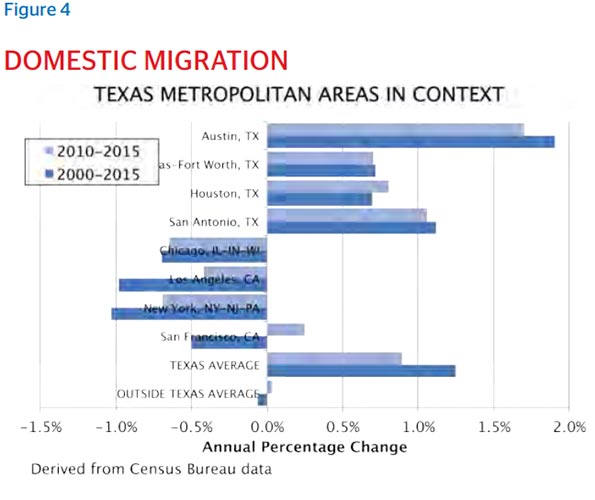
    This domestic growth was displayed in a map by Manhattan Institute senior fellow Aaron Renn, showing which parts of America people net are leaving for San Antonio. There are only a handful of areas that had positive net migration from San Antonio, most notably Austin, 80 miles to the northeast. Meanwhile, whole swaths of the country — including much of California, Cascadia, Florida, the Southwest, the Northeast and the Rust Belt — are pushing people out and into San Antonio.
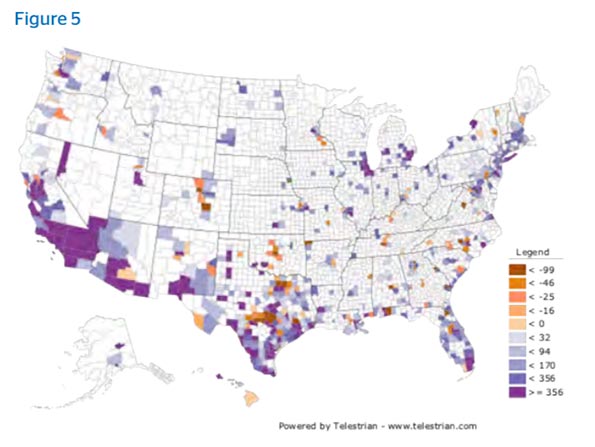
    This is particularly true for the young. Once an area that had trouble holding onto younger educated people, the region has now emerged as one of the fastest-growing destinations for them, outpacing in terms of growth such traditional “brain gain” centers as New York City, Boston and San Francisco. From 2010-13, San Antonio had the second-highest percentage growth among college-educated persons ages 25-34, and the fastest growth rates over that period for 20-to-29–year-olds of all education levels.
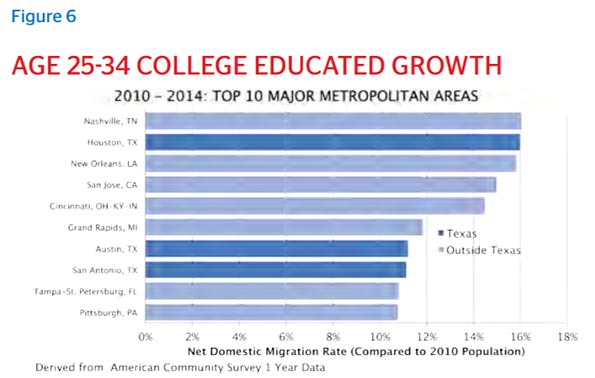
    The reasons are multifaceted: Some people may be seeking warmer weather, better amenities or a historical setting. More likely, migrants are drawn to San Antonio for pragmatic reasons. The cost of living is relatively low, highlighted by median home prices that, at $131,000, are $55,000 below the national median. San Antonio also has strong employment opportunities and companies desperate to hire, explaining the wage growth.
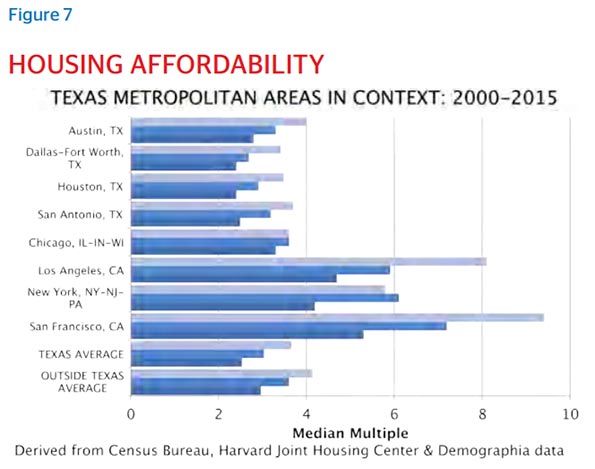
    These low housing prices explain much of San Antonio’s relatively low cost of living. According to the Council For Community and Economic Research, San Antonio’s living costs are less than half those of New York or San Francisco, and considerably less even than sunbelt boom towns such as Houston, Dallas-Ft. Worth, Austin, and Phoenix.
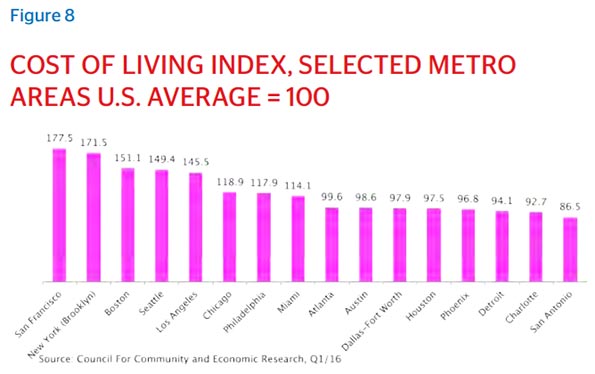
    “We don’t have enough people,” says Tony Quesada, editor-in-chief of the San Antonio Business Journal, “so we wind up importing talent from other parts of the country.”

    Then there are quality-of-life factors: Average one-way commute times are several minutes below the U.S. average, at 22 minutes. And, once drivers get off the city’s highways, they will likely be strolling through any number of quiet, secluded neighborhoods.
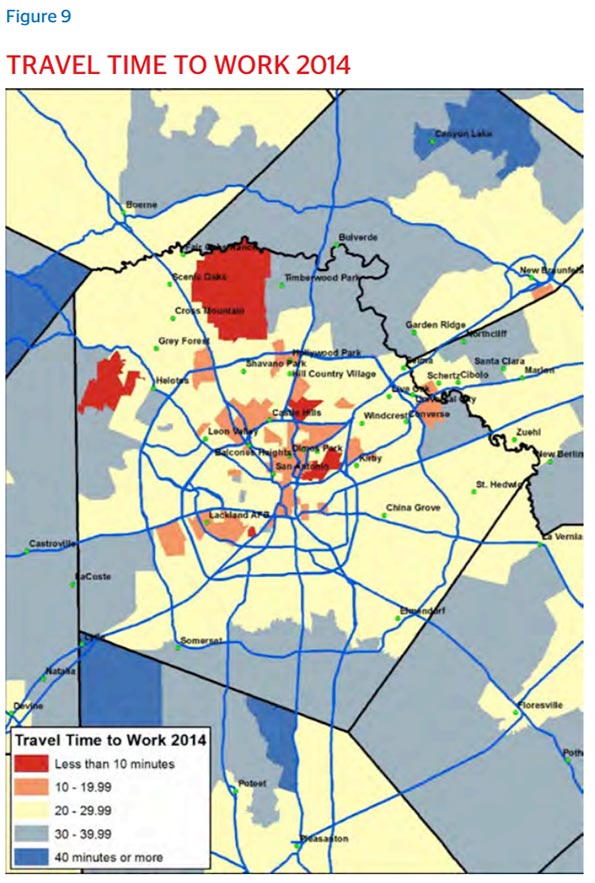
    But complementing these factors is an attraction that you hear repeatedly during interviews and will find anecdotally while navigating the streets — “comfort.” San Antonio is a big city with a small-town feel, where people are friendly, and community relations are tight. This was reaffirmed in July, when Travel + Leisure magazine named San Antonio America’s Friendliest City, based on reader surveys.

    Former mayor Cisneros called this dynamic the city’s “secret sauce,” claiming that it has helped unify whites and Hispanics, as well as competing factions of the business and political communities. The sentiment was echoed by outsiders, including 31-year-old real estate developer Juan Cano. By his mid-twenties, he’d grown frustrated with San Diego’s traffic, high costs and mediocre job market. So he studied what city he should relocate to, and, after combining several economic and quality-of-life factors, chose San Antonio.

    He said the best thing he’s encountered in his seven years here is the city’s homey atmosphere.

    “What San Antonio beats people out on is not weather, is not number of activities or amenities; but what they beat out other cities and states on is congeniality,” he said. “People here really care about how your day is going.”

    Cano agrees with Cisneros that this openness also bolsters the business climate, including for small entrepreneurs like him, looking to make connections.

    Formation of a New Kind of City

    Of course, growth doesn’t occur in a bubble; when various factors drive lots of people into an area, there will be tangible changes at street level. A traditional urban commentator might guess that such growth would produce infill densification, as it did for the coastal cities that boomed during America’s industrial era.

    And to some degree, such “buzz” is now felt in Texas’ opportunity cities, including San Antonio. While its downtown remains largely for tourists, adjacent areas are growing more vibrant and cultured, thanks to millennial population growth and city-funded enhancements. The River Walk has been extended north and south of downtown, sparking mid- and high-rise development. Along the “Southtown” portion of the route, new condos mix with historic homes and mostly unpretentious nightlife. Along the route’s northern portion, the city pursued a public-private partnership to create the Pearl District, a mixed-use, master-planned development that has become one of America’s leading warehouse revitalization stories. Other interior neighborhoods — North St. Mary’s, Tobin Hill and the Market Square area in west downtown — are slowly filling in.
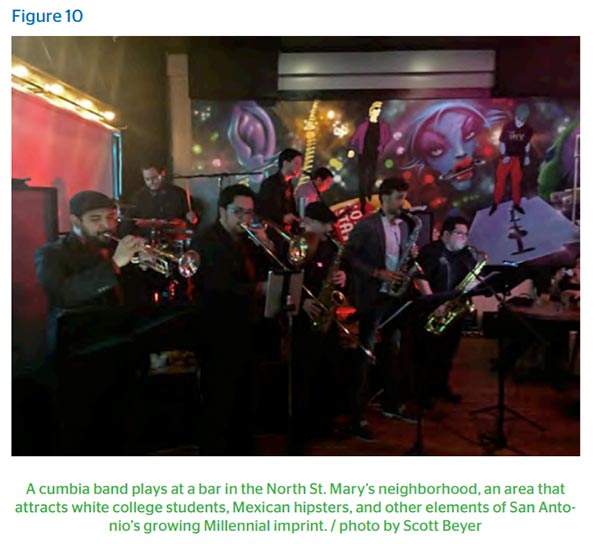
    But if San Antonio is showing some welcome growth in its inner ring, the city’s trajectory continues further outward, primarily to the north. This section of town long was the exclusive white area, while lower-income Mexican-American families dominated the west and south sides, and African Americans the east side. This segregated pattern still defines San Antonio, although things are changing.
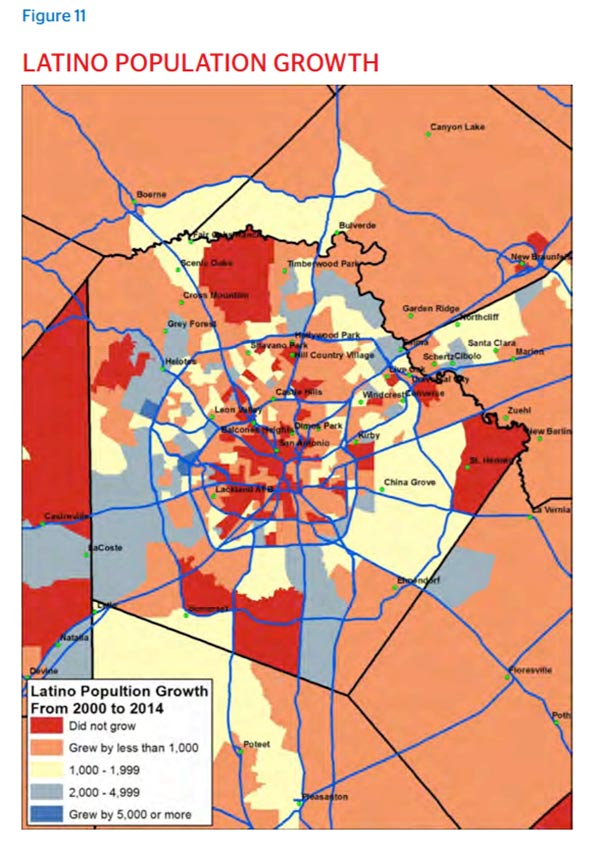
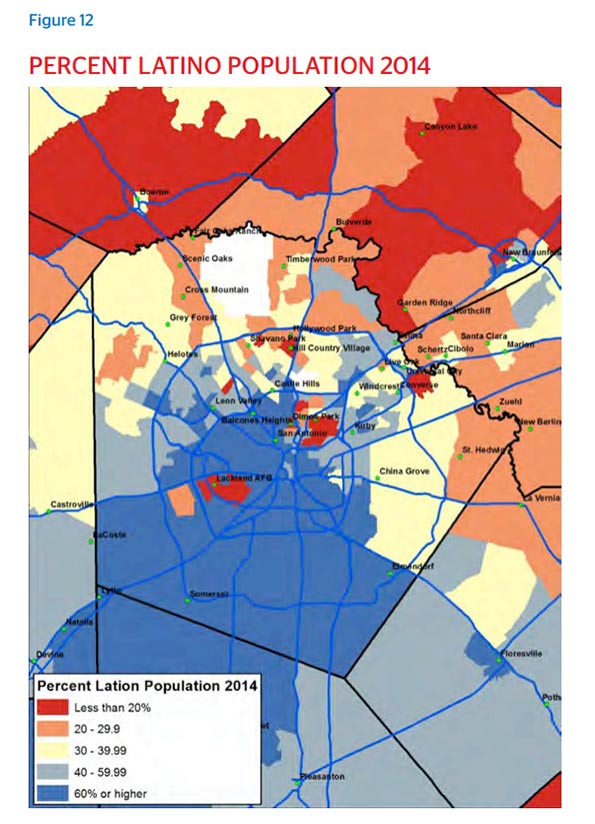
    Stone Oak is the prototypical example: Once a stretch of undeveloped Texas Hill Country extending north from the state Highway 1604 loop circling the central city, it has become a gargantuan master-planned community of 31,000 residents in just two decades.159 It features densely packed single- and multifamily housing and retail rolling for miles.

    Stone Oak accommodates much of San Antonio’s new money, which is to say that it is one-third Hispanic. The community is populated by health workers, techies, staffers at nearby UTSA and most notably, Mexican nationals.

    Growth is even occurring in the historically hyper exclusive suburbs carved out within San Antonio’s city boundaries, like Alamo Heights and Terrell Hills. According to Sáenz, these areas were once forbidden to minorities. Today, there is a Hispanic presence in both suburbs, and generally throughout San Antonio’s north side. This suggests that the city is providing upward mobility for large portions of its Hispanic population.
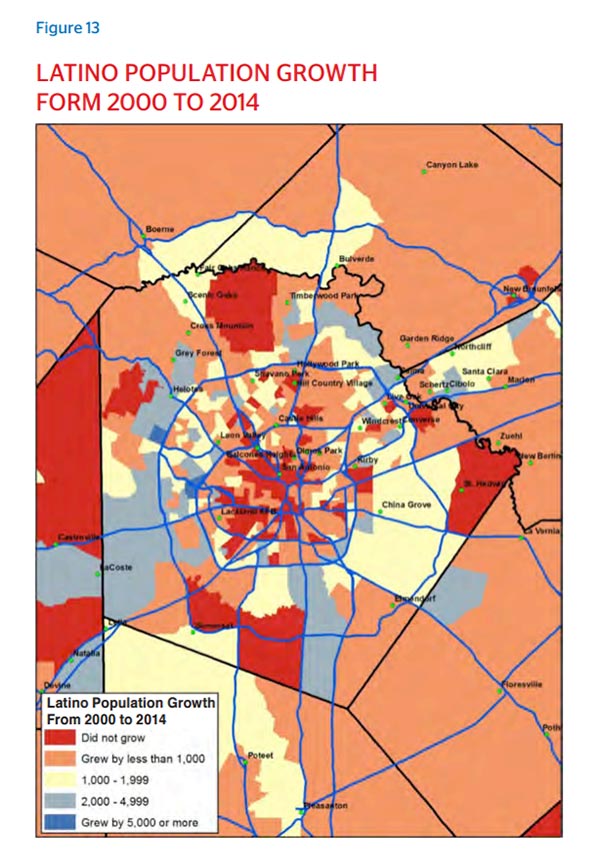
    Future Challenges

    Cities that enjoyed the rapid growth now experienced by San Antonio have also suffered the downsides. New York, San Francisco and Los Angeles, among others, are economically dynamic and culturally interesting, yet overwhelmed by overloaded infrastructure, service failures, growth-killing regulations and patronage-ridden political machines that only worsen these problems. When I asked community leaders how San Antonio could avoid this fate in coming decades, two answers surfaced.

    The first was that San Antonio needed to continue expanding infrastructure, a point emphasized by local billionaire and Spurs owner Red McCombs. This could mean everything from doubling down on housing and highway construction to exploring 21st-century solutions like green energy. While there have been recent expansions, the San Antonio-Austin corridor lacks a top-notch airport, which may explain why neither city has had the same success attracting corporations as had Houston and Dallas. In other cases, however, the city is taking the initiative in infrastructure growth. In May, the San Antonio Water System board approved the takeover of the Vista Ridge Pipeline, a new project that will diversify the water supply. San Antonio also recently launched SA2020, a plan designed to improve the city on 58 quality-of-life indicators.

    Fortunately, San Antonio is in a financial position for such expansion; while other U.S. cities’ pension debts have prevented them from even providing well-paved streets. San Antonio has among the lowest per capita unfunded pension liabilities of any major city. For six consecutive years, the city has received a perfect bond rating. It also has a population, said McCombs, while overlooking the downtown skyline from his north-central office, that understands intuitively the connection between capital investment and prosperity.

    “You give Texans a good reason for paying taxes,” he said, “and they’ll pay them.”

    Secondly and perhaps even more critically, San Antonio needs to continue mobilizing its minority population, mainly by improving its K-12 education system. While there are countless success stories here, there are also Mexican-Americans and African Americans who have lived in multigenerational poverty on the city’s west, south and east sides, and low-skilled, non-English-speaking immigrants are still arriving. Many of their neighborhoods, while certainly nicer than most urban American slums, are nonetheless rundown and have lower-performing public schools than those in outlying areas. The city and the state have taken several recent measures to address the problem, including a city voter-approved sales tax increase for Pre-K schooling, and charter school expansion.

    Other K-12 measures have been more innovative. The SA Works program, for example, is a partnership between the city and the Chamber of Commerce to connect high school and college students with local companies and other supporting agencies, who then offer internships and job-shadowing opportunities.

    In June, a partnership was launched between the San Antonio Independent School District and H.E.B. to open five specialty schools that will plug students into the local employment scene.

    If San Antonio continues embracing new ideas to address its infrastructure and education challenges, it will remain a regional growth engine, and an example for other cities. America, after all, is slated to become 23 percent Hispanic by 2035. San Antonio represents an extreme early version of this demographic shift, and an example of how it can work.

    “San Antonio,” concluded Cisneros, is “driven by the understanding that jobs and incomes are the way we’re going to progress, and, in fact, we have. I see it in the quality of restaurants, the [more diverse] crowd at the Spurs [games], in the retail mix of the city, the integration in neighborhoods, with Latinos and African Americans moving into neighborhoods once beyond their reach. Intermarriage. It’s almost as if a new culture has emerged. … It’s one culture adapting the things that it likes about another culture.”

    These same economic and cultural improvements can be observed in other big Texas cities, suggesting that they are the outcome of liberalized polices. San Antonio, as the Mexican-American capital, has long been the underdog of the four great Texas cities. But today its Latino character is proving to be yet another asset, contributing a unique wrinkle within Texas’ broader urban growth story.

    Scott Beyer is a Forbes columnist and cross-country traveler who covers U.S. urban issues. For three years, he’s circling America to live for a month each in 30 cities, starting from Miami and ending in New York City. The point is to write a book about revitalizing cities through Market Urbanism — which is the intersection of classical liberal economics with urban issues. But he also writes articles on multiple other city subjects.

    Top photo: Zereshk [GFDLCC-BY-SA-3.0 or CC BY 2.5], via Wikimedia Commons