Blog

  • The G-20’s New Balance of Power: The Productive Economy Still Matters

    As world leaders gather in Canada this weekend, the nations with the most influence won’t be the high-tech mavens. Joel Kotkin on why traditional industries still matter in the post-information age.

    Are we entering the post-information age?

    For much of the last quarter century, conventional wisdom from some of the best minds of our times, like Daniel Bell, Alvin Toffler and Taichi Sakaiya—in both East and West—predicted that power would shift to those countries that dominate the so-called information age. At the time, this was the right call, but it may increasingly be, if you will, old news. Although there’s no question that iPhones and 3-D movies are nifty—and hedge funds generators of massive wealth for investors and operators—we now may actually be entering what might be called the post-information age.

    As the ministers gather in Toronto this weekend for the G-20, we can see how overblown the efficacy of a virtual economy might be. The current star players on the field in terms of economic growth and fiscal strength generally derive their power not from information technology, media, or financial savvy but by the mundane but still important basic underpinnings of economic growth: agriculture, manufacturing and energy production.

    This is true among both the advanced countries as well as the developing ones. The stars of the West are not the brainy Brits or the entrepreneurial “creative” Americans but places like host Canada and Australia, whose place in the world economy relies heavily on the production of raw materials like uranium, iron ore, oil, timber, grains, fish and beef. Sure, they have some cutting-edge companies, nice (often heavily subsidized) film industries, and lots of smart people (after all, my wife is from Montreal!). But it’s the basics that drive their economies.

    So much so that Australia, braced by rising exports to Asia, has been growing well enough to let its interest rates rise, something that is all but unthinkable for the U.S. Fed, at least until the November elections. Due in large part to its commodity-based economy and more enlightened regulation, Canada’s banking system is widely considered the most stable in the advanced industrial world, with a rate of leverage 18 to 1 compared with the U.S.’s 26 to 1 and the EU’s scary 61 to 1. Budget deficits? Hardly an issue. Bank bailouts? Nary one.

    The flip side of the Canada-Australia coin are the high-performers who now excel in the field most of our high-tech pundits—starting with Megatrends’ John Naisbitt 20 years ago—generally disdain: manufacturing. Naisbitt called manufacturing “a declining sport” and was roundly applauded by Wall Street and other sources of economic “wisdom.” The most obvious contrary example is China, the modern equivalent of 19th-century Britain’s “workshop of the world.” But other, faster-growing economies among the G-20—Brazil, Turkey, India and South Korea, for example—also are rising fast largely on the back of manufacturers.

    None of this suggests that high-tech or information are unimportant. But by their nature industries like software are exceedingly mobile. In contrast, the basics in these rapidly growing economies involve large-scale investment and the presence of the right resources. It’s easier to move software development to Bangalore than soybean production or natural gas.

    In any case, it’s not smart to give up the basics—unless perhaps you are Liechtenstein or Monaco—and hope to have enough money left to sustain your drive into high-tech industry. Do you really think that the rising industrial powers have any intention of ceding media, finance, and technology to Americans, Japanese or Europeans? I would not count on it.

    History serves as an excellent guide here. Take the example of Great Britain—home of the Industrial Revolution—which should be considered a cautionary tale. In the 19th century and much of the 20th, even though the country depended on manufactured goods for its livelihood, British elite schools, financial institutions, and media all worked against “the needs of industry” to create what historian Martin Wiener has called “two unequal capitalist elites,” the more powerful of which had little interest in, and even disdain for, industrial activities. The “best” talent, and the most social prestige, favored the financial sector over the industrial. Production was particularly looked down upon: it was “the Cinderella of British industry.”

    There are also more recent examples supporting the notion that hard work and attention to the basics still matter. In the 1980s, Japanese firms that were widely written off as “copycats” eventually became primary innovators, particularly in automobiles, semiconductors, and computer games. Koreans were often then dismissed by both Americans and Japanese as unimaginative imitators; today South Korea’s electronics and car companies are surging not only in America but across the world. Now they have their gaze fixed on biotechnology and videogames.

    In the coming decades Chinese and Indian companies will seek to move from low-wage work to more specialized, and increasingly innovative, kinds of products—in everything from pharmaceuticals to fashion and finance. The enormous profits to be made from less “sexy” activities—ranging from manufacturing to call center and code writing—will provide the funds to invest in both the hard infrastructure and the necessary training to move decisively into ever higher-end activities.

    This contempt for production underpinned the decline of Britain as a great power, and could prove disastrous in mid-21st entury America as well. In the America envisioned by the advocates of the “creative economy,” our productive facilities would serve mainly as tourist attractions, much as we now visit restored pioneer villages. The problem is that it may work for a small, highly educated class and some financial managers, but not for the vast majority of Americans.

    In reality a more prosperous future is possible, but only if the country focuses both on developing the intellectual prowess of its citizenry and on maintaining the physical infrastructure necessary for key basic sectors like agriculture, energy, and manufacturing. A single-minded emphasis on nontangible industries—notably finance—is a dangerous delusion, as is particularly clear in both the Wall Street disaster of 2008 and the current devastation of the even more finance-dependent British economy and its exchequer.

    Fortunately, there is still time for America—still by far the world’s pre-eminent economy—to adjust to the realities of the post-informational economy. We remain the world’s leading agricultural power, and global demand for food, particularly proteins, will soar as the global population expands from six to nine billion by 2050. Many of these people will be more affluent, and provide prime markets for such American exports as soybeans, nuts, fruits, wine, beef, and chicken. Only a small number of Americans may work on farms, but over 10 percent are involved in some way with the marketing, processing, financing and research of agricultural-related activities.

    Similarly America can also enjoy the kind of energy-generated wealth that underpins Canada, Australia, and G-20 members Russia, Brazil, and Saudi Arabia. Our ruinous trade deficit in energy is largely a failure of will, faulty regulation and lack of proper incentives. In the short run, we have ample supplies of relatively clean natural gas—particularly in the Great Plains—as well as significant on-shore oil supplies and a prodigious capacity for renewable energy. In 10 years, with a pragmatic focus on these industries, we might not be an energy exporter but we could be fairly self-sufficient, perhaps only importing from our close Canadian cousins.

    At the same time, there is no compelling reason why America needs to abandon industry. Unlike Europe we will have an expanding workforce and growing domestic market. The manufacture of hard goods, which requires a sophisticated infrastructure and is generally energy-intensive, could turn out to be relatively easy to salvage for American workers. Like agriculture, manufacturing directly may employ a relatively small number of people, but many others benefit from the service industries that depend on it. Manufacturers also boost the tech sector; roughly one in four U.S. scientists and engineers work for industry.

    Although it may not be obvious to our trendy information-age pundits and their admirers among economic journalists, or perhaps some in the current administration, the U.S. is well-positioned to meet the requirements of the emerging post-information age. If we add our natural resource base and industrial capacity to our prodigious ability to innovate, the U.S. could not only compete against, but out-perform every major country in the G-20. The key now is summoning national and political will to exploit our advantages, assets that America sadly now appears to have in short supply.

    This article originally appeared in TheDailyBeast.com.

    Joel Kotkin is executive editor of NewGeography.com and is a distinguished presidential fellow in urban futures at Chapman University. He is author of The City: A Global History. His newest book is The Next Hundred Million: America in 2050, released in Febuary, 2010.

    Photo by rjason13

  • G-20 Summit: There is No One Size Fits All

    There is one thing you need to remember as you listen to the debate about economic and fiscal policy at the G-20 Summit this weekend in Toronto: There is No One-Size-Fits All. There is not even a “One-Size-Fits Twenty.”

    Back in 2001, I summarized the few things about finance and economics that most scholars agree will support a growing economy and healthy capital markets:

    “Four strategies can be shown to generally promote stable national financial systems: 1) having independent rating agencies; 2) having some safety net; 3) minimizing government ownership and control of national financial assets; and 4) allowing capital market participants to offer a wide-range of services.”

    As of today:

    1) Our rating agencies are independent of government, but not from the financial institutions who buy the ratings (who also buy the government, but I’ll leave that story to Matt Taibbi over at Rolling Stone …); 2) we bankrupted the Federal Deposit Insurance Corporation in late 2009, before the end of the recession (and that doesn’t even count all the bailouts of Wall Street and Main Street); and 3) the government took ownership positions in all US major financial institutions during the bailout.

    I’ll come back to #4 to another time – Congress has vowed to ruin even that one before the 4th of July recess by passing the Wall Street Reform Act.

    The United States delegation to the G20 Summit consists of President Obama, his economic advisor Larry Summers and (your friend and mine) Treasury Secretary Tim Geithner. At least one of them should know better than to go around insisting that every nation at the meeting should have the same policy as the United States: damn the torpedoes, full speed ahead! In other words, just as Federal Reserve Chairman Ben Bernanke is firing up the helicopters, keep dropping dollar bills on the economy until something starts growing. In a letter sent to the G-20 leaders in advance of the Summit in Toronto, they made it clear that the rest of the G-20 countries should do the same. While President Obama writes in the letter that the G-20 should “commit to restore sustainable public finances in the medium term” the underlying context is that there should be more fiscal stimulus in the short term.

    I’m not the only economist to have said this before: When it comes to developing robust capital markets and a vibrant economy, there is no “one size fits all”. This lesson should be familiar to the US delegation. To make it clear, let’s look at the numbers.


    2000

    2001

    2002

    2007

    2008

    2009

    Consumer Inflation Rate

    Canada

    2.7%

    2.5%

    2.3%

    2.1%

    2.4%

    0.2%

    France

    1.7%

    1.7%

    1.9%

    1.5%

    2.8%

    0.4%

    Germany

    1.5%

    2.0%

    1.4%

    2.3%

    2.6%

    0.0%

    United Kingdom

    2.9%

    1.8%

    1.6%

    4.3%

    4.0%

    2.2%

    United States

    3.4%

    2.8%

    1.6%

    2.9%

    3.8%

    -0.4%


    Economic Growth Rate

    Canada

    5.2%

    1.8%

    2.9%

    2.7%

    0.4%

    -2.5%

    France

    3.9%

    1.9%

    1.0%

    2.3%

    0.4%

    -2.2%

    Germany

    3.2%

    1.2%

    0.0%

    2.5%

    1.3%

    -5.0%

    United Kingdom

    3.9%

    2.5%

    2.1%

    3.0%

    0.7%

    -4.8%

    United States

    3.7%

    0.8%

    1.6%

    2.0%

    0.4%

    -2.4%

    The numbers in question are 2007 through 2009, those associated with the current recession. I include 2000-2002 in the table to show what happened in the last recession, for a little perspective. The players in question are US, UK, France and Germany – I include Canada as a courtesy because they are the host country for the summit,. The first thing you’ll notice is that the US is the only one among the group that did not see positive prices increases last year – hence, their continued willingness to employ the cash-dropping helicopters.

    French Finance Minister Christine Lagarde is outspoken this week on the subject of getting the federal budget under control in France instead of expanding economic stimulus programs: she believes what’s best for France is to get the deficits under control, which means reducing the budget and not more spending. On this one, I’m with Minister Lagarde: Vive La Différence!

    There’s one more thing you need to know about economic growth and that is this: It takes more than a 2.4% increase to make up for a 2.4% decrease. Think of this way: if you start at 1,000 and reduce by 50%, you are left with 500. Now, at 500 if you get a 50% increase, you are only back to 750. To get from 500 back to 1,000, you need a 100% increase. As I wrote back in January: “At this rate, it will take 11 quarters (nearly 3 years) to catch up.” More government spending, however, will not provide a healthy long-term solution.

    Susanne Trimbath, Ph.D. is CEO and Chief Economist of STP Advisory Services. She will be participating in an Infrastructure Index Project Workshop Series throughout 2010. Her training in finance and economics began with editing briefing documents for the Economic Research Department of the Federal Reserve Bank of San Francisco. She worked in operations at depository trust and clearing corporations in San Francisco and New York, including Depository Trust Company, a subsidiary of DTCC; formerly, she was a Senior Research Economist studying capital markets at the Milken Institute. Her PhD in economics is from New York University. In addition to teaching economics and finance at New York University and University of Southern California (Marshall School of Business), Trimbath is co-author of Beyond Junk Bonds: Expanding High Yield Markets.

    Photo by carlossg

  • Despite Transit’s 2008 Peak, Longer Term Market Trend is Down: A 25 Year Report on Transit Ridership

    In 2008, US transit posted its highest ridership since 1950, a development widely noted and celebrated in the media. Ridership had been increasing for about a decade, however, 2008 coincided with the highest gasoline prices in history, which gave transit a boost.

    Less reported was the fact that despite higher ridership, transit’s market share (of transit and motor vehicles) has fallen since the 1950s. In 1955, transit’s market share was over 10%. By 2005, transit’s share had dropped to 1.5%, but recovered only to 1.6% in 2008. Transit’s all time peak ridership was in 1945, driven up by World War II and gas rationing. It is thus not surprising that national transit ridership (boardings) declined 3.8% in 2009 as gasoline prices moderated.

    Market Share by Major Urban Area

    Demographia has released urban area roadway and transit market share estimates for 2008, based upon Federal Transit Administration and Federal Highway Administration data. The table below compares 2008 with 1983 market share data for 56 urban areas with a corresponding metropolitan area population of more than 900,000 (complete data).

    Urban Areas: Roadway & Transit Market Share: 2008
    Ranked by 2008 Transit Market Share
    With 25 Year (1983) Comparison
        2008 1983 Roadway Share % Change
    Rank Urban Area Roadway Share Transit Share:  Roadway Share Transit Share: 
    1 New York 89.0% 11.0% 87.7% 12.3% 1.5%
    2 San Francisco 95.0% 5.0% 93.7% 6.3% 1.4%
    3 Washington 95.5% 4.5% 96.1% 3.9% -0.6%
    4 Chicago 96.1% 3.9% 94.2% 5.8% 2.0%
    5 Honolulu 96.2% 3.8% 93.2% 6.8% 3.2%
    6 Boston 96.7% 3.3% 97.5% 2.5% -0.8%
    7 Seattle 97.2% 2.8% 97.6% 2.4% -0.4%
    8 Philadelphia 97.3% 2.7% 96.0% 4.0% 1.4%
    9 Portland 97.7% 2.3% 97.6% 2.4% 0.1%
    10 Salt Lake City 97.8% 2.2% 99.1% 0.9% -1.3%
    11 Los Angeles 98.1% 1.9% 98.1% 1.9% 0.0%
    12 Denver 98.2% 1.8% 98.5% 1.5% -0.3%
    13 Baltimore 98.3% 1.7% 97.7% 2.3% 0.6%
    14 Pittsburgh 98.6% 1.4% 97.3% 2.7% 1.3%
    15 Miami-West Palm Beach 98.7% 1.3% 98.8% 1.2% -0.1%
    16 Atlanta 98.8% 1.2% 98.0% 2.0% 0.8%
    16 Cleveland 98.8% 1.2% 98.0% 2.0% 0.8%
    16 Las Vegas 98.8% 1.2% 99.6% 0.4% -0.8%
    16 Minneapolis-St. Paul 98.8% 1.2% 98.8% 1.2% 0.0%
    16 San Diego 98.8% 1.2% 99.3% 0.7% -0.5%
    21 San Jose 99.0% 1.0% 99.0% 1.0% 0.0%
    22 Austin 99.1% 0.9% 99.7% 0.3% -0.6%
    22 Houston 99.1% 0.9% 99.0% 1.0% 0.1%
    22 Milwaukee 99.1% 0.9% 98.3% 1.7% 0.8%
    22 Sacramento 99.1% 0.9% 99.0% 1.0% 0.1%
    22 San Antonio 99.1% 0.9% 98.7% 1.3% 0.4%
    27 St. Louis 99.2% 0.8% 99.0% 1.0% 0.2%
    28 Buffalo 99.3% 0.7% 98.5% 1.5% 0.8%
    28 Providence 99.3% 0.7% 98.9% 1.1% 0.4%
    30 Charlotte 99.4% 0.6% 99.3% 0.7% 0.1%
    30 Cincinnati 99.4% 0.6% 98.7% 1.3% 0.7%
    30 Dallas-Fort Worth 99.4% 0.6% 99.4% 0.6% 0.0%
    30 Hartford 99.4% 0.6% 98.7% 1.3% 0.7%
    30 Orlando 99.4% 0.6% 99.7% 0.3% -0.3%
    30 Phoenix 99.4% 0.6% 99.4% 0.6% 0.0%
    30 Rochester 99.4% 0.6% 98.9% 1.1% 0.5%
    30 Tucson 99.4% 0.6% 98.9% 1.1% 0.5%
    38 Detroit 99.5% 0.5% 98.8% 1.2% 0.7%
    38 Fresno 99.5% 0.5% 99.3% 0.7% 0.2%
    38 New Orleans 99.5% 0.5% 97.4% 2.6% 2.2%
    38 Norfolk-Virginia Beach 99.5% 0.5% 99.2% 0.8% 0.3%
    38 Riverside-San Bernardino 99.5% 0.5% 99.6% 0.4% -0.1%
    43 Columbus 99.6% 0.4% 98.6% 1.4% 1.0%
    43 Louisville 99.6% 0.4% 98.9% 1.1% 0.7%
    43 Memphis 99.6% 0.4% 99.4% 0.6% 0.2%
    43 Tampa-St. Petersburg 99.6% 0.4% 99.5% 0.5% 0.1%
    47 Bridgeport 99.7% 0.3% 99.8% 0.2% -0.1%
    47 Jacksonville 99.7% 0.3% 99.4% 0.6% 0.3%
    47 Kansas City 99.7% 0.3% 99.4% 0.6% 0.3%
    47 Nashville 99.7% 0.3% 99.4% 0.6% 0.3%
    47 Raleigh 99.7% 0.3% 99.9% 0.1% -0.2%
    47 Richmond 99.7% 0.3% 99.1% 0.9% 0.6%
    53 Indianapolis 99.8% 0.2% 99.3% 0.7% 0.5%
    54 Birmingham 99.9% 0.1% 99.5% 0.5% 0.4%
    54 Oklahoma City 99.9% 0.1% 99.9% 0.1% 0.0%
    54 Tulsa 99.9% 0.1% 99.6% 0.4% 0.3%
    Unweighted Average 98.7% 1.3% 98.3% 1.7% 0.4%
    All Urban Areas Combined 98.4% 1.6% 97.5% 2.5% 0.9%
    Based upon passenger miles
    Core urban areas in metropolitan areas with more than 900,000 population in 2009.
    Derived from Federal Transit Administration and Federal Highway Administration data
    Los Angeles and Mission Viejo urban areas combined
    San Francisco, Concord and Livermore urban areas combined
    Historic transit market share data at http://www.publicpurpose.com/ut-usptshare45.pdf
    Maryland commuter rail (MARC) assigned to Washington, DC

    In 1983, transit systems started receiving support from federal taxes on gasoline. This was also the first year that the National Transit Database reported on the same annual basis as it does today. One justification for using funds from road users was the hope of attracting people from cars to transit. The national data above and the urban area below show that the overwhelming share of new travel has, nonetheless, continued to be captured by motor vehicles rather than transit. Among the 56 urban areas, 13 experienced gains in transit market share from 1983 to the peak year of 2008, while 37 posted losses and six had no change. Transit was able to capture only 0.9% of new urban travel between 1983 and 2008, while roadways captured 99.1%. (Note 1).

    The Top 10: Still a New York Story

    #1: New York: The nation’s predominant urban area remains New York, with an 11.0% transit market share. In 2008, 41% of the national transit ridership (passenger miles) was in New York, with much of it either in or focused upon New York City. The New York City Transit Authority, and a host of local public and private systems, principally serve New York City destinations and account for a remarkable 38% of the nation’s transit ridership. Even so, transit’s market share dropped from 12.3% in 1983. As a result, the roadway market share in New York increased 1.5% between 1983 and 2008, the fourth largest gain in the nation. Transit attracted 8.7% of the new demand between 1983 and 2008, while roadways attracted 91.3%.

    #2: San Francisco: San Francisco had the nation’s second highest transit market share in 2008, at 5.0%. This is a decline from 6.3% in 1983. Nonetheless, San Francisco moved up from 6th place in 1983. This produced a 1.4% increase in the roadway market share between 1983 and 2008, the fifth largest gain in the nation. Transit accounted for 2.2% of the new demand, while roadways attracted 97.8%.

    #3: Washington: Washington placed third in transit market share in 2008, at 4.5%. This represents a gain from 3.9% in 1983 and an improvement from 6th place. Washington was the only urban area among the top five to experience an increase in transit market share. Much of Washington’s transit increase was on its expanding Metrorail system and the MARC commuter rail system (most of the ridership on this Maryland based system commutes to Washington. Overall, transit in Washington has attracted 5.1% of new travel over the past 25 years, while roadways attracted 94.9% of new demand.

    #4: Chicago: Chicago ranked fourth in transit market share, at 3.9%. In 1983, Chicago had ranked 3rd, with a market share of 5.8. The roadway market share in Chicago increased 2.0% from 1983 to 2008, the third largest road travel gain in the nation. Transit attracted 1.3% of new demand over the period in Chicago, while roadways attracted 98.7%.

    #5: Honolulu: Honolulu ranked fifth in transit market share, at 3.8%. This is a significant drop from 1983, when Honolulu ranked 2nd in the nation, with a transit market share of 6.8%. Honolulu’s roadway market share gain was the largest in the nation between 1983 and 2005, at 3.8%. Transit ridership also dropped in Honolulu from 1983 to 2008, so that roadways accounted for all new travel.

    #6: Boston: Boston ranked sixth in transit market share in 2008, at 3.3%. This is a gain from 2.5% in 1983, when Boston ranked 9th. Much of Boston’s increase is attributable to its commuter rail expansion. Transit captured 4.1% of new demand, while roadways attracted 95.9%.

    #7: Seattle: Seattle’s principally all bus transit system ranked 7th in 2008 with a market share of 2.8%. This is an increase from 2.4% in 1983, when Seattle ranked 10th. Transit captured 3.1% of new travel over the past 25 years, while roadways accounted for 96.9%.

    #8: Philadelphia: Philadelphia slipped from the 5th largest transit market share in 1983 (4.0%) to 8th in 2008, at 2.7%. Philadelphia’s transit system, one of the most comprehensive in the nation, captured just 1.4% of new travel over the last quarter century, while roadways captured 98.6%.

    #9: Portland: Portland ranked 9th in transit market share in 2008, at 2.3%. This is a decline from 2.4% in 1983 and occurred despite opening the most extensive new light rail system in the nation over the period. Transit attracted 2.2% of new travel over the period, while roadways attracted 97.8%.

    #10: Salt Lake City: Salt Lake City, at 10th, is a new entrant to the top 10 transit market share urban areas, with a share of 2.2%. In 1983, Salt Lake City ranked 34th, with a transit market share of 0.9%. Even with this increase, however, roadways captured the bulk of new travel, at 96.2%, while transit attracted 3.8%, due to transit’s small 1983 base.

    Other Urban Areas: There were also notable developments among the urban areas that did not place in the top 10 in 2008 transit market share.

    Las Vegas: Las Vegas improved its ranking more than any other urban area, moving from 49th in 1983 to 16th in 2008 (in a tie with Atlanta, San Diego, Cleveland and Minneapolis-St. Paul). In 1983, Las Vegas had a transit market share of 0.4%, which improved to 1.2% in 2008. This was an especially notable achievement, because Las Vegas experienced substantial population growth over the period. During the period, Las Vegas established a 100% competitively contracted transit system, the only such transit system in the nation and has seen ridership expand by more than 10 times. Nonetheless, as in other gaining urban areas, such as Salt Lake City and Washington, the transit ridership base was so small that roadways captured nearly all the new demand, at 98.6% (transit obtained 1.4%).

    Atlanta: Atlanta both (1) was the fastest growing larger urban area in the developed world between 1983 and 2008 and (2) built the second most new rail capacity in the nation, in its expansion of the MARTA Metro (trailing only Washington’s Metro). Yet, Atlanta’s transit market share fell from 2.0% to 1.2% between 1983 and 2008, with transit attracting only 0.9% of new travel.

    New Rail Urban Areas: Transit market shares generally failed to increase in urban areas opening new light rail or metro systems over the period (excludes urban areas with new rail systems that were not open at the beginning of fiscal year 2008).

    • Six urban areas with new rail systems experienced market share declines, including Portland, Baltimore, Houston, Sacramento, St. Louis and Buffalo.
    • Four urban areas with new rail systems had static transit market shares, including Los Angeles, Minneapolis-St. Paul, San Jose and Dallas-Fort Worth.
    • Three urban areas with new rail systems experienced transit market share increases. The largest increase was in Salt Lake City (and the largest of any urban area). Denver and Miami-West Palm Beach also experienced increases.

    Where from Here? It might have been expected that transit would have attracted far higher ridership numbers when gasoline prices achieved such heights. Yet, nationally, transit market share increase was only from 1.5% to 1.6%, even as roadway demand was declining modestly.

    Transit’s principal marketing problem lies in its problem serving destinations outside downtown. Downtowns typically account for only 10% of urban area employment. Some trips in an urban cannot even be made on transit. For example, Portland’s extensive transit system connects only about two-thirds of the jobs and residences within the (Tri-Met) service area (Note 2). Further Tri-Met’s award deserving internet trip planner shows that some trips to outside downtown destinations can require more than two hours, even when light rail is used.


    Note 1: This data relates only to passenger transportation. Urban roadways, unlike transit, also carry a substantial amount of local and intercity freight, which is not reflected in this data.

    Note 2: According to Metro’s 2004 Regional Transportation Plan, 78% of the residences and 86% of the jobs in the Tri-Met service area were within walking distance (1/4 mile) of a transit stop. This means that approximately 67% of residences and jobs are within 1/4 mile of a transit stop (0.78 * 0.86). Metro’s plans envision this figure dropping to 59% by 2020 (this data does not include Clark County in Washington, part of which is in the urban area).

    Wendell Cox is a Visiting Professor, Conservatoire National des Arts et Metiers, Paris. He was born in Los Angeles and was appointed to three terms on the Los Angeles County Transportation Commission by Mayor Tom Bradley. He is the author of “War on the Dream: How Anti-Sprawl Policy Threatens the Quality of Life.

  • Immigrant Entrepreneurs Can Turbocharge Cleveland’s Flagging Economy

    In seeking to lure a Chinese lightbulb-maker to town, Cleveland leaders revealed both a vision and a blind spot.

    Cleveland Mayor Frank Jackson and his team should be given credit for recognizing the tremendous opportunity in attracting foreign direct investment, or “FDI,” and the new jobs that it provides.

    According to a 2008 report by the U.S. Chamber of Commerce, foreign firms employed more than 5.3 million U.S. workers through their U.S. affiliates and have indirectly created millions of additional jobs. More than 30 percent of direct hires are in manufacturing. In Ohio, 600 foreign-based corporations from 28 countries are operating 1,000 facilities and employing about 180,000 people.

    One exciting new trend is the rise in the annual number of foreign investment projects in the U.S. renewable energy sector, jumping from 4 projects in 2003 to over 40 in 2008.

    In its eagerness to attract a foreign company offering energy-saving light bulbs, however, City Hall fell into traps which may have been avoided if had it tapped the cultural resources at their fingertips.

    When Mayor Jackson’s administration waded into unfamiliar waters to partner with an LED light bulb company in Ningbo, China, no one thought to talk with Chinese-American entrepreneurs and professionals living in Northeast Ohio. These individuals are eager to assist the City in helping identify appropriate partners in China, supporting the due diligence, and generally advising on a culture that dates back to 5,000 B.C. and has only opened-up in recent decades.

    As reported by Crain’s Cleveland Business, local immigrants were not viewed as a resource.

    ‘Why weren’t we informed; we could have helped you?’ asked Hong Kong-born immigration attorney Margaret Wong….

    Ms. Wong made the statement last Thursday evening, May 20, in the Red Room, a conference room attached to Cleveland Mayor Frank Jackson’s office at Cleveland City Hall. She was there with a group of local small business owners, clergy and other civic leaders invited by the mayor to a meeting to enlist their support in his effort to bring Chinese lighting manufacturer Sunpu-Opto Semiconductor Co. to the city.

    Ms. Wong was asking chief of staff Ken Silliman why the Mayor, who was not present, hadn’t sought the assistance of people such as her and the others in the room sooner in his attempt to make Cleveland the U.S. beachhead of Sunpu-Opto, a maker of energy-efficient LED lighting.

    Mr. Silliman didn’t have a ready answer.

    The answer may be that in this region immigrants are often not viewed as a valuable resource to support the region’s business development, or viewed as people with the skills to help Northeast Ohio navigate the language, cultural and market barriers abroad.

    This must change.

    Yes, it is important that the City and the region aggressively pursue FDI, not only with passion, but also with skill, networks, and on-the-ground experience.

    To make these efforts successful, however, leadership should look to leverage the foreign-market experience of our immigrant entrepreneurs and innovators, particularly in relation to China and India, where booming economies, mounting foreign currency reserves, and relationship-based business culture create unique opportunities and challenges.

    Cleveland’s immigrants, some of whom enjoy business and governmental relationships in the homeland that go back generations, are eager to be a partner in revitalizing the city and the region. They are in a unique position to help our region capture our share of the $245 billion of foreign direct investment streaming into the U.S, to ramp-up our exports to global markets where 95% of the world’s consumers live, and to attract the world’s best and brightest innovators, entrepreneurs, and professionals driving a changing economy.

    There is precedent in leveraging ethnic and global networks for local development Northeast Ohio’s Jewish community, which enjoys extensive business, family and social ties in Israel, has helped the region attract tens of Israeli companies in recent years.

    What is needed now is a bold regional plan to take this formula for success to a larger scale, particularly targeting markets such as China where the government is encouraging its businesses to expand into the United States.

    The path to this global journey, however, should begin with a few short steps at home, launching a multi-purpose International Welcome Center which will help the region build a bridge to the world.

    The Welcome Center will not only provide a much-needed platform to coordinate local resources for attracting FDI, but it will also help educate the region on why the development of a global culture is an economic necessity and on what steps we can all take to welcome and partner with international resources, such as the immigrant talent living right now in Northeast Ohio.

    This represents a bit of conundrum. How do we recruit and welcome foreign companies, their executives, and their families, if we do not fully value our existing immigrant entrepreneurs and innovators? How do we attract foreign direct investment when overseas companies are feared as job-takers?

    In responding to the dichotomy of not welcoming immigrants while trying to lure foreign companies to Cleveland, Anne O’Callaghan, founder of the Welcome Center in Philadelphia said in her City Club of Cleveland speech last year:

    Do the region’s leaders think that foreigners should just stay in the homeland but still wire you their money?

    Northeast Ohio’s immigrant community is rich in technology, entrepreneurship, global market knowledge, and new wealth.

    To make a credible push to attract foreign companies which can establish manufacturing, research, and corporate headquarters in Northeast Ohio and in-source thousands of new jobs, the region can take a bold step forward by partnering with immigrants already here and put out the “welcome mat” for those who may arrive tomorrow.

    Richard Herman is a Cleveland lawyer, Co-Chair of TiE Ohio (The International Entrepreneur), and Co-Author of Immigrant, Inc. (Wiley & Sons, 2009).

    Photo by Caveman 92223 — On the 2010 US Tour

  • Millennial Surprise

    The boomer’s long domination of American politics, culture and economics will one day come to an end. A new generation–the so-called millennials–will be shaping the outlines of our society, but the shape of their coming reign could prove more complex than many have imagined.

    Conventional wisdom, particularly among boomer “progressives,” paints millennials–those born after 1983–as the instruments for fulfilling the promise of the 1960s cultural revolt. In 2008 the left-leaning Center for American Progress dubbed them “The Progressive Generation.” The center contrasted them favorably to the Xers, a cohort of 20 million fewer, and their “conservative views.”

    The case for the millennials’ left-leaning views can be traced to when the oldest millennials started to vote, in 2004. That year big loser John Kerry took the 18 to 29 vote by nearly 10 points. In the last election millennials supported Barack Obama over John McCain by a staggering 30 points. He outperformed McCain in every ethnic group, winning 54% of young white voters and a remarkable 76% of young Hispanics. Obama may still have won without millennial support, but only narrowly.

    This vote was shaped by important and perhaps lasting attitudes. Authors Morley Winograd and Michael Hais identified among these young voters a strong communitarian ethos, generally liberal social views and somewhat of a “green” agenda. They wrote that millennials’ embrace of the Democratic Party in 2008 could foreshadow a long-awaited leftward realignment paralleling that which occurred in the 1930s.

    Yet there are signs that millennial voters, if not shifting to the right, may have lost some of their progressive ardor. Recent polls suggest that younger voters are far less likely to vote this year than in 2008. Gallup reports that nearly half of voters ages 18 to 29 are not enthusiastic about turning up at the polls this November, a far higher number than senior or boomer voters.

    One reason for such a dramatic shift is likely the economy. The current recession has been very hard on younger workers–unemployment hits around 20% for workers between 16 and 24. The brunt of the recession has hit blue-collar, high school educated youths, but even the college crowd, the core of the Obama constituency, faces what appears to be dismal prospects in the years ahead.

    Not too surprisingly, a May Allstate-National Journal Heartland Monitor survey of voters 18 to 29 found only 45% of millennials still solidly behind the president’s economic agenda. This could have a depressing impact on the leftward lurch among millennials. Indeed one recent Harvard survey found only half of all young voters planned to vote Democratic for Congress this year, compared with 60% in 2006.

    If the downturn persists, we could see some changes in generational politics. In the 1970s a similarly dismal economy accompanied the boomers as they were entering the workforce in huge numbers. Then, as now, long-term unemployment and underemployment seemed the wave of the future.

    The hard times of the 1970s changed the politics of the boomers. The bungled presidency of Jimmy Carter did not do much for the credit of the Democratic Party. Boomers, who sided with Carter in 1976, ended up voting for Ronald Reagan in large numbers four years later. The relative prosperity of the Reagan years painted a basically conservative tinge to boomer voters, something that benefited both Republicans and more centrist Democrats like Bill Clinton.

    This change could occur again, but other factors may slow a rightward shift among millenials. Republican nativism–exemplified by the Arizona immigration law–may be a boon with boomer voters, who are overwhelmingly white (only one in four are non-white). In contrast, roughly two in five millennials are minority group members. The age group 18 and under is already majority “minority.”

    Another big factor will be social liberalism. On a host of critical issues–from interracial dating to gay marriage–millennials tend to be far more “progressive” than earlier generations. According to a recent Pew study, 63% of millennials believed society should accept homosexuality compared with only 48% of boomers.

    Millennials also tend to disapprove of such things as prayer in school compared with boomers or older generations. Although most express some religious commitment, there are more unaffiliated and basic non-believers than in previous generations. The GOP’s long-term embrace of a hard religious right positions will not pay off among millennial voters.

    Perhaps most troubling for Republicans–and this is a point emphasized by Winograd and Hais–are millennial views on government. Two-thirds, according to Pew, currently favor an expanded government role in the economy compared with roughly 40% of boomers. Not surprisingly, tea partiers, at least for now, are more likely to come from the older set than younger voters.

    Yet there is no lock for the Democrats. For one thing, expansive government is likely to be more attractive to those who are not yet paying taxes. As millenials head into their late 20s and early 30s, they may adopt different somewhat views. If the current public sector expansion proves ineffectual in creating jobs–after all not everyone can work for Uncle Sam–they could, like their boomer forebears, embrace a more private-sector oriented approach.

    More than anything else, both liberals and conservatives need to understand that this emerging generation may prove far less predictable than either side expects. Many “progressive” urbanists, for example, expect that most millenials will be happy to live in dense multifamily housing–largely as renters–as they enter their 30s. This is probably not altogether the case.

    Hais and Winograd argue that millenials may be more attracted to urban settings–as is often the case for younger, unmarried and childless people–than boomers and older generation. Yet their research also shows that more than twice as many–some 43%–identify suburbs as their “ideal place to live.” They embrace suburbs even more than boomers.

    Similarly, this generation also shares with the boomers a strong interest in homeownership–refuting the claim of some urban boosters that renting is the wave of the future. Instead they appear surprisingly traditional in terms of wanting marriage, kids and believing in following the rules. They may change things up, but still very much embrace the desire to achieve the “American dream.”

    In these and many ways, millennials are likely to continue redefining our society in ways that neither currently boomer dominated party will appreciate. Given the mess the boomers have left them, that may prove a difference worth celebrating.

    This article originally appeared in Forbes.com.

    Joel Kotkin is executive editor of NewGeography.com and is a distinguished presidential fellow in urban futures at Chapman University. He is author of The City: A Global History. His newest book is The Next Hundred Million: America in 2050, released in Febuary, 2010.

    Photo by rjason13

  • Is Pennsylvania History?

    On a recent whirlwind through Pennsylvania, I thought of James Carville, who popularized the notion that “It’s Philadelphia on one side, Pittsburgh on the other, and Alabama in the middle.” It’s a clever line, but between the Ohio and Delaware rivers he is missing a great American tapestry: the wreck of the Penn-Central, United flight 93’s final frantic moments, the social history of the Johnstown flood, and whether a state of steel and coal is past or present.

    Pennsylvania also reflects some broad truths about the nation, in particular, that stimulus plans can take forty years, the Amish have it right, the Civil War remains a personal wound, and Amtrak will never be the agent of high-speed rail.

    My first stop was Harrisburg, and I got there on a train that crossed through Amish country. I would imagine that as a community the Amish have the lowest debt-to-equity ratio in the country. There is something timeless and inspiring about their red barns and silos that flickered across the train windows, and no one needs to exhort the Amish to “Go Green.”

    In Harrisburg, as if a character in a novel by Theodore Dreiser, I walked with my grip from the station to a restaurant in the shadow of the state capitol. Later that evening I went to a high school graduation in the Concert Forum Hall, an elegant rotunda that was finished in the depths of the Depression.

    Around the circular walls are huge maps and timelines of world history. I passed the slow moments of the ceremony following Hadrian on his way into the Syrian desert and Marco Polo to the court of the Great Khan.

    Will the current stimulus money produce any buildings of such greatness? Somehow I doubt it. When the train went through Philadelphia, I saw a cheerful sign in an empty rail yard, with wording to the effect that the hot government money would get Americans back to work. The boast sounded unconvincing, as if everyone knows that stimulus money will end up funding deficits, national security advisors, and weapons contractors.

    General Robert E. Lee thought so much of Harrisburg and its strategic rail bridges that twice he embarked on campaigns to cut the main line of the Pennsylvania Railroad, and twice he failed, first at Antietam and then Gettysburg. The bridges over the Susquehanna remain, and their stone arches echo Avignon. The downtown — which looks in need of some stimulus — recalls the urban loneliness of Edward Hopper.

    From Harrisburg I drove west to Chambersburg and Mercersburg, strategic hamlets in the Civil War, but now a long way from the information superhighway. In 1864 Lee’s general, John McCausland, burned Chambersburg to the ground when the citizens failed to post his demanded ransom, which was $100,000 in gold, or $500,000 in currency (even terrorists are leery of inflated money); later, Chambersburg was the only northern town razed during in the war.

    President James Buchanan grew up in Mercersburg, a sleepy town notable today for its distinguished prep school. The log cabin in which he was born is now on the campus of Mercersburg Academy, and a nearby plaque notes that Buchanan served as U.S. Senator, ambassador to Russia and Great Britain, and Secretary of State before becoming the fifteenth president, impressive achievements for someone whose presidency is remembered as a failure, ruined by the Dred Scott decision and the drift to Civil War, which he did little to prevent.

    In a more recent conflict, United flight 93 crashed west of Mercersburg, near Shanksville, which echos the lonely farmland over which so much of the Civil War was fought. Conspiracy theories (a rare American growth industry) postulate that no plane crashed at Shanksville or that the one that did was destroyed by a missile, perhaps on orders from the trigger-happy Dick Cheney. (President Bush was finishing up My Pet Goat with the school kids.) Other theories claim that engine parts were found eight miles from the crash site and no plane debris larger than small fragments were located.

    A visit to the temporary Flight 93 memorial, however, puts to rest these and a number of other 9/11 conspiracy theories. About eighty percent of the plane was found at the site, although much of its was buried in the soft earth that had been strip mined; many local residents saw the plane hurtling intact toward the ground; the only debris found miles from the crash site was paper; and one of the engines flew several hundred yards — not miles — from the impact crater.

    The memorial to the victims of Flight 93 is budgeted to cost about $50 million, some of which has been privately raised. In design, it looks like the Vietnam Memorial in the middle of nowhere. No doubt it was a flush Congress that authorized the expenditure, even though the temporary memorial, a simple American flag at the crash site and a makeshift observation deck, looks like a better use of government resources. (Think of American tragedies remembered only with a statue in a traffic circle.)

    Forty Americans died at Shanksville. The death toll at Johnstown, just up the road, was more than two thousand when in 1889 a dam above the city broke and a wall of water washed over the gritty mill town. The tragedy is recalled in a series of memorials around the Little Conemaugh River Valley, and at a flood museum in Johnstown, which more recently has lost most of its steel production and its jobs.

    Not even the local filming of the 1977 movie Slap Shot with Paul Newman could save the economy of Johnstown, now laced with boarded storefronts, although it’s fun in the main square to imagine the presence of Coach Reggie Dunlop and the Hansons (“They brought their fuckin’ TOYS with ’em!”).

    A morality tale as well as a local disaster, blame for the Johnstown flood falls on The South Fork Fishing & Hunting Club, a mountain retreat of the super rich — Carnegie and Frick were members — that callously ignored warning signs that its South Fork Dam might give out. No wonder its so hard to win as a Republican in central Pennsylvania.

    I spent the night in Pittsburgh, no longer a steel city, but one given over to the service economy: in this case, sports stadiums, universities, finance, and hospitals. Old America made steel rails; new America entertains the masses.

    I left Pittsburgh on the The Pennsylvanian, Amtrak’s daily service to Philadelphia and New York, a remnant of the Pennsylvania Railroad, once the largest corporation on earth. After the Pennsylvania Railroad merged with the New York Central in 1968, the combined company failed less than three years later. The writer L.J. Davis said “it was more a death watch than a merger.” Penn-Central was the Enron of the 1970s. When it failed, it was the biggest bankruptcy in U.S. history.

    Here’s an overlooked cautionary tale about the delayed time reactions of government’s economic interventions: played out over thirty years, the Penn-Central merger was a big success. It took, however, the deregulation of the freight railroad business and the sale of the assets of Conrail (the successor to the bankruptcy) to the Norfolk Southern and CSX. When the dust settled, Penn-Central left the Northeast with two privately-owned railroads that are everything the shareholders had hoped for in 1968.

    On my return trip east, the train crossed the Allegheny Mountains on the Horseshoe Curve, ambled through Altoona and Lewistown, and then paused for almost forty-five minutes in Harrisburg and Philadelphia—an odd schedule for a railroad now talking up high-speed rail. Keep in mind that all the rail stimulus billions will bring is a return to the train speeds reached in the 1920s… the perfect metaphor for the illusions of government investment.

    What makes me hopeful about Pennsylvania’s future? I see optimism in the Amish red barns, the three rivers in Pittsburgh, the endurance of Johnstown, the four tracks of the main line, the federal-era houses in Harrisburg, the life of the Susquehanna, and the roadside markers like one in Chambersburg that reads: “On June 26, 1863, Gen. Robert E. Lee, and staff, entered this square.”

    What’s not to admire about a state that keeps its history so alive? I only wish it still had a steel industry and the Broadway Limited.

    Flickr Photo by Runner Jenny: 155th Pennsylvania Zouave Monument, Little Round Top, Gettysburg.

    Matthew Stevenson is the author of Remembering the Twentieth Century Limited, winner of Foreword’s bronze award for best travel essays at this year’s BEA. He is also editor of Rules of the Game: The Best Sports Writing from Harper’s Magazine. He lives in Switzerland.

  • China’s Urban Challenge: Balancing Sustainable Economic Growth and Soaring Property Prices

    Today, Beijing seeks to balance strong economic growth and soaring prices amidst a severe global crisis and debt turmoil in advanced economies. The challenge is colossal – to provide urban space for more than 600 million people in the coming decades.

    For months, the famous hedge fund wizard, James Chanos, has been predicting a severe Chinese property slump. As he puts it, “Dubai times 1,000 – or worse,” with the “potential to be a similar watershed event for world markets as the reversal of the U.S. subprime and housing boom.”

    The contrarian investor Chanos made his fortune on Wall Street by foreseeing the collapse of Enron and other high flying companies whose stories were “too good to be true.” He is not the only skeptic on China, but certainly one of the most prominent and articulate. And yet, China’s real estate market is very different from those of the U.S. or Dubai.

    In Dubai, the problem had to do with too much leverage. In China, consumers buying residential properties are required to put down 30 percent before taking out a mortgage. For a second home, the down payment is 50 percent, irrespective of their net worth. Home purchase is predicated on affordability.

    In the pre-crisis U.S., perverse incentives were magnified by low interest rates, sometimes minimal down payment and loans to those with poor credit histories. Excessive debt was sliced, repackaged and securitized into mortgages. Banks and ratings agencies engaged in unethical conduct. Appropriate regulatory oversight was absent.

    In the long-run, the containment of rapid price increases is vital for China’s economic growth and social cohesion. In the short-run, volatile price fluctuations are difficult to avoid in the large urban centers. These large agglomerations are evolving into “global cities”, which are driven not just by local conditions, but by global trade and investment.

    Soaring prices
    In “China bubble” predictions, Chinese property markets are typically portrayed as unitary or homogeneous. Yet, there is huge variation among cities and regions. In 2009, the urban GDP per capita was highest in Shenzhen reaching almost US$13,800 USD, whereas in Hefei it was about US$6,100.

    Until recently, the concern for the soaring prices in the property markets has been focused primarily on the high-end segment of the first-tier cities. Since the 1980s, the economic ripple effect of the successful first-tier cities – such as Shenzhen, Beijing, and Shanghai – has been spreading into new generations of Chinese cities.

    By the early 2000s, second-tier cities – from Suzhou and Shenyang to Chengdu and Chongqing – attracted significant attention with investments from global corporate giants. Third-tier cities – from Ningbo and Fuzhou to Wuxi and Harbin – have been following in the footprints, while inspiring still others, such as Kunming and Hefei.

    Yet for the most part soaring prices characterize primarily residential properties – almost exclusively the high-end segment of the most prosperous first-tier cities.

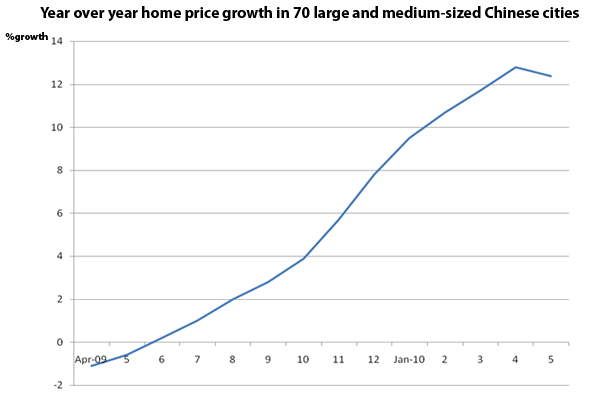
    In March, property prices in 70 Chinese cities soared by a record 11.7 percent from the previous year. In response, the government rolled out a series of measures to curb the domestic housing market amid concerns over asset bubbles.

    In early May, the People’s Bank of China raised the reserve requirement ratio for major banks by half a percentage point. Property stocks were expected to face further decline. Following Beijing and Shenzhen, the Shanghai municipal government released regulations for the property sector to curb housing speculation and soaring prices.

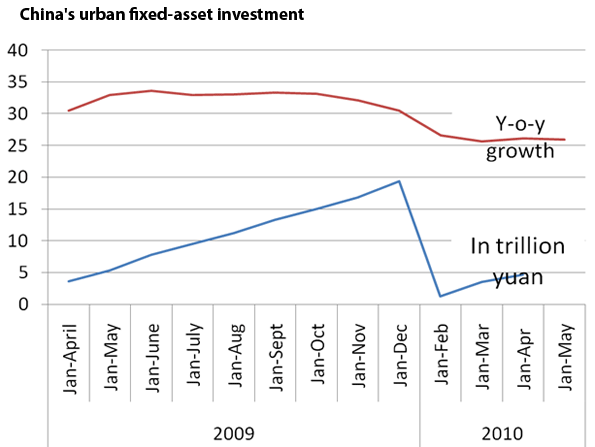
    Some observers worried that tightening policies may deter property developers from starting new projects and purchasing land, thereby cutting the supply and pushing up prices next year. And yet, despite these measures, housing prices rose 12.8 percent in April from a year earlier. At the same time, China’s urban fixed-asset investment increased by 26.1 percent year-on-year to $684.63 billion. The growth rate was 4.4 percentage points lower from the same period of 2009.

    As public concern over “skyrocketing housing prices” continued to simmer, the real estate tycoon Ren Zhiqiang was hit by a shoe at a forum in Dalian. The attacker was fuming over soaring housing prices.

    Last month, home prices in 70 Chinese cities rose by 12.4 percent year-on-year. The growth rate was 0.4 percentage points lower than in April, as property sales in first-tier cities (including Beijing, Shanghai and Shenzhen) contracted following the string of government measures. New home prices rose 15.1 percent year-on-year, down 0.3 percentage points from April.


    In a bid to curb soaring prices, the government has tightened scrutiny of developers’ financing, curbed loans for third-home purchase, raised minimum mortgage rates and tightened down-payment requirements for second-home purchases.

    By early summer, new home sales in Beijing were down 70 percent. Property transactions in Shanghai slumped around 70 percent and in Shenzhen by 62 percent month-on-month in May.

    Why have prices soared so frantically and what could be done about it?

    Toward new developments and new business models
    In the West, the great urban centers – from Paris to New York City and Tokyo – evolved into great metropolises in a century or two. In China, the first-tier cities – such as Shenzhen, Beijing, and Shanghai – are morphing into global cities in barely decades.

    Understandably, the residents of the first-tier cities would like to own an apartment in their home city. However, these cities also attract the wealthy across China, prosperous investors in East Asia and multinational property companies worldwide.

    Additionally, the high price-to-rent ratios have been driven by speculation, the desire for long-term investment, and few investment instruments.

    Even buyers contribute to soaring prices. To facilitate the marriage of their son or daughter, parents are often willing to devote their savings to real estate. As the young couple and their parents put income and savings into a purchase of a single apartment, excessive prices are driven even higher.

    In addition to great demand, the soaring prices reflect supply dilemmas. Currently, residential real estate development is geared to high-end and high-margin properties, which ensure a significant cash flow for cities. In the leading cities, the direct and indirect GDP contribution by real estate can amount to some 25-35 percent of the GDP; in other cities, this contribution is relatively higher. Ironically, luxury developments support local incomes, which maintain economic growth nationwide.

    As long as high-end real estate offers high margins where affordable housing does not, regional governments, which possess the land rights, have an incentive to prioritize luxury projects.

    The government seeks to sustain real estate market development and thus to support growth critical for China’s economy. It also seeks to ensure affordable housing vital to Chinese people. As debt problems are escalating in the West, reconciling these goals – economic growth and affordable housing – poses a difficult challenge.

    A shift towards affordable mass-market – reportedly only 10 percent of total residential sales – is critical. In the current business model, high margins come from a very narrow high-end segment of the market. This made sense in the early days of Chinese real estate when only few wealthy people could afford a home.

    Today, far more Chinese are able and willing to acquire a home. A new era requires a new business model, which can be based on the broad middle-class segment of the market.

    Conclusion: China is not Japan déjà vu
    In China’s property markets, some argue that the risks are now so great that a decade of little or no growth, as Japan experienced in the 1990s, can no longer be dismissed. They see parallels with Japan in the late 1980s, when authorities responded to the export slump caused by the revaluation of the yen after the 1985 Plaza Accord. As Tokyo adopted a low interest rate policy to boost an expansion in domestic demand, it also created conditions for a massive economic bubble.

    Yet, contemporary China’s situation is very different. First of all, in China, there remains a large shortage of residential property that meets new living standards.

    In Japan, property price increases were more than 30 percent in the latter half of the 1990s. In China’s prosperous coastal cities, they have been around 12 percent in 2003-2009.

    In Japan, the health of the banks deteriorated rapidly with the asset bubble. In China, the share of non-performing loans declined from almost 20 percent to less than 2 percent in the 2000s.

    In Japan, the asset bubble occurred after the eclipse of the high-growth era. Instead of a potential growth rate of 3-4 percent, China, assuming stability in the international and domestic operating environment, may enjoy relatively high growth for another decade or two. In such circumstances, even rapid price fluctuations in the first-tier cities can be tolerable, even if they are not preferable.

    Ultimately the difference between Japan and China is reflected by demand. Japan in the 1980s was already highly urbanized and its city population was plateauing. In China, the situation is very, very different.

    Today, there are some 360 million urban residents in China. In the next three decades, the figure is expected to grow to 970 million. What Beijing is trying to achieve is unique in history – to create urban space to more than 610 million people, within a single generation.

    In such an environment, periods of overheating will occasionally be accompanied by dramatic price increases.

    China, the urbanization rate is about 45 percent, whereas in Japan and other advanced countries it is more than 80 percent. As these nations reflect very different levels of economic development and different levels of individual prosperity, their real estate markets are different as well.

    Despite its rapid pace of expansion, China’s real estate is still at a very preliminary stage. The marketplace is so colossal that there are no precedents, no simple models.

    Yet the prospects for a robust growth remain intact. The key will be not to allow that growth to become threatened by a property bubble – while providing affordable housing for the rapidly-expanding new middle-class.

    Dr. Dan Steinbock is Research Director of International Business at India, China and America Institute (USA) and Senior Fellow at Shanghai Institutes for International Studies (China). The brief is part of the author’s ongoing project on emerging megapolises worldwide. A highly abbreviated version of the brief has been published by China Daily, China’s leading English-language daily in May.

    Photos and Illustrations: Dan Steinbock and China’s National Bureau of Statistics