Blog

  • Planning’s Cultural Cringe?

    First it was Portland, Oregon, touted as a poster child for urban planning in Australia. Now, Vancouver, Canada, is the comparison, and are we seeing another incarnation of Australia’s infamous cultural cringe?

    Advocates of higher density and the “brawl against sprawl” in Australia frequently cite overseas cities as model case studies. Portland, Oregon, was for a long time cited as a good example of pro-density housing strategies which sought to limit ‘sprawl’, to promote public transport by investing in things like light rail, and to promote cycling and a range of other planning ‘solutions’ that would sound remarkably familiar in Australia.

    The truth about Portland, however, didn’t match the hype of its city planners. Much of the boosterism focused on the mostly downtown area of Portland. Like Melbourne, or Sydney, this is its own municipality, with its own Mayor and its own planning officials. As they aggressively sold a story about the virtues of their planning strategy for the city core, they omitted the inconvenient broader metropolitan facts as they went.

    The story of the real Portland, including the surrounding suburban areas, is different than what these policy promoters would have you believe. Portland today, despite hundreds of millions invested in a new light rail system and the promotion of inner city housing density, has fewer public transport trips as a percentage of total travel than in 1980. Urban Growth Boundaries introduced by Oregon State in the 1970s led to housing price pressures which eventually excluded the middle and working class. Leading US city demographer Joel Kotkin describes it as an ‘elite city’ which is ‘remarkably white, young and childless.’ And as international housing market expert Wendell Cox has pointed out, the suggestion that Portland has much to crow about in terms of urban consolidation doesn’t match the official statistics. Portland is as guilty of ‘sprawl’ as Los Angeles.

    The same can be said of Vancouver. Touted by its city officials as a paragon of virtue in planning policy, the Vancouver story is almost entirely limited to its geographically confined downtown. Here, in the wake of overbuilding of office properties in the downtown core, city officials rezoned excess commercial capacity to permit high density residential housing in what we would call the CBD. This ‘living first’ strategy produced a wave of new residential development which saw the core population grow by 20,000 people to around 60,000, and to potentially 90,000 by 2015. Redundant waterside areas have been coverted into residential precincts, and commuting by public transport, cycling or walking are favoured over private vehicles.

    Taken in isolation, the Vancouver story could start to sound convincing. But there are some glaring omissions. The City of Vancouver is home to around 600,000 people. The downtown area – the subject of much of the planning hype – is home to 60,000 people. The broader metro region, based on the same sorts of urban definitions we might use for Brisbane, or Sydney or Melbourne, is home to 2 million people. There is precious little said about the lives of the 1.4 million people who aren’t residents of the City of Vancouver, or the more than 1.9 million who don’t live in the revitalized urban core.

    For these Vancouverites, life isn’t a rosy as the planning hype would have you believe. The most glaring omission about life in Vancouver is that it also happens to be one of the world’s least affordable cities in which to live. According to both the Reserve Bank of Canada and Demographia, Vancouver’s housing rates as severely unaffordable, eating up some three quarters of the region’s median pre-tax household incomes. The problem is so chronic that it has prompted an online game “Crack Shack or Mansion” where visitors are asked: “Can you tell the difference between a crack shack and a Vancouver, BC mansion, listed for one or two million dollars?” Play the game yourself, it’s an eye opener. [A Crack Shack, for the uninitiated, is a den of inequity where illegal drugs are produced].

    That’s hardly the sort of model city you’d want to tout as a planning example we could learn from. The other glaring omission from the planning fairy tale of Vancouver is that life in the city core is vastly different from the overwhelmingly suburban conditions of the vast majority. To the south of Vancouver’s downtown lies an endless suburban grid of detached housing, with limited parklands or open space. Check it out for yourself on Google Maps or Google Earth. Jump into Google Street View and take a walk down a typical Vancouver street. Do that with a housing price list from “Crack Shack or Mansion” in hand and then convince me this is a model for any Australian city.

    A final glaring omission is the climate. This from the official Living in Canada website: “Snow depths of greater than 1 cm are seen on about 10 days each year in Vancouver compared with about 65 days in Toronto. Vancouver has one of the wettest and foggiest climates of Canada’s cities. At times, in winter, it can seem that the rain will never stop.” Summers aren’t so bad though: for two months of the year, the average daily maximum even exceeds 20’c!

    So Vancouver as the next poster child of planning for any Australian city is looking shaky. It’s hopelessly unaffordable (and we have enough problems of our own in that regard), the quality of its majority suburban environment is lower than the standards we already enjoy, and the climate could not be less similar.

    The same can be said of other city-regions often described as examples of how Australian cities could develop. Copenhagen, Paris, or Venice have all in their time been selectively extolled as models for Australian urban planning.

    Maybe this fascination with irrelevant urban models stems from a form of cultural cringe? Whatever the reason, the analogies can be dangerous, especially when they omit the more essential economic or lifestyle based criteria such as housing affordability, share of economic wealth amongst a city/region’s residents, or climate and lifestyle factors.

    It might instead be more helpful if Australian planners referring to overseas examples also kept in mind some of these pragmatic metrics. For example, benchmarking cities with more affordable housing markets than ours and with strong local economies where wealth and standards of living are enjoyed across a wide spectrum of society would produce some very different case studies. Factor in similar climate patterns (which largely dictate recreational and lifestyle behavior) to our own and the choice of comparable cities reduces further.

    We might even start to find that our own cities offer plenty of examples of ‘getting it right.’ Instead of this cultural groveling we could start to define the things we like most about our own existence and plan ways of replicating that, rather than imposing on our cities forms of existence that, appealing as elements might be, are incapable of replication in the Australian context.

    Ross Elliott is a 20 year veteran of property and real estate in Australia, and has held leading roles with national advocacy organizations. He was written and spoken extensively on housing and urban growth issues in Australia and maintains a blog devoted to public policy discussion: The Pulse.

    Photo by ecstaticist

  • Decentralized Growth and “Interstate” Highways in China

    Andrew Batston of The Wall Street Journal writes of China’s decentralization, with the growing employment in interior urban areas. Until the last decade, most of China’s spectacular urban population and employment growth had occurred on the East Coast, especially in the world’s largest megaregions of the Pearl River Delta (Hong Kong-Shenzhen-Dongguan-Guangzhou-Foshan-Jiangmin-Zhongshan-Zhuhai-Macao), the Yangtze Delta (Ningbo-Shaoxing-Hangzhou-Shanghai-Suzhou-Wuxi-Changzhou-Nangjing) and Beijing-Tianjin. Millions of migrant workers had traveled to the East Coast from the interior to take jobs paying far more than they could earn at home.

    But that has changed. Industrial production and jobs have expanded substantially in the interior, making it possible for people to take jobs closer to home, in Chongqing, Chengdu, Xian, Changsha, Wuhan, Shenyang, Taiyuan and many more urban areas. This is a fortuitous development, because the mega-regions are already sufficiently populated and could have well grown far larger if the interior development had not taken place.

    However, jobs have become more plentiful in the interior. China’s growing US interstate standard expressway (freeway) system has been an important contributor to this development. Like the US system, there are no grade crossings and all roadways have at least two lanes of traffic in each direction.

    Now, a number of interior urban areas are now within a day’s truck drive of the East Coast ports and those that are not are within two days. According to China Daily, the 65,000 kilometers (over 40,000 miles) of the national expressway system is open. This does not include extensive provincially administered systems, such as in Beijing, where four full freeway ring roads are open and a fifth is at least half complete (Beijing has six ring roads, but the first is not a freeway). Shanghai has an extensive locally administered freeway system, as do some other urban areas.
    By comparison, the US interstate system is approximately 46,000 miles (this excludes 1,000 miles of 2-lane interstate designated conventional highway in Alaska), and a total of 57,000 miles including non-interstate freeways. China is expected to displace the United States in freeway mileage by the end of the decade, when plans call for more than 60,000 miles.

    Photograph: National Expressway Route G-040 near Taiyuan, Shanxi

  • Stimulus, Spending and Animal Spirits: How to Grow the Economy

    The most fanatical Keynesians are losing their composure. Brad DeLong, a prominent Berkeley economist and Keynesian, is virtually yelling that “We Need Bigger Deficits Now!”, emphasis his. Paul Krugman does DeLong one better, calling proponents of fiscal responsibility madmen.

    They are following the gospel of John Maynard Keynes, who famously advocated government deficits to pay people to dig holes, increasing demand and therefore economic activity. This is, to be polite, bunk.

    It is worse than that actually. The logic implies that any government expenditure funded by debt will result in sustained economic growth. The result has been a stimulus plan that completely lacks coherence. Instead, we have a hodgepodge of spending initiatives that provide a temporary illusion of growth, but that will leave us with little that is long-term, except for huge hangover of debt which will be a drag on economic activity for years.

    Keynesian stimulus theory comes about because of what is called a liquidity trap, a situation where the interest rate is zero, because no one wants to invest. The logic is that you can spend your way out of a liquidity trap; that by spending, government can increase sales. Eventually the increased sales will cause businesses to invest, driving interest rates up.

    It is an article of faith among Keynesian economists that if the stimulus is big enough, it will generate sustained long-term growth. Call this the Tinkerbell Principle. You only have to believe in animal spirits to have expectations of a better future.

    Consequently, when the spending doesn’t achieve the desired result, Keynesians always call for more deficit spending, just as we see in the above-linked DeLong and Krugman arguments. And, when that doesn’t work, like a broken record, they will call for more, but there can never be enough.

    There is a case to be made for expectations, but they need to be rational. The recession was similar to a bank run, which can kill a bank, even when there is no initial weakness to generate the run. In this case, we had a run on the world’s financial system. Call it a regime shift from a good equilibrium to a bad equilibrium.

    Can government spending alone bring us back to a good equilibrium? It can if you believe in animal spirits, but I don’t.

    I believe that people are not excessively stupid. Economists call this concept rational expectations, the idea that most people can see obvious consequences most of the time.

    I believe that people spend out of wealth: the value of the assets they hold and the present value of future income. This may not be an easily calculated number, but people keep track of it. It is something like a fielder’s response when a batter hits a ball. This is a complex problem, but fielders respond instantly. The fielders are moving in the correct direction at the correct speed to intercept the ball while the bat is still in motion.

    Finally, I believe that people try to smooth consumption. That is, they like to eat a little every day rather than go without for several days and binge on other days.

    Let’s analyze typical deficit-financed government spending programs using these beliefs. Somebody is going to have to repay the debt someday. It can be the person who receives the money, some other person who is currently working, or some future worker.

    If the person who receives the money is the one who must repay it, she will normally save it. Her wealth has not changed, she knows that she will have to repay the money, and she’s not excessively stupid. She’ll want the money there when she needs it. We saw this with the Bush “tax rebates.” Consumers saved the rebates, and the administration did not see the consumption boost they had anticipated.

    There is another possibility though. She could be what we call ‘liquidity constrained’, holding no cash and unable to borrow. Her wealth is still unchanged, but she wants to smooth consumption — keep it at a relatively steady level — so she may spend some or all of the money. However, this implies that her future spending stream will be reduced. We’re taking from tomorrow’s economy to support spending today. This may be justifiable on humanitarian grounds, but it doesn’t generate sustained long-term economic growth.

    Suppose it is another worker who will repay the government debt. His wealth has just decreased. He’ll spend less, and, also being a consumption smoother, he’ll start spending less right now. Again, there is nothing here to generate sustained long-term economic growth.

    Finally, suppose it is some future worker who will repay the debt. He or she will enter life or the workforce with a debt. I’ll ignore the ethical implications of enabling increased consumption by current citizens by imposing, without consent, debt on future workers; instead, I’ll stick just to the economics.

    Our future worker starts a career, absent some other endowment, with a negative net worth. Over the course of his career he’ll spend and invest less than if he had started with a zero net worth. Again, this is not a prescription for sustained long-term economic growth.

    What we have to face is that by borrowing to consume now, we are taking away from the future. This is just not the way to achieve sustained long-term economic growth.

    So what to do if you are a politician who thinks something must be done?

    The liquidity trap comes about because no one wants to invest. What government should do in response is try to increase demand for investment. This would increase economic activity now and in the future. Increased demand for investment can be created by investing in public capital that makes private capital more productive, and by lowering the cost of borrowing.

    When the government borrows and invests the money in projects that increase private capital’s productivity, it is increasing the return to capital. Increasing returns to private capital increases the demand for private capital and investment. Current and future economic activity is increased.

    We have lots of examples of these types of investments, including canals, dams, highways, public utilities like the Tennessee Valley Authority, and more.

    The other approach to increasing investment is to lower the interest rate. This is difficult to do directly when the interest rate is zero, but the government can achieve the same result another way. An investment tax credit effectively lowers investors’ borrowing costs.

    So, if the government is going to actively stimulate the economy, it would be far better to invest in public capital that improves the returns to private capital. It will also help to provide a meaningful investment tax credit. Consumers could then rationally expect their future income stream, hence their wealth, to improve. With increased wealth their spending will increase, and we will be on our way to sustained long-term economic growth.

    Flickr photo “Búho Real” by sıɐԀ ɹǝıʌɐſ

    Bill Watkins is a professor at California Lutheran University and runs the Center for Economic Research and Forecasting, which can be found at clucerf.org.

  • Time to Dismantle the American Dream?

    For some time, theorists have been suggesting that it is time to redefine the American Dream of home ownership. Households, we are told, should live in smaller houses, in more crowded neighborhoods and more should rent. This thinking has been heightened by the mortgage crisis in some parts of the country, particularly in areas where prices rose most extravagantly in the past decade. And to be sure, many of the irrational attempts – many of them government sponsored – to expand ownership to those not financially prepared to bear the costs need to curbed.

    But now the anti-homeowner interests have expanded beyond reigning in dodgy practices and expanded into an argument essentially against the very idea of widespread dispersion of property ownership. Social theorist Richard Florida recently took on this argument, in a Wall Street Journal article entitled “Home Ownership is Overvalued.”

    In particular, he notes that:

    The cities and regions with the lowest levels of homeownership—in the range of 55% to 60% like L.A., N.Y., San Francisco and Boulder—had healthier economies and higher incomes. They also had more highly skilled and professional work forces, more high-tech industry, and according to Gallup surveys, higher levels of happiness and well-being. (Note)

    Florida expresses concern that today’s economy requires a more mobile work force and is worried that people may be unable to sell their houses to move to where jobs can be found. Those who would reduce home ownership to ensure mobility need lose little sleep.

    The Relationship Between Household Incomes and House Prices

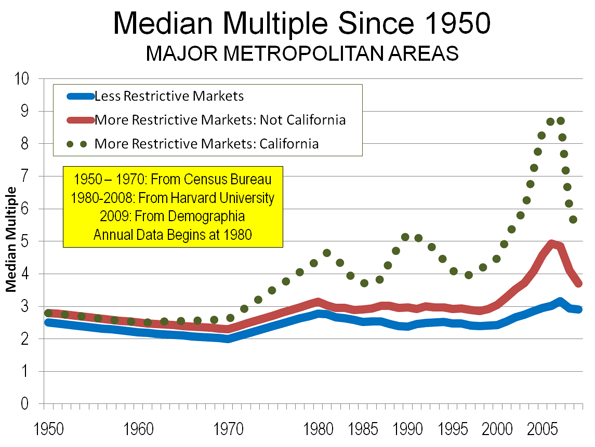
    It is true, as Florida indicates, that house prices are generally higher where household incomes are higher. But, all things being equal, there are limits to that relationship, as a comparison of median house prices to median house prices (the Median Multiple) indicates. From 1950 to 1970 the Median Multiple averaged three times median household incomes in the nation’s largest metropolitan areas. In the 1950, 1960 and 1970 censuses, the most unaffordable major metropolitan areas reached no higher than a multiple of 3.6 (Figure).

    This changed, however, in some areas after 1970, spurred by higher Median Multiples occuring in California.

    William Fischel of Dartmouth has shown how the implementation of land use controls in California metropolitan areas coincided with the rise of house prices beyond historic national levels. The more restrictive land use regulations rationed land for development, placed substantial fees on new housing, lengthened the time required for project approval and made the approval process more expensive. At the same time, smaller developers and house builders were forced out of the market. All of these factors (generally associated with “smart growth”) propelled housing costs higher in California and in the areas that subsequently adopted more restrictive regulations (see summary of economic research).

    During the bubble years, house prices rose far more strongly in the more highly regulated metropolitan areas than in those with more traditional land use regulation. Ironically many of the more regulated regions experienced both slower job and income growth compared to more liberally regulated areas, notably in the Midwest, the southeast, and Texas.

    Home Ownership and Metropolitan Economies

    The major metropolitan areas Florida uses to demonstrate a relationship between higher house prices and “healthier economies” are, in fact, reflective of the opposite. Between August 2001 and August 2008 (chosen as the last month before 911 and the last month before the Lehman Brothers collapse), Bureau of Labor Statistics data indicates that in the New York and Los Angeles metropolitan areas, the net job creation rate trailed the national average by one percent. The San Francisco area did even worse, trailing the national net job creation rate by 6 percent, and losing jobs faster than Rust Belt Pittsburgh, St. Louis, and Milwaukee.

    Further, pre-housing bubble Bureau of Economic Analysis data from the 1990s suggests little or no relationship between stronger economies and housing affordability as measured by net job creation. The bottom 10 out of the 50 largest metropolitan areas had slightly less than average home ownership (this bottom 10 included “healthy” New York and Los Angeles). The highest growth 10 had slightly above average home ownership (measured by net job creation). Incidentally, “healthy” San Francisco also experienced below average net job creation, ranking in the fourth 10.

    Moreover, housing affordability varied little across the categories of economic growth (Table).

    Net Job Creation, Housing Affordability & Home Ownership
    Pre-Housing Bubble Decade: Top 50 Metropolitan Areas (2000)
    Net Job Creation: 1990-2000 Housing Affordability: Median Multiple (2000) Home Ownership: Rate 2000
    Lowest Growth 10  7.4%                                2.8 62%
    Lower Growth 10 14.9%                                3.1 63%
    Middle 10 22.8%                                3.2 64%
    Higher Growth 10 30.9%                                2.6 61%
    Highest Growth 10 46.9%                                2.9 63%
    Average 24.7%                                2.9 62%
    Calculated from Bureau of the Census, Bureau of Economic Analysis and Harvard Joint Housing Center data.
    Metropolitan areas as defined in 2003
    Home ownership from urbanized areas within the metropolitan areas.

    Home Ownership and Happiness

    If Gallup Polls on happiness were reliable, it would be expected that the metropolitan areas with happier people would be attracting people from elsewhere. In fact, people are fleeing with a vengeance. During this decade alone, approximately one in every 10 residents have left for other areas.

    • The New York metropolitan area lost nearly 2,000,000 domestic migrants (people who moved out of the metropolitan area to other parts of the nation). This is nearly as many people as live in the city of Paris.
    • The Los Angeles metropolitan area has lost a net 1.35 million domestic migrants. This is more people than live in the city of Dallas.
    • The San Francisco metropolitan area lost 350,000 domestic migrants. Overall, the Bay Area (including San Jose) lost 650,000, more people than live in the cities of Portland or Seattle.

    Why have all of these happy people left these “healthy economies?” One reason may be that so many middle income people find home ownership unattainable is due to the house prices that rose so much during the bubble and still remain well above the historic Median Multiple. People have been moving away from the more costly metropolitan areas. Between 2000 and 2007:

    • 2.6 million net domestic migrants left the major metropolitan areas (over 1,000,000 population) with higher housing costs (Median Multiple over 4.0).
    • 1.1 net domestic migrants moved to the major metropolitan areas with lower house prices (Median Multiple of 4.0 or below).
    • 1.6 million domestic migrants moved to small metropolitan areas and non-metropolitan areas (where house prices are generally lower).

    An Immobile Society?

    Florida’s perceived immobility of metropolitan residents is curious. Home ownership was not a material barrier to moving when tens of millions of households moved from the Frost Belt to the Sun Belt in the last half of the 20th century. During the 2000s, as shown above, millions of people moved to more affordable areas, at least in part to afford their own homes.

    Under normal circumstances (which will return), virtually any well-kept house can be sold in a reasonable period of time. More than 750,000 realtors stand ready to assist in that regard.

    Of course, one of the enduring legacies of the bubble is that many households owe more on their houses than they are worth (“under water”). This situation, fully the result of “drunken sailor” lending policies, is most severe in the overly regulated housing markets in which prices were driven up the most. Federal Reserve Bank of New York research indicates that the extent of home owners “under water” is far greater in the metropolitan markets that are more highly restricted (such as San Diego and Miami) and is generally modest where there is more traditional regulation, such as Charlotte and Dallas (the exception is Detroit, caught up in a virtual local recession, and where housing prices never rose above historic norms, even in the height of the housing bubble). Doubtless many of these home owners will find it difficult to move to other areas and buy homes, especially where excessive land use regulations drove prices to astronomical levels.

    Restoring the Dream

    There is no need to convince people that they should settle for less in the future, or that the American Dream should be redefined downward. Housing affordability has remained generally within historic norms in places that still welcome growth and foster aspiration, like Atlanta, Dallas-Fort Worth, Houston, Indianapolis, Kansas City, Columbus and elsewhere for the last 60 years, including every year of the housing bubble. Rather than taking away the dream, it would be more appropriate to roll back the regulations that are diluting the purchasing power and which promise a less livable and less affluent future for altogether too many households.

    Note. Among these examples, New York is the largest metropolitan area in the nation. Los Angeles ranks number 2 and San Francisco ranks number 13. The inclusion of Boulder, ranked 151st in 2009 seems a bit curious, not only because of its small size, but also because its advantage of being home to the main campus of the University of Colorado. Smaller metropolitan areas that host their principal state university campuses (such as Boulder, Eugene, Madison or Champaign-Urbana) will generally do well economically.

    Photograph: New house currently priced at $138,990 in suburban Indianapolis (4 bedroom, 2,760 square feet). From http://www.newhomesource.com/homedetail/market-112/planid-823343

    Wendell Cox is a Visiting Professor, Conservatoire National des Arts et Metiers, Paris. He was born in Los Angeles and was appointed to three terms on the Los Angeles County Transportation Commission by Mayor Tom Bradley. He is the author of “War on the Dream: How Anti-Sprawl Policy Threatens the Quality of Life.

  • The Downside of Brit-Bashing

    Obama may be spanking BP’s brass today. But the other crisis—Europe’s economic mess—reminds us why it’s important that the U.S. and U.K. stick together.

    The controversy over the BP spill threatens to drive US-UK relations to a historic low point. When recently in London, several people worried that the President may be engaging in “Brit-bashing” at the expense of our historically close ties. This theme has been widely picked up in the UK press.

    “It’s the gushing geyser of Obama’s anti-British rhetoric,” screams Melanie Phillips this week in the Daily Mail,” that now urgently needs to be capped.” Indeed, however much President Obama wants to beat up the Tony Hayward, who certainly deserves to be both tarred and feathered, he might want to consider how “Brit-bashing” may not be in our long-term interest. This is particularly true at a time hat the world’s other big crisis—the collapse of the euro—offers a unique opportunity to shore up our now beleaguered “special relationship.”

    The British Empire may be little more than a historical relic, but the current euro crash could make those old ties between mother country and her scattered former colonies, including America, more alluring. After a decade marked by sputtering movement towards greater integration with Europe, the United Kingdom, particularly its beating heart—London—might be ready to drift away from the continent and back towards America and Canada and the rest of the world beyond.

    This process will be accentuated by the fact that while Europe’s population and economy, particularly on its southern and eastern tiers, seems set to decline even further, the future of North America—largely due to mass immigration and its large resource base—continues to appeal to British investors and companies. In addition, the rise of other parts of the world, notably Russia, India and China, suggests that Britain’s future, like that of North America, rests increasingly outside of Europe.

    Social forces in Britain today will accentuate these trends. In London today you do hear many European languages, but the big money you see around posh places in Mayfair more often speaks not Italian or French, or even German, but Hindi, Arabic , Russian and, increasingly, Chinese. London today is not so much a British city as a global one, with a percentage of foreign-born residents—roughly one-third—equivalent to that of such prominent American multi-racial capitals as New York or Los Angeles.

    Just take a look at the over 200,000 people who became UK citizens last year, up from barely 50,000 annually a decade earlier. The EU accounted for barely three percent of the total; all of Europe, including the former Soviet bloc, represented eight percent. In contrast the biggest source of new subjects was from the Indian subcontinent—roughly 30%—and Africa, which provided another 27 percent.

    This ethnic transformation—much like the one taking place and widely celebrated by Obamanians in the United States—helps tie Britain, despite its proximity to the continent, more to the rest of the world. The UK may not be ready for its own version of Barack Obama, but a post-European future seems increasingly likely through ties of both blood and money. To be sure, in the coming year the level of immigration may decline under the Tories, whose party competes for voters with nativist groups. But economics—and the disastrous state of the Euro—may prove an even larger factor in the country’s transformation.

    Already there is growing concern that the sovereign debt issues of places like Greece, Spain, Italy and Portugal—the so-called swilling PIGS—could force Britain, with its already weak economy, to raise interest rates and cut its budgets more than might be advisable. Last month London’s FTSE 100 has lost fifteen percent of its value as a result of the euro crisis, a steep fall made only marginally tolerable by the even worse results on the continent. Future euro-moves could prove even more threatening. Wide ranging attacks on financial speculation, so popular in an increasingly hegemonic Germany, are like a gun aimed at Britain’s economic core. After all, the UK’s exports are built not around cars, steel or fashions but its role as the world’s banker, consultant and business media center. “The euro zone,” complains one columnist in the right-leading Daily Telegraph, “may be leading us into a double-dip recession.”

    But declining euro-enthusiasm is not limited to those considered conservative “nutters” by Britain’s continentally-minded sophisticates. You don’t have to be an unreconstructed Thatcherite to resist tying the country to the future feeding of widely irresponsible “Club Med” countries or kowtowing to Berlin. Rather than the Germans and their PIGS, Britain may be better off linking with both the BRIC countries—Brazil, Italy, India and China—as well as a rebounding North America.

    As the ultimate capitalist entrepot, Britain’s trump lies in being hugely attractive to Americans. In this respect, beating up BP, however justified, may also be squandering an opportunity to solidify a relationship that is needed on so many fronts from battling Islamic extremism—the Brits and the Canadians are our only strong reliable allies—to preventing German-style controls over the global entrepreneurial economy.

    Herein lies our opportunity. Although not “anti-European,” Britons tend to be “deeply skeptical about the institutions of the European Union,” notes Steve Norris, a former MP, onetime chairman of the ruling Conservative party and two times that party’s candidate for Mayor of London. As he puts it: “The British do not want a federal Europe in which significant powers pass from sovereign parliaments to Brussels.”

    Although Labour also resisted rapid integration into Europe, the current government under the new Prime Minister David Cameron, Norris notes, has made it clear that it is even more resistant to this trend. This may prove an embarrassment to Cameron’s historically Europhile deputy prime minister, the Liberal Independent’s Nick Clegg, but the movement away from Europe seems increasingly inevitable.

    For one thing, the future of the euro may depend on expanding Brussels’ control of member nation’s budgets, something few British MPs of any party are likely to embrace. Attempts by France and Germany to expand the power of Brussels to save the Euro are likely to chase away even the most devoted Europhiles in Britain.

    All this is good news for a strengthened US-UK alliance—something that should not be threatened by excessive “Brit bashing.” For all its many shortcomings, Great Britain remains one of the globe’s great outposts of both civilization and dynamic market capitalism. Its economic power may be a shadow of what it once was, but its cultural, political and role as a transactional center keep the place globally relevant.

    A Britain both more Atlanticist and global also can play a more positive role by adding its weight to ours in slowing a shift to protectionism, battling terrorism and in resisting the now ballyhooed trend towards state-based capitalism. And that would bode well for Britain itself, allowing the country to play to fundamental strengths that derive from its unique historical legacy.

    This article originally appeared in The Daily Beast.

    Joel Kotkin is executive editor of NewGeography.com and is a distinguished presidential fellow in urban futures at Chapman University. He is author of The City: A Global History. His newest book is The Next Hundred Million: America in 2050, released in Febuary, 2010.

    Photo by Public Citizen

  • Second Thoughts on the Condo Market

    Mega-builder Larry Murren, whose company (MGM Mirage) opened the “largest privately funded construction project in U.S. history” told WSJ (the Wall Street Journal Magazine) that if he had to do it all over again, he would reconsider the condo-residential component of the project. “We would have built about half of those units” at the new $8.5 billion “City Center” development.

    The less than stellar performance condominium sales in the project was reported by the Las Vegas Review Journal, which indicated that only 78 of the project’s approximately 675 condominium units have sold. MGM Mirage is not alone in this plight. The Review Journal further notes that Las Vegas has a reports a 250 month or nearly 21 year supply of unsold condominium units. This means that some of today’s unsold units could still be on the market for parents in a suburban Las Vegas house to move to when their newborn heads off to college. These numbers qualify Las Vegas for finals of the Condo Bust World Cup, against other strong competitors Miami and Dubai.

    Murren credits a mixed-use symposium as the inspiration for City Center. Murren would not be the first developer to have been smitten by over-promotion of condominium market prospects. However the balance of Center City (shopping, entertainment, hotels and casinos) appears to be doing far better than the condominium element.

    Second thoughts have been occuring to a number of additional central city condominium developers around the nation as the central city condominium market continues its meltdown. The most recent evidence comes with condo auctions in the cores of Baltimore, St. Petersburg and Boston.

    In Baltimore, Pier Homes at Harborview has scheduled an auction of new units with minimum bids discounted from 55% to 75% below list prices. This means that the minimum bid, the Baltimore Sun indicates that only half of the units (completed two years ago) have been sold.

    In St. Petersburg, units in the 36-story Signature Place condominium tower were auctioned last month, with average bid prices 50% off the previous list prices. The Boston Globe indicates that “another” condo/loft auction is to occur in that city on June 26, with minimum bid prices up to 60% off list.

    The extraordinary risk of the central city condominium market was summarized by Larry Murphy, a Las Vegas real estate analyst: “It takes two to three years to build a high-rise project, and it can’t be done in phases like a new-home subdivision. All of the units have to be built at once.” He further noted that “Most of the units are sold within the first three months of completion. After that, sales drop off dramatically.” These inherent complexities of the condominium market will not be solved by mixed use seminars.

  • L.A.’s Economy Is Not Dead Yet

    “This is the city,” ran the famous introduction to the popular crime drama Dragnet. “Los Angeles, Calif. I work here.” Of course, unlike Det. Sgt. Joe Friday, who spoke those words every episode, I am not a cop, but Los Angeles has been my home for over 35 years.

    To Sgt. Friday, L.A. was a place full of opportunities to solve crimes, but for me Los Angeles has been an ideal barometer for the city of the future. For the better part of the last century, Los Angeles has been, as one architect once put it, “the original in the Xerox machine.” It largely invented the blueprint of the modern American city: the car-oriented suburban way of life, the multi-polar metropolis around a largely unremarkable downtown, the sprawling jumble of ethnic and cultural enclaves of a Latin- and Asian-flavored mestizo society.

    Yet right now even the most passionate Angeleno struggles to feel optimistic. A once powerful business culture is sputtering. The recent announcement of Northrop Corp.’s departure to suburban Washington was just the latest blow to the region’s aerospace industry, long our technological crown jewel. The area now has one-fourth as many Fortune 500 companies as Houston, and fewer than much-smaller Minneapolis or Charlotte, N.C.

    Other traditional linchpins are unraveling. The once thriving garment industry continues to shift jobs overseas and has lost much of its downtown base to real estate speculators. The port, perhaps the region’s largest economic engine, has been mismanaged and now faces severe threats from competitors from the Pacific Northwest, Baja, Calif., and Houston. Although television and advertising shoots remain strong, the core motion picture shooting has been declining for years, with production being dispersed to such locations as Toronto, Louisiana, New Mexico, Michigan, New York and various locales overseas.

    Once a reliable generator of new employment, over the past decade L.A. has fared worse than any of the major Sun Belt metros–including hard-hit Phoenix–losing over 167,000 jobs between 2000 and 2009. Historic rival New York notched modest gains, while the rising big metro competitors, Dallas and Houston, enjoyed strong and steady growth. L.A. may not be Detroit, and probably never will be, but its once proud and highly diversified industrial base is eroding rapidly, losing one-fifth of all its employment since 2004. In contrast to the rest of the country, unemployment still continues to rise.

    To give you an idea how much L.A. has sunk, look to this year’s Forbes best city rankings, which measures both short- and mid-term job growth. Once perched in the upper tier of major cities, Los Angeles now ranks a pathetic 59th out of 66 large metro areas, far below not only third-place Houston and fourth-place Dallas but also New York and even similar job-losing giants like San Francisco and Philadelphia.

    It takes a kind of talent to sink this low given L.A.’s vast advantages: the best weather of any major global city, the largest port on this side of the Pacific, not to mention the glamour of Hollywood, the Lakers and one of the world’s largest and most diverse populations of creative, entrepreneurial people.

    Jose de Jesus Legaspi, a prominent local developer, pins much of the blame for this on what he describes as “a parochial political kingdom”–with Antonio Villaraigosa, mayor since 2005, wearing the tinsel crown. A sometimes charming pol utterly bereft of economic acumen, Villaraigosa is a poor manager who is also highly skilled at self-promotion. His idea of building an economy revolves around subsidizing downtown developers and pouring ever more funds into the pockets of public sector workers. No surprise then that L.A. suffers just about the highest unemployment rate of any of the nation’s 10 largest cities outside Detroit. One in five county residents receive some form of public aid.

    But the real power in L.A. today is not so much Villaraigosa but what the Los Angeles Weekly describes as a “labor-Latino political machine,” whose influence extends all the way to Sacramento. These politicians represent, to a large extent, virtual extensions of the unions, particularly the public employees.

    The rise of the Latino-labor coalition does stir some pride among Hispanics, but it has proved an economic disaster for almost everyone who doesn’t collect a government paycheck–L.A.’s city council is the nation’s highest paid–or subsidy. Although perhaps not as outrageously corrupt as the Chicago machine, it is also not as effective. L.A.’s version manages to be both thuggish and incompetent.

    According to an analysis by former Mayor Richard Riordan, the city’s soaring pension liabilities will grow by an additional $2.5 billion by 2014, by which date the city will probably be forced to declare bankruptcy.

    So is the city of the future doomed for the long term? Not necessarily. Although Latino politicians and “progressive” allies strive to derail entrepreneurialism, our grassroots remains stubbornly entrepreneurial. This is particularly true of Latino and other immigrant businesspeople in Los Angeles. In 2006, for example, roughly 10% of the foreign born population was self-employed, almost twice the percentage of the native born.

    To be sure, much of this activity takes place in smaller area municipalities–Burbank, Glendale, Lynwood, Monterey Park–that are mercifully outside the reach of the City of Los Angeles, which accounts for somewhat less than half of L.A. County’s 10 million people. But as Legaspi, who came to L.A. from Zacatecas, Mexico, in 1965, points out, ethnic enterprises–Armenian, Iranian, Israeli, Korean, Chinese as well as Mexican and Salvadoran–continue to thrive even within the city limits. You rarely find in L.A. the kind of desolation found in dying cities like Detroit or Cleveland or even large swaths of New York or Chicago.

    All this suggests there’s still hope for Los Angeles to blossom further as a hub for international trade, global culture and fashion. But to achieve that goal the city needs a government that will nurture its grassroots rather than stomp or extort them. “Los Angeles is a potential great world city, but it needs to be ruled like a world city,” Legaspi points out. Until that happens, our putative city of the future will exist more as dreamscape than reality.

    This article originally appeared in Forbes.com.

    Joel Kotkin is executive editor of NewGeography.com and is a distinguished presidential fellow in urban futures at Chapman University. He is author of The City: A Global History. His newest book is The Next Hundred Million: America in 2050, released in Febuary, 2010.

    Photo by k.landerholm

  • The Politics of Risk

    Barack Obama has reached for the mantle of a transformative presidency, aspiring to recast our national social contract in the interest of greater equality and fairness. In cooperation with a Democratic-controlled Congress, he has pursued this goal by expanding Federal authority in response to economic crises and supporting interventions into finance and banking, automobile manufacturing, health care, and environmental policy. This strategy adopts the “statist” philosophy of economic risk management by centralizing governmental authority and control over private markets.

    Ironically, this Europeanization of US public policy is occurring exactly when sovereign debt crises and taxpayer bailouts are casting an ominous cloud over the European model. It seems public sector risk may turn out to be more dangerous than private sector risk. But if we can connect recurring financial crises to the long-term erosion in the economic health of states, we should seriously question whether statism offers the best array of policies to manage the uncertainties of the modern world.

    A surplus of world savings drove people in the developed world to over-borrow, and concentrate debt and risk in overpriced housing assets. Banks then distilled these risky assets into securitized debt obligations and sold them to investors worldwide. What ensued was risk mismanagement on a colossal scale, as the concentration of leveraged debt made the crash far worse than dot-com or tulip bulb mania. This shell game violated all we know about prudent risk management and sucked in politicians, central bankers, financiers, the housing industry, and citizens alike.

    The response has been to substitute massive public credit for shrinking private credit, while seeking new means to regulate financial risk and reward. This sounds a bit too much like the dog that bit us. In terms of public policy it means more centralized political control over central banks and the financial sector, with unpredictable market distortions yielding more liabilities and burdens for taxpayers. The net result will be an increase in systemic risk exposure.

    The modern social welfare state would more accurately be labeled the social insurance state, as its spending priorities are dominated by programs related to old age pensions, health care, and the risks of unemployment and poverty. Social insurance has been the developed world’s primary political response to systemic risk. Regrettably, it may impose the least efficient means to manage risk, with the most costly consequences.

    Financial risk is managed by saving, pooling, hedging and, most important, asset diversification. The key concepts are savings and diversification, as these underpin the logic of insurance pooling. A financially sound insurance pool must align contribution and benefit ratios according to known actuarial data and demographic trends. The inconvenient truth is that our social insurance programs, like Social Security and Medicare, are not really insurance pools, but pay-as-you-go transfer schemes. We tax younger workers to immediately pay out benefits to older, retired citizens. This design inflicts a host of problems and costs.

    Pay-as-you-go means our Social Security and Medicare taxes have not been saved in a “trust” fund, rather they are doled out in benefit promises and used to fund other political priorities through general revenues. This is the problem of political and bureaucratic “agents” following their own short-term incentives. This is also how we get “too big to fail” and runaway budgets.

    Because taxes to fund entitlement transfers crowd out private savings and lead us to believe the government is saving for us, private savings decrease. This means we cannot adequately fund the economic growth necessary to fund future social insurance liabilities. The alternative has been to borrow from abroad, mostly from the Chinese. As birth rates decline and longevity increases, the “trust” funds will run out or overburden younger workers as baby boomers age.

    We can readily measure the consequences of our policy failures in societal risk management. Household savings rates in the U.S. have dropped from an average of 10% in the 1970s to less than 1% just before the financial crisis in 2008. In the immediate response to the crisis the rate jumped to 6%, but this was offset by roughly a trillion dollars in new public debt. (Estimates for China’s household savings rate range from 25-50%)

    US public debt as a percentage of GDP now fluctuates around 80%. This compares to Japan at 192%, Italy at 115%, Greece at 108%, France at 80%, and Germany at 77%. Chile, which privatized its social insurance three decades ago, services a public debt at 9% of GDP.

    Our current account deficit, which measures how much more we import than export, persists at 3% of GDP while China runs a 6% surplus. In simplest terms, the Chinese are lending us money to buy their goods.
    A recent survey by the Peter G. Peterson Foundation of US political leaders from both parties found unanimous agreement that US structural deficits due to entitlement programs would cause a financial collapse of US public finances within ten years unless the programs were reformed.

    A true national insurance program cannot be a shell game that transfers resources from one group to another. The nation must accumulate real savings to be invested to fund future needs. The danger of our current treatment of risk management through entitlements is that we are not really insuring against our risks, but merely passing them on to others. This is neither moral, nor economically viable.

    Our only chance of solving these problems must focus on managing economic risk by boosting savings and promoting the widespread diversification of assets. The increased concentration of political, economic, and financial power currently dominating the developed world is antithetical to such solutions and financial reform should not risk reinforcing a Wall Street-Washington oligarchy.

    The unfocused blame put on markets for our financial crises is disingenuous. The heavy reliance on credit and debt, the opacity of financial technology, the capture of regulatory agencies by the industries they regulate, and the volatility of asset markets are all symptoms of misguided policies. History and theory have both shown how functioning private markets are most efficient in allocating and managing diversified risk. The best financial regulation, then, is not another politicized agency, but the continued promotion of open, competitive, and transparent financial markets. The caveat for financiers is that failure and bankruptcy are essential features of free markets.

    A world defined by risk and uncertainty is like a sea full of hidden icebergs. Politicians like to reinforce social solidarity and national cohesion by claiming we are all in the same boat and must pull together. Mr. Obama seems to favor this metaphor, but, in terms of systemic risk, it also fits the Titanic analogy. A more useful metaphor is that we are all in different boats on the same sea. This can apply to countries, states, cities, markets, workplaces, and families. The multiplicity and diversity of institutional structures is a lesson conveyed by nature through biodiversity. All we need do is apply the lesson. As one Greek citizen was quoted saying about his country’s latest crisis: “It could be a chance to overhaul the whole rancid system and create a state that actually works.”

    Flickr photo: “Loaded” by Niffty

    Michael Harrington is a policy analyst who has taught political science at UCLA and conducted economic research for The Reason Foundation, The Milken Institute and the US Chamber of Commerce. His work has appeared in the Wall Street Journal, Barron’s, Business Week, the Economist, the Christian Science Monitor, the Los Angeles Times, and other publications.

  • Florida: Amendment 4 Pushes the Reset Button on Development

    by Richard Reep

    Like a heroin addict going cold turkey, Florida appears poised to get off the growth drug this coming fall. If massive overbuilding, unemployment, depopulation, and a tourist-chasing oil slick weren’t enough, Florida’s voters are in the mood to vote yes on a referendum called Amendment 4, which would make every future change to the state’s comprehensive plan subject to voter approval, rather than be reviewed through a representative public process. The referendum capitalizes on short-term voter outrage over everything. But in the long term, Florida will likely languish in the twilight of missed opportunities as businesses relocate elsewhere to avoid risky, lengthy public campaigns to build their presence in this state.

    Between 1845 and 2009 Florida became the fourth most populous state in the nation. Because of its immense desirability, land developers have become legitimate partners in Florida politics, and have dictated much of its growth management legislation in the modern era. A byproduct of this process, however, has been increasing resentment among those who came for affordability and a low-density lifestyle, as cow pastures and orange groves got mowed down for subdivisions and malls.

    Traffic and congestion, which many migrants thought they would magically leave behind up north, came with them. Since before the 1980s, the popular press has published article after article about citizens who came for the good life, only to see nature replaced by concrete. Many who came seemed genuinely puzzled about this transformation, as if they expected that human activity would have no noticeable impact.

    Laissez-faire politicians kept the debate from becoming a serious topic, for the land seemed limitless, and the state’s leadership preferred not to dignify this seeming selfishness with a response. The response to those who wanted to lock the door after they had arrived was silence. This time around, emotions have acquired a larger momentum in the form of Amendment 4. Those who support it, such as writer Dori Sutter of the Orlando Sentinel, claim that Florida is overbuilt and has the ability “to create jobs and revenue and to accommodate population growth of more than 80 million people.”. In other words, Sutter’s point is that the current growth management model will accommodate an additional 60 million people over Florida’s current population – if the future immigrants are content to use this model exactly as it is drawn today, with no exceptions.

    Right now is an opportune moment for Florida to clean up its act. Voters might be more likely to approve housekeeping moves to repurpose abandoned properties and improve the aesthetics of the built environment. This kind of activity, however, depends upon businesses moving in, and most business owners handle enough risk without adding a political campaign to their plates. If Florida resembled, say, Europe in its sense of place, then Amendment 4 would be a stroke of genius.

    As it is, Amendment 4 would be the mother of all reset buttons, and voters who push this button in November would freeze the state’s built environment at its worst, not its best. This pause would bifurcate the state’s economic pathway away from the previous course of growth for growth’s sake, and set the stage to diversify the economy and allow Floridians to discover their own destiny through direct democracy. As such, it represents a grand experiment in process, replicating New England-style town hall debates over the nature and the future of the community.

    In the long term, however, this new pathway is far from guaranteed to make for a better process. For one thing, rational facts and figures hold little stock compared to emotional appeals during an election campaign, and every change to the built environment will face as many detractors as it will supporters. Decision-making will likely result in as many bad calls as the process does now.
    Property development is a complex, high-stakes game involving many public and private players. Emotional appeals to voters will tend to reduce this process to matters of style and aesthetic appeal, glossing over technical issues. And, when these matters are put to broad votes, safe pathways will likely win over innovative pathways and inventive ideas, further miring the state in the past. This is why property development has historically been left to the government to handle, with representative democracy in the form of public development commissions, and limited participation by way of public hearings.

    Those who want to put every 7-11 and office building to the vote recognize the change that it would make to Florida’s growth management process, as well as to the state itself. This season of voter outrage seems to be the moment to punish Florida’s favorite villain, the evil developer, as well. Florida seems to have hit an impasse where the current process has yielded an unfavorable product. While citizen input has largely gotten the state where it is today, the results are widely viewed as unsatisfactory.
    Currently, no compelling argument has been put forth against Amendment 4. Homebuilders and developers protest that the process is fine as it stands. Citizen boards, administrative review boards, and public hearing stakeholders are made up of Floridians who approve a Comprehensive Plan every five years, and then review changes to the Comprehensive Plan when landowners request these changes to suit their needs. Sophisticated and complex, this process already involves environmental protection, detailed technical work, and deep pockets.

    Those put in charge of growth management find it hard to say “no” when the state’s property tax coffers, (along with sales taxes) fund much of the public realm. Since growth — development — funds much of the state government’s activities, growth management acts as a financial conduit, one hardly likely to be restricted by those in charge of it. Saying “no” is just not part of the process.

    If the process represents a public conversation about how a city or a region should grow, disgust with the conversation has risen to new levels. Floridians are in the mood for grand solutions: witness last October’s vote in Miami for Miami 21, a form-based zoning code that replaces the zoning process with a product, a Master Plan, of sorts, for the city. Miami 21 appears to be stopping the conversation by limiting future generations’ ability to influence the pathways on which the city may economically develop.

    Amendment 4, rather than reforming the process, also tries for a grand solution. Public debate will be characterized by posturing and politicizing, hardly conducive to rational discussion of complex, technical issues. Where growth is already been well-managed, this might be acceptable, as these regions will organically fine-tune their infrastructure. Where growth has been poorly managed, however, lack of services, traffic congestion, and patchwork development patterns will punish residents and governments alike with declining property values and reduced quality of life.
    The long-term consequences will inexorably reshape Florida’s future, and income from activities other than real estate development will have to be considered for the very first time in Florida’s history. Gaming – already looming large in Florida’s future – is one possibility. A state income tax is a distant possibility, although a state with a large, low-wage service population will likely be unsatisfied with this kind of shot in the arm.

    Thomas Jefferson said, “The government you elect is the government you deserve,” and Florida’s government managed growth in a way that Floridians deserve. Today, with profound disgust at the result, voters appear poised to start over, this time without the government’s help. If growth is no longer Florida’s favorite drug, then with Amendment 4 the state will suffer through cold turkey as businesses relocate elsewhere. A diverse, robust economy may or may not result from this dramatic change. If it does, then Florida will truly get the state that it deserves, and emerge stronger from the depths to which it has sunk. If, however, this move cripples the state’s recovery, then politicians will have some hard work ahead to reestablish trust among voters, and adapt the state’s revenue system and growth management system to a new, no-growth public mentality.

    Flickr photo of a vintage Florida postcard by Mary-Lynn

    Richard Reep is an Architect and artist living in Winter Park, Florida. His practice has centered around hospitality-driven mixed use, and has contributed in various capacities to urban mixed-use projects, both nationally and internationally, for the last 25 years.