Blog

  • Curbing Euro-Envy

    Times are tough in the newspaper business. For example, The New York Times used to have a robust fact-checking department. Either the staff has been laid off or maybe they can’t keep up with the errors, either of which could explain the op-ed piece “Europe Energized.”

    Hill’s piece is classic cheerleading. He would have us believe that Europe has significantly reduced its reliance on oil, as its governments have enticed the citizenry out of cars and into mass transit and planes. Starting with the contention that Europe has the same standard of living as the United States, he indicates that Europe has made much greater progress in reducing energy use and carbon emissions.

    In fact, Europe does not enjoy the same standard of living as the United States. In 2009, the gross domestic product (purchasing power parity) was approximately one-third less ($14,000 less). For most households in Europe and the United States, that is a not an inconsequential amount of money. One reason for Europe’s lower rates of energy consumption is its historically lower income levels.

    Hill claims substantial reductions in oil consumption relative to the United States. However, Europe has not sworn off oil. Indeed, according to International Energy Agency (IEA) data, Europe’s oil consumption per capita dropped only marginally more than that of the United States between 1980 and 2006. Nor has Europe done a better job of becoming more energy efficient. Measured in tons of oil equivalence, the United States has reduced its per capita energy consumption more than Europe since 1980, again based upon IEA data. It is, of course, easier to reduce oil consumption with near static population growth.

    EU data indicates that mass transit’s market share in Europe has been declining for decades (like in the United States). Further, despite all the new high speed rail lines, cars and airplanes have accounted for the greatest travel increases. In 1995, airplanes carried a slightly smaller volume (passenger kilometers) than passenger railways, including high speed rail. By 2008, airlines were carrying 37% more passenger kilometers than rail, despite a huge expansion of high speed rail. Since 1995, at least 15 passenger kilometers have been traveled by car for every additional passenger kilometer traveled by rail, high speed or not. Meanwhile, Europe’s truck dependent freight system is less fuel efficient than America’s, which relies to a greater degree on freight railroads.

    None of this is to suggest that Europe does not lead the United States in some fields. There is no question that cars get much better mileage in Europe. By 2020, new cars are scheduled to achieve more than 60 miles per gallon, which is near double the US expectation. Europe is leading the way in automobile fuel efficiency and is demonstrating the massive extent to which improved fuel efficiency can accomplish tough environmental goals.

    Yet, curiously, no interest has been expressed by the Euro-Envious to implement European highway speed limits. Recently, Italy raised maximum speeds on some roads to 93 miles per hour, France, Austria, Denmark, Slovenia and others have 81 mile per hour limits and there are no speed limits on much of the German autobahn system. No US speed limits are this high.

    Having happily lived both within the pre-1200 (AD) boundaries of Paris and the urban fringes of four major US urban areas, it seems that both sides of the Atlantic have their strengths and weaknesses. Detailing them requires getting the facts right.

  • An Awakening: The Beginning of the Great Deconstruction

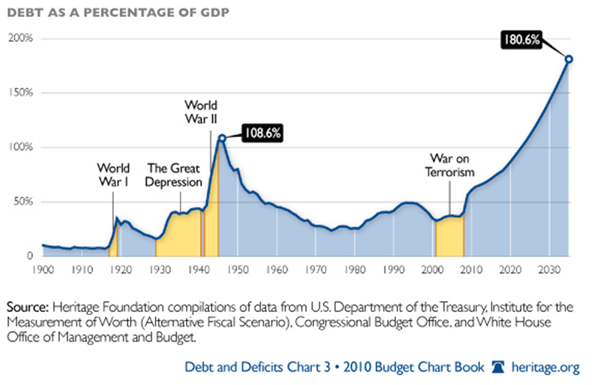
    The federal debt climbed above $13 trillion this month. An easier way to define the national debt is to comprehend that we each owe more than $39,000 to the Chinese, Japanese, and Arabs of the Persian Gulf. The budget deficit will exceed $1.5 trillion this year and forty-seven states are running deficits. California has a $19 billion deficit and its legislature’s landmark response was to pass a law banning plastic bags. Our cities are in worse shape. The former mayor of Los Angeles, Richard Riordan, says that a bankruptcy by that city is inevitable. At the same time, the United States’ Congress voted themselves a 5.8% pay increase. It is no wonder why Americans are nervous.

    Americans are stressed out because of debt, according to an Associated Press-GfK poll. They are trimming their debt at the fastest rate in more than six decades, according to the Federal Reserve. The average amount owed on credit cards is $3,900, the poll said. That’s down from $5,600 last fall and $4,900 last spring. Household debt fell 1.7 percent last year to $13.5 trillion, according to the Fed. It was the first annual drop, based on records going back to 1945. As Americans get their own house in order, the approval rating for Congress has fallen to an all time low. The public will likely make them pay for their angst in November.

    The American people are about a year ahead of the politicians. The spending by Washington, Sacramento, Los Angeles, and by politicians in general, is unsustainable. The people understand that it must be changed. As Senator Tom Coburn (OK) told me last week, either we change our ways or they will be changed for us. Leaders like Senator Coburn will begin The Great Deconstruction. The nation can no longer afford the government it has created.

    The Department of Energy was created by President Carter in 1977 after an OPEC embargo caused gas lines and rationing. In 1977, America imported 33% of its oil. The DoE’s goal was to eliminate our dependence on imported oil. The DoE budget for 2010 was $26.4 billion. It employs 116,000 workers. We now import 66% of our oil. America can no longer afford such an inefficient bureaucracy. Bureaucracies like the DoE that have lost sight of their purpose must be deconstructed.

    Senator Coburn is preparing legislation to rescind $120 billion in 2010 spending by rescinding 2010 budget increases, consolidating 640 duplicative governmental agencies, returning unspent appropriations and cutting wasteful spending. A few examples:

    • Congress has a discretionary budget of $4.7 billion per year. They voted themselves a 6% increase in 2010. Coburn wants this increase rescinded for a saving of $250 million.
    • The Department of Education spends $64.2 billion per year. They spend $1 billion each year administering 207 separate programs at 13 different federal agencies to “encourage” students to take math and science.
    • The Department of Agriculture owns 57,523 buildings. More than 4,700, valued at $900 million, are vacant. Despite this vacant space they spend $193 million per year renting an additional 11 million square feet.

Our politicians have perfected the art of spending money, or as we now know, wasting money. Last year, they loaded spending bills with $11 billion of earmarks – after spending $860 billion on a Stimulus Bill. A new breed of politician, like Senator Coburn, will begin the long process of deconstruction.

There is precedent for deconstruction. In 1945, federal spending ballooned to $106 billion, $93 billion of which was for defense. The deficit jumped from $40 billion in 1938 to $253 billion in 1945. A Democrat President and a Republican Congress established the Commission on Organization of the Executive Branch of the Government in 1947. President Truman put a former Republican President, Herbert Hoover, in charge. It became known as the Hoover Commission. It created the structure of government that exists today and generated savings of $7 billion at the time. A total of 273 recommendations were presented to Congress in a series of nineteen separate reports. A 1955 study concluded that 116 of the 273 recommendations were fully implemented and that another 80 were mostly or partly implemented. By 1949, the federal budget had fallen to $40 billion.

It will come to be known as The Great Deconstruction because it must occur at every level of government. Federal spending is unsustainable. Moody’s is already speculating that we may lose our AAA rating. The states are in crisis with 46 in deficit. The press is referring the California as a “failed state” and “our Greece”. The $860 billion Stimulus Bill sent approximately 30% to the states to support their public employees. But it was a one-year fix. This year, the states are burning through their reserves and next year, they will be forced to cut services, raise taxes, or both. Connecticut, the wealthiest state on a per capita basis with personal income of $54,397 in 2009 (Department of Commerce) saw its Fitch rating lowered from AA+ to AA. Connecticut needs to borrow $956 million to close a budget gap this fiscal year and it borrowed $947.6 millionto cover last year’s deficit.

The cities are no better off with many states raiding their reserves. Many cities are exploring municipal bankruptcy, Chapter 9, as a way out of unsustainable contracts. The Great Deconstruction will take a decade or more. Like the Hoover Commission before it, this process will transform the role of government, and the image of government as it transforms the cost of the people’s business.

***************************************************

The Great Deconstruction is a series written exclusively for New Geography. Future articles will address the impact of The Great Deconstruction at the national, state, county and local levels.

Robert J. Cristiano PhD is the Real Estate Professional in Residence at Chapman University in Orange County, CA and Director of Special Projects at the Hoag Center for Real Estate & Finance. He has been a successful real estate developer in Newport Beach California for twenty-nine years.


Other works in The Great Deconstruction series for New Geography

The Great Deconstruction :An American History Post 2010 – June 1, 2010
The Great Deconstruction – First in a New Series – April 11, 2010
Deconstruction: The Fate of America? – March 2010

  • Striking a Balance

    As noted by Wendell Cox, commuting and congestion have a large economic cost. Time spent behind the wheel, slowed by traffic, is time that could otherwise be put to more productive economic pursuits. Commuting and congestion also have social costs. Every minute lost trapped in snarled traffic is time that might have been spent with family, friends, relaxing, or getting involved in community building activities. Commuting can also lead to elevated stress levels, with studies showing finding that “greater exposure to congestion is related to elevated psycho-physiological stress among automobile commuters.”

    One proposed solution to the challenges presented by commuting and congestion is an enhanced embrace of telecommuting. Proponents argue that businesses looking to increase productivity, burnish their “green” credibility and reduce fuel use, and allow workers to strike a better balance between life and work should offer employees the option to work from home. Whatever the motivation, it does appear that there has been a rise in the adoption of telecommuting. According to varying estimates, somewhere between 20 and 35 million individuals telecommute occasionally. Numbers appear to be on the rise, with projections showing up to 63 million workers will be making use of some form of telecommuting by 2016.

    As businesses increase their adoption of telecommuting, they may also want to provide workers with increased schedule flexibility. A recent study conducted by BYU finds that workers given the option to make use of telecommuting and flex-scheduling had a much higher “breaking point” at which family life and work begin to interfere with one another. According to the study, “for office workers on a regular schedule, the breaking point was 38 hours per week. Given a flexible schedule and the option to telecommute, employees were able to clock 57 hours per week before experiencing such conflict.” As the study points out, this added flexibility allows workers to potentially make use of the equivalent of an “Extra Day or Two” in each work week, adding to productivity. According to the lead researcher, E. Jeffery Hill, the use of flexible scheduling can also contribute to greater worker satisfaction and morale. In challenging economic times the promise of increased worker productivity, improved worker happiness, and potential cost savings realized through reduced office space and facilities should be an attractive spur to increased corporate adoption of telecommuting.

  • The Declining Human Footprint

    There are few more bankrupt arguments against suburbanization than the claim that it consumes too much agricultural land. The data is so compelling that even the United States Department of Agriculture says that “our Nation’s ability to produce food and fiber is not threatened” by urbanization. There is no doubt that agricultural production takes up less of the country’s land than it did before. But urban “sprawl” is not the primary cause. The real reason lies in the growing productivity of American farms.

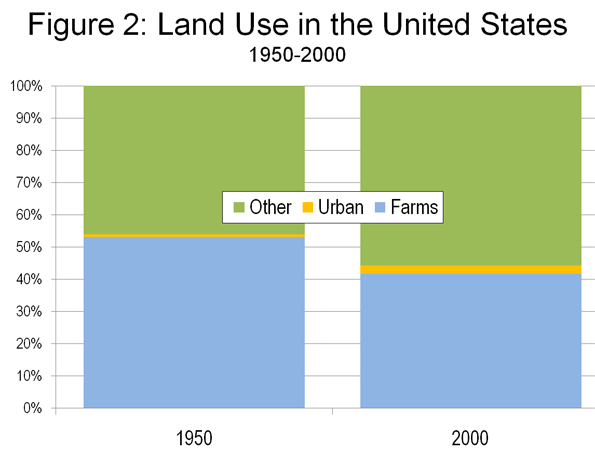
    Since 1950, an area the size of Texas plus Oklahoma (or an area almost as large as France plus Great Britain) has been taken out of agricultural production in the United States, not including any agricultural land taken by new urbanization (Note 1). That is enough land to house all of the world’s urban population at the urban density level of the United Kingdom.

    America’s Spectacular Agricultural Productivity

    Even with less land, agriculture’s performance has been stunning. According to US Department of Agriculture data, US farm output rose 160% between 1950 and 2008. Productivity per acre rose 260%. In particular , California’s farms – often cited as victims of sprawl – have done quite well. Between 1960 and 2004 (Note 2), the state’s agricultural productivity rose 2.3% annually and 3.0% per acre. By comparison national agricultural productivity rose less over the same period at 1.7% overall and 2.2% per acre.

    According to the United States Department of Agriculture, from 1990 to 2004 (latest data), California’s agricultural production rose 32% and on less farm land.

    Of course, there has been substantial reduction of farmland close to some metropolitan areas, but overall the impact of urbanization nationally has not been substantial. For example, since 1950:

    In addition, the nation’s agriculture is subsidized to the tune of more than $15 billion annually, which is strong evidence that more land is being farmed than is required. Subsidies increase the supply of virtually anything beyond its underlying demand. This can be illustrated by imagining how much less transit service there would be if it were not 80% subsidized. Suffice it to say, America is not threatened by “disappearing farmland.”

    America has less farmland because it has not needed as much as before to serve its customers. Thus, considerable farmland has been returned to a more natural state. Generally, this has got to be good for the environment. Land that is left to nature does not require fertilization, for example. The same interests that have frequently claimed that farmland has been disappearing also decry the loss of open space. In fact, the withdrawal of redundant farmland has produced considerable open space – call it open space sprawl.

    Repeat it Often Enough….

    None of this has kept “disappearing farmland” from being a rallying cry among those who would construct Berlin Walls around the nation’s urban areas. Yet the extent to which Bonnie Erbe of Politics Daily and National Public Radio embraced the fiction was surprising. Her “Vanishing Farmland: How It’s Destabilizing America’s Food Supply,” was accompanied by “meant to indict” photograph of farm equipment next to new suburban housing.

    Ms. Erbe’s principal source was a web page from the American Farmland Trust, which seeks to conserve farm land. In its California Agricultural Land Loss & Conservation: The Basic Facts, the American Farmland Trust argues for more “efficient” (i.e. denser) urbanization and claims that, “One-sixth…” (17%) “… of the land urbanized since the Gold Rush … has been developed since 1990.” That might be an impressive figure, if it were not that the state has added 7 million urban residents since 1990, which is one-fourth (25%) of all the urban population added since the Gold Rush and equal to the 1990 population of New York City.

    It is worth noting that California has agricultural preservation measures already in place for farm owners and, finally, that no one can compel an unwilling farm owner to sell their land to a developer or anyone else (except perhaps a government agency through eminent domain).

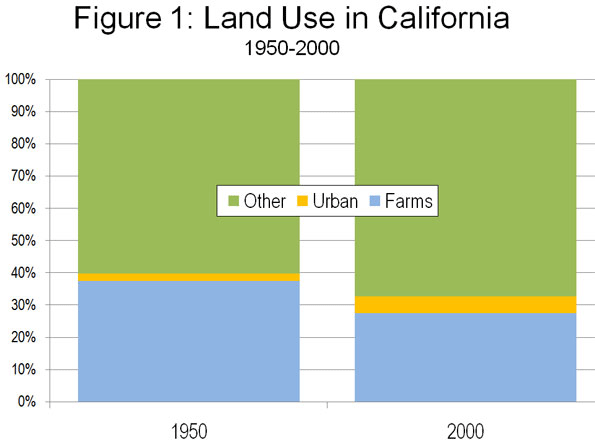
    In California, as elsewhere in the nation, urbanization has not been the principal cause of farm land reduction. According to the US Census of Agriculture, farmland declined in California from 2002 to 2007 by 2.2 million acres. That 5 year reduction in farmland is approximately equal to the expansion of all California urban areas over the 50 years between 1950 and 2000.

    Most Development is Not Urban

    In the same document, the American Farmland Trust indicates support for the radical urban land regulations. Policies such as in Sacramento’s Blueprint that raise significantly inflate the price of land, make housing less affordable. The agricultural, property and urban planning interests who would ration land for people and their houses have missed a larger targets such as ultra-low density “ranchettes” favored by a small wealthy minority who live in the country, but are not farmers.
    According to the US Department of Agriculture, rural, large lot residential development (non-agricultural) covered 40% more land than all of the nation’s urbanization in 2000. These parcels represent “scattered single houses on large parcels, often 10 or more acres in size.” Further, since 1980, the increase in this rural residential development has been one-third greater than the land area occupied by all of the urban areas in the nation with more than 1,000,000 population.

    Finally, if there is a serious threat to agriculture, it is from over-zealous regulation that has put farmers at risk. Water reductions in the San Joaquin Valley – mostly the result of environmental demands – likely have taken more land out of production than any sprawl-happy developer.

    Declining Human Footprint: An International Phenomenon

    The human footprint, as measured by the total urban and agricultural land has been declining for decades, both in the nation and California, where the greatest growth has occurred (Figure 1 & 2). The same is also true of Europe (EU-15), Canada and Australia, where all of the urbanization since the beginning of time does not equal the agricultural land recently taken out of production. Even in Japan, the human footprint has been reduced. It may be surprising, but human habitation and food production has returned considerable amounts of land to a more natural state in recent decades, while America’s urban areas were welcoming 99% of all growth since 1950.


    Note 1: This assumption represents the worst case, since not all land on which new urbanization was developed had previously been farmed.

    Note 2: State data is available only between 1960 and 2004.

    Photograph: Metropolitan Chicago, 2007 (Grundy County)

    Wendell Cox is a Visiting Professor, Conservatoire National des Arts et Metiers, Paris. He was born in Los Angeles and was appointed to three terms on the Los Angeles County Transportation Commission by Mayor Tom Bradley. He is the author of “War on the Dream: How Anti-Sprawl Policy Threatens the Quality of Life.

  • Energy’s Other Side

    The BP oil spill disaster likely spells the slowing down, or even curtailing, of offshore oil drilling for the foreseeable future. You can take California, Florida and much of the east coast off the energy-drilling map for years, perhaps decades.

    But if the oil, gas and coal industries are widely detested on the coasts, people in Bismarck, N.D., have little incentive to join an anti-energy jihad. Like other interior energy centers, people in this small Missouri river city of over 100,000 see their rising oil-, gas- and coal-based economy as the key to a far more lucrative future.

    “We have so much work that we don’t know what to do,” explains Niles Hushka, co-founder of Kadrmas, Lee and Jackson, a Bismarck-based engineering firm active in Great Plains energy development. In the next three weeks Hushka’s firm plans to add 70 more people, most of them skilled technicians and engineers.

    The problem in Bismarck is not so much creating jobs but filling positions; the city can be a hard sell due to its relative isolation and harsh climate. Still there’s some virtue to having opportunities. Even at the pit of the recession Bismarck has continued to experience job growth. Today its unemployment rate stands at well under 4%, the lowest rate in the country.

    This economic record is not unique to Bismarck. Other domestic energy centers like Anchorage, Alaska, and Morgantown, W.Va., also rank high among the strongest job markets in the country.

    Many energy towns are not only getting lots of jobs, but they are also becoming richer. One study, done by economist Mike Mandel, finds the highest per capita income growth in regions of Oklahoma, West Texas and Louisiana, where energy growth has driven the economy. Between 2000 and 2008 these areas enjoyed soaring per capita income gains, while many centers of the “creative economy” such as San Jose, Calif., Raleigh-Durham, N.C., and even Austin, Tex., have experienced per capita income declines.

    But few areas are enjoying a greater boom than Bismarck and surrounding parts of western North Dakota. It enjoys a vast array of energy resources, from fossil fuels to biofuels as well as prodigious potential for wind power.

    The real big action now, however, is in oil. New drilling technologies have allowed for the tapping of oil deposits far deeper below the surface. The U.S. Geological Service recently increased its estimate of North Dakota’s economically recoverable oil–much of it in the massive Bakken and Three Forks formations–25-fold to 4.3 billion barrels. These formations also extend to large swaths of northern Montana and southern Saskatchewan, Canada.

    Unlike past oil booms, such as the one that crashed in the 1980s, this one will last a long time. For one thing the voracious demands on energy coming from India, China and other developing countries will keep energy prices high. At the same time resistance to drilling tends to be weaker in remote areas with few residents, notes Debra Dragseth, a professor of business at Dickinson State University.

    The prospect of long-term prosperity tied to oil and gas wealth is already beginning to change the long dismal demographics of the area. A long-term boom could attract a new flow of blue- and white-collar workers to Bismarck and other parts of the plains. This is already starting. Long a net exporter of people–the state’s population is less than it was in 1930–today Bismarck and the state of North Dakota enjoy positive in-migration from the rest of the country.

    Part of the lure is something North Dakota had previously lacked: a plethora of high-paying jobs. Truck drivers in the industry earn as much as $80,000 a year, and wages for skilled professionals tend to go well over $100,000 annually. Meanwhile the cost of living is low, with housing prices a third or less of those on the coasts.

    Of course, work in the oil or gas fields isn’t easy–and it is sometimes dangerous, particularly in the often brutal winters. But opportunities in tough times can prove an irresistible lure to younger people, which is critical for what has been among the country’s most rapidly aging states. “It’s a petroleum land rush,” says 30-year-old Jerry Haas, who now looks for oil sites for the Dallas-based Petro-Hunt interests. “People see it as a great place of opportunity among people my age.”

    Haas, a native of North Dakota, sees more and more out-of-staters coming to Bismarck, in search of generally high-paying, energy-related employment. He has helped organize a 200-member young professionals group to lobby for more youth-oriented amenities in this decidedly conservative Great Plains town.

    The shifts in migration and particularly income–due largely to energy–represent a huge boost to an area that has long suffered from an exodus of young talent and a dearth of high-paying jobs. The key issue now is finding ways to turn the current boom into longer-term prosperity. North Dakota certainly has an unprecedented opportunity to build up its human and physical infrastructure. While other states struggle with huge budget shortages, North Dakota’s government enjoys an oil-driven surplus that is expected to grow in the next year from $500 million to over $1 billion.

    Dragseth believes the energy boom will allow North Dakotans, long ignored or at best dismissed as hopeless rubes, to start dreaming in ways impossible in much of the country. They can envision a future where, for instance, post-secondary education is free and used to lure the top students from around the world. North Dakota could use its good fortunes to gain the human capital it sorely needs. The Gulf disaster may put an ugly face on energy exploration, particularly oil, for many Americans. But in the nation’s oft-ignored interior, the development of new fuels offers the prospect of a previously unimagined prosperity.

    This article originally appeared in Forbes.com.

    Joel Kotkin is executive editor of NewGeography.com and is a distinguished presidential fellow in urban futures at Chapman University. He is author of The City: A Global History. His newest book is The Next Hundred Million: America in 2050, released in Febuary, 2010.

    Photo by k.landerholm

  • The Vote: Democracy or Disease?

    When the California polls closed on Tuesday, the most costly primary race in the state’s history—thus far—came to an end. Like many high profile races for Senator and Governor nationwide, the spending attracted national attention.

    Of course, this isn’t the first time that California politics and political trends have captured the national imagination and spread like a virus. Given the particularly brutal economic meltdown in California, one would not expect the state’s notoriously dysfunctional governance system to be a role model for others to follow. Alas, it unfortunately seems that it is. Three examples below from the Midwest show that California-style governance definitely has its fans. Indeed, the rise of using constitutional amendments to make policy, and of big money/ special interest- backed referendum petitions shows that the California governance disease is starting to metastasize, even in the Heartland.

    The first example is Missouri, where billionaire Rex Sinquefield launched launched a successful drive to get an initiative on the ballot to eliminate the city earnings tax in Kansas City and St. Louis. Sinquefield is a self-made man who became rich after, among other things, creating the first S&P 500 index fund. Known for his ardent support of free market views, Sinquefield has followed in the footsteps of George Soros and other wealthy financiers in pushing his ideas politically, albeit in a smaller arena. Like Soros, Sinquefield channels plenty of money to candidates, and even has his own think tank, the free market Show Me Institute.

    Sinquefield’s latest crusade is to change state law to prohibit new cities from having local earnings taxes, and to require those cities where they are already in place to put them to a vote every five years and phase them out if ever voted down, with no mechanism for ever reinstating such a tax, even if the city’s voters approve it. While this is a state law change, it targets two specific cities, Kansas City and St. Louis; the latter gets a third of its revenue from the earnings tax. Sinquefield says he wants to replace the earnings tax with a land value tax – an excellent idea – though his actual initiative text doesn’t replace it with anything.

    Whatever one thinks of the actual policy, the idea of billionaire-backed petition drives is right out of the California special interest playbook. Also, while Sinquefield might reasonably want to eliminate the earnings tax in St. Louis, where he lives and pays taxes, it isn’t clear what skin he has in Kansas City’s tax. In effect, Kansas City residents are will have their city’s fiscal future determined by voters who largely live outside the city limits, in a campaign financed by an out-of-town billionaire who lives 250 miles away on the far side of the state.

    And there will be more than 20 other referendum votes on the Missouri ballot this fall. In this governance environment, it shouldn’t be surprising that a significant number of Kansas City businesses are migrating across the state line to Overland Park and other Kansas suburbs where they don’t have to deal with this type of politically induced uncertainty. The political risk in Missouri is commercially toxic.

    The second example is Indiana. Prodded by court rulings, Indiana switched from a property assessment system that undervalued older buildings to one more reflective of market values. This, in combination with the elimination of an inventory tax, led to a spike in property taxes across the state. The spike, along with an income tax increase, led to the mayor of Indianapolis losing his reelection bid to a total political neophyte without any significant financial or establishment backing.

    This stunning upset jolted the legislature into action. Indiana sales taxes were raised by one percentage point, the state took over several key municipal expenses, including educational operations costs and juvenile justice, and it bailed out underfunded local pensions. In return, property taxes were capped to prevent a repeat of the tax crisis.

    So far, so good. By most accounts the financial restructuring and the tax caps are working reasonably well. But state politicians aren’t satisfied. They are in the process of amending the state constitution to write the tax caps into law.

    This is a mistake on two levels. First, it assumes a constitutional tax cap is a substitute for political will on fiscal policy. The notion that if property taxes are limited, then legislative spending won’t increase has been disproven; the example of Prop 13 in California immediately comes to mind. In fact, writing the tax caps into the constitution might actually cause future legislatures to breathe easy and take their eye off the fiscal ball.

    The second is that constitutions should deal with the structure and general powers of government, not with setting tax rates. Writing specified property tax rates into the constitution is simply an attempt by the current legislature to take advantage of high current popularity for a particular policy, and to prevent future legislatures from changing that policy, even if conditions or public opinion change. As a general rule, one legislature or governor should not be able to bind the terms of policy of their successors. If that is established as a valid exercise of legislative power, it seems likely to be used again and again in the future, perhaps for more dubious policies.

    The last and most incredible example is Ohio, where a group of developers wanted to open casinos. Led by Rock Ventures, the investment vehicle of Quicken Loans owner Dan Gilbert of Detroit, the group spent $47 million to draft, put on the ballot, and pass a constitutional amendment permitting casino gambling in Ohio. But this initiative did much, much more than that. It only permitted casinos on four specific properties — properties controlled by the referendum backers — and thus granted them exclusive rights to open casinos. It exempted their casinos from zoning or most other types of local control, authorized them to operate 24 hours a day, and specified a very low license fee of only $50 million per casino to the state. It also permitted them not only to run any game currently allowed by any surrounding state, but also any game those states might approve in the future. It’s undoubtedly one of the most incredible constitutional amendments in the history of the United States.

    Casino companies are far from the only special interest groups to use Ohio’s liberal initiative process to their own ends. Other users include the conservative Cincinnati anti-tax group COAST – Citizens Opposed to Additional Spending and Taxes. COAST does endorse candidates, but in general has a poor track record of getting politicians elected. It has, however, used initiatives to defeat or delay a slew of projects locally. On another front, animal rights advocates at the Humane Society are trying to amend the Ohio constitution to implement their preferred standards for treatment of animals in agriculture.

    The takeaway on Ohio referendums for any special interest group is very clear: “Why not us, too?”

    The legislature is starting to get fed up. Rep. John Domenick wants to amend the constitution to require future changes to obtain a two-thirds supermajority vote, not just a simple majority. He cites the growing ability of deep pocketed, out-of-state interest groups like the Michigan-based casino developers to effectively take over policy making from elected officials.

    Domenick is on the right track. Direct democracy can play an important role in many cases. For example, there’s nothing wrong with requiring voter approval for large tax increases or bond issues for major civic programs after they are approved by elected officials. This gives the matters in question extra legitimacy. But referendum petitions that are too easy to submit and approve only lead to political gridlock and a special interest takeover of the levers of power. The lessons of California suggest that going too far down the road of reliance on constitutional restrictions can become a substitute for political will.

    Flckr photo by SanFranAnnie

    Aaron M. Renn is an independent writer on urban affairs based in the Midwest. His writings appear at The Urbanophile.

  • Dhaka’s Dangerous Development

    It has been a horrendous week in Dhaka, the capital of Bangladesh and the world’s most dense urban area (104,000 population per square mile/40,000 per square kilometer). On Tuesday, a five story residential building collapsed, killing 23 people in the building and in other structures in the path of the collapse. Then, on Thursday evening, a fire started on the lower floors of an 8-story residential building in the old town section of Dhaka. By the time it was controlled, 117 people had died and 8 buildings had been destroyed (link to Daily Star photo).

    Disastrous fires are an unfortunate fact of life in the hyper-dense informal settlements (shantytowns) that pervade large urban areas in developing countries. In April, 7,000 people were left homeless in a Manila shantytown fire (photo), while the homes of 4,000 families were destroyed in another Manila fire just three weeks later.

    While Dhaka has no shortage of shantytowns, this was not a shantytown fire. The bigger risk is the sprawl of high rise buildings (5 stories to 20 or more), which are home to most of the people who do not live in shantytowns. The Daily Star now reports in an article entitled, “Filled-up, Full of Risk” that much of the land is “reclaimed” and “marshy” in Dhaka and not suitable for multi-story buildings. Recent heavy rains have made the situation worse, and at least three additional buildings have begun to tilt since Tuesday’s collapse.

    Dhaka is built on one of the most challenging sites for an urban area. It sits on one of the world’s largest river deltas (the Ganges-Brahmaputra). The combined river course (called the Padma) is only miles to the west. Only 200 years ago, the Brahmaputra itself ran to the east of Dhaka and then changed course. This illustrates the instability of the riverine system, which completely surrounds the urban area with tributaries and river channels.

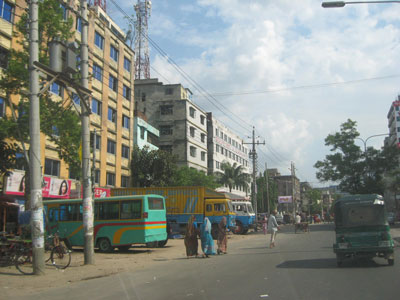
    A map produced in the Daily Star, illustrates the problem. The red areas are considered safe for building multi-story buildings. Virtually all of these areas are now developed. However, large sections of high rise buildings have been developed outside the red areas (see photo), especially between Mirpur and Gulshan. Virtually all of the areas that can be developed are unsuitable for high rises. With a population expected to rise from the current 10 million to 16 million by 2025, Dhaka needs room to grow. It will not be easy.

    Photo: Multi-story buildings between Mirpur and Gulshan

  • BEA Report: Printed Word Surplus? Brave New Books at Book Expo America

    If the future of the printed word lies inside the sleek case of Apple’s new iPad, get ready for illuminated manuscripts that will turn most books into animated cartoons. It was all on display at Book Expo America (BEA), the just-ended annual trade fair extravaganza that pulls together under one roof all the players in the publishing industry.

    BEA met in the vast caverns of New York’s Jacob Javits Center, which for two days was clogged with booksellers, librarians, authors distributors, packagers, literary agents, ghost writers, designers, and editors, all searching for the holy grail of the next bestseller.

    The former Duchess of York, Sarah Ferguson, known to the tabloids as Fergie, was hyping her new book, which I daydreamed might have the title, “Diary of a Bag Woman.” She wasn’t alone: To tout their wares, at BEA, every publisher that can do so arranges for its star authors to sign advance copies of their forthcoming books.

    Other authors on display at this year’s exposition were Ian Frazier, of New Yorker fame, who has a new book about his travels in Siberia, and Gary Trudeau, Doonesbury’s creator, who was flogging an anthology of Zonker’s forty years. The publishers of L. Ron Hubbard accosted me in the aisles with some raptures on Scientology. And I sat through several presentations on the future of electronic books, which are best understood as clouds of literacy delivered with the whoosh of an email.

    The eight hundred pound gorilla in the rooms at the Javits Center was, of course, Amazon, which delivers an endless river of books to readers, but which shaves the margins of publishers and writers.

    There was little evidence of Barnes and Noble or Borders, the overweight gorillas of earlier years. Both retailers now appear in the guise of suburban dinosaurs, heavy on inventory, coffee, and “gift ideas.”

    Who needs to venture to the mall for a book when Amazon can deliver it to your mailbox, or an ebook to your Kindle, seemingly in seconds? Amazon also offers “print on demand” services that, based on your digital file, can print a quality paperback edition of a book in about four hours from when an order is received, sparing the industry the headache of remaindered copies and large warehouses.

    The next step in retailing was on display, as well: the so-called Espresso Book Machine, a $75,000 on-demand printing press that, almost instantly, can print top quality paperback books. Imagine printing out War and Peace as you are waiting to board a (delayed) flight.

    The model of the book publishing industry hasn’t changed since Gutenberg printed his bible. As in the Renaissance, publishers recruit authors to write compelling stories, print them between cardboard, and try to sell the products to captive audiences.

    The author’s take from this production line is about fifteen percent, after expenses have been paid. For a book that sold 20,000 copies with a cover price of $30, the publisher might gross $200,000, while the author could hope to take home about $30,000 — one reason why publishers at BEA entertain each other with expense account lunches while writers live in garrets.

    Even Amazon has no lock on the future of book publishing, especially that of ebooks. Its Kindle, despite being early in the game, is proprietary to Amazon, and the future of electronic publishing may be in the sale of “open format” devices, so that consumers can read their book files on whatever portable reader they happen to own.

    The question of which format will become the ebook industry standard was certainly a buzz topic at BEA. Don’t bet on the iPad sweeping the field; many conventioneers complained that it was heavy. The hot concept at BEA was the enhanced manuscript, which marries the traditional electronic book with Internet hyperlinks.

    Imagine that your child is struggling through a school text on the treaties of Westphalia (the end of the Thirty Years War in 1648). On encountering the word “Münster,” the child is invited to click through to a short film that shows the Papal legate arriving in the German city with his dog or to listen to simulated dialogue between Cardinal Mazarin and the German princes. Elsewhere, maps of Europe’s new nation-state configuration pop up on demand.

    Some of the most crowded stands were those of small and independent publishers. Is the traditional publishing business doomed? Many publishers would appear to be heading to the exits. Their business model is laden with costs (staff, paper, printing, distribution, and warehousing), and their profits are squeezed by Amazon and other online sources.

    The only reason to publish a book with a house like Simon & Schuster is because they have the access to sales and distribution markets. Anyone with a Mac and some patience can turn out an ebook and post it to Amazon. The big publishers may garner shelf space at Barnes and Noble, but big box stores themselves may be going the way of all flesh.

    My guess is that most reading in the future will be done online and electronically, and that readers who want a hard copy of the book will print one from something like the Espresso Book machines.

    The big retailers are likely to fade away, but small independent book shops, places like Margot Farris’s Pages in Manhattan Beach, California, will survive as local centers of literacy, gathering like-minded reading spirits that want something more than an e-file, even if it’s just wine and cheese.

    As a reader, what excited me at BEA? Very little, I confess. Despite wandering a convention center the size of the Astrodome full of books, I saw little that I wanted to read.

    For a long time, publishing has served up specialty books about self-improvement, wine, dogs, antiques, exercise, home repair, and the like. Books about things that interest me — that’s history, travel, essays, classical fiction, baseball, Theodore Dreiser, and the Russo-Japanese War of 1904-05 — seemed lost in the glitzy displays.

    I did pick up a biography of Montaigne, Frazier’s travels to Krasnoyarsk, and an invitation to visit Oman’s Department of Education, whose booth staff, next to the glitter of Harper Collins, looked like contestants on “Lost.”

    As for writers, I fear that printed words will remain an oversupplied commodity, abundant on all sorts of devices, pages, and sites that are notable for their inability to pay writers for their work, even if it is hyperlinked, profusely illustrated, gold embossed, or dedicated to the lives of the saints.

    As a book writer, I might wish it otherwise, and pine for the days when typeset words, printed on heavy stock paper, were all that were required to prod the reader’s illumination. To use the words of E.B. White, who wrote Charlotte’s Web, I write “to amuse myself and for children.” That’s not something iPads, Fergie, or L. Ron Hubbard can take away.

    Photo of Abrams Books’ giant typewriter display, Book Expo America, May, 2010 by gruntzooki: http://www.flickr.com/photos/doctorow/4639586151/

    Matthew Stevenson is the author of Remembering the Twentieth Century Limited, winner of Foreword’s bronze award for best travel essays at this year’s BEA. He is also editor of Rules of the Game: The Best Sports Writing from Harper’s Magazine. He lives in Switzerland.

  • Steve Lafleur

  • Toronto’s G-20 Conference: Financial Boon or Boondoggle?

    Ever since the ill fated 1999 WTO meeting in Seattle, there has been some debate over the merits of hosting meetings of international organizations in major cities. Some argue that there are economic spin offs from the tourism generated by these conferences, but others argue that the security costs far outweigh the benefits. In the lead up to the G-20 meeting in Toronto, scheduled for June 26-27, there has been a flurry of controversy over the price tag for conference security. The combined security tab for the G-8 and G-20 could end up as high as $900 million dollars (Canadian). The tourism industry does have the potential to reap some gains from the G20.

    The best case scenario for the industry would see 50,000 rooms booked for the conference. Unsurprisingly, Greater Toronto Hotel Association’s Terry Mundell is excited. “It’s a good news story for us,” he claims. If we assume (optimistically) that each room goes for $300/night, the hotel industry could make $30 million out of the deal. On top of this, people will obviously be spending money while they’re in town. Let’s assume that these 50 thousand people consume 4 meals/day at $100/person. This would be a cool $40 million for the restaurant industry. Maybe these folks will have a few drinks. Let’s budget in $100/night. After all, these are affluent folks. That’s $10 million for the bars. Maybe a few souvenirs to bring back for the kids? Let’s say another $10 million. And what if they need some Tylenol? Toothbrushes? Toss in another $10 million. We’re up to about $100 million in direct economic benefits. But wait, people need to get to Toronto, and to get around the city. We’ll be generous and throw in $100 million for airfare, though the benefits of this are not entirely injected into the Canadian economy. Add to that $100/day in cabs, and we have another $10 million. This brings the grand total to $210 million. Far from negligible. Unfortunately, that’s about double the official estimate of $100 million. Like I said, this is a best case scenario.

    On the cost side of the ledger, it is important to note that the costs will be divided between the G-20 Conference in Toronto, and the G-8 conference in Huntsville, 2 ½ hours north of the city. Let’s be extremely generous and assume it is an even split. Of the $833 million already announced, we’ll say $400 million is going to the Toronto conference. This still leaves us with a shortfall of $190 million, even under an extremely optimistic scenario.

    Here’s the bad news: even under the optimistic scenario, we still haven’t factored in opportunity costs. So far it has been confirmed that three Blue Jays games will be moved to Philadelphia, and the University of Toronto will shut down during the conference. In anticipation of former Jays star pitcher Roy Halliday’s first return to Toronto, the team had budgeted for 90,000 fans to attend. At an average revenue of $39/fan, that’s a loss of $3.5 million dollars. It’s hard to say how many fans would have come into the city from out of town, but it wouldn’t be at all unrealistic to say that the city is going to lose at very least another $3.5 million in spin offs.

    Even without any similar cancellations, Seattle business managed to lose at least $10 million in revenue as a result of the WTO meeting in 1999 (not to mention the $2 million in property damage). Furthermore, if the G-20 wasn’t going to be in Toronto, we don’t know how many hotel rooms would have been rented out for other events, or whether the conference goers will crowd out other patrons from restaurants. This is the difficulty with these types of estimates. They take into account the benefits that we see, but not the unseen opportunity costs. It’s hard to count a family that decided not to to Toronto for recreation or a cultural event because they want to avioid crowds or inflated room rates.

    One might argue that the short term costs will be mitigated by long term benefits. After all, some people might like the city so much that they’ll want to visit again. Perhaps some number of people will even want to move to the city. I had a similar experience during the G-20 in Pittsburgh last year (though haven’t followed through). If we look at it this way, any shortfall could be seen as a tourism advertising expense. Will this pay off in the long run? Unfortunately it is impossible to tell.

    So let’s assume that the shortfall for the conference is $200 million dollars. That seems pretty reasonable at this point. Let’s further assume that there will be a non-trivial long term tourism benefit to the city. In fact, let’s assume they make it all back. I still don’t buy into the idea of holding major international political conferences in major cities.

    Here’s why. There is an enormous inconvenience to city residents, which will likely include many people being caught up in violent protests and police retaliation. No one should have to get tear gassed in the name of boosting tourism. I was in Pittsburgh during the last G-20 meeting when stores were being smashed in, and the police were gassing protesters. Given that I was wise enough to stay away from the protests, I didn’t personally witness the chaos. Having said that, there is plenty of footage showing the violent clashes between protesters and police. After Seattle, London, Pittsburgh, and many other cities have endured chaos during these conferences, politicians should have learned their lesson. Forget tourism dollars. These conferences are about solving major economic problems. The G-8 meeting is being held in tiny Huntsville, where the G-20 originally was supposed to be held. That’s how it should be.

    It’s easier to import police to a small town than evacuate the downtown of a major city. Unfortunately, governments have not learned from history They seem determined to let their citizens pay the price for their cherished few days in the sun.

    Steve Lafleur is a public policy analyst and political consultant based out of Calgary, Alberta.

    Photo by Sweet One