Blog

  • Urban Economies: The Cost of Wasted Time

    Much has been written in recent years about the costs of congestion, with ground breaking research by academics such as Prud’homme & Chang-Wong and Hartgen & Fields showing that the more jobs that can be accessed in a particular period of time, the greater the economic output of a metropolitan area. Greater access to jobs not only improves economic growth, but it also opens greater opportunities for people and households to fulfill their aspirations for a better quality of living.

    Congestion costs are principally the cost of wasted time, which the most recent Texas Transportation Institute (TTI) Annual Mobility Report places at $15.47 per hour. It is important to understand that much of this cost is not because the car is not moving. It is rather because time that could be used more productively is being consumed.

    Steve Polzin of the University of South Florida has raised a related issue that has been virtually absent from urban planning discussions in a Planetizen blog entitled “The Cost of Slow Travel.” Noting that transit travel time is considerably slower than auto travel times, Polzin broadly estimates that slower travel on transit costs the nation $44 billion, which is two-thirds the $66 billion. Polzin does not suggest that this is a final, “take to the bank” lost productivity number, but does suggest attention to the issue.

    Such thinking is long overdue. Wasted time is wasted time. Most wasted time occurs with respect to travel during peak periods, when most people are commuting to or from work. The $66 billion in wasted time by automobile translates into $550 per commuter per year in the United States (Based upon 2007 commuting data from the American Community Survey). The cost of wasted time for transit is 12 times as high, at $6,500 per commuter, using Polzin’s estimate. Of course, as Polzin is quick to point out, these are not final figures. However, they are a starting point for important (and perhaps “inconvenient”) economic research that has been largely kept off the agenda up until now.

  • It is Time to Plant

    It is springtime in Kentucky – think foals and mares in the pristine meticulously fenced pastures. But, in another part of the state – the Appalachia region of eastern Kentucky – it is time to plant on those rocky hillsides. As my 90 year old father puts it, you plant your corn when tree buds are the size of squirrel ears. I confess to not having given a thought to whether squirrels even have ears or not … but my father knows. He was born and raised in a part of the world where they know things like that, typical of the mostly Scots-Irish who settled there. He knows the land like the back of his hand, he is self-reliant and stubborn to a fault and he knows what it is like to be poor and bereft of opportunity.

    Appalachia Eastern Kentucky – take just one geographic area out of a huge region spread over several states – is negatively depicted in popular imagery and academic literature as a drag on the Kentucky economy. The whole region is enigmatic like the underachieving child in a family of superstars. Until now, that is. With the financial collapse having brought America to her knees, it is a bit like the screaming headline about Toyota’s debacle: “the A student flunked the class.” Perhaps that underachieving C student finally has her chance to shine. After all, who would have given Ford a chance a few years ago?

    But Appalachian eastern Kentucky is after all a land where every manner of program has been tried, books written, studies undertaken, and mournful music sung. It is where the failed War on Poverty was launched in the 1960s. The reason for a “new day dawning” is that there is a stir across the land that signaling an epochol shift in the evolution of the American Dream. Call it by wonky titles like “new localism” or call it “choosing who I want to be and where I want to do it.” But whatever it is, it is impacting on our lives dramatically and will do more so in the future.

    The prestigious Economist Magazine (May 15, 2010) recently reflected that in the future people will have unprecedented choices of living in big vibrant cities or in smaller more nurturing rural settings. And, the stories abound. Take Patty who left the factories of the north to return to her native land. Always known for her shrewd business acumen, she took over and renovated “The Old Schoolhouse” antique gallery located near Cave Run Lake. She scours the region for her “goods” and is visited daily by weary travelers seeking the authenticity of a culture too long locked in the shadow of conventional definitions of success. Likewise, despite the long held belief that they are leaving, young people are finding ways to stay in the region, such as the young man in a recent audience who has taken advantage of “tele-learning” and plying his trade as a graphic artist for a west coast software company.

    There appears to be a convergence of forces at work that could prove transformational for regions like Appalachia. Brought on by the Great Recession, people have to make choices about their priorities and perhaps even to downsize lifestyle appetites. But that’s not all. These forces will impact all places but particularly rural places like Kentucky, places of great beauty and tranquility and appeal waiting for the right moment that may finally be here.

    These converging forces are driven in large part by technology and the realization of its earlier promise that we truly can live and work anywhere. It is about participating in the preservation of a precious culture locked for too long in the closet of neglect and stigmatized with the label of backwardness. It is about an ability to do more than scrape out a meager living in the rocky hillsides. Evidence can be seen in a migration pattern that is, for the first time in decades, giving Kentucky and surrounding states a positive net migration from the rest of the country. We are seeing youthful retirees coming home in some instances and young families putting down roots in places that feel right for their chosen way of life. And there is a growing business culture that knows about the world but sees no paradox in growing itself in Appalachian soil – and using the culture to its advantage.

    Just take note of Kentucky “ham” country if you want to partake of successful business stories. Recently profiled in the New York Times Magazine (May 23, 2010), Kentucky’s home grown hams are making their way onto the world stage. The author marveled at the ham store owner’s chatter about attending a ham conference in Spain and the desire of buyers to travel to a small town to buy nitrate free bacon. Imagining Kentucky hams being worth a wait in noisy New York City restaurants defies explanation except to acknowledge that the song is right that “somethin’s happenin’ here.”

    What must the Appalachian region of eastern Kentucky and the rest of Appalachia do to take advantage of this new opportunity? It must reinvent itself as with many other aspects of the American Dream under the new rules of the 21st century. Reinvention will require answering the question “what is success”? With extreme partisanship and 30,000 foot politics at other levels of government, it is no longer viable to look in the direction of the “higher ups.” We must look to ourselves. Only we can provide the basis for community building and ensure the investments we need to make in health and education.

    Ah, springtime. Nature has taught us well; re-invention is to see the possible and to seize the moment. The moment is now.

    Sylvia Lovely is an author, commentator and speaker on issues relating to communities and how we must adapt to the new landscape that is the 21st century.

    Photo by J. Stephen Conn.

  • Can Europe’s Economy Turn Around If Its Great Cities Continue To Wither?

    Europe’s Greece crisis has turned the world’s attention to the continent’s fundamental flaw: burgeoning public spending and sluggish growth in some of its national economies.

    To the extent that Europe’s more economically fragile countries cannot fix this flaw, Europe poses a global financial risk as toppling EU countries cannot meet their obligations and those left standing cannot prop them up. Only fiscal discipline and boosting growth can save Europe in the long-run.

    And for this reason, we ought to worry about Europe’s cities. Why? Because as large cities increasingly drive national economies in our rapidly urbanizing global community, Europe’s urban growth patterns look alarmingly tepid.

    Around the world, people are clustering together faster than ever at a time when it seems technology should allow them to disperse more easily than ever. As it turns out, innovation and a growing services sector flourish best when lots of people and firms are geographically proximate. Ideas, knowledge and valuable skills are transferred more easily in denser areas.

    There is a direct relationship between economic competitiveness in the 21st century and the growth of metropolitan areas. But Europe’s cities show signs of trouble. They have almost entirely lost the momentum that has driven European pre-eminence for the past 200 years.

    In 1800, only 3% of the world’s population lived in urban areas, and the only Western cities among the world’s 10 largest urban areas were London and Paris. Neither had a population greater than 1 million. Just 100 years later, though, nine of the world’s 10 largest cities were in the West — with four of the top six located in Europe, propelled by their economic predominance through industrialization.

    Other countries followed the model. By the mid-20th century, 30% of the world’s population lived in urban areas, a considerable increase since 1800. But that was only the beginning of an explosive era in urbanization. Between 1960 and 2000, the number of people living in cities worldwide skyrocketed to 3 billion from 750 million.

    Currently, the world’s largest 100 cities generate 25% of global GDP, a figure that will continue to rise over the next few decades — and which will increasingly exclude Europe’s cities.

    Asia and Africa, often regarded poetically as agrarian societies, are leading the global urbanization boom. Today, London is the only European city among the world’s largest 20 metropolitan areas. Paris is 22nd. Among the top 25 cities, they are two of the three slowest-growing areas.

    Late-20th century growth has been driven almost entirely by suburban expansion around core cities. Nevertheless, central cities worldwide have added population on average over the past half century — except in Europe. It is the only continent where core cities have lost population over the past 45 years. While its suburban growth has kept its metropolitan areas growing overall, its net urbanization rate since 1965 is the slowest worldwide.

    Because developed countries are already highly urbanized, their metropolitan areas grow more slowly than those in emerging economies. But Europe’s rate is unusually slow compared to its peer group of developed nations.

    Europe’s main metropolitan areas grew just 28% since 1965, a period during which the United States essentially doubled its urban population. Australia and New Zealand have seen urbanization rates of 90% during the same period. Worldwide, the growth average in urban areas has been 135% since 1965.

    Europe is the only continent with cities growing at less than 1% annually. In Eastern Europe, the growth rate is actually negative. Some cities, such as Munich and Warsaw, have grown at respectable rates and mitigate Europe’s well-known population decline problems. For instance, each city grew between 2000 and 2010, while Germany and Poland each contracted as a whole.

    However, urban growth rates in Europe will likely stay low in coming years, which raises questions about whether Europe’s economy will continue to grow enough to help the continent out of its present troubles.

    European leaders’ disconnect with this important reality was on display several weeks ago when the European Commission chose to announce major carbon emissions in 500 cities at the same time its finance ministers were structuring the massive Greece bailout.

    However important greening urban areas may be, if Europe should be doing anything with its cities these days, it should be figuring out how to put them at the forefront of its economic recovery. The European habit of implementing growth-inhibiting policies — especially in its cities — has to change if the continent hopes to have a prosperous future.

    Given the increasingly metropolitan nature of economic growth around the globe, the health and vitality of Europe’s cities will be key to the continent’s future prosperity. Policymakers need now more than ever to ask serious questions about the origins of future growth. To answer those questions, they need to pay serious attention to their cities.

    This article first appeared at Investors Business Daily.

    Ryan Streeter is a senior fellow at the London-based Legatum Institute, an independent, nonpartisan organization that researches and advocates an expansive understanding of global prosperity.

  • The Suburban Exodus: Are We There Yet?

    For many years, critics of the suburban lifestyles that most Americans (not to mention Europeans, Japanese, Canadians and Australians) prefer have claimed that high-density housing is under-supplied by the market. This based on an implication that the people increasingly seek to abandon detached suburban housing for higher density multi-family housing.

    The Suburbs: Slums of the Future?

    The University of Utah’s Arthur C. (Chris) Nelson, indicated in an article (entitled “Leadership in a New Era“) in the Journal of the American Planning Association. that in 2003, 75% of the housing stock was detached and 25% was attached, including townhouses, apartments, and condominiums. By 2025 he predicts that only 62% of consumer will favor detached homes, (Note 1). He also predicts a major shift in consumer preferences from housing on large lots (defined as greater than 1/6th of an acre) to smaller lots (Note 2). This, he suggests, would create a surplus of 22 million detached houses on large lots.

    This predication is largely made on the basis of “stated preference” surveys which the author, Dr. Emil Malizia of the University of North Carolina (commenting on the article in the same issue), and others indicate may not accurately reflect the choices that consumers will actually make. Dr. Nelson’s article has been widely quoted, both in the popular press and in academic circles. It has led some well-respected figures such as urbanist and developer Christopher Leinberger to suggest in an Atlantic Monthly article that “many low-density suburbs and McMansion subdivisions, including some that are lovely and affluent today, may become what inner cities became in the 1960s and ’70s—slums characterized by poverty, crime, and decay.”

    The Condo Market Goes Crazy

    Misleading ideas sometimes have bad consequences. The notion that suburbanites were afflicted with urban envy led many developers to throw up high-rise condominiums in urban districts across the country. Sadly for these developers, the Suburban Exodus never materialized, never occurred. As a result, developers have lost hundreds of millions, if not billions of dollars and taxpayers or holders of publicly issued bonds could be left “holding the bag” (see discussion of Portland, below).

    This weakness has been seen even in the nation’s strongest condominium market, New York City, where one developer offered to pay purchaser’s mortgages, condominium fees and real estate taxes for a year as well as closing costs.

    But the damage is arguably worse in other major markets which lack the amenities and advantages of New York.

    Take, for example, Raleigh (North Carolina), where low density living is the rule (the Raleigh urban area is less dense than Atlanta). The News and Observer reports that the largest downtown condominium building (the Hue) “considered a bold symbol of downtown Raleigh’s revitalization,” has closed its sales office and halted all marketing efforts. The development’s offer of a free washing machine, dryer, refrigerator, and parking space were not enough to entice suburbanites away from the neighborhoods they were said to be so eager to leave.

    This is not an isolated instance. Around the nation, condominium prices have been reduced steeply to attract buyers. New buildings have gone rental, because no one wanted to buy them. Other buildings have been foreclosed upon by banks; and units have been auctioned. Planned developments have been put on indefinite hold or cancelled.

    Miami: Of Little Dubai and Cadavers

    Miami’s core neighborhood (downtown and Brickell, immediately to the south) has experienced one of the nation’s most robust condominium building booms. More than 22,000 condominium high rise units were built between 2003 and 2008. Miami could well have more 50-plus story condominium towers than any place outside Dubai.

    As a result, Miami has suffered perhaps the most severe condominium bust in the nation. According to National Association of Realtors data, the median condominium price in the Miami metropolitan area has dropped 75% from peak levels (2007, 2nd Quarter). By comparison, the detached housing decline in the metropolitan area was 50%; the greatest detached housing price decreases among major metropolitan areas were from 52% to 58% (Riverside-San Bernardino, Sacramento, San Francisco and Phoenix).

    The most recent report by the Miami Downtown Development Authority indicates that 7,000 units still remain unsold. The Brickell area is home to the greatest concentration and largest buildings and has the highest ratio of unsold units at 40%.

    Icon Brickell (see photograph above) may be the largest development in the core. Icon Brickell consists of three towers, at 58, 58 and 50 floors and a total of nearly 1,800 units. Despite opening in 2008 and offering discounts of up to 50%, barely one-third (approximately 620) of the units have been sold, according to the Daily Business Review, which also reported on May 13 that the developer had transferred control of two of the towers to construction lenders.

    One building, Paramount Bay, was referred to by The New York Times as a “47-story steel and glass cadaver” with a lobby “like a mortuary.” A real estate site indicates that only one of the buildings 350 units has been sold.

    More recently sales have inched up in the core but due not to any suburban exodus. According to The Miami Herald, huge discounts that have lured Europeans, Canadians, and Latin Americans to the core. The real estate and consulting firm Condo Vultures notes that more than 1,000 of the sales are to a few bulk buyers, a market segment some might refer to as “speculators.”

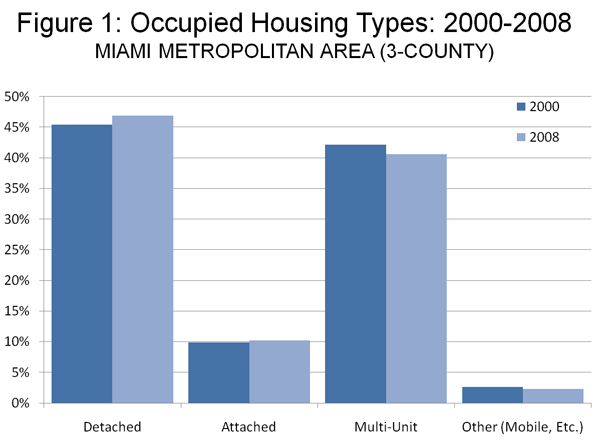
    The latest data from the US Bureau of the Census confirms that there is no fundamental shift away from detached housing in the Miami area, as housing trends point toward more detached housing. In 2000, 48.1% of residents in the Miami metropolitan area lived in detached housing. By 2008, the figure had risen to 49.2% (Figure 1). Essentially, the Suburban Exodus remains a mirage.
    Portland: Gift Certificates for Distressed Developers

    If developer greed was the motive in Miami, government subsidies have been the driving force in Portland. The city of Portland will soon have issued nearly $450 million in urban renewal bonds, provides 10-year tax property tax forgiveness, and reduced development fees, which the Portland Development Commission (PDC) has called “gift certificates” for developers (Note 3).

    Gift certificates have not been enough to cure Portland’s sickly downtown condominium market. The Oregonian reported that prices were down, on average, 30% over the year ended the first quarter of 2010. Remarkably prices in the much ballyhooed Pearl District are plummeting even more than those in the rest of the Portland area. According to DQ News, the median sale price of a house in the Pearl District dropped four times the average in Multnomah County and an even greater six times decline relative to suburban counties over the past year.

    There is more. Just this year, the Pearl District has seen its Eddie Bauer, Adidas, and Puma stores close.

    One condominium building the Encore, is reported to have sold only 17 of 177 units. A recent auction of units at the largest building in the city, the John Ross brought prices “far below the replacement cost” according to The Oregonian’s Ryan Frank, who noted that “it will likely be years before there’s a new high-rise condo built.” Late last year, the Pearl District’s Waterfront Pearl was reported to have sold only 31% of its units and had not sold a unit for a year.

    The Portland Development Commission itself has become part of the condominium bust story. PDC had indicated it was considering relocating its offices to a new 32-story mixed use tower (Park Avenue West), which was to have included condominiums, offices, and retail stores. For more than a year, the proposed 32-story tower has been an unsightly hole in the ground, with construction suspended. PDC decided to stay put in its older, less expensive offices. Even before PDC decided not to locate in Park Avenue West, the developers eliminated the plans for 10 floors of condominiums, doubtless because it made no economic sense to add to an already flooded market.

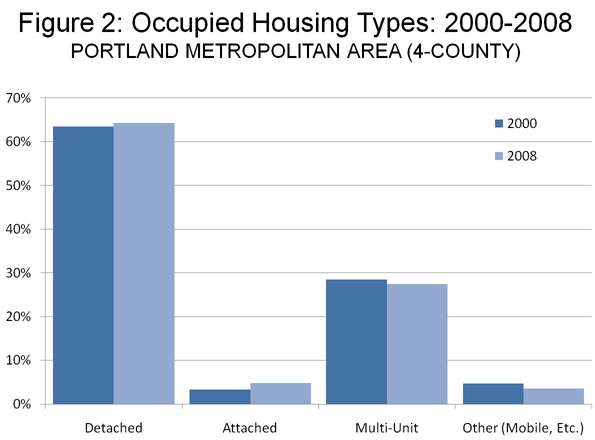
    In Portland, like in Miami, the fact remains that suburbia has not been abandoned. Despite the high density over-building in the Pearl District and elsewhere in the core, detached housing has become even more popular in the region. According to data from the Bureau of the Census, the share of households living in detached housing in the Portland metropolitan area rose from 63.7% in 2000 to 64.5% in 2008 (Figure 2).
    High-Rise Condos: Slums of the Future?

    To say that the high-rise condominium market has fallen on hard times would be an understatement. The condo bust in New York has become so acute that Right to the City, a coalition of community organizations has called upon “the City to acquire the tax delinquent buildings through tax foreclosure and convert vacant units into permanently affordable housing for low-income New Yorkers.” In a report entitled People without Homes and Homes without People: A Count of Vacant Condos in Select NYC Neighborhoods, Right to the City points out that there are more than 4,000 empty condo units in 138 buildings, with owners delinquent on nearly $4 million in taxes to the city.

    Owners of new condominiums around the nation who paid pre-bust prices for their units may not be inclined to stay around if they are surrounded by less affluent renters who have been attracted by desperate building owners and lenders.

    Are these dark towers of discounting the slums of tomorrow? Only the data and time will tell and it’s too early to know, but preliminary findings show little of the predicted shift toward higher density living (Figure 3). Certainly national data indicates, if anything, a slightly strengthening market for detached, rather than attached housing (Figure 4).

    • Between 2000 and 2008, the share of households living in detached housing rose from 61.4% to 63.5%.

    • A similar trend is shown by the national building permits data. Between 2000 and 2009, 75.2% of residential building permits in the United States were for detached housing. This is up strongly from 69.6% in the 1990s and nearly equals the highest on record (the 1960s), when 77.7% of residential building permits (housing units) were detached houses.

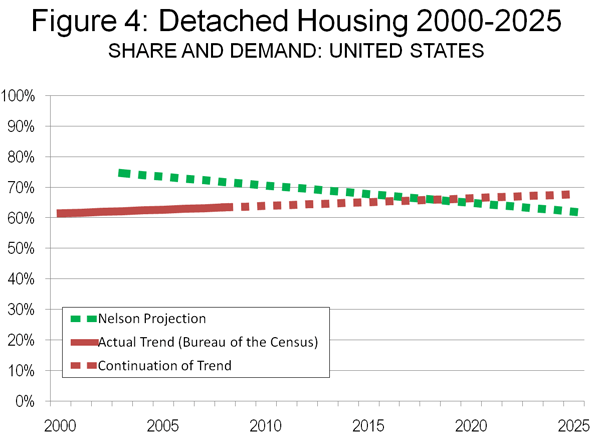
    Looking at the data, there remains little evidence that the stated preferences on which the predictions relied have been translated into the reality of a shift in preferences toward smaller lots in cores or inner ring suburbs. Domestic migration continues to be strongly away from core counties to more suburban counties. Core cities are growing less quickly than suburban areas. Exurban areas are growing faster than central areas, including inner suburbs.

    Clearly, the Suburban Exodus has not begun and there is little reason to believe that it will anytime soon.


    Note 1: In estimating the 2003 share of detached housing (75%), Dr. Nelson uses “one-unit structures” data from the 2003 American Housing Survey Table 2-3. US Bureau of the Census American Housing Survey personnel responded to my request for clarification, indicating that “one-unit structures” includes … single detached housing units, mobile homes, and single attached housing units (such as a townhouse).” Thus the 75% detached estimate is high because it includes mobile homes and single attached housing. As is indicated above, data from the US Bureau of the Census data indicates that the share of detached housing of detached plus attached housing in 2000 was 61.4%. This figure, coincidentally, is virtually the same as the 62% Dr. Nelson predicts for 2025.

    Note 2: The assumption that consumers prefer small lot detached housing may not be sufficiently robust and may even be exaggerated. Dr. Nelson appears to principally rely on research by Myers and Gearin (2001) (in the journal Housing Policy Debate) for concluding that consumers prefer small lot rather than larger lot detached housing, defining small lot development as 1/6th of an acre or less or less than 7,000 square feet. Yet neither figure appears in Myers and Gearin. Moreover, a National Association of Home Builders commenter (also in Housing Policy Debate) questions how its data was characterized by Myers and Gearin in justifying a finding of preference for smaller lots (the survey is unpublished). Without access to the original surveys referenced in Myers and Gearin, it is impossible to judge what respondents may have had in mind as the dividing line between large lots and small lots.

    Note 3: This characterization was on the Portland Development Commission website (accessed January 2, 2007). It was cited in our report, Zero Sum Game: The Austin Streetcar and Development and subsequently removed from the website. A large share of Portland’s urban renewal bonds are insured by Ambac Financial Corporation, which has reported losses exceeding $1 billion in the last two quarters. Ambac indicated that it has “insufficient capital to finance its debt service and operating expense requirements beyond the second quarter of 2011 and may need to seek bankruptcy protection.” Ambac was the insurer of State of Nevada bonds to build the Las Vegas Monorail, which has already entered bankruptcy and is unable to pay its bonds.

    Wendell Cox is a Visiting Professor, Conservatoire National des Arts et Metiers, Paris. He was born in Los Angeles and was appointed to three terms on the Los Angeles County Transportation Commission by Mayor Tom Bradley. He is the author of “War on the Dream: How Anti-Sprawl Policy Threatens the Quality of Life.

    Photo: Icon Brickell, Miami

  • China’s Housing Bubble: Quality Research Required

    It is extremely difficult to find reliable reporting on the intensity of the housing bubbles across China, but this article from the China Post of June 1, 2010 “Economist sees housing market bubble”, appears to be realistic.

    It states that in 2009 the average house price to average annual household income in China was 9.1 times earnings and that it rose to 11.15 during the first two months of 2010. Beijing and Shanghai are reported to have exceeded 20 times average household earnings during early 2010. These figures are from Yao Shujie, head of the School of Contemporary Chinese Studies at the University of Nottingham.

    The article noted that last week, Chinese real estate services company E House China released figures suggesting that house prices to incomes nationwide in 2009 were 8.03 times incomes, but those in Beijing, Shanghai, Hangzhou and Shenzhen were over 14 times household incomes.

    Recently, Wendell Cox of Demographia, working with the South China Post, estimated that the Median Multiple (median house price divided by median household income) for Hong Kong was 10.4 – as reported in this New Geography article Unaffordable Housing in Hong Kong. Because sufficiently reliable data is now available from Hong Kong, it will be included within the Annual Demographia International Housing Affordability Surveys going forward.

    As the Annual Demographia International Housing Affordability Surveys clearly illustrate, house prices do not exceed three times gross annual household incomes in normal markets.

    Rather remarkably, in researching and reporting on the China Housing Bubble, there has been no discussion of the land ownership differences of China and western countries.

    Freehold land is not available in China. The land is leased for a remarkably short term of 70 years. Instead of conventional ground leases in the west where ground rentals are paid, Chinese Local Governments demand an upfront payment of capitalized rental. On this basis, the land interest should be a wasting asset over the term of the lease.

    Rather remarkably – this appears not to be the case in China, where the buying public have convinced themselves (no doubt with encouragement from real estate agents and developers) that at the end of the term of the ground lease, Local Government will simply “gift” the land to home owners!

    On the sound income to house price measure, China’s housing bubble is clearly the worst in the world. When the unsatisfactory and uncertain land ownership issue is factored in as well, it is particularly concerning.

  • Subdivisions: The Lots-Per-Minute Race

    When you get that morning cup of Java, do you desire the minimal flavor? How about your career, do you desire the most minimal pay check or profits or the most mundane of positions? Let’s assume for some reason that you said ‘No, you would always want to strive for something better than the minimum’.

    You now have three hats in front of you, one says “planner” on it, one says “engineer,” and the last one says “developer”. When you put on the “planner” hat, your job is to develop and enforce a set of rules that will guide the development of a city. You suggest to the council a set of standards that recommend the minimum dimensions and areas for residential or commercial projects that are brought in for approvals. Council and planning commission members will argue a bit, but eventually they will decide on what the minimum controls will be within the regulations you will be writing…

    Under the “developer” hat, you just bought 100 acres from the bank at a steal, yet it still cost over two million dollars, and that monthly interest payment is going to be painful. You cannot begin to sell any lots until you get preliminary plat approval, so until then, money bleeds out, not in. You cannot form a business plan until someone lays out your site. You look at the local engineering firm and see they offer “land planning” as one of their areas of expertise. They have a large impressive office with lots of computer screens flickering away. Obviously, they must be experts on land planning who can deliver a unique land development that will provide a market edge that makes your development as successful as possible. So you just sign here on their contract for services…

    Wearing that “engineer” hat, you look over your production floor. It was once bustling with activity, but now those screens are flickering with employees trying to look busy in fear that a layoff is coming. Luckily, you have a developer coming in with that 100 acre project. You really like laying out subdivisions, and you look forward to using that new software you just bought to automate the process. Next week, you’re scheduled to meet with the developer, who is going to present a sketch plan on the site. You’re ready, with your new software that promises an LPM (lots per minute) ratio of up to 250 lots per minute. With this new tool you can easily lay out that new development in just an hour. Since this is only a sketch plan meeting, you just need a quick picture to get things started.

    To make sure you are up to date on the latest regulations, you check the web site of the city for the latest minimums to enter into the software. You use Google Earth to trace in the boundary of the site, because you do not have the time to survey the land, nor does the developer want to spend any money at this point until he knows the city will give him sketch plan approvals. Besides, you threw the initial planning in for free to lure in the developer and get those lucrative engineering fees.

    After obtaining a rough estimation of the site from Google Earth, you use your latest technology to generate streets and lots almost as fast as you can move the mouse across the screen. Something that used to take days is now virtually instant. Each lot appears at the exact minimum setback, with the exact minimum side yard, and at the exact minimum square footage. Wow! You are quite happy to tell the developer that he’s got 400 lots on his site.

    Slapping on the developer’s hat you use the sketch plan to create your financial projections, cautiously of course, because you have not been given sketch plan approval yet. But clearly you are about to make a ton of money.

    Wearing the planner’s hat, at the planning commission meeting you present “Oak Ridge”, the proposal for the 100 acres. After hearing complaints about the monotonous design, you explain that Oak Ridge follows the regulations that the planning commission had agreed upon: every minimum has been met. Reluctantly they approve the sketch plan for Oak Ridge.

    Wearing the developer hat you could not be more pleased. Imagine the profits that the lot sales will bring, especially because you got the land so cheap! Never in your wildest dreams had you thought you could get 400 lots approved. The next day you put down a deposit to order that Bentley you always dreamed about.

    A few weeks later— wearing the engineer’s hat — you sit down with the actual boundary survey, which is much more accurate than the Google Earth data you used for the sketch plan. You find that the boundary was not even close to what you traced. The surveyor points out the wetlands that will take up about a quarter of the land. He also explains that there is evidence of the pipeline easement. What the ^%$#… ? What pipeline easement? Oh, yes, you remember that Google Earth does not show easements, an honest mistake.

    You explain to your staff that the developer wants to explore a low impact development with surface flow. They tell you that the software only automates pipe networks; surface flow calculations are not automated. You direct them to forget the low impact stuff, too much liability and it will add too much manual labor time.

    Wearing the developer’s hat you sit down, ready to be presented with the preliminary plat of Oak Ridge. It is a wise choice to be sitting down, because the 240 lot preliminary plat comes as a bit of a shock! What happened to the 160 extra lots we got approved? The engineer explains that was just a quick sketch. By the time the actual boundary was provided, and what with the wetlands and the steep slopes, well, it just had to be made to work.

    The engineers explain to you they held every lot to the absolute allowed minimum and that 240 lots is not bad at all. Your vision of the plan blurs and an image of your financial partners and lenders appear, along with thoughts how you are going to pay for that Bentley you picked up last week.

    No more need of hats. You now have a picture of a scenario that repeats itself all too often in the land development process. We live in a world dictated solely by minimums. The new buzz-phrase is “a forms based regulatory process”. Is this not just another way to assure that there is a minimum relationship between manmade structures? Notice how architecture did not enter this story… That will not be a factor until later on, as the lots are sold – why worry at the onset of the development?

    There are a variety of software packages that automate land development and are used by virtually every engineer in the world. These packages have been developed by firms whose main purpose is to automate engineering. It is so simple to throw in automation for lot geometry. Some of the firms that provide this automation are quite large – billion dollar corporations, that earn profits by using those minimum dimensions allowed by regulations and providing tools that cut the process of producing land developments and engineering drawings from months to minutes.

    In this process of progress, we got lost. To have the concept of an LPM ratio of 250 lots per minute is like saying we will layout 250 homes at $200,000 each in 60 seconds. This equates to $833,333 in housing for each second. The development is likely to sit for a few centuries or more, and each home is likely to have 3 people living in it. The average home sells every 6 years, so the living standards of 25,000 people will be set in those 60 precious seconds. How much thought do you think someone laying out 4.16 homes per second will give towards reducing housing costs, eliminating monotony, views from the homes, curb appeal, low impact drainage, long term values, ecology, preserving natural contours and vegetation?

    If you want to speed towards a completely unsustainable world, join virtually everyone involved in the land development process. They are already doing that quite well, thank you. We need a complete overhaul of the land development process. Smart Growth is a solution for a limited envelope of development. It will make an impact, but the impact will only be a small ripple in a very large pond. A prescribed set of stringent rules cannot apply to every development situation, thus a monolithic strict set of rules is not a fix for both urban and suburban living.

    If you do not seek minimum taste, nor minimum income potential or a minimum position in life, then why would you be remotely satisfied living in the minimal development pattern that creates a minimal city?

    When we lay out and build new cities and rebuild existing ones, let’s take the time, thought, and consideration to maximize living standards and assure the successful placement of all businesses that will thrive in the developed future. Perhaps then, we could call this maximized future “sustainable”.

    Rick Harrison is President of Rick Harrison Site Design Studio and Neighborhood Innovations, LLC. He is author of Prefurbia: Reinventing The Suburbs From Disdainable To Sustainable and creator of Performance Planning System. His websites are rhsdplanning.com and performanceplanningsystem.com.

  • The Future Of America’s Working Class

    Watford, England, sits at the end of a spur on the London tube’s Metropolitan line, a somewhat dreary city of some 80,000 rising amid the pleasant green Hertfordshire countryside. Although not utterly destitute like parts of south or east London, its shabby High Street reflects a now-diminished British dream of class mobility. It also stands as a potential warning to the U.S., where working-class, blue-collar white Americans have been among the biggest losers in the country’s deep, persistent recession.

    As you walk through Watford, midday drinkers linger outside the One Bell pub near the center of town. Many of these might be considered “yobs,” a term applied to youthful, largely white, working-class youths, many of whom work only occasionally or not at all. In the British press yobs are frequently linked to petty crime and violent behavior–including a recent stabbing outside another Watford pub, and soccer-related hooliganism.

    In Britain alcoholism among the disaffected youth has reached epidemic proportions. Britain now suffers among the highest rates of alcohol consumption in the advanced industrial world, and unlike in most countries, boozing is on the upswing.

    Some in the media, particularly on the left, decry unflattering descriptions of Britain’s young white working class as “demonizing a whole generation.” But many others see yobism as the natural product of decades of neglect from the country’s three main political parties.

    In Britain today white, working-class children now seem to do worse in school than immigrants. A 2003 Home Office study found white men more likely to admit breaking the law than racial minorities; they are also more likely to take dangerous drugs. London School of Economics scholar Dick Hobbs, who grew in a hardscabble section of east London, traces yobism in large part to the decline of blue-collar opportunities throughout Britain. “The social capital that was there went [away],” he suggests. “And so did the power of the labor force. People lost their confidence and never got it back.”

    Over the past decade, job gains in Britain, like those in the United States, have been concentrated at the top and bottom of the wage profile. The growth in real earnings for blue-collar professions–industry, warehousing and construction–have generally lagged those of white-collar workers.

    Tony Blair’s “cool Britannia,”epitomized by hedge fund managers, Russian oligarchs and media stars, offered little to the working and middle classes. Despite its proletarian roots, New Labour, as London Mayor Boris Johnson acidly notes, has presided over that which has become the most socially immobile society in Europe.

    This occurred despite a huge expansion of Britain’s welfare state, which now accounts for nearly one-third of government spending. For one thing the expansion of the welfare state apparatus may have done more for high-skilled professionals, who ended up nearly twice as likely to benefit from public employment than the average worker. Nearly one-fifth of young people ages 16 to 24 were out of education, work or training in 1997; after a decade of economic growth that proportion remained the same.

    Some people, such as The Times’ Camilla Cavendish, even blame the expanding welfare state for helping to create an overlooked generation of “useless, jobless men–the social blight of our age.” These males generally do not include immigrants, who by some estimates took more than 70% of the jobs created between 1997 and 2007 in the U.K.

    Immigrants, notes Steve Norris, a former member of Parliament from northeastern London and onetime chairman of the Conservative Party, tend to be more economically active than working-class white Britons, who often fear employment might cut into their benefits. “It is mainly U.K. citizens who sit at home watching daytime television complaining about immigrants doing their jobs,” asserts Norris, a native of Liverpool.

    The results can be seen in places like Watford and throughout large, unfashionable swaths of Essex, south and east London, as well as in perpetually depressed Scotland, the Midlands and north country. Rising housing prices, driven in part by “green” restrictions on new suburban developments, have further depressed the prospects for upward mobility. The gap between the average London house and the ability of a Londoner to afford it now stands among the highest in the advanced world.

    Indeed, according to the most recent survey by demographia.com, it takes nearly 7.1 years at the median income to afford a median family home in greater London. Prices in the inner-ring communities often are even higher. According to estimates by the Centre for Social Justice, unaffordability for first-time London home buyers doubled between 1997 and 2007. This has led to a surge in waiting lists for “social housing”; soon there are expected by to be some 2 million households–5 million people–on the waiting list for such housing.

    With better-paid jobs disappearing and the prospects for home ownership diminished, the traditional culture of hard work has been replaced increasingly by what Dick Hobbs describes as the “violent potential and instrumental physicality.” Urban progress, he notes, has been confused with the apparent vitality of a rollicking night scene: “There are parts of London where the pubs are the only economy.”

    London, notes the LSE’s Tony Travers, is becoming “a First World core surrounded by what seems to be going from a second to a Third World population.” This bifurcation appears to be a reversion back to the class conflicts that initially drove so many to traditionally more mobile societies, such as the U.S., Australia and Canada.

    Over the past decade, according to a survey by IPSOS Mori, the percentage of people who identify with a particular class has grown from 31% to 38%. Looking into the future, IPSOS Mori concludes, “social class may become more rather than less salient to people’s future.”

    Britain’s present situation should represent a warning about America’s future as well. Of course there have always been pockets of white poverty in the U.S., particularly in places like Appalachia, but generally the country has been shaped by a belief in class mobility.

    But the current recession, and the lack of effective political response addressing the working class’ needs, threatens to reverse this trend.

    More recently middle- and working-class family incomes, stagnant since the 1970s, have been further depressed by a downturn that has been particularly brutal to the warehousing, construction and manufacturing economies. White unemployment has now edged to 9%, higher among those with less than a college education. And poverty is actually rising among whites more rapidly than among blacks, according to the left-leaning Economic Policy Institute.

    You can see the repeat here of some of the factors paralleling the development of British yobism: longer-term unemployment; the growing threat of meth labs in hard-hit cities and small towns; and, most particularly, a 20% unemployment rate for workers under age 25. Amazingly barely one in three white teenagers, according to a recent Hamilton College poll, thinks his standard of living will be better than his parents’.

    It’s no surprise then that Democrats are losing support among working-class whites, much like the now-destitute British Labour Party. But the potential yobization of the American working class represents far more than a political issue. It threatens the very essence of what has made the U.S. unique and different from its mother country.

    This article originally appeared in Forbes.com.

    Joel Kotkin is executive editor of NewGeography.com and is a distinguished presidential fellow in urban futures at Chapman University. He is author of The City: A Global History. His newest book is The Next Hundred Million: America in 2050, released in Febuary, 2010.

    Photo by MonkeyBoy69

  • An American History Post 2010: The Great Deconstruction

    There is a great battle brewing – the proverbial paradox of the immovable object versus an irresistible force. The battle lines are drawn. On one side is the Greatest Generation, Americans over 60, middle class and mostly white. Mainstream media calls them The Tea Party and worse.

    On the other side is President Barack Obama and a younger generation of progressive Democrats who see the need for an ever more expansive government. The battlefield is spending and debt. The Greatest Generation, following World War II, bought homes with a 30-year mortgage and 20% down, and paid off those mortgages accumulating trillions in equity along the way. The Credit Card Generation – epitomized by both George W. Bush and his Democratic successor – nurtured the zero down, no doc, adjustable rate mortgage that allowed millions of homebuyers, who could not afford to purchase a home, to buy one. The bursting of the housing bubble cost trillions in lost equity and resulted in 2.8 million foreclosures in 2009.The figures tell the story.

    Spending

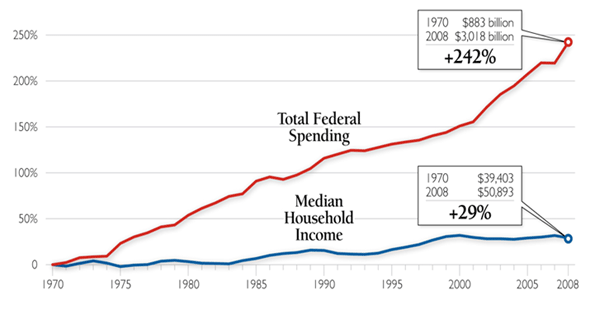
    According to the Office of Management & Budget (OMB), Federal spending has grown more than eight times faster than Household Median Income. Since 1970, middle-income Americans’ earnings have risen 29 percent, but federal spending has increased 242 percent (Percentage Change of Inflation-Adjusted Dollars, 2009). The Greatest Generation believes that spending by Washington politicians has grown out of control. They understand it is not a Republican or Democrat issue. They opposed the $800 billion TARP Bailout under Bush as much as Obama’s $800 Stimulus Bill. They opposed the trillion dollar Healthcare Bill recently enacted into law despite a clear majority opposed to its passage. They recognize that Social Security and Healthcare comprise huge unfunded obligations that will be passed on to their grandchildren.


    Source: Heritage Foundation

    Debt

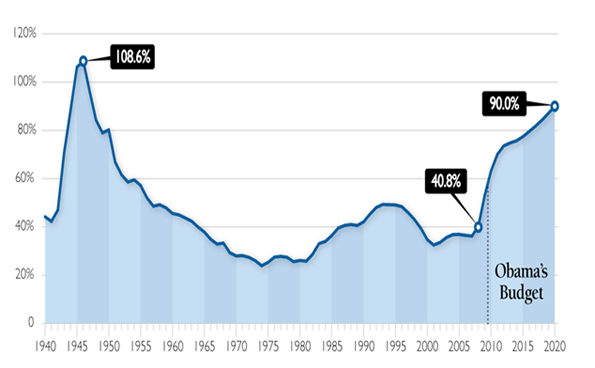
    Since World War II, publicly held debt as a percentage of the economy (GDP) has remained below 50%. In 2008 when President Obama took office, it was 40.8 percent, nearly five points below the post-war average. According to the OMB, Obama’s budget would more than double this figure to 90 percent of Gross Domestic Product by 2020, levels not seen since World War II. (Greece’s debt level of 150% precipitated their meltdown). By 2020, Americans will spend more on interest payments on the Federal debt than on military spending. The Greatest Generation believes these debt levels to be unsustainable.


    Source: Heritage Foundation

    An Unsustainable Path

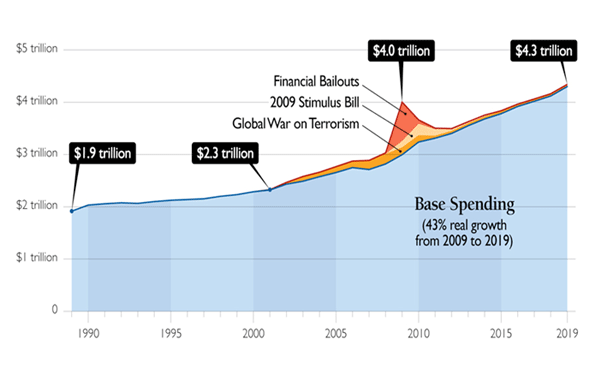
    In 1990, the federal budget was less than $2 trillion. Ten years later the federal budget was just $2.3 trillion. By 2010 the budget exploded to $4 trillion. The Obama budget projects a 43% growth to $4.3 trillion by 2019 according to the OMB. This massive increase over the $2.9 trillion budget Obama inherited in 2008 is not due to emergency spending alone but an intentional structural growth in government. Federal revenues have not kept pace with spending. The U.S. government was forced to borrow $1.5 trillion to pay its bills last year. The national debt is projected to increase from $13 trillion to $20 trillion by 2020 (Inflation-Adjusted Dollars, 2009). The path is unsustainable.


    Source: Heritage Foundation

    While the classic paradox of the immoveable object versus the irresistible force can never be solved, this battle will be settled at the ballot box in 2010 and 2012 when Americans determine the path their country will follow in the 21st Century. If the Greatest Generation prevails, many incumbent politicians will find themselves out of a job as collateral damage. A new wave of politicians will begin The Great Deconstruction.

    New Jersey Governor Chris Christie may be the prototype of this new generation of politicians. He was elected to deconstruct the dysfunctional government of New Jersey, an economy that resembles Greece. Christie inherited the nation’s worst state deficit — $10.7 billion out of a $29.3 billion budget. Christie is doing something unusual, honoring his campaign promises and acting like his last election is behind him. Christie epitomizes the politician the Greatest Generation craves, one willing to lose his job.

    Christie has already declared a state of emergency, signed an executive order freezing spending, and cut $13 billion in spending – in just two months. His first budget included 1,300 layoffs, cut spending by 9%, and privatized government services. The deconstruction of New Jersey has begun. New Jersey may be an unlikely place for The Great Deconstruction to begin, but it is a harbinger of things to come.

    The Great Deconstruction is a series written exclusively for New Geography. Future articles will address the impact of The Great Deconstruction at the national, state, county and local levels.

    Robert J. Cristiano PhD is the Real Estate Professional in Residence at Chapman University in Orange County, CA and Director of Special Projects at the Hoag Center for Real Estate & Finance. He has been a successful real estate developer in Newport Beach California for twenty-nine years.

    Other works in The Great Deconstruction series for New Geography
    The Great Deconstruction – First in a New Series – April 11, 2010
    Deconstruction: The Fate of America? – March 2010