Blog

  • The States and Economic Development, Identifying Top Performers

    This is an excerpt from “Enterprising States: Creating Jobs, Economic Development, and Prosperity in Challenging Times” authored by Praxis Strategy Group and Joel Kotkin. The entire report is available at the National Chamber Foundation website, including highlights of top performing states and profiles of each state’s economic development efforts.

    States throughout American history have done everything they can to cultivate, attract, retain, and grow the businesses that comprise the most fundamental building blocks of their economy. Even in today’s volatile global economy states with severe unemployment and budget woes can point to policies, programs, and investments that foster new economic opportunities and create jobs.

    Read the full report.
    Read part one in this series: The Jobs Imperative: Power to the States

    Many state economic development organizations were originally established with business recruitment and attraction as their primary focus. But today’s mix of state approaches to economic development has moved well beyond earlier, sometimes singularly focused attempts to lure footloose businesses with huge financial incentives and/or by offering a business climate based on cheap labor, low taxes, and lenient regulations.

    States, nonetheless, still compete with each other for companies in “traded sectors” and jobs in the global economy, either directly or by virtue of unique assets and resources, and this sometimes involves financial incentives and tax abatements. But there is growing momentum among governors and state legislatures to grow their economies from within by creating a new set of competitive advantages that include building human capital through workforce development and training, harnessing the power of science and technology assets, making strategic investments in infrastructure, reaching out to global markets, developing opportunities related to energy and the environment, and spurring entrepreneurship and innovation.

    Generally, state economic development efforts include an interrelated array of policies, programs and investments, falling into three major categories: (1) an entrepreneurial approach focusing on new business and technology-based development, oftentimes with a focus on bolstering productivity and innovation; (2) recruitment, expansion, and retention strategies emphasizing financial incentives or investments and other programs, including international trade and export promotion; and (3) “fertile soil” policies28 that create the conditions for growth that will benefit almost any type of business by streamlining governmental regulation, optimizing taxes, investing in infrastructure, and/or by providing a better-educated, more highly skilled work force.

    While it is up to state governors and legislators to set the environment for development to flourish, ultimately economic development success is defined by execution at the local and regional level. With well designed state-implemented development tools, effective workforce development and skills training systems, and strong infrastructure, states can give local economic developers the power to assist the growing businesses, to broker the key partnerships, and to lead the key initiatives that create the jobs needed to sustain our growing population.

    Most of all, states must carefully weigh policy to refrain from constructing barriers to private enterprise growth. Many of the most effective economic development initiatives start from grassroots efforts or private sector business leaders, so supporting these efforts from the state level is imperative.

    Measuring the States: A List of the Top Performers
    A primary goal of any state economic development program is not only to increase the number of jobs in the state, but to improve the quality of jobs and the overall prosperity of the state’s residents.

    This study combines metrics for each economic development policy area to measure overall high performers in each policy topic area. States are compared in each metric and top states are determined by a composite comparison of all metrics in overall performance and in each policy area. For a full description of all metrics and results for each state as well as top performers in exports, innovation, workforce development, infrastructure, and tax and regulation, see the full report.

    To establish the overall best performers we combined measures of Job growth rate since 2000 and since 2007; Gross State Product (GSP) measures: real GSP growth since 2000, GSP per job 2008, Growth in GSP per job 2000-2008; and income: per capita personal income growth 2000-2009 and median four person family income adjusted for cost of living, 2009.

    Top Overall Growth Performers

    1. North Dakota – While North Dakota’s low unemployment and recession resistance is often attributed to healthy agriculture and energy sectors, its construction and manufacturing sectors are relatively healthy and the state has seen 42% job growth in professional and technical services and 36% in management of companies since 2002. North Dakota is the top job performer since the 2007 peak and is fifth since 2000. The state also places first in growth in GSP per job (productivity increase), second in GSP growth and third in per capita income growth. Recent investments in research and development (R&D) infrastructure are beginning to pay off as the state is the fastest growing in science, technology, engineering, and mathematics (STEM) job growth.
    2. Virginia – Already a professional and technical services powerhouse in 2002, Virginia added another 135,000 jobs in that sector since that time, fueled by 90,000 new jobs in computer systems design and management and technical consulting services. The state’s high incomes and slightly below average cost of living placed it first on our cost of living adjusted family income measure.
    3. South Dakota – South Dakota is a strong overall performer, doing best in productivity and output measures. Partly due to an enterprise-friendly regulatory structure, the state has 30% more finance industry employment than the national norm and has added 18% growth in finance employment since 2002. The state’s manufacturing sector actually gained jobs since 2002, led by growth in signs, chemicals, communications equipment, and construction equipment, all averaging more than $43,000 in earnings per worker.
    4. Maryland – Maryland landed in the top 20 or better on all seven performance metrics. Maryland saw strong growth in technical consulting and computer systems design, but especially private scientific research and design services, a sector more than 2.5 times as concentrated in Maryland than the nation as a whole and paying nearly $95,000 in earnings per worker.
    5. Wyoming – Wyoming’s growth is powered by a rapidly expanding energy cluster, which added more than 18,000 jobs since 2002 and now holds 30% of all employment in the state. The energy growth has spilled over into business services sectors such as environmental consulting, surveying and mapping, and testing laboratories. Its overall manufacturing supersector also gained jobs, seeing the fabricated metal and electrical equipment clusters begin to emerge.
    6. New York – While New York saw average job growth through the beginning of the decade, it has weathered the recession better than most other states, and its high productivity and productivity gains help place it among our top performers. Accounting for about 8% of all jobs in the state, the professional and technical services sector added more than 115,000 jobs for 15% growth.
    7. Texas – Texas has seen strong job growth this decade and has weathered the recession well, fueled by 20% expansion of a now 1.1 million job energy cluster. Recently machinery manufacturing and transportation equipment manufacturing clusters are emerging, both growing to more than 90,000 jobs. This has helped stimulate a 15% expansion in transportation and logistics including warehousing and storage and many freight and specialized trucking sectors.
    8. Iowa – A solid performer across most of our metrics Iowa’s strength is perhaps in its stability. The state’s largest cluster, agribusiness, food processing and technology, grew at a 1% rate since 2002, significantly better performing than the same group of industries nationally. Iowa’s other most competitive clusters include machinery manufacturing (farm and construction equipment, refrigeration and heating systems, and other commercial equipment) transportation and logistics, and advanced materials (search and navigation equipment and machine shops).
    9. Nebraska – Nebraska has added 15,000 jobs to its business and financial services cluster since 2002, led by management and technical consulting, management of enterprises, and credit intermediation, all adding at least 3,000 jobs and averaging $55,000 to $90,000 in earnings per worker. The state’s railroads and support industries and freight trucking support a strong transportation and warehousing cluster, and the state has seen a boom in marketing consulting and market research sectors.
    10. Montana – While Montana’s energy and mining clusters added a combined 8,400 high-paying jobs to the state since 2002, Montana’s greatest source of national dominance came from the collection of arts, entertainment, recreation, and visitor industries, perhaps a sign that the rest of the nation is beginning to discover the Big Sky country. Montana is also beginning to see the emergence of smaller clusters in chemicals, apparel and textiles, and fabricated metal products.

    Growing Jobs: How Do They Do It?

    A review of which states are high performing shows a diverse group—some big, some small; some rural, some urban; some inland, some coastal—but a closer examination shows a shared pattern of policies by these high performers.

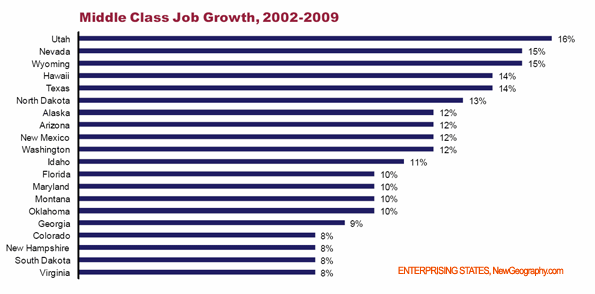
    There is no such thing as single a silver bullet strategy for job creation. Among our top ten performers, all ten have seen at least 4% job growth since 2002 in mid-level jobs requiring at least long term on-the-job training but less than a four-year degree. Five of the ten states increased those jobs more than 10%. At the same time all ten increased science, technology, engineering, and mathematics (STEM) jobs by at least 4% over the same period, with 7 of 10 growing STEM jobs at least 14%.29

    An assessment of top performing states, regardless of by what measure, eventually gets down to a state’s ability to execute successful initiatives. Aside from minding the basics of primary education and supportive infrastructure, success begins with an understanding of a state’s economy and demographics, including its strong points and its gaps. States that can mobilize the relevant partners to put together the strategic networks to build upon those strengths while addressing the weaknesses will be winners in the long run.

    Adequately financing any initiative is paramount to its success. Top performing states have come up with winning formulas often based on combining state funding with federal programs and private sources. As regional workforce skills gaps become more acute, non-governmental agencies and private enterprises more are willing to join new collaborative development projects.

    Programs such as Kentucky’s “Bucks for Brains” which requires universities to match state funds with donations from philanthropists, corporations, foundations, and other non-profit agencies, or Florida’s use of American Recovery and Reinvestment Act (ARRA) funding in combination with existing state funds to tackle major infrastructure programs illustrate unique solutions to sufficiently financing winning initiatives.

    Examples of strong partnerships featuring open communication are especially evident in high performing export states. Export programs are based upon effective communication between the importing country, the exporting manufacturer or business, and the state program helping to facilitate the connection.

    The TexasOne program creates promotional materials to market the state and its manufacturers to importing countries and leads trade missions to importing countries and hosts reverse trade missions to the state. Nevada works with a network of trade representatives in targeted markets throughout Asia, North America and Europe, focused on cultivating distribution channels and facilitating opportunities for foreign direct investment in Nevada enterprises.

    Many high performing states offer an array of corporate, manufacturing, and land tax programs. So too, many states are shying away from direct subsidies for promised job growth in favor of highly targeted tax credit programs that require direct investment by the firm or venture investors wherein the tax benefits are only realized after new jobs are in place. Other credit programs target historically underdeveloped geographical regions.

    Other states such as North Dakota, Florida, and Mississippi have turned to comprehensive tort reform as another key element enterprise-friendliness. Whether these reforms are specific to a particular industry or issue, they ultimately help businesses, large and small, remain competitive and free of excessive burdens from excessive litigation.

    Private sector and academic collaboration is one of the most readily identifiable attributes of high performing states across all measures. Whether it is successful innovation and entrepreneur programs such as Montana’s TechRanch, Oregon’s Innovation Council, Rhode Island’s Center for Innovation and Entrepreneurship, or job creation and economic development initiatives such as Momentum Mississippi, these private and academic partners are providing critical input, oversight, and resources to bolster the effectiveness of state efforts.

    Many states are locating business incubators adjacent to universities in partnership with the schools while others are building laboratory spaces and other specialized infrastructure to offer to growing companies on an a la carte basis. In either case, this business and scientific infrastructure can reduce start-up costs for new enterprises and provide students the chance for experiential learning while earning their degrees.

    While there are obviously other policies or initiatives that high performing states share there are some commonalities: building on momentum; delivering adequate funding for initiatives; developing strong relationships and communication strategies; enterprise-friendly tax and regulation systems; and vigorous collaboration between business, government, and education institutions.

    Read the full report.

    Praxis Strategy Group is an economic development, analysis, and strategic planning firm. Joel Kotkin is executive editor of NewGeography.com and author of The Next Hundred Million: America in 2050

  • Enterprising States: Creating Jobs, Economic Development, and Prosperity in Challenging Times

    This is an excerpt from “Enterprising States: Creating Jobs, Economic Development, and Prosperity in Challenging Times” authored by Praxis Strategy Group and Joel Kotkin. The entire report is available at the National Chamber Foundation website, including highlights of top performing states and profiles of each state’s economic development efforts.

    Read the full report.

    Read part two in this series: The States and Economic Development, Identifying Top Performers

    The Jobs Imperative: Power to the States

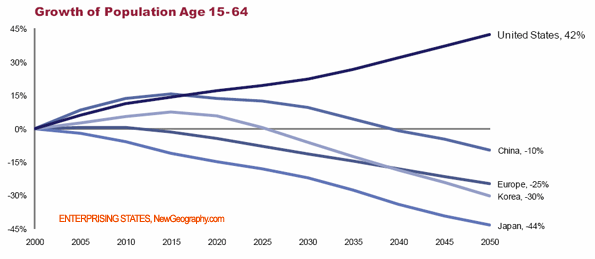
    In the coming decades, the United States will enjoy an enormous demographic advantage over its primary competitors in both Europe and East Asia. As countries such as Germany, France, Japan, South Korea and even China will experience declining workforce growth and rapid aging, by 2050 the pool of people aged 14 to 64 in the United States is expected to grow by more than 40%, compared to what it was in 2000. In contrast, China’s workforce will fall by 15%, Europe’s will decline by 25%, and that of Japan will plunge by 44%.

    This growth represents an unprecedented opportunity for free enterprise in America, but it also poses a tremendous challenge. What the United States does with its “demographic dividend”—that is, its relatively young working-age population—will largely depend on whether or not the private sector can generate growth in jobs and wealth to help meet the needs of a larger aging population.

    Government, too—particularly at the state and local levels—will need to play a role with policies that spur the private sector. Government can facilitate long-term job growth by establishing smart approaches to education, immigration, health care, energy, infrastructure, and tax and regulatory policies.

    A University of Kentucky report prepared for the U.S. Chamber of Commerce has calculated the total number of new jobs needed “to return the economy to our pre-recession level of employment and provide jobs for all the expected new entrants.” It concluded, “The national total is nearly 23 million workers. Almost forty percent of these additional jobs are concentrated in California, Florida, and Texas, three states that comprise 26 percent of the population as of 2008.” Each of the three states that are predicted to need fewer positions since the start of the recession has fewer than 850,000 people. In these states, North Dakota, South Dakota, and Wyoming, the number of workers affected by the recession is more than offset by slower population growth projected by the Census.

    And simply to keep pace with population growth in 2010, the New America Foundation estimates, the country needs to add more than 125,000 jobs a month. The employment imperative is particularly critical today, with over fifteen million unemployed. Even if we reach the administration’s goal of providing 95,000 jobs a month this year, 190,000 monthly next year, and 250,000 in 2012, our overall unemployment rate is expected to remain over 8% by 2012. According to estimates by the Economic Policy Institute, it could take until 2013 or even 2014 to get back to the unemployment levels of before the recession.

    The most critical need is to create jobs for middle and working class people, and for the young, with the teen unemployment rate now over 24% compared to under 15% in 2007.

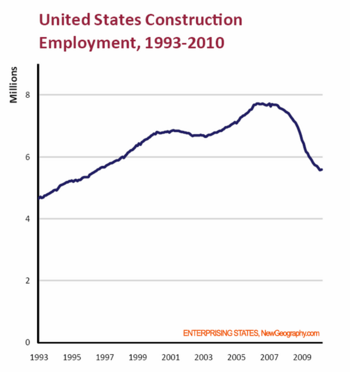
    These groups have borne the brunt of the recession—particularly in areas such as construction, where employment has contracted by two million jobs since 2006. The nature of the federal stimulus, which focused more on the social safety net than on infrastructure, appears to have largely missed this heavily male, blue collar segment.

    Many have been out of work for a long time. Nearly 6.3 million Americans have been unemployed for over six months, the largest number since the federal government started keeping track in 1948. The average duration of unemployment—28.5 weeks—is the highest since the end of the Second World War. According to the labor department, right now there are roughly 6.1 unemployed people for every job, four times the rate in December 2007.

    Needed: An American Approach to Job Creation

    More than a year after the passage of the federal stimulus, much more work needs to be done to strengthen of our free enterprise system. Some analysts suggest that we take our lead from the example of European societies, and use tax dollars to stimulate and preserve employment as well as expand social protections. Others argue that adopting European models of shorter hours and more leisure might benefit the economy. Yet these are not rational choices for the United States, since virtually all these societies are aging rapidly, and few have been growing rapidly.

    Indeed, many of these societies still have higher rates of youth unemployment than the United States. By the end of 2009, unemployment for those under the age of 25 stood at 21% in the European Union (EU), with some countries—Sweden (27%) and Spain (44%)—at extraordinarily high levels.

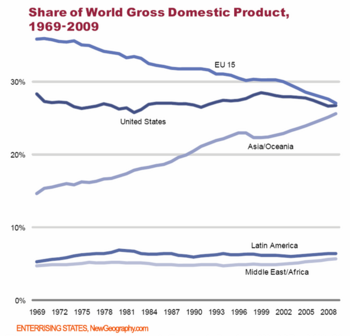
    Overall, the core European countries have not grown as quickly as the United States over the past forty years, and seem to be lagging in the current early stages of the recovery. This is a long term trend. The core EU fifteen countries’ share of the world economy has shrunk considerably, while that of the United States has remained remarkably stable. For EU countries, expansive social protection has not been paired with rapid growth.

    The United States will need to find its own means to address its unique jobs imperative. Clearly, the expansion and preservation of government employment has proven stimulative, but private sector employment continues to be a struggle in most of America.

    One third of the stimulus was directed to local government, and public employment has barely dropped. Even so, there is increasing stress on state and local government, due to the declines in the private sector economy. The limited efficacy of a government-centered approach can be seen in the states—which, after all, cannot print their own money to cover their deficits—with extremely stressed budgets and the inevitability of large cutbacks in public employment.

    Another misplaced approach to job creation is the widely embraced notion—both at the federal and the local levels—that government regulations tied to a “green” economy could create a large new employment source. Various studies in countries that have created massive incentives for such employment—Spain, Germany, Denmark—find that the employment-stimulating impact of such policies can be more than off-set by the negative consequences of resulting high energy prices. When cap and trade mandates raise energy taxes and the cost of doing business, they ultimately inhibit job growth. In the long run new jobs in energy sectors will be created by the creation and production of new technologies.

    Expanding our production of all energy sources could be a major source of jobs. But the experience in some European countries makes clear that green jobs on their own cannot be a fundamental driver of future job creation. Indeed, literature suggests that much of the job growth in green industries has occurred in China and other countries. To date, the actual impact of green jobs seems to be less than expected.

    The one likely way to expand green jobs, notes a series of studies by EMSI, would be through greater economic growth. Most new green jobs depend on the expansion of other key sectors, notably housing, manufacturing, warehousing and agriculture. As these industries expand, they will be the prime markets for new, environmentally responsible technologies and techniques.

    The only sustainable way for the United States to create jobs lies in a rapid expansion of the private sector economy, including in the construction, manufacturing, and energy sectors. A ‘green’ economy cannot be created at the expense of the rest of the economy as a whole. Unreasonable constrictions on manufacturing and construction inhibit job growth. And roadblocks to energy development—including to renewable energy projects—from environmental legislation, as well as from environmentalists and NIMBYs, are also harmful to job growth. Improving the quality of the environment should be a primary concern here, of course, as well. But without robust economic growth, the United States simply will have to accept a massive decline in living standards.

    The growing divergence between advanced countries should not be viewed as a matter of right or wrong, better or worse. Rather, it signifies how societies of different heritages, faced with different prospects, cope with their evolving futures.

    What Is the Best Role for the Federal Government In Job Creation?

    The best role for the federal government is to fund national priorities like energy, physical infrastructure, and the national defense, and to set basic health and safety regulatory guidelines that are carefully balanced against the need to maintain low barriers to entry into the market. But, for the most part, the primary mission for economic development went to the states, and, more importantly, the private sector economy.

    The mounting federal initiatives to wrest environmental, wage, and benefit concessions from private companies are examples of a centralization of government power over both states and private businesses that could take us in the wrong direction. Although certain times do call for increased federal activity—legitimate threats to national security or economic emergencies, such as the Great Depression or the recent financial crisis—we may be approaching a critical juncture where Washington’s power may be reaching beyond its effectiveness.

    The current impulse to create a high-employment economy by imposing federal restrictions—such as the proposal that private firms that do not raise wages will be bullied into doing so by the manipulation of federal contract awards—marks a departure from our free-market traditions. Similarly, possible federal control over local zoning decisions—through such organizations as the EPA—also mark a crossing of the regulatory Rubicon.

    States and localities are far better positioned than the federal government to foster strategic investment, regulations, taxes and incentives that encourage private sector prosperity. In large part, this is because they are more responsive to local conditions. Many academic planners, policy gurus, and national media have tended to favor large government units as the best way to regulate and plan for the future. But central planners consistently seek to reduce the influence exercised by the plethora of villages, towns, and cities in the United States: well over 65,000 general-purpose governments. With so many “small towns,” the average local jurisdiction population in the United States is 6,200, small enough that nonprofessional politicians can have a serious impact on local issues.

    The American preference for solving problems at the state or local level should be central to the government role in job creation. One size determined in Washington will not fit all. South Dakotans and Californians will prefer to address employment problems in different ways. Within the limits of constitutional rights, we should let them try their hand, and let everyone else learn from their success or improve upon their policies.

    Indeed, many Americans on both the right and left are instinctive decentralists. Our economic evolution mirrors this trend. America’s entrepreneurial urge, in contrast to developments elsewhere, has actually strengthened. In 2008, 28% of Americans said they had considered starting a business—more than twice the rate for French or Germans. Self-employment, particularly among younger workers, has been growing at twice the rate of the mid-1990s.

    For this reason, supporting new businesses—and small and medium-sized firms—by ensuring that they can get the credit they need is an essential piece of the job-creation picture. For jobs to grow, these businesses must thrive.

    Innovation and Entrepreneurship Are the Key to Solving the Jobs Imperative

    America will depend on its emerging population of younger workers to keep expanding its economy. In the 1970s, when the coming-of-age of the boomers began to impact the labor market, labor force growth created a period of higher unemployment. Now, we could see a reoccurrence as the large millennial generation starts to seek employment. Yet now, as then, predictions of a long term labor glut could well change as these workers find and develop new opportunities.

    This happened to the boomers in the late 1980s, when talk of long-term high unemployment was replaced with concerns over a labor shortage. The growth of new industries tied to the use of computers, and later of the internet, created a surge in demand for skilled workers. As boomers integrated into the workforce and were replaced by less numerous generation “X”-ers at the entry level, companies fretted increasingly about a diminishing pool of workers.

    The opportunities for employment created by the rise of new industries, and by the innovative expansion of established businesses, cannot be underestimated. Such innovation has long been the source of new growth for the American economy, although the exact nature of that innovation is impossible to predict. Much of the pioneering will likely come from skilled immigrants, who are
    estimated to have started a quarter of all venture-backed
    public companies between 1990 and 2005.

    This enterprising spirit reflects a broad, long-term American trend. U.S. employment has been shifting not to mega corporations, but to individuals and smaller units; between 1980 and 2000, the number of self-employed individuals expanded tenfold to comprise 16 percent of the workforce.

    The smallest businesses—the so-called microenterprises— have enjoyed the fastest rate of growth. By 2006 there were some twenty million such businesses, one for everysix private-sector worker. Hard economic times could slow this trend, but historically, recessions have served as incubators of innovation and entrepreneurship. Many of the individuals starting new firms will be those who have recently voluntarily left or been laid off by bigger companies.

    The Vital Role of Infrastructure and Basic Industries

    To succeed in the mid-21st century, Americans also will need to pay more attention to the country’s basic industries. Some assume that the American future can be built around high-end “creative” jobs, without ever reviving the industrial economy or rebuilding our physical infrastructure. In the America envisioned by advocates of “the creative economy,” our productive facilities would serve mainly as tourist attractions, much as we now visit restored pioneer villages.

    Such an approach assumes that our rising competitors, notably China and India, will surrender high value activities such as media, finance and engineering. This is a dangerous and historically ill-considered assumption. In the 1980s, Japanese firms that were widely written off as “copycats” became primary innovators, particularly in automobiles, semiconductors, and computer games. In the coming decades, Chinese, Indian, and Brazilian companies—to name a few—will seek to move from low-wage work to more specialized, innovative kinds of products. The enormous revenues generated from the less trumpeted activities will provide the funds to invest in their move into ever higher-end activities.

    Americans can create a more prosperous future, but only if we focus on maintaining the physical infrastructure necessary for basic production and transportation, as well as on developing the intellectual prowess of our citizenry. America’s unique demographics require the country to pay attention not only to high-tech industries or financial services, but also to the basics: construction, manufacturing, agriculture, and energy.

    These critical industries underpin our prosperity and employ our expanding blue-collar workforce. They can provide new opportunities for the majority of workers who do not possess four year or advanced college degrees. In 2005, the National Association of Manufacturers, the Manufacturing Institute, and Deloitte Consulting surveyed eight hundred U.S. manufacturing firms: More than 80% reported that they were “experiencing a shortage of qualified workers overall.” Nine in ten firms stated that they faced a “moderate-to-severe shortfall” of qualified technicians. By 2020 this shortage could grow to 13 million workers. A resurgent manufacturing sector would also boost the country’s technological workforce. By 2007, industry employed about a quarter of the nation’s scientists and related technicians.

    This revived focus on production would help large swaths of the country. The Great Plains area, which is still profiting from industrial and agricultural expansion, would benefit, as would the Great Lakes, which has weathered so many challenges in recent decades. Historically neglected regions such as Appalachia would also profit.

    The Critical Role of States

    America is a vast country made up of hundreds of diverse economies. From early on, very different industries clustered in different places. There has been wide divergence in the skills and abilities of local populations. Although federal intervention is necessary in certain areas—for example, in creating national research institutions or interstate transportation—it is often at the state or local level that the best policies for a particular region can be developed.

    The need to tailor economic development to local needs has been a critical aspect of the success of our federal system. By giving a state wide leeway to develop its own solutions to the jobs imperative, we would be providing the other states with potential role models—as well as a warning system of policies to avoid—in their own strategies. The states are described in the famous opinion issued by Supreme Court Justice Louis Brandeis as places that “serve as a laboratory” where the nation can “try novel social and economic experiments without risk to the rest of the country.”

    States have often been leaders in fashioning progressive approaches to economic development. Private and state-sponsored development created the initial network of roads, canals, and steamboats that knit together regional economies. When President James Madison vetoed federal funding for the Erie Canal in 1817, the New York legislature used its own tax and credit resources to complete the 363 mile system eight years later. Eventually the canal helped assure the Empire State’s national preeminence. Other states, including Pennsylvania, Ohio, Indiana, Illinois, Maryland and Virginia, followed suit with their own canal-building projects.

    In the 1920s and 1930s states—and some municipalities—also invested heavily in wealth-creating infrastructure, including highways and water and power systems. These investments supplemented significant new underwriting of projects from private corporations. States continued to make these investments throughout the 1950s.

    At the time, no state was more successful at developing its economy than California. Under both Republican and Democratic Governors, California developed what has become a widely accepted model of local economic development based on the expansion of traditional infrastructure—roads, bridges, water and energy systems—matched by massive investments in “human capital”, including a master plan for higher education that spanned the elite universities to the community colleges.

    California’s state investment and business promotion policies inspired other states, notably Texas and North Carolina. This state role was also embraced by the young Governor of Arkansas, Bill Clinton. Faced with the issues of a poor, racially divided state, Clinton recognized that, given the deep divisions in Washington, “There is no alternative to continued intense state efforts to deal with our most pressing domestic problems.”

    Although unemployment dropped, there remained problems relating to national competitiveness and declining middle class wages, Clinton argued. But he continued to believe in the exercise of local power. “In a country as complex and diverse as ours, in which most job growth is generated by small business,” he noted, “many of these [economic] issues will almost have to be dealt with at the state level.”

    In David Osborne’s landmark work, Laboratories of Democracy, he described how the late 1980s and early 1990s saw the emergence of a whole host of innovative Governors. The “first agenda” of these Governors, Osborne noted, was “creating economic growth”, a notion Governor Clinton later used effectively in his campaign for the Presidency.

    In today’s federal-level climate, states could potentially play a more significant role than they did in the ‘80s and ‘90s. Chuck McCutcheon, co-editor of Politics in America at CQ-Roll Call Group, suggests that continued DC “political gridlock” makes the states better suited to deal with major policy issues. At the state and local levels, he suggests, politicians are more likely than their highly polarized federal counterparts to “get along” with each other.

    Conclusion: The Power of the States to Lead the Jobs Imperative

    Ultimately, states and localities are best qualified to meet the jobs imperative. As Alexis De Tocqueville observed, it is natural that citizens of a state or locality are more solicitous about “the increasing prosperity of his own district,” and this serves “to stir men more readily than the general interests of the country and the glory of the nation.”

    As our country grows, reaching 400 million people by 2050, the differences between our various states and communities will grow. We will have more diverse regional economies, demographics and cultures. We need to look at these local sources—what Thomas Jefferson called “our little Republics”—to lead the jobs imperative. It is an imperative upon which depends the future success of our entire nation.

    Read the full report.

    Praxis Strategy Group is an economic development, analysis, and strategic planning firm. Joel Kotkin is executive editor of NewGeography.com and author of The Next Hundred Million: America in 2050
  • Shanghai: The Rise of the Global City

    The opening of the World Expo heralds Shanghai’s coming of age, the rising economic might of China, and the financial power of Asia’s legendary metropolis.

    But that’s only part of the story. The World Expo also reflects the rise of Shanghai as a global city and the intensity of competition among emerging Chinese mega-cities.

    At the eve of the World Expo, Shanghai was buzzing with anticipation and excitement. Presented by 192 countries and 50 international organizations, the World Expo will continue for six months. It will also be the largest world exhibition ever and is expected to attract 70 million visitors from home and abroad.

    With a population of over 20 million people, Shanghai is a hugely popular tourist destination renowned for its historical landmarks such as the Bund with its historical buildings lining the Huangpu River. In turn, Shanghai’s increasing financial power and China’s rapid economic development is reflected by the ultra-modern and ever-expanding Pudong skyline, with the Oriental Pearl Tower, the Jin Mao, and the 492-meter (1,614 ft) World Financial Center.

    For foreign sinologists, the World Expo heralds not only the resurgence of the great metropolis, but the “comeback of the city’s brash patrons.” In reality, Shanghai’s comeback started in the early 1990s, and today the resurgence of the colossal city may still be in its infancy.


    China Pavilion Preview
    Theme: Chinese Wisdom in Urban Development
    The main structure of the China Pavilion, “The Crown of the East,” has a distinctive roof, made of traditional dougong or brackets, which date back more than 2,000 years.


    Shanghai Pavilion
    Theme: New Horizons Forever
    Taking the form of Shikumen, Shanghai Pavilion seeks to blend history and modernism, the East and the West.

    In 2005, the wealthiest metropolises, as measured by their estimated GDP, were still led by the great urban centers of the leading advanced economies. By 2020 a third of these wealthy cities will be in the large emerging economies. Shanghai‘s strategic position at the mouth of the Yangtze River has made it an ideal location to assume a position in the urban paragon.

    In fact, Shanghai and the Yangtze River Delta already constitute one of the largest concentrations of adjacent metropolitan areas in the world. It is the home to some 80-90 million people with GDP (PPP) of some US$2 trillion, or about the economic size of France. However, unlike France, which is growing at the rate of 1-2 percent in 2010-2011, Shanghai enjoyed a double-digit growth in 1992-1997 and continues to grow at about 8-9 percent per year.

    Shanghai’s Resurgence

    Originally a fishing and textiles town, Shanghai grew to importance in the 19th century. The rapid development of the city began in the aftermath of the Opium War of 1840 when the Western powers forced China to open five of its coastal cities, including Shanghai, to foreign trade. The colonial powers forced the weak Qing government to sign treaties granting them the right to establish foreign concessions. In Shanghai, the part of the city proper west of the Huangpu River grew ever larger in size, whereas Pudong on the east side of the river was left untouched.

    Back in 1918, founder of the Republic of China, Dr. Sun Yat-sen put forward the idea of building a major harbor in East China with Pudong as its base. By the 1920s and the early 1930s, Shanghai was a major center of international trade and finance in the East Asian region.

    Shanghai’s Pudong and the Lujiazui Financial District

    In the late 1930s and 1940s, Shanghai was engulfed by one calamity after another. First it was battered by the currency crisis in 1935, the Sino-Japanese War starting in 1937, the onset of the Pacific War in late 1941 and, in the aftermath of World War II, the Civil War (1945-1949).

    After the declaration of the People’s Republic of China in 1949, most foreign firms moved their offices to Hong Kong, as part of an exodus of foreign investment. As Shanghai fell into a historical oblivion, Hong Kong thrived. The “Pearl of the Orient” lost its position as East Asia’s main financial center.

    During the 1950s and 1960s, Shanghai was transformed into an industrial center. It paid a crippling price in terms of taxes; until 1990, one-sixth of the central government’s revenue came from Shanghai. After China embarked on its open-door policy in the early 1980s, things began to change. After decades of neglect,there rose a resurgence of trade and investment.

    A Wedding Couple by the People’s Heroes Memorial on the Bund

    The great transformation came in the early 1990s, when Deng Xiaoping declared that Shanghai would be “the head of the dragon” pulling the country into the future. The development of Pudong helped to restore Shanghai’s historical role for the Yangtze River Delta and, more broadly, to China.

    In a whirlwind of two decades, Shanghai increased its role in finance, banking, and as a major destination for corporate headquarters. It became a major lure to the highly educated portion of China’s workforce.

    Dusk in Pudong’s Financial District

    Tale of Two Cities

    Since the early 2000s, Shanghai and Hong Kong have increasingly been seen as rivals for the economic center of the Greater China region. Hong Kong has the advantage of a less opaque legal system, international market integration, broader economic freedom, greater banking and service expertise, lower taxes, and a fully-convertible currency. Shanghai has stronger links to both the Chinese interior and the central government, and an impressive base in manufacturing and technology.

    Since the late 1990s, Shanghai has been booming and thriving, while Hong Kong, despite its historical wealth and capabilities, has been haunted by anxiety and doubt over the future. Yet Hong Kong remains one of the world’s great financial centers. According to Financial Development 2009 by the World Economic Forum (WEF), Hong Kong ranks 5th worldwide in terms of financial sector development. Along with Tokyo and Singapore, it stands as one of the premier financial centers in Asia.

    With the recent global financial crisis, Asian cities are closing in on London and New York as leading financial centers. Although still behind Hong Kong, Shanghai has been catching up.

    The financial strength of Hong Kong has been boosted by decades of globalization. The rise of Singapore as a financial center has been also driven by determined government policies and multinational investment. Shanghai’s emergence as a future financial hub has been shaped by similar forces: years of financial reforms and multinational investment and more recently, a strong support by the central government.

    In early 2009, China’s State Council approved Shanghai’s plans to position itself into one of the world’s leading financial and shipping centers by 2020. A month later, five major trading cities – including Shanghai – got the nod from the central government to use the yuan in overseas trade settlement, which reflects China’s recent, gradualist moves to expand the use of its currency globally.

    In the long term, China will play a major role in the emerging global financial architecture. What is less certain is how this emergence will shape the roles of Shanghai and Hong Kong. Already Shanghai’s stock market is worth more than Hong Kong’s, but the city’s financial sector lacks Hong Kong’s depth and the breadth. Hong Kong has an active financial futures market, whereas Shanghai trades commodities futures. In fixed income markets, Hong Kong is far more active in global bonds than Shanghai, which is far more active in domestic currency trading.

    A big barrier: the Hong Kong dollar can be traded freely in international markets, whereas China’s RMB is not fully convertible. But over time this barrier will dissolve. Hong Kong’s regulatory system is considered independent and transparent, whereas Shanghai’s whereas Shanghai’s regulator is part of the government’s state council. In addition to the regulatory regime, there are substantial systemic differences with legal system and taxation.

    In the future, some observers expect China to have a single dominant financial center. Others believe that, due to China’s massive size, multiple centers are conceivable. In the third scenario the assumption is that, in the medium-term, Shanghai and Hong Kong will co-exist as complementary centers. But in the long-term, Shanghai will become China’s international financial center.

    Competition of Chinese Cities

    As can be seen in other parts of the world, there is increased competition among China’s cities. But since the number and scale of Chinese cities is far higher relative to their counterparts in advanced economies, the implications of Chinese urban rivalry are broader and global.

    Having suffered relative decline since the establishment of the People’s Republic of China, Shanghai’s population base increased faster relative to other cities only briefly during the massive infrastructure projects of the 1990s. Economically, Shanghai is still growing, but doing so more slowly relative to other Chinese first-tier cities such as Beijing, Shanghai, Guangzhou, Shenzhen, and in particular the emerging second-tier cities such as Chengdu, Dalian, and Shenyang. In the footprints follow the third-tier cities from Harbin to Ningbo and the fourth-tier cities from Kunming to Hefei.

    The criteria for these tiers comprise GDP per capita adjusted to purchasing power parity, level of economic development, property markets, foreign direct investment, distance to ports, and so on. As productivity levels are increasing in the more prosperous cities, the old low-margin industries are migrating to poorer regions. The process of migration predates the global crisis, but the latter has amplified it. Today, Shanghai’s growth model is predicated increasingly on innovation and high-value industries.

    Yet despite the rise of second and third tier cities, the true competition for global financial preeminence in China will boil down to a contest between Shanghai and Hong Kong. However, it may not result in a win-lose scenario. As Shanghai is evolving into China’s global financial hub, Hong Kong’s efforts to accelerate IPOs and regional innovation and the proposed merger of Hong Kong and Shenzhen could support a Nasdaq-like stock exchange in the future Pearl River Delta Metropolis.

    Meanwhile, China is giving rise to a number of megacities, which seek for specialized competitive advantages. The central government is urging and providing incentives for the wealthiest urban centers to cooperate with other cities in order to accelerate urban growth regionally. Shanghai is no exception; emulating the lessons of the Pearl River Delta, it is boosting the regional innovation system in its Yangtze River Delta.

    Shanghai’s advantage lies in its size and industrial diversity, the competitiveness of several manufacturing subsectors, and the emergence of business services. At the same time, Shanghai’s expanding technological capabilities are being nurtured by a deepening pool of human capital, increasing R&D, FDI in high-tech activities, and the openness of the city to the rest of the world. The dynamic megapolis is driven by a growing middle class, which is feeding a nascent demand for innovation. With its advanced services, large population base, and China’s largest retail sales, Shanghai is well-positioned to emerge as China’s premier business city.

    Just as New York City exemplified the strengths and aspirations of emerging America in the 20th century, Shanghai, perhaps more than any old or emerging rival, will personify the capabilities and dreams of rising Asia in the 21st century.

    Dr. Dan Steinbock is research director of international business at the India, China and America Institute (USA). He currently also serves as senior fellow at the Shanghai Institute for International Studies (SIIS), and visiting professor at the Shanghai Foreign Trade Institute. He focuses on the post-crisis integration of G-7 and BRIC economies worldwide and advises companies, governments and municipalities on issues of competitiveness and innovation. He divides his time between New York City, Shanghai and Guangzhou, and occasionally Helsinki, Finland.

  • Bungled Parliament:: The Price of Pursuing Safe Society Over Growth and Opportunity

    On May 6 British voters handed themselves a hung Parliament for the first time since 1974. No political party has a governing majority. This has surprised most pundits who have assumed for several years that the Conservatives would reclaim government in Britain by 2010, ending 13 years of Labour rule and the tenure of Gordon Brown, the prime minister everyone loves to hate.

    The reasons for the conservative’s disappointing performance are complex. Certainly the surprisingly adroit performance in the first-ever prime ministerial debates by Nick Clegg, the even-more-telegenic-than-David Cameron leader of the Liberal Democrat party, did not help. But Clegg’s lustre – which became known as “Cleggmania” – eventually wore off by election day, and the Lib Dems ended up losing five seats.

    The real reason for the Conservatives disappointing performance lay elsewhere. To many, it seemed that David Cameron, the Conservatives’ young and telegenic leader, represented a new type of Tory politician – one concerned with social justice and the environment while remaining true to core beliefs about smaller government and enterprise.

    Yet the bigger issue may well be this: the Conservatives, like their rivals, failed to make a compelling case how to restore an environment of growth and opportunity capable of bringing Britain out of its profound economic doldrums.

    Given Britain’s fiscal situation and a widely spread sense of economic malaise, the overall paucity of good policy ideas and public messages about opportunity and economic recovery is difficult to fathom. The fact that the Conservatives – erstwhile harbingers of enterprise and growth – managed to remain vague on economic fundamentals is particularly astounding.

    Days before the election, only 29 percent of voters said they trusted the Conservatives to do the best job dealing with unemployment, compared to 28 percent who preferred Labour. On the economy overall, 37 percent believed Conservatives were the best party compared to 36 percent who preferred Labour’s approach, an amazing result given the fact that Labour has controlled the government for thirteen years. Only on taxes did the British public clearly prefer the Tories to Labour, 31 to 24 percent, which is likely owing to the fact that the Conservatives very publicly opposed Labour’s promise to raise the National Insurance tax (similar to the payroll tax in the U.S.). This ended up as the only economic issue for which Tories showed any public passion in the weeks leading up to the election, and the opinion polls suggest their message got through. But they didn’t capitalize on the lesson.

    The roots of the problem run deep. British politicians have grown too accustomed to thinking about safety and security rather than policies that would require taking some risks for growth. Each party admitted in one way or another that public spending cuts would be necessary to deal with Britain’s deficit, but none – including, shockingly, the Conservatives – laid out an aggressive vision of how these cuts could be combined with the types of policies needed to increase entrepreneurship, create more jobs, attract investment, and promote greater overall opportunity in the economy.

    Consider the third and final televised party leader debate, which focused on the economy. Cameron, to his credit, was the only one to use the word “entrepreneur” or one of its derivatives. He did so three times. The three candidates together only spoke of “growth” six times, and no one ever said anything about creating opportunity. They spoke a lot about the importance of jobs but talked about what is required to create them less than a half dozen times. Meanwhile, Clegg used the word “fair” or one of its derivatives 19 times, and Brown did the same 12 times – addressing everything from the need to make tax increases fair to making compensation for bankers fair. Cameron never engaged in fairness drivel, but he also never countered by laying out a strong growth oriented agenda. In a fundamental way, he punted away his best issue.

    Months earlier, the Conservatives launched an ad campaign with Cameron’s face plastered all over England with the less-than-comprehensible slogan: “We can’t go on like this. I’ll cut the deficit, not the NHS.” With a budget deficit of 11.1 percent of GDP and a national debt of nearly £1 trillion (the interest on which costs the government more than it spends on education), you don’t have to be a financial wizard to know you can’t cut the deficit without touching the NHS.

    Then, at the end of the campaign, Cameron’s team began using the expression “Big Society” as its unifying theme. No one really knew what to make of it. Was it the same as a Fat Society? Was Big better than Effective or Strong? In other words, total tripe. The Conservatives seemed to be promoting social rotundity while saying little about the future of growth, enterprise, education reform (for which the party has a very forward-looking plan) and anything that would create opportunity in this increasingly fragmented, class-bound society.

    All of this is somewhat surprising, given that the Conservative manifesto has important things to say about creating an environment favorable to investment, lower taxes, and progress through important growth sectors such as high-tech exports. It certainly compares well with Labour’s manifesto, which talks blithely about tax hikes and a growing public sector with no sensible formula to restore long-term growth. That the Tories did not exploit this difference seems inexplicable but as a result, they did not look different enough from their competitors to earn the solid majority that was once seen as all but inevitable.

    Ryan Streeter is a Senior Fellow at the London-based Legatum Institute.

    Photo by bixentro

  • What Jobs?

    According to the Bureau of Labor Statistics, there were 290,000 more jobs in the US this month than there were last month. Twenty percent of those jobs were added by the federal government. While the federal government added 69,000 new jobs last month, every other level of government – including the post office – cut an average of 2,250 jobs. State governments were hardest hit last month, cutting 5,000 jobs.

    Since April 2009, the federal government has added 119,000 jobs while state and local governments cut 215,000 jobs.

    Compared to April 2009, more than 500,000 jobs have been added in employment services. Another 329,000 jobs were added in the healthcare industry. These must be the “green shoots” that we were so looking forward to last summer because the overall economy lost 1,380,000 jobs in the last year.

    Eighty percent of the jobs increase last month was added in the private sector. Of the jobs created in the private sector, only 22 percent were in goods producing industries; about half of the goods producing jobs added in the last month can be attributed to the bailout of the auto industry. In the last 12 months, the U.S. civilian population increased by 2.1 million persons. The labor force has remained about constant at 154.7 million. The difference – explained in the details of today’s jobs report – is attributable to discouraged workers, involuntary part-time workers, and marginally attached workers.