Blog

  • Goldman Profited from Crisis – Shocking!

    If someone is just finding out last week that Wall Street is profiting from the crisis it created, then I have only one question for them – “what rock have you been living under for the last two years?”

    I’ve been shining a bright light on this since I first joined NewGeography.com to cover finance. From one of my first articles in November 2008, where I explained the nuances of financial innovations – “Who stands to gain? … Citigroup, Goldman Sachs, JP Morgan and Morgan Stanley …. You can do the math from there.” – to recent blogs on the impact of stimulus and bailout spending – “Goldman Sachs … even got transaction fees for managing the Treasury programs that funded the bailouts.” – I hope that it has been more obvious than painful that you have to take personal responsibility for your finances because you can’t rely on Wall Street to do it for you.

    Last week, the SEC charged Goldman Sachs with civil fraud. On Friday, a group of investors filed a lawsuit against Goldman’s executives for behaving in an “unlawful” manner and for “breaches of fiduciary duties” – meaning they were reckless with other people’s money. Goldman is also being sued by the Public Employee’s Retirement System of Mississippi for lying about the real value of $2.6 billion in mortgage-backed securities (MBS). I remind you that there’s a good chance that Goldman (and other Wall Street banks) were and are selling MBS that don’t have mortgages behind them – as I like to put it, there’s no “M” in their “BS”.

    In a nauseating twist to the story, AIG (according to sources for the Business Week article) insures Goldman’s board again investor lawsuits – so AIG may be paying the costs of defending Goldman’s executives in addition to any fines or settlements on the cases. AIG is still on bailout life support from US taxpayers. In December 2009, the Federal Reserve Bank of New York took $25 billion worth of AIG preferred stock as partial payback for the $182.3 billion bailout.

    Even less shocking to readers of NewGeography.com should be the story that the SEC lawyers were busy surfing the internet for pornography when they should have been preventing this stuff from happening in the first place. I wrote an article last February about bailed-out Wall Street bankers spending taxpayer money on prostitutes. Those SEC staffers will need to be up to date on all things unholy when they head for the door that leads them to more lucrative jobs on Wall Street.

    Like the arsonist who gets the insurance payoff after burning down his own house, the Wall Street bankers profited from transaction fees in creating the crisis, profited from the bailout payoffs funded by the U.S. taxpayers and they continue to profit from their credit derivatives as the whatever was left standing begins to collapse around us. Like most Americans, I think I’d get some sense of satisfaction from seeing someone in handcuffs over what has been done to the value of our savings and the global reputation of our capitalist system.

  • Contemporary China’s Mirror Image: Imperial Germany

    China has emerged as the bad boy on the global scene, pushing around executives at Rio Tinto, attacking Google, and humiliating Barack Obama at the Copenhagen Climate Talks. Speculation is growing about China’s rising power and the country’s leaders are displaying a discouraging sense of hubris. There is growing fear that the autocratic Middle Kingdom will soon dominate the world.

    These fears have parallels with another rising power of a century ago: Imperial Germany. Both emerged quickly on the global scene and did so with an enormous chip on their shoulders. Like China today, Germany was a little late coming to the industrial revolution, though its cultural contribution to European civilization and in turn to American civilization was enormous (Ralph Waldo Emerson was passionate student of Goethe). Only after its final unification and triumph over the French in the Franco-Prussian War of 1871 could Otto von Bismarck, the great 19th century pragmatist, force Germany’s sundry states into union.

    Again like China, once united and in control of its own destiny, Germany grew quickly, harboring ever more delusions about its place in the sun. In the years leading to the First World War Wilhelm I, the competent Bismarck confidant, died of cancer. This allowed vainglorious Wilhelm II to assume the mantle of the state in 1888. Prussian militarism by then was backed by a massive industrial machine operating in complete fealty to the state. Germany’s new Emperor and his clique felt that it had something to prove.

    China, once the most advanced nation on earth, similarly has a passel of historical resentments ranging from the Opium War to the complete denigration of its standing in the world. Like Germany, China has viewed itself as an advanced culture whose time had now arrived. Like Germany in the late 19th Century, it has incorporated technologies from others about as fast as it could get its hands on them.

    When Deng Zhao Ping awoke China from its Maoist/Stalinist nightmare that ripped through the country under the guise of the Cultural Revolution, they were confronted with the disintegration of communist governments around the world. Chinese leaders knew that the only way to for them to hold power was to have their economy grow. This approach parallels the economic pragmatism in late Imperial Germany under Bismarck and the Hohenzollerns, who pushed economic growth as a means of promoting social welfare while simultaneously doing all they can to consolidate power in their hands. Bismarck created the first social security system not out of a deep seated concern for the proletariat but to emasculate the socialist party.

    China by the same token has not adopted capitalism because they want to move the country towards rule of law and greater democracy but as a means of justifying their continued presence at the country’s helm. China, much like Imperial Germany, has witnessed unbelievable growth because of these centralized policies.

    On the eve of WWI, Germany was the second largest economy in the world after shooting ahead of Britain and trailing America. China just accomplished a similar feat in an even shorter time frame. China passed contemporary Germany a couple of years ago and is poised to do so with Japan in the coming year. China is cultivating a modern-style imperial prescence in Iran, Africa and Latin America in an effort to secure the natural resources that the country lacks much like Germany did. Ironically, China is doing more to raise living standards in Africa than any western aid program has been able to do.

    German industrial bosses were elites, most bore the titles of nobility. China’s bosses have been compared to the Emperor’s corrupt courtesans. The vast wealth of the Thyssen and Krupp steel dynasties can still be seen today in the massive industrial museums lining the Ruhr Valley. As in Imperial Germany, the military dominates large swaths of the economy. Germany in the late 19th and early twentieth century used its coal and iron resources to build the munitions factories that lined the despoiled Ruhr and Rhine. Holding even tighter on the reigns, China has developed an a strong state-dominated economy, forcing, for example, foreign firms to enter a joint venture with a state-owned corporation, which will quickly steal what it can of the western company’s intellectual property.

    The two governments bear disturbing similarities. Germany also had a vast bureaucracy attempting to tamp down any sedition amongst its masses. China is doing much the same. The most interesting parallel however is the rampant nationalism propagated in both Imperial Germany then and contemporary China.

    Of course, there are also some significant differences. China, for example, is much larger than Germany ever was. China is also not necessarily as instinctively expansionist . But it is extremely sensitive when it comes to Taiwan. The kerfuffle over arms sales to Taiwan last month provides more than enough evidence of this. Germany also had territories that it got very sensitive about as well. China’s attitude towards Taiwan and Tibet echoes the Kaiser’s sentiment towards occupying Strasbourg along the French border.

    Is China going to attack its neighbors and plunge the Pacific Rim into World War Three? It seems highly unlikely. China still has a lot of growing left to do. Large swaths of the peasantry are still stumbling along at poverty levels. China is also well aware of the US military’s ability to project force should it try to attack Taiwan.

    China may want to occupty Taiwan and there is none of the rhetoric among the leadership cadre about the need for Lebensraum that dominated conversations in German salons before the Great War. China’s leadership also appears far more competent than that of late Imperial Germany. But this may have to do with dumb luck. The Hohenzollerns up until Wilhelm II were all competent leaders. Could China be so unlucky as well? Could one idiot weasel his way up through the CP ranks? Who knows?

    China has serious problems with restive minorities and a growingly arrogant and repressive regime. It has industrial might, a massive resentment of western powers and a desire to get its own place in the sun. It does not have the same geographical pressures that Germany had and it is still not in any position to take on the US in the military theater and its rulers realize that. Though its economy is inflating, much of the population living below the poverty line.

    So far the technocrats over the last thirty years have been freakishly capable and have generally done a good job. The real trial of China’s claim to its place in the sun will be when a blustering fool like Kaiser Wilhelm weasels his way into the party chairmanship. Just as Germany was powerless to dispose of its ill-suited leader, China may very well be as well. If that happens, God help us all.

    Kirk Rogers resides in Bubenreuth on the outer edges of Nuremberg and teaches languages and Amercan culture at the University of Erlangen-Nuremberg’s Institut für Fremdsprachen und Auslandskunde. He has been living in Germany for about ten years now due to an inexplicable fascination with German culture.

    Photo by Artshooter

  • We Need a New Ross Perot

    Is it time to bring back Ross Perot? Not the big-eared, chart-crazed egomaniac and his Texas cigar boat, but a nascent movement like his among independents that can transform today’s stale and essentially self-destructive debate between two equally bankrupt parties.

    Independent politics outside the established main parties has been on the upswing around the world, from Europe to the Tea Parties here at home. Perhaps the most stunning case has occurred in the United Kingdom, where Nick Clegg, leader of the perennial also-rans, the Liberal Democrats, was widely judged as the winner of the second in three debates with Prime Minister Gordon Brown and Conservative challenger David Cameron.

    Helped by good looks and an affable manner, Clegg is emerging as a real threat to the long-established Labour and Conservative parties. He has risen in the polls since early April from below 20 percent to above 30 percent. As my London-based colleague at the Legatum Institute, Ryan Streeter, observes, Clegg may himself be an Establishment figure—educated at elite schools and married to a Spanish lawyer—but his rise is based largely on “anti-government, anti-political sentiment.” His appeal is particularly strong among 18- to 34-year-old voters.

    This revolt of the independent middle is not unique to the U.K. Last year Japanese voters threw out the long-dominant Liberal Democratic Party for a newly cobbled together Democratic Party. French voters this year also bolted away from established parties to support independent, smaller groupings on both left and right.

    Independents matter even if they fail to take power. Clegg may not make it all the way to 10 Downing Street, but his stronger showing could transform British politics, forcing both Tories and Labourites to find ways to counter his appeal.

    This occurred here with the Perot movement in the early 1990s. Looking back, one can almost say it was Perot who ultimately shaped the times. Challenging both Bill Clinton and George the First, Perot gave voice to a deep-seated national concern—particularly among the older adult middle class—about out-of-control spending, a rising deficit, and declining national competitiveness. By focusing on these issues, he made George Bush and his cynical deal with the religious right seem both diversionary and divisive.

    The Perotista base, not wildly dissimilar from today’s Tea Parties, helped drive the first Bush from the White House by splitting the center-right vote. Two years later, upset with perceived Clintonian overreaching, particularly on health care, these same middle-class independents handed the Congress to the Republicans. In the end, we got the best of both worlds: a fiscally responsible government without the moralistic clatter and reflexive militarism of the GOP right.

    Over the next few years, we could use a Perot-like person who would challenge both the slavishly pro-greed Republicans and the crony capitalism of our Chicago machine government. The time seems right: Both Democrats and Republicans are losing support and, more important, respect from an increasingly alienated mainstream middle.

    The rise of new political forms across both Europe and America reflects some of the new realities of contemporary media. With the rise of the Internet, the ability of large parties to use the press as their obedient propaganda corps has been greatly diminished. Similarly, establishment consensus on issues—for example, on climate change—is no longer easy to enforce. The Internet is too protean and easy to penetrate to be corralled by either the power of money or lobbyist influence-peddling.

    The current political unrest also reflects a growing sense among the middle class in advanced countries, particularly those employed in the private sector, that the dominant parties are simply not interested in their fate. In the U.S., this view has been reinforced around the two biggest issues facing Congress this year, health-care and financial reform.

    On health care, the Republicans, ever subservient to their corporate donors, refused to address the fundamental issues—such as eliminating exclusions for pre-existing conditions, portability of coverage, or provisions allowing small businesses and sole proprietors to buy reasonably priced coverage—that matter to middle-class voters. Their inability to do something significant when in control of Congress and the White House opened the door to Obamacare.

    That said, the Democratic alternative, as Rodney Dangerfield would put it, proved no bargain either. Their plan ended up suiting insurance companies, Big Pharma, and those, mostly union members, holding “Cadillac” health plans. The losers were, as usual, members of the entrepreneurial middle classes who will now be subject to ever higher taxes in exchange for what could prove even worse coverage.

    The bankruptcy of the existing parties is, if anything, even more evident in the financial-reform debate. Desperate to win back their wayward constituency on Wall Street, most Republicans oppose regulation of even the dodgiest practices. At the same time, they are correct to call out the Democrats’ embrace of “too big to fail” institutions, which in essence would allow big banks to operate with the patina of guaranteed federal support.

    So in the end, we have something akin to a shouting match in a whorehouse over who gets to cavort with the best-endowed john. The Democrats may play a populist tune, but they take in far more money from the likes of Goldman Sachs—the firm was the largest corporate donor to the 2008 Obama campaign—than the more obviously craven GOP. A former Obama White House counsel, Gregory Craig, even serves on the pirate firm’s legal defense team.

    All this suggests the Democrats stand largely for the expansion of crony capitalism, the melding of corporate power and state. The Dodd bill, as Representative Brad Sherman, an independently minded California Democrat, has suggested, will give the kind of “unlimited executive bailout authority” that the Wall Street interests “desperately want but doesn’t dare ask for.”

    The Republicans, for their part, talk of adherence to conservative principles but, with a sly wink, are engaged in a giant “come-on” to the financial elite. Instead of too big to fail, they embrace the unfettered right to cheat and dissemble. In the end, the losers are the smaller banks and the middle class, who are forced to choose between corporate vultures and an ever more arrogant, clubby government-business alliance.

    Ultimately, the only way to rein in these awful people is to develop new independent political movements outside the Beltway. This category can include the Tea Partiers but also can extend to budget-conscious, grassroots Democrats like Montana Governor Brian Schweitzer. Although we could conceivably see the emergence of a new Perot-like figure, the independents may flex their muscle this time in a more grassroots, multifaceted manner.

    Something certainly needs to arise to force the parties to abandon policies that will lead to the destruction of the middle class—one party by unbridled corporations, the other by over-expansive government. In this respect, for all his goofiness, Ross Perot and his movement are looking better all the time.

    This article originally appeared at The Daily Beast.

    Joel Kotkin is executive editor of NewGeography.com and is a distinguished presidential fellow in urban futures at Chapman University. He is author of The City: A Global History. His newest book is The Next Hundred Million: America in 2050, released in Febuary, 2010.

    Photo: Leia

  • The New Look of the American Suburb

    If you want an easy demonstration of the unsustainability of the classic American suburb, just take a drive around the inner ring suburbs of almost any city, starting with the ones that have a classic branching, winding streets, not traditional grids or those that grew up along transit lines. It is easy to find untold miles of decay, of “dead malls”, “grayboxes”, and subdivisions that have seen better days. If most of today’s new suburbs think they’ll fare any better, they are going to be in for a rude shock in 30 years or so.

    Some have argued that what we need are “suburban retrofits,” where older areas are redeveloped along new urbanist lines. While this is certainly an attractive option in some places, particularly in town center areas, the sheer quantity of decaying older suburbs means this isn’t a viable option across the board at the moment. Retrofits are hard to pull off and expensive to boot. There simply isn’t enough planner/political bandwidth or TIF dollars to make it happen on a wholesale basis. So we have to find some method to renew most of these areas in place.

    Enter immigrants. In older cities, immigrants were historically crammed into near downtown ghettos like the various “Chinatowns” and the like we see. Today, in cities that have them, those districts might still have a cultural role, but they are no longer the demographic core of their communities. Also, for cities without longstanding histories of immigration, these ghettos never developed. Instead, today immigrants disperse throughout metro areas. You find them everywhere from inner city neighborhoods to the most posh suburbs. One of the places along that spectrum you can find them are these inner ring suburbs.

    I want to share some pictures of immigrant driven revitalization of inner ring suburbs through some facts and photos from Indianapolis. But I think you’d find similar things in many cities across the nation.

    Indianapolis was traditionally one of America’s least diverse cities, featuring only the classic black-white split. But it has seen a large influx of immigrants in the last decade. Its metro foreign born population is only 5.19%, which is small, but the Indianapolis Star reported last year that this represented a 70% population increase since 2000. Unlike some towns which have seen immigration driven almost entirely from Mexico, Indianapolis has seen a very diverse set of immigrants, that come from all over the globe, including 26,000 Asians and 10,500 Africans. The Indian population has doubled to 6,000, the Pakistani and Nigerian populations have tripled to 1,000 each. There are 5,600 Chinese and 1,500 Burmese. These aren’t huge numbers today, but given the network effects of international immigration and the lead time to build a large community (remember the example of the large community from Tala, Mexico, which has its roots in the 1970’s), this represents a potential future tsunami of immigration, provided the economy stays strong, the local climate welcoming, and a bit of pro-active marketing takes place. Again, I’m sure we’d see similar diversity of immigrants in other cities, ranging from Detroit’s Arab community to Bosnians in St. Louis to Somalis in Columbus, Ohio.

    The most diverse area in Indianapolis is Pike Township on the northwest side. Though technically part of the city today, it is originally an inner ring suburban area. Its schools have children from 63 different countries speaking 74 different languages. The Lafayette Square area on the southeast boundary of Pike Township is a classic struggling inner ring commercial zone, complete with a dying mall.

    Yet the presence of all of those immigrants has led to a spontaneous renewal of parts of this struggling area in the form of businesses catering to local ethnic populations.

    One of them is a 62,000 square feet international supermarket called Saraga:


    Saraga is run by Korean brothers Jong Sung and Bong Jae Sung and features hundreds of spices and 40,000 products from around the world, ranging from house made kimchi to a halal meat department. Lest I stir up too much suspicion I didn’t take many photos inside the store, but wanted to share one shot of some of the contents from a Middle Eastern aisle:


    The owners are planning to open a second location on the South Side. They are facing a lot of competition from an array of new specialty markets in their current location, and also want to be positioned closer to the burgeoning immigrant community on the South Side and south suburbs. Not long ago the South Side of Indianapolis was stereotyped as the “redneck” side of town, but as American Dirt chronicled, this has changed a lot. While not part of the favored quarter, the South Side has increasing diversity both ethnically and in terms of incomes. Notably the South Side has become epicenter of the Indianapolis Sikh community.


    Saraga should be careful. There are already two Indian groceries and a Mexican grocery in Greenwood. Here is part of the competition in Lafayette Square:


    This, and many of the other establishments, might not look like much. But imagine what it would look like if they weren’t there.

    Here’s one of my favorite signs from a nearby strip center, showing the diversity of establishments rubbing elbows:


    The facade of Cairo Cafe shows a typical Indianapolis pattern, where an ethnic restaurant does double duty as a small scale specialty grocery.


    It’s the same thing at the Vietnamese restaurant Saigon and Guatelinda. Saigon is beloved of hipsters, but I’ve got to confess I don’t think it is very good.


    Another nearby strip mall always blows my mind for the diversity of restaurants and stores it contains. You might need to enlarge this one to see, but it’s a Peruvian restaurant next to a Mexican restaurant next to an Ethiopian restaurant:


    A pastry shop next to another oriental market:


    Some type of Latino shop:


    A Cuban sandwich shop:


    Hopefully this gives you a flavor for how immigrants can be a force of renewal for older, struggling suburban area. I’ll admit I focused on food establishments, since that’s what’s most interesting to me, but there are plenty of others. This also shows the increasingly multi-cultural face of America, even in an interior city in the middle of Midwest corn country. If I were a city with lots of these struggling areas – and let’s face it, that’s most cities – I’d sure want to get me a lot more immigrants pronto.

    In the interest of completeness, I should also note that the Lafayette Square area has also become home to large number of independent black-owned businesses. In addition to being Indy’s immigrant heart, Pike Township has also emerged as a key hub for the region’s black middle class. That will have to be the topic of a future post, alas.

    Aaron M. Renn is an independent writer on urban affairs based in the Midwest. His writings appear at The Urbanophile.

    This article is re-posted from The Urbanophile.

  • A Spotlight on Chicago Machine Boss Alderman Burke

    With President Obama’s approval ratings headed downward, there’s a growing interest in the powerful Cook County politicians that pushed Obama. James Peterson has written a three part series on Chicago Machine boss, Alderman Ed Burke. The series was written for Andrew Breitbart’s Big Government website.

    The first installment of the series deals with Alderman Burke’s association with the Chicago Mob. Burke’s unapologetic relationship with Alderman Fred Roti, who was described by the FBI (in 1999) as one of only 47 made members of the Chicago Mob. Peterson quotes this resolution Burke entered into Chicago’s City Council glorifying Roti:

    Fred B. Roti, a committed public servant, a cherished friend of many and good neighbor to all, will be greatly missed and fondly remembered by his many family members, friends and associates.

    Peterson’s second article deals with top FBI informer Robert Cooley’s accusation that Alderman Burke attempted to fix a murder trial for the Chicago Mob. Even though Cooley repeated this accusation, Burke failed to sue him or the publisher of the book. Peterson also deals with the sensitive subject of Alderman Burke’s relationship with Chicago’s media. Peterson quotes a 2003 Chicago Sun-Times story:

    The curious public feud between City Council’s most powerful alderman and one of Chicago’s highest profile television reporters was turned up a notch Wednesday. Unable to persuade WLS-TV Channel 7 to pull reporter Andy Shaw off the City Hall beat because of the bed and breakfast Shaw and his wife run out of their Lincoln Park home, Finance Committee Chairman, Edward M. Burke (14th) did what he considers to be the next best thing. He introduced a legislative “order” directing six city departments—Fire, Revenue, Buildings, Streets and Sanitation, Zoning and Public Health—to enforce “any and all provisions” of the municipal code at only one address:607 West Deming. That happens to be the address of the Windy City Urban Inn, where the Shaws have continued to rent seven rooms at their three-story mansion…

    Part three deals with Alderman Burke and the legitimate world. Peterson delves into the relationship Burke has had with the law firm Jenner and Block. Peterson quotes an a 1997 Chicago Sun-Times story:

    Ald. Edward M. Burke (14th), whose decisions on hiring lawyers in the City Council ward remap case have funneled $7.5 million in city fees to the prominent Jenner and Block law firm, holds co-counsel status with that firm in two recent lawsuits, court records show. Burke’s links with the firm do not appear to violate any laws or regulations…

    Managing partner Jerold Solovy – who is the lead attorney in the remap case – was treasurer of the unopposed 1996 campaign for Illinois Appellate Court justice of Anne Burke, the alderman’s wife. And prominent [Jenner and Block] partner John Simon served as her campaign chairman. The firm provided $14,414.15 in services and money to the campaign.

    The firm hired Burke’s daughter Jennifer A. Burke in June, 1995, shortly after she graduated 173rd in a class of 385 from Chicago Kent College of Law. In making new hires, the firm usually draws top students from the nation’s leading law schools. Two weeks ago, Burke, whose name has been linked to the federal investigation of ghost payrolling at City Hall, hired Jenner and Block partner and former U.S. Attorney Anton Valukas to represent him in that inquiry.

    Anyone interested in the place President Obama came from should read all three articles in detail. Alderman Burke is one key people who fast tracked Obama’s career. You’ll also want to read about the Chicago Democrats and the Chicago Mob. When Rod Blagojevich’s trial starts on June 3, the names of Tony Rezko, Jesse Jackson Jr., Valerie Jarret, Rahm Emanuel, and David Axelrod, and Barack Obama are guaranteed to be mentioned. They are part of the Chicago Democratic Machine, a Machine with Alderman Burke at the top.

  • Unaffordable Housing in Hong Kong

    For the past six years, Hugh Pavletich of Performance Urban Planning (Christchurch, New Zealand) and I have authored the Demographia International Housing Affordability Survey. The Survey assesses structural housing affordability by the use of the Median Multiple (median house price divided by the median household income). This measure is in wide use and has been recommended by the United Nations and the World Bank.

    Six nations are routinely covered, including the United States, the United Kingdom, Canada, Australia, Ireland and New Zealand. In each of these nations, the Median Multiple has been astonishingly similar, at least until recent years, with all six nations having had a Median Multiple of 3.0 or less until the last decade, or at the worst, the late 1980s. Of course, as Demographia and a world-class collection of economists have shown, house prices have risen substantially relative to incomes as a result of growth management (also called smart growth, urban consolidation) that ration land for development.

    For the first four years of the Survey, California markets were the most unaffordable, with Los Angeles exceeding 11 at one point, while San Francisco, Honolulu and San Diego exceeded 10. That all changed with the US housing bust, which was the most severe in California. As a result, Vancouver has become the most unaffordable major metropolitan area in the six nations, with a Median Multiple of 9.3 in the 2010 Survey. Sydney was a close second at 9.3.

    The South China Morning Post, Hong Kong’s leading English language newspaper, approached Demographia to estimate a Median Multiple for Hong Kong. This we were pleased to comply, given our interest in expanding the scope of the Survey to more than the six nations.

    It took a considerable amount of “digging” to develop the data, and a number of emails back and forth with The South China Morning Post. The result was an estimated Median Multiple for Hong Kong (the entire Special Economic Region) of 10.4. This makes Hong Kong the least affordable metropolitan area of the 273 Demographia has reported upon. The South China Morning Post illustrated this in an attractive graphic.

    At least temporarily, however, home purchasers in Hong Kong have been able to arrange financing packages that mute these high costs. Currently, mortgage interest rates are from 0.8% to 2.1%, which is far below the lowest levels reached in the six nations. As a result, such homeowners find their housing more affordable that some metropolitan areas with higher Median Multiples (such as Vancouver and Sydney).

    However, things could soon change. Professor Chau Kwong-wing of the University of Hong Kong calls the present situation: “… just a short-term illusion,” adding that “People think they can afford an expensive flat with a reasonably cheap mortgage. Their dreams will burst and the flat will become unaffordable when the interest rate rises.” The professor has a point. Variations in interest rates can mask or magnify structural affordability, which is measured by the Median Multiple. This is because interest rates are subject to fluctuation, while buyers and sellers do not renegotiate sales prices after the deal is concluded.

    Professor Chau echoed the land regulation views of the economists, indicating that the need for “increasing land supply for sales.”

    We look forward to routinely reporting on Hong Kong in future editions of the Demographia International Housing Affordability Survey.


    Hong Kong has grown fast in recent decades, not only in population but also in income. International Monetary Fund placed Hong Kong’s 2009 gross domestic product per capita (adjusted for purchasing power) only 10% below that of the United States, and 15% above its former colonial administrator, the United Kingdom. Hong Kong was even further ahead of other major European Union nations and Japan.

  • The Muddled CNT Housing and Transportation Index

    The Center for Neighborhood Technology (CNT) has produced a housing and transportation index (the “H&T Index”), something that has been advocated by Secretary of Housing and Urban Development (HUD) Shaun Donovan and Secretary of Transportation Ray LaHood. The concept is certainly worth support. Affordable housing and mobility are crucial to the well-being of everyone, which translates into a better quality of life, more jobs and economic growth. Surely, much of the internationally comparatively high standard of living enjoyed by so many middle and lower income households in the United States has resulted from inexpensive housing (often on the urban fringe) and the ability to access virtually all of the urban area by quick and affordable personal transportation.

    CNT has developed an impressive website, with “tons” of data and maps that are both impressive and attractive. Maps can be adjusted to look at approximately 40 demographic indictors for “block groups” in the nation’s metropolitan areas. Block groups are neighborhoods (smaller than census tracts) defined by the Bureau of the Census and have an average population of approximately 1,500.

    CNT uses the HUD “housing burden” at 30% of household income as a maximum for affordability and further says that housing and transportation should not exceed 45%. The maps show neighborhoods that CNT finds to be affordable and not affordable by these criteria.

    But for all of its superficial impressiveness, the H&T Index is subject to serious misinterpretation and suffers from methodological flaws that neutralize the usefulness of its affordability indices.

    The H&T Index: Potential for Misinterpretation

    The H&T Index: Not a Neighborhood Index: The H&T Index is particularly susceptible to misinterpretation by ideological interests contemptuous of America’s suburban lifestyle, who would use public policy to force people to live in higher densities. While the H&T Index reports data at the neighborhood level, it is not a neighborhood index. However, the H&T Index does not compare neighborhood housing and transportation costs with neighborhood incomes. Rather, the H&T Index uses the metropolitan median household income.

    As a result, low income neighborhoods appear to be affordable, because their less costly housing is compared to the higher metropolitan area median income. Higher income neighborhoods appear unaffordable, because their higher housing costs are compared to the lower metropolitan area median income.

    Press reports, such as in the Washington Post have failed to clearly describe this issue. Without clear reporting, the H&T Index is could play into the popular fiction that suburbs are filled with households unable to cannot afford their housing and transportation. In fact, the vast majority of suburban homeowners can afford their transportation and housing and an appropriate portrayal of neighborhood data (with the corrections noted below) would illustrate this. The high level of recent foreclosures that have occurred in some suburbs are simply a reflection of the fact that “easy money” enticed some people to take on obligations that were beyond their means (just as central city developers built condominium towers that have been foreclosed upon or offered as rentals, with unit prices discounted 50% and more).

    The potential for misinterpretation is illustrated by examining three neighborhoods in Dallas County (Table 1), one low income, one middle income and one high income (2000 data).

    • The H&T Index indicates that housing costs are 8% of incomes in the low-income West Dallas neighborhood when compared to median metropolitan income. However, when the neighborhood income is used, the share of income required for housing is 57%, nearly twice the HUD maximum standard.

    It might be thought that people should move to West Dallas from the suburbs to take advantage of the low housing prices. However, any such migration would quickly escalate land prices up to eliminate any advantage (and to force the low income residents to move, as happens in “gentrifying” neighborhoods).

    • In the middle income (Garland) neighborhood, housing costs as a share of income are 24%, whether measured by the metropolitan or neighborhood income, both within the HUD 30% maximum
    • In the high income (University Park) neighborhood, CNT finds housing costs to be 102% of median metropolitan incomes. When neighborhood income is used instead, housing costs drop to 25% of incomes, well within the HUD 30% maximum.
    Metropolitan & Neighborhood Housing & Transportation Indices: 2000
    Factor Low Income Neighborhood: West Dallas Middle Income Neighborhood: Garland High Income Neighborhood: University Park
    Median Household Income: Metropolitan (PMSA) $48,364 $48,364 $48,364
    Housing Cost Share 8% 24% 102%
    Median Household Income: Neighborhood $6,989 $48,594 $200,001
    Housing Cost Share 57% 24% 25%
    Base data from H&T Index

    The H&T Index: Criticisms of the Methodology

    (1) Missing the Housing Bubble? CNT places more emphasis on transportation costs than on housing costs. This is evident in the H&T Index attention to rising transportation costs from 2000 to 2008. The housing bubble and its impact on household costs appears nowhere among the 40 indicators (Note).

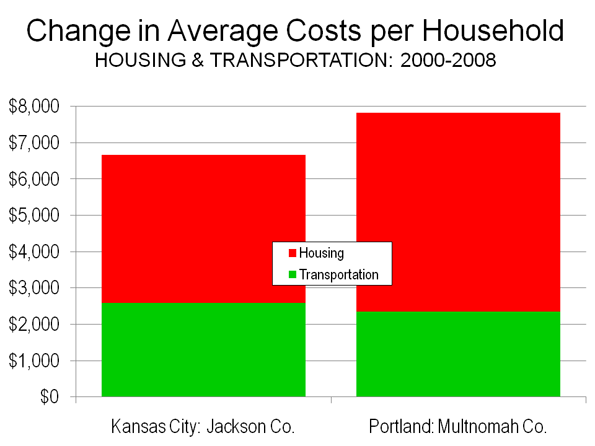
    Yet, there is every indication that housing costs have risen substantially more than transportation costs since 2000. For example, in Kansas City’s core Jackson County, the Census Bureau’s American Community Survey data indicates that the increase in average housing costs was nearly 60% greater than CNT’s transportation cost increase. In Portland’s core Multnomah County, the increase in average housing costs was more 125% greater than CNT’s estimated increase in transportation costs (Figure).

    (2) Exaggerating by Mixing Averages and Medians: The H&T Index compares average housing and transportation costs with the median household income. Averages and means are not the same things. Median income data is “middle” score, with one half of households having incomes above the median and one-half having incomes below the median. On the other hand, “average” housing costs and transportation costs are the total housing and transportation costs divided by the total number of households. High incomes and high priced housing skews averages up. Mixing medians and averages is inherently invalid. For example, in 2008, average housing costs were 19% higher than median housing costs. This means that, on average, where the H&T Index reports a 30% housing affordability figure, it is really substantially lower, at 25% (30% reduced by 19%).

    Thus, the net effect of comparing average housing costs to median incomes makes the housing element of the H&T Index worse than it really is.

    (3) Exaggerating by Leaving Some Households Out: The H&T Index excludes home owning households without a mortgage. The average housing expenditures of households without mortgages are smaller than those of households with mortgages. However, this is a material omission, since housing costs include utility payments. In Multnomah County, excluding households without mortgages raises average housing expenditures by nearly 10% (in 2008). Households without mortgages are households too. The net effect of excluding households without mortgages is to increase housing costs, making the housing portion of the index higher than it would otherwise be.

    (4) Exaggerating by Mixing Data from Different Years: The H&T Index provides 2008 estimates for neighborhood transportation costs, using modeled data. Transportation costs have surely increased since 2000, reaching their peak in 2008 due to the highest ever gasoline prices. CNT again compares these average costs to median household income, but not for 2008. CNT uses 2000 income data. In Jackson County and Multnomah counties, the use of 2000 instead of 2008 data exaggerates transportation’s share of household income between 20% and 25%.

    Each of the above methodological issues is sufficient to render H&T Index outputs to be unreliable.

    Housing’s Role in Housing & Transportation Affordability

    While both transportation and housing costs are important, housing costs have dented household budgets far more than the increase in transportation costs. Even after the house price declines of the last few years, house prices remain well above their historic ratio to household incomes. This will only get worse, if, as many expect, mortgage interest rates rise from their present lows and as rents rise to follow higher house prices.

    In contrast, transportation costs are more susceptible to reduction than housing costs. Once the mortgage is signed, the cost of the house will not be reduced. Once the lease is signed, there is little chance that the rent will be lowered. But transportation costs will be reduced in the future by the far more fuel efficient vehicles being required by Washington. Some people can work at home part of the time. People also change cars more frequently than they change houses. If costs become an issue, perhaps the next car is a compact rather than an SUV.

    CNT’s focus on trends in transportation costs rather than housing costs is consistent with its related study, Penny Wise Pound Fuelish, which advocates expansion of prescriptive land use (smart growth) policies to encourage core urban development and make much suburban development illegal. Yet, these very policies played a dominant role in driving house prices up three times as fast relative to incomes as in metropolitan areas that did not adopt them.

    Genuine advocacy for affordability requires addressing both transportation and housing costs. It also requires recognition of the significant damage done to affordability by prescriptive land use policies. An extra dollar that a household must pay for housing is just as valuable as one spent on transportation.

    All of which leaves us where we started. The nation could still use a reliable housing and transportation index.


    Note: CNT provides no 2008 data for housing costs. Such costs will not be available at the neighborhood level from the American Community Survey until 2012 or 2013. However, it would likely have been no more difficult for CNT to model updated housing data by neighborhood than it was to model 2008 data for transportation costs at the neighborhood level.

    Wendell Cox is a Visiting Professor, Conservatoire National des Arts et Metiers, Paris. He was born in Los Angeles and was appointed to three terms on the Los Angeles County Transportation Commission by Mayor Tom Bradley. He is the author of “War on the Dream: How Anti-Sprawl Policy Threatens the Quality of Life.

    Photograph: Hartford Suburbs

  • I Heart Des Moines

    Forbes Magazine just released its “Best Places for Business and Careers” list and it’s no surprise to me that Des Moines, Iowa just landed in the top spot. Nearly 5 years ago, I’d have said the same thing you may have just muttered. “Des Moines…that’s fly over country…who’d want to live and work THERE?” I fully appreciate your logic with our cold winters, humid summers, and ag-centric heritage. But weather and corn fields aside, the Des Moines metro, a circle consisting of about half a million people, has captured my heart and I’ve become its most passionate evangelist.

    After a lifetime of Southern California bustle, my wife wasn’t exactly thrilled about my desire to abandon our friends and family infrastructure. But ultimately she wanted me to have more than a view from the windshield of a Honda Civic and to be a stay-at-home mom for our kids. We began to see clearly that reaching goals for entrepreneurship, more family time, and more civic engagement were unattainable in our current location. We were ready to reclaim our time, live with less hassle, and stretch a bit.

    So in 2005, we executed geographic arbitrage landing in Clive, Iowa, a beautiful community on the West side of the Des Moines metro. Soon the memory of my 2.5 hour daily plunge into freeway hell was fading. Views of the beaches and mountains from the window of the 6:20AM flight to DFW became real life experiences on urban bike trails and fishing at the lake blocks from my house. A 20-minute drive from end-to-end, the Des Moines metro area defines easy living and 70 miles equals 60 minutes. (I’m still chronically early to my appointments.)

    During those first months here a local business blogger who’d been reading my copious posts on “Why Des Moines?” reached out to me. After coffee and a few introductions, my personal and business network began to flourish. It was hard to comprehend how quickly anyone who’s willing could reach top level contacts in business, associations, and in government. Before long I was shopping a business plan to investors and prominent business owners in town. I was even introduced to State House representatives who cared about my thoughts on what’s happening in their districts. (I went 33 years never meeting a Congressman in CA.) I realized that within a few phone calls I could reach top decision makers, corporate leaders, and legislators and they were willing to listen to me. My business createWOWmedia is growing rapidly now and I’m reaping the benefits of 2.5 years of head down execution and statewide relationship building. I had the time, the energy, and the start up capital through my CA home sale to stop dreaming and start doing. The Des Moines metro gave me that opportunity and I’m thankful for it.

    I’ve figured out that if you’re willing to endure a couple months spent largely indoors or bundled up that the trade-offs are magical and worth their weight in gold. I wouldn’t trade what I’ve found here for anything. The Des Moines metro and the state of Iowa as a whole offer so much…and ask so little in return. Des Moines is easy living defined.

    Am I worried about a massive influx of new Iowans pouring in from Western states based on this piece and Forbes’s recommendations? No chance. But if you do decide to take the plunge and reclaim your life from the concrete jungle, shoot me an email and I’d be happy to guide you. That’s what good neighbors and Iowans do.

    Doug Mitchell is a Southern California refugee who moved his family to Des Moines, Iowa to build a better life. Doug can be reached at doug@createWOWmedia.com or on twitter @doug_mitchell

  • Goldman’s Failure to Disclose

    The big news in finance this week is that Goldman Sachs got busted – finally – for fraud related to those mortgage-backed bonds. At the heart of the Securities and Exchange Commission charges is the accusation that Goldman Sachs failed to disclose conflicts of interest it had on some mortgage investments. One of the charges that Michael Milken plead guilty to in the 1980s was the failure to disclose. “This type of non-disclosure has [not since] been the subject of a criminal prosecution,” according to his website. The charges against Goldman are for civil fraud. The difference between civil and criminal cases is that civil cases are usually disagreements between private parties; criminal cases are considered to be harmful to society as a whole. The judge in the Milken case found that his failure to disclose resulted in $318,082 of financial damage. The SEC is charging that Goldman’s failure to disclose resulted in a $1 billion loss to investors. The former resulted in criminal charges, the later in civil. One has to wonder, given Milken’s 10-year sentence for a relatively small dollar-valued infraction, what would be appropriate in this case.

    The only criminal case related to the financial crisis that has been brought against any Wall Street executive so far was against two Bear Stearns hedge fund managers. They were found not guilty in November of “falsely inflating the value of their portfolios.” Theirs was a crime of commission not omission – they were charged with actively lying to investors and not with failing to disclose information. The closest situation that might result in criminal fraud charges for failure to disclose will be if the Justice Department pursues charges against Joseph Cassano, the AIG accountant who failed to disclose information about the magnitude of the losses AIG had insured. Federal prosecutors have been investigating this since at least April 2009 – information about investigations is not made public, including if the investigation has been dropped, so we don’t know for sure that there aren’t charges in the pipeline.

    All this Wall Street activity that resulted in the US taxpayers forking over $3.8 trillion in bailout money – it’s really hard to imagine that some good-guy-with-a- badge somewhere can’t figure out who harmed our society as a whole.