Blog

  • The Great Deconstruction – First in a New Series

    History imparts labels on moments of great significance; The Civil War, The Great Depression, World War II. We are entering such an epoch. The coming transformation of America and the world may be known as The Great Deconstruction. Credit restrictions will force spending cuts and a re-prioritization of interests. Our world will be dramatically changed. There will be winners and losers. This series will explore the winners and losers of The Great Deconstruction.

    ***

    The phrase, The Great Depression, was coined by British economist Lionel Robbins in a 1934 book of the same name. Its unexpected onset followed years of speculative growth during which economist Irving Fisher famously proclaimed, “Stock prices have reached what looks like a permanently high plateau.” The depression can be traced to the stock market crash of Black Tuesday, October 29, 1929, when stocks lost $14 billion in a single day. During the Great Depression that, followed, unemployment soared to 25%, a drought turned the farm belt into a dust bowl and international trade plummeted by two-thirds. The worldwide slump did not end until the advent of World War II.

    A similar, albeit less catastrophic, stock market collapse occurred in 2008. Following the speculative rise of a housing bubble, trillions of dollars in home equity and stock value were wiped out and 15 million Americans were left looking for work. Paul Krugman, columnist for the New York Times, labeled the worst downturn in nearly a century, The Great Recession. The Dow fell from a peak of 14,093 in October of 2007 to 6,626 in March of 2009. While Wall Street recovered half of its losses thanks to TARP, an $800 billion financial rescue package for the banks, Main Street has lagged behind. Home equity fell by $5.9 trillion. Housing starts plummeted from 2,075,000 in 2005 to 306,000 in 2009 decimating the construction industry. Foreclosure notices went out to 2.8 million homeowners in 2009 and 4,000,000 are projected for 2010. Eight million jobs have been lost and despite an $800 billion stimulus package, unemployment remains at 9.7%. Under-employment, the real jobless number, has reached 17%. Diversion of agricultural water to protect an endangered species in California and a severe drought has brought bread lines to the famously fertile Imperial Valley.

    Like the Great Depression before it, this recession will leave permanent scars on the people. The depression experience made our parents forever frugal. The Greatest Generation became savers, amassing trillions in home equity, stocks and savings accounts. In contrast, their spoiled and coddled children, the Baby Boomers, became the generation of instant gratification. Easy credit and home equity credit lines meant flat screen TVs, vacations, jewelry and jet-skis could be acquired instantly and paid for later. The Baby Boomers entered Congress, the state house and local government with the same attitude: buy now and pay later. Their largesse was fueled by a bubble mentality. Even though the Dot-Com Bubble burst in the late 90s, it was followed by the Housing Bubble of the 00s and a seemingly endless stream of revenue. A spending frenzy ensued with equity rich homeowners offered home equity lines of credit and credit cards with $100,000 limits.

    It wasn’t just consumers who went wild. In many states, such as California, so did the Legislature. In 1999, California rewarded its public employees with generous pensions (SB 400) that allowed retirement at age 50 with 90% of salary – for life. The California Legislative Analyst’s Office estimated the cost of SB 400 at $400 million per year. In 2009, the actual cost was $3 billion. The pension drain contributed to the $20 billion state deficit that California now faces. A Stanford Institute for Economic Policy Research report estimates California’s unfunded pension obligation at $500 billion.

    Cities in California matched SB 400, as did counties and municipal agencies, and it led to similar economic results. On April 6th, the City of Los Angeles announced furloughs for public employees, a 40% pay cut, effective immediately to help plug a $500 million deficit. Vallejo, a small city of 120,000 that generously paid its City Manager $600,000 per year and its firemen, $175,000, was forced to file for Chapter 9 Municipal Bankruptcy once the Great Recession dried up their honey pot.

    The problem has consumed municipal government across the nation. The Center on Budget and Policy Priorities recently estimated budget deficits for cities and counties would reach $200 billion this year. Detroit, with a $300 million deficit, has proposed leveling and returning huge sections of the decaying city to farmland.

    At the Federal level, the Obama Administration projects deficits of $1 trillion per year as far as the eye can see. The unfunded obligations for Social Security and Medicare are a staggering $107 trillion. Congressional Budget Office Director Douglas Elmendorf said, “U.S. fiscal policy is unsustainable, and unsustainable to an extent that it can’t be solved through minor changes. It’s a matter of arithmetic.”

    Elmendorf said fixing the problem will require fundamental changes and government would need to make changes in the large programs, Medicare, Medicaid and Social Security and the tax code, to get the deficit under control.

    When the Credit Card is Denied …

    Such deficits simply cannot be ignored. There will be an intervention. It may come from outside if China, Japan and the Saudis stop buying our debt. It could come from our children who may object to being forced to repay debt they did not spend. It will more likely come from our parents, The Greatest Generation, in the form of a credit intervention. Our parents may intervene, like they did back in the 60s when the Boomers experimented with sex, drugs and rock n roll. When some of us lost control, it was our parents who intervened and straightened us out. They may be forced to intervene once again. this time at the ballot box in November 2010. The Greatest Generation may send the politicians packing, impose order where chaos has reigned, and cut up the credit cards used by their spoiled and coddled Baby Boomer children. Have you noticed who attends the Tea Party rallies? They are retired, educated, tax paying middle class Americans – they look a lot like our parents.

    Deconstruction will take many forms and will encompass all that we know. Private industry has already shed 8 million jobs. The firing of private employees was low hanging fruit. Once untouchable social programs will be forced to disappear. Sacred cows will be slaughtered. Pet programs will be defunded. Even the military may have to learn to live with less. Further changes imposed will cut deep, reaching the union protected public employees and their constitutionally protected pensions. Just as General Motors was forced to abandon its venerable Pontiac brand along with Saturn, Saab and Hummer, unions will lose many of the benefits they obtained the last ten years. There will have to be changes to Medicare, Medicaid and even Social Security.

    We learned something from the health care fiasco. If we treat seniors, our parents, fairly and honestly, they will make the sacrifice. They were upset with the unfairness of the Cornhusker Kickback and the Louisiana Purchase. They became furious when Cadillac health care plans of union members received different treatment than theirs. Treated fairly, our parents will be part of the solution.

    Fifteen million Americans are looking for work. The jobs will not return soon. Thirty-three states have deficits that must be resolved by law. It will not happen without major sacrifice and draconian job lay-offs of public employees at the national, state, and local levels. The furloughs in Los Angeles only portend things to come. The Great Deconstruction has already begun.

    ***************************************

    The Great Deconstruction is a series written exclusively for New Geography. Future articles will address the impact of The Great Deconstruction at the national, state, county and local levels.

    Robert J Cristiano PhD is the Real Estate Professional in Residence at Chapman University and Director of Special Projects at the Hoag Center for Real Estate & Finance. He has been a successful real estate developer in Newport Beach California for twenty-nine years.

  • Power in Los Angeles: The High Price of Going Green

    Greece and Los Angeles are up against a financial wall. Los Angeles had its bond rating cut on April 7. Greece managed to hold out until April 9. Greece has endured public employee strikes as it has attempted to reign in bloated public payrolls. Los Angeles Mayor Antonio Villaraigosa drew the ire of the city’s unions and city council opposition in proposing two-day a week furloughs for city employees.

    A Bankrupt Los Angeles?

    Most recently, the context of discussions has been an expected $73 million payment to the city from the Los Angeles Department of Water and Power (DWP). Mayor Villaraigosa raised the possibility of a city bankruptcy if the payment was not received.

    The Mayor attempted to encourage the city council to approve an electricity rate increase, which was sought by DWP. In support of the rate increase, Villaraigosa submitted a report to the city council saying that “Council rejection of the DWP board’s action [to increase rates] would be the most immediate and direct route to bankruptcy the city could pursue.”

    DWP Interim General Manager S. David Freeman added such action would lead the “utility would think twice about sending” the money o to the city. Despite these warning, the city council then rejected the proposed rate increase.

    The Price of Renewable Energy

    For its part, DWP says that that the rate increase is necessary to cover the costs of investing in renewable energy sources, as required by state and federal regulations. They cited a Mayoral directive to increase generation from renewable sources (solar and wind). Right now the bulk of Los Angeles’ power comes from fossil fuels, much of it from coal-fired plants outside the state.

    Switching from this relatively inexpensive energy is proving very expensive. Indeed, the rejected rate increase is just the first of four planned hikes. The result, if all four increases are ultimately granted by the city council, would be to increase residential electricity bills up to 28% and commercial electricity bills up to 22%.

    How Much Will the People Pay?

    There is a much larger story here than the immediate financial difficulties faced by the city of Los Angeles. It is clear that council members are concerned about the impact of rate increases on their constituents. It is a particularly challenging for consumers in the city of Los Angeles. Unemployment is high, with Los Angeles County consistently above the national average The city, with its higher concentration of poverty, is likely to be somewhat higher. Many households are having difficulty paying their inflated mortgages and hardly in the position less more for electricity. The city has more than its share of poverty. And, finally, the city’s lack of business competitiveness is so legendary that it repeatedly ranks near or in the Kosmont “cost of doing business” surveys.

    This larger story is likely to be played out in communities around the nation, as politicians, such as the President, who expect and perhaps even would favor that electricity bills “skyrocket.” One would think rising expenses in any critical sector are a “non-starter” in the presently hobbled economy. It will be interesting to see what eventually gives in Los Angeles those who advocate for consumers (including some on the city council) , or those, including the DWP and its unions, who wish to add additional costs to the budgets of those already in distress. In the longer run, this will not be sustainable, in Los Angeles or anywhere else, because the public appetite for higher prices is not unlimited.

    But the behavior of DWP is a matter of curiosity, regardless of how or why the city of Los Angeles reached its present financial embarrassment.

    What if it Were Southern California Edison?

    As is indicated from its name, DWP is a publicly owned utility, owned by the city of Los Angeles. Its rate increases are subject to approval by the city council. DWP appears intent on withholding payment from the city because its proposed rate increase have not been approved. Imagine, if instead, the city of Los Angeles were served by a private but publicly regulated electricity utility, such as Southern California Edison (SCE). Imagine further that the California Public Utilities Commission denied a rate increase and that, in response, SCE announced that it “would think twice” about sending some or all of its taxes to the state in response. When DWP officials undertake such a strategy, there is apparently no legal sanction. The legal sanctions against SCE would be manifold. It is a paradox that a publicly owned utility can be less subject to restraint than one that is, in essence, owned by the taxpayers.

    Who is in Charge?

    But there is an even more curious situation. The Los Angeles Department of Water and Power is, in fact, an agency completely under the control of the city of Los Angeles. The Mayor and the city council represent the sum total of the policy authority over the city of Los Angeles and all of its commissions, departments and other instrumentalities. The DWP board of directors is appointed by the Mayor and must be confirmed by the city council.

    Regardless of the Mayor’s authority to remove DWP board members, he has considerable persuasive political power, which could be used to encourage a more cooperative attitude on the part of the DWP. This was proven in 1984, when predecessor Mayor Tom Bradley asked for (Note 1), and received, the resignations of all 150 city commissioners, as well as his two appointees to the Southern California Rapid Transit District.

    Mayor Bradley then announced a practice that required new appointees to submit an undated letter of resignation upon appointment, to ease removal should it be necessary. This became a bi-partisan practice, also followed by Bradley’s successor, Mayor Richard Riordan (Note 2).

    The Crisis Passes

    Within the last couple of days, the immediate crisis appears to have passed, but the fundamental problems wil continue to fester. The city has found $30 million, the result of higher property tax collections. The Mayor is now asking DWP to pay $20 million, instead of $73 million. However, as Mayor Bradley showed, the Mayor can do much more than “ask.”

    The Mayor’s two-day furlough plan for city workers now has been shelved. Ray Ciranna, the city’s Acting Administrative Officer told the Los Angeles Times that: “We are still in a budget crisis, but we will end the year paying all of our bills.” Things, however, may not be so rosy for residents facing stiff electricity rate hikes tied to the inordinate costs of renewable energy. Many of them already face financial distress every bit as serious as the city’s was just a few days ago. This is one Hollywood movie that, sad to say, we may see repeated in other locations around the country as cities, localities and citizens try to cope with the high costs of draconian “green” energy policies.


    Note 1: The author was, at the time, a Tom Bradley appointee to the Los Angeles County Transportation Commission. He was not included in the Mayor’s call for resignations.

    Note 2: While elective offices in the city of Los Angeles are non-partisan, Bradley was a Democrat and Riordan was a Republican.

    Photo: John Ferraro Department of Water & Power Building (City Council President Ferraro was the first chairman of the Los Angeles County Transportation Commission, whose meetings were normally held in the DWP board room).

    Wendell Cox is a Visiting Professor, Conservatoire National des Arts et Metiers, Paris. He was born in Los Angeles and was appointed to three terms on the Los Angeles County Transportation Commission by Mayor Tom Bradley. He is the author of “War on the Dream: How Anti-Sprawl Policy Threatens the Quality of Life.

  • Pondering Urban Authenticity: A look at the new book “Naked City”

    “If you seek authenticity for authenticity’s sake you are no longer authentic.”

    – Jean-Paul Sartre

    As the United States shifted from a manufacturing to a knowledge-based economy during the latter half of the 20th Century, former industrial cities suffered population losses to the suburbs and post-WWII boomtowns. Some of these cities were able to stay afloat while others went into permanent decline never to fully recover. Most experienced an increase in crime and a decrease in quality-of-life.

    Following flight from the city core, an entire generation of Americans, Generation X (born roughly between the early 1960s and early 1980s), was raised in suburban environments which they came to resent as bland and homogenous. Alienated by the conformity of the ‘burbs,, this generation suffered a kind of postmodern malaise which in turn spurred a quest for meaning. Rather than uniting around a single cause like their parents and grandparents, Xers searched for meaning by seeking out a variety of ‘authentic experiences’.

    One of the places that more adventurous GenXers sought authentic experience was in gritty but dangerously alluring urban environments. Rejecting the values of post-war America, many looked to the city as a place to reconnect with the hustle and bustle of diverse and ethnic neighborhoods.

    This was a significant break from what might be seen as aspirational urbanism. Instead of returning to the city for economic opportunity, as had been the case since the inception of the Industrial Revolution, to the move to the city had transformed into essentially a lifestyle choice.

    In her new book Naked City: The Death and Life of Authentic Urban Places, Sharon Zukin assess the effects of this phenomenon by taking stock of her home city New York. Zukin, a Professor of Sociology at Brooklyn College, asserts that a true sense of authenticity has been lost. In the introduction she clarifies this assertion by stating
    “Authenticity is not a stage set of historic buildings as in SoHo or a performance of bright lights as at Times Square; it’s a continuous process of living and working, a gradual buildup of everyday experience, the expectations that neighbors and buildings that are here today will be here tomorrow.”

    Naked City highlights areas where gentrification has had the most impact on neighborhood character, including Manhattan’s Harlem and East Village as well as several Brooklyn neighborhoods. Despite their differences, each of these neighborhoods experienced a similar increase in real estate prices during the recent boom years. As is typically the case with gentrification, condo developers – often constructing projects far larger than commonly found in the area’s traditional landscape – descended upon these places once they had proved to be up-and-coming hip spots.

    In a sense, a neighborhood like Williamsburg has become a victim of its own success. Located conveniently across the East River from Manhattan and full of convertible industrial spaces, Williamsburg is the quintessential model for post-industrial gentrification. With a keen sociologists’ eye, Zukin observes how the influx of hipsters from out of town looking for ‘authentic experience’ has ironically made the neighborhood too costly for long time working-class residents that gave it its appealing identity in the first place.

    One of the most thought-provoking chapters of Naked City, titled A Tale of Two Globals, examines the small Brooklyn neighborhood of Red Hook – not long ago a crime-infested poor community. Red Hook’s sinister reputation subsided in large part due to the arrival of New York City’s first IKEA store in 2008. Zukin describes how the big-box store was fought tooth and nail by gentrifiers yet positively concedes that IKEA ultimately transformed a dead zone and lived up to its promise of hiring local workers.

    Not far from IKEA, a group of Central American immigrants have been serving up snacks in traditional fare at a local soccer field since the early 90s when crack was still a major problem. The pupusa street vendors originally catered to immigrant families attending soccer matches on the weekends. Zukin details how the Salvadoran vendors gained popularity with the hip crowd when the word of the delicious authentic food spread over local food blogs. With their newfound popularity, the street food vendors attracted the attention of city regulators who then proceeded to make their life difficult, coming close to shutting down their entire operations.

    The subtitle of the book alludes to urban deity Jane Jacobs, with whom Zukin shares the skill of making a compelling narrative out of describing urban development battles. Zukin is obviously influenced by Jacobs, but she also dares to be critical of her ideas. She posits that Jacobs focused too much on the built character of the street and did not give enough attention to the sociological factors effecting cities. Zukin might have a valid point: the popularity of Jacobs’ romantic notions of the city helped attract people back to the city in the first place, but in the process transformed them into idealized urban playgrounds. Jacobs’ message has even been twisted by developers and their pundit allies to the point where her ideas are used as marketing tools.

    Zukin deserves much credit for taking on the complex issue of the authenticity of cities. Yet, by the end of Naked Cities, we are left with more questions than answers. Is it really so bad that New York has been gentrified? Has gentrification and increases in living costs been one of the determining factors in helping crime rates drop to historic lows? Certainly, a lower crime rate is better for quality of life but an increased cost of living is no good for the middle and working classes. At one point in her book, Zukin discusses Union Square Park and its affiliation with the local ‘Business Improvement District’ (BID). Union Square Park is in reality a privately run zone masquerading as public space. Is this where are cities are headed? Is this good or bad? A libertarian would say fine but a socialist would probably cry foul.

    Although Naked Cities deals specifically with New York, the issues brought forth by the book are familiar to other American cities. For one, the ‘hipster’ culture, largely defined by Williamsburg in Brooklyn, has replicated itself in neighborhoods in other cities such as the Mission District in San Francisco and Silver Lake in Los Angeles. Though very different in character, the types of people attracted to these places generally share the same tastes in art, fashion and music, bringing their own form of cultural homogenization and conformity to once unique and authentic neighborhoods.

    One thing is for sure – ‘authenticity’ in the true sense of the word has probably departed large parts of New York City for good. Once a representation of new beginnings, the city is well on its way to museum status. This does not mean New York will go away – it may become to the 20th Century what Paris is to the 19th Century.

    When it comes to hope and aspiration, a true sense of ‘authenticity’ is probably best experienced in cities in the developing world such as China where opportunity abounds in urban centers. It can also be found, curiously, in suburban ethnic malls and strip-centers around Los Angeles, San Jose or Houston, or at farmer’s markets and neighborhood activities in less fashionable cities. But, increasingly, not in the once ‘authentic’ place now subsumed in what New York Mayor Michael Bloomberg has dubbed ‘the luxury city’.

    Adam Nathaniel Mayer is a native of California. Raised in Silicon Valley, he developed a keen interest in the importance of place within the framework of a highly globalized economy. Adam attended the University of Southern California in Los Angeles where he earned a Bachelor of Architecture degree. He currently lives in China where he works in the architecture profession. His blog can be read at http://adamnathanielmayer.blogspot.com/

    Photo by [charlie cravero]

  • Reconnecting the In-between City

    The socio-spatial landscape of what we call the “in-between city,” includes that part of the urban region that is perceived as not quite traditional city and not quite traditional suburb (Sieverts, 2003). This landscape trepresents a the remarkable new urban form where a large part of metropolitan populations live, work and play. While much attention has been focused on the winning economic clusters of the world economy and the devastated industrial structures of the loser regions, little light has been shed on the urban zones in-between.

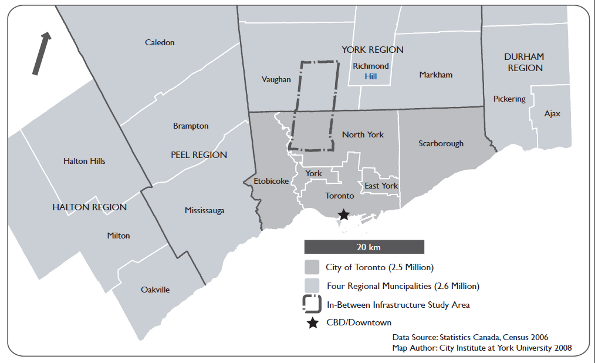
    We view this new landscape with a particular view towards urban Canada. Applying these concepts to a North American city, Toronto, Canada, we look specifically at the 85 square kilometers around York University, an area that straddles the line between the traditional suburb and the inner city.

    A politics of infrastructure
    When we speak of a “politics of infrastructure”, we refer to a growing awareness that involves political acts that produce the infrastructure policy for urban regions. We therefore follow Colin McFarlane and Jonathan Rutherford’s advice to open up “the ‘black box’ of urban infrastructure to explore the ways in which infrastructures, cities and nation states are produced and transformed together”. This “politicization of infrastructure” involves the understanding of how infrastructure policies and planning are linked to “the co-evolution of cities and technical networks in a global context” (McFarlane and Rutherford 2008: 365). The politics that produced the (public) modern infrastructural ideal for the centres and the (privatized) modern infrastructural ideals for the peripheries, largely marginalized the role of d the in-between cities of our metropolitan regions. They were left as residual spaces filled by thruways and bypasses.

    But the increased significance of these spaces today commands our attention in new and inevitable ways. In this sense, the politics of the in-between city suggests the need for a de-colonization from the forces that built the glamour zones at both ends of its existence: the urban core and the classical suburb or exurb.

    The newest – 2006 – census figures in Canada reveal that 70 percent of the population live in metropolitan areas (see note). However, within those urban areas they increasingly live outside of urban cores in a new kind of urban landscape. Interestingly, more Canadians also work in the suburban parts of metropolitan areas. The number of people working in central municipalities increased by 5.9 percent from 2001 to 2006 whereas the number of people who worked in suburban municipalities increased by 12.2 percent.

    Of course the growth of the traditional suburban kind continues, and while inner cities experience densification of office and condominium developments, much of the most dynamic growth areas are literally in-between. But the picture in the old suburbs and the enclaves is a distinctly mixed one. There are areas of aggressive expansion, for example around suburban York University in Toronto, where a New Urbanist-styled “Village at York” has added one thousand units of residential space. Yet just one block away, the Jane-Finch district continues to lose both in economic standing and demographically and remains one of the designated “priority neighbourhoods” where the City of Toronto sees much room for socio-economic improvement.

    Yet even as these in-between areas experience fast paced socio-spatial change, the realities of political and administrative power leave them marginalized. The Steeles Avenue corridor at the northern edge of the York University campus, for example, is a major east-west thoroughfare at the border of two municipalities – Toronto and Vaughan – that has enjoyed little attention from the cities’ investors and resident communities. Planners in the two municipalities have only recently begun to think about redevelopment possibilities in the corridor, but their policy-making is largely in isolation from each other. Just where the need for articulated urban infrastructure development is greatest, the capacity to act is least.

    At the same time, the linear nature of public transit and other networked infrastructure which favour either mass concentration of jobs or housing or wealthy suburban enclaves – leaves many places that lie between designated destinations in a fallow land of unsatisfactory access. This bias is corroborated by the political decision making processes.

    No politician, planner or bureaucrat will champion public expenditure in the in-between zone, particularly if they are inhabited by or provide jobs to socially less powerful groups. As a consequence, infrastructure built to connect centres actually disconnect those non-central spaces that lie in-between. While highways link smart centres and movieplexes around the urban region, blue collar workers in the widespread facilities of the sprawling suburban Toronto industrial districts rely on irregular buses or van service to get them to and from work.

    Empirically, our 85 sq km study area – partly in the City of Toronto and partly in the City of Vaughan – is home to about 150,000 people. It is a place that is rich in social and physical complexities and contradictions. Uneven access to different infrastructure is particularly visible in the poorly understood and under-recognized “in-between city.” Casting light on the infrastructure problems of the “in-between city” is a necessary precondition for creating more sustainable and socially just urban regions, and for designing a system of social and cultural infrastructure that meets community needs.

    How can renewal come to the politics of infrastructure in the in-between city? The question is how our respones to the global economic recession can effect these oft-neglected regions. Will they reinforce the ways in which the in-between areas and their dependent populations have been marginalized or will they participate in the renewal?


    Note: Census Metropolitan Areas are defined as having a population of at least 100,000.

    References
    McFarlane, Colin and Jonathan Rutherford (2008) Political Infrastructures: Governing and Experiencing the Fabric of the City, International Journal of Urban and Regional Research 32,2; 363-74.

    Sieverts, Tom (2003) Cities Without Cities. Between Place and World, Space and Time, Town and Country. London and New York: Routledge.

    Roger Keil (Dr.Phil, Frankfurt) is the Director of the City Institute at York University, the Director of the Canadian Centre for German and European Studies, and Professor at the Faculty of Environmental Studies at York University, Toronto. Keil’s current research is on the global suburbanism, infrastructure in the Zwischenstadt, on cities and infectious disease, and regional governance. Keil is the co-editor of the International Journal of Urban and Regional Research (IJURR) and a co-founder of the International Network for Urban Research and Action (INURA).

    Douglas Young is Assistant Professor of Social Science at York University where he teaches in the Urban Studies Program. He is a former architect, municipal planner and developer of non-profit housing cooperatives. He is co-author of a book about politics in Toronto, “Changing Toronto: Governing Urban Neoliberalism,” which was published in 2009 by University of Toronto Press, and co-editor of a forthcoming book, “In-between Infrastructure: Urban Connectivity in an Age of Vulnerability,” which will be published by Praxis (e) Press. His current research interests include infrastructure in the in-between city, suburban renewal, and urban legacies of socialism and modernism.

  • Sao Paulo: Upward Mobility through Music

    In a city notorious for its vast gap between rich and poor and the involvement of children in gang activity and drug trafficking, a music school is providing an opportunity for the young people of the favelas to put their energies to better use in performing for themselves and their communities. The school’s band has now toured the world and received visits from heads of state. This documentary tells the story of Sao Paulo’s Meninos Do Morumbi and how it has affected the lives of its students.

  • Transit in Los Angeles

    Los Angeles officials hope to convince Congress take the unprecedented step of having the US Treasury to front money for building the area’s planned 30 year transit expansions in 10 years instead. The money would be paid back from a one-half cent sales tax (Measure R), passed by the voters in 2008. That referendum required 35% of the new tax money to be spent on building 12 rail and exclusive busway transit lines.

    Measure R was not the first instance of Los Angeles officials committing to spend 35% of a new one-half cent sales tax on new transit lines.

    Proposition a: the Start of it All

    In 1980, County Supervisor and Los Angeles County Transportation Commission (LACTC) chairman Kenneth Hahn, whose district included low-income south Los Angeles, made a last-minute proposal (Note 1) to place a half-cent sales tax on the ballot to lower bus fares to $0.50. No funding would have been provided for rail.

    Chairman Hahn’s proposal was amended twice and adopted by LACTC (Note 2). The first amendment provided funding to municipalities to start or expand their own transit services. The second amendment (which I spontaneously introduced), dedicated 35% of the money to building a rail system (My seconder, Supervisor Baxter Ward, required excluding busways). A 10 corridor map was drawn during the meeting (see Rail Rapid Transit System above). LACTC (Note 2) approved the program, which was adopted by the voters as Proposition A in November of 1980.

    Results: The Proposition A programs met with varying levels of success (and failure):

    Bus Fare Reduction: The bus fare was reduced for three years. As a result, transit ridership at the Southern California Rapid Transit District (SCRTD), the principal bus operator, rose 40%, to its modern peak, in perhaps the largest major system ridership increase in modern history. The program was also cost effective, with a cost per new passenger of $0.56 (2008$), a small fraction of virtually any new rail system built in the United States in recent decades. Fares were raised in 1985 and one-third of the bus ridership disappeared.

    Municipal Transit Services: The more efficient municipal bus operators (such as Santa Monica, Long Beach, Gardena, Montebello and others) used the new money to expand their services and ridership. Other jurisdictions established new local services, usually provided more cost-effectively by private operators under competitive contracts (costs average 40% less per hour).

    Rail Program: As it turned out, LACTC grossly over-promised on the its rail system. By 1990, only four lines were either completed or under construction but there was no money for the rest. Another half cent tax was approved by the voters to finish the job. By 2008, six lines were completed or under construction, still short of the 1980 promise. During the interim, two new exclusive busways had also been added to the system. The 2008 referendum, Measure R, would finish the job, and more, by building 12 new rail or exclusive bus lines.

    Nonetheless, approximately 300,000 people ride the metro and light rail trains of the Los Angeles County Metropolitan Transit Authority (formerly the Southern California Rapid Transit District) every day. Some MTA officials have even suggested that this decade’s modest growth in Los Angeles traffic congestion has resulted from people giving up their cars to ride the rail lines.

    The Results: The reality is quite different. Even when gasoline prices peaked at nearly $5.00 per gallon in 2008, total MTA bus and rail ridership was 5% below 1985 levels, indicating that for each new rail rider; at least one former bus rider had abandoned transit. Daily bus ridership dropped more than 300,000 (Table 1).

    Moreover, traffic congestion growth slowed during this decade Los Angeles not due to a shift to transit (there wasn’t one), but because of its anemic population growth, with Los Angeles County adding only one-quarter the number of new residents during the 2000s as had been forecast. The Los Angeles metropolitan area (including Orange County) also had the highest rate of domestic outmigration in the nation from 2000 to 2009, losing at a rate one-third greater than Detroit. Employment in Los Angeles County was at the same level in 2008 as in 2000.

    Table 1
    MTA/SCRTD Ridership, Costs and Fare Recovery: 1985-2008
      1985 2008 Change
    Unlinked Trips (Millions)             497          474 -5%
    Passenger Miles (Millions)          1,947      1,989 2%
    Operating & Annualized Capital Costs (Millions)  $      1,077  $  1,775 65%
    Cost per Passenger Mile  $        0.55  $    0.89 61%
       Bus: Cost per Passenger Mile  $        0.55  $    0.77 38%
       Light Rail: Cost per Passenger Mile  $    0.85
       Metro: Cost per Passenger Mile  $    1.81
    Fare Ratio 23% 19% -19%
       Bus: Fare Ratio 23% 25% 5%
       Light Rail: Fare Ratio 11%
       Metro: Fare Ratio 8%
    Bus capital costs estimated using national ratio from APTA Transit Fact Book
    Rail capital costs estimated from mid-year of project construction (discounted at 7% over 30 years)

    The Costs: Rail systems are often promoted for their “cost-effectiveness.” However, these claims always exclude the cost of capital (building the system and buying the vehicles). Capital costs are far higher for rail systems than for buses. Los Angeles is no exception. It is estimated that SCRTD/MTA annual capital and operating costs rose 65% from 1985 to 2008, adjusted for inflation, in large measure due to the rail services. Bus riders pay double or triple the fares in relation to costs as rail riders (Table 1).

    With Other Bus Operators: Ridership Up, Market Share Down:

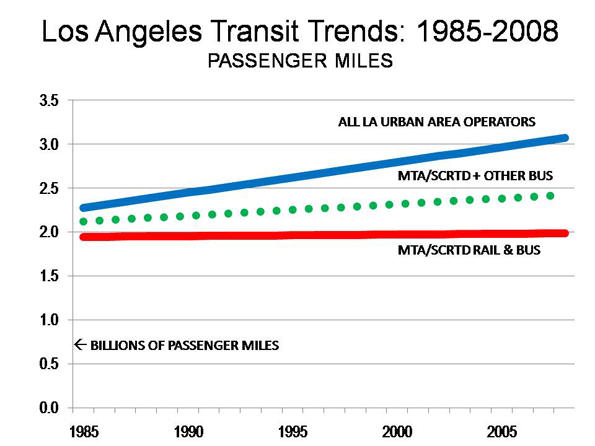
    Los Angeles is somewhat unique as a metropolitan area in having a large number of transit operators. So, even as the MTA/SCRTD system grew, the other bus systems expanded more rapidly. This was made possible by their more cost-effective operation and, especially among the newer systems, the use of competitive contracting (contracts with private operators) to reduce costs even more. In 2008, for example, more than 35% of the county’s bus service was provided by operators other than MTA. Approximately 85% of the added transit usage (passenger miles) from 1985 to 2008 was from the bus services of these other operators.

    Overall transit ridership increased in the Los Angeles urban area, with the new five-county Metrolink commuter rail system contributing substantially to the increase as well. The neighboring Orange County Bus system doubled its ridership, while rejecting rail (Figure). Even so, transit’s market share in the Los Angeles urban area declined nearly 10% from 1985 to 2008 (Table 2).

    Table 2
    LOS ANGELES URBAN AREA ROADWAY & TRANSIT DATA
      1985 2008 Change
    Annual Roadway Passenger Miles    114,590   168,219 47%
    Annual Transit Passenger Miles         2,279       3,071 35%
    Roadway & Transt Passenger Miles    116,869   171,290 47%
    Transit Market Share 2.0% 1.8% -8%
     
    Freeway Lane Miles         5,310       6,992 32%
    Vehicle Miles per Freeway Lane Mile       13,487     15,037 11%
    Average Congestion Delay (Peak Period) 27% 49% 81%
    Los Angeles urban area includes Mission Viejo urban area.
    Metrolink commuter rail system: 75% of passenger miles estimated in Los Angeles urban area.
    Annual passenger miles in millions

    Prospects: The Next 30 Years

    Los Angeles has again committed to a major expansion of transit service, despite the fact that the Metro and light rail lines have done little more than siphon ridership from buses. There is little to suggest that the future will be any more successful than the past.

    • MTA, like LACTC before it appears to have over-promised on transit expansion. 35% of a half-cent sales tax is no more likely to finance a 12 line expansion today than a 35% share could fund an 11 line expansion in the 1980s and 1990s.
    • Nonetheless, new transit lines will be built. These Measure R expansions are likely, however, to be no more successful in reducing traffic congestion than the earlier rail expansions.

    Further, funding the Measure R rail system is likely to be more challenging. The original Proposition A was followed by decades of growth, which generated rising tax revenues. Now, however, both LA’s population and employment growth have ground to a standstill. The rosy revenue forecasts are not likely to be achieved, which should be a matter for concern among not only local officials, but to the federal taxpayers being asked for a hefty advance.


    Notes

    1. LACTC had held hearings on a proposed ballot initiative, but a consensus had developed that no referendum would be placed on the ballot in 1980. Chairman Hahn surprisingly called a special meeting of LACTC just before the deadline for submitting a measure to the ballot.

    2. LACTC was the principal transportation (transit and highways) policy body in Los Angeles County from 1977 to 1993. By state law, the commission included the mayor of Los Angeles, the five county supervisors (county commissioners), the major of Long Beach, two elected officials from smaller cities, and two additional appointments by the mayor of Los Angeles. Mayor Tom Bradley routinely appointed a city council member to LACTC and a private citizen (three times the author of this article). In 1992, LACTC and SCRTD merged into the Los Angeles County Metropolitan Transportation Authority (MTA), which has a similarly composed board of directors.

    Illustration: 1980 Proposition A Rail Map (Los Angeles County Transportation Commission)

    Wendell Cox is a Visiting Professor, Conservatoire National des Arts et Metiers, Paris. He was born in Los Angeles and was appointed to three terms on the Los Angeles County Transportation Commission by Mayor Tom Bradley. He is the author of “War on the Dream: How Anti-Sprawl Policy Threatens the Quality of Life.

  • Jobs Will Rule November

    Health care lays behind him, financial reform and climate change ahead, but for President Barack Obama–and his opponents–there is only one real issue: jobs. The recent employment reports signal some small gains, yet the widespread prognosis for a slow, near-jobless recovery threatens the president and his party more than any major domestic challenge.

    Tea party activists and conservative ideologues often link the president’s dwindling popularity to an overreach on health care, but it all boils down to the old Clintonian adage: It’s the economy, stupid. Health care reform is simply too complex and its long-term effects too unknowable to be a winning issue for either side.

    The jobs deficit, on other the hand, is immediate and affects tens of millions of families. You can start with the highest-ever percentage of long-term unemployed on record. In recent months there have been roughly five to six applicants for every open position. Youth unemployment reaches near 20% for workers in their 20s–more than 25% for teenagers and over 43% for black teens. Even if the economy improves, according to the administration predictions, unemployment could remain close to double digits by the mid-term elections and over 8% by 2012.

    The prospect of long-term unemployment, and underemployment, is clearly damaging the “hope” brand once associated with the president. Recent CBS poll data show that 84% of Americans are worried about the economy.

    Over a third of those polled were concerned that someone in their household might lose their job. Some 52% identify the economy as the most important issue, while health care registered only 13%. Given the administration’s focus on health care and other issues–such as climate change–it’s not surprising that barely two in five of those polled approve of the president’s handling of the economy.

    Those inside the Washington bubble are too absorbed with political maneuverings to focus on the basic. The primary domestic challenges for the country lie not in addressing climate change, suburban sprawl or gay marriage, but spurring employment and generating new wealth.

    Part of our problem is that the two main parties are committed primarily to serving the interest of aligned constituencies .Republican dogmatism and canine-like obedience to short-term corporate profits contributed mightily to the economic meltdown. In its period in power , the GOP failed to either restrain Wall Street or address the nation’s indebtedness. No surprise then that many even moderate, middle-class voters opted for the Democrats over the past two elections.

    The question now is whether the Democrats are squandering their advantage. After almost 15 months in office, Democratic dogmatism–a mixture of faith in all forms of federal spending, “green jobs” and ever more regulation–has not exactly turbo-charged the economy. As a result, middle-class voters–those making $50,000 to $75,000 annually, have been slipping from the Democrats, according to a recent Wall Street Journal poll. These are precisely the voters who also put Scott Brown into the Senate.

    Yet the president’s situation is far from hopeless. Manufacturing payrolls are slowly beginning to grow, and industrial production is on the upswing. Survivor sectors such as health care continue to create new jobs. The bleeding may have finally stopped in construction, where the recession has been particularly devastating. Although the generally high-wage finance and information sectors continue to shrink, rapid growth in temporary business services could presage a new wave of permanent hires.

    These improvements suggest new opportunities for Obama. It allows him to point to a relatively stronger economy–particularly compared with Japan and the E.U.–as proof both of his policy acumen and our country’s overall vitality.

    This is when we really find out whether Obama is a thoughtful moderate of the campaign trail who embodies American exceptionalism or the hard-edged tool of the Democratic constituency groups. So far he has been a man of the left more comfortable with expanding the public sector than finding ways to boost private sector payrolls.

    The stimulus, crafted by old-dog Democrats like Nancy Pelosi and Harry Reid, with its emphasis on government workers and the university-industrial complex, solidified this notion. A public-sector-oriented approach has proved to have limited popular appeal, particularly at a time when many in the private sector regard the public workforce as an oppressive and overcompensated privileged class.

    Administration fiscal policy also erred in its focus on Wall Street. Obama, described during the 2008 campaign as the “hedge fund” candidate, has indeed done very well for this privileged class. Yet Democrats are hard-pressed to make the case that what’s good for George Soros is good for the USA.

    Now the question is whether the president can refocus on jobs. This will take, among other things, backing off the economically ruinous climate change agenda. Even the most gullible economic development officials are beginning to realize that “green jobs” are no panacea.

    In fact, as evident in Spain, Germany and even Denmark, over-tough green legislation can destroy the productive capacity of the most enlightened industries. Similarly in green strongholds like California and Oregon, the mounting climate change jihad could slow and even explode the incipient recovery by imposing ever more draconian regulation on businesses that can choose to migrate to less onerous locales.

    There are some hopeful signs of Obama’s repositioning. His recent moves embracing nuclear power and off-shore oil drilling, however inadequate, show that he’s at least trying to triangulate between the green purists and the unreconstructed despoilers. Some sort of moderated energy legislation–there’s no way to get the more radical House version through the Senate–would reassure businesses and the public that the president has jobs as his No. 1 priority.

    The well-funded, politically connected environmental lobby, no doubt, will try to head off any dissent from its agenda. But the same hard-boiled pol who threw his own pastor under the bus–remember Rev. Jeremiah Wright?–would seemingly be willing to diss pesky affluent white greens who, after all, have nowhere else to go politically.

    An equally good opportunity lies in the push for financial reform. As in the case of health care, the Republicans have a miserable record to defend. After all, the GOP dominated Congress and White House did little to rein in the out-of-control financial sector. Sure, there’s blame to go around for folks like Barney Frank but the buck was definitely with the Republicans, and they failed.

    Main Street businesses that felt ignored by the stimulus might look favorably on tough administration polices against big banks. Republicans could yet score points by opposing “too big to fail” provisions, as Mike Barone suggests, but one has to wonder if Republicans possess the moxie to stand up to large corporate interests, even detested ones.

    But right now the burden is on the president. Building on what is still a weak recovery, he must make clear that jobs and growth are his top domestic priorities. If he fails to communicate that message adequately, the voters, however leery of the Republicans, will rebuke him.

    This article originally appeared at Forbes.com.

    Joel Kotkin is executive editor of NewGeography.com and is a distinguished presidential fellow in urban futures at Chapman University. He is author of The City: A Global History. His newest book is The Next Hundred Million: America in 2050, released in Febuary, 2010.

  • The State of Illinois’ Long Term Decline

    Barack Obama’s home state is in the news but not for positive reasons. Fitch downgraded Illinois debt. At the end of March, according to the Bond Buyer:

    Fitch Ratings late Monday downgraded Illinois’ general obligation rating one notch to A-minus and warned of possible further action by leaving the state’s credit on negative watch ahead of $1.3 billion of short- and long-term GO issuance in three deals over the coming weeks.
    Gov. Pat Quinn had hoped that the General Assembly’s passage last week of pension reforms would stave off any negative rating actions and buy the state some additional time to address a nearly $13 billion budget deficit and liquidity crisis in the current legislative session.

    Fitch isn’t Illinois’ only problem. The Chicago Tribune wrote a devastating editorial concerning Illinois’ economic performance:

    once-thriving Illinois in February had 475,000 fewer jobs than it did in November 2000. Even replacing every one of those jobs wouldn’t fix the sorry state of this state: Factoring in population growth over the last decade, Illinois needs 600,000 new jobs just to get the employment level back to where it was. The cumulative cost to Springfield of those lost jobs: $6 billion in tax revenues through fiscal ’09 and, barring some miracle, $10 billion through fiscal ’11.

    Illinois politicians keep trying to blame job losses on the Great Recession. But this is only the latest bad patch in two decades during which Illinois has lagged the nation at growing jobs. Geoffrey Hewings, head of the U. of I.’s Regional Economics Applications Laboratory, says something else has to explain why Illinois unemployment keeps running well above the national rate: “Our economy looks like the U.S. economy” in terms of its blend of manufacturing, service and other sectors. “Yet since 1990, we’ve underperformed the U.S. in job creation.”

    In fact, for the decade before this recession began, other researchers have pegged Illinois’ job creation rate at 48th in the U.S., ahead of moribund Ohio and Michigan. Can’t blame recession for that.

    Illinois lawmakers spent much of the last 20 years treating private-sector employers as if they were stupid — unable to understand that they and their workers eventually would have to pay for too much state spending, borrowing and promises of future obligations — none more egregious than the now severely underfunded retirement benefits for public employees.

    This kind of editorial might scare away future business expansion in Illinois. It wasn’t easy for the Tribune to write this one because it’s so negative that it even might scare advertisers away. But, the truth can’t be ignored much longer. Special interest groups are thriving, but taxpayers are not. The long time Illinois Speaker of House is more responsible than any individual for Illinois’ persistent financial problems. Illinois declines, but Madigan’s property tax appeals law firm thrives.

  • New Urbanism, Smart Growth, & Andres Duany: A Critique From Suburbia

    In 1998 Hollywood introduced us to a new star when it released The Truman Show, shot on location at Seaside in Florida. No I’m not talking about Jim Carrey, Laura Linney or Ed Harris. I’m talking about none other than Andres Duany.

    A few months ago, I stayed at the magnificent WaterColor Inn, which is in the neighborhood adjacent to Seaside. Watercolor is closer in feel to a suburban development’s sense of space (more open), but WaterColor’s Town Center doesn’t offer a large choice of restaurants, so Seaside serves as a destination. Other than a sign marking the border, one does not immediately feel as if Seaside and WaterColor are two very different developments.

    While both Duany and Peter Calthorpe seem to make claims to be the founders of the New Urbanism, Duany gets more attention. I’ve only met him once, at a conference. I was impressed with his presentation as honest and straightforward, even though I’m not a New Urbanist — quite the opposite, in fact. He spoke of his disdain for the suburbs, but agreed that 80% of the housing market preferred them, and then went on to speak of the benefits of New Urbanism.

    What I experienced in Seaside was much different than what I expected from watching The Truman Show. When the film was released, the main feature of a typical cookie-cutter suburban home was… well, uh, hmm… I guess you could describe it as quite featureless. But some developers and builders ventured forth into New Urbanism, or an emulation of the look. The home buyer was now faced with a choice: the requisite aluminum, white, three car garage door with the home hidden somewhere behind it, or a home with a front porch instead. Buyers became smitten. They may have still bought the garage snout home, but the writing was on the wall. The days of the vinyl clad / garage forward / featureless home were numbered, and if builders were smart, then they had to increase their architectural character. Many suburban homes gained a porch, some architectural detail, and a somewhat less prominent garage. Buyers started demanding walks and other amenities… and builders and developers responded until the housing market crashed.
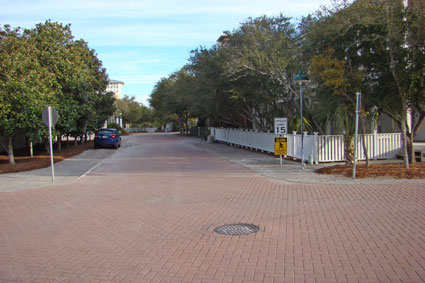
    This evolution can be attributed more to the efforts of Duany than of anyone else. The Duany developments stand apart from some other New Urbanist development partly because of their detail and character, and partly because of their high price point. I’ve been to the Kentlands, I’on, Celebration, and now Seaside. The architectural and landscape detailing is outstanding. When I went to Kentlands, a decade ago, I got lost; it breaks from the Smart Growth grid theory. There was nobody sitting on the porches, and I saw only one person walking. To be fair it was during the workday. I was really looking forward to a stroll to the local coffee shop, but instead, the K-Mart strip center defined the entrance with no apparent internal commercial development. I understand that today there are more walkable services.

    On my I’on visit (on a nice weekend) I saw very large homes with only single car garages or no garages at all. Again, nobody was sitting on any of the porches (which were spacious and beautiful), but there were people strolling. I’on is a very large development, and the only one I visited that seemed to be planned on a grid. The only local businesses (at the time) were a chocolate shop, a hair stylist, and the I’on sales office. For anything else you would probably need to drive.

    Upon entering Celebration we were greeted by massive, majestic homes that align the main street. Very cool. This gives a feeling of arrival, as opposed to a suburban development that would typically showcase the highest density and cheapest product at the front entrance (blame Levittown transitional zoning for that). On a Sunday morning my wife and I had a coffee in the Celebration town center. We were alone, other than one other table where a real estate salesman was trying to sell one of the homes. The stores were open, but either people aren’t shopping before 11:00AM on Sunday mornings, or they simply get tired of frequenting that same shop that sells all items with “Celebration” logos. Again, not a soul on the front porches, and only a few on the walks.

    I distinctly remember Seaside from The Truman Show as well coiffed and manicured. Homes all behind picket fences. When we strolled the streets, the landscaping between each home and white picket fence was overgrown, making it difficult to see the homes and closing up space along the streets. There were no walks along the streets. There were natural trails in a straight pedestrian system behind each home along the rear yards, with paths so narrow (about 4’ between picket fences) that I needed to follow behind my wife as we strolled through the blocks (these paths were not in the movie).
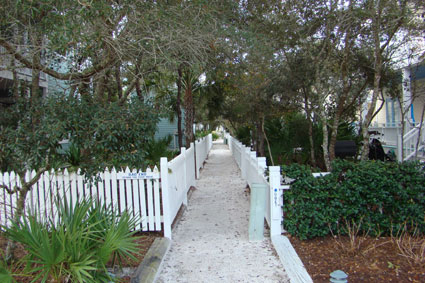
    Many of the homes had observation towers hovering over the rooftops, cool architectural features that would allow a view of the shoreline. A decade after the development’s premiere, that open view was closed up by a wall of very large ocean view homes, blocking all those great views that the towers would have provided. There’s now little tie from the community to the shore other than a single bar elevated above the shops allowing a good view.

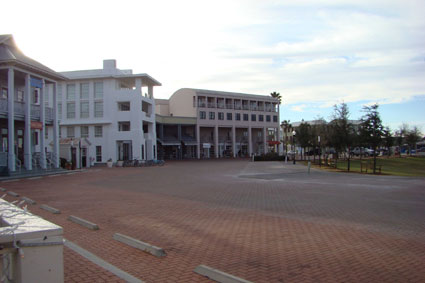
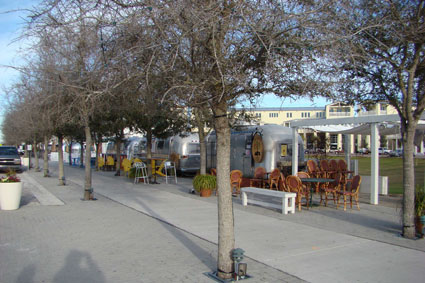
    In general, much of Seaside is overgrown with landscape that blocks the feeling of space. We were told by a few sources that only about twenty residences have full time owners, with the rest rented. There were a few restaurants and bars, and the same grocery store that was in The Truman Show, but the feel of the development was much different than what I expected after seeing the movie. The main street has rows of Airstream trailers with street vendors selling various food items, something I found distracting from the image of New Urbansim; very touristy. The general pattern of Seaside is quite maze-like, requiring us to carry a map as we took a stroll.

    By contrast, WaterColor has similar architectural character, but is much more diverse in its open spaces and provides the look of Seaside with a more suburban sense of space. Seaside homes generally lacked vehicle storage or protection from the elements; WaterColor homes had the convenience of garages — mostly, but not all, in alleys — and some carports. Garages are an indication of permanent residence, not a weekend jaunt. They keep many of the cars off the street and out of sight. Unlike a standard New Urbanism design that separates the garage from the home (as if a car contained some negative aura that could take control of our lives), the WaterColor homes had the garages attached. WaterColor is a place you can live in, not just rent for a week.

    If the nation’s suburban architectural character has improved, I think much of it is due to the effort that Duany has taken to showcase New Urbanism, which has had a positive influence in the overall character of land development. Whether New Urbanism thrives or it fails, he has left us this lasting gift. Duany developments I’ve visited are beautiful, even with their flaws and their high priced entry.

    But architecture and landscaping are NOT planning. And here lies the problem. You can take the worst planned neighborhood and showcase it with the Duany style of high quality elements —- his eye for architecture and landscaping —- and it will look great. In a well-planned suburban neighborhood, on the other hand, the display of repetitive garage-grove facades with plain vinyl siding, void of landscaping other than the requisite sod, will look awful. As people drive or stroll through the Duany development, they will naturally say it’s well planned, even if it’s dysfunctional, inefficient, and has a high environmental impact. This is not to say that it necessarily is, but you can’t feel those things from street level. The plain subdivision will be identified as terribly planned, even if the plan is functional and efficient with low environmental impacts.

    I’m not a follower of Duany and disagree with much of his ideology. But I do thank him for making the real world, suburban and urban —- not just the make-believe world of The Truman Show —- a better place.

    Rick Harrison is President of Rick Harrison Site Design Studio and Neighborhood Innovations, LLC. He is author of Prefurbia: Reinventing The Suburbs From Disdainable To Sustainable and creator of Performance Planning System. His websites are rhsdplanning.com and performanceplanningsystem.com.

    Photo: Seaside, Florida’s Post Office — Where they filmed ‘The Truman Show’

  • Queensland, We’ve Got a Problem

    Queensland Premier Anna Bligh MP has a problem. Reacting to sensationalized media reports of runaway population growth as well as an infrastructure lag revealing itself in everything from mounting congestion to a lack of hospital beds, Queensland residents are starting to say ‘enough.’ The prospects of continuing population growth at around 2.5% or 100,000 people per annum, despite the economic benefits this brings, are increasingly unpopular, something that gets the attention of most politicians.

    In many ways it’s ironic for Premier Bligh to find herself in this position. She follows a succession of Premiers who managed to get away with weekly media boasts of “1500 people every week” moving into the State, drawn – it was alleged – by our climate and lifestyle. In the past, any Premier who questioned this growth would have felt the result at the ballot box.

    Bligh’s response has been (in a time honoured tradition) to convene a ‘summit of experts’ and community representatives (you can read it all here), designed to thrash out a policy accord for the future. No politician worth their salt holds an inquiry unless they have a fair idea of the outcome in advance, so it’s a fair bet the outcomes will include even more regulatory controls on urban growth, in the name of ‘sustainability’ to appease the anti-growth coalition of greens and neo-Malthusians. Pro-growth lobbies on the other hand will be promised a ‘business as usual’ attitude to economic expansion, only under more ‘responsible’ oversight.

    But the biggest irony is that attempts to contain or control growth may be too late. It is just possible that the unthinkable will happen: growth will stall, and in coming years, a future Premier will be wondering what went wrong.

    How could this happen?

    First, a bit of history. Queensland’s growth status in the Australian context has been driven over the past 30 years almost entirely from interstate migration. Low state taxes, relatively cheap housing, aggressively pro business governments (including one which famously went too far) and a ‘Florida-like’ allure of lifestyle and warm climate all combined to make the state a population magnet. “The Sunshine State” – just like Florida – was how tourism promoters labeled it. “The low tax state” was the label peddled by business promoters. Both became interchangeable.

    In contrast, international migration to Australia was largely focused on Sydney and Melbourne. The rate of natural births over deaths was barely in the positive, resurrected recently by a Federal Government baby bonus of questionable long lasting effect. This left interstate migration as Queensland’s growth driver.

    Arrivals from Victoria or Sydney could famously relocate to the south east corner of Queensland and find themselves in a better quality home, in a more convenient location, and with cash left over. They were faced with shorter commute times, lower taxes and overall a better quality of life than the one they left behind.

    But in the late 1990s this all started to change. Increasing land use controls appeared as planners sought to ‘manage’ the growth of the state better. “We can’t destroy what you came to enjoy” became a new mantra, and an urban growth boundary for the popular south east was introduced under ‘smart growth’ principles. In the 1995-2000 period, three statutory plans appeared for the south east, followed by a 10 year regional planning program in 2000 (SEQ 2021) followed by an Office of Urban Management in 2004, a South East Queensland Regional Plan in 2005 and then an updated version in 2009.

    It’s become an industry joke that we now produce more plans than houses. But the inevitable consequence of this explosion of planning regulation – matched at the same time by the surreptitious introduction of exorbitant per lot housing levies under the guise of ‘user pays’ – was to drive up housing costs rapidly while drying up new supply.

    Queensland housing construction is now at a 20 year low. The median house price, which in 1999 was half that of Sydney’s, is now 80% of Sydney prices and roughly at 8 times average incomes. A thirty year or more tradition of relatively lower cost housing in Queensland has been smashed in the space of six or seven years.

    Also over the same period, the state’s tax advantage has been eroded. Once Queensland boasted some of the lowest vehicle registration fees in the country; now it has the highest. Electricity prices, also once amongst the cheapest of any state, are now just as expensive. Land and other property taxes have rapidly caught up with other states and overshot others. According to the Institute of Public Affairs IPA, state business taxes in just one year went from being the second lowest in the country in 2008 to mid field by 2009. Roads and other infrastructure which were once enjoyed as part of the general tax contribution are separately tolled, water is priced and charged separately from council rates to residents. Overall, the general cost of living advantage compared to interstate rivals has evaporated.

    The rapid erosion of Queensland’s relative tax and cost of living advantage prompted a writer for The Australian newspaper to lament in late 2009 that: “Queensland has squandered its low-tax edge and become a public-sector spendthrift, putting at risk its long-term growth potential and ability to attract investment.”

    In fairness, maintaining low taxes and funding a generational catch up in infrastructure might be mutually exclusive. The state is now undergoing a record level of infrastructure investment, in response to the growth it has witnessed. The timing for Premier Bligh though is not good: the benefits of this new wave of infrastructure might not be felt for some years. In the meantime, residents are growing increasingly impatient and the prospects of adding to population numbers are being met with increasing hostility. Some of the more alarmist messages of green and ‘no growth’ advocates are finding traction. Even leading Australian business figure like entrepreneur Dick Smith is warning that we will soon run out of food. This in a state larger than Texas with a population of just 4 million, and in a country with five times the amount of arable land per capita than the USA.

    Faced with funding a much larger public sector plus a big infrastructure program, the state is whetting its tax appetite. Plus, the popular sentiment now turning against population growth suggests that relief from excessive land use controls on housing supply or a meaningful reduction in the level of upfront per lot levies is remote at best.

    The results are already apparent. Interstate migration – once the single biggest driver of growth in Queensland – has collapsed and now accounts for just half the level of births over deaths and only one third the level of international migration. The sun still shines in the Sunshine State but Queensland is now longer the low tax (and low cost of living) state. With lower average incomes than other states, the sums no longer add up for many people. And as birth rates slow, without the international migration tap, Queensland’s population growth overall could hit the brakes. The risk here is compounded by the increasing pressure on Prime Minister Kevin Rudd to slow down international migration to Australia (for an example, see here). If that happened, growth could fall to record low levels almost overnight.

    So while Premier Bligh prepares for the population summit and its aftermath, it could prove the ultimate irony that measures to control the rate of population growth in Queensland become quickly redundant and the very least of our worries.

    Ross Elliott is a 20 year veteran of property and real estate in Australia, and has held leading roles with national advocacy organizations. He was written and spoken extensively on housing and urban growth issues in Australia and maintains a blog devoted to public policy discussion: The Pulse.