Blog

  • Financial Crisis: Too Late to Change?

    A travelling salesman is driving down a country road when he runs over a cat. Seeing a farmhouse nearby, he approaches to confess this unfortunate situation to the pet’s owner. When a woman answers the door, he says, “I’m sorry, but I think I just ran over your cat.” She asks him, “Well, what did it look like?” “Oh, m’am,” he replies, “I completely ran over it, so it was very awful, just a smear on the road…” “Oh, no,” she interrupts, “I mean, what did it look like before you ran over it.”

    Congress and the Administration are trying to find ways to spend more money in their quest to stimulate the economy. But just like that travelling salesman, they are working with the picture after the wreck – and they can’t seem to focus on what things looked like before it happened. In other words, they are so happy to be spending money without restraint that they have neglected to figure out how we got into this mess in the first place. We all know that the problem started in the financial sector – I don’t know anyone who would disagree with that. In fact, the banks were the first to get money from the federal government – the October 3, 2008 act of Congress that will forever be known as The Bank Bailout.

    Sadly nothing is different than it was on September 17, 2008 – the day that your 401k turned into a 201F. The now officially “to big to fail” banks are no more restrained in their activities today than they were in the days, weeks, months and years leading up to the crisis. If anything, they are a little freer because now they are all “banks” with a federal guarantee for ever more risk-taking behavior without consequences.

    Becoming a bank means that the money they hold can be protected by the Federal Deposit Insurance Corporation (FDIC). The FDIC has been “so depleted by the epidemic of collapsing financial institutions” that analysts thought it would be forced to borrow money from the Treasury before the end of 2009. Since January 1, 2010, another 41 banks have failed. To hold the wolves at bay, the FDIC board eased the rules on buyers of failing banks, opening the door for hedge funds and private investors to gain access to “bank” status – and the protections that go with it. At the end of the third quarter of 2009, the FDIC’s fund was already negative by $8.2 billion, a decrease of 180 percent in just three months (from July to September 2009). According to the Chief Financial Officer’s report, the FDIC projects that the fund “will remain negative over the next several years” as they absorb some $75 billion in failure costs through the end of 2013. Taking their lead from Congress – that is a policy of robbing the future to pay off the past – the FDIC is proposing that banks pre-pay their insurance fees for the next three years.

    There is no relief in sight, either. Just this week, a case of “insider trading” in New York was dismissed because the deal involved credit default swaps which – as I explained here last March – payoff losses “like” insurance but not regulated like insurance and which are bought and sold “like” securities but not regulated like securities. Although they are at the root of the causes of the financial crisis, not one new rule, regulation or law has been implemented to stop this nonsense from continuing. If you look at who’s in charge of figuring out what went wrong – and making recommendations on how to prevent it from happening again – you will find the Financial Crisis Inquiry Commission consists of political appointees who “have consulted for legal firms involved in lawsuits over the crisis.”

    That’s not reassuring. A Commission composed of members who earn their livelihood from financial institutions – including those that precipitated the crisis – is unlikely to solve or have any incentive to discover the mystery of the causes of the greatest financial collapse in the history of the world. This group is part of the problem – not the solution.

    Eighteen months after Wall Street roasted weenies on the bonfire of your 401k, the one noticeable difference is that the stock market is higher than it was on that fateful day in 2008. Unfortunately, this version of “economic recovery” is being driven by the financial services industry instead of the real economy. As rising stock prices encourage more savers and investors into the stock market, they create an increasing supply of investable funds in the hands of the banks – who remain as free to speed down our financial highways today as they were when they ran over the economy like that poor cat on a country road, leaving nothing but a stain on the pavement.

    Susanne Trimbath, Ph.D. is CEO and Chief Economist of STP Advisory Services. Her training in finance and economics began with editing briefing documents for the Economic Research Department of the Federal Reserve Bank of San Francisco. She worked in operations at depository trust and clearing corporations in San Francisco and New York, including Depository Trust Company, a subsidiary of DTCC; formerly, she was a Senior Research Economist studying capital markets at the Milken Institute. Her PhD in economics is from New York University. In addition to teaching economics and finance at New York University and University of Southern California (Marshall School of Business), Trimbath is co-author of Beyond Junk Bonds: Expanding High Yield Markets.

    Photo by David Reber’s Hammer Photography

  • EPA Joins the Green Building Party

    By Richard Reep

    Well into the last decade, green design and smart growth operated as two separate and distinct reform movements. Both were widely celebrated in media, academic and planning circles, seeing themselves as noble causes albeit underdogs in the struggle against the mighty capitalistic enterprise of real estate development. Starting in 2009, the frozen credit market has kept private development moribund, and these two movements are somewhat moot as development takes a cease-fire.

    Yet now the two movements appear to be joined at the hip, a move encouraged by a federal bureaucracy and an Administration that embraces both groups’ agenda. In the process, what was once seen as an alternative to conventional development appears to be well on the way to becoming federally-mandated regulatory policy. The EPA, DOT, and HUD recently signed a memorandum of understanding to start making policy around green design and smart growth, turning these choices into federal standards.

    The standard bearer for green building, LEED certification, is the U. S. Green Building Council’s definition of energy efficiency and green design. A reform-focused movement, LEED established criteria by which a building’s energy and water use could be measured against a baseline, and the USGBC awards credits to the building when energy efficiency measures are achieved. LEED increases a building’s construction cost but reduces the building’s life cycle cost – monthly electric bills – and real estate developers, who gain nothing from lower energy costs, were slow to become interested in this choice. LEED was the domain of owner-operators like governments, who have a vested interest in keeping their future costs as low as possible, and was adopted as a criterion for capital expenditures by the GSA as well as many cities and counties by the close of the last millennium.

    Smart growth’s official champion is the Congress of the New Urbanism, which offers a design style choice for real estate developers. Developers, being profit oriented, historically have been loathe to tinker with what sells, and thus only in a few areas has New Urbanism gained a foothold. At its best, new urbanism represents a choice for homeowners who prefer dense, mixed-use communities that resemble traditional American towns, accentuating walkability and reducing residents’ dependence upon the car. In this key feature, Smart Growth advocates lobbied the U. S. Green Building Council to create a special category of LEED for Neighborhoods.

    Both movements promised reform. Both movements increased cost. Neither program was particularly effective at penetrating the real estate development market as long as the investment community favored large, formula-driven, profit-oriented real estate developers, and innovation consisted of product cost-cutting. The cost premium associated with each movement left them largely the playthings of boutique, niche-oriented developers aspiring to nobility while protecting their bottom line.

    Changes afoot in the last several months, however, are combining these two movements into one powerful force that turns these laudable movements away from choice and towards a prescriptive, and ultimately restrictive policy. Beginning in 2006, the Environmental Protection Agency encouraged communities to build walkable, energy-efficient growth within their boundaries, rather than continue spreading out – a surprising focus for an agency created to reduce pollution. Little else happened until late 2009, when suddenly the EPA began linking Energy Star (a Department of Energy program) to New Urbanist values such as walkability and mixed-use development. The EPA, which regulates pollution, has suddenly moved front-and-center into regulating growth, as if it were another type of pollution.

    At the same time, the U. S. Green Building Council yielded to heavy lobbying by the New Urbanist movement to create a new criterion, LEED Neighborhood Development. A developer may now submit a new land plan for certification to this LEED standard, and “smart growth” is being codified and standardized into a checklist and formula to be measured against a baseline. Like LEED for New Construction, these standards will also increase the cost for the developer desiring to build to these standards.

    Investors and developers may, on the surface, appear to have lost these dramatic battles. In the bigger picture, however, while the economy retools itself, it is not unusual to see regulation increase. If anyone remembers the S&L crisis of 1990-92, one of the biggest regulatory acts to affect real estate in modern times hit developers right between the eyes: The Americans with Disabilities Act. This reform removed physical barriers for all citizens with disabilities, but as a cost burden to developers it pales in comparison to the premiums that will be paid to meet the smart/green regulations currently being formulated by the Feds.

    Banks – hardly institutions with widely popular standing – stand to gain the most, because a developer who borrowed $10 million for a project in 2006 will probably need to borrow $11 or $12 million for the same project by the time bankers get around to discussing credit again. Developers also stand to gain, because as the cost goes up, so does the price. Coming out of the Millenial Depression, new construction will be faced with higher energy performance requirements, the higher costs associated with urban development, and a longer regulatory review process than ever before seen.

    The losers, of course, will be the vast majority of Americans who work hard and earn modest incomes. New home prices will increase, and renters will have to pay their landlords more to cover the increased costs of politically sanctioned development. While the affluent will be able to enjoy the benefits of a green, urbane lifestyle, the grocery store cashiers, dry cleaner clerks, housekeepers and artists who make up so much of our community will be forced out by the sheer cost of this movement – out to the suburbs, out to the exurbs, and out to the trailer parks beyond them. No green for you: your commute time just got much longer.

    Technology, of course, will eventually decrease in price and become more affordable; like VCRs and DVD players, the early adopters pay the freight until the appliance becomes a commodity. The same is likely true for exotic solutions like photovoltaics or low-voltage lighting as the marketplace sorts out what works from what doesn’t. So the impetus to go green will impose a crushing cost burden on new construction, which may gradually, over time, be absorbed into the mix.

    An affordable starter home in a low-cost subdivision, however, may be as doomed as leaded gasoline, and the American Dream will likely shift away from the landowner-based society once vaunted by Thomas Jefferson. The walkable lifestyle, now being exercised by free will, is well on its way to becoming federal government policy in a grand effort to incorporate reform and regulation into our lives from above.

    Whether or not this achieves the EPA’s mission to reduce pollution will only be discovered in the decades ahead as we incorporate the next hundred million Americans into the urban boundaries we have already set upon the land. It may be entirely possible to reach some of these goals without prescriptive overly burdensome regulation, yet this may only occur if political realities begin to reign in the current regulatory onslaught.

    Richard Reep is an Architect and artist living in Winter Park, Florida. His practice has centered around hospitality-driven mixed use, and has contributed in various capacities to urban mixed-use projects, both nationally and internationally, for the last 25 years.

    Photo by eng1ne

  • Freeing Energy Policy From The Climate Change Debate

    The 20-year effort by environmentalists to establish climate science as the primary basis for far-reaching action to decarbonize the global energy economy today lies in ruins. Backlash in reaction to “Climategate” and recent controversies involving the Intergovernmental Panel on Climate Change (IPCC)’s 2007 assessment report are but the latest evidence that such efforts have evidently failed.

    While the urge to blame fossil-fuel-funded skeptics for this recent bad turn of events has proven irresistible for most environmental leaders and pundits, forward-looking greens wishing to ascertain what might be salvaged from the wreckage would be well advised to look closer to home. Climate science, even at its most uncontroversial, could never motivate the remaking of the entire global energy economy. Efforts to use climate science to threaten an apocalyptic future should we fail to embrace green proposals, and to characterize present-day natural disasters as terrifying previews of an impending day of reckoning, have only served to undermine the credibility of both climate science and progressive energy policy.

    The Endless Weather Wars

    The habit of overstating the current state of climate science knowledge, and in particular our understanding of the relationship between global warming and present-day weather events, has been difficult for environmentalists to give up because, on one level, it has worked so well for them.

    Global warming first exploded into mass public consciousness in the summer of 1988, when droughts, fires in the Amazon, and heat waves in the United States were widely attributed as warning signs of an eco-apocalypse to come. Former U.S. Senator Tim Wirth held the first widely covered congressional hearing on the subject that summer and admits having targeted the hearing for the hottest day of the year and turned off the air conditioning in the room to ensure that the conditions would be sweltering for the assembled media.

    Such tactics have only intensified over the past two decades. In the run-up to U.N. climate talks in Kyoto in 1997, the Clinton Administration recruited Al Roker and other weathermen to explain global warming to the public. In 2006, Al Gore used his “Inconvenient Truth” slide show to link Hurricane Katrina, droughts, and floods to warming. And some environmental groups have routinely implied that present-day extreme weather and natural disasters are evidence of anthropogenic warming.

    But it turned out that both sides could play the weather game. Skeptics also started pointing to weather events like snowstorms as evidence of no warming. While environmental advocates frequently criticize opponents such as Sen. James Inhofe for conflating weather with climate, the reality is that both sides abuse the science in the service of their political agendas. Climate change models, created in an effort to understand the potential long-term effect of global warming on regional weather trends, can no more tell us anything useful about today’s extreme weather events than last month’s snow storms can inform us as to whether global warming is occurring.

    Climate Science Disasters

    For more than 20 years, advocates have simultaneously overestimated the certainty with which climate science could predict the future and underestimated the economic and technological challenges associated with rapidly decarbonizing the energy economy. The oft-heard mantra that “All we lack is political will” assumes that the solutions to global warming are close at hand and that the primary obstacle to implementing them is public ignorance fed by fossil-fuel-funded skeptics.

    Environmental advocates — with help from pollsters, psychologists, and cognitive scientists — have long understood that global warming represented a particularly problematic threat around which to mobilize public opinion. The threat is distant, abstract, and difficult to visualize. Faced with a public that has seemed largely indifferent to the possibility of severe climactic disruptions resulting from global warming, some environmentalists have tried to characterize the threat as more immediate, mostly by suggesting that global warming was already adversely impacting human societies, primarily in the form of increasingly deadly natural disasters.

    The result has been an ever-escalating set of demands on climate science, with greens and their allies often attempting to represent climate science as apocalyptic, imminent, and certain, in no small part so that they could characterize all resistance as corrupt, anti-scientific, short-sighted, or ignorant. Greens pushed climate scientists to become outspoken advocates of action to address global warming. Captivated by the notion that their voices and expertise were singularly necessary to save the world, some climate scientists attempted to oblige. The result is that the use, and misuse, of climate science by advocates began to wash back into the science itself.

    Little surprise then, that most of the recent controversies besetting climate science involve efforts to move the proximity of the global warming threat closer to the present. The most
    explosive revelations of Climategate involved disputed methodological techniques to merge multiple data sets (e.g., ice cores, tree rings, 20th century weather station readings) into a single global temperature trend line, the “hockey stick” graph. Whatever one thinks of the quality of the data sets, the methods used to combine them, or the efforts by some to shield the underlying data from critics, it is difficult to avoid the conclusion that those involved were trying to fit the data to a trend that they already expected to see – namely that the spike in global carbon emissions in recent decades tracked virtually in lockstep with a concomitant spike in present-day global temperatures.

    Other faulty or sloppy claims in the IPCC’s voluminous reports — such as the contention that global warming could melt Himalayan glaciers by 2035 — followed the same pattern.

    Perhaps most problematic of all, with some environmentalists convinced that connecting global warming to natural disasters was the key to climate policy progress, researchers felt enormous pressure to demonstrate a link. But multiple studies using different methodologies and data sets show no statistically significant relationship between the rising cost of natural disasters and global warming. And according to a review sponsored by the U.S. National Science Foundation and Munich Re, researchers are unlikely to be able to unequivocally link storm or flood losses to anthropogenic warming for several decades, if even then. This is not because there is no evidence of increasing extreme weather, but rather because the rising costs of natural disasters have been driven so overwhelmingly by social and economic factors — more people with more wealth living in harm’s way.

    Yet prominent environmental advocates, including Al Gore, have continued to make claims linking global warming to natural disasters. And in its 2007 report, the IPCC — ignoring evidence to the contrary — misrepresented disaster-loss science when it published a graph linking global temperature increases with rising financial losses from natural disasters.

    Action in the Face of Uncertainty

    It was only a matter of time before such claims would begin to undermine public confidence in climate science. Weather is not climate and linguistic subterfuges, such as the oft-repeated assertion that extreme weather events and natural disasters are “consistent with” climate change, do not change the reality that advocates and scientists who make such assertions are conflating short-term weather events with long-term climactic trends in a way that simply cannot be supported by the science.

    For 20 years, greens and many scientists have overstated the certainty of climate disaster out of the belief that governments could not be motivated to act if they viewed the science as highly uncertain. And yet governments routinely take strong action in the face of highly uncertainty events. California requires strict building codes and has invested billions to protect against earthquakes even as earthquake science has shifted its focus from prediction to preparedness. Recently, the federal government mobilized impressively and effectively to prevent an avian flu epidemic whose severity was unknown.

    In the end, there is no avoiding the enormous uncertainties inherent to our understanding of climate change. Whether 350 parts per million of CO2 in the atmosphere, or 450 or 550, is the right number in terms of atmospheric stabilization, any prudent strategy to minimize future risks associated with catastrophic climate change involves decarbonizing our economy as rapidly as possible. Stronger evidence of climate change from scientists was never going to drive Americans to demand economically painful limits on carbon emissions or energy use. And uncertainty about climate science will not deter Americans from embracing energy and other policies that they perceive to be in the nation’s economic, national security, and environmental interest. This was the case in 1988 and is still largely the case today.

    But the danger now is that having spent two decades demanding that the public and policy-makers obey climate science, and having established certainty and scientific consensus as the standard by which climate action should be judged, environmentalists risk undermining the case for building a clean-energy economy. Having allowed the demands of advocacy efforts to wash back into the production of climate science, the danger today is that the discrediting of the science will wash back into the larger effort to transform our energy policy.

    Now is the time to free energy policy from climate science. In recent years, bipartisan agreement has grown on the need to decarbonize our energy supply through the expansion of renewables, nuclear power, and natural gas, as well as increased funding of research and development of new energy technologies. Carbon caps may remain as aspirational targets, but the primary role for carbon pricing, whether through auctioning pollution permits or a carbon tax, should be to fund low-carbon energy research, development, and deployment.

    No longer conscripted to justify and rationalize binding carbon caps or the modernization and decarbonization of our energy systems, climate science can get back to being primarily a scientific enterprise. The truth is that once climate science becomes detached from the expectation that it will establish a standard for allowable global carbon emissions that every nation on earth will heed, no one will much care about the hockey stick or the disaster-loss record, save those whose business, as scientists, is to attend to such matters.

    Climate science can still usefully inform us about the possible trajectories of the global climate and help us prepare for extreme weather and natural disasters, whether climate change ultimately results in their intensification or not. And understood in its proper role, as one of many reasons why we should decarbonize the global economy, climate science can even help contribute to the case for taking such action. But so long as environmentalists continue to demand that climate science drive the transformation of the global energy economy, neither the science, nor efforts to address climate change, will be well served.

    Ted Nordhaus and Michael Shellenberger are the authors of Break Through: From the Death of Environmentalism to the Politics of Possibility and a recent collection of energy and climate writings, The Emerging Climate Consensus, with a preface by Ross Gelbspan, available for download at www.TheBreakthrough.org. In previous articles for Yale Environment 360, they have written about what they consider flaws in the cap-and-trade debate and why public concern in the U.S. about global warming has declined.

    Photo by ItzaFineDay

  • Don’t Mess With Texas

    One of the most ironic aspects of our putative “Age of Obama” is how little impact it has had on the nation’s urban geography. Although the administration remains dominated by boosters from traditional blue state cities–particularly the president’s political base of Chicago–the nation’s metropolitan growth continues to shift mostly toward a handful of Sunbelt red state metropolitan areas.

    Our Urbanist in Chief may sit in the Oval Office, but Americans continue to vote with their feet for the adopted hometown of widely disdained former President George W. Bush. According to the most recent Census estimates, the Dallas and Ft. Worth, Texas, region added 146,000 people between 2008 and 2009–the most of any region in the country–a healthy 2.3% increase.

    Other Texas cities also did well. Longtime rival Houston sat in second, with an additional 140,000 residents. Smaller Austin added 50,000–representing a remarkable 3% growth–while San Antonio grew by some 41,000 people.

    In contrast, most blue state mega cities–with the exception of Washington, D.C.–grew much more slowly. The New York City region’s rate of growth was just one-fifth that of Dallas or Houston, while Los Angeles barely reached one-third the level of the Texas cities.

    These trends should continue: According to Moody’s Economy.com, Texas’ big cities are entering economic recovery mode well ahead of almost all the major centers along the East or West Coasts. This represents a continuation of longer-term trends, both before and after the economic crisis. Between 2000 and 2009 New York gained 95,000 jobs while Chicago lost 257,000, Los Angeles over 167,000 and San Francisco some 216,000. Meanwhile, Dallas added nearly 150,000 positions and Houston a hefty 250,000.

    This leads me to believe that the most dynamic future for America urbanism–and I believe there is one–lies in Texas’ growing urban centers. To reshape a city in a sustainable way, you need to have a growing population, a solid and expanding job base and a relatively efficient city administration.

    None of these characteristics apply to places like President Obama’s hometown of Chicago, which continues to suffer from the downturn–but you would never know it based on media coverage of the Windy City.

    The New Yorker, for example, recently published a lavish tribute to the city and its mayor, Richard Daley. But as long-time Chicago observer Steve Bartin points out, the story missed–or simply ignored–many critical facts. Mistaking Daley’s multi-term tenure as proof of effectiveness, it failed to recognize the region’s continued loss of jobs, decaying infrastructure, rampant corruption and continued out-migration of the area’s beleaguered middle class.

    Generally speaking, as Urbanophile blogger Aaron Renn points out, the repeated reports of an urban renaissance in older northern cities should be viewed with skepticism. In the Midwest region over the past year the share of population growth enjoyed in core counties–an area usually much larger than the city boundary–actually declined in most major Midwestern metros, including Chicago.

    Yet urbanists generally have not embraced the remarkable growth in the major Texas metropolitan areas. Only Austin gets some recognition, since, with its hip music scene and more liberal leanings, it’s the kind of place high-end journalists might actually find tolerable. The three other big Texas cities have become the Rodney Dangerfields of urban America–largely disdained despite their prodigious growth and increasingly vibrant urban cores.

    Part of the problem stems from the fact that all Texas cities are sprawling, multi-polar regions, with many thriving employment centers. This seems to offend the tender sensibilities of urbanists who crave for the downtown-centric cities of yesteryear and reject the more dispersed model that has emerged in the past few decades.

    Yet despite planners’ prejudices, places like Houston and Dallas are more than collections of pesky suburban infestations. They are expanding their footprints to the periphery and densifying at the same time.

    Of course, like virtually all other regions, Houston and Dallas suffer excess capacity in both office buildings and urban lofts. But the real estate slowdown has not depressed Texans’ passion for inner city development. Indeed, over the past decade the central core of Houston–inside the boundaries of the 610 freeway loop–has experienced arguably the widest and most sustained densification in the country.

    An analysis of building permit trends by Houston blogger Tory Gattis, for example, found that before the real estate crash, the Texas city was producing more high-density projects on a per-capita basis than the urbanist mecca of Portland. Significantly, as Gattis points out, the impetus for this growth has largely resulted not from planning but from infrastructure investment, job growth and entrepreneurial venturing.

    This process is also evident in the Dallas area, which has experienced a surge in condo construction near its urban core and some very intriguing “town center” developments, such as the Legacy project in suburban Plano. In Big D, developers generally view densification not as an alternative to suburbia but another critical option needed in a growing region.

    It’s widely understood there that many people move to places like Dallas, whether in closer areas or exurbs, largely to purchase affordable single-family homes. But as the population grows, there remains a strong and growing niche for an intensifying urban core as well.

    Dallas and other Texas cities substitute the narrow notion of “or”–that is cities can grow only if the suburbs are sufficiently strangled–with a more inclusive notion of “and.” A bigger, wealthier, more important region will have room for all sorts of grand projects that will provide more density and urban amenities.

    This approach can be seen in remarkable plans for developing “an urban forest” along the Trinity River, which runs through much of Dallas. The extent of the project–which includes reforestation, white water rafting and restorations of large natural areas–would provide the Dallas region with 10,000 acres of parkland right in the heart of the region. In comparison, New York City’s Central Park, arguably the country’s most iconic urban reserve, covers some 800 acres.

    If it is completed within 10 years, as now planned, the Trinity River project will not only spawn a great recreational asset, but could revitalize many parts of the city that have languished over the past few decades. It could become a signature landmark in the urban development of 21st-century America.

    As we look at the coming decades, this Texan vision may help define a new urban future for a nation that will grow by roughly 100 million people by 2050. To get a glimpse of that future, urbanists and planners need to get beyond their nostalgic quest to recreate the highly centralized 19th-century city. Instead they should hop a plane down to Dallas or Houston, where the outlines of the 21st-century American city are already being created and exuberantly imagined.

    This article originally appeared at Forbes.com.

    Joel Kotkin is executive editor of NewGeography.com and is a distinguished presidential fellow in urban futures at Chapman University. He is author of The City: A Global History. His newest book is The Next Hundred Million: America in 2050, released in Febuary, 2010.

    Photo by Stuck in Customs

  • SPECIAL REPORT: Metropolitan Area Migration Mirrors Housing Affordability

    On schedule, the annual ritual occurred last week in which the Census Bureau releases population and migration estimates and the press announces that people are no longer moving to the Sun Belt. The coverage by The Wall Street Journal was typical of the media bias, with a headline “Sun Belt Loses its Shine.” In fact, the story is more complicated – and more revealing about future trends.

    Domestic Migration Tracks Housing Affordability: There have been changes in domestic migration (people moving from one part of the country to another) trends in the last few years, but the principal association is with housing affordability.

    Severe and Not-Severe Bubble Markets: Overall, the major metropolitan markets with severe housing bubbles (a Median Multiple rising to at least 4.5, see note) lost nearly 3.2 million domestic migrants (all of these markets have restrictive land use regulation, such as smart growth or growth management) from 2000 to 2009. However, not all markets with severe housing bubbles lost domestic migrants. “Safety valve” bubble markets drew migration from the extreme bubble markets of coastal California, Miami and the Northeast. These “safety valve” markets (including Phoenix, Las Vegas, Portland, Seattle, Riverside-San Bernardino, Orlando, Tucson and Tampa-St. Petersburg), gained a net 2.2 million from 2000 to 2009, while the other bubble markets lost 5.3 million domestic migrants from 2000 to 2009 (See Table below, metropolitan area details in Demographia US Metropolitan Areas Table 8). At the same time, the markets that did not experience a severe housing bubble (those in which the Median Multiple did not reach 4.5) gained a net 1.5 million domestic migrants.

    The burst of the housing bubble explains the changes in domestic migration trends. Housing affordability has improved markedly in the extreme bubble markets, so that there was less incentive to move. Then there was the housing bust-induced Great Recession, which also slowed migration since people had more trouble selling their homes or finding anew job. As a result, the migration to the “safety valve” markets and to the smaller markets dropped substantially.

    • During 2009, the “safety valve” markets gained only 51,000 net domestic migrants, one-fifth of the annual average from 2000 to 2008.
    • At the same time, the other severe housing bubble markets lost 236,000 domestic migrants in 2009, compared to the average loss of 638,000 from 2000 to 2008.
    • Areas outside the major metropolitan areas also experienced a significant drop in domestic migration, dropping from an annual average of 203,000 between 2000 and 2008 to 23,000 in 2009.
    • The major metropolitan markets that did not experience a severe housing bubble gained 161,000 domestic migrants in 2009, little changed from the 169,000 average from 2000 to 2008. These markets are concentrated in the South and Midwest. Indianapolis, Kansas City, Nashville, Louisville and Columbus as well as the Texas metropolitan areas continued their positive migration trends.
    Domestic Migration by Severity of the Housing Bubble
    Metropolitan Areas over 1,000,000 Population
    2000-2008
    Metropolitan Areas 2000-2009 2009 2000-2008 Average
    Withouth Severe Housing Bubbles     1,509,870         160,514      168,670
    With Severe Housing Bubbles    (3,161,514)        (184,486)     (372,129)
       Not "Safety Valve" Markets    (5,347,211)        (235,838)     (638,922)
       "Safety Valve" Markets     2,185,697           51,352      266,793
    Outside Largest Metropolitan Areas     1,651,644           23,972      203,459
    Severe housing bubbles: Housing costs rose to a Median Multiple of 4.5 or more (50% above the historic norm of 3.0). 
    Median Multiple: Median House Price/Median Household Income
    "Safety Valve" refers to markets with severe housing bubbles that received substantial migration from more expensive markets (coastal California, Miami and the Northeast). These markets include Las Vegas, Phoenix, Riverside-San Bernardino, Sacramento, Portland, Seattle, Orlando, Tucson and Tampa-St. Petersburg.

    Moreover, the Census Bureau revised its previous domestic migration figures for 2000 to 2008 to add more than 110,000 from the markets without severe housing bubbles, while taking away more than 150,000 domestic migrants from the markets with severe housing bubbles. This adjustment alone rivals the 2009 domestic migration loss of 183,000 in these markets

    Population Growth: The Top 10 Metropolitan Areas: Sun Belt metropolitan areas continued to experience the greatest population growth. Between 2000 and 2009, the fastest growing metropolitan areas were Atlanta, Dallas-Fort Worth and Houston, In 2009, Washington, DC was added to the list (Details in Demographia US Metropolitan Areas, Table 2).

    New York: The New York metropolitan area remains the nation’s largest, now reaching a population of over 19 million. More than 700,000 new residents have been added since 2000. However, New York’s population growth has been the second slowest of the 10 largest metropolitan areas since 2000 (Figure 1). Moreover, New York’s net domestic out-migration has been huge. New York has lost 1,960,000 domestic migrants, which is more people than live in the boroughs of The Bronx and Richmond combined. Overall, 10.7% of the New York metropolitan area’s 2000 population left the metropolitan area between 2000 and 2009. More than 1,200,000 of this domestic migration was from the city of New York. Between 2008 and 2009, New York’s net domestic out-migration slowed from the minus 1.32% 2000-2008 annual rate to minus 0.58%., reflecting the smaller migration figures that have been typical of the Great Recession.
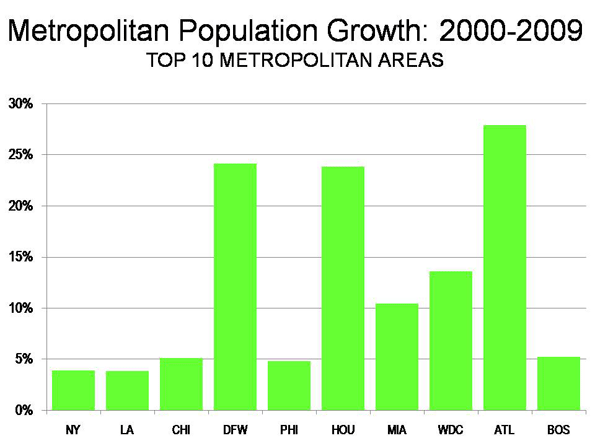
    Los Angeles: For decades, Los Angeles has been one of the world’s fastest growing metropolitan areas. Growth had ebbed somewhat by the 1990s, when Los Angeles added 1.1 million people. The California Department of Finance had projected that Los Angeles would add another 1.35 million people between 2000 and 2010. Yet, the Los Angeles growth rate fell drastically. From 2000 to 2009, Los Angeles added barely one-third the projected amount (476,000) and grew only 3.8%. Unbelievably, fast growing Los Angeles became the slowest growing metropolitan area among the 10 largest. In 2009, Los Angeles had 12.9 million people. Los Angeles lost 1.365 million domestic migrants, which is of 11.0% of its 2000 population, and the most severe outmigration among the top 10 metropolitan areas (Figure 2).
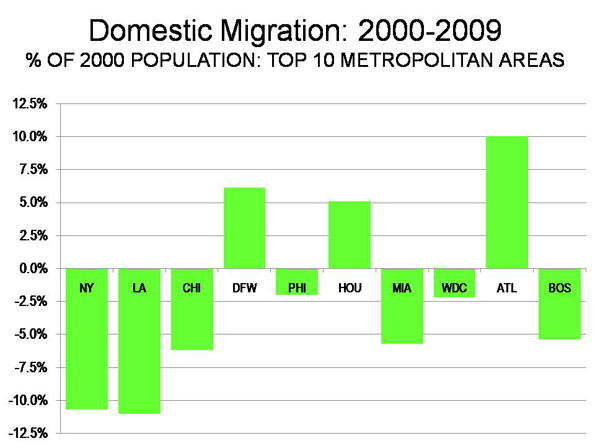
    Chicago: Chicago continues to be the nation’s third largest metropolitan area, at 9.6 million population, a position it has held since being displaced by Los Angeles in 1960. Chicago has experienced decades of slow growth and continues to grow less than the national average, at 5.1% between 2000 and 2009 (the national average was 8.8%). Yet, Chicago grew faster than both New York and Los Angeles. Chicago also lost a large number of domestic migrants (561,000), though at a much lower rate than New York and Chicago (6.2%). Even so, Chicago is growing fast enough that it could exceed 10 million population in little more than a decade, by the 2020 census.

    Dallas-Fort Worth: Dallas-Fort Worth has emerged as the nation’s fourth largest metropolitan area, at 6.4 million, having added 1,250,000 since 2000. In 2000, Dallas-Fort Worth ranked fifth, with 500,000 fewer people than Philadelphia, which it now leads by nearly 500,000. Dallas-Fort Worth added more population than any metropolitan area in the nation between 2008 and 2009 and has been the fastest growing of the 10 top metropolitan areas since 2006. As a result, Dallas-Fort Worth has replaced Atlanta as the high-income world’s fastest growing metropolitan area with more than 5,000,000 population. Dallas-Fort Worth added a net 317,000 domestic migrants between 2000 and 2009.

    Philadelphia: Philadelphia is the nation’s fifth largest metropolitan area, at just below 6,000,000 population. Like Chicago, Philadelphia has had decades of slow growth, yet has grown faster in this decade than both New York and Los Angeles (4.8%). Philadelphia has lost a net 115,000 domestic migrants since 2000, for a loss rate of 2.2%, well below that of New York, Los Angeles and Chicago.

    Houston: Houston ranks sixth, with 5.9 million people and is giving Dallas-Fort Worth a “run for its money.” Like Dallas-Fort Worth, Houston has added more than 1,000,000 people since 2000. Over the same period, Houston has passed Miami and Washington (DC) in population. Houston has added a net 244,000 domestic migrants since 2000, and added 50,000 in 2008-2009, the largest number in the country. Like Dallas-Fort Worth, Houston accelerated its annual domestic migration growth rate in 2008-2009. At the current growth rate, Houston seems likely to pass Philadelphia in population shortly after the 2010 census.

    Miami: Miami (stretching from Miami through Fort Lauderdale to West Palm Beach) is the seventh largest metropolitan area, with 5.6 million people. Miami has added more than 500,000 people, for a growth rate of 10.4%. However, Miami has suffered substantial domestic migration losses, at 287,000, a loss rate of, 5.7% relative to its 2000 population.

    Washington (DC): Washington recaptured 8th place, moving ahead of Atlanta, which had temporarily replaced it. Washington’s population is 5.5 million and added 655,000 between 2000 and 2009, for a growth rate of 13.6%. However, Washington lost a net 110,000 domestic migrants, 2.2% of its 2000 population. That trend was reversed in 2008-2009, when a net 18,000 domestic migrants moved to Washington, perhaps reflecting the increased concentration of economic power in the nation’s capital.

    Atlanta: Atlanta is the real surprise this year. For more than 30 years, Atlanta has had strong growth, however, this year it slowed. Atlanta is the 9th largest metropolitan area in the nation, at 5.5 million. Since 2000, Atlanta has added 1.2 million people, though added only 90,000 last year. Atlanta has added a net 429,000 domestic migrants since 2000, though the rate slowed to only 17,000 in 2008-2009.

    Boston: Boston is the nation’s 10th largest metropolitan area, with 4.6 million people. During the 2000s, Boston has added nearly 200,000, growing by 4.2%. Yet, Boston has also experienced a net domestic migration loss of 236,000, or 5.4% of its 2000 population. In 2008-2009, Boston, like Washington, reversed its domestic migration losses, adding 7,000.

    Trends by Size of Metropolitan Area: As throughout the decade, the slowest growing areas of the nation have been metropolitan areas over 10,000,000 population (New York and Los Angeles), which grew 3.9% and non-metropolitan areas, which grew 2.6% during the decade Metropolitan areas that had between 2.5 and 5.0 million population in 2000 boasted the biggest jump (these include fast growing Houston and Atlanta, which are now more than 5 million), at 13.4% for the decade. All of the other size classifications grew between 8.9% and 11.3% over the decade (see Demographia US Metropolitan Areas, Table 1). Metropolitan areas that began the decade with between 5,000,000 and 10,000,000 population gained 10.0%. Those with 250,000 to 500,000 grew 10.4%, those with 500,000 to 1,000,000 grew 10.2% and the smallest metropolitan areas, those from 50,000 to 250,000 grew 8.9%

    Metropolitan areas over 1,000,000 population lost 2.19 million domestic migrants during the decade, but smaller metropolitan areas added 2.24 million domestic migrants. Non-metropolitan areas lost 50,000 domestic migrants. In 2009, the smaller metropolitan areas gained 125,000 domestic migrants, while the larger metropolitan areas lost 30,000. Non-metropolitan areas lost more than 90,000 domestic migrants. As noted above, these smaller figures for 2009 reflect the more stable housing market and the extent to which the Great Recession has reduced geographic mobility (See Demographia US Metropolitan Areas, Tables 1 and 3).


    Note: The Median Multiple is the median house price divided by the median household income. The historic standard has been 3.0.

    Photograph: Dallas

    Wendell Cox is a Visiting Professor, Conservatoire National des Arts et Metiers, Paris. He was born in Los Angeles and was appointed to three terms on the Los Angeles County Transportation Commission by Mayor Tom Bradley. He is the author of “War on the Dream: How Anti-Sprawl Policy Threatens the Quality of Life.

  • Mayor Daley’s Report Card

    In December of 2010 Mayor Daley will become Chicago’s longest serving Mayor. In office since 1989, he will surpass the record held by his father. In the March issue of The New Yorker magazine, journalist Evan Osnos has a long article on Mayor Daley. The front cover of the magazine calls Daley, “America’s most successful mayor”.

    By longevity standards Mayor Daley is a success, but then again so was the late Coleman Young who was Detroit’s Mayor for over 20 years.

    The tone of Osnos’ piece is mostly positive, providing some history:

    He took office at a moment when Chicago was paralyzed by infighting and mismanagement. In 1987, William Bennett, the Secretary of Education, said that Chicago had the worst school system in the country—“ an education meltdown.” The center of the city was a desiccating museum of masterpieces by Mies van der Rohe and Louis Sullivan. Infant mortality in remote neighborhoods was comparable to levels in the Third World.

    In the years that followed, Detroit, Cleveland, and former industrial powers continued to wither, but Chicago did not. It has grown in population, income, and diversity; it has added more jobs than Los Angeles and Boston combined.

    The problem with Osnos’ history is it’s not entirely accurate. First of all, by the time Mayor Daley was elected in 1989 the City Council infighting had mostly stopped. Eugene Sawyer, Chicago’s second African American Mayor, was supported by the white elements of the Chicago Democratic Machine.

    Some of the mistakes are hard to fathom. Osnos cites no source on his rather incredible job numbers. Chicago has roughly the same population as it did in 1989, unlike Los Angeles which has climbed past the 4 million mark. Chicago is stuck under 3 million people with the long term population trend in decline. It’s difficult to have population growth without decent job growth.

    Osnos’ article has provoked a heated reaction from Chicago Reader ace columnist Ben Joravsky. The Chicago Reader and Joravsky, over the years, have covered Daley’s shady tenure as Mayor. Jorasky reminds us in attacking the New Yorker article:

    And why is it that Daley’s boosters always compare Chicago to poor, unfortunate Detroit—a one-industry town battered by the collapse of its one industry? Chicago has always been a larger, healthier, more diverse town than Detroit. If you want to see how Chicago really ranks, compare it to New York City, whose population and wealth are rising faster than Chicago’s with a fraction of the attendant corruption. In fact, Chicago’s population has fallen in the last few years.

    Joravsky could hardly keep from mentioning Chicago’s murder problem:

    Did I mention that in recent years Chicago has been the murder capital of the country? In fact, the murder tally has been much higher under Daley than it ever was under Byrne or Washington—it’s even higher than, yes, Detroit, which Osnos points out was known as the nation’s murder capital in the 1970s. And now we’re so broke we can’t hire police officers to replace the hundreds of veterans who are retiring—even though our taxes keep going up and up. My property taxes were $2,700 in 1997; this year I expect I’ll pay close to $8,000.

    This isn’t Chicago’s only problem. Its convention business is evaporating. Chicago’s union run McCormick Place is headed towards financial ruin. Major trade shows have left Chicago for better places to do business. Part of McCormick Place’s problem has been the pervasive influence of the Chicago Mob, also known as the outfit. Mayor Daley is quite sensitive to the subject because it has affected so many aspects of Chicago. Recently, the Chicago Tribune quoted former senior FBI agent James Wagner explaining the situation:

    The Outfit has long been entrenched at McCormick Place and in many of the unions and contractors that do business there.
    “It’s been a rehabilitate-the-felon location in terms of being a place to get people jobs when they get out of prison,” said James Wagner, a former longtime organized-crime supervisor for the FBI in Chicago and now top investigator at the Illinois Tollway. “It’s had these kinds of problems for about as long as it’s been there. And it’s had someone associated with the Outfit in just about every job there.”
    Among the factors that make McCormick Place a haven for the mob are its sheer size and the number of contracts and trade shows there, Wagner said.
    Four years ago, the riggers union, whose members set up exhibits at McCormick Place, was under federal investigation after its boss, Fred Schreier, who was once married to the niece of the late mob boss Tony Accardo, pleaded guilty to taking a bribe.

    Near the end of Osnos’ New Yorker article Mayor Daley’s scandals get a mention without too much detail. Daley fails to answer questions on the massive Hired Truck scandal which has been closely linked to the Chicago Mob. Daley also refuses to remain silent on why a major campaign contributor and close friend bombed a restaurant with the Chicago Mob, according to federal testimony. Recently, Daley admitted that he’s been questioned by the FBI concerning a major bribery and zoning case which just concluded.
    Chicago’s immediate economic situation has been nicely summarized by blogger Gary Lucido:

    How much worse can it get?

    I just picked up the January employment numbers for the greater Chicago metropolitan area and the picture is getting more grim than I thought – we have hit a new 14 year low. The Chicago area has lost 162,000 jobs in just the last 12 months and a total of 459,000 jobs have been lost since employment peaked in July 2007. The unemployment rate for the Chicago area is now at 11.7%, which is up from a low of 4.6% in November 2007 and that is higher than any rate that I have access to (going back to 1990).

    The New Yorker article mentions Mayor Daley polling numbers dropping into the 30s. In Chicago’s one party state, Daley can run next time, even with low polling numbers, and win — unless a credible wealth financed candidate materializes. No candidate has. But, one sign that Mayor Daley feels he’s got a bad report card coming: he opened up a Twitter page.

    Steve Bartin is a resident of Cook County and native who blogs regularly about urban affairs at http://nalert.blogspot.com. He works in Internet sales.

    Photo by kate.gardiner

  • Let’s Not Fool Ourselves on Urban Growth

    There has been a lot written lately about the return to the city. I’ve noted myself how places like central Indianapolis have reversed decades of population declines. That’s exciting. And the New York Times, for example, just trumpeted how “smart growth is taking hold” in America.

    But let’s not kid ourselves here. In my view this represents a possible inflection point, but it is way too early for the type of triumphalist rhetoric being bandied about by advocates.

    Let’s take a look at the change in the regional population share in core counties in 2009 vs. 2008 for the Midwest cities I typically focus on.

    City  Core County Share Change   2009 Core County Share   2008 Core County Share 
    Columbus 0.02% 63.83% 63.81%
    Pittsburgh 0.02% 51.74% 51.72%
    Milwaukee (0.01%) 61.52% 61.53%
    Minneapolis-St. Paul (0.02%) 50.84% 50.86%
    Chicago (0.06%) 55.19% 55.24%
    Louisville (0.07%) 57.33% 57.41%
    Kansas City (0.11%) 34.13% 34.25%
    Cincinnati (0.17%) 39.37% 39.54%
    St. Louis (0.18%) 47.68% 47.86%
    Indianapolis (0.23%) 51.09% 51.32%
    Cleveland (0.26%) 61.00% 61.26%
    Detroit (0.32%) 43.47% 44.06%

    For St. Louis, I use St. Louis city + St. Louis County as the core. For Minneapolis-St. Paul, I used Hennepin+Ramsey as the core.

    As you can see, only two regions managed to increase core county share of population, and these by a minuscule amount. Everyone else lost core county share. Keep in mind that even these “core” counties have many places with suburban characteristics. Now you might prefer a purely core city measure, and if so, be my guest. But don’t be surprised if the data gets even worse in many cases. Even in Chicago, which might have experienced the biggest urban core construction boom in America, the city lost population while Cook County gained it. Looking at the core city would make Chicago’s share loss worse.

    I think this shows there is still some work to do, to put it mildly.

    So why the difference versus the EPA study the NYT trumpets? Well, for one thing, the EPA study is worthless as a measure of urban health. They measure only new building permits, not people. This I think taps into a subtle suburban mindset in our outlook, that new housing units must represent net new inventory and net new people moving in, but in urban areas that’s not necessarily the case.

    The sad fact is, many of our urban cores have experienced significant housing abandonment and demolition. So in addition to construction of net new units, there’s a countervailing force of reduction. For example, the greater downtown area of Indianapolis has been seeing lots of construction. But the regional center comprehensive plan noted that between 1990 and 2000, the net number of dwelling units actually decreased. “The actual number of housing units declined over the 10-year period as some housing became dilapidated or was demolished and as some projects were emptied to await renovation (the Census only counts habitable units).”

    What’s more, as yuppies move in, and others move out, there is bound to be an effect on household sizes. Is it is really a good idea to price out larger immigrant families to the inner ring suburbs so that DINK’s can move in? How’s that for the environmental footprint of the region?

    I’m glad we’ve got big increases in urban construction and even population increases in some neighborhoods, but let’s not get ahead of ourselves by trumpeting a “fundamental shift”, as the EPA does, when the demographics don’t back it up.

    The New York Times article is also a disappointment. It fails to do any independent analysis of the data and only talks to people who are cheerleaders for the study, making it a sad piece of journalism.

    Someone recently described me as an “apologist for sprawl”. I in no uncertain terms reject that label. I am a passionate urban advocate who wants to see our core cities thrive and prosper. I want more growth there. I live in a city in a walkable neighborhood and rarely drive.

    But advocacy research of the type urbanists are quick to decry in others does a disservice to the cause. To change the trajectory of our cities and our built environment in America, we need to start with something called “reality”. I am optimistic that there’s a change in the air. But let’s not make claims about “fundamental shifts” that are simply not supported by any realistic look at the totality of the data.

    This post first appeared at The Urbanophile.

  • March Madness: Good Sports In The White House?

    Given the news spin cycle, is it any wonder that the presidency has been reduced to a talk show, or that March Madness has better ratings than the wars in the Middle East? But American presidents might think about adopting a SportsCenter model — snappy replays, contrite Tigers — and drop Rush Limbaugh and James Carville as their founding fathers. The continental divide in American history isn’t that between Democrats and Republicans, or conservatives and liberals, but whether or not the president should be a good sport.

    I realize that embracing a president by his or her ability to play sports, or least talk about them, would saddle the country with leaders like Derek Jeter, Scottie Pippin, or Peyton Manning. But my take on the run of political leaders since Teddy Roosevelt cluttered up the White House with big game trophies is that modern presidents have had a complicated relationship with the national pastimes. Maybe it was the German strategist Clausewitz who said that sports is the extension of politics by other means?

    To be sure, presidents up to and including Barack Obama have played sports, and many have played their games well. I have no doubt that Bill Clinton shoots a reasonable, if erratic game of golf, or that former Yale baseball player George Herbert Walker Bush throws competitive horseshoes. But how many presidents would you have wanted in your fantasy league, and how many (think Richard Nixon) picked up the clubs only when a few photographers were in the rough?

    To see if there is a correlation between good presidents and good sportsmen, let’s sort out the players from the duffers. Those who could play the games: Teddy Roosevelt (rod and gun), Franklin Roosevelt (excellent at golf before polio, and sailing afterwards), Jack Kennedy (golf, girls, and touch football, although not in that order), Gerald Ford (football in college, tennis in the White House, the Pro-Am circuit in retirement), and the George Bushes (speed golf, cigarette boats).

    On the bench, so to speak, place: William Howard Taft (of sumo proportions), Woodrow Wilson (hard to imagine him playing much pond hockey, although he did ride horses), Warren Harding (are cards considered a sport?), Calvin Coolidge (“harrumph”), Herbert Hoover (a fan of the medicine ball), Harry Truman (although he was brisk walker), Lyndon Johnson (beagle handling does not count), Richard Nixon (despite the bowling poster in “The Big Lebowski”and installing lanes in the White House), Ronald Reagan (lifeguarding, horseback riding, the original Brush Clearer), and Jimmy Carter (knocked silly by a killer rabbit).

    I have my doubts about Dwight Eisenhower, who played 800 rounds of golf as president but still only had an 18 handicap, and Barack Obama, who despite his pick-up basketball and vacation golf has the shadow of a 37 (in bowling) hanging over his presidency. (Kids without barriers usually score better than 37. If the Birthers want proof of alien associations, they should look into this.)

    Sports and politics came together harmoniously with Franklin Roosevelt, who could never walk after his 1921 bout with polio. When he ran for the presidency in 1932, however, he began his campaign with a long sailing trip in the waters off New England, and the image of Roosevelt at the helm quelled whatever fears there might have been about his incapacity. Roosevelt was, in fact, an excellent sailor.

    Likewise, Jack Kennedy used sports to cover up a chronically bad back, Addison’s Disease, and a host of other ailments that had him under constant medical care. Instead of a bed-ridden presidential candidate, the public saw a “vigorous” man playing touch football on the lawn at Hyannis Port or heading out in a sailboat. In retrospect, the images of a robust president were as manufactured as those of Family Man Kennedy.

    The ability to talk about sports might add more to presidential success than the ability to play the games. Sports talk is one of the few common languages for much of the United States. Without any ability to speak it, a candidate on the campaign trail would find himself with a lot awkward pauses in the company of local politicos.

    The former radio sportscaster Ronald “Dutch” Reagan could obviously talk a good game. For much of his broadcasting career, all he had were the wire service reports of the action, and he would have to conjure the play-by-play, much as he later was attracted to invented economic theories (the Laffer Curve) or history (“I did not trade arms for hostages”). Few had the Gipper’s gift of small talk, and a lot of it revolved around sports.

    By this logic, President Obama ought to be one of the more successful American presidents. He occasionally joins the broadcast at half-time in key college basketball games, he picked the NCAA champion in his 2009 bracket, and he seems to enjoy golf. Why, then, are his approval ratings on a par with presidents who never hit a three-pointer?

    Part of the explanation can be gleaned in one of the many health care posts I have read recently. The correspondent was despairing of the President’s ability to convince the American people that health care reform was actually good for them, which prompted a digression into Obama’s wounded-duck throw with last year’s All-Star ceremonial pitch (apparently George W. Bush threw high heat) and, of course, the 37. Meaning: he’s losing the sports-bar, call-in radio constituency, which, when it comes to medicine, is only interested in steroids.

    By my logic, Bill Clinton got impeached not for groping an intern but for boasting he had broken 80 in a golf game. (In the words of Jack Nicklaus: “Eighty with fifty floating mulligans.”) Nor did Gerald Ford’s presidency ever recover from his erratic tee shots. Doubts surfaced about W not so much over Iraq as when it was reported that he had watched the Super Bowl by himself.

    The hope for the Obama presidency is that it will return to his sporting roots. On the campaign trail, he watched a lot of ESPN, and he is a long-time White Sox fan, perhaps even from the days of their Disco Demolition Night. After all, the athletically-challenged Nixon won four national elections on the strength of owning his own bowling ball (but was he a “sandbagger”?) and calling in a few plays to the Washington Redskins coach, George Allen (which, by the way, never worked.) Clearly, Obama has affection for his basketball, and my guess is that he spends more time than a president should thinking about the NBA draft. All are hopeful signs for his time in office.

    Matthew Stevenson is the editor, along with Michael Martin, of The Rules of the Game: The Best Sports Writing from Harper’s Magazine, published by Franklin Square Press, and the recently published Remembering the Twentieth Century Limited. He lives in Europe.

    Photo: