Blog

  • It Wasn’t Rural ‘Hicks’ Who Elected Trump: The Suburbs Were — And Will Remain — The Real Battleground

    Much of the New York and Washington press corps has concluded that Donald Trump’s surprising journey to the Oval Office was powered by country bumpkins expressing their inner racist misogyny. However, the real foundations for his victory lie not in the countryside and small towns, but in key suburban counties.

    The popular notion of “city” and “country,” one progressive and “vibrant,” the other regressive and dying, misses the basic geographic point: the largest metropolitan constituency in the country, far larger than the celebrated, and deeply class-divided core cities, is the increasingly diverse suburbs. Trump won suburbia by a significant five percentage point margin nationally, improving on Romney’s two-point edge, and by more   outside the coastal regions.

    Despite the blue urbanist cant that dense metro areas — inevitably labelled “vibrant” — are the future, in fact, core cities are growing at a slower pace than their more spread out suburbs and exurbs, which will make these edge areas even more important politically and economically in the coming decade. The states that voted for Trump enjoyed net domestic migration of 1.45 million from 2010 to 2015, naturally drawn from the states that were won by Hillary Clinton. Democrat-leaning ethnic groups, like Hispanics, are expanding rapidly, but Americans are moving in every greater numbers to the more conservative geographies of the Sun Belt, the suburbs and exurbs.

    Suburbs Drive Swing States

    The future battles between the parties will have to be waged where the people and jobs are: suburbia. Suburban voters particularly put Trump ahead in the crucial Midwestern states of Michigan, Wisconsin, and came close to winning him supposedly deep blue Minnesota. This is where the Democratic falloff from the Obama years was most evident, notes Mike Barone, falling from  dropping from 54 percent for Obama to 2008 to 45 percent this year.

    Clinton did win some suburban counties, especially in the Philadelphia area, but by lower margins than President Obama had in 2012. Clinton’s margin was also lower in some older rustbelt urban counties: Erie (Buffalo), Onondaga (Syracuse), Monroe (Rochester), Albany, and Hamilton (Cincinnati). A number of college towns and state capitals also invariably voted for Clinton, overwhelmingly.

    Overall, though, most suburban counties in the swing states supported Trump. In Michigan, Trump lost Detroit, and surrounding Wayne County, by better than two to one, but captured four of the five surrounding suburban counties. His margin greatly exceeded that of Romney in these counties, which, combined with his strong support in smaller cities and rural areas outside the major metropolitan areas, put him over the top in this critical state.

    A similar pattern can be seen in Pennsylvania. Clinton, of course, won overwhelmingly in the large urban counties — the city of Philadelphia went for her by 82 to 15. She also won some nearby suburban counties around the city, as was expected. But elsewhere Trump did better. He lost Allegheny County (Pittsburgh) but won all the surrounding suburban countries by piling up 54 percent to 74 percent of the votes; he lost the state capital of Harrisburg but made that up by crushing her in the suburban counties. Particularly striking was his victory in historically Democratic Erie County (population 280.000), west of Buffalo; Obama had won the county by 16 points in 2012.

    Much the same can be said about Wisconsin, where Trump was not expected to be too competitive, as well as Ohio, someplace he was expected to win. Clinton’s edge in Ohio’s smaller, blue collar urban constituencies fell well below the levels enjoyed by President Obama while surrounding suburban counties went, almost without exception, heavily for Trump.

    The Political Geography Of The Future

    Ultimately the road to recovery for Democrats does not lie in expanding the urban core vote. As Mike Lind has suggested, progressives embrace a kind of post-national “open borders” ideology that makes sense in denser, global cities — where the demand for low-end service labor is greater — than in suburban or small town and rural areas that tend to be more egalitarian and, for the most part, whiter.

    There may be growing unanimity of Democratic support in core areas, but urban cores are growing more slowly, or not at all, compared to the suburbs. Indeed the urban vote in the cores, although obviously tilted blue, has dropped in recent years, with the exception of the Obama run in 2008. Nor do attempts to call suburban or “countryside” people “deplorable,” racist and even too fat constitute much of a strategy to appeal to these areas.

    In contrast, Trump’s geographic coalition between the deep red countryside and the suburbs demonstrated an alternative that can work, particularly in key swing states. Despite the wishes of many planners, and their Democratic allies, suburbs and small towns are not about to go away in the near future. Areas outside million-plus metropolitan areas accounted for 100 percent of the vote in Iowa, 61 percent in Wisconsin, 47 percent in Michigan and Pennsylvania, and 44 percent in Ohio. They may not be demographically ascendant, but they still carry considerable heft.

    Nor can blue state advocates continue to claim that millennials will not move to suburbia, because that is clearly happening. Urbanist mythology now holds to a fallback position that millennials move to the suburbs simply because they have been priced out. However, they don’t look at other compelling reasons — notably shaped by life stage — for suburban growth. As most millennials will soon be over 30, its seems likely more will head to the periphery, as did earlier generations to gain more space to raise a family, better schools and safety. Even after the Great Recession people continued to move in large numbers from urban core counties to the less dense suburbs and exurbs. Between 2010 and 2015, suburban counties of major metropolitan areas added 825,000 net domestic migrants, while the urban core counties lost nearly 600,000. The real question is whether millennials will turn these red-trending areas bluer, or will their experience as homeowners and parents make them more traditional and conservatively minded suburbanites?

    The basic geographic and demographic conclusion: the balance of political power lies with suburban and exurban counties, particularly in swing states. Republicans need to build on their success by appealing more the minorities and immigrants who are also moving to the periphery. To return to power, the Democrats should   shift their attention from their urban core base and look more to the periphery. In the end, they need to provide compelling reason why these areas should support a party that, at least for now, seems generally favorable  to their exclusion and even ultimate demise.

    This piece originally appeared in Forbes.

    Joel Kotkin is executive editor of NewGeography.com. He is the Roger Hobbs Distinguished Fellow in Urban Studies at Chapman University and executive director of the Houston-based Center for Opportunity Urbanism. His newest book, The Human City: Urbanism for the rest of us, will be published in April by Agate. He is also author of The New Class ConflictThe City: A Global History, and The Next Hundred Million: America in 2050. He lives in Orange County, CA.

    Wendell Cox is principal of Demographia, an international public policy and demographics firm. He is a Senior Fellow of the Center for Opportunity Urbanism (US), Senior Fellow for Housing Affordability and Municipal Policy for the Frontier Centre for Public Policy (Canada), and a member of the Board of Advisors of the Center for Demographics and Policy at Chapman University (California). He is co-author of the “Demographia International Housing Affordability Survey” and author of “Demographia World Urban Areas” and “War on the Dream: How Anti-Sprawl Policy Threatens the Quality of Life.” He was appointed to three terms on the Los Angeles County Transportation Commission, where he served with the leading city and county leadership as the only non-elected member. He served as a visiting professor at the Conservatoire National des Arts et Metiers, a national university in Paris.

    Electoral map by Ali Zifan (This file was derived from:  USA Counties.svg) [CC BY-SA 4.0], via Wikimedia Commons

  • Five Ideas to Make America Greater

    Donald Trump’s presidential campaign was based on the notion that he could “Make America Great Again.” But beyond the rhetoric — sometimes lurching into demagoguery — the newly elected president comes to office, as one commentator suggests, “the least policy-savvy president in history.”

    To succeed, Trump must adopt innovative policies that transcend traditional right-left divides. He needs to find ways to help his heavily white, working-class base while expanding his appeal to minorities, millennials and educated people who are now largely horrified by his ascendency.

    In the short run, his biggest problem may lie with his own Republican Party establishment, which, rather than “drain the swamp,” would simply like to create one of its own. The looming presence of corporate lobbyists, swarming around the administration like hungry flies, is not encouraging at all, nor are GOP congressional plans to re-establish “earmarks.”

    The key lies not in empowering a different set of K Street parasites, but rather in reversing income stagnation. If he cannot, his triumph may prove to be no more consequential than an absurdist, Latin American-style telenovela.

    A flatter, fairer tax

    The basic instinct among many Republicans tends toward reducing taxes on their richest donors and making life easier for the ultrarich, including some on Trump’s economic team. Trump’s imperative should, instead, be to make the tax system fairer for the middle and working classes. One way would be to make a graduated flat tax that would mean that the rich, who make most of their money from investments, pay the same rate for capital gains as the rest of us do for income.

    Democrats will, no doubt, still charge Trump with being “unfair,” but, as Ronald Reagan proved 20 years ago, Americans support incentives for work if they don’t unfairly tilt conditions to the ultrarich. Main Street business owners, the most hostile constituency to the Obama administration’s policies, pay taxes based on their income and can’t manipulate the system like Apple, Google, Wall Streeters or, for that matter, real estate developers like Trump himself.

    A middle ground for immigration

    Opposition to illegal immigration helped drive the Trump campaign early on, but, outside of the GOP base, there is little support for a mass roundup of the undocumented. The vast majority of Americans, over 70 percent, also oppose “open borders.” After all, even President Obama evicted 2 million people during his two terms in office.

    Trump also can begin reordering our immigration policies toward skilled workers who are interested in becoming citizens. At the same time, Trump could score points by undermining the H1-B visa program, which allows Silicon Valley firms, along with corporations like Disney and Southern California Edison, to lay off American workers and replace them with temporary indentured servants.

    Read the entire piece at The Orange County Register.

    Joel Kotkin is executive editor of NewGeography.com. He is the Roger Hobbs Distinguished Fellow in Urban Studies at Chapman University and executive director of the Houston-based Center for Opportunity Urbanism. His newest book, The Human City: Urbanism for the rest of us, will be published in April by Agate. He is also author of The New Class ConflictThe City: A Global History, and The Next Hundred Million: America in 2050. He lives in Orange County, CA.

    Photo: Gage Skidmore from Peoria, AZ, United States of America (Make America Great Again hat) [CC BY-SA 2.0], via Wikimedia Commons

  • Here’s How Donald Trump Could End America’s New Feudalism

    One obvious, if little discussed, reason the progressive wave receded last week: The left’s increasingly unappealing economic agenda. In the past, progressives focused on improving conditions for working and middle class Americans through economic growth, home ownership and expansive infrastructure projects.

    Today, notes former Bill Clinton aide William Galston, progressives rarely promote economic growth, having developed a particular hostility to many of the industries—energy manufacturing, transportation and agriculture—that offer economic opportunity to millions of Americans. This new environmental orientation has been less than enthusiastically embraced away from the coasts, where Trump, not coincidentally, triumphed.

    In contrast to the old Democratic notions embraced by the likes of Harry Truman or the late California Governor Pat Brown, today’s progressives promote social control and the consolidation of a cognitively determined world order. Its promise amounts to forging a kind of high-tech middle ages in which the new aristocracy—techies, media grandees, financial moguls, academics, high-level bureaucrats—dominate while the middle class becomes increasingly serf-like.

    In this new neo-feudalism, property ownership, like power, is concentrated in ever fewer hands.

    Trumpism as anti-feudalism

    The Trump victory tapped into a class rebellion among middle- and working-class voters who feelthe most alienated and pessimistic about the future. The post-industrial, asset-inflated world so beneficial to the Apples, Googles, media stars and the trustifarians in glamour cities has been less kind to the middle and working class, whose incomes have dropped or stagnated over the past decade and a half.

    While some percentage of Trump’s supporters were fundamentally “deplorable,” this wasn’t the KKK triumph imagined by scriptwriter Adam Sorkin. Rather, he won with the support of many people who had previously voted for Barack Obama.

    White working class voters, endless mocked and sometimes even demonized in the media, were massively underestimated by the pollsters, as well — who used 2012 exit polls that undercounted as many as 10 million white voters over 45 to build their models for who would turn out in 2016. 

    And Trump dominated those voters, winning them by 40 percentage points — a 15 point improvement over Mitt Romney’s margin. Trump’s opponent, it should be noted, was also white.

    How feudalism could trump populism.

    It remains to be seen how Trump’s voters will feel about their choice in the years to come, but the basic incoherence of his world-view, along with the corporatist leaning of the Republican majority in Congress, could undermine any attempt to restore upward mobility

    There are fundamentally three forces driving our post-modern feudalization, all of them related. One is globalization, highlighted throughout the campaign, and clearly responsible for considerable job losses for certain classes and certain regions. As countries such as China and India move up the value-added chain, even higher-paid workers will face mounting economic competition. San Jose and Raleigh soon could feel some of  the pain that Youngstown and Flint have absorbed for decades.

    The second is immigration which, for all its many blessings, tends to depress wages for lower and middle workers. Many native-born Americans who used to enjoy steady work have joined the rapidly expanding, and economically vulnerable, precariat made up of contingent, irregularly employed workers. Both Bernie Sanders and Trump identified the problems faced by such workers by unrestricted immigration.

    Undereducated whites are not the only ones who are suffering from downward mobility. Trump trailed but still considerably outperformed previous GOP nominees among both Latinos and African Americans. Increasingly, educated workers are threatened by such things as -IB visas for skilled workers, which essentially replaces indigenous skilled workers with imported indentured servants. This has already resulted in job losses among IT workers at places like the Disney Company and Southern California Edison.

    The third driver of feudalization lies in the concentration of business and property ownership. Lenin once identified “small scale production” as what “gives birth spontaneously to capitalism and the bourgeoisie.” America’s small firms are in retreat while large corporations increasingly dominate everything from food to technologyFor the first time in our modern history, exits from business now exceed new incorporations.

    Similarly, home ownership has dropped to its lowest level in five decades, with the decline steepestamong young people. More millennialsnow live with their parents than with a partner. And when they do move out, they are often trapped into renting, often at high rates, with little chance of ever buying a house.

    The Religious Slant of Ecotopia

    The first feudal era was characterized by constrained class mobility, a decline of middle orders and a persistent concentration of power, first in feudal lords and later kings. But what held Medieval society together was an attachment to common articles of faith. Catholic dogma defined and justified the ascension of the aristocracy and royalty, and explained in theological terms both why the poor should accept their fate, and why middle-class aspirations were a threat to the moral order.

    Today religion is in, pardon the pun, secular decline. Particularly in the bluest states, it has been replaced by two new faiths. One is the green religion, now focused on climate change. The other new faith is technological determinism, the idea that there is a magical, disruptive solution to any problem, including those relating to nature.

    Nowhere are these two religions more commingled than in America’s Ecotopia, which extends from Northern California to the Pacific Northwest and is both the home to our leading tech companies and birthplace of modern environmentalism.

     Structural changes help explain this melding. Today Silicon Valley profits have become more centered on software and media than hardware, so the constraints associated with environmental regulations, such as high energy and water costs, have become less important to oligarchs. At the same time many Silicon Valley companies — notably Tesla/Solar City — have sought to profit from the shift to “green” energy, feeding on the beneficent federal subsidies attached to it.

    For these interests, the GOP’s great sweep represents a bit of an unexpected setback. The federal subsidies driving some of these industries are likely to be scaled back. Used to a cozy relationship with the White House, the tech elite, with the notable exception of Peter Thiel, finds itself on the outside looking in.

    Acolytes of the technocratic green ideology, hostile to Trump, geographically and ideologically removed from the rest of the nation and already functioning as a kind of wealthy, cossetted alt-nation, are now talking vaguely about succession. That conversation is driven in part by apocalyptic predictions about climate change generally accepted without skepticism in media, academic and political circles.

     Although couched in scientism, green politics should be seen as somewhat faith-based, a craving more about piety than practical reality. Both Bjorn Lomborg and NASA’s Richard Hansen, one of the earliest heralds of climate change, doubt that the measures embraced by the Paris accords will prove remotely effective in reducing temperature rise. California , a recent report demonstrates. could literally fall into the ocean with no appreciable impact on global temperature, particularly given that countries like China continue to boost their coal capacity.

    Neo-feudalism and the fate of the middle class.

    Most critically, the theology of green progressives will do as little good for today’s middle and working class people as extreme Catholic dogma did for the medieval peasantry. Overall, according to a recent Social Science Council report, California is now the most unequal state when it comes to “well being,” combining stupendous, mostly coastal wealth with the highest rate of poverty in the nation, concentrated inland.

    Neo-feudalism diminishes  the property owning middle-class. In the Bay Area, regional governments are now seeking to limit all new development to a mere fraction of the area’s land mass, all but guaranteeing the future generations will face almost impossibly high housing prices. And a new set of state regulations, including a requirement that new houses have “zero” net energy use all but guarantees that houses, over time, will continue becoming ever more expensive.

    The Bay Area’s regional plan also says goodbye to the American dream, suggesting that 82 percent of all new housing should be rental. Ultimately there will be little left for “little people” save for low end service jobs and benefit-less roles in the gig economy   created by the oligarchs  . Tech firms in the Valley employ shockingly few Latinos or African Americans, who make up barely 6 percent, for example, of Facebook’s workforce. And that’s better than the average of barely 5 percent among the leading tech firms.

    Older industries do far better on these terms. In manufacturing, 16.2% of workers are Latinos and 9.7% are African America, according to 2015 data.  In mining, quarrying and oil and gas extraction, Latinos make up 16.9% of the workforce and African-Americans 4.8%, while in agriculture, forestry, fishing and hunting, nearly a quarter of the workforce—23%—is Latino and 2.7 percent is African-American.

    As the green ideology undermines the last bastions of the middle and working class economy, some of the most extreme “ethnic cleansing” is taking place in such cities as San Francisco, Portland and Seattle, where high prices, regulations ,  sometimes aided local redevelopment,  have worked to push minorities to the poorer suburbs, or out of the region entirely.

    Oligarchs and Alms for the Poor

    Silicon Valley’s answer to this to this reality is hardly reassuring. At a conference on environmental economics several years back, I discussed with a prominent Silicon Valley venture capitalist the impact of these policies on homeownership and family formation. A low birthrate didn’t faze him because he believed “we really don’t need people now,” at least not those without special skills. Ultimately robots will do most of the basic work, he explained.

    Of course, if the largely childless hipsters on of San Francisco may accede to this view, it’s unlikely that many others, including the poor and undocumented immigrants, will embrace the post-human perspective at the heart of Silicon Valley. Of course the oligarchs have a solution to the marginalization of the masses: a pool of subsidies to help cover artificially inflated housing and energy costs. Elon Musk and other valley heavyweightssupport a government-sponsored minimum income for what they regard as an  increasingly redundant population.

    The oligarchs do not want risk a rebellion from below; the Trump victory demonstrates that potential. Yet don’t worry much about their being burdened by their call for societal generosity. Skilled at tax avoidance, they’ll pass the bill on to the remaining middle and working class residents, while the regulatory clerisy, both in government and the universities, enjoy pensions and other protections unavailable to the masses.  

    Trump and the New Feudalism

    For all the awfulness associated with Trump, his election stemmed from a disinclination among Americans to accept their place in the new technocratic order. Trump is best praised for some of the enemies he has made—movie stars and hierarchs of the environmental left, the racial grievance industry, the high-tech oligarchs, the bureaucracy and a university system that serves largely as a giant re-education camp. Not surprisingly, those enemies are having a collective fit about his victory.

    Yet for all the pleasure one can derive from this spectacle, it’s dubious that Trump, himself the licker off a silver spoon, will be effective at slowing America’s slide towards neo-feudalism. After all, his basic policy instincts tend to be wrong: cutting taxes on the rich is not what the middle and working classes need. And banning illegal immigration and engaging in trade wars may help some industries, but will certainly hurt others. By themselves, there’s no chance that those steps will restore prosperity to so many Americans.

    But Trump’s working-class-fueled victory should finally convince the operatives in both parties that restoring upward mobility constitutes our  great political challenge. There could be some common ground in policies that embrace things like expanding skills  education and economically useful infrastructure, relaxing federal regulation and reducing taxation of small enterprise.

    What Trump deserves credit for—perhaps the only thing he deserves credit for—is derailing the predictable transition of the same old insiders who would feed at the trough in a Clinton Inc. administration. Now it’s up to the rest of us—those who supported him and those, like me, who did not—to determine that making America “great again” also means standing up to the new feudalism, and chasing this regressive order back into the darkness of the past, where it belongs.

    This piece first appeared at The Daily Beast.

    Joel Kotkin is executive editor of NewGeography.com. He is the Roger Hobbs Distinguished Fellow in Urban Studies at Chapman University and executive director of the Houston-based Center for Opportunity Urbanism. His newest book, The Human City: Urbanism for the rest of us, will be published in April by Agate. He is also author of The New Class ConflictThe City: A Global History, and The Next Hundred Million: America in 2050. He lives in Orange County, CA.

    Photo by Gage Skidmore from Peoria, AZ, United States of America (Donald Trump) [CC BY-SA 2.0], via Wikimedia Commons

  • Should Children Vote?

    The rising cost of entitlements will test inter-generational harmony.

    In the week following the Brexit vote, a recurrent complaint from the losing side was that a majority of older people voted to leave while a majority of younger people voted to remain. In the eyes of the complainers, this rendered the leave outcome less legitimate because younger people have more years of life ahead of them and therefore would allegedly suffer more than old people from a decision to leave the European Union. So much for the wisdom of old age knowing what is best. And so much for the principle of one person one vote, regardless of age, gender or race or whatever.

    Instead of disenfranchising a group of older voters, we may consider allowing children some representation in our voting system. In the United States, the voting age is 18 which means that there are approximately 74 million US citizens aged under 18 who do not have the right to vote. That is a sizable 23% of the entire population who will all be adults by 2034 and who may not in the future take kindly to the long-duration budget commitments that were made in their absence.

    Entitlements Demand and Supply

    When Social Security was introduced in 1935, US life expectancy at birth was 62 years. When Medicare was introduced in 1965, it was 74 years. Today, it is approaching 80 years. What is more, people who are now middle-aged or older can expect to live past the age of 80. Life expectancy at birth is 80 years, but an American aged 70 can now expect to live to 85. And one aged 80 can expect to live to 89. Meanwhile the retirement age has remained around 65 since 1935, which means that the demand for these entitlements has increased in line with or faster than the rise in life expectancy.

    In recent years, two other factors have put this demand on an accelerating trajectory. One is the rising number of retired baby boomers. The other is the relentless increase in health care costs.

    On the other side of the equation, US households have fewer children today than in the past. The US Total Fertility Ratio (TFR) was a low 2.0 children per woman in the mid 1930s due to the Great Depression. It then zoomed to 3.5 at the height of the baby boom in the late 1950s before settling back back to 3.0 in the mid 1960s. But today, the TFR is back to its Depression era levels of 2.0 children per woman. It is a cruel irony that Medicare was enacted in 1965, just as the baby boom was ending. Because there are fewer workers per retiree today, the supply of dollars for entitlements has become less abundant.

    screen-shot-2016-11-12-at-2-36-28-pm

    Pros and Cons

    Going back now to the question of the children’s vote, there are at least two reasons to maintain the status quo, which is a right to vote at 18.

    First you could say that before a certain age, a person is not mentally equipped to make a critical choice between several candidates. Some people may argue, and not just for comic effect, that many adults from any demographic group are similarly ill-equipped, but that is a more subjective appraisal.

    Perhaps this question is better addressed by re-examining what the voting age should be. Is 18 the proper age to get the right to vote? It would not be hard to make a case that 16 is old enough. If you can drive, you can vote.

    Second you could say that young people should not have the right to vote because they don’t pay taxes. But as we know, a large percentage of adult Americans also don’t pay taxes. If there is a case for eliminating representation without taxation, there is no reason why this restriction should be confined to the under 18 cohorts.

    On the other side of the argument, the logic of giving children some representation would be obvious if we hadn’t lived without it for so long. For one, it would place a check on government actions and decisions that create economic benefits for older generations while imposing a financial burden on the young. If the very young had some representation, the magnitude of this wealth transfer would certainly be smaller.

    Two Steps for Representation

    In theory, Americans aged less than 18 are represented indirectly by their parents’ votes. But in practice, the idea that a teenager would agree with his parents’ political choices sounds realistic only to someone who has never met a teenager. Therefore Step One would be to provide some representation by lowering the voting age to 16.

    That would still leave 66 million Americans aged 0 to 15 with no direct representation. Today, a family of two parents and three children has two votes. But a childless couple also has two votes. We may then consider Step Two which is to give parents a fractional vote for every child. For example, a family would get an additional one third of a vote if the family has one child, two thirds for two children and one full vote for three or more children. The extra fractions would be attached to one of the parents’ votes. So if that parent pulled the lever for a certain candidate, his vote would count not as one vote, but as 1.33 votes if he has one child, 1.67 votes if he has two and two votes if he has three or more.

    Of course, this could get complicated quickly if the parents disagree on whom to vote for. Which parent would become the custodian of the fractional votes to use on Election Day? This can easily be addressed by having parents take turns at every new electoral cycle, by having the fractional votes randomly allocated to either parent, or by giving each parent half of the fractional votes. In the latter case, for a family with three children, Mom and Dad would each have 1.5 votes.

    Yet another proposal is to let each child decide his/her vote and to allocate to him/her a fractional vote that starts at one tenth of a vote at the age of nine and grows by one tenth every year until it reaches a full vote at eighteen. In this case, a ten year old would have 2/10 of a vote and a fifteen year old would have 7/10 of a vote and both would choose their own candidates instead of piggybacking their parents’ preferences.

    As things stand today, giving children some representation would tip the scale to the Democrat candidate in many contests. In the most recent election for example, Pew Research estimates that voters aged 18 to 29 favored Hillary Clinton by an 18% margin and those aged 30 to 44 favored her by 8%. Meanwhile, voters aged 45 or higher preferred Donald Trump by an 8% margin.

    Notwithstanding probable resistance from some quarters, the issue ought to be decided on its own merits rather than on whether it helps or hurts one or the other party. If one party’s platform appeals mainly to the older generations, the children’s vote would be a healthy jolt and an incentive for that party to start addressing issues that are of greater import to the young.

    Further, any concern that children representation would skew the results unfairly is mitigated by the fact that, in a typical election, as many as 45% of eligible voters don’t even bother to show up. Because the margin of victory is small in most elections, a low turnout also leads to a skewed outcome.

    Sami Karam is the founder and editor of populyst.net and the creator of the populyst index™. populyst is about innovation, demography and society. Before populyst, he was the founder and manager of the Seven Global funds and a fund manager at leading asset managers in Boston and New York. In addition to a finance MBA from the Wharton School, he holds a Master’s in Civil Engineering from Cornell and a Bachelor of Architecture from UT Austin.

  • San Francisco Observations

    I made quite a few trips to San Francisco during the late 90s into the early 2000s, but hadn’t been back in a very long time – probably close to 15 years.

    Recently I was there for a conference and a long weekend and got to spend some time exploring the city. I won’t claim a comprehensive review, but I did have a few takeaways to share.

    1. Fewer homeless than expected. Based on the rhetoric you read in the papers, I expected SF to be overrun with aggressive homeless people. This wasn’t the case. There were visible homeless to be sure, but no more than I remember from 15 years ago and no more than I see in New York. And they were not particularly aggressive in any way.

    2. A curiously low energy city. It’s tough to judge any American city’s street energy after living in New York, but San Francisco felt basically dead. Tourist areas around Union Square and the Embarcadero were crowded, and the Mission on a Friday night was hopping, but otherwise the city was very quiet. Haight-Ashbury was nearly deserted and many neighborhoods had the feel of a ghost town. It’s very strange to be walking around a city with such a dense built fabric but so few people.

    3. San Francisco is too small to support a centralized economy. The Financial District has a number of skyscrapers, and SOMA is awash in construction – the biggest changes I observed were in this district – but central San Francisco is too small to serve as a global city business center. And the city as a whole is not big enough to support that kind of a resident base. The bottom line is that San Francisco’s constrained geography renders the construction of a CBD in the style of a Chicago or New York very difficult. Also, at only around 856,000 people – an all time record high – the absorption capacity of the city is limited. Contrast with NYC at 8.5 million, LA with 4 million and Chicago with around 2.7 million in much bigger geographies. Also, the transport geography of San Francisco does not include the type of massive commuter rail system that NYC, London, Chicago, etc. have. In short, I don’t see SF having the capacity for a much greater degree of employment centralization.

    4. Major construction is undesirable in San Francisco. As I’ve written before, San Francisco is one of America’s most achingly beautiful cities with a very unique building stock. It’s also, like Manhattan, mostly fully developed. So new construction in most places would involve demolition of the existing building stock. No surprise SOMA is where the construction is, because there’s room to do it and/or lower quality buildings to replace. To make a serious increase in the quantity of residential or office space would involve significant damage to the character of the city and would not in my view be desirable. Nor, given the point above about its small size, is it likely to make much of a difference anyway. It’s hard to see how the city of San Francisco itself changes its trends without an economic pullback.

    5. San Francisco doesn’t feel like it has the services of a high tax city. Taxes are high in San Francisco, but it many ways it doesn’t feel like it. In New York, our taxes are high, but the level of services is highly visible, at least in Manhattan. Just as one small example, SF’s storm drains were often partially blocked with leaves, and there were pools of standing water even on Market St. In NYC, BID employees or building supers regularly clear storm drains and sweep water into sewers. Our parks are in better shape. I was surprised to see that SF still has curbs with no ADA ramps. In short, while the city is beautiful and such, it doesn’t radiate the feel of high services.

    6. Barrier and POP transit system. I ran into a curious situation while riding transit. Muni, the city’s transit agency, has a light rail system called Muni Metro. It runs as a subway under Market St. Because it runs on street elsewhere, the trainsets are pretty short. I rode the subway portion, which has a barrier system. But then on the train my ticket was checked again by a conductor. Why have barriers if you are running a POP system on top of it? I’m glad I saved my ticket.

    7. San Francisco Opera. I attended my first opera in San Francisco. The San Francisco Opera is a very globally respected company. The opera, Janacek’s The Makropulous Case, was very good. It was well-patronized but there were plenty of empty seats too. It has the feel of the Lyric Opera of Chicago, where the majority of attendees are subscribers. The average age was very high – much higher than the Met Opera, which although suffering a serious attendance problem draws quite a few young people. The SF Opera’s patron base is getting up there. I also took a look through the program. I did not see a single tech company on their list of corporate sponsor, nor did I see any tech names I recognized on their major donor list. Opera in San Francisco appears to be an old money affair, with the emphasis on old. This doesn’t bode well for the future of this flagship cultural organization if it can’t find a way to tap into younger attendees and donors. I’d have to caveat this somewhat given that my investigation is very limited. But this is a trend affecting many similar organizations.

    Aaron M. Renn is a senior fellow at the Manhattan Institute, a contributing editor of City Journal, and an economic development columnist for Governing magazine. He focuses on ways to help America’s cities thrive in an ever more complex, competitive, globalized, and diverse twenty-first century. During Renn’s 15-year career in management and technology consulting, he was a partner at Accenture and held several technology strategy roles and directed multimillion-dollar global technology implementations. He has contributed to The Guardian, Forbes.com, and numerous other publications. Renn holds a B.S. from Indiana University, where he coauthored an early social-networking platform in 1991.

  • Overcrowded California

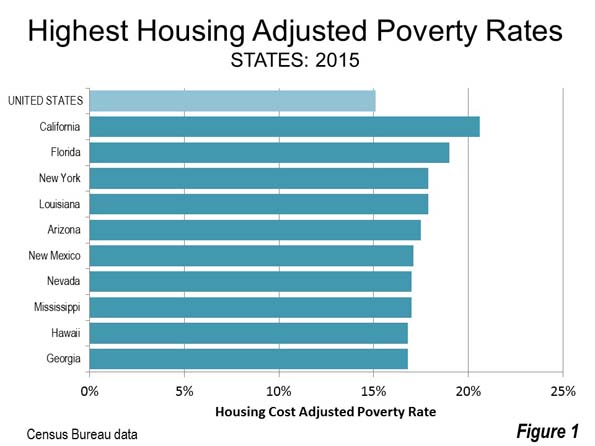
    In its decades of unprecedented population growth, California was a land of superlatives. Regrettably, the superlatives have changed from mostly positive to largely negative. For example, the latest Census Bureau Supplemental Poverty Estimates, indicated that California continues to have the highest poverty rate of any state, after adjustment for housing costs (Figure 1). Not even Mississippi can compete with that, sitting 3.6 percentage points lower. California metropolitan areas undoubtedly resemble this shameful performance, though the Census Bureau does not provide data below the state level.

    It should not be surprising that this backdrop is accompanied by some of the highest rates of housing overcrowding in the nation, according to the latest American Community Survey data (2015). Overcrowding is estimated by the number of people living in a dwelling unit per room. That raises the critical question of what is a room? The American Community Survey gives the following instruction on how to count rooms:

    "When counting the number of rooms in a home for the American Community Survey (ACS), please count rooms separated by built-in archways or walls that extend out at least 6 inches and go from floor to ceiling. Include only whole rooms used for living purposes, such as living rooms, dining rooms, kitchens, bedrooms, finished recreation rooms, family rooms, enclosed porches suitable for year-round use, etc.

    DO NOT count bathrooms, kitchenettes, strip or pullman kitchens, utility rooms, foyers, halls, open porches, balconies, unfinished attics, unfinished basements, or other unfinished space used for storage."

    Overcrowding is generally defined as a household having more than one person (of any age) per room in a dwelling unit. Severe overcrowding is more than 1.5 persons per room. A household is the people living in a housing unit, whether a detached house, an apartment, a mobile home or other.

    Degrees of Overcrowding

    California generally leads in both overcrowding and severe overcrowding. The state’s share of overcrowded households in the nation is 27 percent, while the state has 30 percent of severely overcrowded households, almost 3 times its 11 percent share of households.

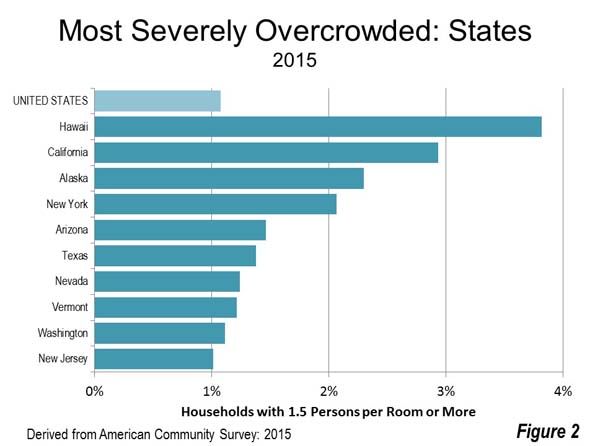
    Only Hawaii has a higher severe overcrowding rate than California, at 3.8 percent of households California’s severe overcrowding rate is 2.9 percent. By contrast, average for the United States is a much lower 1.1 percent. Alaska has the third most severe overcrowding rate, at 2.3 percent, while New York has the fourth most severe overcrowding, at 2.1 percent. Arizona ranks fifth at 1.5 percent (Figure 2).

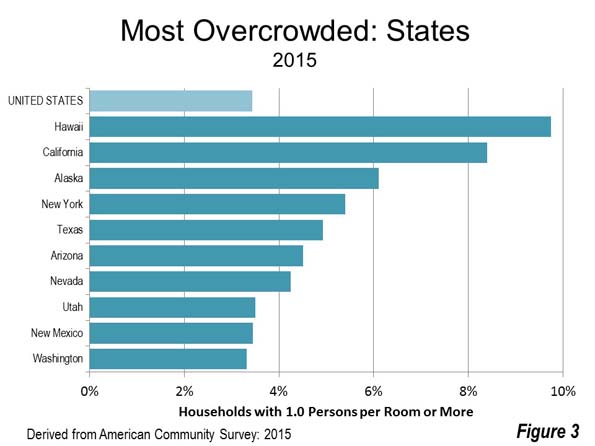
    The situation is similar with respect to basic overcrowding, more than one person per room. Hawaii also leads in this category at 9.7 percent, followed by California at 8.4 percent. The national overcrowding rate is 3.4 percent. Again, Alaska ranks third at 6.1 percent, followed by New York and 5.4 percent and Texas at 4.9 percent (Figure 3).

    Metropolitan Areas

    California metropolitan areas dominate in terms n both of the highest severe overcrowding rates and the highest overcrowding rates, to a far greater extent than one would expect from a highly developed, still affluent state.

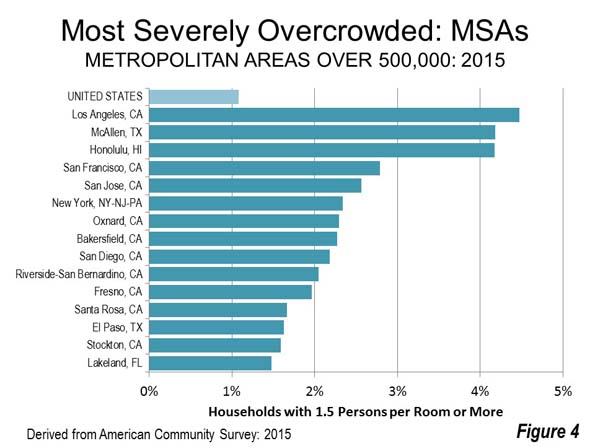
    California is home to 12 of the 106 metropolitan areas with more than 500,000 population (as of 2015). 10 of the 15 most severely overcrowded metropolitan areas are in California. My birthplace of Los Angeles has the worst rate in the United States, with 4.5 percent of its households in living in severely overcrowded conditions. This is more than four times the national rate of 1.1 percent. McAllen, Texas, in the Rio Grande Valley, is the second most severely overcrowded (4.2 percent), leading the third ranked Honolulu (4.2 percent) in the second digit.

    Two of California’s and the nation’s most wealthy metropolitan areas are among the most severely overcrowded (more than 1.5 persons per room), both in the San Francisco Bay Area. These include San Francisco itself (#4) and San Jose (#5). New York is the sixth most severely overcrowded.

    Other California metropolitan areas among the most severely overcrowded are Oxnard (#7), in the Los Angeles area, Bakersfield (#8) and Fresno (#11) in the San Joaquin Valley, San Diego (#9), Riverside San Bernardino (#10) in the Los Angeles area as well as Santa Rosa (#12) and Stockton (#14) in the San Francisco Bay Area (Figure 4).

    Only two of California’s metropolitan areas with more than 500,000 residents do not rank in the most severely overcrowded metropolitan areas, Sacramento and Modesto.

    California’s dominance in basic overcrowding (over one person per room) is more complete, with 11 of its 12 largest metropolitan areas represented in the most overcrowded 15. Only Sacramento was exempted.

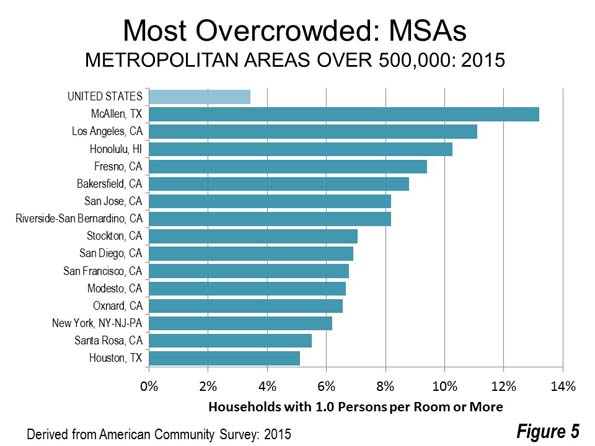
    The same three metropolitan areas lead the pack, though in a somewhat different order. McAllen has an overcrowding rate of 13.2 percent, nearly 4 times the national rate of 3.4 percent. Los Angeles is the second most overcrowded, at 11.1 percent, while Honolulu repeats its third ranking at 10.3 percent.

    The next at nine most overcrowded metropolitan areas are all in California, including Fresno (#4), Bakersfield (#5), San Jose (#6), Riverside-San Bernardino (#7), Stockton (#8), San Diego (#9),
    San Francisco (#10), Modesto (#11), in the San Joaquin Valley and Oxnard (#12). Santa Rosa has the 14th largest overcrowding rate (Figure 5).

    Contributing Factors

    Two characteristics stand out with respect to the states and metropolitan areas most overcrowded, high international immigration rates and high housing costs. High housing costs were cited as a factor in California’s high overcrowding rates by the state Legislative Analyst. High housing costs are also a problem in Hawaii and New York, which are among the 10 most crowded states in both categories as are there largest metropolitan areas. In addition, states that are magnets for international immigration are also represented among the most overcrowded, such as California, New York, Arizona, New Mexico and Nevada.

    Overcrowding has important social consequences, especially for children. For example, Claudia D. Solari at the University of North Carolina, Chapel Hill and Robert D. Mare of UCLA found in research focused on the city of Los Angeles that overcrowded housing significantly harms children, regardless of socioeconomic characteristics, negatively impacting school achievement, behavior and physical health. They conclude that these factors can persist throughout life, affecting their future socioeconomic status and adult well-being.”

    California, with its progressive ideals, needs to match its performance with its rhetoric. The state’s working class is clearly being hemmed in, and face a future that is hardly that promised by its political class.

    Wendell Cox is principal of Demographia, an international public policy and demographics firm. He is a Senior Fellow of the Center for Opportunity Urbanism (US), Senior Fellow for Housing Affordability and Municipal Policy for the Frontier Centre for Public Policy (Canada), and a member of the Board of Advisors of the Center for Demographics and Policy at Chapman University (California). He is co-author of the “Demographia International Housing Affordability Survey” and author of “Demographia World Urban Areas” and “War on the Dream: How Anti-Sprawl Policy Threatens the Quality of Life.” He was appointed to three terms on the Los Angeles County Transportation Commission, where he served with the leading city and county leadership as the only non-elected member. He served as a visiting professor at the Conservatoire National des Arts et Metiers, a national university in Paris.

    Photo: Downtown Los Angeles toward the Hollywood Hills and the San Fernando Valley (by author)

  • Ivanka Trump, Chelsea Clinton, and the Emerging Female Electorate

    The 2016 election is in the rear-view mirror. But the votes and views of a key demographic group—young women—will reverberate significantly in future elections. Two members of this group, Ivanka Trump and Chelsea Clinton, were the most visible representatives of their peers during the campaign. Examining their unique demographic characteristics and attitudes provides clues about what we can expect from the emerging female electorate going forward.

    Diversity
    Let’s start with the basics. While very close in age, the two women fall into different generations. At 35, Ivanka Trump is at the front end of the much-discussed Millennial cohort. Millennials are now the largest generation, making up more than one quarter of the nation’s population. Chelsea, at 36, is a young Gen Xer, a group with a less distinctive profile in public opinion. Together, Millennials and Gen Xers make up the largest share of eligible (not actual) voters (56%).

    The United States is experiencing what demographer Bill Frey calls a “diversity explosion,” with Millennials the most diverse generation in our history. Ivanka and Chelsea are part of the declining national white share of America’s population. Among Millennials, 56% are now white, 21% Hispanic, 14% African-American and 7% Asian.

    The Millennial generation is also the most educated generation in history, especially its women. Women surpassed men in bachelor’s degrees conferred in 1982, master’s degrees in 1987, and doctoral and other professional degrees in 2006. Ivanka and Chelsea’s Ivy League educations are not the norm for most young women, but their levels of education illustrate the impressive gains their female peers are making. This election, women with a college degree were 51 percent of voters and voted for Hillary Clinton, 58%-38%.

    The Future Family
    Ivanka married at age 27, just days before her 28th birthday; Chelsea at age 30. Like many other women their ages and younger, they married later (and will be married longer if they stay married). In 2015, the average age of first marriage was 27 for women and 29 for men, up from 21 for women and 23 for men of the Silent generation (born 1928–45). Around 20% of Millennials are married today. A quarter are the children of divorce or parental separation, true for Ivanka but not for Chelsea.

    While these two women have married, the rise of the nonmarried electorate may be more consequential politically. In the AEI/Brookings Institution/Center for American Progress report “States of Change: The Demographic Evolution of the American Electorate, 1974–2060,” we note that in 1974, 70% of eligible voters were married. Today, the married share of the eligible electorate is down to 52%. The nonmarried share is almost as large at 48%. Among female eligible voters, the nonmarried share has surpassed the married share. Strong majorities of nonmarried women (a group that includes single, divorced and widowed women) have voted Democratic in every presidential election since the 1980s, the first time the exit pollsters collected these data, and they have become more Democratic over time. Nonmarried women voted 62 percent for Hillary Clinton. Sixty-seven percent voted for Barack Obama in 2012.

    Religious intermarriage is becoming more common, and both Ivanka and Chelsea married someone of a different faith. Pew’s 2014 religious landscape survey found that people who married after 2010 were more than twice as likely to be in religious intermarriages as those who married before 1960 (39%-19%).

    Millennials are leading another significant religious change in America: the rise of the “nones.” More than a third of Millennials (35%) say they have no formal religious affiliation. Still, around 50% of Millennials say they are absolutely certain they believe in God.

    Declining fertility is another big story of our time, and the current fertility rate of 1.9 births per woman now falls below the replacement rate of 2.1. Ivanka has three children at this point, and Chelsea, two. Today, according to Gallup, American women say their ideal family size is 2.6 children, down from 3.6, a figure that remained constant until the late 1950s. In the same survey, 40% of Americans 18-40 years old who do not have children said they want them someday. Young adults still want kids; they just aren’t having as many.

    Women at Work—And at Home?
    Ivanka and Chelsea are working mothers, as both have highlighted in recent public appearances. They are both working moms of newborns, to boot. According to the Bureau of Labor Statistics (BLS), 68% of married mothers in 2015 were in the labor force, as were three-fourths of mothers not married or living apart from their spouse. Fifty-eight percent of mothers with infants under a year old were in the workforce either full- or part-time last year.

    As more women have entered the U.S. workforce, their attitudes about working have shifted. Since 2007, around 50% of women, up from 36% when Gallup first asked the question in 1974, have consistently told the pollsters that if they were free to do either—a big “if” for most women—they would prefer to have a job outside the home than to stay home and take care of their house and family. While a majority of younger women and women with a college degree said they would prefer to work, a majority of women with children said they would not. In Gallup’s 2014-15 data, 54% of employed women with children under 18 preferred to stay home, as did 57% of women not currently employed with children.

    In 2015, both parents worked in 61% of married-couple families with children under 18, according to the BLS. Ivanka and Chelsea have more resources than most working mothers to help them navigate the work-family balance. More millennial husbands than husbands in earlier generations say they help at home. Fifty-nine percent of parents employed full-time say they share household chores equally, but women still handle most child-rearing responsibilities.
    Ivanka is not alone in professing the joys of parenthood, as she did in her September Wall Street Journal article. In a 2015 Pew study, more than three in four parents with children under 18 described being a parent as enjoyable and, separately, rewarding. Mothers and fathers both gave equally as high responses.

    Political Laggards, Social Leaders?
    In terms of partisan identification, Ivanka spoke for many in her generation when she said at the GOP convention: “I do not consider myself categorically Republican or Democrat.” More young people describe themselves as independents than as Republicans or Democrats. This election, more young voters cast ballots for third-party candidates than older voters did. But in recent elections, young voters have voted heavily Democratic. They voted solidly for President Obama in 2008 (66%) and 2012 (60%), fueled largely by the preferences of minority youth. In 2016, they voted 55% for Clinton to 37% for Trump. White young people voted narrowly for Trump, 48%- 43%. Minority millennials voted heavily for Clinton. Young white women voted for Clinton, 51%- 42%. Their older sisters, white women ages 30–44, voted more closely for Trump, 49%- 45%.

    Younger voters pay some attention to politics. In the Spring 2016 Harvard Institute of Politics (IOP) poll, over half of 18- to 29-year-olds said they are following closely this year’s presidential election (60%) and, separately, news about national politics (52%). But unlike Ivanka and Chelsea, most do not actively participate. Although 37% have liked a political issue on Facebook and 29% a political candidate, most are passive and don’t engage in traditional political activities such as volunteering.

    Even though Ivanka and Chelsea haven’t made explicit their opinions on many mainstream issues, polling data show clear patterns in young people’s attitudes. Both Gen Xers and Millennials strongly support gay marriage, but until recently, young women were much more supportive than young men. Today their views are similar. Young men and women support marijuana legalization, but young women are more dubious about it than men. On abortion, the young, like other generations, want to keep abortion legal but are willing to put restrictions on its use. Young women are less supportive about women being drafted than are young men. Although these issues get substantial media attention, the top issues for most young people—as for their parents—are the economy, terrorism and health care.

    The granddaughters of feminism are charting their own course. In the Harvard IOP poll, 37% of women 18-29 years old identified themselves as feminists, while 58% did not. That’s not to say young women don’t think there’s progress to be made. In another poll from Pew earlier this fall, 63% of women 18-34 said there are still significant obstacles that make it harder for women to get ahead than men, compared with 38% of men this age who gave this response. When asked if they’ve ever personally experienced discrimination because of their sex, more women say they haven’t than say they have (53%-46%).

    Life at the Local Level
    Ivanka and Chelsea campaigned on behalf of a parent for the country’s highest elected office, but young people aren’t very confident in government. They want the federal government to do many things and at the same time have little trust in it. Nearly two-thirds don’t think Social Security will be available when they retire. Similarly, young people are neither cheerleaders for nor hostile to big business. Many observers have commented on their distrust in central institutions, but this could have a silver lining. As they grow up, they are likely to be more self-reliant and perhaps more active in their local communities, where they have higher confidence that problems can be solved.

    Both Ivanka and Chelsea appear to have close relationships with their parents, another factor that defines the younger generations. Young people often talk to or text with their parents, and 32% of 18- to 34-year-olds live with a parent, surpassing for the first time the number of those living with a spouse or partner in their own household. Many also live near their parents. In the 2014 General Social Survey, over half (53%) of young adults said they lived in the same city as when they were 16 years old. Of those who moved away, one in five lived in the same state, while slightly more (one in four) moved to a different state.

    A Younger Direction
    Ivanka and Chelsea didn’t sign up to be presidential surrogates, but both were a credit to their families on the campaign trail. Both have said their friendship will continue after the dispiriting political brawl that was this year’s campaign, something that could serve as good advice for the rest of us. And in an interview with 60 Minutes this week, Ivanka said she is “going to be a daughter” in her father’s presidential administration, rather than having a more formal role. As she and Chelsea return to their lives off the campaign trail, the demographic and attitudinal footprint of young women gives us a sense of how this emerging electorate will reshape the country’s political and cultural landscape for generations to come.

    This piece is adapted from an article that first appeared on WSJ.com.

    Karlyn Bowman is a senior fellow and Heather Sims a program manager at the American Enterprise Institute.

    Photo by Michael Vadon (Own work) [CC BY-SA 4.0], via Wikimedia Commons
  • Memo to the Next President: Don’t Forget the Working Class

    At the end of most US presidential elections, most Americans are ready to see the last of campaign ads, social media commentaries and tension-fraught news coverage. That’s even more true this year. But more than in most recent elections, we shouldn’t expect the frustrations and divisions that have surfaced over the past 18 months to disappear after the ballots have been counted. Tensions over class and race, especially, may die down, but they aren’t going away. If a new president will take them on, something good might yet emerge from this ugly election.

    Although it’s true that working-class voters are declining in number, they have drawn increasing attention over the past several elections, in part because, as Ruy Teixeira and his colleagues at The Democratic Strategist have been arguing for a while, they remain a crucial demographic. And this year, the white working class has not only been recognized as a key voting bloc, it has been an active player, demanding that the country and its leaders recognize the economy does not work for many Americans.

    Amid far too many reports that have pinned Donald Trump’s success on the white working class, this year’s election coverage also has drawn attention to real problems, many of them rooted in class and racial inequalities. If the next president wants to succeed she (or he) must address what design experts call “wicked problems” — big, complex issues that resist simple explanations or one-dimensional solutions. It won’t be easy.

    The election has created the conditions for addressing the first of those: class resentment. I don’t mean the resentment poor and working-class people feel toward the wealthy. I mean the resentment they feel toward a government that doesn’t seem to care about them or have the will to address economic inequality. I’m also talking about resentment toward a public discourse that denigrates and blames working-class people for not being more like the middle class. WNYC’s On the Media provided a terrific overview of that discourse in a series of reports about common and problematic assumptions that shape reporting on poverty. As host Brooke Gladstone explained, reliance on these assumptions generates media that reinforces the idea that people are poor because they don’t work hard or because they make bad choices. No matter how much we might deplore some of the behavior and attitudes that have surfaced in the election, we can’t address the class-based cultural divide by dismissing poor and working-class people as “deplorables” who lack the critical thinking skills that college education provides.

    Good leadership could address class resentment not only with better policies — more on that below — but also by taking it seriously. While claims that Trump’s support comes primarily from the white working class are problematic, both he and Bernie Sanders won votes this year because they addressed working-class people’s sense of being left behind by the economy and put down by the media. Both also recognized a simple truth about American culture: Class is a central and increasingly important divide. A good president will acknowledge that, but also will lead the way in fostering deeper and more critical conversations about the economic, social and cultural roots of those divisions.

    Of course, the cultural divide reflects a very real and serious economic gap, and a good leader must be willing to talk about its sources and consequences — including the way contemporary global capitalism, neoliberal ideology and technology drive economic changes that deepen inequality. We need to create more jobs through infrastructure projects among other strategies. But we also need policies that address not only the quantity of jobs but also their quality — what they pay, how they are structured and how workers are protected from exploitation as well as physical and psychological injuries. Raising the minimum wage is just a start. American economic leaders need to look critically at the effects of the “gig economy” and rising precarity, a term some scholars have coined to describe the uncertainty facing many workers who can’t count on a regular paycheck. Instead of pushing for everyone to go to college, we need to focus on ensuring that the thousands of working-class jobs that our economy will continue to produce are good jobs. This doesn’t necessarily mean bringing back manufacturing. It probably does mean bringing back the labor movement, with a broader and more inclusive social unionism.

    Inequality doesn’t stem only from employment, however. As Jack Metzgar has argued, we need tax policies that focus less on the persistent fantasy of trickle-down economics and instead put cash into the pockets of the working class, who will spend it. We could expand the earned income tax credit and increase credits to help families pay for child care, housing or college. We also need to take another look at health care. The Affordable Care Act was a step in the right direction, with in its emphasis on providing insurance to those who hadn’t had it previously, but it still relies on the private insurance industry. It’s time to develop a single-payer system that puts first the needs of ordinary people, not those of a profit-based industry.

    Perhaps the most troubling problem that has surfaced in this year’s election is racism. While some have challenged stories that present racism as a white working-class problem, we also know that racism and racial divisions are real problems for working-class people. Racism is a class issue, in multiple ways. First, racial division undermines the class solidarity that could generate social change movements. It also distracts people from the real source of their problems — not other poor and working-class people, but the economic and political system that, as Guy Standing has suggested, is rigged against workers and what, in today’s economy, he has named the “precariat.”

    At the same time, racism presents a threat to working-class people. While the profiling and anxieties that underlie police violence toward black people sometimes target middle-class (and upper-middle-class) African-Americans, working-class black men are probably at greater risk. Here, too, we need policies that more forcefully address racial injustice and divisions, to ensure that citizens are protected by the police rather than needing protection from them. But we also need policies that facilitate more racial interaction. Among the most interesting insights on this year’s election was Jonathan Rothwell’s analysis of Gallup poll data, which revealed that Trump’s strongest support came from white people living in highly segregated areas. Racism is a structural issue, not just a matter of morality or attitudes, and we need to address it with policies that challenge housing and education segregation and inequities.

    None of this is easy, and these “solutions” are as limited as they are idealistic. I’m sure there are better ideas out there. Our next president needs to find them. She (or he) must pay attention — not only to the anger and frustration of working-class people but also to the complex nature of the problems that generate those feelings.

    In 2008, Barack Obama’s campaign tried to keep his supporters’ momentum going by creating Organizing for America, which became Organizing for Action, a network of community organizing groups that largely faded from the national picture. This year, we need more.

    Whatever the result of Tuesday’s election, neither the media nor the new president should stop talking about and listening to the working class. It’s time to move from campaign mode to action, from courting working-class voters to addressing the conditions of their lives.

    Note: This essay was first published by Moyers & Company.

    Sherry Linkon is a Professor of English and Director of the Writing Program at Georgetown University.  She is co-author, with John Russo, of Steeltown USA: Work and Memory in Youngstown (Kansas 2002) and is working on a book-length study of contemporary American literature about deindustrialization.

    Photo by: By Michael Vadon [CC BY-SA 2.0], via Wikimedia Commons

  • California Jumps the Shark

    America may have trended toward the GOP, but California seems determined to find its own direction. The only question is, simply, how much more progressive the Golden State will become, even in the face of a far more conservative country beyond the Sierras.

    This election confirmed, if it was needed, the death spiral of the state’s Republican Party. Thanks, in part, to Donald Trump — and his magnetic anti-appeal among Latinos, women and the educated — the GOP did even worse here in the presidential race than in 2012, when it couldn’t muster 40 percent support, and has lost several legislative seats, allowing the Democrats to re-establish their coveted two-thirds supermajority in the Assembly — and possibly in the Senate as well.

    The progressives also won most of the major propositions — most critically, the extension of a high income tax rate on the state’s affluent population through 2030. We may have more freedom to smoke pot, but it won’t be so easy to start a business, buy a house or build a personal nest egg, if you are anything other than a trustifarian or a Silicon Valley mogul, or are related to one.

    Go any direction you want, as long as it’s to the left

    Since the late 1990s, California has been moving leftward, with a bit of a bump from the Schwarzenegger recall election. By morphing into a liberal Democrat, the Terminator helped terminate the GOP as a serious force. Add to that the damage done by the residue of Pete Wilson’s Proposition 187, which permanently alienated the rising Latino electorate, and the GOP seems destined to further decline.

    The only hope for sanity has been an alliance of the Republican rump with moderate Democrats, many of them backed by what’s left of traditional California business. But, increasingly, inside the party, it’s been the furthest Left candidates that win. In the Democrat-only Sanchez vs. Harris race for the U.S. Senate, the more progressive candidate triumphed easily, with a more moderate Latina from Southern California decimated by the better funded lock-step, glamorous tool of the San Francisco gentry Left.

    Gradually, the key swing group — the “business Democrats” — are being decimated, hounded by ultra-green San Francisco billionaire Tom Steyer and his minions. No restraint is being imposed on Gov. Brown’s increasingly obsessive climate change agenda, or on the public employee unions, whose pensions could sink the state’s finances, particularly in a downturn.

    Read the entire piece at The Orange County Register.

    Joel Kotkin is executive editor of NewGeography.com. He is the Roger Hobbs Distinguished Fellow in Urban Studies at Chapman University and executive director of the Houston-based Center for Opportunity Urbanism. His newest book, The Human City: Urbanism for the rest of us, will be published in April by Agate. He is also author of The New Class ConflictThe City: A Global History, and The Next Hundred Million: America in 2050. He lives in Orange County, CA.

  • There are “Left-behind” in the Blue States Too

    The 2016 presidential election revealed a strongly divided nation. Donald Trump’s victory has been characterized as a “landslide” by some, noting the surprisingly high electoral vote tally. Others note the likelihood that Hillary Clinton will win the popular vote. In any event, the result is far different than many expected. In its last pre—election prediction of the electoral vote, the Los Angeles Times gave Hillary Clinton one-half more electoral votes (352) than she will apparently receive (232). Her apparent popular vote victory (approximately 300,000 at this point) is so concentrated that without California she would have lost the popular vote by more than 3,000,000 (based on trends at this writing).

    Just about everyone agrees that the pollsters got this election very wrong. It appears that Trump voters, especially rural voters were significantly under sampled in polling. Generally, it is agreed, that the secret to the success of the Trump campaign was the mobilization of voters who believed that they had been “left-behind” by the “system.” This was the key to the strong Republican performance in the Rust Belt and especially in “coal country.”

    In these areas, working households who had depended on manufacturing or mining employment have seen jobs disappear and incomes drop in the last two decades. It was, overall, an election pitting the more fortunate “elite,” especially the West Coast and in Northeastern metropolitan areas against middle and lower middle income households that have not done well. These are households that feel they have been “left-behind” in a national economy that has yet to restore inflation-adjusted 1999 median incomes.

    Yet the “left-behind” were evident in voting patterns even in the more prosperous Blue State metropolitan regions (combined statistical areas), especially in outer suburban counties, which often have smaller populations.

    New York

    The New York metropolitan region, with its high nominal household income, has a number of counties in which Donald Trump polled well.

    The four most highly urban boroughs of the city delivered overwhelming mandates to Clinton, with as much as 89 percent of the vote in Manhattan and the Bronx, 80 percent in Brooklyn and 75 percent in Queens. She also received strong support from inner suburban counties, 65 percent in Westchester, 74 percent in Hudson (Jersey City), 77 percent and Essex (Newark) and 66 percent in Mercer (Trenton) and Union (Elizabeth).

    However, some of the outer counties showed strong support for Donald Trump. For example, he received 66 percent of the vote in New Jersey’s Ocean County, and more than 60 percent of the vote in Sussex County, New Jersey and won other suburban New Jersey counties such as Monmouth, Hunterdon, Morris. Trump also took Suffolk County in eastern Long Island, and the Hudson Valley counties of Putnam, Orange and Dutchess, where the FDR Library is located.

    Even farther out, Trump managed above 60 percent majorities in Pennsylvania’s Pike and Carbon counties and also won Northampton County (Bethlehem).

    Washington-Baltimore

    There was strong support for Trump in Washington – Baltimore metropolitan region, with its lucrative government jobs machine. Northernmost Franklin County, Pennsylvania provided a 71 percent majority to Trump, while Maryland’s Washington County, just across the border, provided 64 percent. Closer to Baltimore, Carroll and Harford provided Trump 65 percent and 60 percent majorities. Across the Chesapeake Bay Bridge from an Annapolis, Queen Anne’s County voted 66 percent for Trump. Southeast of Washington, St. Mary’s County voted 60 percent for Trump.

    West Virginia’s Hampshire County provided the largest majority in the metropolitan region to Trump at 78 percent, while Berkeley County provided a 60 percent vote. Amazingly, every county in the state of West Virginia voted for Trump, despite its decades of Democratic Party domination, providing Trump a 62 to 27 percent landslide.

    The situation was similar in outer counties across the Potomac River in Virginia. Warren County voted 66 percent and Frederick County 65 percent for Trump. Facquier  and Culpepper counties supported Trump at 60 percent.

    The “Left” Coast

    There were even pockets of strong Trump support in some metropolitan regions of the so-called “Left Coast.”

    For example, in the Portland metropolitan region, Linn County voted 60 percent for Trump. Among the 11 suburban Portland counties, six supported Trump. Perhaps most surprisingly, Marion County, home of Oregon’s capital (Salem) supported Trump. Marion County was one of only two Clinton supporting states in which the capital county supported Trump (the other being Storey County in Nevada).

    California was not to be left out. In the Sacramento metropolitan region, five of the seven suburban counties supported Donald Trump.

    Minneapolis-St. Paul

    Trump managed to command surprisingly strong support in the suburbs of high-income Minneapolis-St. Paul. Beyond Clinton’s predictably strong support in core Ramsey (St. Paul) and Hennepin counties (Minneapolis), all but two of the 19 suburban counties supported Trump. Support was strongest in the outer suburban counties. The entire northeastern corner of the metropolitan region provided strong support to Donald Trump. In Stearns County (St. Cloud), Trump received 60 percent of the vote and an even higher 65 percent in adjacent Benton and Shelburne counties.

    Wright County, which is adjacent to central Hennepin County, voted 63 percent for Trump. There was a wall of strong support across the remainder of the metropolitan region’s northern tier, with a 65 percent majority in Isanti County, 64 percent in Mille Lacs County and 61 percent in Chisago County. The southeastern corner of the metropolitan region also supported Trump strongly, with Le Sueur County providing 62 percent and Sibley County providing the largest Minneapolis – St. Paul area majority for Trump at 67 percent.

    Denver

    Denver, with its information technology industry and its high nominal household income supported Hillary Clinton strongly. Yet, four suburban counties supported Trump, Douglas, Weld, Park and Elbert.

    What is Behind the Trump Support in Blue States?

    While the metropolitan regions discussed above have not endured the huge manufacturing and resource industry losses of the Rust Belt metropolitan regions, some households have faced serious economic challenges. Here the culprit is a high cost of living, most evident in especially high house prices. Many middle income residents are “driving until qualified” to find the housing they desire at a price they can afford.

    Like those in the less economically favored parts of the nation, they are having difficulty sustaining their standard of living. With the prospect of mortgage interest increases and price increases from strengthening regulation, the ranks of the “left-behind” could grow, and with it the Trump coalition. Or, a Democratic Party returning to its roots could seize the opportunity, though that seems less likely.

    Wendell Cox is principal of Demographia, an international public policy and demographics firm. He is a Senior Fellow of the Center for Opportunity Urbanism (US), Senior Fellow for Housing Affordability and Municipal Policy for the Frontier Centre for Public Policy (Canada), and a member of the Board of Advisors of the Center for Demographics and Policy at Chapman University (California). He is co-author of the “Demographia International Housing Affordability Survey” and author of “Demographia World Urban Areas” and “War on the Dream: How Anti-Sprawl Policy Threatens the Quality of Life.” He was appointed to three terms on the Los Angeles County Transportation Commission, where he served with the leading city and county leadership as the only non-elected member. He served as a visiting professor at the Conservatoire National des Arts et Metiers, a national university in Paris.

    Electoral map by Ali Zifan (This file was derived from:  USA Counties.svg) [CC BY-SA 4.0], via Wikimedia Commons