Blog

  • The Forty-Fifth Parallel

    When I was a kid growing up in Oregon, we’d occasionally drive north on I-5 to Portland. Just north of Salem we’d pass a sign that read (if memory serves) “The 45th Parallel: Halfway between the equator and the north pole.”

    I wish I’d stopped and taken a picture of myself straddling the parallel. It would go with a collection of similar straddles: across the equator in Uganda, across the Arctic Circle in Finland, and across the 42nd parallel.

    Yes, for if you go south on I-5 (or almost any other road) the 42nd parallel, 7/15ths of the way from the equator to the north pole, is very well marked. It says “Welcome to California.” For 42 is the southern boundary of Oregon and Idaho, against California, Nevada and Utah. Likewise, heading south from Syracuse on I-81, just past Binghamton, it’s marked as “Welcome to Pennsylvania.”

    Other latitudes form important state lines: the four corners is at the 37th parallel and the 109th meridian. Colorado’s northern boundary follows the 41st parallel. And famously, the 49th parallel comprises the largest part of the US-Canada border.

    The special 45th parallel, however, is explicitly reflected in political geography in only two places: it forms Montana’s southern boundary with Wyoming. And more significantly, it forms the northern boundary of New York and Vermont against Quebec.

    Only four states lie entirely north of the 45th parallel: Alaska, Washington, Montana (almost), and North Dakota. The biggest cities are Seattle and Portland. The parallel divides the Minneapolis-St. Paul area. So counting six million from Washington, 2 million each from Oregon and Minnesota, and about 3 million from everywhere else, approximately 13 million Americans live north of the 45th parallel – or 4% of our population.

    Now consider Canada. That country’s southernmost reach is Middle Island in Lake Erie, just south of the 42nd parallel. (My mother often told me that Canada was south of California.) The 45th parallel passes north of Barrie, Ontario, which means the Toronto Metro area and Western Ontario are to the south. Further east, St. John, NB lies just to the north, but Halifax, NS is just to the south. Montreal, Ottawa, and all western cities are north of 45. I’ll guess that about 25 million of Canada’s 34 million people live north of the 45th – about 74% of the population.

    So while almost all Americans live to the south, a large majority of Canadians live to the north. So if one wants to distinguish the US from Canada by a single straight line, the 45th is as good as any. It is much better than the iconic 49th, since the largest Canadian cities are well south of that latitude.

    Heading east, the 45th passes through the southern tip of Crimea, and splits Kazakhstan and Mongolia in half. The only parts of Russia lying south are Vladivostok and the northern Caucasus. Japan, China and the Central Asian republics are almost all to the south.

    In Europe, the parallel runs through Southern France and Northern Italy. To a very rough approximation, it follows the Pyrenees-Alps mountains. In the continental EU, only Bulgaria, Greece, Spain and Portugal lie entirely to the south.

    The parallel wouldn’t have been the worst way to split up the former Yugoslavia: Zagreb is to the north, and Belgrade in the south. Further, the Serbian region of Vojvodina and the Romanian region of Transylvania are north. These areas both have large Hungarian minorities, formerly part of the Austro-Hungarian empire. Irredentist movements in Hungary might happily settle for a boundary at the 45.

    A reasonable population estimate for north of the 45th counts 200 million in the former USSR, 370 million in Europe, and 30 million in Canada, for a total of 600 million, or 10% of the world’s population.

    If the earth were a perfect sphere, then 29.3% of the surface area of the northern hemisphere would lie north of the parallel (this is a reasonably straightforward calculus problem; try it if you’re so inclined). As the earth is actually an ellipsoid, the number is somewhat smaller. Since about 5 billion people live in the Northern Hemisphere, only about 12% of them live north of 45. (Only about one million people live south of 45 S.)

    Is this surprising? Not really – one wouldn’t expect many people to be living at the north pole. But come to think of it, you’ll be surprised by how surprising this number really is.

    A reasonable rule of thumb is that cities at the same latitude will have the same average annual temperature, as they get the same amount of sunshine at the same times. Thus while Minneapolis certainly has colder winters and hotter summers than Portland, on average it should come out right. I learned this again on my last visit to Portland – summer nights in Portland are cold!

    But the rule of thumb doesn’t apply when something truly bizarre affects the climate. And that bizarre thing is the Gulf Stream, which heats Europe 5+ degrees latitude more than it should. Thus Milan (at 45) has a San Francisco climate; London, Paris and Berlin feel like Portland; Oslo, Helsinki and St. Petersburg are similar to Vancouver; and even Murmansk can’t be worse off than Anchorage.

    Thus the surprise is not how few people live north of 45, but rather how many. For of the 600 million northerly souls, only 5% of them live in North America. That means that subarctic Eurasia has nearly 20 times the population, but probably only 3 times the land area. Thus there is a seven-fold higher population density in northern Eurasia than there is in North America. I’m surprised.

    To quantify the surprise, the appropriate Gulf Stream comparison line through Europe might be at the 52nd parallel rather than 45. I chose that latitude as it roughly corresponds to the Baltic coast. Thus France, Germany, Benelux, Ukraine, Poland, and major parts of European Russia lie between 45 and 52, along with smaller countries. Estimating that combined population at about 400 million, and subtracting that from the 600 million, we get a more reasonable sub-arctic population estimate of about 200 million.

    So 200 million live in the northerly Eastern hemisphere, and 35 million live in Canada – a ratio of nearly six to one. I’m still surprised, but can no longer account for the discrepancy. Is life really that much easier in Finland?

    There is another half-way latitude worth mentioning. What latitude splits the earth’s surface in half? If you did the above calculus assignment, you will immediately know the answer: the 30th parallel. Half the earth’s surface lies within 30 degrees of the equator, and half beyond. The 30th parallel does not correspond to any political geography – it goes through Jacksonville, Baton Rouge, Beaumont, and Austin, before entering Mexico southeast of El Paso.

    So the United States mostly lies between the 30th and 45th parallels. Now isn’t that just the very best of temperate climes?

    Daniel Jelski is Dean of Science & Engineering State University of New York at New Paltz.
  • The Failed State of California – The Changing Landscape of America

    The Golden State is not so golden anymore. California is broke. With a $20 billion dollar deficit and tax revenues down 27% from last year, Governor Schwarzenegger looks to Washington D.C. for a bail-out to rescue the state from financial ruin. Like the executive passing a beggar on a street corner, Washington looks the other way. Unemployment is statistically 12.3%, but functionally, it runs closer to 20% of the work force. Nowhere is unemployment more tragic than in the Central Valley, the fruit and vegetable producer of the world. The unemployment rate in arguably the most fertile land on the planet is near 30% as residents line up in bread lines to feed their families. How did this happen? What happened to the Golden State?

    California is a victim of its own success.

    For decades following WWII, people flooded into the golden state in search of weather, opportunity and the good life. California delivered. Under Governor Pat Brown in the 1960s, California had wonderful weather, plentiful water, new highways, and the best public school systems in America. Every student had access to a strong community college system and top students were guaranteed admission to the University of California. Agriculture, Hollywood, aerospace and construction provided more jobs than workers.

    The 1970s brought harbingers of California’s future. The environmental movement muzzled a robust real estate industry with alphabet agencies like AQMD, CEQA, EIR and CCC. Building moratoriums raised home prices along the coast. Aggressive land use controls pushed development inland creating urban sprawl and long commutes as residents sought affordable housing inland. Governor Jerry Brown quipped, “If we do not build it, they will not come” and shut down highway construction, public school construction and added layers of new regulations. The people came anyway.

    The collapse of the Soviet Union in 1989 dealt California a cruel blow. The peace dividend meant the end for many high paying aerospace jobs and defense contracts. The recession that followed was felt far deeper than in the rest of the country. California climbed out of its recession led by wave after wave of new millionaire software developers during the dot com revolution.

    In 2001, the dot come bubble burst. The politicians in Sacramento, emboldened by an endless supply of money from the dotcommers to state coffers, spent over $100 billion while revenues fell to just $70 billion. They ran up a $38.2 billion deficit in 2002 under Governor Gray Davis – more than the other 49 states combined. The people recalled Davis in 2003 and replaced him with the Terminator, Arnold Schwarzenegger.

    The politicians learned nothing.

    California survived the bursting dot com bubble with yet another round of real estate escalation (the housing bubble) that lifted home prices by 20% per year. Spending escalated in line with home prices. More regulations were added to burden industry. Taxes were raised. Tuition increased. California added “The Global Warming Solutions Act of 2006” as if California alone could stem global warming. In response to 9-11, politicians passed SB 400, a feel good law that allowed cops and fireman to retire at 50. It was budgeted to cost “just $400 million” per year. Last year it cost $3 billion. Then, they passed SB183 the next year, applying the same benefits to non-safety state employees like billboard inspectors. When the housing bubble burst in 2007, California found itself with a $20 billion deficit – again.

    This time, California will not climb out so easily. Federal regulators, implementing the Endangered Species Act that was invented in California, diverted water from the farms of the Imperial Valley to the ocean to protect the engendered Delta Smelt. This tiny fish, with no commercial value, threatens the well being of tens of thousands of agricultural workers and contributes to unemployment figures worse than the Great Depression. California’s schools now rank 49th in the nation. They no longer generate the brilliant minds that fueled past economies. California’s 11.6% income tax has forced many high income earners to no income tax states like Florida or Nevada. The housing industry that created 212,960 units in 2006 was only able to build 36,000 units in 2009.

    Former state librarian and California historian Kevin Starr talks about the potential of California being the nation’s first failed state. John Moorlach, Orange County Supervisor says, “We better start talking about this. What are we going to do when the entity (state government) above us crumbles? I think we are already technically bankrupt.” He should know: Orange County went bankrupt in 1994. The City of Vallejo, population 120,000, was forced into bankruptcy in 2008 by commitments by its politicians to pay its City Manager $400,000 per year and its fireman an average of $175,000 annually.

    The biggest obstacle facing California’s recovery is a dysfunctional pension system created by politicians indebted to the public employee unions. The pension obligation is now $17 billion per year. California has 260,000 state employees and 38,000 are paid more than $100,000 per year. The University of California employs another 250,000 and 19,000 are paid over 100,000 annually. These generous salaries have been converted into lifetime annuities. The Legislative Analyst’s Office estimates the unfunded pension obligations of California to total $237 billion. In an era of retiring baby-boomers, this trajectory is clearly unsustainable. With tax receipts down, huge pension obligations and a state budget deficit of $20 billion, the vast majority of municipalities in California are suffering deficits and facing the prospect of Chapter 9 municipal bankruptcy.

    A train wreck is coming.

    Schwarzenegger, once the Terminator but now a Termed-Out lame duck, told the Sacramento Press Club, “No single issue threatens the fiscal health of this state more than our exploding pension obligations. Over the last 10 years, our pension costs have gone up by 2,000 percent from $150 million per year to $3 billion a year (for state government workers). That means hundreds of billions in unfunded liabilities and it means the $3 billion we are spending now will go up to $10 or $12 billion.”

    In October, state Treasurer Bill Locker told lawmakers they needed to reform the pension system or “it will bankrupt the state.” The California Public Employees’ Pension System chief actuary has described the current pension system as “unsustainable.” Adam B. Summers, a policy analyst at the Reason Foundation and author of “California Spending By The Numbers: A Historic Look At State Spending From Gov. Pete Wilson to Gov. Arnold Schwarzenegger” warns, “I think we are starting to approach a tipping point.”

    Do the politicians in Sacramento want to do something about the train wreck that is coming? The answer as of now is clearly no. There is no evidence that they are willing to curtail spending and reform the pension laws that cover 500,000 state employees. They know the State of California cannot go bankrupt under existing laws. However, if they will not act, the people may act for them. Just as they did in 2003 with the recall of Gray Davis, the people are taking the initiative. They are sponsoring the Citizens Power Initiative to curtail the ability of unions to use payroll deductions for campaign purposes. Another initiative would make California’s full-time legislature part-time. In the meantime, the California economy continues to grind to a halt. Will the people of California shock the nation like the people of Massachusetts did with the election of Scott Brown? Or will the unions buy another election and drive the Golden State over the edge, making it the First Failed State?

    ***********************************

    During the first ten days of October 2008, the Dow Jones dropped 2,399.47 points, losing 22.11% of its value and trillions of investor equity. The Federal Government pushed a $700 billion bail-out through Congress to rescue the beleaguered financial institutions. The collapse of the financial system in the fall of 2008 was likened to an earthquake. In reality, what happened was more like a shift of tectonic plates.

    ************************************

    This is the eighth in a series on The Changing Landscape of America written exclusively for New Geography

    Robert J. Cristiano PhD is a successful real estate developer and the Real Estate Professional in Residence at Chapman University in Orange, CA.

    PART ONE – THE AUTOMOBILE INDUSTRY (May 2009)
    PART TWO – THE HOME BUILDING INDUSTRY (June 2009)
    PART THREE – THE ENERGY INDUSTRY (July 2009)
    PART FOUR – THE ROLLER COASTER RECESSION (September 2009)
    PART FIVE – THE STATE OF COMMERCIAL REAL ESTATE (October 2009)
    PART SIX – WHEN GRANNY COMES MARCHING HOME – MULTI-GENERATIONAL HOUSING (November 2009)
    PART SEVEN – THE FATE OF DETROIT: GREEN SHOOTS? (February 2010)

  • Sydney: Choking in its Own Density

    The Daily Telegraph reports that air pollution is getting worse in Sydney, with one in ten days rating “poor” in 2009. Critics of the ruling Labor state government claim that increasing air pollution and the lack of public transport are the cause. They are half right.

    Sydney’s Densification is Intensifying Traffic Congestion: Sydney’s intensifying traffic congestion contributes substantially to rising air pollution.

    The increasing traffic congestion is an inevitable consequence of the state government’ s “metropolitan strategy” which is “jamming” high rise residential buildings into suburban detached housing neighborhoods. The mathematics of traffic and densification is that unless each additional resident drives minus kilometers and minus hours, there will be more traffic, even before considering the impacts of intensifying commercial and heavy vehicle traffic.

    The road system was not built for higher densities and neither was other infrastructure such as sewers or the water system, as Tony Recsei has noted in his preface to the 6th Annual Demographia International Housing Survey.

    The fact is that higher densities are strongly associated with more traffic, which means greater traffic congestion. The additional stop and go traffic produces greater pollution on the roads adjacent to which people and their children live. It also means more greenhouse gas emissions, because fuel consumption increases as traffic congestion intensifies.

    The association between higher densities and greater traffic congestion is also indicated by the ICLEI-Local Governments for Sustainability Density-VMT Calculator, based upon Sierra Club research. According to the Calculator, under the urban consolidation (“smart growth”) scenario, residential housing would be 37 housing units per hectare, as opposed to its “business as usual” scenario at a density of 10 housing units per hectare. The density of traffic (vehicle kilometers per square kilometer) under the higher density “urban consolidation” strategy would be 2.5 times as high as under the “business as usual” scenario.

    According to federal Bureau of Transport and Regional Economics, Sydney’s total traffic volume is projected to increase nearly 20% over the next decade. Nearly half of the increase will come from commercial and heavy vehicles. With little or no expansion of the urban footprint, there will be nowhere for the new traffic to go except onto the existing already over-crowded roadways.

    Stuck in Sydney’s Traffic: Already, the average one-way trip to work in Sydney is longer than in all but one of the 52 metropolitan areas in the United States with more than 1,000,000 population. Only New York takes as long as Sydney, because so many people use public transport, which is inherently slower for nearly all trips.

    Of Blind Faith: Public Transport: Public transport serves as an article of faith to which officials cling in the innocent or cynical hope that it can reduce traffic congestion. There is no doubt of the good that public transport can do to get people to the central city (CBD), with its highly concentrated employment. However, Sydney’s CBD oriented system is over-crowded. A succession of state governments have been incapable of providing sufficient service to make the trip comfortable for the less than 20% of Sydney employees who work there. Proposals to centralize more of Sydney’s employment in the CBD could not be more wrong-headed.

    Transit is about the CBD, whether in Sydney, Toronto, Portland or Atlanta. The public transport system capable of attracting a significant number of commuters to the smaller concentrated centers like Chatswood, Parramatta, or Norwest (much less the dispersed employment throughout the rest of the metropolitan area) has never been conceived, much less seriously proposed or built.

    Why We Regulate Air Pollution: Public health was the very justification for regulating air pollution. Air pollution’s negative impacts are principally local. The consequences are measured reduce the quality of life of people intimately exposed to the more intense air pollution from nearby roads.

    Higher densities come with a price. Higher densities are producing greater traffic congestion, higher levels of air pollution and greater public health risks. This is just the beginning.

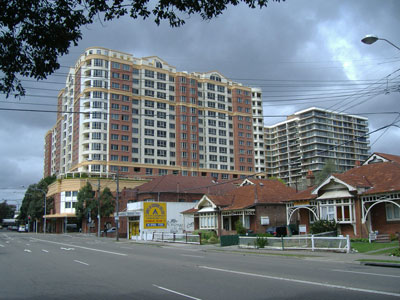
    Photograph: Strathfied, Sydney: Densification of detached housing neighborhood.

  • Biotech Research No Silver Bullet for Florida

    By Richard Reep

    Until recently, Florida was the king of growth, agriculture, and tourism. Growth – at 900 immigrants a day from other states – characterized Florida’s landscape for over 30 years, and growing cities were in perennial battle with agriculture up until the watershed year of 2009. As a tourist destination, Florida claimed world-class status, which once served the state just fine. Now, gasping for breath and facing financial uncertainty, Florida’s leadership frantically seeks a new silver bullet to create jobs, focusing on biomedical research. This focus is timely and important, and can truly move the state in a new direction, and the state leadership’s resolve to diversify the economy should stay strong, even with a short-term lack of results.

    Thanks to the Florida State Legislature’s 2006 Florida Capital Formation Act, It is now home to new facilities for Torrey Pines, Scripps, Max Planck, Nemours, the Miami Institute for Human Genomics, SRI International, the Vaccine & Gene Therapy Institute, and Charles Stark Draper Laboratory, Inc. However, the Millennial Depression has slowed growth and delayed the much-needed spinoffs that the state was counting on for job creation. Now, with the state’s coffers empty, the lack of instant job growth is causing a search for another, new instant success instead.

    Seven world-class life science research institutes in three years actually constitutes a remarkable achievement. Two are already off the ground and operational: Max Planck Institute and Torrey Pines. As they enter the operational phase, the laboratories are discovering that there is tough competition to attract top research scientists to Florida, with its noted lack of cultural amenities and its reputation for being, well, not exactly a progressive state in terms of education, culture, or environmental values.

    In January, however, the state legislature’s own analysis office recommended dropping life sciences research investment, because the return on this investment is measured in years. The politically correct unit of measurement today is apparently months or even minutes. In a published report, this office complained that its investment – all of three years old – had “not yet resulted in the growth of technology clusters”. It then recommended that Florida shift focus from research institutes to attracting biotech manufacturing companies, perhaps shortening the payback cycle.

    Only in our current times is failure defined as the lack of instant success. The report cites a lack of private venture capital as the reason for failure in Florida, yet digs no further into the reasons why Florida is low on the list of venture capital firms. This, along with government and large non-profit investment, is historically the only true source of funding for pure research, and is usually tightly tied to the region in which the research is to occur.

    As Thomas Edison’s winter home, Florida has always had a reputation among scientists and inventors as a vacation spot, rather than a real research venue. Venture capitalists prefer to cluster their investments around known quantities, and like most other investors, associate the unknown with high risk. By 2002, the Progressive Policy Institute ranked Florida 49th in employment of scientists and engineers, hardly news in a state dominated by service workers, construction laborers and immigrant farm labor.

    Unfortunately, scientists and their families tend to like the things that Florida is not good at: sensitivity towards the natural environment, excellent, competitive schools and universities, highly trained workforces and public philanthropy for arts and cultural activities. When it comes to private research grants, scientists tend to find their homes in places like San Diego, Boston, Berlin, and London. Beaches and theme parks just don’t appear on their radar screens.

    Thus, the state’s massive injection of capital has yet to produce any spin-off laboratories or manufacturing facilities around these new facilities. Private venture capital is simply shy to develop add-ons, knowing it will be a real hard sell to the main class of research scientists so desperately needed. And this fact, in these tough times, is what calls into question the whole investment strategy. On the surface, the state’s ambition to become king of research appears to be ludicrous.

    Yet, this lunacy may have method in it: Florida has many factors that do, in fact, favor life science research. It does have specific, although lightly funded, university research in biotech and medical study already in place. The state also has a gerontological population that provides a natural study base for much of the growing research in aging.

    Also, the scientific community is as diverse in its leisure and cultural choices as anybody, and Florida’s mild climate and recreational activities have already contributed to the attraction of new researchers. Unlike other, more established clusters in places like Boston and San Diego, Florida is also highly affordable, an important factor given the compensation levels to which many science professionals are accustomed. This is one reason Southern California gained an early foothold in aviation and science research and has maintained the lead in these areas.

    And lastly, sometimes it’s good to be the new kid on the block, for the competitive politics within other clusters has yet to develop in Florida. Even Florida’s former governor Jeb Bush expressed surprise at how “the state’s universities have played so well together” to gain its early foothold in science research. Florida has shown great energy and creativity in attracting these new research venues, and can continue to outperform the established, stable locations if it keeps its eye on the long-term goal and uses its natural advantages to sell the state to the scientific community worldwide.

    The strategic payoff is a more stable, educated state population that can ride out the boom/bust employment cycle better. This payoff, however, can only come if Florida’s leadership quits seeking a magic “silver bullet” to fix things in the next fifteen minutes, and does the hard work to attract and retain venture capital, invest in its educational system, and keep its collective eye on a long-term goal to become competitive in more than just a cheap place to live and vacation. Florida’s business and political leadership made some good choices to create a state-funded venture capital arm in 2006, and should stick to their commitments. If they pay their dues, eventually they may just find themselves a new crown to wear.

    Richard Reep is an Architect and artist living in Winter Park, Florida. His practice has centered around hospitality-driven mixed use, and has contributed in various capacities to urban mixed-use projects, both nationally and internationally, for the last 25 years.

    Photo: alternatePhotography

  • Over-Charged and Under-Stimulated

    As we reported in July of last year, Goldman Sachs and other US bank bailout success stories are reaping big dollar benefits from the “nebulous world of public-private interactions.” Goldman Sachs – somehow always first in line for these things – even got transaction fees for managing the Treasury programs that funded the bailouts.

    Now, the senator in my neighboring state of Iowa is once again trying to wake up Congress to the facts. You may recall that Senator Chuck Grassley (D-IA) admitted almost a year ago that he and the other members of Congress were fooled into voting for the bailout because they thought former-Treasury Secretary Paulson actually knew what the hell he was doing when he asked for $750 billion in the fall of 2008. “When it’s all said and done, you realize he didn’t know anything more about it than you did.

    Late last week, the Huffington Post called our attention to a letter that Senator Grassley sent to Goldman Sachs about the fees they will collect on the next bit of federal stimulus – bonds that are used to underwrite the latest jobs bill. Grassley points to a November 27 report from Bloomberg News for some evidence that Goldman may be over-charging local governments by more than 30 percent above what is normally charged for bond underwritings (i.e., handling the paperwork and rounding up some buyers).

    In Grassley’s letter, he includes a quote in the article to the effect that the local governments don’t care about the fees since there is a “large subsidy.” However, according to The Financial Times of London – and we agree with their assessment – Goldman and others are able to charge excessive fees because the financial crisis reduced their competition. When banks were required to raise more capital before they could pay back their bailout money, they did – and earned record fees for themselves in the process!

    It is eerily similar to the driving forces behind the “subprime crisis” that was repeatedly blamed for the financial crisis. The financial sector gains its profits from fees – issuance fees, trading fees, underwriting fees, etc. – unheeding of the impact on the real economy, taxpayers and the cost to the nation as a whole.

  • New Traffic Scorecard Reinforces Density-Traffic Congestion Nexus

    Inrix, an industry provider of traffic information, has just published its third annual Traffic Scorecard, which ranks the nation’s 100 largest metropolitan areas based upon the intensity of their peak hour traffic congestion in 2009. The results provide further evidence of the association between higher urban population densities and more intense traffic congestion.

    Los Angeles, Again: Not surprisingly, Los Angeles is again the most congested metropolitan area over 1,000,000 population. In Los Angeles, roadway travel takes nearly 34.7% more in peak periods than when there is no congestion. This means that a trip that would take 30 minutes without congestion would take, on average 40.5 minutes during peak periods.

    The principal measure used by Inrix is the Travel Time Index, which was developed by the Texas Transportation Institute (TTI), for its congestion reports that started in 1982. TTI’s latest Urban Mobility Report is for 2007. The Inrix measures are developed from actual GPS vehicle readings. This information is also provided to TTI to assist in preparation of its annual Urban Mobility Report.

    Measuring Delay: In the new edition, Inrix switches from using the Travel Time Index to what it calls the Travel Time Tax. The difference between the two measures is that the Travel Time Tax measures the percentage of delay, such as 35% in Los Angeles, while the Travel Time Index would state the figure as 1.35. The new method is preferable because differences in traffic congestion are more readily apparent. . For example, a metropolitan area having a Travel Time Tax of 15% would have 50% worse traffic congestion than a metropolitan area having a Travel Time Tax of 10%. This large difference is not as obvious when comparing the Travel Time Index values of 1.15 and 1.10. The “Travel Time Tax” parlance, however, is less than optimal and this article will use “average congestion delay” instead.

    Ranking the Metropolitan Areas: The average congestion delay in Los Angeles was much worse than in the other largest metropolitan areas, just as its core urban area density is well above that of anywhere else in the US, including New York (where far less dense suburbs more than negate the density advantage in the core city). It also doesn’t help that a number of planned freeways were cancelled in Los Angeles over the last 50 years.

    Among the large metropolitan areas, Washington, DC had the second worst Average congestion delay, at 22.4%, followed by San Francisco, at 21.5%, Austin at 20.7% and New York at 19.7%. Austin may seem to have placed surprisingly high, however this was the nation’s last large metropolitan area to open a full freeway to freeway interchange and has only recently begun to develop a comprehensive freeway system, through the addition of toll roads. Austin’s late roadway development is the result of two factors. Austin was too small in 1956 to receive a beltway under the interstate highway system and an anti-freeway movement delayed construction for decades.

    Inrix also develops an average congestion delay for the worst commuting hour. Los Angeles also has the most congested worst hour, with an average congestion delay of 69%. Austin ranked second worst at 55%, while San Francisco was third at 46%, Washington, DC fourth at 45% and New York fifth at 44%.

    Honolulu: Almost as Bad as Los Angeles: Smaller metropolitan areas also exhibited intense traffic congestion. Honolulu had an average congestion delay nearly as bad as Los Angeles, at 32.4% and a worst hour average congestion delay of 64%. The core urban area of Honolulu has the highest density of any metropolitan area between 500,000 and 1,000,000 population. New York exurb Bridgeport-Stamford had a worst hour average congestion delay of 63%, with a peak period average congestion delay of 18.0%.

    Inrix: Density and Traffic Congestion: Virtually all of the congestion and most of the analyzed road mileage is in the urban areas, rather than in the rural areas that make up the balance of the metropolitan areas. The metropolitan areas with more dense urban areas tend to have worse traffic congestion, as the table below indicates.

      • Metropolitan areas with core urban densities (see Note 1) of more than 4,000 per square mile had peak period average congestion delays of 18.4%, which is more than three times that of metropolitan areas with core urban densities of less than 2,000 (5.9%).

      • Metropolitan areas with core urban densities of more than 4,000 per square mile had worst peak hour average congestion delays of 37.5%, which is nearly 2.4 times that of metropolitan areas with core urban densities of less than 2,000 (15.9%).

    These relationships are similar to those indicated in the Texas Transportation Institute data for 2007.

    Traffic Congestion & Urban Density in the United States: 2009
    Core Urban Area Density (2000) Peak Period Average Congestion Delay: 2009 Compared to Least Dense Category Worst Hour Average Congestion Delay: 2009 Compared to Least Dense Category
    Over 4,000 18.4% 3.26 37.5% 2.36
    3,000-3,999 10.0% 1.76 22.3% 1.41
    2,000-2,999 7.3% 1.30 17.7% 1.12
    Under 2,000 5.6% 1.00 15.9% 1.00
    Density: Population per square mile
    Travel Time Tax: Additional travel time required due to traffic congestion
    2000 population density is the latest reliable data
    Calculated from INRIX & 2000 Census data

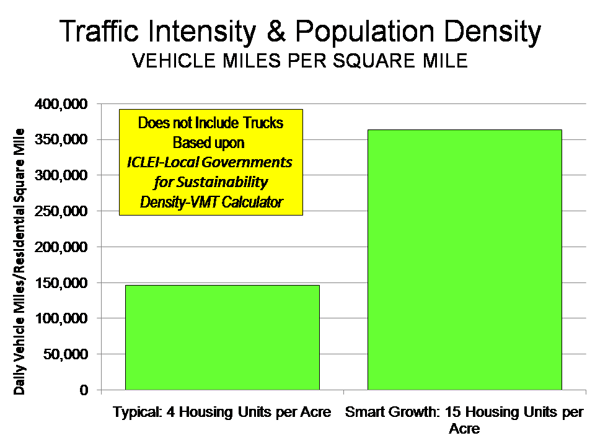
    Sierra Club Data Also Shows Nexus: Moreover, the association between higher densities and greater traffic congestion is indicated by the ICLEI-Local Governments for Sustainability Density-VMT Calculator, which is based upon Sierra Club research. According to the Calculator, under the “smart growth” scenario, residential housing would be 15 units per acre, as opposed to its “business as usual” scenario at a typical density of four housing units per acre. The density of traffic (vehicle miles per square mile) under the higher density “smart growth” strategy would be 2.5 times as high as under the “business as usual” scenario (Figure).

    The Inevitable Comparisons: Invariably, analysts (smart growth advocates and me) like to point out relationships between Portland, with its “smart growth” policies and Atlanta, the least dense major urban area in the world. The Inrix data shows Portland to have an average peak hour delay of 12.2%, which is 15% worse than Atlanta (10.6%). Portland is nearly twice as dense as Atlanta, while Atlanta’s traffic congestion is made worse by one of the most decrepit freeway and arterial systems in the nation.

    A National Vision: Inrix has also developed a monthly national congestion delay factor. Inrix notes that traffic congestion had been improving as driving declined due to the Great Recession. However, Inrix refers to reduction in driving as “lucky,” and notes that without a “national vision” that “includes addressing congestion as a national priority,” greater traffic congestion will result.

    There is indeed good reason to address traffic congestion. As David Hartgen and M. David Fields have shown, there is a strong relationship between the higher levels of mobility that occur with less congestion and greater economic growth. Obviously that relationship extends to higher urban densities, which are associated with economically counter-productive levels of traffic congestion.

    But there is more than jobs and the economy. More intense traffic congestion produces more intense air pollution as well as more greenhouse gas emissions. It is well to remember that public health was the rationale for air pollution regulation. Air pollution’s negative impacts are so local that they are measured in the quality of life of individual people, especially those in close proximity to unnecessarily overcrowded roads. It is ironic that the higher density promoted by smart growth advocates exposes urban residents to more intense air pollution.


    Note 1: 2000 core urban area (urbanized area) population densities are used in this analysis because there is no later reliable information. The next reliable urban area density data will be a product of the 2010 census. The Federal Highway Administration (FHWA) produces later urban area density figures, many of which are substantially inconsistent with those of the United States Bureau of the Census, which is the primary source of such information. For example, as late as 2005, FHWA reported the Houston urban area to have 1.3 million fewer people than the Bureau of the Census, while reporting a land area nearly 250 square miles larger than the census had measured. Of course, this is a physical impossibility. The result was that Houston’s density was overstated by 45%.

    Note 2: Inrix also ranks metropolitan areas using an “overall congestion” measure, which is simply all congestion added up. As a result, the overall congestion measure is heavily weighted by population. This is illustrated by comparing Los Angeles and Honolulu. These metropolitan areas have very similar average congestion delays, as noted above. This means that drivers encounter similar traffic delays during peak in Los Angeles and Honolulu. However, Honolulu’s overall congestion measure is 95% less than that of Los Angeles, principally driven by the fact that Honolulu’s population is 93% less. As such, the overall congestion measure is of little relevance to people in their day to day commute or as a comparative measure of the intensity of congestion between areas.

    Photograph: Los Angeles City Hall.

    Wendell Cox is a Visiting Professor, Conservatoire National des Arts et Metiers, Paris. He was born in Los Angeles and was appointed to three terms on the Los Angeles County Transportation Commission by Mayor Tom Bradley. He is the author of “War on the Dream: How Anti-Sprawl Policy Threatens the Quality of Life.

  • Anti-Smart Growth Governor Wins Primary

    There are many factors and issues that go into winning a political campaign, and the ones swirling about the Texas Republican Primary were numerous. Incumbent governor Rick Perry cruised to an easy victory over sitting U.S. Senator Kay Bailey Hutchison and activist Debra Medina on Tuesday to set up a general election showdown with former Houston mayor Bill White, a Democrat.

    It’s worth recalling that last year Perry distinguished himself as the anti-Smart Growth governor, bucking a trend in which political leaders at all levels embrace this command-and-control planning doctrine. In June 2009, Governor Perry vetoed SB 2169 – a bill relating to “the establishment of a smart growth policy work group and the development of a smart growth policy for this state.”

    In his veto message, Governor Perry said:

    Senate Bill No. 2169 would create a new governmental body that would centralize the decision-making process in Austin for the planning of communities through an interagency work group on “smart growth” policy…. This legislation would promote a one-size-fits-all approach to land use and planning that would not work across a state as large and diverse as Texas.

    I’m not sure if this was on many minds as voters headed to the polls, but there does seem to be a strong sentiment among Texans against top-down centralized planning. The recent mayor’s race in Houston grabbed national attention because of the winner’s sexual orientation. But earlier Annise Parker had soundly defeated über-Smart Growth advocate Peter Brown, setting up her run-off with Gene Locke. Brown had made zoning and central planning a centerpiece of his campaign.

    Texas has out-performed most other states in terms of economic vitality, housing affordability and other quality of life indicators, and its cities crowd Business Week’s top ten list of metros least touched by the recession.

    When it comes to Smart Growth and centralized planning, political leaders at all levels and in all states should embrace the Lone Star attitude: Don’t Mess With Texas!

  • Suburban Design: Square Peg In A Round Hole

    Remember that Fisher Price toy – “Baby’s First Blocks”? It was supposed to teach us one of life’s first lessons: Place a square shape in a square hole, and a round shape in a round hole. We’re supposed to understand this idea before we learn to say our first words, or to walk. Yet in the development of our neighborhoods, we have put that square shape into every hole, no matter what the shape of that hole.

    In past centuries land was primarily developed with one pattern – the grid — because it was simple to calculate the geometry and stake out in the field. No matter what you have read about the “town square” and the advantages of the “grid pattern”, the reason for the grid was simply that it sidestepped the painstaking task of manually calculating the land development plat when curves were involved. Forested areas were routinely clear-cut, and swamps (today’s wetlands) were filled in. Those were the days during which development was straight-forward and simple: develop land while destroying what nature provided on the soil. Natural topography, which is certainly not based upon the grid, was bulldozed into oblivion.

    In the 1960’s, newer forms of site design became commonplace, primarily in the exploding suburban landscape that rose after urban-core riots fueled what was then known as “White Flight”. This newer form of design introduced more curved patterns. Unlike the grid, the occasional curve broke up the monotony, and submitted site plans began to look more interesting. These new patterns were the start of a desire to follow the natural shape of the terrain.

    But in the 1960s we did not have an awareness of the environmental damage of development that we posses today. As automation in computations, drafting, and land surveying technology began to reduce the workload of non-gridded designs, the curved pattern became more commonplace. This transition is easily seen by visiting any city’s land records and looking at the changes in land development patterns of recorded plats since World War II.

    For decades, the curved patterns were designed by individuals who concentrated on density goals by squeezing every hundredth of a foot allowed by ordinance. Curved streets conform to the random contours of nature much better than the grid, and the curved pattern, if correctly designed, can be extremely efficient while delivering connectivity for vehicles and pedestrians. That is, if the land planner knows how to design these systems. But patterns that would harness any delivered vehicular and pedestrian connectivity were not part of the plan. Without concentrating on harnessing the curved patterns to create functional traffic systems, so-called “land planners” — and anyone can still become a land planner simply by adding the term ‘land planning’ to their business card — provided plenty of ammunition to the New Urbanism movement’s attacks on curved design.

    In any case, with the use of curved patterns land development broke away from sole use of the monolithic square shape, and introduced two new primary shapes: An inner pie shaped lot and an outer pie shaped lot. For more than a half century, these three basic shapes have defined the majority of the growth pattern for American development.

    These three basic shapes have been the foundation on which we have built millions upon millions of new homes. We have been placing that square shaped home in the triangular hole as if one of the first lessons we were taught was meaningless. Those toy blocks were supposed to teach us to take advantage of the shapes in life that we are offered. Apparently the architectural community, as well as the building industry, ignored this opportunity, until now.

    Home builders large and small have used the same basic shape, as if all lots were only rectangular. Even homes that have garage snouts and are often anything but rectangular in shape are set by civil engineers with a house “pad” that is based on the square. I’m pretty sure most of these engineers were brought up with the Baby’s First Blocks, or something similar. Forcing a square shape into a triangle shape results in a bigger triangle than need be, or making the square much smaller than necessary. In other words, we have built a quite inefficient world for over half a century.

    In an effort to create a more sustainable world, we are developing new methods to design neighborhoods. Part of the effort to eliminate the tremendous waste in land development has been to reassess architecture as part of the overall function of the neighborhood. This became much more critical as we developed Performance Planning System, which was created to teach sustainable development design methods. It quickly became apparent that there was a tremendous void in the opportunities to incorporate new forms of architecture, especially in developments with curved patterns.

    The square home that fits on the square lot does not offer much real opportunity for change. But the other two basic shapes invite new efficiency and value to the home buyer, critical in this down housing market. Homes that are shaped to fit on the inside of the curve can be wider in the front…much wider. This results in a home that does not have to be as deep, essentially making the rear area useable as well because of extra rear yard depth, while providing the same useable square footage. The extra width makes the garage less prominent, and creates much more viewable area from within the home that looks out on the larger rear yard and the streetscape. The home that’s wider in the front allows a bigger porch area and greater opportunity to tie living areas to the street. Less of the side of the home is exposed, and the streetscape becomes more attractive, enhancing that all-important curb appeal.

    The outer side of a curved shape is the opposite pie shape. In this case we can create a stronger tie to the larger rear yard (the outer curves have larger rear yards than a rectangular lot). Like the inner pie, there is more width opportunity to create a home that maintains a target square footage, yet is less deep, again creating an ever larger useable rear yard.

    Perhaps even more important is that we can use these new patterns either to make larger homes, to create larger, more useable yards, or to create non-rectangular pad shapes that adhere to the letter of the law (ordinance regulations) while gaining density and reducing neighborhood sprawl. Actually we can easily accomplish all three!

    So what do the home builders think? In this down economy there is little opportunity to for trends to develop, but in almost all cases where we have promoted this idea builders have embraced it. These developers have included one of the largest home builders in North America, and one of the most respected in Texas.

    The amount of waste we can eliminate by using the lessons that were supposed to be taught with our First Blocks is enormous. And it comes just in time to give builders that extra edge in today’s tough market.

    Rick Harrison is President of Rick Harrison Site Design Studio and Neighborhood Innovations, LLC. He is author of Prefurbia: Reinventing The Suburbs From Disdainable To Sustainable and creator of Performance Planning System. His websites are rhsdplanning.com and performanceplanningsystem.com.

  • Decentralize The Government

    From health care reform and transportation to education to the environment, the Obama administration has–from the beginning–sought to expand the power of the central state. The president’s newest initiative to wrest environment, wage and benefit concessions from private companies is the latest example. But this trend of centralizing power to the federal government puts the political future of the ruling party–as well as the very nature of our federal system–in jeopardy.

    Of course, certain times do call for increased federal activity–legitimate threats to national security or economic emergencies, such as the Great Depression or the recent financial crisis, for example.

    Other functions essential to interstate commerce–basic research, science education, the guarantee of civil rights, transportation infrastructure, as well as basic environmental health and safety standards–also call for federal oversight. Virtually every modern president, from Roosevelt and Eisenhower to Reagan and Clinton, has endorsed these uses of centralized government.

    But what is happening now goes well beyond the previously defined perimeters of the federal government’s powers. Obama seems to possess a desire not so much to fix the basic infrastructure of the country but to re-engineer our entire society into the model championed by liberal academia.

    There also seems to be a conscious design to recreate the country as a European-style super-state. Forged by an understandable urge to minimize chaos after a century of conflict, the super-state generally favors risk management through centralization of authority. This has traditionally been accomplished by ceding regulatory powers to national capitals, though lately more and more powers have been ceded to the European Union.

    Initially the administration had hopes of imposing similar controls through acts of Congress. However, with the shifting political mood, this seems less and less possible. With its latest action the administration sends the message that it will now impose the desired results through the bureaucracy. Under the proposal, private firms that do not raise wages will be bullied into doing so through the manipulation of federal contract awards.

    This marks a departure from our basic traditions. For most of our history the burden of expanding opportunity has rested with the private economy, albeit in conjunction with often necessary protections for workers and consumers. Now the overall control of the economy is shifting to Washington–from government contracts to ownership shares in companies like General Motors and much of the financial sector.

    This new order would transform the very nature of American capitalism. Now the economic winners will not be those working for the most agile or profitable companies, but those who gain the blessings of the federal overlords. In some senses this extends the corrupt, largely failed political economy of Chicago politics to a bastard American form of French dirigisme.

    Climate change provides another critical and necessary rationale for the expansive federal role. With the “cap and trade” system all but dead, the administration now wants to regulate energy and land use through the gentle graces of a largely unaccountable EPA apparat. As a result, we may see energy use, land use and transportation–as is increasingly the case in California–controlled by the whims of the unelected bureaucracy.


    Such command and control approaches have their advantages in making people do what the mandarins demand. This is one reason there are so many admirers of Chinese autocracy now. In that regime, unlike our messy democracy, you can be forced to be green in precisely the way they tell you. There are always firing squads for those who go off the program.

    Of course, even the most passionate centralists don’t advocate adopting the Chinese model. But the notion of an enlightened super-state has long appealed to those disgusted with American-style muddling through. In some ways, the current fashion recalls Americans’ attraction for the Soviet Union or even fascist Italy during the troubled 1930s.

    Fortunately, most Americans do not appear ready for unbounded autocracy. This is particularly true outside the coastal urban centers. The Tea Party may have some cranky–even ill-advised–ideas, but they reflect a genuine–and broader–American preference for solving problems at the state or local level.

    Indeed, Americans, including some on the left, are instinctive decentralists. We express this tendency physically, first in our decades-old movement to the suburbs, and increasingly to smaller towns and cities as well as rural areas. Even in cities like New York or Los Angeles, local neighborhood identity trumps ties to more grandiose visions of City Halls or regional bodies. The rise of the Internet and social networks has enhanced this decentralizing trend by providing instant linkages and helping ad hoc organization among neighbors.

    Economic evolution mirrors this trend. Over the past few decades U.S. employment has shifted not to mega corporations but to smaller units and individuals; between 1980 and 2000 the number of self-employed individuals expanded 10-fold to include 16% of the workforce. The smallest businesses–the so-called micro enterprises–have enjoyed the fastest rate of growth, far more than any other business category. By 2006 there were some 20 million such businesses, one for every six private sector workers.

    America’s entrepreneurial urge, in contrast to developments elsewhere, has actually strengthened. In 2008 28% of Americans said they had considered starting a business–more than twice the rate for French or Germans. Self-employment, particularly among younger workers, has been growing at twice the rate of the mid-1990s.

    The remarkable volatility within even the largest companies has exacerbated this trend. Firms enter and leave the Fortune 500 with increasing speed. More and more workers will live in an economic environment like that of Hollywood or Silicon Valley, with constant job shifts, changes in alliances between companies and the growth of job-hopping “gypsies.” Although hard times could slow new business formation, historically recessions have served as incubators of innovation and entrepreneurship.

    Much of the most dynamic and meaningful change takes place under the radar of both big business and government. The shift to greater localism can be seen in the growth of local, unaffiliated community churches, regional festivals and farmers markets. Bowling clubs and old men’s clubs may be fading, but volunteerism has spiked among millennials and seems likely to surge among baby boomers. In 2008 some 61 million Americans volunteered, representing over a quarter of the population over 16.

    No other major country exhibits this kind of localized, undirected activism. Such vital grassroots may become even more important as the country becomes more diverse. In the coming decades we will have to accommodate an expanding range of locally preferred lifestyles, environments, ethnic populations and politics. One size determined by mandarins in Washington increasingly will not fit all. South Dakotans and San Franciscans will prefer to address similar problems in different ways. Within the limits of constitutional rights, we should let them try their hand and let everyone else learn from their success (or failure).

    Ultimately, we do not want to recreate the expansive mandarin state so evident in many foreign countries. Instead, we should focus more on family, community, neighborhoods, local jurisdictions and voluntary associations–what Thomas Jefferson called our “little republics”–as the most effective engines driving toward a better future.

    This article originally appeared at Forbes.com.

    Joel Kotkin is executive editor of NewGeography.com and is a distinguished presidential fellow in urban futures at Chapman University. He is author of The City: A Global History. His newest book is The Next Hundred Million: America in 2050, released in Febuary, 2010.

  • Why Millennials are Economic Liberals and What to Do About It

    The Obama administration celebrated the anniversary of the passage of the American Recovery and Reinvestment Act, or economic stimulus, by pointing out the gradual recovery of the United States economy has resulted in “saving or creating two million jobs.” But young Americans continue to bear the brunt of what is still America’s worst recession since the Great Depression.

    From December 2008 to December 2009, the employment of 16-24 year olds in the U.S. fell by 1.78 million, or a third of the total estimated drop in employment of 5.4 million. Only 41% of Millennials are working full time, a drop of 9 percentage points in the last few years, even as the proportion of older workers employed full time remained fairly stable.

    The experience with hard times of Millennials, born 1982-2003, is one of the main reasons why they strongly support the classic liberal solution of effective government intervention in the economy. Recent Pew research, for example, indicates, that far more than older generations, a large majority of Millennials (71%) agrees that the government should guarantee that every citizen has enough to eat and a place to sleep. Millennials are also the only generation in which a majority (54%) disagrees with the contention that if something is run by the government it is usually inefficient and wasteful and a plurality (49%) rejects the belief that the federal government controls too much of our daily lives.

    A recent study by UCLA professor Paola Giuliano, and her colleague Antonio Spilimbergo, clearly documents the impact of recessions on people who are between 18 and 25, “during which most beliefs on how society and the economy work are formed.” Their research found that individuals who experienced recessions much milder than our current Great Recession during these formative years believe that “luck rather than effort is the most important driver of individual success, support more government redistribution, and have less confidence in institutions.” Other research shows that people who think luck is the primary driver of success are more willing to increase taxes to pay for a more activist government. Giuliano and Spilimbergo’s findings support the observation that lies at the heart of William Strauss and Neil Howe’s generational cycle theory, namely that the “values, attitudes and world-views” acquired during this period of early socialization “become fixed within individuals and are resistant to change.”

    The research of Giuliano and Spilimbergo also suggests that the Millennial Generation’s economic liberalism comes with a healthy dose of skepticism about the ability of institutions to help them meet their profound economic challenge. To fully restore Millennial confidence, government will need to take effective action to deal with the economy and reaffirm America’s tradition of economic mobility and rising middle class incomes. Beyond whatever short-term benefits President Obama’s stimulus program has provided, longer term more structural changes in the economy will need be made — starting with education.

    Higher education remains an important antidote to low wage employment in such economic circumstances, but only if students complete their chosen field of study. Yale economist Lisa Kahn has found that “the labor market consequences of graduating from college in a bad economy are large, negative and persistent,” resulting in lower wages, in less prestigious jobs for extensive periods of time. Her research suggests that even college graduates fortunate enough to get a job still suffer a 6 to 7 percent initial loss in income for every one percent drop in employment. Even though the differential diminishes over time, her research found such unlucky graduates still experiencing a statistically significant 2.5% loss of wages fifteen years later.

    Even so, those who get a four year college degree earn on average 35% more than those who leave college without getting a degree. Getting one or two years of post-secondary education and receiving an associate’s degree from a community college or a certificate from a career college also boosts wages above what they would have been without such a degree. One Florida study found that holders of certificates in particular occupations such as health care or IT earned 27% more than those who attended, but failed to complete, college. Associate degree holders earned 8% more than those who had no post-secondary education.

    One major reason students aren’t able to get a degree or certificate is that three-fourths of associate degree or certificate seekers end up working to help cover their education and living costs. Meanwhile federal support for higher education has failed to keep up with rising costs so that more and more students find themselves financing their education with student loans of one type or another. In Indiana, for instance, 62 percent of those who do manage to graduate carry student loan debt averaging $23,264 per student. The loan burden in that state is even higher for graduates of for-profit, private colleges who leave school with an average debt burden of $32,650.

    Increasing Pell Grant funding and the value of college tuition tax deductions are two steps government could take to address this problem. Reforming the student loan program to eliminate subsidies to banks as President Obama has advocated, and including student loans under any consumer protection agency that might be created as part of financial regulatory reform would also help address this problem that would fit with Millennial’s liberal perspectives.

    The other major reason students fail to complete their post-secondary education is the inadequate preparation for college, especially in math and science, they receive in high school. This is something that parents of Millennials will tolerate no longer. As Neil Howe points out, “when these Gen-X “security moms” and “committed dads” are fully roused, they can be even more attached, protective and interventionist than Boomer [parents] ever were. . .They will juggle schedules to monitor their kids’ activities in person. . . [and] will quickly switch their kids into – or take them out of – any situation according to their assessment of their youngsters’ interests.”

    These “stealth-fighter parents” have already begun to move one of the largest and most consistently poorly performing school districts in the country, Los Angeles Unified, forcing the district to grant them more say in school curriculum and governance. Their success led California’s usually dysfunctional legislature to pass a “parent trigger” law empowering a majority of parents in a demonstrably failing school attendance area to fire the principal and half the teachers as part of a turnaround initiative. Congress should incorporate this very interventionist idea into its reauthorization of the framework federal education law when it comes up for renewal this year. It should also expand funding for the Obama administration’s innovative Race to the Top initiative, which rewards schools that improve student learning performance rather than simply subsidizing mediocrity.

    All of these ideas will be resisted by those who believe that individual success is solely based upon effort and initiative and don’t believe in the efficacy of government efforts to revive the economy. Others with a stake in the status quo will argue against some of these ideas. But Millennials, whose lifetime of liberal economic beliefs have been forged by their experience with the Great Recession, will resist entreaties from those who offer only laissez faire economic policies or who try to delay dealing with these problems. They want government to act quickly and effectively, before they and their siblings are doomed to never enjoy the American Dream.

    Morley Winograd and Michael D. Hais are fellows of the New Democrat Network and the New Policy Institute and co-authors of Millennial Makeover: MySpace, YouTube, and the Future of American Politics (Rutgers University Press: 2008), named one of the 10 favorite books by the New York Times in 2008.