Blog

  • Ethics, Banking And The Coin of the Realm

    Many years ago, I wrote for a New York investment bank whose name has been semi-obscured by the epidemic of shotgun marriages on Wall Street in the intervening decades. Thus, the news that Goldman Sachs enabled the miserable financial accounting habits of Greece did not surprise me, nor, I feel sure, anyone who ever worked for one of the banks. As many characters on “The Wire” put it over five years of exquisite television, “All in the game, yo.” Or, in the words of a previous era’s television icon — JR Ewing, Texas oilman on “Dallas” — “Once you give up your ethics, the rest is a piece of cake.”

    The New York Times account of a team of Goldman bankers parachuting into Athens last November was unusual in one way: the fact that the assault was led by the bank’s president. That indicates the priority attached to the possibility that a sovereign nation’s economy might go the way of Lehman Brothers, with Goldman’s DNA on the corpse. What financial resources did he have in his briefcase? I wonder. It can’t have been US taxpayer money — Goldman had already paid that back.

    No, Goldman offered the same kind of solution, ultimately refused, that had worked many times in the past, which the Times described as “a financing instrument that would have pushed debt from Greece’s health care system far into the future, much as when strapped homeowners take out second mortgages to pay off their credit cards.”

    Legal? Probably. Ethical? Well…

    You remember “Ethics.” It’s defined in the Oxford English Dictionary as the “science of morals; moral principles or code.” Some science. I once had to go from office to office at the bank for a CEO speech on the topic, to be delivered at the Harvard Business School. I heard story after story about how the bank’s morals were routinely tested, ranging from the ridiculous to the sublimely ridiculous, to the frontiers of illegality.

    To be fair, some bankers still felt bound by institutional standards, in part because they still operated under a commercial bank charter, which meant they were more tightly regulated than pure investment banks. For example, the bankers were precluded by bank policy from making political contributions to state and municipal politicians to underwrite bond issues — so-called pay-to-play — which put them at a big disadvantage in competition to Wall Street’s classic buccaneers. The separation of commercial and investment banking, embodied in the Depression-era Glass-Steagall Act, is something many in government and the financial industry would like to restore.

    But generally speaking, rules were meant to be bent, if not broken. In finance, doing things you might have trouble explaining to your own mother is business as usual. The ethical line that defines what’s right is often very close to the line that defines what’s legal. The bigger problems are posed by the line that separates what’s right from what’s profitable. Bankers always have their feet firmly planted on a slippery slope.

    At times, the distinctions are trivial. For example, among the people I met at work, there was the old Middle Eastern hand who kept a bottle of Scotch in his desk in Riyadh for clients who dropped by to talk business on evenings during Ramadan. Islam and Saudi law forbid locals to drink, but, hey, at least they only indulged after they were done praying for the day.

    My acquaintance’s day job consisted of arranging deals that circumvented the Islamic strictures against charging interest. This is achieved by transmuting loans into discrete purchases and sales at precise intervals and prices that happen to track market interest rates during the elapsed time. It had been common practice when doing business with oil-rich Muslims for decades, but you could see a degree of moral fudging that could easily snowball.

    Today’s headlines on the crisis in Greece — and its ethical dimensions — echo the ethical quandaries faced by bankers in days gone by. There was the time that a world-renowned hedge fund operator wanted to speculate against the currency of another European country that today has massive credit problems of its own, and he wanted our bank to take some of his positions. The bank was big enough so that these positions could be disbursed throughout its book, and thereby escape notice prematurely. You do your client’s bidding, right? But what do you do when the central bank of the target country is also your client? Do you warn them? Do you refuse to act on behalf of one client when its interests are opposed to those of another? This is where the “science of morals” becomes the “art of morals,” and it is abstract art: you can see anything you want to see on the canvas. Besides, the speculator wouldn’t be attacking the currency if the country were better run.

    In a case which probably came close in mechanics to the transactions in the current crises in Greece, a huge economy’s huge bank, or maybe it was a too-big-to-fail industrial company, or maybe it was the Treasury of the nation itself (the distinctions have been blurred by the mists of time) wanted to move its regulatory obligations forward and thereby delay embarrassment or financial catastrophe until the future. Sound familiar? No? Then you haven’t been reading the papers.

    In this instance, explicit reporting deadlines had to be bridged, and the true health of a nation’s finances was at risk, at least insofar as accounting rules can be counted upon to define fiscal risk. The upright bankers did what any ethical beings would do. They insisted that the nation’s Finance Minister give an explicit nudge and wink, so that the bank’s complicity would have legal cover if the transaction ever came to light.

    This month’s Greek situation follows this template. Loans become swaps or other transactions that escape rules on lending, and circumvent deadlines. The problem is always pushed off into the future. This is an established tradition. Speaking about sovereign debt, Walter Wriston at Citibank used to say that you pay off a Treasury bill by selling another Treasury bill. Today you pay off a Treasury bill by calling it something else and selling that, if that’s what your customer wants. Rules, credit limits, due diligence, regulations, laws…these are just words. A rose may be a rose, but if you don’t want the wrong people to notice the smell, call it something else.

    At the dawn of the contemporary banking culture (the mid-1990s – so last century) a trader at Bankers Trust, another one of those institutions whose name has disappeared, was caught on tape saying, “What Bankers Trust can do for Sony and IBM is to get in the middle and rip them off, make a little money. Funny business, you know? Lure people into that calm and then just totally f— ‘em.”

    F— ‘em? He says that as if it’s a bad thing. American banking has now tracked the full trajectory from Nicholas Biddle, president of the Second Bank of the United States, and thorn in the side of Andrew Jackson, to his descendant Sydney Biddle Barrows, known as the Mayflower Madam, who ran a New York City call-girl ring in the 1980s. She famously said, “Clients don’t pay you to be with them, they pay you to go away”. Well, yes. Banks are there to serve your needs, and then they leave. But when the urge returns, they are just a phone call away.

    Henry Ehrlich is co-author of the forthcoming Asthma Allergies Children: A Parent’s Guide, and editor of the upcoming companion website AsthmaAllergiesChildren.com. Bankers Trust and “Dallas” quotations fromThe Wiley Book of Business Quotations, edited by Henry Ehrlich.

  • Recessions Destroy Lives

    Thursday a man flew an airplane into the Austin, Texas, IRS Building. The Left claimed he was a “Tea bagger,” their vulgar term for Tea Partiers, apparently because he was anti-government. The Right claimed he was a whacky leftist, apparently because he was critical of Bush. A Muslim group claimed he was a terrorist, apparently because he wasn’t a Muslim.

    They all miss the point, and quite frankly, the attempt to make political points out of personal tragedy is pretty disgusting.

    Today, there is a report of a Moscow, Ohio, man who bulldozed his home before it was foreclosed. No doubt someone somewhere will try to make political hay out of this man’s misfortune. That will be as misguided as the response to the Texas man’s misfortune.

    What these events really do is highlight the human costs of recessions, costs that increase in recession severity and duration. These are the more extreme examples, but the fact is, people’s lives are ruined in recessions. Some working families will suffer a permanent decrease in income. Some of our young people will never recover from a bad start to their working lives. Some families will be destroyed because of financial stress. Some individuals will commit suicide. A few will do things like bulldoze their home or fly into a building.

    To ask how big a problem we have is to ask how many are unemployed and how long have they been unemployed. Here are the numbers as of January 2010:

    • 14.8 million Americans were out of work and looking for a job.
    • 6.3 million Americans had been out of work over six months.
    • 9.3 million Americans were underemployed
    • Over half of unemployed Americans had been out of work for over 19 weeks.
    • The unemployed American’s average unemployment duration was 30 weeks.
    • 4.5 million Americans had left the labor force.

    All of these people deserve our sympathy. They also deserve more from our society and our leaders. Most of them are in their current circumstances through no fault of their own. Even worse, our political class appears to be far more interested in election, reelection, rewarding supporters, partisanship, and political purity than they are in providing the environment for job creation. They have also failed to provide a humane safety net, one that provides at least a minimum standard of living, maintains dignity, and provides appropriate incentives.

  • MILLENNIAL PERSPECTIVE: Kindle 101

    The rising Millennial Generation has been cast as the leading force in teaching current technological advancements, and in predicting what will come next. Labeled “Digital Natives” because of our familiarity with digital communications and media technologies, the rise of the Millennials has run parallel with the rise of the cell phone, the computer complete with Internet, and the launch of MP3 players. In keeping with expectations that we’ll provide leadership on the digital media world, here’s what to expect of the sophisticated technology of Kindle, the digital book:

    Named “Kindle” to evoke the crackling ignition of knowledge, this software and hardware platform was developed by Amazon.com for rendering and displaying e-books and other digital media.

    First released in the U.S. in, 2007, the device represents the turning point in a transformation toward Book 2.0, the revolution in progress that will change the way readers read, writers write and publishers publish. Originally it was designed to present an aura of “bookishness”. With the dimensions of a paperback, the Kindle weighs 10.3 oz and mimes the clarity of a printed book by using a colorless “E-Ink”. Unlike most wireless devices, the Kindle doesn’t run hot or make beeps, and the battery is durable and made to last at least 30 hours on charge. It runs on “Whispernet”, a wireless connectivity-based on EVDO broadband service offered by cell phone carriers which provides access everywhere, not just in Wi-Fi hotspots.

    Any bookworm can carry 200 books onboard the device and hundreds on a memory card. “The vision is that you should be able to get any book—not just any book in print, but any book that’s ever been in print—on this device in less than a minute,” says Amazon president Jeff Bezos.

    Search tools provide convenient access to a high volume of books. Consumers can read multiple books online for free, instead of buying books one at a time at a higher price. It pairs nicely with a trend towards short content: news stories, online journals, blogs, and short e-books. The short story phenomenon has grown among young writers who prefer writing short fiction blogs rather than lengthy novels.

    Amazon prices Kindle editions of New York Times best sellers and new releases at $9.99. The price for the Kindle edition books drops for classic novels; Edgar Allan Poe works are under $5.00, and vintage hardboiled reads are available for under $7.00. The first chapter of almost any book is available as a free sample.

    Digital book prices are in danger of rising. Beginning in March, books from Macmillan will reportedly cost up to $14.99. Five additional publishers have negotiated higher prices for digital publication on iPad.

    When purchased, the Kindle e-book is auto-delivered wirelessly to your Kindle in under a minute. A Kindle owner can also subscribe to major newspapers or popular magazines. When issues go to press, the virtual publications are automatically beamed into the user’s Kindle. A user can also subscribe to selected blogs, which cost either 99 cents or $1.99 a month per blog.

    Kindle allows the reader to personalize the reading experience. Users are able to change the font size, which is particularly accommodating to the Boomer generation and those older who may struggle with small print. For tech savvy multi- taskers, an electronic highlighter captures passages, which can be linked via web access to Wikipedia and Google. Another feature includes a personalized Kindle e-mail, which allows users to file any word document or PDF file into a personal digital library.

    The original Kindle proved to be revolutionary and popular device, selling out within its first six hours on the market. Within less than two years, Kindle 2 and Kindle DX were released.

    Kindle 2 developed into an “international version” of Kindle. Currently, it works in 100 countries using AT&T’s U.S. mobile network. Kindle DX is a little larger, with greatly increased book storage and, of course, a higher price.

    As authors adapt to online literature, the current book readership demographics may change as well. Scott Moyers, Director of the NY office of Wylie Publishing Agency, categorized the readers of e-books as “People who view the physical book as disposable”. Moyers believes that the first genres to solely go e-book will be Romance and Mystery novels, based on rapid turnover of the vast amount of works available in those genres. Visually intensive books — such as photography books that are beautifully produced — will be the last genre to go e-book, suggests Moyers, since these would be a “paler echo on the colorless Kindle”.

    Piracy poses a threat, as in the music industry; pirate sites may gain access to scan the online books. As far as “peer-to-peer” file sharing, Kindle has attempted to create a limit: a user can freely borrow an e-book for one month. Although this suppresses most excessive file sharing, online file sharing could become more popular.

    Despite potential dangers, Kindle has expanded along with the wild success of internet visibility on computers and cell phones. “Kindle for PC” and the Kindle application for the iPhone are now available. Can “Kindle for Mac” and “Kindle” for Blackberry be far behind?

    Kjellrun Owens is a freshman at Chapman University. Originally from Minnesota, she plans to pursue a career in Broadcast Journalism/TV.

  • The Nile Flows North

    “How can a river flow north?” the real estate lady asked me. “I mean, it’s impossible.” The offending river, within whose watershed I proposed to buy a house, is the Wallkill. It rises in Northern New Jersey – near Sparta – and passes by Middletown, NY, and through Montgomery, Walden, the eponymous town of Wallkill, New Paltz, Rosendale, and finally (with a complication) drains into the Hudson River at Kingston, NY – approximately 100 miles north of its source.

    In defense of the American public school system, I add that my realtor was born and educated in Europe.

    A colleague of mine (I work at a university) said at least semi-seriously that, except for the Nile, the Wallkill is the only river in the world that flows north.

    Now where have I heard that before? I used to live in DeKalb, Illinois. It was common wisdom in those parts (indeed, if memory serves, even stated in the student newspaper), that – except for the Nile – the Kishwaukee River is the only river in the world that flows north.

    You’ve all heard of that, of course: the famous, north-flowing Kishwaukee? The only problem is that only the South Branch (sort of) flows north. The main course, if anything, heads south.

    I grew up in Eugene, OR, at the headwaters of the Willamette, which really does flow north. But I don’t recall any of my high school chums telling me about the Willamette and the Nile. Maybe they knew me too well. Or perhaps that’s because so many other rivers in Oregon flow north: the Deschutes, the John Day, and the Hood. Even the Oregon portion of the Snake flows north.

    I do understand that in Cairo the word on the street is that, except for the Willamette, the Nile is the only river in the world that flows north. Odd, since in Sudan for about 200 miles, the Nile River actually flows south.

    So what accounts for this urban legend that (fill in the blank) river and the Nile are the only two rivers that flow north? I can think of three reasons.

    First, had I pressed her, the reason that my Realtor likely would have given: Rivers flow down, south is down on the map, and therefore rivers must flow south. OK, so that one is silly. My European Realtor should consider the Rhine, Elbe, Neisse, Vistula, and (arguably) the Seine or the Havel.

    My colleague, on the other hand, is smarter. He asked for an example of another north-flowing river, and I (pulling his chain) mentioned the St. Lawrence.

    “But that doesn’t really flow north.”

    And it is true, it flows only northerly. But that begs the question: how true to the compass does a river actually have to flow before it counts with the Nile? Clearly, if you define “north” narrowly enough, then very few rivers flow north – not even the Nile.

    I gave him better examples: The Mackenzie, Churchill, Red (ND), Fox (WI), San Joaquin, Bitterroot, Yellowstone, Madison, Jefferson, Lualaba.

    The Lualaba? That, my friend could argue, surely shouldn’t be on the list, though it flows nearly due north for almost 1000 miles. After all, it is just a different name for the Congo, upstream from Kisangani Falls. But nobody really knew that: for at least two centuries it was thought that the Lualaba drained into the Nile, surely establishing its northward credential. It was only in 1877 that Henry Morgan Stanley (of “Dr. Livingstone, I presume” fame) took a boat down the Lualaba all the way to its mouth at the Atlantic Ocean.

    Lest you think that multi-named rivers exist only in uncharted Africa, think again. Our very own Niagara River flows due north, from Lake Erie to Lake Ontario, and is just an extension of the St. Lawrence.

    The Lena, the Ob, and the Don flow north, all of which drain into the Russian arctic.

    But that brings us to the third reason for this persistent legend: that it’s true. No, I am not wearing a tinfoil hat, but even the most improbable urban legends have a grain of truth. I’ll argue this one does, and here is why.

    Most of the world’s continents are in the northern hemisphere, and conversely, oceans are disproportionately in the southern. Thus, to reach the ocean, rivers must on average flow south.

    We are all subject to the Mercator fallacy, and assume that the northern coast is as long as the southern. But it isn’t. The northern shores of Russia, Alaska and Canada are much, much shorter than the southern coasts of Asia, Europe and North America. Thus, just by the odds, there have to be many fewer rivers flowing north than flowing south. I do believe this is true.

    How could one prove that? I don’t know. It would be a lot of work – counting rivers, controlling for south-heading-north-flowing ones, etc., etc. Not worth the candle. So I’ll just accept my hypothesis as both reasonable and true.

    I’m not willing to give my real estate agent much credit. But my university colleague is not quite as far off the mark as you might have originally thought. North-flowing rivers are, indeed, relatively rare.

    The Richelieu, Monongahela, Shenandoah, and the St. Mary’s (FL).

    I’ve listed all the ones I can think of. Can you think of more? Creeks, brooks, streams and canals don’t count. And neither does the St. Lawrence. But other than that, I’m curious what you’ll come up with.

    Except for the Nile.

    Daniel Jelski is Dean of Science & Engineering State University of New York at New Paltz.

  • Obama Throws Life-Line to Smart Growth Areas

    President Obama has announced a special program of assistance for home owners in the five states that have been hit hardest by the housing crisis. The proposed program is targeted at California, Florida, Arizona, Nevada and Michigan, where house price declines are more than 20% from the peak of the bubble.

    The greatest losses occurred in California, Florida, Arizona and Nevada (see note), where peak to trough house price loses exceeded 40% in all 12 metropolitan areas over 1,000,000 population except Jacksonville. These markets accounted for 70% of the gross housing value loss in the nation before the Lehman Brothers collapse. House prices were driven to unprecedented levels of up to four times historic norms by overly prescriptive land use regulations (“growth management” or “smart growth”) that makes land unaffordable.

    Average losses were more than $175,000 in the markets of these states, more than 10 times those in traditionally regulated markets such as Atlanta, Dallas-Fort Worth, Houston, Indianapolis, Kansas City and Cincinnati. These intense losses were beyond the ability of the mortgage industry to sustain and it is generally acknowledged that this precipitated the Great Recession.

    Smart growth had nothing to do with the Michigan price collapse. There, the strong economic downturn pushed prices down even as the state escaped without a housing bubble.

    The President’s program means that the nation is now paying twice for smart growth policies. The first payment was, of course larger, which cascaded into the huge household wealth losses in the Great Recession.


    Note: While Las Vegas and Phoenix are sometimes perceived as not having prescriptive land use policies, the Brookings Institution ranks both metropolitan areas as toward the more restrictive end of the regulatory spectrum. These overly prescriptive regulatory environments are exacerbated by the fact that in both metropolitan areas much of the developable suburban land is owned by government, and is being auctioned, though at a rate less than demand. These factors combined to drive auction prices per acre up nearly 500% in Phoenix and nearly 400% in Las Vegas during the housing bubble.

  • Norfolk Light Rail: Expensive Rising Tide

    The Virginian Pilot reports that the cost of the Hampton Roads (Virginia Beach-Norfolk metropolitan area) “Tide” light rail line has now escalated to nearly $340 million. This is up nearly one-half from the estimates made when the project was approved by the Federal Transit Administration. According to federal documentation, the line will carry 7,100 daily passengers in 2030. This means that the capital cost alone will amount to an annual subsidy of approximately $6,500 per daily passenger (using Office of Management and Budget discount rates), plus an unknown additional operating subsidy. This is enough to lease every daily commuter a new Ford Taurus for the life of the project (assumes a new car every 5 years and includes future car price inflation).

    The light rail line cannot be expected to do much for transportation. Even if the line reaches its projected ridership (many do not) by 2030, it will carry only 0.1% of the travel in the metropolitan area (one out of every 1,000 trips).

  • The Heavy Price of Growth Management in Seattle

    The University of Washington Study: Economist Theo Eicher of the University of Washington has published research indicating that regulation has added $200,000 to house prices in Seattle between 1989 and 2006. Eicher told the Seattle Times that “Seattle is one of the most regulated cities and a city whose housing prices are profoundly influenced by regulations.”

    Not surprisingly, this caused consternation in the planning community, which would prefer to minimize or dismiss any negative consequences of planning regulations on housing affordability.

    The Washington Chapter of the American Planning Association (W-APA) published a response. Admitting that “land use regulations do add costs to housing”, it criticizes the Eicher study for focusing “solely on cost” and ignoring how land use regulations add to the quality of life. (Note 1). A recent Washington Policy Center report provides a detailed critique of the W-APA report. This article evaluates Seattle housing affordability trends using basic price and income data and the Median Multiple (median house price divided by median household income), a standard affordability measure that has been recommended by both the World Bank and the United Nations.

    How Growth Management Raises House Prices: It has been established that overly prescriptive land use regulation (called growth management or smart growth) raises house prices. As the former governor of the Reserve Bank of New Zealand Donald Brash has pointed out the affordability of housing is overwhelmingly a function of just one thing, the extent to which governments place artificial restrictions on the supply of residential land.

    However, the mere adoption of growth management or smart growth polices does not increase housing costs. Where, for example, an urban growth boundary (a favored strategy of growth management) is drawn far enough from the urban area, there may be little interference with developable land values. This was the case in Portland, for example, in its early growth management days. However, as land was developed and the urban growth boundary was not moved sufficiently outward in response, land became more scarce and land prices were driven up, leading to Portland’s severe housing unaffordability.

    How Growth Management Drives Up House Prices: Land prices are driven up as market participants perceive scarcity. When government policies constrict the supply of land, developers purchase “land banks” to ensure that they have access to land inventory. Without growth management, developers and builders can purchase land when they need it, because governments have not placed artificial restrictions on its supply.

    In the more prescriptive environment, property appraisals rise and sellers are able to obtain higher prices because development is prohibited on most land. In short, sellers face less competition and can command much higher prices.

    Sometimes growth management proponents claim that their communities have sufficient land available for building. However, the interplay between land buyers and sellers creates a rigged game that leads to higher land prices. This is obvious in everywhere from Seattle and Portland to California and Florida. In these markets, there is not a sufficient supply of “affordable land” for building. A New Zealand government’s “2025 Taskforce” found the price of comparable land to be about 10 times as high if it is inside an urban growth boundary rather than outside (essentially across the road).

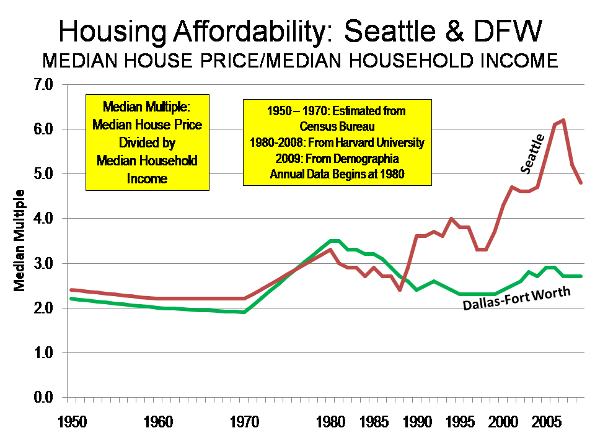
    Seattle’s Lost Housing Affordability Decade: During the decade of the housing bubble (1997 to 2007), the median house price increased from $169,000 to $395,000 in Seattle. In 1997, Seattle’s housing affordability was rated “moderately affordable,” with a Median Multiple of 3.3 (median house price divided by median household income). By 2007, the Median Multiple had escalated to 6.2, indicating housing unaffordability worse than any major metropolitan area between World War II and 1997. (Figure 1). Of course, other markets, particularly in California, became even more unaffordable after 1997.

    In Seattle and other more prescriptive markets, house prices exploded during the housing bubble. At the same time, many other markets experienced only modest house price increases. The easier money and profligate lending practices thus produced very different results. In more prescriptive markets, like Seattle, both underlying and speculative demand drove prices to unprecedented heights. In the more responsive markets, the generally higher underlying demand was accommodated by planning systems that permitted sufficient new housing to be built on affordable land and price escalation was far more modest (as were subsequent price losses).

    New House Example: The role of Seattle’s growth management in driving up land and house prices is obvious. According to W-APA, approximately 62% of the cost of a new house in 1999-2000 was in construction costs. A new house in 1997 costing the same as a median house price would have involved approximately $105,000 in construction costs. Based upon subsequent house cost increases and the decline in house construction costs relative to the rest of the nation in Seattle, construction costs on the same house should have risen $40,000 from 1997 to 2007 (Note 2). At the same time, the median house price in Seattle increased $225,000. Less ss than 20% of the cost escalation could be attributed to construction cost inflation. Nearly $185,000 was due to other factors, principally higher land prices.

    Comparing Seattle to Dallas-Fort Worth: Things were very different in more responsive markets, as is illustrated by Dallas-Fort Worth (Figure 2). Dallas-Fort Worth, now the nation’s fourth largest metropolitan area, trailing only New York, Los Angeles and Chicago has grown more than twice as fast as Seattle (21.2% from 2000 to 2008, compared to 9.6%). Dallas-Fort Worth’s underlying demand has been even greater relative to Seattle, as indicated by its net domestic migration. Dallas-Fort Worth has added more than 10 times as many domestic migrants (260,000 versus 23,000) and more than 5 times its 2000 population (5.0% v. 0.8%). Moreover, and perhaps surprisingly, the Dallas-Fort Worth urban area (along with Houston) is more compact (read “sprawls” less) than Seattle (Note 3). Finally, the share of sub-prime mortgages was higher in Dallas-Fort Worth than in Seattle.

    Yet, despite this huge demand, housing affordability has remained below the historic Median Multiple norm of 3.0. In 2007, the Dallas-Fort Worth Median Multiple was 2.7. The median house price increased $32,000 from 1997 to 2007 and more than 70% of the change was due to construction costs.

    In 1997, the Seattle median house price was $54,000 higher than in Dallas-Fort Worth. By 2007, the price of a median house in Seattle had escalated to nearly $250,000 more than its counterpart in Dallas-Fort Worth (Since 2007, house prices have dropped $90,000 in Seattle and $5,000 in Dallas-Fort Worth, illustrating the more intense price volatility of tightly regulated markets. Even so, Seattle housing affordability remains materially worse than before).

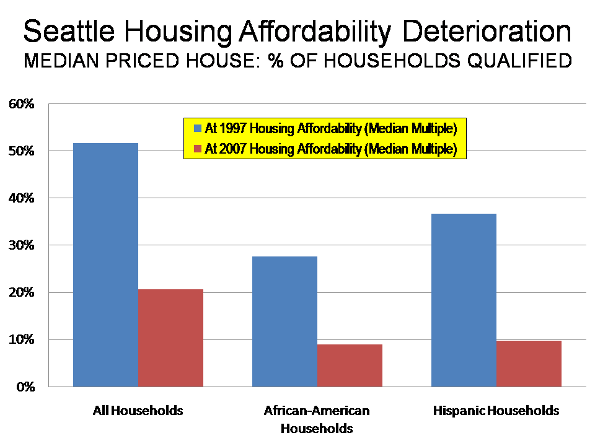
    Driving Households out of the Home Ownership Market: If 1997 housing affordability (using the Median Multiple) had been retained, 50% of Seattle households would have been able to qualify for a mortgage on the median priced house. However, by 2007 only about 20% of Seattle households could have qualified for a mortgage on the median priced house in 2007 at present FHA underwriting standards (Note 4).

    Impact on Minority Households: The highest price, however is being paid by Seattle’s minority households (Figure 2).

    • The share of African-American households able to qualify for a mortgage on the median priced house declined nearly 70% compared to 1997 affordability (Median Multiple). At 1997 housing affordability, more than 25% of African American households would have been able to qualify for a mortgage on the median priced house in 2007. In reality, by 2007, less than 10% of African-American households could have qualified for a mortgage on the median priced house.
    • The share of Hispanic households able to qualify for a mortgage on the median priced house declined more than 70% compared to 1997 affordability (Median Multiple). At 1997 housing affordability, more than 35% of Hispanic households would have been able to qualify for a mortgage on the median priced house in 2007; by 2007 than number had plunged to less than 10%.

    The High Price of Growth Management in Seattle: The 10-year trend of house prices increases in the Seattle metropolitan area supports Eicher’s analysis. We readily admit to the charge of evaluating housing affordability “solely on price.” There is still the dubious W-APA claim that land regulation adds to the quality of life. But whose quality of life? As housing affordability declines, the quality of life may be raised for some, but only by keeping others down.


    Notes:

    (1) The W-APA report makes the common error of presuming that land use restraints were not a factor in the house price escalation of Phoenix and Las Vegas. In fact, the Brookings Institution ranks both metropolitan areas as toward the more restrictive end of the regulatory spectrum. These overly prescriptive regulatory environments are exacerbated by the fact that in both metropolitan areas much of the developable suburban land is owned by government, and is being auctioned, though at a rate less than demand. These factors combined to drive auction prices per acre up nearly 500% in Phoenix and nearly 400% in Las Vegas during the housing bubble. Despite their high building rates, these land restrictions denied sufficient affordable land for development to keep house prices from rising rapidly. Further, W-APA refers to Phoenix and Las Vegas as having “relatively unfettered sprawl,” yet both are more compact than Seattle. In 2000, the Las Vegas urban area (area of continuous urban development) was 62% more dense than Seattle and the Phoenix urban area was 28% more dense than Seattle (calculated from US Bureau of the Census data).

    (2) There are no reliable sources for median new house prices at the metropolitan area level. Generally, however, US Bureau of the Census data indicates that in the West, the median priced new house costs have averaged 6% more than the median priced house in the 2000s. Construction cost escalation (national and Seattle) is calculated from R.S. Means Residential Square Foot Costs (1997 and 2007 editions).

    (3) In 2000, the Seattle urban area had a density of 2,844 persons per square mile. Dallas-Fort Worth had a density of 2,946 and Houston had a density of 2,951. All three were relatively close to Portland (3,340), but well behind Los Angeles (7,069), which is the most dense major urban area in the nation.

    (4) Estimated assuming a FHA “front end ratio” of 29%, (mortgage, property tax and homeowners insurance divided by gross annual income) and a 10% down payment. Calculated using 2007 American Community Survey income data for the Seattle metropolitan area.


    Wendell Cox is a Visiting Professor, Conservatoire National des Arts et Metiers, Paris. He was born in Los Angeles and was appointed to three terms on the Los Angeles County Transportation Commission by Mayor Tom Bradley. He is the author of “War on the Dream: How Anti-Sprawl Policy Threatens the Quality of Life.

  • Creating a Pearl River Delta Megapolis, The Growth Story of the 21st Century

    In Southern China, the Pearl River Delta is giving rise to an urban super-power in the first rank.

    In 2005, the wealthiest metropolises were still led by the thriving urban agglomerations of the leading advanced economies in North America, Western Europe and Japan; that is, Tokyo, New York City, Los Angeles, Chicago, Paris and London. The scale economies of these metropolises are as significant as those of many national economies. For instance, the estimated GDP of Tokyo and New York City, respectively, was not that different from the total GDP of Canada or Spain, whereas London’s estimated GDP was higher than that of Sweden or Switzerland.

    In contrast with 2005, when most of the top-100 wealthiest cities were in the G-7 economies, by 2020 a third of these wealthy cities will be in the large emerging economies. However, such rankings are based on linear extrapolations, which tend to downplay growth differences and the impact of rapid urbanization. One of such rapid-growth regions is the Pearl River Delta (PRD), or Zhusanjiao – Southern China’s low-lying area where the Pearl River flows into the South China Sea.

    This area includes Metropolitan Guangzhou, a city of 10 million, capital of the Guangdong Province, which has more than 110 million people; Shenzhen, one of the fastest-growing cities in the world; and Hong Kong, one of the most competitive cities worldwide. In this region, urban planners are joining forces to create a massive Pearl River Delta Megapolis – which includes half a dozen cities of more than 4 million people each (Guangzhou, Shenzhen, Hong Kong, Dongguan, Foshan, and Jiangmen).

    Since the economic liberalization in the late 1970s, the PRD has become one of the leading economic regions and a major manufacturing center of China. It is an ideal place for foreign investment. Hong Kong provides a world-class financial, logistics and service center, while Guangdong has first-rate electronics and manufacturing capabilities. It is these complementarities that are expected to drive the rise of the PRD region.

    Two Cities, Two Systems: Hong Kong and Shenzhen

    In 1997, Hong Kong reverted to Chinese sovereignty as a Special Administrative Region (SAR). China promised Hong Kong a 50-year autonomy; “one-country, two systems”, as Deng Xiaoping put it.

    Measured by purchasing power parity, Hong Kong’s GDP per capita today is about $42,600 (the U.S. average is $46,600). With its seven million people, it is almost as prosperous as Switzerland in terms of GDP per capita.

    This success is linked to China’s soaring economic growth, Hong Kong’s tax incentives, financial services, and its role in global trade. Despite Asia’s 1997 crisis, the technology sector slowdown, and SARS, Hong Kong’s economic engine has continued to hum. Today, the resilient city-state remains a globally important trade, shipping and the financial hub for the Greater Pearl River Delta.

    In the past, Hong Kong was the main gateway to mainland China. As the mainland has given rise to rapidly-growing and increasingly prosperous 1st tier metropolises, there are now almost 110 cities with more than 1 million people in China (by 2025 there will be more than 150 such cities in China). As a result, the role of gateway cities is becoming redundant.

    In 2008, Hong Kong International Airport handled almost 48 million people. However, since the opening of the Baiyun International Airport in Guangzhou, just one hour away from Hong Kong via a high-speed ferry, the region has been growing as an air transportation hub for the region. In 2008, it handled more than 33 million people and was the 2nd busiest airport in mainland China in terms of passenger traffic. Currently, Guangzhou is preparing for the Asian Games in late fall 2010, which will attract millions of visitors.

    Despite 30 million tourists in Hong Kong last year, the growth levels are highest in nearby Macau, China’s Las Vegas, where half of the $22 billion GDP is attributed to gaming, tourism and hospitality industries. It was shipping that initially made Hong Kong, still one of the world’s biggest container ports by output. Ever since Yangshan, a massive deepwater port off the southern coast off Pudong, opened its first phase in 2004, Shanghai’s role has risen rapidly. In 2008, the list of the world’s busiest container seaports – measured by total mass of shipping containers – was led by Singapore, followed by Shanghai, Hong Kong, Shenzhen and Guangzhou.

    Since Shenzhen was established as China’s first economic zone in 1979, the former fishing village has exploded into a prosperous city of 9 million; if, floating migrant population is included, the population base probably exceeds 14 million. Today, Shenzhen has been rated the fifth most crowded city in the world, following Mumbai, Calcutta, Karachi and Lagos – and the first in population density in China, according to Forbes magazine.

    The urban density of population in Shenzhen is 17,150 people per square kilometer, followed by Shanghai at 13,400 people. For a comparison, urban density in metropolitan Los Angeles and New York is 2,750 and 2,050 people, respectively. Unlike the U.S. cities, however, Chinese cities continue to grow – rapidly.

    Shenzhen lacks Hong Kong’s financial sophistication and global mindset. Hong Kong would like to take advantage of Shenzhen IT capabilities and manufacturing cost-efficiencies. Together, the two could evolve into the mainland’s technology hub and IPO venue.

    In 2008, Shenzhen’s GDP per capita was already $13,200 (almost approximate with Taiwan or South Korea). Combined, the total GDP of Hong Kong ($215 billion) and Shenzhen ($120 billion) would be about the same as that of Argentina or Iran.

    “Front Shop, Back Factory” Is No Longer Enough

    As the United States was swept by the global recession in late 2007, the Guangdong and Hong Kong governments intensified their high-level strategies for cooperation. The leaders of the province and the city-state see the next 20 years as a golden age in the acceleration of economic integration between the two territories, and in the creation of a world-class Pearl River Delta Megapolis.

    The proponents of the integration tend to use the term ‘metropolis.’ In fact, the PRD agglomeration would simply dwarf existing metropolises worldwide. Accordingly, the term ‘megalopolis’ may be more appropriate.

    The basic goal of this massive integration would be to enhance quality of life and status of the Greater Pearl River Delta agglomeration. Accordingly, the proponents of the GPRD seek to speed up the upgrading and restructuring of industries in the region. They hope to ensure Hong Kong’s continued prosperity and stability and increase the integrated competitiveness of the region. They also hope to develop an important engine for the development of China and the Pan-Pearl River Delta Region.

    Naturally, such objectives require substantial industrial restructuring and upgrading. In the course of 30 years of China’s reform and opening up, Hong Kong and the Pearl River Delta region jointly created an economic miracle based on the model of “Front Shop, Back Factory”. In this model, the PRD region served as the factory of the world, while Hong Kong exploited its service capabilities.

    The growth model is no longer sustainable. It has been continuously weakened. At the same time, signs of change have already become apparent in Guangzhou.

    The Pearl River Delta manufacturing industry has entered an era of restructuring, consolidation, and upgrading in three major sectors; that is, the region’s key industries, the high-tech industry and industry supporting systems. Overall, future prospects for the manufacturing industry look bright.

    Megapolis-in-Progress

    In Guangdong, Party Secretary Wang Yang has called for new thinking on Guangdong-Hong Kong economic integration, while Hong Kong’s Chief Executive Donald Tsang has stressed the need to strengthen Guangdong-Hong Kong economic cooperation. Nearly 80 percent of the residents in the two territories surveyed express confidence in accelerated cooperation between the two territories.

    Still, the plan also poses monumental problems and obstacles, including differences between Guangdong and Hong Kong in their legal, economic, public administration and social services systems. In addition to these differences, the region’s rapidly-growing urban centers have strategic objectives of their own. Competitive strains also exist between the different cities in the region.

    Yet, the incentives for agglomeration are more powerful. The development of the PRD Megapolis would spur growth in the region’s GDP, trade and investment. Some think-tanks expect the GDP of the PRD Metropolis to exceed $2.7 trillion on the basis of the current exchange rates in the next 30 years. For all practical purposes, this would mean that, by 2038, the PRD GDP would be comparable to that of the New York or London metropolitan areas. It will no longer be and up-and-comer; like Tokyo, it will stand as an urban super-power in the first rank – but more than three times bigger.

    Dr. Dan Steinbock is research director of international business at the India, China and America Institute (USA). He currently also serves as senior fellow at the Shanghai Institute for International Studies (SIIS), and visiting professor at the Shanghai Foreign Trade Institute. Dr Steinbock divides his time between New York City, Shanghai and Guangzhou, and occasionally Helsinki, Finland. His new book is Winning Across Borders: How Nokia Creates Strategic Advantage in a Fast-Changing World (Jossey-Bass/Wiley, April 2010) and his most recent policy brief is “Legacy and Globalization: Shanghai and Hong Kong as China’s Emerging Global Financial Hubs” (SIIS).

  • Buffett Favors Health Insurance Bailout

    Warren Buffett, CEO of Berkshire Hathaway (NYSE: BRK), and owner and investor of some very large financial firms including insurance companies, is paying favors backward and forward among the political appointees and politicians that have helped him through the financial crisis. This week, he brought Treasury Secretary Henry “Hank” Paulson to Omaha recently to help tout Paulson’s new book.

    He’s also helping out Senator Ben Nelson (D-NE). A year ago, I button-holed Nelson after lunch with the Sarpy County (NE) Chamber of Commerce. He told us in March 2009 that he had discussed the Troubled Asset Relief Program (TARP) with Buffett before voting “yes” on the bailout. Now we are learning that Nelson is discussing other Congressional matters with Buffett – the health insurance bailout.

    In October 2009, Bill Moyers investigative reporting gave us a complete outline of just how cozy the insurance industry is with Congress. I said it back then: what they are calling “healthcare reform” is really just “health insurance bailout.” President Barack Obama slipped up in July and called it “health insurance reform” which sent tongues wagging. How soon they forget, really. Seven months later, he’s back to talking about “Health Care Reform” only this time in the context of the possible failure of Congress to pass any legislation.

    I doubt it’s necessary to reiterate, but just for the record: Nelson “added a provision (to the legislation) extending federal payment for Nebraska’s new Medicaid enrollees beyond 2017, when the federal share is set to begin to decline” The backlash on the “Kornhusker Kickback” came from a wide array of interests, including. Nebraska Governor Dave Heineman. Heineman appeared on Fox Business setting the record straight: he definitely did not suggest this idea to Nelson and he wanted no special deals for Nebraska.

    So, who came galloping to rescue Nelson from the backlash and fallout? None other than Warren Buffett was quoted defending Nelson to the press. And Nelson didn’t let the effort pass unnoticed. Nelson is running television ads in Nebraska quoting Buffett’s comment that “he would have made the same vote” as Nelson on the health insurance bailout. Buffett called Nelson’s vote “courageous”: How much courage did it take for Nelson to vote in favor of legislation that is supported by his largest donor?

    Did I mention, again, that Buffett’s BRK holds insurance companies – ten of them according to the 2008 annual report. The holdings include not only property and casualty insurance, but also “reinsurance” (which could include the full spectrum of insurance businesses). Buffett calls this “the core business of Berkshire.” His insurance operations, “an economic powerhouse,” provided $58.5 billion in cash “float” on which they earned $2.8 billion.

    Berkshire Hathaway employees and PACS are top contributors to Nelson’s political campaigns. Nelson has a long history with insurance. According the Clean Money Campaign, his pre-politics career was spent as “an insurance executive” and “insurance company lawyer.” His “lifetime campaign contributions from the insurance industry rank him fourth in the Senate,” behind only McCain, Kerry, and Dodd.

    Hank Paulson, Warren Buffett, the Financial Crisis Inquiry Commission and now Senator Ben Nelson: part of the problem – not the solution.