Blog

  • Reforming Anti-Urban Bias in Transportation Spending

    State governments have to stop treating transportation like yet another welfare program.

    Among urban and rural areas, who subsidizes whom?

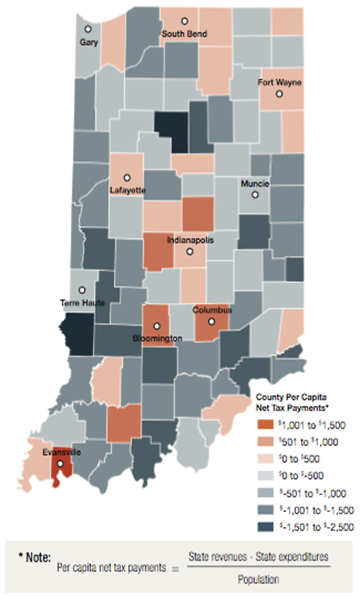
    It’s methodologically difficult to measure net taxation, but the studies that have been done suggest that, contrary to the belief of some, urban areas are big time net tax donors. For example, a recent Indiana Fiscal Policy Institute study found that Indiana’s urban and suburban counties generally subsidize rural ones.

    Just the consolidated city-county of Indianapolis-Marion County sends $420 million more to the state annually than it receives every year. That’s equal to the entire public safety budget of the city. The rest of the metro area sends another $340 million to the state annually.

    Similarly, a 2009 Georgia State University study found that the Atlanta metro area accounted for 61% of state tax collections but only but only 47% of expenditures. A 2004 University of Louisville study found that the state’s three major urban regions – Louisville, Lexington, and Northern Kentucky (south suburban Cincinnati) – generate over half the state’s tax revenues but only receive back about one third in state expenditures, an annual net outflow of $1.4 billion per year.

    The Atlanta and Indianapolis examples are particularly instructive, since both are the capital and by far the largest city of their state. They are sometimes presumed to benefit from disproportionate state spending as a result, but the reality is quite different.

    That’s not to say that this is necessarily bad. The fundamental basis of any government is a commonwealth, a body of citizens who see themselves as fellows, who believe each other’s fates are linked. Thus, generally spreading the burdens on some type of a progressive basis is broadly considered equitable, and assistance to the less fortunate constitutes a core function of government. To the extent that cities generate the most wealth in today’s economy, and have the highest incomes, it is no surprise they pay more in taxes. This doesn’t per se mean there’s an anti-urban bias in policy.

    Indeed, income redistribution is one of the key functions of state government. Actual welfare and safety net programs, including things like health care for the poor, are a major budget item in every state. But it goes beyond that. K-12 education could be treated as a purely local service, but every state spends large amounts on it. One could argue this is strictly to ensure a minimum level of funding equity between rich and poor districts. That is, it’s purely redistributive. Indeed, states sadly spend more time fiddling with funding formulas than in actual education reform and improvement. Even corrections disproportionately and unfortunately affects the poor. We are, in effect, a collection of 50 welfare states.

    The fact that so many of the functions of state government have taken on a redistributive cast also comes with downsides. Most importantly, even functions that should have little to do with welfare or equity have come to be seen through that lens.

    Exhibit A is transportation. Two-thirds of Americans live in large metro areas, yet less than half the federal transportation stimulus funds are going to the top 100 metro areas. Missouri is spending half its stimulus money on 89 small counties that account for only a quarter of the state’s population. In Ohio, the state cancelled plans to spend $100 million in stimulus funds on the crumbling Cleveland Inner Belt bridge in order to divert them to paying for a $150 million bypass around Nelsonville – a town of only 5,000 people. This is part of a plan to construct a four lane divided highway into sparsely populated southeast Ohio as part of a “build it and they will come” economic development plan. Mecklenburg County, NC, the state’s largest and home to Charlotte, received only $7.8 million out of the first $423 million in projects in that state. The Atlantic Monthly described this as a contest between a “mayor’s stimulus” and a “governor’s stimulus” – and the governor won.

    State after state has rural “roads to nowhere.” Without any legitimate economic development strategy on offer for depressed rural areas and small industrial cities, salvation is said to lie in access to four lane highways. The logic is that until every county in America is crisscrossed with these things, somehow residents are deprived of their due. This plays well to rural resentment, allowing people who are by nature proud believers in self-reliance and dismissive of welfare to claim instead that they’ve been cheated out of their “fair share” of transportation money. One suspects at least some deep inside understand the fiscal reality, which accounts for the self-righteous rhetoric designed as much perhaps to convince themselves as others.

    Regardless, a lack of transportation investment is crippling our cities, many of which have congested, crumbling roads and shaky bridges. Earmark reform would help at the federal level. Earmarked projects and “high priority corridors” are too often, as with “strategic” corporate programs, projects for which no traditional justification can be found.

    But beyond this, governance reform at the state level is critical to bring transportation funding allocations in line with real population and economic development measures. That’s not to say that rural areas should get no funding. There are many areas where legitimate state funding is warranted, such as replacing substandard bridges or correcting roads with dangerous geometry. But that doesn’t mean states should spend huge amounts of money on large rural expansion projects of dubious value that rob urban areas of the funds needed for projects with genuine transportation merit and real economic development potential.

    If states won’t act to reform this, then, despite legitimate governance concerns in our system of federalism, the federal government may need to step in to take a more direct role in funding formulas to ensure that a proper share of the money gets sub-allocated to metro areas. The federal government simply can’t allow states to continue diverting critical and limited transport money to boondoggles.

    With metro areas as the economic locus of the 21st century, failing to take action to make sure our cities get the transportation investment they need puts both the state treasury and national economic competitiveness at risk. Cities can only continue to play their role as wealth generators and sources of transfer funds for their states if they themselves are economically healthy, which requires infrastructure investment. As the Indiana, Georgia, and Kentucky examples show, state treasuries and rural funding are dependent on urban economic health. You can’t redistribute money from urban to rural areas if there’s nothing to distribute.

    Aaron M. Renn is an independent writer on urban affairs based in the Midwest. His writings appear at The Urbanophile.

    Photo: Pete Zarria

  • Blame Their Parents, Not Us

    We appreciate Pete Peterson’s attention to our work, but in responding to his complaint that we are denigrating Generation X and underrating its civic participation, we should begin at the beginning, define our terms, and give credit where credit is due. In writing our book, Millennial Makeover: MySpace, YouTube, and the Future of American Politics, we borrowed heavily from the thinking of and acknowledged our intellectual debt to Neil Howe and the late William Strauss, the founders of generational theory. In their seminal books, Generations (1992) and The Fourth Turning (1997), Strauss and Howe described the four generational archetypes – Idealist, Reactive, Civic, and Adaptive – that have cycled throughout Anglo-American history. Stemming from the way each generation was reared by its parents, each generational type develops a characteristic set of attitudes and behaviors that is broadly similar regardless of where in American history it appears.

    It is the attitudes and behaviors of these archetypes, not our biases or disdain for Generation X, that underpin our comments. Those same archetypical attitudes and behaviors also shape the statistics that Peterson cites both selectively and somewhat out of context in his New Geography posting.

    One of Peterson’s contentions is that members of Generation X currently participate in voluntary or non-profit activities to at least the same extent as Millennials do. He cites a survey conducted by the National Conference on Citizenship (NCOC) to prove his point. It is clear, however, that the NCOC itself places great hope in the Millennial Generation, entitling a section in its reports, “The Emerging Generation: Opportunities with the Millennials” and stating that “In the 2009 Civic Health Index, Millennials emerge as the ‘top’ group for volunteers.”

    While the NCOC statistics do indicate that Millennials lead the way in civic engagement, to be fair the overall differences between the X and Millennial Generations are not large. What most distinguishes Millennials from other generations is the type of community activities in which they are involved. Not surprisingly, given the lower incomes normally associated with entry level jobs and the fact that the Great Recession has hit them to a far greater extent than other generations, Millennials are more likely than older generations to volunteer rather than make financial donations. While a plurality of those in all generations say they both volunteer and donate financially, Millennials are substantially more likely to engage solely as volunteers. Among those who only volunteer, Millennials do so at 3.25 times the rate of Baby Boomers, 2.6 times that of seniors, and 1.3 times more than members of Generation X. In effect, at least in the current economy, Millennials have more time than money.

    As Peterson points out, when respondents were asked whether they had increased their civic participation in the past year, Gen-Xers led the way with 39% answering “yes” surpassing Millennials (29%), Boomers (26%), and seniors (25%). He dismisses the possibility that this might reflect improvements in previously low engagement levels among Gen-Xers, but actually it does. According to the U.S. Department of Education in 1984, when all of them were Gen-Xers, only a quarter (27%) of high school students participated in community service. Twenty years later, when all high school students were Millennials about three times as many (80%) did so. It could be argued that this increase occurred simply because by 2004 students were required to be active in their communities while they weren’t previously. But, for whatever reason, Millennials better seemed to internalize the lessons about community service to which they were exposed in high school. In 1989, 13% of those participating in the National Service organizations like the Peace Corps and Teachers Corps were from Generation X, about the percentage contribution of the generation to the U.S. population at that time. In 2006, 26% of National Service participants were Millennials, twice their percentage in the population.

    Peterson also maintains the voting turnout of Generation X equals that of Millennials when the two generations were of similar age. To demonstrate this he compares youth turnout in the 1992 and 2008 presidential elections. According to CIRCLE, a non-partisan organization that studies and attempts to increase the political participation of young people, 18-29 years did indeed vote at similar rates in 1992 when those of that age were Gen-Xers (50%) and in 2008 when that age group consisted primarily of Millennials (52% overall and 59% in the competitive battleground states in which the Obama and McCain campaigns concentrated their efforts).

    What Peterson did not do is to report on what occurred in all of the elections between 1992 and 2008. This provides more nuanced data that is generally more favorable to Millennials. For example, in 1996, when again all young voters were members of Generation X, youth electoral participation fell to 37%, the lowest of any year for which CIRCLE reports data. Youth voting began to steadily increase starting in 2000 as the first Millennials attained voting age until, in 2008, it reached the highest level since 1972.

    But, Peterson’s biggest unhappiness with those of us who “gush” about the Millennials really seems to be his belief that we extol them for partisan reasons. It is true that Millennials lean heavily to the Democratic Party. They supported Barack Obama against John McCain by a greater than 2:1 margin (66% vs. 32%) and, according to Pew, last October identified as Democrats over Republicans by 52% vs. 34%. They are also the first generation in at least four to contain more self-perceived liberals than conservatives.

    We certainly don’t hide the fact that we are life-long Democrats, something we clearly pointed out in the introduction to our book even as we made every effort to be evenhanded in our examination of American politics. That evenhanded examination suggests that as a civic generation, at this point in American history, it is hard to imagine most Millennials being anything other than Democrats. Civic generations, like the Millennials, favor societal and governmental solutions to the problems facing America. At least since the New Deal, the Democratic Party has had more affinity for such approaches than the GOP. It is for this reason that the GI Generation (Tom Brokaw’s Greatest Generation) became lifelong Democrats in the 1930s and why we believe most Millennials now see themselves as Democrats and vote that way. For Peterson to wish that were different won’t make it so.

    But, in the end, all generational archetypes play key roles in the mosaic of American life. In truth, no generation is somehow “better” or “worse” than another. When the civic GI Generation served America so nobly and effectively in World War II, members of the idealist Missionary Generation like Franklin D. Roosevelt inspired it and it was commanded in battle by great generals from the reactive Lost Generation such as Dwight Eisenhower and George Patton. America now faces a new set of grave issues. It will take the concerted efforts of all generations to confront and resolve them.

    Morley Winograd and Michael D. Hais are fellows of the New Democrat Network and the New Policy Institute and co-authors of Millennial Makeover: MySpace, YouTube, and the Future of American Politics (Rutgers University Press: 2008), named one of the 10 favorite books by the New York Times in 2008.

  • Memo To Obama: Banks Are Beautiful

    In his search for what Theodore Roosevelt called “a good, safe menace,” President Barack Obama has settled on the nation’s largest commercial banks, which as late as last year’s bailouts were still considered the best hope for economic salvation.

    At first Obama was content to rail about the filthy lucre of banker bonuses. Then he got the idea of maybe hitting the bonus babies with special taxes. But the reason that the Secretary of the Treasury is often the former chairman of Goldman Sachs is because the bank is one of the instruments that keeps the government afloat.

    Maybe President Obama didn’t get that memo, but he’s paying the banks’ bonuses, and they are paying his. The President needs the American banking system much in the way that the banking system needs the government as its biggest client.

    In his best imitation of William Jennings Bryant, who didn’t want the American experiment to be crucified on a “cross of gold,” the President has proposed a populist uprising against the bankers, not to mention a restoration of the Glass-Steagall Act and a tax on bank assets to recoup the taxpayer money lost in the crash.

    In attacking the money changers Obama would seem to be on safe ground. Who doesn’t despise an industry that got fat on mortgages and home equity, went bust, found redemption with easy government bailout money, and then celebrated by paying out bonuses from taxpayer contributions?

    It’s easy to imagine the President leading a Million Man March into the temples of Citibank or Bank of America to demand penance for the wages of so many sins. The Democrats may have gotten Massachusetts all wrong, but how can they not benefit from igniting a few bonfires against the vanities of Wall Street?

    The problem with a Banker Crusade is that once the ramparts are breached at castles like that of Goldman Sachs, what will become evident is that the entire American government can be understood as a failed S & L — those savings banks of shame that in the 1980s found their vaults filling up with suspect asset pools, if not whitewater.

    Like the government today, S & Ls lived beyond their means on other-people’s money, invested in bad assets, and resorted to phony accounting to cover up the losses… until the taxpayers were sent the bill for the overdrafts.

    The root cause of the S & L crisis in the 1980s was the decision of the Reagan administration to deregulate savings banks (they were no longer limited to plain vanilla mortgages), but still allow them to keep their federal insurance for deposits up to $100,000.

    Under this no-lose formula, banks could borrow nearly unlimited amounts of money in federally-insured deposits, and then lend out the funds to themselves, their cronies, or any get-rich-quick scheme that happened to send a prospectus to the bank’s board. S & Ls threw money at race horses, private planes, wine cellars, and even a few Senators, including John McCain.

    When the borrowers went broke and the banks failed, the government bailed out the depositors, and the grubstakers moved on down the trail. As Warren Buffett quipped, “In the 1980s, it was the bankers who were wearing the ski masks.”

    In the end, the government paid out something like $500 billion to cover the depositors with federal insurance.

    Fast forward to the U.S. government balance sheet in 2010, over which President Obama presides as the chief credit officer. As I read the annual report, the government is losing about $1.6 trillion a year, liabilities are $14 trillion and growing, and some of the nervous depositors are thinking of lining up at the front doors (or voting Republican).

    The deposits funding the American dream come from government bonds and securities, some of which have been sold to overseas investors. Of the $14 trillion in liabilities on the balance sheet, more than $3 trillion is held abroad, much of it in Asia and especially China.

    More troubling for the country’s Banker-in-Chief is that the government-as-bank — instead of lending its borrowed money against hard assets such as railroads, schools, wharves, hospitals — has put out the money to fund what the brochures might call Lifestyle Loans (“At American Security, you can live like there is no tomorrow”).

    At least 1980s S & Ls had a few houses and planes to repossess. All the U.S. government now shows in its loan bags is a trillion-dollar budget deficit, off balance sheet liabilities (another $1 trillion) to pay for the wars in Iraq and Afghanistan, multi-trillion dollar obligations to the depositors of Fannie Mae and Freddie Mac, and the coupons (with a present value of about $41 trillion) awarded to its citizens for Medicaid, Medicare, and Social Security redemptions.

    As a pyramid scheme, those numbers are hard to beat. The public debt is already equal to the gross domestic product, and government borrowings are projected by 2015 to rise to $20 trillion.

    Lost in the presidential outrage against the commercial lenders is one reason why so many of them are flush with money, even in bad times: banks, notably investment banks, earn huge spreads brokering debt for the American government.

    What put the government into the savings-bank business?

    After 2001, when the economy stalled, the strategy to keep the good times rolling was to encourage lower margin requirements for investment banks, home mortgages, and consumers, who were patriotically encouraged to spend the equity in their homes at places like Wal-Mart. (“When the going gets tough, the tough go shopping.”)

    To fund this asset bonanza (although it was based on dubious collateral), the government turned to the investment banks, which packaged, securitized, swapped, stripped, and laundered mortgage-backed securities until stock and real estate markets had doubled in value.

    The bubble burst not just because of rapacious bankers, but in part because the government’s voracious need for funding dried up liquidity for the leveraged banks. To be sure, the likes of Lehman and A.I.G. had bad loans galore, but the financial crisis is also about an electronic run at banks competing with the government to find funding.

    Ironically, banker greed pales in comparison to that of the U.S. Congress, which through the last decade pushed home ownership (thanks to the subprimers at Fannie and Freddie) as a way to spread the word of electoral happiness. Bad debtors got jumbo mortgages, and members of Congress got re-elected.

    In the current market, Obama manages a balance sheet that looks a lot like Citibank’s: it limps along, based on federal guarantees, and most of the collateral (consisting of subprime mortgages and used B-52 bombers) has little resale value on eBay.

    What bank would not want as its best customer a major industrial country that needs $14 trillion every year to balance its books?

    One percent of $14 trillion is $140 billion, a figure that roughly equates to the annual income of the banks that President Obama is now threatening to penalize. Would he prefer that they stop rolling over government debt?

    Listening to Obama rail against the banking fraternity, I can’t help but recall the high moral tone that starts the movie, Butch Cassidy and the Sundance Kid, which can be viewed as a cautionary tale on the moral hazards of (unauthorized) bank bonuses.

    In the opening scene, Butch is casing out a bank that he is thinking about robbing. The guard signals to him that it’s closing time. Before leaving, Butch asks, “What happened to the old bank? It was beautiful.”

    The guard answers: “People kept robbing it.”

    To which Butch responds: “Small price to pay for beauty.”

    In time, that may become the President’s reconsidered view of the banker bonuses.

    Matthew Stevenson is author of Remembering the Twentieth Century Limited and An April Across America.

  • Opposition to High Speed Rail Grows

    The St. Louis Post Dispatch characterizes high speed rail as a “bridge to the 19th century,” in noting its opposition.

    I couldn’t have said it better, though I tried in my Wall Street Journal Oped (“Runaway Subsidy Train”). As usual, some of the best lines in this article fell on the “cutting room floor,” as editors can allow only so many words. The two most important points were:

    • Significant community opposition is developing. Within the last 10 days there have been community and neighborhood protests against new high speed rail lines in France, Italy, Spain and Hong Kong. Further, opposition to the greenhouse gas belching Mag Lev (magnetic levitation) extension from Shanghai to Hangzhou (China) has blocked that project. There is a burgeoning opposition to the swath that high speed rail will cut through the communities on the peninsula south of San Francisco.
    • A traveler using high speed rail from Orlando to Tampa who gets caught at a rental car counter line might not save any time over driving even if the train reached the speed of light.

    The biggest problem with high speed rail is that it requires huge expenditures of public funding in a market (intercity passenger transport) that does not require subsidies. Much of the impetus comes from generous donations to political campaigns by vendors who live off public funding and by a naive cadre of virtual sheep who believe anything that runs on rails walks on water.

  • A Race Of Races

    When Americans think of our nation’s power (or our imminent lack of it) we tend to point to the national debts, GDP or military prowess. Few have focused on what may well be the country’s most historically significant and powerful weapon: its emergence as the modern world’s first multiracial superpower.

    This evolution, after centuries of racial wrangling and struggle, will prove particularly critical in a world in which the power of the “white” race will likely diminish as power shifts to China, India and other developing countries. By 2039, due largely to immigrants and their offspring, non-Europeans will constitute the majority of working-age Americans, and by around 2050 non-Hispanic whites could well be in the minority.

    But this should not be seen so much as a matter of ethnic succession as multiracial amalgamation. The group likely to grow fastest, for example, will be made up of people, like President Obama himself, who are of mixed race. There is no more demonstrable evidence of the changing racial attitudes of Americans. As recently as 1987 slightly less than half of Americans approved of interracial couples. By 2007, according to the Pew Center, 83% supported them. Among the millennial generation, who will make up the majority of adults in 2050, 94% approve of such matches.

    Today roughly 20% of Americans, according to Pew Research Center, say they have a relative married to someone of another race. Mixed-race couples tend to be younger; over two-fifths of mixed-race Americans are under 18 years of age. In the coming decades this group will play an ever greater role in society. According to sociologists at UC, Irvine, by 2050 mixed-race people could account for one in five Americans.

    The result will be a U.S. best described in Walt Whitman’s prophetic phrase as “the race of races.” No other advanced, populous country will enjoy such ethnic diversity.

    The U.S. will likely remain militarily and even economically preeminent, but much of its power will stem from its status as the world’s only multiracial superpower. America’s global reach will extend well beyond Coca-Cola, Boeing and the Seventh Fleet and express itself in the most intimate cultural and familial ties.

    Our continuing relative success with immigration is key to this process. In the next decades the fate of Western countries may well depend on their ability to make social and economic room for people whose origins lay outside Europe. No Western-derived country produces enough children of European descent to prevent them from becoming granny nation-states by 2050.

    In other words, countries and societies need to become more racially diverse in order to succeed. Yet over the past few decades many countries, from Iran to the nations of the former Soviet bloc, have narrowed their definition of national identity. Even the province of Quebec, bordering the U.S., has imposed preferential policies devised to blunt successful minorities. Because of these restrictive policies, which in some places are accompanied by lethal threats, Jews, Armenians, Coptic Christians and diaspora Chinese have often been forced to find homes in more-welcoming places.

    In recent decades Europe has received as many immigrants as the U.S., but it has proven far less able to absorb them. The roughly 20 million Muslims who live in Europe have tended to remain segregated from the rest of society and economically marginalized. In Europe, notably in France, unemployment among immigrants – particularly those from Muslim countries – is often at least twice that of the native born; in Britain, as well, Muslims are far more likely to be out of the workforce than either Christians or Hindus. British Muslims, according to Britain National Equity Panel, possess household wealth one-fifth that of the predominant nominally Christian population.

    This is also a famously alienated and socially isolated population. For example, in Britain in 2001 up to 40% of the Islamic population believed that terrorist attacks on both Americans and their fellow Britons were justified. They are not mixing much; 95% of white Britons say they have exclusively white friends. In comparison, only 25% of American whites in 29 selected metropolitan areas reported having no interracial friendships at all.

    Despite scattered cases of terrorists in our midst, the contrast between U.S. Muslims and their counterparts overseas is particularly telling. In the U.S. most Muslims are comfortably middle class, with income and education levels above the national average. They are more likely to be satisfied with the state of the country, their own community and their prospects for success than are other Americans – even in the face of the reaction to 9-ll.

    More important, more than half of Muslims – many of them immigrants – identify themselves as Americans first, a far higher percentage than in the various countries of Western Europe. This alienation may be a legacy of the European colonial experience, but it can also be seen in Denmark and Sweden, which had little earlier contact with the Muslim world. In contrast, in the U.S. more than four in five are registered to vote, a sure sign of civic involvement. “You can keep the flavor of your ethnicity,” remarked one University of Chicago Pakistani doctorate student in Islamic studies, “but you are expected to become an American.”

    But the general success of American immigration extends beyond Muslims. Even the largely working-class immigrants from Mexico generally have had lower unemployment than white and other workers, at least until 2007; then with the housing-led recession their unemployment rate began to rise, since so many were involved in construction and manufacturing. Once the economy recovers the historical pattern should reassert itself. Other large groups, including Asians, Cubans, Africans and a still considerable number of Europeans, have performed even better.

    Immigrants by their very nature, of course, are a work in progress, reflecting the essential protean nature of this civilization. Yet they are clearly becoming Americans and transforming who we are as a people. Ideologues on the left and right often don’t understand what is going on in America. The left, locked on the racial past, looks for new grievances to stoke among newcomers. They envision the rise of a fractured country – precisely the same thing many conservatives fear.

    Yet Hispanics, and particularly their children, are not becoming serape-wrapped Spanish speakers. Among Hispanics in California, 90% of children of first-generation immigrants speak fluent English; in the second generation half no longer speak Spanish. Only 7% of the children of immigrants speak Spanish as a primary language.

    Over the next few decades this pattern of ethnic and racial integration will separate America from its key competitors. In 2005 the U.S. swore in more new citizens than the next nine immigrant-receiving countries put together. These newcomers will reshape the very identity of the country and allow the U.S. to continue growing its labor force.

    Our prime competitors of the future – India and China – are unlikely to evolve in this direction. India is a highly heterogeneous country itself and remains driven by ethnic and religious conflicts. China, like Japan and Korea, remains a profoundly homogeneous country with little appetite or capacity to accept newcomers.

    America’s relative openness is particularly critical in the worldwide struggle for skilled labor. Right now more than half of all skilled immigrants in the world come to the U.S., though Australia and Canada, which have much smaller populations, have higher percentages of them. Despite repeated press reports about return migration to home countries, understandable given our sometimes bizarre immigration policy and the deep economic downturn, the vast majority of skilled immigrants – at least 60% – from around the world are staying.

    America’s successful evolution to a post-ethnic society will prove particularly critical in U.S. relations with developing nations, our largest source of immigrants. Even those immigrants who return home to Europe, China, India, Africa or Latin America often retain strong familial and business ties to the U.S. They can testify that America maintains a special ability to integrate all varieties of people into its society.

    As we negotiate the next few decades, America’s growing diversity allows it to stand alone, a multiracial colossus unmatched by any in the evolving global economy. In the current world being a “race of races” represents not a dissolution of power but a new means for expressing it.

    This article originally appeared at Forbes.com.

    Joel Kotkin is executive editor of NewGeography.com and is a distinguished presidential fellow in urban futures at Chapman University. He is author of The City: A Global History. His newest book is The Next Hundred Million: America in 2050, released in Febuary, 2010.

  • Get Real About Generation X Stereotypes

    Pity Generation X, the Americans born between 1965 and 1981, who have been derided for years as “apathetic,” “cynical,” and “disengaged.” Meanwhile, the greatness of the Greatest Generation is clear in its very name. Much laudatory ink has been spilled on the Baby Boomers…usually by Boomers themselves. As for the Millennials, those born between 1982 and 1998, the quantity of reportage lauding their public-spiritedness has quickly become tiresome. But a new report casts doubt on the widely accepted stereotype of Gen X-ers as inferior to these other groups.

    Sociologists Morley Winograd and Michael D. Hais, authors of Millennial Makeover: MySpace, YouTube, and the Future of American Politics, offer a good example of the usual attitude. “Millennials are sharply distinctive from the divided, moralistic Baby Boomers (born 1946–1964) and the cynical, individualistic Gen-X-ers (born 1965–1981), the two generations that preceded them and who are their parents,” they write. “Millennials have a deep commitment to community and helping others, putting this belief into action with community service activities.”

    In a Boston Globe op-ed prior to last year’s presidential election, Harvard’s Robert Putnam took things a step further, comparing Millennials to the earlier cohort that survived the Depression and fought World War II: “The 2008 elections are thus the coming-out party of this new Greatest Generation. Their grandparents of the original Greatest Generation were the civic pillars of American democracy for more than a half-century, and at long last, just as that generation is leaving the scene, reinforcements are arriving.”

    Would it be unseemly at this point to groan, “Gag me with a spoon”?

    All of this stereotyping might be more bearable if it were true. But the latest Civic Health Index study from the congressionally chartered National Conference on Citizenship (NCOC) puts both the Millennials and Generation X in a different light. The report, entitled Civic Health in Hard Times, focuses on the impact of the economic downturn on nationwide civic participation. The results, organized by generational cohort, indicate that much of the derision heaped on Generation X’s withdrawal from the public square has been misplaced.

    While Gen X-ers fall slightly behind Millennials in volunteering (42.6 percent to 43 percent), the narrowness of the gap is surprising, given the vastly greater number of volunteering opportunities available to (and sometimes mandated for) Millennials in high school and college. Gen X-ers far outdistance Baby Boomers (35 percent) in volunteering, and even outperform the real “Greatest Generation” of retired seniors (42 percent). And when asked whether they had increased their participation in the past year, Gen-X respondents scored highest, with 39 percent answering yes. This far surpassed Millennials (29 percent), Boomers (26), and seniors (25).

    Certainly this outcome might partly reflect small changes in already low engagement levels among Gen X-ers, but a deeper look reveals that they flex considerable civic muscle. Boomer respondents took the top spot when asked whether they “had given food or money to someone who isn’t a relative” in the last year, with 52.9 percent responding affirmatively, but Gen X-ers finished second (51.2 percent), followed by seniors, with Millennials placing last. When asked about a range of civic involvement activities, from “giving money, food, shelter” to more direct “volunteering,” Gen X-ers finished second to seniors — ahead of both Boomers and Millennials — in stating that they had done “all of the above”.

    As for more general political participation, recently released data from the U.S. Census Bureau show that while Millennials had a statistically significant uptick in voter participation in the November 2008 elections, they still trailed every other generation in percentage turnout. In fact, 18-, 19-, and 20-year-olds voted at the lowest percentages of any age surveyed—39.8 percent, 40.1 percent, and 43 percent, respectively. Gen X-ers far surpassed Millennials in percentage voting in 2008, 52.1 percent to 44.5. And the voter turnout for Millennials in 2008 was less than 1 percentage point higher than Gen-X-er turnout figures for 1992, the comparable election, age-wise, for the older cohort. These are hardly numbers befitting “a new Greatest Generation.”

    Moving from the issue of participation to that of trust in our largest governing institutions, the NCOC survey shows that there is some truth to the characterization of Gen X-ers as cynical. When asked, “Do you trust the government in Washington to do what is right?” Gen X-ers were the most dubious of all generations, with only 20.7 percent responding that they trusted the feds either “most of the time” or “just about always.” Compare this with Millennials (27.9 percent), Boomers (27.8), and seniors (26.2). The same trends pertain to questions about state government, though Gen X-ers’ level of trust in their local government was higher.

    This divergence between trust and participation makes sense when understood as a rational civic reaction to what are perceived as broken or distant political institutions. Gen X-ers, cautious about whether our politics can ameliorate significant societal ills, are nonetheless “voting” with their money and time to address these challenges. We may be skeptical, but we’re not apathetic.

    So why all the gushing about the Millennials? Part of the reason is the necessary examination of a new and very large generation’s coming of age, and of its participation in a democratic society. But it’s also difficult not to see a partisan element. In 2007, as researchers Winograd and Hais point out, Millennials self-identified as Democrats over Republicans by a margin of 52 percent to 30 percent. Winograd, a former adviser to Vice President Al Gore, uses this snapshot to forecast a Democratic “historic opportunity to become the majority party for at least four more decades.”

    Michael Connery, author of the recent Youth to Power: How Today’s Young Voters Are Building Tomorrow’s Progressive Majority, recently suggested, “If a ‘post-partisan’ politics is going to be ushered in on a wave of Millennial support, it will have a distinctly progressive character.” Connery concludes that it is “this optimism and belief in their own power to make positive change in the country — reflected in many polls and surveys of Millennials taken in the past few years — more than anything that accounts for the incredible surge in youth participation that we are seeing today.”

    These pundits should be careful, though, for while Millennials have registered predominantly Democratic, they’ve also shown a libertarian streak, expressing significant support for fiscally conservative policies.

    Winograd, Connery, and others (like the Center for American Progress’s Ruy Teixeira) seem less interested in touting the Millennials’ civic engagement than in celebrating their political leanings and what these might mean for the Democratic Party. In contrast, Gen X-ers began to participate politically as the youngest members of the Reagan Revolution, with most research finding us (to this day) more politically conservative than our Boomer parents.

    One wonders how much applause we would hear for Millennials if their current affiliation were reversed. As this year’s Civic Health Index demonstrates, Gen X-ers are proving to be deeply involved in civil society, even as we continue to be suspicious of big government. So while pundits keep handing out participation trophies to the Millennials, maybe this year they should save a few for the enlightened skeptics of Generation X.

    An earlier version of this article appeared in City Journal.

    Pete Peterson is executive director of Common Sense California, a multipartisan organization that supports citizen participation in policymaking (his views do not necessarily represent those of CSC). He also lectures on State and Local Governance at Pepperdine’s School of Public Policy.

  • Our Exurban Future and the Ecological Footprint

    ‘How shall we live?’ is a question that naturally concerns architects, planners, community representatives and all of us. It is a question that turns on the density of human settlements, the use of resources and the growing division of labour.

    Where Europeans lived mostly in the countryside in the eighteenth century, by the middle of the nineteenth century they had gathered in burgeoning towns and cities. The divide between town and country became a worldwide template in the twentieth century, as nations measured their economic growth by the pace of urbanisation. Today, more and more of the world’s population live in cities. In 1970, 35 per cent of the world’s population lived in urban environments; today that number has passed fifty per cent.

    The passage of people from the countryside to the city, though, was not the end of the great movement of peoples in the developed world. The developing world continues to urbanise, but North America and Europe started to move in the opposite direction in the 1920s, away from city centres outwards into new suburbs. Humanity, it seemed, was on the move again, and by the 1970s more Americans lived in suburbs than in cities or in the country.

    European cities, too, saw the growth of suburbs, as first wealthy people, and then later working people moved away from city centres, taking advantage of new railway and tramlines, and then later motorways, to commute to work, and return to homes beyond the urban boundary line. All these have been in one way or the other supported by governments.

    Roosevelt’s government Homeowners Loan Corporation, the Federal Housing Administration and then later the Veterans Administration provided cheap mortgages with fixed term repayments and a low interest rate. After World War II the rise continued, and by 1972 the FHA had helped nearly eleven million families to own homes. In those same years between 1934 and 1972, the percentage of American families living in owner-occupied dwellings rose from 44 per cent to 63 per cent.

    Between 1920 and 1930, when automobile registrations rose by more than 150 percent, the suburbs of the nation’s largest cities grew twice as fast as the core communities. Henry Ford said at the time ‘The City is doomed’ and that ‘we shall solve the city problem by leaving the city’. In 1956, the Interstate Highway Act created the largest freeway system in the world.

    In Britain, the postwar government planned and built garden suburbs and new towns, ringing London, on schemes first outlined by Ebenezer Howard at the end of the nineteenth century. Similar ‘garden cities’ were built in places like Hellerau, outside Dresden (1909) and Kapuskasing and Walkerville in Ontario, Canada.

    The reflux of people in the more developed world, away from the city centres, strains our distinctions between ‘city’ and ‘suburb’. The suburbs of the previous generation are the urban centres of the present. The dense settlements of Notting Hill, New Jersey and Sarcelles are the suburbs of twenty, fifty or a hundred years ago. As suburbanisation carries on, people are moving away from the suburbs their parents moved into, with much the same motives of seeking greener pastures or fleeing urban problems. New words are coined to describe the change: exurbs, edge cities, edgelands.

    This pace of suburbanisation has provoked its own anxieties. The great historian of ‘sprawl’, Robert Bruegmann, identifies three distinctive ‘anti-sprawl’ movements. In the 1920s Britain, intellectuals and Tory shire-dwellers raised a great protest against ‘ribbon development’ and what they condemned as ‘bungaloid growth’. In the late 1950s William H. Whyte, a journalist at Fortune magazine warned that ‘huge patches of once green countryside have been turned into vast, smog-filled deserts – at a rate of some 3000 acres a day’.

    Today suburbs are no longer just gauche or racist; they are killers of the planet. Herbert Girardet’s idea of the ‘human footprint’ was that each head of population would need a given area of land from which to raise his or her subsistence. As the mass of consumer goods each person used increased, he would need more land – the footprint would get larger. Indeed, says Girardet, if all the world lived at London rates of consumption, they would need three planets to sustain them, around 40 billion hectares, rather than the 14 billion hectares of landmass on our earth.

    Often ignored in such discussions is the fact that as consumption has grown, even more so has productivity. Across the world the land given over to grain harvesting shrunk from 732 million hectares in 1981 to 656 million in 2000 (after growing solidly from 587 million in 1950), even though the world population kept rising. That is because yields grew faster than consumption, releasing land from cultivation. Over the same years, grain yields from each hectare grew from 1.1 tons to 2.7 tons.

    This efficiency has done much to keep green land, well, green. We are seeing not deforestation but aforestation. In the United States forestland is growing 5886 square kilometres on average every year. In the European Union forests are growing 1428 square kilometres every year. And as farm land is retired, ever more land is protected in national parks worldwide.

    Much of the critique of the suburbs revolves around the car. The intrinsic link between suburbs and cars has many social consequences, but first and foremost it has consequences for energy use and globe-warming CO2 emissions. In thousands of ways, the more dispersed life of the suburbs would seem to be a much greater drain on resources than a more compact life in densely occupied cities.

    However, there is evidence that runs counter to our expectations of the association between settlement densities on the one hand, and energy use and greenhouse gas emissions on the other. Analysis of the Australian Conservation Foundation’s Conservation Atlas prepared for the Residential Development Council shows, surprisingly, that per capita greenhouse gas emissions are lower in suburban areas than city centres.
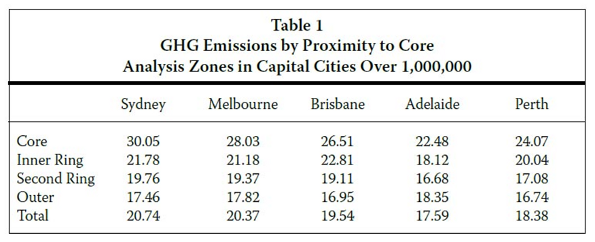

    Source: Greenhouse gas emissions, tonnes per capita, Housing form in Australia and its impact on greenhouse gas emissions, Residential Development Council 22 October 2007, p 11

    There are a number of reasons why this should be the case. First, suburban dwellings are often newer, incorporating more energy efficient means and materials – notably, better insulation. Second, though car journeys are less greenhouse gas efficient by the kilometre, the difference is not so great, and public transit is less efficient in other ways (because it rarely takes you just where you need to go) creating extra journeys and more waste.

    What is more, the view that suburban commuting must be a greater producer of greenhouse gas emissions does not take into account the changing patterns of home and work location in the newer suburbs. Our model of the diurnal commute, into the city in the morning and back to the dormitory town at night is becoming less typical.

    For many people, commuting is quicker in the suburbs than in cities. It takes residents within the suburbs and exurbs 24/25 minutes, much less than the 43 minutes for those living and working in Greater London. The case for reducing energy use by living at higher densities appeals to our common sense, but less dense living might provide answers to the problems of energy and emissions.

    Suburbanisation has raised fears of social division. Anxieties about social alienation, along with those about the environment, fit into a wider account of the problems of suburbanisation, and a proposed solution, which has been called the New Urbanism.

    One group that hoped to address the problem are the New Urbanists, a group of architects and planners who have turned the perceived problem of the suburbs around and created a manifesto to reverse those negative trends. Among the best-known exponents of the New Urbanism is Peter Calthorpe, for the arguments in his books The Next American Metropolis (1993) and Sustainable Communities (with Sim Van der Ryn, 1989).

    Calthorpe argues that we are still building suburbs that are ‘increasingly out of sync with today’s culture’ failing to take into account changing household composition, falling incomes and environmental concerns – a proposition that many American “progressives” held to be strikingly confirmed by the collapse of the US housing market in 2008/9, and its wider impact on the economy.

    Intriguingly, Calthorpe’s views on planning take us far away from technical considerations into an idea of what the good life ought to be. Calthorpe says that ‘we need to start creating neighbourhoods’, arguing that, ‘Our faith in government and the fundamental sense of commonality at the centre of any vital democracy is seeping away in suburbs designed more for cars than people, more for market segments than communities.’

    The New Urbanists were an influence on Britain’s Urban Task Force, under Lord Rogers of Riverside, who drew up the British government’s planning policy in the document Towards an Urban Renaissance in 1998. Rogers, too, favoured higher densities, mixed use and an end to suburban sprawl.

    Folding the idea of preserving our social capital into the broader ideas of environmentalism, New Urbanists, the Urban Task Force and Herbert Girardet have all gravitated towards a concept of ‘sustainable communities’. It is a concept that is at once recognisable and at the same time very vague. Still, it has been an enormous influence on policy makers, who have tried to give substance to its implications.

    However, the evidence is clear that despite the many policy initiatives that have been taken to create ‘sustainable communities’, developers, and perhaps consumers, too, have resisted the appeal. First, take the case of Europe. Analysis of 42 west European cities shows that in all but one (Berlin) the suburbs and exurbs are growing faster than the core.

    In 1965 44 million people lived in the center of these 42 cities, while 42 million lived in the suburbs and exurbs. By 2000, the inner city population had dropped to 39 million, while the suburban had grown to 71.6 million. On average, inner city populations declined by 13 per cent, while suburban and exurban populations increased by 113 per cent.

    • For example Madrid’s inner city population grew from 2.25 million to 2.4 million between 1965 and 2000, but its suburbs grew from 125,000 to 2.1 million.
    • Over the same period, Frankfurt’s inner city declined from 695,000 to 641,000, while its suburbs grew from 755,000 to 1.25 million
    • Brussels’ inner city shrunk by 30,000 to 137,000, while its suburbs grew from 1.8 to 2.3 million.
    • Even Barcelona, poster-boy for urban densification, saw its core decline from 1.6 million in 1965 to 1.5 million in 2000, while its suburbs grew from half a million to 2.26 million over the same period.

    Source: Western Europe: Metropolitan Areas & Core Cities 1965 to 2000/2001, Demographia, http://www.demographia.com/db-metro-we1965.htm.

    Policies that try to contain sprawl run against the grain of human nature. Many, even most people aspire to live at lower densities than they do right now.

    Still, there is a point to the Urban Renaissance. The gentrification of canal and riverside districts, and the creation of ‘cultural quarters’ is a well-documented trend. This was the sense in which there was an urban renaissance in the noughties: well-heeled yuppies took back parts of the inner city. Often single, they had less need of gardens and preferred loft living in Shoreditch or central Zurich to a detached house in the Suburbs, which were coming to be less exclusive, anyway.

    These developments should lead those polemicists painting the suburbs as the greedy well-to-do and the inner cities as disproportionately occupied by the suffering poor to recalibrate their argument. Tim Butler, Chris Hamnett and Mark Ramsden’s analysis of London’s employment in the 2001 census shows that outer London and the South East is more working class than inner London.

    The image of black inner cities and white suburbs is changing, too. Many major cities are suffering ‘black flight’ as black Americans move out to the more affordable suburbs: Chicago, Los Angeles, Houston, Dallas, San Diego, Washington and Oakland. San Francisco’s black population is down from 13.4 to 6.5 per cent.

    Not only do the New Urban policy prescriptions coincide with the recent gentrification of inner cities, there is some evidence that they have helped it. Portland, where the adoption of an urban growth boundary (or green belt) was intended to densify the city and protect the country, has seen house prices rise much faster than the national average (it was below that, now it is above). Inside Oregon’s protected ‘farm land’ many farmhouses turn out to be just country homes for the wealthy disguised as farms

    To show that Greenwich Millennium Village was not just more riverside yuppie flats, but a real community, architect Ralph Erskine built in a combined school and health centre, except that an old school, Anandale, had to be relocated from the centre of Greenwich to the peninsula to provide the children – and spookily, it has kept its old catchment. Erskine’s Potemkin Village recruits children from Greenwich to act the part of the local community. A few parents objected at first, but most changed their minds when they saw the quality of the facilities. Around ten of the families in the Village proper send their children there, and of those, the majority are in the 20 per cent of new homes that earmarked for social housing. Like other attempts to reinvent the village in the town, such as the Bo01 estate in Malmo, Sweden, Erskine’s Greenwich peninsula is overwhelmingly upper middle class.

    It is pointed that in Britain, where, thanks in part to Lord Rogers, planning restrictions on new development were greatest, there was no boom in housebuilding, unlike much of the rest of the world. Of course there was a boom in house-prices – quite a phenomenal one. But all through the period 1997 to 2008 house-building fell below the rate needed to replace Britain’s dilapidated housing stock.

    The New Urbanism was always rather more than an architectural style, but also a vision of the good life. It hoped to address the social divide, and the solipsistic withdrawal from city life. Curiously, it seems if anything to have played a part in accelerating the social divide, in particular the gentrification of inner city enclaves. Far from making the city more diverse, the new urbanism seems to be making it more uniform. In London the trend towards in-fill by building on brownfield land has had the unintended effect of the loss of green spaces in the City. In the north of the city, Londoners gathered to protest at the recreation of urban overcrowding, when Islington’s municipal authorities planned to force yet another apartment block on top of garages in Pilgrim’s Way.

    The New Urbanism describes one trend in society, the gentrification of inner cities. But many more people want to move outwards, to cheaper and more spacious homes. As communications improve, and more land is released from farm use by rising agricultural productivity, that shift towards more dispersed dwellings should find its place in architecture and planning theory, too.

    Ultimately more dispersed patterns of living lead to more dispersed commuting.

    South East England, the Bassin Parisien, Central Belgium, the Dutch Randstad, Rhine-Ruhr, Rhine-Main, Northern Switzerland, and Greater Dublin are examples of what geographers call polycentric urban regions. When industry moves out of monocentric cities, it disperses along valleys and communication lines.

    But the growth of Mega City Regions does not mean the countryside is all being concreted over. On the contrary, these economic regions are a lot greener, a lot more dispersed than the twentieth century city. Exurbs and edge towns are being populated in the yawning green spaces in between the industrial estates.

    The issue that needs to be addressed is: Can We Imagine A Dispersed Future?

    Far from being necessarily de-humanising, dispersed settlements are an opportunity for an enlargement of the human spirit. To imagine that there is anything in physical proximity that is essential to community is to confuse animal warmth with civilisation, and an unfortunately deterministic view of architecture’s relationship to society. But worst of all it misses out the great alternatives that are waiting to be made in new communities across the country.

    James Heartfield is author of Let’s Build! Why we need five million homes in the next ten years, and a director of www.Audacity.org.