Blog

  • Phoenix, Put Aside Dreams of Gotham

    Now that Phoenix’s ascendancy has been at least momentarily suspended, its residents are no doubt wondering what comes next. One tendency is to say the city needs to grow up and become more like East Coast cities or Portland, Ore., with dense urban cores and well-developed rail transit. The other ready option is always inertia – a tendency to wait for things to come back the way they were.

    Neither approach will work in the long run. Over the coming decade, Phoenix has to recalibrate its economy into something based on more than being a second option for Californians and speculative real-estate investment. Instead, it needs to focus laserlike on economic diversity and creating good jobs.

    The model here for Phoenix is not New York or San Francisco. Phoenix can’t rival these cities for their 19th-century charm or early 20th-century infrastructure. As we would say back in New York (my hometown): fuggedaboutit.

    Instead of dreaming about Gotham, Phoenix should think more about Houston. Like the Texas megacity, Phoenix is the ultimate late 20th-century town, dependent on air-conditioning, ample freeway space and a wide-open business culture.

    A century away from becoming “quaint,” Phoenix needs to follow Houston’s example of relentless economic diversification: in Phoenix’s case, away from dependence on tourism and construction. Houston has done this by focusing beyond its core energy sector to fields like international trade, manufacturing and medical services.

    Phoenix’s opportunities may lie elsewhere but may include some of these same industries. The idea is that the region needs to heal its job problem. Only then can the real-estate market rebound on a solid basis.

    This employment focus must replace the current obsession with changing the city’s urban form. Despite the current problems, Phoenix has performed pretty well over the past decade, creating more new jobs than most Sun Belt cities, not to mention job losers like San Francisco, Chicago, Los Angeles and New York. Equally important, it still leads the nation over the past decade in net in-migration among the largest cities

    Unfortunately, some in Phoenix still suffer horribly from Manhattan envy. One prominent Phoenix consultant describes the downtown as “the glorious goose that’s laying the gilded egg” that will turn the city into a dynamic trend-setter of a new urban paradigm. Phoenix, he opined, “won’t be a place of renown till it has the Big It.” In other words, Phoenix will not be a true metropolis until it has its own Times Square, Eiffel Tower, Space Needle or other grand attraction.

    Yet in newer cities like Phoenix, the quest for the “Big It” is often delusional. In Phoenix, the vast majority of the population moved in decades after the original downtown lost its primacy. People have their own notion of what “it” is, and many times, “it” could be in a different center or in more than one center – think Scottsdale, Tempe, Mesa, the Camelback Corridor, or a host of other communities.

    The Valley’s $1.4 billion transit system carries barely 15,000 round trips daily – a microscopic proportion of the region’s trips – with the biggest traffic on weekends. Sounds more like Disneyland than New York.

    Nor does the high-end condo, art-museum, convention-center thing seem to be working so well. Too bad the extra $1.5 billion spent sprucing up the area could not have been spent more usefully for less critical things, like police and fire, or better roads and schools.

    Rather than focus on emulating the urban father figures from the past, Phoenix’s best bet lies with its best assets: being reasonably priced, professionally managed and, well, warm and lovely in December. Shedding its real-estate-obsessed cocoon, Phoenix should focus on creating jobs for both present and future residents. That’s how you can grow up and find your own way.

    This article first appeared at The Arizona Republic.

    Joel Kotkin is executive editor of NewGeography.com and is a distinguished presidential fellow in urban futures at Chapman University. He is author of The City: A Global History. His next book, The Next Hundred Million: America in 2050, will be published by Penguin Press February 4th.

    Photo: robotography

  • The Kids Will Be Alright

    America’s population growth makes it a notable outlier among the advanced industrialized countries. The country boasts a fertility rate 50% higher than that of Russia, Germany or Japan and well above that of China, Italy, Singapore, North Korea and virtually all of eastern Europe. Add to that the even greater impact of continued large-scale immigration to America from around the world. By the year 2050, the U.S. population will swell by roughly 100 million, and the country’s demographic vitality will drive its economic resilience in the coming decades.

    This places the U.S. in a radically different position from that of its historic competitors, particularly Europe and Japan, whose populations are stagnant. The contrast between the U.S. and Russia, America’s onetime primary rival for world power, is particularly dramatic. Some 30 years ago, Russia constituted the core of a vast Soviet empire that was considerably more populous than the U.S. Today, even with its energy riches, Russia’s low birth and high mortality rates suggest that its population will drop to less than one-third that of the U.S. by 2050. Russian Prime Minister Vladimir Putin has spoken of “the serious threat of turning into a decaying nation.”

    An equally dramatic and perhaps more critical demographic shift is taking place in East Asia. Over the past few decades a rapid expansion of their work force fueled the rise of the “East Asian tigers,” the great economic success stories of the late-20th and early-21st centuries. Yet that epoch is coming to an end, not only in Japan and Korea but also in China, where the one-child policy has set the stage for a rapidly aging population by mid-century.

    Within the next four decades, most of the developed countries in both Europe and East Asia will become veritable old-age homes: A third or more of their populations will be over 65, compared with only a fifth in America. Like the rest of the developed world, the U.S. will certainly have to cope with an aging population and lower population growth, but in relative terms the county will boast a youthful, dynamic demographic.

    As many other advanced countries become dominated by the elderly, the U.S. will have the benefit of a millennial baby boom as the “echo boomers” start having offspring in large numbers later in this decade. This next surge in growth may be delayed if tough economic times continue, but over time the rise in births will add to the work force, boost consumer spending and allow for new creative inputs.

    The differing demographic trajectories create a diverse set of issues for 21st-century America than those facing its rivals. The key challenges the European Union, Japan and Korea will contend with in the coming decades involve coping with a rapidly aging population, filling labor shortages and finding ways to invest in growing economies. In contrast, the U.S.’s greatest priority will be to create opportunities for its ever-expanding population. The New America Foundation estimates the country needs to add more than 125,000 jobs a month simply to keep pace with population growth in 2010. What the U.S. does with its “demographic dividend”—that is, its relatively young working-age population—will largely depend on whether the private sector can generate the incomes among the young to meet the needs of a larger aging population.

    Entrepreneurialism and America’s flexible business culture—including the harnessing of entrepreneurial skills of aging boomers—will prove critical to meeting this challenge. Many of the individuals starting new firms will be those who have recently left or been laid off by bigger companies, particularly during a severe economic downturn. Whether they form a new bank, energy company or design firm, they will do it more efficiently—with less overhead, more efficient use of the Internet and less emphasis on pretentious office settings.

    “People are watching their companies go under. Therefore you get three vice presidents who get laid off but know their business,” says Texas entrepreneur Charlie Wilson. “They start a new company somewhere cheap that is more efficient and streamlined. These are the new companies that will survive and grow the next economy.”

    It is here—at the grassroots level—that you can best glimpse the essential sources of American resiliency. American society draws most of its adaptive power not from its elite precincts but through the efforts of communities, churches, entrepreneurs and families.

    You can see this in the resurgence of once-declining Great Plains cities like Fargo, N.D., where high-tech now joins agriculture and manufacturing to form one of the country’s strongest local economies. Or you can visit the emerging immigrant hotbeds, such as the San Gabriel Valley east of Los Angeles or the Sugarland area, just west of Houston, with their plethora of new churches, temples, companies and ethnic shopping malls.

    Immigrants represent a critical component of our next wave of new dynamism. Between 1990 and 2005, immigrants started one quarter of all venture-backed public companies. Large American firms are also increasingly led by people with roots in foreign countries, including 14 of the CEOs of the 2007 Fortune 100.

    But much of the energy will come from more obscure enterprises. Recent newcomers have already distinguished themselves as entrepreneurs, forming businesses from street-level bodegas to the most sophisticated technology start-ups.

    What drives immigrants is their optimism in America’s future. California developer Dr. Alethea Hsu, in explaining why she opened a new Asian-oriented shopping center in Orange County, cited the entrepreneurial energy of both affluent and working class immigrants which, she said, will allow them to thrive through the recession and beyond. “We are leased up, and we think the supply of shopping still is not enough,” Ms. Hsu said in early 2009. “We feel great trust in the future.”

    This entrepreneurial urge also extends beyond the immigrant community. In 2008, 28% of Americans said they had considered starting a business, more than twice the rate for French or Germans. Self-employment, particularly among younger workers, has been growing at twice the rate as in the mid-1990s. In the most recent Legatum Prosperity Index, the U.S. ranked at the top among all countries in terms of entrepreneurship and innovation.

    Most important of all will likely be the rise of the millennial generation—a group of Americans who will start reaching their prime earning years late in the next decade. Surveys identify them as strongly family- and community-oriented. The millennials will be America’s new entrepreneurs, workers and consumers in the coming decades. They will provide the kind of resource our major competitors are destined to run short on.

    The millennials also will help shape an increasingly culturally diverse America which by 2050 will be roughly half made up of ethnic minorities. This emerging post-ethnic future contrasts dramatically with the ethnic politics common among the nation’s chief global rivals. Even famously politically correct nations as Sweden, Denmark and the Netherlands have turned against immigration. Switzerland just banned the construction of minarets, while France is considering banning some forms of Islamic garb.

    Our prime Asian rivals—China, Japan, and Korea—remain even more culturally resistant to diversity. Chinese xenophobia, in particular, is deeply entrenched, notes Martin Jacques, author of “When China Rules the World.” A Chinese world superpower would be both racially homogenous and far from tolerant of newcomers. Recently the appearance of a mixed-race Shanghai girl on a national talent show sparked a surge of racist invective.

    The very diversity of the emerging America makes many wonder what will hold the country together. Ultimately, this unique society will find its binding principle in the notions that have long differentiated it from the rest of world: a common belief system, a sense of a shared destiny and an aspirational culture.

    As the British writer G. K. Chesterton once put it, the U.S. is “the only nation…that is founded on a creed.” This faith is not, and was not initially meant to be, explicitly religious; rather, it is a fundamentally spiritual idea of a national raison d’être.

    Of course, this optimistic scenario depends on intelligent and energetic actions by central and local governments, as well as community organizations. But the road to the American future will be primarily laid not by the central state but by families, individuals and communities. During the industrial age Ralph Waldo Emerson once observed, “The age has an engine, but no engineer.” Much the same may be said in the coming decades.

    This article first appeared at The Wall Street Journal.

    Joel Kotkin is executive editor of NewGeography.com and is a distinguished presidential fellow in urban futures at Chapman University. He is author of The City: A Global History. His next book, The Next Hundred Million: America in 2050, will be published by Penguin Press February 4th.

    Photo: jcolman

  • Suburbs & Cul-de-Sacs: Is The Romance Over?

    The Virginia Department of Transportation does not like cul-de-sacs. You know, those little circles that suburban home dwellers worship so much and pay a premium to be located on? Under its regulations, all new subdivisions must have only through streets. Essentially, no more cul-de-sacs. Getting rid of these desirable dead-ends, according to the DOT, will improve safety and accessibility for emergency vehicles.

    The new set of rules regarding street regulations is called Secondary Street Acceptance Requirements (SSAR). It requires a set of closed, interconnected street segments designed under specific formulae to make sure the streets are well situated for pedestrians and bicycles. The SSAR is also designed to better distribute traffic in local suburban settings, specifically subdivisions.

    I’m here to defend the cul-de-sac, but not as it is typically built and designed.

    What makes a cul-de-sac lot premium? Homeowners fall in love with the quiet courts and the sense of built-in neighborliness. The words “quiet cul-de-sac location” can spur more sales than the words “new granite counters.” The homes have huge rear yards, because of the extreme pie shape. The paved dead end areas guarantee no traffic will be speeding through, making parents and kids feel safe.

    The wide angles between the adjacent home sides create some useable side yard space, as well as added privacy. Quiet, serene, and safe – what’s not to love?

    Who Determines The Best Street Pattern? One of the biggest problems of suburban street design is that those who typically plan subdivisions don’t focus on vehicular or pedestrian flow, nor are they required to do so. The vast majority of subdivisions (and even of master planned developments) in the US are designed by engineering and land surveying companies that focus on density and meeting the ‘minimums’. A developer will typically hire the same company that engineers and surveys their site to plan the subdivision layout.

    Very little information is available on how to create suburban street patterns with connectivity. These areas may have significant topographic variations, making a traditional urban grid pattern undesirable. Suburban regulations don’t offer much help or guidance, either. Planning commissions and city councils that do not have an understanding of traffic engineering end up giving a yes vote to site plans they do not understand. The result is a conglomeration of people involved in the approval processes that produce a traffic system based more on familiarity than on functionality.

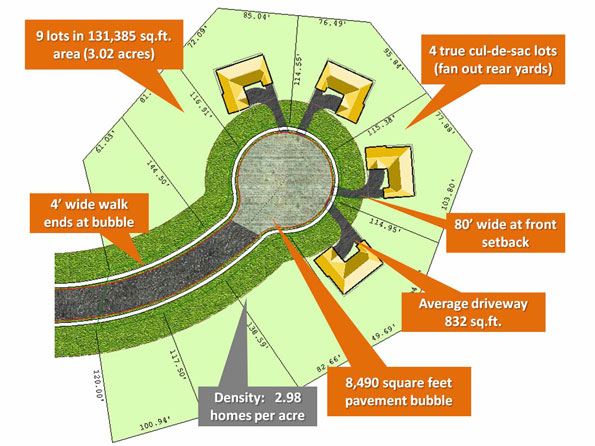
    Cul-de-Sac Design Guidelines: To make matters worse, existing design guidelines for cul-de-sacs create the most waste with the least benefit. Here in the upper Midwest, a cul-de-sac will have a 120 foot diameter right-of-way with a 110 foot circle of asphalt. Why? Because fire departments say they need that radius to turn around a fire truck. Go a bit south and that dimension reduces to a 100 foot diameter right-of-way with a 90 foot diameter circle. I’m not sure why northern firemen don’t turn the steering wheel as tight as those in the South, but according to these regulations, they apparently can’t. So up North the typical cul-de-sac will consume 8,500 square feet of paving, and in the South just under 6,000.

    This means that at a typical 25 foot setback from the right-of-way to the home front, an 80 foot wide suburban lot in the north will result in four or so premium lots. In the South, with a typical 20 foot setback and narrower 60 foot wide lot, there might be five or so premium lots.

    An 8,500 square foot volume of cul-de-sac paving for four Northern-sized lots comes out to 40 percent more square feet of paving per house compared to the same lot on a straight street. This means the home will cost the city 40 percent more for snow removal, resurfacing, etc., forever. It also cost the developer 40 percent more, but that is recouped because the lots on the cul-de-sac can be sold at a huge premium.

    A street leading to a cul-de-sac will have standard size lots fronting it. Depending upon the length of the street, there may be a few lots or dozens of them leading to the premium ones along the circle. These “street” lots might have a slightly higher value because of the low traffic approaching a closed end street, but they will certainly not equal the value of the lots around the circle.

    From an efficiency perspective, it seems like only a fool would defend the use of cul-de-sacs. Here are some facts from that fool. In planning, everyone assumes that the minimum dimension is the most efficient. In cul-de-sacs, the minimum dimensions are typically very inefficient. Making cul-de-sacs larger than the minimum fire engine turning radius makes them more efficient.

    Impossible? Take a look at the typical suburban design above, and compare it to to this re-designed cul-de-sac:

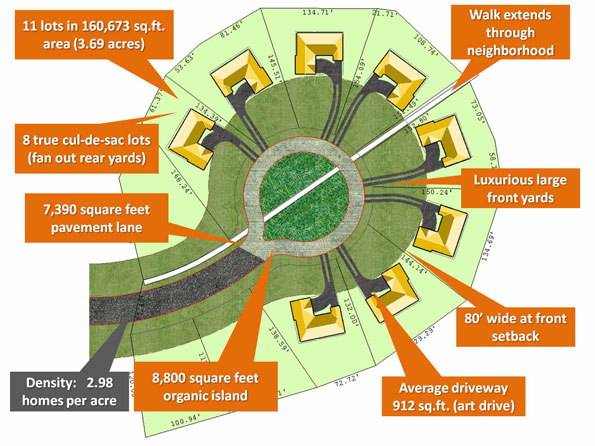
    By making a typical northern cul-de-sac larger, say 160 feet in diameter, and using a one-way narrow lane with an island in the center, the amount of total paved area plummets. Instead of a solid sea of asphalt, the new cul-de-sac uses 10% less paving and has room for a central park that will be approximately 8,800 square feet of organic surface.

    Now place the homes at a deeper setback. Yes, pulling the homes farther from the right-of-way to a 40 or 50 foot setback (instead of 25) accomplishes two things. It stretches the length of the setback line and makes the lots much less pie-shaped. The new, deeper setback should double the number of lots…with much less paving. Instead of being 40 percent less efficient, the new cul-de-sac is approximately 20 per cent more efficient than a rectangular lot on a straight street.

    And while the new cul-de-sac lot is less pie shaped, it will still have a significantly larger rear yard. The lots overlooking an 8,800 square foot park will have a much higher value than if they were overlooking 8,500 square feet of asphalt or concrete. The park can be used in a variety of ways, but a combination of rain gardens and recreation seems natural. By draining into the center, we eliminate curbing on one side, making them even more efficient. Since the number of premium cul-de-sac lots is at least doubled and uses less paving and less overall land area, there would be fewer cul-de-sacs.

    The Dead End Issue: But what of pedestrian and bicycle circulation? Well, that’s simple, as these non-vehicular designs can extend beyond the cul-de-sac as well as through them, making the central park areas destination places. Emergency vehicular access? Interconnecting walks could be made wide enough at certain locations to provide emergency access that would rival tight grid patterns.

    If these arguments favoring the efficient new cul-de-sacs aren’t enough, God likes them! How do I know? What scripture did I study to make this claim? Well, if God did not want cul-de-sacs, then why vary the natural contours of the land? Not every site is perfectly flat or a perfect square shape. In many cases, contours form peaks and valleys in which cul-de-sacs may be the only way to design a development; anything else would be unnatural.

    Hold your hand in front of you and then spread your fingers wide. When rain falls on the land and runs off it forms peaks and valleys similar to your jutting fingers. Where this happens, using the natural contour for the location of cul-de-sacs makes much more sense than trying to place a circulation pattern between the finger nails. Property configurations also often require a cul-de-sac or two (three, four or more).

    Of course a big bull-dozer could reconfigure any land to implement SSAR, but then…wouldn’t that be a sin?

    Rick Harrison is President of Rick Harrison Site Design Studio and Neighborhood Innovations, LLC. He is author of Prefurbia: Reinventing The Suburbs From Disdainable To Sustainable and creator of Performance Planning System. His websites are rhsdplanning.com and performanceplanningsystem.com.

    Photo:

  • Florida: From Hard Times in the Sunnier Climes

    By Richard Reep

    Florida’s era of hard times continues. Last week we held a “Jobs Summit ” here in Orlando but heard little but self-congratulation by politicians like Governor Charlie Crist. He praised the Legislature’s budget cuts but had little to claim when it came to reviving the economy.

    The basic reality is this: Florida is not only troubled, but in danger of falling further behind. For example, Suntech China, a solar cell manufacturer, recently worked with the State of Florida to build a solar cell manufacturing plant – in Arizona. Thanks to Florida’s unconvincing efforts, this employer decided to call Arizona its new home.

    The television and movie industry is rapidly expanding out of California into states like New York, Louisiana and New Mexico, thanks to incentives by these states to attract film and TV producers. Florida, with MGM, Universal Studios, Full Sail, and other venues, remains stagnant in this industry.

    While Central Florida is one of the country’s top ten “super regions” of population clusters, it consistently fails to get on the national stage regarding transportation, employment, and return on its federal tax money. For every dollar of income tax sent by Central Florida citizens each year, far less than a dollar comes back in terms of federal spending. Other states, like New Mexico and Alaska, receive our portion of that dollar.

    Publicly funded capital improvement projects, such as Nemours Hospital, continue to be awarded to out-of-state companies, leaving companies here in Florida, already reeling from the collapse of the real estate bubble, in even worse shape.

    Florida, which has little onshore energy resources such as oil or gas, has offshore energy resources that could pump billions of dollars into its coffers. Instead the riches of the Gulf are being exploited by Texas, Louisana, and Alabama.

    Florida, the “Sunshine State,” with vast solar and agricultural potential, has no renewable energy policy. Instead, biofuel and solar research leadership seems headed to Michigan, California and other states.

    Florida has yet to create a policy of sustainability at a statewide level. Instead, the state relies on growth, tourism, and agriculture for employment, hardly a sustainable policy given the catastrophe of 2009.

    While statewide unemployment is over 11%, labeled “Great Recession” by the press, those in the design and construction industry face unemployment estimates between 25% and 33%, levels matching that of the Great Depression.

    Nor are politics in our favor, even though Florida, reversing its generally conservative past, cast its lot with Obama in 2008. But now the promises of Transportation Secretary Ray LaHood in return for the State’s funding of commuter rail seem to be largely forsaken. During the Jobs summit, Obama’s railroad czar Joseph Szabo assured Florida that its priority would be yielded to Illinois. High-speed rail in Florida is unlikely in our lifetime. Chicago is simply more important than Orlando in today’s politics.

    Clearly Florida is not yet a basket case. With the right help from Tallahassee, Florida can reinvent itself and take advantage of the following natural assets:

    Sunshine still can bring talent and jobs. Sure, we are behind right now, but sunshine brought jobs before WW2 when Florida was ahead in aviation training. The mild climate is far more forgiving on student pilots than places where harsh winters ground light aircraft.

    Suntech should serve as Florida’s Pearl Harbor. Sure, we lost one solar cell manufacturer, but that technology is barely efficient enough to be viable. Florida could take advantage of this failure to revamp its poor growth management process, which was the reason for the failure to begin with, and actively seek out the best candidate for research and development of photovoltaic technology that would compete with Suntech and win.

    Deregulate Power Generation: The Sunshine State should be a net energy producer, not consumer. We could build a conduit to supply energy, through solar fields, up into the Southeast, as well as down into the Caribbean. There is a rather large island in need of vast amounts of clean power 90 miles away that will need this someday soon.

    Agricultural jobs: The statewide emergency declared as a result of the freeze should be a wake-up call to assist agriculture with some new ideas. Rather than sell dead orange groves out to developers, Florida should assist farmers to convert a portion of cropland to power generation, using solar collectors, photovoltaics, and biofuel crops.

    Media: This is a no-brainer for jobs. The movie industry grew in California because of the climate but is unionized and regulated to death. It’s time for Florida to compete. The next wave of entertainment culture is interactive virtual reality anyway, and the center of this activity has yet to be established, although there is an emerging concentration of firms like Raytheon doing research here. Florida could become a virtual reality technopole if it attracts the right players and provides the right resources.

    Transportation and the National Stage: For too long, Florida’s congressional delegation seems to have labored in the background, and Florida sends too few effective people to Washington. As a state made up of people escaping hard reality up north, we seem to have taken our “live and let live” beach culture too far and it has cost us credibility, capital, and clout. It’s time to reverse this trend and get passionate about our worth as a state and our contribution to America in items that matter. As a destination, Florida must rank much higher than Illinois for travel, and high speed rail should be awarded based on need rather than political favoritism.

    Meanwhile, growth and tourism will come back. They always do. And Florida, instead of losing designers to its competition, could find ways to retain them for the next generation of entertainment and leisure destinations. Housing, presently overbuilt, shouldn’t be ignored, but Florida has much to fix in terms of the quality of housing. Public/private partnerships to increase quality of life over quantity are necessary to make housing attractive and affordable and create quality, desirable communities for the 21st century.

    Florida is truly at a crossroads. For the last hundred and sixty-five years it relied on agriculture, growth, and tourism, but these narrow economic bands perpetuate cyclical booms and busts. Fundamental change can occur if the state’s leadership declares war on business as usual. The state needs to get nimbler to stay competitive when the economy does return. For those who want to stick it out and see Florida through this economic transition, it is imperative that the leadership respond now not just with words, but with actions that effect true, deep, and meaningful change.

    Richard Reep is an Architect and artist living in Winter Park, Florida. His practice has centered around hospitality-driven mixed use, and has contributed in various capacities to urban mixed-use projects, both nationally and internationally, for the last 25 years.

  • E-Bikes, China and Human Aspirations

    The Wall Street Journal recently carried an article entitled “E-Yikes: Electric Bikes Terrorize the Streets of China.” The article describes difficulties arising from the fact that nearly 120 million electric (battery) bicycles (E-Bikes) are now in operation in China, as people have abandoned mechanical bicycles and highly-polluting petrol motorbikes.

    However, to the millions of owners, China’s E-Bikes are a boon, not a bane. E-Bikes are best understood in terms of human aspiration (just like cars in America or Western Europe). People generally seek to improve their lifestyles. Research at the University of Paris, the University of California, the University of North Carolina and elsewhere has clearly demonstrated a strong relationship between higher incomes and higher rates of economic growth where people have greater personal mobility. This is what the E-Bike provides.

    In the large urban areas of the 21st century, even the dense Chinese urban areas, travel is highly dispersed. The efficient operation of the urban area requires an ability to travel from any point in the urban area to any other point in a short amount of time. As effective as public transport can be for trips within the dense (but generally small) urban core or to the urban core from suburban areas, a large share of trips simply cannot be feasibly made any other way than by personal mobility. This includes walking, for very short trips and bicycles for somewhat longer trips. But, it also includes substantial and increasing travel by faster modes of transport, particularly cars and two-wheeled vehicles. E-Bikes have greatly improved mobility. At the same time, the E-Bike has enormously reduced both the air pollution and carbon footprint of two-wheeled personal mobility.

    This is not to discount the traffic and other difficulties. However, the Chinese, like their western counterparts, will continue to seek better lives and that means greater personal mobility. It means that E-Bike usage will continue to grow and that car usage will also continue to grow, as incomes rise. While that will make traffic congestion even worse, the spectacular automobile fuel efficiency improvements ahead will allow massive expansion of personal mobility, while moving in the right direction with respect to the carbon footprint. In the final analysis, the Chinese (and the Indians, Indonesians, etc.) would like to live as well as we do in the United States and Western Europe. And why not?

    Photograph: E-Bike display at a Suzhou (Jiangsu) hypermarket.

  • The War Against Suburbia

    A year into the Obama administration, America’s dominant geography, suburbia, is now in open revolt against an urban-centric regime that many perceive threatens their way of life, values, and economic future. Scott Brown’s huge upset victory by 5 percent in Massachusetts, which supported Obama by 26 percentage points in 2008, largely was propelled by a wave of support from middle-income suburbs all around Boston. The contrast with 2008 could not be plainer.

    Browns’s triumph followed similar wins by Republican gubernatorial contenders last November in Virginia and New Jersey. In those races suburban voters in places like Middlesex County, New Jersey and Loudoun County, Virginia—which had supported President Obama just a year earlier—deserted the Democats in droves. Also in November, voters in Nassau County, New York upset Nassau County Executive Thomas Suozzi, an attractive Democrat who had carefully cultivated suburban voters.

    The lesson here is that political movements ignore suburbanites at their peril. For the better part of a century, Americans have been voting with their feet, moving inexorably away from the central cities and towards the suburban periphery. Today a solid majority of Americans live in suburbs and exurbs, more than countryside residents and urbanites combined.

    As a result, suburban voters have become the critical determinants of our national politics, culture, and economy. The rise of the Republican majority after 1966 was largely a suburban phenomenon. When Democrats have resurged—as they did under Bill Clinton and again in 2006 and 2008—it was when they came close to splitting the suburban vote.

    But now, once again, things have changed. For the first time in memory, the suburbs are under a conscious and sustained attack from Washington. Little that the administration has pushed—from the Wall Street bailouts to the proposed “cap and trade” policies—offers much to predominately middle-income oriented suburbanites and instead appears to have worked to alienate them.

    And then there are the policies that seem targeted against suburbs. In everything from land use and transportation to “green” energy policy, the Obama administration has been pushing an agenda that seeks to move Americans out of their preferred suburban locales and into the dense, transit-dependent locales they have eschewed for generations.

    As in so many areas, this stance reflects the surprising power of the party’s urban core and the “green” lobby associated with it. Yet, from a political point of view, the anti-suburban stance seems odd given that Democrats’ recent electoral ascendency stemmed in great part from gains among suburbanites. Certainly this is an overt stance that neither Bill nor Hillary Clinton would likely have countenanced.

    Whenever possible, the Clintons expressed empathy with suburban and small-town voters. In contrast, the Obama administration seems almost willfully city-centric. Few top appointees have come from either red states or suburbs; the top echelons of the administration draw almost completely on big city urbanites—most notably from Chicago, New York, Los Angeles, and San Francisco. They sometimes don’t even seem to understand why people move to suburbs.

    Many Obama appointees—such as at the Departments of Transportation and of Housing and Urban Development (HUD) and at the Environmental Protection Agency (EPA)—favor a policy agenda that would drive more Americans to live in central cities. And the president himself seems to embrace this approach, declaring in February that “the days of building sprawl” were, in his words, “over.”

    Not surprisingly, belief in “smart growth,” a policy that seeks to force densification of communities and returning people to core cities, animates many top administration officials. This includes both HUD Secretary Shaun Donovan and Undersecretary Ron Sims, Transportation undersecretary for policy Roy Kienitz, and the EPA’s John Frece.

    Transportation Secretary Ray LaHood revealed the new ideology when he famously declared the administration’s intention to “coerce” Americans out of their cars and into transit. In Congress, the president’s allies, including Minnesota Congressman James Oberstar, have advocated shifting a larger chunk of gas tax funds collected from drivers to rail and other transit.

    In addition, the president’s stimulus—with its $8 billion allocation for high-speed rail and proposed giant increases in mass transit—offers little to anyone who lives outside a handful of large metropolitan cores. Economics writer Robert Samuelson, among others, has denounced the high-speed rail idea as “a boondoggle” not well-suited to a huge, multi-centered country like the United States. Green job schemes also seem more suited to boost employment for university researchers and inner-city residents than middle-income suburbanites.

    Suburbanites may not yet be conscious of the anti-suburban stance of the Obama team, but perhaps they can read the body language. Administration officials have also started handing out $300 million stimulus-funded grants to cities that follow “smart growth principles.” Grants for cities to adopt “sustainability” oriented development will reward those communities with the proper planning orientation. There is precious little that will benefit suburbanites, such as improved roads or investment in other basic infrastructure.

    But ultimately it will be sticks and not carrots that planners hope to use to drive de-suburbanization. Perhaps the most significant will be new draconian controls over land use. Administration officials, particularly from the EPA, participated in the drafting of the recent “Moving Cooler” report, which suggested such policies as charging tolls on the Interstate Highway System, charging people to park in front of their homes, and steering some 90 percent of all future development into the most dense portions of already existing urban development.

    Of course, such policies have little or no chance of being passed by Congress. Too many representatives come from suburban or rural districts to back policies that would penalize a population that uses automobiles for upwards of 98 percent of their transportation and account for 95 percent of all work trips.

    But the president’s cadres may find other ways to impose their agenda. New controls, for example, may be enacted through the courts and regulatory action. There is already precedence for this: As EPA director under Clinton, current climate czar Carole Browner threatened to block federal funds for the Atlanta region due to their lack of compliance with clear air rules.

    Such threats will become more commonplace as regulating greenhouse gases fall under administrative scrutiny. As can already be seen in California, regulators can use the threat of climate change as a rationale to stop funding—and permitting—for even well-conceived residential, commercial, or industrial projects construed as likely to generate excess greenhouse gases.

    These efforts will be supported by an elaborate coalition of new urbanist and environmental groups. At the same time, a powerful urban land interest, including many close to the Democratic Party, would also support steps that thwart suburban growth and give them a near monopoly on future development over the coming decades.

    Glimpse the Future

    One can glimpse this future by observing what takes place in most European countries, including the United Kingdom, where land use is controlled from the center. For decades options for new development have been sharply circumscribed, with mandates for ever-smaller lots and smaller homes more the norm for single-family residences.

    In Britain the dominant planning model is widely known as “cramming,” meaning forced densification into smaller geographic areas. Over the past generation, this has spurred a rapid shrinking of house sizes. Today the average new British “hobbit” house, although quite expensive, covers barely 800 square feet, roughly one-third that of the average American residence. Even in quite distant suburbia many of the features widely enjoyed here—sizable backyards, spare bedrooms, home office space—are disappearing.

    But these suburban hobbits will be living large compared to the sardines who would be forced to move into inner cities. In London, already a densely packed city, planners are calling for denser apartment blocks and congested neighborhoods.

    This top-driven scenario may be playing soon in America. Following the proposed edicts of “Moving Cooler,” the urban option increasingly would become almost the only choice other than the countryside. Unlike their baby boomer parents, the next generation would have few affordable choices in comfortable, low- and medium-density suburbs and single-family homes.

    Ownership of a single-family home would become increasingly the province only of the highly affluent or those living on the fringes of second-tier American cities. Due to the very high costs of construction for multi-family apartments in inner cities, most prospective homeowners would also be forced to remain renters. Although widely hailed as “progressive,” these policies would herald a return to the kind of crowded renter-dominated metropolis that existed prior to the Second World War.

    Are Suburbs Doomed?

    The anti-suburban impulse is nothing new. Suburbs have rarely been popular among academics, planners, and the punditry. The suburbanite displeased “the professional planner and the intellectual defender of cosmopolitan culture,” noted sociologist Herbert Gans. The 1960s counterculture expanded this critique, viewing suburbia as one of many “tasteless travesties of mass society,” along with fast and processed food, plastics, and large cars. Suburban life represented the opposite of the cosmopolitan urban scene; one critic termed it “vulgaria.”

    Liberals also castigated suburbs as the racist spawn of “white flight.” But more recently, environmental causes—particularly greenhouse gas emissions as well as dire warning about the prospects for “peak oil”—now drive much of the argument against suburbanization.

    The housing crash that began in 2007 added grist to the contention that the age of suburban growth has come to an end. To be sure, the early phases of the subprime mortgage bust were heavily concentrated in newer developments in the outer fringes. In part due to rising home prices, a disproportionate number of new buyers were forced to resort to sub-prime and other unconventional mortgages.

    The outer suburban distress attracted much media attention and delighted many who had long detested suburbs. One leading new urbanist, Chris Leinberger, actually described suburban sprawl as “the root cause of the financial crisis.” Leinberger and other critics have described suburbia as the home of the nation’s future “slums.” The favorite images have included McMansions being taken over by impoverished gang-bangers and other undesirables once associated with the now pristine inner city.

    Others portray future suburbs as serving at best as backwaters in a society dominated by urbanites. In contrast to a brave new era for “the gospel of urbanism,” the suburbs are expected to contract and even wither away. According to planner Arthur C. Nelson’s estimate, by 2025 the United States will have a “likely surplus of 22 million large lot homes”—that is, residences on more than one sixth of an acre.

    City boosters, however, largely ignore the real-estate crisis impact on urban condo markets throughout the country. Like the new developments on the fringe, the much hyped apartment complexes in central cities such as New York, Miami, Los Angeles, Chicago, and Denver came on line precisely as the housing market crashed, with similar devastating effects. Many remain unoccupied and others have been converted from high-end condos to more modest rentals.

    Yet fundamentally the attack on suburbia has less to do with market trends or the environment than with a deep-seated desire to change the way Americans live. For years urban boosters have proposed that more Americans should reside in what they deemed “more livable,” denser, transit-oriented communities for their own good. One recent example, David Owens’ Green Metropolis, supports the notion that Americans should be encouraged to embrace “extreme compactness”—using Manhattan as the model.

    Convinced Manhattanization is our future, some “progressives” are already postulating what to do with the remnants of our future abandoned. Grist, for example, recently held a competition about what to do with dying suburbs that included ideas such as turning them into farms, bio-fuel generators, and water treatment plants.

    What Do the Suburbanites Want?

    In their assessments, few density advocates bother to consider whether most suburbanites would like to give up their leafy backyards for dense apartment blocks. Many urban boosters simply could not believe that, once given an urban option, anyone would choose to live in suburbia.

    Jane Jacobs, for example, believed that “suburbs must be a difficult place to raise children.” Yet had Jacobs paid as much attention to suburbs as she did to her beloved Greenwich Village, she would have discovered that they possess their own considerable appeal, most particularly for people with children. “If suburban life is undesirable,” noted Gans in 1969, “the suburbanites themselves seem blissfully unaware of it.”

    Contrary to much of the current media hype, most Americans continue to prefer suburban living. Indeed for four decades, according to numerous surveys, the portion of the population that prefers to live in a big city has consistently been in the 10 to 20 percent range, while roughly 50 percent or more opt for suburbs or exurbs. The reasons? The simple desire for privacy, quiet, safety, good schools, and closer-knit communities. The single-family house, detested by many urbanists, also exercises a considerable pull. Surveys by the National Association of Realtors and the National Association of Home Builders find that some 83 percent of potential buyers prefer this kind of dwelling over a townhouse or apartment.

    In other words, suburbs have expanded because people like them. A 2008 Pew study revealed that suburbanites displayed the highest degree of satisfaction with where they lived compared to those who lived in cities, small towns, and the countryside. This contradicts another of the great urban legends of the 20th century—espoused by urbanists, planning professors, and pundits and portrayed in Hollywood movies—that suburbanites are alienated, autonomous individuals, while city dwellers have a deep sense of belonging and connection to their neighborhoods.

    Indeed on virtually every measurement—from jobs and environment to families—suburban residents express a stronger sense of identity and civic involvement with their communities than those living in cities. One recent University of California at Irvine study found that density does not, as is often assumed, increase social contact between neighbors or raise overall social involvement. For every 10 percent reduction in density, the chances of people talking to their neighbors increases by 10 percent, and their likelihood of belonging to a local club by 15 percent.

    These preferences have helped make suburbanization the predominant trend in virtually every region of the country. Even in Portland, Oregon, a city renowned for its urban-oriented policy, barely 10 percent of all population growth this decade has occurred within the city limits, while more than 90 percent has taken place in the suburbs over the past decade. Ironically, one contributing factor has been the demands of urbanites themselves, who want to preserve historic structures and maintain relatively modest densities in their neighborhoods.

    Multicultural Flight

    Perhaps nothing reflects the universal appeal of suburban lifestyles more than its growing ethnic diversity. In 1970 nearly 95 percent of suburbanites were white. Today many of these same communities have emerged as the new melting pots of American society. Along with immigrants, African-Americans have moved to the suburbs in huge numbers: between 1970 and 2009, the proportion of African-Americans living in the periphery grew from less than one-sixth to 40 percent.

    Today minorities constitute over 27 percent of the nation’s suburbanites. In fast-growing Gwinett County outside Atlanta, minorities made up less than 10 percent of the population in 1980; by 2006 the county was on the verge of becoming “majority minority.” In greater Washington, D.C., the Northeast’s most dynamic region in economic and demographic terms, 87 percent of foreign migrants live in the suburbs, while less than 13 percent live in the district, according to a 2001 Brookings Institution study.

    Perhaps most intriguingly, this diversity is itself diverse, including not only African-Americans but also Latinos and Asians. Suburban areas such as Fort Bend county, Texas, and the city of Walnut, in the San Gabriel Valley east of Los Angeles, already have among the most diverse populations in the nation. And this is not merely a California phenomenon: Aurora (outside Denver), Bellevue (the Seattle suburb), and Blaine (outside Minneapolis) are becoming ever-more diverse even as the nearby city centers become less so. By 2000 well over half of mixed-race households were in the suburbs, a percentage that continues to grow.

    Today the most likely locale for America’s new ethnic shopping centers, Hindu temples, and new mosques are not in the teeming cities but in the outer suburbs of Los Angeles, New York, and Houston. “If a multiethnic society is working out in America,” suggests California demographer James Allen, “it will be worked out in [these] places  . . . The future of America is in the suburbs.”

    A War Not Worth Fighting

    If most Americans clearly prefer suburbs then why would our elected representatives choose to pick a fight with them? Perhaps the most widely used explanation lies with densification as a means of reducing greenhouse gases. But this rationale itself seems flawed, and could reflect more long-standing prejudice than proven science.

    For example, a recent study by the National Academy of Sciences found that a nationally imposed densification policy would at best cut greenhouse gas emissions between less than 1 and 11 percent by 2050. Other research suggests that, by some measurements, low-density development can use less energy than denser urban forms.

    Although automobile commuting now consumes more energy resources than well-traveled traditional urban rail systems, the future generation of low-mileage cars may prove more efficient than often underutilized rail systems that are now seen as critical elements of fighting climate change. A public system running at low capacity—commonplace in many regions—may actually produce more emissions than the coming generation of personal vehicles.

    Moreover, tall buildings may not be as green as some advocates suggest. Recent studies out of Australia show that townhouses, small condos, and even single-family homes generate far less heat per capita than the supposedly environmentally superior residential towers, particularly when one takes into account the cost of heating common areas and the highly consumptive lifestyle of affluent urbanites (with their country homes, vacations, and frequent flying). In terms of energy conservation, the easiest and least expensive option may be to retrofit single-family houses and wood-shaded townhouses.

    Two- or three-story homes or townhouses often require only double-paned windows and natural shading to reduce their energy consumption; one Los Angeles study found that white roofs and shade trees can reduce suburban air conditioning by 18 percent. Such structures are particularly ideal for using the heat- and water-saving elements of landscaping: after all, a nice maple can cool a two-story house more efficiently than it can a ten-story apartment.

    Of course, density advocates can and do produce their own studies to justify their agenda. But there seems enough reasonable doubt to focus on more efficient, and less intrusive, ways to create greener communities by improving energy efficiency of automobiles and changing the way suburbs fit into metropolitan systems.

    Turning Deadwood into Greenurbia

    The “green” assault on suburbia also largely ignores changes already taking place across the suburban landscape. In a historical context, the latest suburban “sprawl” may be compared to Deadwood. That rough-and-ready mining town on the Dakota frontier was developed quickly for the narrow purpose of being close to a vein of gold. But over time these towns developed respectable shopping streets, theaters, and other community institutions.

    One change already evident can be seen in commuting patterns. Density advocates and the media often characterize suburbanites as people who generally take long commutes to work compared to the shorter rides enjoyed by city-dwellers. But with the continuing dispersion of work to the suburbs over the past two decades, suburban work locations actually enjoyed shorter commutes than their inner city counterparts in virtually all the largest metropolitan areas.

    This is true even in New York. Although Manhattanites enjoy short commutes and can even walk to work, most people who live in New York City and work in Manhattan suffer among the longest commutes in the nation. In fact, residents of Queens and Staten Island spend the most time getting to work of all metropolitan counties. Residents in suburbs and particularly exurbs actually endure generally shorter commutes, in large part because of less congestion and closer proximity to employment.

    Such pairing of jobs and housing will shape the suburban future and represents among the easiest ways to cut transportation-related emissions. Even more promising has been the continuing rise in home-based employment. According to Forrester Research, roughly 34 million Americans now commute at least part time from home; by 2016 these numbers are predicted to swell upwards to 63 million.

    Oddly, despite these tremendous potential environmental benefits, the shift toward cyberspace has elicited little support from smart-growth advocates. Indeed most reports on density and greenhouse gases virtually ignore the consideration of telecommuting and dispersed work.

    One reason may be that telecommuting breaks with the prevailing planning and green narratives by making dispersion more feasible. The ability to work full time or part time from home, notes one planning expert, expands metropolitan “commuter sheds” to areas well outside their traditional limits. In exchange for a rural or exurban lifestyle, this new commuter—who may go in to “work” only one or two days a week—will endure the periodic extra long trip to the office.

    Yet although it may offend planning sensibilities, the potential energy savings—particularly in vehicle miles traveled—could be enormous. Telecommuters drive less, naturally; on telecommuting days, average vehicle miles are between 53 percent and 77 percent lower. Overall a 10 percent increase in telecommuting over the next decade will reduce 45 million tons of greenhouse gases, while also dramatically cutting office construction and energy use. Only an almost impossibly large shift to mass transit could produce comparable savings.

    Ultimately, technology will undermine much of the green case against suburbia. If we really want to bring about a greener era, focusing attention on low-density enclaves would bring change that conforms to the preferences of the vast majority of people.

    Think Twice Before You Act

    Ultimately, the war against suburbia reflects a radical new vision of American life which, in the name of community and green values, would reverse the democratizing of the landscape that has characterized much of the past 50 years. It would replace a political economy based on individual aspiration and association in small communities, with a more highly organized, bureaucratic, and hierarchical form of social organization.

    In some ways we could say forced densification could augur in a kind of new feudalism, where questions of land ownership and decision making would be shifted away from citizens, neighbors, or markets, and left in the hands of self-appointed “betters.” This seems strange for an administration—and a party—whose raison d’être ostensibly has been to widen opportunities rather than constrict them.

    Indeed it is one of the oddest aspects of contemporary “progressive” thought that it seeks to undermine even modest middle class aspirations such as living in a quiet neighborhood or a single-family house. This does not seem a winning way to build political support across a broad spectrum of the populace.

    Of course suburbia is not and will not be the option for everyone. There will continue to be a significant, perhaps even growing, segment of the population which opts for a dense urban lifestyle or, for that matter, to live further in the countryside. But unless we see a radical change in human behavior and social organization, the majority will likely settle for a suburban or exurban existence.

    Given these realities, it seems more practical not to work against such aspirations but instead to evolve intelligent policies that would reconcile them with our long-term environmental needs. Suburbanites like their suburbs but would also like to find a way to make them greener as well as more economically and socially viable. Right now neither party has developed such an agenda, and so the suburbs, now clearly leaning right, remain up for grabs. To win suburbanites over, politicians first have to respect the basic preferences while offering a realistic program for improvement. This remains a key to building a sustainable electoral majority, not just for the next election, but for the decades to come.

    This article first appeared at The American.

    Joel Kotkin is executive editor of NewGeography.com and is a distinguished presidential fellow in urban futures at Chapman University. He is author of The City: A Global History. His newest book is The Next Hundred Million: America in 2050, released in Febuary, 2010.

  • NG Publisher in Fargo Forum Regarding FM Economy

    “What we find in the Fargo-Moorhead economy, with very few exceptions, is that a lot of things are growing and they are growing very substantially. Weʼre firing on all eight cylinders.
    The investments being made in science and technology in Fargo-Moorhead are having a definite impact. Our strategy is right, and the world is our market.”

  • MILLENNIAL PERSPECTIVE: Vintage Fashion & The Twice-Around Economy

    One impact of the recession has been a fundamental change in consumer clothing purchase patterns. Luxury retailers’ losses have been second-hand retailers’ gains. Internet marketers have also been uniquely positioned to benefit.

    Instead of buying new goods, more shoppers are turning to second-hand bargains. Thrift stores, with their low prices, are rising in popularity. As an added bonus, shoppers can walk away with vintage goods that might be worth more than their price tags indicate, because most thrift stores do not check the labels on goods and price them accordingly. (I cannot resist mentioning that I personally recently found a Free People skirt for $5.95 at Goodwill. Still attached was the original store tag: $144.00. )

    Even small vintage boutiques that cater to a higher-end shopper — in Los Angeles, for example, Decades, Resurrection, and The Way We Wore — are actually faring quite well during these difficult economic times. More clothing is available for purchase by vintage store owners as people scramble to come up with extra cash. This allows the stores to choose from a larger selection, and consequently, have greater control over the quality and quantity of their stock. More clothing also equals a faster turnover of goods, keeping the racks refreshed. This means the stock of the store is more appealing to frequent customers who are most likely to make purchases.

    According to an employee at a San Francisco location of Buffalo Exchange, a nationwide, youth-oriented second-hand chain, “More people have definitely been trying to sell [to us], but the number of customers has surprisingly increased as well.” This is partially due to the quicker rotation of stock, but also because customers are searching for high quality clothing at lower prices. Vintage fashion items are usually made out of sturdier fabrics and have superior construction to today’s clothing. For consumers who want affordable clothing that will last, vintage presents a great alternative.

    Consumers are not the only ones with their eyes turned toward vintage fashion. Designers have recently been evoking the 1930s and 1940s in their newest lines, drawing parallels between the current economic recession and the Great Depression. Although reminding consumers of the Great Depression might seem like a poor marketing strategy, it also carries the message that the times will improve and the economic crisis will resolve just as the Great Depression did. The association of vintage items and longevity is also a boon, in that it makes their designs appear more like investments.

    As this designer interest suggests, the trend is fueled by more than pure economics. Vintage items contain elements of nostalgia. To those people who actually lived during the period in which the goods were manufactured, they often call back positive memories. More significant from a marketing viewpoint, for those who are not old enough to have experienced the actual decade in which their vintage product was created, vintage still recalls what they perceive as more prosperous times in our nation’s history.

    The notion that items can last despite the events of the time is part of a movement against the current cynicism towards the “disposable” culture. Vintage clothing is recognized as sturdy in an age of “planned obsolescence” with products made cheaply to intentionally break down and need replacement. Anything that has survived this long is viewed as a good investment over the inferior merchandise of today.

    Along with a rejection of the throw-away culture is a rejection of the mass-produced, seen-everywhere culture. The older a piece of clothing is, the less likely it is that other similar pieces have survived. It’s one of the few inexpensive ways to find unique, possibly even designer, clothing. There’ s also a counter-cultural element in not following the corporate legacies of stores like Macy’s, but instead creating new looks that differ from what current designers decide is in fashion.

    The search for vintage clothing is about finding something completely original and rare that no longer exists, or does so only in small amounts. And what better tool speaks to finding unusual niches than the internet?

    The internet has become an option where pricing has leveled out between the extremes of bargain hunting and pricey boutiques. This equilibrium of price has been achieved in part by the abundance of information available on the internet, not just about vintage fashion, but about how to price it correctly. The search features on sites such as eBay allow users to easily compare similar pieces of vintage fashion and determine if it is overpriced or not as unique as it might be perceived in a vintage store window.

    Perhaps the most important innovation in the online realm of vintage fashion is the website etsy.com, which allows individuals to set up their own shops and sell handmade and vintage goods. What differentiates Etsy from competitors such as Amazon and eBay is the interface: consumers feel as if they are breezing through individual shops as they enjoy aesthetically appealing layouts and large high quality photographs. This ability to create personalized shops aimed at an audience searching for handmade and vintage items is the perfect resource for those searching for a venue in which to resell their thrift store finds and make them appeal as affordable and unique clothing.

    The downside is the difficulty to determine authenticity in a virtual world. Unlike porcelain and glass, there is no simple black-light test to figure out the age of a fabric. On the other hand, online information abounds in relation to authenticating vintage fashion in general.

    As the economy spins, fashion does as well: past to present, cast-off to coveted, retail to thrift shop. With the addition of the internet, yesterday’s twice-arounds may become tomorrow’s thrice-arounds.

    Photos of Elsewhere Vintage in Orange, California by Elizabeth Iverson.

    Elizabeth Iverson is a freshman at Chapman University in Orange, California. She is currently studying Film Production and wishes to pursue a career in the entertainment industry.