Blog

  • If I Were Sheikh Mohammed

    On January 15th, Dubai’s ruler, Sheikh Mohammed bin-Rashid bin-Maktoum responded to an article written by the author and Joel Kotkin suggesting the United Nations should move its headquarters from New York to Dubai. Dubai issued a formal statement, “The emirate would welcome talks with officials at the organisation to inform them of the facilities and advantages that Dubai can offer.”

    If I were Sheikh Mohammed, I would follow this bold gesture with another and offer to lead a modern Marshall Plan for reconstruction of Haiti, fueled by the crude oil fortune pumped from the Persian Gulf. What better way to demonstrate the deservedness of Dubai and the Gulf region as the site of the new United Nations Headquarters than to demonstrate the ability to lead the world in a time of crisis.

    The Marshall Plan was announced by Secretary of State George C. Marshall during a speech at Harvard University on June 5, 1947. Marshall said,

    “The truth of the matter is that Europe’s requirements for the next three or four years of foreign food and other essential products – principally from America – are so much greater than her present ability to pay that she must have substantial additional help or face economic, social, and political deterioration of a very grave character”.

    The European Recovery Program, or Marshall Plan as it was known, reconstructed the war ravaged economies of Western Europe between 1948 and 1952. By 1952, these economies were 35% higher than in 1938. The recovery led to unprecedented growth for twenty years and stability on the continent.

    Change “Europe” to “Haiti” and the words ring as true in 2010 as they did in 1947. The United States has pledged $100 million. Britain has pledged $10 million. The UAE, to date, has offered just “shelter materials” according to the UN Office for the Coordination of Humanitarian Affairs (WSJ 1/16/10). Dubai must do more to take its place as a leader on the world stage.

    Haiti is a tiny island nation of 9,000,000. Between two and three million souls were clustered in ramshackle housing around the city of Port au Prince when a 7.2 earthquake hit. More than 100,000 perished although the true count may never be known. Haiti is one of the poorest places on earth with a per capita income of just $1,317 (2008).

    The Persian Gulf, half a world away, pumps 20,000,000 barrels of crude per day at a cost of approximately $4 per barrel. At current world prices of $80 per barrel, the gulf nations have free cash flow approximating $1.5 billion per day. The developed nations of the West pump more than half a trillion dollars per year into the coffers of the Persian Gulf nations and these nations are struggling with the worst financial crisis in a century. To the contrary, the sovereign wealth funds of Abu Dhabi, Saudi Arabia and other oil rich GCC nations contain $3 trillion dollars.

    Presidents Bill Clinton and George W. Bush have agreed to lead an international effort to raise emergency funds to aid in the immediate rescue of the Haitian people. They will raise enough to bring in badly needed rescue personnel, water, food and tents for 2,000,000 people living in hellish conditions. But their efforts do not touch Haiti’s long term needs.
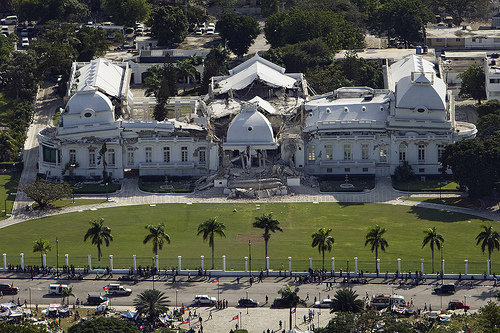
    Haiti has been mostly destroyed. It is estimated that 75% of its buildings have been damaged or destroyed. Its Presidential Palace collapsed as did its main Cathedral and the island’s UN Headquarters. Its infrastructure is in ruins, its water system destroyed. It looks reminiscent of Dresden, Germany during the carpet bombing of World War II. Dead bodies lie everywhere amidst the smoking ruins of a destroyed city.

    The city of Port au Prince needs to be razed to the ground. 2,000,000 people need to be dispersed around the Caribbean as the residents of New Orleans were after Hurricane Katrina. And then a massive reconstruction project, similar to the Marshall Plan after WWII, must be undertaken to rebuild everything from roads and ports to homes, hospitals and schools. Who will lead that effort? The nations of Latin America do not have the expertise or capital. The United States is financially exhausted, drained from two wars half a world away, 10% unemployment and a financial collapse as severe as the Great Depression.

    There is one man who is no stranger to multi-billion dollar projects and the transformation of a nation, Dubai’s ruler, Sheikh Mohammed bin-Rashid bin-Maktoum. Why would Sheikh Mohammed intervene and lead an effort to rebuild Haiti that will cost several billion dollars? Haiti is half a world away from the Persian Gulf. One reason is his proven ability to create and build a radical new urban vision. Sheikh Mohammed built the tallest structure on the planet, huge residential islands in the Gulf, and the world’s largest airport – simultaneously.

    The Gulf Cooperation Council, (GCC) consists of the UAE, Kuwait, Bahrain, Saudi Arabia, Oman and Qatar. To say these nations are rich is an understatement. Their oil reserves total somewhere around 500 billion barrels. Dedicating $10 billion to rebuild Haiti would require allocating a week’s revenue from crude oil production. That much money will not be needed tomorrow. A pledge of $3 billion per year for three years would suffice and not even dent the balance sheets of the Gulf nations.

    Sheikh Mohammed needs to take the lead if he wants the balance of power, respect and authority to move the UN from New York City to the Middle East. For too long, the Middle East has exported oil, its wars, the Israeli/Palestinian conflict and terrorists to the world. To many, the face of Islam has been the face of a terrorist, committing heinous acts on innocent people. Dubai, despite its majesty, has not yet become a true global destination, particularly in the wake of the world economic crisis. What better way to raise the image of Islam and the Middle East than to lead a 21st Century Marshall Plan to rebuild Haiti? The reward might just be a Nobel Peace Prize as George C. Marshall was awarded in 1953.

    Sheik Mohammed should make this announcement at the foot of the tallest structure ever created by man to show, while reaching for the sky, the ruler of Dubai can reach down to the poorest, most ravaged people on the earth and lift them up as well. He could take the center stage of the world, once again, and do what has made him arguably the most visionary developer since the Pharaohs of ancient Egypt.

    Robert J. Cristiano PhD is a successful real estate developer and the Real Estate Professional in Residence at Chapman University in Orange, CA.

    Photos:
  • “First” vs. “Worst”

    Taking on the Portland mystique is not easy – and likely I’ll find out again with my most recent piece: Picture-perfect Portland?

    But I’d also like to take a Midwest perspective that shows some surprising things. Let’s compare Portland to a similarly sized and less acclaimed Midwest city, Indianapolis. You can think of Portland as being in “first place” from a policy perspective by popular acclaim. It has an urban growth boundary, extensive transit, excellent urban density, a strong biking culture, a strong culture of civic engagement, the most microbreweries per capita, and on down the line. It is a place people want to live in so badly that they will move there with no job in hand and would be one of the cities that comes to mind among similar sized metros as a talent hub.

    If Portland is first, then you’d have to characterize Indianapolis as “worst”. Indianapolis is surrounded by expanding suburbia with very pro-sprawl policies on all four sides. It is one of the least dense cities in America. It has no rail transit and only the 99th largest bus system, along with one of the lowest transit market shares in the country. It is currently in the middle of a multi-billion program to widen about 60 miles of freeway. It just recently put in its very first bike lanes and scores near the bottom in green measures of sustainability. Its brand image also is hardly the best. You don’t hear too many people around the country going, “Man, I’ve gotta get me to Indianapolis.”

    But let’s look at how these cities compare on various quantitative measures of urban performance.


    Portland

    Indianapolis

    Population Growth (2000-2008)

    14.5%

    12.5%

    Domestic In-Migration (2000-2008)

    5.4%

    4.2%

    International In-Migration (2000-2008)

    3.7%

    1.4%

    Job Growth 2001-2009 (QCEW)

    10,300 (1.1%)

    17,100 (2.1%)

    Job Growth 2001-2009 (CES)

    23,800 (2.4%)

    31,000 (3.6%)

    Unemployment Rate (Nov 2009)

    10.8%

    8.2%

    Per Capita GMP (2008)

    47,811

    46,450

    Per Capital GMP Growth (2001-2008)

    22.4%

    1.7%

    Median Household Income (ACS 2008)

    $58,758

    $53,671

    Median Monthly Housing Cost (ACS 2008)

    $1,522

    $1,125

    College Degree Attainment (ACS 2008)

    33.3%

    31.8%

    Travel Time Index (Texas A&M)

    1.28

    1.21

    Now in most of these Portland does beat Indy, but not by a lot. In job growth and unemployment – two big factors in today’s economy – Indy actually does better. Portland’s higher incomes are offset by higher housing costs. There are only two stats – international migration and GMP per capita growth – where Portland has a big lead.

    Given the wide difference in their policies, it is striking to see these cities so close. By rights, it should be total world domination by Portland – but it isn’t.

    Now obviously these aren’t the only statistics to measure a city by. Portland residents would no doubt tout their many livability advantages. Yet at some point isn’t livability supposed to translate into superior demographic and economic performance? Isn’t it supposed to make a city attractive to the talent pool needed to thrive in the 21st century? And isn’t that talent supposed to power the economy? I was particularly struck by how close the cities were on college degree attainment. While I called Portland a talent hub, perhaps I spoke too soon. Contrast with Boston, which has 41.9% of its over 25 population with a bachelors degree or better.

    It may be that policy changes act with a lag. But Portland has been at this a long time. The UGB dates to 1973 and the light rail system started construction in the early 80s, for example. Perhaps other factors play a bigger role than many imagine. Land use and transportation policies might provide benefits to cities, but they do not, by themselves, create an economic dynamo.

  • Oregon Tries to Catch California – On the way down!

    Oregon’s voters will soon give their judgment on Measures 66 and 67, measures that will raise income and corporate taxes in the recession-ravaged state – with unemployment at 11.1 percent, the eighth highest in the nation. Besides leaving the state with the highest marginal rate in the country, tied with Hawaii, more insidiously measure 67 will impose a minimum tax based on sales, not profits, implying an infinite marginal tax rate for low-profit companies.

    This is not good news for businesses and citizens of Oregon. In a report titled Tax Policy and the Oregon Economy: The Effects of Measures 66 and 67, Two Cascade Policy Institute economists, Eric Fruits and Randall Pozdena, thoroughly review the literature on the impacts of tax increases on jobs and domestic migration, and they rigorously analyze the measures’ impact on Oregon jobs and migration.

    They estimate the new measures through 2018, will cost Oregon employment losses of “approximately 47,000.”

    Finally, Fruits and Pozdena examine the impacts of measures 66 and 67 on migration. They find that adoption of measures 66 and 67 will result in the loss of approximately 80,000 Oregon tax filers with a loss of $5.6 billion in adjusted gross income.

    These results have to be taken as the minimum impacts. Fruits and Pozdena are careful researchers. They do nothing that is not completely defensible. Consequently, because of statistical issues, some of the potential impacts, particularly those of measure 67’s minimum tax based on sales are almost surely under measured.

    Clearly Oregon , where many residents look down on the increasingly bedraggled Golden State seems anxious to follow California’s decline trajectory. We all know how that story ends: high unemployment, domestic out-migration, declining jobs, declining opportunity, and a vanishing middleclass.

    I am not alone in seeing the warning signs.

    The PEW Center on the States issued a report in November 2009 titled Beyond California: States in Fiscal Peril. PEW created an index using foreclosure rates, job losses, state revenues, budget gaps supermajority requirements, and money-management practices. The index resulted in values ranging from 6, Wyoming, to 30 California. Higher values are bad here, and the closer to California’s 30, the more a state is at risk of California-style fiscal problems. Oregon, with a value of 26 is listed as one of nine states that the PEW researchers consider at high risk.

    Then there’s Small Business & Entrepreneurship Council’s recently released Small Business Survival Index. They use a much larger set of variables to create their index of public policy climates for entrepreneurship, a total of 39 indicators covering tax policy, regulation, crime rates, costs, and more. This index results in values ranging from 25.7 for South Dakota to 84 for the District of Columbia. As with the previous index, high numbers are bad. California, with a score of 77.7 is the second worst state, behind only New Jersey. Oregon’s score is 65.2, the 38th among states, and dangerously close to California’s score.

  • Denmark, and the US, in 2010

    Denmark is a good microcosm. It holds lessons for us here in the States, good and bad. I felt that way when I first lived there in 1971, when I researched my doctoral dissertation there in 1977, and I feel that way now.

    Denmark is a mixed-economy (free market competition with a large public sector), social welfare, multi-party democratic country that, because of its small size and international exposure, is affected more quickly and deeply by social, economic and political forces at work in the Western (and wider) world. It was a founding NATO member (1949) and the first Nordic member of the European Union (which it joined, simultaneously with Britain and Ireland, on New Year’s Day 1973). For such a small, homogenous country, it has amazing social, economic and political diversity (for example, over the past 36 years some 15 different political parties have at one time or another garnered representation in Folketinget, the Danish Parliament).

    Denmark has had, and continues to have, an outsized global influence relative to its size, whether in diplomacy, design, architecture, or quality manufacturing. Denmark gets a lot of things right. The standard of living is high, and so is the quality of life. As for the Danes themselves, both the famous and anonymous, they display an unmistakable national character combined with healthy individualism. (The unwritten law of Danish culture commands that one is not to draw attention to oneself, but it’s liberally violated!)

    The US is also a mixed-economy, social welfare, multi-party, democratic, diverse nation. There is an undeniable leftist political orientation among elites, media, academia, government and public policy professionals in both countries. What lessons can we learn from recent developments in Denmark? Like the US, Denmark has gone through, and is going through, economic, financial, real estate, employment, debt and deficit problems of unanticipated severity. And like the US, responsible parties have taken their eye off the ball.

    My colleague and partner Jorn Thulstrup, owner, CEO and publisher of News ex-press, a daily compilation of Danish news media presented in English for the diplomatic community in Copenhagen (among other clients), recently wrote a sharply critical report on the hangover left in Denmark by the Climate Conference. He states:

    The COP15 Climate Conference held in Copenhagen in December, fuelled by political and economic special interests and enthusiastically embraced by naive Danish journalists, preoccupied people in this country far more than the rest of the world. For a lengthy period of time, leading Danish politicians and commentators seemed to be suffering from the illusion that, in terms of climate and energy, Denmark could rule the world. A widespread perception flourished that Denmark, as host of COP15, could create some kind of platform to market Danish technology, especially wind energy and enzymes used in the production of bio-ethanol.

    But eventually, as expected, the concluding “Copenhagen Accord” failed to live up to the exaggerated expectations and only confirmed that the skeptics were right at least about the politics: the climate conference was a ritual event without meaning or influence.

    Preoccupation with meaningless things is not costless. Hosting the Climate Conference cost Denmark billions of kroner, but the indirect costs were even more serious: it tied up official government business, cabinet ministers and security forces for such a long time, and to such an extent, that many serious political and economic issues – like how to get the economy growing again – were neglected.

    Denmark deservedly prides itself on its quality of life, which includes a low crime rate. But while Copenhagen was free of the widespread destruction and vandalism that many had feared during the climate conference, the devotion of overwhelming police resources to COP15 over the past two years has actually been accompanied by an increased crime rate generally.

    The failure of COP15 is disappointing, if not unexpected. But the global economic crisis has left its mark throughout this country too. Years of budget surpluses have been transformed into deficits, in the necessary effort to prevent a collapse of the financial sector and limit growing unemployment. The government is now focused on the domestic agenda, with the top priority to restore economic growth, aiming to secure a political platform that will lead to victory at the next general election. Sound familiar?

    Small country, big ideas
    Another more serious problem is Denmark’s inability to compete, writes Thulstrup. Major wage hikes at home and devaluations abroad have made Danish goods and services too expensive. Unfortunately, Danish workers haven’t been able to compensate with increased productivity – in fact, quite the opposite. Possibly, as a society, the crisis was not taken seriously enough. Things went well for years and it appeared, after years of balance of payments and budget surpluses, that the country was capable of managing any setback. Also sound familiar?

    Every year or so some international poll shows that Danes are the “world’s happiest people.” (It would be more accurate to say “most contented,” or, if I’m feeling mischievous, “resigned to their situation”!) But the problem, writes Thulstrup, is that they are no longer very industrious. Studies, reports and commissions have been warning for years of the lack of qualified manpower.

    Denmark has a high workforce participation rate, due to the share of women that work outside the home, but is a laggard in actual hours worked. It’s a case of short working days, long holidays, and a high amount of sick leave. Students take too long to become qualified and too many people retire early – at the state’s expense. More and more fail to contribute anything to production and are being supported by fewer and fewer. A third of working-age adults – the potential labor force – is out of work, compared to just one in four eight years ago. And it’s going to get worse in the coming years. Thulstrup expects very little change in Denmark in 2010, in terms of economic growth. .

    That also sounds depressingly familiar.

    What about “flexicurity,” the Danish labor market scheme that seeks to combine employer flexibility (the ability to hire and fire easily) with employee security (publicly-funded job retraining)? Robert Kuttner praises flexicurity in Foreign Affairs (March/April 2008), while conceding that Danish conditions are unique and not applicable elsewhere. Thulstrup says flexicurity keeps the official Danish unemployment rate artificially low by forcing into job training, and then counting as employed, many people whose employment prospects are meager. In this way and others, he says, the system is susceptible to waste, fraud and abuse. Additionally, its costs are exorbitant: an “astonishing” 4.5% of GDP (as per Kuttner).

    Big country, perverse ideas
    We have taken our eye off the ball here in the States too. Over the past year our liberal elites have been consumed with climate control, health-care reform and public-sector pump-priming, when they should have been focusing on creating the conditions for private sector economic growth. We are now faced with the specter of laws, regulations and taxes that are unwanted and harmful, more expensive energy, and slower economic growth than would otherwise occur. That’s a shame, because economic growth is an all-purpose salve that cures a multitude of ills, and an all-purpose social lubricant that hides a multitude of sins.

    The essence of all of this is the matter of incentives.

    The lesson we should be learning from Denmark is that preoccupation with ritual, meaningless and nonsensical things is not costless. The cost of not working is greater than imagined over time. Misallocation of resources is not just wasteful and expensive, it does violence to the general welfare, not to mention common sense.

    Dr. Roger Selbert is a trend analyst, researcher, writer and speaker. Growth Strategies is his newsletter on economic, social and demographic trends. Roger is economic analyst, North American representative and Principal for the US Consumer Demand Index, a monthly survey of American households’ buying intentions.

    Photo:

  • Copenhagen: the Fall of Green Statism

    Now we have the Copenhagen deniers. These are people who won’t accept that the UN’s climate change process has been derailed. The highest emitting nations refuse to be bound by an enforceable treaty. Instead of bedding down a replacement for the near-defunct Kyoto Protocol, they asked for a rain check.

    If the grandly named Copenhagen Accord is “a first step”, as President Obama put it, what were Rio (1992), Geneva (1996), Kyoto (1997), Buenos Aires (1998), Lyon (2000), The Hague (2000), Marrakech (2001), New Delhi (2002), Milan (2003), Buenos Aires (2004), Montreal (2005), Nairobi (2006), Vienna (2007), Bali (2007), Bangkok (2008), Ghana (2008), Poznan (2008), Bangkok (2009) and Barcelona (2009)?

    Apparently these earlier meetings of the UN Framework Convention on Climate Change were just for cocktails. And the list doesn’t include the eleven or so gatherings since 1998 of the Convention’s “subsidiary bodies”, all held in Bonn.

    Copenhagen wasn’t meant to be just another UNFCCC meeting. It was the Conference of Participants (the Convention’s supreme body) where member nations were to sign off on a successor to Kyoto, which only covers the period to 2012. Their failure to do so means the process is in disarray. Consisting of twelve short clauses, the Accord is little more than a face-saving device full of vague and unenforceable aspirations. The final clause calls “for an assessment of the implementation of this Accord to be completed by 2015”, so the world won’t have a binding operational treaty for some time, if ever.

    Copenhagen wasn’t a first step; it was the last step. It marked the end point in a long cycle of top-down, bureaucratic, multilateralism launched at the 1992 Rio Earth Summit. This all came unstuck in the very different world of 2009.

    The geo-political rifts on display at Copenhagen can’t be papered over with the diplomatic equivalent of a Hallmark greeting card. Essentially, the UN process is hostage to a standoff between the two largest emitters and their respective camps. On the one hand there’s China (for which read the Communist Party, whose grip on power depends on high rates of carbon-spewing growth) and so-called rapidly industrialising countries like India, Brazil, South Africa and Indonesia. On the other there’s the United States (for which read representatives of energy-producing regions in Congress, which must ratify any treaty negotiated by the President) and most of the developed world.

    Negotiations are rarely successful when both parties can only lose. Climate talks are about the apportionment of pain and blame, with benefits flowing to a third category of poorer countries, so the prospect of a workable compromise between the major camps is remote. Expect emissions to go on rising.

    Australia counts for little in all of this and was rebuffed at Copenhagen. Our 1.4 per cent contribution to global emissions has zero impact on the climate.

    Despite all the guff about Copenhagen being “a first step” or “a good beginning”, the collapse of the UNFCCC process changes everything. Absent a binding multilateral instrument, or the realistic prospect of such an instrument, the rationale for government-level, legislative and tax-funded initiatives disappears. The contention that we must enact a framework complementing the Kyoto Protocol and succeeding protocols, and demonstrate a credible intention to achieve prescribed emission targets, has been swept away.

    Bizarrely, our government persists with the argument that early action is essential to avoid the higher costs of delay. This claim rests on the assumption that acting now will prevent adverse climate effects. But that assumption was demolished at Copenhagen. Assuming the IPCC is right, only action by the major emitters, not Australia, can avoid such effects and they aren’t playing ball.

    If this is really about climate change, the government should call a moratorium on climate-related legislation and spending until the international position is clearer.

    Of course, individuals, firms and organizations in the private sector are always entitled to act on their own initiative, should they feel strongly about the issue. There just isn’t a rationale, or moral justification, for coercive state action.

    As John Humphreys of the Centre for Independent Studies points out, “it is an indication of the sorry state of community groups that when faced with a problem, they spend millions of dollars whingeing and asking other people to do something“. He proposes that “instead of whinging and waiting for politicians to become benevolent, people who are worried about anthropogenic global warming can take immediate action”. Climate activists and concerned citizens should put their money where their mouths are.

    On a practical level, Humphreys estimates that if activists were to organise a system of voluntary “workplace giving”, whereby people could opt to allow 0.5 per cent (or more) of their income to go directly into a “climate fighting fund“, more that $1 billion would be raised if only one third of Australians participated. These funds could be used to buy low-emission energy from alternative energy producers for sale to into the power grid at the going market price. For one thing, this would spur investment in alternative energy technologies without inefficient meddling from government.

    This is one of many courses open to those who profess to be alarmed about the coming cataclysm. We’re often told they’re in the majority. Since the future of the planet is at stake, why should higher contributions matter?

    If green activists and entrepreneurs can generate demand for expensive but clean energy sources, the government should facilitate this market by removing barriers to entry, not by mandating or subsidising particular energy options. If property developers can generate demand for high-density “green” housing, planning officials shouldn’t regulate against this, just as they shouldn’t regulate against low-density housing. The same applies to transport and cars. Let consumers choose. This is the real “market solution” to climate change (assuming a solution is needed), not the fake market represented by a cap-and-trade ETS.

    Surveys and electoral returns show that the affluent tend to be more concerned about green issues, so this approach has an added advantage. It relieves wealthy greens of the moral hypocrisy inherent in demanding state interventions which produce glittering opportunities for them, while shifting the pain disproportionately to the most vulnerable in the community.

    This article first apeared at The New City Journal

    Photo:

  • Now You Should be Really Fiscally Afraid in California

    After reading a recent article I wrote about growing unfunded liabilities for public employee pensions and health care, a reader told me that it made him want to “burn his eyes out with red hot pokers.” Yes, the current situation – expanding debt, growing government, excessive pay and special privileges for government workers, thanks to union power – is not fun to read about. It can be downright scary, when one considers the financial mess that already is looming.

    If you really want to be scared, you need to listen to the types of people who are now sounding the alarm bells. I’m a libertarian, and it’s not a surprise to hear me warn about the ill effects of government spending.

    But listen to what former California Assembly Speaker Willie Brown, one of the state’s best-known liberal politicians, recently wrote in a San Francisco Chronicle op-ed:

    “The deal used to be that civil servants were paid less than private sector workers in exchange for an understanding that they had job security for life. But politicians–pushed by our friends in labor–gradually expanded pay and benefits…while keeping the job protections and layering on incredibly generous retirement packages…This is politically unpopular and potentially even career suicide…but at some point, someone is going to have to get honest about the fact.”

    Democratic state Treasurer Bill Lockyer said at a legislative hearing: “It’s impossible for this Legislature to reform the pension system, and if we don’t it will bankrupt the state,”

    The chief actuary for the California Public Employees Pension System called the current pension situation “unsustainable.”

    This is from a recent Economic Policy Journal article: “According to the chairman of New Jersey’s pension fund, the US public pension system faces a higher-than-expected shortfall of more than $2 trillion.”

    The only hope to rein in the current problem is for wider agreement that the days of enriching public employees must end. That means making inroads with liberal Democratic politicians, many of whom must realize that the future of other programs they support are imperiled by shaky finances and pension obligations that suck the life out of government budgets.

    Steven Greenhut is director of the Pacific Research Institute’s calwatchdog.com journalism center and author of “Plunder! How Public Employee Unions Are Raiding Treasuries, Controlling Our Lives and Bankrupting The Nation.”

  • High-Speed Rail: Toward Least Worst Projections

    It comes as welcome news that the United States Department of Transportation Inspector General is concerned about the integrity of high-speed rail projections, “including ridership, costs, revenues and associated public benefits.” The issue has become ripe as a result of the $8 billion for high speed rail that the Obama Administration slipped into the economic stimulus bill early in 2009.

    The response was more than 250 applications from 30 states totaling $57 billion. It is easy to understand the Inspector General’s concern, though no-one should be surprised that the demand for free money outstrips the supply. Applicants range from the huge California High Speed Rail proposal, to a greenhouse gas belching magnetic levitation (maglev) line in population-losing Pittsburgh, to comparatively modest railroad grade crossings that could improve both railroad and highway safety.

    In a January 4 letter to the Federal Railroad Administrator, Inspector General Mitchel Behm announced an evaluation of “best practices” with respect to high-speed rail forecasts, noting that “it is of critical importance that the Federal investments are directed to the most worthy projects.” For starters, the Inspector General needs to understand that there are is no such thing as “best practices” in high-speed rail forecasts. Best practices and high speed rail in the same sentence sounds like a line from a comedy routine. The record of ridership, revenue and cost projections in high speed rail projects is abysmal.

    An Object Lesson: The Las Vegas Monorail Default: This was brought home earlier this week, when the privately financed Las Vegas Monorail defaulted on its bonds, principally because its ridership was absurdly over-projected. Even before the economic implosion (2007), the Las Vegas Monorail was carrying only 21,000 riders per day, far below the 53,500 riders that had been predicted for 2004 by the world-class planning firm retained by the promoters. In 2000 we produced a report predicting that the Monorail would carry between 16,900 and 25,400 daily riders. The reality was in the middle of that range. Of course, no venture could survive with consumer demand 60 percent below projections and default was inevitable, as we predicted. People who purchased the bonds may have overlooked the shaky foundations of the project, assuming that the state required bond insurance would make them whole. It did for the first defaulted payment, however the bond insurer, Ambac, itself is also in financial difficulty. Abmac has been characterized as “a borderline insolvent bond insurer.” Following Ambac’s debt payment, the Las Vegas Monorail filed for bankruptcy improbably claiming that it was necessary to permit expansion to the airport.

    High Speed Rail Follies: Of course, the Las Vegas Monorail is not a high-speed rail line, but high-speed rail projects are subject to the same risk of absurdly inaccurate projections of ridership, revenue and costs.

    High speed rail has often been touted by proponents as being profitable. However, they usually exclude such basic costs building the system and buying the trains. This is like a household that claims to be saving, but does not pay the mortgage. Proponents routinely repeat claims of profitability for one line or the other, without the slightest concept of reality. Indeed no less than Iñaki Barrón de Angoiti, director of high-speed rail at the International Union of Railways in Paris, said that high speed rail is not a profitable business and said that short Paris-Lyon and Tokyo-Osaka routes are the only ones in the world that have “broken even.”

    The California proposal, in particular, anticipates substantial private investment. Anyone courageous enough to invest will want due diligence performed by consultants other than those who produced the numbers to support the Las Vegas Monorail bond issue.

    Within the past few days, the non-partisan California Legislative Analyst’s office issued a critical report of the new California High Speed Rail business plan. The most damning criticism was that the plan “appears to violate law, because it assumed operating subsidies, which were prohibited by the bond issue passed by the voters of the state. This is particularly relevant to the USDOT Inspector General’s inquiry, since the California High Speed Rail Authority has been claiming for years that the project would not require operating subsidies. California, needless to say, is not in a position to be offering subsidies of any kind.

    Cheerleader Projections: There is plenty of reason for concern:

    Taiwan’s high-speed rail line, the only fully privately financed line in the world, has attracted approximately one-half of its projected ridership and has suffered considerable construction cost overruns. During its first few years of operations, its debt has been restructured, its bonds downgraded, expansion plans have been suspended and the Taiwan government has now taken majority control of the board. It should not be long before Taiwan taxpayers will be footing the bill.

    The new high-speed rail line in Korea is attracting approximately one-half of its projected ridership, while its costs were three to four times the projected level.

    This problem is all documented in Megaprojects and Risks: An Anatomy of Ambition, by Bent Flyvbjerg of Oxford University, Nils Bruzelius of and Werner Rothenberger of the University of Karlsruhe and former chairman of the World Conference on Transport Research. The authors examined decades of major transportation projects in Europe and North America and identified a general pattern of projection inaccuracy. With respect to the systematic cost projection errors, Professor Flyvbjerg says: “Underestimation cannot be explained by error and is best explained by strategic misrepresentation, that is, lying.” He further notes that “The policy implications are clear: legislators, administrators, investors, media representatives, and members of the public who value honest numbers should not trust cost estimates and cost-benefit analyses produced by project promoters and their analysts.”

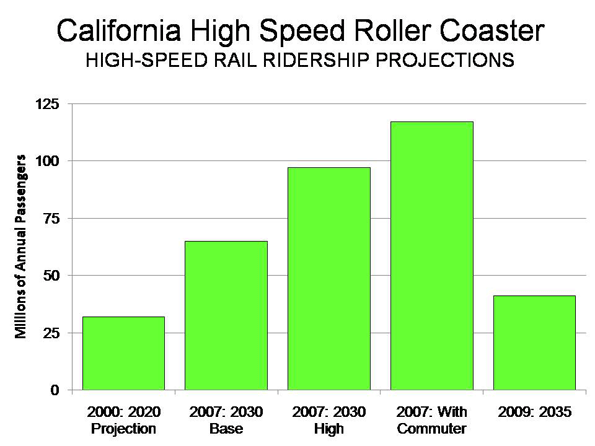
    The California High Speed Roller Coaster: The proposed California High Speed Rail system seems poised to break “lower the bar” even further with respect to performance relative to projections. The ridership projections have been like a roller coaster. In 2000, the California High Speed Rail Authority’s modelers predicted, in an “investment grade projection” that the system would carry 32 million riders a year by 2020. Then, in 2007, the projection gurus raised the “base” number to 69 million by 2030 and added a “high” number of 97 million. By the time the high speed rail bond election was underway, some Authority board members went around the state citing a number of 117 million riders that included commuter ridership.

    Within the last month, the Authority has released a new plan indicating that ridership will be 41 million in 2035 (See Figure). If the 2000 ridership projections were “investment grade” then the subsequent projections have been “junk bond grade.”

    Joseph Vranich and I projected annual ridership of 23 million to 31 million for 2030 in a report published by the Reason Foundation (The California High Speed Rail Proposal: A Due Diligence Report). We also predicted, based upon our analysis of high speed rail systems worldwide, that the costs will rise by as much as another 70 percent to cover the usual cost overruns and to build portions of the system not included in the projections.

    The erratic ridership projections are just the beginning. We also found the proposed fare structure to be far too optimistic (fares far too low). Apparently the California High Speed Rail Authority agrees, because it has doubled its proposed fare levels. Meanwhile, its costs continue to rise, despite having risen by half from 2000 to 2008 (inflation adjusted), at the same time that the size of the proposed system was shrinking.

    Perverse Incentives: Part of the problem here lies with incentives. The “world class“ consulting firms have no incentive to produce reasonable numbers. Indeed, some actually participate in later stages of the projects and as a result have exactly the opposite incentive – an interest in projections being optimistic enough that the project gets approved.

    Solutions: The Inspector General might look at removing the incentive for misrepresentations and exaggeration, by prohibiting the participation of planning consultants in the implementation phase of high speed rail projects. Another modest proposal could revolutionize major project projections. Perhaps the world class consulting firms should be required to guarantee their projections financially.

    We certainly wish the Inspector General the best, though he has certainly set a standard (“best practices”) not likely to be achieved. But perhaps he can move the industry from absurdity to least worst projections.

    Wendell Cox is a Visiting Professor, Conservatoire National des Arts et Metiers, Paris. He was born in Los Angeles and was appointed to three terms on the Los Angeles County Transportation Commission by Mayor Tom Bradley. He is the author of “War on the Dream: How Anti-Sprawl Policy Threatens the Quality of Life.

  • Municipal Budget Mess

    A recent report from the National League of Cities projects a grim financial situation for many municipal governments during the next three years. According to the report the municipal sector “likely faces a combined, estimated shortfall of anywhere from $56 billion to $83 billion from 2010-2012.” Such shortfalls will be “driven by declining tax revenues, ongoing service demands and cuts in state revenues”. Facing large deficits, cities around the nation may be forced to “cure revenue declines and spending pressures with higher service fees, layoffs, unpaid furloughs, and drawing on reserves or canceling infrastructure projects”.

    The process of belt tightening has already begun in cities across the nation. In Michigan, the city of Jackson is asking municipal workers to take pay cuts to help close a $900,000 budget deficit. Toledo, Ohio, another rust belt city hard hit by the recession, may face a deficit of up to $44 million, and is being forced to consider “mid-contract union concessions, cutting city spending, and possibly asking the voters to increase the city’s 2.25 percent income tax.”

    In California, already challenged by record state deficits, the city of Los Angeles may have a budget shortfall of $1 billion by 2013, “driven primarily by escalating employee pension costs and stagnant tax revenues”. For the current fiscal year the city faces a deficit of $98 million. Under such budget conditions, the city’s administrative officer projects substantial cuts to city services will be “unavoidable”.

    With states already facing their own set of budget challenges, the League of Cities is calling on the federal government to intercede. According to the League, “in the absence of additional federal intervention, a deepening local fiscal crisis could hobble the nation’s incipient recovery with more layoffs, furloughs, cancelled infrastructure projects, and reduced services.” However, with an exploding federal debt load and federal budget deficits running at all time highs, municipal cries for increased aid may face a lukewarm reception in Washington, DC. Support for expanded stimulus efforts might prove lacking, with signs beginning to emerge that a mild economic recovery is underway, and many of the already passed stimulus dollars yet to be spent.

    For now, cities facing deficits will have to find ways to solve the shortfall on their own. If they are unable to bridge the gap, municipalities may find themselves forced, like the city of Vallejo, California,to file for Chapter 9 bankruptcy protection.

  • Stop Coddling Wall Street!

    By all historical logic and tradition, Wall Street’s outrageous bonuses—almost $20 billion to Goldman Sachs alone—should be setting a populist wildfire across the precincts of the Democratic Party. Yet right now, the Democrats in both the White House and Congress seem content to confront such outrageous fortune with little more than hearings and mild legislative remedies—like a proposed new bank tax, which, over the next decade, seeks to collect $90 to $100 billion. This amounts, on an annual basis, to about half of this year’s bonus for Goldman’s gold diggers alone. It’s speaking loudly and carrying a stick made of paper mache.

    But this should come as no surprise, really. Postmodern Democrats are generally more concerned about the fate of the polar bears than real people on Main Street.

    One reason may be that Democrats increasingly collect the bulk of contributions from the very financial sector that they have bailed out and coddled since taking office. However, more substantially, the Democrats—including many “progressives”—seem more comfortable with big business and high finance than their erstwhile working- and middle-class constituencies. For this, we need the Democratic Party?

    Somewhere outside Nashville, the shade of Andrew Jackson, the founder of the modern Democratic Party, is stirring uncomfortably. So, too, are the remains of Harry Truman and Franklin Roosevelt, Jackson’s heirs to the leadership of the Party of the People.

    Faced with highway robbers like those at Goldman Sachs, Jackson would have threatened to seize their assets and, if they protested, hang them from the highest tree. Franklin Roosevelt would have made political mince meat out of these outrageous “economic royalists.” Harry Truman would have uttered an earthy expletive and sought to cut them down to size. Truman hated phonies and elitists; today’s Democrats Party is lousy with them.

    Now we see the very abandonment of the idea of the Democratic Party opposing concentrations of power. Historically, Democrats took on the largest and most powerful institutions of society. Jackson made his critical battle against the government-run Bank of the United States, which he considered a means “ to grant titles, gratuities, and exclusive privileges, to make the rich richer and the potent more powerful.”

    In his time, Franklin Roosevelt battled big business, which largely hated him, by seeking to create a more equal distribution of wealth. He tried to save homeowners and farmers from the banks; speculators wiped out in 1929 did not enjoy banner years for a long time to come. Truman fought not for big banks and major companies, but for programs that spread capital to the middle class, whether for college loans or mortgages.

    Now we have the postmodern Democratic Party of Barack Obama. The new party has little use for populism of any kind—it prefers to legislate from on high, whether on financial reform, climate change or land-use policy, from what it considers its superior knowledge. If your factory or business is shut down as a result, it’s you who better learn to evolve.

    We will see this same mind-set in action with the administration’s proposal for a cap-and-trade program. It may end up doing little for the environment, but a lot of traders, well-connected corporate CEOs, and academic consultants will be made even richer. Draconian “green” policies that boost subsidies and energy prices may not be what Americans want—climate change ranks near the bottom of popular concerns—but such an approach fits neatly the agendas of Harvard faculty, Wall Street, and the mainstream media. That is, those who matter.

    The rotten economy remains detestable but the stimulus program is working fine for their key constituencies. Stocks are up, many hedge funds are doing well, university research coffers are bulging. Meanwhile, taxpayers are employing ever-more unionized public employees, whose often-insane pensions are consuming many local government budgets.

    Many Americans who work for themselves are enraged, but they lack a credible channel for expressing it. The Republicans are largely discredited by their disgraceful performance over the last decade, up to and including the initial Bush-Paulson bailout. The Republicans presided as easily as the Democrats over the disastrous financialization of the economy; by the mid-2000s, finance accounted for some 41 percent of all American profits—three times the percentage in the 1970s.

    But for now, populists are in retreat in Washington. Last week, Byron Dorgan of North Dakota announced his retirement from the Senate. Dorgan, friends tell me, was disgusted with Obama’s focus on health care and climate change at a time when the economy was unraveling and Americans were losing their jobs. He also knew that the president’s mounting unpopularity in Middle America posed a profound threat to his own reelection prospects.

    Dorgan will be missed. His voice would have been set against the coddling of Wall Street. He supported reinstating the 1933 Glass-Steagall Act, which put a barrier between banks and investment houses. He also opposed “too big to fail” policies and was ready to attack the administration’s “cap-and-trade” scheme, which he considered a large giveaway to Wall Street traders.

    Dorgan’s departure leaves only a handful of genuine populists in Congress, including Jon Tester from Montana, James Webb of Virginia, as well as our resident socialist, Vermont’s Bernie Sanders. They may well be at last willing to take on the battles that Jackson, Roosevelt, and Truman would have fought against “interests.”

    Right now for every populist, there are several gentry Democrats—epitomized by the likes of New York Senator Charles Schumer and his sidekick, Kirsten Gillibrand—who will do Wall Street’s bidding on the Hill. Erstwhile populists may find some allies among independent-minded Republicans but, for the most part, the GOP is too blinded by ideology or too well bought to curb the big investment houses.

    So in the end, another crop of 35-year-old Wharton and Harvard MBAs gets to spend their multimillion-dollar windfalls. Maybe if you live in New York, perhaps a few shekels might fall your way. After all, these people have kids to nanny, dogs to walk, apartments to decorate, and toenails to be painted.

    These bonuses simply remind us of our outrage. Jackson, Roosevelt, and Truman would have understood the opportunity for the Democratic Party presented by this egregious, undeserved windfall. Truman in particular would have detested the academically oriented “progressives” who explain away excess and look for new ways to harry independent smaller businesses. As he once quipped, “There should be a real liberal party in this country, and I don’t mean a crackpot professional one.”

    Yet that’s exactly the kind of Democratic Party we have now: one that shames the legacy of Truman, Roosevelt, and Jackson and looks the other way while the Treasury is raided and the economy works mainly for the benefit of the least deserving.

    This article first appeared at TheDailyBeast.com

    Joel Kotkin is executive editor of NewGeography.com and is a distinguished presidential fellow in urban futures at Chapman University. He is author of The City: A Global History. His next book, The Next Hundred Million: America in 2050, will be published by Penguin Press February 4th.

  • Las Vegas: The Boom – Bust Bender

    It’s delightfully easy to blast Las Vegas… or simply to make fun of it. It is the world capital of shamelessness, so it is more or less beside the point to criticize. Yet with the debut of the colossal $8.5 billion CityCenter, Vegas makes pretension to “sustainable urbanism.” Even by Vegas standards of hype, this is mendacity at a colossal scale.

    CityCenter describes itself as “a collection of spectacular hotels and residences, sensational spas, astonishing dining and extraordinary shopping.” But MGM Mirage CEO Jim Murren asserts higher aspirations for the largest private development in U.S. history, saying he aimed to create “something with expert urban planners” that would “put world-class architects into the mix” in order to “stretch the boundaries of our knowledge and create something that would be a gift, a resource to the community that we could make a lot of money on.” CityCenter’s developers claim that it is “one of the largest sustainable developments in the world, with six Gold LEED certifications from the U.S. Green Building Council.”

    The distinction says more about the shallowness of LEED scoring than about the depth of CityCenter’s commitment to sustainability. Although the buildings employ state-of-the-art energy saving (hence money saving) technology, the gold ratings are based in part on pure gimmickry, like “the world’s first fleet of stretch limos powered by clean-burning compressed natural gas.” A mecca for gambling, shopping and recreation built in a desert climate is, by definition, unsustainable.

    And not just environmentally. The project only averted bankruptcy this spring when MGM paid $100 million in debt service owed by its partner, Dubai World. Dubai World, of course, is the company that recently rocked markets across the globe by asking to postpone its gazillions in debt.

    L.A. Times architecture writer Christopher Hawthorne calls City Center “a final bender for Wall Street’s decade of unreason.” Is it too much to hope that this glitzy fiasco will permanently discredit the blend of leveraged debt, “starchitecture,” and headlong consumerism that has spread around the world with ever taller and more fanciful towers and ever more grandiose claims to represent a glorious future?

    Megaprojects are the product of meglomania, whether in Las Vegas, Shanghai, Dubai, Universal Studios or downtown Los Angeles. No amount of solar-paneled green cladding can disguise their fundamental flaw: Bigness dwarfs and often destroys the human scale that great places have in common.

    It is hard not to admire the audacity, the “make no little plans” grandeur of big visions. The Greeks, however, had a name for such delusions: hubris. When Icarus climbed too close to the sun his wings melted and he plunged into the sea.

    In the case of giant real estate “projects,” it is not only the promoters who get taken down.

    We Americans have our own parable of urban hubris in the saga of Robert Moses. Yet no matter how often the story is told (including the latest book on his nemesis, Jane Jacobs, Wrestling with Moses), public officials continue to be particularly prone to the siren song of megadevelopments. Grand Avenue in Los Angeles; Ground Zero in Manhattan; Atlantic Yards in Brooklyn; Hunters Point in San Francisco… the list of recent “public-private partnerships” to remake cities on a grandiose scale could fill a page.

    The invariable promises of investment returns commensurate with the project’s size invariably disappoint. No one is that smart, it turns out. Sustainable urbanism comes in small doses, crafted to the climate and history of real places. It comes from new building that respects human scale and the fabric of organic towns and cities. It emerges from the efforts of property owners, investors, designers and craftspeople understanding and applying timeless principles to the needs of our time.

    Sustainable urbanism doesn’t have to carry the weight of the overhead and egos of mega developers, starchitects, and all the myriad fixers — lobbyists, lawyers, flacks, event planners, consultants etc — that live off their wake . It doesn’t put the public purse at risk on speculative real estate ventures. The public isn’t jolted with yet another over-the-top effort to shock and awe them with ever-larger and more lavish excess. Instead, sustainable urbanism thrives off both the synergy and the competition that comes from appropriately sized and scaled additions to the cityscape.

    That is not to say that urban interventions must be tiny – only that they not be bloated and autonomous. When the 104 acre Villa Italia Mall in Lakewood, Colorado was taken down, its redevelopment into the mixed-use downtown of Belmar was certainly a big project. Moreover, it shares many of the downsides of megaprojects, including public sector financial subsidies and risk as well as relatively bland, homogenous design and development, particularly in the tilt toward corporate retail tenants. Yet obviously there was no “organic” way to transform a dead mall.

    Similarly, the redevelopment of the thirty-four acre Burlington Northern Railyard on the northern edge of the Pearl District in Portland, Oregon is the product of a single developer. The construction of more than 2500 midrise housing units, 90,000 square feet of retail space, and two major urban parks is a big development by any standards. Yet it differs sharply from the megaprojects in its faithful extension of the famous Portland block pattern over the grayfield site. It may be large, but it is the antithesis of the self-contained and almost invariably anti-urban design of megaprojects. It is simply several more well-executed blocks of the Pearl District, rather than a place unto itself.

    These comparably large projects stretch the limit of scale on place-making, financial risk and social and economic diversity. One of the best designed and intentioned megaprojects of our time, the redevelopment of Denver’s Stapleton Airport, demonstrates that once projects cross the threshold of counting square feet in the millions it becomes essentially impossible to be successful, if success is defined as creating prosperous, human-scale urban fabric. Certainly, Forest City’s Stapleton is an exemplary model for trying to faithfully execute urbanism on a mega-scale (as distinguished from the botch made of Playa Vista in Los Angeles). But even there, the power centers, office park and suburban subdivision elements undercut their claims to authentic sustainability of real urbanism.

    Nor is real urbanism simply an academic conceit or an elitist niche. On the contrary, it is the only proven model for successful civilizations, prosperous regions, environmental staying power and decent living standards for working people. The modern real estate industry’s products, of which megaprojects are simply the reductio ad absurdum examples, have yet to pass the test of surviving in geographies and economic eras not characterized by cheap oil and cheap money. The current economic reckoning is a warning that, like the dinosaurs, megaprojects are highly vulnerable to any change in the climate.

    The counter argument is, of course, that no one knows if they will stand the test of time and “if you build it they will come.” Megaprojects may be forlorn or unloved by urbanists now, but when we have four billion more people on the planet, at least some of these projects will be cherished cornerstone investments in the cities of the future. The optimistic proponents of this view predict “this too shall pass” and, just as Rockefeller Center emerged triumphant from the Depression, CityCenter and its cousins will be vindicated as a form of visionary city building that was simply ahead of its time.

    This view certainly has a well-funded lobby and fawning fans in the media, ever impressed by record-breaking spectacle. But common sense ought to prevail. Megaprojects are bad bets, even in Las Vegas. In almost every regard, giant projects crush the essential elements of diversity, flexibility and intimacy necessary to making – and sustaining – great places.

    Instead of CityCenter, imagine something on its scale broken up into 1500 more modest projects across America; each significant enough to make a mark, yet restrained enough to strengthen the city instead of overwhelm it. Not only would the investment have made a far better contribution to the goal of sustainable urbanism, it would have been far less recklessly risky. As Jane Jacobs warned nearly 50 years ago, “the forms in which money is used must be converted to instruments of regeneration — from instruments buying violent cataclysms to instruments buying continual, gradual, complex and gentler change.”

    Rick Cole is city manager of Ventura, California, and recipient of the Municipal Management Association of Southern California’s Excellence in Government Award. He can be reached at RCole@ci.ventura.ca.us