Blog

  • High Tech Won’t Save California’s Economy

    Much has been made of California’s struggles, but some still say California’s best days are ahead of it. In this calculus, innovation in high tech, biotech, green tech, clean tech, any tech will ultimately pull the state out of its current funk and to even greater success tomorrow. Promoters of this view cite an impressive roster of statistics around venture capital, patents, new business formation, etc., along with obligatory anecdotes of ambitious new startups with world changing products (coming soon) and their slick, dynamic founders. This view reached its apotheosis in a Time magazine cover story called “Why California Is Still America’s Future”.

    This view of the world is correct – but incomplete in a fundamental way. These emerging industries are in many ways the future of America, and they all have their creative epicenter in California. But they aren’t generating many net new jobs there.

    Let’s consider the counties that make up the heart of these industries. Silicon Valley’s San Mateo and Santa Clara Counties both experienced slow job growth between 1990 and 2009. San Mateo County only added 30,000 net jobs, an average of less than 1,700 new jobs per year, or a compound annual growth rate of 0.5%.
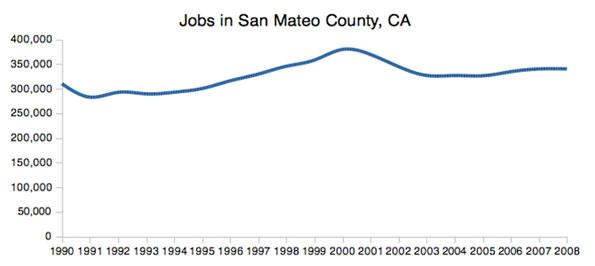
    Santa Clara County added around 50,000 jobs over that 18 year period – about 2,700 jobs per year, but only a CAGR of only 0.3%.
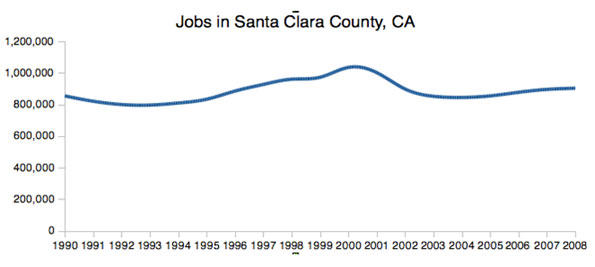
    Both counties added significant new jobs in the late 90s, but these were lost when the dotcom bubble collapsed. The recovery from that decline only reached back to the levels just before the early 90s recession, continuing the long running Silicon Valley boom-bust cycle. Silicon Valley actually added jobs at a slower rate than California as a whole during this period.

    You can see the employment impacts just driving down the 101 freeway; there are more than 43 million square feet of unoccupied space, the equivalent of 15 Empire State Buildings. Twenty one percent of “Class A” space and low rise flex space – used for high-tech research and development – is empty. Unemployment overall in Santa Clara county hovers around 12%, substantially over the national average.

    San Diego County, one of the key centers of the biotech industry, did much better, adding 310,000 jobs over the same timeframe. This is over 17,000 jobs per year, or a CAGR of 1.53%, much better than Silicon Valley, but hardly enough to reflate California’s job market. For example, Los Angeles County added almost a million people during this time, but actually lost jobs.
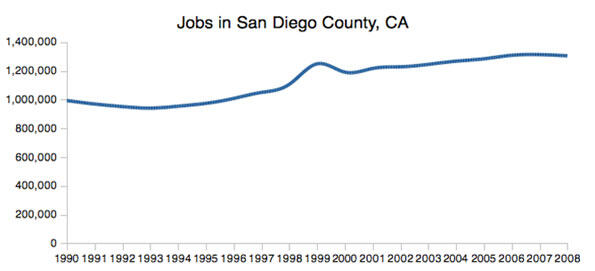
    A critical consideration may well be that the future could be different from the past for these industries, and that over the next 20 years they will generate far more jobs than in the previous. But the evidence seems to be the other direction.

    California clearly has no shortage of dynamism in high-end economic sectors. There are still plenty of new innovative firms being founded in California or even moving there. And it seems likely these firms will continue to generate significant wealth for the state in the future. Given its current tax structure, the state treasury has significant “operational leverage” to the upside here. Another strong recovery cycle might even replenish the state’s coffers, though won’t offer solace for some time at least.

    But these industries won’t generate many net new jobs. And that is becoming the problem in both Silicon Valley and the state.

    Therein lies California’s dilemma. The ability to generate large amounts of wealth on a narrow job base isn’t enough to support a state of 37 million people. Brazil generates enormous wealth too, and supports lavish stores like Daslu, where you can’t walk in off the street, but there’s a helipad on the roof – and a favela just down the street. But Brazil doesn’t have a middle class economy.

    With innovation the watchword of the day, and no other realistic prospects available in the near term, it is easy to see why places from California to Michigan are placing their hopes on such high end information age jobs. Unlike most, California is already winning the war for the highest value jobs and talent in the space. The headquarters, R&D, core software development, design, and prototyping will be done in California. But it is unlikely to be where the manufacturing, customer support, sales, warehousing, back office support, and other core functions get done. And those are where the jobs are. The back of the iPhone says everything we need to know. “Designed by Apple in California. Assembled in China.”

    California is clearly right to make these industries a priority. The danger is that it comes to focus on them so exclusively that it implements policies that are overly favorable to those select functions, but hostile to everything else. California needs to make sure it has a strategy for middle class and working class jobs beyond the low end service sector. That’s a much harder problem than maintaining Silicon Valley’s dominance, but it’s clearly at least equally as important. The high end portion of various “tech” sectors alone are never going to provide enough jobs to secure a prosperous future for the vast majority of Californians.

    Aaron M. Renn is an independent writer on urban affairs based in the Midwest. His writings appear at The Urbanophile.

  • Move the United Nations to Dubai

    The opening last week of the world’s tallest building, the half-mile-high Burj Dubai, has largely been greeted with guffaws and groans. The Daily Telegraph labeled it “the new pinnacle of vanity”–“a purposeless monument to the subprime era.” The Wall Street Journal compared it to the Tower of Babel. (When the Empire State Building was completed in 1931, in the throes of the greatest financial crisis of the 20th century, it was met with similar jeers. The then-tallest building in the world was called the Empty State Building, and it remained vacant for several years.)

    Yet the Burj’s completion–indeed the whole wild enterprise known as Dubai–could signal a potential opportunity to the global community: turning the place into the headquarters for that other misguided ship, the United Nations.

    Let’s spell out the logic. The United Nations is a pain in the butt. It pays no taxes and annoys hard-working New Yorkers with its sloth, pretensions and cavalier disregard for traffic laws. The place is a sinkhole dominated by anti-American, anti-Semitic and authoritarian fantasies. It is far from the elegant crown jewel that celebrated the U.S.’s global ascendancy after the Second World War.

    Today the U.N. building is a mostly empty shell–water dripping through its roof, asbestos lining its ceiling and an erratic heating and cooling system have forced most UN workers to new facilities. The building is in the midst of a $1.87 billion overhaul–of which the U.S., which could use the cash for myriad other things, would be on the hook for $437 million.

    And the U.N. may be leaving anyway. A relocation committee has recommended that the organization move temporarily to Singapore by 2015. It will be hard to vacate Asia again for New York, which is far away from the bulk of the world’s largest population centers.

    Singapore might make a fine world capital, since it does work like a fine watch. But it’s already crowded, expensive and highly regulated. You have to wonder if hard-working, rational Singaporeans would want to drive up costs and lose their ability to run things as they see fit to accommodate the U.N. bureaucracy.

    In contrast, the al-Maktoum family has transformed a once vast, empty landscape into a Star Wars-like capital city of the future. There is no skyline more arresting than the one built over the past 15 years by Sheikh Mohammed bin Rashid Al Maktoum, the Absolute Ruler of the tiny Emirate. In just 500 square miles, about half the size of Orange County, Calif., the sheikh has created a monument to modern architectural engineering.

    Sheikh Mohammed could offer to build a United Nations City to house the U.N. in any number of vacant office towers. Business Bay has 65 million square feet of office space under construction in more than 200 high-rises. Dubai already has thousands of newly constructed apartments that await the international delegates. More than 2 billion people in Africa, Europe and Asia are within a six-hour flight from Dubai. Travel connections through the world’s largest airport would be a breeze. Dubai has 55 five-star hotels to accommodate every regal and royal delegation, as well as the Harvard Medical School Dubai Center, a $1,400,000,000 facility branded with the Harvard crest, just in case one of the U.N.’s elite workers breaks a gasket.

    Questions of taste and timing aside, you have to admire the sheikh’s chutzpah. The al-Maktoums, descendants of the Bani Yas clan, have ruled Dubai since 1833, first under the protection of the British. The United Arab Emirates was founded in 1971 with big brother Abu Dhabi, the emirate with 96% of the confederation’s oil reserves.

    Like New York, Dubai aimed first to be a capital of capital. Recognizing that oil revenues at $70 a barrel brought immense cash flow to the Persian Gulf, Sheikh Mohammed set out to create a setting where Arab pride and excess oil revenues could be comfortably parked. His boldness caught the attention of the world financial community and soon the tiny emirate employed more construction cranes than any site on Earth.

    For now flying so close to the sun has resulted in a painful and somewhat humiliating fall. With the financial market collapse of 2008 to 2009 international buyers disappeared and property values plummeted. Half of the $300 billion in construction projects screeched to a halt. The Dubai government, with $80 billion to $100 billion of debt, was in trouble, and Dubai World, its investment arm, announced suspension of interest payments on its loans. Enter Abu Dhabi. The neighboring emirate wrote kid brother Dubai a check for $25 billion. What does $25 billion get you in 2010? On Jan. 4, at the grand opening of the Burj Dubai, Sheikh Mohammed announced that the tower would forever be known as Burj Khalifa, named after the Emir of Abu Dhabi.

    Let’s look a bit longer term. Right now there’s 33.6 million square feet of mostly state-of-the-art office space in Dubai. More than 8 million square feet is vacant with millions more in the pipeline. There’s a great airport–as opposed to that aerial dumpster, JFK–that is hours closer to the emerging economic powers of the new century, notably the oil states, India and China. The workforce is skilled and open to foreigners, since the vast majority are foreigners. In Dubai 83% of the 2.2 million residents are from somewhere else. Talk about cosmopolitan.

    But how about New York? “Moving the U.N. to Dubai would be a boon for New Yorkers who have to put up with traffic jams created by the likes of Colonel Qaddafi, scofflaws protected by diplomatic immunity and the loss of real estate revenue they would gain if the U.N. building were turned into something far more useful–condos with a view,” suggests urban historian Fred Siegel, a visiting professor at Saint Francis College in Brooklyn and a fellow at New York’s Manhattan Institute.

    Liberating New York from the United Nations, in fact, would open up some of the best situated real estate in the world. A treasure trove of great apartments and offices right along the East River would suddenly become available, bringing a potential revenue windfall to New York City, which could use it. None of this would threaten the city’s—or the country’s–economic and political status. That grows out of economic and military power, which the U.N. does little or nothing to augment.

    What would Dubai get? It’s an ideal opportunity to refurbish its tarnished image on the world stage in a way that plays to its infrastructural and geographical advantages. The Arabian Sea and the Indian Ocean are increasingly the focal point of the world economic and political systems. Some of the biggest challenges facing the U.N. are concentrated in the south in Somalia and Yemen, to the west in Israel and Palestine, and to nearby Iran and Pakistan. Dubai would have to reconcile itself to a permanent Israeli presence, but that may not be as difficult as many think. Jews, and even Israelis, do business today in Dubai with perhaps less worry about running into manifestations of anti-Semitism than in London or Paris.

    Bringing the United Nations to Dubai makes sense. New York gets rid of one of its worst welfare cheats, and Dubai finds new tenants to fill its vacant towers. Dubai has already built something that looks the part of a 21st-century world capital. Let it get a cast appropriate for its glittering set.

    This article originally appeared at Forbes.com.

    Joel Kotkin is executive editor of NewGeography.com and is a distinguished presidential fellow in urban futures at Chapman University. He is author of The City: A Global History. His next book, The Next Hundred Million: America in 2050, will be published by Penguin Press February 4th, 2010. Coauthor Robert J. Cristiano Ph.D. is a successful real estate developer and the Real Estate Professional in Residence at Chapman University in Orange, Calif.

    Photo:

  • Executive Editor JOEL KOTKIN on The Conference Review Board regarding cities

    Not only are there more biggish cities and big-city-ish places for a company to choose from—smaller cities are more like big cities than they used to be. “A lot of what I call the amenity structures that used to exist only in one or two U.S. cities now exist in ten or twelve—not in the same depth as a New York or Chicago, maybe, but sufficient,” says trend guru Joel Kotkin. “Let’s say I’m a Columbia University-trained MBA. Thirty years ago, if I landed in Dallas or Houston or St. Louis or Atlanta, I’d say, ‘Gee, I’m in the sticks.’ Now …”

    Joel on TCB Review

  • Executive Editor JOEL KOTKIN on McClatchy DC regarding the future

    Further out, the future seems brighter. As Joel Kotkin writes, this could be yet another American century. We’re still an entrepreneurial hotbed, our energy resources are plentiful, most of our rivals will be in decline by 2030, we retain the edge in military hardware, we’re an agricultural superpower, and we’re unparalleled in our ability to absorb different races, religions and cultures, “an increasingly critical factor in maintaining global pre-eminence.

    Joel on McClatchy DC

  • Executive Editor JOEL KOTKIN on The Wall Street Journal regarding democracy

    The loss of Dodd is no loss. He was tainted by Wall Street slavishness and represented the very gentry liberalism that threatens the future and credibility of the Democrats. If we are to be ruled by Wall Street, why not support a party that doesn’t mind if the rest of us try to get rich? Dorgan is another story. He has been a legitimate, if sometimes crusty, populist. He is just not another pampered society socialist like Dodd. He spoke for the Heartland and the middle class in tones that recall some of the great true progressives. He will be missed.

    Joel on WSJ

  • Contributing Editor MICHAEL LIND on Just Above Sunset regarding the economy

    It takes one back to Paris and that question, and maybe it was this way for more than a decade, or so argues Michael Lind in a discussion of what was called the New Economy in the nineties.

    Michael on Just Above Sunset