Blog

  • The Crisis Next Time: Public Finance

    The financial crisis of 2008 paved the way for the employment crisis of 2009, which has now paved the way for the upcoming public finance crisis of 2010. Most federal, state and municipal budgets are strained to the breaking point while the economy still has not found its footing. Meanwhile our national politics is obsessed with expensive overhauls of environmental policy and healthcare reform. Our latest policy strategy is an attempt to borrow and spend our way to prosperity, ala Japan of the past twenty years.

    It’s tempting to point to a few simple causes of these economic misfortunes, such as mortgage subsidies, loose credit standards, or excess financial leverage, but the truth is that we are experiencing the fallout of a failed policy paradigm.

    This paradigm was rooted in the past century with the creation of the Federal Reserve in 1913, the Employment Act of 1946 and the Humphrey-Hawkins Full Employment and Stabilization Act of 1978. It’s a paradigm dependent on many admittedly useful policy tools, including both Keynesian demand stimulus and the Austrian school’s theory of money and credit, the monetarism of Friedman, as well as the supply-siders of the 1980s.

    So, in what ways have these approaches failed?

    The policy goals are clearly stated: stable GDP growth and full employment. But the economic results have been decidedly mixed: the growth of real incomes laden with an exploding entitlement state, structural budget crises, widening wealth disparities, a catastrophe-prone banking system, and volatile asset markets. We’ve heard the term “systemic risk” bandied about the recent financial crisis, but this report card captures the true risks of the system we’ve created.

    Politically and socially, Americans clearly want a society where a growing middle class thrives, opportunity exists for individual success and advancement, and a prosperous elite accepts the responsibilities of power not to exploit the weak and disadvantaged. Instead, our political economy is hollowing out the middle class, creating more dependency among the poor, and fostering a culture of corruption and irresponsibility among the elites. Elsewhere I’ve characterized this current state of affairs as Casino Capitalism and Crapshoot Politics.

    Second question: why has our democratic politics failed to deliver? The short answer: Our government is doing too much of what it shouldn’t be doing and not enough of what it should.

    Free market economies are very good at producing wealth by harnessing the incentives of market participants. Market prices are valuable information signals that tell everyone how much of each good to produce. Governments, however, no matter how enlightened, cannot attain this efficiency. But, due to the political imperative to “do something” in response to countless demands, they feel compelled to try. Thus the focus on “growing the economy” and “creating jobs.”

    Unfortunately, these goals often demand incompatible policies, highlighting the differences between the private and public sectors. Private firms earn profits (i.e., create wealth) by increasing productivity, often by reducing labor costs. However, the public sector follows no profit criteria, so the government increases employment without attention to productivity. Thus, with more public sector jobs we create more employment while producing less. At the same time, the growth of the public sector empowers a politically powerful public union interest in its continued expansion. This is no way for a nation to grow rich.

    When we peel away the logic we find the true goal of public sector job creation: political redistribution of the economy’s wealth-creating capacity in order to mitigate the effects of markets. This is not an unworthy societal goal, but our public policies adopt counterproductive means to achieve it.

    To be fair, the political problem arises because private markets are agnostic towards the distributional effects of their success. Inequality, poverty, pollution, environmental degradation, the concentration of economic and political power – all these are unfavorable distributional effects of markets that give rise to political demands. The question is over how government should meet these demands.

    The 20th century attempt to tax and redistribute wealth has landed the modern welfare state in a cul-de-sac of exploding budgets, rising costs of living, slower economic growth and structural unemployment. We’re robbing Peter to pay Paul and neither – except for a relative handful of bureaucrats and rent-seeking capitalists – is better off for it. This adds up to less opportunity all around. Again, the problem is with our failed paradigm. We need to align our policies with behavioral incentives without surrendering our policy goals to an agnostic market mechanism.

    To construct a new paradigm we might do best to return to first principles of what Americans want: freedom, opportunity and justice. In order to enjoy these principles, citizens need to be empowered with choice, autonomy, and protection from unmanageable risks. Only functioning free and competitive markets can provide the necessary resources.

    So, what should be the proper role for government?

    The maldistribution of resources can be mitigated if citizens participate in the wealth creating process as more than an input labor cost. Public policy should cease deficit spending to promote employment and instead look to creating the necessary environment for private risk-taking, saving, investment, and production. This includes insuring market competition and mitigating the effects of economic risk and uncertainty. Tax and regulatory policies should promote the widespread accumulation, diversification, and access to capital to empower individuals and families with the necessary resources to build wealth and insure themselves against uncertainty. Where private insurance markets are incomplete, there is a role for limited social insurance to fill the gap.

    Numerous specific policies flow from this general paradigm shift, for example, we can stop penalizing savings through overly loose credit and onerous tax policies on interest and dividend income. There is no reason not to have a tax-free threshold for capital income that reflects the desired savings level of the median annual income household.

    Why have we stuck with a failed policy paradigm? Part of the answer is the Kuhnian nature of scientific revolutions, but the pursuit of power and influence by narrow interests is certainly a determinant factor. Economically and socially, we know where we need to go. Getting there politically is another matter. Our present political leadership (of both parties) certainly is not taking us in that direction.

    Michael Harrington is a policy analyst and writer with a multidisciplinary background in economics, finance and political science. His specialties are international capital markets, trade, and social insurance. He has taught political science at UCLA and conducted economic research for The Reason Foundation, The Milken Institute and the US Chamber of Commerce. His published writings and opinions have appeared in numerous business journals, including the Wall Street Journal, Barron’s, BusinessWeek, the Economist, the Christian Science Monitor and the Los Angeles Times.

  • Don’t Give Up On The U.S.

    If the U.S. were a stock, it would be trading at historic lows. The budget deficit is out of control, the economy is anemic and the political system is controlled by academic ideologues and Chicago hacks. Opposing them is a force largely comprised of know-nothings–to call them Neanderthals would be too complimentary.

    Not surprisingly, many Americans have become pessimistic. Two in three adults now fear their children will be worse off than they are. Nearly 40% think China will become the world’s dominant power in the next 20 years, as indicated by a recent survey.

    Yet, in spite of everything, I would still place my long-term bets on the U.S. Here’s why:

    1. The U.S. is the only advanced country in the world with viable demographics. By 2030, all our major rivals, save India, will be declining, with ever-larger numbers of retirees and a shrinking labor force. By 2050 Germany, Japan and South Korea could approach having twice as many people over 65 per capita as the U.S. By then, the U.S. will have 400 million people, which may be more than the entire EU and three times the population of our former archrival Russia.

    2. In terms of energy resources, the U.S., combined with Canada, is the second richest region in the world after the Middle East. The country possesses vast resources of natural gas, about 90 years’ worth, as well as strong areas for wind power. Given America’s past profligacy, the country could derive considerable savings with even modest conservation efforts.

    3. America remains the world’s agricultural superpower, with the most arable land on the planet. With another 3 billion people expected on the planet by 2050, the U.S. should enjoy a continuing boom in food exports.

    4. Military power matters now and in the future. We are not living in a Star Trek future of earthly harmony. The U.S. leads in military technology and, yes, our martial spirit remains a positive factor, despite the portrayals from Hollywood. For all its missteps, the U.S. military has achieved its strictly war-fighting missions–in Iraq and Afghanistan, as well as a host of smaller conflicts–over the past 20 years. Meanwhile, Europe and Japan have taken themselves out of the military game, and it will be decades before China will be ready for a head-to-head challenge.

    5. There is no large country that comes close to the U.S. as an entrepreneurial hotbed (Taiwan, Israel and Hong Kong come close but are far smaller). The recent Legatum Prosperity Index showed the U.S. remains by far the largest generator of new ideas and companies on the planet.

    Of course, all these critical advantages could be squandered by fecklessness. The empowered American left–in sharp contrast to the tradition that runs from Franklin Roosevelt and Harry Truman all the way to Bill Clinton–often envisions the U.S. as a country headed into the dustbin of history, and deservedly so.

    Leftist historian Immanuel Wallerstein, for example, asserts that the U.S. has been “a fading global power” since the 1970s. The only question now, he suggests, is “whether the United States can devise a way to descend gradually, with minimum damage to the world, and to itself.” Another leading liberal analyst, Parag Khanna, envisions a “shrunken” America that is lucky to eke out a meager existence between a “triumphant China” and a “retooled Europe.”

    The traditionally pro-American right increasingly shares this pessimism, albeit for different reasons. With Obama and the Democrats in power, many conservatives, including such keen observers as Charles Krauthammer and Victor Davis Hanson, believe the country has hit the historical skids.

    Yet declinism is often overstated. Today, only someone delusional would suggest that once widely feared Japan, soon to fall to third place (behind China) as an economic power, constitutes a serious threat to American preeminence. However, the fantasy of a European resurgence remains deeply embedded among American policy wonks and academics. It is a firmly held belief despite the continent’s decades of slow growth, demilitarization, disastrous demographics and mounting budget woes, particularly on its southern and eastern fringes.

    On the other hand, China and India represent true ascendant economies of the next decade and beyond. China’s rise has led one writer, the Guardian’s Martin Jacques, author of When China Rules the World, to suggest that America must “learn to bow” before the great power of the 21st century.

    Yet for all their impressive growth, neither China nor India possesses either the institutional strengths or natural resources of the U.S. China’s current boom has much to do with an orgy of money-printing that would make Barack Obama blush. Real estate in some places is turning bubblish. There are reports of vacancy rates as high as 50% in Shanghai’s commercial market.

    India, as anyone who has spent time there knows, remains a highly fragmented and largely impoverished country. It will be a great power of the future, but a very poor one, which will take many decades, even a century, to approach even a decent fraction of America’s current per capita income.

    Often overlooked as well is America’s unique advantage as an inclusive multiracial society. Over the past decade America has produced two African-American Secretaries of State and one President. America remains unique in its ability to absorb different races, religions and cultures, an increasingly critical factor in maintaining global preeminence.

    What Americans need most now is to develop policies that build on our essential strengths. Some tech enthusiasts and members of the Obama Administration claim that “the age of infrastructure is over.” However, in reality there is no way to assure a decent future for the next 100 million Americans without a major investment in everything from roads and broadband to transmission lines, water systems and basic skills training

    Some conservatives may oppose such a domestic surge, but the investment reflects a strong American tradition. The critical issue will be to make sure a commitment to infrastructure does not morph into a Washington-led industrial policy that would inevitably reward the well connected and stunt our innovative edge.

    In the end, Americans must remain true to our individualist traditions. Compared with Europeans, who instinctively look to government for guidance, the vast majority of Americans still believe that hard work is the key to self-improvement. Our primary economic asset continues to lie with entrepreneurial spirit and adaptability.

    In the coming decade, American success will require precisely this blend of public support and private initiative. If the U.S. stays true to its unique traditions, it will remain the world’s best investment for decades to come.

    This article originally appeared at Forbes.com.

    Joel Kotkin is executive editor of NewGeography.com and is a distinguished presidential fellow in urban futures at Chapman University. He is author of The City: A Global History. His next book, The Next Hundred Million: America in 2050, will be published by Penguin Press early next year.
  • The Good News in Florida’s Bad Times

    By Richard Reep

    2009 was ugly. A swirl of dispiriting events stalled over much of the world this year, and Florida was no exception: state depopulation and tourism decline hit the state’s only two legitimate growth industries.

    Yet the bad times contain within them some good news. This end of an era meant that economic planners might finally turn to productive industries to generate jobs and revenue, just like the rest of the nation.

    First the bad news. For the first time since Florida became a state in 1845, more people moved out of the state than in, as reported by the University of Florida Bureau of Economic Research in August. In other states, this might not be news, but in Florida this has been viewed as nothing short of catastrophic. Growth is one of the state’s two primary industries, and with the last 163 years, growth was taken for granted (1945 saw depopulation as military personnel went home).

    Florida’s other traditional support, tourism, collapsed in 2009, as jittery tourists stayed close to home or went elsewhere in search of vacation. Since growth and tourism were the state’s only economic activity, this pretty much tanked it for the year; without a state income tax, the government is starved for tax money and is taking a hatchet to basic services in an effort to stay afloat. Meanwhile, it’s easy to get a parking space at the beach, hotel rooms are cheap and plentiful for a change, and the weather is as beautiful as ever.

    With private development dead, government desperate for income, and the professional class seeking jobs elsewhere, it will be easy for outsiders to write off the future prospects for the Sunshine State’s towns and cities. On the ground, however, a slightly different story emerges, a stoic sort of acceptance and the glimmerings of a change or two in the individual outlooks of citizens who stay. A few foreboding trends also cloud the horizon.

    Miami, a city not known to shy away from risks, this year replaced its Euclidean zoning code with a form-based code in a grand experiment with the public process. Voters who had enough of corruption and greed decided to endorse a visually appealing future of their city. Whether or not the outcome produces a better city, the 500+ public meetings did spark a badly needed public/private dialogue that should help Miami reshape itself into its new vision.

    Those who do stay in Florida and stick it out are getting more involved. As the outside world stopped supplying capital and residents, a sense of new localism sprang up almost overnight, with people gravitating away from the big brands and status symbols of a once-proud consumerist lifestyle. Sure, many turned to global brands like Wal-mart, but many more are supporting local food co-ops, farmer’s markets, independent eateries, and home industries in an effort to beat the system.

    If restlessness and discontent are the first necessities of progress (as stated by Thomas Edison), citizens of Florida cities like Tampa, Jacksonville, Orlando and Miami are ripe for progress. Consumer culture took a pause, but people still need to eat. Like the rest of the nation, this rediscovery of local goods and services has flowered, upon which a newfound sense of identity is being built through face-to-face exchange without the invisible army of middlemen that our commercial culture has spawned.

    With earnest public debate about the urban future in one of our nation’s largest cities, we can be assured that Florida citizens do care about the quality of life in their community. With neighborhoods spawning local markets and co-ops, we can be assured that urbanites do care about their local producers – and know a bargain when they see one. Both factors will contribute to a citizenry emerging stronger out of the state’s economic turmoil.

    Left to its own devices, Florida may sort itself out. Agriculture and manufacturing, two key industries faintly alive in Florida, have a chance to come back. Affordability and quality of life could lure the right kind of talent and encourage local entrepreneurs. Florida is poised to develop industries with health research and digital media where our lower costs and attractive climate could prove decisive.

    Yet this localist trend and greater attention to fundamentals could be altered by more meddling from Washington. The state returned Washington’s check for a train set not once, but twice, causing a concerned Secretary Ray LaHood to make a personal visit to see what was wrong. After some gentle persuasion – after all, Obama’s nationwide high speed rail vision could easily bypass this state with jobs and cash – Florida’s elected officials quickly jumped back to the politically correct side of the fence, and passed a bill to bring commuter rail to Central Florida. Now LaHood must deliver on the promise to prioritize Florida’s high speed rail construction.

    For the future, if the past is any guide, the upcoming war with Afghanistan could prove a boon to Florida. World War 2 saw an influx of servicemen and women, and the opening of multiple military bases, supply depots, and runways, partly due to its mild weather and partly due to its political stature. By adding this industry to offset its growth and tourism losses, Florida can benefit from the fulfillment of arguably President Obama’s most dangerous campaign promise.

    Doubts about these guns and trains leave more than a few Floridians worried about the strings attached to big brother’s largesse. It would be far more constructive to place more faith on the citizen’s renewed interest in the public process and the individual’s support of localism, two trends that seem destined to stay and become ingrained in our lifestyles. If Florida must accept Washington’s command economy for now, then at least the state will be left with increased transportation options and more exposure to service personnel who just might want to come back to stay after the war is over.

    But the more important work will, in the end, be done locally. If Floridians can capitalize on genuine public/private dialogue, such as happened in Miami 21, then there is a chance the state can pull from behind and surge ahead as a place where the future can still be sunny.

    Richard Reep is an Architect and artist living in Winter Park, Florida. His practice has centered around hospitality-driven mixed use, and has contributed in various capacities to urban mixed-use projects, both nationally and internationally, for the last 25 years.

    Photo:

  • The Decade of the South: The New State Population Estimates

    Much has been made – particularly in the Northeastern press – of the slowing down of migration to the South and West as a result of the recession. But in many ways this has obfuscated the longer term realities that will continue to drive American demographics for the coming decade.

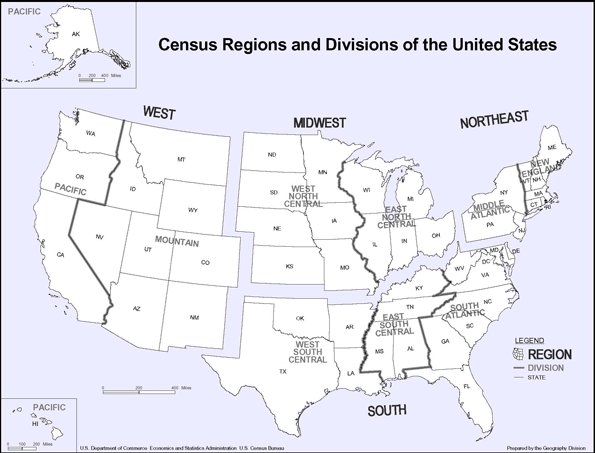
    Americans have been moving from the Northeast and Midwest to the West and South for decades (see US region map). In the first four decades after the Second World War, the warm, dry climates of coastal California were a significant factor. As the nation became more mobile – aided by such things as inexpensive air travel and the interstate highway system and the spread of air conditioning – the larger migration pattern went towards the South. There were, of course, other factors. Business costs, particularly the costs of labor, were often lower in the West and especially the South. Personal taxes in some states were lower than in the Northeast and Midwest. Surely the period from the end of World War II to 2000 could be called the demographic “half-century” of the West and South.

    The New State Census Estimates: The latest (July 1, 2009) Bureau of the Census release of state population estimates indicates a fundamental shift in migration patterns. Yes, even at recession-depressed rates, the Northeast and Midwest continue to export domestic migrants, but they are almost exclusively going to the South now, and not the West (See Table).

    Net Domestic Migration by State
    2009 Rank Net Domestic Migration Rank 2000-2009
    State 2009 2000-2009
    1 Texas    143,423       838,126 2
    2 North Carolina      59,108       663,892 4
    3 Washington      38,201       239,037 9
    4 Colorado      35,591       202,735 10
    5 South Carolina      31,480       306,045 7
    6 Georgia      26,604       550,369 5
    7 Tennessee      20,605       259,711 8
    8 Oklahoma      18,345         42,284 19
    9 Virginia      18,238       164,930 12
    10 Oregon      16,173       177,375 11
    11 Arizona      15,111       696,793 3
    12 Louisiana      14,647      (311,368) 45
    13 Alabama      11,044         87,199 14
    14 Utah        8,623         53,390 17
    15 Wyoming        7,192         22,883 25
    16 Kentucky        6,268         81,711 15
    17 Arkansas        5,298         75,163 16
    18 West Virginia        4,510         17,727 26
    19 District of Columbia        4,454        (39,814) 37
    20 Massachusetts        3,614      (274,722) 44
    21 New Mexico        3,366         26,383 24
    22 Delaware        2,580         45,424 18
    23 Montana        2,410         39,853 21
    24 South Dakota        1,619            7,182 27
    25 Idaho        1,555       110,279 13
    26 North Dakota        1,375        (18,071) 31
    27 Pennsylvania        1,346        (33,119) 34
    28 Alaska           979          (7,360) 29
    29 Missouri          (124)         41,278 20
    30 Nebraska          (956)        (39,275) 36
    31 Vermont          (975)          (1,505) 28
    32 Kansas       (1,242)        (67,762) 41
    33 Iowa       (2,135)        (49,589) 40
    34 New Hampshire       (2,602)         32,588 22
    35 Maine       (2,937)         29,260 23
    36 Nevada       (3,801)       361,512 6
    37 Hawaii       (5,298)        (29,022) 33
    38 Mississippi       (5,529)        (36,061) 35
    39 Wisconsin       (5,672)        (11,981) 30
    40 Rhode Island       (6,172)        (45,159) 38
    41 Indiana       (6,805)        (21,467) 32
    42 Connecticut       (7,824)        (94,376) 42
    43 Minnesota       (8,813)        (46,635) 39
    44 Maryland    (11,163)        (95,775) 43
    45 Florida    (31,179)    1,154,213 1
    46 New Jersey    (31,690)      (451,407) 47
    47 Ohio    (36,278)      (361,038) 46
    48 Illinois    (48,249)      (614,616) 49
    49 Michigan    (87,339)      (537,471) 48
    50 New York    (98,178)  (1,649,644) 51
    51 California    (98,798)  (1,490,105) 50
    Derived from US Bureau of the Census data.

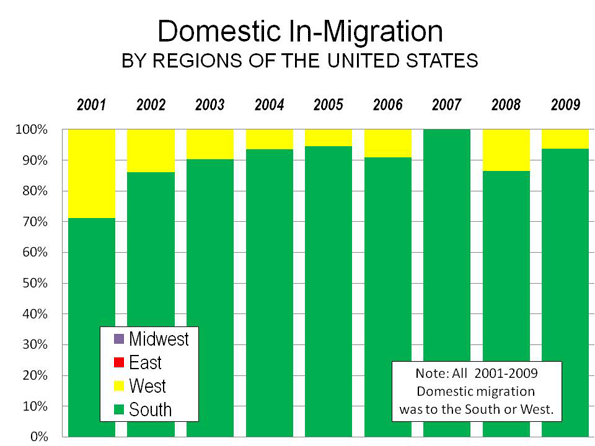
    Moving to the South: Between 2000 and 2009, the South attracted 90% of domestic migrants from other states, with the West accounting for only 10% (see chart below). In 2001, the South attracted 71% of domestic migration but its share rose to 86% in 2002 and accounted for virtually all net migration by 2007. In that year, not only did the Northeast and Midwest lose domestic migrants, but also the West. By 2009, the South’s share of inbound domestic migration fell back to 94%.

    Throughout the decade, the small share of domestic migration that did not go to the South went to the West, while the Northeast and Midwest continued to lose residents. The 2000s are best characterized as the demographic “decade of the South” because the vast majority of Americans moving between states moved South.

    Nearly all states in the South gained domestic migrants during the decade. Only Mississippi, Maryland and Louisiana, along with the District of Columbia, lost domestic migrants. Even before Hurricanes Katrina and Rita, Louisiana was losing domestic migrants. Perhaps the big surprise is Florida, which has led the nation in domestic in-migration for years and has attracted 1.1 million from other states during the 2000s.

    Florida’s peak came in 2004 and 2005, when more than a net 260,000 domestic migrants moved to Florida from other states. Things have changed markedly, however, with Florida rapidly losing domestic migrants in 2008 and 2009, very likely due to the impact of the housing bubble and an overreliance on inbound retirees to drive its economy.

    However, Florida’s recent decline does not weaken the near-monopoly position of the South as the dominant destination of movers. Florida’s rapidly declining domestic migration has been largely replaced by a new domestic migration champion: Texas. In the early 2000s, Texas generally attracted from 30,000 to 50,000 net domestic migrants. Migration from Louisiana from Rita and Katrina propelled Texas to the top in 2006 and the state appears to have consolidated its position as the leader in domestic migration. In 2009, with domestic migration at more modest levels nationally, the Texas gain was more than any year except for 2006 with Hurricanes Katrina and Rita. But it’s not just a Lone Star story. Seven of the top ten states in domestic migration remained in the South in 2009. Throughout the entire decade, 6 of the top 10 states were from the South and 4 from the West. However, most of the gains in the West were simply from moving around (and from California); there was relatively little inter-regional domestic migration.

    Moving Around the West (and Away from California): Most states in the West have also gained domestic migrants in the 2000s, with the exceptions of Alaska, Hawaii and California. California is the real story in the West, having lost nearly 1.5 million domestic migrants, a population greater than that of the city of San Diego. In 2000, California lost nearly 100,000 domestic migrants and for the fourth year in a row led the nation in net domestic out-migration. This includes 2006, when not even Louisiana’s catastrophic hurricanes could drive as many people away as California. During the first year of the decade, California lost only 45,000 net domestic migrants. By 2007, as the center of the worldwide housing bubble, California’s losses were 7 times that amount. In 2009, even with depressed migration rates associated with the recession, out migration more than doubled between 2001 and 2009.

    California is simply not the draw that it used to be. There was a time, in the late 1930s, that the state tried to bar “Okies” from moving to the state, legislation wisely declared unconstitutional by the Supreme Court. Things have certainly changed. The latest Internal Revenue Service data indicates that every year during the 2000s, Oklahoma gained net domestic migrants from California.

    Outside California, there has been healthy domestic in-migration in the West. However, California’s losses cancelled out more than 80% of the West’s gains during the decade. Much of the movement within the region was internal, with Californians shifting to markets where housing was less expensive (but still expensive), such as Arizona, Nevada, Washington and Oregon. More recently the movement to the housing bubble ground zero states of Arizona and Nevada, have all but disappeared, with far smaller gains in Arizona and a small net loss in Nevada in 2009.

    In one year (2007), California lost more domestic migrants than all of the other states of the West gained. Domestic migration in the West remains largely about households moving around within the region: from California to other states, with a far smaller number arriving from elsewhere in the nation.

    Escape from New York (and the Northeast): Domestic migrants continue to leave the Northeast, just as they have for decades. In the Northeast, only New Hampshire and Maine gained domestic migrants in the 2000s. However, it was a bit different in 2009. Both New Hampshire and Maine lost, while Massachusetts and Pennsylvania gained.

    Pennsylvania has been the subject of more than one “what’s wrong with Pennsylvania” report as analysts inside and out decry its competitive position. In fact, by the ultimate measure of competitiveness, where people choose to move to or from, Pennsylvania has done relatively well in the 2000s. Pennsylvania’s modest loss of 33,000 domestic migrants pales by comparison to the net 2.5 million people who have moved away from neighboring New York, New Jersey, Maryland and Ohio. Like Texas, Georgia and many other states, Pennsylvania largely missed the housing bubble, which probably accounts for some of this surprising phenomenon.

    But the relative success of Pennsylvania should not be touted, as the mainstream media would tend to, as a sign of general Northeastern resurgence. New York alone lost 1.65 million over the 2000-2009 period. This is, in absolute numbers, more than California and a larger percentage loss than Louisiana with Katrina and Rita. Critically, data through 2008 shows that most of the domestic migration losses came from New York City and to a lesser extent its suburbs. Upstate New York, which also missed the housing bubble, experienced comparatively modest domestic migration losses, as Ed McMahon and I showed in an Empire Center policy report earlier this year.

    Hollowing out the Heartland: Domestic migrants are also deserting the Midwest, though in somewhat smaller numbers than in the Northeast. Only Missouri and South Dakota gained domestic migrants in the 2000s, although in 2009, Missouri experienced a small loss and was replaced by North Dakota as a gainer. But it is not a region-wide phenomena. Nearly 90% of the loss in the Midwest was in Illinois and the economic basket case states of Michigan and Ohio.

    Slowing Migration: One of the principal stories out of this year’s Census release is that interstate domestic migration declined markedly in 2009. Indeed, domestic migration was lower than in any other year in the decade, but not by that much. In 2009, 500,000 people migrated between the states, compared to between 570,000 and 620,000 annually from 2001 to 2003. Then, from 2003 to 2007, interstate domestic migration was up to 1.25 million and averaged more than 900,000. The anomaly is not so much that domestic migration is down, but rather that domestic migration got so high in the middle part of the decade, at the very same time that house price differences reached unprecedented heights. It’s no wonder people were moving.

    The Future? What comes next after the chaotic decade of the 2000s? As is suggested above, much of the variation in domestic migration is explained by differences housing prices and trends. Indeed, the price of housing may be a surrogate for the cost of living, which varies principally between areas based upon housing cost differences. This is likely to continue. In coastal California, house prices remained above historic norms, even at the largest “bubble burst” losses,” and there are recent indications that unhealthy price escalation has resumed. Much of the West and most of the country is far more affordable. This would suggest that coastal California’s domestic migration losses will continue and rise in the future.

    By contrast, in much of the rest of California and the other “ground zero” states of Florida, Arizona and Nevada house prices have returned to historic norms, which suggests that after the recession, strong domestic in-migration could resume.

    The future looks very bright for Texas and other states in the South that have done so well (such as North Carolina, South Carolina, Georgia, Tennessee, Oklahoma and even Arkansas). Their biggest challenge will be to resist the siren songs to become more like California, with its disastrous policies appreciated only by proponents and a fawning media.

    Wendell Cox is a Visiting Professor, Conservatoire National des Arts et Metiers, Paris. He was born in Los Angeles and was appointed to three terms on the Los Angeles County Transportation Commission by Mayor Tom Bradley. He is the author of “War on the Dream: How Anti-Sprawl Policy Threatens the Quality of Life.

  • World Small Area Map of GHG Emissions

    The European Commission has just made a Google Earth overlay available showing annual greenhouse gas (GHG) emissions by 10 square kilometer quadrants. The overlay can be manipulated to show estimates from every year beginning in 1970. One of the most fascinating features is the GHG emissions on the oceans, from shipping lanes. All are green (fewer GHG tons), but one route stands out as by far the busiest, from Hong Kong and Japan through the Straits of Malacca and the Suez Canal to northern Europe.

    The application is useful for broad reviews of GHG emissions by same-sized areas, though the zoom feature does not provide high resolution enough photography to discern differences at the smallest area level.

  • Editor WENDELL COX on the Reason Foundation regarding suburbs

    When Congress has found time not occupied with nationalizing healthcare, they have introduced a series of laws designed to curtail suburban living. This column by Wendell Cox explains why that is a mistake.

    Wendell on the Reason Foundation

  • Contributing Editor MICHAEL LIND on Free Silver regarding presidents

    It reminds me of the introductory anecdote from the book Up From Conservatism by Michael Lind. Lind describes the 4-way 1948 Presidential election between Democrat Harry Truman, Republican Thomas Dewey, Progressive Party candidate Henry Wallace, and Dixiecrat Strom Thurmond. He traces each of those candidates’ ideologies into the ’90s (when the book was written). Thurmond, he suggests, is a modern day Republican: Right-wing, conservative, and Southern – which he uses as a code for racist throughout the book. Wallace, he argues, is New Left – the predecessor to George McGovern, Jerry Brown, and (if Lind had waited a decade to write his book) the Markos Moulitsas Left. Thomas Dewey is the DLC: centrist, pro-business, inoffensive to all, and indifferent to labor. But, there’s no modern equivalent to Truman.

    Michael on Free Silver

  • Contributing Editor AARON RENN on Dustbury regarding Detroit

    I like the idea. And Aaron Renn has pointed out that Detroit has one distinct advantage: an ineffectual and inefficient municipal government.

    Aaron on Dustbury

  • Executive Editor JOEL KOTKIN on Instapundit regarding the Green Movement

    JOEL KOTKIN: The Green Movement’s People Problem. “The movement needs to break with the deep-seated misanthropy that dominates green politics and has brought it to this woeful state.”

    Joel on Instapundit

  • Executive Editor JOEL KOTKIN on The Trumpet regarding San Francisco

    Urbanologist Joel Kotkin agrees: “Even other liberal places wouldn’t put up with the degree of dysfunction they have in San Francisco. In Houston, the exact opposite of San Francisco, I assume you’d get shot.”

    Joel on The Trumpet