Blog

  • Growing Today’s Green Jobs Requires Solid Economic Development Policy

    I was hired for my first Green Job, thirty-four years ago, shoveling horse stalls for a barn full of Tennessee Walking Horses. The droppings and bedding that was removed from the stables was then composted and applied to my employer’s crops in lieu of chemical fertilizers. You don’t get much greener than that!

    Now don’t get me wrong, I am not bragging about holding such a lucrative job because the 75 cents an hour they paid me made this Ozark, Missouri boy feel rich. Actually, I am bragging that I learned the value of environmental stewardship and the interdependence of our economy at an early age. For our community, no horses meant no corn.

    My employer, a local auto dealer who owned the farm, created these value-added “green jobs” without any subsidy from the government or without a governmental policy forcing his customers to pay him a subsidy. But I guess that is the good old days. So much for market forces and producing a product that customers will pay for.

    I have spent more than 25 years in the profession of economic development serving at the community and state levels. I have worked with hundreds of companies to create tens of thousands of jobs. In that time, I have seen more “silver bullets” than the Lone Ranger ever gave away. These have included the following “you must have” edicts: four lanes/interstate highway; a new airport terminal; micro chips; nanotechnology; aqua culture; speculative buildings; a Super Bowl; a bohemian bastion; or a biotech cluster. Now, it’s environmentally friendly “green” businesses like wind farms and solar fields that are calling for precious public resources.

    Yet in reality, these silver bullets usually work only for a few places and certainly do not constitute a national strategy for job creation. Some places may benefit from the rush to wind and solar energy, although the benefits may well diminish if the panels or turbines are made elsewhere. There are not too many industries that have such a large profit margin that they can afford to pay double or triple their existing electric rates.

    In fact, the answer to job creation is definitely not financially supported and government-mandated green energy policy that focuses its efforts on wind and sun. The reasons why that policy won’t work include:

    1. A quick review of a recent issue of a national economic development trade publication featured ads by 32 states that claim to be the next green energy place, although they only focus on wind and solar. Maybe it is because the public is being coerced into subsidizing these industries. But at the end of the day there will NOT be 32 places nationwide that are green energy centers of excellence, but more likely a dozen or so globally.
    2. Most of these green initiatives rely on nature. Nature is not constant – that is what makes it “natural.” Wind may be a suitable form of power off the ocean on Monday, Tuesday and Wednesday evenings but what happens when it quits blowing? Not only are the resources stranded and not providing a return on investment but no power is being generated.
      Now don’t get me wrong, wind power has worked for years. Farmers have been using it to fill up water tanks for their animals for hundreds of years. But as all farmers know, if the wind quits for long enough, the animals die. Are we to bet our economies and our lives on the hope that maybe someone can develop a storage tank for electricity generated by the wind even if it quits?

    3. Solar power is great. But let’s be realistic. How are we ever going to get solar panels on the roof of every home – at a cost of $60,000 or more – in America when some people don’t even have cable television or broadband access yet? And what about the heat radiated from the panels themselves? And, solar power still has the same storage and reliability issues that come with wind power.

    Let’s be clear that here are two very clear outcomes we, as a nation, must strive to achieve: low cost, environmentally sensitive energy independence and job creation. These are not mutually exclusive goals.

    Energy independence will never come from wind and solar power; neither is dependable or manageable enough to meet our needs. Compound this with artificially mandated requirements and the hidden taxes that go with them and we are facing higher energy prices which will cripple the economy.

    When it comes to jobs, we must embrace the age-old adage: Be yourself but be great. We call this model Community Capitalism. In short, Community Capitalism is focused and organized philanthropy and business investment occurring simultaneously in five strategic areas based upon historical and geographical advantages in order to create jobs and wealth.

    I am blessed to live in a place, Kalamazoo, Michigan, that has embraced the fundamentals of Community Capitalism for more than 100 years. Kalamazoo is the place where the friable pill, a pill easily dissolved when ingested, was invented; where Dr. Homer Stryker invented the oscillating device that cuts casts off; where the yellow-checkered cab was invented; where most of the nation’s corsets and paper were once produced, and home of the Kalamazoo sled, the direct-to-you-from Kalamazoo Stove, Shakespeare Rod & Reel and Gibson Guitars.

    So what are we great at? We are one of only a few places globally where a drug can move from concept through trials to market. We are centrally located, a short drive to the logistical hub of Chicago. We can staff a call center or customer care center with the speed of light. We will leave the micro chips to Boise, the film industry to Hollywood, the Country music business to Nashville, the financial district to Manhattan; and telecommunications to Dallas. Not to say we won’t welcome a few of their companies. But they are great at those things; we will be good at best.

    So how do we create jobs using the five precepts of Community Capitalism: place, capital, infrastructure, talent and education? The same way communities have grown for hundreds of years.

    First is the concept of place. Great economic regions know who they are and that sense of identity ensures people are not only comfortable within the environment but can nurture their personal and professional growth. Think about places that do this really well and where place has become their brand – like Boise, Idaho; Austin, Texas; Melbourne, Australia and Gorongosa in Africa.

    Capital is critical to spur innovation and entrepreneurship. In the case of Kalamazoo, we established in 2005 a limited partnership venture fund to invest in early-stage life science companies. The $100 million Southwest Michigan First Life Science Fund is believed to be the largest sum of community-based private capital ever to be raised and managed by an economic development organization. Other communities have focused on angel networks, revolving loan funds or even micro lending. But whatever the source, we know that companies cannot grow without the capital to grow a business.

    Great communities understand that great minds need the right place to make things happen and are committed to providing the necessary infrastructure. For example, when we saw the need to create a place for local talent to incubate biotech concepts, we created a 69,000-square-foot accelerator to do just that. This same catalyst served the Palm Beach, Florida region’s desire to grow life science research when Scripps Research Institute decided to locate there and mix its DNA with the local biotech economy. It also worked for Corpus Christi, Texas when the Harte Research Institute was built to chart the future of the Gulf of Mexico.

    Communities cannot be great if they lack a long-term, funded commitment to education and academic excellence. Our legacy in life science and manufacturing prominence has resulted in an indigenous cluster of highly educated people. And we realize that educated people seek out strong education for their families which in turn produces a high-performance workforce.

    We are home to the world-renowned Kalamazoo Promise college scholarship program which provides free scholarships to every child that graduates from the Kalamazoo Public school system. In fact, Southwest Michigan’s diversified workforce is highly educated and boasts one of the nation’s highest concentrations of Ph.D.’s (1.84%), more than two times the national average per capita (0.81 %).

    Other economic regions have used “education” to make a difference. For example, the African Children’s Choir uses its funds to build schools, provide medical care and fund community development projects in the villages from which its young members come from. Oprah Winfrey’s Leadership Academy for Girls in South Africa looks to instill change for young girls in a place where almost a third of all pregnant women are afflicted with HIV.

    Finally, we recognize that a community needs to embrace talent. Kalamazoo is home to the Stryker Corporation, which is the only publicly traded company to achieve double-digit growth every year over a twenty-year period due to its commitment to putting the right people in the right place at the right time.

    I understand that none of these five things is as easy as the Lone Ranger’s silver bullet. It is much harder to raise capital to grow companies than it is to get your congressman to earmark dollars for highways or build a speculative building in a corn field. But if we are to truly build a sustainable economy that grows jobs and wealth, we must invest in Community Capitalism while limiting artificial governmental manipulations of the economy.

    Ron Kitchens serves as the Chief Executive Officer of Southwest Michigan First, as well as the General Partner of the Southwest Michigan First Life Science Fund. Ron has worked with more than 200 Fortune 500 corporations as a Certified Economic Developer in addition to starting multiple privately held companies and serving as a city administrator, elected official and staff member to United States Senator John Danforth.

  • The World’s Smartest Cities

    In today’s parlance a “smart” city often refers to a place with a “green” sustainable agenda. Yet this narrow definition of intelligence ignores many other factors–notably upward mobility and economic progress–that have characterized successful cities in the past.

    The green-only litmus test dictates cities should emulate either places with less-than-dynamic economies, like Portland, Ore., or Honolulu, or one of the rather homogeneous and staid Scandinavian capitals. In contrast, I have determined my “smartest” cities not only by looking at infrastructure and livability, but also economic fundamentals.

    These criteria unfortunately exclude mega-cities like New York, Mexico City, Tokyo or Sao Paulo, which suffer from congenital congestion, out-of-control real estate prices and expanding income disparities–symptoms of what urban historian Lewis Mumford described as “megalopolitan elephantiasis.”

    Instead, today’s “smart” cities tend to be smaller, compact and more efficient: places like Amsterdam; Seattle; Singapore; Curitiba, Brazil; and Monterrey, Mexico. This is not an entirely new notion: Between the 14th and 18th centuries, modest-sized cities like Venice, Italy; Antwerp, Belgium; and Amsterdam nurtured modern capitalism and created canals and vibrant urban quarters that remain wonders even today.

    In the Pacific-centric modern era, smart commercial cities are increasingly found outside Europe. Indeed, the most likely 21st-century successor to 15th-century Venice is Singapore, a commercially minded island nation that, like its forebear, is run by an often enlightened authoritarian regime.

    When it first achieved independence in 1965, Singapore’s condition was comparable to other developing cities like Bombay, Cairo, Lagos or Calcutta. The island city’s neighbors included unstable countries like Vietnam, Malaysia and Thailand. Its GDP per capita ranked well below those of Argentina, Trinidad, Greece or Mexico.

    The country’s first prime minister and current eminence grise, Lee Kuan Yew, was determined to change reality. Today, Singapore, with a population of less than 5 million, boasts an income level close to the wealthiest Western countries and a per-capita GDP ahead of most of Europe and all of Latin America. Once largely semi-literate, its population is now among the best-educated in Asia.

    To be sure, this enviable achievement was accomplished in an authoritarian fashion, but much of what Singapore has done must be considered “smart” by any reasonable accounting. Strategic investments taking advantage of its location between the Indian and Pacific Oceans have paid off handsomely: Today Singapore Airport is Asia’s fifth largest, and the city’s port ranks as the largest container entrepôt and is the second biggest, after Shanghai, in terms of cargo volume in the world.

    All this has made Singapore a huge lure for foreign companies, with over 6000 multinationals, including 3600 regional headquarters, now located there. For foreign managers, engineers and scientists, largely English-speaking Singapore offers a pleasant and predictable environment, particularly compared with other Asian centers.

    At least one recent survey by the World Bank’s International Finance Corporation rates Singapore No. 1 in the world for ease of doing business. Although its growth has been slowed by the recession, the city’s close ties to the resurging economies of Southeast Asia, China and India lead many forecasters to predict a strong recovery over the next year.

    Hong Kong, yet another outpost of British imperialism, has also performed well. Last year the World Bank ranked the area No. 3 for ease of doing business, compared with No. 89 for the rest of China. As long as Chinese Communists allow wider freedoms in Hong Kong than in the mainland, the area should continue to take advantage of its basic assets, including the world’s third-largest container port, an excellent airport and a highly skilled entrepreneurial population.

    The continuing appeal of Hong Kong was vindicated by the recent decision of Hong Kong Shanghai Bank Chief executive George Geoghegan to relocate there from London. As the center of the world economy continues to shift to Asia while Europe and America struggle, he is likely to find more company.

    Not all the world’s “smart” cities are trading giants like Hong Kong and Singapore. They also include well-run metropolises, such as the city of Curitiba. The south Brazilian city is regarded as an innovator in everything from bus-based rapid transit, used by some 70% of residents, and its balanced, diverse economic development strategy.

    With a population of 3.5 million, Curitiba demonstrates how to achieve the evolving Brazilian dream without the mass violence, transportation dysfunction and ubiquitous grinding poverty that plague many other Latin American metro areas. The city’s program of building “lighthouses”–essentially electronic libraries–for poorer residents has become a model for developing cities world wide. These are among the reasons Reader’s Digest recently named Curitiba the best place to live in Brazil.

    Another similarly “smart” city in the developing world is Monterrey, Mexico, which has emerged from relative obscurity and turned itself into a major industrial and engineering center over the past few decades. The city of 3.5 million sits adjacent to the dynamic U.S.-Mexico border region and has 57 industrial parks specializing in everything from chemicals and cement to telecommunications and industrial machinery.

    Over the last decade, the area has consistently grown at a faster rate than the rest of Mexico–or, for that matter, the United States. Monterrey and its surrounding state, Nuevo Leon, now boast per-capita GDP roughly twice that of the rest of Mexico.

    Although hard-hit by the current recession, Monterrey seems poised for an eventual recovery. Dominated by powerful industrial families, the area has long been business-friendly. It has also become a major education center, with over 82 institutions of higher learning and 125,000 students, led by the Instituto Technologico de Monterey, considered by some Mexico’s equivalent of MIT or Cal Tech.

    Of course, “smart” cities also exist in the advanced industrial world. Amsterdam, a longstanding financial and trading capital, is home to seven of the world’s top 500 companies, including Philips and ING. Relatively low corporate taxes and income taxes on foreign workers attract individuals and companies, one reason why, in 2008, the Netherlands was largest recipient of American investment in Europe. Amsterdam’s advantages include a well-educated, multilingual population and a lack of political corruption.

    Amsterdam’s relatively small size–740,000 in the city and 1.2 million for the entire metropolitan area–belies its strategic location in the heart of Europe and proximity to the continent’s dominant port, Rotterdam. The city’s Schiphol airport, Europe’s third-busiest, is only 20 minutes from the center of Amsterdam, a mere jaunt compared with commutes to the major London or Paris airports. Schipol has also spawned a series of economically vibrant “edge cities” that appear like more transit-friendly versions of Houston or Orange County, Calif.

    North America also has its share of smart cities. Although self-obsessed greens might see their policies as the key to the area’s success, Seattle’s growth really stems more from economic reality. In this sense, Seattle’s boom has a lot to do with luck–it’s the closest major U.S. port to the Asian Pacific, which has allowed it to foster growing trade with Asia.

    Furthermore, Seattle’s proximity to Washington state’s vast hydropower generation resources–ironically the legacy of the pre-green era–assures access to affordable, stable electricity. The area also serves as a conduit for many of the exportable agricultural and industrial products produced both in the Pacific Northwest and in the vast, resource-rich northern Great Plains, linked to the region by highways and freight rails.

    As North America’s economy shifts from import and consumption toward export and production, Seattle’s rise will be a model for other business-savvy cities in the West and South. Houston’s close tie to the Caribbean, as well as its dominant global energy industry, thriving industrial base, huge Texas Medical Center complex and first-rate airport, all work to its long-term advantage. Arguably the healthiest economically of America’s big cities, Houston is also investing in–not just talking about–its green future; last year it was the nation’s largest municipal purchaser of wind energy.

    Another smart town poised to take advantage of an industrial expansion is Charleston, S.C., which has expanded its port and manufacturing base while preserving its lovely historic core. Once an industrial backwater, Charleston now seems set to emerge as a major aerospace center with a new Boeing 787 assembly plant, which will bring upward of 12,000 well-paying jobs to the region.

    Further inland, Huntsville, Ala., has long had a “smart” core to its economy–a legacy of its critical role in the NASA ballistic missile program. Today the area’s traditional emphasis on aerospace has been joined by bold moves into such fields as biotechnology. Kiplinger recently ranked the area’s economy No. 1 in the nation.

    With the likely rise in commodity prices over the next decade, Canada also seems likely to produce several successful cities. Perhaps the best positioned is Calgary, Alberta. Over the past two decades, the city’s share of corporate headquarters has doubled to 15%, the largest percentage of main offices per capita in Canada.

    Although last year’s plunge in oil prices hit hard, rising demand for commodities in Asia should help revive the Albertan economy by next year.

    In their press releases, all these cities make a point of bragging about being green and environmentally conscious. Yet they have demonstrated their “intelligence” in other ways–by exploiting their locations and resources to make savvy business and development decisions. At the end of the day, it will not be their clean air but their commercial prowess–as has been the case in history–that will sustain their success in the decades ahead.

    List of the World’s Smartest Cities

    1. Singapore The 21st-century successor to 15th-century Venice, this once-impoverished island nation now boasts an income level comparable to the wealthiest Western countries, with a per-capita GDP ahead of most of Europe and Latin America. Singapore Airport is Asia’s fifth-largest, and the city’s port ranks as the largest container entrepot in the world. Over 6,000 multinational corporations, including 3,600 regional headquarters, are located there, and it was recently ranked No. 1 for ease of doing business.
    2. Hong Kong As the center of the world economy continues to shift from West to East, Hong Kong is certainly reaping the benefits. Hong Kong Shanghai Bank’s chief executive recently relocated there from London. Its per-capita GDP is ranked 15th in the world. The Heritage Foundation and The Wall Street Journal have ranked Hong Kong the freest economy in the world.
    3. Curitiba, Brazil This well-run metropolis in southern Brazil is famous for its rapid bus-based transit, used by 70% of its residents, and its balanced, diverse economic development strategy. The city’s program of building “lighthouses”–essentially electronic libraries–for poorer residents has become a model for developing cities worldwide. Environmental site Grist recently ranked Curitiba the third “greenest” city in the world.
    4. Monterrey, Mexico Over the past few decades Monterrey has emerged from relative obscurity into a major industrial and engineering center. The city of 3.5 million has 57 industrial parks, specializing in everything from chemicals and cement to telecommunications and industrial machinery. Monterrey and its surrounding state, Nuevo Leon, boast a per-capita GDP roughly twice that of the rest of Mexico.
    5. Amsterdam This longstanding financial and trading capital is home to seven of the world’s top 500 companies, including Philips and ING. Relatively low corporate taxes and income taxes on foreign workers attract companies and individuals. Amsterdam’s advantages include a well-educated, multilingual population and a lack of political corruption, as well as its location–in the heart of Europe, close to a major international airport and a short train trip to Rotterdam, the continent’s dominant port.
    6. Seattle, Wash. Seattle’s location close to the Pacific Ocean has nurtured trade with Asia, and its proximity to Washington state’s vast hydro-power generation station assures access to affordable, stable clean electricity. The area also serves as the conduit for many of the exportable agricultural and industrial products produced both in the Pacific Northwest and in the vast, resource-rich northern Great Plains, closely linked to the region by highways and freight trains.
    7. Houston, Texas Houston’s close tie to the Caribbean, as well as its dominant global energy industry, thriving industrial base, huge Texas Medical Center complex and first-rate airport all work to its long-term advantage. Arguably the big city in the U.S. with the healthiest economy, Houston is also investing in a “green” future; last year it was the nation’s largest municipal purchaser of wind energy.
    8. Charleston, S.C. Charleston has expanded its port and manufacturing base while preserving its lovely historic core. Once an industrial backwater, Charleston now seems poised to emerge as a major aerospace center, with the location of a new Boeing 787 assembly plant there, which will bring upward of 12,000 well-paying jobs to the region.
    9. Huntsville, Ala. This southern city has long had a “smart” core to its economy, a legacy of its critical role in the NASA ballistic missile program. Today the area’s traditional emphasis on aerospace has been joined by bold moves into such fields as biotechnology. Kiplinger recently ranked the area’s economy No. 1 in the nation.
    10. Calgary, Alberta With the likely rise in commodity prices over the next decade, Canada seems likely to produce several successful cities. Over the past two decades, Calgary’s share of corporate headquarters has doubled to 15%, the largest percentage of main offices per capita in Canada. Although the plunge in oil prices hit hard, rising demand for commodities in Asia should help revive the Albertan economy by next year.

    This article originally appeared at Forbes.com.

    Joel Kotkin is executive editor of NewGeography.com and is a distinguished presidential fellow in urban futures at Chapman University. He is author of The City: A Global History. His next book, The Next Hundred Million: America in 2050, will be published by Penguin Press early next year.
  • When Granny Comes Marching Home Again… Multi-Generational Housing

    During the first ten days of October 2008, the Dow Jones dropped 2,399.47 points, losing 22.11% of its value and trillions of investor equity. The Federal Government pushed a $700 billion bail-out through Congress to rescue the beleaguered financial institutions. The collapse of the financial system in the fall of 2008 was likened to an earthquake. In reality, what happened was more like a shift of tectonic plates.

    *******************************************

    The driveway tells the story. The traditional two-story 2,200 square foot suburban home has a two-car attached garage. Today’s multi-generational families fill the garage, the driveway and often also occupy the curb in front of the home. The economic crisis that is transforming America is also changing the way we live. The outcome will change the way America views its housing needs for the balance of the 21st Century.

    As is often the case, we can more clearly see the future by looking into our past. That is because time and time again America has reverted to its roots when confronted with a challenge. The root of the American family is the home. A century ago, America was an agrarian nation. Most Americans grew up on the farm or in a small town often tied to agriculture. A century ago, our census was 92,000,000, less than one-third of today’s population. Los Angeles was a city of 319,000. Cleveland was the fifth largest city with 560,000. The tenth largest city in 1910 was Buffalo NY with 423,000 souls.

    A century ago, parents, children, grown children, and grandparents lived together in America’s homes. In 1910, the vast majority of kids did not go off to college. They stayed home and worked the farm. Mom certainly did not drive and usually she did not work outside the home. Grandma – who then as now usually outlived grandpa – did not go off to an active senior housing project or nursing home at age 55. With the average life expectancy at just 49 years, there was little market for such facilities. A young Grandma lived in the family home and helped with the cooking, the sewing and the child rearing.

    Along the way, we fought in two world wars, America industrialized and the great Middle Class exploded. Our children went off to college and did not return. Our cities exploded. By the end of the century, Los Angeles grew to 3,700,000. The tenth largest city was Detroit with 1,000,000. Children were expected to leave the home shortly after high school and never come back, except to visit.

    Big changes occurred on the other end of the demographic curve. As life expectancy grew to 75. Grandma had her choice of active senior living, congregate care or a skilled nursing facility when she hit 70 and slowed down.

    The expectations of greater family dispersion – with young people leaving home early and grandparents on their own – drove much of real estate thinking at the end of the 20th Century. With empty-nesters and young people both heading back to the city, urban planners were focusing on high-rise apartments and condominiums in dense urban areas. Many eagerly anticipated the death of the suburbs since the number of young families declined. Across the country, and even in suburban areas like the City of Irvine, CA brilliant urban planners began rezoning industrial land into high density housing. The face of America was thought to be changing in predictable ways.

    Then, along came 2008 and the economic crisis. The plates under our feet began to shift. The mass migration to dense urban living evaporated as people stayed put and speculating in condos lost all economic logic. The shiny new urban corridor in Irvine now lined with high rise housing sits empty, with many units vacant and foreclosed. In nearby Santa Ana, twin 25-story residential towers sit eerily vacant with not a single unit sold or occupied. Central Park, a giant new urban project in Irvine that boasted dense high-rise, townhouse and mid-rise units, sits vacant behind green security fences.

    Where did the buyers go? Many young people moved back home with their parents when their high paying jobs in real estate or mortgage brokerage disappeared. With their jobs and income gone, they sought refuge in the safety of their childhood homes. Their parents ended any speculation of selling and down-sizing when their children returned. With job creation non-existent, they do not plan on leaving anytime soon. In one recent Pew study, 13 percent of parents with grown children reported one of their adult offspring had moved back home in the past year. Roughly half of the population 18 to 24 still lives with their parents.

    This stay-at-home trend predates even the recession. According to the U.S. Census Bureau, the national relocation rate in 2008 was the lowest since the agency started tracking the data in 1948. The rate was 11.9 percent in 2008, a decline from 13.2 percent in 2007. The 2008 figure represents 35.2 million people, which is the smallest number of residents to move since 1962. The number was 38.7 million in 2007.

    What about Grandma and, increasingly, even Grandpa? Our parents, thanks to the miracle of modern medicine, are living longer than ever. If she has reached age 65, she can expect to live another 20 years. Unfortunately, her retirement account and savings plan may not. Many Americans are living well into their 90s and we will see the first wave of centurions in our lifetime. No one expected this to happen and we are unprepared for it. Grandma will not be able to afford the $3,000 to $4,000 a month expense of a quality retirement facility – for 20 years.

    This changing dynamic will alter movement of Americans, which has now been slowing down for a generation. In 1970, nearly 20 percent of Americans changed their place of residence every year. But by 2004, that figure had dropped to 14 percent, the lowest level since 1950. The tough economy and aging demographics will slow migration down even more. Mom and Dad will not find it easy to take that new position in another city with the kids at home and now Grandma, and even Grandpa, too.

    This will have profound impact on the kind of housing Americans will want. Homebuilders may find lower demand for single family houses as America doubles up but it will be the much ballyhooed drive to urbanize America with dense high-rise units that is most in danger.

    Extended families will want larger – not smaller – houses. They may not be able to afford McMansions, but conventional suburban houses will be changed to meet the demands of extended families. Granny flats, consisting of self contained ground floor units, will be in demand as the baby boomer generation moves into retirement. Smaller single floor homes called Casitas will need to be mixed into planned developments so that the Grandparents can live closer to the children.

    City staff and urban planners, already grappling with a mandate to accommodate global warming and carbon footprints, will have to rethink existing zoning rules which have not yet responded to the new reality. This reality will be driven by aging demographics, diminished capital and the shifting plates of our economy. The baby boomer “bubble” that is now beginning to retire is a well established fact. Lesser known is the impact of the financial crisis on young workers who simply have been priced out of the housing market. Along the pricier coasts and Northeastern cities, they will need the down payment from their parents – who in exchange will live with their kids – to purchase their own home.

    The kids have already come home. Like the financial downturn, they will not be leaving anytime soon. Grandma is next in line. When she comes home, the circle will be complete, with consequences few in the real estate industry have yet to contemplate seriously.

    **********************************
    This is the sixth in a series on The Changing Landscape of America. Future articles will discuss real estate, politics, and other aspects of our economy and our society.

    Robert J. Cristiano PhD is a successful real estate developer and the Real Estate Professional in Residence at Chapman University in Orange, CA.

    PART ONE – THE AUTOMOBILE INDUSTRY (May 2009)
    PART TWO – THE HOME BUILDING INDUSTRY (June 2009)
    PART THREE – THE ENERGY INDUSTRY (July 2009)
    PART FOUR – THE ROLLER COASTER RECESSION (September 2009)
    PART FIVE – THE STATE OF COMMERCIAL REAL ESTATE (October 2009)

  • A Threat To Home Owners Associations

    In the 1990s, just about the only site amenity that most suburban developments offered was a fancy entrance monument. Usually, there were no other additions beyond ordinance minimums and even those weren’t generally elaborate. Some of these monuments did cost millions, but once past the gilded gates, the seduction ended, and residents were greeted by familiar monotonous cookie cutter subdivisions.

    As neighborhood planners, we educate our developer clients regarding the virtues of building site amenities that improve Quality of Life (trails, gazebos, decorative ponds and fountains, etc). You would think these amenities were an easy sell to the cities approving the developments. After all, great developments create a great city, right? It’s not that simple, because all of these amenities require maintenance, and that places a burden on tax payers. No city wants to create a tax burden for all, when the likely benefit accrues to the few within the development.

    The solution to that problem was simple: The Home Owners Association. We are not talking about the type of Stepford-like association where lifestyles and flower plantings are strictly dictated, but the more limited type that adds a small monthly fee to service the common outdoor site amenities. In other words, only those extra amenities are cared for. Private yards still remain the financial burden of the individual homeowners. In the North, with snow removal, these neighborhood association fees are likely to be higher if the trails and walks are cleared. Since these Associations do not have to maintain private yards or address maintenance of buildings typical of townhome projects, the monthly fees are minimal. Some associations were formed in the North that did give options for snow removal on private driveways, at a very reasonable cost (after all, why not clear a few extra driveways while you are out clearing the trails?).

    The developer could now offer a much higher living standard and create more valuable lots that would be easier to sell. The majority of the neighborhoods we designed in the late 1990s through 2006 (the recession) offered the advantages that these minimal cost Associations could provide. We encouraged developers to spend less on elaborate entrance monuments and instead spread real value through the development where people lived.

    How HOAs May Be At Risk The recession has not just brought about massive foreclosures and reduced home prices. It has escalated real-estate taxes (the home value may be 40% less but the tax remains at pre-recession rates) and put the very idea of a Home Owners Association at risk. With failed development, there are often also failed Associations. With little or no maintenance of a development that was once cared for by private funding, cities may have to take over the burden until the economy recovers, and in some areas, if it recovers. Comprehensive associations that maintain all of the grounds (where there are no privately maintained yards),including the building exteriors and rooftops, as well as the streets, are at the greatest risk. The limited Associations that were typical of the neighborhoods we designed are not as much of a problem, but could easily be lumped into “all Associations are bad news” category in the minds of those approving future developments, after the economy returns.

    This affects all types of residential development.

    Developments that exceed minimum standards typically offer site amenities to make the development more enticing. Someone must maintain these extras. Fear of HOA failures will certainly be more on the minds of cities after the recession, but without HOAs, who will maintain the amenities? A two million dollar entrance monument does not make a neighborhood sustainable. Spreading value through the neighborhood with features that enhance quality of life, is a better investment. The Homeowners Association must not fall victim to the recession.

  • A Return to the City or a New Divide in the Nation’s Capital Region?

    Census data continue to suggest that fringe areas still grow faster than cities, but some have continued to argue that the flight to the suburbs has ended, or at least slowed, and that we are experiencing a resurgence of urban living. In a 2005 article for the Journal of the American Planning Association, Robert Fishman predicts a new pattern of migration – a so-called Fifth Migration – that will revitalize inner core neighborhoods that were depopulated through decades of suburbanization. In a 2004 study of the New York region, James W. Hughes and Joseph J. Seneca contemplate the beginning of a “third transformation,” or a post-suburban regional geography, characterized by the end of population dispersion and the beginning of recentralization.

    Anecdotes, rather than hard data, have tended to drive the back to the city case. Data brought to bear on the issue usually shows the suburbs are still going strong. Yet it also appears that all suburbs are not created equal and population data may be missing subtle population shifts within a metropolitan area. The flow of households within a metropolitan area can show early signs of a change in a region.

    This analysis considers the extent to which there is the beginning of a back to the city movement in the Washington DC metropolitan area using county-to-county migration data from the Internal Revenue Service. We must start with the assumption that the Washington area is unique among American metropolitan areas. The presence of the national government largely shapes the structure and geography of the regional economy. A large share of the region’s jobs is concentrated in the core, due to the role of the Federal government in the region. However, in addition to being the seat of the Federal government, the Washington DC metropolitan area also serves a varied set of private sector employers, and is home to a diverse population with growing suburban and city neighborhoods.

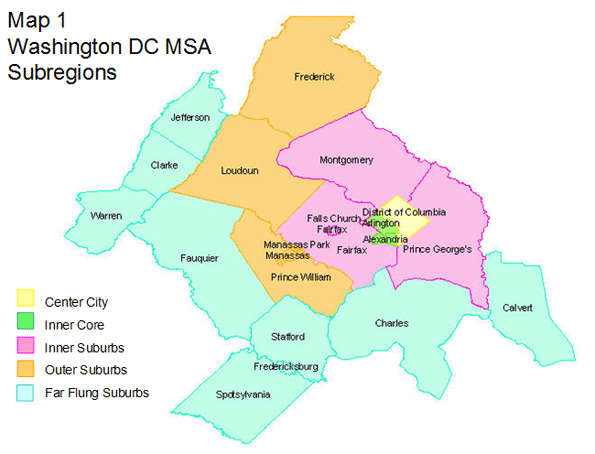
    The metro area is defined by 22 counties and cities in the states of Maryland, Virginia and West Virginia and has at its center city the District of Columbia. For this analysis, the Washington DC metropolitan area is divided into five sub regions: Center City, Inner Core, Inner Suburbs, Outer Suburbs and Far Flung Suburbs (see Map 1). According to Census Bureau population estimates, between 1987 and 2007 the population of the Washington DC metropolitan area grew from 3.92 million to 5.31 million people, an increase of about 35.5 percent. The population growth rates over this period varied considerably within the metropolitan area. The Center City experienced a 7.6 percent population decline between 1987 and 2007 while all of the other subregions in the metropolitan area grew. The fastest growing subregion was the Outer Suburbs, where the population grew by 109.6 percent over the 20-year period, followed by the Far Flung Suburbs (80.0%), Inner Suburbs (27.4%) and Inner Core (23.7%).

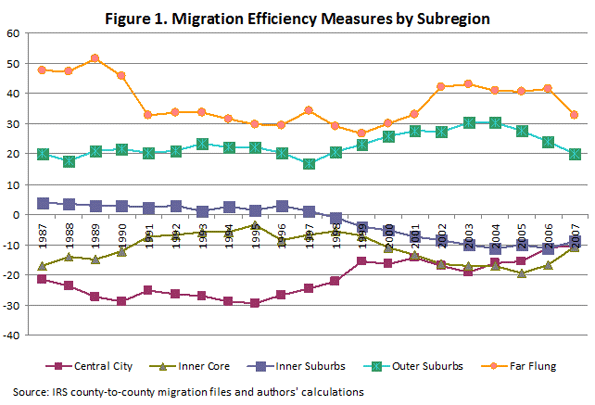
    Figure 1 shows that the subregions furthest from the region’s core, the Outer Suburbs and Far Flung Suburbs, consistently have the highest rates of net migration, which indicate that they have been net gainers of households from other parts of the metropolitan area over the past 20 years. For the Inner Suburbs, net migration is positive (but small) until 1998 when it becomes negative. Both the Inner Core and Center City have negative net migration over the entire period, reflecting losses of households to the rest (i.e. the suburban portions) of the metropolitan area.

    Looking at the entire 20-year period suggests that the suburbs of the Washington DC metropolitan area have gained population at the expense of the closer-in jurisdictions. However, in the last few years, since 2005, the net migration rates for the Outer Suburbs and Far Flung Suburbs have declined while the rates for the Inner Core and Center City have become less negative. These three years of data suggest that the more distant suburbs have started gaining households more slowly while the closer-in jurisdictions have lost households more slowly with net migration rates moving towards zero. While three years do not necessarily constitute a trend, this analysis suggests the possible beginning of a modest back to the city movement in the Washington DC area.

    However, household gains (or a slowdown in losses) in the inner jurisdictions may be coming more at the expense of the Inner Suburbs as opposed to the more distant suburban jurisdictions. The Inner Suburbs subregion is continuing the downward trend in net migration rates that began in the late 1990s, losing households to both the outer suburban and core jurisdictions. If this trend continues, the Washington DC metropolitan area may experience a relative population decline of its Inner Suburbs, while the more far flung suburbs continue to grow (albeit more slowly) and the population of the inner jurisdictions stabilizes or even grows slowly.

    Despite the beginning of a small back to the core movement, the suburbs of the national capital region will continue to gather most future growth, and that suburban growth will be even further out. Over the last three decades, jobs have followed people into suburban communities; a place like Tyson’s Corner in Fairfax County now has almost as many jobs as Washington’s downtown business district. Workers can live in the Outer Suburbs and Far Flung Suburbs, benefiting from the relatively lower housing costs and commute with relative ease to jobs in these suburban employment centers. Some share of the population will choose to move back to the city, but there will always be demand for suburban life.

    The Inner Suburbs are caught in the middle of population moving in and moving out. The Inner Suburbs have become more urban and congested, as well as more racially and ethnically diverse. These changes may cause some households – including both native born persons and upwardly mobile immigrants — to look even further out for a traditional suburban lifestyle. A younger metropolitan area, the result of the large millennial or “echo boom” generation, may lead to more people moving out of the congested Inner Suburbs to a “real” urban neighborhood in the core, which is also crowded, but has public transit and walkable communities. This trend, however, may well be short-lived if, when this generation hits their mid-30s by 2015, it acts like previous generations, starting to raise families and move again to suburbs, most likely in the further periphery.

    All this suggests, for the short run at least, a possibility that this new pattern of household redistribution could create a new divide in the national capital region. Different from the well-documented east-west divide, the emerging divide will be between the “urbanites” and the “far flungs.” The divide will be demographic, economic and political and will characterize the future challenges to forming transportation, housing and other regional policies.

    Lisa Sturtevant is an Assistant Research Professor at George Mason University School of Public Policy, Center for Regional Analysis.

  • Executive Editor JOEL KOTKIN on United Liberty regarding communities

    In an essay for Newsweek, writer Joel Kotkin contemplates the significance of Americans moving at the lowest rate since the 1940s. Deeming this phenomenon “new localism,” Kotkin argues that communities are growing stronger, with a new focus on families and local businesses as a result of economic crunches.

    Joel on United Liberty

  • Contributing Editors MORLEY WINOGRAD and MIKE HAIS on Jill Stanek regarding abortion

    If forced to choose, Americans today are far more eager to label themselves “pro-life” than they were a dozen years ago. The youngest generation of voters – those between the ages of 18 and 29, and therefore most likely to need an abortion – is the most pro-life to come along since the generation born during the Great Depression, according to Michael Hais and Morley Winograd, authors of Millennial Makeover, who got granular data on the subject from Pew Research Center.

    Morley and Mike on Jill Stanek

  • Contributing Editor MICHAEL LIND on Humanaturalism regarding the Pledge

    Some Americans have problems with the content of The Pledge of Allegiance, and I’m among them, though I won’t admit to any lack of commitment to my country or its founding principles. The Pledge always made me feel conflicted, for reasons I could never articulate well. Now there are some interesting ideas circulating about this, one of which can be summarized by the question: “Shouldn’t the government pledge allegiance to the people rather than the other way around?”

    Michael on Humanaturalism

  • Dubai Debt Debacle

    When a bunch of American bankers woke up last Thursday, I hope they found more to be thankful for than just a traditional turkey dinner. It’s thought that the American banks will have less exposure to Dubai World than most European or Asian banks – although the American banking industry is known to hide a thing or two up their sleeves. Dubai World is asking creditors for a “standstill” – meaning they want the interest to stop accumulating on their debt. It’s a polite way of saying they can’t afford the interest payments anymore.

    Dubai is one of the seven states that make up the United Arab Emirates (UAE). Dubai borrowed heavily to finance a building boom supported by high oil prices. They now lay claim to the world’s tallest building and an island in the shape of a palm tree – at least General Motors went broke building cars. The capital of the UAE is Abu Dhabi. It’s unlikely that Abu Dhabi can come to the rescue. Just last February Abu Dhabi injected $4.5 billion into five banks that were coming under financial pressure when the real estate market shifted. Bailing out banks seemed to stop the U.S. government from bailing out General Motors.

    Dubai World is said to be in debt for $60 billion, although some reports put the figure much higher at about $90 billion. Even at the low end, that figure is equal to all the foreign direct investment in the UAE. (Foreign direct investment is all the money that foreigners invested in UAE.) By comparison, the direct investment of all UAE residents in other countries is less than one half that amount (about $29 billion at the end of December 2008). But don’t think that means that Dubai World’s investments are of little consequence outside the Gulf region. Recent projects include ports in London and Vancouver. DP World was at the center of a controversy in February 2006 when they announced the purchase of a firm that oversees operations at six U.S. ports – DP World subsequently sold them off.

    Dubai World is the UAE government’s investment conglomerate. That makes this a crisis in sovereign (public) debt – possibly only the first shoe to drop in the coming crisis I warned about back in July. Hope you don’t get tired of hearing me say “told ya’ so” – I suspect it will happen with increasing frequency during the next twelve months. The real problem with defaulting sovereigns is that there is no Chapter 11 bankruptcy process for them, like there was for General Motors. When a country defaults on their debt, they just stop paying – “governments can change the rules on a whim.”

  • The Infrastructure Canard

    One of the principal arguments used against suburbanization is that its infrastructure is too expensive to provide. As a result, planners around the high income world have sought to draw boundaries around growing urban areas, claiming that this approach is less costly and that it allows current infrastructure to be more efficiently used.

    Like so many of the arguments (a more appropriate term would be “excuse”) used to frustrate the clear preferences about where people want to live and work, the infrastructure canard holds little water upon examination.

    Becoming Less Affordable as Demand Declines: Within the new world high-income nations, there was considerable urban growth between World War II and 1980. Nearly all of this growth was in the suburbs, where infrastructure was provided through borrowing, taxation and utility user fees. Yet, even as population growth has slowed, the diminished bill has been declared beyond the capability of governments which have often opted for what is seen as more affordable compact development (smart growth).

    Estimating the Cost of Suburban Infrastructure: The seminal volume Costs of Sprawl – 2000 projected a need for $225 billion more in costs from 2000 to 2025 for expanding suburban infrastructure than would be required for more compact development. This superficially large number melts down to $30 per capita on an annual basis. This is hardly the kind of expenditure increase that brings bankruptcy to local governments, even if it were not disputable.

    Higher Cost Infill Infrastructure: Costs of Sprawl – 2000 and other analyses generally rely upon a “build up” of infrastructure costs, which is then extrapolated to develop overall estimates. These estimates are rarely, if ever, calibrated for consistency with actual experience as reported in government financial sources. Moreover, they generally assume that the cost of building comparable lengths of sewer, water or roads are equal throughout the urban area. They are not. Generally, costs are far higher in infill areas, for a variety of reasons, especially higher labor costs.

    Public and Private Costs: Further, many of the infrastructure costs decried in Costs of Sprawl – 2000 and other sources, are not government costs at all but incurred by private companies. Virtually all local roads and some arterials are built and paid for by developers, with the costs passed on to homeowners. Sewer and water expenditures are usually financed by user fees, either paid to private companies or municipally owned utilities.

    Cost Differences are Minimal: Moreover, my analysis with Joshua Utt of municipal water and sewer user fees from all reporting jurisdictions in 2000 indicated a 1,000 increase in population per square mile is associated with a $10 reduction per capita, a figure that does not justify strong-armed land use regulation.

    The High Cost of Infill Infrastructure: Proponents fail to account for the fact that infill development also requires more infrastructure. The existing water and sewer systems in densifying areas are likely to require upgrades, now or later. In many older cities, these systems are older, even obsolete and may not have the capacity to meet the increased demand. Constructing these upgrades will generally be far more expensive in an already developed area than building new, state of the art facilities in greenfield areas.

    Building Gridlock: The proponents virtually never propose expansion of roads to deal with the increased traffic that occurs in densifying conditions. Yet, the national and international evidence is clear: higher densities produce more traffic. Without more capacity, this means slower speeds, more intense pollution and more greenhouse gas emissions.

    There is no point in imagining that it can be any different. For example, the most dense part of the nation is New York’s Manhattan. It is served by a rail system that is far more comprehensive than any other place in the nation. Yet, traffic volumes (total vehicle miles) per square mile in Manhattan are more than 3.5 times that of the nation’s most congested urban area, Los Angeles, and 12 times that of the nation’s least dense major urban area, Atlanta.

    Thus, any savings that might be obtained from not expanding roads to meet demand is achieved by retarding service levels. Further, the longer travel times would stunt economic growth.

    The Transit Infrastructure Canard in Australia: One of the more ludicrous features of the infrastructure canard in Australia is the fixation with rail transit, which planners frequently justify to ban or limit suburban expansion. This is a Neanderthal view that fails to recognize that only a small portion of urban fringe dwellers work in the downtown areas, which are the only employment centers effectively served by rail. The minute roads are opened, the infrastructure for transit is in place. Bus service can quickly and efficiently be established to downtown, local employment poles, or the nearest rail station for those few outer suburbanites who can get to work more conveniently by transit than by their cars. Overall, less than 20% of commuters work downtown in Australian urban areas, and the farther out they live, the less likely they are to commute downtown.

    Operating Costs are the Problem: Moreover, the focus on construction of new facilities is misplaced, because, construction costs are not the principal driver of public expenditures. Less than 20% of local government expenditures are for construction, while more than 80% covers day to day operations. New population, or the same population in a larger area will require similar government operating expenditures. It is likely that compact development will require just as many teachers and just as many public servants. Moreover, they will probably be paid more, since older, more dense communities have significantly higher government employee wages and salaries per capita than average.

    Cost Consequences of the Infrastructure Canard: More importantly, the infrastructure canard imposes far greater costs on society than any savings even its most ardent proponents can imagine. This is because compact development materially increases housing costs.

    Destroying Housing Affordability in Australia: There’s ample evidence of this down under. Planners have tied a noose around all Australian urban areas which virtually outlaws development on or beyond the urban fringe. As economics would predict, land for development has become scarce, which in turn has increased its price. Once known for its affordable housing, most Australian areas have seen the price of homes relative to incomes double or triple since the new policies were enacted. Nearly all of this increase has been in the price of the land, not in the house construction (inflation adjusted). Land for development is so scarce in this less than 0.5% developed nation that its urban areas are likely to be buried by blizzards before housing affordability returns.

    Destroying Housing Affordability in the United States: In the United States, compact development polices have also increased house prices. For example, even after hitting bottom earlier this year, house prices in compact development markets such as California, Seattle and Portland remained as much as twice as expensive related to income than in less strongly regulated markets. The annual US infrastructure savings suggested in the Costs of Sprawl – 2000 are so small that they would pay less than one-third of the excess higher annual mortgage payments in California attributable to compact development (Note).

    Fastest Growing Metropolitan Areas: Doing the Impossible: While planners in California, Portland, Seattle and elsewhere delude the public and elected officials into believing that suburban infrastructure is unaffordable, faster growing metropolitan areas found the opposite. Atlanta, Dallas-Fort Worth and Houston are the three fastest growing metropolitan areas with more than 5,000,000 population in the high income world. Rather than restraining suburbanization, these metropolitan areas allowed it to continue. Their reward was not only delightful communities (despite their being despised by the planners), but also the retention of housing affordability. None of this has slowed some positive inner-ring development, particularly in Houston, to meet that niche demand.

    A Matter of Will: The fast growing metropolitan areas demonstrate that suburban infrastructure can still be provided without a material financial burden to the community. Indeed, given the house price escalating effects of compact development, the cost of living will be lower where suburban expansion is allowed. It is not a matter of suburban infrastructure being too expensive but the resistance of planners and urban land autocrats to crafting policies that actually reflect the desires of the vast majority of people in most advanced countries.


    Note: Estimated based upon the approximate 50% house price premium compared to metropolitan areas without compact development, assuming the average house price, a mortgage of 90% of the house value, amortized over 30 years at 5% and applied to the approximately 75% of houses that are mortgaged.

    Wendell Cox is a Visiting Professor, Conservatoire National des Arts et Metiers, Paris. He was born in Los Angeles and was appointed to three terms on the Los Angeles County Transportation Commission by Mayor Tom Bradley. He is the author of “War on the Dream: How Anti-Sprawl Policy Threatens the Quality of Life.