Blog

  • Obama in China: Walking the Great Mall

    Ever since Richard Nixon visited China in winter 1972—an event timed to play into that year’s presidential elections—American presidents have made the pilgrimage to the modern version of the Forbidden City.

    Landing in Shanghai on Sunday evening, President Obama has two days of meetings with the Chinese leadership, not to mention a town hall event with Chinese students (as if they were eligible to vote in a New Hampshire primary).

    As a stage-set for photo opportunities, China is hard to beat. American presidents can walk the Great Wall, toast a nation in the Great Hall of the People, tower over diminutive Chinese leaders dressed in gray Mao suits, and make sweeping statements about new world orders.

    For their part, the Chinese leadership loves nothing more than the chance to block traffic around Tiananmen Square, call out the drill corps, shoot off some fireworks, and release photographs of summit meetings, which then become the fodder of endless Sinologist conferences to try to figure out who has power in China and who is in line for a little “self-criticism.”

    When President Nixon went to China, his only political goal—other than to show up—was to reach agreement on a joint communiqué that was drafted to avoid all the contentious issues of U.S.-Chinese relations, such as the war in Vietnam or U.S. support for Taiwan.

    While aides haggled over the text of the equivocatory statement, Nixon and his National Security Advisor, Henry Kissinger, met with Mao, whose health was failing and who had to be propped up in a chair, as if part of a Disney World – Epcot diorama on the Long March.

    For reasons of domestic political consumption, Nixon and Kissinger needed Mao as much as he needed them to help fend off Russian threats along the Amur River and to nudge China into a broader world.

    They left the meeting and China gushing about how Mao had political magnetism, a great sense of humor, and the vision of a wise emperor, although he probably said little more than one of his gift pandas.

    That Mao’s Cultural Revolution had killed millions mattered little more than the American wars in Korea and Vietnam or that Nixon himself had devoted his political career to China’s political isolation.

    All that mattered was that the world would get the impression of Sino-American harmony—whatever the underlying reality—and that tea-like ceremony is how every subsequent summit meeting has been choreographed.

    For a while, after the Nixon visit, American presidents thought it was good politics to preface a China visit with strong words of U.S. support for Taiwan, which has always played well as a plucky anti-communist billboard.

    Even as the presidential administrations of Ford, Carter, Reagan, Bush, Clinton, and Bush II were turning toward the economic riches of the East, and Taiwan was relegated to a diplomatic sideshow, the warm-up footage to any Chinese summit had to include a few profiles of Chiang Kai-shek or Free Tibet as popular icons of freedom.

    After the 1989 massacres at Tiananmen Square, no American president could get close to Chinese airspace without finger waggling China for its abysmal record on human rights.

    So as not to be seen kissing the rings of communist autocrats, the American president would “bring up” the name of an imprisoned dissident, just so that it was clear that the United States did not place Wal-Mart’s inventory ahead of personal freedoms. Only later in the trips did anyone take out an order form.

    The problem for President Obama on this trip to China is that he arrives with the aura of someone late on his VISA card payments but still talking up his next trillion-dollar vacation.

    In this analogy, China’s leadership is best understood as a bunch of repo men nervous about the penalty interest, although, to be fair, in the last ten years, the economic miracles of both the United States and China have been founded on illusions.

    China accumulated its huge foreign trade surpluses based on an artificially low currency and the sweatshop wages paid to its workers. By contrast, the United States has thrived on debt funded from its reserve currency, and the cheap goods its can buy from overseas.

    In the middle of both pyramid schemes is the U.S. financial services industry that rolls over America’s $12 trillion debt, a large chunk of which is due to the Chinese and other Asian depositors.

    On most geopolitical issues, the United States and China have little in common. China props up the Stalinist regime of North Korea, abuses the human rights of its citizens, fires up a coal plant every month, buys spheres of influence in all sorts of rogue states like Iran and the D.R. Congo, and refuses to co-operate in international currency reforms.

    In turn, China has little time for American running-dog policies in Afghanistan and India, feels Taiwan is an internal matter, remains terrified of a re-armed Japan, and is fearful that its U.S. dollar-denominated financial assets are wasting away in Margaritaville.

    These differences of opinion ought to necessitate substantive diplomatic exchanges. In a positive sense, American consumers have fueled much of China’s economic growth and political confidence, and Chinese production can be an engine of increasing affluence in the developing world, interests that both countries should share.

    Instead, empty symbolism will likely reign for the remainder of President Obama’s package tour. Like President Nixon, he’ll leave behind an optimistic-sounding protocol (on global warming, nuclear disarmament, and the wealth of nations) and come home with swell pictures of the Great Wall.

    Someday the lack of a serious dialogue between the United States and China might be the subject of a show trial (in either country). After all, the question of “Who lost China?” has been a specter of American foreign policy since 1949. And even in the booming free-market China that Obama will no doubt admire, no one wants to be known as a “capitalist-roader.”

    Matthew Stevenson was born in New York, but has lived in Switzerland since 1991. He is the author of, among other books, Letters of Transit: Essays on Travel, History, Politics, and Family Life Abroad. His most recent book is An April Across America. In addition to their availability on Amazon, they can be ordered at Odysseus Books, or located toll-free at 1-800-345-6665. He may be contacted at matthewstevenson@sunrise.ch.

  • Boomer Economy Stunting Growth in Northern California

    The road north across the Golden Gate leads to some of the prettiest counties in North America. Yet behind the lovely rolling hills, wineries, ranches and picturesque once-rural towns lies a demographic time bomb that neither political party is ready to address.

    Paradise is having a problem with the evolving economy. A generational conflict is brewing, pitting the interests and predilections of well-heeled boomers against a growing, predominately Latino working class. And neither the emerging “progressive” politics nor laissez-faire conservatism is offering much in the way of a solution.

    These northern California counties–which include Sonoma, Napa, Solano and Marin–have become beacons for middle- and upper-class residents from the Bay Area. These generally liberal people came in part to enjoy the lifestyle of this mild, bucolic region, and many have little interest in changing it.

    “The yuppies have insulated themselves here for the long term,” notes Robert Eyler, a director at the Center for Regional Economic Analysis at Sonoma State University. “The boomers have blocked everyone else different in age and skill from rising up and making their place.”

    Nowhere is this more evident than in the “green,” anti-growth movement so prevalent in these places. Strong restrictions of business growth, bolstered by California’s draconian land-use regulations, have turned these areas into business no-go zones. This has become increasingly clear after the collapse of the real estate boom, which created thousands of jobs for agents, mortgage brokers and construction workers.

    Hard times have come to paradise. Unemployment in Sonoma now tops 10%, up from barely 3% two years ago, notes Eyler. The rate is slightly higher in neighboring Solano County but a bit lower in wealthy Marin and Napa. Across the region, vacancy rates for offices and other commercial buildings have reached as high as 30%. Overall, by some estimates, the vacancy rate is higher in Sonoma than in Detroit.

    These conditions, local business leaders suggest, seem to have no effect on the region’s well-organized and well-financed greenies, who often see any growth as a threat to their quality of life

    Of course, economic reversal can sometimes hurt the balance sheets of wealthy yuppies and early retirees, but Eyler suggests the change could prove most devastating to the next generation of residents. In 2000 these counties were almost 70% white; Eyler projects that by 2030 they will be majority minority, with the Latino percentage more than doubling to almost one-third the population.

    At the same time, the predominant white population will be getting older and even less supportive of economic growth. The boomers who moved to paradise may not have “put up a parking lot” as much as rooted themselves firmly into the ground. Already Marin, the wealthiest county, is among the oldest in California, vying with other high-end places like San Francisco and Orange and Ventura Counties.

    Today in Marin, there are still more people aged 40 to 55 than over 65. But by 2025 the over-65 crowd will be as large as the prime working-age population (which comprises those in their 30s and 40s) and should be larger than the under-25 population. The old and young also will diverge greatly in their ethnicities. In virtually all North Bay areas, the bulk of the codgers will be white, while most young people will be Hispanic or other minorities.

    In the past, besides construction, these young workers might have found employment in the area’s once-burgeoning electronics and telecommunications industry. But many of these companies have moved operations to more business-friendly regions or overseas. “When these kids who are in school now grow up, we are going to have a huge job crisis here,” Eyler warns. “But when the boomers are gone, what happens when all the jobs have moved to Des Moines?”

    Of course, the widely accepted solution to this dilemma comes in the color green–that environment jobs will provide the new employment. Indeed by some accounts, most embarrassingly in a recent Time magazine cover, the shift to green technologies has already created a “thriving” economy.

    This would be news to a state that suffers 12% unemployment, massive outmigration and among the worst business climates in the country. Time extols Google, Apple, Facebook, Twitter and the other Silicon Valley companies as exemplars leading to a glorious prosperity; somehow the article missed the empty factories, vacant offices and abandoned farms across the state.

    Not surprisingly, California’s middle class is getting hammered, and has for years. Since 1999, according to research at the California Lutheran University forecast project, the state has experienced a far more dramatic drop in households earning between $35,000 and $75,000, than the national average. At the same time California’s poverty rate has grown at a more rapid pace than the national average, with a huge spike since 2006.

    This reflects a strange disjunction between the optimism of the top-tier boomers–venture capitalists, academics and the self-described progressives–and the realities facing most Californians. For Apple’s Steve Jobs, Google’s Eric Schmidt and venture capitalists connected to Al Gore, these could well be the best of times. Fed policy prints money for investment bankers to speculate; stock prices rise as people have nowhere else to invest. And for the much celebrated venture community, there’s also an Energy Department that pours hundreds of millions into “green” start-ups that build things like expensive electric cars.

    California’s high-tech greens may talk a liberal streak in terms of diversity and social justice, but their prescriptions offer little for those who would like to build a career and raise a family in 21st century California. Their policies in terms of land use regulation and greenhouse gas emissions will make it even harder for existing factories, warehouses, homebuilders and other traditional employers of the middle- or working class. “In effect,” Eyler notes, “the progressives have become regressives.”

    In the real world hype and enthusiasm are not sufficient to create a sustainable economic model. In order to grow a “green” economy, you first have to have an economy. To be sure, there are potential opportunities in the development and implementation of energy-saving technologies in the next decade, including wind and solar energy, but it’s doubtful that many jobs can be generated without a major shift in the economic climate here.

    One key problem, as suggested in a recent analysis by Rob Sentz at Economic Modeling Specialists, is that green is not really about “what” you make but about “how” you make it. Green jobs, for the most part, will come from growth in construction, manufacturing and warehousing industries.

    Yet the “greenest” parts of the country–places like the northern end of the Bay Area–are among the toughest places to build or manufacture anything, without huge public-sector subsidies. Indeed, California’s new green requirements, compared with places like Texas or China where manufacturing has other advantages, would further undermine an already struggling sector. Few businesspeople see much growth in the near future in office or residential construction.

    This leaves “green” industries reduced to largely improving the energy footprint of existing structures, an effort that will no doubt be further undermined by the deteriorating picture for many commercial mortgages. At best, Eyler notes, this may create a small temporary surge in jobs, but the long-term effects will likely be limited.

    Ultimately, the only way out of this looming crisis lies with the boomer gentry doing something totally out of character: getting past their self-interest and self-love for the good of the next generation. In the process, they do not have to give up preserving paradise, but focus as well on creating economic opportunity for the emerging working and middle class majority. If not, their Eden will end up as a green version of a gated community.

    This article originally appeared at Forbes.com.

    Joel Kotkin is executive editor of NewGeography.com and is a distinguished presidential fellow in urban futures at Chapman University. He is author of The City: A Global History. His next book, The Next Hundred Million: America in 2050, will be published by Penguin Press early next year.

  • Hyper-Partisans on the Green Politics Battlefield

    America is more polarized today than at any time since Reconstruction. A major quantitative analysis by social scientists Nolan McCarty, Keith Poole and Howard Rosenthal found today to be the most polarized period in 130 years.

    If you want to understand how it is that the debate over — for example — global warming policies became so shrill, consider the recent pattern of behavior by the country’s second-most read climate blogger, Joe Romm. We will argue – against those who pooh-pooh his influence – that Joe Romm is, in fact, far more influential today than Joe McCarthy was in the 1950s, a fact that, unfortunately, has proven poisonous to creating the consensus needed for serious action on climate.

    Today’s fractured and polarized media environment has allowed Joe Romm to become the most influential liberal climate activist in the country, largely because he has convinced liberals and Democrats that he is an energy and climate science expert. This explains why Nobel Prize Winner and New York Times columnist Paul Krugman says “I trust Joe Romm,” Thomas Friedman calls ClimateProgress.org “the indispensable blog,” Al Gore relies on him for technical analysis, and the Center for American Progress makes him the organization’s chief spokesperson on climate and energy issues.

    Partisan Identity as a Mental Short-Cut
    It’s no coincidence that America’s Climate McCarthyite-in-chief is a blogger at the largest liberal think tank and not a U.S. Senator. Busy fundraising and campaigning, members of Congress have largely outsourced the deliberative process of legislating to partisan interest groups and think tanks.

    Much has been written about the ideological echo chamber conservatives like Sen. James Inhofe, Rush Limbaugh, and Glen Beck have created to enforce anti-environmental orthodoxy on the Right. Less remarked upon has been the creation of its analog on the Left – an accomplishment in which Romm has taken a leading role. Romm has mastered the echo chamber in its liberal expression and creates a reassuring green womb for his growing cadre of loyal readers.

    Most importantly Romm functions to inform his readers of the partisan identity of any given thing, whether it be a new technology, policy, or analysis. Thus, when it came time for Romm to criticize a rather technical piece on the rising carbon intensity of the global economy that appeared in the journal Nature he attacked it not as inaccurate or incorrect, but rather as Republican:

    It will be no surprise to learn the central point of their essay, ironically titled “Dangerous Assumptions” is “Enormous advances in energy technology will be needed to stabilize atmospheric carbon dioxide concentrations at acceptable levels,” which is otherwise known as the technology trap or the standard “Technology, technology, blah, blah, blah” delayer message developed by Frank Luntz and perfected by Bush/Lomborg/Gingrich.

    In other words, the Nature article was not what it claimed to be. It wasn’t an analysis suggesting that the United Nations Intergovernmental Panel on Climate Change should revisit its assumptions about decarbonization. It wasn’t an argument for stronger technology policies. No, it was a devious Republican message – one designed by Republican pollster Frank Luntz during the Bush years – to delay action.

    How then did Romm become convinced that, rather than being genuine, the “Dangerous Assumptions” analysis was, in fact, Republican propaganda? Because Romm’s Climate McCarthyism is, in large measure, the product of his Hyper-Partisan mind, one which sees everything through the gaze of Republican or Democratic, “climate denier” or “climate science advocate,” and “climate destroyer” or climate savior.

    Elsewhere Romm attacked Robert Mendelsohn, another leading environmental economist:

    When the global warming deniers and delayers at right wing think tanks like the Hoover Institute agree with your analysis, you should start to ask yourself whether you really know what you’re talking about.

    Get it? The economists in question should rethink their work not because their assumptions are wrong, or their findings invalid, but rather because a conservative think tank agrees with them.

    If You Do Not Agree Then You Must Be A Republican
    Romm does not simply enforce the existing Democratic discourse, he also seeks to narrow it, effectively reducing its appeal by making it more hysterical, shrill, and apocalyptic. Little surprise, then, that Romm felt the need to attack the views of environment writer Gregg Easterbrook for writing a critical review of Friedman’s book, which relied heavily on Romm’s apocalyptic interpretation of the climate science.

    Here’s Easterbrook:

    Why does the cocktail-party circuit embrace claims about a pending climate doomsday? Partly owing to our nation’s shaky grasp of science–many Americans lack basic understanding of chemicals, biology, and natural systems. Another reason is the belief that only exaggerated cries of crisis engage the public’s attention; but this makes greenhouse concern seem like just another wolf cry.

    Romm responded by calling Easterbrook – wait for it – Republican:

    Thanks to the Gregg Easterbrooks of the country — otherwise known as Reagan, Gingrich, Bush and McCain – the United States became only a bit player in a global industry it helped create and once dominated, a bit player in what will certainly be one of the largest job-creating industries in the world.

    Reading Romm, one would be hard pressed to conclude that Easterbrook was anything other than an opponent of action to reduce carbon emissions. In fact, Easterbrook is an advocate of the dominant Democratic and environmental approach to climate change, cap and trade. “Government should regulate greenhouse emissions,” he wrote in his review, “then let the free market sort out the details, including by funding the research.”

    Easterbrook’s policy agenda turns out to be closer to most national environmental groups than to Bush’s, Gingrich’s, or Luntz’s. If Easterbrook is recycling partisan talking points, they are mostly Democratic, not Republican ones, save for his view that global warming’s threat is real but not apocalyptic.

    McCarthyism in a Hyperpartisan Era
    Some readers have complained to us that Joe Romm is no Joe McCarthy. They are right. Joe Romm is far more influential. Others wonder why we criticize Romm, who believes passionately that global warming is occurring and that we must take action to address it, rather than Limbaugh or Inhofe, who reject climate science and oppose action.

    And yes, to be fair, McCarthy had the ability to get people fired and put on blacklists. In this way he was more powerful. But Romm shapes how a whole generation of Democratic leaders, liberals, and greens think about the most serious environmental problem in the world, climate change, and about the master resource, energy, in the most powerful economy humankind has ever created. In this way Romm is more influential. Those who wave away Romm’s influence are disconnected from our new hyper-partisan and fractured media reality.

    “The nation grows more politically segregated,” Nicholas Kristof quoted Bill Bishop, the author of the Big Sort, saying, “and the benefit that ought to come with having a variety of opinions is lost to the righteousness that is the special entitlement of homogeneous groups.”

    Joe Romm has the trust of liberals and Democrats, but not on the force of his arguments, the weight of his evidence, or the success of his agenda, for all are spectacular failures. As terrible as it may turn out to be, global warming is not “apocalypse now.” No, Joe Romm has won the trust of partisans because he tells them the story they want to hear better than anyone else. Unfortunately, hyper-partisans like Joe Romm are part of the problem, not the solution. Effective solutions to global warming cannot be enacted in our extremely divided political environment.

    Democratic partisans, liberals and greens have spent much of the last eight years tearing out our hair about all the ways the hyper-partisan it’s-all-a-hoax! Republicans have blocked action on climate. These complaints may have been cathartic, but they have not been productive. We have not had and cannot have any impact on Republicans, and our partisan apocalypse talk and our sacrifice-now agenda are obviously alienating the vast, moderate middle.

    The work of holding Republican obstructionists, anti-government extremists, and right-wing conspiracy mongers to task is work for principled conservatives, not liberals. The work of greens and liberals is to challenge the Democratic demagogues, the left-wing bullies, and the Climate McCarthyites who narrow and polarize the debate in ways that make effective policy action all but impossible. If we can hold our own hyper-partisans to account then fair-minded conservatives might do the same. For until the establishment and the grassroots on both left and right learn to say no to Joe Romm and to Glenn Beck, hyper-partisanship is here to stay.

    An earlier version of this article appeared at The Breakthrough Institute blog.

    Michael Shellenberger and Ted Nordhaus are co-founders of the Breakthrough Institute and authors of the seminal essay The Death of Environmentalism in 2004 and the controversial and critically acclaimed Break Through: Why We Can’t Leave Saving the Planet to Environmentalists in 2007. They are widely recognized experts on climate and energy policy and their work has deeply influenced a new generation of clean energy advocates.
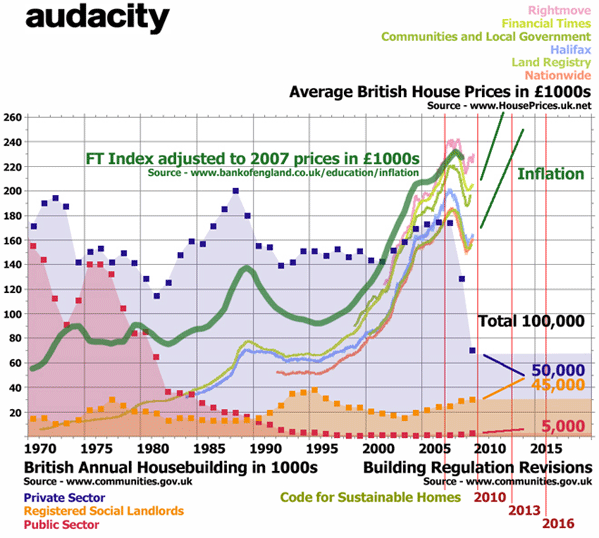
  • Predicting the Future of British House Building

    People are expecting British house building to pick up. Sadly they will be disappointed, even as the housing market inflates into another bubble.

    There have been declines and recoveries in British house building before the 2007 collapse in construction activity. Data is in abundance. The total number of homes built annually has more than halved since the late 1960s, as successive governments withdrew from publicly funding the post-war welfare programme of council house building. There have been ups and downs in the volume of private housing built. After building 175,000 private homes in 2007 many expected that the market for new private housing would eventually recover from the financial crisis. The pent up demographic demand for new private housing would surely lead to a recovery of building if financing were made available. It seems irrational to suggest that the supply of housing will not recover to meet demand.

    In July 2008 audacity argued that British house builders would be collectively reduced in the planning regulated market to building 100,000 homes in 2009. They would shift from aspiring to build in “volume” to making their money from planning approved “eco-homes” for a luxury market. This has already occurred and there will be no necessary recovery of volume in a few years. Production may even decline from that level of inactivity.

    There seems little demand for new housing from the Public. Instead, we seem to be most concerned that housing continues to inflate in value as an asset. Most see obvious advantages in housing asset inflation, while complaining of the unaffordability of better housing. Britain is experiencing house price inflation again, but home owners know that the worsening gap between household income and the cost of buying a home, even on very low rates of interest, is frustrating new buyers, and the young in particular.

    Gordon Brown knows that playing the housing market is a mainstream activity for the electoral majority. New Labour is doing what is necessary to revive housing asset inflation. Some had hoped that the bursting of the bubble in 2007 would reconnect house prices with household income. Young people were understandably most hopeful of that prospect. Now prices are drifting upwards again to unaffordable highs. This is happening nationally, but is particularly true in greater London, where average house prices have recovered to nearly £270,000, which is where they were before the collapse of Lehman Brothers in September 2008. This makes an average house “affordable” to those earning more than £90,000 a year. That is a very small percentage of the region’s home buying public.

    Here’s what the restoration of higher prices means nationally, and in London in particular. There will be greater social immobility, expressed in more commuting, an extension of families, and several households living in the same home. Overcrowding will be more likely. Homelessness may slightly increase, but most housing difficulty will be accommodated within the existing stock.

    The mainstream majority of the electorate – those already owning homes – is likely to be grateful that the burst bubble did not turn into a crash. New Labour will try to take the credit for averting any further financial disaster. What will be ignored is that house price inflation suits Britain’s politicians, and the lending institutions in The City. The British economy is too weak to pay higher wages, and the mainstream majority are too politically weak to challenge that predicament. What other future is there for Britain except another asset inflation bubble?

    The problem then with restoring the Brown bubble is it solves none of our fundamental problems: notably a weak economy, low wages and lack of decent housing. David Cameron’s Conservative opposition will not make any difference to that predicament. They want to get rid of regional tiers of planners and to return control to local authorities, as was the intention of the 1947 Town and Country Planning Act. That is the legislation that stops the British public from building housing on cheap farmland.

    But it’s doubtful they will try to break the back of housing inflation and our country’s dependence on it. The British economy depends greatly on The City, which needs to expand the £1.2 trillion of mortgage lending in a secure way for lenders in the global financial system. This only happens when existing house prices are maintained well above the cost of constructing new ones, and best in a period of asset inflation. The trickle of new homes onto the market could reduce, and while any demographic demands of a growing population for the utility of housing would not be met, the political and economic demand for asset inflation and loan security will be satisfied.

    The way in which existing homes are made more expensive than the cost of building new ones is to inflate the price of land and keep it inflated. It is the high price of land approved for development within the 1947 legislation that is unaffordable. That is why government and house builders recognise there is “planning gain” to be negotiated over, as the uplift in land value that follows an approval to develop.

    Yet this stands in the way of a clear public interest. Government housing experts argue we need at least 240,000 new homes a year to meet demographic demand. Our inability, or even unwillingness, to tackle this issue would have shocked either the Conservatives or the Socialists of the last Century.

    What matters is to make materialist sense of the future. Society can’t live off asset inflation and debt. We must build new housing.

    We face a serious predicament today. Small quantities of highly subsidised and high density “eco-homes” are to be built by socially motivated architects, some working with the former “volume” house builders. How can building an insufficient number of homes be called “sustainable”? Instead of building new replacement homes Britain is also looking to finance a greener and endlessly refurbished housing stock, while producing too few “eco-homes” even to accommodate yearly household growth.

    The finance obsessed Green Capitalists of today are worse than their counterparts from a century ago. At least the Capitalists of the past were materialists, who believed in building more, and developing a construction industry based on materials manufacture and the skills of the workers they exploited. Those Capitalists were progressive materialists.

    The new capitalists in housing are not even interested in meeting the needs of the working and middle classes, but in pleasing environmentalists. Unsurprisingly, they also will not have to hire too many workers to build their meagre product. Today Capitalists are abandoning industrial production in favour of finance, and this is nowhere more evident than in housing. Hiding behind the moral claims of environmentalism the Capitalists of twenty-first century Britain have clearly abandoned any idea of social progress, when once they could claim to be materialists. What is noticeable is that they have so many moralistic Greens cheering them on.

    Sadly, there is no political association today to oppose Green Capitalists operating a nationalised planning system, in their effort to realise asset inflation in the form of a housing market. New Labour under Gordon Brown will not change this – indeed he clearly favours housing inflation and the City over the needs of aspiring families. So do the Conservatives under David Cameron. At the same time, they can play to a green constituency, which now dominates the media.

    Given the current planning regime and the moral imperative for building “eco-homes”, British house builders will be reduced to building around 100,000 homes for a very long time. They will aspire not to build in “volume” but instead take pride that their homes are “sustainable”.

    Only a political challenge will improve the situation. Gordon Brown faces no political challenge from David Cameron. He never will. Under New Labour or the Conservatives the only future for house builders will be to offer highly differentiated luxury “eco-homes” for the equity rich, or the top quintile of earners, supported with high subsidies in some form to build affordable “eco-homes”. Architects will particularly benefit from this shift in the market.

    New Labour will build a few council homes more as a publicity stunt to keep their middle class Old Labour supporters amused. Conservatives will not bother about such nonsense. They will both insist on “zero carbon” new housing by 2016. Both will focus on refurbishment of the existing stock, not replacement. Both will exclude more land from the planning system.

    The only people who will challenge this predicament, this retreat of Capitalism from population growth and industrial productivity, will be the working mainstream middle. Brown thinks he has bought off the majority of home owners with asset inflation, and temporarily he might have relieved many. Cameron thinks he can further mobilise established local residents attempting to extract more “gain” from the planning system. He imagines local opposition to development aggregating to a general protection of house price inflation nationally.

    These Red/Green and Blue/Green political leaders might be proved wrong. The construction industry matters, and with argumentative organisation materialists might push for house building against the greens of Britain. Most of all there is the new generation of British people – those entering their 20s and 30s – who will demand something other than over-priced, undersized and often miserably maintained housing for themselves and their families.

    A longer version of this article originally appeared at www.audacity.org/IA-07-11-09.htm

    Ian Abley, Project Manager for audacity, an experienced site Architect, and a Research Engineer at the Centre for Innovative and Collaborative Engineering, Loughborough University. He is co-author of Why is construction so backward? (2004) and co-editor of Manmade Modular Megastructures. (2006) He is planning 250 new British towns.

  • Executive Editor JOEL KOTKIN in Forbes regarding Obama

    A good friend of mine, a Democratic mayor here in California, describes the Obama administration as “Moveon.org run by the Chicago machine.” This combination may have been good enough to beat John McCain in 2008, but it is proving a damned poor way to run a country or build a strong, effective political majority. And while the president’s charismatic talent — and the lack of such among his opposition — may keep him in office, it will be largely as a kind of permanent lame duck unable to make any of the transformative changes he promised as a candidate.

    Joel on Forbes

  • Contributing Editor AARON RENN on Dallas News regarding Portland

    Among the media, academia and within planning circles, there’s a generally standing answer to the question of what cities are the best, the most progressive and best role models for small and midsize cities. The standard list includes Portland, Seattle, Austin, Minneapolis and Denver. In particular, Portland is held up as a paradigm, with its urban growth boundary, extensive transit system, excellent cycling culture and a pro-density policy. These cities are frequently contrasted with those of the Rust Belt and South, which are found wanting, often even by locals, as “cool” urban places.

    Aaron on Dallas News

  • Executive Editor JOEL KOTKIN on Law Professor Blog regarding cities

    “Meanwhile, Joel Kotkin of New Geography and Forbes continues to pour empirical water on Florida’s creative class thesis in Numbers Don’t Support Migration Exodus to “Cool” Cities”

    Joel on Law Professor Blog

  • Editor WENDELL COX on Education for the Driving Masses regarding traffic

    “With the ring road open around the north part of the city, highway traffic and truckers can now avoid the congestion and lights of 16th Avenue and bypass Calgary. According to transportation expert Wendell Cox the ring road is a step in the right direction.”

    Wendell on Education for the Driving Masses

  • Contributing Editor AARON RENN on EMSI regarding green economy

    Newgeography.com’s Aaron Renn discusses the effects of reducing carbon emissions on regional economies. Renn concludes the article this way: “In short, action on carbon reduction may well be a good policy goal. But we shouldn’t embrace any means to that end uncritically if it creates huge distortions in regional economic advantage or further damages America’s industrial competitiveness.”

    Aaron on EMSI

  • Executive Editor JOEL KOTKIN on Reuters regarding Obama

    “The key rule of Chicago politics is delivering the spoils to supporters, and Obama’s stimulus program essentially fills this prescription. The stimulus’s biggest winners are such core backers as public employees, universities and rent-seeking businesses who leverage their access to government largesse, mostly by investing in nominally “green” industries. Roughly half the jobs saved form the ranks of teachers, a highly organized core constituency for the president and a mainstay of the political machine that supports the Democratic Party.”

    Joel on Reuters