Blog

  • High Speed Rail: Not One Big Happy Family

    California High Speed Rail Commission member Rod Diridon is chafing at all of the competition that has been created by the billions committed by the federal government to high speed rail. According to a New York Times report, he called many of the proposed systems around the country “vultures” and told an American Public Transportation Association meeting “If I can borrow a term from our good friends in labor, they are a ‘Do not patronize… And I cannot say it any stronger”. Consistent with that view, Diridon urged that the federal government be asked to commit all of its current $8 billion in funds to the California project.

    There may be even more disturbing news for Diridon: new competition has appeared on the horizon. A report (page 23) by the David Suzuki Foundation and the Pembina Institute (both of Canada) suggests that:

    “Using the Edmonton – Calgary example as a template, judgmentally adjusted for distance, geography and relative land values, we estimate that a full high-speed link would cost about $4 billion. If the cost were shared equally between Canada and the United States, the Canadian total would be about $2 billion.”

    Why stop at that? How about getting a quarter each from Zimbabwe and the Honduras? It would certainly make it less expensive for Canadian taxpayers. Perhaps our friends to the North simply made a typographical error, but perhaps not. Stranger things have been proposed.

  • Obama Still Can Save His Presidency

    A good friend of mine, a Democratic mayor here in California, describes the Obama administration as “Moveon.org run by the Chicago machine.” This combination may have been good enough to beat John McCain in 2008, but it is proving a damned poor way to run a country or build a strong, effective political majority. And while the president’s charismatic talent – and the lack of such among his opposition – may keep him in office, it will be largely as a kind of permanent lame duck unable to make any of the transformative changes he promised as a candidate.

    If Obama wants to succeed as president he must grow into something more than movement icon, become more of a national leader. In effect, he needs to hit the reset button. Here are five key changes that Obama can implement to re-energize and save his presidency.

    1. Forget the “Chicago way.” The Windy City is a one-party town with a shrinking middle class and a fully co-opted business elite. The focused democratic centralism of the machine – as the University of Illinois’ Richard Simpson has noted – worked brilliantly in the primaries and even the general election campaign. But it is hardly suited to running a nation that is more culturally and politically diverse.

    The key rule of Chicago politics is delivering the spoils to supporters, and Obama’s stimulus program essentially fills this prescription. The stimulus’s biggest winners are such core backers as public employees, universities and rent-seeking businesses who leverage their access to government largesse, mostly by investing in nominally “green” industries. Roughly half the jobs saved form the ranks of teachers, a highly organized core constituency for the president and a mainstay of the political machine that supports the Democratic Party.

    The other winners: big investment banks and private investment funds. People forget that Obama, even running against a sitting New York senator, emerged as an early favorite among the hedge fund grandees. As The New York Times’ Andrew Sorkin put it back in April, “Mr. Obama might be struggling with the blue-collar vote in Pennsylvania, but he has nailed the hedge fund vote.”

    At best, the president’s policy seems like Karl Rove in reverse, essentially smooching the core and ignoring the rest. This is a formula for more divisiveness, not the advertised “hope” Americans expected last November.

    2. Focus on Real Jobs, Not Favored Constituencies . The Chicago approach works better in a closed political system controlled by a few powerbrokers than in a massive continental economy like the U.S. Health care and education, which depend on government largesse, are surviving. But the critical production side of the economy that generates good blue-collar jobs – like agriculture, manufacturing and construction – is getting the least from the stimulus.

    These industries need more large-scale infrastructure spending, as well as more focused skills training and initiatives to free capital for politically unconnected entrepreneurial businesses. Instead, productive industries face the prospect of more regulation while capital for small businesses continues to dry up.

    Those in post-industrial bastions tied to speculative capital – think Manhattan and the Hamptons – are the ones most benefiting from Obamanomics. College towns like Cambridge, Mass., Madison, Wis., Berkeley, Calif., and Palo Alto, Calif., will also prosper, becoming even richer and more self-important. It seems, then, that Obama has done best for elite graduates of Harvard and Stanford and other members of the “creative class.”

    The rest of America, however, is still waiting for a real sustained recovery. Industrial and office properties remain widely abandoned not only in Detroit but Silicon Valley. The future sustainability of our economy depends mostly on what happens to those who previously staffed these facilities – those who produced actual goods and services – not just on a relative handful of people working at Google or the national laboratories. In other words, we need jobs for machinists, welders and marketers as well as scientists with Ph.D’s.

    3. Step on the Gas. Providence has handed America – and Obama – an enormous gift in the now recoverable deposits of natural gas found across the continent. Proven levels have been soaring and now amount to 90 years’ supply at current demand. More will be found, and across a wide section of the country.

    Natural gas may be a fossil fuel, but it is relatively clean and thus the perfect intermediate solution to our energy problems. The problem: The president’s green advisers will seek to prevent developing these resources.

    Although Obama should support strong environmental controls on gas extraction, the greens should not be allowed to block this unique and historic opportunity to shift economic power back to North America. Along with modest increases in domestic and Canadian oil, natural gas could end our dependence on fossil fuels from outside North America. This would relieve our military from the onerous task of defending other people’s oil supplies. But most important, the new energy sources could expand our industrial and agricultural economies so they can capitalize on the huge potential growth from markets at home and in the developing world.

    The natural gas era could then finance continued research and deployment of renewable fuels. Let’s give it the 10 or 20 years that great transformations require. Quick fixes will lead us to subsidize the purchase of rapidly dated technology from China or Europe; we should aim at the energy equivalent of the moon shot, helping forge a huge technological advantage.

    4. Rediscover America. As a candidate, Obama spoke movingly about his Kansas roots, but lately he seems to have become all big city all the time. This administration offers very little to people who live in places like Kansas, as many of my heartland Democrat friends complain.

    Urbanites often forget that this is an enormous country. Crowded into dense cities themselves, they fail to look down from the window when crossing the country by plane. The vast majority of America is, well, vast – sparsely settled, if settled at all.

    Moreover, Obama’s people need to understand that 80% of America live in suburbs or small towns. They do not want to live in dense cities or realize a move there would mean living in less than idyllic conditions. If Obama wants to shape a green America, he must find ways that work with the majority’s preferences.

    But so far the president’s housing, transport and planning advisers seem to be pushing the death of suburbia and promoting ever more densification. It’s hardly surprising, then, that suburbs and small towns feel left out. After finally starting to inch toward the Democrats, they are now turning again to the right. If Democrats want to retain their majority, they need the strong support of these constituencies – without it the Congressional majority will be gone by the end of the second term, if not the first.

    5. Chuck the Nobel; Embrace Exceptionalism. Many progressives love Obama because they see him as one of them in the struggle with what the immortal Bill Maher calls “a stupid country.” But the president should remind himself that the country may not be quite as dumb as it sometimes looks from Oslo – or from Dupont Circle, Cambridge or Soho.

    Being smart was part of the reason the Republicans lost the majority. The voters understood the country was wasting resources – and young people – on internecine conflicts for energy that we could produce at home. The Bush years also undermined any GOP claim to fiscal responsibility.

    Initially Obama allowed us to redefine American exceptionalism as something more than monomaniacal use of force and overconsumption. He spoke to our traditions of inclusiveness, adaptability and idealism. He offered the perfect vehicle because he and his story are so exceptional. Yet Obama sometimes seems more interested in serving as the apologizer rather than as commander in chief. His vision appears less American than pseudo-European.

    This is not the path to success for American presidents. Whether Ronald Reagan or Franklin Roosevelt, Harry Truman or even Bill Clinton, a president has to be a spokesman for his country. Right now, on the world stage, Obama is looking more and more like Jimmy Carter.

    I suggest these things because, for all his missteps over the past year, Barack Obama is my president and I want him to succeed. But to do so, first he needs to hit his own reset button – and the sooner the better. Unlike some, I do not believe the Obama presidency is already doomed. Presidents often grow in office: Despite his exceptionalism in other areas, let’s hope that Obama proves the norm here.

    This article originally appeared at Forbes.com.

    Joel Kotkin is executive editor of NewGeography.com and is a distinguished presidential fellow in urban futures at Chapman University. He is author of The City: A Global History. His next book, The Next Hundred Million: America in 2050, will be published by Penguin Press early next year.

    Official White House Photo by Pete Souza

  • Urban Youth Deserve Chance to Hear About Service Academies

    Here’s a disturbing thought as Veterans Day approaches: Some teachers and administrators of the Los Angeles Unified School District (LAUSD) refuse to allow visits to high school campuses by representatives of the service academies that train young officers.

    The service academies have all earned reputations as fine academic institutions that go further on training future officers. There is the U.S. Military Academy; the U.S. Naval Academy; the U.S. Air Force Academy; the U.S. Coast Guard Academy; and the U.S. Merchant Marine Academy. They all offer full scholarships and require five years of service after graduation.

    Candidates must meet demanding standards on academics, physical fitness, and extra-curricular activity. They are generally required to secure a nomination from a member of the U.S. Congress, the president, or the vice president.

    The merit involved in gaining a nomination, along with the geographic apportionment by Congressional districts, offers the chance to draw candidates from across the socio-economic spectrum. Graduation from a service academy offers young officers from every corner of society the chance to reach significant rank.

    Measure that against the LAUSD teachers and administrators who deem a career as a military officer to be unworthy of a hearing at high school campuses. Some will tell you that they object because our wars are fought by too many young persons of color. Others view the “don’t ask, don’t tell” policy on gays in the military as contemptible prejudice.

    These objections are absurd. Our civilian leadership decides the actions and policies of the military. War or peace? That’s in the hands of the president and Congress. Gays in the military? Same story.

    It’s true that our military stands ready for war if so directed by the civilian leadership of our democracy. It’s also notable that never in the course of history has any institution possessed the war-making might of the U.S. military. And never has an institution in such a position yielded so loyally to the will of unarmed leadership. This sense of duty has lasted through good and bad, gallant victories and horrific mishaps. Never has there been a serious challenge to civilian oversight.

    All of that is overlooked by LAUSD teachers and administrators—and their boycotts have an effect. Some members of Congress who represent Los Angeles have chronic difficulty in filling the number of nominations they are allowed to make to the service academies each year. They aren’t coming up short on qualified candidates. They can’t even get that far—not enough young achievers know about the possibilities of the service academies.

    It’s time that someone gave these alleged educators who forbid any discussion of service academies a lesson on the honorable history of our military. They should also be reminded that it will require representatives from throughout our society—rich and poor, all colors and creeds, town and country—to keep this line of honorable service intact.

    Keeping knowledge of the service academies away from youngsters in our city is nothing short of demographic censorship. It is time for LAUSD to put an end to the practice.

  • A Slow Job Recovery in Silicon Valley

    Although job growth is gradually returning to Silicon Valley, don’t break out the champagne quite yet.

    Lucia Mokres moved to the area five years ago. Last year, when she was working at a contract engineering and manufacturing firm, she saw several clients lose their jobs, as well as both large and small companies go under in the economic crunch. She remembers one conference vividly. While manning the event booth, instead of seeing people pitch work they had for her firm, they instead passed out resumes, asking her team for work.

    Soon after, her job was cut back from 5 days per week to 4 days, which included a 20% pay cut. Mokres said, “That was really hard, as my rent and student loans did not also get cut 20%.”

    She persisted over “many months” to find a better position, which ultimately resulted in a higher salary and better benefits as a clinical scientist in a medical device company based in Menlo Park, Calif. Looking ahead now, Mokres feels optimistic about her future in Silicon Valley and said, “I am in the medical industry, and there will always be a demand for medical technology and healthcare.”

    “There are worse places to be,” she added. “I’m in one of the top two biotech hotspots in the country. Silicon Valley breeds innovation, and therefore will survive.”

    Harold Lee* feels less cheerful. He was the class president at a tier one university several years ago, and since graduating in 2004, he has worked at several of the top companies in Silicon Valley. He is now a product manager at a social networking startup based in Mountain View, Calif. While he couldn’t imagine leaving the area, he summarized his long-term prospects in one word: “limited.”

    Lee counts himself lucky to have a job at a popular startup, when the signs around him are still troubling. “There’s definitely a palpable feeling of companies scaling back,” he said. “Free lunches are no longer free, snacks are rationed out a bit more, and there’s a lot more focus on measured productivity.”

    Reports from friends and peers, particularly those who have been laid off in the last year, have not lifted the gloom. Said Lee, “Things have settled down to the point where people aren’t frightened, but I doubt anyone would be surprised if they got a pink slip tomorrow.” He added, “Trying to get a job is immensely difficult. I have friends who returned to get their graduate degrees in business, who now can’t land anything.”

    The lagging indicator in economics is jobs, which, for the average worker, has the biggest personal impact. Over the last year, California lost 732,700 jobs, the worst hit of all U.S. states, according to the U.S. Bureau of Labor Statistics.

    The job situation in Silicon Valley has not rebounded as quickly as hoped. The area’s jobless rate is nearly double what it was a year ago, according to the state’s Employment Development Department. Nearly three times as many people are actively looking for work, versus during the dot-com bust, when the jobless rate peaked at 9.2 percent in early 2003. The recent number of unemployed is 110,900, representing an 87 percent increase from the prior year, according to the EDD.

    The technology industry has continued to take a beating in the past six months. Cisco cut 700 local jobs in July, and Lockheed Martin slashed nearly 500 local jobs in August, based on state filings. Most recently in October, Sun Microsystems Inc. announced that it would eliminate up to 3,000 jobs across all sites, or 10 percent of its worldwide work force through the new year, due to the takeover by Oracle Corp.

    The larger question is if the recovery in Silicon Valley will be technology-led. Many believe that the tech industry, which dominates local economics, will lead other companies out of the recession. Does a rising tide lift all boats? Due to the slower return of jobs, it will likely take more time for tech companies to generate the tax revenue needed to support the service sector and other programs again.

    However, local leaders and economists feel that the worst has passed. The usual suspects are optimistic. Stanford University recently hosted its fourth annual roundtable, and the panel discussion dove immediately into the economic crisis. Moderated by television host Charlie Rose, the panel included Eric Schmidt, chairman of the board and chief executive officer of Google; Penny Pritzker, who serves on President Barack Obama’s Economic Recovery Advisory Board; Guillermo Ortiz, governor of the Bank of Mexico; Stanford Economics Professor Caroline Hoxby; Garth Saloner, dean of the Stanford Graduate School of Business; and Stanford President John Hennessy.

    Google’s CEO Schmidt told the audience: “We know that things are improving. We’re seeing everyone come up at the same time, which is a good sign.”

    Other experts, who track economic growth, echo similar sentiments. The perennially optimist Stephen Levy of the Center for Continuing Study of the California Economy has told press that, while Silicon Valley will continue to lose some jobs, revival signs are encouraging. He said, “We’re on the road to recovery.”

    Not everyone has the same rosy forecast. Job growth in the Valley has not been creating net jobs for over a decade. Some individuals have done well, but the path to upward mobility may not be as cheery as the professional boosters and Valley insiders suggest. While the information sector for the three major Valley cities – specifically the cluster of San Jose, Sunnyvale, and Santa Clara – grew the fastest of all nonfarm sectors at nearly 31 percent since 2003, overall employment has actually dropped by 6 percent over the last 12 years, according to data from the U.S. Bureau of Labor Statistics.

    Judy Huang has learned this lesson the hard way. After working nine years with local technology companies, she has returned to job hunting and found that the road to recovery is much rockier up close. After witnessing several friends struggle similarly, she set up a community group called “Yes We All Can” to support other job seekers with emotional support and job tips. Huang explained, “We have more fun doing it with a little help from our friends.” Since she started the group in May, roughly a quarter of group members have found job positions.

    Hiring specialists have also seen slow growth. Andrew Adelman has not seen any particular sector bounce back yet in Silicon Valley, although he thinks that the recovery will likely start with companies that focus on efficiencies in operations. Adelman directs CoreTechs, Inc., a temporary contract staffing firm that specializes in technical and accounting positions. He noted, “Most companies we speak to are on freezes until they feel confident in either maintaining their current revenue or some pick up. Until they have that confidence, nothing is going to change.”

    He felt that the last economic crash was focused mainly on Internet companies and supporting services. In his view, the current downturn is much more widespread. Many companies outside the tech industry have had to face staff cutbacks and shrinking revenue, and their paranoia feeds a deeper dread. He said, “The fear this time around is much more pervasive and thus much more damaging in the stagnation it causes. Once the fear starts to wane will be when a true recovery starts to take hold.”

    Lei Han agrees. Based in San Francisco, she started a blog, “Career Coach – I am in your corner,” in February, which allows her to mentor and encourage individuals on a broader scale. From the worker’s perspective, she said, “They are all worrying more about their careers and jobs. Almost everyone I know knows someone who has been laid off.”

    She added, “Ironically, people who have a job are also worried. There is a bit of survivor guilt, as well as survivor nonchalance.”

    Despite recent challenges, there are several reasons for workers to be optimistic. At the top of the list, Silicon Valley still remains the world’s hotbed of innovation.

    John Lekashman, an engineering executive who has lived in Silicon Valley since 1983, has seen the region survive many downturns. He laughed, “We have been iron oxide valley, and silicon valley, and software valley, and social media valley and biotech valley, and solar valley, and nanotech valley, and any of a bunch of other random new ideas that fly.”

    From his experience, workers in Silicon Valley persevere. The region fosters a culture of renewal and failure, which will provide an economic buffer until the jobs become plentiful again.

    * Not his real name

    Tamara Carleton is a doctoral student at Stanford University, studying innovation culture and technology visions. She is also a Fellow of the Foundation for Enterprise Development and the Bay Area Science and Innovation Consortium.

  • Forgetting Middle Skill Jobs

    A new report from Skills2Compete attempts to address a national problem which continues to diminish our country’s competitive edge in the global economy. The loss of middle-skill jobs and the lack of qualified workers to fill the remaining jobs are major barriers, not only to our economic recovery, but also to our ability to sustain a high quality of life for succeeding generations. The report concludes that a new state policy is needed to align the workforce and education and training to better meet California’s labor market demand. Accomplishing that goal means improving basic skills in the workforce and ensuring that skills training and education is available to anyone post high school. A major policy change is a good start, but the report does not go far enough in addressing what is needed to restore the importance of middle-skill jobs to the economy.

    Part of the challenge lies with the current mindset of the public education system and parents who value and push college as the only track to a well-paying and satisfying job. This leaves out a large segment of youth and the workforce who are not college bound and who need training and skills and encouragement to fill middle-skill jobs. Where does a high school student get vocational training or learn about middle skill jobs? Remember woodworking? Metal shop? Drafting?

    Vocational education was the name of the program that provided these courses, but now it’s labeled “career tech” and the classes are no longer available in most public high schools. As a result, students have little awareness of these careers. A few years ago, while conducting focus groups of freshman and sophomore students, I was stunned to learn that many did not know what an electrician, welder, auto technician, or HVAC technician did and worse, they disdained those jobs because they thought they were “dirty” and didn’t pay well. This doesn’t bode well for a functioning society or economy. Who will service our cars, fix our plumbing, and build machinery to process our food or the solar panels to heat our homes? It will take more than a policy change to transform awareness, perceptions and values about middle-skill jobs.

    The last economic boom was sustained, not by wealth created by high value manufacturing jobs, but by unbridled consumer spending particularly for houses and retail goods. If we want that standard of living to return, then we must address the greater challenge of how to grow and sustain an economy driven by production of goods instead of consumption. Along with a paradigm shift in our educational system that recognizes the importance of middle skill jobs, we must change our attitudes about work and what creates value not only for our economy but our worth to society.

    We continue to hold on to arcane principles and entitled expectations about work that are increasingly less relevant in a fast-paced globalized world. We are not prepared to re-invent ourselves and our careers in terms of continuous learning of new skills and training either for middle-skill or knowledge jobs. That is what is ultimately needed to succeed in the rapidly changing workplace.

    Leslie Parks has spent over ten years as a practitioner and consultant in the fields of economic and workforce development. She recently served as Director of Downtown Management and Industrial Development for the San Jose Redevelopment Agency until September 23, 2009 when she and 24 colleagues were laid off due to significant budget cuts. Leslie is now preparing for yet another career in the 21st Century workplace.

  • It’s Crowded Out Here

    Do you know that where I’m sitting right now, the population density is 2,787,840 people per square mile?

    And here are two other numbers (from Wikipedia) that you shouldn’t believe: The population density of Manhattan is 71,201/sq mi. And of Australia: 7.3/sq mi.

    And now a number that might just be credible: Hong Kong has 2,346.1/sq mi.

    My personal population density I got by allotting myself 10 square feet, and then extrapolating to a square mile. True, as far as it goes, but this must be what Mark Twain meant by “lies, damned lies, and statistics.”

    Population densities (PDs) have meaning only if averaged over some relevant space. The size of that space is a matter of geographical judgment, and cannot simply be left to the statistician’s computer.

    Australia’s is easy to discredit: 90% of the country is empty desert. The habitable land (on which the population survives) is much smaller, and the relevant population density must therefore be (a still low) 70-80 people per square mile.

    So let’s consider some relevant spaces. We’ll start in Indiana, come back to New York, and end up in Hong Kong.

    Indiana is a state where the population is fairly evenly dispersed: there are no large uninhabited spaces, and likewise, no megacities of enormous density. The PD is 169.5/sq. mile.

    In Table 1, I have taken 2000 census data and ranked Indiana counties by population, reporting also the land area and the density.

    Geographic area

    Population

    Land
    area
    Pop.
    Density/sq.
    mi of land

    Cumulative Population
    Cumulative area
    Cumulative Density
    Anti-cumulative Density
     
    Indiana
    6,080,485
    35,867
    169.50
     
    #
    COUNTY
    1
    Marion County
    860,457
    396.25
    2,171.50
    860,457
    396.25
    2,171.50
    169.53
    2
    Lake County
    484,556
    496.98
    975.00
    1,345,012
    893.23
    1,505.79
    147.16
    3
    Allen County
    331,846
    657.25
    504.90
    1,676,858
    1,550.48
    1,081.51
    135.40
    4
    St. Joseph County
    265,577
    457.34
    580.70
    1,942,435
    2,007.82
    967.43
    128.32
    5
    Elkhart County
    182,788
    463.81
    394.10
    2,125,223
    2,471.63
    859.85
    122.21
    6
    Hamilton County
    182,734
    397.94
    459.20
    2,307,957
    2,869.57
    804.29
    118.44
    7
    Vanderburgh County
    171,916
    234.57
    732.90
    2,479,873
    3,104.14
    798.89
    114.33
    8
    Tippecanoe County
    148,937
    499.79
    298.00
    2,628,811
    3,603.93
    729.43
    109.90
    9
    Porter County
    146,798
    418.11
    351.10
    2,775,609
    4,022.04
    690.10
    106.99
    10
    Madison County
    133,378
    452.13
    295.00
    2,908,987
    4,474.17
    650.17
    103.78
    11
    Monroe County
    120,553
    394.35
    305.70
    3,029,540
    4,868.52
    622.27
    101.03
    12
    Delaware County
    118,774
    393.29
    302.00
    3,148,314
    5,261.81
    598.33
    98.42
    13
    Johnson County
    115,204
    320.19
    359.80
    3,263,518
    5,582.00
    584.65
    95.81
    14
    LaPorte County
    110,136
    598.24
    184.10
    3,373,654
    6,180.24
    545.88
    93.02
    15
    Vigo County
    105,864
    403.29
    262.50
    3,479,518
    6,583.53
    528.52
    91.18
    16
    Hendricks County
    104,099
    408.39
    254.90
    3,583,616
    6,991.92
    512.54
    88.82
    17
    Clark County
    96,460
    375.04
    257.20
    3,680,077
    7,366.96
    499.54
    86.47
    18
    Howard County
    84,961
    293.07
    289.90
    3,765,038
    7,660.03
    491.52
    84.23
    19
    Kosciusko County
    74,068
    537.5
    137.80
    3,839,105
    8,197.53
    468.32
    82.09
    20
    Grant County
    73,408
    414.03
    177.30
    3,912,513
    8,611.56
    454.33
    81.01
    21
    Bartholomew County
    71,441
    406.84
    175.60
    3,983,954
    9,018.40
    441.76
    79.54
    22
    Wayne County
    71,109
    403.57
    176.20
    4,055,063
    9,421.97
    430.38
    78.09
    23
    Floyd County
    70,818
    148
    478.50
    4,125,881
    9,569.97
    431.13
    76.59
    24
    Morgan County
    66,702
    406.47
    164.10
    4,192,582
    9,976.44
    420.25
    74.33
    25
    Hancock County
    55,377
    306.12
    180.90
    4,247,960
    10,282.56
    413.12
    72.92
    26
    Warrick County
    52,387
    384.07
    136.40
    4,300,347
    10,666.63
    403.16
    71.63
    27
    Henry County
    48,527
    392.93
    123.50
    4,348,874
    11,059.56
    393.22
    70.64
    28
    Noble County
    46,291
    411.11
    112.60
    4,395,165
    11,470.67
    383.17
    69.80
    29
    Dearborn County
    46,117
    305.21
    151.10
    4,441,282
    11,775.88
    377.15
    69.08
    30
    Boone County
    46,091
    422.85
    109.00
    4,487,372
    12,198.73
    367.86
    68.04
    31
    Lawrence County
    45,915
    448.83
    102.30
    4,533,288
    12,647.56
    358.43
    67.31
    32
    Marshall County
    45,138
    444.27
    101.60
    4,578,426
    13,091.83
    349.72
    66.63
    33
    Shelby County
    43,451
    412.64
    105.30
    4,621,877
    13,504.47
    342.25
    65.95
    34
    Jackson County
    41,356
    509.31
    81.20
    4,663,233
    14,013.78
    332.76
    65.23
    35
    Cass County
    40,915
    412.87
    99.10
    4,704,148
    14,426.65
    326.07
    64.85
    36
    DeKalb County
    40,280
    362.88
    111.00
    4,744,428
    14,789.53
    320.80
    64.19
    37
    Dubois County
    39,654
    430.09
    92.20
    4,784,082
    15,219.62
    314.34
    63.39
    38
    Knox County
    39,255
    515.83
    76.10
    4,823,337
    15,735.45
    306.53
    62.79
    39
    Huntington County
    38,068
    382.59
    99.50
    4,861,404
    16,118.04
    301.61
    62.45
    40
    Montgomery County
    37,636
    504.51
    74.60
    4,899,041
    16,622.55
    294.72
    61.73
    41
    Miami County
    36,097
    375.62
    96.10
    4,935,138
    16,998.17
    290.33
    61.39
    42
    Putnam County
    36,023
    480.31
    75.00
    4,971,161
    17,478.48
    284.42
    60.70
    43
    Wabash County
    34,954
    413.17
    84.60
    5,006,115
    17,891.65
    279.80
    60.33
    44
    LaGrange County
    34,920
    379.56
    92.00
    5,041,035
    18,271.21
    275.90
    59.77
    45
    Harrison County
    34,305
    485.22
    70.70
    5,075,340
    18,756.43
    270.59
    59.07
    46
    Clinton County
    33,866
    405.1
    83.60
    5,109,206
    19,161.53
    266.64
    58.74
    47
    Adams County
    33,631
    339.36
    99.10
    5,142,837
    19,500.89
    263.72
    58.14
    48
    Steuben County
    33,218
    308.72
    107.60
    5,176,055
    19,809.61
    261.29
    57.29
    49
    Greene County
    33,154
    541.73
    61.20
    5,209,209
    20,351.34
    255.96
    56.33
    50
    Gibson County
    32,504
    488.78
    66.50
    5,241,713
    20,840.12
    251.52
    56.15
    51
    Jefferson County
    31,692
    361.37
    87.70
    5,273,405
    21,201.49
    248.73
    55.82
    52
    Whitley County
    30,700
    335.52
    91.50
    5,304,105
    21,537.01
    246.28
    55.03
    53
    Jasper County
    30,065
    559.87
    53.70
    5,334,170
    22,096.88
    241.40
    54.18
    54
    Daviess County
    29,802
    430.66
    69.20
    5,363,972
    22,527.54
    238.11
    54.20
    55
    Wells County
    27,599
    369.96
    74.60
    5,391,571
    22,897.50
    235.47
    53.71
    56
    Jennings County
    27,537
    377.22
    73.00
    5,419,108
    23,274.72
    232.83
    53.12
    57
    Randolph County
    27,396
    452.83
    60.50
    5,446,504
    23,727.55
    229.54
    52.52
    58
    Washington County
    27,213
    514.42
    52.90
    5,473,717
    24,241.97
    225.80
    52.23
    59
    Posey County
    27,043
    408.5
    66.20
    5,500,760
    24,650.47
    223.15
    52.20
    60
    Clay County
    26,571
    357.62
    74.30
    5,527,331
    25,008.09
    221.02
    51.69
    61
    Ripley County
    26,514
    446.36
    59.40
    5,553,844
    25,454.45
    218.19
    50.94
    62
    Fayette County
    25,580
    214.96
    119.00
    5,579,425
    25,669.41
    217.36
    50.58
    63
    White County
    25,262
    505.24
    50.00
    5,604,687
    26,174.65
    214.13
    49.14
    64
    Decatur County
    24,554
    372.6
    65.90
    5,629,241
    26,547.25
    212.05
    49.09
    65
    Starke County
    23,569
    309.31
    76.20
    5,652,810
    26,856.56
    210.48
    48.42
    66
    Scott County
    22,961
    190.39
    120.60
    5,675,772
    27,046.95
    209.85
    47.46
    67
    Franklin County
    22,156
    386
    57.40
    5,697,928
    27,432.95
    207.70
    45.89
    68
    Owen County
    21,801
    385.18
    56.60
    5,719,729
    27,818.13
    205.61
    45.36
    69
    Jay County
    21,791
    383.64
    56.80
    5,741,520
    28,201.77
    203.59
    44.82
    70
    Sullivan County
    21,734
    447.2
    48.60
    5,763,254
    28,648.97
    201.17
    44.22
    71
    Fulton County
    20,526
    368.51
    55.70
    5,783,780
    29,017.48
    199.32
    43.95
    72
    Spencer County
    20,373
    398.69
    51.10
    5,804,153
    29,416.17
    197.31
    43.32
    73
    Carroll County
    20,176
    372.26
    54.20
    5,824,329
    29,788.43
    195.52
    42.84
    74
    Orange County
    19,297
    399.52
    48.30
    5,843,626
    30,187.95
    193.57
    42.14
    75
    Perry County
    18,917
    381.39
    49.60
    5,862,543
    30,569.34
    191.78
    41.71
    76
    Rush County
    18,250
    408.28
    44.70
    5,880,793
    30,977.62
    189.84
    41.14
    77
    Fountain County
    17,964
    395.69
    45.40
    5,898,758
    31,373.31
    188.02
    40.84
    78
    Parke County
    17,257
    444.77
    38.80
    5,916,015
    31,818.08
    185.93
    40.44
    79
    Vermillion County
    16,801
    256.89
    65.40
    5,932,815
    32,074.97
    184.97
    40.62
    80
    Tipton County
    16,587
    260.39
    63.70
    5,949,402
    32,335.36
    183.99
    38.94
    81
    Brown County
    14,957
    312.26
    47.90
    5,964,359
    32,647.62
    182.69
    37.12
    82
    Newton County
    14,547
    401.85
    36.20
    5,978,906
    33,049.47
    180.91
    36.07
    83
    Blackford County
    14,050
    165.1
    85.10
    5,992,956
    33,214.57
    180.43
    36.05
    84
    Pulaski County
    13,748
    433.68
    31.70
    6,006,704
    33,648.25
    178.51
    33.00
    85
    Pike County
    12,842
    336.18
    38.20
    6,019,546
    33,984.43
    177.13
    33.25
    86
    Crawford County
    10,729
    305.68
    35.10
    6,030,275
    34,290.11
    175.86
    32.37
    87
    Martin County
    10,353
    336.14
    30.80
    6,040,629
    34,626.25
    174.45
    31.84
    88
    Benton County
    9,426
    406.31
    23.20
    6,050,055
    35,032.56
    172.70
    32.13
    89
    Switzerland County
    9,068
    221.18
    41.00
    6,059,123
    35,253.74
    171.87
    36.47
    90
    Warren County
    8,429
    364.88
    23.10
    6,067,552
    35,618.62
    170.35
    34.84
    91
    Union County
    7,351
    161.55
    45.50
    6,074,903
    35,780.17
    169.78
    52.09
    92
    Ohio County
    5,619
    86.72
    64.80
    6,080,522
    35,866.89
    169.53
    64.37

    There are big differences from one part of the state to another. Marion County (Indianapolis) is the most populous, with PD = 2171. At the other extreme, Warren County has the smallest density (90 of 92 by population), with PD = 23.1, or 100-fold smaller. Does averaging these numbers make any sense?

    I have calculated what I call the Cumulative Density (CD). For Marion County, being the most populous, the CD is simply the PD for that county. For Lake County (Gary-Hammond, and #2 in population), the CD is the sum of the populations of the two counties, divided by the sum of their land areas, and so on. For Ohio County (smallest by population) all populations and all land areas are added, and CD = PD for the state.

    Similarly, I have calculated the Anti-cumulative density (aCD), which is the same thing, but now starting at the bottom of the table. The aCD for Ohio County equals the PD for Ohio County, whereas the aCD for Marion County equals that for the state as a whole.

    So what does this mean in terms of observables? Consider the drive from Indianapolis to St. Louis, westbound on I-70. This is a heavily traveled road, with lots of truck traffic. The largest city along this stretch is Terre Haute, in Vigo County.

    Now consider an alternate, parallel route: the four-lane highway – US 40 (known for much of its stretch as the National Road). This has very little traffic, and almost no truck traffic. Why?

    The interstate connects metropolitan areas, and hence traffic on the interstate will reflect the cumulative density. The parallel side roads such as US 40 carry mostly local traffic, and thus traffic should be proportional to the anti-cumulative density.

    So the cumulative density for Vigo County is 528/sq mile, a number that averages in Indianapolis and its collar counties. On the other hand, the anti-cumulative density is 91/sq mile, or approximately 6 times smaller. Indeed, a factor of six is probably a good estimate for the traffic difference between I-70 and US 40. So for a more relaxing trip to Indy – if somewhat slower – take US 40.

    The population density of Manhattan is almost as absurd as my personal population density. Manhattan is not an appropriate average: one needs to include reasonable hinterland space from which the island draws its food, water and labor. The metropolitan area does just fine.

    Table 2 shows census data for Downstate New York, defined as the metro area most generously understood. This includes much of the Catskill Park from which the City gets its water. This area has 12.9 million people spread over 5100 square miles, for a PD of 2,530. (Including relevant parts of NJ reduces this number to 2140.)

    Geographic area
    Population

    Land
    area

    Pop. Density
    Cumulative Population Cumulative area Cumulative Density Anti-cumulative Density
    New York 18,976,457 47213.79 401.90
    Upstate New York 6,109,043 42128.85 145.01
    # COUNTY
    1 Kings County 2,465,326 70.61 34,916.60 2,465,326 70.61 34,914.69 2,530.49
    2 Queens County 2,229,379 109.24 20,409.00 4,694,705 179.85 26,103.45 2,074.47
    3 New York County 1,537,195 22.96 66,940.10 6,231,900 202.81 30,727.77 1,666.17
    4 Suffolk County 1,419,369 912.2 1,556.00 7,651,269 1,115.01 6,862.06 1,359.14
    5 Nassau County 1,334,544 286.69 4,655.00 8,985,813 1,401.70 6,410.65 1,313.91
    6 Bronx County 1,332,650 42.03 31,709.30 10,318,463 1,443.73 7,147.09 1,053.86
    7 Westchester County 923,459 432.82 2,133.60 11,241,922 1,876.55 5,990.74 700.03
    8 Richmond County 443,728 58.48 7,587.90 11,685,650 1,935.03 6,039.00 506.64
    9 Orange County 341,367 816.34 418.20 12,027,017 2,751.37 4,371.28 375.17
    10 Rockland County 286,753 174.22 1,645.90 12,313,770 2,925.59 4,208.99 360.13
    11 Dutchess County 280,150 801.59 349.50 12,593,920 3,727.18 3,378.94 256.39
    12 Ulster County 177,749 1126.48 157.80 12,771,669 4,853.66 2,631.35 201.43
    13 Putnam County 95,745 231.28 414.00 12,867,414 5,084.94 2,530.49 413.98
    Total Downstate New York 12,867,414 5084.94 2,530.49
    New Jersey 6,208,552 3838.53 1,617.43
    Total Metro 19,075,966 8,923 2,137.73

    This isn’t Indiana anymore! Metro New York City really is more densely populated than the Hoosier state – by about a factor of 10. The aCD where I live (Ulster County) is double that of Vigo County, and indeed, my local highways are at least twice as busy.

    But it would be a mistake to average in all of New York State into a single PD number. The census tells us that NYS has 401/sq. mile, but that is Mark-Twain-land. Upstate New York – beyond the political – has only tenuous connections with the City.

    Table 3 shows the census data for all upstate counties in New York – the PD is 145/sq mile, or sparser than Indiana. Indeed, Hamilton County, entirely within the Adirondack Park, only has 3/sq. mile! I once lived in Chautauqua County (aCD = 71), and can compare upstate NY, Indiana, and downstate NY; my car insurance rates have varied proportionally to the aCD.

    Geographic area Pop.
    Land
    area

    Pop. Density
    Cumulative Population Cumulative area Cumulative Density Anti-cumulative Density
    Upstate New York 6,109,043 42128.85 145.01
    # COUNTY
    1 Erie County 950,265 1044.21 910.00 950,265 1,044.21 910.03 145.01
    2 Monroe County 735,343 659.29 1,115.30 1,685,608 1,703.50 989.50 125.56
    3 Onondaga County 458,336 780.29 587.40 2,143,944 2,483.79 863.17 109.42
    4 Albany County 294,565 523.45 562.70 2,438,509 3,007.24 810.88 100.01
    5 Oneida County 235,469 1212.7 194.20 2,673,978 4,219.94 633.65 93.82
    6 Niagara County 219,846 522.95 420.40 2,893,824 4,742.89 610.14 90.61
    7 Saratoga County 200,635 811.84 247.10 3,094,459 5,554.73 557.09 86.00
    8 Broome County 200,536 706.82 283.70 3,294,995 6,261.55 526.23 82.42
    9 Rensselaer County 152,538 653.96 233.30 3,447,533 6,915.51 498.52 78.46
    10 Schenectady County 146,555 206.1 711.10 3,594,088 7,121.61 504.67 75.58
    11 Chautauqua County 139,750 1062.05 131.60 3,733,838 8,183.66 456.26 71.84
    12 Oswego County 122,377 953.3 128.40 3,856,215 9,136.96 422.05 69.97
    13 St. Lawrence County 111,931 2685.6 41.70 3,968,146 11,822.56 335.64 68.28
    14 Jefferson County 111,738 1272.2 87.80 4,079,884 13,094.76 311.57 70.64
    15 Ontario County 100,224 644.38 155.50 4,180,108 13,739.14 304.25 69.89
    16 Steuben County 98,726 1392.64 70.90 4,278,834 15,131.78 282.77 67.94
    17 Tompkins County 96,501 476.05 202.70 4,375,335 15,607.83 280.33 67.79
    18 Wayne County 93,765 604.21 155.20 4,469,100 16,212.04 275.67 65.37
    19 Chemung County 91,070 408.17 223.10 4,560,170 16,620.21 274.37 63.28
    20 Cattaraugus County 83,955 1309.85 64.10 4,644,125 17,930.06 259.01 60.72
    21 Cayuga County 81,963 693.18 118.20 4,726,088 18,623.24 253.77 60.54
    22 Clinton County 79,894 1038.95 76.90 4,805,982 19,662.19 244.43 58.84
    23 Sullivan County 73,966 969.71 76.30 4,879,948 20,631.90 236.52 58.00
    24 Madison County 69,441 655.86 105.90 4,949,389 21,287.76 232.50 57.18
    25 Herkimer County 64,427 1411.25 45.70 5,013,816 22,699.01 220.88 55.64
    26 Livingston County 64,328 632.13 101.80 5,078,144 23,331.14 217.66 56.37
    27 Warren County 63,303 869.29 72.80 5,141,447 24,200.43 212.45 54.84
    28 Columbia County 63,094 635.73 99.20 5,204,541 24,836.16 209.55 53.97
    29 Otsego County 61,676 1002.8 61.50 5,266,217 25,838.96 203.81 52.31
    30 Washington County 61,042 835.44 73.10 5,327,259 26,674.40 199.71 51.74
    31 Genesee County 60,370 494.11 122.20 5,387,629 27,168.51 198.30 50.59
    32 Fulton County 55,073 496.17 111.00 5,442,702 27,664.68 196.74 48.22
    33 Tioga County 51,784 518.69 99.80 5,494,486 28,183.37 194.95 46.07
    34 Chenango County 51,401 894.36 57.50 5,545,887 29,077.73 190.73 44.07
    35 Franklin County 51,134 1631.49 31.30 5,597,021 30,709.22 182.26 43.15
    36 Allegany County 49,927 1030.22 48.50 5,646,948 31,739.44 177.92 44.84
    37 Montgomery County 49,708 404.82 122.80 5,696,656 32,144.26 177.22 44.48
    38 Cortland County 48,599 499.65 97.30 5,745,255 32,643.91 176.00 41.30
    39 Greene County 48,195 647.75 74.40 5,793,450 33,291.66 174.02 38.35
    40 Delaware County 48,055 1446.37 33.20 5,841,505 34,738.03 168.16 35.71
    41 Orleans County 44,171 391.4 112.90 5,885,676 35,129.43 167.54 36.20
    42 Wyoming County 43,424 592.91 73.20 5,929,100 35,722.34 165.98 31.91
    43 Essex County 38,851 1796.8 21.60 5,967,951 37,519.14 159.06 28.09
    44 Seneca County 33,342 324.91 102.60 6,001,293 37,844.05 158.58 30.61
    45 Schoharie County 31,582 622.02 50.80 6,032,875 38,466.07 156.84 25.15
    46 Lewis County 26,944 1275.42 21.10 6,059,819 39,741.49 152.48 20.80
    47 Yates County 24,621 338.24 72.80 6,084,440 40,079.73 151.81 20.62
    48 Schuyler County 19,224 328.71 58.50 6,103,664 40,408.44 151.05 12.01
    49 Hamilton County 5,379 1720.39 3.10 6,109,043 42,128.83 145.01 3.13

    And finally, a word on Hong Kong. I’ve never been there, and haven’t looked up any statistics other than the Wikipedia number, but I tend to believe that. It seems remarkably close to the New York metro number, which I hypothesize is a reasonable density for any large mega-city in the world.

    Do you know that where I’m sitting right now, the population density is 2,140 people per square mile?

    Now that’s a number you can believe in.

    Daniel Jelski is Dean of Science & Engineering State University of New York at New Paltz.

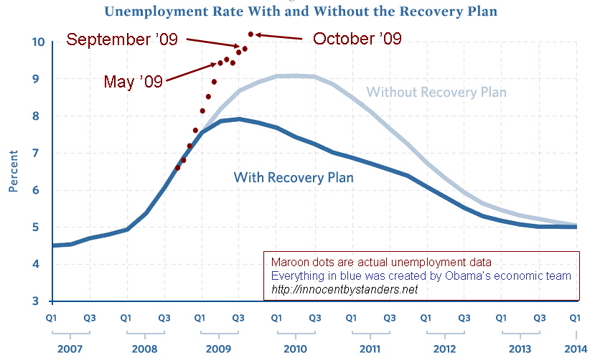
  • Unemployment Rate Nowhere Near White House Predictions

    Check out this chart from geoff at Innocent Bystanders plotting the actual recent unemployment rates against the predicted stimulus-reduced rate from Obama’s recovery team:

    Google’s chart interface is one of the easiest ways to explore unemployment data, allowing for easy comparisons for any state or county.

  • Police Pensions and Voodoo Actuarials

    A key argument that public-safety officials use to justify their absurdly high pension benefits –- i.e., “3 percent at 50” retirements that allow them to retire with 90 percent or more of their final year’s pay as early as age 50 — is this: We die soon after retirement because of all the stresses and difficulties of our jobs. This is such a common urban legend that virtually every officer who contacts me mentions this “fact.” They never provide back-up evidence.

    Here is one article I’ve been sent by police to make their point. It was written in 1999 by Thomas Aveni of the Police Policy Council, a police advocacy organization. Here is the key segment: “Turning our attention back towards the forgotten police shift worker, sleep deprivation must be considered a serious component of another potential killer: job stress. The cumulative effect of sleep deprivation upon the shift-working policeman appears to aggravate job stress, and/or his ability to cope with it.

    “Even more troubling is the prospect that the synergy of job stress and chronic sleep indebtedness contributes mightily to a diminished life expectancy. In the U.S., non-police males have a life-expectancy of 73 years. Policemen in the U.S. have a life expectancy of 53-66 years, depending on which research one decides to embrace. In addition, police submit workman’s compensation claims six times higher than the rate of other employees …”

    I don’t doubt that police work can be very stressful, but many jobs are stressful, many have long hours, many are more dangerous, many involve sleep deprivation. As intelligent adults, we all need to weigh the risk and benefits of any career choice. Aveni uses the high amount of workers compensation claims as evidence of the dangers of the job, but given the tendency of police and firefighters to abuse the disability system – miraculously discovering a disabling injury exactly a year from retirement, thus getting an extra year off and protecting half the pension from taxes – I’m not convinced this proves anything. Given the number of officers who are retired based on knee injuries, back aches, irritable bowel syndrome, acid reflux, etc., this suggests that police game the system and know their fellows on the retirement board will approve virtually any disability claim.

    There are so many legal presumptions (if an officer develops various conditions or diseases it is legally presumed to be work related, whether or not it actually is work related) that bolster the scam. “Disabled” officers often go right out and get similar law enforcement jobs, which calls into question how disabling the injury really is. Regarding sleep deprivation, police and firefighters have secured schedules that minimize the long hours; then the officers often choose to work overtime for double salary, which perhaps is the real cause of sleep problems.

    The big whopper in the Aveni article, however, is the claim that officers live to be 53-66. If that were so, there would be no unfunded liability problem because of pension benefits. Police officers would retire at 50-55, then live a few years at best.

    But, for example, according to the state of California pubic employees’ retirement system (CalPERS) actuary, police actually live longer than average these days, which isn’t surprising given that the earlier people retire and the wealthier they are, the longer they tend to live. And according to a 2006 report to the Oregon Public Employees Retirement System, these are the age-60 life expectancies for the system’s workers (meaning how many years after 60 they will live):

    — Police and fire males: 22.6
    — General service males: 23.4
    — Police and fire females: 25.7
    — General service females: 25.7

    So we see that police and firefighters who retire at age 60 live, on average, well into their 80s. That’s real data and not the hearsay used by apologists for enormous police pensions.

    CalPERS actuary David Lamoureux sent me a CalPERS presentation called “Preparing for Tomorrow,” from the retirement fund’s 2008 educational forum. The presentation features various “pension myth busters.”

    Here is Myth #4 (presented as part of a Power Point presentation): “Safety members do not live as long as miscellaneous members.” CalPERS officials explain that “rumor has it that safety members only live a few years after retirement.” Actuarial data answers the question: “Do they actually live for a shorter time?” The presentation considers the competing facts: “Safety members tend to have a more physically demanding job, this could lead to a shorter life expectancy. However, miscellaneous members sit at their desk and might be more at risk to accumulating table muscle!” Fire officials, by the way, make identical claims about dying as early as police officials.

    For answers, CalPERS looked at an experience study conducted by its actuarial office in 2004. It looked at post-retirement mortality data for public safety officials and compared it to mortality rates for miscellaneous government workers covered by the CalPERS system.

    Here are the CalPERS life expectancy data for miscellaneous members:

    — If the current age is 55, the retiree is expected to live to be 81.4 if male, and 85 if female.
    — If the current age is 60, the retiree is expected to live to be age 82 if male, and 85.5 if female.
    — If the current age is 65, the retiree is expected to live to be age 82.9 if male, and 86.1 if female.

    Here is the CalPERS life expectancy data for public safety members (police and fire, which are grouped together by the pension fund):

    — If the current age is 55, the retiree is expected to live to be 81.4 if male, and 85 if female.
    — If the current age is 60, the retiree is expected to live to be age 82 if male, and 85.5 if female.
    — If the current age is 65, the retiree is expected to live to be age 82.9 if male, and 86.1 if female.

    That’s no mistake. The numbers for public safety retirees are identical to those of other government workers. As CalPERS notes, average public safety officials retiree earlier than average miscellaneous members, so they receive their higher level of benefits for a much longer time.

    Here is CalPERS again: “Verdict: Myth #4 Busted! Safety members do live as long as miscellaneous members.”

    The next time you hear this “we die early” misinformation from a cop, firefighter or other public-safety union member (most of them probably believe it to be true, given how often they have read this in their union newsletters), send them to CalPERS for the truth!

    I expected these numbers for the recently retired, given the pension enhancements and earlier retirement ages, but it seemed plausible that police in particular might have had a point about mortality rates in earlier days. But even that’s not true. A 1987 federal report from the National Criminal Justice Reference Center, “Police Officers Retirement: The Beginning of a Long Life,” makes the following point:

    “’The average police officer dies within five years after retirement and reportedly has a life expectancy of twelve years less than that of other people.’ Still another author states, ‘police officers do not retire well.’ This fact is widely known within police departments. These statements (which are without supporting evidence) reflect a commonly held assumption among police officers.

    “Yet, a search of the literature does not provide published studies in support. Two suggested sources, the Los Angeles City Police and Massachusetts State Police, have provided data which also appears to contradict these assumptions. Reported in this paper are results from a mortality study of retired Illinois State Police (ISP) officers. It suggests that ISP officers have as long, if not longer, life expectancy than the population as a whole. Similar results also arise when examining retirees from the Ohio Highway Patrol, Arizona Highway Patrol, and Kentucky State Police.”

    The report also casts doubt on the commonly repeated statistic that police have higher rates of suicide and divorce than other people. The federal report found the divorce rates to be average and suicide rates to be below average. This is important information because it debunks a key rationale for the retirement expansions, although more recent data need to be examined on divorce/suicide rates.

    Police have an oftentimes tough job, but many Americans have oftentimes tough and sometimes dangerous jobs. This needs to be kept in perspective. Public officials need to deal in reality rather than in emotionally laden fantasy when considering the public policy ramifications of pensions.

    This article was excerpted from Greenhut’s forthcoming book, “Plunder! How Public Employee Unions Are Raiding Treasuries, Controlling Our Lives And Bankrupting The Nation” to be published by The Forum Press in November.