Blog

  • The Fog of Stimulus

    The news is full of stories about the the impact of the ARRA on job creation, including this one from the The Wall Street Journal about a shoe store owner who created or saved nine jobs with less than $900.

    In the story, the Army Corps of Engineers spent $889.60 buying boots from shoe store owner Buddy Moore of Kentucky. Because the boots were purchased with ARRA funds, the Corps asked Buddy to report how many jobs the boot order had “created or saved.” He and his daughter struggled with paperwork, online forms, and a “helpline,” only to make a wild guess 15 minutes before the reporting deadline that they had created nine jobs.

    Though not completely spelled out in the article, the impression is that Buddy and his daughter reasoned that they had created or saved nine jobs, because their boots had “helped nine members of the Corps to work.”

    This sort of misreporting is now fodder for ARRA opponents, and is the last thing that the White House wanted on its hands. In July the Office of Management and Budget (OMB) issued this memorandum and created a series of PowerPoints and PDFs intended to assist ARRA recipients with their reporting.

    These documents do not appear to be currently available on the White House website, but you can find the Google doc here. This list (also not directly available) shows that the Army Corps of Engineers is and was considered a primary recipient. Given its status, it is the one required in the initial PowerPoint to report the “job creation narrative and number.”

    As a prime recipient, the Corps should have been briefed on the fact that the key data issue to avoid was: “Significant Reporting Errors: (which are) instances where required data is not reported accurately and such erroneous reporting results in significant risk that the public will be misled or confused by the recipient report in question.”

    They also would have had to listen in to this presentation on data quality, which stresses that prime recipients are fully responsible for the quality of the data. The Corps could have caught the reporting mistake by running a simple math equation, which would have indicated that the shoe store had created a full-time job for every $98.84.

    If this were true, only $2 billion (administered by Buddy Moore) would have reemployed every single unemployed person in the US, a savings of $785 billion to the American taxpayer.

    In the end, it turns out that because the payment made by the Corps was less than $25,000, the Corps (while responsible for reporting the total number and amount of small sub-awards less than $25,000) was not required to have Buddy Moore report anything.

    Prime recipients are still responsible to report a total jobs creation estimate based off what sub-recipients and vendors do with the funds they disperse. To do that, the Corps could have called up Buddy and asked him to estimate the extra hours he worked for that specific order, and calculated Full Time Equivalents using those hour(s) by “… adding the total hours worked by all employees in the quarter, and dividing by the total hours in a full-time schedule.”

    In this case, let’s assume he worked an extra hour filling the boot order. A quarter-year full-time job would take 520 hours to complete, so he would report that the Corps funds created 1/520 of a quarterly FTE (.001923 FTE), or just about 2/1000th’s of a full-time job for a quarter of the year. The shoe store’s estimate of job creation, therefore, was 4,680 times too big.

    The OMB’s method of job reporting is, by our estimation, a good way of quantifying job creation. The problem, highlighted by the WSJ article, is that average businesses and recipients have had a hard time understanding what data was needed in the first place, and then what they were supposed to do with it.

    Mark Beauchamp is a customer service representative at Economic Modeling Specialists Inc., an Idaho-based data and economic analysis firm.

    Illustration by Mark Beauchamp.

  • Congress and the Administration Take Aim at Local Democracy

    Local democracy has been a mainstay of the US political system. This is evident from the town hall governments in New England to the small towns that the majority of Americans choose to live in today.

    In most states and metropolitan areas, substantial policy issues – such as zoning and land use decisions – are largely under the control of those who have a principal interest: local voters who actually live in the nation’s cities, towns, villages, townships and unincorporated county areas. This may be about to change. Two congressional initiatives – the Boxer-Kerry Cap and Trade Bill and the Oberstar Transportation Reauthorization Bill – and the Administration’s “Livability Partnership” take direct aim at local democracy as we know it.

    The Boxer-Kerry Bill: The first threat is the proposed Senate version of the “cap and trade” bill authored by Senator Barbara Boxer-Kerry (D-California) and Senator John Kerry (D-Massachusetts). This bill, the Clean Energy Jobs and American Power Act (S. 1733), would require metropolitan planning organizations (MPOs) to develop greenhouse gas emission reduction plans. In these plans, the legislation would require consideration of issues such as increasing transit service, improvements to intercity rail service and “implementation of zoning and other land use regulations and plans to support infill, transit-oriented development or mixed use development.” This represents a significant step toward federal adoption of much of the “smart growth” or “compact development” agenda.

    At first glance, it may seem that merely requiring MPOs to consider such zoning and land use regulations seems innocent enough. However, the incentives that are created by this language could well spell the end of local control over zoning and land use decisions in the local area.

    True enough, the bill includes language to indicate that the bill does not intend to infringe “on the existing authority of local governments to plan or control land use.” Experience suggests, however, that this would provide precious little comfort in the behind-the-scenes negotiations that occur when a metropolitan area runs afoul of Washington bureaucrats.

    The federal housing, transportation and environmental bureaucracies have also been supportive of compact development policies. As these agencies develop regulations to implement the legislation, they could well be emboldened to make it far more difficult for local voters to retain control over land use decisions. There could be multiple repeats of the heavy-handedness exercised by the EPA when it singled out Atlanta for punishment over air quality issues. In response, the Georgia legislature was, in effect, coerced into enacting planning and oversight legislation more consistent with the planning theology endorsed by EPA’s bureaucrats. No federal legislation granted EPA the authority to seek such legislative changes, yet they were sought and obtained.

    There is also considerable support for the compact development agenda at the metropolitan area level. The proclivity of metropolitan and urban planners toward compact development is so strong as to require no encouragement by federal law. The emerging clear intent of federal policy to move land use development to the regional level and to densify existing communities could encourage MPOs to propose plans that pressure local governments to conform their zoning to central plans (or overarching “visions”) developed at the regional level. Along the way, smaller local jurisdictions could well be influenced, if not coerced into actions by over-zealous MPO staff claiming that federal law and regulation require more than the reality. It would not be the first time. Further, MPOs and organizations with similar views can be expected to lobby state legislatures to impose compact development policies that strip effective control of zoning and land use decisions from local governments.

    Surface Transportation Reauthorization: The second threat is the Surface Transportation Authorization Act (STAA or reauthorization) draft that has been released by Chairman James Oberstar (D-Minnesota) of the House Transportation and Infrastructure Committee. This bill is riddled with requirements regarding consideration of land use restrictions by MPOs and states. Unlike the Boxer-Kerry bill, the proposed STAA includes no language denying any intention to interfere with local land use regulation authority.

    Like the Boxer-Kerry Bill, the Oberstar bill significantly empowers the Department of Transportation and the Environmental Protection Agency and poses similar longer term risks.

    The Administration’s “Livability Agenda:” These legislative initiatives are reinforced by the Administration’s “Livability Agenda,” which is a partnership between the EPA, the Department of Housing and Urban Development and the Department of Transportation. Among other things, this program is principally composed of compact development strategies, including directing development to certain areas, which would materially reduce the choices available to local government. Elements such as these could be included in an eventual STAA bill by the Obama Administration.

    The Livability Agenda: Regrettably, the Boxer-Kerry bill, the Oberstar bill and the “Livability Agenda” will make virtually nothing more livable. If they are successful in materially densifying the nation’s urban areas, communities will be faced with greater traffic congestion, higher congestion costs and greater air pollution. Despite the ideology to the contrary, higher densities increase traffic volumes within areas and produce more health hazards through more intense local air pollution. As federal data indicates, slower, more congested traffic congestion produces more pollution than more freely flowing traffic, and the resulting higher traffic volumes make this intensification even greater.

    There are also devastating impacts on housing affordability that occur when “development is directed.” This tends to increase land prices, which makes houses more expensive. This hurts all future home buyers and renters, particularly low income and minority households, since rent increases tend to follow housing prices. It is particularly injurious to low income households, which are disproportionately minority. The large gap between majority and minority home ownership rates likely widen further. So much for the American Dream for many who have not attained it already.

    The Marginal Returns of Compact Development Policies: These compact development initiatives continue to be pursued even in the face of research requested by the Congress indicating that such policies have precious little potential. The congressionally mandated Driving and the Built Environment report indicates that driving and greenhouse gas emissions could be higher in 2050 than in 2000 even under the maximum deployment of compact development strategies.

    Local Governments at the Table? The nation’s local governments should “weigh in” on these issues now, while the legislation is being developed. If they wait, they could find bullied by EPA and MPOs to follow not what the local voters want, but what the planners prefer. Local democracy will be largely dead, a product of a system that concentrates authority – and perceived wisdom – in the hands of the central governments, at the regional and national level.

    Even more, local citizens and voters need to be aware of the risk. It will be too late when MPOs or other organizations, whether at their own behest or that of a federal agency, force the character of neighborhoods to be radically changed, as Tony Recsei pointed out is
    already occurring in Australia.

    Wendell Cox is a Visiting Professor, Conservatoire National des Arts et Metiers, Paris. He was born in Los Angeles and was appointed to three terms on the Los Angeles County Transportation Commission by Mayor Tom Bradley. He is the author of “War on the Dream: How Anti-Sprawl Policy Threatens the Quality of Life.

  • Executive Editor JOEL KOTKIN on The Napa Valley Register regarding California

    “Today’s public benefits fail that test. As urban scholar Joel Kotkin of Chapman University puts it: ‘Twenty years ago, you could go to Texas, where they had very low taxes, and you would see the difference between there and California. Today, you go to Texas, the roads are no worse, the public schools are not great but are better than or equal to ours, and their universities are good. The bargain between California’s government and the middle class is constantly being renegotiated to the disadvantage of the middle class.’”

    Joel on the Napa Valley Register

  • Smart Growth Places 3rd in Houston Mayor’s Race

    Houston city councilman Peter Brown, unique as a devotee of smart growth (compact development) in this city of light land use regulation, placed third in the mayoral election yesterday. Brown had long advocated Portland-style smart growth land use and development policies for the city of Houston and looked likely to garner the most votes in the four-way race. Brown, an architect and urban planner, spent more than $3 million of his own money in the election.

    The Houston metropolitan area distinguished itself by not experiencing the profligate credit and smart growth related house price bubble and, as a result experienced little decline in house prices and largely avoided the Great Recession. Houston is the largest municipality in the nation without zoning, however, with land regulation being principally limited to private covenants between land owners. Other Texas metropolitan areas also averted the housing bubble and the Great Recession, because their generally more liberal approaches to land regulation did not produce the price distortions that occurred in more highly regulated metropolitan areas as in California, Florida, Arizona, Nevada, the Pacific Northwest and the Northeast.

  • Detroit: Urban Laboratory and the New American Frontier

    The troubles of Detroit are well-publicized. Its economy is in free fall, people are streaming for the exits, it has the worst racial polarization and city-suburb divide in America, its government is feckless and corrupt (though I should hasten to add that new Mayor Bing seems like a basically good guy and we ought to give him a chance), and its civic boosters, even ones that are extremely knowledgeable, refuse to acknowledge the depth of the problems, instead ginning up stats and anecdotes to prove all is not so bad.

    But as with Youngstown, one thing this massive failure has made possible is ability to come up with radical ideas for the city, and potentially to even implement some of them. Places like Flint and Youngstown might be attracting new ideas and moving forward, but it is big cities that inspire the big, audacious dreams. And that is Detroit. Its size, scale, and powerful brand image are attracting not just the region’s but the world’s attention. It may just be that some of the most important urban innovations in 21st century America end up coming not from Portland or New York, but places like Youngstown and, yes, Detroit.

    Let’s refresh with this image showing the scale of the challenge in the city of Detroit proper:


    There are zillions of pictures to illustrate the vast emptiness in Detroit. Kaid Benfield at NRDC posted these:
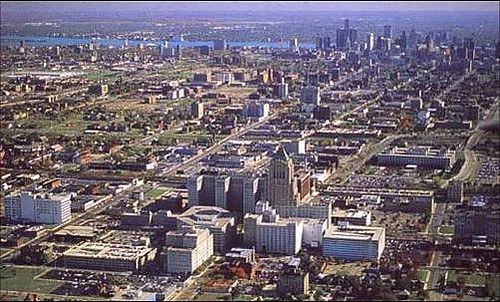

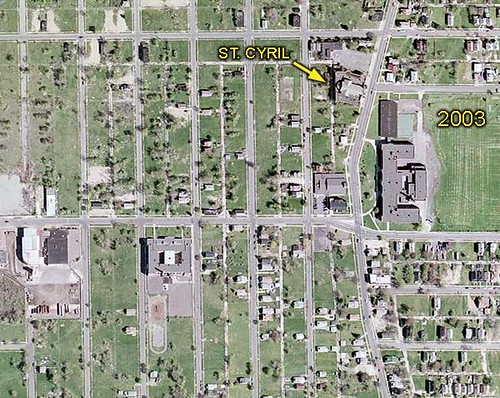
    This phenomenon prompted someone to coin the term “urban prairie” to capture the idea of vast tracts of formerly urbanized land returning to nature. The folks at Detroit’s best discussion site, DetroitYES, posted this before and after of the St. Cyril neighborhood. Before:
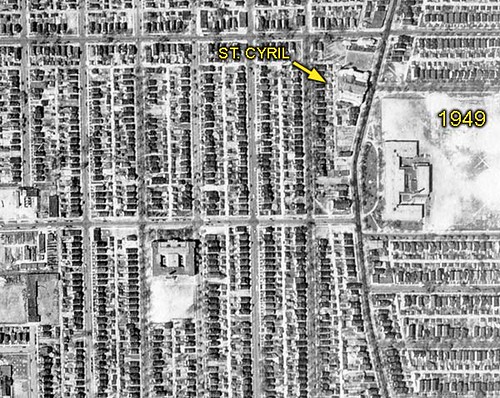

    After:

    A site named “Sweet Juniper” recently had a fantastic photo of the spontaneous creation of “desire line” paths across all this vacant land. You should click to enlarge this photo.


    One natural response is the “shrinking cities” movement. While this has gotten traction in Youngstown and Flint, as well as in places like Germany, it is Detroit that provides the most large scale canvas on which to see this play out, as well as the place where some of the most comprehensive and radical thinking is taking place. For example, the American Institute of Architects produced a study that called for Detroit to shrink back to its urban core and a selection of urban villages, surrounded by greenbelts and banked land. Here’s a picture of their concept:


    It seems likely that this will get some form of traction from officialdom, as this article suggests, though implementation is likely to be difficult.

    Detroit is also attracting dreams of large scale renewal through agriculture, as Mark Dowie writes in Guernica (hat tip @archizoo).

    Were I an aspiring farmer in search of fertile land to buy and plow, I would seriously consider moving to Detroit. There is open land, fertile soil, ample water, willing labor, and a desperate demand for decent food. And there is plenty of community will behind the idea of turning the capital of American industry into an agrarian paradise. In fact, of all the cities in the world, Detroit may be best positioned to become the world’s first one hundred percent food self-sufficient city.

    This isn’t just a crazy idea from some guy who lives in California. He documents several examples of people right now, today growing food in Detroit. It wouldn’t surprise me, frankly, if Detroit produces more food inside its borders today than any other traditional American city.

    About five hundred small plots have been created by an international organization called Urban Farming, founded by acclaimed songwriter Taja Sevelle. Realizing that Detroit was the most agriculturally promising of the fourteen cities in five countries where Urban Farming now exists, Sevelle moved herself and her organization’s headquarters there last year. Her goal is to triple the amount of land under cultivation in Detroit every year. All food grown by Urban Farming is given free to the poor. According to Urban Farming’s Detroit manager, Michael Travis, that won’t change.

    The fact that Urban Farming moved to Detroit is exactly the effect I’m talking about. To anyone with aspirations in this area, it is Detroit that offers the greatest opportunity to make your mark. It is the ultimate blank canvas. For urban agriculture and many other alternative urban dreams, it is Detroit, not New York City that is the ultimate arena in which to prove yourself.

    It’s not just farmers; intellectuals and artists of various types are drawn to Detroit, both to study it and pursue ideas about the remaking of the city:

    Detroit has achieved something unique. It has become the test case for all sorts of theories on urban decay and all sorts of promising ideas about reviving shrinking cities.

    “It’s unbelievable,” said Sue Mosey, president of the University Cultural Center Association, who has been interviewed recently by two separate PBS crews and an Austrian journalist writing about Detroit.

    “All of us have been inundated with all of these people who somehow think that because we’re so bottomed out and so weak-market, that this is this incredible opportunity,” Mosey said.

    Robin Boyle, a professor of urban planning at Wayne State University who has been interviewed by numerous visitors, echoed that sentiment.

    “They realize that there is an interesting story to tell, that has real characters, but even more, they discover a place that is simply not like everywhere else,” he said.

    Toby Barlow wrote in the New York Times about out of towners buying up $100 houses, moving to Detroit, and doing all sorts of interesting things with them:

    Recently, at a dinner party, a friend mentioned that he’d never seen so many outsiders moving into town…Two other guests that night, a couple in from Chicago, had also just invested in some Detroit real estate. That weekend Jon and Sara Brumit bought a house for $100.
    ….
    A local couple, Mitch Cope and Gina Reichert, started the ball rolling. An artist and an architect, they recently became the proud owners of a one-bedroom house in East Detroit for just $1,900. Buying it wasn’t the craziest idea. The neighborhood is almost, sort of, half-decent. Yes, the occasional crack addict still commutes in from the suburbs but a large, stable Bangladeshi community has also been moving in.

    So what did $1,900 buy? The run-down bungalow had already been stripped of its appliances and wiring by the city’s voracious scrappers. But for Mitch that only added to its appeal, because he now had the opportunity to renovate it with solar heating, solar electricity and low-cost, high-efficiency appliances.

    Buying that first house had a snowball effect. Almost immediately, Mitch and Gina bought two adjacent lots for even less and, with the help of friends and local youngsters, dug in a garden. Then they bought the house next door for $500, reselling it to a pair of local artists for a $50 profit. When they heard about the $100 place down the street, they called their friends Jon and Sarah.
    ….

    But the city offers a much greater attraction for artists than $100 houses. Detroit right now is just this vast, enormous canvas where anything imaginable can be accomplished. From Tyree Guyton’s Heidelberg Project (think of a neighborhood covered in shoes and stuffed animals and you’re close) to Matthew Barney’s “Ancient Evenings” project (think Egyptian gods reincarnated as Ford Mustangs and you’re kind of close), local and international artists are already leveraging Detroit’s complex textures and landscapes to their own surreal ends.

    In a way, a strange, new American dream can be found here, amid the crumbling, semi-majestic ruins of a half-century’s industrial decline. The good news is that, almost magically, dreamers are already showing up. Mitch and Gina have already been approached by some Germans who want to build a giant two-story-tall beehive. Mitch thinks he knows just the spot for it.

    It’s what Jim Russell likes to call “Rust Belt chic”, and Detroit has it in spades.

    This piece also highlights the absolutely crucial advantage of Detroit. It’s possible to do things there. In Detroit, the incapacity of the government is actually an advantage in many cases. There’s not much chance a strong city government could really turn the place around, but it could stop the grass roots revival in its tracks.

    Can you imagine a two-story beehive in Chicago? In many cities where strong city government still functions effectively, citizens are tied down by an array of regulations and permits that are actually enforced in most cases. Much of the South Side of Chicago has Detroit like characteristics, but the techniques of renewal in Detroit won’t work because they are likely against code and would be shut down the minute someone complained. Just as one quick example, my corner ice cream stand dared to put out a few chairs for patrons to sit on while enjoying a frozen treat on a hot day. The city cited them for not having a license. So they took them away and put up a “bring your own chair” sign. The city then cited them for that too. You can’t do anything in Chicago without a Byzantine array of licenses, permits, and inspections.

    In central Indianapolis, which is in desperate need of investment, where the city can’t fill the potholes in the street, etc., the minute a few yuppies buy houses in an area and fix them up, they immediately petition for a historic district, a request that has never been refused, ensuring that anyone who ever wants to do anything will be forced to run a costly and grueling gauntlet of variances, permits, hearings, etc. Only the most determined are willing to put up with that.

    In most cities, municipal government can’t stop drug dealing and violence, but it can keep people with creative ideas out. Not in Detroit. In Detroit, if you want to do something, you just go do it. Maybe someone will eventually get around to shutting you down, or maybe not. It’s a sort of anarchy in a good way as well as a bad one. Perhaps that overstates the case. You can’t do anything, but it is certainly easier to make things happen there than in most places because the hand of government weighs less heavily.

    What’s more, the fact that government is so weak has provoked some amazing reactions from the people who live there. In Chicago, every day there is some protest at City Hall by a group from some area of the city demanding something. Not in Detroit. The people in Detroit know that they are on their own, and if they want something done they have to do it themselves. Nobody from the city is coming to help them. And they’ve found some very creative ways to deal with the challenges that result. Consider this from the Dowie piece:

    About 80 percent of the residents of Detroit buy their food at the one thousand convenience stores, party stores, liquor stores, and gas stations in the city. There is such a dire shortage of protein in the city that Glemie Dean Beasley, a seventy-year-old retired truck driver, is able to augment his Social Security by selling raccoon carcasses (twelve dollars a piece, serves a family of four) from animals he has treed and shot at undisclosed hunting grounds around the city. Pelts are ten dollars each. Pheasants are also abundant in the city and are occasionally harvested for dinner.

    This might sound awful, and indeed it is. But it is also an inspiration and a testament to the human spirit and defiant self-reliance of the American people. I grew up in a poor rural area where, while hunting is primarily recreational, there are still many people supplementing their family diet with wild game. Many a freezer is full of deer meat, for example. And of course, rural residents have long gardened, freezing and canning the results to help get them through the winter. So this doesn’t sound quite so strange to me as it might to you. The fate of the urban poor and the rural poor are more similar than is often credited. And contrary to stereotypes the urban poor often display amazing grit and ingenuity, and perform amazing feats to sustain themselves, their families and communities.

    As the focus on agriculture and even hunting show, in Detroit people are almost literally hearkening back to the formative days of the Midwest frontier, when pioneer settlers faced horrible conditions, tough odds, and often severe deprivation, but nevertheless built the foundation of the Midwest we know, and the culture that powered the industrial age. No doubt in the 19th century many of those sitting secure in their eastern citadels thought these homesteaders, hustlers, and fortune seekers crazy for leaving the comforts of civilization to head to places like Iowa and Chicago. But some saw the possibilities of what could be and heeded the call to “Go West, young man.” We’ve come full circle.

    More Detroit

    Detroit: Do the Collapse
    Detroit: Not the Future of the American City
    For talent – good jobs, cools places, new narrative (Crain’s Detroit Business – featuring Yours Truly)

    Aaron M. Renn is an independent writer on urban affairs based in the Midwest. His writings appear at The Urbanophile.

  • Executive Editor JOEL KOTKIN in Forbes regarding blue states

    “For the past decade a large coterie of pundits, prognosticators and their media camp followers have insisted that growth in America would be concentrated in places hip and cool, largely the bluish regions of the country.”

    November 4, 2009

  • Executive Editor JOEL KOTKIN on Union Leader regarding blue states

    “Forbes magazine columnist Joel Kotkin this week summarized some of the latest research on U.S. migration patterns. Several studies show that Americans continue to move out of high-tax, high-regulation states such as New York, California and Massachusetts and to lower-tax, lower-regulation states such as Texas and North Carolina.”

    Joel on Union Leader

  • Executive Editor JOEL KOTKIN on Reason regarding blue states

    “Net migration, both before and after the Great Recession, according to analysis by the Praxis Strategy Group, has continued to be strongest to the predominately red states of the South and Intermountain West. ”

    Joel on Reason

  • Executive Editor JOEL KOTKIN on WalletPop regarding housing

    “Call it the ‘new localism.’ Scholar Joel Kotkin does, and writes quite eloquently about how the economic and societal changes can benefit our nation by strengthening communities. ”

    Joel on WalletPop

  • Contributing Editor TORY GATTIS on BlogHouston regarding traffic congestion

    “TORY GATTIS calls attention to a Dallas Observer blog post on the congestion that rail expansion may produce in downtown Dallas. “My understanding is that Houston may face the same risk when the east-west line opens downtown,” writes Gattis, ‘It will take some amazingly sophisticated train and traffic signal synchronization to keep things running smoothly down there. Same for the Uptown/Galleria line on Post Oak.’”

    November 4, 2009