Blog

  • Home-Based Businesses: Residential Zoning and The Cyber Village

    Currently in the United States about 27% of all homes have some form of a home based business. These businesses can be key to conservation efforts that lower our carbon footprint by reducing transportation needs, eliminating redundant facilities, and consolidating equipment. They provide significant opportunities for two solutions to problems that face today’s growth issues.

    My software company was founded in Dallas, where I worked from the dining room table in an apartment. I yearned for the day my business could operate out of a real office. After the business started generating a positive cash flow the apartment was left behind, and my office moved to a location in the newly built Dallas Galleria. My 104 square feet of office space was complimented with a separate meeting room, receptionist, and a parking space in the garage. All this cost me $600 a month. After the initial six month lease was up the rent skyrocketed and parking was no longer free; however, the 104 square feet remained the same.

    Oh, how I yearned for a nice dining room table to work from!

    Soon I decided that the money spent on rent — both apartment and Galleria office — could build a really nice home. In 1982 I built a home specifically designed for a residence and my business. With about 4,000 square feet, of which about one third was dedicated business space with a separate office entrance, we had a viable base from which to live and work.

    The IRS allowed us to write-off one third of the total housing expenses without question. By not having to pay office rent we could double the home payments, and the 30 year mortgage was paid in full in less than 10 years.

    Maple Grove, the lakefront suburban Minnesota community where we had built, allowed a home business occupation via ordinance limited to one non-family employee. At first we complied, but the business grew. At times there were up to 6 employees at the home, but neighbors did not complain.

    I was not the only lake front home operating a big business. Across the lake, a major manufacturer of car radar warning units operated out of the basement of a house. This was a husband-and-wife business, but it was no small operation. The company had full page ads in leading automotive magazines. I sometimes visited; I’d hear the phone ring with an order, and the wife would say ‘I’ll see if we have any in stock at the warehouse, can you hold?’ She would then call down to the basement and ask if they could make an A-50 unit for shipping. Nobody but the UPS man would know the truth!

    Solution #1: The Residential/Business
    The Residential/Business (RB zoning) would be an entirely new land use, sort of a morphing of an office center and a neighborhood of luxury single family homes. Office complexes typically have a higher degree of landscaping and architectural detail than single family developments. In the RB neighborhood, homes would be large and impressive with heavily landscaped commons that serve as pedestrian access to the businesses that are located within the home structure.

    Family members and employees would park in the rear, with multiple garage spaces and outside parking for the employees. From the arterial streets abutting these developments it would be an impressive sight, giving a sense of wealth to the neighborhood and municipality. The types of businesses would be restricted to low traffic professional services, including medical services, but also could include very light manufacturing. The RB zones would be an excellent transition (buffer) from commercial centers to residential ones. The RB residential structures would house the entire business and home, serving as the main hub for all of the business needs.

    Below, a Residential/Business community
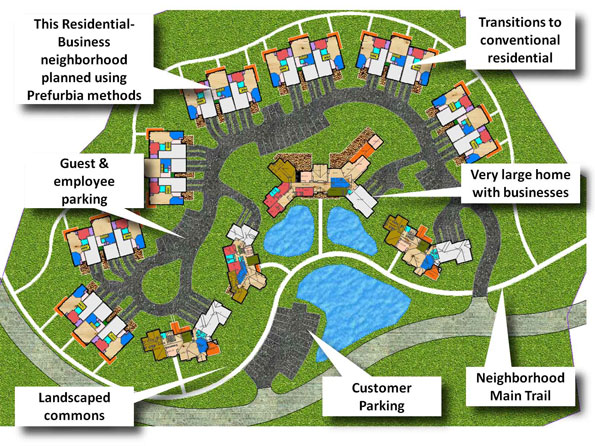
    There could be some overlap of business functions into the residential elements of the home. For example, a conference center with an 80 inch screen for presentations could be used for Monday night football on occasion. From a financial standpoint, for a small to medium sized business owner this is a win-win situation. It delivers the advantages that I had experienced in my own situation in a comprehensive, specifically designed development plan.

    Solution #2: The Cyber Village
    George E. Van Hoesen, of Global Green Building, LLC, has developed an alternative solution, the Cyber Village.

    The proliferation of computers and cell phones, as well as video conferencing and express delivery, has made the notion of the at-home cyber office an excellent solution for growth issues. New definitions of work, recreation, and education have brought the family home again. Residential design and community planning can begin to address the increasing needs of these new households while keeping the neighborhood’s primarily residential character.

    Unlike the Residential/Business solution, homes in the Cyber Village need not be as business intensive or change the character of a neighborhood. A main component of the Cyber Village is the Cyber Office, serving as the community foundation for business activity. This facility, complete with offices, reception services, mail services, meeting rooms, board rooms, reference libraries and office equipment, would serve subscribers (businesses within the neighborhood) for their out-of-office and administrative needs. This Cyber Office location could serve as the hub for deliveries, recycling, storm shelter, resource center, rideshare, and other community resource needs. Subscribers would choose the level of access to the facility based on their own individual business needs. The features of the cyber office would lend credibility and added professionalism to a residence-based business without breaking the bank.

    Below, a Cyber Village
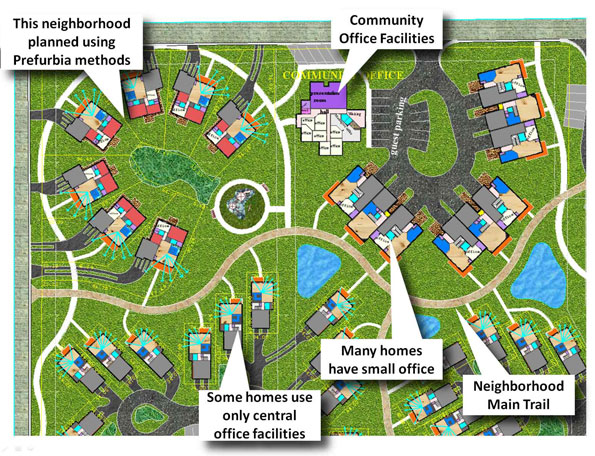
    The neighborhood Cyber Office could be managed as a for-profit business, providing services for a fee. Communities could also manage a Cyber Office as a part of the homeowners association. A mix of services could be provided, depending on the needs of the community. The overall concept reduces the carbon footprint of the home-based business and addresses the needs of the changing work place.

    Zoning Both Solutions
    Both solutions fall outside the scope of conventional zoning. The Cyber Village may comply more easily with existing regulations, especially those that allow a home to operate a business with a few employees. If a city’s regulations are flexible enough, it may be possible to design and implement a Cyber Village that complies with city code now. The Residential/Business solution, with its more aggressive business size, would compete with — or make obsolete — office complexes. Office “use” is often taxed at a higher rate than residential use. Since cities do not like to lose tax revenue, it is likely that municipalities would require a new basis to tax the RB residents.

    Creating a new zoning class and tax classification is not difficult, but it might be time consuming. The current slow market allows cities to restructure their zoning and tax codes, so now is the time to act.

    Both solutions would have a significant reduction on the carbon footprint of land development. They offer alternatives to the Smart Growth solutions in which shop owners are encouraged to live over their stores in high density developments. Both the Residential/Business and the Cyber Village alternatives curb traffic and sprawl…and at the same time, provide residential settings with enough space for family enjoyment.

    Rick Harrison is President of Rick Harrison Site Design Studio and author of Prefurbia: Reinventing The Suburbs From Disdainable To Sustainable. His website is rhsdplanning.com.
  • The Limits of Transit: Costly Dead-End

    The proposed Chicago Transit Authority (CTA) fare increase and service cuts for next year are indicative of transit’s recurring budgetary problems, and not only in Chicago but nationwide. But in the Windy City, these moves have elicited an understandably negative public reaction since the city of Chicago depends on transit about as much as any city besides New York.

    CTA, like other transit agencies around the nation routinely, claim that fare increases and service cuts are necessary due to under-funding. Transit budget crises seem to come as often as Presidents day in many places and more often than February 29 (every four years) virtually everywhere.

    If under-funding were the primary problem, then an examination of historic trends would indicate that the money available to transit had declined (after adjusting for inflation) relative to ridership. But in nearly all cases, including both the CTA and the national data, this is far from the truth.

    Cost Escalation at CTA: Despite its storied history as one of the nation’s premier transit agencies, CTA has suffered heavy ridership losses since its modern peak in 1979. A principal reason for this decline was a series of devastating fare increases that would not have been necessary if costs had been maintained within inflation. In 2007, CTA spent 13% more (inflation adjusted) to run its buses and trains than in 1979. That would be fine if ridership had risen 13% (or more), since then both riders and taxpayers could feel that they had obtained value for money. However, ridership dropped by more than 2 percent. If CTA had kept its costs per passenger within inflation, it would have at least $400 million more each year, and would have no need to consider fare increases or service reductions.

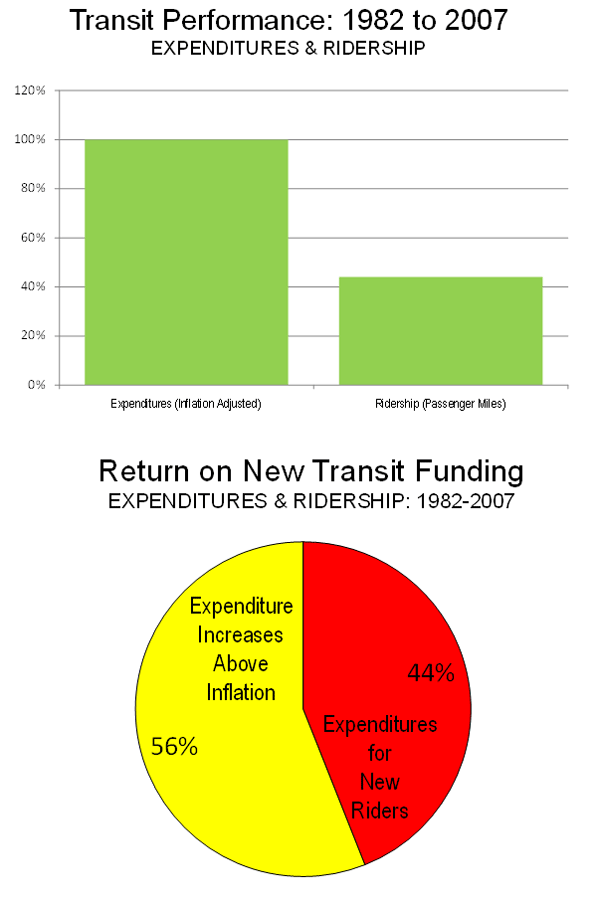
    National Transit Cost Escalation: Between 1982 (the last year before the federal gas dedicated gas tax for transit) and 2007, national transit ridership (passenger miles) rose 44% percent. At the same time, transit expenditures, adjusted for inflation, rose 100%. This means that each new inflation adjusted $1.00 for transit delivered $0.44 in new value (additional ridership). If transit had kept expenditures growth within inflation, there would have been in excess of $13 billion in 2007 (See Note).

    In contrast, the price (or cost) of most products and services rise about with the rate of inflation or slightly more or less. Over the same period of time, automobile and airline costs per passenger mile have declined, producing more than $1.00 in value for each new inflation adjusted dollar. Food costs have declined 3 percent relative to inflation, energy costs have declined 2 percent relative to inflation and housing costs have risen 1 percent relative to inflation.

    Transit’s Intractable Fiscal Problem: Transit is incapable of producing ridership increases that coincide with its funding increases because of its structure. Transit is a monopoly, and an unregulated monopoly incapable of managing itself effectively. Private monopolies, such as electric utilities, are routinely regulated. Economic theory generally holds that monopolies are to be avoided, because of their power to violate the interests of consumers by passing on higher than necessary prices and substandard service. No responsible government would think of granting a monopoly to a private company without exercising regulatory control to ensure that the company does abuse its position of power.

    Before the wide availability of subsidies to transit, there were private companies, which could not raise fares or cut service without regulatory review and approval. It was not the best possible system, but it was designed to principally serve consumers. But government is different. There are no commissions set up to regulate government monopolies, like transit.

    Competitive Incentives: The antidote to monopoly is competition, and transit costs cannot be controlled without it. There is a successful model. Transit agencies can competitively bid and competitively contract bus routes for limited periods of time, requiring firms to supply services they specify. The public agency continues to draw the routes, establish the timetables and set the fares. In a number of cases, competitive contracting has lowered costs and reduced the rate of cost increase.

    In Los Angeles, our efforts led to carving a new transit district (Foothill Transit) out of the old public monopoly (the Southern California Rapid Transit District). Other services were transferred from the public monopoly to be administered by the city of Los Angeles. In each case, the transferred services were competitively contracted, and evaluation reports put the savings at more than 40%. Similar results have been achieved in Denver and San Diego, where approximately 50% of bus services are now competitively contracted. In Denver, the competitive contracting program was established by state legislation, while in San Diego, local officials introduced the program to gain control of rapidly escalating costs. More than a decade ago, my report for the Metropolitan Transit Association showed that substantial savings could be achieved at CTA through competitive contracting without requiring employee layoffs or give-backs.

    Competitive contracting has even spread to commuter rail systems, such as in San Diego, Dallas-Fort Worth, Miami, Boston and Los Angeles. However, for all of these savings, competitive contracting accounts for only a small share of transit services in the United States.

    The Antithesis of Cost Effectiveness: There remains strong resistance by the special interests that control transit, from the managers to the employees to vendors. Within a couple of years, the California legislature caved to lobbying from transit interests, including the transit unions, and outlawed the kinds of cost reducing reforms that had created Foothill Transit. This is despite the fact that not a single penny in wages or benefits had been taken away from a single transit worker.

    Perhaps the most brazen case was when the Denver transit agency approached the state legislature in the early 1990s seeking repeal of the competitive contracting bill, claiming that it was costing the agency more than if the services were provided by its own employees. It later was revealed that the analysis had compared the internal costs of operations with the competitively contracted costs of operations and capital (buses and facilities). It was even worse than that. The cost of the competitively contracted buses was amortized at a rate more than double the normal accounting standard. After this misleading initiative, the legislature expanded the competitive contracting requirement.

    The resistance of monopoly transit interests to competitive contracting is understandable. People and organizations generally tend to look out for their own interests first and unregulated monopolies can do so with a vengeance. Without the countervailing force of competition (or, less effectively, regulation) their financial demands prevail over the interests of the riders and taxpayers, without whom there would be no reason for transit to exist.

    One result is that when major transit expansions are chosen, the approaches that cost the most per passenger are often selected. The classic case is the selection of rail technologies over bus technologies, which are usually far more cost-effective given the modest transit volumes in the United States. Instead we often choose rail systems that cost more on an annual basis than it would cost to lease each new transit customer a car in perpetuity. Sometimes the cost equals that of an economy car, other times it could be a Lexus.

    Another contributing factor has been transit wages and benefits, both for managers and operating employees. These have risen far faster than in competitive markets, whether unionized or not. Other costs have risen as well, from capital costs to the costs of administration. The present monopoly situation effectively establishes a public policy objective of maximizing transit costs per passenger. The focus should be on maximizing ridership by minimizing expenditures per passenger.

    Internal Reforms Do Not Survive: There is always the potential for internal reform. One of the most sweeping of such programs was implemented by Chicago’s Mayor Jane Byrne in the early 1980s. She forced major cost reductions at CTA. However, after she left, costs resumed their upward trend. It is difficult, if not impossible, to sustain the political will to control transit costs without the incentives of competition.

    Overseas: Perhaps surprisingly, the conversion to competition has been widespread overseas. Virtually all of the world’s largest public bus systems take this approach. Transport for London (formerly London Transport) is competitively bid. Between 1985 and 2000, the costs per mile of service declined more than one-half, adjusted for inflation. Much the same has occurred in Socialist Scandinavia. All Copenhagen bus service is competitively bid. Stockholm not only bid its bus service, but also saved money by competitively bidding its metro (subway) system. Commuter rail lines are being competitively bid in Germany, as are entire bus systems in Adelaide and Perth in Australia. In all of these cases, the public has gained by lower costs, expanded services and generally lower fares than would have otherwise been the case. In the United States, however, the surviving public monopoly structure skims more than half of the new money off the top, leaving less than half for the riders and taxpayers.

    Why This is Important: All of this is relevant because there is a sense that transit will play a much larger role in the future. Virtually none of the analysis exhibits any understanding of the dynamics that rule transit expenditures. For example, the contentious Moving Cooler presumes that transit expenditures will rise within the inflation rate and, as a result, expects romantically unachievable increases in ridership.

    This is wishful thinking of the worst kind. Congress, the state and the nation’s transit agencies have studiously avoided any sort of analysis that would compare transit costs to inflation. They cannot be relied upon to set things right since they will not confront the special interests that control transit.

    Instead, American transit agencies spend more without a corresponding increase in ridership. New money made available to transit loses value like the depreciating currency of a hyper-inflating economy. Washington, state governments and local governments can throw a lot more money at transit. They seem incapable however of producing a corresponding increase in ridership.


    Note: National expenditures calculated from the governments database of the United States Bureau of the Census. Ridership from the American Public Transportation Association. Chicago ridership and operating cost data from the American Public Transportation Association and the US Department of Transportation Federal Transit Administration National Transit Database. Financial data adjusted to 2007$ using the Consumer Price Index.


    Wendell Cox was appointed to three terms by Mayor Tom Bradley to represent the city of Los Angeles on the Los Angeles County Transportation Commission (LACTC), which was the principal transit and highway policy body in the nation’s largest county. As the only LACTC member who was not an elected official, he chaired the Service Coordination Committee, which established the procedures that led to the establishment of Foothill Transit. He also chaired two American Public Transit Association national committees (Governing Boards and Policy & Planning).

  • Executive Editor JOEL KOTKIN in The Housing Chronicles Blog

    Joel Kotkin, urban scholar and a presidential fellow in urban futures at Chapman University, has written an interesting article in the current issue of Newsweek. In “There’s No Place Like Home,” Kotkin argues that a generational shift from Americans regularly moving in order to take advantage of job opportunities is giving way to a new settledness.

  • Executive Editor JOEL KOTKIN in the Sacramento Bee regarding Reno

    “In 2005, it ranked No. 1 on the “Best Places for Doing Business in America,” an annual list compiled for Inc. magazine by California public policy analyst Joel Kotkin.

    In the latest rankings, published on Kotkin’s NewGeography.com Web site, Reno is No. 314. Sacramento is No. 297.”

    Joel in The Sacramento Bee

  • Contributing Editor SUSANNE TRIMBATH in Rolling Stone Magazine

    If you own stock that pays a dividend, you can even look at your dividend check to see if your shares are real. If you see a line that says “PIL” — meaning “Payment in Lieu” of dividends — your shares were never actually delivered to you when you bought the stock. The mere fact that you’re even getting this money is evidence of the crime: This counterfeiting scheme is so profitable for the hedge funds, banks and brokers involved that they are willing to pay “dividends” for shares that do not exist. “They’re making the payments without complaint,” says Susanne Trimbath, an economist who worked at the Depository Trust Company. “So they’re making the money somewhere else.”

    Susanne in Rolling Stone

  • Executive Editor JOEL KOTKIN in The Napa Valley Register regarding new localism

    Mobility, a genetic fact of American life, is part a new and lasting trend referred by author Joel Kotkin as “new localism.”
    He writes: “The basic premise; the longer people stay in their homes and communities, the more they identify with those places, and the greater their commitment to helping local businesses and institutions thrive, even in a downturn.”

    Joel in The Napa Valley Register

  • Contributing Editor MICHAEL LIND in the CATO Institute regrading U.S. standing in the world

    “Michael Lind has a better word for it: ‘Nothing could be more repugnant to America’s traditions as a democratic republic,’ he writes in The American Way of Strategy, ‘than a grand strategy that can be sustained only if the very existence of the strategy is kept secret from the American people by their elected and appointed leaders’ (my emphasis).”

    Michael Lind on CATO

  • Executive Editor JOEL KOTKIN in the New York Times regarding new localism

    “Perhaps nothing will be as surprising about 21st-century America as its settledness,” writes Joel Kotkin in Newsweek. “For more than a generation Americans have believed that ’spatial mobility’ would increase, and, as it did, feed an inexorable trend toward rootlessness and anomie.”

    Joel in The New York Times

  • Executive Editor JOEL KOTKIN in Saint Louis Today regarding new localism

    “There’s an interesting essay in the latest Newsweek by urban thinker Joel Kotkin, who argues that, for reasons familial, economic and technological, often-rootless Americans are entering a time when we’re more likely to stay put. And that this will have all sorts of implications for the communities we call home.”

    Joel in Saint Louis Today