Blog

  • Webinar: The Future of Rural America

    New Geography publisher Delore Zimmerman will host a webinar next week discussing the future of rural america. The webinar is part of the Rural Broadband Initiative organized by Northern Minnesota’s Blandin Foundation.

    From Blandin:

    If you are interested in rural community and economic development trends, this webinar is for you. Delore Zimmerman will provide guidance for rural community leaders about development trends and the steps communities must take to increase their investment attractiveness.

    The role that technology plays in increasing economic vitality will be presented both in theory and practice, and Delore will include information about successful regional economic development strategies.

    Here’s more information and registration for this free webinar.

  • The IOC rejects Chicago in the First Round

    The International Olympic Committee has rejected Chicago in the first round. A delegation of President Obama, Michelle Obama, Oprah, Mayor Daley and others failed to convince the IOC. President Obama made an impassioned plea to the IOC:

    “Chicago is a city where the practical and the inspirational exist in harmony; where visionaries who made no small plans rebuilt after a great fire and taught the world to reach new heights,” Obama told the IOC’s members. “I urge you to choose Chicago.”

    This fell on deaf ears representing a major defeat for President Obama, Mayor Daley, and powerful Alderman Ed Burke (who was the point man to hand out the money).

    Veteran Chicago journalist Ben Joravsky summarized the negative concerning Chicago:

    the city hasn’t completed a major construction project on time or on budget in recent memory. Pick a project, any project: the reconstruction of Soldier Field, the creation of Millennium Park, the redevelopment of the prime downtown land at Block 37, the expansion of O’Hare airport—they were all finished way over budget if they were finished at all. In Chicago, people know that the question isn’t whether city projects will go over budget, but by how much.

    Even though Chicago’s City Council voted 49-0 in a guarantee to support the 2016, public support has been on the decline all year. A recent Chicago Tribune poll suggested half the public didn’t want the Olympics. The IOC, undoubtedly, had to be concerned the lack of public support in Chicago when making the final decision.

    The grass roots organization No Games Chicago deserves much credit for taking on the Chicago Machine with meager funds. Thomas Tesser of No Games ran an effective campaign in the media against the powerful Chicago interests. The Chicago Sun Times ran this Tesser attack which was quite effective:

    The City Council voted to give oversight of the City’s Olympic commitments to Ald. Ed Burke, chairman of the Finance Committee. This is the final cruel joke played by the Council on the taxpayers. Burke has become a millionaire doing deals with firms that have business with the city and has collected millions in campaign contributions from firms doing business with the city. Pat Ryan, the chairman of the 2016 effort, contributed $3,000 to Burke. Burke didn’t mention that he has ten clients who are major donors to the

    Will Chicago come back for another try in 2020? Only time will tell.

  • Crash in High-end Real Estate or a Roller Coaster Recession? :

    During the first ten days of October 2008, the Dow Jones dropped 2,399.47 points, losing trillions of investor equity. The Federal Government pushed TARP, a $700 billion bail-out, through Congress to rescue the beleaguered financial institutions. The collapse of the financial system was likened to an earthquake. In reality, what happened was more like a shift of tectonic plates.

    *******************************************

    In September 2009 the Fed proclaimed “The Recession is Over.” President Obama said his Stimulus Package saved the US economy and his international actions have “brought the global economy back from the brink.” Vice-President Biden declared, “The Stimulus Package worked beyond my wildest dreams.” I feel so much better. Living in California, I must have missed these events.

    If the recession is over, why is unemployment in California 12.2%? (Functional unemployment, the real number, is closer to 16%). In decimated areas like the Central Valley, unemployment is at Great Depression levels of 26%. If the economy was saved, why do our homes continue to lose value? And it is not just “our homes” that are impacted. Treasury Secretary Timothy Geithner was forced to rent out his Larchmont, N.Y., home after it failed to sell. President Obama’s Chicago home, purchased for $1.65 million with a $1.3 million jumbo mortgage at the height of the real-estate bubble is now worth less than $1.2 million according to an estimate by Zillow.

    The recession may be over but Americans are now experiencing The Roller Coaster Recession. Like a roller coaster chugging its way up to the top, home values climbed between 2002 and 2007. Beginning in the fall of 2007, home values declined, first slowly but inexorably until they bottom out and began to climb again. Have we bottomed out? The Atlantic screamed, “Home sales soared 11% in June”.

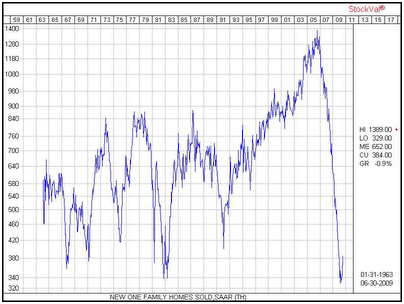
    Not so fast. Like the cars in a roller coaster, the first cars will begin to climb out while the last cars are still screaming downward at top speed. The Commerce Department reported sales in August rose a tepid .07% in August. What they did not highlight is that new home sales of 429,000 are at historical off the chart low compared to the last 50 years (see chart below).

    Such is the case with the Roller Coaster Recession. In California’s roller coaster ride the first car, The Inland Empire, crested the top in 2007. When pink slips were issued, these homeowners did not have deep pockets to sweat it out. All of their savings had been plowed into their down payment. When values declined, they had no staying power. They were gone in the first wave of foreclosures.

    Meanwhile, the rear car, Coastal California, continued to climb in value seemingly immune to the problems inland. The reason was staying power. The residents of tony Corona Del Mar were able to dump their third car, the Range Rover to keep solvent. When that ran out, Coastal California tapped their savings and finally used their equity lines to maintain their high mortgage payments while they waited for a buyer. But it is 2009 and the buyers have not materialized. More Jumbo Loans are falling behind in their payments. Watch the 60-day delinquency rate on prime Jumbo Loans. According to First American Core Logic, Jumbos in default jumped to 7.4% in May versus 4.9% for conforming loans

    Like our proverbial roller coaster, now it’s the turn for the first cars to rise. As the Inland Empire seems to have bottomed, Coastal California is still racing downward. There are 200 homes for sale between $1.5 and $3 million in ritzy Corona Del Mar. Even with a hefty 25% down payment, a $2 million property will require a $1,500,000 mortgage. Today’s lenders will require proof that the borrower can afford the $7,500 per month mortgage payment. They will demand a W-2 or 2008 tax return showing at least $22,500 per month in income to support a 30% housing expense ratio.

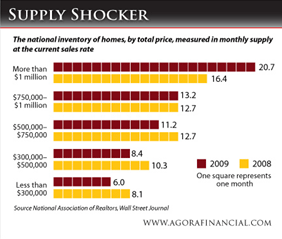
    The reality is there simply are not enough buyers earning $250,000 per year to buy up the 200 homes in Corona Del Mar. The current inventory will take 17 months to sell out but, as the recession continues, more homes are posting For Sale signs each month. Coastal California has not yet seen their bottom and they are still heading down at a rapid pace.

    Our national leaders may proclaim the end of the recession, but Californians have no reason to party. The Stimulus Package that shipped $50 billion to California was a one-time windfall that delayed but did not end California’s structural $26 billion budget deficit.

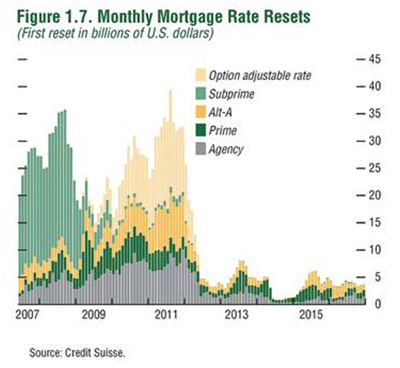
    Add to that the “Mortgage Armageddon” that is scheduled to hit next February. As the sub-prime mortgage defaults subside, the Option ARMS (adjustable rate mortgages) and Prime ARMs will begin to reset in early 2010 (see chart). This is not a working class but primarily a middle and upper-class problem. It is more a coastal than inland crisis; in New York terms, more Larchmont and less exurbia.

    There is a problem, however, with dinging the rich. They are the very folks expected to spend in our consumer-driven economy and invest in new ventures. If they have to re-route more dollars to mortgage payments, they not going to be able to help the economy.

    The Roller Coaster Recession will see more rises and dips before a sustainable recovery comes to California and other high-priced marekts. Those in the first car, like The Inland Empire, have nearly completed their ride. Any remaining dips will be minor in drop and brief in duration. But the genteel folks in the last car, in places like Coastal California, have another precipitous drop in front of them. This may come as a surprise to those believing the headlines that the recession was over. The wild ride for many is hardly over yet.

    ***********************************

    This is the fourth in a series on The Changing Landscape of America. Future articles will discuss real estate, politics, healthcare and other aspects of our economy and our society.

    Robert J. Cristiano PhD is a successful real estate developer and the Real Estate Professional in Residence at Chapman University in Orange, CA.

    PART ONE – THE AUTOMOBILE INDUSTRY (May 2009)
    PART TWO – THE HOME BUILDING INDUSTRY (June 2009)
    PART THREE – THE ENERGY INDUSTRY (July 2009)

  • One Homeowner, Two Mortgage Holders, No Lien!

    I’ve been following this for a while and writing about it on NewGeography.com since March – not all mortgage-backed securities (MBS) are actually backed by mortgages. So when the homeowner goes into bankruptcy, there’s no way for the MBS holder to prove a lien on the house and the judge awards the bondholder bupkus. In April, a bankruptcy judge in California wrote that as many as one-third of all MBS didn’t have mortgages. No “M” in the “BS,” as I like to put it!

    Well, this story just gets better and better. It turns out that even when the MBS has an actual mortgage underneath it, the same mortgage is backing more than one security. Last week I talked to Matt Taibbi, who wrote in Rolling Stone magazine (The Great American Bubble Machine) that 58 percent of an MBS issued by Goldman Sachs had nothing but a list of zip codes where the mortgages should have been. He told me about a lawyer in Florida who has a list of cases where two MBS holders showed up at the bankruptcy proceedings, both claiming that they owned the same mortgage. You can expect to read more on that here as the story develops.

    Then it gets worse! Gretchen Morgenson reported in the New York Times on Sunday that there are about 60 million mortgages registered with the Mortgage Electronic Registration System (MERS) to keep track of who owns which loans and which MBS. Problem was that MERS, created by Fannie Mae, Freddie Mac and the mortgage industry, thought they were too good to have to register liens against land at the county level – real estate 101 for any sober realtor. The Kansas Supreme Court has now ruled that changes in mortgage ownership registered with MERS – and not registered with the local land authority – have no legal standing.

    Don’t forget – MBS are the junk that Treasury Secretary Geithner wants purchase with tax-payer dollars; and Federal Reserve Chairman Ben Bernanke committed $1.25 trillion of freshly-printed dollars to buy up out of the marketplace this year. Here’s the math made easy – the median house costs $177,000, figure an 80% mortgage, times 60 million mortgages: it looks like $8.5 trillion worth of mortgages could have no real estate underneath them! If the repo man comes knocking on your door, remember these four words: Show Me The Paper!

  • Homebuilding Rebound… Or Boredom in the Burbs?

    The economy might come back – but will the housing market return? And in what form?

    Right now, builders are jumping into the low end of the market because of the $8,000 first time home buyer tax credit. This tax credit cannot survive indefinitely. Compared to homes sold in 2006, today’s are bare bones in size, materials and finishes in response to current, temporary market conditions. But the scrimping only makes the homes built in yesterday’s developments more attractive to potential buyers. The next wave of home buyers will have a choice: stay where they are, move to a more recently built (devalued) home, or buy new.

    Here’s a rundown on the major factors — and the forces on them — that will guide home buyers in their decisions. It’s also a rundown for any community, planner or developer — government or private sector — who would like to see the market rebound.

    Lot Size: Will buyers want to be shoehorned into new compressed development, or will they prefer to remain in the larger lot suburbs, where there are plenty of bargains today with usable yards and at least some views?

    The administration is pushing for compact (very dense) development, something the home buying market historically finds less desirable. If one hundred residents of a subdivision were asked the square footage of their lot, few would know the answer (more would be aware of their house’s square footage). Homes placed close to the street guarantee a claustrophobic feeling of space. Space is defined by that object that stops viewshed – typically a home, wall (fence) or low vegetation.

    Density is increased by the creation of narrower lots (and homes). When the lot narrows either the square footage of the house must plummet, or the home must get deeper. Assuming that facing directly into the home next door is not a quality view, the percentage of wall space that allows windows with a good view becomes very small as the home narrows.

    To illustrate, take a business card and look especially at the long edges. The shape emulates the rectangular perimeter of a typical suburban home built in the past few decades. Now imagine nice front and rear yard spaces with plenty of wall surface for windows, even with a garage taking up a portion of the front.

    Along comes the anti-sprawl movement pushing narrower lots, and making those on City Councils and Planning Commissions feel guilty about destroying the planet. Across America over the past two decades lots have been getting smaller – in some cases much smaller. Now take that business card and rotate it 90 degrees. This would represent the shape of a typical suburban home today.

    Huh. Wouldn’t all those side windows now look into the neighbors home? Well, windows now are placed along the short side of the home. What about the garage? Well, typically that’s still along the front, but since cars did not suddenly get 33% narrower, occupants just lost quite a bit of precious viewing area. Density went up by 33% but useable yards went down by 33%.

    Today we are building with much less width than we did during the past few decades. Yet the environmentalists and press do not seem to have taken notice.

    What is most likely coming down the road?

    Miniscule, very narrow lots combined with vertical growth. To illustrate, cut that business card in half. OK, so there goes the square footage right? Take one half and place it on top of the other. Well, it’s likely that the home was already two story, so that means three stories right? How much do you like climbing stairs? Better buy stock in residential elevator companies. So how do you park cars in this very narrow lot? If you do not want the street to appear as a solid wall of garage doors, then the only way to provide garage space is a single width garage, two stalls deep — another inconvenience — or a two car garage in the rear… but there goes any attempt for quality rear yard space.

    Architecture: Suburban homes have been looking pretty bland for the past few decades. Slapping on a front porch (most are the size of a stoop) really doesn’t make that much difference.

    Blame architects? An AIA registered, certified, artistically talented architect was not likely involved in the design process of the mass market home. It’s far cheaper to let Harry down the street (nephew of what’s his name) to draw up plans. How do you think many small home builders get financed? If they go to a lumber yard and select from a series of home plans, they can get a package deal; materials and financing furnished by the same source, standard packages from which to choose. Any wonder why 30 home builders in the same town seem to all build the same character-free house?
    Did the lumber yard hire a talented architect to gain advantage in the local market? What incentive do you think the supplier of the materials would have to actually be efficient in the drafting of the home? Excess material means increased profits!

    Homes in suburbia lack character and devalue a community as a general rule, but it’s not always the case. For example, in many areas in Texas, housing is affordable and full of architectural character with great landscaping. Builders in the major Texas markets know that if they shortcut curb appeal, nobody will clamor to their door. The local home buying market is astute… and today’s strongest home market.

    National large home builders? Most of the nationals expand into an area by buying out a local builder that showed signs of success (see above).

    Green: Ask your banker how much green means to the value of a home. Ask the appraisal company, does green add any value? Green certification is commonly messy and difficult, requiring builders to chase points instead of building wisely. Most green standards were inspired by a social engineering agenda. My own certified green home earns me lots of points because I’m near a bus stop and walking distance to a coffee shop. No wonder the financial people don’t take the movement seriously. My residential elevator? Not listed on the “points” system. Home designed to maximize quality viewsheds? No points! We had intended to place a 1 ½ inch foam insulation fill around the entire foundation surface, but a 2 inch minimum was required to earn points . That increased the cost of construction by $900. I’m not an expert in insulation, but it seems I spent 30% more to get a 0.1% benefit on my utility bill – hell of a deal! That $900 extra added to my payments – let’s see with interest, that cost me $5.25 every month… got my point though.

    Will the home market flourish when the economy returns?

    In the last few weeks I was Keynote Speaker at the Western States Planning Association Annual Meeting and at the North Dakota American Institute of Architects.

    Planners and Architects are very different groups. Ever wonder why the neighborhood plan and the architecture of the homes within it rarely seem related to each other? Nobody looks at mass market housing from a perspective of combined architectural spaces as a main component of the overall neighborhood design. The merging of planning and architecture on housing for the masses was well received by both groups.

    How will we bring the housing market back?

    Not by scrimping and reducing value, but by increasing value through a combined effort of architects, planners, and engineers to create a new era of sustainable communities that increase living standards affordably. Density is not a solution. A revolution in design is.

    Rick Harrison is President of Rick Harrison Site Design Studio and author of Prefurbia: Reinventing The Suburbs From Disdainable To Sustainable. His website is rhsdplanning.com.

  • When Thanatos Beat Eros, Mapping Natural Population Decreases

    For an advanced capitalist society, the United States has a quite high birth rate, and substantial natural increase. Yet despite this, almost a third experienced natural decrease, an excess of deaths over births, over the recent 2000-2007 period. Some counties with natural decrease still grow in population because of sufficient in-migration, but more typically, natural decrease is associated with high levels of out-migration and with long term population decline.

    My first map, Figure 1, depicts counties with natural decrease at five levels, with warm colors marking the higher “rates” (actually here, simply the share that natural decrease is of the base population in 2000), and cool colors lower rates, blue being closest to a balance of births and deaths.
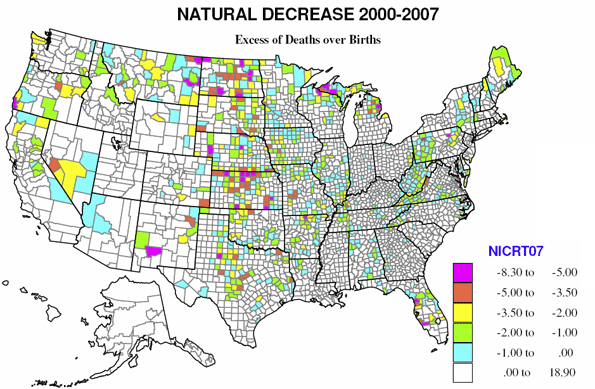
    The Great Plains, the part of the country most dependent on agriculture, has led this trend as it has been since probably 1960, with counties from Texas to North Dakota, Montana (and beyond into Canada) experiencing among the highest levels of natural decrease. Others include central Florida, Appalachia, and some interior parts of New England, the upper Michigan to northern Minnesota iron range, and a sizable scatter of counties across the west.

    What causes natural decrease? First is a pattern of long term out-migration of the surplus young, who could not be supported by the limited rural economy and other natural resource based industries. Second is the growth of the elderly population from selective migration to amenity retirement areas. Florida is the “flagship” case, but to a lesser degree it occurs in favored local environments in most of the country. Third would be a situation of natural decrease because of unusually high mortality. Fortunately, there is no example of this in the United States.

    The geography of natural decrease

    First there is a small set of counties with natural decrease, more deaths over births, but still net positive growth due largely to net domestic in-migration (magenta and yellow on the county types map, Figure 2). The bulk of these counties are retirement amenity areas, mostly but not entirely in the Sunbelt, and mostly but not entirely in the south and west. Another even smaller group is characterized by long term declining industry and mining based economies, but also offers affordable housing stock for second homes and later retirement. We see this especially in Appalachia.
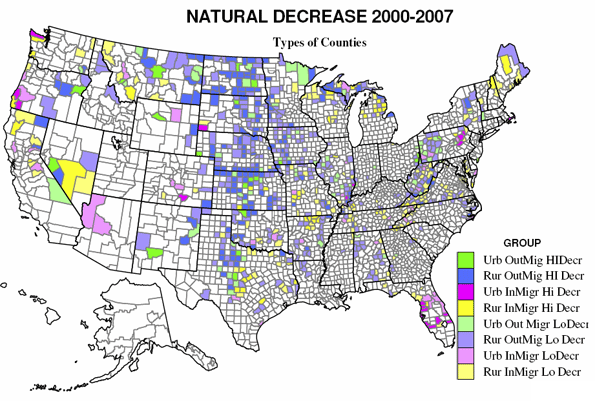
    The largest cluster of the first type of places covers a swath of central Florida, including such cities as St. Petersburg, Sarasota, Port Charlotte, Melbourne, Daytona Beach, followed by southwestern Oregon, northwestern Arizona (Prescott, Lake Havasu City), central Colorado (west of Colorado Springs), parts of rural Northern California, Wyoming, South Dakota, Montana and Washington state.

    The main cluster of the second type, areas with industrial decline that have become amenity retirement destinations, are in Appalachia, especially the North Carolina – Tennessee border area (Great Smokies), selected counties in northern West Virginia and exurban counties around Pittsburgh. A prominent cluster is the Scranton-Wilkes-Barre, Hazleton area of east central PA. Scattered Midwestern examples include places like Hot Springs, Arkansas, 3 counties in Southeast Illinois, along with areas along Lake Superior, parts of Arkansas as well as on the Texas Gulf coast.

    The more rural natural decrease counties with net in-migration (215 counties, yellow on the map) tend to occur in the same regions. The two main “belts” of such counties are retirement and resort counties extending from the central Texas hill country through Ozark plateau and lakes, and again parts of Appalachia. Virginia has the largest number of such counties, some just beyond the commuter zone of Washington. Similar areas occur across the far north, characterized by recreation and retirement as well as ex-logging or mining. A third area includes areas in western Montana, popular with California retirees, and a fourth is far northern CA.

    Then there are counties losing population from natural decrease and net internal out-migration. Two-thirds (576) of counties with natural decrease experience this expected pattern of long term decline of resource-based economies. Of these 105 have at least a 50 percent urban population (green on the map), but most (471 of all 861) natural decrease counties are predominantly rural (blue on the map).

    The Great Plains, from Texas though Dakotas and eastern Montana to Nebrasla represents the largest region for natural decrease and populatiob loss. represents the largest region for such losses. This is quintessential high plains farm belt, which continues to experience mechanization, loss of local businesses and out migration of the young for at least 80 years now. But although the large majority of rural counties with net out-migration (blue on the map) are in the Great Plains belt, significant numbers also occur in the forest and mining counties in Maine, Michigan, eastern Oregon, northeastern New York, and northern Appalachia.

    This leaves an interesting scattering of counties from Texas, northern Louisiana, Arkansas, Alabama, and the North Carolina-Virginia border region. These are mainly farming areas, often with significant (35 to 60 percent) Black population shares, largely elderly, areas somewhat “left behind” in the growth of industrialization and urbanization of the south. This is where young Blacks have left for city opportunities, just as young whites have from the prairies and the mines.

    What will the future bring?

    I examined maps of counties with 0 to 1% natural increase, or with high shares of the population between 45 and 64, which are plausible candidates for a shift to natural decrease, but also looked at counties with 0 to 1 % natural decrease, which are candidates for a shift to natural increase.

    The most likely future areas for a shift to natural decrease include many in a wider Appalachian belt, within the greater Mississippi valley from Louisiana to Canada. Hundreds of these counties have the potential to shift to natural decrease by 2025, as the vanguard of the Babyboomers reach 80. The likelihood of the shift does depend on the proximity of the county to vigorous urban and metropolitan areas and on counties’ relative success or failure at attracting retirees. Other commentators have talked of the “slowdown” of migration to and growth of Florida, and the spread of retiree settlement to many other parts of the country. This is already evident on the map, but it is premature to write off Florida’s appeal to retirees, particularly as house prices there have plunged.

    There are also forces that may slow, or even reverse, natural decrease. Northward expansion of the Hispanic population will have the contrary effect of raising birth rates and a shift to natural increase. Some areas that have attracted affluent retiree migrants also could experience sufficient investment to foster more general growth.

    At the same time, the retirement geography of the massive Baby Boomer cohort has the potential of redrawing the map. But overall, I believe we will see more counties experiencing natural decrease.

    This process has now reached around 800 counties. But we will see more of this when the nation approaches ZPG, zero population growth, perhaps after 2050, in many counties

    Richard Morrill is Professor Emeritus of Geography and Environmental Studies, University of Washington. His research interests include: political geography (voting behavior, redistricting, local governance), population/demography/settlement/migration, urban geography and planning, urban transportation (i.e., old fashioned generalist)


    References:
    Morrill, Richard, 1993, The spread of natural decrease, FOCUS,43- 30-33
    Morrill, Richard\, 1994, Aging in place, age specific migration and natural decrease, Annals of Regional Science, 28- 1-26
    Cromartie, John and Kandel, William, 2008 Rural population and Migration-Trend 4,Natural decrease on the rise. Economic Research Service,USDA \
    Cromartie, John and Nelson, Peter, 2008, BabyBoomer migration and socioeconomic change in “no growth’ counties. Paper, Rural Sociological Society.
    Frey, William,, 2004, Generational Pull, American Demographics
    Johnson, Kenneth and Beale, Calvin, 1992, Natural population decrease in the United States, Rural Development Perspectives, 8 , pp 8-15
    Johnson, Kenneth
    Hull, Victor, Retirement choices stretch beyond Florida. 2006,
  • Contributing Editor MICHAEL LIND in Just Above Sunset regarding conservatism

    “But oddly enough, that’s only a minor matter. Bigger questions are also at issue. And for a consideration of those questions, one might turn to Michael Lind, the former neoconservative who stepped back and decided all that stuff was nonsense, then gave us Up From Conservatism: Why the Right is Wrong for America (1996) and Made in Texas: George W. Bush and the Southern Takeover of American Politics (2004). He likes rethinking things, even if no one else does.”

    Michael Lind on Just Above Sunset

  • Executive Editor JOEL KOTKIN on Urbanatomy

    “To dedicated urbanites, thriving on the culture, street life and energy of the city’s downtown, suburbs can seem like a bland and boring alternative. Who would trade the intensity, hybridity and vibrancy of the core for the sterile sprawl of the periphery? Yet, as urban theorist Joel Kotkin points out, the reality of market forces and ‘voting with your feet’ provides stark evidence that suburbia is emerging as the predominant form of urbanism in the 21st century. “Since 1950, more than 90 per cent of metropolitan population growth in America has taken place in the suburbs,” he writes. “Today, roughly two out of three people in the nation’s metro areas are suburban dwellers.” The future of the metropolis, it seems, lies in its suburbs. ”

    Joel on Urbanatomy

  • Contributing Editor WENDELL COX on the National Center for Policy Analysis

    “One of the most frequently mouthed claims about high-speed rail is that it is enormously profitable. Judging by the claims made by proponents, you might wonder why all the world’s capital has not “beaten a path” to the station, says Wendell Cox, a senior fellow with the Heartland Institute.”

    Wendell Cox on NCPA

  • Purple Politics: Is California Moving to the Center?

    You don’t have to be a genius, or a conservative, to recognize that California’s experiment with ultra-progressive politics has gone terribly wrong. Although much of the country has suffered during the recession, California’s decline has been particularly precipitous–and may have important political consequences.

    Outside Michigan, California now suffers the highest rate of unemployment of all the major states, with a post-World War II record of 12.2%. This statistic does not really touch the depth of the pain being felt, particularly among the middle and working classes, many of whom have become discouraged and are no longer counted in the job market.

    Even worse, there seems little prospect of an immediate recovery. The most recent projections by California Lutheran University suggest that next year the state’s economy will lag well behind the nation’s. Unemployment may peak at close to 14% by late 2010. Retail sales, housing and commercial building permits are not expected to rise until the following year.

    This decline seems likely to slow–or even reverse–the state’s decade-long leftward lurch. Let’s be clear: This is not a red resurgence, just a shift toward a more purplish stance, a hue that is all the more appropriate given the economy’s profound lack of oxygen.

    There is growing disenchantment with the status quo. The percentage of Californians who consider the state “one of the best places” to live, according to a recent Field poll, has plummeted to 40%, from 76% two decades ago. Pessimism about the state’s economy has risen to the highest levels since Field started polling back in 1961.

    Inevitably, this angst has affected political attitudes. Though still lionized by the national media, Gov. Schwarzenegger’s approval ratings have fallen from the mid-50s two years ago into the low 30s. The 12% approval rate for the state legislature, according to a Public Policy Institute of California survey in May, stands at half the pathetic levels recorded by Congress.

    Moreover, voters now favor lower taxes and fewer services by a 49-to-42 margin–as opposed to higher taxes and more services. Support for ultra-green policies aimed to combat global warming has also begun to ebb. For the first time in years, a majority of Californians favors drilling off the coast. Californians might largely support aggressive environmental protections, but not to the extreme of losing their jobs in the process.

    Remarkably, state government seems largely oblivious to these growing grassroots concerns. The legislature continues to pile on ever more intrusive regulations and higher taxes on a beleaguered business sector. Agriculture, industry and small business–the traditional linchpins of the economy–continue to be hammered from Sacramento.

    Agriculture now suffers from massive cutbacks in water supplies, brought about in part by drought, but seriously worsened by the yammerings of powerful environmental interests. Large swaths of the fertile central valley are turning into a set for a 21st-century version of Steinbeck’s Grapes of Wrath.

    At the same time, the state’s industrial base is rapidly losing its foundation. Toyota recently announced it was closing its joint venture plant in Fremont, the last auto assembly operation in the state, shifting production to Canada and Texas. Even the film business has been experiencing a secular decline; feature film production days have fallen by half over the decade, as movie-making exits for other states and Canada.

    Most important, California may be undermining its greatest asset: its diverse, highly creative and adaptive small-business sector. A recent survey by the Small Business and Entrepreneurship Council ranked California’s small-business climate 49th in the nation, behind even New York. Only New Jersey performed worse.

    Regulation plays a critical role in discouraging small-business expansion, a new report from the Governor’s Office of Small Business Advocate suggests. Prepared by researchers from California State University at Sacramento, the report estimates that regulations may be costing the state upward of 3.8 million jobs. California currently has about 14 million jobs, down 1 million since July 2007.

    Ironically, the regulatory noose is now slated to tighten even further as a result of radical measures–from energy to land use–tied to reducing greenhouse gases. Another study, authored by California State University researchers, estimates these new laws could cost an additional million jobs.

    Many in the state’s top policy circles, as well as academics and much of the media, dismiss the notion that regulations could be deepening the recessionary pain. Some of this stems from the delusion–always an important factor in this amazing state–that ultra-green policies will actually solidify California’s 21st-century leadership. Few seem to realize that other states, witnessing the Golden State’s economic meltdown, might not rush to emulate California’s policy agenda.

    Internally, discontent with the current agenda seems particularly strong in the blue-collar, interior regions of the state. Brookings demographer Bill Frey and I have described this area as the “Third California.” In the first part of the decade, this region expanded roughly three times as rapidly as Southern California, while the Bay Area’s population remained stagnant.

    Today the Third California represents roughly 30% of the state’s population, compared with barely 18% for the ultra-blue Bay Area. The most conservative part of the state has skewed somewhat more Democratic in recent elections, largely due to migration from coastal California and an expanding Latino population.

    But the intense economic distress now afflicting the interior counties–where unemployment rates are approaching 20%–may now reverse this process. The ultra-green politics embraced by the Democrats’ two prospective gubernatorial nominees-Attorney General Jerry Brown and San Francisco Mayor Gavin Newsom–may not appeal much to a workforce heavily dependent on greenhouse-gas-emitting industries like farming, manufacturing and construction.

    Eventually, the Democrats may rue their failure to run a pro-business, pro-growth candidate, particularly one with roots in the interior region. This oversight could cost them votes among, say, Latinos, who have been far harder hit by the recession than the more affluent (and overwhelmingly white) coastal progressives epitomized by Brown and Newsom. Along with independents, roughly one-fifth of the electorate, Latinos could prove the critical element in the state’s purplization.

    This, of course, depends on the Republicans developing an attractive pro-growth alternative. In recent years, the party’s emphasis on conservative cultural issues and xenophobic anti-immigrant agitation has hurt the GOP in the increasingly socially liberal and ethnically diverse California.

    Although he has proved a poor chief executive, Gov. Schwarzenegger did at least show such a political approach could work. The recent emergence of three attractive Silicon Valley-based candidates, including former eBay CEO Meg Whitman and State Insurance Commissioner Steve Poizner, as well as the likable libertarian-leaning former congressman Tom Campbell, could score well at the polls.

    This political course-correction should be welcomed not only by Republicans but by California’s moderate Democrats and Independents. However blessed by nature and its entrepreneurial legacy, California needs to move back to the pro-growth center if it hopes to revive both its economy and the aspirations of its people.

    This article originally appeared at Forbes.

    Joel Kotkin is executive editor of NewGeography.com and is a distinguished presidential fellow in urban futures at Chapman University. He is author of The City: A Global History. His next book, The Next Hundred Million: America in 2050, will be published by Penguin Press early next year.