Blog

  • How Smart Growth Disadvantages African-Americans & Hispanics

    It was more than 45 years ago that Dr. Martin Luther King, Jr. enunciated his “Dream” to a huge throng on the Capitol Mall. There is no doubt that substantial progress toward ethnic equality has been achieved since that time, even to the point of having elected a Black US President.

    The Minority Home Ownership Gap: But there is some way to go. Home ownership represents the core of the “American Dream” that was certainly a part of Dr. King’s vision. Yet, there remain significant gap in homeownership by ethnicity. Rather than a matter of discrimination, this largely reflects differing income levels between White-Non-Hispanics, African-Americans and Hispanics or Latinos. Today, approximately 75% of white households own their own homes. Whites have a home ownership rate fully one-half higher than that of African-Americans and Hispanics or Latinos at 47% and 49% (See Figure).
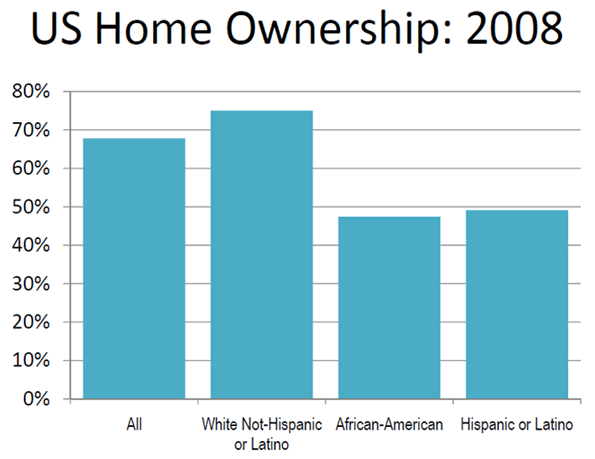
    Setting the Gap in Stone: A key to redressing this difficulty will be convergence of minority household incomes with those of whites, and that is surely likely to happen. However, there is another important dynamic in operation: house prices in some areas have risen well in advance of incomes, so that convergence alone can not narrow the home ownership gap in a corresponding manner. It is an outrage for public policy to force housing prices materially higher so long as home ownership remains beyond the incomes of so many, especially minorities.

    The Problem: Land Use Regulation: The problem is land use regulation. The economic evidence is clear: more restrictive land use regulation raises house prices relative to household incomes. This can be seen with a vengeance in the house price increases that occurred during the housing bubble. As we have previously described, metropolitan markets with more restrictive land use regulation (principally the more radical “smart growth” policies) experienced house price escalation out of all proportion to other areas in the nation. In some cases, they topped out at nearly four times historical norms. On the other hand, in the one-half of major metropolitan area markets where land use regulations were less severe, house prices tended to increase to little more than historic norms, at the most.

    How Smart Growth Destroys Housing Affordability: This difference is principally due to the price of land, which is forced upward when the amount of land available for building is artificially limited, as is the case in smart growth markets. At the peak of the bubble, there was comparatively little difference in house construction costs per square foot in either smart growth or less restrictive markets. However, the far higher land prices drove house prices in smart growth markets far above those in less restrictively regulated markets. Where house prices rise faster than incomes, housing affordability drops as prices rise at escalated rates.

    Wishing Away Reality: It is not surprising that the proponents of smart growth undertake Herculean efforts to deflect attention away from this issue. Usually they pretend there is no problem. Sometimes they produce studies to indicate that limiting the supply of land and housing does not impact housing affordability, which is akin to arguing that the sun rises in the West. Even the proponents, however, cannot “walk a straight line” on this issue, noting in their most important advocacy piece (Costs of Sprawl – 2000) that their more important strategies have the potential to increase the cost of housing.

    The Assault on Home Ownership: Worse, well connected Washington interest groups (such as the Moving Cooler coalition) and some members of Congress seek to universalize smart growth land rationing throughout the nation, which would cause massive supply problems and housing price inflation that occurred in some markets between 2000 and 2007. Even after the crash, these markets experienced generally higher house prices relative to incomes in smart growth markets than in traditionally regulated markets.

    House Price Increases and Minorities: House price increases relative to incomes weigh most heavily on ethnic minority households, because their incomes tend to be lower. This is illustrated by an examination of the 2007 data from the American Community Survey, in our special report entitled US Metropolitan Area Housing Affordability Indicators by Ethnicity: 2007. The year 2007 was the peak of the housing bubble, but represents a useful point of reference for when future “smart growth” policies were imposed nationwide.

    Median Priced Housing: The data (Table) indicates that median house prices were 75% or more higher for African-Americans than Whites, however that African-Americans in smart growth markets require 84% more to buy the median priced house. The situation was slightly better for Hispanics or Latinos with median house prices at least 50% more relative to incomes than for Whites. House prices relative to Hispanic or Latino median household incomes were 86% higher in smart growth markets than in less restrictively regulated markets.

    SUMMARY OF HOUSING INDICATORS BY
    LAND USE REGULATION CATEGORY
    Metropolitan Areas over 1,000,000 Population: 2007
    HOUSING INDICATOR Less Restrictive Land Use Regulation Markets More Restrictive Land Use Regulation Markets All Markets More Restrictive Markets Compared to Less Restrictive Markets
    MEDIAN VALUE MULTIPLE        
    All 3.1 5.8 4.5 1.89
    White Non-Hispanic or Latino 2.7 5.1 3.9 1.90
    African-American 4.9 8.9 6.9 1.84
    Hispanic or Latino 4.2 7.9 6.1 1.86
    LOWEST QUARTILE VALUE MULTIPLE      
    All 2.1 4.2 3.2 2.01
    White Non-Hispanic or Latino 1.8 3.7 2.8 2.01
    African-American 3.3 6.5 5.0 1.95
    Hispanic or Latino 2.9 5.7 4.4 1.98
    MEDIAN RENT/MEDIAN HOUSEHOLD INCOME      
    All 13.8% 17.1% 15.5% 1.24
    White Non-Hispanic or Latino 12.1% 15.1% 13.6% 1.25
    African-American 21.9% 26.1% 24.0% 1.19
    Hispanic or Latino 19.1% 23.0% 21.1% 1.20
    LOWER QUARTILE RENT/MEDIAN HOUSEHOLD INCOME    
    All 10.8% 13.1% 12.0% 1.22
    White Non-Hispanic or Latino 9.4% 11.6% 10.5% 1.23
    African-American 17.0% 20.0% 18.5% 1.17
    Hispanic or Latino 14.9% 17.5% 16.2% 1.18
    NOTES        
    Median Value Multiple: Median House Value divided by Median Household Income
    Low Quartile Value Multiple: Low Quartile House Value divided by Median Household Income
    2007 Data
    Calculated from American Community Survey (US Bureau of the Census) Data
    “More restrictive” land use regulation markets (generally "smart growth") include those classified as "growth management," "growth control," "containment" and "contain-lite" and "exclusions: in "From Traditional to Reformed A Review of the Land Use Regulations in the Nation’s 50 largest Metropolitan Areas" (Brookings Institution, 2006) and markets with significant large lot zoning and land preservation restrictions (New York, Chicago, Hartford, Milwaukee, Minneapolis-St. Paul, and Virginia Beach). Less restrictive" land use regulation markets (generally "traditional") include all others, except for Memphis, where urban growth boundaries have been drawn far enough from the urban area to have no perceivable impact on land prices and Nashville, where the core county is exempt from the urban growth boundary requirement in state law.

    Lower Priced Housing (Lowest Quartile): I recall being told by a participant at a University of California–Santa Barbara economic forum organized by newgeography.com contributor Bill Watkins that, yes, smart growth increases house prices, but not for lower income residents. My challenger went so far as to say that lower income households were aided economically by smart growth. The facts are precisely the opposite. Comparing the lowest quintile (lowest 25%) house price to median household incomes indicates that minorities pay even a higher portion of their incomes for lowest quintile priced houses than the median priced house. African-Americans in smart growth markets needed 95% more relative to incomes to afford the lowest quartile house. Hispanics or Latinos needed 98% more.

    Rental Housing: The problem carries through to rental housing. There is a general relationship between rental prices and house prices, though rental prices tend to “lag” house price increases. In the smart growth markets, minorities must pay approximately 20% more of their income for the median contract rental in smart growth metropolitan areas than in less restrictively regulated markets. Similar results are obtained when comparing minority household median incomes with lowest quintile contract rents, with African-Americans paying 17% more of their incomes in smart growth markets and Hispanics or Latinos paying 18% more.

    Moreover, it is important to recognize that all of the above data is relative, based on shares or percentages of incomes. Varying income levels are thus factored out. Minority and other households in smart growth markets face costs of living that are approximately 30% higher than in less restrictively regulated markets, according to analysis by US Department of Commerce Bureau of Economic Analysis economists. Some, but not all of the difference is in higher housing costs.

    Social Costs of Smart Growth: In 2004, the Tomas Rivera Policy Institute, which focuses on Latino issues, noted concern about the homeownership gap in California, which has been ground zero for land use regulation driven house price increases for decades:

    Whether the Latino homeownership gap can be closed, or projected demand for homeownership in 2020 be met, will depend not only on the growth of incomes and availability of mortgage money, but also on how decisively California moves to dismantle regulatory barriers that hinder the production of affordable housing. Far from helping, they are making it particularly difficult for Latino and African American households to own a home.

    Examples of the restrictions cited by the Tomas Rivera Policy Institute are restrictions on the supply of land, high development impact fees and growth controls.

    California has acted decisively, but against the interests of African-Americans and Hispanics or Latinos. The state enacted Senate Bill 375 in 2008, which will impose far stronger state regulations on residential development, increasing the likelihood that minorities in California will always be disadvantaged relative to White-Non-Hispanics. At the same time, State Attorney General Jerry Brown has forced some counties to adopt more restrictive land use regulations through legal actions. California, which had for decades been considered a state of opportunity, is making home ownership and the pursuit of the “American Dream” far more difficult, particularly for its ever more diverse population.

    Stopping the Plague: In California, the hope to increase African-American and Latino home ownership rates to match those of white-non-Hispanics may already be beyond reach due to the that state’s every intensifying radical smart growth policies. However, the “Dream” continues to “hang on” in many metropolitan markets. Hopefully Washington will not put a barrier in the way of African-Americans and Hispanics or Latinos that live elsewhere in the nation.

    US Metropolitan Area Housing Affordability Indicators by Ethnicity: 2007 includes tables with data for each major metropolitan area in the United States

    Photo: Starter house in Atlanta suburbs (by the author)

    Wendell Cox is a Visiting Professor, Conservatoire National des Arts et Metiers, Paris. He was born in Los Angeles and was appointed to three terms on the Los Angeles County Transportation Commission by Mayor Tom Bradley. He is the author of “War on the Dream: How Anti-Sprawl Policy Threatens the Quality of Life.
  • The Crisis of Academic Urban Planning

    A wide gulf has opened up between mainstream Australian values and the prescriptions of our urban planning academics. So much so that the latter are at risk of degenerating into a cult. While it’s usually unfair to criticise a group in generalised terms, there are ample grounds in this case. Anyone who doubts the existence of an urban planning “establishment” in and around the Australian university system, and that it’s in thrall to ultra-green groupthink, should revisit some recent correspondence to our newspapers.

    A perfect example appeared in the Australian Financial Review of 31 July 2009. On that day, the paper carried a joint missive penned by no less than eight leading-lights from various urban and planning related faculties, along with two others from like-minded institutions.

    Stirred by the perennial bugbear of residential development on the urban fringe, the authors wrote to denounce the Victorian Government’s plans to develop 40,000 hectares of new suburbs.

    The signatories included the Dean and the Chair of Melbourne University’s architecture faculty, leaders of the university’s Nossal Institute for Global Health and Eco-Innovation Lab, the Director of Curtin University’s Sustainability Policy Institute, a Professor of Planning and the Dean of Global Studies at Royal Melbourne Institute of Technology (RMIT), and the Director of Urban Research at Griffith University.

    They were joined by two holders of non-academic posts, one in the City of Melbourne’s Design and Urban Environment Department, the other at the Melbourne Sustainable Society Institute.

    Since they’re all attracted to some variant of the command economy, let’s call them “the ten commandants”.

    Their letter opens with the standard formula of green urbanism. The Victorian Government’s plans are “unsustainable – environmentally, economically and socially”. This highly abstract phrase, a mainstay of the urban planning literature, implies a seamless and mutually reinforcing compatibility amongst the three dimensions of sustainability. In the real world things aren’t so simple.

    The formula conceals far more than it reveals. It’s not at all clear that environmental sustainability, as conceived by the commandants, is compatible with economic sustainability. More than likely, it isn’t. As most prescriptions for environmental sustainability include measures to suppress economic activity, including regulations and cost imposts, the more likely outcome is economic stagnation.

    Economic stagnation may well be compatible with environmental sustainability, at least in the eyes of ultra-green academics, but it’s hardly compatible with social sustainability. A society without economic opportunities will descend into division and conflict.

    In this regard the commandants’ agenda is ominous. “[W]e will have these [new fringe suburbs] to deal with”, they complain, “when we finally commit to a low carbon economy”.

    This paternalistic tone pervades the whole letter, even when the public are offered apparent choices. Having spilt a lot of ink on how, in the sustainable future, “developments will be denser than the surrounding suburbs”, the commandants still claim “we will live with … more choice of housing type”. And the false choices keep coming. Consider this intriguing paragraph: “Not everyone wants or needs to live in an activity centre or on the tramline, but a sustainable city is one where you can get there without a car”. You can live wherever you like, as long as you don’t need a car. Plenty of choice there.

    “This is a future”, they say of their vision, “where we will be fitter rather than fatter”. This is a future, more accurately, where intellectuals treat people like laboratory rats.

    What it all means, of course, is that the public won’t have a say, let alone a choice. “The fear of a suburban backlash is unfounded”, say the commandants, “and attitudes will become more supportive when imaginative design visions and construction projects demonstrate what is possible”. Behind the condescending verbiage lurks a strategy of imposing a fait accompli. Indeed, they end up hoping that the federal government will intervene.

    There’s one good thing about the letter. It concedes that releasing more land does improve housing affordability. Planners have tended to argue that it doesn’t work, since nobody wants to live on the fringe. Still, the commandants question the benefits, arguing these are “short term” and “outweighed by the long-term costs in capital expenditure and car-dependency”. Such criticisms underestimate the substantial and positive ripple effects of affordable housing on disposable incomes, consumer demand, job creation and ultimately state revenues.

    Green platitudes usually get a pass in the media, but on 3 August the AFR published a valiant letter in reply from Alan Moran of the Institute of Public Affairs, aptly titled “Planners’ patrician arrogance”.

    Moran makes two powerful points. First, had the commandants bothered to canvass public opinion, they would have discovered that “consumers around the world overwhelmingly prefer [separate houses to apartments] … One United Kingdom survey showed that only 2 per cent of people prefer to live in apartments”. Second, despite all the guff about the “sustainability” of denser development, the Australian Conservation Foundation found that “emissions from inner city households are a third greater than those on the fringe”.

    Leading up to the global financial crisis, demand for residential property was subdued, especially in Sydney. Buyers baulked at the combination of rising interest rates and developer costs, together with inflated prices linked to stymied land supply. Commentators speculated about a cultural shift away from outer suburbia. But things changed.

    Since the crisis, plummeting interest rates and government incentives have unleashed a new wave of demand. Buyers, including a substantial proportion of first home buyers, have flocked to new fringe suburbs. According to one report “[p]roject-home builders are reporting a boom in new house sales in parts of Sydney that were until recently green pasture.” NSW Department of Planning figures show that in the current financial year building on Sydney’s fringe made up just under 20 per cent of all construction, compared with 10 per cent in 2005-06.

    Things are no different in Melbourne. The city’s fastest growing area is the outer western suburb of Werribee.

    Where does that leave the commandants? They would agree that urban planning should alleviate socio-economic disadvantage. If so, they and the planning establishment need to acknowledge that most low to middle income Australians reject their vision of a compact ecopolis. These Australians cherish their lifestyle, and sense that the social and economic costs of planning fetters will far outweigh the environmental benefits.

    The suburbs have spoken. Unless planners ditch their utopian dreams and integrate academic research with social reality, they face increasing alienation from the policymaking process.

    This article first apeared at The New City Journal

  • Perspective on G-20: Don’t Trip on those Green Shoots

    Everywhere you look – from the White House to Wall Street – they are painting a sunny picture of recovery, free from any gloomy ideas. Bernie Madoff is in jail, Goldman Sachs is repaying their bailout money, and everywhere they look they see “green shoots.”

    Yet according to the Congressional Budget Office (CBO), the US economy and federal government are headed for doom. We are on a completely unsustainable path economically and financially. The CBO updated their forecasts after our June piece on the State of the Economy. In their updated Budget and Economic Outlook, CBO clearly concludes that the current rate of high spending and low revenues has the nation on an unsustainable fiscal course. Unemployment won’t drop below 5% until 2014. As a result, according to the latest country risk rankings by Euromoney magazine [http://www.euromoney.com, subscription required for full access] Canada, Australia and most of Scandinavia have passed the US as safer places to invest in business.

    These predictions of doom are, in fact, based on the best-case scenario of 3 percent economic growth next year and 4 percent the year after that; plus the expiration of tax cuts and no new stimulus or bailout packages. Whether we call it a Panic, a Depression, a Recession or a Downturn, it all means the same thing. The nomenclature has been softened over the decades to remove that ever so gloomy feeling folks get when things are bad. If you still have a job, you know someone who has been laid off, had their hours cut, etc. I just received my first new piece of business since February. Things are tough everywhere you look.

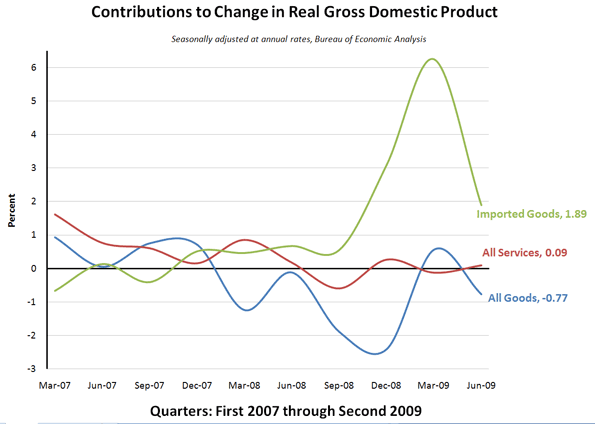
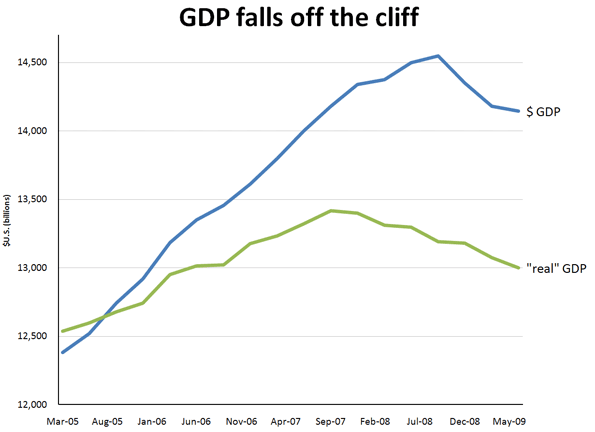
    GDP this year ($14,143 billion) is about where it was two years ago in actual dollar terms ($14,180 billion, third-quarter 2007). Accounting for inflation in consumer prices, our economy is closer to the level it was at the end of March 2006 or even back to the end of 2005. Actual dollar GDP peaked in September 2008 but I prefer the regular “real” GDP, adjusted for changes in what a dollar will buy you, which peaked in the third quarter of 2007 – we live in the real world, using real dollars to pay for real things.

    The importance of changes in the real-dollar economy become most obvious when we consider international trade, which has been on the minds of the leaders of the G-20 nations in Pittsburgh this week. The fact that US consumers sustained and even increased their demand for imported goods until the onset of the global recession and in the face of a declining dollar lends credence to President Obama‘s plan to discuss what the world, not just what the US, can do to “lay the groundwork for balanced and sustainable economic growth.”

    On the one hand, our consumption of imported goods contributed to ours and the world’s economic growth. This fuels concern over whether or not the US can keep the promise to not impose new trade barriers before the end of 2010 and the world’s willingness to continue to buy our debt in the form of US Treasury bonds. At the same time, as Kansas City Federal Reserve Bank President Thomas Hoenig said last week in a speech I attended in Omaha, we need the world’s consumers to continue buying US goods in order to maintain our position as the “industrial leader of the world.” It’s a delicate balance, at best.

    The late 2007 nose dive in the “real” economy exposed the trouble brewing on the housing front, when we became aware of the explosion in credit derivatives, and when many of us started warning people about the insanity taking place in U.S. bond markets. No matter how you measure it, we would need about a 3 percent increase in GDP by next summer just to get back to where we were the last time everyone felt good about their money.

    Data from Bureau of Economic Analysis; author’s calculations
    So, why are we hearing such a positive spin on the economic news? One reason is the lack of understanding among reporters – most of them probably studied literature or journalism in college – not finance or economics. New York Times economics reporter Edmund L. Andrews is a perfect example. He just published a book describing “how he signed away his life for a toxic loan to buy a house in Silver Spring that he couldn’t really afford.” The Washington Post reviewer called the book “bright and breezy.” No gloom there!

    At the same time that he was signing the papers for an outsized mortgage, Andrews was writing articles like this gem from September 1, 2007 – just as the real economy was perched on the edge of the cliff – where he reports on Federal Reserve Bank Chairman Ben Bernanke saying he will “prevent chaos in the mortgage markets from derailing the economy.” The stock market climbed nearly 1 percent that day to close at 13,357.74 – it closed at 9,820.20 last Friday. Yet, Mr. Andrews still has a job with the New York Times – unlike millions of his readers – writing about topics like troubled mortgages.

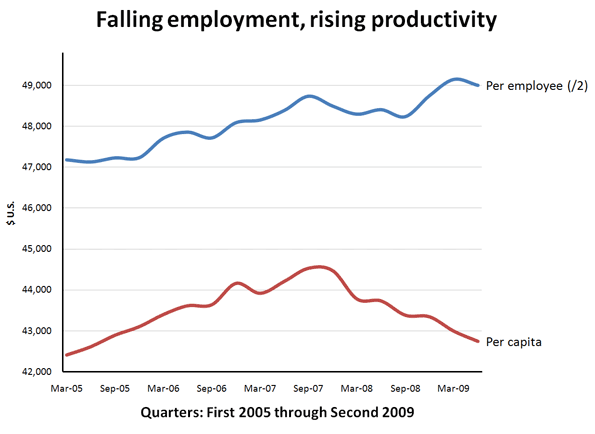
    Data from Bureau of Economic Analysis and Census Bureau. Per employee divided by 2 for scale.

    But what about the recent stock market rise? We should not be surprised if business profits are up: fewer people working means that the output per worker has been increasing since the end of 2008. GDP per capita (per person in the population), on the other hand, has been decreasing since the end of 2007 – an indication of a falling standard of living.

    The next few months are a time to focus, concentrate, plan, and follow-through. We are at a turning point comparable to the beginning of the Industrial Revolution and the system of capitalism that financed it. By frantically printing money and creating credit through bank bail-outs, the Federal Reserve and the Treasury are boosting the stock market by pumping in about $150 billion a month into corporate securities, increased auto sales (with government rebates) and home sales (with government first-time buyer tax credits).

    The problem is that these three pieces – banking, cars and homes – are not the whole economy, and, since they depend on government debt, none of these “green shoots” are sustainable on their own. Keep your eye on the big picture (the Kiplinger Recovery Index is a handy one-stop) – and don’t relax until all the indicators are green.

    Susanne Trimbath, Ph.D. is CEO and Chief Economist of STP Advisory Services. Her training in finance and economics began with editing briefing documents for the Economic Research Department of the Federal Reserve Bank of San Francisco. She worked in operations at depository trust and clearing corporations in San Francisco and New York, including Depository Trust Company, a subsidiary of DTCC; formerly, she was a Senior Research Economist studying capital markets at the Milken Institute. Her PhD in economics is from New York University. In addition to teaching economics and finance at New York University and University of Southern California (Marshall School of Business), Trimbath is co-author of Beyond Junk Bonds: Expanding High Yield Markets.

  • Why the feds should stay out of high-speed rail (and most transportation)

    Set aside for a minute whether high-speed rail (HSR) makes sense or not on a cost-benefit basis. Regardless of whether it does or not (and some smart people are arguing not), I’d like to make the argument that federal funding has no place in HSR. Instead, it should be left to individual states or regional state coalitions.

    The federally-funded interstate system was originally conceived for defense purposes – rapid mobilization – after Ike saw the German autobahns. Freight and people movement were obvious beneficiaries, over short, medium, and long distances. It is a comprehensive network that crosses state lines, which argues for federal involvement. The government made the minimal investment it had to make – road beds – and people/companies paid for vehicles and fuel. Fuel was taxed to pay for it all. If EZ-tag technology had been available at the time, I suspect they would have tolled it all instead to pay for it.

    Airports followed a similar arrangement: government provides the landing strips and terminals while private companies provide the vehicles and fuel. Passenger ticket taxes pay for the infrastructure. As airports are a local decision, they are (mostly) paid for locally, although regulated federally for standardization and safety.

    HSR is targeted at medium distances only, making it more of a state/regional decision (i.e. a small collection of states). It also requires huge subsidies, as the government provides the track, cars, and energy. There is nothing directly related that can be taxed to pay for it (like fuel taxes for roads and passenger ticket taxes for airports). You could try to tax the rail tickets, but if they were fully priced they would not attract nearly enough riders. So no matter how you slice it, in the end the government (i.e. taxpayers) will be paying the majority of the cost of moving each passenger. The infrastructure cost cannot be covered by direct user fees, as demonstrated in other countries.

    Rather than compare HSR to the interstate highway system, the better analogy would be airports. Imagine if California said, “Feds, give us money to build a few airports in key CA cities and provide a subsidized government-run airline to provide frequent intra-state service where tickets are priced way below cost.” Put that way, people would recognize the idea as absurd, and tell California to do it themselves if they think it’s such a good idea.

    The problem is that a simple program that made sense at the time – a federal gas tax to build an interstate highway system – has evolved into a Frankenstein monster of massive federal involvement in enlarged urban freeways, local rail transit, and now high-speed rail – areas where they simply do not belong. Local transportation planners have shifted decision making from “What are the best cost-benefit investments we can make to move people in our area?” to “How to do we grab our ‘fair’ share of the federal pie, regardless of whether or not the project is something we would consider with our own money?” And that is leading to a lot of boondoggles being built around the country, culminating recently in the famous Bridge to Nowhere in Alaska.

    The answer? The feds need to get out of the transportation business beyond minimal maintenance of the interstate highway system (the basic four lanes – not the expanded urban freeways). Let local entities make local decisions on transportation investments, including funding, and a whole lot of waste will magically disappear.

    This post originally appeared at Houston Strategies.

  • Pittsburgh Renaissance?

    In the third of a three part New Geography series on Pittsburgh for the G-20 summit, Aaron Renn assesses Pittsburgh’s value as a model region for other cities suffering decline.

    As the G-20 leaders prepare to convene in Pittsburgh, expect the recent chorus of praise for that city’s transformation to reach a crescendo. Pittsburgh, once the poster child for industrial decline and devastation, is now the media darling as an exemplar of how to turn it around. The New York Times talks about how “Pittsburgh Thrives After Casting Steel Aside” while the New York Post informs us that “Summer in Pittsburgh Rocks”. The Economist named Pittsburgh America’s most livable city. This emerging reputation for cracking the code on revitalization is prompting struggling burgs like Cleveland and Detroit to ask what lessons the Steel City holds for them.

    But does reality live up to the hype? Has Pittsburgh really turned the corner? For the most part, a look at the data suggests otherwise:

    1. Population Is Shrinking. The city of Pittsburgh has lost over 50% of its population since its peak and it is still declining. Just since the 2000 census Pittsburgh has lost nearly 25,000 people – over 7% of its population. The metro area is shrinking too, making Pittsburgh one of only a handful of large metro areas with the dubious distinction of population decline. Others on that list: Buffalo, Cleveland, Detroit, and New Orleans. Since 2000, metro Pittsburgh has actually lost a greater percentage of its population than metro Detroit.
    2. People Are Leaving. Part of Pittsburgh’s population loss is a result of a rare case of more deaths than births. But the region has net outmigration too. Few other stats are so telling about a city. Is this a place people are voting with their feet to move to or leave from? They may come to school or an internship at a local hospital, but, more often than not, they are not putting down roots. With more people moving out than moving in, Pittsburgh is clearly not a destination city
    3. International Immigrants Are Staying Away. Metro Pittsburgh’s foreign born population percentage was 2.6% in 2000 – very low. The Pittsburgh Technology Council summed it up best when it said, “Our region has negligibly grown its foreign born population.” Contrast Pittsburgh with the national average for foreign born population of 5.7%, and regions like Boston (11.2%), Denver (9.3%), and even Detroit (6.1%).
    4. Poverty Is High. Pittsburgh’s economic area poverty rate is worse than all cities benchmarked against it by Pittsburgh Today at 11.6% versus 9.3% in Milwaukee, 9.9% in Cincinnati, and 10.5% in Cleveland among 14 comparison cities.
    5. The City Is in Debt – Bigtime. Pittsburgh is buried under a mountain of liabilities. Its unfunded pension liability is over $1 billion. Its annual interest on its debt is $352 per capita, far higher than peer cities. Pittsburgh Quarterly is very direct: “Put simply, compared with all the benchmark regions, Pittsburghers have been saddled by their governments with relatively huge amounts of public debt.”

    Still, by other measures Pittsburgh is, if not thriving, certainly outperforming both the Rust Belt and the nation as a whole. Its July metro unemployment rate of 7.8% is well below the national average. In the last 12 months, Pittsburgh lost 2.8% of its jobs, which is a much better performance than regions like Chicago (-4.5%), Atlanta (-4.9%), and Portland (-5.8%). Its housing market, having never boomed to begin with, has not experienced the declines of most of the rest of the country, making it a Rust Belt outpost of the “zone of sanity”.

    Pittsburgh has a large “eds and meds” sector, led by the University of Pittsburgh, whose medical center employs over 25,000 people, and Carnegie-Mellon University. Pittsburgh was early to the game in this approach, with steel fortunes powering the development of these institutions starting in the 1950s. There are now seven universities within a five mile radius of downtown.

    Eds and meds employment is quasi-public sector. It can be a source of stability, but it’s not proved to be the source of dynamism that you see in Silicon Valley, around Boston or even Madison. Sure, there have been some high tech successes in Pittsburgh, but the city is far from a hub of the innovation economy.

    Pittsburgh’s downtown remains an employment center with a density uncommon in a Rust Belt full of cores defined more by parking lots than vital streetscapes. Pittsburgh has long had a rich fabric of dense, urban neighborhoods, and many of those are strengthening. The city’s geography retains its charm, and a lot of former industrial areas along the three rivers have been repurposed for recreational use.

    The truth is that the Pittsburgh story is still being written. It’s still more “green shoots” than a true renaissance so far. Until its migration statistics change course, and it demonstrates sustained and growing economic dynamism, the city cannot claim to have truly turned itself around. Still, the signs of progress are better than in places like Cleveland and Detroit.

    What accounts for this? A few success factors come to mind:

    1. Passion for the City. Older river cities like Cincinnati and New Orleans tend to have strong provincial cultures, with all the good and bad that implies. You see this in Pittsburgh in the unique local “yinzer” dialect, traditions like the cookie table at weddings, and of course the Steeler Nation. There’s a strong attachment to the native soil in Pittsburgh, even for those who left.
    2. Starting Early Into the Cycle. Jane Jacobs pegged Pittsburgh’s economic stagnation to 1910. The steel industry collapsed decades ago. Pittsburgh had troubles before other cities, so it is figuring out how to deal with them before other cities. It takes a long time to recover from a hundred years of status quo thinking.
    3. Shrinkage. There’s no longer a need for a Fort Pitt to project military power. The steel industry is gone and with it the need for thousands of steelworkers. Part of the issue in the Rust Belt is that there is no longer any economic raison d’etre for some of these big cities. Pittsburgh long was too big for its role in today’s economy, so shrinkage was good. This also created the rather unique institution of the Pittsburgh diaspora, best known through the Steeler Nation. Like the Indian and Chinese diasporas, it’s a network of people who went out, made connections in the world, built new skills, etc. that Pittsburgh can now tap into, as tirelessly documented by Jim Russell.
    4. The Totality of the Collapse. On Wall Street they call it “capitulation”, where the markets hit bottom and there is no positive sentiment. You have to hit that bottom to start back up. Pittsburgh went through a civic devastation when the steel industry collapsed the likes of which few American cities have seen. This shock to the system created the conditions necessary for change that a more gradual decline would not have.
    5. Dramatic Educational Improvements. The Chicago Fed reported that Pittsburgh’s national rank for percentage of adults who were high school grads went from 55th to 3rd. And for college grads it went from 69 to 37. These are amazing numbers.

    Is the Pittsburgh model transplantable elsewhere in the Rust Belt? In the short term, no. Pittsburgh’s successes of today are rooted in 30 years of steel industry collapse, shrinkage, and boosting its brain power. The auto industry restructuring eventually might bring a needed jolt to Detroit and other Rust Belt cities, but recovery is a long term game that requires sustained commitment over many years to things like education. Pittsburgh has achieved some of this, perhaps not as spectacularly as the media suggests, but in ways that are still useful for other Rust Belt cities to ponder.

    Aaron M. Renn is an independent writer on urban affairs based in the Midwest. His writings appear at The Urbanophile.

  • Hyping Pittsburgh: With the Global Economy in Dire Straits, Hell with the Lid Blown Off Never Looked Better

    As host of the G-20 summit, Pittsburgh briefly will sit in the global spotlight. In this second article of a three part series featuring Pittsburgh, rust belt observer Jim Russell digs into migration and education trends and what it may mean for the region.

    Chris Briem (the blogger behind Null Space) jokingly called it the “Mystic Order of the Yinzerati”. He would later take the idea about the influence of Pittsburgh expatriates more seriously. I’ve referenced talk about a conspiracy theory involving the diaspora and how the current US President seems to favor the Steel City. How else does one explain the location of the upcoming G-20 economic summit?

    Site Selection magazine is the latest conduit for Pittsburgh’s aggressive image makeover. By now, the narrative is polished. As an active consumer of all media about Pittsburgh, I find the story stale. The lines are well-rehearsed and remind me of an article I read last year in the New York Times or a decade ago in the Wall Street Journal. More often than not, I would discover that the writer of the glowing review has a Pittsburgh connection.*

    Recently, a journalist from Forbes interviewed me about the Pittsburgh renaissance. I mentioned the positive press the city has received and how the Burgh Diaspora seemed to be behind it all. At that point, she confessed that she was from Pittsburgh. The result? Pittsburgh is an archetype for the thriving 21st century city.

    I’m an avid Pittsburgh booster and I would bet that this round of rebranding will finally take root. However, that doesn’t mean I believe everything I read. Left out are all the challenges the region faces. Local bloggers fret about the city pension crisis getting swept under the rug, pointing out that the many myths used to promote Pittsburgh are disingenuous. Some natives have gone so far as to suggest that all the propaganda is nothing more than gilding a turd. After all, the population of Pittsburgh is still in decline. What about the brain drain?

    Ironically, the brain drain from Pittsburgh is the reason why I’m so bullish on this region’s future. Taking notice of the prolific Yinzerati, I began to see talent out-migration in a different light. Not every Rust Belt city could marshal the kind of sustained campaign that has benefited the New Pittsburgh. The more fantastic the fabrication, the more impressive the media blitz would seem. Surely expatriates from other shrinking cities could do the same. I’ll tell you why they haven’t.

    As brain drain is commonly understood, every region suffers from the same affliction. But the exodus from Pittsburgh was exceptional. Chris Briem charted the difference between unemployment rates in Pittsburgh and the national average from 1970 to present day. You might note that right now, never has the job market looked relatively better. What should really stand out is how bad the economy was in the early 1980s. It was a remarkable period of out-migration for young talent, robbing Pittsburgh of almost an entire generation.

    As I began to understand the connection between educational attainment and geographic mobility, I speculated that Pittsburgh’s brain drain was the result of a substantial investment in local human capital. The chronic decline in population is the result of successful workforce development policy. At least, that was my theory.

    Bill Testa, who works for the Federal Reserve Bank of Chicago, provided the evidence I was seeking. Compared with other Rust Belt cities and the nation over the period 1969-2006, Pittsburgh has anemic total employment growth. Strangely, Pittsburgh is a cohort outlier (in positive respects) if we consider gains in per capita income.

    Testa hints at the reason behind the surprising statistic:

    While Pittsburgh ranked low in college attainment in 1970, its gains in this metric since then have been the most rapid. Perhaps not accidentally, Pittsburgh’s growth in per capita income also outpaced other cities in the region.

    Pittsburgh did a great job of educating its populace. This policy would betray the region during the hard times of the early 1980s. Dynamic labor mobility found expression in the only avenue available, relocation. The Mysterious Order of the Yinzerati was born.

    Pittsburgh hasn’t been able to cash in on the diaspora dividend until the last decade. As I noted above, positive spin about Pittsburgh isn’t anything new. During the early 1990s, the work of urban planner Paul Farmer was nationally admired. Cities such as Minneapolis hoped to mimic Pittsburgh success. Former mayor Tom Murphy, not remembered fondly in Pittsburgh, enjoys a strong reputation as a wizard of downtown revitalization almost everywhere else. I imagine the Burgh Diaspora actively evangelizing their hometown’s dramatic transformation. But if anyone was listening, they didn’t move there on the advice of these expatriates.

    The demographics quietly improved. What little immigration there was tended to be highly educated. Furthermore, the numbers of college educated residing in Pittsburgh are becoming more concentrated. All the while the population continues to decline and that’s what makes the front page, which brings me back to positive publicity push leading up to the G-20.

    Pittsburgh is finally ready to take advantage of the spotlight. With the global economy in dire straits, hell with the lid blown off never looked better. The underlying numbers, such as unemployment, are relatively strong. Pittsburgh is a place of brain gain, not drain. When national growth returns, people will begin to move again. Pittsburgh will be one of the places they will consider.

    Thanks to the considerable influence of the Yinzerati, historic federal expenditures will rain down on the land of Three Rivers. Chris Briem can tell you how many Yinzers end up in Washington, DC. Or, ask the head coach of the Washington Redskins. The point is that even if you don’t know much about Pittsburgh, many people inside the beltway do. The G-20 is just the tip of the iceberg.

    *For the record, my Pittsburgh connection is through my wife who grew up in the North Hills.

    Read Jim Russell’s Rust Belt writings at Burgh Diaspora.

  • Executive Editor JOEL KOTKIN reference on Burgh Diaspora regarding city grown


    Land-rich boomtowns, like Dallas, can offer the same kind of value proposition that Cincinnati can bring to the table. Read a little Ed Glaeser or Joel Kotkin and you will get the gist of the comparative advantage. The assets of shrinking cities are a bit more complicated. I recommend saving a few dollars and watching Anthony Bourdain’s “No Reservations”. First city to embrace Rust Belt Chic as a branding campaign wins.”

    Joel on Burgh Diaspora

  • Executive Editor JOEL KOTKIN quoted on Folks Magazine

    “He then linked his argument to a Joel Kotkin book of 1992 that saw Indians as one of five ethnic groups “particularly well adapted to succeed within today’s progressively more integrated world economic system.” In 2009, those final seven words would be replaced with just one: globalisation. Never mind; Kotkin, and Adhikari, had the idea right.”

    Joel on Folks

  • Taiwan’s Failing High Speed Rail Line Faces Government Takeover

    According to Railway Technology, Taiwan’s struggling high speed rail line, the only fully private and commercial high speed rail system in the world, will be taken over by the government his week. The line has been plagued by disappointing ridership levels totaling approximately one-third projected levels. The company has generated insufficient revenues to meet its debt obligations and had previously renegotiated its bank credit to substantially lower interest rates. The company lost $770 million in 2008 and has a debt of approximately $10 billion. The cost of the system was approximately $15 billion.

  • Pittsburgh Didn’t Volunteer for G20

    As host of the G-20 summit, Pittsburgh briefly will sit in the global spotlight. With this article by longtime Pittsburgh resident and columnist Bill Steigerwald, New Geography opens a three part series looking at this intriguing metropolis from the point of view of planning, demography and economic performance.

    Pittsburgh didn’t volunteer to host the G-20 Summit that is coming here next week to inflict so much civic pain and disruption.

    It was entirely President Obama’s call. He apparently thought it would be a good idea to have the finance ministers and central bankers of the world’s top 20 economies hold one of their city-disrupting conferences in downtown Pittsburgh on Sept. 24-25.

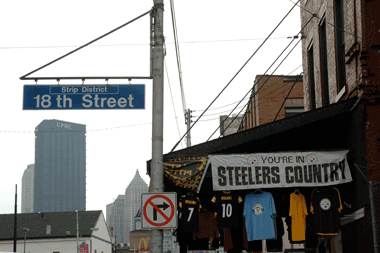
    Perhaps Mr. Obama, who will chair the G-20, thought he was doing the financially strapped city of Pittsburgh a favor by sending 4,000 foreign bureaucrats and media folk here to spend their Euros and Yen on Steelers T-shirts and game jerseys.

    Maybe he thought placing the G-20 meeting in Western Pennsylvania – a disproportionately Caucasian and socially conservative corner of America where his 2008 vote totals were disappointing – would pay him political dividends in the 2012 election.

    In either case, the president was sadly mistaken.

    Except for the local booster & tourism sector – who’d welcome a Category 8 hurricane to Pittsburgh as long as the international media covered it and said nice things about their no-longer smoky city – it’s safe to say everyone in this town who doesn’t work in the homeland security industry wishes they had never heard of the G-20.

    As months of local media stories have made plain, the conference is not only going to be a huge public annoyance, it’s going to be a lose-lose situation for everyone – especially the city government.

    Any economic benefits to the local GDP from the arrival of 4,000 visitors with fat expense accounts will be outweighed by the cost of protecting property from the tens of thousands of leftist protestors, angry anarchists and professional window-breakers who stalk G-20 meetings around the world.

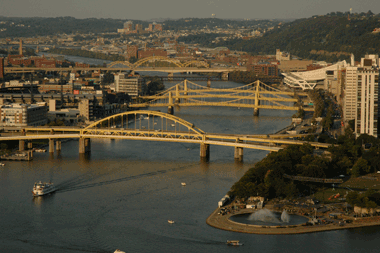
    To maximize security and minimize destruction, the Secret Service and local authorities will fortify most of the Golden Triangle, the photogenic downtown business district squeezed between the Allegheny and Monongahela rivers as they meet to create the Ohio River.

    Barricades will be erected. Cars and mass transit will be diverted. Several major construction sites will be sealed off to deny protestors dangerous things to throw. Most downtown businesses probably will close. City schools and colleges will shut down.

    The predicted cost to local public coffers for hiring, feeding and equipping additional police and paying overtime will be at least $20 million, most of which will be reimbursed by the federal government.

    Whatever the final bill is, hosting the G-20 is an “honor” the city of Pittsburgh and its taxpayers didn’t need and can’t afford. The city is already bankrupt and in state receivership because of the generous pension deals it’s promised but won’t be able to pay for.

    The city of Pittsburgh looks fabulous and robust when its skyline and riverbanks are shown on TV during Steelers home games. But it’s really the capital city of an economically stagnant, over-taxed, over-regulated, steadily depopulating metropolitan region that has been horribly governed for 60 years.

    The private-public power-brokers who’ve run the city have wasted billions on a never-ending series of destructive urban renewal projects, redevelopment boondoggles and wasteful mass-transit projects.

    Almost nothing has been built in downtown Pittsburgh or on its riverbanks in the last 20 years without being handed millions in public subsidies – whether it was PNC Financial Service’s almost completed downtown skyscraper, a gorgeous Lazarus department store that went bust in the ‘90s or the shiny new homes for the Pirates, Steelers and (soon) the Penguins.

    If curious G-20 attendees have time to stroll around the city’s abandoned downtown streets on Thursday and Friday, they will have no trouble finding evidence of City Hall’s current crop of fiascoes-in-the making.

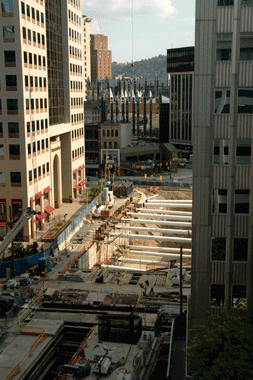
    Right in front of fancy Fifth Avenue Place, for example, is a deep trench where busy Stanwix Street should be.

    It’s not where a Scud missile hit during the first Gulf war. It’s the construction zone of one end of the local mass transit system’s infamous “Tunnel to Nowhere.”

    The 1.2-mile light-rail extension goes from Gateway Center downtown under the Allegheny River to the North Shore, where its other end has been tearing asunder the wasteland of former parking lots between the subsidized new homes of the Steelers and Pirates for several years.

    The twin light-rail tunnel – cleverly built under a river in the “City of Bridges” so as to maximize the cost and provide unions and construction companies with six or seven years of high-paid make-work – will allegedly carry 4.2 million riders a year in the distant transit future.

    That impressive but fraudulent projection comes out to about 11,000 “riders” a day – which actually represents only 5,500 human commuters making a (two-ride) round trip commute. A large proportion of those annual riders, by the way, will be baseball or football fans.

    All that socially correct “mass transit” will end up costing at least $650 million, with federal and state taxpayers picking up about 97 percent of the tab. Except for yours truly and the conservatives on the Pittsburgh Tribune-Review’s editorial page, virtually no one in local politics or the media questioned or challenged the lunacy of building the transit tunnel.

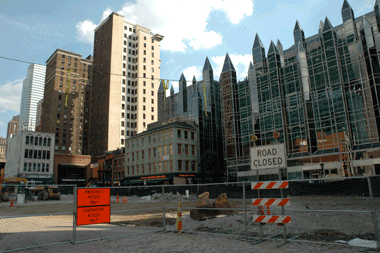
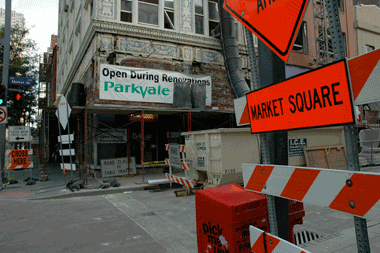
    Another wasteland in the middle of downtown that G-20-goers might visit is the flattened construction site that used to be Market Square.

    Once upon a time, before City Hall planners began demolishing and rebuilding huge chunks of downtown in the 1950s; it was what urbanists are supposed to encourage: an actual square with markets.

    Then, in the 1960s, the city took it over and transformed it into a poorly designed, commerce-free urban park with trees, grass and heavy city bus traffic. The public space delighted crowds of lunching office workers at midday but the rest of the time it was a lawless playpen for about 100 homeless people, drunks and drug pushers.

    Today the area around Market Square, last refurbished in the 1990s, hardly has a live store or restaurant left standing. It is waiting to be turned into its next reincarnation – a $5 million European-style piazza with no vehicles piercing its heart and no low walls and green spaces for social misfits to reside.

    On one edge of battered Market Square is Fifth Avenue, which has been tortured constantly by City Hall for about 25 years.

    In the early 1980s, its street surface was torn up for several years so the city’s rinky-dink light-rail subway could be built beneath it. Not long after that, Fifth Avenue was rendered virtually impassable to shoppers for a couple years while the city slowly redid its sidewalks and curbs.

    Then, in the late 1990s, Fifth was targeted by City Hall for a preposterously stupid and destructive redevelopment scheme.

    The crude 1960s-style renewal project would have misused eminent domain power to clear-cut Fifth Avenue and Forbes Avenue, wipe out nearly 100 businesses and build what amounted to an outdoor suburban mall anchored by a Nordstrom store.

    Fortunately, that plan was miraculously stopped by an alliance of preservationists and property rights defenders. But is it any wonder that after a quarter century of torture by city planners Fifth Avenue became “dilapidated” and in need of serious redevelopment?

    As G-20 attendees will learn if they bother to walk a few moments from their hotels, the nightmare on Fifth Avenue continues. Its northern end is currently being torn down, fixed up, blocked to pedestrians or under construction.

    PNC Financial is putting the final touches on its new 23-story, $178 million headquarters – which received $48 million in state and local subsidies and wiped out half a block of retail storefronts. Meanwhile, up the street, the lovely stone tomb the city erected in the late 1990s for Lazarus has been all but given away to a local developer who’s converted it into a pricy condo and office space that still has 32 of its 65 units to sell.

    Whenever the national media rediscover the glories of Pittsburgh’s clear skies and affordable livability, which they seem to do every four years, they never stick around long enough to note the failings of its governments and politicians.

    Taxes on property and people and businesses are too high. The city schools are absurdly expensive and ineffective. The roads and 1950s parkways are old, narrow and crumbling. Public services are often poor or costly. Unions and Democrats wield the sort of uncontested political power that’s never good for a municipality.

    Yes, it is still true, as the national media and local booster sector never tire of repeating, that the “City of Champions” and its suburbs are a great place in which to live, raise a family, grow old and die peacefully.

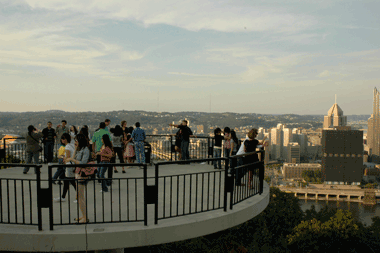
    With its famous three rivers and hills and bridges and skyscrapers and hillside homes and urban neighborhoods and spectacular views and historic downtown buildings, Pittsburgh is rich in natural and man-made charm.

    Toss in a cost of living 17 percent below the national average and low crime rates, lots of good affordable housing, major-league super-teams like the Steelers and Penguins, great museums like the Carnegie and top universities like Carnegie Mellon and Pitt – Pittsburgh does deserve to be ranked highly on those meaningless most-livable city lists.

    It’s also true – as some in the national media latched on to earlier this year – that compared with many other parts of the country, Pittsburgh has not suffered greatly in the current recession.

    Pittsburgh has an unemployment figure lower than the national average, a very low home-foreclosure rate and stable-to-slightly-rising housing prices.

    But Pittsburgh’s good fortune was not, as out-of-town media claimed, because its wise leaders had figured out how to dodge a severe economic downturn. Or because – as President Obama has been led to believe – the region’s post-industrial “eds and meds” service economy is particularly healthy or even resilient.

    Pittsburgh’s relatively impressive economic statistics are pretty much the 30-year norm for Pittsburgh – in times of national booms or busts. They probably won’t change for the better unless the spectacularly rich Marcellus shale natural gas deposits lying underneath western Pennsylvania are exploited, which may not happen for decades or ever happen at all.

    There’s one thing about Pittsburgh’s future that is a near certainty: It’s going to have fewer residents next year than it has today.

    Since the mid-1990s, Pittsburgh has had more deaths than births each year. Between 2000 and 2006, in fact, it had 21,045 more deaths than births, earning it the distinction of being the largest metropolitan area where deaths outnumber births.

    That negative ratio wouldn’t be so bad if immigrants from anywhere else were flocking to Pittsburgh. But they aren’t. Metro Pittsburgh has the lowest percentage of foreign-born residents of any major city – 3 percent – compared to 12.5 percent nationally.

    Pittsburgh has only about 7,000 immigrants from Latin America – second to the 7,800 who hail from India. Only 16,000 international immigrants arrived in metro Pittsburgh between 2000 and 2006, dead last among the 25 largest cities.

    Post-industrial decline, out-migration, too many older people, more deaths than births, too few immigrants from Mexico and Georgia – they’ve all contributed to Pittsburgh’s incredible six-decade population decline.

    In 1950, Pittsburgh was the country’s 12th biggest city. It had 676,806 citizens in a metropolitan area of about 2.5 million.

    Today the metro population, ranked 22nd, is down to 2.35 million and Pittsburgh’s surviving population of 310,000 live in the country’s 59th biggest city – right behind Aurora, Colo., a growing municipality that will never have to worry about getting stuck with hosting a G-20 summit.

    Photos by Bill Steigerwald.

    Bill Steigerwald, a free-lance libertarian writer who recently retired from daily newspaper journalism, loves his native Pittsburgh but hates the political and corporate power brokers who’ve been damaging the city for 60 years. His columns are archived at the Pittsburgh Tribune-Review and his 2000 article for Reason magazine on the city’s abuse of eminent domain powers is here.