Blog

  • “Cash For Clunkers” Doesn’t Utilize Junkyard Efficiency

    My father owned and operated a junkyard in Tucson for a number of years, and I learned a lot about the auto recycling industry helping around the office and as a delivery driver. So as a junkyard enthusiast, the “Cash For Clunkers” program naturally caught my interest lately. Though it looks to be the product of good intentions, I don’t think the legislation understands that junkyards already comprise an efficient, well developed recycling system for salvaging vehicles, with a beneficial result for the environment overall. I’m skeptical that quickly scrapping so many government-defined “clunkers” and replacing them with new, fuel-efficient models will have a substantial environmental benefit, because the plan has the potential to waste many useful materials in these cars.

    A junkyard may appear to be little more than a landfill for old cars if you’re just driving by, but in fact, to succeed, it must function as a highly efficient recycling operation. Junkyards sell parts to other junkyards, mechanics, and directly to consumers, and attempt to make as much of a profit as possible from each part on every car in their inventories.

    There is also a network of scavengers who travel around to junkyards gathering large core items, like alternators and starters, and a number of precious metals in small amounts that most don’t even recognize as in our cars. (Catalytic converters, for example, contain platinum and palladium, which are quite valuable when salvaged.) But a car needs to sit on the lot for a considerable period of time for this recycling process to work itself through. Parts from a car are usually sold one at a time over a period of months or even years; scavengers work on their own schedules. A scavenger may only come by a junkyard a few times a year to core out a particular metal or gather the useful components. Meanwhile, the junkyard needs to be selling parts off the car for it to be financially worth keeping in the inventory. A car is only sent off to be crushed for scrap metal when it no longer retains enough value to justify filling the space on the lot.

    If the Cash For Clunkers program is successful, it has the potential to throw a wrench into the system. The program’s rules require that the engine of a trade-in car be destroyed with an injection of sodium silicate so that the car won’t be resold and put back on the road. The rules seem to encourage the immediate crushing and shredding of the trade-in cars, but should they remain on junkyard lots, their inventory value would take an immediate hit with a non-functioning engine (the most valuable part of the car). To what degree the value decreases depends on the extent of the engine damage, the demand for the particular engine, and the age of the engine.

    A genuine old clunker would be likely to have a well used, and therefore less valuable engine, but then, the “clunker” program nickname (its official title is the “Car Allowance Rebate System”) is something of a misnomer. To be eligible for the program, cars must fall into certain categories of fuel inefficiency, be less than 25 years old, and worth less than $4500. This includes a number of models from the nineties. A working engine in many of the models targeted for the program is likely to have fewer miles on it, and therefore a higher inventory value, than a more traditionally defined clunker.

    But engine issues aside, if the program succeeds in taking a large number of particular models off the road, it could have an even more drastic effect on the junkyard value of those models, simply by lowering the demand for their parts. If there are only a few of a given model on the road, few consumers will buy parts for them from junkyards. Many junkyards are picky about which models they purchase for inventory, and won’t even bother with a model if there is little or no demand for its parts. So if Cash For Clunkers leaves some car models without junkyard value, those models would start going directly to the crusher, taking many of their valuable components with them. The scrap metal from crushed cars is used to make things like rebar and fence posts, so it isn’t as though the scrap winds up in the landfill. But it’s still a waste for precious metals and other valuable components to be crushed down with the low-end materials for low-end product.

    And even beyond the metals, something mundane like a plastic glove box has its own environmental impact. The overall junkyard process, where cars without “street” value become parts donors for cars still in use, prevents a great deal of after-market manufacturing of glove boxes and all the other parts that wear out or get damaged in cars on the road. If entire models are abruptly taken off the road, devalued at the junkyard, and crushed, it means that many new glove boxes must be manufactured – both for the new cars replacing the model, and for any other models and even makes still on the road for which that model of glove box, or stereo, or steering column fits (and many parts are surprisingly versatile this way). That could mean a boost in manufacturing, sure – but it also means an environmental impact that offsets some of the gains from the new fuel-efficient car that replaces the clunker.

    Cash For Clunkers is scheduled to end November 1, so it’s unlikely to have a long-term effect on the auto recycling industry beyond burdening it with a glut of devalued inventory. But so far the program is popular, and may be expanded or set a precedent for future programs. If this happens it could take a toll on the junkyards and their ability to recycle effectively. If there are suddenly millions of brand new car models on the road, there would be a period of hardship for the auto recycling industry, as the new cars would be running well, with any repairs done mostly under warranty at the dealerships with new parts. This whole scenario could also, by extension, tax the junkyard consumer base of low income, self-sufficient individuals whose cars are older, skillfully maintained, and perhaps most importantly, paid off.

    It’s beyond my pay rate to comprehensively evaluate the net difference in environmental impact between manufacturing and selling new, fuel-efficient cars for these quick “clunker” trade-ins and letting the older models stay on the road. But a legitimate evaluation would clearly involve more complex factors than a simple comparison of fuel efficiencies. Yet it’s clear that the program doesn’t appear to insert any innovative solutions into an already dynamic and effective recycling system. Even if it has some positive outcomes, it doesn’t look like Cash For Clunkers will utilize the industry’s full potential for environmental benefit.

    Perhaps its primary motive lies elsewhere, in its attempt to jump-start the auto industry with a “green” marketing gimmick. But in the process we may have reaped some unintended damage on a sometimes unsightly but remarkably environmentally resourceful industry.

    Andrea Gregovich lives in Anchorage, Alaska. She has written a novel about a junkyard called Martyred Cars and is looking for a publisher.

  • Koyaanisqatsi Redux

    I went to Hollywood one night last week to watch my favorite film of all time, Koyaanisqatsi (released in 1983). It was being shown on a big screen at the Hollywood Bowl, accompanied by orchestra playing the original score, conducted by its composer, Philip Glass. Oh, I didn’t go to the Bowl; I watched it at my daughter’s apartment about half a mile away (hi def DVD and digital sound system turned way up, thank you). It was much more enjoyable than going to the Bowl; after all, I didn’t want to share the experience with an audience that undoubtedly would have, shall we say, a different appreciation of the art.

    You see, the message and meaning most of the Hollywood crowd take from Koyannisqatsi (Hopi Indian for “life out of balance” or “crazy life”) is that man has despoiled and separated himself from his natural environment. Frankly, it has always had the exact opposite effect on me. Even after what must be 100 viewings, I am continually overwhelmed, impressed and delighted by the images of what man has been able to create, invent and build to control his environment, increase his wealth, provide him his food and energy, raise his standard of living, and transport him around the planet (or across the city).

    I am sure most of the Hollywood Bowl crowd has a different response, and finds the images disturbing and disgusting. This is the reactionary impulse, born of an anti-industrial, anti-development mindset. I would wager the majority of that audience has bought completely into the scaremongering of catastrophic man-made global warming, which to the properly skeptical and scientifically literate remains unproven (oh hell, it’s ludicrous on its face). This is deliciously ironic, as many sequences in Koyaanisqatsi were filmed in the 1970s, when most of the same crowd were hectoring us about global cooling (doubly ironic, as a cooling may now actually be upon us).

    My first review of the film, published some 25 years ago, needs only minor updating.

    This truly remarkable film by Godrey Reggio has no plot, no characters, no dialogue. The images of the film are awe-inspiring: first, huge expanses of pristine nature: deserts, rivers, mountains, mesas, lakes, waterfalls, clouds. Then grand-scale technology: huge earth-moving machines, power plants (nuclear and otherwise), oil refineries, food-processing plants, space shuttles, rockets, jets, freeways, subways, skyscrapers, shopping malls, train stations (and of course the obligatory atomic bomb explosions and mushroom clouds) – all shot in fascinating slow-motion and/or time-lapse format by cinematographer Ron Fricke. The accompanying music by Philip Glass is eerie, haunting and perfect.

    The film is a visual, aural and emotional feast. If it bores you, you don’t understand you are looking at, in juxtaposition, the majestic indifference of nature; the supreme accomplishments of physical engineering; and some of the most awful consequences of attempts at social engineering. Some of the images that make indelible impressions, all set to a majestic, driving score:

    • desert rock formations unchanged through thousands, if not millions of years
    • huge power transmission lines stretching forever across barren desolation
    • the implausible flying behemoth that is a 747
    • the flow of vehicles on a freeway, at night, from 50 stories up, that in time-lapse photography really does look just like the flow of blood through vessels, arteries and capillaries as seen through a microscope
    • row upon row of huge, empty, abandoned south Bronx tenements
    • the razing of the Pruitt-Igoe housing project in St. Louis (the most graphic depiction of public policy failure ever committed to film, I should think)
    • the rush of commuters who in time-lapse photography look like ants swarming an anthill
    • various mass production activities: mail-sorting machines, industrial assembly lines, escalators, elevators, revolving doors, conveyor belts, money counting machines, huge bowling alleys, movie theaters
    • finally, the high resolution satellite photograph of a massive city grid (Los Angeles, of course) overlaid, first, on a printed circuit microchip board, and secondly, on an intricate Hopi Indian woven blanket. The matches are nearly perfect.

    A very noticeable detail of the ’70s-era footage from Los Angeles is the blanket of smog that covers the city; I can tell you, having lived here all of these years, that the situation is dramatically improved. (I now see far-off mountain ranges daily; in the ’70s that was rare.) Environmental quality has been improving over the decades (read The Skeptical Environmentalist by Bjorn Lomborg for the statistical evidence). The solutions to the problems that technology causes often end up being more technology, sensibly and carefully applied.

    The single greatest contributor to the amelioration of LA smog, for example, is the catalytic converter. Instigated and required by government, you say? Developed and produced by industry in response to marketplace demand, says I.

    I find the movie very relevant today. It seems some of our new political overlords seem to think they can have a productive economy without production, without what the film depicts: heavy industry; mass processing of food, clothes, consumer and industrial goods; massive residential and commercial development; huge efforts devoted to energy extraction, production and transmission; untrammeled mobility for goods, people and vehicles. Now I’m a “new economy” guy myself, but I realize that our wealth, standard of living and quality of life – the current and future prospects for hundreds of millions of us – are dependent upon these activities, and that the health of the industries that make them possible are far more important than any particular small sub-species of bird, fish, ant or rat (the threats to which are always exaggerated anyway).

    We are really talking about the role of government here, not only in protecting nature. What the film shows me is that it is in fact government’s job to protect the “other” environment: the environment that encourages, promotes and allows incentives for production. Part of this environment is the need for massive infrastructure: energy systems, water systems, waste systems, transport systems, roads, dams, etc., etc., in adequate capacity and in good repair. Mass production and economies of scale bring good quality cheap to millions, and provide opportunities to generate incomes, grow wealth and lead productive, modern lives. More efficiency can also create more nature; for example, the millions of acres of non-redundant farmland turned into forest or open space.

    We used to know and understand this as a society. Our political elites were devoted to it. Now, not so much. We need to relearn the basic lessons and regain that consensus again.

    Dr. Roger Selbert is a trend analyst, researcher, writer and speaker. Growth Strategies is his newsletter on economic, social and demographic trends; IntegratedRetailing.com is his web site on retail trends. Roger is US economic analyst for the Institute for Business Cycle Analysis and its US Consumer Demand Index, a monthly survey of American households’ buying intentions.

  • Meet Me in St. Louis

    There is a bend in the river – and that’s where they put the city of St. Louis.

    St. Louis is fun – and here is a guide to finding your way around. Just remember the bend in the river.

    Imagine a bow (as in bow and arrow) aimed to the east. The imaginary arrow slides right through the Gateway Arch overlooking the river. Just to the west, behind the levee, is the old downtown.

    The St. Louis westernmost city limit parallels Skinker Blvd. That boundary mirrors the river just as the string mirrors the bow. The city is almond-shaped, with the river on the east and Skinker Blvd. to the west. These two arcs meet at the northern and southern points of town. This is a simplification: Skinker Blvd. goes by that name for only a short part of the arc, roughly where the arrow’s feathers would be. To the north it becomes Goodfellow Blvd., and to the south it turns into McCausland Ave., along with other names. But those are details – the main point is this: following Skinker (or its renamed equivalents) to the north will eventually get you to the river, and likewise, following it to the south will also lead you to the river.

    And this is helpful: north-south streets in St. Louis form arcs parallel to Skinker that lead from river to river. Let’s call them arc streets. The inner-most such street is Parnell/Jefferson, followed by Grand Blvd. (that’s where St. Louis University is), Kingshighway Blvd., and then Skinker. To a first approximation, all of these streets parallel Skinker and intersect the river at points north and south of downtown.

    Superimposed on this are streets that radiate from downtown. Two important ones are North Florissant Ave., and South Broadway. These directly parallel the river, and (this is important) will intersect all of the arc streets. Thus North Grand Blvd. intersects North Florissant at approximately right angles – try something like that in Chicago. But in St. Louis it makes perfect sense – Grand is an arc that will intersect the river, and Florissant is a radial that parallels the river. (S. Grand Ave. should also intersect S. Broadway, but doesn’t because the very southern part of the city doesn’t follow the rules. I’ve never been there, so I don’t know why.)

    Starting with Florissant, the important radial streets are Natural Bridge, Martin Luther King, Page Blvd., Delmar, Olive/Lindell, Market/Forest Park, Chouteau, Gravois, and Broadway. These radiate fan-like from downtown, and all of them intersect the arc streets at approximately right angles. Of these, Lindell, Forest Park, and Chouteau are roughly east-west streets; the others head either northwest or southwest. (Quiz: which radial streets also intersect the river?)

    St. Louis University is at Grand & Lindell. Washington University is at Skinker & Forest Parkway. The justly famous Forest Park stretches along Forest Parkway from Kingshighway to Skinker. The Arch is at the foot of Market St. The cultural heart of the city is along Lindell Blvd. near Vandeventer Ave. (which, if it went through, would be an arc street west of Grand).

    Will you meet me in St. Louis? How about at a nice restaurant near the corner of Delmar and Skinker?

    You do know where that is, don’t you?

    Daniel Jelski is Dean of Science & Engineering State University of New York at New Paltz.

  • Forget Second Stimulus; We Need Economic Vision

    As the American economy slowly heals, the Obama administration will no doubt claim some credit for its $787 billion stimulus — and perhaps even suggest doubling down for a second stage. Republicans, for their part, will place their emphasis on the “slow” part of the equation and persistent high unemployment, blaming the very same stimulus program.

    Whatever the politics, no new stimulus should be considered unless it deals with the fundamental illness undermining the country’s long-term economic prospects. Such a stimulus would address the country’s essential problem: persistent overconsumption amid underproduction.

    Neither party wants to address this issue because neither chooses to understand it. From the very beginning, the Obama administration has viewed the stimulus as a political issue, not an economic one. This became clear to me even before the election when I asked Obama’s campaign economic adviser, Austan Goolsbee, about “the goal” of the president-to-be’s program.

    All I got for my trouble was vague political rhetoric about improving the economy. Though some parts of the stimulus, such as extending health and unemployment benefits, were clearly justified, the whole program never sought to address the roughly $800 billion annual imbalance between American consumption and production.

    Instead, we have witnessed a grab bag of political handouts — Chicago machine politics on a grand scale — designed to placate key Democratic constituencies. Most have gone to what my old teacher Michael Harrington described as “the social-industrial complex” consisting of the education industry, social service providers and the various government bureaucracies.

    As a recent New America Foundation report makes clear, precious little has gone to the productive side of the economy that determines the country’s competitiveness and creates many high-paying blue-collar jobs. Infrastructure, a critical component of any productivity-enhancing strategy, has accounted for barely 10 percent of the package.

    The results have not been pretty for the productive sectors of the economy. Construction workers now have higher than 19 percent unemployment; jobs in this sector have fallen during the past year in 333 out of 352 metropolitan areas, with more than 200 plunging by double digits. Meanwhile, the hard-pressed manufacturing sector suffers more than 12 percent unemployment.

    Why this disinclination to fund the tangible parts of the economy? One reason may be that those working in construction and manufacturing — both blue-collar workers and white-collar professionals — do not wield the same influence in this law review administration as college professors, Service Employees International Union-organized workers or unionized teachers.

    One also senses that some militant environmentalists in the administration may be less than enthusiastic about anything associated with the entire carbon-creating part of the economy. Certainly, new factories, natural gas facilities, roads, ports and waterways don’t fit the professed passion of the president’s own science adviser, John Holdren, for the gradual “de-development” of the U.S. and other advanced economies.

    Even prospects for the auto industry — the one manufacturing sector that the administration has effectively annexed — are threatened by plans to enact policies that will “coerce” Americans out of their cars. This amounts to trying to “save” an industry by destroying it.

    For sectors not under government control — warehousing, fossil fuel energy, home construction and agriculture — the administration’s “green” regulatory regime could boost costs at the worst possible time. As a result, the coming recovery once again may be consumption-led and fail to improve our overall competitiveness. The biggest beneficiaries will most likely be Chinese manufacturers, German and Japanese automakers and, because of a lack of sufficient domestic alternatives, energy producers from Venezuela and the Middle East to Russia.

    If they had a collective IQ over 50, the still largely discredited Republicans could run strongly against this economic scenario. Yet, for the most part, they seem incapable of putting the national interest ahead of Wall Street’s profits and corporate excess.

    So no matter how much the conservatives complain, Obamanomics most likely will end up with results remarkably like those of Bushonomics: more consumption, less production, expanding public debt, asset inflation on Wall Street and a slowly declining middle-class standard of living. The only real difference will lie in who gets to rob the public — instead of pharmaceutical and oil companies, we get Gorite “renewable” energy traders and well-connected “green” venture capitalists.

    Americans need to place a pox on both these flawed models. We need a totally new approach that focuses on key productivity-enhancing investments such as improved transportation infrastructure — new roads, bridges, ports and waterways to meet the demands of an expanded economy for a growing population. We should be looking at modern equivalents of the New Deal electrification program, the GI Bill, the Eisenhower highway and the space program.

    Clearly, an infrastructure that is inadequate today will be utterly useless in 2050, when there are projected to be at least 100 million more Americans. Already, our energy-generating capacity in some parts sputters like that of a Third World country. Commodity exports, such as grains, unable to reach foreign markets because of a lack of rail cars and adequate waterways, are left to rot and feed rats.

    This is not the way to prepare ourselves for ever greater competition from countries such as China, India and Brazil. Americans must demand a program that, while perhaps financially painful now, will make it possible for our progeny to enjoy a prosperous future rather than a declining one.

    This article first appeared at Politico.

    Joel Kotkin is executive editor of NewGeography.com and is a presidential fellow in urban futures at Chapman University. He is author of The City: A Global History. His next book, The Next Hundred Million: America in 2050, will be published by Penguin early next year.

  • Millennials Think Globally, Act Locally

    The phrase, “Think Globally, Act Locally” has often been used by environmentalists to sum up a strategy devoted to conserving the earth’s scarce natural resources at the local level. More recently, business executives borrowed the idea to emphasize the need for building capabilities at the country or regional level even as they pursue global growth. But now the Millennial Generation, Americans born between 1982 and 2003, are giving the phrase an entirely new meaning as they pursue their efforts to change the world – one local community at a time.

    In contrast to the generational stereotypes many people hold of them, Millennials are very much concerned about and connected to the world around them – more so, in fact, than many older Americans. Responding to questions on foreign policy in a recent Pew Research Center survey, only 9% of Millennials were unable to express an opinion on how President Obama is doing in working with our allies, while almost a quarter of senior citizens had no opinion on the same subject. On the knotty question of Israeli/Palestinian relations, all but 7% of Millennials could tell survey researchers what they thought of American foreign policy in this area. On the other hand, 26% of senior citizens could not (see table below).

    In addition to its high level of concern with international matters, the Millennial Generation’s ability to make virtual friends instantaneously on Facebook or Twitter with Iranian protesters provides a unique perspective on how to deal with America’s foreign policy challenges.

    Perhaps most notable is how the Millennial Generation deals with the concept of “threats”. A majority of Millennials do see Al Qaeda, and the nuclear programs of North Korea and Iran as “major threats” to the United States, but by rates 15 to 20 points less than other generations. Other more intractable but less direct security concerns, such as the drug trade in Mexico, China’s emergence as a world power, or conflicts in the Mideast ranging from Pakistan to Palestine, are not considered a major threat among a majority of Millennials. To be sure, some of these attitudes may reflect the inevitable naiveté of young people, but we believe the underlying beliefs of Millennials suggest an alternative explanation.

    Millennials have been taught since at least high school that the best way to solve a societal problem is act upon it locally and directly. Tired of exalted rhetoric from Boomer leaders that rarely produced results and frustrated by their older Gen-X siblings lack of interest in pursuing any collective action to address broad social problems, Millennials have embraced individual initiative linked to community action. Eighty-five percent of college age Millennials consider voluntary community service an effective way to solve the nation’s problems. Virtually everyone in the generation (94%) believes it’s an effective way to deal with challenges in their local community. No wonder one of Barack Obama’s first legislative initiatives, the Kennedy National Service Act, was in response to the desire to serve of his most loyal constituency, the Millennial Generation.

    And when it comes to public service, Millennials are putting their money where their mouth is, although lack of opportunity in the private sector also could be accelerating this public service trend. Teach for America, which places new graduates in low-income schools, saw a 42% increase in applications over 2008. Around 35,000 students are now competing for about 4,000 slots. U.S. undergraduates ranked Teach for America and the Peace Corps among their top 10 “ideal employers,” ahead of the likes of Nike or General Electric.

    Scotty Fay, a recent University of Massachusetts graduate, typifies the continuing belief of her generation in the importance of collective action to cope with a challenging world. “If we excel and we’re able to keep ourselves working, we’ll be OK, we hope, because we haven’t experienced anything different than that,” says Fay, who worked two jobs on top of her full-time course load, and is now getting ready for her Peace Corps assignment in Guinea.

    First Lady Michelle Obama, in kicking off the administration’s “summer of service” initiative, made it clear that the administration sees this belief as key to America’s future. “This new Administration doesn’t view service as separate from our national priorities, or in addition to our national priorities – we see it as the key to achieving our national priorities.” Given the likelihood of continuing employment challenges for America’s newest workers, more and more Millennials are likely to gain their first work experiences performing some type of voluntary service.

    This penchant for public service shapes the beliefs of Millennials on how the United States should deal with the problems it faces around the world. In last year’s contest for the Democratic presidential nomination, Millennials believed Barack Obama was right and Hillary Clinton was wrong over whether to conduct direct talks with our enemies. And they thought Sarah Palin was completely off base when she declared in her acceptance speech at the convention that “the world is not a community and it doesn’t need an organizer.” In fact, Millennials believe that what the world needs most is thousands of community organizers, working on the ground to solve their own country’s problems, linked electronically, of course, to friends around the world.

    This is a trend that, appropriately, resonates outside our borders as well. Grassroots activism, led largely by young Iranians, produced protests that may yet topple one of the most autocratic regimes in the world. Activism of this type across the Mideast could result in regime changes of far greater consequence than the military conquest strategy the United States employed in Iraq. Given the distinctions Millennials make between the seriousness of direct military threats, such as terrorism and nuclear proliferation, as opposed to squabbles over power or territory, America’s foreign policy is likely to shift towards a more multi-lateral, institution-building focus as this generation assumes our country’s leadership. This will occur even as Millennials continue to express support for our military by word and deed – when that becomes the only available option.

    It may take a decade or two before we know how the Millennial Generation’s belief in the need to “think globally, act locally” will impact our overall foreign policy. But in the interim, the United States will surely benefit from the generation’s focus on rebuilding our country, as well as the world, one community at a time.

    Total Millennials Gen-X Boomers Silent & Older
    Obama favors… (6/09)          
    Israel too much 6% 5% 9% 6% 4%
    Palestinians too much 17% 9% 16% 20% 23%
    Right balance 62% 79% 62% 63% 47%
    DK 14% 7% 13% 11% 26%
    Compared with Bush Administration has Obama Administration made US (6/09)          
    Safer from terrorism 28% 40% 23% 29% 23%
    Less safe from terrorism 21% 16% 20% 23% 24%
    No difference 44% 38% 48% 43% 44%
    DK 7% 6% 9% 5% 9%
     Is each of following a "major threat" to well-being of US (6/09)          
    Islamic extremist groups like Al Qaeda 78% 59% 77% 86% 85%
    North Korea’s nuclear program 72% 51% 74% 75% 81%
    Iran’s nuclear program 69% 55% 67% 75% 76%
    Drug-related violence in Mexico 59% 42% 55% 61% 77%
    China’s emergence as world power 52% 31% 51% 59% 61%
    Political instability in Pakistan 50% 30% 45% 59% 63%
    Israel/Palestine conflict 49% 39% 45% 53% 58%
    In dealing with our allies does Obama…(6/09)          
    Push America’s interests too hard 8% 3% 10% 6% 11%
    Take account of allies’ interests too much 20% 13% 18% 25% 22%
    Strikes right balance 57% 76% 53% 59% 46%
    DK 15% 9% 18% 10% 22%
    Approve how Obama is handling foreign policy (6/09) 57% 59% 61% 52% 55%
    Is Obama’s approach to national security…(6/09)          
    Too tough 2% 1% 2% 5% 2%
    Not tough enough 38% 30% 37% 42% 41%
    About right 51% 64% 53% 46% 48%
    DK 8% 6% 8% 7% 10%
    Approve/Disapprove how Obama is handling North Korea (6/09)          
    Approve 51% 61% 50% 55% 38%
    Disapprove 23% 15% 26% 22% 25%
    DK 26% 24% 24% 23% 36%


    Morley Winograd and Michael D. Hais are fellows of the New Democrat Network and the New Policy Institute and co-authors of Millennial Makeover: MySpace, YouTube, and the Future of American Politics (Rutgers University Press: 2008), named one of the 10 favorite books by the New York Times in 2008.

  • Projecting 30-45 Year Olds in the United States

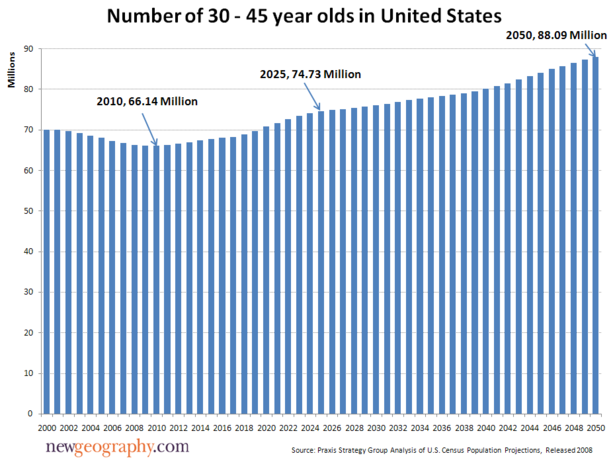
    We constantly hear the the harping about “brain drain” in our local editorial pages and economic developer’s board rooms. Most of the time, the term is referring to college-age or immediately post college individuals. However this overlooks another slightly less mobile age group that might be more amenable to direct recruitment tactics: 30-45 year olds, or those that may be looking to resettle as their priorities shift more seriously to their career, their family, and more importantly a balance of the two.

    Now comprised of the smaller Generation X group, we’ll reach a low point in the United States for this age group in 2010:

    As the larger group of the Millennial generation ages, we’ll see another 8-10 million 30-45 year olds in the US in the next 15 years, and this group will grow by nearly 1/3 by 2050.

    Census projects very rapid growth of this group between 2040 and 2050, but keep in mind that folks comprising this rapid growth after 2040 are just being born now, so this projection will be refined as birth numbers become concrete in the next few years.

  • Rating World Metropolitan Areas: When Money is an Object

    American metropolitan areas have been the subject of considerable derision. Often characterized as inferior to those of Australia, Canada, Europe and even of Japan by planners and politicians who travel abroad, there has long been a desire to reshape American cities along the lines of foreign models. Yet, despite this, American metropolitan areas generally provide a standard of living to their residents unmatched anywhere in the world. This is based upon the latest comparative economic data for the world’s most affluent metropolitan areas.

    International Rankings: American metropolitan areas never seem to place near the top of “quality of living” or “livability” indexes, such as those published by The Economist and the Mercer consulting group. On the other hand European, Australian and Canadian metropolitan areas usually grab the honors, frequently led by the likes of Vancouver, Melbourne, Zurich or Vienna.

    The media routinely reports these rankings without serious analytical analysis, which can lead to misunderstanding or even misrepresentation in comparing metropolitan areas on issues of living standards (Note 1). As Owen McShane pointed out on this site before, these ratings serve their purpose, which is to rank metropolitan areas based upon their “attractiveness to expatriate executives”. Not only do these lists fail to consider housing affordability, as McShane indicates, they also do not consider the overall economic performance of metropolitan areas in regard to their residents, which is not an insignificant matter. These highly publicized international listings might be thought of as “money is no object” ratings.

    When Money is an Object: The problem here: money is an object for the great majority of people living in the world’s metropolitan areas. This is true in Kinshasa, Seattle, Vancouver or Vienna.

    When the available measures of affluence or the standard of living are considered, the picture for US cities drastically improves. Here the US metropolitan areas dominate the list. The best available data is gross domestic product (GDP) per capita, adjusted for national level purchasing power (Note 2). Metropolitan area GDP data is now produced by the Bureau of the Census in the United States and regional data generally conforming to most metropolitan areas is available for the European Union by Eurostat (Note 3). Data for other metropolitan areas can be estimated from other national and regional sources.

    In 2005 (the latest available data), The Economist top ten averaged 57th in GDP per capita in the world. Mercer’s top ten did even worse, averaging 62nd. None of The Economist or Mercer top 10 ranked was among the 25 metropolitan areas with the highest GDP per capita. Vienna ranked best, at 27th. Perennial favorites Vancouver and Melbourne ranked 71st and 72nd (Table 1). Zurich, another rating champion, ranks 74th, just ahead of Oklahoma City. In contrast, only 5 of the 51 large metropolitan areas in the United States ranked behind Vancouver, Melbourne and Zurich.

    Table 1
    Top 10 Economist & Mercer "Cities"
    Ranked by Affluence
    (GDP per Capita, Purchasing Power Parity)
    Metropolitan Areas over 1,000,000 Population
    City or Metropolitan Area GDP per Capita: Rank among Top 100 World Metropolitan Areas The Economist Mercer
    Vienna 27 2 1
    Perth 28 5
    Munich 40 7
    Calgary 46 6
    Frankfurt 51 8
    Sydney 62 9 10
    Toronto 67 4
    Vancouver 71 1 4
    Melbourne 72 3
    Zurich 74 10 2
    Helsinki 84 7
    Auckland 84 5
    Dusseldorf 99 6

    100 Most Affluent World Metropolitan Areas: GDP per capita estimates for 2005 are provided for the 100 most affluent metropolitan areas in the world with more than 1,000,000 residents (Table 2).

    Dominance of the United States: It is perhaps not surprising that San Jose, California ranks as the richest major metropolitan area in the world, with a 2005 GDP per capita of $78,700. Number 2, however, is a surprise: Charlotte, NC-SC, which not only pirated away San Francisco’s largest bank some years ago and has now displaced the tony city by the Bay in the runner-up position. San Francisco and Washington, DC rank third and fourth most affluent in the world. Brussels, grown fat on the largesse of its European Union taxpayers, ranks 5th.

    The dominance of the United States is illustrated below.

    • The US has 8 of the 10 richest metropolitan areas in the world. Only Stockholm, at number 9, joins Brussels in the top 10 from outside the United States.
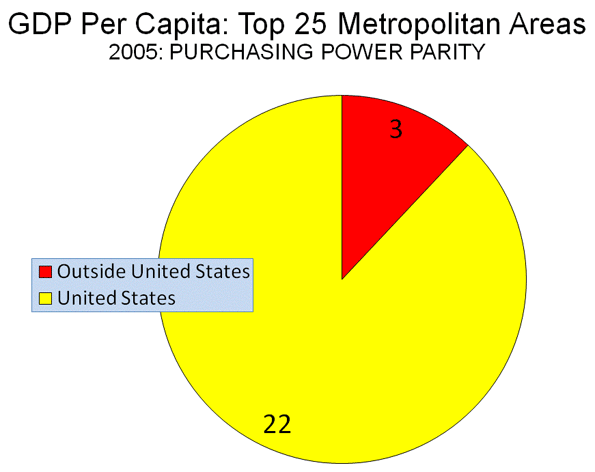
    • The US has 22 of the top 25 metropolitan areas (Figure)
    • 37 of the most affluent 50 metropolitan areas are in the United States. By contrast, Mercer ranks only seven US “cities” in the top 50.
    • 46 of the 70 richest metropolitan areas are in the United States

    Only one of the 51 US metropolitan areas with more than 1,000,000 fails to make the top 100 in the world, Riverside-San Bernardino ($25,800), which could just as easily be considered a part of the Los Angeles metropolitan area, just as San Jose could be considered a part of the San Francisco metropolitan area.

    Outside the United States: Outside the United States, the metropolitan areas of Australia and Canada perform best relative to their size. All five of Australia’s largest metropolitan areas placed in the top 100, with one in the top 50. Five of Canada’s six top metropolitan areas made the top 100, with one in the top 50. Europe placed 33 of its metropolitan areas in the top 100, with 11 in the top 50 and 22 in the second 50.

    The top 100 list provides some surprises.

    • One eastern European metropolitan area has already entered the top 100. Prague ranks 48th, with a GDP per capita of $42,400, which is more than Frankfurt or Phoenix.
    • London, arguably the world’s financial capital, ranks 44th, at $42,700. Some listings show London much higher, however such rankings exclude the outer portion of the metropolitan area, which these estimates include.
    • Tokyo-Yokohama ranks 79th, at $35,700. This ranking is lower than others, which either ignore purchasing power or exclude most of the metropolitan area by focusing only on the high income core (the prefecture of Tokyo).
    • The world’s two large “city-states,” Singapore and Hong Kong also make the list. Singapore ties Louisville and Sacramento at 53rd, with a GDP per capita of $41,500. Hong Kong ranks 79th, at $35,700. Moreover, it would not be surprising if other Chinese metropolitan areas begin to break into the top 100 over the next decade.

    Ranking Metropolitan Areas for People: American metropolitan areas provide their residents a superior standard of living. True enough, the mountains and water features of Vancouver or Zurich are superior to those of Oklahoma City or Charlotte. However, the average resident does not have enough money to spend much time boating in Vancouver or Zurich or taking in what may be a better cultural life. The standard of living may well be better for those with money in Vancouver, Vienna, Melbourne or Zurich than it is in an American metropolitan area. However, most people cannot afford to live like financiers and other “jet-setters.” For everyday people, the American metropolitan area remains the best place in the world to live.

    Table 2
    Top 100 World Metropolitan Regions 
    Gross Domestic Product per Capita: 2005 Estimates
    Purchasing Power Parity
    Metropolitan Areas over 1,000,000 Population
           
    Rank Nation Metropolitan Area GDP per Capita
    1 United States San Jose $78,700
    2 United States Charlotte $67,900
    3 United States San Francisco $65,400
    4 United States Washington $65,300
    5 Belgium Brussels $63,700
    6 United States Boston $59,000
    7 United States Seattle $57,600
    8 United States New York $56,200
    9 Sweden Stockholm $55,100
    10 United States Hartford $55,000
    11 United States Denver $54,700
    12 United States Minneapolis-St. Paul $54,600
    13 Germany Hamburg $53,500
    14 United States Dallas-Fort Worth $53,000
    15 United States Houston $51,900
    16 United States Indianapolis $51,800
    17 United States Philadelphia $50,100
    18 United States San Diego $50,000
    19 United States Atlanta $49,600
    20 United States Los Angeles $49,100
    21 United States Chicago $48,400
    22 United States Salt Lake City $48,200
    23 United States Milwaukee $47,800
    24 United States Nashville $47,700
    24 United States Columbus (Ohio) $47,700
    26 United States Las Vegas $47,400
    27 Austria Vienna $47,000
    28 Australia Perth $46,700
    29 United States Portland (Oregon) $46,600
    30 United States Kansas City $46,400
    31 United States Richmond $46,200
    32 United States Orlando $45,900
    32 United States Cleveland $45,900
    34 France Paris $45,700
    35 United States Memphis $45,500
    35 United States Detroit $45,500
    37 United States Austin $45,300
    37 United States Raleigh $45,300
    39 Ireland Dublin $44,300
    40 Germany Munich $43,800
    40 United States Baltimore $43,800
    42 United States Birmingham $43,500
    43 United States Miami $42,900
    44 United Kingdom London $42,700
    44 Denmark Copenhagen $42,700
    46 Canada Calgary $42,600
    46 United States Cincinnati $42,600
    48 Czech Republic Prague $42,400
    48 United States Phoenix $42,400
    50 Netherlands Utrecht $41,900
    51 Germany Frankfurt $41,800
    52 United States New Orleans $41,600
    53 United States Sacramento $41,500
    53 United States Louisville $41,500
    53 Singapore Singapore $41,500
    56 United States Pittsburgh $41,400
    57 Canada Ottawa $41,200
    57 United States Jacksonville $41,200
    59 Netherlands Amsterdam $41,000
    60 United States St. Louis $40,900
    61 France Lyon $40,400
    62 Australia Sydney $40,100
    63 Norway Oslo $40,000
    64 United States Rochester $39,900
    65 Italy Milan  $39,100
    66 United States Virginia Beach $39,000
    67 Canada Toronto $38,200
    68 Belgium Antwerp $37,900
    68 United States Tampa-St. Petersburg $37,900
    68 Australia Brisbane $37,900
    71 Canada Vancouver $37,600
    72 Australia Melbourne $37,100
    73 Japan Nagoya $37,000
    74 Switzerland Zurich $36,900
    75 United States Oklahoma City $36,800
    76 Germany Stuttgart $36,700
    77 United States Providence $36,100
    78 Germany Nuremburg $35,900
    79 Japan Tokyo-Yokohama $35,700
    79 China Hong Kong $35,700
    81 Netherlands Rotterdam-Hague $35,600
    82 Spain Madrid $35,500
    83 Italy Rome $35,400
    84 New Zealand Auckland $35,300
    84 Finland Helsinki $35,300
    86 Canada Edmonton $35,200
    87 Greece Athens $34,700
    88 Spain Bilbao $34,600
    89 France Toulouse $34,500
    90 Italy Turin $34,200
    90 United States San Antonio $34,200
    92 Australia Adelaide $33,500
    93 United States Buffalo $33,400
    94 Japan Shizuoka-Hamamatsu $32,500
    95 Spain Barcelona $32,300
    96 Japan Fukuoka-Kitakyushu $31,300
    97 Germany Cologne $31,000
    98 France Marseille $30,400
    99 Germany Essen-Dusseldorf $30,200
    100 Germany Hannover $29,900
    (1) Purchasing power parity. Metropolitan areas over 1,000,000 population for which data is available. Based upon data from Eurostat, US Bureau of Economic Analysis and Japan Statistics Bureau. 
    (2) US data for metropolitan areas from Bureau of Economic Analysis. Scaled to World Bank 2005 GDP PPP figure.
    (3) European data for metropolitan regions from Eurostat regional data. There is no generally accepted metropolitan area definition in Europe. Scaled to World Bank 2005 GDP PPP figure.
    (4) Japan data from Japan Statistics Bureau Scaled to World Bank 2005 GDP PPP figure.
    (5) London metropolitan area is Greater London plus the historic counties of Berkshire, Buckinghamshire, Essex, Herfordshire, Kent and Sussex (including unitary authorities), which are adjacent to the London green belt. Some London metropolitan region GDP estimates exclude suburban areas outside the Greater London Authority. This analysis includes these suburban areas, using GVA scaling from UK National Statistics to estimate non-metropolitan contribution included in Eurostat data (Bedfordshire, Oxfordshire, East Sussex and West Sussex).
    (6) Estimates for the following metropolitan areas scaled to 2005 from 2002 estimates using the closest available change estimate (metropolitan, state/provincial or nation) of the change in GDP per capita (http://www.demographia.com/db-gdp-metro.pdf): Metropolitan areas in Australia and Italy as well as Essen-Dusseldorf, Lyon, Marseille, Dublin, Auckland, Oslo, Zurich, Vancouver, Toronto and Ottawa.
    (7) Metropolitan area data for Calgary and Edmonton estimated from local sources.

    Note 1: Another problem with these kinds of rankings is that can be misleadingly unrepresentative. For example, Mercer ranks more than 200 “cities,” which sounds like a significant number. By cities, Mercer appears to mean municipalities (the website is unclear and Mercer has not responded to our request for clarification of what they mean by “city”), of which there are many in all first world metropolitan areas. Some have as few as 50,000 to 100,000 residents. Mercer ranks White Plains, New York (population: 57,000), in the New York metropolitan area, but has no ranking for the many larger cities in the metropolitan area, except for New York itself. Considering that the United States alone has nearly 275 municipalities of more than 100,000 population, the Mercer list appears to be far from comprehensive.

    Note 2: The national purchasing power parity conversion factor does not permit comparison of standards of living within nations. For example, anecdotal data would indicate that the cost of living is considerably higher in the San Jose, San Francisco and New York metropolitan areas than in the rest of the country. While not generally available, a purchasing power parity analysis within the United States could show metropolitan areas with lower GDPs per capita to have superior standards of living.

    Note 3: The European Union does not formally delineate metropolitan areas, however provides regional data that in most cases is a rough approximation of metropolitan areas.


    Wendell Cox is a Visiting Professor, Conservatoire National des Arts et Metiers, Paris. He was born in Los Angeles and was appointed to three terms on the Los Angeles County Transportation Commission by Mayor Tom Bradley. He is the author of “War on the Dream: How Anti-Sprawl Policy Threatens the Quality of Life.