Blog

  • Rural-Urban Rift on Healthcare Reform

    While much of the media coverage on the ongoing healthcare reform debate has focused on partisan division, a less mentioned point of conflict exists between rural and urban healthcare interests.

    Rural healthcare providers have long received lower Medicare reimbursement rates than their urban counterparts. Such geographic disparities are set by complex formulas that take into account (among other things) prevailing wage rates and assume higher costs of care provision in urban areas. Rural providers have argued that while wage rates may be lower in their communities, they face challenges in providing care not seen in urban environments, and are less able to take advantage of economies of scale potentially available in higher volume urban settings.

    Rural concern over reimbursement rates has now become a point of contention in the heated healhcare reform debate. At issue is a proposal to have the so-called ‘public option’ “pay health care providers at reimbursement rates used by Medicare”. Rep. Earl Pomeroy (D-North Dakota), a member of the House Ways and Means Committee, voted against what he stated was “a very urban bill.” Another Democrat, Ron Kind of Wisconsin’s 3rd District, also voted against the reform bill in committee, arguing that the proposed reimbursement rates were unfair, and that he didn’t “want to lock our providers into a system where they continue to be penalized”.

    Perhaps sensing a growing threat to their healthcare agenda, the Obama administration appears to be making conciliatory moves to placate rural Democrats. On Tuesday, House “Blue Dog” Democrats, representing the more conservative wing of the Democratic Caucus, met with President Obama to discuss their concerns. On the table were proposed changes to the legislation focused on “protecting rural areas and small businesses.”

    Upon leaving the White House, Rep. Mike Ross (D-Arkansas) expressed hope that the meeting had yielded progress towards creation of an “independent Medicare advisory council”. Such a council would, reports the Wall Street Journal, be empowered to “to make binding recommendations on how Medicare pays doctors and hospitals.” This would appear to be a concrete step towards addressing rural concerns over potential geographic disparities under the public option. However, it remains to be seen if the proposed changes will be acceptable with representatives from more urban districts.

  • The Blue-State Meltdown and the Collapse of the Chicago Model

    On the surface this should be the moment the Blue Man basks in glory. The most urbane president since John Kennedy sits in the White House. A San Francisco liberal runs the House of Representatives while the key committees are controlled by representatives of Boston, Manhattan, Beverly Hills, and the Bay Area—bastions of the gentry.

    Despite his famous no-blue-states-no-red-states-just-the-United-States statement, more than 90 percent of the top 300 administration officials come from states carried last year by President Obama. The inner cabinet—the key officials—hail almost entirely from a handful of cities, starting with Chicago but also including New York, Los Angeles, and the San Francisco area.

    This administration shares all the basic prejudices of the Blue Man including his instinctive distaste for “sprawl,” cars, and factories. In contrast, policy is tilting to favor all the basic blue-state economic food groups—public employees, university researchers, Silicon Valley, Hollywood, Wall Street, and the major urban land interests.  

    Yet despite all this, the blue states appear to be continuing their decades-long meltdown. “Hope” may still sell among media pundits and café society, but the bad economy, increasingly now Obama’s, is causing serious pain to millions of ordinary people who happen to live in the left-leaning part of America.

    For example, while state and local budget crises have extended to some red states, the most severe fiscal and economic basket cases largely are concentrated in places such as New York, New Jersey, Illinois, Pennsylvania, Michigan, Oregon, and, perhaps most vividly of all, California. The last three have among the highest unemployment rates in the country; all the aforementioned are deeply in debt and have been forced to impose employee cutbacks and higher taxes almost certain to blunt a strong recovery.

    The East Coastdominated media, of course, wants to claim that we have reached “the twilight” of Sunbelt growth. This observation seems a bit premature. Instead, traditional red-state strongholds such as the Dakotas, Idaho, Texas, Utah, and North Carolina, dominated the list of fastest-growing regions recently compiled for Forbes by my colleagues at www.newgeography.com.

    When the recovery comes, job growth also is most likely to resurge first in the red states, while the blue states continue to lag behind. For reasons as diverse as regulatory policy, aging infrastructure, and high levels of taxation, blue states continue to be more susceptible to recessions than their red counterparts.

    This assumption is borne out by an analysis of economic cycles by the website JobBait.com, which has found that since 1990 the states most vulnerable to economic downturns include the Great Lakes states of Michigan, Illinois, Ohio, and New York as well as Connecticut and California. Those most resistant have been generally red bastions such as the Dakotas, Nebraska, and Texas, and resource-rich states such as Alaska, Montana, New Mexico, and Wyoming.

    This suggests that even the hardest-hit red states, notably Florida and Arizona, are likely better positioned in the long term for a recovery. A generation of out-migration may be slowing down temporarily due to the recession, but many people moved to places such as Arizona, Florida, Texas, and Georgia over the first seven years of the decade; in contrast, the high-tax blue states, including New York, New Jersey, and California, lost 1,100 people every day between 1998 and 2007. Most of them headed to the red states.

    “When the economy comes back,” notes veteran California-based economist and forecaster Bill Watkins, “there will be a pent-up demand. People will compare and move to the places that are affordable and don’t have the fundamental tough tax and regulatory structures.”

    Devolution in Blue

    These demographic and economic trends will have a long-term political impact. The net in-migration states—almost all of them red—will gain new representatives in Congress after the next census while New York, Pennsylvania, Michigan, and perhaps even California could see their delegations shrink.

    In fact, amidst the Blue Man’s current political ascendency, the devolutionary process is likely to continue. Its roots are very deep, and will prove more difficult to reverse than media and policy claques suggest. In historic terms, blue states’ relative decline represents one of the greatest shifts of political and economic power since the Civil War.

    In the modern period that starts with the end of the Second World War, the states that are now blue were also, to a large extent, the best. They included the undisputed centers of finance, industry, culture, and education. Blue-state politicians also dominated both parties, either directly or behind the scenes.

    In contrast, the Red Man was disdained. As late as the 1940s, Los Angeles—still then very much in its red period—as well as Houston, Dallas, Charlotte, and Phoenix, were all not listed on the Social Register, the ultimate list of the socialite elite. You might visit Texas or invest in its oil, buy Los Angeles real estate, or winter in Scottsdale, but these were not places of consequence. These cities were not for civilized, serious people.

    Yet demographic forces changed this balance of power forever. In sharp contrast to Europe, often the preferred model for the Blue Man, the United States’ population exploded in the postwar era. This expansion could not be comfortably accommodated in the old cities.

    New demographics and timing shaped America’s urban patterns in largely unforeseen ways. Urban theorist Ali Modarres notes that America’s population over the second half of the 20th century grew by 130 million, essentially doubling, while the populations of France, Germany, and Britain together increased by 40 million, or 25 percent.

    In Europe slower population growth meant that planners could accommodate expansion through gradual expansion of existing cities. In contrast, America’s huge growth could only be accommodated by creating new places and vastly expanding others. This led to the growth of suburbs everywhere, but the bulk of expansion took place in vast emerging metropolitan areas such as Los Angeles, and later Phoenix, Dallas, Houston, Atlanta, Miami, and Las Vegas.

    This trend held up through much of the past decade. Nevada’s s population grew at four times the national increase of 8 percent while Arizona expanded three times as much and Florida twice the average. In contrast, growth in the blue states of the Northeast and Midwest generally stood well behind the national average.

    More important still, the new regions experienced a broad entrepreneurial explosion that reshaped the whole economy. In many cases, this growth came directly at the expense of the blue states. When major companies relocated they tended to leave places like New York, Pittsburgh, Cleveland, and Chicago for the burgeoning red cities.

    In 1950 Atlanta did not rank among America’s most important economic centers; 50 years later it stood among the most popular cities for large corporations and their subsidiaries. The same could be said for places like Houston, Dallas, and Charlotte. It was the quintessential American story, evidence, as Marxist scholar William Domhoff observed, that America’s “open class system is almost the opposite of a caste system.”

    Blue Man Economics

    Today two principles now drive the political economy of the blue states—and so shape the Obama administration today. The first one is the relentless expansion of public sector employment and political power. Although traditional progressives such as Franklin D. Roosevelt, Harry Truman, Fiorello La Guardia, and Pat Brown built up government employment, they never contemplated the growth of public employee unions that have emerged so powerfully since the 1960s.

    Public sector employees initially played a positive role, assuring that the basic infrastructure—schools, roads, subways, sewers, water, and other basic sinews of society and the economy—functioned properly. But as much of the private economy moved out of places such as New York, Illinois, and, more recently, California, public sector employment began to grow as an end to itself.

    Some blue-state theorists, columnist Harold Meyerson among them, have identified this new, highly unionized public sector workforce not so much an adjunct to the middle class but its essence. This has become very much the reality in many core blue regions—particularly big cities like New York, Chicago, and Detroit—as the private-sector middle class has drifted to the suburbs or out to the red states.

    Even before the recession these public-sector unions and their lavish benefits had become a major burden for blue states and cities. In California alone state pensions are now $200 billion underfunded. San Francisco has more than 700 retirees or their survivors earning pensions in excess of $100,000 per year. In New York, despite Mayor Michael Bloomberg’s occasional utterances about the city’s expanding pension system being “out of control,” city contributions to the pension system have grown fivefold under his watch. They now consume roughly one in ten dollars in the city budget.

    The only way to pay for these expenditures rests on the second key blue economic principle—the notion of an ever expanding high-end “creative economy.” This conceit is based on the notion that tangible things matter little and that, as former Wired magazine editor Kevin Kelly put it, “communication is the economy.”

    New York pioneered the idea that the economy could depend totally on the efforts of the talented few, mostly those on Wall Street but also those in the media and other “creative” industries. This formula has been widely accepted since New York Mayors John Lindsay and Ed Koch allowed New York City’s public sector to expand, often with borrowed money.

    Sadly this focus has tended to leave little room for a diverse economy that might employ an expanding, upwardly mobile middle class. Instead, companies and employees in these high-value industries tend to dominate almost all the attention of blue-state policy makers.

    Since this class had less need than traditional industries for basic infrastructure, a confluence of interest has emerged between the post-industrial elites and the public employees. Money raised from the monied post-industrial elite would essentially buy social peace by funneling largesse not into improving the roads, subways, or ports but into the pockets of the public employees.

    The Great Delusion and Its Blue-State Victims

    This elite strategy has served to bifurcate most blue states into an affluent core and a rapidly declining periphery. For example, California, a state whose shift from red to blue has given some heft to “progressives” everywhere, has experienced an increasing gap between a small sliver of wealthy metropolitan residents along the coast and an increasingly marginalized interior populated largely by middle- and working-class Hispanics.

    And then there is the imposition of increasingly stringent environmental regulation. This has hit hardest the essential sectors of the non-“creative class” economy such as manufacturing, warehousing, and agriculture. Basic industries depend more than finance or “creative” ones on reasonably priced energy and land, access to raw materials, and a sane regulatory regime. “In California,” notes economist Watkins, “everything has priority over the economy.”

    You can see the effects clearly in California. Climate change regulations work to constrain new construction of homes, particularly suburban single-family homes. Manufacturing industries, even relatively “clean” ones, make easy targets for carbon-hunting regulators. A recent Milken Institute report found that between 2000 and 2007 California lost nearly 400,000 manufacturing jobs, all this while industrial employment was growing in major competitive rivals such as Texas and Arizona.

    Trucking firms, saddled with harsh new deadlines to shift to cleaner vehicles, also are going out of business. Like manufacturers, many of these have historically been sources of upward mobility for largely Latino entrepreneurs and workers.

    Perhaps the most searing disaster is unfolding in the rich Central Valley. Large areas are about to be returned to desert—due less to a mild drought than to regulations designed to save obscure fish species in the state’s delta. Over 450,000 acres have been allowed to go fallow. Nearly 30,000 agriculture jobs—mostly held by Latinos—were lost just in May. Unemployment, 17 percent across the Central Valley, reaches to more than 40 percent in some towns such as Mendota.

    “We are getting the sense some people want us to die,” notes native son Tim Stearns, a professor of entrepreneurship at California State University at Fresno. “It’s kind of like they like the status quo and what happens in the Central Valley doesn’t matter. These are just a bunch of crummy towns to them.”

    A similar process of secular decline can also be seen in the peripheries of other blue states such as upstate New York, which has ranked near the bottom of job growth nationwide over the past 40 years. But nowhere has this occurred more completely than in Michigan.

    Under the leadership of Governor Jennifer Granholm, Michigan has sought to reinvent itself from an industrial powerhouse to a center of the “creative economy.” For much of her first term, Granholm focused on such inanities as promoting a “cool cities” program, following the notion that creating places for the terminally hip would help turn around her state’s economy.

    Yet in the end, Michigan stands at the worst end of almost every calculator, with the highest unemployment and rates of out-migration, and the worst cities for business. Its per capita income, which was 16th in the nation shortly before Granholm ascended as governor, has now dropped to 33rd, the lowest since the federal government has been keeping records.

    Detroit now suffers a 22 percent unemployment rate, the highest of any major city. Nearly one in three residents is on food stamps. But the pain goes well beyond Motor City. Altogether Michigan communities account for a remarkable six of the nation’s ten worst job markets, according to the most recent ForbesNew Geography survey.

    Waiting for Obama

    Many in the true blue states greeted Barack Obama’s election like the coming of a Messiah who would redress these serious problems. After all, it is widely believed in blue states that the red-state barbarians had looted the Treasury for their clients in the energy, industrial, home-building, pharmaceutical, and defense industries. Now the blue states, and their industries, would get payback. A vast expansion of public infrastructure, more emphasis on basic industry, and incentives for new entrepreneurial ventures could now help rapidly declining areas in the blue states.

    Yet hopes that Obama would emphasize such basic infrastructure now have been dashed. Instead, the stimulus has been largely steered to social service providers, “green” industries, and academic research. One reason, as we now know, is that feminists saw such an approach as too favorable to “burly men” who might not have been among the president’s core fan base.

    Sadly, many of those “burly men,” particularly the unemployed, still reside in the blue states. They might not be in the places inhabited by the post-industrial elites but they do live in the hardscrabble neighborhoods, industrial suburbs, and small towns from Michigan and upstate New York to California’s vast interior.

    Another group that may be unexpectedly hurt by the Obama policies will be the middle and upper middle classes in blue states. Already burdened by high rates of taxation locally and higher costs for everything from housing to education, these hardy souls—making more than $125,000 to $250,000 a year—now are about to find themselves heaped in with the “rich.” Higher federal tax rates, as proposed by the administration, could prove disastrous for many blue-state middle-income families.

    The Chicago Model: Obama’s ‘Closed Circle’

    This skewed allocation of resources reflects the administration’s roots in contemporary Chicago. It derives from a pattern of rewarding core constituencies as opposed to lifting up the whole economy.

    The financial bailout reflects one part of this. Money lavished on bankers and lawyers, most of them in New York and Chicago, represents relief to what is now a core Obama constituency. Indeed the whole Troubled Asset Relief Program mechanism is being run by what Simon Johnson, a former chief economist at the International Monetary Fund, has described as a “wonderfully closed circle.”

    This approach, notes University of Illinois political scientist Dick Simpson, comes naturally for an administration dominated by veterans of the Chicago machine. Politicians in the Windy City do not worry much about opposition—49 out of 50 aldermen are Democrats—and follow policies adopted by the small central cadre.

    Once the message is set upon, notes Simpson, Chicago Mayor Richard M. Daley operatives such as David Axelrod set about spinning things. This system is ideal for cultivating both media skill and political discipline during election season—something so evident in Obama’s brilliant campaigns against first Hillary Clinton and then John McCain, Simpson observes.

    But machine politics do not necessarily work out so well for the rest of the population. “The principle problem is that the machine is not subject to democracy,” notes Simpson, who remains hopeful for the Obama presidency. “There’s massive patronage, a high level of corruption . . . There’s a significant downside to authoritarian rule. The city could do much better.”

    To be sure, there has been considerable gentrification in Chicago, as in many cities. Chicago’s “revival” also has been a classic case of blue-state economics, driven largely by a now fading real estate boom, the financial industry, a growing college and university population, and tourism. But overall, from the point of view of most middle and working class residents, Chicago’s political system has proved inefficient and costly. This can be seen in demographic trends that show Chicago as the only one of few large U.S. cities to lose population. At the same time, the middle class, particularly those with children, continue to flee to the suburbs. Roughly half of all white families (as of 2005) leave when their children reach school age.

    Is There Hope for Blue America?

    Ultimately, waiting for Obama will not revive the blue states. Instead the best prospect lies in blue states healing themselves. Fortunately, there are some tentative signs of unrest. The same regime failure that stuck to Republicans in the wake of the Bush presidency soon may be felt by Democrats burdened with the failed legacy of Illinois Governor Rod Blagojevich, New Jersey Governor Jon Corzine, or New York Governor David Paterson. Even Illinois, the president’s home state, could go Republican, suggests political scientist Simpson, if the Republicans put up a viable, middle-of-the-road candidate.

    Powerful signs of mounting resistance have emerged in the most important state of all, California. The massive rejection of the budget agreement last spring was a blow to not only its architects, Governor Arnold Schwarzenegger and the Democrats in the legislature, but the general conventional wisdom that holds increased taxes as the key to addressing the state’s budget problem.

    Even in deep blue Los Angeles, the public sector machine built around onetime union organizer and current Mayor Antonio Villaraigosa has lost some recent battles, including an attempt to create a public sector union monopoly over the city’s solar industry. There is now greater appreciation of soaring public sector pension obligations as groups like the California Foundation for Fiscal Responsibility expose lists of public employees enjoying mega-pensions.

    Similar efforts have started in other states, and with private-sector pensions being cut around the country, anger over the emerging privileged class of public workers may well gain traction. Ultimately, more people in blue states will begin to realize that their states need to learn again how to compete against both their red counterparts and the rest of the world.

    There is no intrinsic reason blue states should continue to decline. They have created much of the industrial enterprise, technological innovation, and cultural vitality that made the United States the world’s preeminent country. The prospects for these places can certainly be brighter than they are today.

    This article originally appeared at the American.

    Joel Kotkin is executive editor of NewGeography.com and is a presidential fellow in urban futures at Chapman University. He is author of The City: A Global History. His next book, The Next Hundred Million: America in 2050, will be published by Penguin early next year.

    *State map courtesy of Mark Newman: http://www-personal.umich.edu/~mejn/election/2008/
  • Decline in Construction and its Effect on Gender

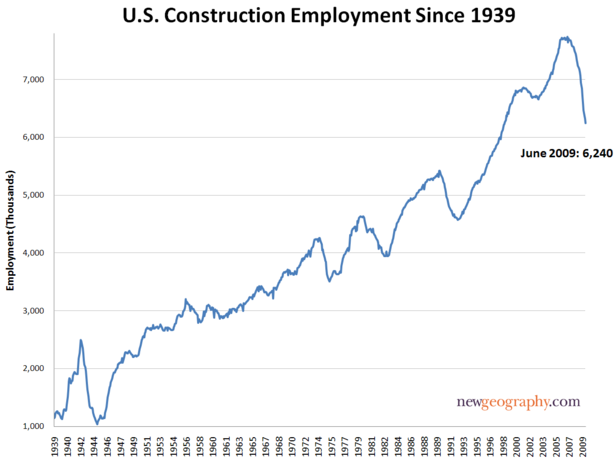
    Unemployment in the construction sector increased by 79,000 in June, according to a report The Associated General Contractors of America released earlier this month. Over the past year, that number has grown to 992,000.

    Even more alarming is the disparity between the construction worker unemployment rate, over 17.4 percent, and the national average for all sectors, around 9.7. Construction employment is crumbling before our eyes.

    The current economic climate has not proven friendly to construction on the whole as state and local revenue continues to decline and little demand for commercial or retail facilities, as well as shrinking orders for new facilities, puts construction in a perilous zone.

    Though as recent as last November, President-elect Obama had conjured up a program to rebuild the nation’s infrastructure.

    The $787 billion American Recovery and Reinvestment Act would modernize roads, bridges, schools, and public transportation – among other things – and reinvigorate the floundering construction and manufacturing industries.

    However, this “shovel ready” stimulus plan did not sit well with women’s groups who wanted nothing to do with a stimulus package that only created jobs for “burly men.”

    These women’s groups seemed to misjudge the president-elects original plan designed to “stop the hemorrhaging in construction and manufacturing while investing in physical infrastructure that is indispensable for long-term economic growth” and instead turned the stimulus into an issue of gender politics. But from the first complaint, onward, the construction and manufacturing industries stood no chance.

    Obama changed his plan, adding health, education, and “other human infrastructure components” to his proposal.

    A report entitled “The Job Impact of the American Recovery and Reinvestment Plan” released on January 10, estimated that the number of jobs created that were likely to go to women was around 42%, a non-too disheartening figure when women “held only 20 percent of the jobs lost in the recession.” The report concluded that the stimulus package would now “skew job creation somewhat towards women.”

    The act was signed into law on February 17 and over the past four and a half months some unfortunate figures have appeared. As noted previously, the construction industry is in a downfall, while there is a growing discrepancy between female unemployment rate (8 percent) and male unemployment rate (10.5 percent) – the highest male-female jobless rate gap in the history of the BLS [Labor Department] data back to 1948.

    All this data, however, has pushed the issue of gender-politics above the issue of human need. Now which group of people should make their voices heard? Let’s hear from women in the construction industry.

  • The Rich Home on the Range

    Have your home on the range, access to a few thousand acres …without paying for it all!

    By Candace Evans

    Mark Lowham was raised on a ranch in Casper, Wyoming. He got away from roping steers and repairing fences to study at Stanford Business School. Lowham thought he might return to ranching one day, but he never dreamed that instead of roping steers, he’d be marketing ways to rope adults into a herd of conservation-minded land-owners.

    Lowham is senior vice president of WEST*GROUP, where he works with Gerald T. Halpin, a former rocket scientist renowned for having the perfect nose for real estate deals. Halpin’s best to date, according to Lowham, was his 1962 acquisition of two dairy farms, Storm and Ulfelder, in the Washington suburbs. They became a significant part of Tyson’s Corner, now the 12th largest commercial business district in the United States. Tyson’s Corner, says Lowham, is larger than downtown Atlanta or Denver. WEST*GROUP, the company Halpin started in 1962 with partners Thomas F. Nicholson, Col. Rudolph G. Seeley and Charles B. Ewing, Jr. is the largest landowner in Tyson’s with more than thirty three city blocks still under Halpin’s sharp eye.

    Though he launched in the greater Washington area, Halpin had seen the west in his extensive travels, and focused on the natural beauty of the Grand Tetons near Jackson Hole, Wyoming.

    In 1989, WEST*GROUP formed a partnership called Meridian, whose mission was to develop a 1400 acre ranch in Jackson Hole, Wyoming, just minutes from the most perfect snow midway between the town of Jackson Hole and the Jackson Hole ski area.

    The spread was initially zoned and approved for 1160 home sites but Halpin decided to turn what he called Indian Springs Ranch into a hybrid of private land ownership and common space sharing. Owners would hold title to a specific portion of the overall ranch – their homestead – and have access to the rest, much like a country club.
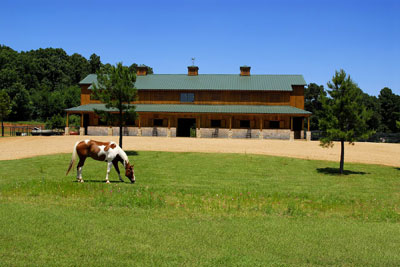
    Those 1400 acres would only house 46 home sites of approximately seven acres each, enough really to be anyone’s Ponderosa. But you’d still get all the perks of ranch ownership: acres of protected ranch land, grazing cattle, horses to ride, barns, pool, tennis courts and a gathering lodge for community. The seven acre parcels of land on the ranch would be separated by several acres between homesteads, on which owners could build in their “envelope”.

    This trend has been growing for a decade. Movies like the 1991 film “City Slickers” projected the romance of ranching into every movie theatre in America. Ted Turner and other significantly high net worth individuals began buying up huge land parcels in the west – Wyoming, Montana, and Colorado, “glamorizing” recreational ranch ownership. Halpin’s first vision for Indian Springs, circa 1989, was to have a small exclusive guest ranch on the order of Lost Creek Ranch & Spa, the exclusive Jackson Hole guest ranch run by Halpin’s son and daughter in law. Lost Creek is one of those places where city slickers can temporarily escape the city and play cowboy outdoors while dining indoors on lobster claw salad, Venison Rosini, and halibut stuffed with crab. Then they get to dunk boot-weary toes in the Jacuzzi after a hard day riding herd and fall asleep beneath the stars on Frette sheets.

    Prominent people bought early sites: Connie Stevens, the actress; Carol and Robin Farkus, he the N.Y.C. Chairman of Alexanders Department Stores, Tom Bolger, chairman of Bell Atlantic. Buyers came from California, New York, the Midwest, the Minneapolis region. They attracted other well-heeled people, which helped sell out the homesites.

    Meridian’s first venture was so profitable, Lowham led the company to develop a Texas Hill Country ranch in 1998; a new ranch in Mesquite, Nevada is currently in the works.

    Though vacation home sales are now slower than they once were, they are not dead. The shared ownership ranch offers owners a shot at full home ownership while splitting the costs of the ranching operation as well as amenities. Some operations even eek out a small profit, but what these buyers are really looking for is a way to pay a fraction of the operating costs while enjoying the whole property. There’s a strong conservationist edge: most shared ownership ranches, like Indian Springs, its Texas Hill Country sibling, The Preserve at Walnut Springs (Ken Starr is an owner, as is yours truly), and Cross Pines Ranch Preserve in East Texas near Mineola, scatter a handful of homes across the vast acreage to create a true sense of isolation, leaving the majority of land to breathe.

    “Ranchers are looking for a way to preserve land and conserve it while not going bankrupt,” says Dallas Addison, developer of Cross Pines, based on a conservation easement where each owner has a one-fortieth interest in the entire property. The conservation concept will soon be crossing the Pacific. Addison has partnered with fellow Texan Alan Friedman, owner of Trisept Inc., to develop Bosque Canyon Ranch at Lake Whitney in the Texas Hill Country, and a 7,000-acre project on Hawaii’s Big Island.

    Other ranches cluster homesteads in one area to preserve as much raw open space as possible; the forever-open range becomes a prime selling point.

    “Clustering is a much better land use process,” says Larry Corson, senior vice president with Dallas-based Hunt Realty Investments. Hunt is the developer of Cornerstone, a 6,000 acre ranch near Telluride, CO. “Our owners actually prefer it, knowing what they have preserved in perpetuity for the environment and wildlife.”

    Cornerstone was once a plain Jane hunting ranch owned by Texans. It was foreclosed and sold at auction to a local investor. Corson literally spotted the site for his employer, Dallas oilman Ray Hunt, off a dirt road. After two years of working with local officials on the development plan, construction began in 2004. The property opened in 2006. Homesteads range from one to one hundred acres, starting prices at $175,000 to seven figures plus an $80,000 club initiation fee and $6,000 a year dues, which are fairly typical.

    Perhaps helped by the relatively vibrant Texas economy, in 2008 the company reported $8 million in sales. The land Corson saw had full potential for a five-star plus ranch: horseback riding, an extensive trail system for hiking, riding or jeeping, fly fishing onsite and private access to the nearby Uncompahgre River, snow mobiles, cross-country skiing, snow shoeing, ice skating, toboggans, and downhill skiing at nearby Telluride in the winter months. But the best selling point of all was the art in every window – breathtaking views of the San Juan Mountain range from every angle.

    It’s City Slickers roughing it on Gulfstreams.

    Corson immediately saw potential for the one thing Telluride was sorely lacking: a high quality, private golf course. The spread held a natural plateau for what has become a world-class, Greg Norman-designed golf course. So there you have it – take a hike, go fish, study the migration patterns of deer and elk, saddle up for a Kamikaze ride, or golf.

    The owners come from all over, but most are from Texas, like investment banker Richard Moses, who was in Telluride for all of 24 hours when he bought not one but two lots. In a tough market, says Corson, if people are going to make a real estate purchase it’s going to be a lifestyle decision: is this the place I really want to be? And of course, are there enough toys to keep me entertained for weeks?

    “At Cornerstone, we once had a little bear cub one morning sitting on our outside barbecue licking the grease off the grill,” he says.

    Just because it’s a ranch, doesn’t mean there must be cattle. At Cornerstone, management discovered that as soon as they stopped running cattle on the property, the songbirds returned – not a bad trade. The grazing killed off the shallow grassland savannah that the bison had once protected.

    Sometimes the city slickers are more conservation conscious than the country folk, and more self-conscious and contentious. Owners at one shared-ownership ranch recently disagreed, albeit briefly, over the herd. Some owners thought keeping methane-producing Longhorns was not worth the massive carbon footprint, or hoof print, for 2,500 lbs of western eye candy. Of course, they were not as concerned over the carbon footprint etched by their private jet flights to the local FBO.

    Shared ownership of course has its downside: you actually have to share – opinions, design, tastes and common areas. You may not have quite everything the way you would if the whole place was yours alone. Strong management, which can sometimes double as a counseling service, is essential.

    “In this market,” says Corson, “buyers are really doing their homework to make sure the developer can deliver on all the promises.”

    Or just keep peace at the ranch.

    Candace Evans is the Editor of DallasDirt, a Dallas-based real estate blog for D Magazine Media Partners.

  • Transportation fantasyland in DC

    I want to pass along this Wall Street Journal op-ed on some of crazy transportation goals starting to get traction in Congress. The main excerpt:

    Messrs. Rockefeller and Lautenberg aim to “reduce per capita motor vehicle miles traveled on an annual basis.” Mr. Oberstar wants to establish a federal “Office of Livability” to ensure that “States and metropolitan areas achieve progress towards national transportation-related greenhouse gas emissions reduction goals.”

    What does this mean? Most travel is not for its own sake. So reducing the total miles traveled — whether the length or number of trips — means people would have to reduce the activities they want and need to do. People would be “coerced,” in effect, to live in less desirable places or work in less desirable jobs; shop in fewer and closer stores; see their doctor less frequently; visit fewer family members and friends.

    There are three likely ways this could work. The cost of travel could be increased by raising the prices of vehicles or fuel; travel time could be increased by not expanding the highway system; or superior alternatives to the private car could be developed. The most likely way to increase the cost of travel would be by increasing fuel taxes perhaps to as much as $4 per gallon, as some have suggested.

    Allowing congestion to increase travel times would be politically easier. In the name of “multimodal planning,” for example, road-use taxes could be diverted, as Messrs. Rockefeller and Lautenberg suggest, to “increase the total usage of public transportation.” But public transportation (where it’s available) typically takes twice as long as automobile travel, so it’s not practical for many Americans.

    Moreover, public transportation (passenger rail services, subways, buses, light rail) requires heavy subsidies, while roads mostly pay for themselves through fuel taxes. Our roads would be even more self-sustaining if 20% of the federal fuel tax were not already diverted to public transit from the federal Highway Trust Fund. Messrs. Rockefeller, Lautenberg and Oberstar want to grab even more money from the trust fund.

    Americans have always valued their independence and mobility. One way to reassert their rights would be to abolish the misnamed Highway Trust Fund, which finances highway construction and maintenance. Let the states decide what roads they need and how to finance them. The present system expires on Sept. 30 unless Congress reauthorizes it. Let it die.

    Sen. Kay Bailey Hutchison (R., Texas) has in this regard introduced the “Highway Fairness and Reform Act of 2009,” which would explicitly allow states to opt out of the federal financing system. A companion bill has been introduced in the House.

    If a significant number of states opted out of the federal system, it would collapse and responsibility for roads would revert to the states. The vast majority of road users would benefit from such a change. And, if “livability” standards were deemed desirable, local preferences would determine them, rather than federal “greenhouse gas emissions reduction goals.”

    You go, Kay. As I’ve said before, the personal vehicle is now a permanent part of our culture, but the engine technology will evolve to meet climate or energy needs. Transit is not a realistic answer for the vast majority. But beyond that, the Feds really shouldn’t be in the transportation game any more. They built the interstate system – now leave local transportation decisions and funding to the states. That includes high-speed rail, which can be done by consortiums of states if they really want it. But, as Reason recently pointed out, inter-city buses make far more sense:

    As I’ve said many times before, I am a life-long rail fan who has ridden trains on four continents. As a transportation professional, however, it’s incumbent on me to advocate meeting transportation needs in cost-effective ways. Before we spent tens of billions of taxpayer dollars on inter-city passenger rail, I think it behooves us to take a closer look at the potential of inter-city bus travel.

    Besides considerably lower fares than Amtrak, much wider geographic coverage, and a much smaller carbon footprint, inter-city bus service has something else going for it: negligible cost to taxpayers. The Nathan study puts the federal subsidy per passenger mile (averaged over the 10 years from 1996 to 2005) at 0.1 cents. Amtrak’s figure is 19.2 cents. Those numbers are consistent with federal subsidy figures in the 2005 U.S. DOT Bureau of Transportation Statistics report “Federal Subsidies to Passenger Transportation.”

    I rest my case.

    He even mentioned some of the luxury bus services with wifi popping up around the country – especially in the northeast – that appeal to a different demographic from Greyhound. How come we can’t get one of those for the Texas Triangle?

    This post is cross posted at Houston Strategies

  • The Next Culture War

    The culture war over religion and values that dominated much of the last quarter of the 20th century has ended, mostly in a rout of the right-wing zealots who waged it.

    Yet even as this old conflict has receded , a new culture war may be beginning. This one is being launched largely by the religious right’s long-time secularist enemies who are now enjoying unprecedented influence over our national politics.

    For all the manifest differences between these two groups, these culture warriors have much in common. Each represents an effort by a highly motivated minority to impose a particular vision of life on a population that does not share either their level of conviction or specific policy preferences.

    The Christian right saw its mission as using government policy to restore family and faith to a country they saw losing adherence to both. Not content with hometown pieties, they wanted to use government power to regulate areas ranging from abortion and gay marriage to stem cell research, in ways reflecting their values and agenda.

    For a while, their agenda also appealed to white ethnics in urban areas, largely Catholics, who recoiled against the crime and disorder in city streets. When they moved en masse to the suburbs, the religious right’s social base narrowed further.

    One critical weakness of the movement stemmed from the fact that many prominent figures like Pat Robertson, Jerry Falwell and Jesse Helms rose from the segregationist South. This limited their appeal outside the white Confederate ethnic enclaves in small towns and some Southern suburbs. They were notably less successful in the fastest-growing, more ethnically and socially diverse communities, where the future of evangelical Christianity now is being shaped.

    Many of the goals espoused by Christian political activists are clearly commendable – promoting charity and respect for human life. In some areas, such as abortion, they have made real inroads on influencing broader society’s attitudes. But overall, their political attempts to impose a narrow religious agenda has fallen into disrepute even among Republicans.

    Today, the locus of the culture war has shifted to the secularist left, whose primary geographic base lies in our densest, most elite cities. This group has evolved into its own version of what the Calvinists would call “the elect” – those chosen to thrive amid a sinful nation. They might also be called “the cognitive elite,” since their self-image comes not from religious worship but from a sense of higher intelligence, greater rationality and even superior healthfulness.

    Perhaps the most honest description of this largely urban grouping was made in the Seattle alternative paper The Stranger shortly after George Bush’s 2004 re-election. Shocked by John Kerry’s defeat, The Stranger defined their preferred constituency as “islands of sanity, liberalism and compassion.” The red regions, they concluded, were the abode of “people [who] are fatter and slower and dumber.”

    At the time, The Stranger’s solution was to secede in spirit from the red states and build a new America hewing to what they considered humane and scientific values. Yet four years later, the self-proclaimed “islands of sanity” now dominate the government in a manner unprecedented in recent American history.

    The rapid ascendancy of the new culture warriors has everything to do with class and caste. The religious right’s base lay predominately in the small towns and lower middle class. They may have had more votes than the sophisticated city-dwellers, but in the end they had little influence among Bush-era policy-makers, whose greater allegiance was to Wall Street, energy and other corporate interests.

    In sharp contrast, the cognitive elites rise straight from the critical bastions of Obama-era power. They draw strength from the mainstream media, the vast “progressive” non-profit community, the universities, and the professional policy elites. University and think-tank denizens, according to a recent National Journal survey, constitute 37 percent of the top 366 appointees by the Obama administration, far more than under the Bush regime.

    One group, not surprisingly far less well-represented, are white Christians, whose number, according to the National Journal, has dropped from 71 percent under Bush to 46 percent. It’s not that the Obamites lack faith, just that they lean less to conservative Christianity and more toward the gospel according to Al Gore.

    Like their Christian right counterparts, the cognitive elite’s agenda does address some important issues. You do not have to embrace the theology of global warming (aka climate change) to favor incentives for reducing energy use and cleaning up pollution. Advocating healthier outcomes through more walking, bike riding and better school lunches also make sense as public goals. And a planning approach that allows for more housing options in suburbs and better access to transit also could be useful.

    The problem here, as with the Christian right, lies with overzealousness and intolerance. Whether environmentalism qualifies as a religion or ideology for legal purposes, it is clearly being embraced in a quasi-theological way. As Bjorn Lomborg and others have pointed out, any objection to the Gorite carbon emissions agenda invites scorn and denunciation for, as Paul Krugman recently suggested, “treason against the planet.” Even mild skeptics can expect to be treated like a strident atheist at a mega-church – although probably with likely far less compassion or politeness.

    Critically, the climate-change zealots likely will be in our faces and wallets far more than the religious fulminators. Although the public is widely skeptical of the whole climate change agenda, they will have to confront a huge new bureaucratic apparatus that could impact millions of businesses and local planning decisions down to the household level.

    This desire to micromanage in the public interest also extends well beyond climate change. There is clear desire now to influence everything from how we live to what we eat. You can see the beginnings in everything from ever-higher cigarette taxes to bans on trans-fats at your local hot dog stand.

    San Francisco, always ground zero for such intrusive lunacy, now has determined to find ways to shove healthy foods on the plates of city residents, preferably from urban gardens. The city is even taking steps to prevent city workers from ordering donuts for meetings. Now bureaucrats must follow guidelines from the Health Department.

    City workers even have to cut bagels into quarters or halves, presumably so that workers may all look as svelte as Mayor Gavin Newsom. “We have an eating and drinking problem in America,” declared Newsom, a candidate for governor with an admitted former alcohol problem of his own.

    But perhaps the most intrusive changes may come in terms of planning and development. The Obama administration has already declared its desire to “coerce” people out of their cars and discourage sprawl in order to promote its health and carbon-cutting agendas.

    This could evolve into a concerted attempt to force more Americans into the high-density housing as opposed to the single family suburban homes they prefer for reasons ranging from cost to privacy and safety. It may be questionable how much these steps will improve health or the environment, but this may not matter much given the current theological consensus.

    What we now see is policy enacted in the name of scientific dogma, even though science’s essence lies in open inquiry and debate. In the process, agendas are often conflated; reports even mildly contrary to the received wisdom of climate change are ridiculed or ignored. For some urbanists, climate change also provides a convenient excuse to reverse the dispersion to suburbs that they have railed against for decades.

    What we need now is not self-interested dogma, but open, wide-ranging debate designed to find the most effective ways to achieve energy efficiency in both cities and suburbs. Amid the worst economic downturn in a half-century, we also might want to weigh the impact of some “green” policies on the employment, income and wealth prospects for middle- and working-class Americans.

    The anointed secular clerisy seems destined to become very unpopular. Americans do not like to be preached to by their political leaders about how to manage the details of their lives, particularly when the preachers often fail to follow their own precepts; this was a core problem with those who aligned with the religious right. Environmental and health activists would do better to focus more on suasion as opposed to coercion and to offer incentives rather than dictates to achieve their goals.

    They should also learn that problems are addressed most effectively at the local, community and familial levels. The wide access to information through the Internet undermines the very logic for relentlessly centralized solutions; the best “green” policies may be those that evolve organically and fit specific local conditions.

    Basically, cultural warfare makes for stupid politics, as the Republicans should have – but likely have not – learned by now. The new culture war now developing could pose similar dangers for the Democrats, if they are not careful.

    This article originally appeared at Forbes.

    Joel Kotkin is executive editor of NewGeography.com and is a presidential fellow in urban futures at Chapman University. He is author of The City: A Global History. His next book, The Next Hundred Million: America in 2050, will be published by Penguin early next year.

  • Fears of Stimulus Favoratism to Pro-Obama Counties is Overblown

    A recent USA Today analysis of government disclosure and accounting records has revealed that counties that supported Obama last year have reaped more of the benefits of the stimulus package than those counties that supported Senator John McCain.

    That federal aid, which amounts to around $17 billion, has been the first piece of the Obama administration’s stimulus package that can be tracked locally. The USA Today findings showed that Obama-counties received an average of $69 per person while McCain-counties received around $34.

    While the disparity between the two looks bad on paper, it is not all that uncommon. As USA Today writes, “much of [the aid] has followed a well-worn path to places that regularly collect a bigger share of federal grants and contracts, guided by formulas that…leave little room for manipulation.”

    The aid has gone to repairs for military bases, improvements in public housing and helping students to pay for college – all areas that eclipse political party lines. Additionally, about a third of the $17 billion allocated towards projects such as runway repaving and nuclear waste clean up has gone to counties that supported McCain.

    It is far too soon to be drawing conclusions about a stimulus effort that favors Obama’s constituents. While we can keep an eye out for “political favoritism,” ensuring that the stimulus aid lands where it’s most needed (regardless of county) should be our first priority.

  • Housing the Next Generation with Old Shipping Containers

    If the predictions are accurate, America will have to house some 100 million more people by 2040 to mid-century than is now the case. Despite the current round of foreclosures and rising apartment vacancy, over the long term the demand for humane, affordable, sustainable housing is going to escalate dramatically in the coming years.

    In this recessionary time, it may be tempting to ignore the coming boost in housing demand. Yet eventually growth will pick up and the housing market will become re-invigorated. Nonetheless, the problem of meeting the demand for affordable housing will remain. For now, the federal government is trying to help state and local governments acquire, renovate and sell foreclosed properties, and individual homeowners to reduce their mortgage payments to 31 percent of their income. Federal efforts are also being aimed at increasing funds to redevelop public housing and at giving first-time homebuyers an $8,000 tax credit.

    But these are short-term measures. Others, with more lasting impact, may be more effective. One will be the size of houses. Although some may still choose to build large lot homes and McMansions, the longer-term trend will be for somewhat more compact houses. Contrary to the visions of some urban boosters, Americans will continue to favor single family homes over apartments. But these houses seem likely to trend back to the more traditional, modest scale. Between 2006 and 2007, after years of expanding, the size of a median single-family house actually decreased slightly.

    Another critical element of a housing solution lies in building workforce housing close to the workplace. For years, many moderate income Americans have been forced to “drive ‘til they qualify.” Throughout the nation’s metropolitan areas, teachers, police officers, firefighters, salesclerks, municipal workers, and young people, among others, are being elbowed out of the local housing market. In a recent survey conducted by the Urban Land Institute in cooperation with Harris interactive, of the 110 larger firms (over 100 employees) surveyed, fifty-five percent reported a lack of affordable housing nearby, sixty-seven percent of the workers interviewed (who earned less than $50,000 per year) said they would move closer to work if more housing in their price range were available, and fifty-eight percent of the companies reported having lost employees due in part to long commute times.

    For most Americans, particularly between ages 30 and 70, the demand for affordable homes near workplaces will be paramount. In some areas, there may also be greater demand for apartments, even though these too are suffering due to the recession.

    Many zoning and building codes are obsolete and need to be updated, because as written they restrict the construction of low and moderate income housing and segregate residential, retail, and industrial/commercial land uses. Changing zoning to permit and provide incentives for mixed use development, more intense land uses, and higher density development would make workforce housing more affordable.

    The steps above do not apply only to city living. Through good design, suburban living can be made slightly more compact without sacrificing quality of life. Accessory buildings can often be added on a lot, “granny flats” can be built, large old single family homes can be converted into duplexes, empty spaces could be filled in, and other steps can be taken to meet the need for more housing when that need materializes.

    But perhaps the biggest gains can come by using innovative approaches to expanding housing. One novel idea that has begun to emerge is to use old shipping containers that have been transformed into building blocks for home-building materials. Actually, one can hardly call the idea novel, because shipping crates have been used in construction for thousands of years. But today, the old practice is being revived with entrepreneurial, innovative, outside-the-box thinking.

    These reconfigured containers have the advantages of being more economical and durable than conventional materials, speedier to construct, highly customizable, fire-, termite-, water-, and earthquake/hurricane-resistant, strong, safe and green, with a lower carbon footprint. Hence the name of one of the companies working in this field, one with which I am associated, SG Blocks LLC (SG stands for “safe and green”). As the company puts it, “We are in the business of converting instruments of trade into instruments of construction.”

    Shipping containers are big: each weighs 9,000 pounds and measures 8 feet wide by 40 feet long by 9 feet tall. Hundreds and thousands of them are sitting empty in ports around the country. What possible use could they be, one may wonder, in building a new residential or office complex?

    Consider, therefore, that these steel-on-steel containers, when used as re-fabricated “blocks,” are stronger than conventional house framing. They can be cut, fabricated, re-modeled, and turned into a basic home structure for approximately $25-$27 a square foot. Stevan Armstrong, COO of SG Blocks, has pointed out that multi-family mid-rise units built with containers cost 10 to 15 percent less than typical “stick frame” houses. When appropriate coatings are installed, says Dan Rosenthal, a principal with the Lawrence Group, “we have an envelope that reflects about 95 percent of outside radiation, resists the loss of interior heat, provides an excellent air infiltration barrier and does not allow water to migrate in. Because of the superior roof structure, it is easier to incorporate ‘green’ roof systems.”

    Using shipping containers also saves energy on the front end. It takes 6,481 kilowatt-hours to make a ton of steel from virgin materials, 9,000 kilowatt hours of energy to melt down a container, but only 400 kilowatt-hours of energy to convert shipping containers into SG Blocks.

    The possibilities for utilizing this type of construction – infill housing in urban and suburban communities, new construction for residential, commercial, industrial and retail buildings, single- and multi-family homes – are practically limitless. From a design perspective, SG Blocks claims that their modified containers “can be used to build virtually any style of construction, from traditional to modern and all in between…from traditional Main Street to ultra-contemporary.” In short, they can provide people with an opportunity for ownership and economic mobility in a decent community environment.

    To cite a few examples:

    • A continuing care community for seniors on the historic Mission San Luis Rey grounds in Oceanside, CA, 340,000 square feet with 450 SG Blocks, is going up.
    • In Salt Lake City, the first mid-rise container building is being planned for downtown; it will be called City Center Lofts, with eight units and a ground level art gallery.
    • In Ft. Collins, CO, discussions are being held about creating “block” homes for 500 families as part of the city’s Homeless Shelter Program.
    • John Knott, the guiding light in the Noisette Community in North Charleston, SC, wants to build a six- to eight-story “container” building, retail on the first floor with residential units above, topped with a green roof. He proposes using ninety prison re-entry men to do the construction.
    • Work is in process on a three- to four-story student housing and recreational mixed use facility at Lubbock Christian University in Texas.
    • In Panama, “blocks” are being used to build four buildings that will house community and education centers for the U.S. Southern Command.
    • Attached to the top of this article is a photo of a house built with SGBlocks in St. Petersburg, FL.

    Demography is destiny, as has been said so many times. With 100 million more people in the pipeline, we have to find humane, innovative, affordable ways to house them and provide them with opportunity for advancement. Salvaging empty shipping containers to address this problem is only one step, but a most interesting one that is well worth the trying.

    William H. Hudnut III, former Member of Congress and sixteen-year Mayor of Indianapolis, is the principal in his firm, Bill Hudnut Consultants LLC, and an associate of SG Blocks LLC. His email address is: bhudnut3@gmail.com.

  • Here Come Wall Street’s Carbon Trading Wizards?

    If you think that Wall Street’s vapor traders helped house the nation’s people then you are probably eagerly looking forward to how they will keep our environment clean. Under current “free-market” cap and trade proposals the same people who brought you the housing bubble and have contributed to wild swings in energy prices are eagerly anticipating their next vaporous bonanza. Senator Byron Dorgan of North Dakota, one of the few elected officials vigilant enough years ago to foresee the effects of financial deregulation, believes there is a better way. And his proposed solutions will reduce carbon emissions without leaving the future our environment in the hands of speculators – wizards though they may be. Let’s hope, as The Who was once proclaimed, we won’t get fooled again.