Blog

  • Urban Backfill vs. Urban Infill

    By Richard Reep

    Wendell Cox recently reported on the state of so-called “urban infill” efforts, and analyzed which cities are experiencing an increase in their density. This report shows some surprising trends. Cities such as Pittsburgh, which claim to be successful at “infilling”, are actually dropping in density, in part because of low birth rates and lack of in-migration.

    What may be the next trend might be called urban agriculturalization or “urban backfill”. In the past, urban infill used to make sense. Where a concentration of people already existed, and where infrastructure was in place, development between existing structures seemed inevitable. With the accessibility allowed by the car, urban infill became a choice among others, including the suburban frontier. Urban infill became, for most cities, a rarity.

    Current attempts to encourage infill over fringe development may be too little too late, as the cost and regulatory environment favors fringe development. Expenditures on public safety rose as building codes dictated an increasing level of safety in urban cores, not just for the occupants of the building, but for the building itself. Driven higher because of the perceived desirability of a downtown, costs soared out of control as elaborate, complex zoning processes meant high fees to a team of consultants necessary to steer projects through multiple public hearings. These generated some pricey computer graphics, but often no guaranteed outcome.

    Aesthetics also have become highly regulated as well, with design boards composed of interested citizens, reducing the design process to design-by-committee. By the early part of this century, urban infill became an Olympian sport, leaving most of an urban area’s empty lots and dilapidated buildings vacant.

    To further burden the urban infill developer, right now a new form of regulation is entering the scene, that of the so-called smartcode which regulates the last untouched part of the exterior of a structure: its overall form. With rigid codes and design staffs, cities can now create for themselves a vision, supplemented with pretty pictures, of the imagined future, where building patterns need to be just-so. An urban infill developer must now adhere to someone else’s opinion of where his front door is, and whether he has a front porch.

    So, in reality, these urban parcels sit abandoned and income-free, with the biggest real estate growth market being in “for sale” signs, as owners try to unload these properties on a greater fool ready to do battle for the cause of urban infill. It is a no-win scenario for cities.

    Back fill provides an alternative below the line. Overlooked spaces are being discovered by many people as ideal for temporary use, and with only a small cost for a license or permit, new marketplaces, street performances, and other people-intensive activities are rushing in to fill the void. Again, a city with any savvy will try to apply a regulatory and fee drag on this activity; fortunately for the citizens, this usually takes a long time, and in the meantime, many cities are acquiring the look of a genteel form of Blade Runner, with person-to-person commerce taking place among the currently decaying and abandoned edifices and infrastructure.

    Still other parts of the city are trying to beautify their abandoned spaces by planting them, sometimes with gardens, figuring lush landscapes can hide the fact that their core is not as desirable as it once was. And still others fence them off, creating a new canvas for graffiti artists and advertising, and returning the abandoned spaces into wilderness.

    All of this belongs to the study of old field succession, which traditionally has been an agricultural science. For urban cores, this approach suggests a new way to reuse abandoned space. Increasingly, agriculture may not belong exclusively to the rural condition, but can be adapted to the city itself.

    In some areas such as Orlando, entrepreneurs have discovered this reverse-flow effect, which has been useful in so many other endeavors. By applying the standards of agriculture to the urban core, interesting and useful businesses are springing up. Near Orlando’s downtown area, for example, Dandelion’s Café is licensed not as a restaurant but as an agricultural kitchen, allowing it to operate under the Florida Department of Agriculture rather than the Florida Department of Health. This freedom does not compromise public safety – people still get sick from food in Department of Health regulated restaurants – but cleverly avoids the intensive state oversight, permits and fees associated with most restaurants.

    In College Park, the City’s empty land has been converted into a community garden, offering small plots of land for rental to surrounding property owners to cultivate produce. This is not a new idea; urban community gardens exist in cities worldwide. But as the current economic conditions squeeze incomes, creative use of outdoor space to reduce the grocery bill has engendered a new microfarming movement, and may have staying power as people rediscover a sense of shared purpose.

    All this creates a new form of development, which might be characterized as urban backfill. Urban backfill projects include any temporary uses of space for food, commerce, or entertainment. These even include temporary sacred places – the streetcorner preacher, for example, and his congregation. Still other abandoned spaces seemed destined for decay: overgrown weeds, saplings, and mice are turning urban vacant lots into true pastoral scenes that provide surrounding buildings with glimpses of unregulated nature.

    Cities can hold off this backfill for only so long. If Twitter can enable a revolution, ad hocracy can certainly enable free commerce and discourse in a democracy. Temporary uses suggest a vitality that cannot be denied or regulated to death, and suggest that cities consider a new way of looking at these spaces. Urban backfill provides an opportunity to reinvent the American city and create economic and social value where now none exists. It can also help establish both a renewed sense of place that can also nurture new ways for a city to evolve organically and naturally.

    Richard Reep is an Architect and artist living in Winter Park, Florida. His practice has centered around hospitality-driven mixed use, and has contributed in various capacities to urban mixed-use projects, both nationally and internationally, for the last 25 years.
  • Bailout Success!!

    “I guess the bailouts are working…for Goldman Sachs!” The Daily Show With Jon Stewart

    Goldman Sachs reported $3.4 billion second quarter earnings. Mises Economics Blogger Peter Klein says these earnings are the result of political capitalism – earned in the “nebulous world of public-private interactions.” Klein points to an interesting perspective offered by The Streetwise Professor (Craig Pirrong at University of Houston): Moral Hazard. Goldman Sachs’ status as “too big to fail,” conferred on them by the United States Government, has allowed them to increase the money they put at risk of loss in one day’s trading by 33 percent since last May. Goldman received $10 billion in the TARP bailout on October 28, 2008; they returned the money on June 9, 2009. By April 2009, they had paid about $149 million in dividends on the Treasury’s investment – a negligible return. Goldman Sachs also will be receiving transaction fees for managing Treasury programs under contracts awarded to them during the Bailout and beyond. When Goldman Sachs changed its status to “bank” last year they also gained access to the FDIC safety net, which perversely provides incentives for banks to take risks by absorbing the consequences of losses.

    To underscore the importance of cronies in capitalism, Goldman Sachs is on track to dole out bonuses equal to about $700,000 per employee – a 17 percent increase over 2006, when bonuses were sufficient to “immunize 40,000 impoverished children for a year … throw a birthday party for your daughter and one million of her closest friends … and still have enough left over to buy a different color Rolls Royce for each day of the week.”

    Since employees of Goldman Sachs will one day be in charge of the U.S. Treasury, it only makes sense that the company has to keep them happy now – how else can they be assured of future access to capital? The House Oversight and Government Reform Committee seems to think that former Treasury Secretary Hank Paulson – himself a former Goldman Sachs bonus recipient – gave bailout money to his cronies after telling Congress the money was for Main Street homeowners.

    If it isn’t clear by now that the United States Government is picking the winners and losers in this economy, the experience of CIT Group Inc. – a lender to small businesses that is being allowed to fail – should remove any doubts you may have had until now.

    The United States Government passed an additional $12.1 billion to Goldman Sachs through the AIG bailout – money that won’t be returned unless AIG succeeds. To assure their success, AIG is preparing to pay millions of dollars more in bonuses to their executives this year under the premise that a contract is a contract and must be honored (unless it’s a UAW contract, of course.) JP Morgan Chase reported better than expected earnings; even Bank of America, still reeling from the Merrill Lynch merger and extensive mortgage losses in California, earned $3.2 billion in the second quarter of 2009. Citigroup reported $4.28 billion profit in the second quarter.

    With government money and government protection coming at them from all sides, it’s a wonder all the big banks and big bank employees aren’t rolling in dollar bills by now.

  • Forcing Density in Australia’s Suburbs

    Australia is a continent sized country with total urbanized area of only 0.3%.  As is the case with the USA, the population is increasing as a result of natural growth and immigration. The country is blessed with a sunny climate and enough space to enable its inhabitants to enjoy a relaxed, free lifestyle.

    Given this, one would expect there would be little support for the higher density housing ideology of the Smart Growth advocates. Yet since the early 1990s the Australian Federal Department of Housing has been pushing exactly this approach.

    Sydney, located in the state of New South Wales, has been the forefront for this densification policy. Sydney (population 4.34 million) is subdivided into local municipalities, each run by a popularly elected council. Traditionally these councils have had the responsibility of planning their own areas. Over the years council zoning plans have complied with the expressed preference of over 80% of Australians to live in free-standing homes. In an effort to alter this long-standing pattern the New South Wales Government has resorted to the use of authoritarian processes to force densification, whether areas like it or not.

    High-density regulations from the Planning Minister come about by ministerial fiat without discussion in the State Parliament. These regulations require municipal councils to submit planning strategies to the Planning Minister that increase density, to his/her satisfaction, under threat of removal of a council’s planning powers. In a blatant conflict of interest, half of the members of the minister’s assessment panel are developers who stand to gain from the implementation strategies being assessed and the other half are bureaucrats. There is no community representation.

    Most councils have meekly complied with the coercive demand to submit high-density planning strategies.  As a result previously attractive suburbs with their flowers and foliage are being overcome by the relentless march of grey concrete and bitumen. Bewildered long-time residents find themselves isolated amongst the drab shadows of upward-rising, smothering unit blocks.

    One leafy, mainly single-residential council area in the northern part of Sydney (Ku-ring-gai) insisted that the submission of their residential strategy be delayed until studies could be conducted of the effects of the resulting higher density on infrastructure, traffic, the environment and heritage. This cheekiness was dealt with savagely. Its traditional planning powers have been taken away and given to a planning panel appointed by the Planning Minister.

    This planning panel organised a plan that will increase the population density of the municipality by some 50%. The plan proposes that the traditional village centres and numerous surrounding homes in the area be replaced by massive high-rise tower developments, many spreading deep into surrounding residential streets.

    In a token show of democracy the panel arranged for a public consultation meeting on the draft plan. During the meeting, resident after resident excoriated the high-density plan as grossly excessive, defiant of independent studies and contemptuous of environmental and heritage constraints. Speaker after speaker denounced the panel’s processes – as “failures of transparency and due process”, “patronising and condescending of community concerns”, “pandering to developer interests”, being “part of a process to impose a policy that was not in the greater public interest” and a “sham”. The panel ended the meeting when only half of those who registered to speak had done so. Despite tumultuous scenes of uproar, the planning panel resolved to adopt the high-density plan.

    One would think that such dictatorial impositions on a community could be warranted only by indisputably being in the wider public interest. The Planning Department has attempted to justify its stance by alleging benefits for the greater public good. Chief among these are claims that high density is better for the environment and that the policy saves on infrastructure cost.

    In Australia the evidence points to the contrary. On the question of greenhouse gas emissions, a recent study which allocates greenhouse gas emissions to final consumption at the household level1 shows that on average per person emissions in the high-density inner city areas are nearly twice that in the outer low density areas. Another study shows that there are more greenhouse emissions from domestic energy use in high-density living (5.4t/person/year) than in detached dwellings (2.9t/peson/year)2. This results from lifts, clothes dryers, air-conditioners and common lighted areas such as parking garages and foyers. What is more, the energy required to construct high-rise is nearly five times the energy needed to build single-residential, per resident. 

    In Australia high density hardly reduces travel intensity at all. Research on Melbourne areas shows that the people squeezed into newly converted dense areas did not use public transport to any greater extent than before and there was little or no change in their percentage of car use3.

    There is not nearly enough difference in the greenhouse gas emissions of public versus private transport to counter the increased emissions of high-density dwelling. Greenhouse gas emission per passenger km on the Sydney rail network is 105 gm. The figure for the average car is 155 gm – but for  modern fuel efficient vehicles is as low as 70 gm.

    Adding more people to existing infrastructure results in overload. After 15 years of high-density policies, the quality of Sydney suburban roads, rail service, water supply and electricity has noticeably deteriorated. High-density retrofit is hugely more expensive than laying out new infrastructure on greenfield sites. Infrastructure costs quoted by the authorities almost always omit the cost of restoring the standard of infrastructure back to the level of service people enjoyed before high-density was imposed. One example of these “forgotten” costs – the augmentation of electricity supplies in downtown Sydney, necessitated by 4900 additional apartments, will eventually cost $A429 million ($US340 million) – or $A80,000 per new apartment.4

    The effect of high density policies on the cost of housing has been devastating to the younger generation. In attempting to force people into higher density on existing land, the authorities have drastically cut down the supply of new land for housing. This has resulted in the cost of land now comprising 70% of the cost of a place to stay, instead of the traditional 30%. A new dwelling on Sydney’s outskirts should cost about $A210,000 ($U168,000) but is actually more than $A500,000.

    The cost of commercial land in Sydney has also rocketed out of control. Employers take their business elsewhere. Back in 2000, the New South Wales proportion of the national economy was 35%. This has now plunged to barely 30%.5  The proportion of bankruptcies has increased from 25% to 38%.6

    Besides ostensible “green” ideology, perhaps the powerful driver for high-density policies lies with the resulting opportunities for infill developers to make huge profits. Over the last five years, the ruling New South Wales Labor Party received donations from the development industry of $A9 million while the opposition party netted $A5 million. These donations exceeded the total contributions for all political parties over the same period from the gambling, tobacco, alcohol, hotel, pharmaceutical and armaments industries combined7.

    The political donations gain donors favoured access to government.  This inevitably results in policies sympathetic to them, which in turn result in more profits and more donations.  

    Other Australian states also have implemented high-density policies but not to the degree of New South Wales. Recently in Victoria8 and in Western Australia9 carefully couched announcements have revealed that policies are moving away from excessive high-density.

    Mistaken ideology and financial rewards to a minority have made high-density an enduring feature of New South Wales planning policy. The results are not pretty: more greenhouse gases, high traffic densities, worse health outcomes, a creaking and overloaded infrastructure, a whole generation locked out of owning their own home and business fleeing the state for the greener, less congested pastures elsewhere.

    (Dr) Tony Recsei has a background in chemistry and is an environmental consultant. Since retiring he has taken an interest in community affairs and is president of the Save Our Suburbs community group which opposes over-development forced onto communities by the New South Wales State Government.


    1 Australian Conservation Foundation Consumption Atlas, ,http://www.online.org.au/consumptionatlas/

    2 Myors, P. O’Leary, R. and Helstroom, R.,2005, Multi-Unit Residential Building Energy and Peak Demand Study, Sydney, New South Wales Department of Infrastructure, Planning and Natural Resources

    3 Christopher Hodgetts, 2008,Thesis: Urban Consolidation And Transport, University of Melbourne

    4 EnergyAustralia website accessed October 2008

    5 Sydney Morning Herald 15 November 2008

    6 Sydney Morning Herald 29 March 2009

    7 Sylvia Hale, Member of NSW Legislative Council, 29 April 2009, Speech to the National Trust Breakfast

    8 http://www.theage.com.au/opinion/opposition-to-a-bigger-melbourne-smacks-of-cultural-snobbery-20090624-cwpv.html?page=-1

  • No Bailout of Small Businesses

    CIT Group Inc. acknowledged today that “policy makers” turned down their request for aid. It’s always sad when a company fails and goes into bankruptcy – people lose their jobs, all the vendor companies that sell them products suffer from the loss of business, etc. But what makes this one especially sad is that CIT, according to Bloomberg News, “specializes in loans to smaller firms, counting 1 million enterprises, including 300,000 retailers, among its customers.”

    This news comes on the heels of an appearance by former Secretary of Treasury Hank Paulson before the House Committee on Oversight and Government Reform. Summing up after the hearing, Chairman Edolphus Towns (D-NY) admitted that Congress turned over complete authority to Paulson in the Bailout last fall (Troubled Assets Relief Program, TARP): “with no accountability, no checks and balances.” The result is “seemingly arbitrary decision-making.”

    Representatives at the hearing repeatedly accused Paulson of deceiving Congress by telling them (and everyone else) that the bailout money would be used to help homeowners. In the end, it was as if the previous administration pillaged the U. S. Treasury on their way out of town.

    In the third of a series of hearings designed around the Bank of America merger with Merrill Lynch, Paulson told the Committee that he had the authority to remove Ken Lewis as head of the bank if he didn’t go through with the merger.

    Rep. Jim Jordan (R-OH) said there was “a pattern of deception.” He asked specifically, when did Paulson know that he was going to give the money to the banks – which he did on October 13 – after telling Congress on October 3 that he was going to use it to buy up bad mortgages? Paulson’s response was that he believed Congress knew they were giving him flexibility to do whatever he wanted – so he did.

    The question now is this: did Paulson pick and choose among his friends to decide who got a bailout? Special Inspector General Neil Barofsky will report to the House Oversight Committee next week with the release of his quarterly report to Congress on the use of TARP funds. Recall that Barofsky’s office is the only one with the authority to initiate criminal prosecutions. Maybe Paulson is still on his list.

  • Subsidies, Starbucks and Highways: A Primer

    At a recent Senate Banking Committee hearing, Senator Robert Menendez of New Jersey, responding to comments about large transit subsidies, remarked that the last federal highway bill included $200 billion in subsidies for highways.

    The Senator should know better. The federal highway bill builds highways with fees paid by highway users, not by subsidies. Perhaps the Senator was frustrated at having just heard an effective fact-based dismantling of transit lore in testimony by the Cato Institute’s Randal O’Toole and felt it necessary to strike out at the mode by which nearly all travel occurs in the United States.

    In fact, virtually all of Senator Menendez’s $200 billion for federal highway spending come from user fees, which are paid by people and companies that use the highways, not subsidies. The Menendez comment might simply result from ignorance. But often the error appears to be the purposeful muddying of an issue that has become so common in public affairs.

    The “subsidy” litany is accepted by many in the public, who have better things to do than to check the veracity of statements by public “servants”. As a result, we offer this primer on the subject, not only for casual observers of public policy, but also for any members of Congress who might have an interest in veracity.

    What is A Subsidy?

    A government subsidy occurs when taxpayers are forced to pay for a government service, whether or not they use it. Subsidies are legitimate. Subsidies are needed to fund government services demanded by the electorate, such as welfare services and education. On the other hand, payments made by users of a government service (or private goods and services) in proportion to their use are not subsidies. They are user fees, including taxes on the use of gasoline and other fuels.

    This point can be illustrated by looking at the electricity industry. No one would suggest that Potomac Power, Pacific Gas and Electric or other privately owned utilities that are supported by payments from consumers are subsidized. Similarly, government owned utilities like the Los Angeles Department of Water and Power, Austin Energy and the Tennessee Valley Authority are not subsidized, since they receive their funds from users. It would have been no more absurd to characterize user payments to electricity companies as subsidies than to characterize the federal highway program as subsidized (Note 1).

    There is a simple way to tell the difference between subsidies and user payments. With subsidies you pay whether or not you use the service. In contrast, with user fees, you don’t pay if you don’t use. People who don’t use electricity from the Los Angeles Department of Water and Power don’t pay and people who don’t use the highways don’t pay either.

    Transit Subsidies

    Everyone agrees that transit is subsidized. Approximately one-quarter of transit’s operating and capital funding comes from passenger fares. Nearly all of the rest is subsidies. Moreover, an “open and shut” case can be made for subsidies to transit as a welfare service in core cities where it provides the only mobility for some lower-income residents who do not have access to cars. The case is, however, less than “open and shut” with respect to the substantial subsidies for upper-middle income commuters such as those from Connecticut, the Hudson Valley and New Jersey to Manhattan, or from tony East Bay suburbs to San Francisco, or for well-paid Maryland and Virginia commuters into the District of Columbia.

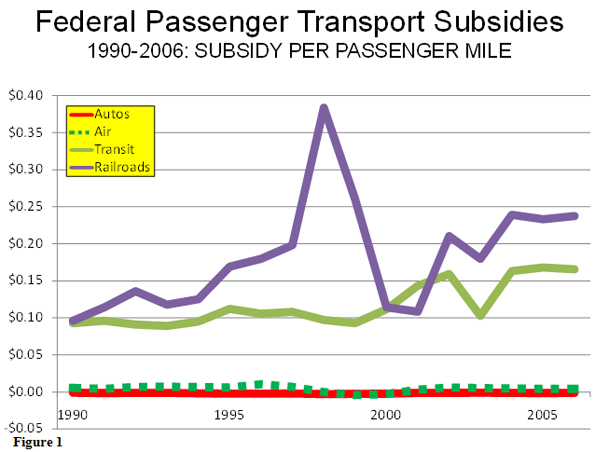
    A 2004 United States Department of Transportation (USDOT) report indicated that federal subsidies to transit amounted to $0.16 per passenger mile in 2002. Our update of this report estimated that the federal subsidy had risen to $0.17 per passenger mile by 2006. Overall, federal subsidies to transit were $7.7 billion in 2002, which increased to $8.6 billion in 2006 (Figure 1).

    Subsidies to Highways

    Virtually all federal highway spending was financed by fees paid by users in proportion to their use of the highways. There was no taxpayer subsidy.

    Indeed, the USDOT report indicates that in 2002, the federal government made a profit on automobile use of highways of $0.001 and had made a profit in every year since 1990, the first year reported upon. Overall, automobile use of the highways earned the federal government a profit of $4.5 billion in 2002 and $5.5 billion in 2006 (Figure 1).

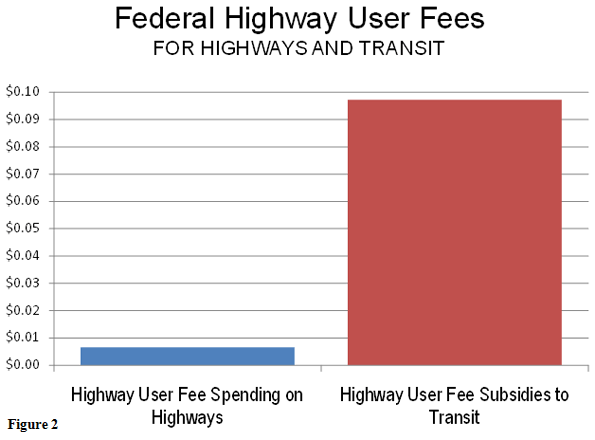
    The profits made by the federal government on highways indicate that highways are, in fact, subsidizing other government services. Senator Menendez neglected to mention, of course, that last highway bill (called “SAFETEA-LU,” its predecessor was called “ISTEA,” pronounced by insiders as “ice tea”) included $34 billion in subsidies by highway users for transit. For more than 25 years, federal law has required an add-on to highway user fees to support transit. Today nearly 15 percent of highway user fees are used to subsidize transit. In fact, road users pay 15 times as much in gas taxes per passenger mile on transit as they paid for highway expenditures (Figure 2).

    The profits do not stop at the federal level. Federal Highway Administration data indicates that user fees exceed the federal and state share of money spent on state highways, these being intercity highways, urban freeways and some other urban roadways. Only at the local government level are expenditures more than highway user fees, indicating subsidy.

    A real world parallel: Most of us have had Starbucks coffee. Our Starbucks coffee is not subsidized; rather we pay for it, 100% of it (Note 2). We can call this a price or we can use the public policy synonym, a user fee. As in the case of highways, those who do not drink Starbucks coffee do not pay for it. However, if Starbucks were financed like the federal highway program, 15 percent of the price of the coffee would be taken to subsidize tea drinkers (the authorizing legislation might be called ICECAFE).

    Airports

    While Senator Menendez did not refer to airports, those afflicted with a love affair with trains frequently claim that airports are subsidized in order to argue for massive expenditures on high speed rail, intercity rail and Amtrak. They are nearly as wrong as Senator Menendez. The air transportation system is overwhelmingly paid for by users, through taxes on tickets and airport fees. As in the case of highways, only those who use airports and the commercial air system pay for them.

    There are relatively small subsidies to commercial air transportation. The USDOT report found subsidies per passenger mile of approximately one-half penny.

    By comparison, the nation’s intercity passenger rail system (Amtrak) was subsidized to the extent of $0.21 per passenger mile in 2002, according to the USDOT report. Our report found that the figure had edged up to $0.24 in 2006, more than 50 times the subsidy to the commercial air system (Figure 1).

    These commercial air subsidies, however small, should be eliminated. Failing that, train proponents have grounds to ask for up to a half-penny per passenger mile of subsidy for high speed rail and intercity rail. Beyond that, equity requires that high speed rail and intercity rail be financed the same way as the commercial air system: with passenger fares, taxes on rail tickets and fees for the use of railroad stations.

    The Bottom Line

    The bottom line is that you pay for your coffee from Starbucks, you pay for your electricity from the Los Angeles Department of Water and Power and you pay for your federal highways with your own money, not with subsidies by people who do not use them.


    Note 1: Of course, if general taxpayer funding is provided to electric utilities, such payments would be subsidies, whether the utility is privately owned or owned by government.

    Note 2: All of this assumes that the local Starbucks is not the recipient of special tax incentives or abatements that might have been used by local government as enticement to locate in the community.

    Wendell Cox is a Visiting Professor, Conservatoire National des Arts et Metiers, Paris. He was born in Los Angeles and was appointed to three terms on the Los Angeles County Transportation Commission by Mayor Tom Bradley. He is the author of “War on the Dream: How Anti-Sprawl Policy Threatens the Quality of Life.

  • High life on New York’s High Line

    Last month, an old elevated train track on Manhattan’s west side was re-opened to the public as a public park. The High Line was a 1.5-mile stretch of track constructed in the 1930s to carry freight trains. The last train ran on the platform in 1980 and the space has been the subject of battles ever since between park-minded preservationists and residents who wanted to tear down the steel monstrosity with no apparent function.

    It is a great thing the preservationists won. The High Line is a magnificent and inspiring park, a one-of-a-kind public space with views of the Hudson River that shows a great respect for the industrial history of the surrounding uber-hip Meatpacking District. It manages to feel both modern and classic at once, with moveable wooden chez lounges that look like they could belong by the pool at a W Hotel sliding along the original tracks at places. Gardens are planted along the walkway and amidst the old tracks making it a perfect place to stroll, visit and view the west side of the city.

    The first phase of the park runs from Gansevoort Street to 20th Street with the second phase slated to open next year extending all the way to 30th Street. The Promenade Plantee in Paris was the first elevated garden to be transformed into a public space but the bug is catching on and other projects are planned in St. Louis, Philadelphia, Jersey City and Chicago.

    To get to the High Line, get off the subway at the 14th Street and 8th Avenue station and walk west towards the river. You will not be disappointed, even it rains like the day I visited.

  • Solar Gains On The Green Competition

    The living room of my electrician friend Harry Gres was filled with solar panels which were destined for his roof to demonstrate the advantages of his new eco-business venture. In the spirit of Herbert Hoover’s campaign pledge of a car in every garage, Harry envisions solar panels on every roof (including garages).

    I know very little about solar electric generation, but I was once a very satisfied owner of a 10kW wind energy system back in the (failed) green era in the early 1980s. Wind generation is very visible. When the blades spin on a wind system one can imagine a generator producing power. The whop-whop noise means the electric meter is turning backwards, a beautiful noise indeed. Harry Gres will have a silent 5kW system on top of his roof; the only visual excitement will be to see the electric meter spinning backwards during sunlit hours. Fortunately, here in Minnesota we have an abundance of both wind and sun.

    Harry’s excitement about a self-sufficient future was apparent. He explained how in his latest- generation solar system, each panel powers its own inverter, so shade in one area does not shut down production. I did not know that in earlier, typical solar systems the entire grid shut down if one panel was in the shade.

    I asked the million dollar question: What’s the cost? Harry explained that you could buy a $50,000 SUV that in 5 years would have little value, or purchase a solar array that would produce electricity for 25 years. I was able to figure out that the system cost 50 big ones. He then went on about how it was not the price, but rather the stewardship of the earth that was important. He also went on about the 30% tax credits which I’m not a fan of for a variety of reasons that are too lengthy to get into here.

    I was skeptical about a 5kW, $50,000 solar system, even though I’ve been deeply rooted in the green industry for 25 years. As a customer, I recently built my own green certified home, and back in 1983 I built a net-zero home (it produced more energy than it used) that used wind generation.

    As a professional, my business is designing sustainable neighborhoods for my developer customers. When I built my green home there were about a dozen other “green” homes that had recently been built and were on tours or home parades. All of them had elaborate — and expensive — geothermal heating/ventilating/air conditioning systems as part of their green packaging. I decided that spending a few thousand dollars on a highly efficient conventional HVAC system was a better investment than spending upwards of $50,000 on a geothermal design. My $200 natural gas bill for my 3,600 sq. ft. house during one of the coldest Januarys on record proved that I had made the right choice.

    Geothermal systems get a lot of buzz. The green certified homes I visited sold quickly at the asking price in a terrible housing market. Most sold for over a million dollars. But a new green home has a low energy bill not because of its geothermal design, but because its emulation of “thermos bottle” construction means that it requires little heating or cooling.

    While Harry was giving me the sales pitch on the $50,000 panels I began to ponder: What if those green homes on parade had been designed with solar arrays instead of geothermal systems? Had they used highly efficient HVAC systems instead of geothermal ones, the homes could have come to the market at the same selling price, and then had free electricity.

    Wind generation may be cheaper to install, but the chances that you’ll get a wind system approved in your dense neighborhood is pretty much a fantasy, whereas the solar array is likely acceptable anywhere. A wind generator is really cool: Directions are not necessary and guests always have something to converse about. The owner of a wind generator does not have to worry about shadows or cloudy days, only about those times when the wind is calm. Wind can happen 24 hours a day. On the other hand, the solar array does not produce the loud whop-whop-whop sound similar to a helicopter hovering a few feet over your and your neighbor’s homes.

    The $26,000 I spent in 1983 for the wind generator would be equivalent, after inflation, to spending $54,000 today. So— those who purchase solar systems like Harry’s today will spend about the same post-inflation dollars that I spent in 1983, and they will have the prospect of free electricity.

    Given the mindset of the new green home buyer, and the apparent success of those who sell homes with geothermal systems, maybe $50,000 for the prospect of solar electricity is not so farfetched. The more I began thinking about this the more excited I became for my friend’s new venture.

    Unlike wind power, which can never hope to achieve high volume distribution, solar panels have the potential for high production numbers. Relatively high sales numbers foster competition, which drives research and development for product evolution.

    As an example, back in the 1980s I sold $10,000 desktop Hewlett Packard Workstations along with a $5,000 Civil Engineering Software package we developed. For today’s market, we developed a $995.00 sustainable neighborhood design software package that works great on a $300 notebook. Comparing the systems we sold in the 1980s to those we sell today at 1/10 the cost is like comparing the Model T Ford to a ZR1 Corvette. Profits from the early adopters of those expensive computer systems financed the research and development that eventually led to the price/performance ratio we take for granted today.

    So is Harry onto something?

    I hope Harry, his family, and all those who jump in during a deep recession profit greatly from this risk he’s taken on. I hope the day comes when we look up at the low cost energy producing tiles on our roofs and think back to the entrepreneurs like Harry Gres that risked all on a venture to make it possible. That’s the American spirit that we need to get back to.

    Rick Harrison is President of Rick Harrison Site Design Studio and author of Prefurbia: Reinventing The Suburbs From Disdainable To Sustainable. His websites are rhsdplanning and prefurbia.

  • It’s Not the Economy Stupid: Crime Still Dropping in L.A.

    Unemployment may be at 11.4% in LA County, pundits may mock the dysfunctional state budget system, but crime is still dropping from already historic lows in the City of Los Angeles.

    According to statistics released by the LAPD yesterday, homicides are down a third compared to the first half of last year with violent crime down 6% and assaults down 8%.

    It seems to be received wisdom – I’ll call it pop criminology – that a spike in criminal activity always accompanies an economic crisis and a drop in employment. The recent movie “Public Enemies” milks this association most explicitly, and it may have been more true in the Depression. Overall, however, this is not the case in the U.S. these days and the numbers for property crime in LA also show a decrease: auto thefts fell 17% and property crime 7% overall compared to Jan. 1-June 30, 2008.

    Obviously, the relationship between crime and economic hardship is more complex and requires critical thinking about a host of sociological factors to attempt to explain the causality of crime. But these numbers, and similar findings in other cities, should debunk the common assertion that economic downturns correlate with criminal resurgence.

    The forthcoming book, “When Brute Force Fails” by UCLA Professor Mark Kleiman is an important contribution to the subject which I look forward to reading. It should be read by pop criminologists and criminologists alike.

    For those of you who have incredible interest in the subject, the LA Times Homicide Blog is an interesting resource. Increasingly, strapped papers like the L.A. Times (which recently discontinued its California section, merging it into the main section) are putting content like this on-line.

  • The Next Global Financial Crisis: Public Debt

    The cloud of the global financial meltdown has not even cleared, yet another crisis of massive proportions looms on the horizon: global sovereign (public) debt.

    This crisis, like so many others, has its root in the free flow of credit from the preceding economic boom years. The market prices of assets were rising steadily. Rising valuations, especially where they were based on improving revenues from robust economic activity, led to rising income streams for governments. This encouraged governments to borrow more, perhaps often to expand services – and the bureaucracy required to offer services – although sometimes to improve infrastructure.

    At the same time, rising market prices for financial assets encouraged more savers and investors into the market. That led to an increasing supply of investable funds, which drove demand for sovereign and municipal debt (in addition to the mortgage-backed securities). This process, driven by the financial services industry instead of the real economy, is eerily similar to the driving forces behind the “subprime crisis.” The demand for public offerings pulled more debt issuance out of borrowers with seemingly little concern for repayment: the financial sector gains its profits from issuance fees, trading fees, underwriting fees, etc. As in the case of mortgages, it will be those who buy and hold the debt, along with the borrowers, who will suffer the consequences.

    Certainly, emerging nations took advantage of the depth of rich nation capital markets to increase their debt through public offerings. At the end of June 2009, only Italy, Turkey and Brazil were covered by more credit default swap contracts than JP Morgan Chase and Bank of America. In addition to those two global banks, Goldman Sachs, Morgan Stanley, Deutsche Telekom AG, France Telecom and Wells Fargo Bank all have more credit derivate coverage than the Philippines.

    Yet there is clearly a potential default problem here. Gross credit default swaps outstanding for the debt of Iceland are equal to 66 percent of GDP, about 20 percent of GDP for Hungary and the Philippines and around 18 percent for Latvia, Portugal, Panama and Bulgaria. If these countries default on their debt, those global banks who sell credit derivatives will be making enormous payments – whether or not the defaulting countries receive any support or bailouts from international donor organizations (like World Bank or International Monetary Fund).

    The table below shows the GDP for the countries named in the most credit default swap contracts (as most recently reported to Depository Trust and Clearing Corporation). For each sovereign (country, state or city), we show the value of their public debt both as a figure and as a percent of GDP. The telling factor here is that the “financial markets,” if they are to be believed, judge these entities as more likely to experience “a credit event” than others. A credit event, as we learned when the AIG saga unraveled can be anything from a decline in the market price of debt to an outright default on payments.

    Sovereigns named in most credit default protection*
    Sovereign Entity  GDP (2008)  Share World GDP (est) Public Debt (current) Debt % GDP
    JAPAN  $     4,348,000,000,000 8.6%  $  7,408,992,000,000 170.4%
    REPUBLIC OF ITALY  $     1,821,000,000,000 3.4%  $  1,888,377,000,000 103.7%
    HELLENIC REPUBLIC (Greece)  $        343,600,000,000 0.4%  $      309,583,600,000 90.1%
    KINGDOM OF BELGIUM  $        390,500,000,000 0.6%  $      315,524,000,000 80.8%
    STATE OF ISRAEL  $        200,700,000,000 0.4%  $      151,929,900,000 75.7%
    REPUBLIC OF HUNGARY  $        205,700,000,000 0.3%  $      151,806,600,000 73.8%
    FRENCH REPUBLIC  $     2,097,000,000,000 3.8%  $  1,404,990,000,000 67.0%
    PORTUGUESE REPUBLIC  $        237,300,000,000 0.4%  $      152,346,600,000 64.2%
    FEDERAL REPUBLIC OF GERMANY  $     2,863,000,000,000 4.7%  $  1,792,238,000,000 62.6%
    UNITED STATES OF AMERICA  $   14,290,000,000,000 21.4%  $  8,688,320,000,000 60.8%
    REPUBLIC OF AUSTRIA  $        325,000,000,000 0.5%  $      191,100,000,000 58.8%
    REPUBLIC OF THE PHILIPPINES  $        320,600,000,000 0.5%  $      181,139,000,000 56.5%
    KINGDOM OF NORWAY  $        256,500,000,000 0.3%  $      133,380,000,000 52.0%
    ARGENTINE REPUBLIC  $        575,600,000,000 0.8%  $      293,556,000,000 51.0%
    REPUBLIC OF CROATIA  $           73,360,000,000 0.1%  $        35,873,040,000 48.9%
    REPUBLIC OF COLOMBIA  $        399,400,000,000 0.6%  $      191,712,000,000 48.0%
    UNITED KINGDOM OF GREAT BRITAIN AND NORTHERN IRELAND  $     2,231,000,000,000 3.5%  $  1,053,032,000,000 47.2%
    REPUBLIC OF PANAMA  $           38,490,000,000 0.0%  $        17,859,360,000 46.4%
    KINGDOM OF THE NETHERLANDS  $        670,200,000,000 0.3%  $      288,186,000,000 43.0%
    MALAYSIA  $        386,600,000,000 0.3%  $      165,078,200,000 42.7%
    KINGDOM OF THAILAND  $        553,400,000,000 0.9%  $      232,428,000,000 42.0%
    REPUBLIC OF POLAND  $        667,400,000,000 0.7%  $      277,638,400,000 41.6%
    FEDERATIVE REPUBLIC OF BRAZIL  $     1,990,000,000,000 2.7%  $      809,930,000,000 40.7%
    SOCIALIST REPUBLIC OF VIETNAM  $        241,800,000,000 0.5%  $        93,334,800,000 38.6%
    KINGDOM OF SPAIN  $     1,378,000,000,000 1.8%  $      516,750,000,000 37.5%
    REPUBLIC OF TURKEY  $        906,500,000,000 1.1%  $      336,311,500,000 37.1%
    KINGDOM OF SWEDEN  $        348,600,000,000 0.6%  $      127,239,000,000 36.5%
    SLOVAK REPUBLIC  $        119,500,000,000 0.2%  $        41,825,000,000 35.0%
    REPUBLIC OF FINLAND  $        195,200,000,000 0.3%  $        64,416,000,000 33.0%
    REPUBLIC OF KOREA  $     1,278,000,000,000 1.4%  $      417,906,000,000 32.7%
    IRELAND  $        191,900,000,000 0.4%  $        60,448,500,000 31.5%
    REPUBLIC OF INDONESIA  $        915,900,000,000 1.7%  $      275,685,900,000 30.1%
    REPUBLIC OF SOUTH AFRICA  $        489,700,000,000 0.5%  $      146,420,300,000 29.9%
    CZECH REPUBLIC  $        266,300,000,000 0.5%  $        78,292,200,000 29.4%
    REPUBLIC OF PERU  $        238,900,000,000 0.2%  $        57,574,900,000 24.1%
    REPUBLIC OF ICELAND  $           12,150,000,000 0.0%  $          2,794,500,000 23.0%
    REPUBLIC OF SLOVENIA  $           59,140,000,000 0.1%  $        13,010,800,000 22.0%
    KINGDOM OF DENMARK  $        204,900,000,000 0.4%  $        44,668,200,000 21.8%
    UNITED MEXICAN STATES  $     1,559,000,000,000 1.9%  $      316,477,000,000 20.3%
    BOLIVARIAN REPUBLIC OF VENEZUELA  $        357,900,000,000 0.6%  $        62,274,600,000 17.4%
    REPUBLIC OF LATVIA  $           39,980,000,000 0.1%  $          6,796,600,000 17.0%
    REPUBLIC OF BULGARIA  $           93,780,000,000 0.2%  $        15,661,260,000 16.7%
    PEOPLE’S REPUBLIC OF CHINA  $     7,800,000,000,000 7.7%  $  1,224,600,000,000 15.7%
    ROMANIA  $        271,200,000,000 0.3%  $        38,239,200,000 14.1%
    REPUBLIC OF LITHUANIA  $           63,250,000,000 0.1%  $          7,526,750,000 11.9%
    UKRAINE  $        337,000,000,000 0.6%  $        33,700,000,000 10.0%
    REPUBLIC OF KAZAKHSTAN  $        176,900,000,000 0.3%  $        16,097,900,000 9.1%
    RUSSIAN FEDERATION  $     2,225,000,000,000 4.3%  $      151,300,000,000 6.8%
    STATE OF QATAR  $           85,350,000,000 0.2%  $          5,121,000,000 6.0%
    STATE OF NEW YORK  $     1,144,481,000,000 2.1%  $        48,500,000,000 4.2%
    STATE OF CALIFORNIA  $     1,801,762,000,000 3.4%  $        69,400,000,000 3.9%
    REPUBLIC OF CHILE  $        245,300,000,000 0.3%  $          9,321,400,000 3.8%
    REPUBLIC OF ESTONIA  $           27,720,000,000 0.1%  $          1,053,360,000 3.8%
    STATE OF FLORIDA  $        744,120,000,000 1.4%  $        24,100,000,000 3.2%
    THE CITY OF NEW YORK  $     1,123,532,000,000 2.1%  $        55,823,000,000 **
    *List from Depository Trust and Clearing Corporation. [www.dtcc.com] Dubai was also on this list, but debt and GDP data were not available.
    **NYC GDP includes entire NY-NJ-PA metropolitan statistical area; debt is for City of NY only.
    Countries in Italics have never failed to meet their debt repayment schedules (Reinhart and Rogoff 2008); Thailand and Korea received IMF assistance to avoid default in the 1990s.

    The obvious consequence is that a crisis in sovereign debt would cause problems not just within those nations, states or cities – but also among their trading and economic partners, among their lenders (banks, sovereigns or international donor organizations) as well as the global financial institutions who sold default protection through the credit derivatives markets. The financial impact would be more than anything we have seen so far: most global financial institutions received bailouts from their sovereign governments to soften or at least delay the impact of the September 2008 financial crisis. Yet, I believe the more dire consequence of a widespread sovereign debt crisis, if there is one, will be civil unrest fomented by the deterioration in governments’ critical functions that will result from their weakened financial positions.

    Policy makers will have few options available across the globe to combat this crisis. The rich world’s governments have not been able to contain their debt burdens through budgetary discipline alone. Between Federal Reserve Chairman Ben Bernanke and Treasury Secretary Tim Geithner, they’ve done everything except load the helicopter with dollar bills to finance the bailout with freshly-minted U.S. dollars.

    Policymakers are just as likely to precipitate a financial crisis as any other investor or borrower – they seem to have no prescient knowledge of the dangers associated with over-speculation, lack of solid accounting practices, balancing a budget, etc. How else do we explain their dependence on borrowing? Basic accounting principles – not to mention ideas going back at least to the biblical story of Joseph and the Pharoah – would guide users to monitor income and spending; actuarial analysis directs us to save during times of “feast” and spend the surplus during times of “famine.”

    Yet the United States government and others have already decided to monetize their financial problems at levels not seen before. I shudder to even think what sovereign default would mean to a large-country (G8, for example); however, I deem such a scenario as highly unlikely. A quick look at the table indicates the countries that have never defaulted or even rescheduled a debt payment in their history. The defaults will more likely come from spendthrift small countries, or big states like California.

    The world economy has encountered these debt situations before. But in this environment, a sovereign debt crisis would be unlike anything we have experienced in the past. Not only have financial markets become more globally integrated – with countries borrowing and lending across national borders with ease – but the use of credit derivate products has increased the chance of a default turning into a global catastrophe. These derivatives will have a multiplier effect on every sovereign debt default. We know for a fact that credit default swap contracts are written without being limited to the total value of the underlying assets. Therefore, there could be nine to fifteen times as many credit default contracts to be paid by global banks as there is debt in default.

    Today there are outstanding about $2 trillion of credit default swaps contracts on just fifty of the world’s 200 nations. These contracts could come payable under even the most modest credit event, spreading the damage globally even before debt-service payments are missed. For example, it is now known that AIG’s Financial Products Division wrote contracts that became payable when the market price of debt decreased, regardless of whether or not the borrower had missed a payment. These circumstances did not exist during any previous debt crisis, including the most recent default cycle, the emerging market debt crises of the 1980s and the 1990s. If widespread sovereign defaults happen, we can expect to see something new and potentially much more damaging.

    Susanne Trimbath, Ph.D. is CEO and Chief Economist of STP Advisory Services. Her training in finance and economics began with editing briefing documents for the Economic Research Department of the Federal Reserve Bank of San Francisco. She worked in operations at depository trust and clearing corporations in San Francisco and New York, including Depository Trust Company, a subsidiary of DTCC; formerly, she was a Senior Research Economist studying capital markets at the Milken Institute. Her PhD in economics is from New York University. In addition to teaching economics and finance at New York University and University of Southern California (Marshall School of Business), Trimbath is co-author of Beyond Junk Bonds: Expanding High Yield Markets.