Blog

  • Independence Day Greetings from New Zealand

    To my friends and colleagues in the US, it must be easy for Americans, in these times, to think that no one elsewhere in the world thinks about the principle on which America was founded. But many of us do.

    These Jacquie Lawson cards are created in England and you will see that she uses the 4th July cards to pass on some information to her subscribers. (She would be well aware that most Americans would be well aware of the contents of the Archives.) So when we say, “we are thinking of you” we mean that in both the personal and historical sense.

    The Anglo American tradition lives on, and at times like this we remember that American history is also British history. Queen Elizabeth the First, James Watt, and Adam Smith are part of our common heritage.

    View 4th of July ecard

  • Go to Oklahoma, Young Man

    One of the great migrations of Americans was from Dust Bowl Oklahoma to California during the Great Depression. People came from all over the parched plains to California; South Dakotans, Nebraskans, Oklahomans and others. But only one group had a name. No one called them Dakoties, nor Nebies, but they did call them “Okies.” Their legacy was spread by John Steinbeck’s Grapes of Wrath. Indeed, so many came to California that it enacted an “anti-Okie” law, which was duly set aside by the United States Supreme Court (Edwards v. the People of California).

    How things change. A Sacramento Bee article reports on the migration of Californians to, of all places Oklahoma and nearby states. For decades, Oklahoma has been the ultimate of “flyover country,” one of the last places people on the coast would think of moving to. Yet, as I pointed out in 2005, Oklahoma has become more competitive, at least partially because its advantages in housing costs and hassle free commuting. Moreover, it’s more than Californians. Seattle, which lost home-grown Boeing to Chicago some years ago, lost its NBA “Supersonics” to Oklahoma City last year. Having spent most of my life on the coast, I never would have imagined that Oklahoma City would become competitive with California and Seattle. But it has.

  • View from the UK: The Progressive’s Dilemma

    American progressives long have looked upon Britain’s Labour Party as an exemplar of how to prioritize social welfare without entirely alienating business. Unlike their European counterparts, whose overly suspicious view of wealth and overly generous view of social welfare spending make poor role models for America, the British Labour Party has brokered a “partnership” between wealth and welfare over the years more suitable to the American psyche.

    Yet today that partnership is nearing collapse. For over a decade Britain’s supercharged financial sector fuelled the growth of an expansive state. But as the financial sector has cooled, Britain’s Labour party is now faced with the stark reality of burgeoning social welfare commitments, unprecedented public debt, and dubious upward mobility prospects for the ordinary citizen. The government has seemed more competent at creating upward mobility for civil servants who service the growing social welfare state than doing the same for the larger population who have to pay for it.

    Now the question for Labour – and the UK – is how to maintain an expansive social insurance program by somehow creating the kind of growth needed to pay for it. Once its “wealth creation strategy” of relying on a fecund banking sector fell apart, its project of providing income security rather than fostering income growth for ordinary people appears to be on the verge of failure.

    In order to maintain social welfare goals amidst a floundering economy, the UK has financed its shortfall through massive debt – something the average British household knows something about. Between 1997 and 2007 average household debt grew from 105 to 177 percent of disposable income. The US, of course, also experienced an explosion of household debt during the same period but not nearly to the same extent. At the end of 2007 America’s average household debt reached 106 percent of disposable income – essentially where the UK started 10 years earlier.

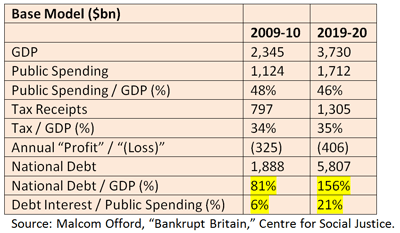
    The UK’s comfort with personal debt has now extended to the public realm. Even before the recession, Britain had $1.2 trillion of public debt, and by next year it will rise to $1.8 trillion, or 81 percent of GDP. If debt payment were a government agency, it would be the fourth largest in Britain. According to the London-based think tank the Centre for Social Justice, 21 percent of total public spending will be devoted to debt service in 2020, compared to 6 percent today. Public debt in the US, by comparison, will reach 60 percent of GDP by next year, and interest on the debt will rise from 4.6 percent to nearly 14 percent ten years from now. Labour’s legacy will be the Mount Everest of indebtedness it has left the current and subsequent generation.

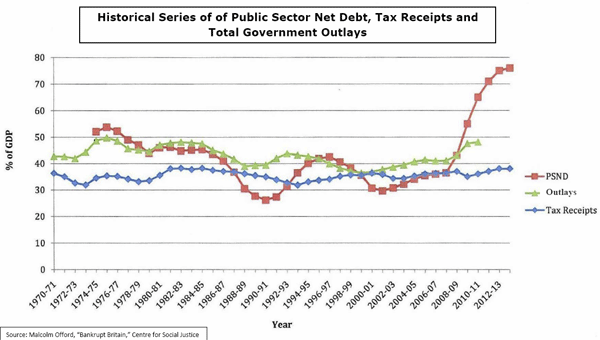
    To put this in perspective, we need look no further than historic trends over the past 30 years. Public debt has tracked fairly proportionately with public spending in the UK during this period. During the economic stagnation of the late 1970s, public debt rose to nearly 50 percent of GDP. It hit its nadir at around 25 percent in 1990 after the Thatcher era, and then rose to around 35 percent, where it has remained ever since – until last year. Suddenly, debt has skyrocketed to more than 75 percent of GDP in the past year – an unprecedented level – and will rise to 100 percent by 2012 before swelling to 150 percent by 2020. In order to reduce debt to its 45 percent level of just a few years ago, public spending would need to be cut by a third. Given that one-fifth of all public spending will go to debt service in 10 years, cutting spending will prove politically impossible for a government – and perhaps an entire nation – that identifies ever expanding government-funded services as essential.

    Even more disquieting, tax receipts have mainly hovered around 35 percent of GDP regardless of the tax rate during the past 30 years. This means that raising tax rates – such as Labour’s proposal to lift the top tax bracket to 50 percent– have little effect as high earners move away or find other ways to protect their assets. Logically, if it hopes to cope with its debt obligations, Britain should therefore keep taxes as low as possible and cut public spending. But instead the UK drives full-speed ahead into the fog of debt without having any notion of how to service its future obligations.

    The UK is therefore faced with a thorny dilemma: on the one hand, it has spent decades creating a social welfare system that reduces risk and promises citizens protection from life’s vagaries, and on the other, it needs people to take risks in order to revitalize the economy. Government spending fostered risk avoidance precisely when Britain most needs an entrepreneurial class that can help diversify the economy away from finance and, to a lesser extent, tourism.

    The people most hurt by social welfare are young working class people – the very group Labour purports to represent. In the UK there’s much talk about the NEETs – young people in their late teens who are Not in Employment, Education, or Training. In 2000 there were 630,000 young people between the ages of 16 and 19 in this group. Today, that number totals 860,000, a 36 percent increase in less than a decade. This would be the equivalent of 4.5 million young people in the United States. If NEETs were a city, they would be the third largest metropolitan area in the UK.

    Increasing numbers of able-bodied young people dropping out of society altogether reflects a growing sense of hopelessness. According to the Gallup World Poll, only 20 percent of 25-34 year olds, and 25 percent of 35-49 year olds, thought the economic conditions in the UK were good before the current economic crisis. The UK’s NEET problem and economic pessimism were rampant when the going was good – something that can only be worse now.

    This is not merely the result of a profligate welfare state. The NEET problem has its origins in complex cultural phenomena. However, it is difficult to argue with the conclusion that an increasing economic resignation among Britain’s younger population is ill-timed for a government betting on future workers to pay the public mortgage.

    The US has a more diversified economy than the UK and likely suffers from less economic resignation, but it is beset with a similar dilemma. Despite historically unprecedented levels of public debt, albeit less extreme than Britain’s, the Obama administration appears to be pursuing an economic program that bears similarities to the Labour preoccupation with creating prophylactics against risk and hardship. In a matter of months, the US deficit has risen from 3.2 to 13.1 percent of GDP, according to the Congressional Budget Office.

    Even with President Obama’s widely doubted promises to cut the deficit in half, the CBO estimates a yearly shortfall of more than $1 trillion ten years from now. Even worse, there is precious little in the administration’s plans – including its grandiose claims about “green jobs” – that will create the growth necessary to carry such debt in the future. In fact many of the administration’s proposals – from its healthcare program to its auto company ownership and a more heavily regulated financial sector – could serve more to curb growth than encourage it. In addition, increased taxes on “the rich” will hit small businesses most grievously, the most plausible engine for growth.

    It appears the administration seems intent on following Labour’s folly of mortgaging the future. Without addressing the issue of how to unleash the entrepreneurial energies of the young generation, it’s hard to see how America will avoid falling into the morass in which its British cousins are now so perilously trapped.

    Ryan Streeter is Senior Fellow at the London-based Legatum Institute.

  • Lessons from the Left: When Radicals Rule – For Thirty Years

    Contrary to popular notions held even here in southern California, Santa Monica was never really a beach town or bedroom community. It was a blue-collar industrial town, home to the famed Douglas Aircraft from before World War II until the 1970s.

    When I first lived there in the early ’70s, the city was pretty dilapidated, decaying and declining (except for the attractive neighborhoods of large expensive homes in the city’s northern sections). I remember a lot of retirees, students, and like me and my wife, renters of small apartments in old buildings. The tiredness of the place was incongruous with its great location and weather. But then the first of several spectacular rises in real estate values took off. Rents started rising precipitously as well, and in a city where 80% of residents were renters, a political earthquake shook the establishment: in 1979 voters passed rent control and soon after that elected a slate of politicians backed by the SMRR – Santa Monicans for Renter Rights – to a majority on the city council. It has now been 30 years that the city of Santa Monica has been dominated by the politics and politicians of SMRR. What have they wrought?

    There have been some momentous battles. Property owners, denied the full use and fair value of their property, came to calling the place “the People’s Republic of Santa Monica.” As economists would predict, rent control resulted in the loss of rental units (and therefore the number of renters), slowed construction of new units, led to the deterioration of existing units as landlords deferred maintenance, decreased the city’s diversity, and increased its exclusivity. These were all opposite effects the original intentions of the new radical rulers.

    But rent control was not the only “social justice” concern on the SMRR agenda; “homeless friendly” policies led to an explosion of homeless people in the city, which comedian Harry Shearer reminds the nation every week on his NPR radio show is “The Home of the Homeless.”

    Other battles fought over the years have involved traffic issues, a living wage ordinance, preferential parking zones, McMansions, development and redevelopment, planning, zoning, schools, affordable housing requirements, and the height of fences and hedges – a thousand things big and small one would expect in a city of 85,000 residents and an annual budget of over $500 million. At some point in the 1980s, the SMRR-dominated City Council, once anti-development, realized that development could generate millions of dollars for city government necessary for funding its political agenda. Massive rezoning and redevelopment were approved.

    One might think that inconsistent policies often causing opposite effect of their intentions would have weakened the left. But two large factors have come into play over time. First, SMRR does not rule without consent and consensus – many, perhaps more than half, of home owners have supported the progressive politics and policies of the SMRR-controlled city council. Secondly, despite the concerns of some property owners and economists, Santa Monica has prospered. Despite powerful regulation, hotels, arts, jobs, and restaurants continue to flow into the city. Opponents on both sides concede most of the population is content and satisfied with the status quo.

    This has been accomplished with pragmatism and a willingness to change policies that were not working. The worst effects of rent control are in the past due to a state law that allowed vacancy decontrol. Same with homelessness: residents wanted to be “progressive” but realized that being kind to the homeless only increased their numbers. The city still overdoes it on permits, regulations, etc., but homeowners and business want to be “progressive,” so they go along with it (and they like regulation when it benefits their interests).

    The city decided to make itself a tourist destination, and it is, but when it looked like nothing but hotels would be built, voters passed a proposition to halt hotel development. On the other hand, last November voters defeated Prop T, which would have limited most commercial development in the city to 75,000 square feet a year for the next 15 years.

    Santa Monica Place, a huge indoor shopping mall, outlived its usefulness, so now it’s being rebuilt as an outdoor mixed-use development. A living wage law was passed by the City Council, and then repealed by voters.

    SMRR is a political machine that has dominated the city for 30 years, using money, favors, jobs for the connected (and bupkis for those not) to build voting blocs for power and control. It inserts its people onto all the boards and commissions with input into policymaking. Their power ultimately comes from persuading renters, who are still a big majority of the city’s inhabitants, that they need SMRR for protection from “greedy landlords.”

    So SMRR dominates political life in the city of Santa Monica, but it does so with the consent of many homeowners, property and business owners, as well as renters. Santa Monica is green, PC, insufferably “tolerant,” self-satisfied, etc., but still doing well for itself. Taxes, rules, regulations and restrictions are onerous, but people and businesses still want to be there.

    I have lived through and observed the political battles of the last 30 years as a renter, homeowner and briefly as a landlord (never again, thanks). The transformation of Santa Monica reflects an interesting story: left-leaning activists who realize they can bend the establishment by controlling it from the inside. They then become the new establishment, but like in today’s left-leaning academia, work to make sure they themselves are never similarly deposed. And yes, I wonder if it holds lessons for the nation, with President Obama and the Democrats now in control and looking to implement a left-leaning agenda.

    What might those lessons be? One, particularly difficult for conservatives to accept, is that the time-tested machinations of leftist political machines sometimes work. They work for the powerful and the connected (who get to have their cake and eat it too: financial reward with a patina of progressivism), and they are perceived to work for the powerless and unconnected (however deleterious in reality). And that the left can come to power and rule with the consent of the governed, if it doesn’t “push the envelope” beyond a certain point, changes course when warranted, rewards cronies and allies, co-opts opponents where possible (and freezes them out where not). It worked for Tammany Hall, it has worked for Mayor Daley, and it seems to be working for Obama. Saul Alinsky would be proud of his protégé.

    Perhaps at the heart of its success is that like all successful political machines, SMRR “fixes potholes.” Frank Gruber, who writes a weekly column about life and politics in Santa Monica for The Lookout News, calls this “squeaky wheel government.” SMRR council members try to turn every complaining resident – and there are many – into happy SMRR voters. Whatever the aims of SMRR, they have created a popular government.

    Gruber, who considers himself an “old leftie” of the “jobs, housing, education, environment” school, takes SMRR to task for putting the needs of comfortable voters (traffic, for instance) ahead of the needs of the larger community (such as jobs for minority youth). (A collection of Gruber’s columns has recently been published in a book called, fittingly, Urban Worrier: Making Politics Personal.)

    In the 2008 elections, in which Santa Monicans voted overwhelmingly for Barack Obama, all four incumbents of the City Council won easily. SMRR seems as entrenched as always. In at least this paradisiacal portion of Southern California, left-wing government appears to be working – even if sometimes at odds with its own old radical objectives.

    Dr. Roger Selbert is a trend analyst, researcher, writer and speaker. Growth Strategies is his newsletter on economic, social and demographic trends; IntegratedRetailing.com is his web site on retail trends. Roger is US economic analyst for the Institute for Business Cycle Analysis and its US Consumer Demand Index, a monthly survey of American households’ buying intentions.
  • Downtown Character and Street Performers

    By Richard Reep

    Carmen Ruest, Director of Cirque de Soleil, recently revealed her start as a street performer, or busker, in Canada. The interviewer did not hesitate to contrast this with the current state of Downtown Orlando, which forbids street performers. Eliminating this ban will improve Orlando’s urban consciousness, both downtown and elsewhere, and improve the city in general.

    The Downtown Development Board (an arm of city government) has long stated its mission to promote arts-based businesses downtown. In the nineties, this board even had special incentives for independent creative enterprises to encourage a local arts scene. Only later did the city give in to the temptation to go for the big box retailers, and all bets were suddenly off.

    Meanwhile, street performers continue to provide local color that graces cities of Europe, Canada, and elsewhere in the United States. Often, tales of tourists include encounters with creative street performers that make the trip; willingly parting with some money for a brief but engaging performance can be a bit of spice in an otherwise overstimulating experience. Such spontaneity is not allowed in Orlando, which ranks among the world’s top tourist destinations.

    The street performer connects with the pedestrian in a unique way: not in the safety of the theater, not in a venue where tickets are taken, and not at a scheduled time. Instead, the performer seeks the audience, and gives the performance first, then hopes for compensation. This puts the onus on the performer to be compelling, original, and brief. In short, the performer has got to have soul. There is no better training ground for future actors and entertainers than the street.

    Meanwhile, Orlando’s downtown arts scene is slowly gentrifying, with a variety of galleries and even artist’s studios. On the third Thursday every month, artists and art lovers from Avalon tour galleries up Pine Street, along Orange Avenue to the City Arts Factory, and some are even brave enough to filter up Magnolia Street to Redefine Gallery.

    However, for anyone who has visited other downtowns, this can be a rather antiseptic experience. If Orlando is serious about Downtown as a tourist venue, perhaps the city should focus a little more on the quality of the experience.

    Right now, spontaneity is missing from Downtown Orlando. The notion of public space is founded on the ability of citizens to express themselves within this space, and by encouraging positive forms of self-expression. If Orlando follows this venerable tradition downtown, the city might be surprised to find the benefits may far outweigh any disadvantages.

    Certainly with the city’s budget cuts, the Police Department has more important places to prioritize cops’ time rather than busting illegal street performance. By legalizing this activity, the shrinking resources of law enforcement can be spent elsewhere, thus improving the general safety and security of the city.

    To encourage the art scene, Downtown has instituted Third Thursdays, an art walk that mimics the ones popularized in the nineties in Scottsdale, Arizona and elsewhere. To experiment with street performers, the pathway taken by the Third Thursdays crowd would be an excellent place to start. If the city were to license street performers and monitor the activity along Pine Street and Orange Avenue, it could be a testing ground for this idea. Given the crowd’s affinity for art, street performers could become another attraction in itself. After all, the walk between galleries includes a lot of blank sidewalk time.

    For Downtown Orlando, it is time to fight fire with fire. Disney is successful because it recreates that lost-in-time feeling of walking in an urban environment and encountering balloon artists, saxophonists, mimes, and other characters. But at Disney and other theme parks this is all carefully choreographed and timed. If the downtown folks were to provide a spontaneous alternative, the city would have a new parking problem as people come to experience this. This proposal is not as ambitious as all that; it is simply to try it for the art walk. That’s once a month on three or four blocks. The city might even collect a license fee, and then let them do their thing.

    For lovers of performance art, the City of Orlando has proposed a new Performing Arts venue to be financed by bond money. However, the City’s Performing Arts Center boosters cannot find anyone else interested in funding this huge trophy. There may be some karmatic justice in the relationship between the City’s distaste for street performers and the City’s evaporating dream of a Performing Arts Center. By allowing and regulating street performers, the City might find itself with a newfound interest in performing arts in general.

    The urban consciousness of the city can be measured in many ways, and one way to measure it is how the citizens of the city use its public spaces. Orlando, with its torpid downtown, has little to lose by experimenting with street entertainment. Perhaps this will help the soul of the city come back to life, and create what has always been missing – an authentic sense of place for the region.

    Richard Reep is an Architect and artist living in Winter Park, Florida. His practice has centered around hospitality-driven mixed use, and has contributed in various capacities to urban mixed-use projects, both nationally and internationally, for the last 25 years.

  • Shrinking the Rust Belt

    An article in the London Daily Telegraph suggesting that President Obama might back a major program of bulldozing parts of cities in the Rust Belt has put so-called “shrinking cities” back in the spotlight. Many cities around the country, especially in the Rust Belt have experienced major population loss in their urban cores which has sometimes spilled into their entire metro area. They have thousands of abandoned homes, decayed infrastructure, environmental challenges, and no growth to justify a belief that many districts will ever be repopulated.

    Cities in the Rust Belt grew in an era when large scale manufacturing required large amounts of labor. Today, productivity improvements mean that the United States can set new industrial production records with a fraction of the workforce of yesteryear. With much of its traditional labor force no longer as in demand in the modern economy, many Rust Belt cities lack an economic raison d’etre. Some may transform themselves for the modern economy, but many will be forced to accept the reality of a significantly diminished stature in the 21st century.

    In this world, size can prove a liability. One of the biggest problems in turning around Detroit is the sheer size of the region. The metro area has a population of 4.5 million – not including nearby Ann Arbor or Windsor, Canada. Is there really any need in the modern day for a city the size of Detroit in Southeastern Michigan? It seems doubtful. As I’ve argued before, transforming that city’s economy would be much easier if the region were smaller.

    One challenge is that a decline in population, which is already occurring naturally, doesn’t shrink the area of urbanization or the accompanying infrastructure that needs to be maintained. Indeed, although it is losing population and can’t support the infrastructure it has, Detroit still wants to build more, such a new regional rail transit system. And legacy debts such as pension liabilities don’t get smaller just because people leave. As with leverage, scale economics works in declining places as well as on the growing ones. The people who operate new transit systems or police who secure expanded areas must be paid. Roads, sewers, and water lines need to be maintained. In many places that are losing people, jobs, and tax base, such fixed costs could prove ruinous over the long run.

    Under such conditions, Rust Belt cities require both outside help and a program of managed shrinkage. The first challenge will be getting these cities, especially larger ones like Detroit, to admit that they need to do it on a regional basis. Medium sized cities like Flint and Youngstown have been more willing to face up to challenges. In contrast, places like Detroit, Cleveland, and Buffalo still see themselves as important national cities. Pride is blocking the effort to undertake a major managed shrinkage program. Instead of adjusting to reality, these cities continue to pour hundreds of millions into projects that vainly attempt to restart growth. .

    What would a federally assisted managed shrinkage program look like? No one can say for sure since this is a new field in America. Clearly, study of what has happened in Europe, particularly in Germany, where managed shrinkage has long been on the agenda, is warranted. But these ideas can’t just be transplanted via lift and drop. We need to create a distinctly American program informed by the best practices of elsewhere. That program should include the following elements:

    1. Education. Raising educational attainment not only makes people more employable in the new economy, it makes them more mobile.
    2. Relocation Assistance. Many people in the Rust Belt might want to move but be unable to do so because they are upside down on a mortgage or can’t sell their house. As more people leave, that will put downward pressure on the housing market. Hence, some government relocation assistance to help buy out people who want to move might be helpful.
    3. Shrinking the Urban Footprint. The quantity of urbanized land needs to be reduced so that the excess housing and infrastructure can be retired and the cost of servicing it eliminated. This means painfully identifying areas which will not receive reinvestment, and encouraging and assisting the people and businesses that remain to relocate. This will be difficult as these neighborhoods are still the locales for people’s homes and they have a strong emotional sense of ownership. Sensitivity is clearly called for. We need to increase localized density in areas targeted for redevelopment and convert other areas to non-urbanized uses such as nature preserves or agriculture. This will be a long process.
    4. Financial Restructuring. Older cities are often hobbled by mountains of debt, underfunded pensions, overstaffed payrolls, and too many municipal fixed assets. The government needs to be right-sized. Federal assistance may be needed to take over pensions and to give cities some tools to restructure unsustainable debt loads outside of bankruptcy.
    5. Development Restrictions. In return for federal assistance, there ought to be a real insistence that these cities sign up to the shrinkage programs. This might include enforceable restrictions on their ability to adopt policies that are oriented towards servicing growth such as restrictions on the ability to use federal funding for net new infrastructure. For example, if Detroit wants to build a federally funded rail system, it should retire an equivalent amount of other infrastructure elsewhere to offset it.

    Participation would be voluntary, but the federal government should make it clear that it will not finance futile attempts by these cities to try to recapture the glory of their pasts.

    This is of course only a conceptual outline of a program. Significant thought, analysis, and research would be needed to develop a program. Given our lack of experience in the field, experiments should be encouraged, flexibility granted within broad parameters, and real world feedback continuously incorporated back into the program. Clearly, we will not get everything right the first time around. We need to have the courage to learn from our mistakes and not forge headlong into failure simply because it would look like a political retreat.

    This won’t be pleasant or easy. It is not a path anyone wants to take. But given the condition of much of the Rust Belt, the only viable options appear to be painful ones. As local blogger Tom Jones recently said, “Too often, dealing with urban problems in Memphis is like the stages of grief. Just this once, maybe we can move past denial, anger, bargaining and depression, and unabashedly move to acceptance and develop the kinds of bold plans that can truly make a difference in the trajectory of our city.”

    Aaron M. Renn is an independent writer on urban affairs based in the Midwest. His writings appear at The Urbanophile.