Blog

  • NGVideo: Reviving Plotlands

    Everybody knows we urgently need to build more homes in Britain, but how, when and where will this happen? WORLDbytes interviewed Ian Abley, an architect and manager of Audacity at the plotlands in Dunton, Essex where from the 1920s East End working class couples built cheap homes themselves. Could we do this now? Ian Abley argues we should collectively break the Town & Country Planning law of 1947 which made buying and building on redundant farmland, like the plotlands, illegal.

    More information and related resources are available here.

    This video and its description are derived from original content by WORLDbytes.org with the express permission of their authors. To see the original full-length video, visit this page.

  • Bad Times Getting Worse for Older Americans

    Olivia S. Mitchell, of the Wharton School at the University of Pennsylvania, told ABC News that “roughly $2 trillion has been lost in 401(k)s and pension plans during the recession.” (According to The Economist, worldwide private pension funds lost $5.4 trillion last year. I wonder if/when the media will start calling it a depression?)

    As stock values go down, the value of the company pension plan investments fall with it. In good times, companies can put cash into the plans to make up the short fall. But with all the financial turmoil around us now, companies don’t have the cash and are unable to borrow it. Some companies are capping payouts and some are offering lump-sum payouts instead of, or in combination with, monthly payments. Other companies are abandoning traditional pensions – where the payouts are defined in advance of retirement – for 401(k) plans – where the contributions are defined instead and the payouts are left uncertain. That puts the risk of bad investments and market collapses on the backs of the workers instead of the companies.

    For employees who are in traditional pension plans, the Pension Benefit Guaranty Corporation (PBGC) was created in 1974 to insure pensions. If your employer goes bankrupt, your pension could still be OK if the plan pays insurance premiums to PBGC. However, the coverage is limited to $54,000 a year for workers who retire at age 65, less if you retire early. The PBGC’s investment assets went down 12 percent between September 2007 to September 2008 (latest financial statements available). That’s on top of a large (albeit falling) deficit of $11 billion (their liabilities are greater than their assets). This is the company that is supposed to protect your pension if your company goes into bankruptcy. Technically, they can’t meet today’s obligations…

    If your employer is in financial trouble and you are expecting to earn more than the pension insurance will cover you may need to think about working during retirement to make up the difference. According to an article published by Wharton in 2007, the Senior Citizens Freedom to Work Act “repealed the Social Security earnings limit, allowing workers 65 through 69 to earn income without losing Social Security benefits.” Good thing, too. Looks like they’ll need to keep working to make it through the depression.

  • Exurban Growth Greater than Central Growth: Census Bureau

    The US Bureau of the Census has just released an analysis of suburbanization showing that the nation continues to suburbanize, despite the consistent media “spin” that people are leaving the suburbs to move to core cities.

    The report, Population Change in Central and Outlying Counties of Metropolitan Statistical Areas: 2000 to 2007, goes further than our previous 2000 to 2008 analysis that showed strong domestic outmigration from central counties to suburban counties and beyond.

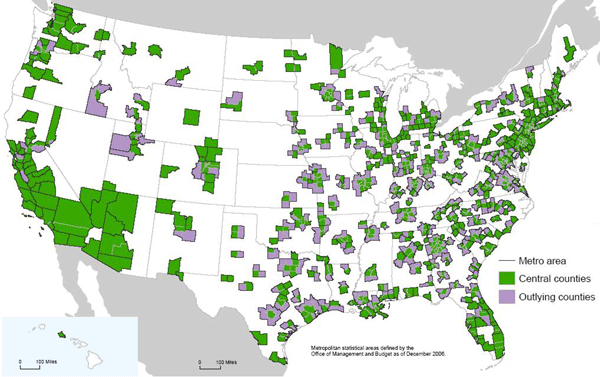
    Our report compared trends between the core county (such as the 5 county New York City core) of each major metropolitan area. The new report compares population trends between what it terms “central counties” and outlying counties. The Bureau of the Census considers any county in the metropolitan area that is generally beyond the urban area (urban footprint) to be outlying. Thus, in Chicago, the report considers not only the core county of Cook, but also 9 additional counties as around it as central (Figure 1). Not surprisingly this means the bulk of the metropolitan area population is in the central counties (92%), however there is rapid movement even further out to the outlying counties.

    This Bureau of the Census report tells us more about exurbanization than suburbanization. Exurbanization might be thought of growth that occurs outside the urban area, including its historic suburban periphery. It represents, if you will, “sprawl beyond sprawl”. You usually can tell when you are in an exurb because you have to drive through countryside to get to the “city” (For definition of urban terms, such as metropolitan area, urban area and city, see this document).

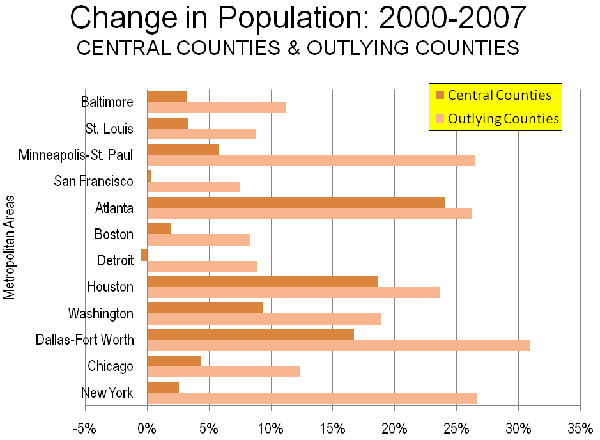
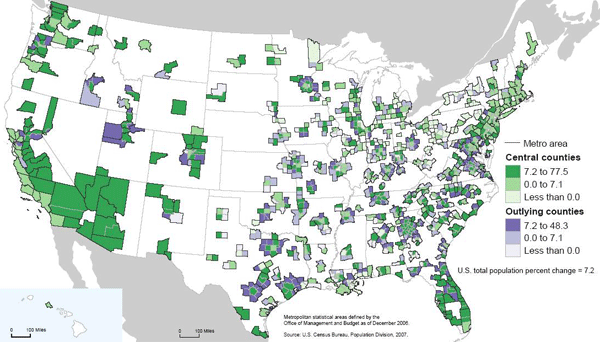
    Between 2000 and 2007, these outlying counties grew 13.1 percent, nearly double that of the central counties, which includes the suburbs, at 7.8 percent (Figure 2). The report goes on to compare detailed results for the 12 metropolitan areas with more than 2,500,000 population that have outlying counties. In every case, the outlying counties grew faster than the central counties. On average, the outlying counties grew at 2.3 times the rate of the central counties (Figure 3).

    • In San Francisco, the outlying county growth was 25 times that of the central counties.
    • In New York, the outlying county growth was 10 times that of the central counties.
    • In Boston and Minneapolis-St. Paul, the outlying country growth was between four and five times the growth in the central counties.
    • In Baltimore, the outlying county growth was 3.5 times the growth in the central counties.
    • In St. Louis, Washington (DC) and Chicago, the country growth was between two and three times the growth in the central counties.

    The strongest central county performance occurred not in the much ballyhooed “cool” dense urban areas of the Northeast or Pacific Coast but in the largest metropolitan areas of the south, Atlanta, Houston and Dallas-Fort Worth.

    • In Dallas-Fort Worth the outlying county growth was 1.9 times the growth in the central counties.
    • In Houston the outlying county growth was 1.3 times the growth in the central counties.
    • In Atlanta, the outlying county growth was 1.1 times the growth in the central counties.

    The worst central county performance occurred in Detroit, where there was a net population loss. The outlying counties grew nearly 9 percent.

    It may seem surprising that the Bureau of the Census analyzed only 12 metropolitan areas. Regrettably, Census metropolitan area definitions makes a broader analysis virtually impossible. Many metropolitan areas do not have outlying counties. That does not mean they do not have outlying or exurban areas. Riverside-San Bernardino is a good example. At the eastern end of this metropolitan area, a recluse might live less than 40 miles from the Las Vegas strip, yet be separated by 175 miles of desert and mountains from the edge of the Riverside-San Bernardino metropolitan area. The problem is that most metropolitan areas are defined by counties, and some counties contain much more area than can reasonably be considered as part of the labor market.

    This fixation with county boundaries is unnecessary. Decades ago Statistics Canada figured out how to define metropolitan areas below the county level. The Bureau of the Census approach tends to obscure the growth of outlying areas, particularly in the largest counties. This is illustrated by our analysis of the Riverside-San Bernardino area from 2000 to 2006, which showed outlying areas to be growing at 2.5 times the rate of the core urban area.

    Nonetheless, the conclusion of the new report is clear. The nation’s most remote suburbs – its exurbs – are growing much faster than the central counties. Whether this trend will now reverse, of course, is up to debate. Perhaps demographic changes and higher energy costs will slow expansion on the outer fringes. More likely, the current recession may well lead to less exurban growth, but history suggests this may prove only a short-lived trend.

    Wendell Cox is a Visiting Professor, Conservatoire National des Arts et Metiers, Paris. He was born in Los Angeles and was appointed to three terms on the Los Angeles County Transportation Commission by Mayor Tom Bradley. He is the author of “War on the Dream: How Anti-Sprawl Policy Threatens the Quality of Life.

  • Why The Left Is Questioning Its Hero

    Much has been made by the national media and the markets about the emergence from our desiccated economic soil of what President Obama has called “green shoots.” But although the economy may already be slowly regenerating (largely due to its natural resiliency), we need to question whether these fledglings will grow into healthy plants or a crop of crabgrass.

    The political right has made many negative assessments of the president’s approach, decrying the administration’s huge jump in deficit spending and penchant for ever more expansive regulatory control of the economy. Polling data by both The New York Times and the Wall Street Journal shows some growing unease about both the expanding federal role in the economy and the growing mountain of debt.

    But this conservative critique, which includes sometimes shrill accusations of nascent “socialism,” isn’t the most important counter to Obamanomics. Perhaps more on point – and politically risky for the administration – are criticisms coming from his supposed bedfellows further to the left.

    One recent example comes from a new report issued by my old colleagues at the liberal-leaning New America Foundation called “Not Out of the Woods: A Report on the Jobless Recovery Underway.” It amounts to a blistering, if largely unintentional, critique of the administration’s policies, providing a sobering antidote to manufactured euphoria peddled by both presidential spin-meisters and some Wall Streeters.

    The report baldly asserts that the president’s programs are simply not sufficient to make up for a “huge job creation deficit” that is getting worse by the day. It estimates the country needs to generate 125,000 or more new jobs a month just to keep pace with population growth – something few see happening for at least several years.

    Even with little immediate hope for such employment gains, the report does cite government and private-sector projections of upward of 10% unemployment well into next year. More worrisome still, the authors assert that the administration’s current program is unlikely to create a return to a “normal” level of joblessness – to between 4% and 5% – until after the president’s first term.

    The New America report then goes on to make some even scarier observations. It claims unemployment rates are far higher in reality than official statistics reveal, citing calculations by Chairman of New America’s Economic Growth Program Leo Hindery of what they call “effective unemployment.” This also includes the millions now working part-time but seeking “full-time and productive work.”

    Hindery is no conservative. He was an adviser to John Edwards and, more recently, to the president himself. Yet his prognosis is grimmer than the ones offered by most right-wingers. He calculates that the real unemployment rate in the country last month was not 9.3%, which is the figure that was reported, but rather closer to an alarming 16.8%. By that measure, more than 30 million people are effectively out of work. That’s nearly one-fifth of the labor force.

    Given current economic policies, the report suggests, we can expect “a six-year recovery for what has been to date only a year-and-a-half recession.” Hiring by government and green industries are clearly not going to make up for the massive losses in productive sectors like manufacturing, business services, energy and agriculture.

    Against this grim background, the president’s program seems inadequate and even chimerical. To be sure, the massive bailout of institutions such as the big banks – as well as Chrysler and General Motors – has provided some reassurance to Wall Street that paper assets may continue their recent upward climb.

    Yet that will do precious little to make a dent in unemployment elsewhere in the economy. Treasury Secretary Timothy Geithner, chief economic guru Larry Summers and others might see “green shoots” for investors, but those could turn out to be more like crabgrass for the rest of us.

    In fact, finance is surviving the recession remarkably unscathed. Just compare the numbers. Since 2007, manufacturing (and other blue-collar-dominated sectors) lost 13% of its employment, while construction payrolls have plunged over 16%. Meanwhile, finance, the industry arguably most responsible for the economic meltdown, has dropped a mere 5% of its jobs. Today unemployment in the financial sector stands at less than 5%, compared with nearly 20% in construction and over 12% for manufacturing.

    So as hundreds of thousands of construction and factory workers are being sacrificed, many grandees of finance – like top executives of Bank of America and Citigroup – remain in their plush perches. Even proven financial demolition experts like Mark Walsh, who led Lehman Brothers’ disastrous march into toxic properties, are now being paid to clean up the mess they so brilliantly created.

    No wonder some factions of the left are becoming uneasy with their hero. Some privately admit that the administration – despite its pro-middle class rhetoric – has adopted an economic program that makes Ronald Reagan seem like the vox populi. One wonders how they will react later this year, when continued high unemployment meets massive, perhaps even record, Wall Street bonuses.

    This state of affairs, as the New America report correctly suggests, does not lead us down a path toward “a strong and sustained recovery.” Clearly, we need something more. For one thing, the country needs to reassert its ability to produce more of what it consumes. (See Joel Kotkin’s earlier column, “We Must Remember Manufacturing.”)

    Others on the left are also making this point, perhaps none more effectively than an article in the Nation called “The Case for Kenosha.” The piece, in short, skewers the Obama administration’s manhandling the auto industry and manufacturing sectors. It accuses Obama of taking the old industrial belt on a “wild ride” that will lead to more plant shutdowns and increased outsourcing to foreign factories. “With ‘fixes’ like these,” the article states, “it’s hard to imagine how Obama plans to fulfill his campaign promise to ‘revive and strengthen all of American manufacturing.’”

    This is not to say that the entire left side of the political spectrum opposes the administration’s economic policy. There is now more than one left in this country, and the gaps between these lefts are every bit as wide as those between, say, small-government libertarians, social conservatives and messianic global interventionists.

    To date, the administration has listed toward the agenda of what may be best described as the left’s gentry wing. These include activists at universities, urban planners and liberal nonprofits, many of whom see in Obama’s pro-green policies and multicultural agenda the fulfillment of their long-time fantasies.

    This, at times, puts them at odds with large parts of the middle- and working-class base of the Democratic Party. The administration’s plans to”coerce” people out of their cars for the alleged good of the environment probably does not offer much “hope” for those working at auto plants. Highly dependent as they are on stocks and asset inflation for their income, the gentry are not likely to object to the administration’s coddling of large financial institutions.

    Then there is the party’s populist contingent, whose inspiration comes more from FDR and Harry Truman than from the likes of Barney Frank and Nancy Pelosi. They are less likely to see much of a difference between a Timothy Geithner or a Hank Paulson. To them, the two Treasury secretaries have both been useful servants for the nation’s “economic royalists.”

    Of course, most conservatives might despair over the populists’ tendency to embrace statist solutions to our economic problems. But would-be inheritors of the Reaganite mantle should at least sympathize with their goal to restore broad-based upward mobility and close-to-full employment. Indeed, if the Republican Party figures out how to take command of the issues like job creation and social mobility, they could even become relevant once again.

    Right now, though, critiques from the left may be more effective than yammering from the still-clueless right. The president knows that talk of green shoots makes people and markets feel better. But unless those shoots show some staying power, the long-term economic consequences – and ultimately political ones, too, for the president and his party – could prove unwelcome indeed.

    This article originally appeared at Forbes.

    Joel Kotkin is executive editor of NewGeography.com and is a presidential fellow in urban futures at Chapman University. He is author of The City: A Global History. His next book, The Next Hundred Million: America in 2050, will be published by Penguin early next year.
  • Smart Growth Bill Vetoed

    Texas Governor Rick Perry has vetoed a bill that would have created a state level “smart growth” program. The veto message is below.

    June 19, 2009

    Pursuant to Article IV, Section 14, of the Texas Constitution, I, Rick Perry, Governor of Texas, do hereby disapprove of and veto Senate Bill No. 2169 of the 81st Texas Legislature, Regular Session, due to the following objections:

    Senate Bill No. 2169 would create a new governmental body that would centralize the decision-making process in Austin for the planning of communities through an interagency work group on “smart growth” policy. Decisions about the growth of communities should be made by local governments closest to the people living and working in these areas. Local governments can already adopt “smart growth” policies based on the desires of the community without a state-led effort that endorses such planning. This legislation would promote a one-size-fits-all approach to land use and planning that would not work across a state as large and diverse as Texas.

    IN TESTIMONY WHEREOF, I have signed my name officially and caused the Seal of the State to be affixed hereto at Austin, this the 19th day of June, 2009.

    RICK PERRY
    Governor of Texas

    Reference: http://governor.state.tx.us/news/veto/12632/

  • How Phoenix Will Come Back

    I have heard Paul Krugman say that ‘the end is nigh’ so many times that it seemed like the only sensible way to think about the housing market. It was identified as a bubble, and that could only mean that it would eventually burst. A steady diet of NYT editorials and Economist charts leave you with one conclusion — this is not going to end well.

    This certainly seems to be true in Phoenix. Even though I’ve lectured for years about ‘the growth machine’, how the economy in a city like Phoenix depends on building more homes, I did not expect the whole thing to collapse quite so precipitately, and with so many repercussions. The number of passengers going through the airport here is down 10% from last year; numerous restaurants, stores and other services have gone out of business, the State is trying to stare down a $3 billion deficit, the universities have fired hundreds of people—so the cycle keeps spreading like a slow motion disaster.

    Also predictable is the response. Local politicians are planning to slash the State budget and get government off people’s backs, once and for all. If we used foreign phrases such as ‘chutzpah’ around here, that would have to qualify. After all, it takes balls to watch the market behave like a bunch of drunks kicking Humpty Dumpty about, and then blame government for trying to put him back together again.

    Yet, at least here in Phoenix, it turns out that Professor Krugman hadn’t really got it figured out after all. As a rational man, he was distracted by the irrational exuberance of the market, the unsupportable ramping up of property prices, the NINJA loans, and the cynical exploitation of those arriving late to the party, those doomed to buy at the top of the market and be left holding fake mortgages on homes with phony values. The solutions seem simple. More oversight from Big Brother and everything can be fixed. Or, if you prefer to listen to the bizarro-world script over on AM radio, the black helicopters are about to start landing on Wall Street as the UN takes over to install European-style socialism.

    Yet much of this commentary is laughably wrong. The housing market debacle was not just predictable but actually utterly unavoidable. Some of this is simply a matter of money circulating around, which as Niall Ferguson’s book The Ascent of Money makes clear, this is as old as capitalism itself. The difference now is that digital technologies have made the speed of trading and transfer shift. The same rules apply, except that everyone must work harder to keep that cash flowing.

    What I now realize is that the entire economic system is based upon finding more risk. Without more risk in which to invest, the economy can’t keep moving. In other words, this wasn’t a series of calamities or errors or criminal mistakes — it is the market at work, no more, no less. And that is not going to change.

    What I thought I knew is not really so. I thought a bigger banking sector was not just more mysterious but was somehow more efficient and therefore safer; after all, health insurance works best if the risks are spread across larger and larger groups. Yet in reality finance is more like a vast Ponzi scheme. We should, in fact, let Mr. Madoff out of jail, as he was doing nothing particularly wrong — his only crime was that he wasn’t being clever enough in hiding his scheme in sufficiently obscure mathematics.

    What happens to the cities, towns and suburbs left devasted by the financial schemers? As James Surowiecki recently observed in the New Yorker, “banking grew bigger and more profitable but all we got in exchange was acres of empty houses in Phoenix.” So? Isn’t that a small price to pay? Given a choice, what would we rather have: a buoyant capital market and a few distant suburbs and downtown condos without any residents, or what we have today in some cities — double digit unemployment?

    There are real policy issues at work here. We were taught years ago, by the Marxists no less, that the purpose of a capitalist economy is to reproduce itself and the purpose of governments is to make sure that happens. So we make credit available to people; first to buy Model Ts, then to live in Levittown, then to play golf in Cancun, and so forth. And for this to work there has to be more risk in which to invest, an endless supply of new things. Housing has served us well in this regard; people live in condos and McMansions, people sell them, people build them, people manufacture the fixtures and fittings. This is how the growth machine, particularly in places like Phoenix, works.

    An economy like Phoenix is like a shark – it can’t stop, it can’t even run slow. We have to find more buyers — or perhaps we just build the homes now and fill them in the future when the population increases. Or, in line with a previous posting, we should have solved the immigration problem, and the need to sell more homes, by legalizing the Latino population and making them creditworthy.

    In this sense, maybe all this focus on the Valley’s 65,000 foreclosures is a mistake. As I argued last year, perhaps they should just be turned over to rentals and let the market sort it all out; predictably, rents are now coming down in apartment complexes as more families find affordable homes to rent.

    What we need is not to stop the market from repairing itself but we need to do it in a more creative way. Some of those suburbs are looking a bit down at heel, and the homes weren’t that sturdy to begin with — so let’s bulldoze them and do some serious brownfield redevelopment. Perhaps build them right, more sustainably, and less dependent on distant employment centers

    We can all get back to work, we can all feel virtuous as no new desert is being bladed, the infrastructure is already paid for, the journey to work costs will be less, the density perhaps a little higher with more jobs, offices and retail located closer to the houses.

    This approach will let us build more homes and get some more risk back into that market. Let’s repurpose the land. Then we can go back to business as usual, and if I was a betting man, that’s exactly what we are going to do.

    Andrew Kirby is the editor of the interdisciplinary Elsevier journal “Cities.”This is his 20th year as a resident of Arizona.

  • GM, Business, and The Age of Small

    At its peak, General Motors employed 350,000 people and operated 150 assembly plants. It defined “big business” for America and the world.

    But GM was not always big. It grew through the acquisitions that it made in the early decades of the twentieth century. In those days, the automotive industry was populated by entrepreneurial small businesses led by people like Ransom Olds and Henry Ford. There were more than 200 automobile companies in the United States in 1920. By 1940, only 17 had survived.

    As with all businesses, success and failure was measured by a company’s ability to manage and adapt to change. Change in consumer expectations and demographics. Demands for lower prices and more features. Underlying all of this was the need to constantly improve, to challenge core assumptions, and attend to customer needs. The early automobile companies that could not adapt were driven out of business or forced to merge. In the end, we had the “Big Three” in control of all major American automotive brands.

    And so it was, but only for a time. Our economy is dynamic. It is always changing. This is why consumer products are always adding “new and improved” to even their most popular and profitable labels, and why companies produce competing products — like laundry detergents and cereals — within their brand. Control of shelf space is vital in retail, and an expanded offering of products maintains a company’s all-important market share.

    In a free economy, “Big” has some advantages. It has more resources and reach. “Big” companies can define a market and, to a point, control entry into it. But “Big” also has many disadvantages. It is unwieldy, bureaucratic, inflexible, slow to react and unresponsive to small events. This is why in a dynamic free economy “Big” gives birth to “Small”, which forces innovation and change, and ushers in the next Big Idea.

    Apple was started in a garage to challenge the giant IBM. Microsoft was founded by a college dropout who ran with a platform (Windows) that Xerox created and discarded. Hechinger’s was the first big box hardware store. It was overtaken by The Home Depot, which pioneered a better way to service clients with an even bigger box.

    America is all about good, better, best. Google is now the dominate internet search engine. A small part of its success has been its ability to become part of the vernacular. How many of us have said, “Let me Google that?” Microsoft is not sitting back and accepting Google’s success as a given. It recently launched “Bing”, with features not available on Google. Is Bing the next newer, better search engine? The market will determine if it is, once consumers take it out for a search or two and decide whether or not they like the results.

    The American automobile industry has reached the end of “Big.” GM recently sold its Saturn brand to Roger Penske, a former auto racer turned entrepreneur. Penske will likely bring new energy and focus to a brand that was only a small cog in a giant corporation. I bet that the brand will reemerge stronger in the marketplace. A Chinese company bought Hummer. SAAB is still looking for a new home. The remaining GM brands, including Cadillac and Buick, will be part of a newer and smaller company. This is the natural economic cycle. It is what would have taken place months ago, and saved the American taxpayer billions of dollars had we simply let GM go into an orderly Chapter 11 bankruptcy.

    The problem is that our federal government is attempting to control this process in order to achieve a desired result. Yes, looking at saving GM as a short term federal jobs program is a valid argument (albeit a God-awful expensive one). But we should not let these actions, taken in the midst of a crisis, instill the belief that government control of markets is a viable alternative to free markets that respond to consumer demand.

    The natural flow of our economy is big to small to big again. We are now entering an ‘Age of Small’ throughout our economy. It is an era in which new ideas will drive innovation, and the nimble will overtake the weak. The only thing that can derail this process is the permanent entry of big government into the mix.

    Government is the antithesis of a market economy. It is unwieldy, bureaucratic, inflexible, slow to react, and unresponsive to small events and to its own consumers.

    It is Big when we are at the right moment for Small.

    Dennis M. Powell is president and CEO of Massey Powell, an issues management consulting company located in Plymouth Meeting, PA.

  • On Our Knees: Prince Charles vs. Lord Rogers

    It is no wonder that architect Richard Rogers is feeling a bit peeved at Prince Charles. This month, the heir to the British throne scuppered plans for a £1 billion development putting 552 apartments on the 12.8-acre site of the old Chelsea Barracks. Rogers was most offended that the Prince used his Royalty to by-pass the usual planning law consultation, by speaking direct to the Qatari royalty who owned the site.

    This is not the first time the heir to the throne has acted as Lord High Planner. Twenty five years ago, he threw a hissy fit about a modernist, hi-tech tower development planned on the national gallery. It was created by the firm Ahrends, Burton and Koralek – but inspired by a Rogers’ design. His sub-majesty called it a ‘monstrous carbuncle’ on the face of a much loved and elegant friend (his ancestor predecessor William IV had a lower opinion of William Wilkins late classical design – ‘a nasty pokey little hole’). He got his way, then, and a pseudo-classical outgrowth was manufactured by Robert Venturi.

    Just a month ago, Charles was asked back to the Royal Institute of British Architects, where he first made the ‘carbuncle’ attack, and even apologised, half-jokingly, promising not to set off another debate about modernist versus traditional architecture. But word had already got out that he was going to sabotage the Chelsea Barracks development.

    Charles’ has been dogged, or perhaps the word is better dogmatic, in his interest in architecture and planning. Out in Dorchester, on land owned by the Duchy of Lancaster (that’s Prince Charles, to you and me) he constructed a weird dreamscape of a village called Poundbury, wholly built according to the Prince’s own ideals, of tradition, community and high density dwellings, designed by the new urbanist Leon Krier. It is full of desperately traditional motifs, like a film set, and it is supposed to be built to dissuade car use (though according to a recent survey, resident are above average car users).

    Richard Rogers has dared break ranks with the Prince publicly over his busy bodying. Rogers makes some excellent points. The Prince is but a man, amongst many: why should he have more say so than anyone else? The Prince will not debate his views, so why should he be allowed this influence on political choices? Even moderate constitutionalists agree that the Royalty enjoys its formal position as head of state (which Charles will become, if his mother Queen Elizabeth dies) on the condition that they keep out of day-to-day politics.

    One person who put some real flesh on the bones of Rogers’ complaints has been Vicky Richardson, the editor of the architecture magazine Blueprint. When Charles stood to address the Royal Institute of British Architects, she shouted out ‘abolish the monarchy’, a cry that was perhaps a bit too plebeian for Richard Rogers.

    Rogers is the last person to be telling us that we should not fawn to established authority. Let me spell it out for you. This is no plebe; it’s Sir Richard Rogers, Baron Rogers of Riverside, a peer of the realm. In 1991, Rogers, in an act of fealty, bent down on one knee before the Queen, to be made a knight. In 1996, he was made a Baron, and sits in the unelected House of Lords (on the Labour benches). Quite why Rogers thinks he is free of the oaths he made to protect the Queen – and consequently her progeny – is not clear.

    Richard Rogers’ leaning on the Royal brand when it suits him is not the end of his fixation with authority over the common people. Though he pressed a few demotic buttons when he turned on Prince Charles, there was a weird undercurrent of superiority in his complaints. Prince Charles is not an expert he was keen to say. Charles has no expertise in architecture … unlike Richard Rogers. It was quite a snooty put down to place on a soon-to-be King.

    Rogers went further, asking whether things ought to be changed, so that the unspoken rule that the monarchy stay out of everyday politics might be shored up. Indeed, Richard Rogers called for a panel of constitutional experts to re-examine the Prince’s powers. ‘A panel of constitutional experts’? Who are these ‘experts’ that know better than the rest of us how the United Kingdom ought to be run? A committee of the House of Lords, perhaps?

    At the heart of Richard Rogers case against the monarchy is not an argument for the people against entrenched authority. Rather, it is an argument for a new elite to take over – ‘experts’ (so-called), technocrats, people like Rogers himself, who know better than the rest of us how we should live.

    In real fact, Rogers may be even more a throwback to medievalism than the Prince. Rogers’s Chelsea Barracks development has been attacked for being too ‘modern’. But the row is cast in terms of traditional versus modern, because in many ways, Rogers plans are more backward looking that Charles’s.

    One feature that lies behind the many complaints that preceded Charles’ intervention is the density of the development. Originally planned for 638 flats, the developers were persuaded to reduce the number and increase the open space from two to 6.2 acres.

    Local people resent more bodies being crammed into an already overcrowded, teeming and increasingly dehumanized London. In this process, Rogers is far more a villain than the unlikable Prince. In 1998 his government appointed Urban Task Force saddled planning authorities with the principle that most new development would take place on ‘brownfield’, that is previously built-upon land, not newer greenfield sites out in the country.

    This is almost something out of apartheid or the 19th Century enclosure acts. The policy is to keep Londoners kettled up behind the Green Belt, telling local authorities to keep filling in every patch of land that becomes available with extra housing, densifying the city. Ironically, the Prince entirely agrees with Rogers on the need for densification – but at least he prefers something more humane, like a nice cottagey feel, and some old stonework.

    The ‘urban nimbys’ who objected to the Chelsea barrack development are a new thing. In north London, residents protested against an apartment block squeezed into a space that used to be garages at Pilgrims Way. Under the regional plan, drawn up on rules laid out by Baron Rogers, local objections have no purchase, because the overriding goal is cramming: forcing ever more people in a fixed amount of space. That is why Rogers is so angry with the Prince. Rogers has the planning approval all sewn up. Because his development offers the highest density, it ticks all the right boxes as far as the planners are concerned. But for residents, looking at results of cramming on their already limited space, 500 new flats squeezed in does not look so good. They have a right to object, but the plan – blessed by the experts, knighted and not – trumps their objections.

    Rogers objects that the Prince is using his hereditary power. But what makes Rogers so cross is that he is accustomed to exercising unchecked and undemocratic power to get his own way. He cannot quite believe that there might be a greater unelected power in the land than his own.

    The fact is the so-called great are only great because we are on our knees, said the Irish rebel James Connolly. It is time the British stood up and kicked both of these unelected overlords out, whether to the manor born or entitled by their “expertise”.

    James Heartfield is author of Let’s Build! Why we need five million homes in the next ten years, and a director of www.Audacity.org.

    Image courtesy of Henry Bloomfield

  • Report on the Jobless Recovery: 18.7% Effective Unemployment Rate in May

    Is the recent talk of “green shoots” coming out of this recession realistic? A recent report from the New America Foundation outlines the strong likelihood of a jobless recession that “could perpetuate the crises in the housing and banking sectors and prevent a sustainable and healthy economic recovery.” A jobless recovery will prevent the wage growth necessary to stimulate business investment, maintain consumption, and pay down debt.

    The report outlines a constructed measure of effective employment: BLS’s measurement of unemployed, 2.2 million marginally attached workers, and 9.1 million workers employed part time only because they can’t find full time work plus another 4.4 million Americans who want to work but gave up the search over a year ago. This results in an 18.68% effective unemployment rate.

    Other highlights from the report:

    • The US economy must add 125,000 jobs per month just to keep pace with population growth.
    • Employment growth is further hindered by continued productivity gains through this recession.
    • As of Q1 2009, only 27% of employers experiencing mass layoffs anticipate rehiring some of the displaced workers.
    • The most severe unemployement and job losses are occurring in sectors comprising the productive economy, precisely the sectors that must grow to shift from the debt-financed growth of the recent past to growth driven by production and consumption made possible by rising incomes.
    • Mass unemployment is now fueling home foreclosures on prime mortgages: 5.7% of prime fixed-rate loans were overdue or in foreclosure last quarter, up from 3.2% a year earlier.

    Read the full report at New American Contract and check out the NAC’s Value Added blog.

  • How Can Cities with Unaffordable Housing be Ranked Among the Most Livable Cities in the World?

    The Economist magazine’s “Economic Intelligence Unit” (EIU) has published its most recent survey of the most livable cities in the world.

    Vancouver, Canada, ranks number one, Vienna, Austria number two, Perth, Australia number five, Geneva number 8, Zurich, number 9, (both in Switzerland) and Auckland, New Zealand, number twelve.

    The comments on the EIU web page are plentiful and outspoken, most of them from people living in the ‘top-ranked’ cities explaining why the survey has got things ‘so wrong’ – or ‘so absolutely right’. Many point out that Vancouver, like so many of the top-rated cities, has severely unaffordable housing.

    Many also have high taxes, and some, like Auckland, have low wages by world standards. For most people, high wages, low taxes and affordable housing make a major contribution to livability.

    Anyone familiar with Zurich and Geneva knows that one has to be very wealthy to live there. For most of us, such cities are quite ‘unlivable’.

    However, the EIU is probably providing its customers with the right answers (or as right as such surveys can be) because their experts are ranking these cities according to their attractiveness to expatriate executives.

    Executives posted from New York to Vancouver or Sydney are unlikely to be concerned with the cost of housing because their housing will be provided free of charge, or subsidized by accommodation allowances. These rankings are not established by interviewing a random sample of residents, but are generated by a team of experts trying to assess these cities through the eyes of transferred executives setting up homes in new countries.

    This introduces another set of biases because even expert visitors have different priorities and preferences to long-term residents.

    Visitors to cities use public transport – especially shuttles, taxis and trains – if only because they do not carry their cars in their suitcase. Again, the comments on the EIU web page demonstrate that the public transport that serves visitors well may not be so impressive to the long term residents.

    Similarly, the Mercer Consulting’s Quality of Living survey ranks Auckland fourth, equal with Vancouver. Vienna, Zurich and Geneva are their top three, with Vancouver and Auckland fourth equal. Again, the Mercer ranking is designed “to help governments and major companies place employees on international assignments”. So housing affordability is not an issue. These are the best cities for ‘top’ people – and for government officials in particular.

    So, when pondering the rankings of these cities, we should understand they have been ranked according to the preferences of a high income, highly mobile, urban elite. This probably reduces their utility as a guide to overall public policy.

    Once we understand this perspective the rankings make much more sense. Whether this makes sense to people starting a career, or trying to raise a family on a middle or even upper middle class income, is dubious at best.

    Of course some will no doubt hail such surveys because they emphasize such things as physical beauty or cultural offerings. Yet they have precious little to do with what matters most, notably affordability of decent housing. For most migrants to these cities, the prospects of upward mobility – something not discussed or even considered – are probably less optimal than in places like Houston, Atlanta, and even New York.

    After all, for most people, the cost of housing is important in making location decisions, whether within their own countries or when considering migration to other lands.

    The 5th Annual Demographia International Housing Affordability Survey (2009) surveyed the Metropolitan Housing Markets of Australia, Canada, the Republic of Ireland, New Zealand, the United Kingdom, and the United States, so does not include the housing markets the EIU ranked in Europe, and elsewhere in the world.

    Even so, the list below shows that six of the ‘top twelve’ most livable cities prove to be ‘severely unaffordable’ as measured by Demographia’s Median Multiple Index. (Median house price divided by median household income.) A further two of the twelve, Toronto, ranked 4th, and Calgary, ranked fifth equal with Perth, are both ‘seriously unaffordable’.

    Most of us would expect housing affordability to be a key ingredient of livability. The list below included the eight EIU ranked cities (from top ranking Vancouver to 12th ranking Auckland) which were also surveyed for housing affordability by Demographia.

    1. Vancouver – 4th least affordable of all the severely unaffordable markets with a Median Multiple Index (MMI) of 8.4.
    3. Melbourne – Severely unaffordable; MMI of 7.1
    4. Toronto – Seriously unaffordable; MMI of 4.8.
    5. Perth – Severely unaffordable; MMI of 6.4
    5. Calgary – Seriously unaffordable; MMI of 4.8
    9. Sydney – 5th least affordable of all severely unaffordable markets; MMI of 8.3
    11. Adelaide – Severely unaffordable; MMI of 7.1
    12. Auckland – Severely unaffordable; MMI of 6.4.

    A survey that included housing affordability, per capita income, tax rates (central and local), and average drive-time to work, would almost certainly generate quite different rankings. Perhaps what has been missing is this acknowledgement that different factors motivate different kinds of people. The urban elite is very different from the middle class in its concerns. Pundits and planners would be well-served to note these differences before using such surveys as the basis for sound public policy.

    Owen McShane is Director of the Centre for Resource Management Studies, New Zealand.