Blog

  • Are-You-Better-Off: 2016 Update

    The 2016 US Presidential campaign has gotten so crazy that the term “silly season” just doesn’t do it justice. In a September 2012 article on ng, I asked the question “Are you better off today than you were four years ago?” Eight years ago, the answer in the swing states was clearly “no” as I described it then:

    “Comparing the swing states not to their conditions four years ago, but how they might feel compared to the rest of the nation, Virginia, Colorado and New Hampshire appear to be “better off” than the average American. But in North Carolina, Florida and Pennsylvania, prices for the basic necessities are above the national average while median incomes are lagging. If consumer confidence translates into voter confidence, then the elections in some of the key swing states will belong to the Republicans in 2012.”

    Indeed, in November 2012, despite winning the White House, the Democrats, lost nearly every contested race for seats in the Senate while also losing governorships and seats in the House of Representatives.

    This time, the economic picture is less clear. States like Colorado are doing well: despite a higher than national average cost of living, their median income is even higher by comparison and the unemployment rate is more than 20% below the national average. Although they were enjoying the same higher incomes in 2012, their unemployment rate then was at the national average – higher by comparison than in 2016. In contrast, Nevada is clearly worse off now than they were in 2012 – unemployment remains high, above the national average. The cost of living stands 6% above the national average while the median income has fallen from slightly above the national average to a little below. With the exception of Wisconsin, every swing state is worse off going into this election than they were going into the 2012 election . In the table, we use red figures to indicate where conditions in the swing states worsened relative to the national average between 2012 and 2016, either a reduction in relative state median income or an increase in relative unemployment (expressed as a percent of the national average).

    Contested State

    2012 income

    2016 Income

    2012 unemployment

    2016 Unemployment

    CO

    118%

    110%

    100%

    78%

    FL

    85%

    88%

    106%

    96%

    IA

    100%

    98%

    64%

    84%

    NC

    85%

    87%

    116%

    96%

    NH

    131%

    128%

    65%

    59%

    NV

    105%

    97%

    145%

    133%

    OH

    92%

    91%

    87%

    98%

    PA

    98%

    99%

    95%

    114%

    VA

    121%

    125%

    71%

    76%

    WI

    101%

    100%

    88%

    86%

    Unemployment from BLS.gov, median income from Census.gov

    Only 4 of the swing states have both cost of living and median income above the national average (Virginia, New Hampshire, Colorado and Iowa). In the other six, the cost of living index is above the national average while the median income is near or below the national average. A lot of Republican voters may be thinking it is time for a change. The Republican pundits will want to blame Donald Trump for “down ballot” losses. Trump seems unconcerned about working with a majority of Democrats in Washington. If the change in Congress occurs, it will more likely be the result of these poor economic conditions in the states than anything specifically that Donald wished for or caused.

    Contested State

    Cost of Living

    Income

    CO

    106%

    110%

    FL

    110%

    88%

    IA

    92%

    98%

    NC

    95%

    87%

    NH

    117%

    128%

    NV

    106%

    97%

    OH

    101%

    91%

    PA

    120%

    99%

    VA

    100%

    125%

    WI

    106%

    100%

    Cost of living overall from Payscale.com for major city in each state. Unemployment from BLS.gov, median income from Census.gov.

    In an April 2009 NG article, I compared measures of economic well-being before and after passage of the Emergency Economic Stabilization Act of 2008, more commonly known as the Bank Bailout Bill. Then Treasury Secretary Hank Paulson assured Congress who in turn assured voters that they would improve “the economic well-being of Americans.” The numbers showed a very different story. We were, in fact, largely worse off in the first six months after the bill passed. Between October 2008 and April 2009, foreclosure rates were no lower, unemployment was higher and the stock market pretty much tanked.

    Looking at the same data again, I think it is pretty clear that the US economy is in an improved condition, across the board. By every measure, we are also even a little better off than this time last year.


    2008

    2009

    2015

    2016

    National Unemployment

    7%

    8%

    5.5%

    4.9%

        Lowest state unemployment

    3.3% (WY)

    3.9% (WY)

    2.6% (NE)

    2.8% (SD)

        Highest state unemployment

    9.3% (MI)

    12% (MI)

    7.6% (CO)

    6.7% (AK)

    National Foreclosure rate (per 5,000 homes)

    11

    11

    5

    3.3

        Lowest state foreclosure rate

    < 1 in 7 states

    < 1 in 6 states

    <1 in 4 states

    <1 in 6 states

        Highest state foreclosure rate        

    68 (NV)

    71 (NV)

    12 (FL)

    9 (DE)

    Dow Jones Industrial Average

    10,325

    7,762

    18,126

    18,404

    2008 figures are as close as possible to passage of the Bank Bailout Bill (October 3, 2008); the date of the 2009 figures varies slightly by category from February through April 2009. 2015 data are May and 2016 are August. Unemployment and foreclosure rates by state were available at Stateline.org for 2008 and 2009; more recent national and state unemployment rates are available from BLS.gov; foreclosure rates are also available from Realtytrac.com. Dow Jones Industrial Average from Google Finance.

    What this means is that the national voter (meaning that majority that usually carries the Presidential election) will be answering the lead question with “yes” – yes, I have been made better off with a Democrat in the White House than I was with the last Republican in the White House. If Democrats take the White House in November, they are likely to take the House and the Senate down ballot.

    Susanne Trimbath, Ph.D. is CEO and Chief Economist of STP Advisory Services. Dr. Trimbath’s credits include appearances on national television and radio programs and the Emmy® Award nominated Bloomberg report Phantom Shares. She appears in four documentaries on the financial crisis, including Stock Shock: the Rise of Sirius XM and Collapse of Wall Street Ethicsand the newly released Wall Street Conspiracy. Dr. Trimbath was formerly Senior Research Economist at the Milken Institute. She served as Senior Advisor on United States Agency for International Development capital markets projects in Russia, Romania and Ukraine. Dr. Trimbath teaches graduate and undergraduate finance and economics.

    Top image by DonkeyHotey (Hillary Clinton vs. Donald Trump – Caricatures) [CC BY-SA 2.0], via Wikimedia Commons

  • California’s Boom Is Poised To Go Bust — And Liberals’ Dream Of Scandinavia On The Pacific

    As its economy started to recover in 2010, progressives began to hail California as a kind of Scandinavia on the Pacific — a place where liberal programs also produce prosperity. The state’s recovery has won plaudits from such respected figures as The American Prospect’s Harold Meyerson and the New York Times’ Paul Krugman.

    Gov. Jerry Brown, in Bill Maher’s assessment, “took a broken state and fixed it.” There’s a political lesson being injected here, as well, as blue organs like The New Yorker describe California as doing far better economically than nasty red-state Texas.

    But if you take a look at long-term economic trends, or drive around the state with your eyes open, the picture is far less convincing. To be sure, since 2010 California’s job growth has outperformed the national average, propelled largely by the tech-driven Bay Area; its 14% employment expansion over the past six years is just a shade below Texas’. But dial back to 2001, and California’s job growth rate is 12%, less than half that of Texas’ 27%. With roughly 10 million fewer residents, Texas has created almost 2.8 million jobs since the turn of the millennium, compared to 2.0 million in California.

    Even in the Bay Area, the picture is less than ideal. Since 2001, total employment in the San Francisco area has grown barely 12% compared to 52% in Austin, 37.8% in Dallas-Ft. Worth, 36.5% in Houston and 31.1% in San Antonio. Los Angeles, by far California’s largest metro area, scratched out pedestrian job growth of 10.3%, slightly above the national increase of 9.3% over that time span.

    Remarkably, despite the recent tech boom, California’s employment growth in science, technology, engineering and mathematics-related fields (aka STEM) since 2001 is just 11%, compared to 25% in Texas. Both Austin and San Antonio have increased their STEM employment faster than the Bay Area while Los Angeles, California’s dominant urban region and one-time tech powerhouse, has achieved virtually no growth. This pattern also holds for the largest high-wage sector in the U.S., business and professional services.

    Geographic Disparity: Relying On Facebook

    “It’s not a California miracle, but really should be called a Silicon Valley miracle,” says Chapman University forecaster Jim Doti. “The rest of the state really isn’t doing well.”

    This dependence on one region has its dangers. Silicon Valley has only recently topped its pre-dot-com boom jobs total, confirming the fundamental volatility of the tech sector. And there are clear signs of slowing, with layoffs increasing earlier in the year and more companies looking for space in less expensive, highly regulated areas.

    Consolidation and dominance by a few giants like Google, Facebook, Apple threaten to make Silicon Valley less competitive and innovative, as promising start-ups are swallowed at an alarming rate. Even Sergei Brin, a co-founder of Google, recently suggested that start-ups would be better off launching somewhere else.

    Housing poses perhaps the most existential threat to the Bay Area, particularly among millennials entering their 30s. Only 13% of San Franciscans could purchase the county’s median home at standard rates and term. For San Mateo, the number is 16%. No surprise that as many as one in three Bay Area residents are now contemplating an exit, according to an opinion poll this past spring.

    Outside the Bay Area, where tech is weaker, the situation is much grimmer. In Orange County, the strongest Southern California economy, tech and information employment is lower today than in 2000. In Los Angeles, employment has declined in higher-wage sectors like tech, durable goods manufacturing and construction, to be replaced by lower-wage jobs in hospitality, health and education. A recent analysis by the Los Angeles Economic Development Corp. predicts this trend will continue for the foreseeable future.

    Expanding Inequality

    Perhaps nothing undermines the narrative of the California “comeback” more than the state’s rising inequality. A recent Pew study found California’s urban areas over-represented among the metro area where the middle class is shrinking most rapidly. California now is home of over 30%  of United States’ welfare recipients, and almost 25% of Californians are in poverty when the cost of living is factored in, the highest rate in the country.

    Even in Silicon Valley, the share of the population in the middle class has dropped from 56% of all households to 45.7%, according to a recent report by the California Budget Center. Both the lower and upper income portions grew significantly; today lower-income residents represent 34.8% of the population compared to 19.5% affluent.

    Such disparities are, if anything, greater in Los Angeles, where high rents and home prices, coupled with meager income growth, is deepening a potentially disastrous social divide. Renters in the L.A. metro area are paying 48% of their monthly income to keep a roof above their heads, one reason why the Los Angeles area is now the poorest big metro area in the country, according to American Community Survey data. Overall California is home to a remarkable 77 of the country’s 297 most “economically challenged” cities, based on levels of poverty and employment, according to a recent study; altogether these cities have a population of more than 12 million.

    One critical sign of failure: As the “boom” has matured, the number of homeless has risen to 115,000, roughly 20% of the national total. They are found not only in infamous encampments such as downtown Los Angeles “skid row” or San Jose’s “the Jungle” but also more traditionally middle class areas as Pacific Palisades and through central parts of Orange County.

    The Fiscal Crisis

    California’s “comeback” has been bolstered by assertions that the state has returned fiscal health. True, California’s short-term budgetary issues have been somewhat relieved, largely due to soaring capital gains from the tech and high end real estate booms; just 5,745 taxpayers earning $5 million or more generated more than $10 billion of income taxes in 2013, or about 19% of the state’s total, according to state officials.

    Most likely this state deficit will balloon once asset inflation deflates. Brown is already forecasting budget deficits as high as $4 billion by the time he leaves office in 2019. The Mercatus Center ranks California 44th out of the 50 states in terms of fiscal condition, 46th in long-run solvency and 47th in terms of cash needed to cover short-run liabilities.

    Despite this, the public employee-dominated state government continues to increase spending, with outlays having grown dramatically since the 2011-12 fiscal year, averaging 7.8% per year growth. No surprise that Moody’s ranked California second from the bottom among the states in its preparedness to withstand the next recession. Brown’s own Department of Finance predicts that a recession of “average magnitude” would cut revenues by $55 billion.

    The Cost Of The Climate Jihad

    Relieved over concerns in the short run budget, the rise in revenues has provided a pretext for Brown to push his campaign to fight climate change to extremes. New legislation backed by the governor would impose more stringent regulations on greenhouse gas emissions, mandating a 40% cut from 1990 levels by 2030.

    Brown has no qualms about the economic impact of his policies since he tends to prioritize one sin — greenhouse gas emissions — even above such things as alleviating poverty. Brown’s moves will, by themselves, have no demonstrable impact on climate change given California’s size, temperate climate and loss of industry, as one recent study found. Brown knows this: he’s counting on setting an example that other states and countries will follow. Perhaps less recognized, California’s efforts to reduce emissions may account for naught, since the industry and people who have moved elsewhere have simply taken their carbon footprint elsewhere, usually to places where climate and less stringent regulation allow for greater emissions.

    California’s climate policies, however, are succeeding in further damaging the middle and working class. Environmental regulations, particularly a virtual ban on suburban homes, are driving housing prices up; mandates for renewables are doing the same for energy prices. This hits hardest at traditionally higher-paying blue-collar employment in housing, manufacturing, warehousing and even agriculture.

    California’s climate agenda has accelerated the state’s continued bifurcation — by region, by race and ethnicity, and even by age. Of course the green non-profit advocacy groups and the media will celebrate California’s comeback as proof that strict regulations and high taxes work. They seem not to recognize that that human societies also need to be sustainable, something that California’s trajectory certainly seems unlikely to accomplish.

    This piece first appeared in Forbes.

    Joel Kotkin is executive editor of NewGeography.com. He is the Roger Hobbs Distinguished Fellow in Urban Studies at Chapman University and executive director of the Houston-based Center for Opportunity Urbanism. His newest book, The Human City: Urbanism for the rest of us, will be published in April by Agate. He is also author of The New Class ConflictThe City: A Global History, and The Next Hundred Million: America in 2050. He lives in Orange County, CA.

    Photo: Troy Holden

  • Cities Need Connectivity in the Global Economy

    My latest column is now online in the September issue of Governing magazine. It’s about the criticality of connectivity to success in the global economy.

    One of the most important ways for cities to get connected is through migration. Jim Russell and his collaborator Richey Piiparinen at Cleveland State University’s Center for Population Dynamics have been documenting how Cleveland has been getting more connected to the global world through this process. This includes foreign immigration but isn’t limited to that. A key part of it is the influx into places like Cleveland of people who have lived in major global cities like New York, then cycled out.

    There are many reasons for this kind of migration, but living costs are certainly one of them. America’s major global urban centers have become extraordinarily expensive to live in. Life in a “microapartment” in New York is less attractive when you are in your 30s and married with kids than it is when you are 22, single and fresh out of college.

    What Rust Belt cities like Cleveland can offer is an authentic urban experience in a genuinely historic place at a price that can’t be beat. No one will mistake it for life in Brooklyn, but these cities’ price/performance ratio has a growing appeal, as their downtown population growth shows.

    Click through to read the whole thing.

    Aaron M. Renn is a senior fellow at the Manhattan Institute, a contributing editor of City Journal, and an economic development columnist for Governing magazine. He focuses on ways to help America’s cities thrive in an ever more complex, competitive, globalized, and diverse twenty-first century. During Renn’s 15-year career in management and technology consulting, he was a partner at Accenture and held several technology strategy roles and directed multimillion-dollar global technology implementations. He has contributed to The Guardian, Forbes.com, and numerous other publications. Renn holds a B.S. from Indiana University, where he coauthored an early social-networking platform in 1991.

    Photo by wzefri

  • Our Town: Restoring Localism

    This is an introduction to a new report from the Center for Opportunity Urbanism, "Our Town: Restoring Localism." Download the full report here.

    America is facing a critical moment in its evolution, one that threatens both its future prosperity and the integrity of its institutions. Over the past several decades, government has become increasingly centralized, with power shifting from local communities to the federal level. This has been accompanied by a decline in non-governmental institutions, a matter of concern to thinkers on both the right and the left.

    The issue here is not the irrelevance or intrinsic evil of government itself, nor is it a debate of liberalism vs conservatism. Rather, it is a question of how to meet society’s primary challenges. Is it most effective to try and solve our myriad problems from a central federal, state or regional authority, or from a more local one?

    We believe the right answer, in many cases, is to make a shift back towards local governing agencies, to neighborhoods, and to families. This change in direction would be a return to the roots of our current federal system, which allows different levels of government to make their own decisions, providing a market- place for various ideas and approaches.

    To be sure, local governments also make mistakes, and they can be authoritarian, corrupt, and short-sighted in meeting the needs of residents. But for the most part, locally generated negatives remain contained to local jurisdictions, and can be fixed through the democratic process at the more accessible local level.

    Download the full report here.

  • The Evolving American Central Business District

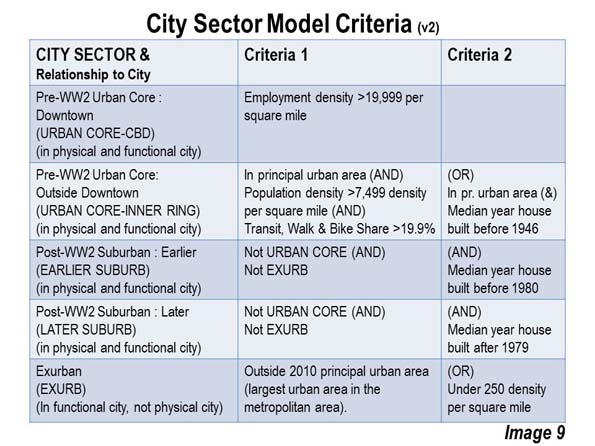
    After decades of serious economic decline, the inner cores in many of America’s largest metropolitan areas have experienced much improvement in recent years. This is indicated by the “City Sector Model,” (Image 9) which we developed to analyze the largest cities (metropolitan areas) using small functional areas, ZIP Code calculation areas (ZCTAs). The 2015 update to the City Sector Model added a fifth broad category of urbanization, when the Urban Core was divided into the Urban Core: CBD, and the Urban Core: Inner Ring (hereinafter referred to as CBD and Inner Ring).

    The CBDs have far higher densities of employment and population than the surrounding Inner Rings that surround them. The largest CBDs are nearly all products of the pre-World War II period, when metropolitan employment was more concentrated. Overall both the CBD and the Inner Ring are more similar than not, with higher densities than the suburban and exurban sectors and with greater use of transit, walking and bicycles in commuting. In contrast, the suburban and exurban areas have near universal use of automobiles.

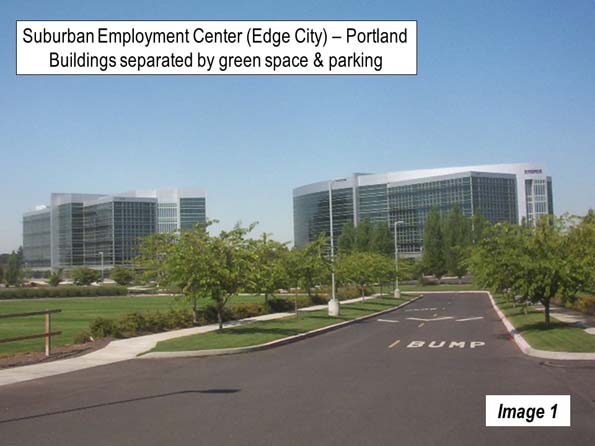
    This article includes analysis of the Urban Core: CBD (CBD) using the latest data from the American Community Survey for 2010 to 2014 (Note 1), with a middle year of 2012. The defining feature of the CBD is high employment densities. The City Sector Model uses employment densities of 20,000 and greater for designation of the CBDs. There are other dense employment centers in metropolitan areas, such as the “edge cities,” but they tend to be characterized by less concentrated development with their buildings, including high-rises, separated by green spaces and parking lots (Image 1). CBDs, on the other hand, typically have their high-rise buildings adjacent to street oriented sidewalks, with less space between the buildings (Image 2).


    Population Trends

    Since 2000, the CBDs have added approximately nine percent to their population. The CBD population growth rate largely tracked the overall metropolitan area growth rate. Critically, these remain a very small part of the urban population. Some 1.3 percent of the metropolitan population lived in the CBD in 2000, a figure that remained virtually the same in 2012.

    This growth rate, however, was not sustained throughout the Urban Core, which includes the much larger Inner Ring. The Inner Ring, which includes 91 percent of the Urban Core population, grew only 0.3 percent. The much larger Inner Ring drops the Urban Core growth rate down to only 0.9 percent, far below the 9 percent in the CBD component.  The other functional sectors grew faster, from two percent in the Earlier Suburbs to 39 percent in the Later Suburbs.

    Becoming More Residential

    Historically largely business districts, CBDs are becoming much more residential. Old, largely abandoned commercial buildings have been converted to new apartments and condominiums. In some places, there is new residential construction. There are new restaurants and other amenities that are associated with vibrant residential areas. There is more of a look of prosperity.

    Indeed, it may be surprising, given these developments that CBDs have not grown more. The net effect is that of the nearly 20 million new major metropolitan area residents added since 2000, less than 0.1 percent have been in the CBDs. However, as some people have moved in, others have moved out (Note 2).

    The growth in CBD population has been dominated by higher income ethnicities (Image 3). While the CBDs were adding 175,000 residents, the growth in Asian and White-Non-Hispanic residents was 215,000. African-American population declined more than 50,000, while Hispanic population edged up less than 10,000.

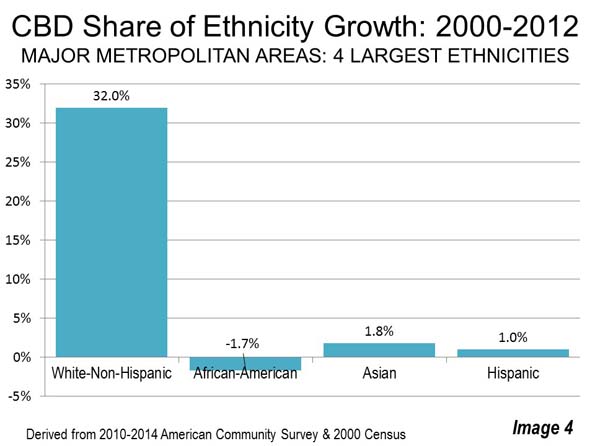
    Astoundingly, the CBDs, with barely one percent of the population, have attracted 32 percent of the major metropolitan White-Non-Hispanic growth. The 135,000 growth in White-Non-Hispanics compared to their slow, overall growth of 435,000. The share of the population growth among African-Americans, Asians and Hispanics in the CBDs has been far less (Image 4).

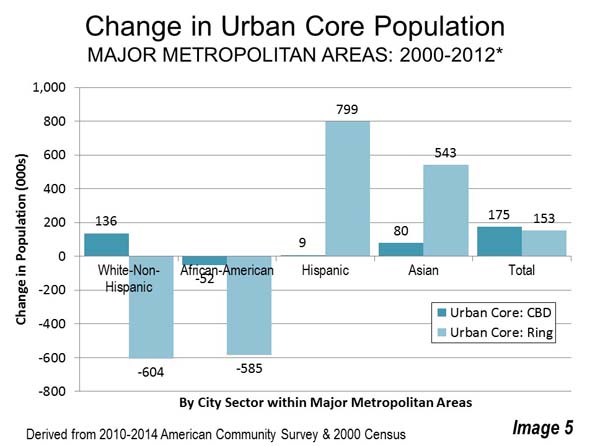
    Trends in the Inner Ring have been much different. There has been an exodus of approximately 600,000 of both white non-Hispanics and African-Americans. This has been somewhat more than offset by increases in the Asian and Hispanic population. Since 2000, Inner Ring has gained approximately 150,000 residents, somewhat less than the 175,000 gain in the CBDs (Image 5).

    The CBD Employment Market

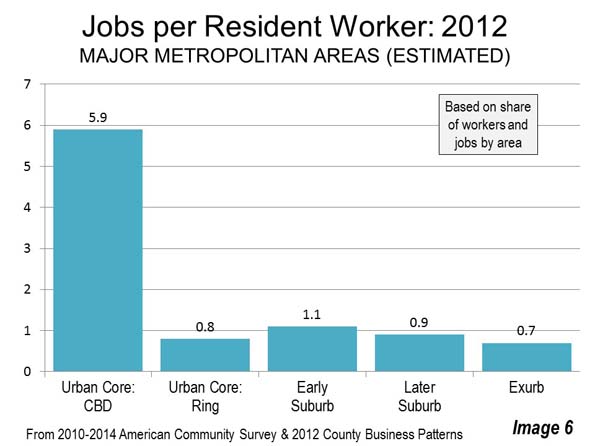
    Another defining feature of CBDs is a huge imbalance between employed residents and jobs. The most recent data indicates that the CBD boasts  nearly six jobs for every employed resident. Elsewhere in the metropolitan areas there was a much closer balance between jobs and resident workers (Image 6).

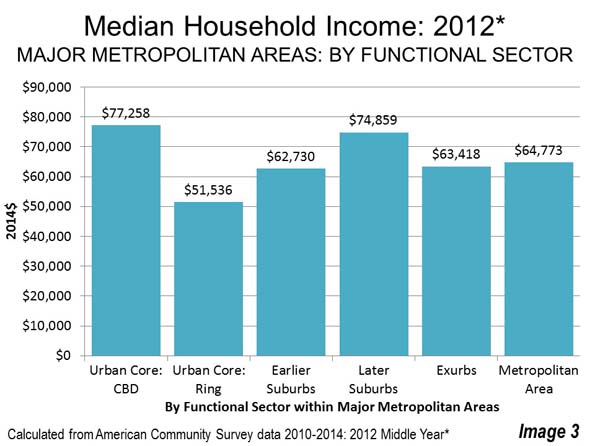
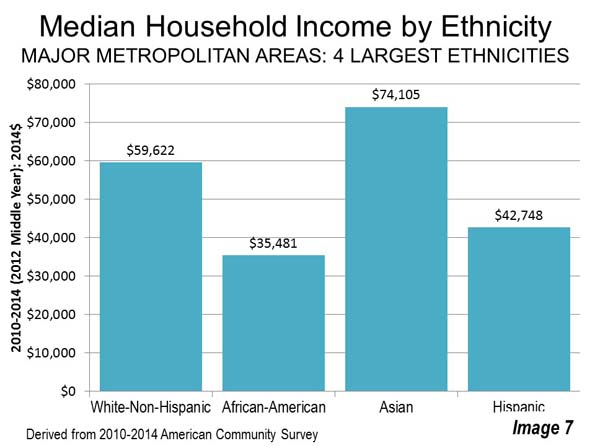
    This huge excess of jobs provides a rich employment market for residents. This and the growth in higher income ethnicities have combined to make the CBDs the most affluent sector in the major metropolitan areas by 2012, at nearly $77.300. This compares to the overall median household income of $64,800, the second ranking $74,900 in the Later Suburbs and the $51,600 in the Inner Ring. The median household income in the Inner Ring was by far the lowest (Image 7).

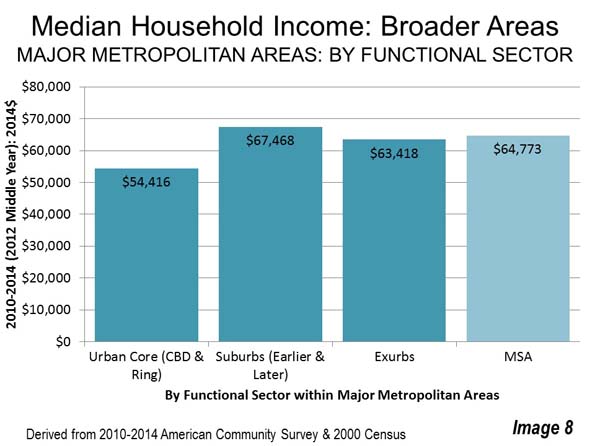
    Overall, as we speak about the core, the lower incomes of the Inner Ring dwarf the higher incomes in the CBD. Overall, the Urban Core (including the CBD and Inner Ring) median household income is $54,400, approximately 30 percent below that of the CBD (Image 8), and well below incomes in the suburbs, exurbs and metropolitan area as a whole.

    Assessing CBD Progress

    The CBDs have made significant progress. This is an important development because they, like other sectors of the city, best play their part as vibrant and healthy areas, rather than the depressed places that they used to be. They have attracted many younger people (Millennial age).

    In context, however, the progress in the CBD has been more symbolic than substantive. The CBD is not a model for what the rest of the metropolitan area. It cannot be. Metropolitan areas are labor markets. This means that they have a jobs to resident worker ratio of approximately 1.0. By definition, labor markets cannot have six times as many jobs as employees. Even with their impressive attraction of younger people, more than 97 percent of Millennial population growth since 2000 has been outside the CBDs.

    CBD population growth has been impressive, but small in relation to the metropolitan area. When combined with the much larger urban core component, the Inner Ring, its income advantage and demographic dynamism fades. Reviving the CBDs is a good thing. But the much larger Inner Ring needs revival as well.

    The bottom line:  the city is better off when all of its component parts are healthy, from the core to the exurbs.

    Note 1: This is the latest available data for small areas and was collected from 2010 to 2014. Thus, approximately one-fifth of the data was collected in each of the five years. For convenience, this article refers to the data as being reflective of 2012 (the middle year).

    Note 2: The ethnic analysis is based on one-race and Hispanic data. This represents 98 percent of the major metropolitan area population.

    Wendell Cox is principal of Demographia, an international public policy and demographics firm. He is a Senior Fellow of the Center for Opportunity Urbanism (US), Senior Fellow for Housing Affordability and Municipal Policy for the Frontier Centre for Public Policy (Canada), and a member of the Board of Advisors of the Center for Demographics and Policy at Chapman University (California). He is co-author of the "Demographia International Housing Affordability Survey" and author of "Demographia World Urban Areas" and "War on the Dream: How Anti-Sprawl Policy Threatens the Quality of Life." He was appointed to three terms on the Los Angeles County Transportation Commission, where he served with the leading city and county leadership as the only non-elected member. He served as a visiting professor at the Conservatoire National des Arts et Metiers, a national university in Paris.

    Photo: Kansas City CBD (by author)

  • What the Blues Brothers and Ferris Bueller’s Day Off Tell Us About Gentrification

    The Blues Brothers and Ferris Bueller’s Day Off are two of the seminal films set in Chicago. Indeed, Chicago itself is a character in both films.

    The films are radically different even though released only six years apart. There are many ways to slice this. Some have said that one is the South Side movie (The Blues Brothers) and the other the North Side movie (Ferris Bueller). Some see one as more urban, one more suburban.

    One other way to look at it is to see how the films portray an urban transition in progress. The Blues Brothers is a look backward at a fading industrial, working class metropolis.  Ferris Bueller looks forward to an upscale, gentrified city.

    I explore the parallels and contrasts in my new article in the Summer issue of City Journal, “Gentrification on the Big Screen“:

    Florida might regard some of Ferris Bueller’s traditional settings for diversion—the Art Institute and Chez Quis, a fictional fancy French restaurant—as stodgy relics from the city’s older, pre–knowledge economy era. But the scene in which Ferris bluffs his way into Chez Quis for lunch, claiming to be Abe Froman, “Sausage King of Chicago,” is perhaps the most revealing one in the film—and it marks another contrast with The Blues Brothers, in which a French restaurant also figures prominently. In the earlier movie, when Jake and Elwood show up at the legendary Chez Paul, they behave boorishly on purpose, to compel a former bandmate now working a legit job as the maître d’ to quit and rejoin them. By contrast, when Ferris and friends crash Chez Quis, they foreshadow a changing of the social guard. The hip young friends are destined to become Chicago’s new proprietors. They will soon be remolding the city, and its restaurants, in their own image. Chez Paul closed in 1995. Today, the city’s highest-end restaurants—like Alinea, a sleek, uber-hip purveyor of innovative cuisine—represent the culmination of this transition. A 48-year-old Ferris might well be eating at Alinea today.

    Watching these films today, viewers under the age of, say, 45 would be struck by how alien Jake and Elwood’s Chicago seems and how familiar Ferris’s Chicago has become. The vibrant working-class culture, tough old nuns, SROs, and Maxwell Street Market of The Blues Brothers have all either disappeared or survive only as shadows of what they once were. With a bit of cultural updating to cars, hairstyles, fashion, music, and phones, however,Ferris Bueller’s Day Off could be remade today, virtually shot for shot. Modern proto-hipsters might well still skip school to visit Wrigley Field, the lakefront, the Sears Tower Skydeck, or the Art Institute. Three decades after Ferris Bueller played hooky from the suburbs, the triumph of the gentrified city is complete.

    Click through to read the whole thing.

    Aaron M. Renn is a senior fellow at the Manhattan Institute, a contributing editor of City Journal, and an economic development columnist for Governing magazine. He focuses on ways to help America’s cities thrive in an ever more complex, competitive, globalized, and diverse twenty-first century. During Renn’s 15-year career in management and technology consulting, he was a partner at Accenture and held several technology strategy roles and directed multimillion-dollar global technology implementations. He has contributed to The Guardian, Forbes.com, and numerous other publications. Renn holds a B.S. from Indiana University, where he coauthored an early social-networking platform in 1991.

    Photo: Aretha Franklin singing in a diner in The Blues Brothers. Image via City Journal

  • Is it Time for MagLev?

    Maryland officials have announced that a proposal to build a maglev line from Washington to Baltimore has received a commitment for the feasibility study of $2 million from Japanese government. This is in addition to a much larger involvement by the Japanese government, which would include a $5 billion commitment from the government Japan Bank for International Cooperation. The private Central Japan Railway Company has also agreed to waive any licensing fees for using its maglev technology.

    The loan would finance one-half of the “somewhat north of “$10 billion cost, as characterized by Northeast Maglev, the developer of the proposed system.

    Surely that is a far better alternative than digging deeper into U.S. taxpayer pockets if combined with sufficient private investment. Otherwise any such system could require huge federal grants, or low interest loans through the Federal Railroad Administration Railroad Rehabilitation and Improvement (RRIF) loan guarantee program.  An RRIF loan could potentially expose taxpayers to a 100% loss, should the maglev system fail to pay for its capital and operating costs, as occurred with what the Washington Post characterized as the “Solyndra Scandal,” which cost taxpayers more than half a billion dollars due to a federal loan guarantee.

    The history of private investment in high speed rail around the world is considerably less than encouraging in this regard.

    What is Maglev?

    Maglev is magnetic levitation, a process by which magnetic forces are used to elevate and propel trains, without friction, at very high speed. The technology has long been favored by futurists and some transport professionals, but there is only one high-speed system in operation (Shanghai). That line has only been partially completed and the rest of the line has been suspended.

    “North of” Cost Estimates

    The evidence seems to be that the costs of maglev are “north of” high speed rail costs. This is of particular concern for taxpayers, since only two high speed rail lines of the many built in the world have “broken even.” There are recent reports that a third, Shanghai to Beijing is now making a profit Generally large rail project costs have been notoriously underestimated, as the Oxford University work led by Professor Bent Flyvbjerg has shown.

    As a result, there is always the risk that a venture proposed as commercial could run out of money during the construction phase, or generate insufficient revenues to its operating and capital costs. In either case, government subsidies would likely be sought by the operator.

     “North of” cost projections, such as suggested by Northeast Maglev, seem to be the rule in high speed rail, given that original cost projections for similar projects have been so routinely unreliable.

    The current $10 billion estimate for the Washington to Baltimore line is already well north of an earlier $8 billion estimate.

    The currently under construction Tokyo to Nagoya and later Osaka (Chuo Shinkansen maglev) has a construction cost in excess of ¥9 trillion (approximately $90 million). With 90 percent of the Tokyo to Nagoya section underground or in tunnels, cost escalation seems likely.

    Similarly, the cost of the California high-speed rail line, in its original full he high-speed configuration from Los Angeles San Francisco tripled (inflation adjusted)  to well “north of” its 1999 cost projection made. Officials cut the system back from full high-speed rail operation in the Los Angeles and San Francisco areas to reduce costs to a more politically acceptable level.

    High Speed Maglev: The One Partial Line

    Currently, the only partial high-speed maglev line in the world takes passengers only two-thirds of the way from its Pudong International Airport terminus to central Shanghai.

    It was planned to extend the Shanghai maglev line to the center and eventually to Hangzhou, an urban area of 7.6 million residents approximately 180 kilometers (110 miles) to the southwest. However, those extensions have been suspended and high-speed rail service is now available to Hangzhou.

    The developers of the Shanghai maglev hoped that China would adopt the technology for its high-speed intercity rail system. China, however, opted for conventional high-speed rail technology and will soon be operating at speeds of up to 350 kilometers per hour (220 miles per hour), the fastest in the world. The train sets are already operating in Manchuria.

    A Real Head Scratcher

    Significantly, the long and disappointing startup pains of maglev may be coming to an end.

    The Central Japan Railway has begun building the Tokyo to Nagoya and eventually Osaka Chuo Shinkansen maglev line. The currently planned completion date for the Nagoya section is 2027, with a package of financial incentives worth and a ¥3 trillion loan from the Japanese government intended to advance the completion date for the new going to Osaka section from 2045 to 2037. Thus, Japanese taxpayers are already potentially “on the hook” financially.

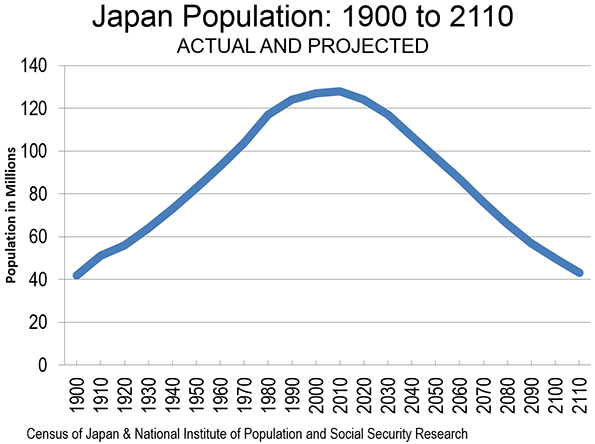
    There’s an element of the bizarre here.  How much additional transport infrastructure is required in the nation that is losing population at a faster rate than anywhere else in the world? By the earliest date the Osaka extension opens (2037), Japan’s population will have fallen 14 million (more than 10 percent) from today, according to projections of the National Institute for Population and Social Security Research. A quarter of a century later (2062), the population will have dropped another 27 million, to 85 million. That is 10 million fewer people than the 95 million who lived in Japan when the first high speed rail line opened just before the 1964 Olympics. In 2089, Japan is projected to have only 58 million people, fewer than almost 170 years (Figure).

    One economic development report noted that the line would “help alleviate the population overcrowding concentration in the Tokyo metropolitan area. Yet, by 2110, the entire country is projected to have not many more people than the Tokyo metropolitan region today.  

    The Chuo Shinkansen maglev is a part of Prime Minister Abe’s financial stimulus program, which has both supporters and critics. The government talks of the economic development the line will induce. Others, such as Edwin Merner of Atlantis Investment Research called the maglev line a misallocation of resources and that passenger demand will be limited.

    The line has also been justified as a means to promote tourism. Yet, the average tourist may find the scenery — much of it very appealing — from the above ground 1 hour 40 minute ride to Nagoya or the 2 hour 30 minute to Osaka on the conventional high speed rail line more satisfying  (such as Mount Fuji) than the hundreds of miles of tunnel on the faster maglev line (Photo).


    By Alpsdake (Own work) [CC BY-SA 3.0], via Wikimedia Commons

    Protecting US and Northeastern Taxpayers

    But, back to the Washington to Baltimore maglev line. A privately financed and commercially viable maglev line would improve transportation in both the Washington to Baltimore corridor and the extension to New York. However, taxpayers need guarantees to ensure that they are not left “holding the bag.”

    For example, before any permits for proceeding are issued, the investors should be required to post a bond to ensure that the private funding will be sufficient to complete the system, thus avoiding public subsidy. Further, a performance bond should guarantee that no operating subsidies are required for at least a minimum number of years (perhaps 10 or 25).

    A Chance for Success?

    With sufficient taxpayer safeguards, there may be a chance for it to succeed. And surely, we wish Japan, the Japan Bank for International Development, the Central of Japan Railway and Northeast Maglev the best, hoping that they can provide a fully commercial venture. On the other hand, like Ford’s “Nucleon” nuclear powered automobile (proposed in the 1950s), the time for maglev may never come.

    Wendell Cox is principal of Demographia, an international public policy and demographics firm. He is a Senior Fellow of the Center for Opportunity Urbanism (US), Senior Fellow for Housing Affordability and Municipal Policy for the Frontier Centre for Public Policy (Canada), and a member of the Board of Advisors of the Center for Demographics and Policy at Chapman University (California). He is co-author of the "Demographia International Housing Affordability Survey" and author of "Demographia World Urban Areas" and "War on the Dream: How Anti-Sprawl Policy Threatens the Quality of Life." He was appointed to three terms on the Los Angeles County Transportation Commission, where he served with the leading city and county leadership as the only non-elected member. He served as a visiting professor at the Conservatoire National des Arts et Metiers, a national university in Paris.

    Lead photo: Chuo Shinkansen maglev by Saruno HirobanoOwn work, CC BY-SA 3.0, https://commons.wikimedia.org/w/index.php?curid=30917648

  • Center for Opportunity Urbanism: America’s Housing Crisis

    This video from Center for Opportunity Urbanism (COU) explores America’s housing crisis — focusing on the new generation. COU is a non-profit dedicated to preserving the American dream and promoting upward mobility for all Americans. Check out the video and let us know what you think.

  • The States Gaining And Losing The Most Migrants — And Money

    When comparing the health of state economies, we usually look at employment and incomes. Another critical indicator worth closer attention is where Americans choose to move, and the places they are leaving.

    American history has been shaped by migration, from England to the Eastern seaboard, and later from the Atlantic Coast toward the Midwest, and later to the Pacific.

    Our analysis of Internal Revenue Service data from 2014, the most recent available, give us an important snapshot of where Americans are moving now, and, equally important, a breakdown by income levels and age.

    The Big Winners: The Sunbelt And Texas

    To measure the states that are most attractive to Americans on the move, we developed an “attraction” ratio that measures the number of domestic in-migrants per 100 out-migrants. A state that has a rating of 100 would be perfectly balanced between those leaving and coming.

    Overall, the biggest winner — both in absolute numbers and in our ranking —  is Texas. In 2014 the Lone Star State posted a remarkable 156 attraction ratio, gaining 229,000 more migrants than it lost, roughly twice as many as went to No. 3 Florida, which clocked an impressive 126.7 attraction ratio.

    Most of the top gainers of domestic migrants are low-tax, low-regulation states, including No. 2 South Carolina, with an attraction ratio of 127.3, as well as No. 5 North Dakota, and No. 7 Nevada. These states generally have lower housing costs than the states losing the most migrants.

    But it’s not simply a matter of taxes and regulations. There are three states in our top 10 with mixed reputations for red tape and taxes: Oregon (fourth), Colorado (sixth), and Washington (eighth). These are states that have thriving information  and professional business services sectors, which offer higher wages. And though these states have high housing costs, they are well below California’s. For Californians, the employment opportunities available in Seattle, Denver and Portland, combined with the prospect of huge profits from selling the house, makes moving particularly attractive.

    The Biggest Losers

    High costs go a long way to explain which states are losing the most migrants. At the top, or rather, the bottom of the list is New York State, which had an abysmal 65.4 attraction ratio in 2014 and lost by far the most net migrants, an astounding 126,000 people. Close behind was Illinois, a high tax, high regulation, and low growth disaster area. In 2014 the Land of Lincoln had an abysmal 67.2 attraction ratio, losing a net 82,000 domestic migrants.

    Most of the other top people-exporting states are in the Northeast and Midwest. But the West, traditionally the magnet for newcomers, now also has some major losers, including Alaska (80.1), New Mexico (84.6) and Wyoming (88.6). The outflow for some of these western states may get worse, unless prices for natural resources like coal, oil, gas and minerals do not recover in the near future.

    And then there is the big enchilada, California. For generations, the Golden State developed a reputation as the ultimate destination of choice for millions of Americans. No longer. Since 2000 the state has lost 1.75 million net domestic migrants, according to Census Bureau estimates. And even amid an economic recovery, the pattern of outmigration continued in 2014, with a loss of 57,900 people and an attraction ratio of 88.5, placing the Golden State 13th from the bottom, well behind longtime people exporters Ohio, Indiana, Kentucky and Louisiana. California was a net loser of domestic migrants in all age categories.

    Where’s The Money Going?

    Some analysts have claimed that the people leaving California are mostly poor while the more affluent are still coming. The 2014 IRS data shows something quite different. To be sure the Golden State, with its deindustrializing economy and high costs, is losing many people making under $50,000 a year, but it is also losing people earning over $75,000, with the lowest attractiveness ratios among those making between $100,000 and $200,000 annually, slightly less than those with incomes of $10,000 to $25,000.

    Overall, many of the most affluent states are the ones hemorrhaging high-income earners the most rapidly. As in overall migration, New York sets the standard, with the highest outmigration of high income earners (defined as annual income over $200,000) relative to in-migrants (attraction ratio: 53). New York is followed closely by Illinois, the District of Columbia and New Jersey, which are all losing the over-$200,000-a-year crowd at a faster pace than California.

    The big winners in terms of affluent migration tend to be historically poorer states, mainly in the Sun Belt and the Intermountain West. Florida has an attraction ratio for people earning over $200,000 a year of 223, the highest in the nation, followed by South Carolina, Montana, Idaho and North Carolina. Four of the states with the highest attraction rate among the highest income earners were in the top five in net in–migration of seniors, many of whom are taking nice nest eggs with them. South Carolina scored the highest, followed by Delaware, Idaho, North Carolina and Florida.

    Where Young Adults And Families Are Headed

    Much of the discussion about millennial migration tends to focus on high-cost, dense urban regions such as those that dominate New York, Massachusetts and, of course, California. Yet the IRS data tells us a very different story about migrants aged 26 to 34. Here it’s Texas in the lead, and by a wide margin, followed by Oregon, Colorado, Washington, Nevada, North Dakota, South Carolina, Maine, Florida and New Hampshire. Once again New York and Illinois stand out as the biggest losers in this age category.

    Perhaps more important for the immediate future may be the migration of people at the peak of their careers, those aged 35 to 54. These are also the age cohorts most likely to be raising children. The top four are the same in both cohorts. Among the 35 to 44 age group, it’s Texas, followed by Florida,  South Carolina and North Dakota. Among the 45 to 54 cohort, Texas, followed by South Carolina, Florida and North Dakota.

    Far more than the often anecdote-laden accounts seen in the media, the IRS data provides us with a glimpse of a demographic future dominated by those states that are either retirement havens or lower cost places that can compete with the traditional high-income economies such as Massachusetts, California, New York and New Jersey. As millennials age, along with their boomer parents, the data gives us a vision of a changing America which is likely to see a greater dispersal of population, income and demographic groups to many places that, like Texas, Florida or South Carolina, have been considered backwaters but now seem destined to emerge as shapers of our national future.

    Where Americans Are Moving — View Top 10 and Bottom 10 States

    This piece first appeared at Forbes.

    Joel Kotkin is executive editor of NewGeography.com. He is the Roger Hobbs Distinguished Fellow in Urban Studies at Chapman University and executive director of the Houston-based Center for Opportunity Urbanism. His newest book, The Human City: Urbanism for the rest of us, will be published in April by Agate. He is also author of The New Class ConflictThe City: A Global History, and The Next Hundred Million: America in 2050. He lives in Orange County, CA.

    Wendell Cox is principal of Demographia, an international pubilc policy and demographics firm. He is a Senior Fellow of the Center for Opportunity Urbanism (US), Senior Fellow for Housing Affordability and Municipal Policy for the Frontier Centre for Public Policy (Canada), and a member of the Board of Advisors of the Center for Demographics and Policy at Chapman University (California). He is co-author of the “Demographia International Housing Affordability Survey” and author of “Demographia World Urban Areas” and “War on the Dream: How Anti-Sprawl Policy Threatens the Quality of Life.” He was appointed to three terms on the Los Angeles County Transportation Commission, where he served with the leading city and county leadership as the only non-elected member. He served as a visiting professor at the Conservatoire National des Arts et Metiers, a national university in Paris.

  • The Bridge from Laissez-Faire to Socialism

    Cronyism remains unchecked in the world’s largest economy.

    We might object to the phrase crony capitalism for two reasons:

    First, because cronyism is in some ways the antithesis of capitalism. The freedom to compete and the freedom to fail that are central tenets of capitalism are severely compromised by cronyism when in the former case powerful politicians intervene to shield their friends in business and finance from competition, and in the latter intervene again to save them from bankruptcy or occasionally from criminal prosecution. Of course, these friends in turn are no disloyal slouches and they later show themselves to be supremely appreciative by underwriting, financially and otherwise, those same politicians who had all but guaranteed their continued dominance in normal times and their survival against bad odds in times of distress.

    Second, because cronyism is just as prevalent, or arguably more prevalent, in a socialist system than in a capitalist one. Socialism is made popular by charismatic figures appealing to the idealism of some voters but wherever it succeeds in establishing itself, its anonymous toiling bureaucrats turn out to be expert cronies of the very first order, if we are to judge by the experience of many countries in the past century.

    Laissez-faire to cronyism to socialism

    This experience suggests the following chronology of events: cronyism gradually creeps into and takes over the laissez-faire economy. After some time, its extractive practices and excesses make socialism appear desirable and reasonable to an increasing number of voters. Finally if socialists manage to take control of government, they trumpet the victory of the people and the dawn of an egalitarian era but in their actions simply replace one set of cronies with another. If this is accurate, socialism then would not be the system that replaces capitalism, but rather the culmination of cronyism. Cronyism is a disease on the body of laissez-faire and socialism is an ultimate manifestation of that disease, investing all the organs of the body and bringing about its final demise.

    For evidence, see Venezuela. Did the downward spiral start with the socialist Hugo Chavez? Or did it start with the cronyism that preceded Chavez and that made Chavez attractive to an increasing number of people? A case can be made for the latter, even if Chavez in the end played a key role in precipitating the downfall.

    The hypothesis is that when laissez-faire is compromised by cronyism, the entire social and economic architecture becomes more vulnerable to the siren call of socialism. This may be because lower income people instinctively understand and accept that a Henry Ford or a Steve Jobs would earn a large fortune as a just reward for his innovations and business genius and large contributions to the advancement of mankind. The same people also understand and accept that lesser Fords and Jobses would earn smaller fortunes that are commensurate with their own lesser contributions, and so on. But these same people have a more difficult time accepting the vast sums extracted from the economy by people who take few risks, contribute little, and owe their advancement and wealth mainly to the lottery of birth or to the connections they have made in the higher circles of learning, politics or business. To say so is not a refutation of capitalism, but of cronyism.

    It makes sense then to decouple the words crony and capitalism and to not let the spread of cronyism be used as a pretext to abandon laissez-faire. The Economist recently acknowledged this difference by identifying some industries where cronyism is rampant:

    Some industries are prone to “rent seeking”. This is the term economists use when the owners of an input of production—land, labour, machines, capital—extract more profit than they would get in a competitive market. Cartels, monopolies and lobbying are common ways to extract rents. Industries that are vulnerable often involve a lot of interaction with the state, or are licensed by it: for example telecoms, natural resources, real estate, construction and defence. (For a full list of the industries we include, see article.) Rent-seeking can involve corruption, but very often it is legal.

    More on this later but note in passing that the term capitalism itself has a tenuous pedigree since its use did not become widespread until the mid 19th century mainly as an antonym to socialism or communism. It has little other reason to exist and proponents of freedom in commerce may be well advised to use the term laissez-faire instead, or an English equivalent, and not let themselves be ensnared in a futile debate of one -ism against another. People who engage in a free and mutually beneficial exchange of goods and services don’t cast about looking for an -ism to describe their activity, just as breathing comes to us naturally and we are not looking to encode a complex ideology to justify its benefits. We need breathing to support life, and we need laissez-faire for the very same reason.

    Cronyism around the world

    Until about two decades ago, the problem of cronyism was mainly present in smaller economies in the developing world where the governing elite was small and dominated by local business interests. In each of these places, politicians and business leaders were closely related by class or clan or blood or marriage, and they successfully perpetuated a system that preserved their wealth and power.

    More recently, cronyism has been on the rise in the United States. Indeed it has become one of the objects of our fascination but, as with the weather, everyone talks about it and no one does anything about it. That can be in part because cronyism is difficult to identify and to expose. Often it is not illegal, a fact that gives moral comfort to its practitioners and ensures its continued advance. Most cronies probably don’t see themselves as cronies but merely as savvy business people trying to do good by influencing policy, or as members of an intelligentsia who have a duty to get involved in government.

    The zero hour of cronyism may have been in 2008 when the financial crisis was so severe that cronyism came into full public view, like a bad family feud normally played out behind closed curtains suddenly erupting in the town square. The depredations of 2008 look like a textbook script of how cronyism works. Failed capitalists did not fail but were given by their powerful friends another chance and they later employed this new chance not only to cement their own positions and to weaken their competitors, but to also cement the positions of the powerful friends who bailed them out. Everything seems to have worked out just fine so long as not too many people asked questions as to how and why it all happened in the way that it did.

    But our understanding of this phenomenon has only grown since then. Some of the general workings of cronyism were described in the 2012 book Why Nations Fail: The Origins of Power, Prosperity and Poverty by Daron Acemoglu and James Robinson in which the authors differentiate between extractive and inclusive economies. Extractive economies are dominated by cronyism while inclusive economies are closer to a competitive laissez-faire model.

    It was alleged and accepted that extractive economies were most often in emerging markets, and that inclusive ones were generally in developed nations. Yet shortly after the publication of Acemoglu and Robinson’s book, this separation came under increased scrutiny. For example, The Economist in 2012 took the “extractive” label and stuck it on the financial industry of the West. In an article titled The Question of Extractive Elites, it wrote:

    There are two potential candidates for extractive elites in Western economies. The first is the banking sector. The wealth of the financial industry gives it enormous lobbying power, including as contributors to American presidential campaigns or to Britain’s ruling parties. By making themselves “too big to fail”, banks ensured that they had to be rescued in 2008.

    If it is true that banking is “extractive”, no one should be surprised that eight years after the 2008 bailouts, the socialism of Bernie Sanders and the populism of Donald Trump have reached a very ripe and receptive audience of disgruntled voters. On our thesis, the success of these two candidates is a natural result of the decades-old drift from laissez-faire to cronyism.

    The problem with cronyism is that it is a form of corruption, albeit one that is nebulous and often legal. A very large sum paid to a former or future government official for consulting or lobbying or for a speech may not technically rise to the level of a bribe but it does look like an attempt to capture that individual and to secure his loyalty before he returns to government where he would then be most appreciative towards his financial patrons. Perhaps then we may think of cronyism as a form of corruption that has thrived temporarily in the absence of the laws and regulations needed to fight it. Or perhaps no new laws are needed and instead a more vigorous judiciary is needed to implement existing laws, that is a judiciary whose independence is not already corroded by the spread of cronyism.

    Corruption Perceptions Index

    Among the many watchdog organizations that study corruption around the world, Berlin-based Transparency International (TI) publishes an annual ranking of countries in itsCorruption Perceptions Index. In 2015, TI ranked the United States 16th of 167 countries. Except for Canada, Singapore, Australia and New Zealand, all of the countries that ranked ahead of the US were in Western and Northern Europe, with Denmark, Finland and Sweden achieving the top scores.

    Large emerging countries fared poorly in the index. Brazil now in the throes of an impeachment battle and several corruption scandals ranked 76th. India was also 76th and Mexico was 95th. China was 83rd and Russia 119th. At the bottom were socialist countries and countries beset by war and internal strife.

    Overall therefore the US score was not as good as those of small relatively homogeneous European nations, but it was far above those of countries with large populations and growing economies.

    Yet with the vast amounts of money sloshing around the US economy, courtesy of the Federal Reserve’s zero interest rate policy, and given the rise of cronyism for over a decade, it is fair to wonder aloud whether Transparency International is being too kind with its US ranking.

    In order to answer this question, we try to estimate the size of the crony economy in the US. This is a difficult endeavor because there are few sources that can be helpful in measuring and quantifying cronyism. The Economist gave it a good try by developing acrony-capitalism index in 2014 and by updating it in 2016.

    In the US, the wealth of billionaires in crony industries adds up to a relatively small percentage of GDP, 2.2% in 2014 and 1.8% in 2016. According to the Economist, this measure of cronyism is a much bigger issue in other countries such as Russia (18% in 2016), Malaysia (13%) and even Singapore (1o.7%).

    Screen Shot 2016-08-18 at 4.25.43 PM

    On the other hand, measured in actual dollars, the wealth controlled by crony billionaires in the United States comes to $334 billion and is second only to that of their counterparts in China. This amount is about ten times the amount of crony wealth in more corrupt (per TI’s estimation) countries such as Brazil and others. So, in raw numbers, the US could be by far one of the largest theaters of cronyism in the world.

    The Economist writes that, because of the crash in commodity prices, the size of the global crony economy is smaller now than it was in 2014:

    Our newly updated [2016] index shows a steady shrinking of crony billionaire wealth to $1.75 trillion, a fall of 16% since 2014. In rich countries, crony wealth remains steadyish, at about 1.5% of GDP. In the emerging world it has fallen to 4% of GDP, from a peak of 7% in 2008. And the mix of wealth has been shifting away from crony industries and towards cleaner sectors, such as consumer goods

    but The Economist still sees cronyism as a significant factor in the 2016 US presidential election. Regarding Donald Trump:

    Despite this slowdown, it is too soon to say that the era of cronyism is over—and not just because America could elect as president a billionaire whose dealings in Atlantic City’s casinos and Manhattan’s property jungle earn him the 104th spot on our individual crony ranking.

    and Hillary Clinton, via some of her donors:

    The rich world has lots of billionaires but fewer cronies. Only 14% of billionaire wealth is from rent-heavy industries. Wall Street continues to be controversial in America but its tycoons feature more prominently in populist politicians’ stump speeches than in the billionaire rankings. We classify deposit-taking banking as a crony industry because of its implicit state guarantee, but if we lumped in hedge-fund billionaires and other financiers too, the share of American billionaire wealth from crony industries would rise from 14% to 28%.

    This lumping together of commercial/retail banks and investment banks/hedge funds under the crony banner would have been largely unjustified before 2008, notwithstanding the controversial rescue of Long Term Capital in 1998, but it does not look as far-fetched after the 2008 bailout of banks of all stripes.

    After the election, we may see a continued advance of cronyism or we may see a retreat. A trend often turns on itself after it reaches a new apex. In order to dial away from socialism and populism and move back towards laissez-faire, we could step up our efforts to limit and roll back cronyism. Otherwise we may see an even stronger drive towards populism or socialism at the next election.

    See also The Economist Daily Chart: Comparing Crony Capitalism Around the World.

    This piece first appeared at Populyst.net.

    Sami Karam is the founder and editor of populyst.net and the creator of the populyst index™. populyst is about innovation, demography and society. Before populyst, he was the founder and manager of the Seven Global funds and a fund manager at leading asset managers in Boston and New York. In addition to a finance MBA from the Wharton School, he holds a Master’s in Civil Engineering from Cornell and a Bachelor of Architecture from UT Austin.

    Photo of Hugo Chavez by Victor Soares/AgenciaBrasil via Wikipedia.