Blog

  • Debates on Airport Rail

    Running a little behind this week, so I just wanted to pass along this story from USA Today on domestic airports adding rail service. People love the service, of course, and many airports are doing it, but later in the article they get to the economic irrationality of it in America’s decentralized car-centric cities (as opposed to Europe and Asia).

    Still, airport-rail ridership in the USA is woefully low compared with other countries, says Andrew Sharp, director general of the U.K.-based International Air Rail Organisation. In many European and Asian airports, 20% to 30% of travelers get to and from the airport using rail. In the USA, ridership typically ranges from 2% to 5%, he says.

    Ongoing debates

    Like most large construction projects, airport rail proposals face stiff headwinds. Opponents challenge funding sources and new taxes and cite preferences for cars and buses. But the central argument in most debates has centered around ridership, specifically whether airports have enough demand to justify millions in cost.

    BART’s connection to SFO, completed in 2003, has yet to reach BART’s initial ridership forecast and is still not profitable. Prior to construction, BART projected there would be 17,800 average daily boardings to and from the airport by the year 2010. As of this month, SFO ridership was at about 11,000.

    Frank Sterling and Juliet Ellis, activists in the Bay Area, also questioned BART’s plans to spend $500 million for Oakland International’s people-mover and its decision to charge $6 for the service vs. $3 for the current shuttle bus.

    “The proposal to charge double that for the new connector might drive away customers, unless it delivers twice the value,” they wrote in a recent newspaper commentary, “Can East Bay residents afford this?”

    Then they use some of my favorite arguments from past posts:

    These are appropriate debates, Coogan says. Some cities are better off sticking to buses, he says. For example, LAX’s FlyAway Bus, which provides non-stop rides to various neighborhoods in Southern California, is more convenient for many travelers than the metro.

    For some cities, it’d be wiser to spend scarce funds for extending metro to public transportation-friendly suburbs before considering airports, Coogan adds.

    How often does a person go to work? And how often does a person go to Paris in a year?” he says.

    More on these arguments here, here, and here (near the bottom). As I said in one of those posts: I agree, and I’ve said before that the market here is a niche one plenty well served by buses: young singles who can’t get a ride to/from the airport. Business travelers will almost always rent a car or take a taxi. Families won’t schlep their luggage on transit. Most others will have friends or family pick them up or drop them off. And our off-site airport parking is dirt cheap. The ridership drivers just aren’t there.

  • Sustaining Localism in the English Suburban Context

    Localism, a longstanding agenda of the Green Party in the context of the UK economy, is gaining ground in the current economic crisis. In a recent edition of the London-based Daily Telegraph, a striking contrast is made between Chester in north-west England – which is suffering from the decline of its relatively narrow economic base and Totnes in south-west England, which with its longstanding interest in alternative living, and more localised economy, seems to be weathering the situation much better. The underlying message from the article is that small is good – particularly for businesses not overextended in their borrowing, and familiar enough with their immediate context to be able to adapt to a changing economy.

    The New Economics Foundation think-tank, has been for several years campaigning against Clone Town Britain (namely, the over preponderance of chain stores at the expense of small chains and independent stores). Past criticism of the foundation for having an overly romantic notion of what constitutes a successful town centre may still continue, but there may also be some economic logic to a more locally oriented town centre strategy.

    Perhaps the best approach is to avoid either free-market efficiency ideology, on the one hand, or a strict local-only approach. It seems clear from other recent research into successful suburban town centres that a combination of national chains and good quality independents makes for the best mix to ensure long-term economic sustainability.

    This issue, like perhaps too much else in Britain, is currently subject to government action. The new Sustainable Communities Act now makes it mandatory for the UK government to assist local councils and community ‘stakeholders’ in drawing up local sustainability strategies for enabling independent businesses to survive in the increasingly cut-throat high street (the equivalent of the US ‘main street’).

    Yet as usual the government seems to overlook where most people live: the word suburb or suburban is nowhere in the Act. Possibly this is not surprising as the main focus is on large scale, infrastructure projects, but the continuing lack of attention in policy terms to the suburbs should be a matter of concern to those who believe a diffuse network of connections is essential to the continuing sustainability of the economy.

    It is equally worrying to see that the influential group set up by London’s Mayor Boris Johnson to focus on the outer London suburbs (which are cited as being his main source of political support in the mayoral elections) continues the pattern of focusing on the larger metropolitan centres at the expense of the smaller suburban centres in the capital. At an ‘Outer London Summit’ held on 11th June, Mayor Johnson made it clear that the policy focus continues to be on strengthening a constellation of “growth hubs” of economic activity, such as the metropolitan centre of Croydon in south London, despite the clear evidence demonstrating how smaller centres have an important role in making suburbs more sustainable.

    Within the next 20 years, most housing growth in England and Wales is predicted to occur in suburban settlements. This development is expected to be sustainable economically and environmentally, which means that suburbs will increasingly be required to provide local economic activities in order to minimise travel and to support cohesive and vibrant communities.

    The Towards Successful Suburban Town Centres research project at University College London has investigated the strategic contribution of Greater London’s smaller and district centres to the sustainability of the metropolitan region. ‘Sustainability’ in interpreted by the project team as referring to conditions favourable to local concentrations of long-lasting socio-economic and cultural activity.

    The research also has found that the widespread perception of suburbia as synonymous with social and architectural homogeneity belies its spatial, social, ethnic and economic diversity. With pressure to build large numbers of new homes increasing, there is a real danger that such perceptions become self-fulfilling.

    Initial findings suggest the success of local centres depends on the ability of their built environments to adapt to social and economic change by allowing pedestrian movement around an extended central area, balanced with accessibility to vehicular and public transport at larger scales of movement. Centres that support a wide range of locally generated activity are likely to be more resilient in the face of change than retail or purely residential monocultures. The results show that spatial variety and economic adaptability are both crucial to economic sustainability.

    This adaptability inherent to the suburban built environment needs to be more widely understood and promoted. The Towards Successful Suburban Town Centres project has found that where the town centre supports a diverse range of activities it benefits from increased by-product movement, where people do more than what they deliberately came to do during their visit to the centre. People visiting local town centres such as Surbiton (made famous by the 1970s BBC sitcom The Good Life), are not like shoppers at a ‘power centre’ dominated by a Wal-Mart. They don’t just shop for a specific item; they linger, eat lunch, drink coffee, research local cultural activities and indeed might be there for a business meeting. Surbiton, like many of London’s smaller town centres, has close links to larger centres such as Kingston, which alongside retail, offices and a university, boasts the new Rose Theatre led by Sir Peter Hall.

    The benefits here go well beyond the strictly economic. More time spent locally leads to a more vibrant mix of people on the streets and helps enliven the town centre throughout the day. This street network potential provides a critical element for sustaining the vitality of suburban and small town centres. The extensive and varied activity in lively areas enables complex routine daily and weekly movement patterns to emerge, thereby furthering the engagement of individuals with their locality.

    With the closure of chains such as Woolworths, however tragic for long-time customers and employers, the economic downturn also opens up opportunities for alternative high street activities. In one example, Art Space + Nature, an avant-garde Scottish art collective, have produced plans to bring new activities to empty shop fronts by putting on art exhibitions. The Institute of Community Cohesion is working on plans to create new indoor markets for local communities in closed business units.

    These and many other grassroots initiatives are localist at heart. The key may be in making sure that these attempts remain grassroots, and not too impacted by either large governmental units or major non-profits. To succeed, localism must be properly bedded in the community. Economic trends, as well as history, demonstrate that a bottom-up approach to creating lasting viable communities works not only in cities, but in suburbs as well.

    Laura Vaughan is a Senior Lecturer in Urban and Suburban Settlement Patterns and the Director of the MSc in Advanced Architectural Studies at the Bartlett, University College London and a member of UCL’s Space research group.

  • The Geography of Class in Greater Seattle

    Most readers may not be initially very interested in the detailed geography of “class” in Seattle, but it actually matters not only for our area but for the whole debate over the shape of the urban future. Academics, perhaps Americans in general, are loath to admit to class differences, yet they remain very crucial to the understanding of how cities and regions evolve.

    Seattle is a great example of the transformation of a 20th century model of the American metropolis to a 21st century-cum-19th century “old World” model of metropolis. It is often held up as one of the role models for other cities, so its experiences should be considered seriously not only for American cities but for regions throughout the advanced world.

    Many readers, including those afflicted with political correctness, probably many upper and lower class folk uncomfortable with their home areas being labeled as of a particular class, or others, might feel that class is an obsolete Marxist term. They may prefer I use the safer term “socio-economic status” rather than “class.” Let’s admit it: “class” is used widely, as in “the middle class is getting squeezed” or the “tax burden on the lower classes.” As it has been for hundreds of years, class remains a meaningful descriptor of areas of obviously differing well-being.

    We should understand by identifying upper or middle or lower classes this does not imply “better than.” Class simply reflects the mix of inheritance, education, biology, experience, discrimination, and life events that lead to variability in economic well-being. Class is real. But there is certainly a legitimate concern with the identification of heterogeneous areas like census tracts as of a particular class, based on average or median values for the in fact diverse households in a tract. This method is far from perfect but nevertheless we and others find such generalization common, meaningful and useful.

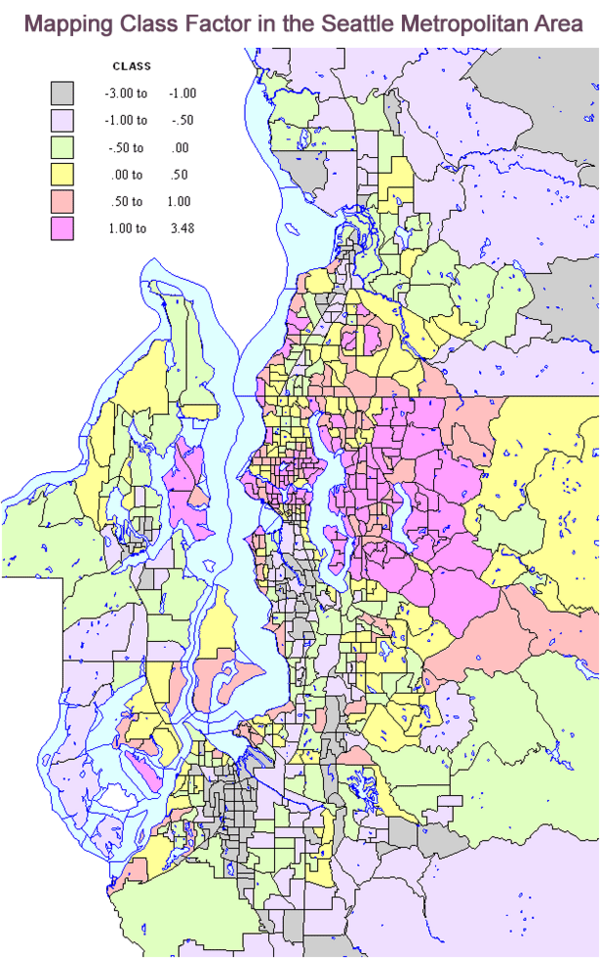
    This map plots “factor scores,” a statistically constructed variable or index divided into six levels of “class:” two upper, two middle and two lower. It is timely to do this, since it was 50 years ago when Calvin Schmid, demographer in Sociology at the University of Washington, and my early mentor, performed a pioneering factor analysis of crime in Seattle – and this was before modern computers! The derived scores most reflect high weighting of the variables: percent of adults with a BA or more, percent in professional versus laboring occupations, median house value and median household income.

    As you look at the map, it’s clear how Seattle reflects very strongly what is generally described as gentrification. This means the reclaiming of the central core by the highly educated and professional, eschewing the suburban metaphorical desert. In the case of Seattle, this process occurring between 1985-2005 resulted in the displacement of over 50,000 less affluent and often minority households to south King county. The city begins to resemble the historic pattern of the rich and important occupying the vibrant core of the city, relegating the working poor to the suburbs, with poor access and inadequate services. Indeed, even now I am involved in a project to assess the lack of access of poor children, often minority or foreign born, to health care in south King county.

    The dominant “upper class” area is the Eastside, east of Lake Washington, and location of the affluent “edge city” of Bellevue, home of the Microsoft campus. A second set of upper class areas are waterfront and view neighborhoods, taking advantage of the Seattle area’s broken topography. The third is simply the University of Washington immediate hinterland. I suspect the location of a large research university with 42,000 students and 22,000 staff increasingly propels Seattle’s unusually high status, income and popularity. I think this is increasingly more important a factor than the presence of an increasingly less important downtown Seattle business center.

    Conversely, lower class areas include traditional zones of mixed housing, industry and transport, such as south Seattle, the older satellite cities of Everett (north), Bremerton (west), and especially Tacoma (south). The largest area of lower class neighborhoods extends from south Seattle through south King county to Tacoma, marked by historical development, displacement from Seattle and high minority population. The second large zone of lower class settlement is the rural fringe, especially in Pierce (south) and Snohomish (north) counties, and may surprise those who think all rural areas are the home of rich estates.

    Then there is the middle class. This is where the suburbs matter most. On the map, middle class areas (yellow and green) are intermediate in location as well and dominate the outer suburban areas as well as some older inner neighborhoods of Seattle and Tacoma. It is unfortunately true that race, ethnicity and class remain highly correlated especially within the core cities of Seattle and Tacoma, reflecting the continuing history of unequal education and job preparation and prospects.

    This analysis suggests one possible future of urban development following something of a European model, with most middle class people in the suburbs, while the rich and poor concentrate either in the urban core or in selected locales in the periphery. As for the city itself, it’s clear that the total landscape is not simply becoming wealthier but increasingly bifurcated between the affluent and the long-term poverty population. And suburbia, home to the vast majority of the region’s population remains the predominant home of the middle and working classes, with pockets of both wealth and poverty.

    Richard Morrill is Professor Emeritus of Geography and Environmental Studies, University of Washington. His research interests include: political geography (voting behavior, redistricting, local governance), population/demography/settlement/migration, urban geography and planning, urban transportation (i.e., old fashioned generalist)

  • New Mitsubishi Car: Climate Friendlier than New York Transit

    Further demonstrating the ability of technology to reduce greenhouse gas (GHG) emissions, Mitsubishi has announced development of a lithium battery driven car, to be sold within two years. The car, the “MIEV Plug-In Electric First Drive” would travel as much as 100 miles (160 kilometers) between charges.

    United States Data and Comparisons: GHG Emissions per Passenger Mile/Passenger KM are indicated below (From power plants – variation is due to mix of fuel sources used in producing electricity)

    Average United States: 61 grams/37 grams

    Lowest (Vermont): 1.4 grams/0,7 grams

    Highest (North Dakota): 102 grams/62 grams

    The average GHG reduction compared to the current US automobile and sport utility vehicle fleet average would be 83 percent. The car would emit approximately less than one-half the GHGs per passenger mile as transit in New York area (the best in the nation) and one-fourth the overall US transit average.

    European Union Comparison: The MIEV would be 40 percent less GHG intensive that is required by the newly adopted European Union fuel economy requirements for 2020 (the equivalent of 101 grams per passenger mile or 62 grams per passenger kilometer).

    The above calculations assume the US national vehicle occupancy rate of 1.6. The comparison to the present fleet includes upstream production and transport activities.

    Sources: Mitsubishi site, Edmunds Review

  • Europe: No Longer A Role Model For America

    For decades many in the American political and policy establishment–including close supporters of President Obama–have looked enviously at the bureaucratic powerhouse of the European Union. In everything from climate change to civil liberties to land use regulation, Europe long has charmed those visionaries, particularly on the left, who wish to remake America in its image.

    “There is much to be said for being a Denmark or Sweden, even a Great Britain, France or Italy,” wrote political scientist Andrew Hacker in his 1971 book The End of the American Era .This refrain has been picked up again more recently by the likes of Washington Post reporter T.R. Reid and economist Jeremy Rifkin. Just last year, international relations scholar Parag Khanna shared his vision of a “shrunken” America lucky to eke out a meager existence between a “triumphant China” and a “retooled Europe.”

    But the tendency to borrow from the European toolbox may be somewhat questionable, particularly given that a growing number of Europeans are either uninterested–barely 40% bothered to vote in E.U. Parliament elections last week–or in open revolt against their own system of government. In the elections, for example, parties generally opposed to expanding E.U. power gained ground in countries as diverse as Hungary, Slovakia and the Netherlands. In Britain, the relatively small U.K. Independence Party, which even opposed membership in the U.N., out-polled the Labour Party and trailed only the Conservatives, who announced their own shift toward a more euro-skeptic point of view.

    Although the E.U.’s current top-down bureaucratic approach is clearly losing support, these recent events don’t necessarily mean the E.U. is doomed. It’s just that people who might be happy to accept a customs union and perhaps even a common currency are simply proving loath to hand over land use controls and environmental standards, much less foreign policy, to Brussels-based bureaucrats. At its root this move represents both a cry against control and a cry for greater autonomy.

    For the Obama administration, there may be some significant lessons here. Compared with Europeans, Americans are disposed to dislike too much central control. Turning Washington into a new Brussels, with regulations to cover virtually any human activity, could backfire both on the president and his party.

    But it’s also critical not to see Europe’s new tilt as affirming Reaganite cowboy capitalism. Many European countries, particularly the northern ones, are justly proud of the “social” models of capitalism they embrace. There are many policies–such as Danish incentives for industrial firms to greenify themselves, efficient universal health care and tough fuel economy standards for cars–that should be discussed and perhaps even adopted in some form in the U.S.

    In one sense, we should understand that Europeans are trying to protect their preferred standards when it comes to culture, social structure and lifestyle. They remain, if you will, fundamentally conservative in their efforts to preserve their well-established welfare states.

    But overall the anti-E.U. vote should make it clear that Europe’s overall economic system makes for a poor role model for our country. When the current economic crisis first hit, many European leaders–and their American fans, like Harvard economist Ken Rogoff–saw vindication for the E.U.’s economic policy and a much tougher road for the U.S. over the next year or two. Yet in reality, Europe already has suffered as much as we have from the downturn, and recovery there may also be even slower to emerge. In some countries, such as Greece and France, social unrest has been far more evident than here in the U.S.

    Simply put, European models do not necessarily work better–and when they do, they have occurred in part due to shifts away from strict welfare-state policies. As Sweden’s Nima Sanandaji and Robert Gindehag have argued the recent return to growth in places like Sweden came only after some modest reforms in both taxes and social benefits.

    Yet at the same time, even successful European countries–as well as the whole E.U.–generally experience slower growth than the U.S. with respect to measures like gross domestic product and job growth. This makes it an example of limited utility for America, a country that needs strong economic growth in order to maintain both its quality of life and overall social sustainability.

    The biggest source of divergence between the U.S. and the E.U. lies in demographic trends. For the most part, Europe is aging far more rapidly, and its workforce is shrinking. As demographer Ali Modarres notes, America’s population over the second half of the 20th century grew by 130 million, essentially doubling, while the populations of France, Germany and Britain together increased by 40 million, or 25%.

    As a result, there is virtually no European equivalent for cities like Houston, Phoenix, Las Vegas or Atlanta. American cities sprawl–and will likely continue to do so–because they are newer and because they are growing much faster in a country that is much vaster. Even with 100 million more people, the country will still be one-sixth as crowded as Germany.

    These differences will only become more stark. Opposition to immigration–from both Muslim countries and the E.U.’s own eastern periphery–is growing even in historically tolerant places like Great Britain, Denmark and Holland. Over time, migration into Europe is destined to slow. In Barack Obama’s wildly multicultural America, strong restrictionist sentiments have not gained much political ground, and, at most, efforts are directed not at reducing legal immigration but rather shifting it toward a more meritocratic model.

    So we can expect America’s population to continue growing at close to the highest rate in the advanced industrial world while Europe remains among the most rapidly aging places on earth. America’s fertility rate is 50% higher than Russia’s, Germany’s and Italy’s. By 2040, for example, the U.S. could have a greater population than the first 15 member nations of the European Union. Compare that prediction to 1950, when America had only half the population of Western Europe.

    These numbers point toward separate destinies for the U.S. and the E.U. Throughout history, low fertility and societal and economic decline have been inextricably linked, affecting such once-vibrant civilizations as ancient Rome, 17th-century Venice and, now, contemporary Europe.The desire to have children also reflects a fundamental affirmation of faith in the future and in values that transcend the individual. This is particularly true in affluent societies, where it is socially acceptable to remain childless and technology has made the decision not to have children easier to enforce.

    The U.S.’ demographic vitality will allow it to emerge from the current economic doldrums with more rapid growth than Europe–continuing a trend that has generally held for most of the past two decades. Innovation, largely a product of youthful indiscretion, also will continue to emerge more quickly stateside. Indeed, according to one recent European Commission survey, at the current rate of innovation, it would take 50 years for the E.U. to catch up to the U.S.

    Largely thanks to these demographic pressures, we could see an American economy twice the size of the E.U.’s by 2050. Unlike Europe, we have better prospects for growth, since there’s really no sustainable alternative for our society. In contrast, 40 years from now Europe’s economic growth rate is expected to fall 40%, due directly to the shrinking size of both its labor force and its internal market.

    We can ultimately expect two very different courses to develop. In America, the emphasis needs to be on sustained growth to prevent a massive decline in living standards. In contrast, Europe may be able to maintain a steady level of prosperity–even with lower growth, since its population will be either stagnant or declining–at least until the looming costs of maintaining a welfare state impose onerous economic burdens.

    Environmentally, Europe will become a “green” hero–because lower economic growth means a natural reduction in energy consumption and dreaded greenhouse gas emissions. Americans, on the other hand, will need to depend more on technological fixes–some of them from Europe–and embrace less economically damaging paths to growth. (These include promoting such things as working close to or at home and developing more fuel-efficient cars.)

    Neither Europe nor America–particularly given a much-reduced E.U. bureaucracy–has a better or worse model. We just have to recognize that these are, in the end, increasingly different societies: The former is focused on preservation of its hard-won peace and prosperity; the latter is challenged more by constant, major and sometimes even frightening change.

    Some may still hold out the hope that wise men in the old continent will present us with a road map to the future. But given the revolt going on against this mega-European ideal, we should understand that even many across the pond are having second thoughts about a future controlled by Brussels. Perhaps it’s better to recognize that most solutions to America’s problems–now and in the future–will be concocted not in Brussels, Berlin or Paris, but at home.

    This article originally appeared at Forbes.

    Joel Kotkin is executive editor of NewGeography.com and is a presidential fellow in urban futures at Chapman University. He is author of The City: A Global History. His next book, The Next Hundred Million: America in 2050, will be published by Penguin early next year.
  • Special Report: Infill in US Urban Areas

    One of the favored strategies of current urban planning is “infill” development. This is development that occurs within the existing urban footprint, as opposed that taking place on the fringe of the urban footprint (suburbanization). For the first time, the United States Bureau of the Census is producing data that readily reveals infill, as measured by population growth, in the nation’s urban areas.

    2000 Urban Footprint Populations

    The new 2007 estimates relate to urban areas or urban footprints as defined in 2000 and are produced by the American Community Survey program of the Bureau of the Census. Urban areas are the continuous urbanization that one would observe as the lights of a “city” on a clear night from an airplane. It is the extent of development from one side of the urban form to the other. Further, urban areas are not metropolitan areas, which are always larger and are defined by work trip travel patterns. Metropolitan areas always include adjacent rural areas, while urban areas never do.

    The Process of Infill

    Although embraced with often religious passion within the urban planning community, infill is neither good nor bad in terms of social or environmental impact. Infill always increases population densities and that means more traffic. If road capacity is increased sufficiently, traffic congestion can be kept at previous levels. If on the other hand, nothing is done, traffic congestion is likely to increase along with population. This means slower traffic and more stop and go operations, which inevitably increases the intensity of air pollution with the potential to cancel out any reductions in greenhouse gas emissions (GHG) that might occur if average car trip lengths decline. Similar difficulties can occur with respect to other infrastructure systems, such as sewer and water. Expanding roads, sewer and water systems in already developed areas can be far more expensive than new systems on greenfield sites. Regrettably, boosters of infill routinely ignore these issues.

    But infill has been going on for years, along with suburbanization, both in the United States and in other first world nations. This is indicated by the general densification trend that occurred in US urban areas between 1990 and 2000 and the longer term densification trends that occurred in a number of southwestern urban areas, such as Los Angeles, San Jose, Riverside-San Bernardino, Phoenix, Dallas-Fort Worth and Las Vegas. All these traditionally “sprawling” areas have, in fact, been densifying since 1960 or before. Since 2000, 33 of the nation’s 37 urban areas with a population exceeding 1,000,000 population experienced population infill to their 2000 urban footprints.

    Infill in Traditionally Regulated Markets (More Responsive Markets)

    Infill is a natural consequence of the traditional post-World War II land use regulation, which tends towards accommodating both demographic growth and market forces. This has been replaced by more prescriptive (often called “smart growth”) land use regulation in some urban areas. Under traditional regulation, suburban development followed a “leap frog” process, moving ever further out. This is roundly condemned in today’s planning literature and among leading academics and policy makers.

    Leap frog development occurs where urban development skips over empty land and creates a less continuous urban fabric. Land is developed based upon the interplay between sellers and buyers. Due to fewer planning restrictions, no seller can be sure that their land will be purchased since there is always plenty of land that buyers can otherwise purchase. This keeps land prices down. In the more responsive markets, it is typical for land and site infrastructure costs to be 20 percent of the total price land and house price.

    Infill occurs as land that has been “leaped” over is subsequently purchased for development. Again, because buyers have plenty of choices, prices of the infill land remains low, so that land and infrastructure costs remain relatively affordable in relationship to the overall new house purchase price.

    The result is an urban area that is generally continuous, though with a transitional “ragged edge.” The ragged edge enabled the broad expansion of home ownership that occurred in the decades following World War II by keeping house prices low.

    Infill in More Prescriptive Markets (Smart Growth)

    The infill process is quite dramatically different in more prescriptive markets. Infill might be mandated as a percentage of total development or by severely limiting the development allowed to occur closer to the urban fringe. Sellers of land on which development is permitted have disproportionate power to charge higher prices because the planning regime seriously limits the availability of alternative sites for buyers. This, of course, flows through to house prices. The share of land and site infrastructure can rise to two-thirds of the house and land cost. The urban area may have a “clearer” edge, but at a significant loss in housing affordability.

    Infill Trends in the 2000s

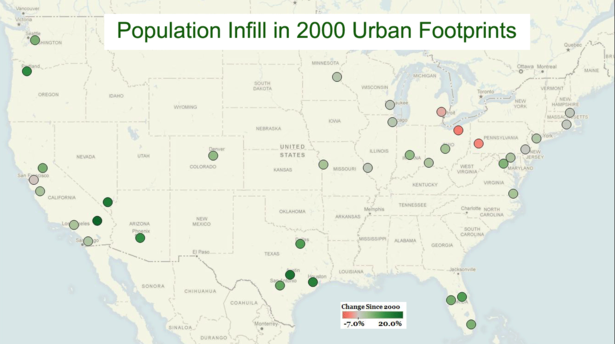
    The new infill estimates indicate that American urban areas continue to densify. Between 2000 and 2007, the 33 of the 37 urban areas of more than 1,000,000 population experienced densification in their 2000 urban footprints. The average population infill increase was 5.6 percent (See Table the following table).

    Population Infill in 2000 Urban Footprints
    2000-2007
      Population Change: 2000 Urban Footprint Population Density of 2000 Urban Footprint in 2007  
    Urban Area 2000 Census 2007 Estimate Change % Rank Rank
    Riverside–San Bernardino, CA       1,506,816      1,800,117     293,301 19.5% 1         4,110 8
    Atlanta, GA       3,499,840      4,118,485     618,645 17.7% 2         2,100 36
    Austin, TX         901,920      1,051,962     150,042 16.6% 3         3,308 17
    Las Vegas, NV       1,314,357      1,518,835     204,478 15.6% 4         5,311 5
    Houston, TX       3,822,509      4,370,475     547,966 14.3% 5         3,377 16
    Portland, OR–WA       1,583,138      1,779,705     196,567 12.4% 6         3,755 12
    Phoenix, AZ       2,907,049      3,254,634     347,585 12.0% 7         4,078 9
    Dallas–Fort Worth, TX       4,145,659      4,549,281     403,622 9.7% 8         3,236 18
    Orlando, FL       1,157,431      1,267,976     110,545 9.6% 9         2,799 24
    San Antonio, TX       1,327,554      1,440,794     113,240 8.5% 10         3,540 14
    Tampa–St. Petersburg, FL       2,062,339      2,209,067     146,728 7.1% 11         2,754 25
    Sacramento, CA       1,393,498      1,488,647       95,149 6.8% 12         4,034 10
    Seattle, WA       2,712,205      2,896,844     184,639 6.8% 13         3,040 21
    Miami, FL       4,919,036      5,243,679     324,643 6.6% 14         4,703 6
    Washington, DC–VA–MD       3,933,920      4,174,187     240,267 6.1% 15         3,611 13
    Denver, CO       1,984,887      2,087,803     102,916 5.2% 16         4,192 7
    Indianapolis, IN       1,218,919      1,278,687       59,768 4.9% 17         2,316 34
    Columbus, OH       1,133,193      1,175,132       41,939 3.7% 18         2,960 22
    Kansas City, MO–KS       1,361,744      1,408,900       47,156 3.5% 19         2,413 31
    Virginia Beach, VA       1,394,439      1,442,494       48,055 3.4% 20         2,742 26
    San Jose, CA       1,538,312      1,588,544       50,232 3.3% 21         6,110 2
    Los Angeles, CA     11,789,487    12,171,625     382,138 3.2% 22         7,302 1
    Cincinnati, OH–KY–IN       1,503,262      1,546,730       43,468 2.9% 23         2,305 35
    Baltimore, MD       2,076,354      2,133,371       57,017 2.7% 24         3,128 19
    San Diego, CA       2,674,436      2,747,620       73,184 2.7% 25         3,514 15
    New York, NY–NJ–CT     17,799,861    18,223,567     423,706 2.4% 26         5,440 4
    Minneapolis–St. Paul, MN       2,388,593      2,438,359       49,766 2.1% 27         2,727 27
    Chicago, IL–IN       8,307,904      8,467,804     159,900 1.9% 28         3,992 11
    St. Louis, MO–IL       2,077,662      2,103,040       25,378 1.2% 29         2,540 30
    Milwaukee, WI       1,308,913      1,324,365       15,452 1.2% 30         2,719 28
    Boston, MA–NH–RI       4,032,484      4,077,659       45,175 1.1% 31         2,350 33
    Providence, RI–MA       1,174,548      1,183,622        9,074 0.8% 32         2,353 32
    Philadelphia, PA–NJ–DE–MD       5,149,079      5,178,918       29,839 0.6% 33         2,880 23
    San Francisco, CA       3,228,605      3,214,137      (14,468) -0.4% 34         6,099 3
    Detroit, MI       3,903,377      3,831,575      (71,802) -1.8% 35         3,041 20
    Pittsburgh, PA       1,753,136      1,687,509      (65,627) -3.7% 36         1,981 37
    Cleveland, OH       1,786,647      1,705,917      (80,730) -4.5% 37         2,641 29
    Total  116,773,113  122,182,066  5,408,953 5.6%
    Data from US Bureau of the Census

    Riverside-San Bernardino, long castigated as a “sprawl” market, had the largest population infill, at 19.5 percent. Atlanta ranked number two, at 17.7 percent. This is a real surprise, since Atlanta was the least dense major urban area in the world in 2000, ranked second in 2000s infill. As a result, it is likely that Pittsburgh- often held up as a model of urban regeneration – is now the world’s least dense major urban area. On the other hand, if Atlanta’s infill rate continues, its 2000 urban footprint will be more dense than that of Boston by 2015.

    Austin ranked third, adding 16.6 percent population to its 2000 urban footprint. Las Vegas ranked fourth, with a 15.6 percent increase in its 2000 urban footprint. The density of Las Vegas is increasing so rapidly that by the 2010 census its 2000 urban footprint will be more dense than the 2000 New York urban footprint, should the current rates continue.

    Perhaps most surprising of all is that Houston ranked fifth, added 14.3 percent to its 2000 urban footprint. This may surprise those who have denounced Houston’s largely deregulated regulatory environment, both in the city and in unincorporated county areas in the suburbs. Yet overall Houston’s infill exceeded that of smart growth model Portland. The Rose City stood at sixth, adding 12.4 percent to its 2000 urban footprint.

    Perhaps equally surprising, Portland remains less dense than average for a western urban area. Its 2000 urban footprint density trailing Los Angeles, San Jose, San Francisco, Las Vegas, Denver, Riverside-San Bernardino, Phoenix and Sacramento, while leading only San Diego and Seattle.

    The top ten were rounded out by Phoenix (7th), Dallas-Fort Worth (8th), Orlando (9th) and San Antonio (10th). It is worth noting that like Houston, the unincorporated suburbs of Austin, Dallas-Fort Worth and San Antonio have largely deregulated land use regulation, yet these urban areas ranked high in infill.

    Interestingly some of the greatest infill growth also took place in the fastest growing, traditionally “sprawling” cities. Atlanta also had the largest numeric increase in the population of its 2000 urban footprint, at more than 600,000. Houston was a close second, at nearly 550,000.

    In contrast, population losses since 2000 in the urban footprints of Cleveland, Pittsburgh, Detroit and San Francisco, means these urban areas experienced no population infill. San Francisco’s loss enabled San Jose to move into second position nationally after Los Angeles in the population density of its 2000 urban footprint.

    How the Core Cities Fared

    The core cities (municipalities) attracted, on average, their population share. Approximately 30 percent of the infill growth occurred inside the core cities. Even this figure may be a bit high, due to the impacts of annexation

    All of the infill in Philadelphia, Baltimore, Chicago, Providence and Minneapolis-St. Paul occurred outside the core cities. The city of Portland attracted barely 10 percent of its urban area infill, despite highly publicized (and subsidized) infill projects such as the Pearl District. Core cities attracted the largest share of infill growth in such diverse cities as San Antonio, San Jose, Columbus, Phoenix and New York.

    Note: Additional information available at http://www.demographia.com/db-uzafoot2007.pdf

    Wendell Cox is a Visiting Professor, Conservatoire National des Arts et Metiers, Paris. He was born in Los Angeles and was appointed to three terms on the Los Angeles County Transportation Commission by Mayor Tom Bradley. He is the author of “War on the Dream: How Anti-Sprawl Policy Threatens the Quality of Life.

  • Kauai, Hawaii: Local Merchants Make Waves

    Many have by now heard or read the story of the plucky group of Hawaiians on the island of Kauai who, when faced with the loss of their businesses due to the state government’s inability to open park roads to a popular beach and camping area, took care of it themselves for a fraction of the cost and in a fraction of the time. How very Tocquevellian. Or, better, how very American. The story brings a reflexive smile to everyone who hears it, but the events cast a spotlight on the way governments at all levels interact with their communities, and how, in light of significant budget cutbacks, roles are changing.

    In his magisterial commentary on 19th century democratic culture, Democracy in America, Alexis de Tocqueville compared the initial sources of public action in European countries with the United States: “Everywhere that, at the head of a new undertaking, you see the government in France and a great lord in England, count on it that you will perceive an association in the United States.”

    De Tocqueville was overwhelmed at this penchant of Americans to collaborate in common effort. The Frenchman attributed this unique, awe-inspiring American quality to the absence of a large government or aristocratic structure. “They can do almost nothing by themselves,” he wrote, “and none of them can oblige those like themselves to lend them their cooperation. They therefore all fall into impotence if they do not learn to aid each other freely.”

    After December floods washed out the park roads, bridges, and facilities at the Polihale State Park, Hawaii’s Department of Land and Natural Resources (DLNR) studied the damage and released a statement two months later, declaring, “We know that people are anxious to get to the beach. However, the preliminary cost estimate of repairs is $4 million.” An original timeline for the work was set for late summer, but, commented local resident and surfer, Bruce Pleas, “It would not have been open this summer, and it probably wouldn’t be open next summer.”

    The DLNR’s natural response to this natural disaster was to go inward (look to its own capabilities) and upward (look for more State or Federal funds). The public’s role – if there was to be any – was to leave them alone to do the first task, and help them achieve the second; specifically, the main objective was to grab a fee-generated windfall for the department, ironically entitled the “Recreational Renaissance” fund. In February, DLNR’s Chair, Laura Thielen, pleaded, “We are asking for the public’s patience and cooperation to help protect the park’s resources during this closure, and for their support of the ‘Recreational Renaissance’ so we can better serve them and better care for these important places.” The department convened an “information meeting” in March to discuss… how residents could work with the department to open the roads? No, only to provide information on how to lobby the state for more funding.

    This approach did not sit well with area residents who depend on the park for their livelihood. It was reported that Ivan Slack, owner of Na Pali Kayaks, which operates from the beach in Polihale, summed up the community’s frustration: “We can wait around for the state or federal government to make this move, or we can go out and do our part.” Beginning in late March, business leaders and local residents organized — “associated” — to take the situation into their own hands. From food donated by local restaurants to heavy machinery offered by local construction companies, a project that was originally forecast to cost millions and take months (if not years) was nearly completed in a matter of weeks, all with donated funds, manpower, and equipment. As Troy Martin from Martin Steel, which provided machinery and five tons of steel at no charge, put it, “We shouldn’t have to do this, but when it gets to a state level, it just gets so bureaucratic; something that took us eight days would have taken them years. So we got together — the community — and we got it done.”

    This was not just a park clean-up, but a significant undertaking involving bridge-building, reconstructing rest rooms, and use of heavy equipment to clear miles of flood-damaged roadways.

    While unique in its scope, what is happening on the southwestern coast of Kauai is not completely anomalous. Due to the national budget crisis, states and cities around the country are having to take a hard look at the services they offer and find new ways to involve civil society. The organization I head up, California Common Sense, is working with cities and school districts that have to chart this new course. The failure of several revenue-raising ballot initiatives here in the Golden State has provided even more impetus to practice this outward-focused governance.

    In some respects, governments themselves are to blame for setting the service expectations of the past decades. Beginning in the mid-1980s, the “TQM” (Total Quality Management) craze in private industry found its way into the public sector, and a new language of “service provider” (government) and “customer” (citizen) followed. Government no longer was something to participate in, but something to pay for. Later in this transition, scholars like Northwestern University’s John McKnight could see that the results of this new relationship were heading towards a precipice. In an essay for The Essential Civil Society Reader, McKnight commented on this situation in terms reminiscent of de Tocqueville’s fears almost two centuries earlier: “The service ideology [in governments] will be consummated when citizens believe that they cannot know whether they have a need, cannot know what that remedy is, [and] cannot understand the process that purports to meet the need.” This, thankfully, is not the situation in Kauai.

    But we, as citizens, don’t get off the hook that easily. Certainly, we have too often taken on this role as “customer,” believing our taxes are just the prices we pay for the services we desire, from filling potholes to teaching our children. When government does not perform up to our expectations the usual response is either to decry its wastefulness or to acquiesce to higher taxes. These often unproductive reactions come from both the left and right on the ideological spectrum.

    The story in Kauai, and others bubbling up around the country, demonstrate that there is a “third way”: get some friends and pick up a shovel when the government can’t or won’t. Governments on the other side of this equation need to be open to this kind of direct participation; in fact, they should encourage it. What is happening in Polihale is not a syrupy, Rockwellian portrait. It is doubtful that this dramatic participation would have occurred without the dire financial consequences that loomed for many of the residents and businesses involved. It is a manifestation of de Tocqueville’s “self-interest rightly understood”.

    “All feel themselves to be subject to the same weakness and the same dangers,” De Tocqueville wrote, “and their interest as well as their sympathy makes it a law for them to lend each other mutual assistance when in need.” Ray Ishihara, manager of the local Ishihara Market, which has donated food for the volunteers, puts this in more concrete terms: “I think it’s great. Everybody needs help these days in this economy.”

    It is ironic that this should all be taking place in President Obama’s home state. The usually articulate Obama has sounded uncomfortable when attempting to define how he expects Americans to “sacrifice” during this financial crisis. From a policy perspective, the Administration’s only responses appear to be raising taxes on our wealthiest 5%, and, interestingly, increasing Federal funding for volunteer programs.

    One thing the President could do is travel out Kauai’s Route 50 to Polihale State Park during his next trip to Hawaii. There, he could see and celebrate what everyday Americans do when they gather in common purpose. Thanks to their hard work and sacrifice, surf’s up.

    Pete Peterson is executive director of Common Sense California, a multi-partisan organization that supports citizen participation in policymaking (his views do not necessarily represent those of CSC). He also lectures on State & Local Governance at Pepperdine’s School of Public Policy. An earlier version of this article appeared in City Journal.