Blog

  • Federal Highway Trust Fund: Problem Solving, Government Style

    News Flash: The Federal Highway Trust Fund will go broke in August.

    It went broke last year, and Congress needed an emergency transfer of $8 billion to keep it solvent. There was very little concern last year, but this year we find ourselves in a post-modernist political environment where managing a crisis is good politics, although actually all we do is talk about it.

    According to Senator Barbara Boxer (D. CA), the fund will need $7 billion this year and another $10 billion next year to remain solvent through September 30, 2010. Even with this crisis verified and time running out, Congress seems reticent to pull the trigger on a solution anytime soon. It’s just too heavy a lift politically.

    It should not surprise anyone that the trust fund is broke. The federal tax on gasoline has not been increased since 1994, but this did not stop politicians from spinning the issue. State and federal data show that gas tax collections are way down. In Pennsylvania for example revenues are running about $100 million below budget. There is also the recession, price of gasoline and more fuel efficient cars contributing to the crisis. But one factor often overlooked is that with the passage of the last federal highway bill (SAFETEA-LU) spending simply outstripped revenues, and even without changes in driving habits and the economic downturn the fund was slated to be depleted.

    Now for the really tough part: Congress needs to find money, not simply print it. The trust fund has a dedicated source of funding that has lost about half its purchasing power to inflation over the past 15 years. During that period, politicians have avoided raising taxes for roads and bridges like the plague, so now a crisis looms and our political leaders are finding out that it is much easier to spend than adequately fund.

    An Associated Press report stated, “A study by the Transportation Research Board of the National Academies estimated that the annual gap between revenues and the investment needed to improve highway and transit systems was about $105 billion in 2007, and will increase to $134 billion in 2017 under current trends.”

    The usual bag of tricks used to obfuscate this issue is no longer available. Not one but two “blue ribbon” commissions have already reported that gas taxes need to be increased. In January, The National Commission on Surface Transportation Infrastructure Financing called for a ten cent per gallon increase. A two year study by National Surface Transportation Policy and Revenue Study Commission called for an increase of 40 cents per gallon. Both studies recommended that gas tax be indexed to inflation. The second recommendation had no chance since it would in effect take this issue out of the hands of politicians who would much rather do nothing about an issue than lose control over it.

    Meanwhile, Congress has been busy at work expanding mandates for biofuels and increasing CAFÉ standards to more than 35 miles per gallon. These two combined decimate gas tax and make it an almost unworkable solution to this crisis going forward.

    Problem solving often requires taking a long term view of things. It demands answering tough questions and a willingness to implement difficult solutions. Elected leaders find it very difficult to take a long term view, because they live in a two-year election cycle. It’s one reason why the founders wanted limited government. They knew the limits of government to make tough choices to solve difficult problems.

    The day after the Department of Transportation reported the trust fund is reaching depletion it issued another press release announcing the Vice President Biden and Secretary of Transportation Ray LaHood were “challenging governors to think boldly when designing high-speed rail plans…” The Obama Administration has committed $13 billion to high-speed trains to jump start a “world class passenger rail system” in America.

    The release states that “President Obama’s vision for high-speed rail mirrors that of President Eisenhower (who gave us the Interstate Highway System.)” High-speed rail was positioned as a solution to lower dependence on oil, provide for a cleaner environment, and drive economic growth. All may be true, but what about the $17 billion hole in the highway trust fund?

    There is a lesson and a caution here about putting matters into the hands of politicians. They know that they won’t get as much credit for fixing something that is broken as they will for giving the people something new.

    Maybe this explains why government budgets keep growing and so do the deficits for many of our legacy programs.

    Dennis M. Powell is president and CEO of Massey Powell an issues management consulting company located in Plymouth Meeting, PA.
  • Farmland Prices: The Cost of Growing A Suburb

    Summer in Minnesota – land of 10,000 lakes — is, for many families, about boating, with the Harley the preferred mode of ground transportation. In winter, snow mobiles are popular. Hunting and fishing replace the corner coffee shops as hangouts. Three car garages are considered a minimum – four even better!

    So how did it come to pass that out-of-control land prices would destroy the economics of housing in this small-town region? And why was the pattern repeated in markets like Las Vegas and Phoenix?

    In the 1980’s the Metropolitan Council in Minneapolis became concerned with sprawl. The MET Council thought Portland, Oregon’s policies to control sprawl by creating an Urban Boundary would be beneficial to the Twin City area, a seven county region. This area is topographically simple: no ocean boundary, and, unlike Portland’s region, no mountain ranges. The MET Council did not anticipate that their attempt to control growth would end up contributing to it.

    Farmers who owned land with sewer capacity outside the boundary knew that its value had just skyrocketed. When a supply — land — is limited, those that control it can name their own price. Within the boundary land was too expensive to develop affordable housing. So cities outside the MET Council’s control began to attract developers. Places that nobody had heard of much: Otsego, Albertville, Elk River, and Hugo are all a very long drive from the Twin City core. These towns had two important components for builders: city sewer and cheap land.

    As the tiny towns outside the Urban Boundary attracted more development, they also attracted the national developers. All of the nation’s Top Ten Home Builders discovered this region. Each year 25,000 or so new homes were built and quickly sold to suburbanites who preferred a 30 to 40 mile commute over living near the city core. (Keep in mind that Minneapolis / St Paul has one of the nicest core areas of a major US city. Even downtrodden sections look pretty nice. And Minneapolis stays alive in the evenings and becomes a social Mecca that is also relatively safe.)

    Much of the escalation in home pricing was due to a bidding war over developable farmland. National builders, using their Wall Street dollars, competed for desirable acreage. If Farmer Fred was able to sell his property for $50,000 an acre, when Roy next door put his farm up, the starting price was $50,000 and the final fee was likely to be $60,000, the starting point of the next site for sale. By 2005 the outer small town land that could have been bought for $12,000 an acre a decade earlier was worth more than 10 times that amount.

    In the past, builders would look at the price of a finished lot, and assume that the house they built on it would cost a maximum of four times the finished lot price; a sort of “one-quarter” rule for land costs. If the lot cost $30,000, they would not build a home that ultimately cost more than $120,000.

    By 2005, if outer suburban land sold for $150,000 an acre and the density (after required park areas, wetlands, buffers, and shoreline zones) was two homes per acre, that meant that $75,000 of a new suburban home was in raw land costs. Add to that $25,000 in construction of roads, utilities, fees, etc, and the lot price skyrocketed to $100,000. Using the one-quarter rule, this meant the builder would need to get $400,000 for the finished home.

    At the 2006 Land Development Today Breakthroughs conference I spoke about our research into the impending market crash and its basis. The market had just begun to show signs of slowdown, and nobody was predicting a big fall.

    Our “study” was based on a comparison of our local housing market in the Minneapolis region with markets where we were working in about 40 States. It involved a simple search of major builders in the top markets. We looked at areas where land prices were escalating much faster than inflation in order to see the common elements. The National Association of Home Builders average national price for a 2,400 square foot average home was $264,000. It should be no surprise that impromptu results indicated the average price of a 2,400 square foot home in Phoenix was $331,000 (20% above average), in Las Vegas $442,000 (40% high), and in the Minneapolis suburbs $349,000 (25% high).

    Weather was not one of the common elements. But all three areas — Las Vegas, Phoenix, and the Twin Cities — had explosive growth for two decades until 2007 (2006 for the Twin Cities), and all three had most, if not all, of the nation’s Top Ten Home Builders selling and building.

    In March of 2005 one of my clients made me an offer. If I convinced a certain farmer to sell, I would receive not just the planning fees, but also 5% of the profits. The land in question was about an hour’s drive from the urban core during rush hour traffic. I looked at the site and took out the slope restriction, the Department of Natural Resources tiers, the wetlands, the buffers, and the land that was otherwise not buildable, including the rolling surface areas that resembled more Moto-Cross course than residential developable land.

    The cost for the remaining buildable area would have been about $300,000 an acre. The numbers simply did not work out. Land prices had reached the breaking point. Since there was no possible way to profit, my 5% of zero would still be zero. I suggested that my client not do the deal, and saved him from financial ruin.

    It’s easy to make Government the scapegoat. Even though the MET Council set in motion policies that likely caused sprawl by trying to curb it, it was not the cause of land prices going out of control. All the major developers with their deep pockets outbidding each other for over a decade was what did the economics in. Today, housing prices in the Twin City market have plummeted to a more realistic point that is about what the national average was in 2005.

    Five years before the crash many actually believed that high land prices were a sign of a great economy. Well guess what? They were wrong.

    Rick Harrison is President of Rick Harrison Site Design Studio and author of Prefurbia: Reinventing The Suburbs From Disdainable To Sustainable. His websites are rhsdplanning and prefurbia.com.

  • A New Story for Timeshare

    By Richard Reep

    More employment sectors are increasingly migratory and less fixated on a particular place. Many of us are instead working from home, or from places where we prefer – it might be a coffeeshop, or it might be a vacation condo. Housing’s rigid systems belong to the Old Economy.

    Meanwhile, a new form of housing less than 2 generations old has quickly gained ground as a part of the luxury leisure lifestyle of the middle class: timeshare. Unfortunately, during the real estate boom in the last several years, timeshares have been severely overbuilt, and the market is years, perhaps even decades, away from filling this oversupply. This form of housing is based not on real estate mortgages – although one or two companies still practice this – but based upon points. And the genius of the points-based residence is its transportability, which served the vacation market extremely well.

    By applying a points-based approach to primary housing, a developer will be able to take advantage of the increasing percentage of workers that move frequently for their careers. This unchains workers from their mortgages and lawnmowers, and enables the nomadic nature that has defined several segments of our economy where project-based employment has replaced company-based employment.

    Most timeshare developers privately agree: “The party’s over. It won’t be anything like it was, even if the economy comes back. At least not for a long, long time,” confessed one senior developer for an international timeshare company privately. Meanwhile, many of the communities who assumed a vast market of affluent customers need to start asking big questions.

    One of them is to refocus on the quality of places. Gated condominium developments, with little or no connection to the communities where they reside, are a study in self-absorbed lifestyles. Turning these into real homes and communities will require opening them up, integrating them into the local culture and civic life of their places, and making timeshares something other than…well, simply a commodity.

    It will also require some fundamental changes that are overdue in the timeshare industry itself. The points-based system was originally fabricated as a customer-loyalty system. It will need to be adapted to suit a worker wishing the flexibility to travel from place to place and stay for longer periods of time. Perhaps a more ominous dilemma that the timeshare developers have created for themselves, however, is the crushing maintenance fees, running often $750 to $1000 a week or more.

    The credit-backed future dreams of luxury and leisure remain idle, but the physical properties sit on some pricey and fundamentally attractive real estate at ski area bases, golf courses, desert getaways, and beaches. Few may be in the mood these days to buy a bunch of ephemeral points for a vacation, but the same system would serve well any project-based endeavor that assembles workers for an assignment and disbands these workers when the assignment is completed.

    The movie industry has operated on this model for years, and other industries have begun working in this same manner. In the Old Economy, this was rare, and most pursuits encouraged a young college graduate to put down roots as fast as possible: Start a career, start a family, and buy a house. Increasingly, however, entry-level workers have resisted this, preferring instead to experiment with multiple careers, often moving from place to place, sometimes until well into their thirties. In the technology industry, software developers have tended to work on this model, and especially in digital media, the permanent nature of jobs and companies has given way to temporary alliances and co-ops to get things done – the so-called Digital Nomads.

    Yet even as the workforce and its physical plants adapted, the housing industry instead has trudged along its same path, with mortgages or rental property as the two options. It is time for timeshare to fill the gap in between these two extremes and offer this as a third option. At this point, the timeshare industry has little to lose. Market contraction and the loss of its credit foundation have rendered these companies dormant. There needs to be a paradigm shift to recover at least some of these investments and, over time, create long-term value.

    Timeshare developers built plenty of beach resorts, which are still fairly active, but still can be turned into more semi-permanent communities. Their interior resorts – desert, golf, and ski areas – have an even more urgent need for reinvention. A stronger and more stable sense of community, safety and security, and higher quality of life could draw more workers away from the large metropolitan areas, as baby boomers downshift and global corporations onshore their workers.

    All this adds up to an opportunity for a timeshare developer who wants to fill his units with paying customers. When digital media employment is studied, it might resemble the timeshare model more closely than one thinks. Dominated by no one single old-economy company, digital media assignments are often accomplished by a temporary alliance of multiple small studios that work together, then decamp and move to the next assignment. This is a perfect scenario for a points-based housing system. Freed from the chains of the mortgage banks and from the landlord-lease situation, the points-based system enables free flow of workers who enjoy sampling the tastes of different cities and have no real interest in setting down roots, mowing lawns, and fixing leaky gutters.

    Ski timeshare properties in particular are quite ready for this shift in focus. Ski towns were built upon timber or mining town functions. They already have reinvented themselves and need to do this again. If these towns were to partner with their timeshare properties and incentivize technology and research employers, a new story and a new model could revitalize them.

    Marrying this desire to move to more low-density regions combines what timeshare developers do best – create amenity-laden residential communities – with a free-flow form of ownership. This approach is worth a closer look. We need to thaw the frozen residential concepts and look at new models and new stories that are happening in America and elsewhere. By adapting timeshare to the New Economy at this critical point, an industry can be repurposed and a new sustainable housing option can be born.

    Richard Reep is an Architect and artist living in Winter Park, Florida. His practice has centered around hospitality-driven mixed use, and has contributed in various capacities to urban mixed-use projects, both nationally and internationally, for the last 25 years.

  • Chicago: Preventing the Self-Destruction of Diversity

    Chicago’s urban core has boomed in a way that makes most other cities jealous. Every time you turn around, it seems, another gem is added to it. The Renzo Piano designed Modern Wing at the Art Institute recently opened its doors to general, if not universal, acclaim, for example.

    But while this boom is to be celebrated, and clearly it has been necessary to sustain the animating life force of the city as a whole, there are long term threats that need to be considered.

    The first is that all booms tend to contain within themselves the seeds of their own collapse. We’ve seen that with the dot.com bubble, the real estate bubble, and the finance bubble, the last two of which are really weighing on Chicago. Growth feeds on itself in a type of positive reinforcement loop. If it hits a certain point, it can really take off, as in a typically “hockey stick” diagram. The problem is that some point the trend reaches the point of exhaustion, and the hangover can be a bear. Most stable systems employ negative feedback controls or stabilizers to “take away the punch bowl just as the party is getting started”.

    The real challenge, however, is what Jane Jacobs called the “self destruction of diversity”. Thriving urban districts require a mixtures of users and uses acting to mutually sustain and energize a neighborhood. But what has a tendency to happen is that, as an area becomes popular, land values go up and rents go up. There is greater demand for and competition for the space. Because of this, the most economically successful use of the moment tends to become increasingly dominant. This is particularly the case if that use benefits from face to face interactions among multiple players in the space and clustering economics.

    Jacobs also talked about the requirement that neighborhoods contain buildings of a mixture of ages, such that they require differing levels of economic rent. New enterprises, particularly in wholly new fields, often require space that is available at low cost. So if there are no low cost buildings in an area, tomorrow’s new industries can’t often get started in a place at all. While she didn’t quite put it this way, this notion is often paraphrased as “new ideas require old buildings”.

    The boom in Chicago causes concern on both of these fronts. Firstly, the great Loop area is increasingly dominated by two uses: financial and business services for the global city function of Chicago, and entertainment/tourism. To some extent, the Loop has always had these characteristics as a typical CBD. And in many respects, the streets are far more active today than they were in an era not that long ago when the streets in the Loop really did roll up at 6pm.

    The real problem is that the boom in the Loop has generated enormous opportunity for profit in the redevelopment of older buildings. Many older buildings have been demolished completely, or preserved only the form of the “facadectomy”. A number of vintage office skyscrapers have been converted to residential use. The high rent district, which used to apply mostly to the core of Loop, now extends far to the West and South instead of just the traditional north. The number of places where one can obtain low-rent space in the greater Loop area would appear to have declined significantly.

    The same forces are operating in residential areas, which are increasingly taking on the cast of New Urbanist suburbs. Housing prices keep out all but the already affluent in many places. Rents have followed suit, leading to a predominance of swanky establishements catering primarily to consumption by the upscale: restaurants, clubs, boutiques, spas, etc. A number of formerly industrial districts have been reborn as more or less single use large format retail strips.

    What will the long term affect of this be? I don’t know. I do think it is something worth of consideration. Affordable housing is obviously something that is on the radar of many groups. But the idea of affordable office or industrial space less so. We want the Loop to be successful, but also I think there should be policies developed that are designed to actively sustain its diversity over time.

    The danger is that the Loop becomes increasingly concentrated in ever most high value specialized services. (I’ve even suggested how we might encourage this through cross-regional collaboration). This can be good in that it keeps Chicago a player at the pinnacle of the global economy. But it also exposes Chicago to the risk of niche exhaustion. And with the global city functions an artifact of globalization as we know it today, any disruption or further evolution of that model could seriously hit Chicago.

    As I’ve long argued, in an ever more rapidly changing, uncertain world, it is critical for cities to have a diversity of strategies and future options for success, and not put all their eggs in one basket. Chicago needs to continue reinforcing its success, but it also needs to look at how to diversify that success so that when, as it inevitably will, economic needs change, Chicago is right there with the next new thing. While picking winners and losers is a problematic concept, at a minimum the city should be looking at how to preserve the conditions necessary for success.

    Interestingly, the city has already taken some steps here. It created the concept of a “Planned Manufacturing District” to prevent residential encroachment into surviving manufacturing zones like the Kinzie Corridor. A good move. While mono-use isn’t always a good thing, for a traditionally manufacturing area, I think this is a decent strategy. We should be looking at similar means of preserving the favorable economics for new ideas in the urban core as well.

    More Chicago:

    Chicago: A Declaration of Independence

    Reconnecting the Hinterland Series
    Part 1A: Metropolitan Connections
    Part 1B: High Speed Rail
    Part 2A: Onshore Outsourcing
    Part 2B: On Innovation

    On the Chicago Economy
    Chicago: Corporate Headquarters and the Global City
    The Financial Crisis: Good for Chicago?

  • The Fate of America’s Homebuilders: The Changing Landscape of America

    During the first ten days of October 2008, the Dow Jones dropped 2,399.47 points, losing 22.11% of its value and trillions of investor equity. The Federal Government pushed a $700 billion bail-out through Congress to rescue the beleaguered financial institutions. The collapse of the financial system in the fall of 2008 was likened to an earthquake. In reality, what happened was more like a shift of tectonic plates.

    History will record that the tectonic plates of our financial world began to drift apart in the fall of 2008. The scale of this change may be most evident in housing.

    PART TWO – THE HOME BUILDERS

    For decades, home ownership epitomized the American dream. For years, Americans saved their money for the required 20% down payment to purchase their dream home and become part of the great American Middle Class. They saved their money in a special account at the local savings & loan that paid a little more interest than the banks. Interest rates were fixed by law. A typical mortgage was written at a fixed rate for 30 years. Most American home owners stayed in their homes and celebrated the pay-off with a mortgage burning party.

    In this arrangement, it was understood that the savings & loans were allowed to pay more interest because they provided long term home mortgages. They paid depositors 4 – 5% and lent money at 6% making a little profit on the arbitrage for their risk. With a 20% down payment, there was little risk. Mortgage bankers knew the homes they lent money on and more importantly, they knew their clients. The mortgage stayed on the books at the local savings & loan until paid.

    In this time, home builders were mostly small local shops known by their customers and the lenders. For decades the industry was quite stable. Homes averaged 1,400 square feet in 1970 according to the National Association of Homebuilders. A quality home could be purchased for under $20,000. Not everyone could afford to buy a home but almost everyone aspired to this. Savings & loans provided 60% of all home mortgages.

    The first crack in the dam appeared in the late 1970s. Under President Jimmy Carter, America suffered double-digit inflation. As the value of the dollar eroded, Americans sought investments that could protect their dollars from the ravages of inflation. Regulation D prohibited banks from paying interest on checking accounts. A tiny bank in Massachusetts, the Consumers Savings Bank of Worcester, Massachusetts introduced the NOW Account (Negotiable Order of Withdrawal) and began paying a higher rate of interest than the savings & loans. Money flooded into the bank.

    The Depository Institutions Deregulation and Monetary Control Act of 1980 began the six-year process of phasing out limits on interest rate. Money flowed out of savings & loans and into NOW accounts and MMDA accounts (Money Market Depository Accounts). The S&Ls, with long term fixed loans on their books and short term money leaving for higher rates at the banks, never fully recovered. The primary source of funding for America’s home building industry was changed forever.

    In the late 1980s the S&L industry attempt to recapture market share by entering the equity side of real estate development with disastrous consequences. The government was forced to seize most of the S&Ls and sell off their assets through the Resolution Trust Company (RTC). In 1989, Congress passed TEFRA, the Tax Equity and Fiscal Responsibility Act that effectively outlawed direct ownership of property by S&Ls. It was a death blow to the industry and the end of the 30-year home mortgage as we knew it.

    This is where the seeds of the current housing disaster and financial meltdown were sown. Wall Street and politics entered the financial vacuum left by the demise of the savings & loan industry. The Garn-St Germain Depository Institutions Act of 1982 introduced the ARM (adjustable rate mortgage) which allowed rates paid to depositors to balance rates charged to borrowers. Our politicians, filled with good intentions, began down an irreversible path of using the home mortgage for social engineering.

    Seeking to increase homeownership, Congress began to unwind the financial safety net that protected the American dream for nearly 100 years. An ugly brew was concocted with the marriage of too much money and too much power. Congress began to consider housing as a right instead of a privilege.

    Over the ensuing quarter century, Wall Street and Congress conspired to turn the traditional 20% down, fixed 30 year mortgage on its ear. In 1977, they passed the Community Reinvestment Act that outlawed red-lining and forced lenders to make loans to poor neighborhoods. In 1982, they passed the Alternative Mortgage Transactions Parity Act (AMTPA) that expanded the funding and powers of Fannie Mae and Freddie Mac by lifting the restrictions on adjustable rate mortgages (ARM), balloon payment mortgages and the Option ARM (negative amortization loan). When a savings & loan made a mortgage in the past, they held it for 30 years or until paid. Freddie and Fannie became the new absentee owner of the majority of mortgages by purchasing them from the originators in the secondary market.

    Thus the die was cast. Mortgage bankers and brokers became salesman and paper pushers packaging applications for the secondary market and financial investors who never saw the asset they lent money against or met the borrowers for whom they made the loan. But this was not enough to satisfy the greed of Wall Street which invented the CMBS (commercial mortgage backed security) in 1991. This was nothing more than a private label pool of mortgages that they sold off to equally unconnected financial investors in their own secondary market. Home mortgage lending by commercial banks went from nothing to 40% of the market in a matter of years.

    The market could have possibly tolerated this bastardization of the conventional mortgage but neither Congress nor Wall Street could control themselves. There was simply too much money to be made. Congress determined that the credit score was discriminatory and violated the rights of the poor and minorities. In 1994, Congress approved the formation of the Home Loan Secondary Market Program by a group called the Self-Help Credit Union. They asked for and received the right to offer loans to first time homebuyers who did not have credit or assets to qualify for conventional loans. Conventional 80% financing was replaced with 90% loans and then 95% and finally 100% financing that allowed a home buyer to purchase a home with no down payment. The frenzy climaxed with negative amortization loans that actually allowed homes to be purchased with 105% financing.

    In June of 1995, President Clinton, Vice President Gore, and Secretary Cisneros announced a new strategy to raise home-ownership to an all-time high. Clinton stated: “Our homeownership strategy will not cost the taxpayers one extra cent. It will not require legislation.” Clinton intended to use an informal partnership between Fannie and Freddie and community activist groups like ACORN to make mortgages available to those “who have historically been excluded from homeownership.”

    Historically, a good credit score was essential to receive a conventional mortgage. Under pressure from the politicians, lenders created a new class of lending called “sub-prime” and as these new borrowers flooded the market, housing prices rose. Lenders used “teaser rates”, a form of loss leader, to help the least credit worthy to qualify for loans.

    Congress instructed Fannie and Freddie to purchase mortgages even though there was no down payment and no proof of earnings by the applicant. An applicant could “state” his or her income and provide no proof of employment. Stated income loans eventually became known as “liar loans”. Sub-prime loans grew from 41% to 76% of the market between 2003 and 2005.

    This devilish brew caused a record 7,000,000 home sales in 2005, including more than 2,000,000 new homes and condominiums. Mortgage lending jumped from $150 billion in 2000 to $650 billion in 2005. Prices rose relentlessly, pushed by more and more buyers entering the market. The top 10 builders in the United States in 2005 were:

    1. D.R. Horton – 51,383 Homes Built
    2. Pulte Homes – 45,630 Homes Built
    3. Lennar Corp. – 42,359 Homes Built
    4. Centex Corp. – 37,022 Homes Built
    5. KB Homes – 31,009 Homes Built
    6. Beazer Homes – 18,401 Homes Built
    7. Hovnanian Enterprises –17,783 Homes Built
    8. Ryland Group – 16,673 Homes Built
    9. M.D.C. Holdings – 15,307 Homes Built
    10. NVR – 13,787 Homes Built

    Economists and pundits eventually began to identify the phenomenon as the housing bubble. And, bubbles burst. But Congress was not ready to confront reality. Rep. Barney Frank testified he “saw nothing that questioned the safety and soundness of Fannie and Freddie”. Fannie Mae Chairman Franklin Raines was paid $91.1 million in salary and bonuses between 1998 and 2004. In 1998 Fannie’s stock was $75/share. Today it is 67 cents.

    In 2007 as prices stopped rising, the flood of buyers entering the market ceased putting market values into a free-fall. Home building is not a nimble industry. It takes years of planning and development to bring a project to market. America’s homebuilders had hundreds of thousands of homes and condos under construction when the housing market came to a crashing halt in the fall of 2008. New home sales, which topped 2,000,000 units per year in 2005, fell to an annual level of under 400,000 units in early 2009. Prices have retreated to 2003 levels and in some markets even lower.


    What happens to America’s home builders? Do they follow General Motors and Chrysler into bankruptcy? Can they survive? New home sales are down 80% since 2005 – doing worse even than automobile sales. The tectonic plates of the housing industry are shifting rapidly and have not settled into any discernible pattern.

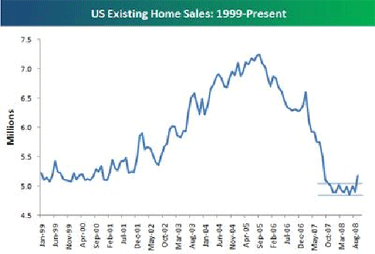
    Residential land has dropped precipitously in value but a case can be made that raw residential land now has a “negative residual value”. There are hundreds of thousands of completed but unsold, foreclosed, and vacant, homes littering the countryside. The chart above demonstrates how dramatically sales have fallen since their peak in 2005. This “overhand” inventory must be cleared out before any recovery can ensue. The prices of these units must be cut by draconian margins to attract the bottom fishers and speculators who will take the risk from the home builders and purchase the outstanding inventory. This will not happen quickly. This is not a market that can generate an early rebound.

    Has Congress learned from its mistakes? Apparently not. In March 2009, Democratic Representatives Green, Wexler and Waters introduced HR600 entitled “Seller Assisted Down Payments” that instructs FHA to accept 100% financing from those who cannot fund the required 3.5% down payment.

    A year from now the landscape of America will be forever changed. Five years from now, will American ingenuity have revolutionized the home building industry? The imperative is to find homebuilders who can speed production and lower costs. And government needs to learn from its own mistakes and realize that a successful housing sector depends on solid market fundamentals as opposed to pursuing an agenda of social engineering.

    ***********************************

    This is the second in a series on The Changing Landscape of America. Future articles will discuss real estate, politics, healthcare and other aspects of our economy and our society. Robert J. Cristiano PhD is a successful real estate developer and the Real Estate Professional in Residence at Chapman University in Orange, CA.
    PART ONE – THE AUTOMOBILE INDUSTRY (May 2009)

  • State of the Economy June 2009

    Nobel Prize-winning economist Paul Krugman was quoted widely for saying that the official recession will end this summer. Before you get overly excited, keep in mind that the recession he’s calling the end of started officially in December 2007. Now ask yourself this: when did you notice that the economy was in recession? Six months after it started? One year? Most people didn’t even realize the financial markets were in crisis until the value of their 401k crashed in September 2008. Count the number of months from December 2007 until you realized the economy was in recession, add that to September 2009 and you’ll have an idea of when you should expect to actually see improvements in the economy.

    Douglas Elmendorf, Director of the Congressional Budget Office (CBO), testified on “The State of the Economy” before the House Committee on the Budget U.S. House of Representatives at the end of May. CBO sees several years before unemployment falls back to around 5 percent, after climbing to about 10 percent later this year. Remember this phrase: Jobless Recovery; it happens every time we have a recession. Employment historically does not increase until 6 to 12 months AFTER GDP starts to improve. Even Krugman admits that unemployment will keep going up for “a long time” after the recession officially ends.

    While some of us are worrying about stagflation – a stagnant economy with rising prices – the CBO report does a good job of describing why deflation is worse than inflation. Deflation would slow the recovery by causing consumers to put off spending in expectation of lower prices in the future. The risk associated with high inflation is primarily that the Federal Reserve would raise interest rates too fast, stalling the economy – similar to what Greenspan did to prolong the recession in the early 1990s. We think the real conundrum is this: how do you deal with an asset bubble without deflating prices? Preventing deflation now simply passes the bubble on to some other asset class at some future time.

    CBO calculates that output in the U.S. is $1 trillion below potential, a shortfall that won’t be corrected until at least 2013. New GDP forecasts are coming in August from CBO. They say the August forecast will likely paint an even gloomier picture than this already gloomy report. Hard to imagine!

    There are plenty of reasons that Krugman and others are seeing encouraging signs in the economy. Social Security recipients received a large cost-of-living adjustment, payroll taxes were lowered so that employees are taking home bigger paychecks, larger tax refunds, lower energy prices – all of these lead to an uptick in consumer spending in the first quarter of 2009. I checked in with Omaha-area Realtor Rod Sadofsky last week. He has seen an improvement in sales in the range of median-priced homes which he attributes to the $8,000 tax credit available to first-time homebuyers (or those who have not owned for at least three years). Along with an up-tick in that segment of the market, those sellers are able to move up to higher priced homes a little further up the range, further improving home sales. However, the tax incentive is scheduled to expire at the end of 2009. When the stimulus winds down…well, there will be no more up-ticks. CBO agrees with Rod and warns of a possible re-slump in 2010 when the effects of the stimulus money begin to wane.

    CBO’s Dr. Elmendorf has a way to solve this problem: to keep up consumer spending, he suggests that people should work more hours and make more money. Duh! We think we hear Harvard calling – they want their PhD back! CBO seems undecided about which came first in the credit markets: problems in supply or problems in demand?

    “Growth in lending has certainly been weak, but a large part of the contraction probably is due to the effect of the recession on the demand for credit, not to the problems experienced by financial institutions.”

    “Indeed, economic recovery may be necessary for the full recovery of the financial system, rather than the other way around.”

    We shouldn’t be so hard on Elmendorf. The report makes it clear just how difficult it has been to figure out 1) what happened 2) why it happened 3) what do we do about it and 4) what happens next. CBO seems to be reaching for answers while to us it is obvious they are missing the point by not even considering that manipulation has wrecked havoc on the markets. Whenever things don’t make sense to someone like the Director of the CBO, experience tells us there’s a rat somewhere.

    Regardless of how overly-complicated financial products may become, the economy really shouldn’t be that hard to figure out. Still, no one seems to know how far down the banks can go – if banks don’t lend to businesses, businesses close, people lose their jobs, unemployed people default on loans, banks have less to lend, and banks can’t lend to businesses…Seems we are damned if we do and damned if we don’t: too much borrowing caused the crisis; too little spending worsens it. Do they want us to keep spending money we don’t have?

    While Krugman is admitting that the world economy will “stay depressed for an extended period” CBO is reporting that “in China, South Korea, and India, manufacturing activity has expanded in recent months.” The other members of the G8, however, aren’t faring any better than we are: GDP is down 10.4 percent in the European Union, 7.4 percent in the UK and 15.2 percent in Japan. Canada – whose banks are doing just fine without a bailout, thank you very much – saw GDP decline by just 3.4 percent in the last quarter of 2008.

    Undaunted by nearly 10 percent unemployment – after predicting it would rise no higher than 8 percent – President Obama announced today that the White House opened a website for Americans to submit their photos and stories about how the stimulus spending is helping them. If they can’t manage the economy, they can still try to manage our expectations about the economy.

    Susanne Trimbath, Ph.D. is CEO and Chief Economist of STP Advisory Services. Her training in finance and economics began with editing briefing documents for the Economic Research Department of the Federal Reserve Bank of San Francisco. She worked in operations at depository trust and clearing corporations in San Francisco and New York, including Depository Trust Company, a subsidiary of DTCC; formerly, she was a Senior Research Economist studying capital markets at the Milken Institute. Her PhD in economics is from New York University. In addition to teaching economics and finance at New York University and University of Southern California (Marshall School of Business), Trimbath is co-author of Beyond Junk Bonds: Expanding High Yield Markets.

  • Britain’s Labour Lessons For Obama

    LONDON – The thrashing of Britain’s New Labour Party – which came in a weak third in local and European Parliament elections this week – may seem a minor event compared to Barack Obama’s triumphal overseas tour. Yet in many ways the humiliation of New Labour should send some potential warning shots across the bow of the good ship Obama.

    Labour’s defeat, of course, stemmed in part from local conditions, notably a cascading Parliamentary expense scandal that appears most damaging to the party in power. Yet beyond those sordid details lies a more grave tale – of the possible decline of the phenomenon I describe as gentry liberalism.

    Gentry liberalism – which reached its height in Britain earlier this decade and is currently peaking in the U.S. – melded traditional left-of-center constituencies, such as organized labor and ethnic minorities, with an expanding class of upper-class professionals from field like media, finance and technology.

    Under the telegenic Tony Blair, an Obama before his time, this coalition extended well into the middle-class suburbs. It made for an unbeatable electoral juggernaut.

    But today, this broad coalition lies in ruins. An urban expert at the London School of Economics, Tony Travers, suggests that New Labour’s biggest loss is due to the erosion of middle-class suburban support. The party also appears to be shedding significant parts of its historic working-class base, particularly those constituents who aren’t members of the public employee unions.

    Even some longstanding ethnic minorities, most notably the highly entrepreneurial South Asians, also show signs of drifting away from Labour. The only Labour supporters left, then, are the liberal gentry, the government apparatus and the most aggrieved minorities.

    This process started before the Parliamentary scandals, Travers adds. Last year a Conservative, Boris Johnson, was able to unseat the sitting Labour-ite mayor of London, Ken Livingstone, largely due to votes from the outer boroughs of the city.

    The shift reveals the weakening hold of gentry liberalism. At its core, gentry liberalism depends on massive profits in key sectors – largely finance and real estate – to maintain its affluence while servicing both its environmentally friendly priorities and redistributing wealth to the long-term poor.

    This has also allowed for a massive expansion of both the scope and size of government. Today government-funded projects account for close to half of Britain’s gross domestic product (GDP), and this share is heading toward its highest level since the late 1940s. In some depressed parts of country, like in the north of England, it stands at over 60%.

    As long as the City of London was minting money – much of it recycled from abroad – the government could afford to pay its bills. But with the economy in a deep recession, Labour can no longer count on the same sources to finance expanding government.

    Although the liberal gentry are not much affected by diminished job opportunities, higher taxes or reduced services, those problems do afflict the tax-paying working and lower middle classes who dominate suburban areas. “We are not [just] dealing with upward mobility,” notes Shamit Saggar, a University of Sussex social scientist with close ties to the Labour Party, “but also the prospect of downward mobility.”

    Both in Britain and America, these middle-income suburban voters remain by far the largest electoral bloc. Last year they divided their votes about evenly between Obama and John McCain, which helped the Democrats, along with the huge supermajorities Obama racked up in the urban core, forge an easy victory.

    In Britain, however, now these suburban as well as small-town voters are tilting to the right, notes Sarah Castells of the Ipsos-Mori survey organization. This is in large part because they no longer believe the Labour Party supports their aspirations. “This is where we see a shift to the Tories,” Castells explains.

    The now-diminished Labour base of public employees, minorities and these gentry liberals is not a sustainable electoral coalition. In total, Labour can’t count for more than one-quarter of the electorate.

    Although vastly different in their class status, these groups share a common interest in an ever-more-expansive state. For public sector workers and the welfare-dependent poor, there is the reasonable motive of self-interest. In contrast, the liberal gentry’s enthusiasm for expanded government stems increasingly from their embrace of environmental regulation, which has become something of a religion among this set.

    You have to wonder what average Brits must make of the likes of Jonathon Porritt, the head of the government’s Sustainable Development Commission – a member of the gentry in both attitude and lineage. The Eton-educated Porritt’s recent pronouncements include such gems as a call to restrict the number of children per family to two to reduce Britain’s population from 60 to 30 million. He also has scolded overweight people for causing climate change.

    These do not seem like sure electoral winners. Today extreme green policies that were once merely odd or eccentric are becoming increasingly oppressive, leading to even more actions that disadvantage suburban lifestyles. Environmental activists’ solution for the country’s severe housing shortage – particularly in the London region – is to cram the working and middle classes into dense urban units resembling sardine cans and force even more suburbanites off the road.

    Even so, large-scale house production over the past decade has lagged behind demand and, as a result, the tidy single-family home with a nice back garden so beloved by the British public may soon be attainable only by the highly affluent – and, ironically, that includes much of the gentry. What an odd posture for a party supposedly built around working-class aspirations.

    “New Labour has brought in ‘New Urbanism,’ and the results are not pretty,” suggests University of Westminster social historian Mark Clapson, as he showed me some particularly tiny, surprisingly expensive new houses outside of London.

    This kind of approach has gained some proponents among the Obama crowd. Recent administration pronouncements endorse such things as “coercing” Americans from their cars, fighting suburban “sprawl” and even imposing restrictions on how much they can drive. It makes you wonder what future they have in mind for our recently bailed-out auto companies.

    It’s possible that America’s middle-income voters will eventually be turned off by such policies, as is the case in Britain. President Obama’s remarkable genius for political theater may insulate him now, but it won’t for eternity. Over time, some of the Democrats’ hard-won, suburban middle-class support could erode.

    The key here may be the quality of the opposition. In Britain, the Conservatives may have found at least an adequate leader in David Cameron. People see him as a viable prime minister. Right now, the Republicans have no such figure, allowing themselves to be led by gargoyles like Rush Limbaugh and Newt Gingrich.

    Yet the president cannot count on Republicans’ continued ineptitude. There’s only so much tolerance in the U.S. – both for cascading public debt and ever-expanding government regulation.

    Of course, Obama still has time to get it right. But if he remains the prisoner of the gentry, he and his party could experience some of the pain now being inflicted upon their ideological counterparts across the pond.

    This article originally appeared at Forbes.

    Joel Kotkin is executive editor of NewGeography.com and is a presidential fellow in urban futures at Chapman University. He is author of The City: A Global History. His next book, The Next Hundred Million: America in 2050, will be published by Penguin early next year.

  • Balancing the California Budget

    The battle to find ways to close California’s gaping $24 billion budget shortfall continues, with Governor Schwarzenegger calling for deep cuts and reorganization throughout state government. Last week, making a “rare speech to a joint session of the Legislature,” Gov. Schwarzenegger argued that the state has “run out of time,” and faces a situation where “Our wallet is empty, our bank is closed, and our credit is dried up”.

    The challenges facing California’s policy makers in balancing the budget can be examined by checking out the Los Angeles Times’ “Interactive California Budget Balancer”. While the state has many different options available to it, making cuts to potentially popular programs will only serve to irritate interest groups which argue for the efficacy and essential nature of their favored programs. Couple this reluctance to make cuts with popular resistance to tax increases, recently seen when voters rejected a set of measures on May 19, and one can better understand the true magnitude of the budget impasse facing the state.

  • A New Auto Industry Model: Not Too Big to Fail

    “A new business model” is what Jack Nerad of Kelly Blue Book called the proposed sale of Saturn by General Motors (GM) to Roger Penske’s Penske Automotive Group.

    What makes it a new model is that Penske would only buy the brand and the dealer network. Penske would subcontract vehicle production other manufacturers, though for the first two years, the GM Saturn plant would produce the cars. Doubtless, Penske will buy vehicles from assembly plants able to provide the best quality for the dollar, establishing competition at the factory rather than corporate level. This radical departure solves the fundamental problem leading to the near-death of the American automobile industry.

    Following World War II, America had little competition. Industrial powers such as in Europe and Japan were flat on their backs and American manufacturers had a “clear field.” American labor and management bid up the price of heavy manufactured goods so much that they became less competitive when war torn economies recovered.

    Americans paid over and over again in their automotive purchases. They paid first through reliability difficulties that were the inevitable result of attempting to compete on price with foreign firms with costs that were competitive in world markets. Finally, they paid with more than $60 billion in loans to General Motors, GMAC and Chrysler. Canadians also paid twice, most recently in more than $13 billion in loans that make their per capita contribution substantially higher than that of Americans. It is not at all clear that North American taxpayers will ever see these amounts repaid (American taxpayers are still waiting for the first penny of repayment from Amtrak on loans made more than 25 years ago).

    The recent loans were the result of a political consensus that GM and Chrysler were “too big to fail.” In an industry characterized by the Penske-Saturn model, the too-big-to-fail problem would be removed.